
 Tiếng Việt

Bismarck
1. Lead / Mở đầu
Bismarck was a German battleship of the Second World War, the lead ship of her class and the largest warship then in commission in the German Navy, the Kriegsmarine. Built by Blohm & Voss at Hamburg, she was laid down in 1936, launched in February 1939, and commissioned on 24 August 1940. At full load she displaced 50,300 tonnes, and her main battery of eight 38 cm (15 in) guns was supported by a heavy secondary and anti-aircraft armament. Bismarck’s operational career lasted nine days. In May 1941, on her first mission, Operation Rheinübung, she sank the British battlecruiser HMS Hood in the Denmark Strait on 24 May 1941, with the loss of 1,415 of Hood‘s crew. Three days later, after a torpedo hit from a Swordfish aircraft had jammed her rudder, she was engaged by the British battleships King George V and Rodney and sank in the North Atlantic on 27 May 1941. Of the 2,221 men aboard, 2,106 were killed and 115 survived. Her wreck was located in 1989.
Bismarck là thiết giáp hạm Đức trong Thế chiến II, tàu đầu tiên của lớp tàu mang tên nó và là tàu chiến lớn nhất lúc bấy giờ đang phục vụ trong Hải quân Đức, Kriegsmarine. Được đóng bởi Blohm & Voss tại Hamburg, tàu được đặt ky năm 1936, hạ thủy tháng 2 năm 1939 và nhập biên chế ngày 24 tháng 8 năm 1940. Khi đầy tải, tàu có lượng giãn nước 50.300 tấn, và dàn pháo chính gồm tám khẩu 38 cm (15 inch) được hỗ trợ bởi hỏa lực phụ và phòng không hạng nặng. Sự nghiệp tác chiến của Bismarck kéo dài chín ngày. Tháng 5 năm 1941, trong nhiệm vụ đầu tiên, Chiến dịch Rheinübung, tàu đánh chìm tàu tuần dương chiến đấu HMS Hood của Anh tại eo biển Đan Mạch ngày 24 tháng 5 năm 1941, khiến 1.415 người trong thủy thủ đoàn của Hood thiệt mạng. Ba ngày sau, sau khi một quả ngư lôi từ máy bay Swordfish làm kẹt bánh lái, tàu bị các thiết giáp hạm King George V và Rodney của Anh giao chiến và chìm xuống Bắc Đại Tây Dương ngày 27 tháng 5 năm 1941. Trong số 2.221 người trên tàu, 2.106 người thiệt mạng và 115 người sống sót. Xác tàu được xác định vị trí năm 1989.
2. Key Facts / Thông tin chính
| Type | Bismarck-class battleship |
| Origin | Germany |
| Builder | Blohm & Voss, Hamburg |
| Laid down | 1 July 1936 |
| Launched | 14 February 1939 |
| Commissioned | 24 August 1940 |
| Fate | Sunk in action, North Atlantic, 27 May 1941 |
| Displacement | 41,700 t standard; 50,300 t full load |
| Length | 251 m (823 ft 6 in) overall; 241.6 m waterline |
| Beam | 36 m (118 ft 1 in) |
| Draft | 9.3 m standard; 9.9 m maximum |
| Propulsion | 12 Wagner superheated boilers; 3 Blohm & Voss geared turbines; 148,116 shp (150,170 shp on trials); 3 shafts |
| Speed | 30.01 knots on trials |
| Range | 8,870 nautical miles at 19 knots |
| Crew | 2,092 officers and men (2,221 aboard on her final voyage) |
| Main armament | 8 × 38 cm (15 in) SK C/34 in four twin turrets |
| Secondary armament | 12 × 15 cm (5.9 in) SK C/28 in six twin turrets |
| Anti-aircraft armament | 16 × 10.5 cm SK C/33; 16 × 3.7 cm SK C/30; 12 × 2 cm FlaK 30 (later 20 × 2 cm) |
| Armour | Belt 320 mm; main turrets 360 mm; main deck 100–120 mm; conning tower 360 mm |
| Aircraft | 4 × Arado Ar 196 floatplanes, 1 double-ended catapult |
3. Background and Development / Bối cảnh và phát triển
Bismarck was named after Otto von Bismarck, the chancellor who had unified Germany in the nineteenth century, and she was the product of Germany’s return to battleship construction after the restrictions of the First World War. The Treaty of Versailles had limited the German Navy to six old battleships of no more than 10,000 tons, and Germany built no new battleship until the 1930s. The Anglo-German Naval Agreement of 1935 allowed Germany to build up to 35 percent of British naval tonnage, and within that framework Germany laid down two battleships of a new class: Bismarck and her sister Tirpitz. Officially, the ships were declared to displace 35,000 tons, the limit set by the Washington Naval Treaty system, but in reality they displaced more than 41,000 tons at standard load and more than 50,000 tons at full load — about 50 percent more than the declared figure.
The design reflected the German Navy’s experience and its strategic position. Germany expected to fight at relatively short ranges in the North Sea and the Atlantic, and the design emphasised protection and a high rate of fire over long-range gunnery. The main battery of eight 38 cm guns was smaller in calibre than the 40.6 cm guns of the newest British and American battleships, but the guns could fire faster — about two rounds per minute per gun — and the ship’s armour was distributed to protect against shells fired at medium ranges. The ship’s wide beam of 36 metres, unusual for a battleship, gave her a shallow draft and a stable gun platform, and her three-shaft propulsion system, with twelve high-pressure Wagner boilers, was designed for reliability on long Atlantic operations.
Bismarck was also built for a role that the German Navy called commerce raiding: breaking out into the Atlantic and attacking the merchant shipping on which Britain depended. The German surface fleet was small — it could not challenge the Royal Navy in a fleet action — and its strategy was to use fast, heavily armed ships to threaten the Atlantic convoy routes and force the British to disperse their forces. Bismarck, with her speed of 30 knots, her heavy armament, and her long range, was the most powerful ship built for that role. Her sister Tirpitz, completed in February 1941, was the only other ship of the class, and she spent most of the war in Norwegian waters, where she tied down British naval forces without ever engaging in a major surface battle.
Bismarck được đặt tên theo Otto von Bismarck, thủ tướng đã thống nhất nước Đức trong thế kỷ XIX, và là sản phẩm của việc Đức trở lại đóng thiết giáp hạm sau các hạn chế của Thế chiến I. Hiệp ước Versailles giới hạn Hải quân Đức ở sáu thiết giáp hạm cũ không quá 10.000 tấn, và Đức không đóng thiết giáp hạm mới nào cho đến thập niên 1930. Hiệp định Hải quân Anh–Đức năm 1935 cho phép Đức đóng tới 35% trọng tải hải quân của Anh, và trong khuôn khổ đó Đức đặt ky hai thiết giáp hạm thuộc một lớp mới: Bismarck và tàu chị em Tirpitz. Về mặt chính thức, các tàu được khai báo có lượng giãn nước 35.000 tấn, giới hạn đặt ra bởi hệ thống Hiệp ước Hải quân Washington, nhưng thực tế chúng có lượng giãn nước hơn 41.000 tấn khi tải tiêu chuẩn và hơn 50.000 tấn khi đầy tải — khoảng 50% nhiều hơn con số khai báo.
Thiết kế phản ánh kinh nghiệm và vị thế chiến lược của Hải quân Đức. Đức dự tính chiến đấu ở cự ly tương đối ngắn tại Biển Bắc và Đại Tây Dương, và thiết kế nhấn mạnh khả năng bảo vệ và tốc độ bắn cao hơn là pháo tầm xa. Dàn pháo chính gồm tám khẩu 38 cm nhỏ hơn về cỡ nòng so với pháo 40,6 cm của thiết giáp hạm Anh và Mỹ mới nhất, nhưng các khẩu pháo có thể bắn nhanh hơn — khoảng hai phát mỗi phút mỗi khẩu — và giáp của tàu được phân bố để chống đạn bắn ở cự ly trung bình. Chiều rộng 36 mét của tàu, bất thường đối với một thiết giáp hạm, cho tàu mớn nước nông và bệ pháo ổn định, và hệ thống đẩy ba trục, với mười hai nồi hơi cao áp Wagner, được thiết kế để tin cậy trong các hoạt động dài ngày trên Đại Tây Dương.
Bismarck cũng được đóng cho một vai trò mà Hải quân Đức gọi là đánh phá giao thương: đột phá ra Đại Tây Dương và tấn công tàu buôn mà Anh phụ thuộc vào. Hạm đội mặt nước của Đức nhỏ — không thể thách thức Hải quân Hoàng gia Anh trong một trận đánh hạm đội — và chiến lược của họ là dùng các tàu nhanh, hỏa lực mạnh để đe dọa các tuyến vận tải Đại Tây Dương và buộc Anh phải phân tán lực lượng. Bismarck, với tốc độ 30 hải lý/giờ, hỏa lực nặng và tầm hoạt động xa, là tàu mạnh nhất được đóng cho vai trò đó. Tàu chị em Tirpitz, hoàn thành tháng 2 năm 1941, là tàu còn lại duy nhất của lớp này, và dành phần lớn thời gian chiến tranh ở vùng biển Na Uy, nơi nó kìm chân lực lượng hải quân Anh mà không bao giờ tham gia trận đánh mặt nước lớn nào.
The decision to build the class was taken in 1934, and the design was prepared by the German naval construction office under the direction of Hermann Burckhardt. The designers worked within the limits of the Anglo-German Naval Agreement, which the German government regarded as a temporary arrangement, and they accepted a design that was larger than the declared tonnage. The deception was maintained through the launch ceremony of 14 February 1939, which was attended by Adolf Hitler and at which the ship was named by Dorothea von Loewenfeld, the granddaughter of Otto von Bismarck. The British Admiralty, which monitored German construction through intelligence and through press reports, estimated the ships at about 35,000 tons until after the war, when the captured records showed the true figures. The design also reflected a debate inside the German Navy between officers who favoured commerce raiding by surface ships and those, including Admiral Karl Dönitz, who argued that the same resources would be better spent on U-boats. The surface-ship programme went ahead, but the argument was never settled, and after Bismarck’s loss the German naval staff shifted its emphasis decisively towards the U-boat war.
Quyết định đóng lớp tàu này được đưa ra năm 1934, và thiết kế do văn phòng đóng tàu hải quân Đức chuẩn bị dưới sự chỉ đạo của Hermann Burckhardt. Các nhà thiết kế làm việc trong giới hạn của Hiệp định Hải quân Anh–Đức, mà chính phủ Đức coi là thỏa thuận tạm thời, và họ chấp nhận một thiết kế lớn hơn trọng tải khai báo. Sự che giấu được duy trì qua lễ hạ thủy ngày 14 tháng 2 năm 1939, có sự tham dự của Adolf Hitler và tại đó tàu được đặt tên bởi Dorothea von Loewenfeld, cháu gái của Otto von Bismarck. Bộ Hải quân Anh, vốn theo dõi việc đóng tàu của Đức qua tình báo và báo chí, ước tính các tàu khoảng 35.000 tấn cho đến sau chiến tranh, khi hồ sơ thu được cho thấy con số thật. Thiết kế cũng phản ánh cuộc tranh luận trong Hải quân Đức giữa các sĩ quan ủng hộ đánh phá giao thương bằng tàu mặt nước và những người, gồm Đô đốc Karl Dönitz, cho rằng cùng nguồn lực đó nên dành cho tàu ngầm U-boat thì tốt hơn. Chương trình tàu mặt nước vẫn tiến hành, nhưng tranh luận không bao giờ ngã ngũ, và sau khi Bismarck mất, bộ tham mưu hải quân Đức chuyển trọng tâm dứt khoát sang chiến tranh tàu ngầm.
4. Design / Thiết kế
Bismarck’s main battery consisted of eight 38 cm (15 in) SK C/34 guns, mounted in four twin turrets named — from forward to aft — Anton, Bruno, Caesar, and Dora. Each gun fired an 800 kg (1,760 lb) armour-piercing shell to a maximum range of about 36.5 km (22.7 miles), and the guns could fire about two rounds per minute. The turrets were protected by armour up to 360 mm thick, and the guns were directed by a fire-control system based on large stereoscopic rangefinders mounted in the foretop and in the turrets, with analogue computers below decks. The secondary battery of twelve 15 cm guns, in six twin turrets, was intended for use against destroyers and other light surface ships, and the anti-aircraft battery — sixteen 10.5 cm guns, sixteen 3.7 cm guns, and twenty 2 cm guns by May 1941 — was intended to defend the ship against air attack. The separation of the secondary and anti-aircraft batteries into two different calibres was a weakness: the 15 cm guns could not be used against aircraft, and the 10.5 cm guns were less effective against surface targets, so the ship carried more guns and more weight than a design with dual-purpose secondary guns would have required.
Protection was arranged on the “all or nothing” principle as the Germans understood it, with heavy armour over the magazines, machinery, and command positions, and lighter armour elsewhere. The main belt was 320 mm (12.6 in) thick, the armoured deck was 100–120 mm thick, and the conning tower was protected by 360 mm of armour. The underwater protection included a torpedo bulkhead and a system of compartments designed to limit flooding, but the ship’s steering gear was a known vulnerability: the rudders were housed in a single compartment, and damage to the steering gear could not be repaired at sea. That vulnerability would decide the ship’s fate in May 1941.
Below decks, twelve Wagner boilers supplied steam to three Blohm & Voss geared turbines, producing 148,116 shaft horsepower on trials — 150,170 shp in the trials configuration — and driving three propellers for a speed of 30.01 knots. The three-shaft arrangement was unusual: most battleships of the period used four shafts, and the German choice was made to save weight and to simplify the machinery. The ship carried four Arado Ar 196 floatplanes, launched from a double-ended catapult, for reconnaissance and gunnery spotting. Her crew numbered 2,092 officers and men, and she carried enough fuel and stores to operate in the Atlantic for weeks without replenishment.
Dàn pháo chính của Bismarck gồm tám khẩu 38 cm (15 inch) SK C/34, lắp trong bốn tháp pháo nòng đôi được đặt tên — từ trước ra sau — Anton, Bruno, Caesar và Dora. Mỗi khẩu bắn đạn xuyên giáp nặng 800 kg (1.760 pound) tới tầm tối đa khoảng 36,5 km (22,7 dặm), và các khẩu pháo có thể bắn khoảng hai phát mỗi phút. Các tháp pháo được bảo vệ bởi giáp dày tới 360 mm, và pháo được điều khiển bằng hệ thống kiểm soát hỏa lực dựa trên các máy đo xa lập thể lớn lắp trên đài quan sát phía trước và trong các tháp pháo, với máy tính cơ học dưới boong. Dàn pháo phụ gồm mười hai khẩu 15 cm, trong sáu tháp pháo nòng đôi, dùng để chống tàu khu trục và các tàu mặt nước hạng nhẹ khác, và dàn pháo phòng không — mười sáu khẩu 10,5 cm, mười sáu khẩu 3,7 cm, và hai mươi khẩu 2 cm tính đến tháng 5 năm 1941 — dùng để bảo vệ tàu trước không kích. Việc tách pháo phụ và pháo phòng không thành hai cỡ nòng khác nhau là một điểm yếu: pháo 15 cm không thể dùng chống máy bay, và pháo 10,5 cm kém hiệu quả hơn trước mục tiêu mặt nước, vì vậy tàu mang nhiều pháo và trọng lượng hơn so với thiết kế dùng pháo phụ đa năng.
Khả năng bảo vệ được bố trí theo nguyên tắc “hoặc tất cả hoặc không có gì” như người Đức hiểu, với giáp nặng trên hầm đạn, máy móc và vị trí chỉ huy, và giáp nhẹ hơn ở nơi khác. Đai giáp chính dày 320 mm (12,6 inch), sàn giáp dày 100–120 mm, và tháp chỉ huy được bảo vệ bởi giáp 360 mm. Hệ thống bảo vệ dưới nước gồm vách ngăn chống ngư lôi và hệ thống khoang thiết kế để hạn chế ngập nước, nhưng hệ thống lái của tàu là điểm yếu đã biết: các bánh lái đặt trong một khoang duy nhất, và hư hỏng hệ thống lái không thể sửa chữa trên biển. Điểm yếu đó sẽ quyết định số phận của tàu tháng 5 năm 1941.
Dưới boong, mười hai nồi hơi Wagner cung cấp hơi cho ba tua-bin hộp số Blohm & Voss, tạo ra 148.116 mã lực trục trong thử nghiệm — 150.170 mã lực trục ở cấu hình thử nghiệm — và dẫn động ba chân vịt cho tốc độ 30,01 hải lý/giờ. Cách bố trí ba trục là bất thường: hầu hết thiết giáp hạm thời kỳ đó dùng bốn trục, và lựa chọn của Đức nhằm tiết kiệm trọng lượng và đơn giản hóa máy móc. Tàu mang bốn thủy phi cơ Arado Ar 196, phóng từ máy phóng hai đầu, dùng cho trinh sát và hiệu chỉnh hỏa lực. Thủy thủ đoàn gồm 2.092 sĩ quan và binh sĩ, và tàu mang đủ nhiên liệu và nhu yếu phẩm để hoạt động ở Đại Tây Dương trong nhiều tuần mà không cần tiếp tế.
Bismarck’s fire control was among the most capable of its period. The main battery was directed from the foretop and the after command position, using stereoscopic rangefinders of 10.5 metres base length, and the firing solutions were computed by analogue computers that took account of the ship’s own course and speed, the target’s course and speed, wind, and the earth’s rotation. The system allowed Bismarck to open fire accurately at long range, and her shooting in the Denmark Strait — five salvos to a hit on Hood — was accurate by the standards of the time. The ship was also fitted with FuMO 23 radar sets for surface search, but the radar was used mainly for navigation and for detecting other ships at night or in poor visibility, and it was not integrated into the main fire-control system in the way that American radar was by 1943. The Arado Ar 196 floatplanes were intended to extend the ship’s reconnaissance range and to spot the fall of shot, but they were not used in combat during Operation Rheinübung, and they were destroyed with the ship.
Hệ thống kiểm soát hỏa lực của Bismarck thuộc hàng tốt nhất thời kỳ đó. Dàn pháo chính được điều khiển từ đài quan sát phía trước và vị trí chỉ huy phía sau, dùng máy đo xa lập thể có chiều dài cơ sở 10,5 mét, và các nghiệm bắn được tính bằng máy tính cơ học có tính đến hướng đi và tốc độ của tàu, hướng đi và tốc độ của mục tiêu, gió, và sự tự quay của Trái Đất. Hệ thống cho phép Bismarck khai hỏa chính xác ở tầm xa, và khả năng bắn của tàu tại eo biển Đan Mạch — năm loạt đạn để trúng Hood — là chính xác theo tiêu chuẩn thời đó. Tàu cũng được lắp các bộ radar FuMO 23 để tìm kiếm mặt nước, nhưng radar chủ yếu dùng cho dẫn đường và phát hiện tàu khác vào ban đêm hoặc khi tầm nhìn kém, và không được tích hợp vào hệ thống kiểm soát hỏa lực chính theo cách mà radar Mỹ đã làm từ năm 1943. Các thủy phi cơ Arado Ar 196 dự tính mở rộng tầm trinh sát của tàu và quan sát điểm rơi của đạn, nhưng chúng không được dùng trong chiến đấu trong Chiến dịch Rheinübung, và bị phá hủy cùng con tàu.
5. Variants / Các biến thể
| Ship | Fate |
|---|---|
| Bismarck | Lead ship; commissioned August 1940; sunk in action, North Atlantic, 27 May 1941 |
| Tirpitz | Sister ship; commissioned February 1941; spent the war in Norwegian waters; sunk by RAF Lancaster bombers at Tromsø, 12 November 1944 |
Only two ships of the Bismarck class were built. They were sister ships in the full sense, built to the same design, with the same armament and armour, and they differed mainly in their service histories. Tirpitz received additional anti-aircraft guns during the war, and her light anti-aircraft armament was increased in response to the air attacks she faced in Norway. Bismarck received two quadruple 2 cm mounts in April 1941, shortly before her final voyage, bringing her light anti-aircraft armament to twenty 2 cm barrels. No other ships of the class were laid down, and the German Navy’s later construction programme was concentrated on U-boats, which the German naval staff regarded as the more effective weapon against British shipping.
Chỉ hai tàu thuộc lớp Bismarck được đóng. Chúng là tàu chị em theo đúng nghĩa, đóng theo cùng thiết kế, cùng hỏa lực và giáp, và chỉ khác nhau chủ yếu ở lịch sử phục vụ. Tirpitz được bổ sung pháo phòng không trong chiến tranh, và vũ khí phòng không hạng nhẹ của tàu được tăng cường để đối phó các đợt không kích mà tàu phải đối mặt ở Na Uy. Bismarck nhận thêm hai bệ pháo 2 cm bốn nòng tháng 4 năm 1941, ngay trước chuyến đi cuối cùng, nâng vũ khí phòng không hạng nhẹ lên hai mươi nòng 2 cm. Không tàu nào khác của lớp này được đặt ky, và chương trình đóng tàu sau đó của Hải quân Đức tập trung vào tàu ngầm U-boat, loại vũ khí mà bộ tham mưu hải quân Đức coi là hiệu quả hơn trong việc chống lại tàu buôn Anh.
Tirpitz had a longer but less active career than her sister. Commissioned in February 1941, she was based in Norwegian waters from 1942, where her presence forced the Royal Navy to keep a strong force in home waters and to provide heavy escorts for the Arctic convoys to the Soviet Union. She was damaged by British midget submarines in September 1943, in Operation Source, and was repeatedly attacked by carrier aircraft and by RAF bombers in 1944. On 12 November 1944, Lancaster bombers of the Royal Air Force attacked her at Tromsø with Tallboy bombs, and she capsized and sank, with the loss of more than 950 men. The two ships of the class thus had opposite careers: Bismarck fought one battle and was sunk within days, while Tirpitz fought no surface battle and was sunk at anchor after more than three years of service.
Tirpitz có sự nghiệp dài hơn nhưng ít hoạt động hơn tàu chị em. Nhập biên chế tháng 2 năm 1941, tàu đóng tại vùng biển Na Uy từ năm 1942, nơi sự hiện diện của nó buộc Hải quân Hoàng gia Anh phải duy trì lực lượng mạnh ở vùng biển quê nhà và cung cấp hộ tống hạng nặng cho các đoàn tàu vận tải Bắc Cực tới Liên Xô. Tàu bị tàu ngầm nhỏ của Anh làm hư hại tháng 9 năm 1943, trong Chiến dịch Source, và liên tục bị máy bay trên tàu sân bay và oanh tạc cơ RAF tấn công năm 1944. Ngày 12 tháng 11 năm 1944, các oanh tạc cơ Lancaster của Không quân Hoàng gia Anh tấn công tàu tại Tromsø bằng bom Tallboy, và tàu lật úp và chìm, hơn 950 người thiệt mạng. Hai tàu của lớp này vì vậy có sự nghiệp đối lập: Bismarck chiến đấu một trận và bị đánh chìm trong vài ngày, trong khi Tirpitz không chiến đấu trận mặt nước nào và bị đánh chìm khi neo đậu sau hơn ba năm phục vụ.
6. Operational History / Lịch sử hoạt động
Trials and working up / Thử nghiệm và chạy thử
Bismarck was commissioned on 24 August 1940 under the command of Captain Ernst Lindemann, and she spent the autumn of 1940 and the spring of 1941 on trials and working up in the Baltic. The trials revealed a number of defects, including problems with the main battery’s fire control and with the ship’s seakeeping, and the working-up period was extended into the spring of 1941. Admiral Günther Lütjens, who would command the operation, flew his flag in Bismarck, and the ship’s company was brought to full strength. By May 1941, the ship was ready for operations, and the German naval staff ordered her to sea in company with the heavy cruiser Prinz Eugen, on a commerce-raiding mission into the Atlantic designated Operation Rheinübung.
Bismarck nhập biên chế ngày 24 tháng 8 năm 1940 dưới quyền chỉ huy của Đại tá Ernst Lindemann, và dành mùa thu năm 1940 cùng mùa xuân năm 1941 cho thử nghiệm và chạy thử tại biển Baltic. Các cuộc thử nghiệm phát hiện một số khiếm khuyết, gồm vấn đề về kiểm soát hỏa lực của dàn pháo chính và về khả năng đi biển của tàu, và giai đoạn chạy thử kéo dài đến mùa xuân năm 1941. Đô đốc Günther Lütjens, người sẽ chỉ huy chiến dịch, treo cờ hiệu của mình trên Bismarck, và thủy thủ đoàn được bổ sung đủ quân số. Đến tháng 5 năm 1941, tàu đã sẵn sàng tác chiến, và bộ tham mưu hải quân Đức ra lệnh cho tàu ra khơi cùng tàu tuần dương hạng nặng Prinz Eugen, trong một nhiệm vụ đánh phá giao thương vào Đại Tây Dương mang tên Chiến dịch Rheinübung.
The Denmark Strait, 24 May 1941 / Eo biển Đan Mạch, 24 tháng 5 năm 1941
Bismarck and Prinz Eugen sailed from Gotenhafen (now Gdynia, Poland) on 18 May 1941 and were detected by British cruisers in the Denmark Strait, between Greenland and Iceland, on the morning of 23 May. The British Home Fleet dispatched the battlecruiser HMS Hood and the new battleship HMS Prince of Wales to intercept them, and the two forces met at dawn on 24 May 1941. Hood, the largest warship in the Royal Navy and a ship with a long record of service, opened fire first, but her fire was directed at Prinz Eugen, which the British had mistaken for Bismarck. Bismarck’s fifth salvo struck Hood at about 06:00, and the battlecruiser exploded and sank within minutes. Of Hood‘s crew of 1,418, only three men survived: Ordinary Signalman Ted Briggs, Able Seaman Robert Tilburn, and Midshipman William Dundas. Prince of Wales, herself newly commissioned and still working up, was hit several times and withdrew, but not before her guns had struck Bismarck three times. One of those hits damaged a fuel tank and caused a leak that reduced Bismarck’s speed and left a trail of oil on the surface, and another flooded a boiler room. Lütjens, whose orders were to avoid a fleet action and to break out into the Atlantic to attack merchant shipping, detached Prinz Eugen to continue the mission alone and turned Bismarck towards the French port of Saint-Nazaire for repairs.
Bismarck và Prinz Eugen rời Gotenhafen (nay là Gdynia, Ba Lan) ngày 18 tháng 5 năm 1941 và bị các tàu tuần dương Anh phát hiện tại eo biển Đan Mạch, giữa Greenland và Iceland, sáng ngày 23 tháng 5. Hạm đội Home của Anh cử tàu tuần dương chiến đấu HMS Hood và thiết giáp hạm mới HMS Prince of Wales đi chặn đánh, và hai lực lượng gặp nhau lúc rạng đông ngày 24 tháng 5 năm 1941. Hood, tàu chiến lớn nhất trong Hải quân Hoàng gia Anh và là tàu có lịch sử phục vụ lâu dài, khai hỏa trước, nhưng hỏa lực của tàu nhắm vào Prinz Eugen, mà phía Anh nhầm là Bismarck. Loạt đạn thứ năm của Bismarck trúng Hood khoảng 06 giờ 00, và tàu tuần dương chiến đấu nổ tung và chìm trong vài phút. Trong thủy thủ đoàn 1.418 người của Hood, chỉ ba người sống sót: tín hiệu viên Ted Briggs, thủy thủ Robert Tilburn và học viên sĩ quan William Dundas. Prince of Wales, bản thân mới nhập biên chế và vẫn đang chạy thử, trúng đạn nhiều lần và rút lui, nhưng trước đó pháo của tàu đã trúng Bismarck ba lần. Một trong những phát trúng đó làm hỏng thùng nhiên liệu và gây rò rỉ, làm giảm tốc độ của Bismarck và để lại vệt dầu trên mặt biển, và một phát khác làm ngập một phòng nồi hơi. Lütjens, người nhận lệnh tránh giao chiến hạm đội và đột phá ra Đại Tây Dương để tấn công tàu buôn, tách Prinz Eugen ra để tiếp tục nhiệm vụ một mình và cho Bismarck quay về cảng Saint-Nazaire của Pháp để sửa chữa.
Prinz Eugen went on to a longer career than the battleship she sailed with. After parting from Bismarck, she continued into the Atlantic, but engine trouble forced her to put into Brest, where she remained until February 1942, when she took part in the Channel Dash — the passage of the German capital ships through the English Channel to Germany — with the battlecruisers Scharnhorst and Gneisenau. She survived the war, was surrendered to the United States in 1945, and was used as a target ship in the atomic bomb tests at Bikini Atoll in 1946, after which she capsized and sank at Kwajalein in December 1946. Her survival, in contrast to Bismarck’s nine-day career, illustrates how much of a warship’s fate depended on circumstances that no design could control.
Prinz Eugen tiếp tục sự nghiệp dài hơn thiết giáp hạm mà nó cùng ra khơi. Sau khi tách khỏi Bismarck, nó tiếp tục vào Đại Tây Dương, nhưng trục trặc động cơ buộc nó phải vào Brest, nơi nó ở lại đến tháng 2 năm 1942, khi tham gia cuộc vượt eo biển Manche — hành trình của các tàu chủ lực Đức qua eo biển Manche về Đức — cùng các tàu tuần dương chiến đấu Scharnhorst và Gneisenau. Tàu sống sót qua chiến tranh, đầu hàng Mỹ năm 1945, và được dùng làm tàu mục tiêu trong các vụ thử bom nguyên tử tại đảo san hô Bikini năm 1946, sau đó lật úp và chìm tại Kwajalein tháng 12 năm 1946. Việc tàu sống sót, trái ngược với sự nghiệp chín ngày của Bismarck, cho thấy số phận của một tàu chiến phụ thuộc nhiều vào hoàn cảnh mà không thiết kế nào có thể kiểm soát.
The hunt and the torpedo hit, 24–26 May 1941 / Cuộc truy lùng và cú trúng ngư lôi, 24–26 tháng 5 năm 1941
The sinking of Hood caused a major reaction in Britain, and the Royal Navy committed a large part of the Home Fleet to the pursuit of Bismarck, including the battleships King George V and Rodney, the aircraft carriers Victorious and Ark Royal, and cruisers and destroyers from several commands. On the evening of 24 May, torpedo bombers from Victorious attacked Bismarck and scored one torpedo hit, which caused minor damage. On 25 May, Bismarck shook off her pursuers by turning in a wide circle while the British ships continued on her earlier course, and for a time the British lost contact. The contact was regained on 26 May, when a Catalina flying boat from Coastal Command located the ship, and in the evening of that day Swordfish torpedo bombers from Ark Royal attacked. One torpedo struck the stern and jammed the rudders, leaving Bismarck unable to steer and circling slowly in the Atlantic, about 300 miles west of France. Efforts to free the rudders, including attempts by divers, failed, and the ship’s fate was decided: she could no longer reach port, and the British battleships were closing in.
Vụ đánh chìm Hood gây phản ứng lớn ở Anh, và Hải quân Hoàng gia Anh huy động phần lớn Hạm đội Home để truy lùng Bismarck, gồm các thiết giáp hạm King George V và Rodney, các tàu sân bay Victorious và Ark Royal, cùng tàu tuần dương và khu trục từ nhiều đơn vị. Tối ngày 24 tháng 5, máy bay phóng ngư lôi từ Victorious tấn công Bismarck và trúng một quả ngư lôi, gây hư hại nhỏ. Ngày 25 tháng 5, Bismarck cắt đuôi những tàu truy đuổi bằng cách quay một vòng rộng trong khi các tàu Anh tiếp tục đi theo hướng cũ của nó, và trong một thời gian phía Anh mất liên lạc. Liên lạc được nối lại ngày 26 tháng 5, khi một thủy phi cơ Catalina của Bộ tư lệnh Duyên hải phát hiện con tàu, và tối hôm đó máy bay phóng ngư lôi Swordfish từ Ark Royal tấn công. Một quả ngư lôi trúng đuôi tàu và làm kẹt bánh lái, khiến Bismarck không thể lái và quay vòng chậm chạp trên Đại Tây Dương, cách bờ biển Pháp khoảng 300 dặm về phía tây. Các nỗ lực giải phóng bánh lái, gồm cả việc thợ lặn xuống nước, đều thất bại, và số phận của tàu đã được định đoạt: tàu không còn có thể về cảng, và các thiết giáp hạm Anh đang tiến đến gần.
The final battle and the sinking, 27 May 1941 / Trận đánh cuối cùng và sự chìm tàu, 27 tháng 5 năm 1941
On the morning of 27 May 1941, the British battleships King George V and Rodney, with the cruisers Norfolk and Dorsetshire, engaged Bismarck. The British ships opened fire at about 08:47, and within half an hour Bismarck’s forward turrets had been put out of action and her fire control destroyed. The ship continued to fire with her after turrets, but she was unable to manoeuvre, and the British battleships closed to point-blank range and fired into her superstructure. By about 10:00, Bismarck was a burning wreck, her guns silent, and the British ships withdrew. The cruiser Dorsetshire then fired torpedoes at the wreck, and at about 10:36 Bismarck capsized and sank. Of the 2,221 men aboard, 2,106 were killed and 115 survived: 110 were picked up by the British ships Dorsetshire and Maori and taken prisoner, and five more were rescued by the German submarine U-74 and the weather ship Sachsenwald.
The exact cause of the sinking is a subject on which the accounts differ. German survivors reported that the crew set scuttling charges and opened the sea valves to sink the ship and prevent her from being boarded, and the examination of the wreck in 1989 found no evidence of the underwater damage that a torpedo would have caused to the main belt, which is consistent with the scuttling account. British accounts credit the gunfire of King George V and Rodney and the torpedoes of Dorsetshire with the sinking. Most historians who have studied the question conclude that the battle damage would have caused the ship to sink eventually, whether or not the crew set scuttling charges, and that the scuttling, if it took place, hastened an outcome that was already certain. This article records both accounts and notes that the question is not fully settled.
The British pursuit / Cuộc truy lùng của Anh
The force assembled against Bismarck was one of the largest ever committed to the pursuit of a single ship. The Home Fleet under Admiral John Tovey included the battleships King George V and Rodney, the battlecruiser Renown, the aircraft carriers Victorious and Ark Royal, and the cruisers and destroyers of several escort groups, while Force H from Gibraltar, under Vice Admiral James Somerville, brought Ark Royal and Renown into the operation from the south. The pursuit was complicated by fuel: the British battleships were operating at the limit of their endurance, and King George V and Rodney were both short of fuel when they engaged Bismarck on 27 May. The operation also depended on intelligence: the British had broken the German naval Enigma code in part, and the Admiralty’s Operational Intelligence Centre tracked Bismarck’s movements from intercepted signals, including the long signal Lütjens sent on 25 May reporting the sinking of Hood and the damage to his own ship, which allowed the British to fix the ship’s position. The combination of signals intelligence, air reconnaissance, and the sheer number of ships committed meant that Bismarck, once damaged and unable to steer, had no route to safety.
Lực lượng tập hợp chống lại Bismarck là một trong những lực lượng lớn nhất từng được huy động để truy lùng một con tàu duy nhất. Hạm đội Home dưới quyền Đô đốc John Tovey gồm các thiết giáp hạm King George V và Rodney, tàu tuần dương chiến đấu Renown, các tàu sân bay Victorious và Ark Royal, cùng tàu tuần dương và khu trục của nhiều nhóm hộ tống, trong khi Lực lượng H từ Gibraltar, dưới quyền Phó đô đốc James Somerville, đưa Ark Royal và Renown vào chiến dịch từ phía nam. Cuộc truy lùng phức tạp vì nhiên liệu: các thiết giáp hạm Anh hoạt động ở giới hạn sức chịu đựng, và King George V cùng Rodney đều sắp cạn nhiên liệu khi giao chiến với Bismarck ngày 27 tháng 5. Chiến dịch cũng phụ thuộc vào tình báo: phía Anh đã bẻ khóa một phần mật mã Enigma của hải quân Đức, và Trung tâm Tình báo Tác chiến của Bộ Hải quân theo dõi di chuyển của Bismarck từ các tín hiệu chặn được, gồm bức điện dài mà Lütjens gửi ngày 25 tháng 5 báo cáo việc đánh chìm Hood và hư hại trên tàu mình, giúp phía Anh xác định vị trí con tàu. Sự kết hợp giữa tình báo tín hiệu, trinh sát trên không và số lượng lớn tàu huy động khiến Bismarck, một khi bị hư hại và không thể lái, không còn đường thoát an toàn.
Sáng ngày 27 tháng 5 năm 1941, các thiết giáp hạm King George V và Rodney của Anh, cùng các tàu tuần dương Norfolk và Dorsetshire, giao chiến với Bismarck. Các tàu Anh khai hỏa khoảng 08 giờ 47, và trong vòng nửa giờ, các tháp pháo phía trước của Bismarck đã bị loại khỏi vòng chiến và hệ thống kiểm soát hỏa lực bị phá hủy. Tàu tiếp tục bắn bằng các tháp pháo phía sau, nhưng không thể cơ động, và các thiết giáp hạm Anh tiến đến cự ly gần và bắn vào cấu trúc thượng tầng của tàu. Đến khoảng 10 giờ 00, Bismarck trở thành một xác tàu cháy, pháo im lặng, và các tàu Anh rút lui. Tàu tuần dương Dorsetshire sau đó phóng ngư lôi vào xác tàu, và khoảng 10 giờ 36, Bismarck lật úp và chìm. Trong số 2.221 người trên tàu, 2.106 người thiệt mạng và 115 người sống sót: 110 người được các tàu Dorsetshire và Maori của Anh vớt lên và bắt làm tù binh, và năm người nữa được tàu ngầm Đức U-74 và tàu khí tượng Sachsenwald cứu.
Nguyên nhân chính xác của vụ chìm tàu là vấn đề mà các ghi chép khác nhau. Những người Đức sống sót kể rằng thủy thủ đoàn đã đặt thuốc nổ tự đánh chìm và mở van nước biển để đánh chìm tàu và ngăn tàu bị lên tàu kiểm tra, và việc kiểm tra xác tàu năm 1989 không tìm thấy bằng chứng về hư hại dưới nước mà ngư lôi sẽ gây ra cho đai giáp chính, điều này phù hợp với lời kể về tự đánh chìm. Các ghi chép của Anh ghi công pháo của King George V và Rodney cùng ngư lôi của Dorsetshire đã đánh chìm tàu. Hầu hết các nhà sử học đã nghiên cứu vấn đề này kết luận rằng thiệt hại trong trận đánh sẽ khiến tàu chìm cuối cùng, dù thủy thủ đoàn có đặt thuốc nổ tự đánh chìm hay không, và việc tự đánh chìm, nếu có diễn ra, đã đẩy nhanh một kết cục vốn đã chắc chắn. Bài này ghi lại cả hai lời kể và lưu ý rằng vấn đề chưa được giải quyết hoàn toàn.
7. Performance and Specifications / Hiệu năng và thông số kỹ thuật
| Specification | Bismarck |
|---|---|
| Displacement (standard) | 41,700 t |
| Displacement (full load) | 50,300 t |
| Length (overall) | 251 m (823 ft 6 in) |
| Length (waterline) | 241.6 m (792 ft 8 in) |
| Beam | 36 m (118 ft 1 in) |
| Draft (standard) | 9.3 m (30 ft 6 in) |
| Draft (maximum) | 9.9 m (32 ft 6 in) |
| Installed power | 12 Wagner boilers; 148,116 shp (150,170 shp on trials) |
| Speed | 30.01 knots on trials |
| Range | 8,870 nautical miles at 19 knots |
| Crew | 2,092 (2,221 aboard on final voyage) |
| Main battery | 8 × 38 cm SK C/34, 4 × twin turrets |
| Main gun shell weight | 800 kg (1,760 lb) |
| Main gun maximum range | About 36.5 km (22.7 miles) |
| Secondary battery | 12 × 15 cm SK C/28, 6 × twin turrets |
| Heavy AA | 16 × 10.5 cm SK C/33, 8 × twin mounts |
| Light AA | 16 × 3.7 cm SK C/30; 20 × 2 cm (after April 1941) |
| Belt armour | 320 mm (12.6 in) |
| Deck armour | 100–120 mm (3.9–4.7 in) |
| Main turret armour | 360 mm (14.2 in) |
| Conning tower armour | 360 mm (14.2 in) |
| Aircraft | 4 × Arado Ar 196 floatplanes |
Measured against her contemporaries, Bismarck was a large and heavily armed battleship, but she was not the largest or the most heavily armed of her generation. The British King George V class carried ten 35.6 cm guns, the American North Carolina class carried nine 40.6 cm guns, and the Japanese Yamato class, then under construction, carried nine 46 cm guns. Bismarck’s advantages were her speed — 30 knots, faster than most battleships of the period — and the quality of her fire control and her armour distribution at medium ranges. Her disadvantages were her relatively light main battery for her size, the separation of her secondary and anti-aircraft batteries, and the vulnerability of her steering gear, which was the single point of failure that ended her career. Her performance in the Denmark Strait showed that her gunnery was accurate and her shells effective: Hood was destroyed by a small number of hits, and Prince of Wales was forced to withdraw. Her sinking three days later showed that a battleship without air cover, unable to manoeuvre, could not survive against a fleet that controlled the sea and the air around her.
Xét theo các tàu cùng thời, Bismarck là thiết giáp hạm lớn và hỏa lực mạnh, nhưng không phải lớn nhất hay hỏa lực mạnh nhất trong thế hệ của nó. Lớp King George V của Anh mang mười khẩu pháo 35,6 cm, lớp North Carolina của Mỹ mang chín khẩu pháo 40,6 cm, và lớp Yamato của Nhật, lúc đó đang đóng, mang chín khẩu pháo 46 cm. Ưu thế của Bismarck là tốc độ — 30 hải lý/giờ, nhanh hơn hầu hết thiết giáp hạm thời kỳ đó — và chất lượng kiểm soát hỏa lực cùng cách phân bố giáp ở cự ly trung bình. Nhược điểm của tàu là dàn pháo chính tương đối nhẹ so với kích thước, việc tách pháo phụ và pháo phòng không, và điểm yếu của hệ thống lái, vốn là điểm hỏng duy nhất kết thúc sự nghiệp của tàu. Khả năng của tàu tại eo biển Đan Mạch cho thấy pháo của tàu chính xác và đạn hiệu quả: Hood bị phá hủy bởi một số ít phát trúng, và Prince of Wales buộc phải rút lui. Việc tàu chìm ba ngày sau cho thấy một thiết giáp hạm không có yểm trợ trên không, không thể cơ động, không thể sống sót trước một hạm đội kiểm soát biển và không phận xung quanh nó.
The figures in the table above are the figures most commonly cited in the published literature, but they vary between sources. German records give the standard displacement as 41,700 tonnes and the full-load displacement as 50,300 tonnes, while some British and American sources give slightly different figures — 41,673 tonnes standard and up to 51,700 tonnes full load — because the displacement of a ship changes with the amount of fuel, ammunition, and stores aboard, and because the two sides measured it differently. Readers comparing sources should check whether a figure is given for standard load or for full load, and whether it is given in metric tonnes or in long tons, since the two units differ by about 1.6 percent.
Các con số trong bảng trên là những con số thường được trích dẫn nhất trong tài liệu đã xuất bản, nhưng chúng khác nhau giữa các nguồn. Hồ sơ Đức ghi lượng giãn nước tiêu chuẩn là 41.700 tấn và lượng giãn nước đầy tải là 50.300 tấn, trong khi một số nguồn Anh và Mỹ đưa ra con số hơi khác — 41.673 tấn tiêu chuẩn và tới 51.700 tấn đầy tải — vì lượng giãn nước của tàu thay đổi theo lượng nhiên liệu, đạn dược và nhu yếu phẩm trên tàu, và vì hai bên đo lường khác nhau. Độc giả khi so sánh các nguồn nên kiểm tra xem con số đó tính cho tải tiêu chuẩn hay đầy tải, và tính bằng tấn mét hay tấn Anh, vì hai đơn vị này chênh nhau khoảng 1,6%.
8. Operators / Các nước sử dụng
Bismarck served with only one navy: the German Kriegsmarine. She was commissioned in August 1940 and remained a German warship for the whole of her service life, which lasted less than nine months. No other navy operated a Bismarck-class battleship. Her sister ship Tirpitz also served only with the Kriegsmarine, and she was sunk in November 1944. After the war, the German Navy built no battleships, and the Bismarck class remains the only class of battleships built by Germany after the First World War.
Bismarck chỉ phục vụ trong một hải quân duy nhất: Kriegsmarine của Đức. Tàu nhập biên chế tháng 8 năm 1940 và vẫn là tàu chiến Đức trong toàn bộ thời gian phục vụ, kéo dài chưa đầy chín tháng. Không hải quân nào khác vận hành thiết giáp hạm lớp Bismarck. Tàu chị em Tirpitz cũng chỉ phục vụ trong Kriegsmarine, và bị đánh chìm tháng 11 năm 1944. Sau chiến tranh, Hải quân Đức không đóng thiết giáp hạm nào nữa, và lớp Bismarck vẫn là lớp thiết giáp hạm duy nhất do Đức đóng sau Thế chiến I.
9. Legacy and Influence / Di sản và ảnh hưởng
Bismarck’s legacy is shaped by the brevity of her career and by the scale of the loss she inflicted and suffered. She is remembered first for the sinking of HMS Hood, which was the Royal Navy’s best-known warship and a symbol of British sea power, and whose loss — 1,415 men killed and three survivors — was felt in Britain as a national shock. The sinking demonstrated the destructive power of modern battleship gunnery, and it also demonstrated the vulnerability of a battlecruiser designed before the First World War to plunging fire at long range. The causes of Hood‘s explosion have been studied in detail: the most widely accepted explanation is that a shell from Bismarck penetrated to a magazine, but the exact sequence has not been established with certainty, and the inquiry that followed the sinking did not reach a conclusive finding on the point.
Bismarck is also remembered for the scale of the British response. The pursuit of the ship involved a large part of the Home Fleet, two aircraft carriers, and dozens of other ships and aircraft, and it showed how seriously the Royal Navy regarded the threat of a single fast battleship loose in the Atlantic. The operation also showed the growing importance of naval aviation: it was aircraft — first the Catalina that found the ship, then the Swordfish that jammed her rudder — that decided the outcome, and the battleships that sank Bismarck on 27 May did so only after she had been immobilised from the air. In that respect, Bismarck’s sinking belongs to the same pattern as the sinkings of Prince of Wales and Repulse in December 1941 and of the Japanese battleship Musashi in October 1944: battleships operating without air cover were vulnerable to air attack, and the aircraft carrier was becoming the decisive weapon at sea.
In Germany, Bismarck has remained a prominent subject in naval history and in public memory, and the ship’s name has been used for streets, ships, and memorials. The wreck, found in 1989, is treated as a war grave, and no artefacts have been removed from it. In Britain, the sinking of Hood is commemorated by the HMS Hood Association, which maintains a memorial at the National Memorial Arboretum and supports the families of the men who served in the ship. The two ships are remembered together, as the two sides of a single action that lasted less than ten minutes and cost more than 3,500 lives.
Di sản của Bismarck được định hình bởi sự nghiệp ngắn ngủi của tàu và bởi quy mô tổn thất mà tàu gây ra và phải chịu. Tàu được nhớ đến trước tiên vì vụ đánh chìm HMS Hood, tàu chiến nổi tiếng nhất của Hải quân Hoàng gia Anh và biểu tượng của sức mạnh biển Anh, mà tổn thất của nó — 1.415 người thiệt mạng và ba người sống sót — được cảm nhận ở Anh như một cú sốc quốc gia. Vụ đánh chìm cho thấy sức phá hủy của pháo thiết giáp hạm hiện đại, và cũng cho thấy điểm yếu của một tàu tuần dương chiến đấu thiết kế trước Thế chiến I trước đạn bắn chéo từ xa. Nguyên nhân vụ nổ của Hood đã được nghiên cứu chi tiết: giải thích được chấp nhận rộng rãi nhất là một quả đạn từ Bismarck xuyên tới hầm đạn, nhưng trình tự chính xác chưa được xác lập chắc chắn, và cuộc điều tra sau vụ chìm tàu không đưa ra kết luận dứt khoát về điểm này.
Bismarck cũng được nhớ đến vì quy mô phản ứng của Anh. Cuộc truy lùng con tàu huy động phần lớn Hạm đội Home, hai tàu sân bay, và hàng chục tàu cùng máy bay khác, và cho thấy Hải quân Hoàng gia Anh coi mối đe dọa từ một thiết giáp hạm nhanh hoạt động tự do trên Đại Tây Dương nghiêm trọng đến mức nào. Chiến dịch cũng cho thấy tầm quan trọng ngày càng tăng của không quân hải quân: chính máy bay — đầu tiên là Catalina phát hiện con tàu, rồi Swordfish làm kẹt bánh lái — đã quyết định kết cục, và các thiết giáp hạm đánh chìm Bismarck ngày 27 tháng 5 chỉ làm được điều đó sau khi tàu đã bị vô hiệu hóa từ trên không. Về mặt đó, vụ chìm tàu của Bismarck thuộc cùng một khuôn mẫu như vụ đánh chìm Prince of Wales và Repulse tháng 12 năm 1941 và thiết giáp hạm Musashi của Nhật tháng 10 năm 1944: thiết giáp hạm hoạt động không có yểm trợ trên không dễ bị tổn thương trước không kích, và tàu sân bay đang trở thành vũ khí quyết định trên biển.
Tại Đức, Bismarck vẫn là đề tài nổi bật trong lịch sử hải quân và ký ức công chúng, và tên của tàu đã được dùng cho đường phố, tàu thuyền và đài tưởng niệm. Xác tàu, được tìm thấy năm 1989, được coi là mộ chiến tranh, và không hiện vật nào bị lấy đi khỏi đó. Tại Anh, vụ chìm tàu Hood được tưởng niệm bởi Hiệp hội HMS Hood, đơn vị duy trì đài tưởng niệm tại National Memorial Arboretum và hỗ trợ gia đình những người từng phục vụ trên tàu. Hai tàu được nhớ đến cùng nhau, như hai mặt của một trận đánh kéo dài chưa đầy mười phút và khiến hơn 3.500 người thiệt mạng.
The writing about Bismarck has itself been a subject of study. The first accounts, published in Britain and Germany in the 1950s and 1960s, drew mainly on the official records of the two navies and on the memoirs of the participants, and they differed on the question of the scuttling and on the causes of Hood‘s loss. The discovery of the wreck in 1989 added a new source of evidence: Robert Ballard’s expedition photographed the hull and found that the torpedo bulkhead was intact and that the main belt showed no sign of torpedo penetration, findings that Ballard and his co-author presented as supporting the German survivors’ account. Later examinations, including the 2001 expedition by the documentary film-maker James Cameron, confirmed the condition of the hull and added detail on the damage to the superstructure from gunfire. Historians now generally treat the scuttling question as unresolved in its details but not in its outcome: the ship was already a wreck when the torpedoes were fired, and she would have sunk from the damage she had received.
Các tác phẩm viết về Bismarck tự chúng cũng là đối tượng nghiên cứu. Những ghi chép đầu tiên, xuất bản ở Anh và Đức trong thập niên 1950 và 1960, chủ yếu dựa trên hồ sơ chính thức của hai hải quân và hồi ký của những người tham gia, và chúng khác nhau về vấn đề tự đánh chìm và nguyên nhân vụ mất Hood. Việc phát hiện xác tàu năm 1989 bổ sung một nguồn bằng chứng mới: đoàn thám hiểm của Robert Ballard chụp ảnh thân tàu và thấy vách ngăn chống ngư lôi còn nguyên vẹn và đai giáp chính không có dấu hiệu bị ngư lôi xuyên thủng, những phát hiện mà Ballard và đồng tác giả trình bày như ủng hộ lời kể của những người Đức sống sót. Các cuộc kiểm tra sau đó, gồm đoàn thám hiểm năm 2001 của nhà làm phim tài liệu James Cameron, xác nhận tình trạng thân tàu và bổ sung chi tiết về hư hại cấu trúc thượng tầng do pháo bắn. Các nhà sử học hiện nay thường coi vấn đề tự đánh chìm là chưa ngã ngũ về chi tiết nhưng không còn nghi ngờ về kết cục: tàu đã là một xác tàu khi ngư lôi được phóng, và tàu sẽ chìm vì thiệt hại đã nhận.
10. Surviving Examples / Hiện vật còn lại
No part of Bismarck survives above water. The wreck lies upright on the seabed of the North Atlantic, about 600 miles west of Brest, France, at a depth of about 4,790 metres (15,700 feet). It was located on 8 June 1989 by an expedition led by the American oceanographer Robert Ballard, who had previously located the wrecks of the RMS Titanic and of the German submarine U-1105. The wreck was found largely intact, with the main turrets still in place and the superstructure collapsed, and the examination of the hull found no evidence of the underwater damage that a torpedo would have caused to the main belt. The wreck is treated as a war grave, and no artefacts have been removed from it. On land, the principal collections relating to Bismarck are held by the German Naval Museum at Wilhelmshaven and by the Imperial War Museum in London, which holds photographs, documents, and artefacts from the pursuit of the ship, including material relating to HMS Hood. The Blohm & Voss shipyard at Hamburg, where Bismarck was built, remains an active shipbuilding facility, and a memorial to the ship’s crew stands in the city.
Không bộ phận nào của Bismarck còn tồn tại trên mặt nước. Xác tàu nằm thẳng đứng dưới đáy Bắc Đại Tây Dương, cách Brest, Pháp khoảng 600 dặm về phía tây, ở độ sâu khoảng 4.790 mét (15.700 feet). Nó được xác định vị trí ngày 8 tháng 6 năm 1989 bởi đoàn thám hiểm do nhà hải dương học Mỹ Robert Ballard dẫn đầu, người trước đó đã xác định vị trí xác tàu RMS Titanic và tàu ngầm Đức U-1105. Xác tàu được tìm thấy phần lớn còn nguyên vẹn, các tháp pháo chính vẫn ở vị trí cũ và cấu trúc thượng tầng đã sập, và việc kiểm tra thân tàu không tìm thấy bằng chứng về hư hại dưới nước mà ngư lôi sẽ gây ra cho đai giáp chính. Xác tàu được coi là mộ chiến tranh, và không hiện vật nào bị lấy đi khỏi đó. Trên đất liền, các bộ sưu tập chính liên quan đến Bismarck được lưu giữ tại Bảo tàng Hải quân Đức ở Wilhelmshaven và Bảo tàng Chiến tranh Hoàng gia ở London, nơi lưu giữ ảnh, tài liệu và hiện vật từ cuộc truy lùng con tàu, gồm cả tư liệu liên quan đến HMS Hood. Xưởng đóng tàu Blohm & Voss tại Hamburg, nơi Bismarck được đóng, vẫn là cơ sở đóng tàu đang hoạt động, và một đài tưởng niệm thủy thủ đoàn của tàu đứng trong thành phố.
The men who died in the two ships are commemorated separately in Britain and in Germany. In Britain, the HMS Hood Association maintains a memorial at the National Memorial Arboretum in Staffordshire and holds an annual service for the 1,415 men lost on 24 May 1941. In Germany, the crew of Bismarck is commemorated by a memorial at the Laboe Naval Memorial near Kiel, and by the records of the German Naval Association, which maintains the names of the 2,106 men who died on 27 May 1941. The wreck itself, like the wreck of Hood, is protected as a war grave under international practice, and the two sites are not open to salvage or to the recovery of artefacts.
Những người thiệt mạng trên hai tàu được tưởng niệm riêng ở Anh và Đức. Tại Anh, Hiệp hội HMS Hood duy trì đài tưởng niệm tại National Memorial Arboretum ở Staffordshire và tổ chức lễ tưởng niệm hằng năm cho 1.415 người mất ngày 24 tháng 5 năm 1941. Tại Đức, thủy thủ đoàn Bismarck được tưởng niệm bằng đài tưởng niệm tại Đài tưởng niệm Hải quân Laboe gần Kiel, và bằng hồ sơ của Hiệp hội Hải quân Đức, đơn vị lưu giữ tên của 2.106 người thiệt mạng ngày 27 tháng 5 năm 1941. Bản thân xác tàu, cũng như xác tàu Hood, được bảo vệ như mộ chiến tranh theo thông lệ quốc tế, và hai địa điểm này không mở cho trục vớt hay thu hồi hiện vật.
Frequently Asked Questions / Câu hỏi thường gặp
What was Bismarck? Bismarck was a German battleship of the Second World War, the lead ship of her class and the largest warship then in commission in the German Navy. She was built by Blohm & Voss at Hamburg, commissioned in August 1940, and sunk in the North Atlantic on 27 May 1941 after a nine-day operational career.
Bismarck là gì? Bismarck là thiết giáp hạm Đức trong Thế chiến II, tàu đầu tiên của lớp tàu mang tên nó và là tàu chiến lớn nhất lúc bấy giờ đang phục vụ trong Hải quân Đức. Tàu được đóng bởi Blohm & Voss tại Hamburg, nhập biên chế tháng 8 năm 1940, và bị đánh chìm ở Bắc Đại Tây Dương ngày 27 tháng 5 năm 1941 sau sự nghiệp tác chiến kéo dài chín ngày.
How did Bismarck sink HMS Hood? On 24 May 1941, in the Denmark Strait, Bismarck’s fifth salvo struck HMS Hood, and the British battlecruiser exploded and sank within minutes. Of Hood‘s crew of 1,418, only three men survived. The most widely accepted explanation is that a shell penetrated to a magazine, but the exact sequence has not been established with certainty.
Bismarck đã đánh chìm HMS Hood như thế nào? Ngày 24 tháng 5 năm 1941, tại eo biển Đan Mạch, loạt đạn thứ năm của Bismarck trúng HMS Hood, và tàu tuần dương chiến đấu Anh nổ tung và chìm trong vài phút. Trong thủy thủ đoàn 1.418 người của Hood, chỉ ba người sống sót. Giải thích được chấp nhận rộng rãi nhất là một quả đạn xuyên tới hầm đạn, nhưng trình tự chính xác chưa được xác lập chắc chắn.
Why was Bismarck unable to escape after the Denmark Strait? Bismarck was damaged in the battle: a hit from Prince of Wales caused a fuel leak that reduced her speed, and she turned towards Saint-Nazaire for repairs. On 26 May, a torpedo from a Swordfish aircraft of HMS Ark Royal jammed her rudders, leaving her unable to steer. British battleships then closed in and engaged her on the morning of 27 May.
Vì sao Bismarck không thể trốn thoát sau eo biển Đan Mạch? Bismarck bị hư hại trong trận đánh: một phát trúng từ Prince of Wales gây rò rỉ nhiên liệu làm giảm tốc độ, và tàu quay về Saint-Nazaire để sửa chữa. Ngày 26 tháng 5, một quả ngư lôi từ máy bay Swordfish của HMS Ark Royal làm kẹt bánh lái, khiến tàu không thể lái. Các thiết giáp hạm Anh sau đó tiến đến và giao chiến sáng ngày 27 tháng 5.
Was Bismarck sunk by the British or scuttled by her own crew? Both accounts exist. German survivors reported that the crew set scuttling charges and opened the sea valves, and the examination of the wreck in 1989 found no evidence of torpedo damage to the main belt, which is consistent with the scuttling account. British accounts credit the gunfire of King George V and Rodney and the torpedoes of Dorsetshire. Most historians conclude that the battle damage would have caused the ship to sink eventually in any case.
Bismarck bị Anh đánh chìm hay bị chính thủy thủ đoàn tự đánh chìm? Cả hai lời kể đều tồn tại. Những người Đức sống sót kể rằng thủy thủ đoàn đã đặt thuốc nổ tự đánh chìm và mở van nước biển, và việc kiểm tra xác tàu năm 1989 không tìm thấy bằng chứng hư hại do ngư lôi ở đai giáp chính, điều này phù hợp với lời kể về tự đánh chìm. Các ghi chép của Anh ghi công pháo của King George V và Rodney cùng ngư lôi của Dorsetshire. Hầu hết các nhà sử học kết luận rằng thiệt hại trong trận đánh sẽ khiến tàu chìm cuối cùng trong mọi trường hợp.
How many men died when Bismarck sank? Of the 2,221 men aboard, 2,106 were killed and 115 survived. Of the survivors, 110 were picked up by the British ships Dorsetshire and Maori and taken prisoner, and five more were rescued by the German submarine U-74 and the weather ship Sachsenwald.
Có bao nhiêu người thiệt mạng khi Bismarck chìm? Trong số 2.221 người trên tàu, 2.106 người thiệt mạng và 115 người sống sót. Trong số những người sống sót, 110 người được các tàu Dorsetshire và Maori của Anh vớt lên và bắt làm tù binh, và năm người nữa được tàu ngầm Đức U-74 và tàu khí tượng Sachsenwald cứu.
Where is the wreck of Bismarck? The wreck lies upright on the seabed of the North Atlantic, about 600 miles west of Brest, France, at a depth of about 4,790 metres. It was located on 8 June 1989 by an expedition led by Robert Ballard. The wreck is treated as a war grave, and no artefacts have been removed from it.
Xác tàu Bismarck ở đâu? Xác tàu nằm thẳng đứng dưới đáy Bắc Đại Tây Dương, cách Brest, Pháp khoảng 600 dặm về phía tây, ở độ sâu khoảng 4.790 mét. Nó được xác định vị trí ngày 8 tháng 6 năm 1989 bởi đoàn thám hiểm do Robert Ballard dẫn đầu. Xác tàu được coi là mộ chiến tranh, và không hiện vật nào bị lấy đi khỏi đó.
Sources / Nguồn
- Wikipedia, “German battleship Bismarck” — construction dates, specifications, the Denmark Strait action, the sinking (2,106 killed, 115 survived), and the scuttling question.
- Naval History and Heritage Command, “The Sinking of Bismarck” (history.navy.mil) — the pursuit, the torpedo hit of 26 May 1941, and the final battle of 27 May 1941.
- Imperial War Museum, London — HMS Hood and Bismarck collections; photographs and documents from the pursuit.
- German Naval Museum (Deutsches Marinemuseum), Wilhelmshaven — Bismarck-class exhibits and construction records.
- Robert D. Ballard, The Discovery of the Bismarck (Madison Press, 1990) — the 1989 wreck expedition and the examination of the hull.
- Ludovic Kennedy, Pursuit: The Sinking of the Bismarck (Collins, 1974) — the operational history of Operation Rheinübung and the pursuit.
Further reading
- Jochen Brennecke, The Hunt for the Bismarck (various editions).
- John Asmussen and others, “Bismarck” technical documentation, kbismarck.com — specifications and the scuttling debate, with source references.
AI Images / Hình ảnh minh họa
Image style for all images: realistic WWII documentary photography style, period-accurate ships, aircraft and settings, natural muted colours, no invented text or markings on the image, no modern objects. Hero 1200×675 px (16:9); in-article images at least 800 px wide; WebP, ~80% quality, 60–120 KB per image.
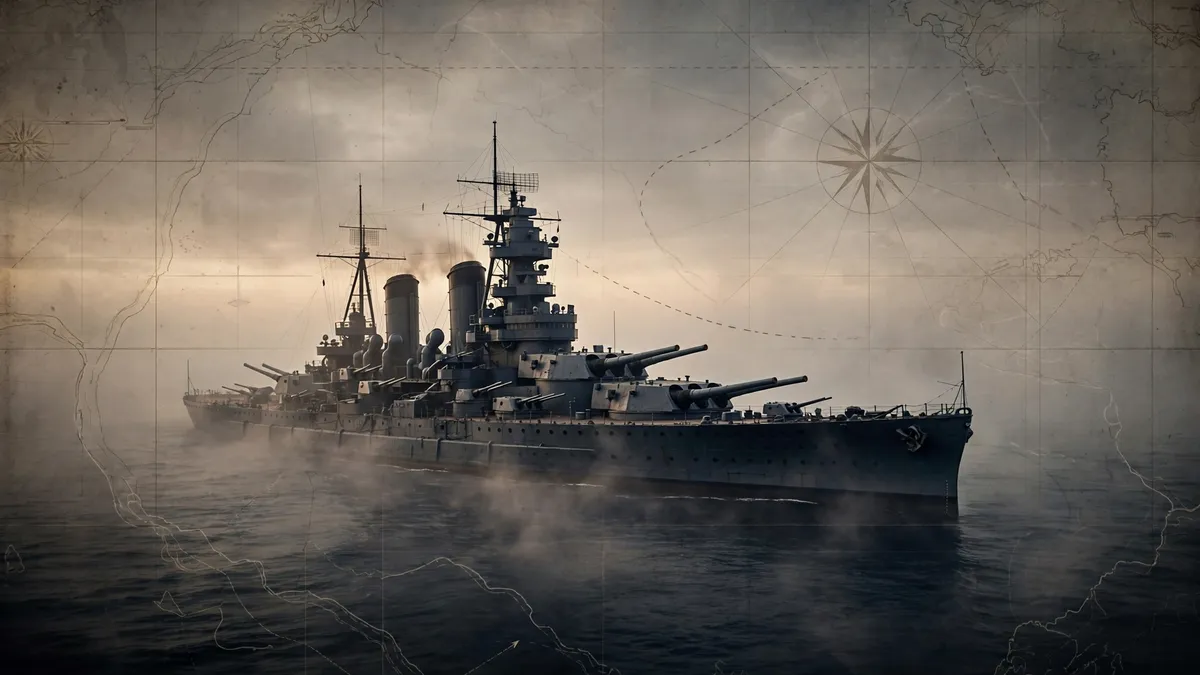
- Hero — Bismarck at sea, 1941. Prompt: “German battleship Bismarck steaming at sea in 1941, four twin 38cm gun turrets, tall funnel, grey Atlantic water, overcast sky, realistic WWII documentary photograph, no text.” Alt EN: “Battleship Bismarck at sea in 1941” (35 chars). Alt VI: “Thiết giáp hạm Bismarck trên biển năm 1941” (43 ký tự).
- Section 1 (Lead) — Bismarck’s forward turrets. Prompt: “Forward twin 38cm gun turrets Anton and Bruno of a German battleship seen from the bow, grey steel, overcast light, realistic WWII documentary photograph, no text.” Alt EN: “Forward 38cm turrets of the battleship Bismarck” (48 chars). Alt VI: “Tháp pháo 38 cm phía trước của thiết giáp hạm Bismarck” (53 ký tự).
- Section 3 (Background) — Blohm & Voss shipyard, Hamburg. Prompt: “1930s German shipyard in Hamburg with a large battleship hull under construction, cranes and scaffolding, workers in period clothing, realistic historical photograph, no text.” Alt EN: “Battleship hull under construction at Hamburg, 1930s” (54 chars). Alt VI: “Thân thiết giáp hạm đang đóng tại Hamburg, thập niên 1930” (58 ký tự).
- Section 4 (Design) — Main battery side view. Prompt: “German battleship at anchor in a fjord, side view showing four twin gun turrets and tall superstructure, calm water, 1941, realistic WWII documentary photograph, no text.” Alt EN: “Bismarck at anchor, side view of the main battery” (49 chars). Alt VI: “Bismarck neo đậu, nhìn ngang dàn pháo chính” (43 ký tự).
- Section 5 (Variants) — Bismarck and Tirpitz. Prompt: “Two large German battleships of the same class anchored in a Norwegian fjord, 1942, steep mountains and calm water, realistic WWII documentary photograph, no text.” Alt EN: “Bismarck and Tirpitz anchored in a Norwegian fjord” (51 chars). Alt VI: “Bismarck và Tirpitz neo đậu trong vịnh hẹp Na Uy” (49 ký tự).
- Section 6 (Operational History) — Denmark Strait, 24 May 1941. Prompt: “Two warships exchanging fire at long range in the Denmark Strait at dawn, 24 May 1941, shell splashes and smoke on the horizon, realistic WWII documentary photograph, no text.” Alt EN: “Naval action in the Denmark Strait, 24 May 1941” (49 chars). Alt VI: “Hải chiến tại eo biển Đan Mạch, 24 tháng 5 năm 1941” (52 ký tự).
- Section 6 (Operational History) — Swordfish torpedo attack. Prompt: “Swordfish biplane torpedo bomber flying low over the Atlantic towards a large battleship, 26 May 1941, grey sea and cloud, realistic WWII documentary photograph, no text.” Alt EN: “Swordfish torpedo bomber attacking Bismarck, 1941” (51 chars). Alt VI: “Máy bay Swordfish tấn công Bismarck bằng ngư lôi, 1941” (55 ký tự).
- Section 6 (Operational History) — Final battle, 27 May 1941. Prompt: “British battleships firing at a burning German battleship in the North Atlantic, morning light, smoke and shell splashes, 27 May 1941, realistic WWII documentary photograph, no text.” Alt EN: “Final battle against Bismarck, 27 May 1941” (43 chars). Alt VI: “Trận đánh cuối cùng chống Bismarck, 27 tháng 5 năm 1941” (53 ký tự).
- Section 7 (Performance) — 38cm gun turret detail. Prompt: “Close-up of a twin 38cm gun turret of a German battleship in a dockyard, sailors for scale, 1940, realistic WWII documentary photograph, no text.” Alt EN: “Twin 38cm gun turret of the battleship Bismarck” (47 chars). Alt VI: “Tháp pháo đôi 38 cm của thiết giáp hạm Bismarck” (46 ký tự).
- Section 9 (Legacy) — Wreck on the seabed. Prompt: “Remotely operated underwater vehicle with lights examining the wreck of a large WWII battleship on the deep Atlantic seabed, dark blue water, realistic documentary photograph, no text.” Alt EN: “Underwater vehicle examining the wreck of Bismarck” (52 chars). Alt VI: “Thiết bị lặn kiểm tra xác tàu Bismarck” (39 ký tự).
- Section 10 (Surviving Examples) — HMS Hood memorial. Prompt: “Naval war memorial with wreaths and a stone monument in an English memorial garden, quiet morning light, realistic photograph, no text.” Alt EN: “Naval war memorial for the crew of HMS Hood” (45 chars). Alt VI: “Đài tưởng niệm thủy thủ đoàn HMS Hood” (38 ký tự).