 WAR ATLAS MILITARY HISTORY MAGAZINE · WWI — WWII
Monte Cassino
1. Lead
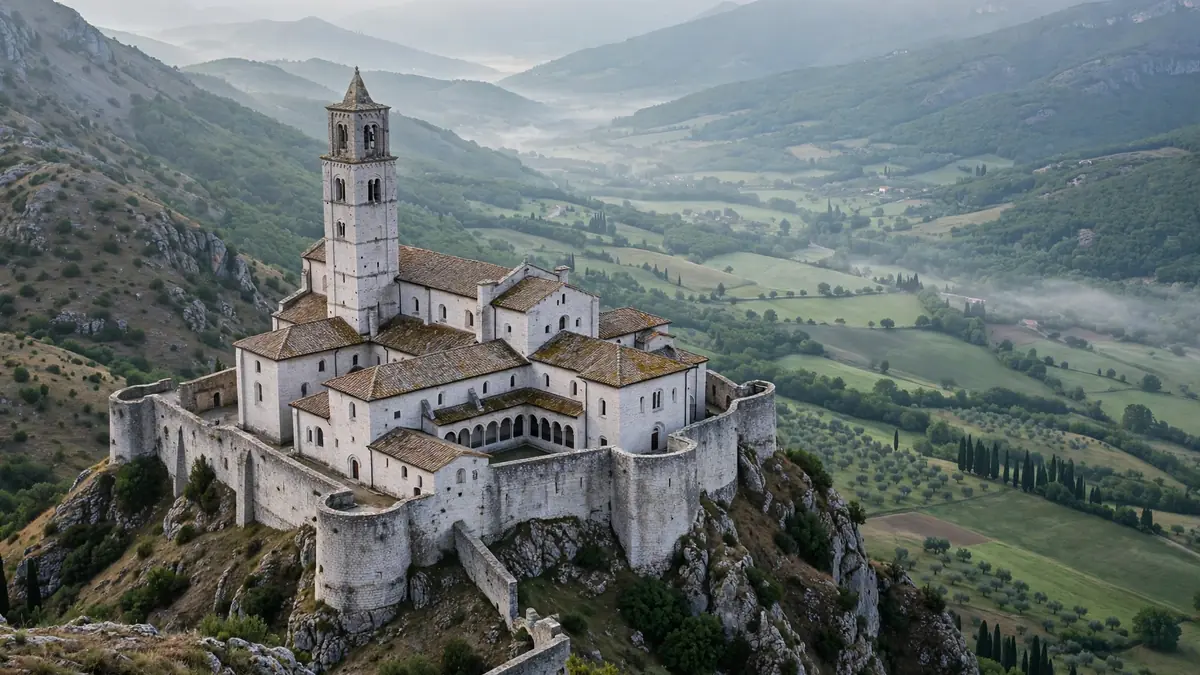
Monte Cassino is a mountain, a monastery and a memory. The mountain rises 516 metres above the Liri Valley, in central Italy, between Rome and Naples, and on its summit stands the Abbey of Monte Cassino, founded by Saint Benedict in the year 529 and the mother house of the Benedictine order.
In the Second World War, the abbey and the mountain became one of the most famous battlefields in Europe: the abbey was destroyed by Allied bombing on 15 February 1944, in one of the most controversial decisions of the war, and the mountain was the scene of four battles, from January to May 1944, in which the Allies fought to break the German Gustav Line and to open the road to Rome.
The final battle was won by the Polish II Corps, under General Władysław Anders, which captured the ruins of the abbey on 18 May 1944, and Monte Cassino has been a symbol of Polish heroism ever since. The abbey was rebuilt after the war and reconsecrated in 1964, and it is today a working monastery, a museum, and a place of pilgrimage for Italians, Poles and visitors from around the world.
This article is about Monte Cassino as a place of memory, not only as a battle. It tells the story of the abbey, from its founding to its destruction and its rebuilding; of the battles that were fought for the mountain; of the controversy over the bombing; of the Polish soldiers who captured it and the cemeteries where they and their comrades lie; and of what Monte Cassino means today, to the monks who live there, to the Poles who remember it, and to the Italians who live in its shadow. The battle is described here in outline; the full military history of the four battles belongs to the battle article, to which this article is linked.
2. Key Facts
| What | A Benedictine abbey on a mountain in central Italy, destroyed in 1944, rebuilt and reconsecrated in 1964 |
| Founded | 529, by Saint Benedict of Nursia; the mother house of the Benedictine order |
| Where | On Monte Cassino, 516 metres above the Liri Valley, near the town of Cassino, between Rome and Naples |
| Destroyed | 15 February 1944, by Allied bombing; the abbey was almost completely destroyed |
| Battles | Four battles, January-May 1944, on the Gustav Line; Allied casualties about 55,000, German about 20,000, by commonly cited estimates |
| Captured | 18 May 1944, by the Polish II Corps under General Władysław Anders |
| Rebuilt | Rebuilt after the war and reconsecrated on 24 October 1964 |
| Cemeteries | Polish War Cemetery (1,052 graves), Commonwealth War Cemetery at Cassino (4,271 burials), German War Cemetery (about 20,000 burials) |
| Today | A working Benedictine monastery, with a museum, a library and a place of pilgrimage |
3. The Abbey of Saint Benedict
The founding in 529
The Abbey of Monte Cassino was founded in the year 529 by Saint Benedict of Nursia, who came to the mountain, then the site of a Roman temple, and built a monastery there. It was at Monte Cassino that Benedict wrote his Rule — the Rule of Saint Benedict — the set of instructions for monastic life that became the foundation of Western monasticism, and that is still followed by Benedictine monks and nuns around the world.
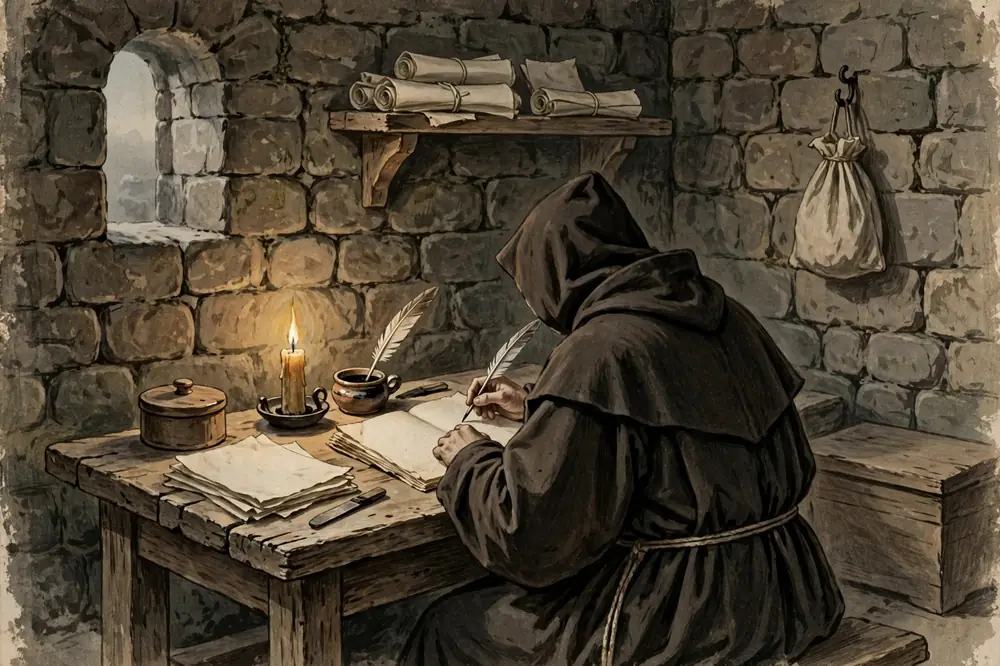
The abbey became the mother house of the Benedictine order, and it grew in wealth and in influence: its monks copied manuscripts, kept the learning of the ancient world alive through the Dark Ages, and built a library that became one of the great libraries of Europe.
The abbey’s position, on a mountain above the road from Rome to Naples, made it a place of strategic importance as well as of religious importance, and its history is a history of destruction and rebuilding, long before the Second World War.
Destruction and rebuilding through the centuries
The abbey was destroyed three times before 1944, and rebuilt three times, and its history is a reminder that the destruction of 1944 was not the first. It was destroyed by the Lombards in 577, and the monks fled to Rome; it was rebuilt, and it was destroyed again by the Saracens in 883, who sacked the abbey and killed its abbot; it was rebuilt again, and it was destroyed by an earthquake in 1349, which brought down the church and the monastery.
Each time, the abbey was rebuilt, and each time it grew greater: the abbey that stood in 1944 was the product of centuries of rebuilding, with a church, a cloister, a library and a museum, and with works of art and manuscripts that had been collected over a thousand years.
The monks who lived there in 1944 were the heirs of that history, and they believed, as their predecessors had, that the abbey would survive the war, as it had survived the Lombards, the Saracens and the earthquake. They were wrong, and the destruction of 1944 was the most complete of all.
The abbey on the eve of war
On the eve of the Second World War, the Abbey of Monte Cassino was a place of peace, of prayer, and of scholarship, and it was one of the most revered monasteries in Italy. Its abbot was Gregorio Diamare, a man of learning and of piety, and its monks were engaged in the work of the abbey: prayer, study, the care of the library, and the welcome of pilgrims.
The abbey’s treasures — its manuscripts, its works of art, its archives — were among the most valuable in Italy, and the monks had begun, as the war approached, to think about how to protect them. The abbey’s position, on the mountain above the Liri Valley, was also its danger: the mountain commanded the road to Rome, and any army that wanted to take Rome would have to take the mountain.
The monks knew this, and they hoped that the abbey’s status as a religious house would protect it, as it had in the past. The hope was not unreasonable: the abbey had survived for fourteen centuries, and it was hard to believe that it would be destroyed in the twentieth.
4. Monte Cassino in the Second World War
The Gustav Line
After the Allied landings at Salerno in September 1943, the Allies advanced up the Italian peninsula, and the Germans fell back to a series of defensive lines across the narrowest part of Italy. The strongest of these was the Gustav Line, which ran from the Tyrrhenian Sea to the Adriatic, across the Liri Valley, and which was anchored on Monte Cassino.
The mountain was the key to the line: from its summit, the Germans could see the whole valley, and they could direct their artillery onto any Allied advance. The Allies, who needed to break the line to reach Rome, attacked the mountain four times, between January and May 1944, in the four battles of Monte Cassino.
The battles were among the hardest of the Italian campaign, and they were fought in winter, in rain and in snow, on steep and rocky ground, against a German defence that was well prepared and well supplied. The casualties were heavy on both sides, and the mountain became a symbol of the Italian campaign: a place where the Allies learned, at great cost, how hard it was to dislodge a determined enemy from high ground.
The abbey and the battle
The abbey’s part in the battle is the most controversial part of the story of Monte Cassino, and it is the part that this article examines in detail. The Germans claimed that they had not occupied the abbey, and that it was a neutral religious house; the Allies claimed that the Germans were using the abbey as an observation post, and that it had to be destroyed.
The truth, as historians now understand it, is more complicated: the Germans had not occupied the abbey itself, but they had occupied the mountain around it, and they had observation posts on the slopes below the abbey, from which they could see the valley.
The abbey’s position, on the summit, made it a landmark and a symbol, and the Allies came to believe that it was the key to the German defence, even though the German defence did not depend on the abbey. The decision to bomb the abbey was taken by the Allied commanders on the ground, and it was approved by the higher command, but it was opposed by many, including the Vatican, and it remains one of the most debated decisions of the war in Italy.
The monks and the treasures
Before the bombing, the monks and the treasures of the abbey were evacuated, in an operation that is one of the more remarkable stories of the war. The abbot, Gregorio Diamare, and the monks left the abbey in the winter of 1943-44, and the abbey’s manuscripts, works of art and archives were packed and sent to Rome, for safekeeping in the Vatican.
The evacuation was carried out with the help of German officers, including Lieutenant Colonel Julius Schlegel, an Austrian officer who organised the transport of the abbey’s treasures to Rome, and who has been honoured since the war for saving them. The monks themselves took refuge in Rome, and the abbot died there in 1945, shortly after the liberation.
The evacuation saved the abbey’s treasures, but it did not save the abbey itself, and the monks who returned after the war found their home in ruins. The story of the evacuation is a reminder that, even in war, there were men on both sides who tried to protect the heritage of Monte Cassino, and that the destruction of the abbey was not the work of men who did not care, but of men who believed, rightly or wrongly, that it was necessary.
5. The Bombing of 15 February 1944
The decision
The Allied commanders
The decision to bomb the abbey was taken by the Allied commanders in Italy, and it was driven by the frustration of the first battles for the mountain. The first battle, in January 1944, had failed, and the second battle, in February, was in progress, with the Allies attacking the mountain and the Germans holding it.
The Allied commanders on the ground — above all, the New Zealand Corps commander, Lieutenant-General Bernard Freyberg — believed that the abbey was being used by the Germans as an observation post, and that it had to be destroyed before the infantry could advance.
The evidence for that belief was thin: the Germans had not occupied the abbey, and the observation posts were on the slopes below it, but the belief was strongly held, and it was supported by the reports of Allied soldiers who had seen Germans on the mountain.
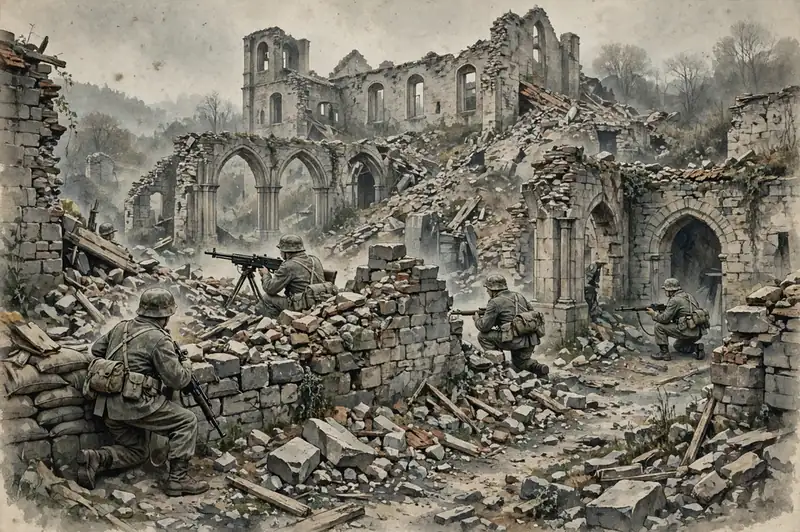
The decision was referred to the higher command, and it was approved by General Sir Harold Alexander, the Allied commander in Italy, and by the air forces, who were asked to bomb the abbey. The Vatican was informed, and it protested, but the protest came too late, and the bombing went ahead.
The debate
The decision to bomb the abbey has been debated ever since, and the debate is one of the most enduring of the war in Italy. The critics of the bombing argue that it was unnecessary, because the Germans had not occupied the abbey, and that it was counter-productive, because the ruins of the abbey provided the Germans with a better defensive position than the abbey itself had, and because it turned Italian and world opinion against the Allies.
The defenders of the bombing argue that the commanders on the ground had to act on the information they had, that the abbey’s position made it a legitimate target, and that the bombing was a military decision, not a cultural one. Historians have generally concluded that the bombing was a mistake, but a mistake made in good faith, by men who believed they were saving the lives of their soldiers.
The debate is not only about the bombing itself but about the relationship between military necessity and cultural heritage, and it is a debate that has shaped the law of war ever since, in the conventions that now protect cultural property in armed conflict.
The bombing
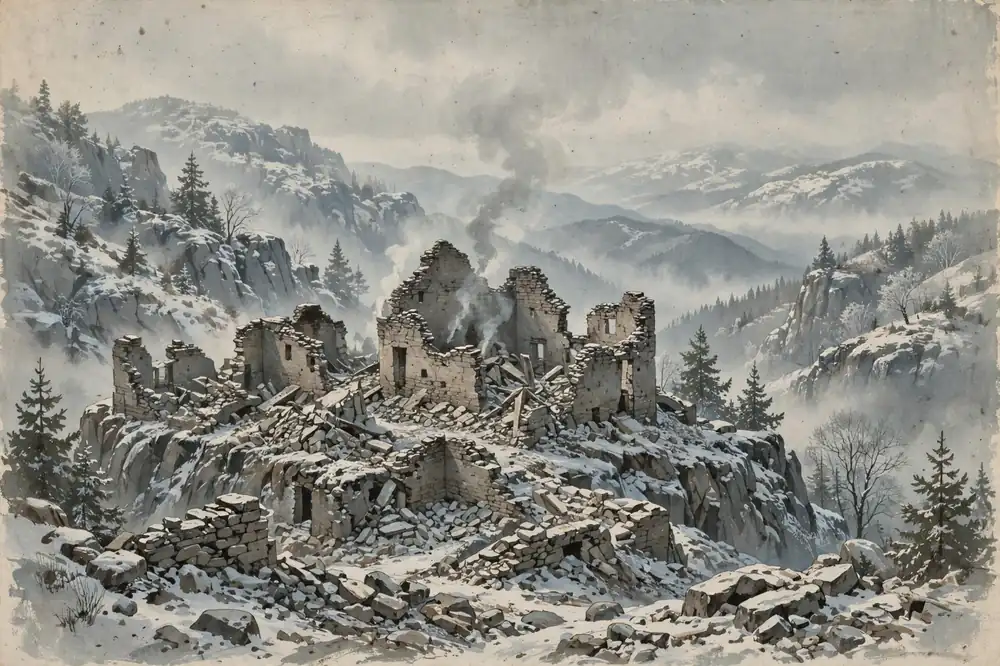
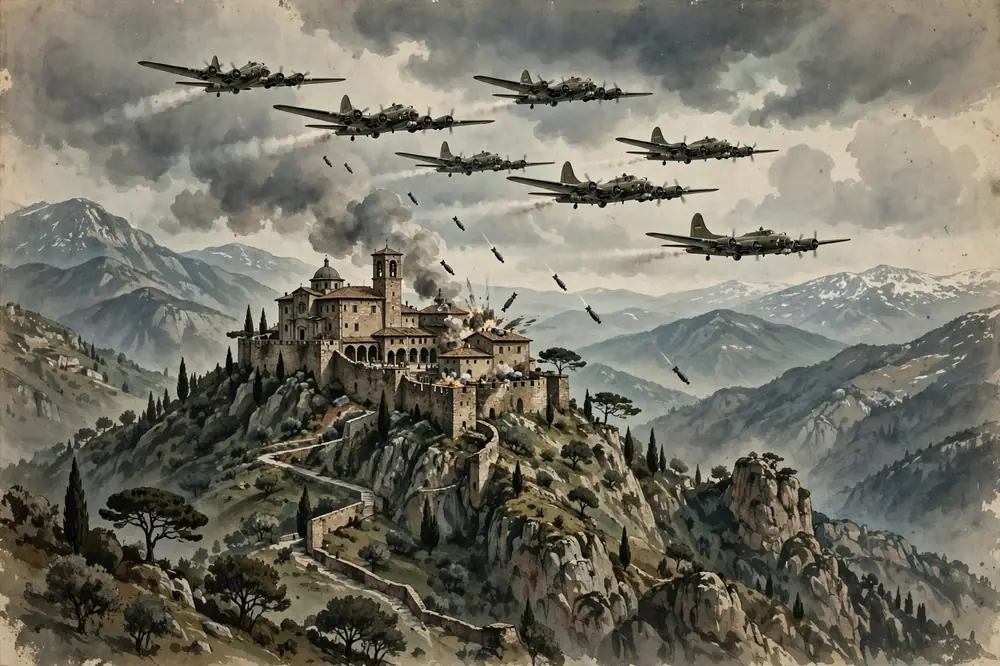
On the morning of 15 February 1944, 142 American bombers dropped about 400 tons of bombs on the abbey, and the bombing continued in the afternoon, with a further 200 tons. The abbey, which had stood for fourteen centuries, was almost completely destroyed: its church, its cloister, its library and its museum were reduced to rubble, and only the outer walls and a few fragments survived.
The bombing killed a number of Italian civilians who had taken refuge in the abbey — the exact number is disputed, with estimates ranging from about 100 to more than 200, and the article gives the range rather than a single figure — and it killed no German soldiers, because there were none in the abbey.
The monks had left, the treasures had been evacuated, and the only people in the abbey were the civilians who had sought shelter there, and who died in the bombing. The destruction of the abbey was reported around the world, and it was condemned by the Vatican, by the Italian government, and by many in the Allied countries, who saw it as an act of vandalism.
The Allies, for their part, insisted that it had been a military necessity, and the debate began at once.
The ruins as a fortress
The bombing did not break the German defence. On the contrary, the ruins of the abbey provided the German paratroopers who defended the mountain with a better position than the abbey itself: the rubble was ideal for defence, the cellars and the crypts were bomb-proof shelters, and the Germans moved into the ruins and held them for three more months, until May 1944.
The bombing is therefore remembered as a military failure as well as a cultural disaster: it destroyed a monument of fourteen centuries, it killed civilians, and it did not achieve its purpose. The Germans, who had not occupied the abbey before the bombing, occupied its ruins after it, and the Allies had to fight for the ruins as they had fought for the mountain.
The lesson of the bombing — that the destruction of a cultural monument can make a military problem worse, not better — is one that has been learned, and relearned, in the wars since 1944, and it is the reason the bombing of Monte Cassino is still studied in military colleges and in the law of war.
6. The Four Battles
The first and second battles
The first battle of Monte Cassino, in January 1944, was an attempt by the American Fifth Army to cross the Rapido River and to break through the Gustav Line. The attack failed, with heavy casualties, and the Americans were forced back across the river. The second battle, in February 1944, was fought by the New Zealand Corps, and it included the bombing of the abbey on 15 February.
The New Zealanders and the Indians attacked the mountain and the town of Cassino, but they too failed, and the battle ended in a stalemate, with the Germans still holding the mountain and the ruins. The first two battles cost the Allies thousands of casualties, and they taught the Allies that the mountain could not be taken by a frontal assault, and that a different approach was needed.
The battles are described in detail in the battle article on Monte Cassino, and this article gives only their outline, because its subject is the abbey and its memory, not the tactics of the fighting.
The third battle
The third battle, in March 1944, was the most destructive of the four, and it was fought for the town of Cassino itself. The town was bombed by Allied aircraft on 15 March, in an attack that destroyed the town and killed hundreds of civilians, and the New Zealanders and the Indians then fought their way into the ruins, street by street, against the German paratroopers who defended them.
The fighting was among the hardest of the Italian campaign: the town was reduced to rubble, the soldiers fought from house to house and from room to room, and the casualties were heavy on both sides. The third battle ended, like the first two, in a stalemate: the Allies took part of the town, but the Germans still held the mountain and the abbey ruins, and the road to Rome remained closed.
The town of Cassino, which had been a prosperous market town before the war, was destroyed, and it was rebuilt after the war, on a new site, as the town that visitors see today.
The fourth battle and the breakthrough
The fourth battle, in May 1944, was part of a larger Allied offensive, Operation Diadem, which attacked the Gustav Line along its whole length, from the sea to the mountains. The Polish II Corps was given the task of taking Monte Cassino itself, and the French Expeditionary Corps was given the task of breaking through the mountains to the west, in a move that outflanked the German line.
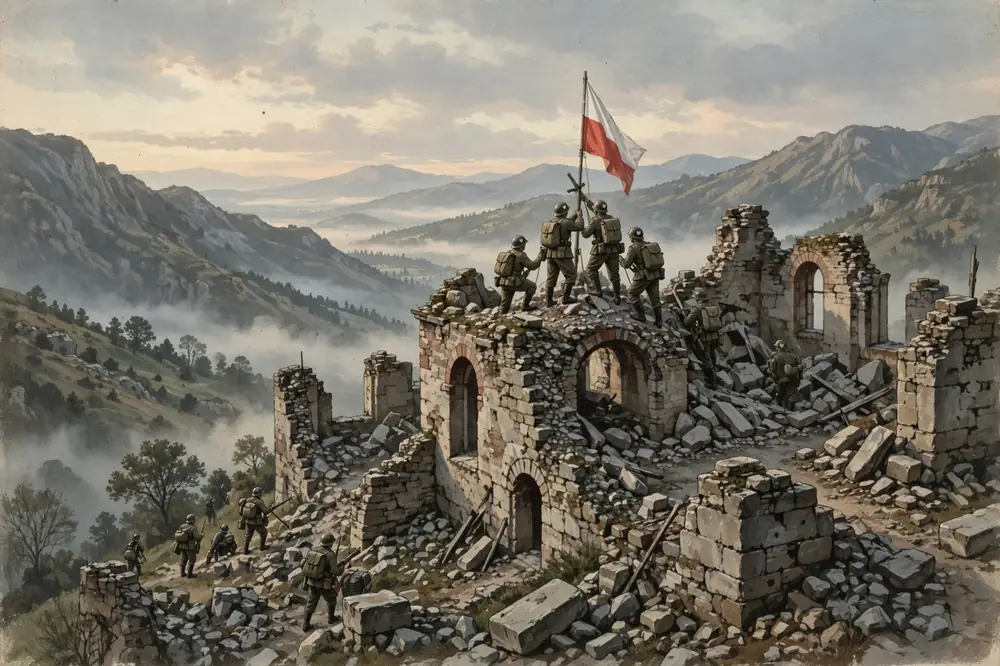
The offensive began on 11 May, with a massive artillery bombardment, and the Poles attacked the mountain on 12 May, and again on 17 May, in fighting that was among the hardest of the war. On 18 May, the Poles captured the ruins of the abbey, and raised the Polish flag over them, and the Germans, outflanked by the French and under pressure along the whole line, withdrew.
The road to Rome was open, and Rome was liberated on 4 June 1944, two days before D-Day. The fourth battle had cost the Allies dearly — the Polish Corps alone lost about 4,000 men killed and wounded — but it had broken the Gustav Line, and it had ended the six months of fighting for Monte Cassino.
7. The Polish Capture
The Polish II Corps
The Polish II Corps, which captured Monte Cassino, was an army of exiles. Its soldiers were Poles who had been deported to the Soviet Union in 1939-40, after the Soviet invasion of eastern Poland, and who had been released in 1941, after the German invasion of the Soviet Union, to form an army under General Władysław Anders.
The Corps had marched from the Soviet Union, through Iran, Iraq and Palestine, to Egypt and then to Italy, and its soldiers had a personal stake in the war: their country was occupied, their families were dead or in exile, and they were fighting for a Poland that did not yet exist.
The Corps was about 50,000 strong, and it included infantry, artillery, armour and engineers, and it had been in Italy since the winter of 1943-44. The task of taking Monte Cassino was given to the Corps by the Allied command, and it was accepted by Anders and his men as an honour and as a duty: the Poles would show the world that Poland was still fighting, and that its soldiers could do what others had failed to do.
The assault of 18 May 1944
The Polish assault on Monte Cassino was made in two attacks, on 12 May and on 17 May, and it was one of the hardest fights of the war. The Poles attacked up the steep, rocky slopes of the mountain, under fire from the German paratroopers in the ruins of the abbey and on the neighbouring hills, and they suffered heavy casualties: about 4,000 men killed and wounded, including about 900 killed, by the most commonly cited figures.
On the morning of 18 May, a Polish patrol found the abbey ruins empty — the Germans had withdrawn in the night — and the Poles raised the Polish flag over the ruins, and played the Polish national anthem on a bugle.
The capture of the abbey was reported around the world, and it became a symbol of Polish heroism: the Poles, who had been the first victims of the war, had taken the mountain that others had failed to take. The flag that was raised on 18 May was later taken to London, and it is now in the Polish Institute and Sikorski Museum.
The Poles also adopted a mascot, a bear named Wojtek, who had marched with the Corps from Iran and who carried ammunition at Monte Cassino, and who has become a beloved symbol of the Polish soldiers.
“Red Poppies on Monte Cassino”
The Polish capture of Monte Cassino was celebrated in a song, “Red Poppies on Monte Cassino” (Czerwone maki na Monte Cassino), written by Feliks Konarski on the night of 18-19 May 1944, in the camp of the Polish Corps below the mountain.
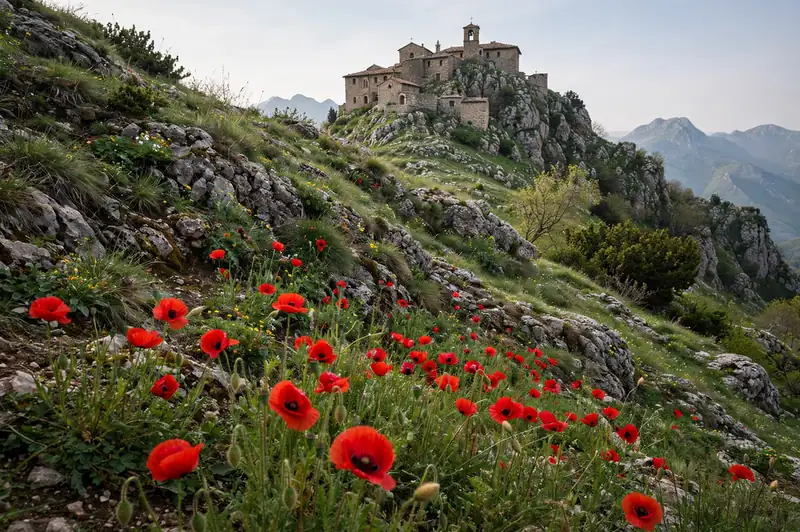
The song describes the red poppies that grew on the slopes of the mountain, and that were said to be redder than usual because they were watered by Polish blood, and it has become the best-known Polish song of the war, sung at every commemoration of Monte Cassino.
The song’s imagery — the poppies, the mountain, the blood — has become the imagery of Monte Cassino itself, and the red poppy is now the symbol of the Polish remembrance of the battle, as it is, in a different tradition, the symbol of remembrance in Britain and the Commonwealth.
The song is taught in Polish schools, and it is sung at the Polish cemetery at Monte Cassino on every anniversary of the battle, by the veterans and by the schoolchildren who come to remember them.
8. The Cemeteries and the Memorials
The Polish War Cemetery
The cemetery on the mountain
The Polish War Cemetery at Monte Cassino stands on the slopes of the mountain, below the abbey, in a place chosen by General Anders himself. It holds 1,052 graves, of the Polish soldiers who died in the battle for Monte Cassino and in the Italian campaign, and it is the most visited of the cemeteries at Monte Cassino, by Poles and by visitors from around the world.
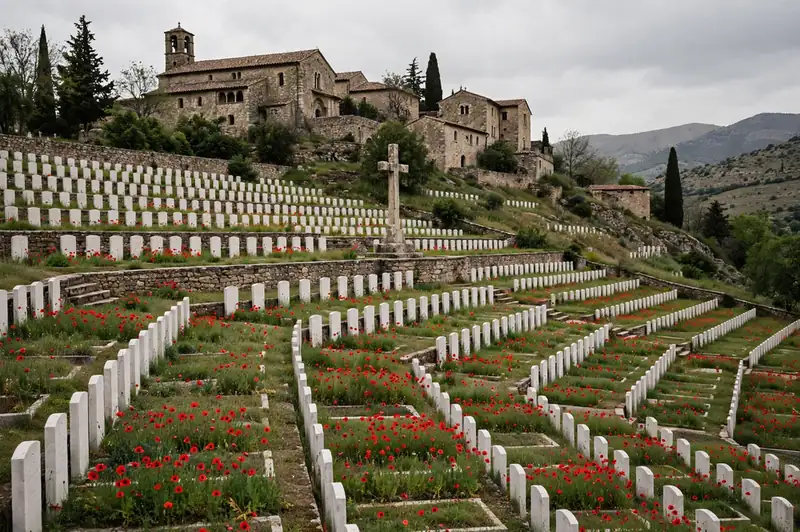
The cemetery is laid out in terraces on the hillside, with a great cross at its head, and with the graves arranged in rows, each with a headstone bearing the name, rank and unit of the soldier buried beneath it.
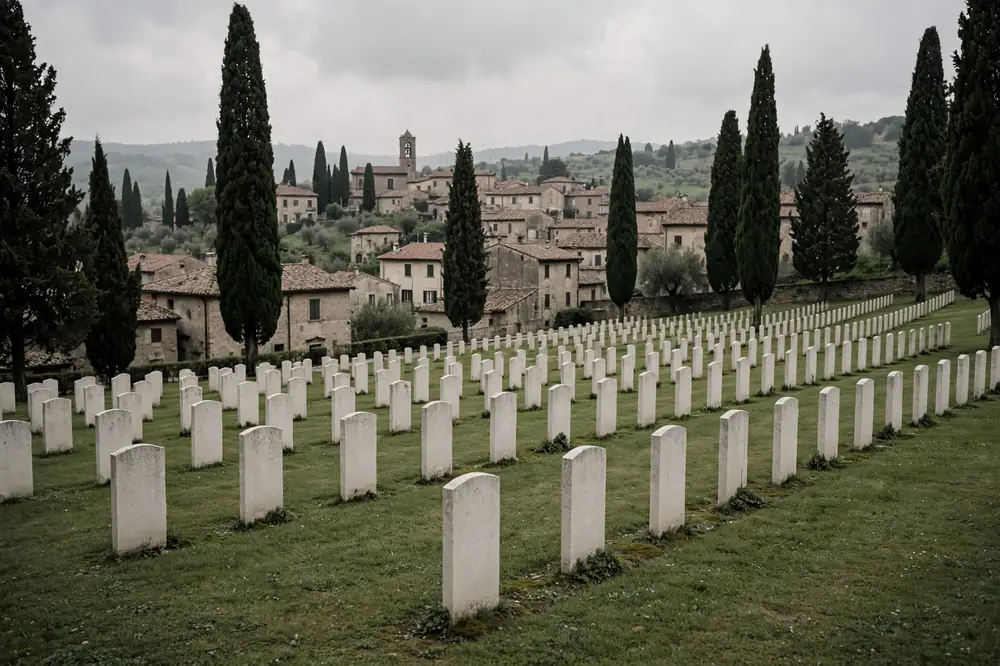
The cemetery’s most famous feature is its entrance, which bears the inscription, in Polish, from the song of the battle: “For our freedom and yours, we Polish soldiers gave our souls to God, our bodies to the soil of Italy, and our hearts to Poland.” The cemetery is maintained by the Commonwealth War Graves Commission, and it is the focus of the Polish commemorations of the battle, held each year on 18 May, the anniversary of the capture of the abbey.
Anders’s grave
General Władysław Anders, who commanded the Polish II Corps at Monte Cassino, is buried in the Polish War Cemetery, among his men, in accordance with his wish. Anders died in London in 1970, in exile, and his body was brought to Monte Cassino and buried in the cemetery he had chosen, in a grave that is visited by Poles from around the world.
His grave is a simple one, like the others, but it is distinguished by its position and by the flowers that are always laid on it. Anders’s burial at Monte Cassino is a reminder that the Polish soldiers who fought in Italy were exiles, who did not return to a free Poland — Poland was under communist rule after the war, and many of the soldiers of the II Corps did not return — and that Monte Cassino became, for them, a substitute homeland, a place where Poland was remembered in exile.
The cemetery is therefore not only a burial ground but a place of Polish national memory, and its care is a matter of national importance in Poland.
The other cemeteries
The Commonwealth War Cemetery at Cassino, in the town below the mountain, holds 4,271 Commonwealth burials, of the soldiers who died in the battles for Monte Cassino and in the Italian campaign, and it is one of the largest Commonwealth cemeteries in Italy.
The German War Cemetery, at Caira, near Cassino, holds about 20,000 German burials, of the soldiers who died in the battles for the Gustav Line, and it is one of the largest German cemeteries in Italy. There are also French and American cemeteries in the area, and the town of Cassino itself has a memorial to the civilians who died in the bombing of the town.
Together, the cemeteries of Monte Cassino tell the story of the battle from every side: the Poles on the mountain, the Commonwealth soldiers in the town, the Germans at Caira, and the civilians of Cassino, who are remembered in the town’s own memorial.
The cemeteries are visited by the families of the dead, by school groups, and by the veterans and their descendants, and they are maintained, each by its own commission, to the standard that visitors expect.
The town of Cassino
The town of Cassino, below the mountain, was destroyed in the war, and it was rebuilt after the war, on a new site, as the town that visitors see today. The town’s own memorial to the war is a reminder that Monte Cassino was not only a battle of soldiers but a disaster for civilians: the town was bombed, its inhabitants were killed and displaced, and its rebuilding was a long and painful process.
The town today lives with the memory of the battle: its streets are named after the units that fought there, its museums tell the story of the battle, and its people welcome the visitors who come to the mountain and to the cemeteries.
The town’s relationship with the abbey is a close one: the abbey is the town’s landmark, and the town is the abbey’s gateway, and the two are linked in the memory of the war and in the life of the present.
9. The Rebuilt Abbey
The rebuilding
The abbey was rebuilt after the war, in a project that lasted from 1948 to 1964, and that was carried out by the Italian state, with the help of the monks and of donations from around the world. The rebuilding was a faithful reconstruction: the abbey was rebuilt, stone by stone, on the plan of the abbey that had been destroyed, using the original stones where they could be recovered, and using the photographs and the plans that had survived.
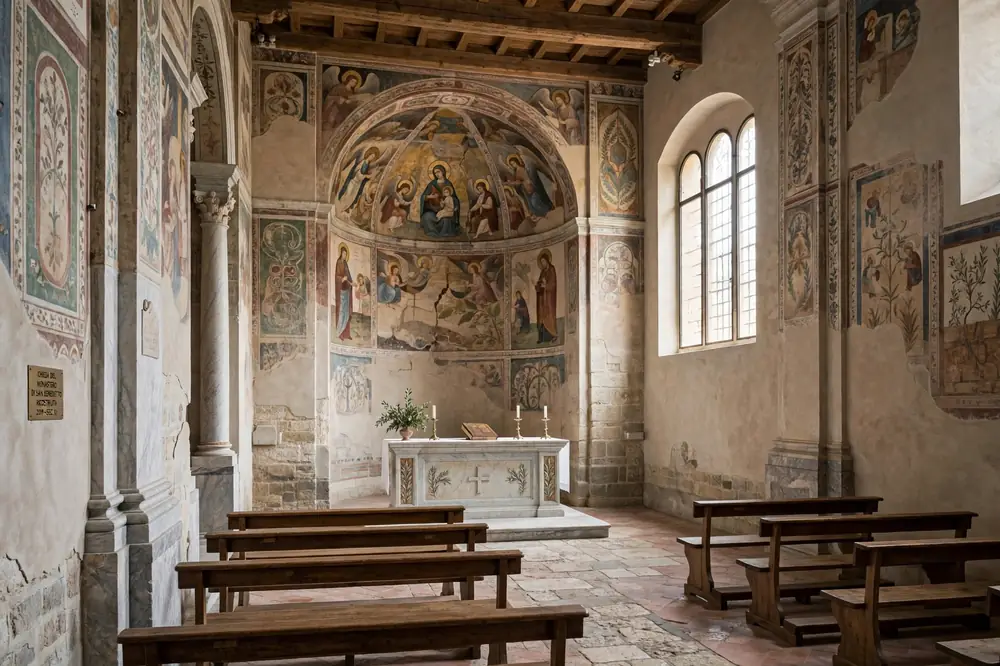
The rebuilt abbey was reconsecrated on 24 October 1964, by Pope Paul VI, in a ceremony attended by the monks, by the veterans of the battle, and by the representatives of the countries that had fought there. The reconsecration was a moment of reconciliation: the abbey that had been destroyed by the Allies was rebuilt with the help of the Allies, and the ceremony was attended by the men who had fought on both sides.
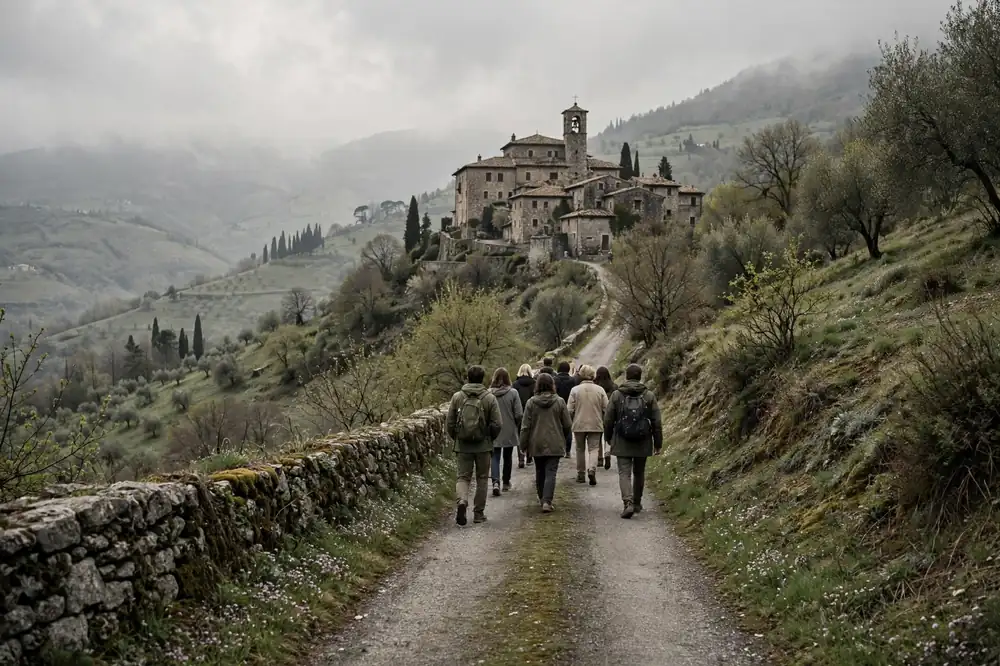
The rebuilding is a reminder that the destruction of a monument is not necessarily its end, and that a building that has been destroyed three times can be rebuilt a fourth time.
The abbey today
Today, the Abbey of Monte Cassino is a working Benedictine monastery, with a community of monks who live by the Rule of Saint Benedict, and it is also a museum, a library, and a place of pilgrimage. The abbey’s museum tells the story of the abbey, from its founding to its destruction and its rebuilding, and it displays the works of art and the manuscripts that were saved from the bombing.
The abbey’s library, rebuilt after the war, holds a collection of manuscripts and books that is one of the most important in Italy. The abbey is visited by pilgrims, by tourists, and by the veterans and their families who come to remember the battle, and it is a place where the memory of the war and the life of the monastery coexist: the monks pray in the church that was rebuilt, the visitors walk through the cloister that was rebuilt, and the mountain that was a battlefield is now a place of peace.
The abbey’s motto, “Ora et labora” — pray and work — is the motto of the Benedictine order, and it is the motto that the abbey has lived by for fourteen centuries.
Visiting Monte Cassino
The abbey is open to visitors, and it is reached by a road that winds up the mountain from the town of Cassino, with views over the Liri Valley that are among the finest in Italy. Visitors should allow at least half a day to see the abbey, the museum, and the Polish cemetery, and to walk the paths of the battlefield.
The abbey asks visitors to behave with respect, as it is a working monastery, and to dress modestly, and to speak quietly in the church and the cloister. The Polish cemetery, below the abbey, is open to the public, and it is the place where most visitors go after the abbey, to see the graves of the Polish soldiers and the view over the valley.
The town of Cassino, below the mountain, has hotels, restaurants and a museum of the battle, and it is the base from which most visitors explore the battlefield. The best time to visit is in the spring, when the poppies are in flower on the slopes of the mountain, and the anniversary of the battle, on 18 May, is marked by ceremonies at the abbey and at the Polish cemetery.
10. Legacy
The legacy of Monte Cassino is, first, a religious one: the abbey is the mother house of the Benedictine order, and its Rule has shaped Western monasticism for fourteen centuries, and it continues to shape it today. Second, it is a military legacy: the four battles of Monte Cassino are studied in military colleges as a case study in the difficulty of attacking high ground, in the importance of logistics, and in the cost of frontal assaults.
Third, it is a legacy of memory: the abbey is remembered in Italy as a place of destruction and rebuilding, in Poland as a place of heroism and sacrifice, and in the world as a symbol of the cost of war and of the possibility of reconciliation.
The abbey that stands today is a rebuilding, and its stones are both old and new, and that is fitting: Monte Cassino has always been a place of destruction and rebuilding, and its history is a history of both.
Monte Cassino in Poland
In Poland, Monte Cassino is one of the most revered places in the national memory, and it is taught in schools as a symbol of Polish heroism. The battle is remembered in the song, in the cemeteries, and in the streets and squares named after Monte Cassino in Polish cities.
The veterans of the battle, who returned to Poland after the war or who remained in exile, were honoured in Poland after the fall of communism, and their memory is now a part of the official history of the country.
The Polish cemetery at Monte Cassino is a place of pilgrimage for Poles, and it is visited by school groups, by veterans, and by the families of the soldiers who are buried there. The battle’s place in Polish memory is secure, and it will remain so for as long as Poland remembers its soldiers, and for as long as the poppies bloom on the slopes of the mountain.
Why Monte Cassino still matters
Monte Cassino still matters because the questions it raises have not gone away. The question of the bombing — when is the destruction of a cultural monument justified by military necessity — is a question that is still asked in every war, and Monte Cassino is the case that is most often cited.
The question of the battle — how to take high ground, and at what cost — is a question that is still studied in military colleges, and Monte Cassino is the case that is most often taught. And the question of memory — how a place can be, at once, a monastery, a battlefield, a cemetery and a symbol — is a question that Monte Cassino answers by being all of those things, at the same time, on the same mountain.
As long as those questions matter, Monte Cassino will matter, and the abbey on the mountain above the Liri Valley will continue to be visited, by monks, by pilgrims, by veterans, and by all those who come to stand where the mountain was fought for and to remember the men who fought there.
Frequently Asked Questions
When was the Abbey of Monte Cassino founded?
The abbey was founded in 529 by Saint Benedict of Nursia. It is the mother house of the Benedictine order.
When was the abbey destroyed?
The abbey was destroyed by Allied bombing on 15 February 1944. It was rebuilt after the war and reconsecrated on 24 October 1964.
Who captured Monte Cassino?
The Polish II Corps, under General Władysław Anders, captured the ruins of the abbey on 18 May 1944, after four battles from January to May 1944.
How many people died in the battles?
Allied casualties were about 55,000 and German casualties about 20,000, by commonly cited estimates. The bombing of the abbey killed about 100 to more than 200 Italian civilians who had taken refuge there.
How many Poles are buried at Monte Cassino?
The Polish War Cemetery at Monte Cassino holds 1,052 graves. General Anders is buried there, among his men.
Can I visit Monte Cassino?
Yes. The abbey is open to visitors, and the Polish War Cemetery below it is open to the public. The town of Cassino, below the mountain, is the base for visiting the battlefield.
Related articles
Sources
- David Hapgood and David Richardson, Monte Cassino: The Story of the Most Controversial Battle of World War II (Congdon and Weed, 1984) — the bombing, the battles and the controversy.
- Matthew Parker, Monte Cassino: The Hardest-Fought Battle of World War II (Headline, 2004) — the four battles and the Polish capture.
- Wikipedia, “Battle of Monte Cassino” and “Monte Cassino” — the abbey, the bombing of 15 February 1944, and the cemeteries.
- The Abbey of Monte Cassino, official site (abbaziamontecassino.org) — the history of the abbey, the rebuilding and visiting information.
- Commonwealth War Graves Commission, “Cassino War Cemetery” and “Monte Cassino Polish Cemetery” (cwgc.org) — the burials and the cemeteries.
- Feliks Konarski, “Red Poppies on Monte Cassino” (1944) — the song of the battle.
- John Ellis, Cassino: The Hollow Victory (Andre Deutsch, 1984) — the Italian campaign and the battles for the Gustav Line.