 WAR ATLAS MILITARY HISTORY MAGAZINE · WWI — WWII
M8 Greyhound
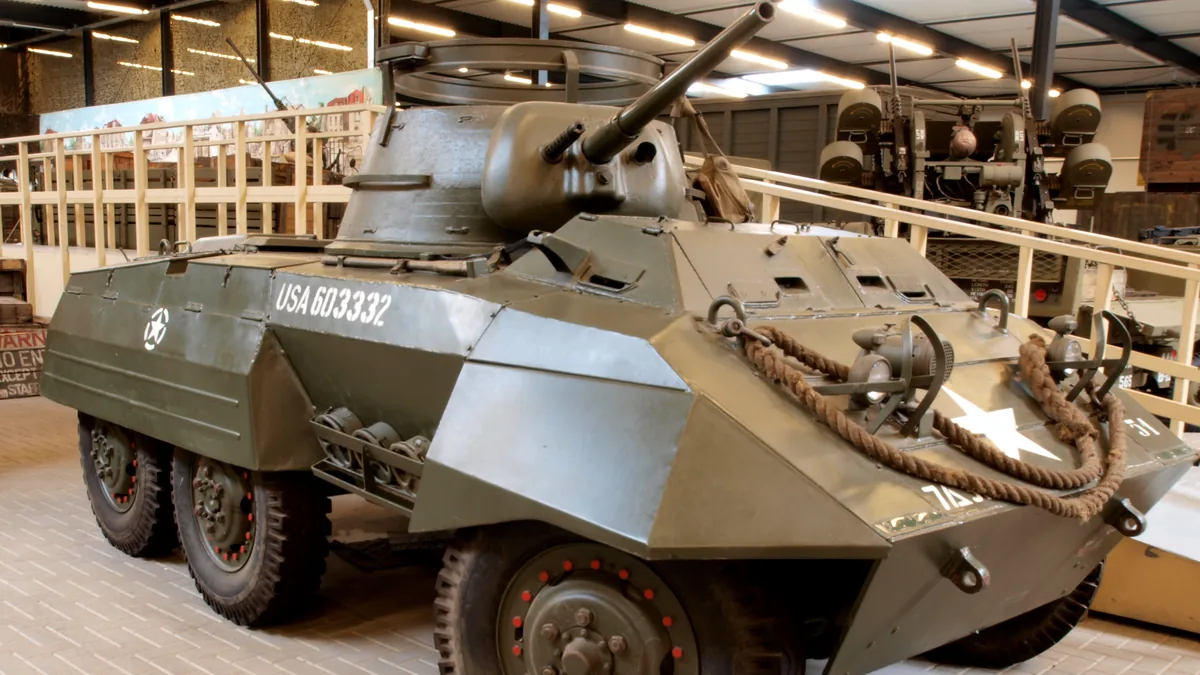
1. M8 Greyhound — At a Glance
The M8 Greyhound was the most numerous American armoured car of the Second World War, and one of the most recognisable vehicles of the Allied armies in Europe. A fast, six-wheeled, lightly armoured reconnaissance vehicle, armed with a 37-millimetre gun in a small turret, the M8 was designed to scout ahead of the tanks, to find the enemy, to screen the flanks, and to exploit a breakthrough, not to fight tanks head-on.
It entered service in 1943, and it served in North-West Europe, in Italy, and in the Pacific, where its speed, its reliability, and its ability to operate on roads made it invaluable to the cavalry reconnaissance squadrons that used it.
The M8 was not a tank, and its crews knew it: its armour was thin, its gun was adequate against light vehicles and infantry but not against German tanks, and its six wheels, although they gave it good road speed, made it less capable cross-country than a tracked vehicle.
Yet the M8 did the job for which it was designed, and it did it well, and it went on to serve after the war with the armies of many countries, in Korea, in Indochina, in Africa, and in South America, where it remained in service into the 1970s and beyond.
The Greyhound’s story is the story of reconnaissance in the Second World War: fast, light, and vulnerable, but essential to the army that used it.
2. Key Facts
| Field | Value |
|---|---|
| Type | Light armoured car |
| Role | Reconnaissance, screening, patrol, convoy escort |
| Origin | United States |
| Manufacturer | Ford Motor Company |
| Designed | 1942 |
| Introduced | 1943 |
| Produced | Approximately 8,523 M8 cars, plus approximately 3,791 M20 utility cars |
| Crew | 4 (commander, gunner, driver, radio operator) |
| Weight | Approximately 7.9 tons |
| Length | 5.00 m (16 ft 5 in) |
| Width | 2.54 m (8 ft 4 in) |
| Height | 2.26 m (7 ft 5 in) |
| Engine | 1 × Hercules JXD 6-cylinder petrol engine |
| Power | Approximately 110 hp |
| Max speed | Approximately 88–90 km/h (55–56 mph) on roads |
| Range | Approximately 560–640 km (350–400 miles) on roads |
| Armour | 3–19 mm (0.12–0.75 in) |
| Armament | 1 × 37 mm M6 gun, 1 × .30 in (7.62 mm) Browning machine gun coaxial, 1 × .50 in (12.7 mm) anti-aircraft machine gun |
| Primary users | United States Army, British Army, French Army, many post-war armies |
3. Background and Development
The Need for a Fast Reconnaissance Vehicle
In 1941, the United States Army recognised that it needed a fast, wheeled reconnaissance vehicle to replace the slow, tracked scout cars and the improvised armoured cars it had used in training. The Army’s cavalry, which had become the mechanised reconnaissance force, needed a vehicle that could move quickly on roads, that could scout ahead of the tanks, and that could fight if it met light enemy forces.
The Ordnance Department issued a specification for a 6×6 armoured car, with a 37-millimetre gun in a turret, a top speed of more than 80 kilometres per hour, and a range of more than 500 kilometres. Several companies submitted designs, and the Ford Motor Company’s design, the T22, was selected.
The T22 was a 6×6 vehicle, with a Hercules engine in the rear, a turret in the centre, and a hull that was welded from armour plate. The prototype was tested in 1942, and the Army ordered it into production as the M8 Light Armoured Car in 1943.
Production at Ford and the M20
Production of the M8 began at Ford’s Chicago plant in 1943, and continued until 1945, with approximately 8,523 M8 cars built. The M8 was also built as the M20 Armoured Utility Car, a version without a turret, with a large open cargo area in place of the turret, which was used as a command vehicle, a personnel carrier, and a cargo carrier. Approximately 3,791 M20s were built.
The M8 and M20 were supplied to the United States Army, to the British Army under Lend-Lease, and to the Free French Army. The British called the M8 the Greyhound, a name that reflected its speed, and the name stuck. The M8’s production was a major industrial effort, and it showed how American industry could produce a specialised reconnaissance vehicle in large numbers and in a short time.
The existence of so many sub-types is a reminder that this was not a static design. Each change was a response to something learned in service, whether it was a fault that needed correcting, a new weapon that needed fitting, or a new role that the machine was asked to perform. Some changes were small and invisible to an outsider, while others altered the shape or the armament in ways that are obvious in photographs. Taken together, the variants tell the story of a design being refined under pressure, with engineers, crews, and commanders all contributing to the next version.
4. Design
Hull, Wheels and Layout
The M8 was a 6×6 armoured car, with six wheels, all of which were driven, and with a hull that was welded from armour plate. The driver sat at the front, with the radio operator beside him, and the commander and gunner sat in the turret in the centre of the vehicle.
The engine, a Hercules JXD six-cylinder petrol engine producing approximately 110 horsepower, was mounted at the rear, and it drove the wheels through a transmission that gave the vehicle a top speed of about 88 kilometres per hour on roads.
The M8’s wheels were large, with run-flat tyres, and the vehicle had a good road speed and a good range, but its cross-country performance was limited by its wheels, which could bog down in mud and which could not climb steep slopes as well as a tracked vehicle.
The hull was low and compact, with a height of about 2.26 metres, and it was designed to be fast and to present a small target.
Turret, Gun and Armour
The M8’s turret was small, open-topped in early versions, and fitted with a 37-millimetre M6 gun and a coaxial .30-inch Browning machine gun. The turret also carried a .50-inch anti-aircraft machine gun on a pintle mount, which could be used against aircraft and against ground targets.
The 37-millimetre gun was adequate against light armoured vehicles, against infantry, and against soft-skinned vehicles, but it was not effective against German tanks such as the Panther and Tiger, and M8 crews were instructed to avoid tank combat. The armour was thin, from 3 millimetres on the floor to 19 millimetres on the turret front, and it could protect the crew against small-arms fire and shell splinters, but not against anti-tank guns or tank guns.
The M8’s design was a compromise: it traded armour and firepower for speed and range, a trade that was appropriate for a reconnaissance vehicle but that made it vulnerable in a fight.
5. Variants
M8, M8 with Improvements and the M20
The M8 was the standard production version, with the 37-millimetre gun in an open-topped turret. Later production M8s had a canvas cover for the turret, improved radio equipment, and small changes to the hull and to the engine. The M20 Armoured Utility Car was the turretless version, with an open cargo area that could carry troops, supplies, or a command post.
The M20 was used as a command vehicle by cavalry squadron commanders, as a personnel carrier, and as a cargo carrier, and it was valued for its speed and its reliability. The M8 and M20 were the only major variants, but the vehicles were modified in the field with additional armour, with sandbags, and with extra machine guns, as their crews tried to improve their protection and their firepower.
The existence of so many sub-types is a reminder that this was not a static design. Each change was a response to something learned in service, whether it was a fault that needed correcting, a new weapon that needed fitting, or a new role that the machine was asked to perform. Some changes were small and invisible to an outsider, while others altered the shape or the armament in ways that are obvious in photographs. Taken together, the variants tell the story of a design being refined under pressure, with engineers, crews, and commanders all contributing to the next version.
Post-War Modifications
After the war, many M8s were modified by the armies that operated them. The French Army fitted some M8s with a larger turret and a 75-millimetre gun, and the Brazilian Army fitted its M8s with a new engine and a new turret. The United States Army used the M8 in Korea, where it served in reconnaissance units, and it was also used by the South Vietnamese Army in the 1960s.
The M8’s post-war modifications show how a wartime design could be adapted to new roles and to new conditions, and how the vehicle’s basic design — a fast, reliable, six-wheeled chassis — remained useful long after the war. The M8’s long post-war service is a testament to the soundness of its design and to the value of a fast reconnaissance vehicle.
The existence of so many sub-types is a reminder that this was not a static design. Each change was a response to something learned in service, whether it was a fault that needed correcting, a new weapon that needed fitting, or a new role that the machine was asked to perform. Some changes were small and invisible to an outsider, while others altered the shape or the armament in ways that are obvious in photographs. Taken together, the variants tell the story of a design being refined under pressure, with engineers, crews, and commanders all contributing to the next version.
6. Operational History
Italy, Normandy and the Breakout
The M8 entered combat in Italy in 1943, where it served with American cavalry reconnaissance squadrons, scouting ahead of the infantry and tanks, and screening the flanks. In Normandy, in June 1944, M8s landed with the Allied invasion force, and they served in the reconnaissance squadrons of the armoured divisions that fought in France.
The M8’s speed and its road performance made it ideal for the breakout from Normandy in August 1944, when the Allied armies advanced rapidly across France and the reconnaissance units were tasked with finding the enemy, with securing bridges, and with exploiting the breakthrough.
M8 crews, often operating ahead of the main force and out of contact with support, showed great courage, and their reports were essential to the commanders who planned the advance.
The day-to-day reality of operating this type was very different from the clean narrative of a campaign history. Crews spent far more time maintaining, fuelling, and waiting than they did in combat, and the weather, the state of the roads or airfields, and the availability of spare parts often mattered more than the enemy. When the machine did go into action, the result depended on training, on leadership, and on luck, as well as on the qualities of the design. Those unglamorous details are what made the difference between a unit that kept its machines flying or rolling and one that did not.
Reconnaissance Ahead of the Tanks
The M8’s role was to scout, not to fight. Its crews were trained to find the enemy, to report his position, and to withdraw, not to engage in a prolonged fight. In practice, M8 crews often found themselves in combat, because they were the first Allied troops to meet the enemy, and because the enemy, when he was found, often opened fire.
The M8’s 37-millimetre gun was adequate against German armoured cars, half-tracks, and infantry, but it was not adequate against German tanks, and M8 crews learned to use their speed to escape from tanks and to call for support from the tanks and tank destroyers that followed them.
The M8’s radio was its most important weapon, because it allowed the crew to report what they had found, and the reconnaissance squadron’s value lay in the information it provided, not in the enemy it destroyed.
The day-to-day reality of operating this type was very different from the clean narrative of a campaign history. Crews spent far more time maintaining, fuelling, and waiting than they did in combat, and the weather, the state of the roads or airfields, and the availability of spare parts often mattered more than the enemy. When the machine did go into action, the result depended on training, on leadership, and on luck, as well as on the qualities of the design. Those unglamorous details are what made the difference between a unit that kept its machines flying or rolling and one that did not.
The Battle of the Bulge, Germany and the Pacific
In the Battle of the Bulge in December 1944, M8s served in the Ardennes, where their speed and their ability to operate on roads made them useful in the confused fighting, and where they were used to screen the flanks and to patrol the roads.
In the advance into Germany in 1945, M8s served with the armoured divisions that crossed the Rhine and advanced to the Elbe, scouting ahead and securing bridges and towns. In the Pacific, M8s served in the Philippines and on Okinawa, where their road speed was less useful in the jungle, but where they were used for patrol and for convoy escort.
The M8’s service in the Pacific was shorter than its service in Europe, because the terrain was less suited to wheeled vehicles, but the type’s versatility was shown by its use in both theatres.
The day-to-day reality of operating this type was very different from the clean narrative of a campaign history. Crews spent far more time maintaining, fuelling, and waiting than they did in combat, and the weather, the state of the roads or airfields, and the availability of spare parts often mattered more than the enemy. When the machine did go into action, the result depended on training, on leadership, and on luck, as well as on the qualities of the design. Those unglamorous details are what made the difference between a unit that kept its machines flying or rolling and one that did not.
Post-War Service Around the World
After the war, the M8 remained in service with the United States Army until the 1950s, and it was supplied to many allied armies. It served in Korea, where it was used by American and South Korean reconnaissance units, and in Indochina, where the French Army used it against the Viet Minh.
It served in Africa, in the Middle East, and in South America, where it remained in service into the 1970s and in some cases into the 1980s. The M8’s post-war service, in so many countries and in so many wars, is a remarkable record for a wartime reconnaissance vehicle, and it shows how the Greyhound’s speed, reliability, and simplicity made it valuable long after the war for which it was designed had ended.
The day-to-day reality of operating this type was very different from the clean narrative of a campaign history. Crews spent far more time maintaining, fuelling, and waiting than they did in combat, and the weather, the state of the roads or airfields, and the availability of spare parts often mattered more than the enemy. When the machine did go into action, the result depended on training, on leadership, and on luck, as well as on the qualities of the design. Those unglamorous details are what made the difference between a unit that kept its machines flying or rolling and one that did not.
7. Performance and Specifications
Speed, Range and Mobility
The M8 had a maximum speed of approximately 88 to 90 kilometres per hour on roads, a cruising speed of about 60 kilometres per hour, and a range of approximately 560 to 640 kilometres on roads. Its cross-country speed was much lower, about 30 kilometres per hour, and its range cross-country was shorter.
The M8’s road speed was its great advantage: it was faster than any tank, and it could move quickly along roads to scout ahead, to exploit a breakthrough, or to withdraw from danger. Its range was also good, allowing it to operate for a day without refuelling, a valuable quality for a reconnaissance vehicle that often operated far from support.
The M8’s mobility was limited off-road by its wheels, which could bog down in mud, and by its low ground clearance, but on roads it was one of the fastest armoured vehicles of the war.
The figures quoted for this type should be read as representative values rather than as exact guarantees for every individual machine. Weight varied with fuel, ammunition, and equipment, engines lost power as they wore, and field modifications added drag or weight that the original test aircraft never carried. Pilots and drivers therefore judged the machine by how it felt in service, by its climb or acceleration on a hot day, and by whether it could still do its job when it was tired and heavily loaded. Those practical judgements, recorded in reports and memoirs, are often more revealing than the clean numbers printed in a handbook.
Gun, Armour and Crew Protection
The M8’s 37-millimetre gun could fire armour-piercing and high-explosive shells, and it was effective against light armoured vehicles and against infantry positions. Its .30-inch and .50-inch machine guns provided additional firepower against infantry and aircraft. The armour, from 3 to 19 millimetres, could protect the crew against small-arms fire and shell fragments, but not against anti-tank weapons.
The crew of four worked in a cramped interior, with the driver and radio operator in the front and the commander and gunner in the turret, and the open-topped turret, although it gave the crew a good view, left them exposed to artillery fire and to grenades.
The M8’s protection was adequate for a reconnaissance vehicle, but its crews knew that their best protection was their speed and their ability to avoid a fight.
The figures quoted for this type should be read as representative values rather than as exact guarantees for every individual machine. Weight varied with fuel, ammunition, and equipment, engines lost power as they wore, and field modifications added drag or weight that the original test aircraft never carried. Pilots and drivers therefore judged the machine by how it felt in service, by its climb or acceleration on a hot day, and by whether it could still do its job when it was tired and heavily loaded. Those practical judgements, recorded in reports and memoirs, are often more revealing than the clean numbers printed in a handbook.
8. Operators
United States Army
The principal operator was the United States Army, which used the M8 in cavalry reconnaissance squadrons, in armoured divisions, and in infantry divisions. The M8 served in the European theatre, in Italy, and in the Pacific, and it was the standard armoured car of the American Army in 1944 and 1945. The Army’s use of the M8 showed how a fast, wheeled reconnaissance vehicle could be integrated into the armoured division, and how it could provide the information that the division commander needed to plan his operations.
The experience of the operators who used this type varied a great deal from one unit to another, because the same machine could be a reliable workhorse in one theatre and a constant source of trouble in another. Climate, the quality of spare parts, the length of supply lines, and the skill of the ground crews all shaped how the type performed in practice. Units that had time to learn its habits usually got far more from it than units that received it in a hurry and took it straight into combat. That pattern, in which training and maintenance mattered as much as the design itself, runs through almost every account left by the men who served with it.
British, French and Post-War Operators
The British Army received M8s under Lend-Lease, and used them in North-West Europe and in Italy, where they served in reconnaissance regiments. The Free French Army operated the M8 in France and in Germany, and the French Army used it after the war in Indochina and in Algeria. After the war, the M8 was supplied to the armies of many countries, including Brazil, Colombia, Peru, the Philippines, South Korea, South Vietnam, and several African countries. The M8’s wide distribution after the war is a measure of its value as a reconnaissance vehicle, and of the fact that many armies, with limited budgets, found the Greyhound to be a capable and affordable armoured car.
The experience of the operators who used this type varied a great deal from one unit to another, because the same machine could be a reliable workhorse in one theatre and a constant source of trouble in another. Climate, the quality of spare parts, the length of supply lines, and the skill of the ground crews all shaped how the type performed in practice. Units that had time to learn its habits usually got far more from it than units that received it in a hurry and took it straight into combat. That pattern, in which training and maintenance mattered as much as the design itself, runs through almost every account left by the men who served with it.
9. Legacy and Influence
The Standard American Armoured Car
The M8’s legacy is that it was the standard American armoured car of the Second World War, and one of the most successful reconnaissance vehicles of the conflict. It was fast, reliable, and easy to maintain, and it did the job for which it was designed.
The M8’s design influenced the development of later American armoured cars, including the M38 Wolfhound, which was designed as a replacement for the M8 but which arrived too late to see service in the war, and the post-war armoured cars that served in Korea and Vietnam.
The M8’s emphasis on speed, range, and radio communication became the standard for reconnaissance vehicles, and its role as the eyes of the armoured division is still the role of the reconnaissance vehicle today.
The figures quoted for this type should be read as representative values rather than as exact guarantees for every individual machine. Weight varied with fuel, ammunition, and equipment, engines lost power as they wore, and field modifications added drag or weight that the original test aircraft never carried. Pilots and drivers therefore judged the machine by how it felt in service, by its climb or acceleration on a hot day, and by whether it could still do its job when it was tired and heavily loaded. Those practical judgements, recorded in reports and memoirs, are often more revealing than the clean numbers printed in a handbook.
Historical Assessment
Historians judge the M8 not as a fighting vehicle but as a reconnaissance vehicle, and on that basis it was a success. It was not a tank, and it was not intended to fight tanks, and its crews’ complaints about its thin armour and its small gun miss the point of its design.
The M8 was designed to find the enemy and to report, and it did that well, in Normandy, in the breakout across France, in the Ardennes, and in Germany. Its long post-war service, in so many countries, is a testament to its design, and its image — the fast, six-wheeled Greyhound with its small turret — is one of the most recognisable of the Allied armies in Europe.
The M8 is remembered as the vehicle that scouted ahead, that found the way, and that helped the tanks to win.
Historians still debate how much weight to give to this type when they assess the wider war. Some emphasise its direct contribution in combat, while others point to the lessons it taught, the doctrines it shaped, and the later designs that borrowed from it. Both views have merit, because a machine can matter through influence as well as through its own record. What is not in doubt is that the type left a mark on the people who used it, and that their accounts, written years later, still convey a strong sense of what it was like to depend on it.
10. Surviving Examples
Museum Vehicles
A number of M8 Greyhounds survive in museums. The National Museum of the United States Army, the Patton Museum at Fort Knox, and the United States Army Armor and Cavalry Collection display M8s, and the Imperial War Museum in Britain and the Musée des Blindés in France hold examples. Other M8s are preserved in museums in the United States, Britain, France, and South America. These museum vehicles are usually finished in the markings of a wartime reconnaissance squadron, and they allow visitors to see the size of the vehicle, its six wheels, and its small turret, and to appreciate how cramped the crew’s positions were.
Visitors who encounter a surviving example today are looking at far more than a static exhibit. The size, the wear on the controls, and the cramped working positions all help to explain what service in this machine felt like, in a way that a photograph or a specification table cannot. Museum staff usually place the vehicle or aircraft in context with the unit that used it, the theatre in which it served, and the men who maintained it, so that a casual visitor can understand why it mattered. That educational role is now one of the main reasons these survivors are preserved, and it keeps the history alive for people who never saw the machine in service.
Running Vehicles and Private Owners
Many M8s survive in running condition, owned by private collectors and by historic vehicle organisations, and they are a common sight at military vehicle shows and at commemorative events. The M8’s popularity with collectors is a measure of its fame and of the fact that many were built and many survived the war. The running M8s, with their Hercules engines and their distinctive shape, are a reminder of the reconnaissance war in Europe, and of the men who crewed them. The fact that so many M8s survive, in museums and in private hands, is a tribute to the vehicle’s ruggedness and to the affection in which it is held.
This aspect of the story deserves emphasis because it helps to explain why the type is remembered as it is. The men who used it did not judge it by a single battle or a single specification, but by months of daily experience, by whether it started on a cold morning, by whether it brought them home when it was damaged, and by whether they trusted it. That trust, once earned, was hard to shake, and once lost, it was hard to regain. It is the human side of the history, and it is as important as any technical detail.
Frequently Asked Questions
What was the M8 Greyhound used for?
The M8 was a reconnaissance armoured car, used to scout ahead of tanks, to screen flanks, to patrol roads, and to report enemy positions. It was not designed to fight tanks.
How fast was the M8?
The M8 could reach about 88–90 km/h on roads, making it one of the fastest armoured vehicles of the war, with a road range of about 560–640 km.
What gun did the M8 carry?
The M8 carried a 37mm M6 gun in its turret, plus a coaxial .30-inch machine gun and a .50-inch anti-aircraft machine gun.
How many M8s were built?
Approximately 8,523 M8 cars were built, plus about 3,791 M20 utility cars, which were turretless versions used as command and cargo vehicles.
Did the M8 serve after WWII?
Yes. It served in Korea, Indochina, and with many armies in Africa, the Middle East, and South America, remaining in service into the 1970s in some countries.
Why was the M8 called the Greyhound?
The British called it the Greyhound because of its speed. The name was adopted widely and is still used today.
Related articles
Sources
- R. P. Hunnicutt, Armored Car: A History of American Wheeled Combat Vehicles
- Steven J. Zaloga, M8 Greyhound Light Armored Car 1941–1991
- National Museum of the United States Army, M8 Greyhound exhibit
- Patton Museum, M8 Greyhound collection records
- United States Army Ordnance Department, M8 technical manuals
- British Army historical studies on reconnaissance operations in North-West Europe
- Wikipedia, "M8 Greyhound"