 WAR ATLAS MILITARY HISTORY MAGAZINE · WWI — WWII
Normandy American Cemetery
1. Lead
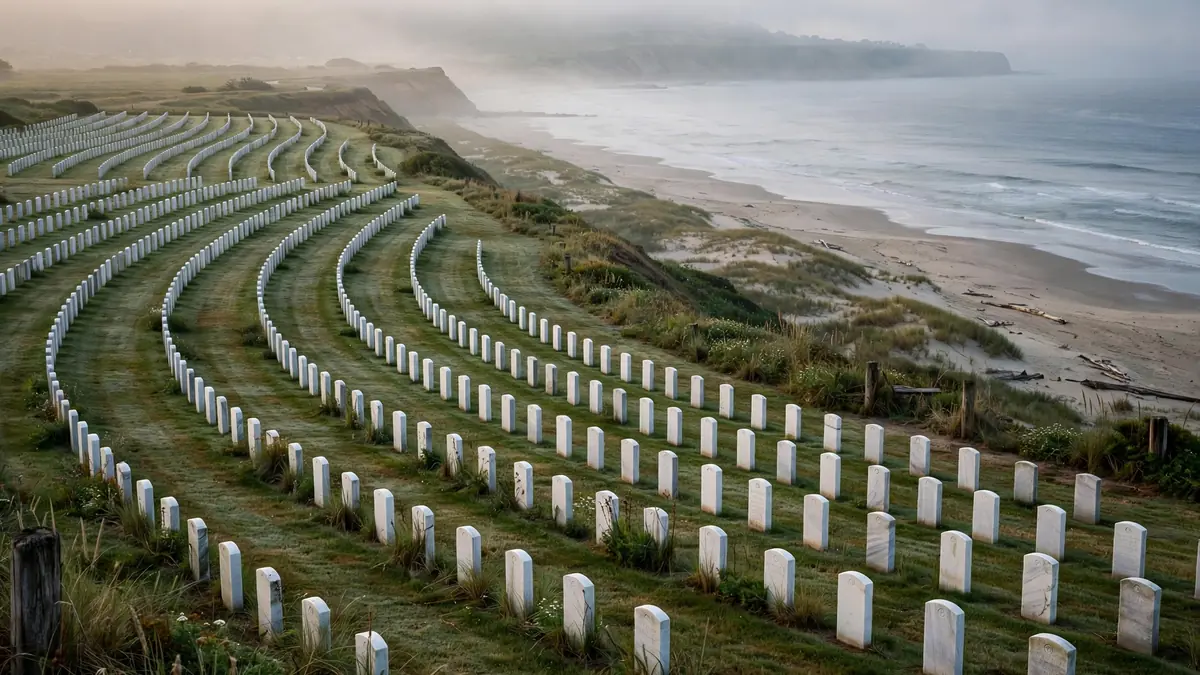
The Normandy American Cemetery stands on a bluff above Omaha Beach, at Colleville-sur-Mer, on the coast of Normandy, looking out over the English Channel. It is the most famous American war cemetery in the world: 9,388 white headstones in long, curving rows on 172.5 acres of lawn, a chapel, a reflecting pool, and a memorial with the names of 1,557 missing men on its Tablets of the Missing.
The men buried here died in the liberation of Normandy and the advance across France in 1944-45, and most of them died on, or in the days after, D-Day, 6 June 1944, when American troops landed on Omaha and Utah Beaches in the greatest amphibious invasion in history. The cemetery was dedicated on 18 July 1956, and it is administered by the American Battle Monuments Commission.
The cemetery is a place of pilgrimage for Americans and for the French, and it is visited by more than a million people each year. It is also a place that has entered the public imagination through films and ceremonies: the opening scenes of Saving Private Ryan (1998) were filmed in a replica of the cemetery, and the anniversaries of D-Day — above all the 60th and the 80th, in 2004 and 2024 — have been marked there by presidents, veterans and crowds.
This article tells the story of D-Day and Omaha Beach, of the first temporary cemetery and its transformation into a permanent one, of the men buried there and the missing named on its walls, and of what the cemetery means to France and to America today.
2. Key Facts
| What | American military cemetery and memorial of the Second World War, administered by the American Battle Monuments Commission |
| Where | Colleville-sur-Mer, above Omaha Beach, Normandy, France; 172.5 acres (about 70 hectares) |
| Buried here | 9,388 American servicemen and women |
| Missing commemorated | 1,557 American soldiers, sailors and airmen with no known grave, named on the Tablets of the Missing |
| First cemetery | Established 8 June 1944, as a temporary burial ground at Saint-Laurent-sur-Mer |
| Dedicated | 18 July 1956 |
| Architects | Harbeson, Hough, Livingston and Larson of Philadelphia; landscape architect Markley Stevenson |
| Most famous graves | Brigadier General Theodore Roosevelt Jr. and his brother, Lieutenant Quentin Roosevelt (First World War), buried side by side |
| Today | Open daily, admission free; more than a million visitors a year; visitor centre opened in 2007 |
3. D-Day and Omaha Beach
The invasion of Normandy
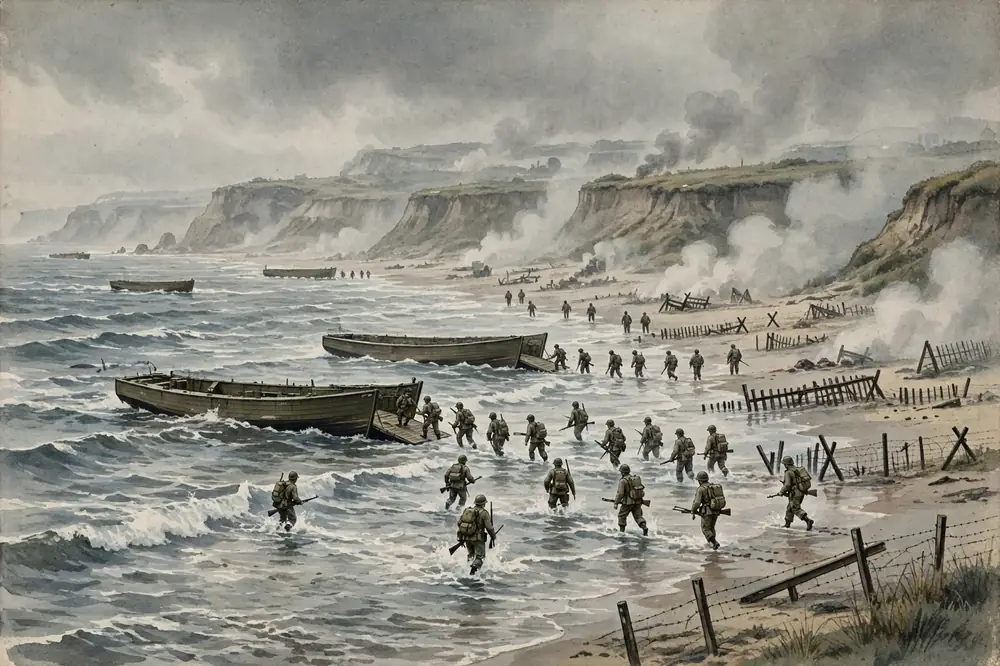
On 6 June 1944, the Allies launched Operation Overlord, the invasion of Normandy, the largest amphibious operation in history. In the early hours of the morning, more than 150,000 Allied troops crossed the English Channel in more than 5,000 ships and landing craft, supported by 11,000 aircraft, and landed on five beaches along the Norman coast: Utah and Omaha, assigned to the Americans; Gold and Sword, assigned to the British; and Juno, assigned to the Canadians.
The invasion had been planned for years, and it was commanded by General Dwight D. Eisenhower, the Supreme Allied Commander, who had to decide, in the face of uncertain weather, whether to go on 6 June or to wait. He decided to go, and the decision was one of the most consequential of the war: if the invasion had failed, the liberation of Europe would have been delayed by years, and the war might have ended very differently.
Omaha Beach
Omaha Beach was the hardest of the five beaches, and it is the beach below the cemetery. The American troops who landed there — the 1st and 29th Infantry Divisions — faced a heavily defended stretch of coast: high bluffs, minefields, barbed wire, and German guns in concrete bunkers that had been built as part of the Atlantic Wall.
The first waves were pinned down on the beach, under fire from the bluffs, and for several hours it seemed that the landing might fail. The beach was taken only by the courage and the initiative of small groups of men — engineers who blew gaps in the obstacles, infantrymen who climbed the bluffs, and officers who led from the front — and by the end of the day the Americans had established a beachhead, at a cost of about 2,000 to 2,500 casualties on Omaha Beach alone, by the most commonly cited estimates.
The men buried in the cemetery above the beach include many who died on that day, and many more who died in the fighting that followed, as the Americans advanced inland through the hedgerows of Normandy.
The breakout and the liberation
The fighting in Normandy lasted for more than two months after D-Day, and it was among the hardest of the war in the west. The Americans fought through the hedgerows — the thick, earth-banked hedges that divided the Norman fields and made every field a fortress — and through the towns of Saint-Lô and Caen, and the British and Canadians fought around Caen, until the breakout of late July 1944, when the American armies broke through the German lines and advanced across France.
Paris was liberated on 25 August 1944, and by the autumn the Allies were on the borders of Germany. The men buried at Colleville-sur-Mer died in all of these battles: on the beaches, in the hedgerows, in the towns, and in the air over Normandy.
Their dates of death, read on the headstones, run from 6 June 1944 through the summer and autumn of 1944, and into 1945, as the advance continued to the Rhine and beyond.
4. The First Cemetery
A burial ground on the battlefield
The cemetery at Colleville-sur-Mer began, like the cemetery at Hamm, as a temporary burial ground, dug in the middle of a battle. On 8 June 1944, two days after D-Day, the first American temporary cemetery in Normandy was established at Saint-Laurent-sur-Mer, just behind Omaha Beach, by the graves registration units of the First Army.
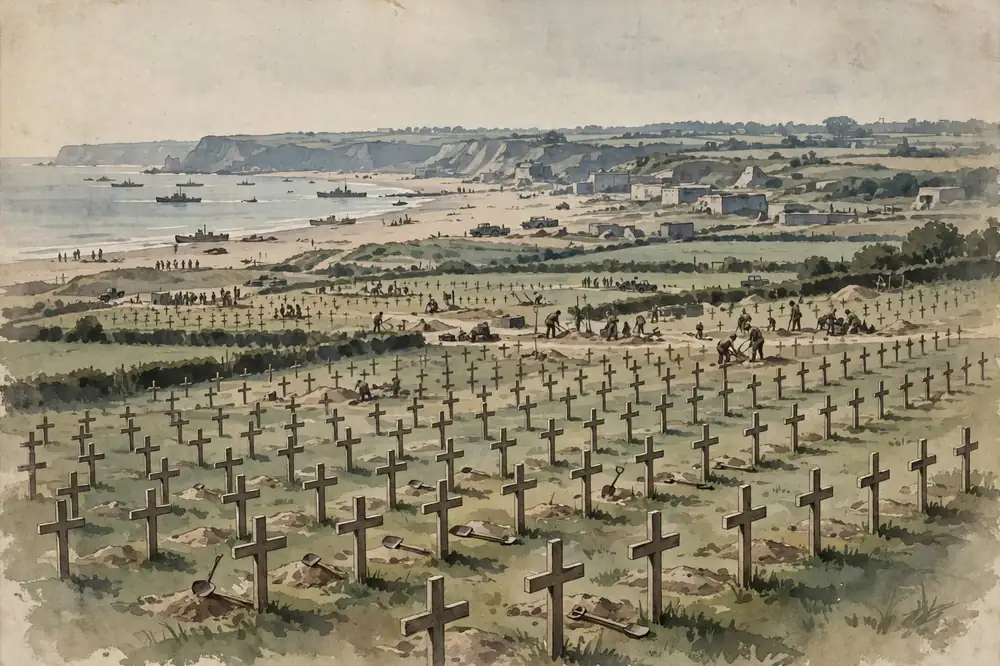
The men who dug the graves did so under fire, in ground that was still being fought over, and the first burials were of men killed on D-Day itself. The temporary cemetery grew rapidly: by the end of the summer of 1944, it held thousands of graves, and it was the largest of the many temporary cemeteries in Normandy.
The dead were buried in long rows, with wooden crosses and Stars of David, and the cemetery was marked by a simple sign. It was a place of work as much as of remembrance: the graves registration units, whose job it was to recover, identify and bury the dead, worked in Normandy for months after the fighting had moved on, and their work was essential to the creation of the permanent cemetery that followed.
The choice of the site
After the war, the American Battle Monuments Commission had to choose a site for the permanent cemetery in Normandy, and it chose the bluff above Omaha Beach, at Colleville-sur-Mer, a short distance from the temporary cemetery at Saint-Laurent-sur-Mer. The choice was deliberate: the cemetery would stand on the high ground above the beach where so many of the dead had fallen, and it would look out over the sea from which they had come.
The French government granted the United States the free use of the land in perpetuity, as it had done at Hamm, and the Commission set about the work of building the permanent cemetery. The temporary cemetery was closed, and the dead were reinterred in the new cemetery, with the exception of those whose families asked for their return to the United States.
The reinterment was completed in the early 1950s, and the cemetery was dedicated on 18 July 1956, in a ceremony attended by French and American officials and by the families of the dead.
The architects and the design
The permanent cemetery was designed by the Philadelphia firm of Harbeson, Hough, Livingston and Larson, with the landscape architect Markley Stevenson, and its design is one of the great achievements of American memorial architecture. The cemetery is laid out on a bluff of 172.5 acres, with the graves arranged in ten plots, in long, curving rows that follow the contours of the land, and with the memorial, the chapel and the reflecting pool at the eastern end, on the axis that runs from the entrance to the sea.
The design makes the most of the site: the visitor enters from the east, walks through the visitor centre and the loggia, and emerges onto the terrace above the graves, with the whole cemetery spread out below and the Channel beyond.
The headstones are of white Italian marble, in the form of Latin crosses and Stars of David, and they are set in lawns that are kept, by the Commission’s gardeners, in immaculate condition. The design is formal and classical, and it is deliberately different from the abstract memorial in Berlin: it is a cemetery that speaks in the language of order, symmetry and peace.
5. The Cemetery Today
The graves
The ten plots
The 9,388 graves at Colleville-sur-Mer are arranged in ten plots, in long rows that curve gently across the lawn, so that the cemetery reads from the terrace as a great fan of white headstones, opening towards the sea. The headstones are of white Italian marble, and they are of two kinds: the Latin cross, for the great majority of the dead, and the Star of David, for the Jewish dead.
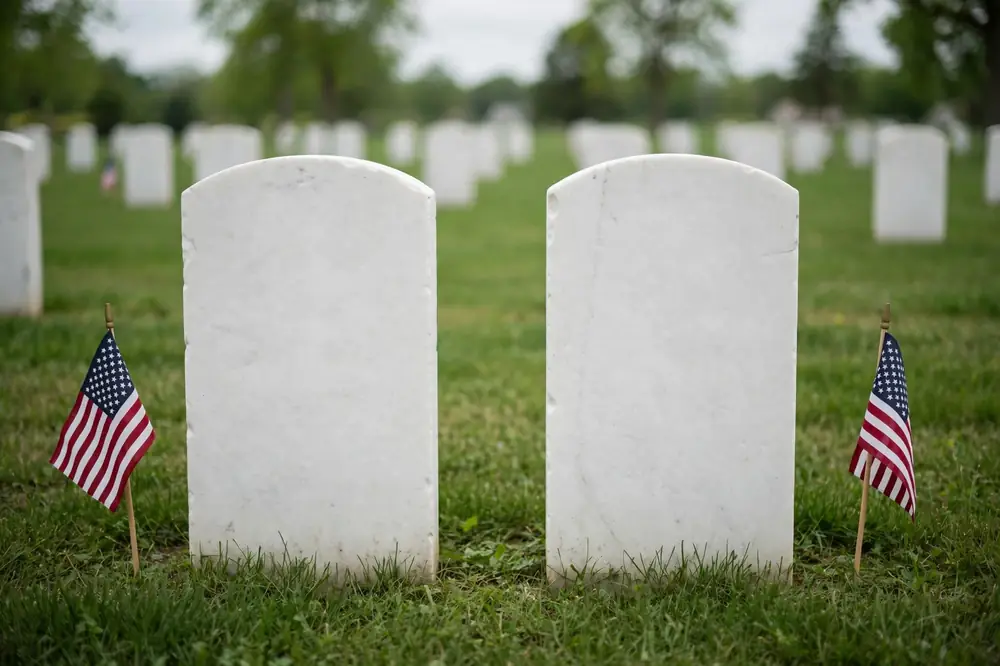
Each headstone bears the name, rank, unit, state and date of death of the person buried beneath it, and the inscriptions are carved in the same style throughout the cemetery, so that no grave is grander than another — with one exception, which is described below.
The plots are separated by paths and by low hedges, and the whole cemetery is planted with trees, so that it feels, in summer, like a park. The Commission’s gardeners, who are employed locally, keep the lawns and the flower beds in the condition that visitors expect, and the cemetery is maintained to a standard that has made it a model for the Commission’s other cemeteries.
The Roosevelt brothers
The most famous graves in the cemetery are those of the Roosevelt brothers, buried side by side in Plot D. Brigadier General Theodore Roosevelt Jr., the son of President Theodore Roosevelt and the oldest man to land on D-Day, at the age of fifty-six, came ashore on Utah Beach with the first wave, on foot and with a cane, and led his men inland.
He died of a heart attack on 12 July 1944, a month after D-Day, and he was awarded the Medal of Honor for his actions on the beach. His younger brother, Lieutenant Quentin Roosevelt, had been killed in the First World War, in 1918, as a fighter pilot over France, and his body was moved after the Second World War to lie beside his brother at Colleville-sur-Mer.
The two graves, side by side, are the most visited in the cemetery, and they are a reminder that the Second World War was not the first war in which American families lost their sons in France, and that the cemetery at Colleville-sur-Mer is the second American cemetery in Normandy, after the cemeteries of the First World War.
The memorial and the chapel
The memorial at the eastern end of the cemetery consists of a loggia, a chapel and a reflecting pool, arranged on an axis that runs from the entrance to the sea. The loggia, a roofed colonnade, bears on its walls the Tablets of the Missing, with the names of the 1,557 men whose bodies were never recovered, and maps of the D-Day operations, in bronze and in stone.
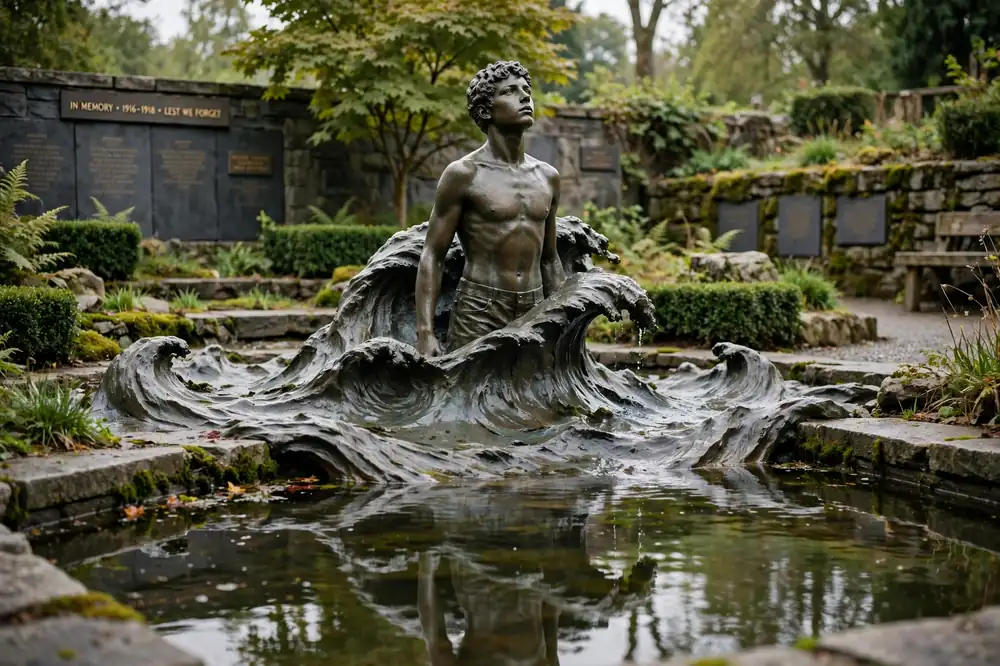
The chapel, built of pale stone, stands at the end of the reflecting pool, and its interior is decorated with a mosaic ceiling, stained-glass windows, and an altar of Italian marble. The chapel’s most famous feature is the statue in the memorial garden, the “Spirit of American Youth Rising from the Waves”, by the sculptor Donald De Lue, which shows a young man rising from the sea, his arms outstretched, in a gesture of both struggle and triumph.
The statue is the symbol of the cemetery, and it is reproduced on the Commission’s publications and on the souvenirs sold in the visitor centre. The memorial garden, with its pool and its statue, is the place where the formal ceremonies of the cemetery take place.
6. The Men Buried Here
Soldiers, sailors and airmen
The 9,388 dead at Colleville-sur-Mer come from every service and from every state of the Union. The largest group are the infantrymen who died on the beaches and in the hedgerows, but the cemetery also holds sailors from the ships that supported the invasion, airmen shot down over Normandy, engineers, medics, tank crewmen and artillerymen, and the men of the airborne divisions who dropped behind the beaches on the night of 5-6 June.
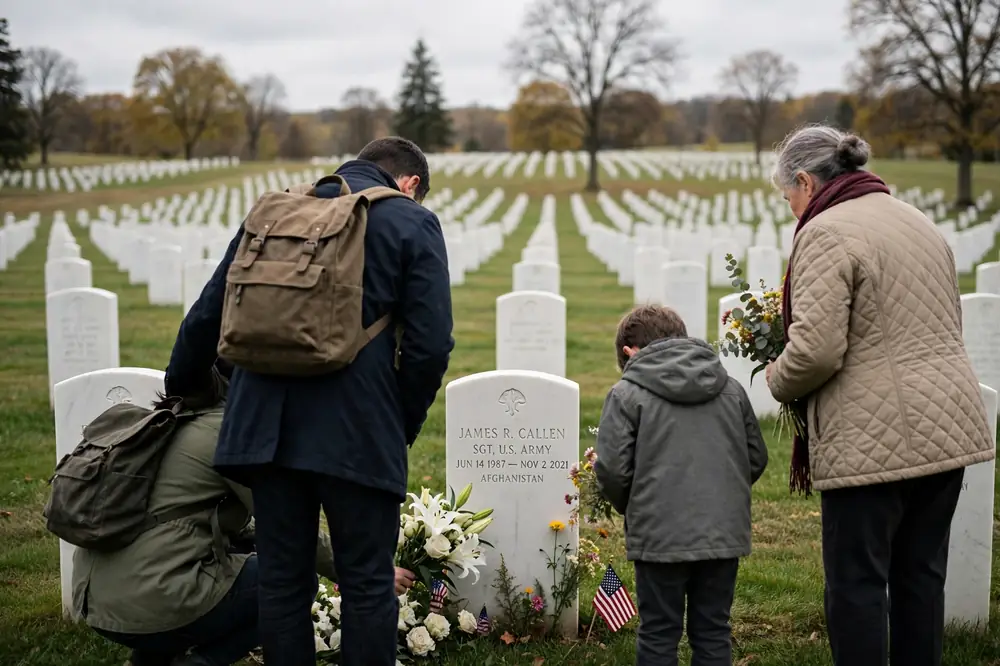
The headstones record the variety of the force that liberated Normandy: the 1st, 4th, 29th and 90th Infantry Divisions, the 82nd and 101st Airborne Divisions, the 2nd and 5th Ranger Battalions, the naval beach battalions, and the many other units that made up the First Army.
The dead include generals and privates, the young and the old, and men who had been in the army for years and men who had arrived in Europe only weeks before they were killed. Their average age was in the early twenties, and their headstones, read one by one, tell the story of a generation: the dates cluster in June and July 1944, the months of the invasion and the hedgerow fighting, and then spread through the rest of 1944 and into 1945.
Medal of Honor recipients
The cemetery holds the graves of many recipients of the Medal of Honor, the United States’ highest military decoration, and their stories are among the best known of D-Day. Among them are First Lieutenant Jimmie W. Monteith Jr., who led his men through the obstacles on Omaha Beach and was killed while directing the attack on the bluffs; Technical Sergeant Frank D.
Peregory, who single-handedly captured a German machine-gun position and killed or captured its crew; and Brigadier General Theodore Roosevelt Jr., who was awarded the medal for leading the first wave ashore on Utah Beach. There are also the graves of the two brothers buried side by side in Plot F, Preston and Robert Niland — the brothers whose story inspired the film Saving Private Ryan, in which a squad is sent to find the last surviving brother of a family that has lost its sons.
The film is a work of fiction, but the Niland brothers were real, and their graves are among the most visited in the cemetery, by visitors who have seen the film and who come to stand where the real brothers lie.
Brothers and families
Among the 9,388 burials are 38 pairs of brothers buried side by side, in adjacent graves, a reminder that the war took whole families: two brothers, killed in the same battle or in the same campaign, and buried together, as they had served together.
The cemetery also holds the graves of fathers and sons, of cousins, and of men who had enlisted together from the same small town and died together on the same beach. The Commission’s records show that the families of the dead came from every part of the United States, and that many of them visited the cemetery in the years after the war, when travel to Europe became possible again.
Today, the families who visit are often the grandchildren and great-grandchildren of the dead, who come to find a grave they have only ever seen in a photograph, and to leave a flower, a note, or a small American flag.
The cemetery’s staff help them find the grave, and the act of finding it — of touching the headstone, of taking a photograph — remains as important now as it was in 1956.
7. The Missing
The Tablets of the Missing
The Tablets of the Missing, on the walls of the loggia, bear the names of 1,557 American soldiers, sailors and airmen who died in the region and whose bodies were never recovered, or were never identified. The names include infantrymen lost in the hedgerows, sailors lost when their ships were sunk off the Norman coast, and airmen shot down over Normandy and the Channel.
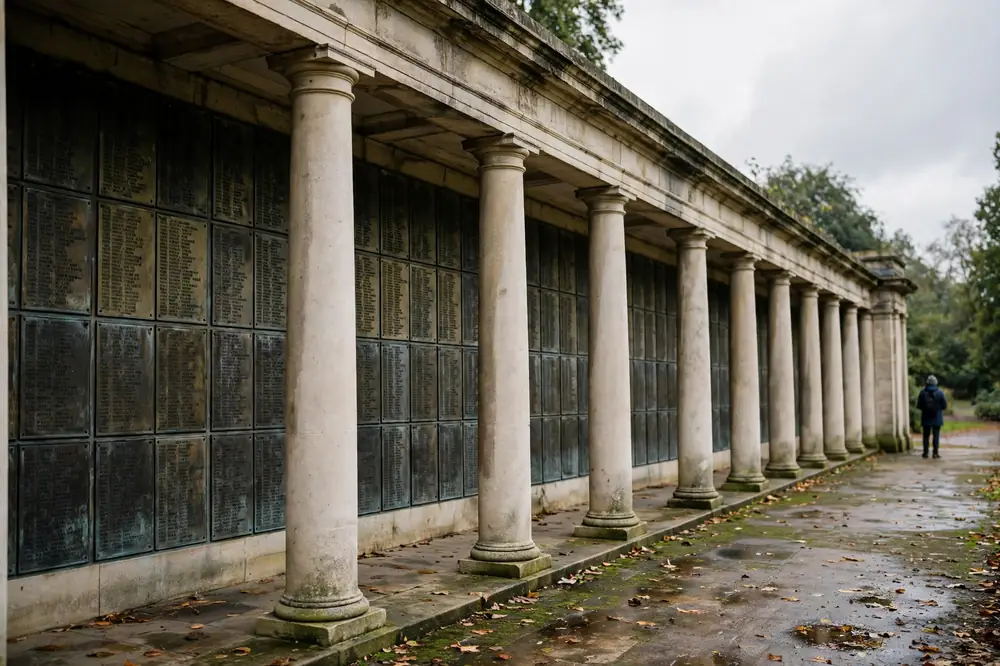
For their families, the Tablets are the only memorial they have, and the act of finding a name on the Tablets is, for many visitors, the purpose of the visit. The Commission maintains a record of the missing, and when a body is identified — as has happened, from time to time, when remains are found in Normandy — the name is marked with a bronze rosette on the Tablets, to show that the man has been found, and a headstone is erected in the cemetery.
The rosettes are a small detail, but they are one of the most moving in the cemetery, because they show that the work of finding the missing is not finished, and that it continues, eighty years after the war.
The missing and the sea
Many of the missing at Colleville-sur-Mer were lost at sea, and the cemetery’s position above the Channel is a reminder of that. The invasion fleet lost ships to mines, to German coastal guns, to E-boats and to the storm that struck Normandy on 19-22 June 1944, and the men who were lost in those sinkings often have no grave but the sea.
The Tablets include the names of sailors from the ships that were sunk off Omaha and Utah Beaches, and of airmen whose aircraft came down in the Channel, and their names are read, each year, at the Memorial Day service.
The sea below the cemetery is therefore not only a view but a grave, and the visitor who stands on the terrace and looks out over the Channel is looking at the place where many of the men named on the Tablets died.
The cemetery’s design makes that connection explicit: the axis of the cemetery runs from the entrance, through the graves, to the sea, and the statue of the Spirit of American Youth rises from the waves, as if the dead were still coming ashore.
The time capsule
In the lawn of the loggia, the Commission has buried a time capsule, sealed at the dedication of the cemetery, which is to be opened on 6 June 2044, the hundredth anniversary of D-Day. The capsule contains records of the cemetery, messages from the men who built it, and the names of the dead, and it is a reminder that the cemetery was built not only for the generation that fought the war but for the generations that would come after.
The time capsule is a small detail, and it is not visible to visitors, but it is one of the most thoughtful in the cemetery: it says that the memory of D-Day is not a matter for the past alone, but for the future, and that the men who built the cemetery trusted the future to remember what they had remembered.
When the capsule is opened, in 2044, the men who built the cemetery will be gone, and the visitors who open it will be the great-grandchildren of the generation that fought the war.
8. Visiting the Cemetery
Getting there
Location and transport
The Normandy American Cemetery stands at Colleville-sur-Mer, on the D514 coastal road, above Omaha Beach, about 15 kilometres north-west of Bayeux, the nearest town. It is reached by road, and by bus from Bayeux, and there is a car park at the entrance. The cemetery is open daily, and admission is free.
Visitors should allow at least two hours, and ideally half a day, to see the cemetery, the visitor centre, and Omaha Beach below, and to walk the paths between the plots. The cemetery is staffed by the American Battle Monuments Commission, and its staff are available to help visitors find a particular grave, using the Commission’s records and the grave locator at the entrance.
The Commission’s website also allows visitors to search for a casualty before they arrive, so that they can find the plot and the row in which a grave stands. The best time to visit is in the morning, when the light is on the graves and the cemetery is quiet, before the tour buses arrive.
The visitor centre / Trung tâm du khách
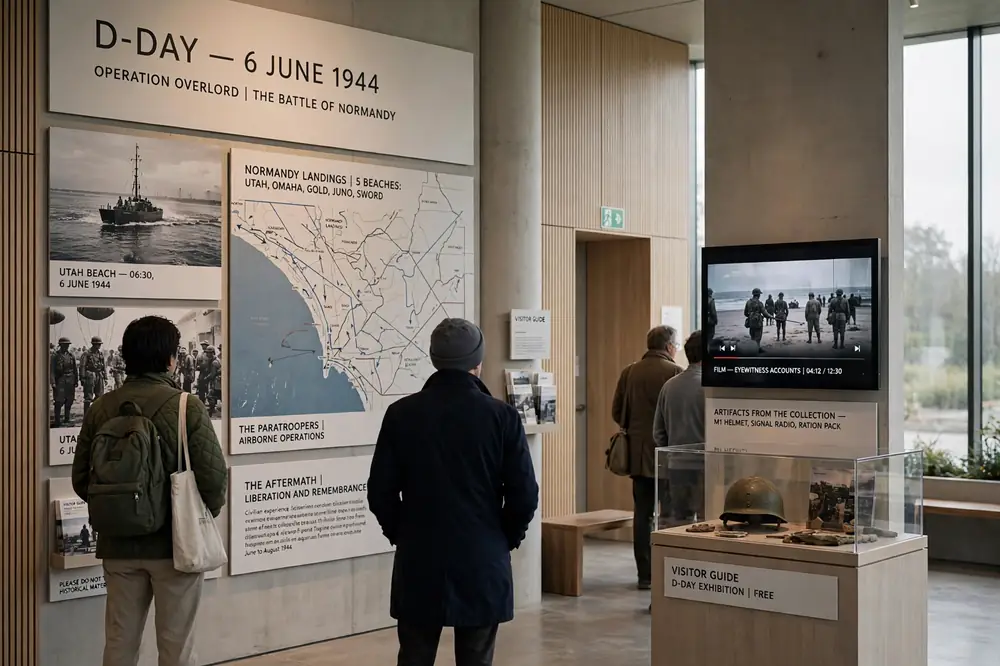
The visitor centre, opened in 2007, stands at the entrance to the cemetery, and it is the place where most visitors begin their visit. The centre tells the story of D-Day and of the men buried in the cemetery, through films, photographs, personal objects and the stories of individual soldiers, and it is designed to prepare the visitor for the walk through the graves.
The centre’s most moving exhibit is a wall of photographs of the dead, and a database in which visitors can search for a casualty and learn his story. The centre also has a shop, a bookshop, and facilities for school groups, and it is staffed by the Commission’s guides, who answer questions and lead tours.
The visitor centre is a modern building, of stone and glass, and it is deliberately modest, so that it does not compete with the cemetery itself: it is a place of introduction, not a destination, and the cemetery, not the centre, is the purpose of the visit.
Omaha Beach below
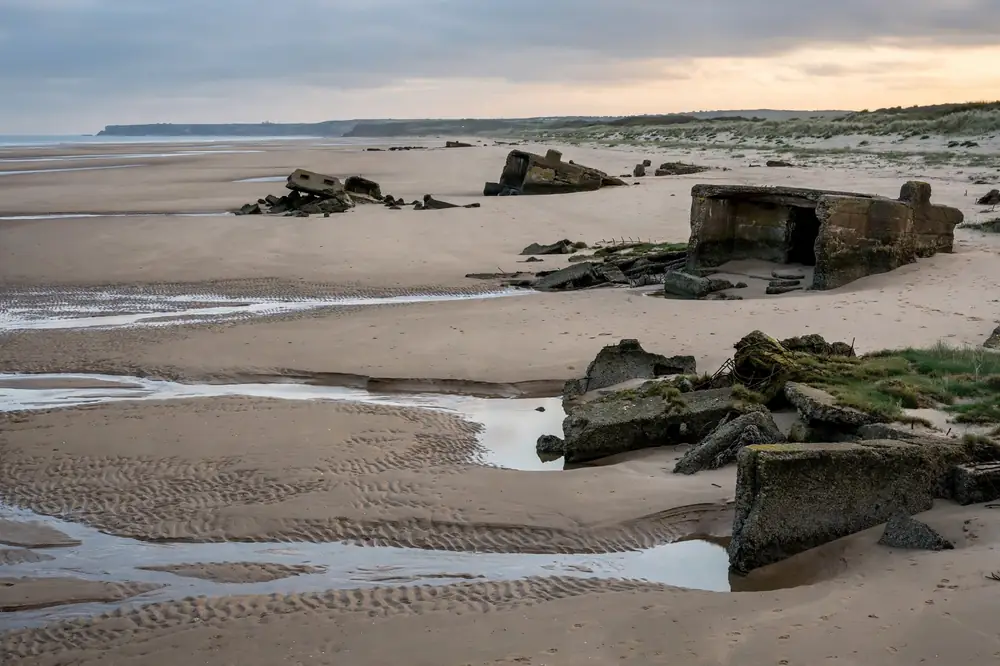
Below the cemetery, a path leads down the bluff to Omaha Beach, and many visitors walk down to the beach after visiting the graves. The beach today is quiet and beautiful, with sand, grass and the remains of the German defences — the bunkers, the gun emplacements, the obstacles — still visible at low tide.
The contrast between the beach and the cemetery above it is the heart of the visit: the beach is where the men died, and the cemetery is where they are remembered, and the walk between the two is a walk between the battle and its memory.
The beach is also the place where the scale of the invasion can be understood: standing on the sand and looking out to sea, the visitor can imagine the fleet that filled the horizon on the morning of 6 June 1944, and the men who came ashore in the first waves.
The Commission asks visitors to treat the beach with respect, and to remember that it is, in its own way, a part of the cemetery.
Behaviour and respect
The Normandy American Cemetery is a working cemetery as well as a memorial, and visitors are asked to behave with the respect due to a burial ground. The Commission asks visitors to speak quietly, not to walk on the graves, not to climb on the memorial, and not to take photographs in a way that disturbs other visitors or the ceremonies.
School groups are welcome, and the Commission provides educational material, but the site is not a tourist attraction in the ordinary sense: there is no entertainment, and the quiet of the place is part of its purpose. Visitors who come with a name to find are helped by the Commission’s staff and by the register boxes at the site, which hold the cemetery and memorial registers.
The best advice for any visitor is simple: walk slowly, read the headstones, and remember that every stone stands for a person whose family once waited for news that never came.
9. Commemoration and the 80th Anniversary
D-Day anniversaries
The anniversaries of D-Day are the great occasions of the cemetery, and they are marked there with ceremonies that bring together presidents, veterans and crowds. The 60th anniversary, in 2004, was attended by the veterans of D-Day, many of them in their eighties, who returned to Normandy for what many knew would be the last time.
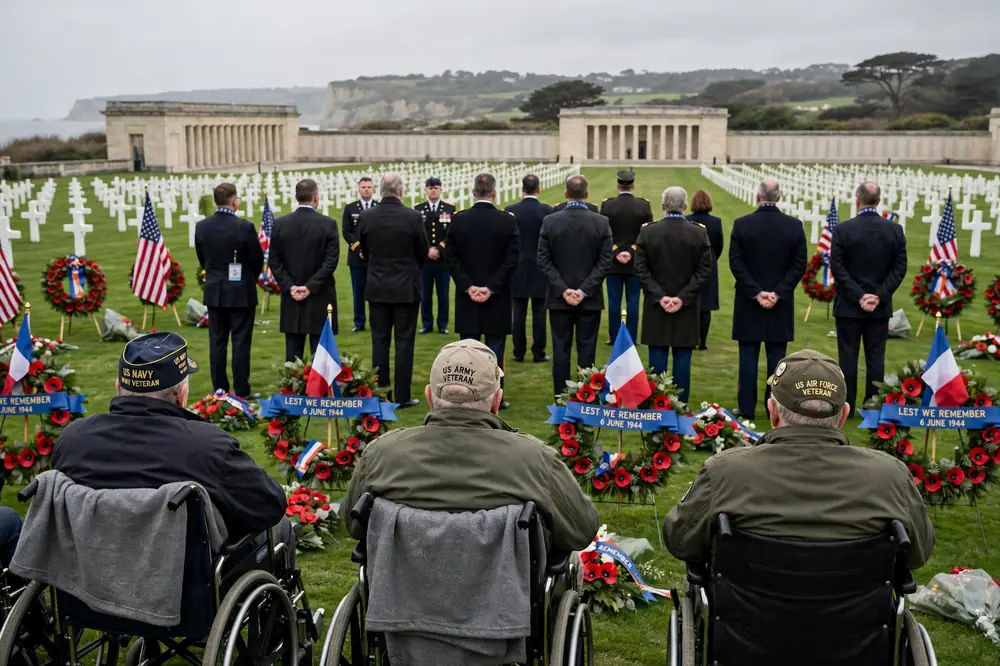
The 80th anniversary, on 6 June 2024, was attended by the presidents of the United States and France, by the veterans who were still alive — by then, only a handful, all of them more than a hundred years old — and by crowds of thousands, who came to honour the last of the generation that landed on the beaches.
The ceremonies follow a familiar pattern: the laying of wreaths, the playing of Taps, the reading of the names, and a flyover by aircraft, but their meaning changes with each anniversary, as the generation that fought the war passes away and the memory of D-Day is carried forward by those who did not fight it.
The 80th anniversary was widely described as the last great anniversary at which veterans would be present, and it was marked with a particular solemnity.
The French and the Americans
The cemetery is an American place in France, and its care is a shared responsibility of the two countries. The French government gave the land free of charge and in perpetuity, and the French people of Normandy have adopted the cemetery as their own: the families of Colleville-sur-Mer and the surrounding villages tend the graves, lay flowers, and welcome the American visitors, in a tradition that has continued since the war.
The relationship between the cemetery and the villages around it is a close one: the villages were liberated by the men buried in the cemetery, and the memory of that liberation is kept alive in the schools, in the museums, and in the ceremonies that mark the anniversaries.
The cemetery is therefore not only a place of American remembrance but a place of Franco-American friendship, and its ceremonies are attended by the leaders of both countries, who use them to reaffirm the alliance that was forged on the beaches of Normandy.
Saving Private Ryan and popular memory
The cemetery entered the popular imagination in 1998, with the release of Steven Spielberg’s film Saving Private Ryan, whose opening scenes — an old veteran visiting the cemetery, and the landing on Omaha Beach — were filmed in a replica of the cemetery built in Ireland, because the Commission would not allow filming in the real cemetery.
The film brought the cemetery, and the story of D-Day, to a new generation, and it is one of the reasons the cemetery is so widely known today. The film is a work of fiction, but the story it tells — of a squad sent to find the last surviving brother of a family that has lost its sons — is based on the real story of the Niland brothers, whose graves are in the cemetery, and the film’s power comes from the fact that its fiction is rooted in a real place and in real graves.
The cemetery’s staff have noted that many visitors come because they have seen the film, and that the film has made the cemetery a place of pilgrimage for a generation that did not live through the war.
10. Legacy
The legacy of the Normandy American Cemetery is, first, a record: 9,388 burials and 1,557 names of the missing, preserved in stone and in the records of the American Battle Monuments Commission, so that the dead of the liberation of Normandy are not forgotten.
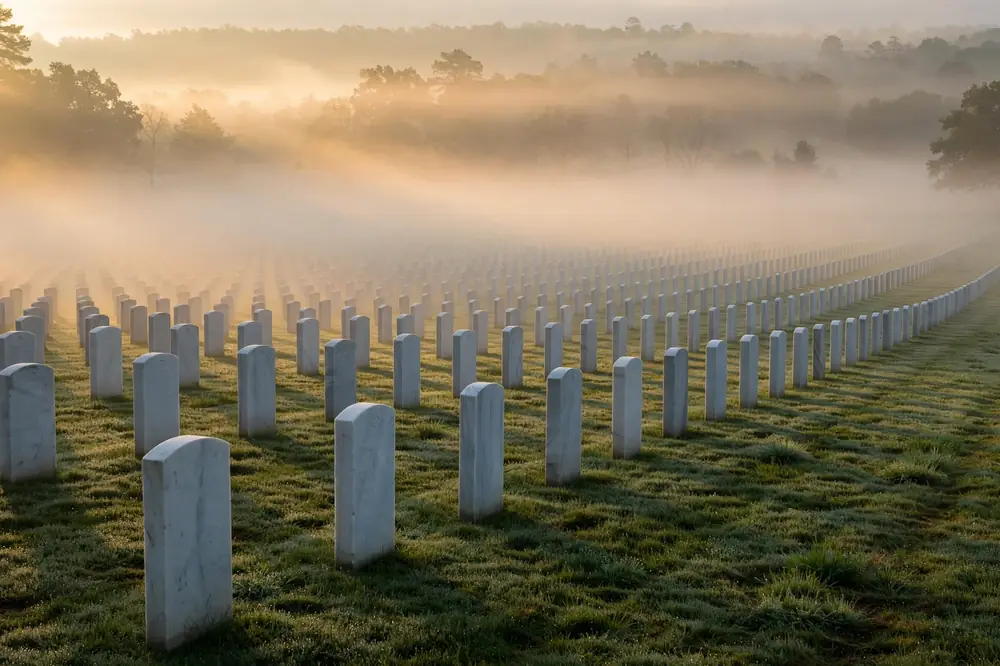
Second, it is a lesson: the cemetery stands above the beach where the liberation of Europe began, and it reminds every visitor that the freedom of Europe was bought with American lives, and that the alliance that won the war was forged in the blood of the men who landed on the beaches.
Third, it is a living bond between two countries: the United States and France, whose relationship was forged on 6 June 1944 and has been maintained ever since, in the care of the cemetery, in the adoption of the graves, and in the ceremonies that bring the two countries together each year.
The cemetery’s beauty — the curved rows of white headstones, the chapel, the reflecting pool, the statue rising from the waves — is a fitting form for that legacy, and it is the reason the cemetery is visited, remembered and loved, by more than a million people each year.
Why Normandy still matters
Normandy still matters because the questions it raises have not gone away. D-Day is still studied in military colleges as a case study in planning, in logistics, and in the courage of ordinary soldiers. The cemetery is still visited by the families of the dead, who come to find a grave or a name, sometimes three generations after the war.
And the alliance between the United States and France, which the cemetery embodies, is still a living relationship, renewed each year in the ceremonies on the terrace above Omaha Beach. As long as those questions matter, and as long as those families come, Normandy will matter, and the rows of white headstones on the bluff above Omaha Beach will continue to be visited, read and remembered, by Americans, by the French, and by all those who come to stand where the liberation of Europe began.
The cemetery asks nothing of its visitors except that they remember, and it is that simple request, repeated by every headstone, that gives the place its enduring power.
A place for the future
The cemetery was built for the generation that fought the war, but it is now a place for the future, and its future is secure: the time capsule in the loggia will be opened in 2044, the Commission will continue to care for the graves, and the visitors will continue to come, long after the last veteran has gone.
The cemetery’s task, in the future, will be the same as it is today: to remember the dead by name, to tell the story of D-Day to each new generation, and to remind the visitor that the freedom of Europe was not given but won, and that it was won by ordinary men, most of them in their early twenties, who came across the sea and did not return.
That is the legacy of the Normandy American Cemetery, and it is a legacy that will outlive the generation that built it. The cemetery will still be there in 2044, when the time capsule is opened, and it will still be there in 2144, cared for by the Commission and visited by the descendants of the men who landed on the beaches, as long as the memory of D-Day endures.
Frequently Asked Questions
How many Americans are buried at the Normandy American Cemetery?
9,388 American servicemen and women are buried at the cemetery at Colleville-sur-Mer, above Omaha Beach.
How many names are on the Tablets of the Missing?
The Tablets of the Missing bear the names of 1,557 American soldiers, sailors and airmen who died in the region and have no known grave.
When was the cemetery dedicated?
The cemetery was dedicated on 18 July 1956. The first temporary cemetery was established on 8 June 1944, two days after D-Day.
Who are the Roosevelt brothers buried there?
Brigadier General Theodore Roosevelt Jr., who landed on Utah Beach on D-Day and died on 12 July 1944, is buried beside his brother, Lieutenant Quentin Roosevelt, who was killed in the First World War in 1918.
What is the “Spirit of American Youth Rising from the Waves”?
It is a statue by Donald De Lue in the memorial garden, showing a young man rising from the sea. It is the symbol of the cemetery.
Can I visit the cemetery?
Yes. The cemetery at Colleville-sur-Mer is open daily and admission is free. A visitor centre opened in 2007, and Omaha Beach can be reached by a path down the bluff.
Related articles
Sources
- American Battle Monuments Commission, “Normandy American Cemetery” (abmc.gov) — 9,388 burials, 1,557 missing, the dedication on 18 July 1956, and visiting information.
- American Battle Monuments Commission, Normandy American Cemetery and Memorial (booklet) — the design, the architects, the chapel and the Tablets of the Missing.
- Wikipedia, “Normandy American Cemetery and Memorial” — the first cemetery of 8 June 1944, the Roosevelt brothers, and the visitor centre of 2007.
- Stephen E. Ambrose, D-Day, June 6, 1944: The Climactic Battle of World War II (Simon and Schuster, 1994) — the invasion and the fighting on Omaha Beach.
- Antony Beevor, D-Day: The Battle for Normandy (Viking, 2009) — the invasion, the hedgerow fighting and the breakout.
- Donald De Lue and the American Battle Monuments Commission, records of the memorial — the “Spirit of American Youth Rising from the Waves” statue.
- American Battle Monuments Commission, visitor centre exhibition guide — the story of D-Day and the men buried at Colleville-sur-Mer.