 WAR ATLAS MILITARY HISTORY MAGAZINE · WWI — WWII
Dwight D. Eisenhower
1. Lead
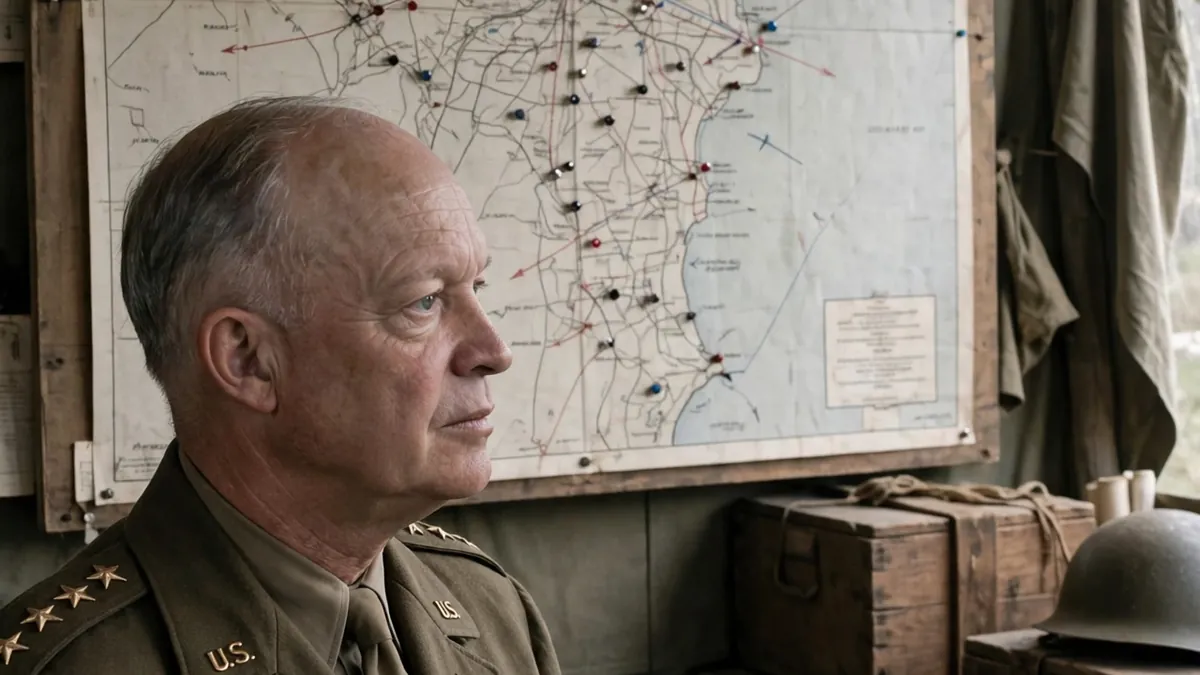
Dwight D. Eisenhower (14 October 1890 – 28 March 1969) was the American general who commanded the Allied Expeditionary Force in Europe during the Second World War and, eight years later, became the 34th President of the United States. As Supreme Commander, Allied Expeditionary Force, he bore final responsibility for Operation Overlord — the invasion of Normandy on D-Day, 6 June 1944 — the largest amphibious operation in history and the opening of the Western Front that led to the defeat of Nazi Germany.
Before Normandy he had already commanded the first great Anglo-American offensive of the war, Operation Torch in North Africa, and the invasions of Sicily and Italy. Eisenhower’s role centred on coalition command: he coordinated American, British, Canadian and Free French forces, reconciled generals and governments with differing interests, and brought them under a single command structure.
After the war he served as the first Supreme Allied Commander Europe of NATO and then as president from 1953 to 1961, ending the Korean War, building the Interstate Highway System and warning, in his farewell address, of the “military-industrial complex”.
2. Key Facts
| Born | 14 October 1890, Denison, Texas, United States (born David Dwight Eisenhower) |
| Died | 28 March 1969, Washington, D.C., United States (aged 78, congestive heart failure) |
| Nationality | American |
| Role / Office | Supreme Commander, Allied Expeditionary Force (1943–1945); General of the Army (five-star); 1st Supreme Allied Commander Europe, NATO (1951–1952); 34th President of the United States (1953–1961) |
| Known for | Commanding Operation Torch, Operation Overlord and the D-Day landings; holding the Anglo-American coalition together; ending the Korean War; the Interstate Highway System |
| Spouse / Family | Married Mamie Geneva Doud in 1916; two sons, Doud Dwight (died of scarlet fever in 1921, aged three) and John Sheldon Doud Eisenhower |
3. Early Life
Dwight D. Eisenhower was born David Dwight Eisenhower in Denison, Texas, the third of seven sons of David Jacob Eisenhower and Ida Elizabeth Stover Eisenhower, a family of Pennsylvania Dutch descent. The family soon moved to Abilene, Kansas, where Dwight grew up in a modest, deeply religious household. His mother was a pacifist, and the family home was poor but disciplined; the boys worked, studied and played hard.
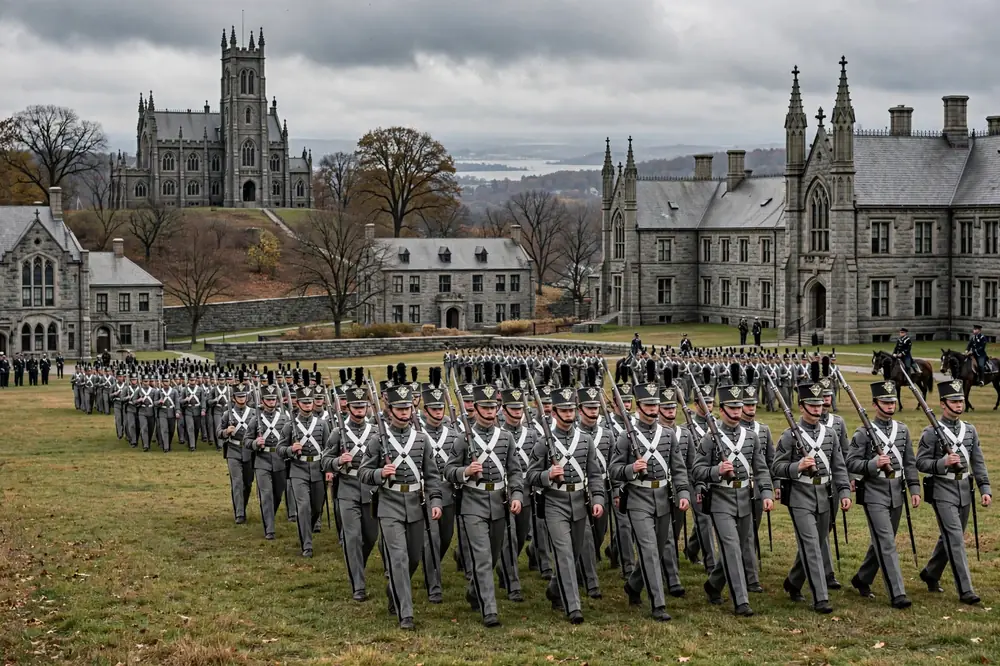
Young Dwight — called “Ike” from an early age — was a keen sportsman and a voracious reader of history, particularly military history. He graduated from Abilene High School in 1909 and worked for a year before winning an appointment to the United States Military Academy at West Point, which he entered in June 1911.
At West Point he was an outstanding football player until a knee injury in his second year ended his playing career; he became a student coach instead. Academically he was average, but he was popular, steady and good at getting on with people — qualities that would define his career.
He graduated in June 1915 as a second lieutenant, in the class that became known as “the class the stars fell on”, because 59 of its members eventually became generals, including Omar Bradley.
Eisenhower did not serve in combat in the First World War. Instead he trained tank crews at Camp Colt, Pennsylvania, and his request for overseas service was repeatedly refused. The disappointment was real, but the interwar years made him. He served in Panama, in France and in Washington, and as aide to General John J. Pershing, General Douglas MacArthur in the Philippines (1935–1939) and Chief of Staff George C. Marshall.
In 1925–1926 he graduated first in his class of 275 at the Command and General Staff School at Fort Leavenworth, a result that marked him out as one of the most promising officers of his generation. He also graduated from the Army War College in 1928. What he learned in these years was not tactics but organisation, staff work and politics — exactly the skills a coalition commander would need.
Until December 1942 he had never heard a shot fired in anger, and before 1942 he had held only one true command, a tank training centre, for less than a year.
Two assignments in the interwar years shaped him in particular. From 1927 to 1929 he served in France with the American Battle Monuments Commission under General Pershing, work that took him over the battlefields of the First World War and taught him how that war had been fought and remembered.
From 1935 to 1939 he served in the Philippines as chief of staff to General MacArthur, then the military adviser to the Commonwealth government, helping to draw up plans for a Filipino defence force with limited funds and equipment. The Philippines years were difficult: Eisenhower and MacArthur disagreed over the defence plans and over MacArthur’s working methods, and Eisenhower later described the assignment as a period of frustration.
It also gave him direct experience of working with a foreign government, of managing scarce resources, and of a theatre in which political and military questions could not be separated — experience that would be directly relevant in North Africa and in Normandy.
4. Rise to Prominence
Eisenhower’s rise was rapid, and it was built on staff work rather than battlefield reputation. In June 1941 he became chief of staff of the Third Army under Lieutenant General Walter Krueger, and his handling of the Louisiana manoeuvres — the largest peacetime exercises in American history — brought him to Marshall’s attention.
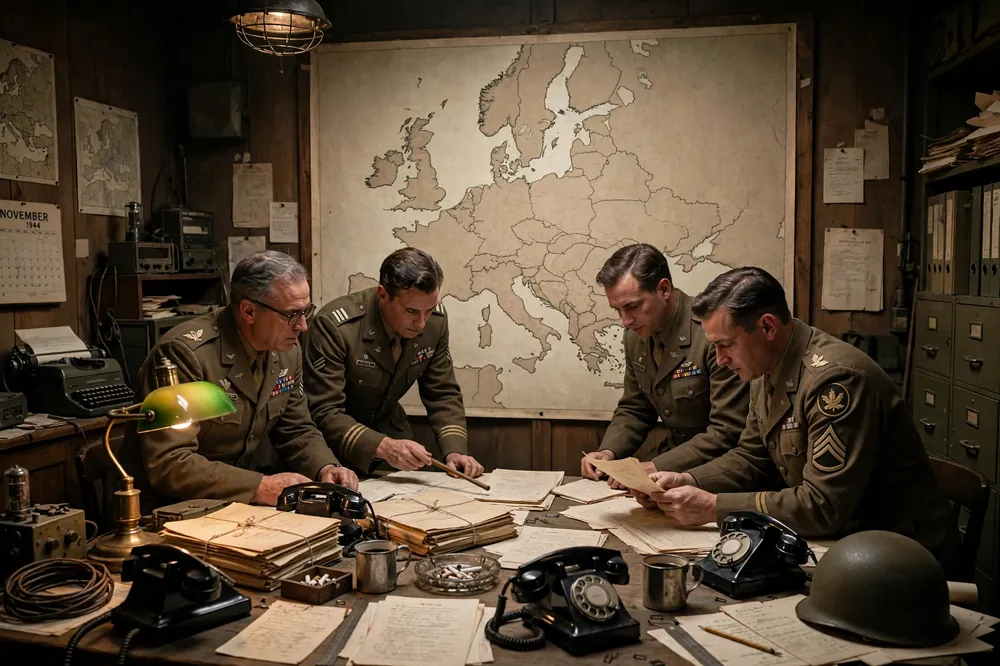
After the attack on Pearl Harbor in December 1941, Marshall brought him to Washington as chief of the War Plans Division, and then as chief of the Operations Division. In that post Eisenhower drafted the first American strategic plans for the war in Europe and argued, against the Navy’s preference for the Pacific, that Germany must be defeated first.
In June 1942 Marshall sent him to London to command all American forces in the European Theatre of Operations. Within months he was chosen to command Operation Torch, the Anglo-American invasion of French North Africa — the first major Allied offensive of the war.
The speed of the ascent is striking: in 1941 he was a colonel; by February 1943 he was a four-star general; in December 1943 President Roosevelt chose him, over Marshall himself, as Supreme Commander of the Allied Expeditionary Force for the invasion of France.
Marshall, who had been the obvious candidate, stayed in Washington as chief of staff; Roosevelt judged that Eisenhower’s experience of coalition command mattered more than Marshall’s seniority.
The appointment to command Torch was itself the result of a strategic argument. Marshall and the American planners favoured a cross-Channel invasion of France as early as 1943; the British chiefs of staff favoured operations in the Mediterranean first, arguing that the Allies were not yet strong enough for a direct assault on France. Torch — landings in French North Africa — was the compromise agreed by Roosevelt and Churchill in July 1942, after the British had argued for the Mediterranean and the Americans for a cross-Channel attack. Eisenhower’s task was to carry out a decision made above him, and to make the Anglo-American command arrangements work in practice.
5. Role in World War II
On 8 November 1942 Eisenhower commanded Operation Torch, the landing of American and British forces at Casablanca, Oran and Algiers in French North Africa. It was the first Allied offensive of the war and a political as well as a military operation: the landings were made against French colonial forces whose loyalty was uncertain, without a declaration of war.
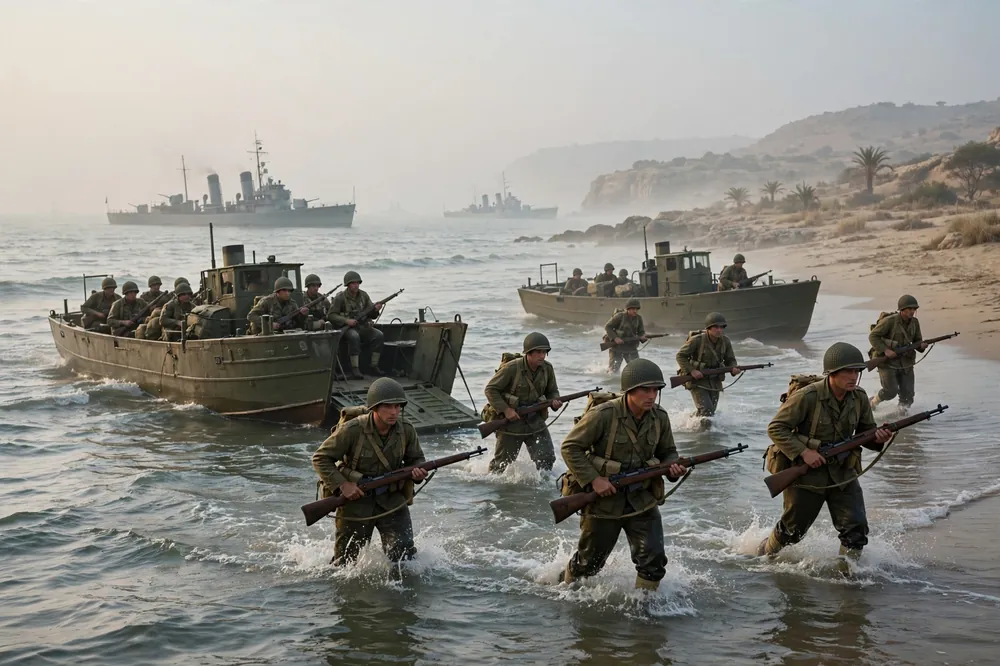
Eisenhower struck a controversial deal with Admiral Jean Darlan, commander-in-chief of the French armed forces in Africa, which quickly ended French resistance but drew fierce criticism from liberals in Britain and the United States because of Darlan’s association with the Vichy regime. The campaign then stalled: German reinforcements held Tunisia, and in February 1943 Field Marshal Erwin Rommel counter-attacked at Kasserine Pass, inflicting a serious defeat on inexperienced American troops.
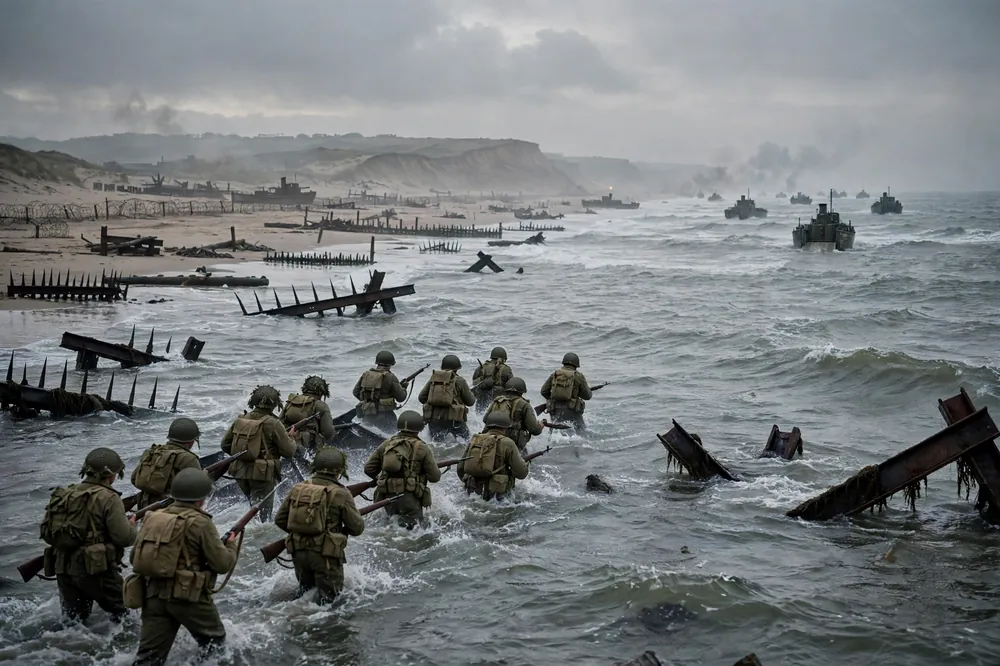
Eisenhower later accepted that the fault was partly his — he had been slow to dismiss commanders whose performance he judged inadequate, above all II Corps commander Major General Lloyd Fredendall. He replaced Fredendall with George S. Patton, and told Patton that no man should be retained in a responsible position once his ability was in doubt. The Allies recovered, and Axis forces in Tunisia surrendered in May 1943.
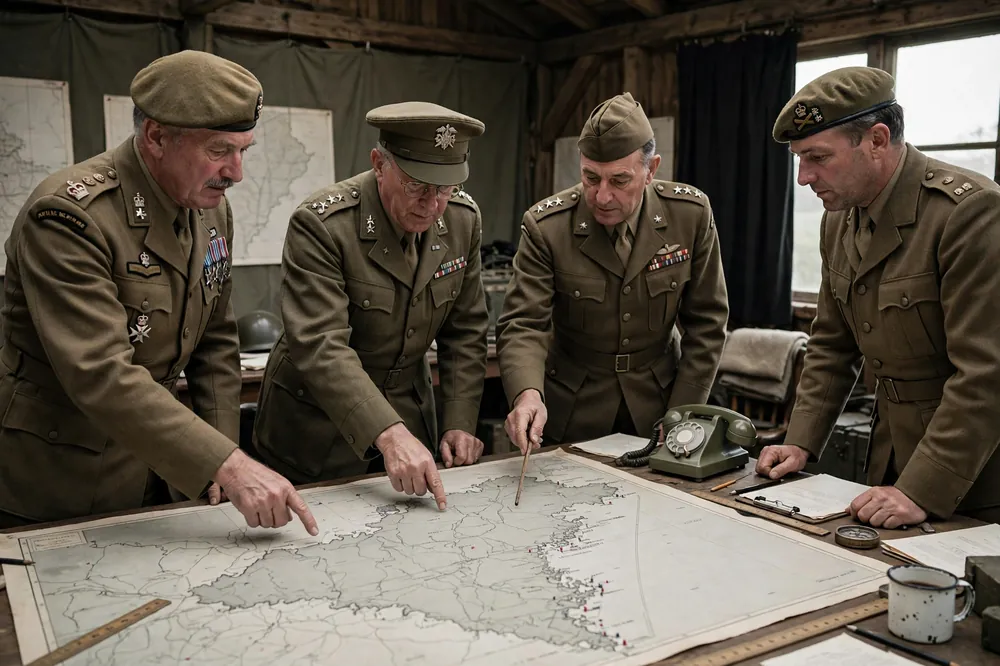
Eisenhower told Marshall that American troops had learned from the experience at Kasserine.
In July 1943 Eisenhower commanded Operation Husky, the invasion of Sicily, followed in September by the landings on the Italian mainland. Sicily fell, but much of the German garrison escaped across the Strait of Messina — a failure of Allied planning that historians still cite. The Italian campaign then bogged down in mountains and mud, and Eisenhower handed it over when he left for London.
His year in the Mediterranean had taught him the hardest lesson of coalition war: that political questions — the Darlan deal, the handling of the Italian surrender, the competing ambitions of British and American commanders — were inseparable from military ones, and that a supreme commander who could not manage allies could not win battles either.
On 24 December 1943 Roosevelt appointed Eisenhower Supreme Commander of the Allied Expeditionary Force, and in February 1944 he formally took command of SHAEF (Supreme Headquarters, Allied Expeditionary Force). His task was Operation Overlord: the invasion of Normandy, planned for the spring of 1944.
Eisenhower’s headquarters had to weld together an invasion force of more than 150,000 men landing by sea and air on 6 June 1944, supported by some 5,000 ships and 11,000 aircraft — figures that make Overlord the largest amphibious operation ever mounted.
He chose Normandy over the Pas-de-Calais, the obvious and therefore heavily defended target, and backed the deception plan, Operation Fortitude, which convinced the Germans that the main landing would come at Calais. One widely discussed decision was the one he made on the evening of 5 June: the weather was marginal, the forecast uncertain, and a postponement of 24 hours was the last possible chance before the tides turned.
After hearing his meteorologists, Eisenhower said, in words his staff remembered, “OK, let’s go.” He had also written, in advance, a short note accepting full blame if the landings failed — a note that was never needed, but which his biographers cite as the measure of the man. The landings succeeded.
Within weeks the Allies were ashore in strength, Paris was liberated in August 1944, and the armies drove toward Germany.
On 15 August 1944, six weeks after D-Day, Allied forces landed in southern France in Operation Dragoon. The operation had been debated for months: Churchill opposed it, preferring an advance through Italy and into the Balkans, while Eisenhower and the American chiefs supported it as a way of opening a second front in France and of securing the ports of Marseille and Toulon.
Eisenhower’s view prevailed, and the landings — carried out by American and French forces under Lieutenant General Alexander Patch — met limited resistance and advanced rapidly up the Rhône valley, linking up with the forces from Normandy in September. Control of the southern forces passed from the Mediterranean command to SHAEF, and from then until the end of the war Eisenhower held supreme command of all operational Allied forces on the Western Front north of the Alps.
From September 1944 Eisenhower assumed direct command of the ground forces from Field Marshal Bernard Montgomery, a move that widened the long-running argument over strategy. Montgomery wanted a single narrow thrust across northern Germany, under his command, aimed at Berlin; Eisenhower insisted on a broad-front advance, with American and British armies moving forward together on a wide front.
The dispute was never purely military: a narrow thrust led by Montgomery would have meant, in effect, letting the British run the war, which was politically impossible. Eisenhower did approve one narrow-thrust operation, Operation Market Garden in September 1944 — the airborne attempt to seize the Rhine bridges at Arnhem — which failed.
In December 1944 the Germans struck back in the Ardennes, in the Battle of the Bulge, and Eisenhower temporarily placed two American armies under Montgomery’s command on the northern flank, a decision that angered his American subordinates but made military sense. The Allies recovered, crossed the Rhine in March 1945, and in April American and Soviet forces met at the Elbe.
On 7 May 1945 the German surrender was signed at Eisenhower’s headquarters in Reims, France, and the war in Europe ended the next day. Eisenhower then served as military governor of the American occupation zone in Germany until November 1945.
The German counter-offensive in the Ardennes, which began on 16 December 1944, was the largest German operation on the Western Front after Normandy. It drove a salient into the Allied lines and surrounded American forces at Bastogne, where the 101st Airborne Division held out until relieved by Patton’s Third Army on 26 December. Eisenhower’s response included the temporary transfer of two American armies to Montgomery’s command, a decision discussed in Section 7, and a rapid redeployment of reserves. In March 1945 American troops captured the Ludendorff railway bridge at Remagen intact on 7 March, giving the Allies a bridgehead across the Rhine before the planned crossings further north.
The liberation of Paris, on 25 August 1944, was a political as well as a military decision. Eisenhower had originally intended to bypass the city, to avoid the cost of supplying its population and the destruction of street fighting, but he agreed to send the French 2nd Armoured Division under General Leclerc into the city, with American support, after an uprising by the French Resistance and a request from General de Gaulle. The decision meant that French forces entered Paris first, and it is recorded as an example of Eisenhower’s practice of giving political considerations weight in operational decisions.
6. Key Decisions
Eisenhower’s most consequential decisions were political as much as military. The Darlan deal in November 1942 traded short-term moral discomfort for an immediate end to French resistance and saved Allied lives; it was, in Stephen Ambrose’s judgement, the mark of a commander willing to take political risks.
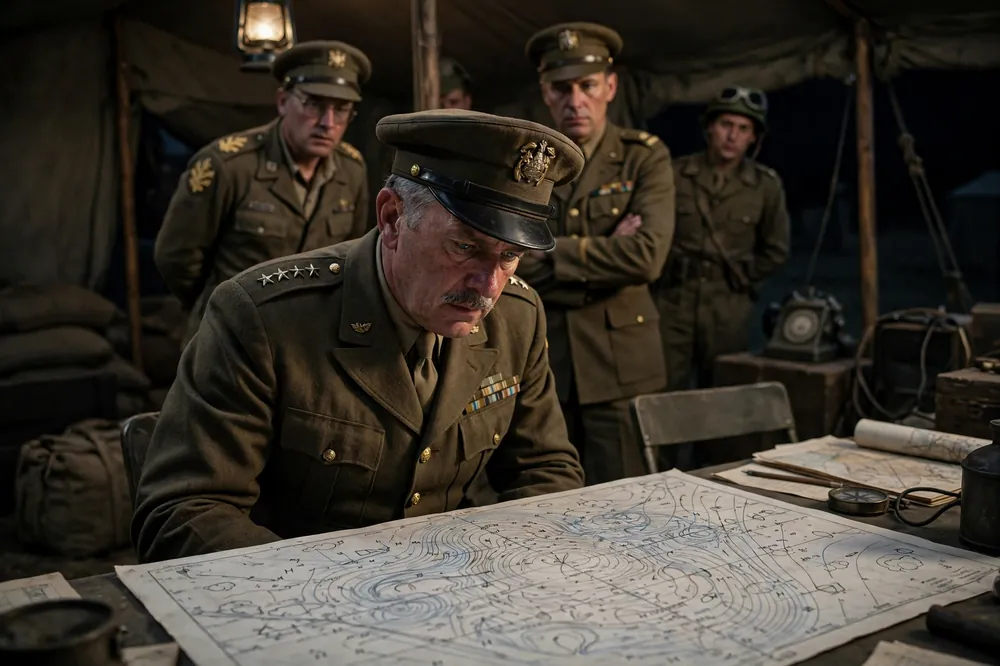
The decision to launch Overlord on 6 June 1944, on a marginal weather forecast, was a decision with major consequences for the war in the West; a postponement would have meant waiting weeks for suitable tides, and the Germans would have had more time to strengthen the Atlantic Wall.
His choice of the broad-front strategy in the autumn of 1944 kept the coalition intact at the cost, his critics say, of a slower advance and a longer war. His refusal to race the Soviets to Berlin in the spring of 1945 — he halted the Western Allies at the Elbe and left Berlin to the Red Army — was a political decision, agreed with his governments, that avoided a clash with the Soviet Union but left the German capital to Stalin.
And his decision to order Allied troops and cameramen to document the liberated concentration camps, including Ohrdruf, in April 1945, was a deliberate act of witness: he wrote to Marshall that he wanted first-hand evidence so that no one could later claim the atrocities had not happened.
A further decision concerned the organisation of his own headquarters. At SHAEF Eisenhower created an integrated staff, with British and American officers serving side by side in the same sections, rather than in separate national staffs. The arrangement was unusual for the period and it produced friction, but it meant that orders issued by SHAEF carried the authority of both nations. Eisenhower also established the practice of consulting the British and American governments before major decisions, and of recording the reasons for his decisions in writing to the Combined Chiefs of Staff, a practice that left a detailed record of his reasoning for historians.
A further decision that has been debated concerns the Falaise Pocket in August 1944, in which the German Seventh Army was encircled in Normandy. The gap between the American forces advancing from the south and the Canadian and British forces advancing from the north was not closed for several days, and a substantial part of the German force escaped eastwards across the Seine, although it left most of its heavy equipment behind.
The question of whether the gap could have been closed sooner — and whether an order by Bradley on 13 August 1944 halting the American advance at Argentan contributed to the escape — has been examined in detail by historians, and the sources do not settle it: Bradley’s stated reason was the risk of friendly fire and the danger of overextension, while his critics have argued that a more aggressive advance would have trapped the German army.
The losses inflicted on the Germans at Falaise were nevertheless heavy, and the pocket is recorded as the effective destruction of the German army in Normandy as a fighting force.
7. Controversies
Eisenhower’s record has been contested from the moment the war ended, and the controversies are worth stating plainly. The Darlan deal was denounced at the time as a bargain with a senior figure of the Vichy regime; Eisenhower’s defenders reply that it ended the fighting in North Africa in days and that Darlan was assassinated within weeks.
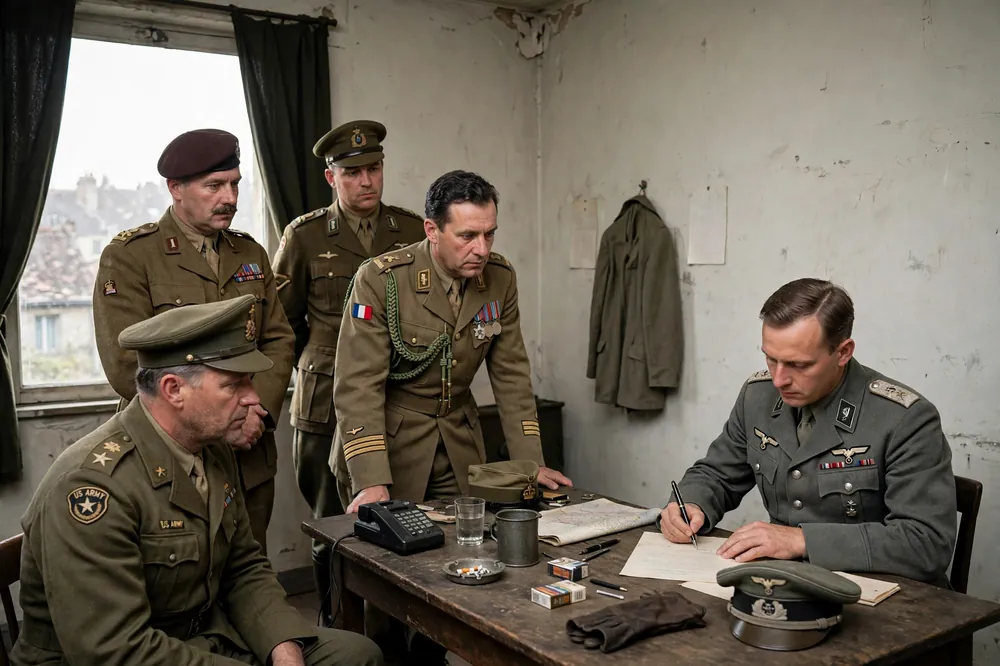
The broad-front versus narrow-front debate has never been settled: Montgomery and his supporters claimed a concentrated thrust could have ended the war in 1944, while Eisenhower’s defenders, including Carlo D’Este, argue that a narrow thrust could not have been supplied beyond the Ruhr and that it was politically impossible to let one ally run the war.
The decision to halt at the Elbe and leave Berlin to the Soviets has been criticised by some historians as a political concession to Stalin; Eisenhower’s defenders note that Berlin had already been assigned to the Soviet occupation zone at Yalta and that taking it would have cost tens of thousands of Allied lives for a city the Allies had agreed to hand over.
Another disputed claim concerns German prisoners of war after the surrender: some writers have claimed that large numbers of German prisoners died in American-run camps through deliberate neglect. Mainstream historians reject this claim as unsupported by the evidence; the deaths that did occur in the chaotic months after the surrender were, according to the historical record, overwhelmingly the result of the collapse of German infrastructure, food shortages and disease, not a policy of extermination.
Finally, Eisenhower’s handling of the Battle of the Bulge — in particular his temporary subordination of American armies to Montgomery — angered American generals, above all Omar Bradley, and the resentment lingered for years. These controversies remain part of the historical record on Eisenhower.
8. Later Life and Death
After the war Eisenhower served briefly as Chief of Staff of the United States Army (1945–1948) and as president of Columbia University (1948–1950). In December 1950 President Truman recalled him to active duty as the first Supreme Allied Commander Europe of NATO, a post he held until May 1952, building the alliance’s military structure from scratch.
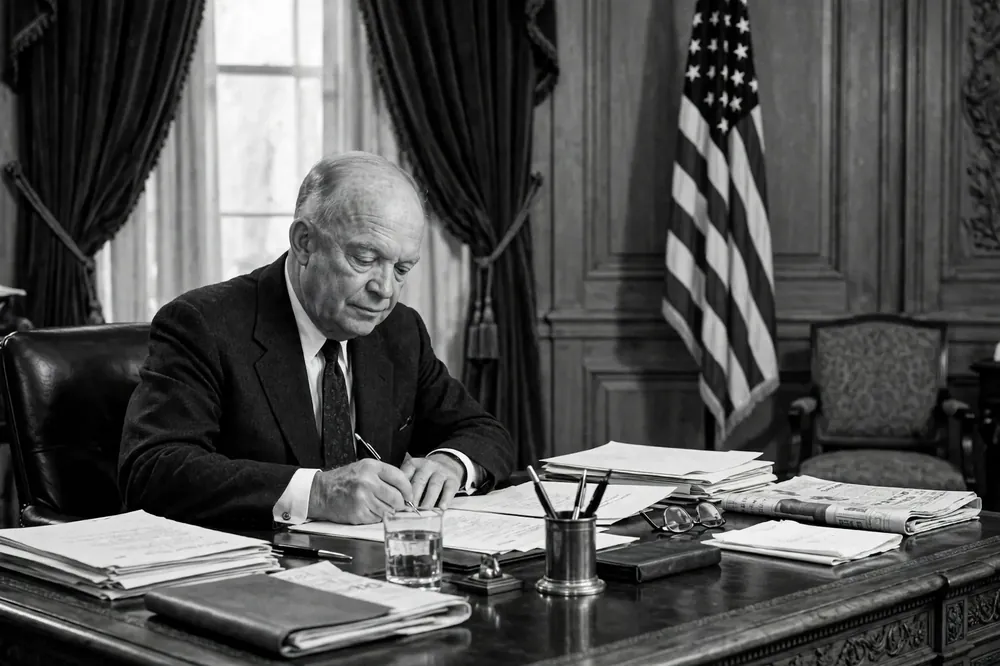
He then resigned to run for president as a Republican, and in November 1952 defeated Adlai Stevenson. He was re-elected in 1956. As president he ended the Korean War with an armistice in July 1953, pursued a policy of “massive retaliation” in the Cold War, authorised the building of the Interstate Highway System — signed into law on 29 June 1956 — and sent federal troops to Little Rock, Arkansas, in 1957 to enforce the desegregation of Central High School.
He suffered a heart attack in 1955 and a stroke in 1957, but completed two terms. On 17 January 1961, in his farewell address, he warned the nation against the acquisition of “unwarranted influence” by what he called the “military-industrial complex” — one of the most quoted passages in American political history.
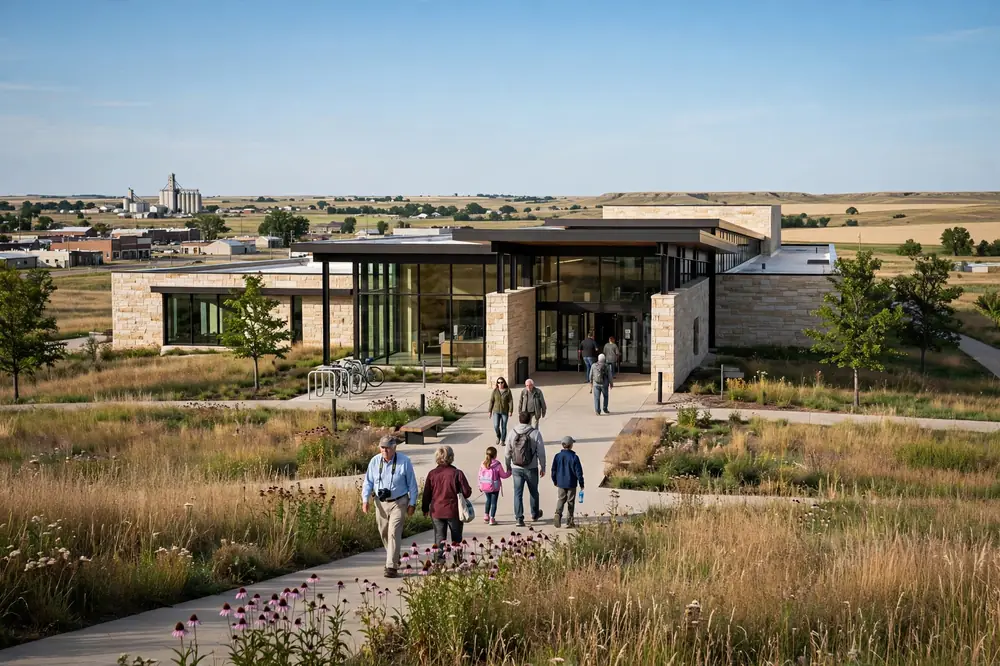
He retired to his farm at Gettysburg, Pennsylvania, wrote his memoirs, and died of congestive heart failure at Walter Reed Army Hospital in Washington, D.C., on 28 March 1969, aged 78. He was buried at the Eisenhower Presidential Library in Abilene, Kansas.
As president, Eisenhower’s foreign policy was tested by two crises in 1956. During the Suez Crisis, Britain, France and Israel attacked Egypt after President Nasser nationalised the Suez Canal; Eisenhower opposed the action, supported United Nations resolutions calling for a withdrawal, and applied economic pressure on Britain and France.
The episode placed the United States in opposition to its two closest allies, and it is recorded as a case in which Eisenhower placed the United Nations and the principle of non-intervention above the interests of the alliance. In January 1957 he set out the Eisenhower Doctrine, under which the United States would provide military and economic assistance to Middle Eastern states threatened by armed aggression.
In the same period he responded to the Soviet launch of the Sputnik satellite in October 1957 by accelerating American missile and space programmes and by signing the National Defense Education Act in 1958. In December 1953 he had delivered the ‘Atoms for Peace’ address to the United Nations, proposing the international control of atomic material for peaceful purposes.
9. Legacy
Eisenhower’s legacy is twofold, military and political, and both parts still shape the world. As a soldier he created the model of the modern coalition commander: the supreme commander as diplomat, manager and politician, whose job is to make allies fight together rather than to win battles personally. NATO, the alliance he helped to build as its first military commander, endures.
The Interstate Highway System he signed into law transformed American geography, commerce and daily life, and remains among the largest public works projects in American history. His farewell warning about the military-industrial complex has outlived the Cold War and is quoted, by left and right alike, whenever defence spending is debated. The Dwight D.
Eisenhower Presidential Library and Museum in Abilene preserves his papers, and the aircraft carrier USS Dwight D. Eisenhower (CVN-69), commissioned in 1977, still carries his name. His order to document the liberated concentration camps created a body of photographic and written evidence that has since been used in historical research on the Holocaust. Historians commonly describe his main contribution as coalition command rather than battlefield tactics.
In the military field, his tenure as the first Supreme Allied Commander Europe left an institutional legacy: the integrated command structure of NATO, with its headquarters at SHAPE, was built on the model of SHAEF, and the post he held from 1951 to 1952 remains the alliance’s senior military appointment. The Interstate Highway System, authorised in 1956, was justified at the time on grounds of national defence as well as commerce, and its construction continued for decades after he left office.
10. Assessment by Historians
Historians’ judgements of Eisenhower have risen steadily since his death. In the years immediately after the war, British critics — above all Montgomery and his biographers — portrayed him as a mediocre strategist who owed his position to political skill and American manpower. American historians of the 1950s and 1960s, writing while Eisenhower was president, often treated his generalship as a footnote to his presidency.
The reassessment began with Stephen Ambrose’s The Supreme Commander (1970) and Eisenhower: Soldier and President (1990), which argued that coalition command was itself a form of generalship, and that Eisenhower’s political and diplomatic skill was not a substitute for military ability but the military ability the job required.
Carlo D’Este’s Eisenhower: A Soldier’s Life (2002) was more critical of his early campaigns in North Africa, judging his performance at Kasserine harshly, but concluded, in D’Este’s assessment, that he adapted quickly and that by 1944 he was the commander best placed to hold the alliance together.
More recent scholarship, including Jean Edward Smith’s biography (2012), has emphasised his strategic judgement: the choice of Normandy, the deception plan, the broad-front advance and the decision to halt at the Elbe were, in this reading, sound decisions taken for sound political reasons.
Many historians today distinguish between two aspects of his record: his battlefield tactics, generally assessed as unremarkable, and his work as supreme commander, generally assessed as effective, in particular his ability to coordinate a coalition of nations and generals with differing interests into a single command.
Assessments of Eisenhower as president have followed a similar course. In the years immediately after he left office, historians often described his presidency as passive, a judgement based on his public manner and on the contrast with the more rhetorical presidencies that followed.
Later scholarship, drawing on the papers released by the Eisenhower Library, has revised that judgement: the record shows a president who worked through staff, who delegated public argument to others, and who took decisions — on the Korean armistice, on Suez, on Little Rock and on the defence budget — that were deliberate and, in the view of the historians who have made the case, consistent.
In surveys of historians ranking American presidents, Eisenhower is now usually placed in the upper tier, a position that reflects the reassessment of both his generalship and his presidency.
Frequently Asked Questions
Who was Dwight D. Eisenhower? Dwight D. Eisenhower was the American general who commanded the Allied Expeditionary Force in Europe during the Second World War, directing the D-Day landings of 6 June 1944, and later served as the 34th President of the United States from 1953 to 1961.
What was Dwight D. Eisenhower’s role on D-Day? As Supreme Commander, Allied Expeditionary Force, Eisenhower held overall command of Operation Overlord. He made the final decision to launch the invasion on 6 June 1944 despite marginal weather, and he had prepared a note accepting full responsibility in case the landings failed.
Why is Dwight D. Eisenhower famous? He is famous for commanding the largest amphibious invasion in history at Normandy, for holding the Anglo-American coalition together through the war in Europe, and for his two terms as president, during which he ended the Korean War and built the Interstate Highway System.
What did Eisenhower warn about in his farewell address? On 17 January 1961 he warned against the “unwarranted influence” of the “military-industrial complex” — the close relationship between the armed forces, the defence industry and government — a warning that remains widely quoted today.
When did Dwight D. Eisenhower die? He died of congestive heart failure at Walter Reed Army Hospital in Washington, D.C., on 28 March 1969, aged 78. He is buried at the Eisenhower Presidential Library in Abilene, Kansas.
How do historians assess Eisenhower as a general? Assessments vary. Many historians describe his battlefield tactics as unremarkable, while rating his work as supreme commander highly, in particular his coordination of allies, generals and governments with differing interests. Stephen Ambrose argued that coalition command was itself the military ability the post required; Carlo D’Este was more critical of his early campaigns in North Africa.
Related articles
Sources
- Wikipedia, “Dwight D. Eisenhower” — dates, offices, commands and career outline, cross-checked against the sources below.
- Encyclopædia Britannica, “Dwight D. Eisenhower” (britannica.com) — biography, Supreme Command and presidency.
- Dwight D. Eisenhower Presidential Library and Museum (eisenhowerlibrary.gov), National Archives — papers, farewell address (17 January 1961) and the D-Day “in case of failure” note.
- Stephen E. Ambrose, The Supreme Commander: The War Years of General Dwight D. Eisenhower (Doubleday, 1970); and Eisenhower: Soldier and President (Simon & Schuster, 1990).
- Carlo D’Este, Eisenhower: A Soldier’s Life (Henry Holt, 2002).
- Jean Edward Smith, Eisenhower in War and Peace (Random House, 2012).
- National Museum of the United States Army, “Dwight David Eisenhower” (thenmusa.org) — service record and Second World War commands.
- Stephen E. Ambrose, “Eisenhower’s Generalship”, Parameters, U.S. Army War College Quarterly, Winter 2010 (reprint of 1990) — Kasserine, the Darlan deal and the broad-front debate.
Further reading
- Stephen E. Ambrose, D-Day, June 6, 1944: The Climactic Battle of World War II (Simon & Schuster, 1994).
- David Eisenhower, Eisenhower: At War, 1943–1945 (Random House, 1986).