 WAR ATLAS MILITARY HISTORY MAGAZINE · WWI — WWII
Thomas Kinkaid
1. Lead
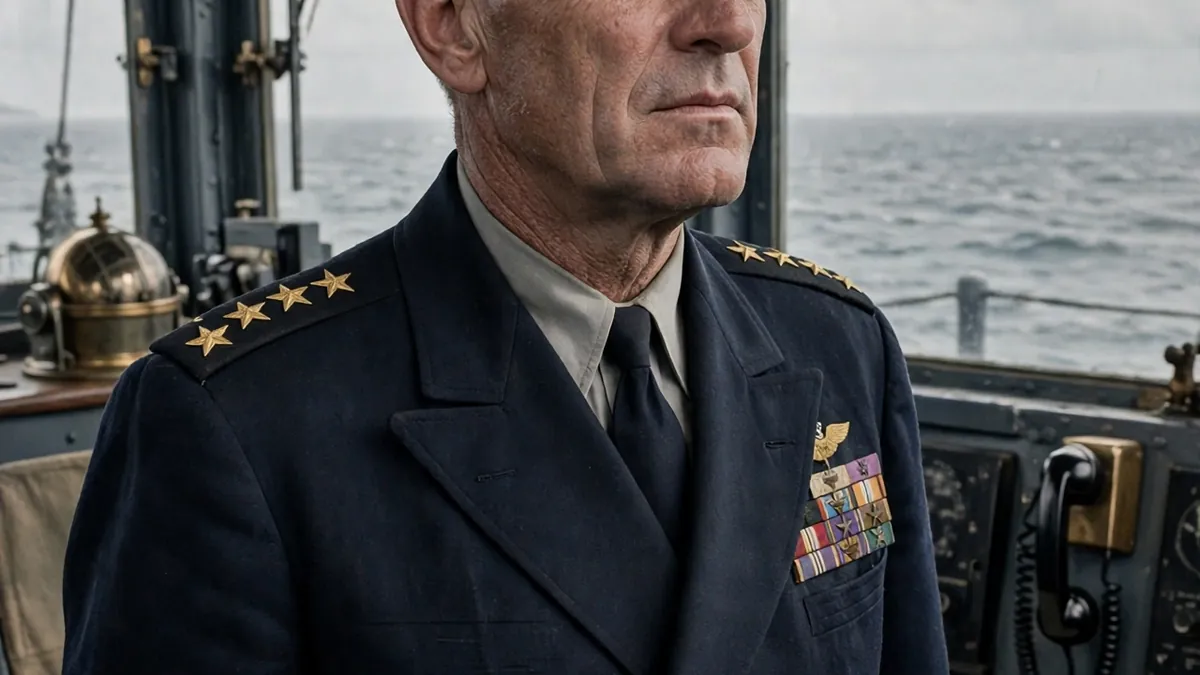
Thomas Kinkaid (3 April 1888 – 17 November 1972) was an admiral of the United States Navy whose Second World War service took him from the carrier battles of 1942 to command of the Seventh Fleet in the Southwest Pacific.
As Commander Allied Naval Forces, Southwest Pacific Area, and commander of the Seventh Fleet under General Douglas MacArthur, he directed the naval support for the Allied advance along the coast of New Guinea and the return to the Philippines. At the Battle of Leyte Gulf in October 1944 — the largest naval battle of the Second World War — his ships fought the Battle of Surigao Strait, the last naval battle between battleships, and his escort carriers held off a Japanese surface force off Samar.
Kinkaid is less widely known than the fleet commanders of the Central Pacific, but his record covers an unusual range: carrier task force command in 1942, the recapture of the Aleutian Islands in 1943, and more than two years of amphibious operations in support of MacArthur’s army.
His career is also defined by a controversy that outlived the war: the question of who was responsible for leaving the San Bernardino Strait unguarded at Leyte Gulf, a dispute in which Kinkaid and Admiral William Halsey gave different accounts.
2. Key Facts
| Born | 3 April 1888, Hanover, New Hampshire, United States |
| Died | 17 November 1972, Bethesda, Maryland, United States (aged 84) |
| Nationality | American |
| Role / Office | Admiral, United States Navy; Commander, Seventh Fleet and Allied Naval Forces, Southwest Pacific Area (1943–1945); Commander, North Pacific Force (1943) |
| Known for | Commanding Task Force 16 at the Battle of the Santa Cruz Islands; recapture of Attu and Kiska; command of the Allied fleet at the Battle of Leyte Gulf, including Surigao Strait |
| Spouse / Family | Married Helen Sherburne Ross in 1911; no children. Son of naval officer Thomas Wright Kinkaid |
3. Early Life
Thomas Cassin Kinkaid was born in Hanover, New Hampshire, on 3 April 1888, the second child and only son of Thomas Wright Kinkaid, a naval officer, and Virginia Lee Cassin Kinkaid. He grew up in a naval family, moving between naval stations, and entered the United States Naval Academy at Annapolis in 1904.
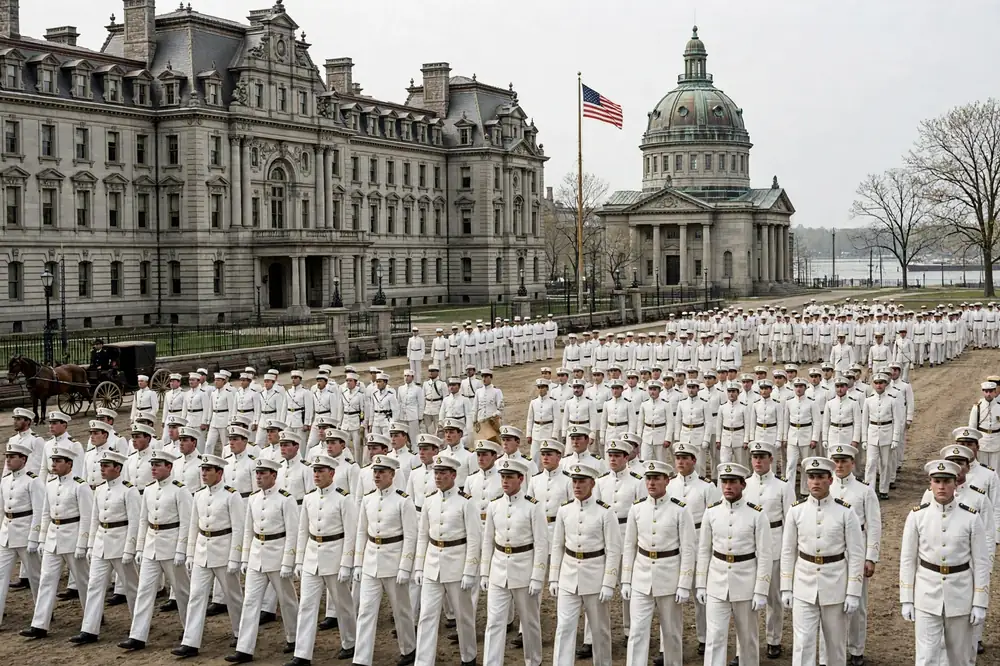
He graduated in June 1908, ranked in the lower half of his class — a fact later biographers note because it contrasts with the senior commands he eventually held. His early service followed the ordinary pattern of a junior naval officer of the period: he served aboard the battleships Nebraska and Minnesota as part of the Great White Fleet’s cruise, and developed an interest in naval gunnery, attending the ordnance course at the Naval Postgraduate School in Annapolis in 1913.
During the First World War he served on patrol duty off the east coast of the United States and later as a gunnery officer. Between the wars he served in a succession of sea and shore posts, including command of the destroyer Isherwood, service as naval attaché, and command of the heavy cruiser Indianapolis from 1937 to 1938.
In 1941 he was promoted to rear admiral and given command of a cruiser division in the Pacific. Nothing in this record suggested a future fleet commander of the first rank; what it did show was steady professional competence, experience in gunnery and in command at sea, and a reputation for calm, methodical work.
Two interwar assignments are worth recording. He was executive officer of the battleship Colorado when the Long Beach earthquake struck in 1933, and he took part in the relief efforts that followed. He received his second command in 1937, the heavy cruiser Indianapolis, which he commanded until 1938. From 1938 to 1941 he served as naval attaché in Italy and then in Yugoslavia, posts that gave him direct experience of European politics in the years before the war. He had graduated from the Naval War College in 1930, and by 1941 he held the rank of rear admiral.
4. Rise to Prominence
Kinkaid’s rise came through the carrier battles of 1942, in which he held commands of increasing responsibility at a time when the United States Navy was losing ships and officers faster than it could replace them. In the first months of the Pacific War he commanded a cruiser division screening the carriers.
At the Battle of Midway in June 1942 he commanded the cruiser screen of Task Force 16 under Rear Admiral Raymond Spruance. In September 1942 he was given command of Task Force 16 itself, built around the carriers Enterprise and Hornet, and in October he led it at the Battle of the Santa Cruz Islands.
The battle was a tactical defeat for the United States — Hornet was sunk and Enterprise was damaged — but Japanese naval aviation also suffered heavy losses in aircrew that it could not readily replace, and the Japanese land offensive on Guadalcanal, which the battle was meant to support, failed. After Santa Cruz, Kinkaid was transferred to the North Pacific.
On 4 January 1943 he took command of the North Pacific Area, and in that post he directed the recapture of Attu in May 1943 and the occupation of Kiska in August 1943. The Kiska landing was unopposed: Japanese forces had already evacuated the island under cover of fog, a fact American intelligence had not established.
The Attu operation, by contrast, was fought against a Japanese garrison that resisted until it was destroyed. On 26 November 1943 Kinkaid was transferred again, this time to the Southwest Pacific, to replace Vice Admiral Arthur Carpender as Commander Allied Naval Forces and commander of the Seventh Fleet under MacArthur — the post he would hold for the remaining two years of the war.
Kinkaid had already seen carrier battle before Santa Cruz. At the Battle of the Coral Sea in May 1942 he commanded the screening cruisers and destroyers of the two American carriers, and for his part in the battle he was awarded the Navy Distinguished Service Medal. At the Battle of the Eastern Solomons on 24 August 1942 he was again with the carriers, aboard Enterprise. These actions gave him more experience of carrier warfare than most American flag officers of the period, and they explain why he was given command of Task Force 16 in September 1942.
5. Role in World War II
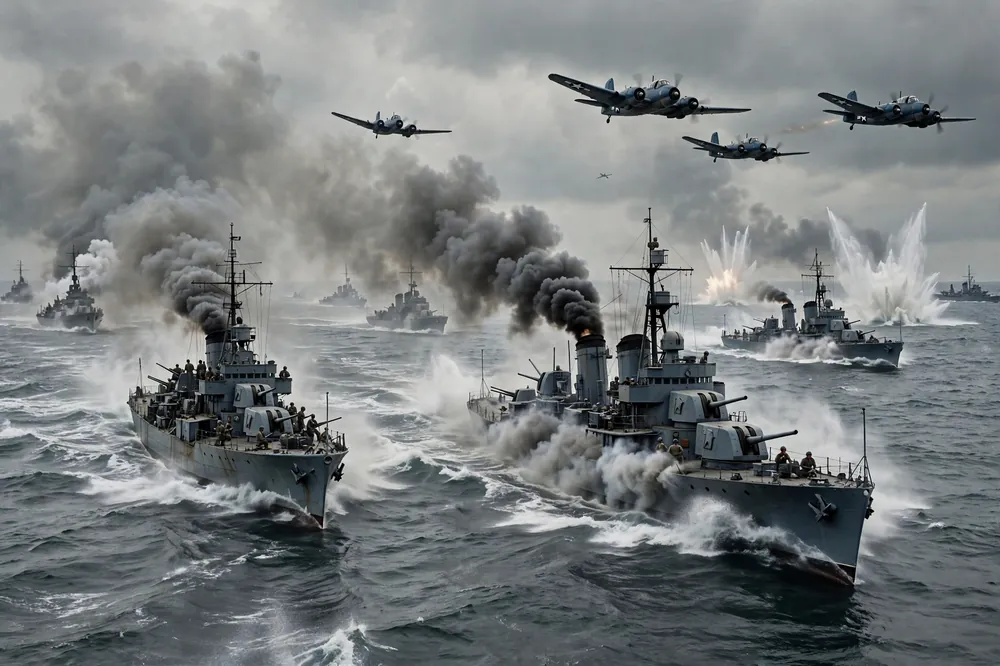
Kinkaid’s first major test as a task force commander came at the Battle of the Santa Cruz Islands on 26–27 October 1942. His Task Force 16, with Enterprise and Hornet, engaged a numerically superior Japanese carrier force under Vice Admiral Nagumo.
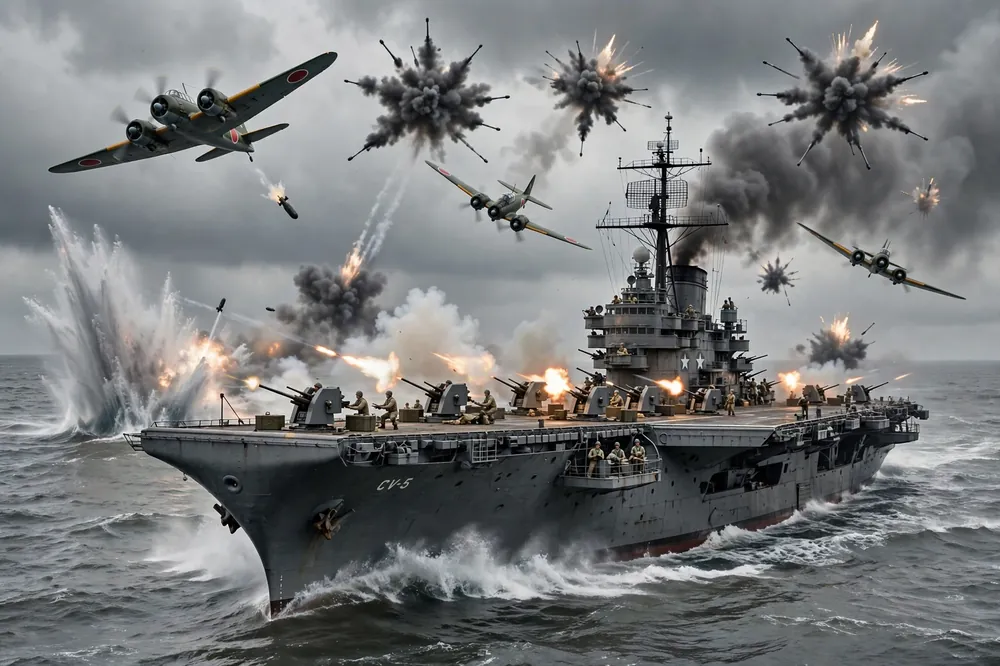
The American carriers launched strikes that damaged the Japanese carriers Shōkaku and Zuihō, but Japanese aircraft struck back: Hornet was hit by bombs and torpedoes and, after attempts to save her failed, was abandoned and later sunk by Japanese destroyers; Enterprise was damaged by bombs. The United States was left, for a time, with no operational fleet carrier in the South Pacific.
The battle is usually described as a Japanese tactical victory and an American strategic success, because the Japanese lost a large number of trained aircrew and were unable to exploit the victory on land at Guadalcanal. Kinkaid’s handling of the battle has been examined in detail by historians: his carriers were outnumbered, his air groups were still learning carrier warfare, and the loss of Hornet was the result of Japanese air attack rather than a single error of command.
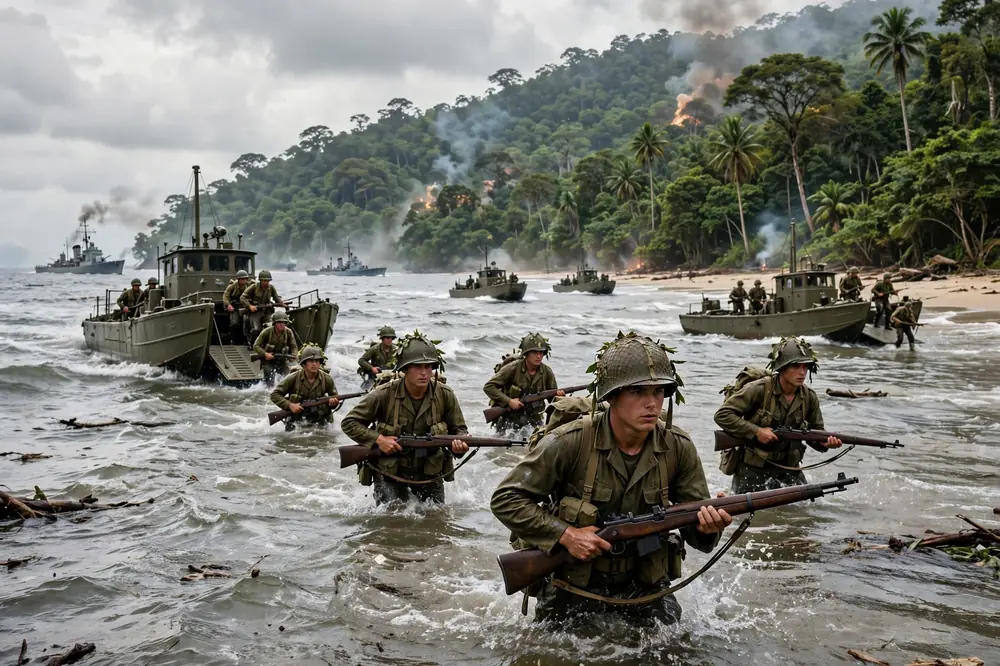
The engagement nevertheless marked the end of his carrier command; his next assignment, in the North Pacific, was a different kind of war.
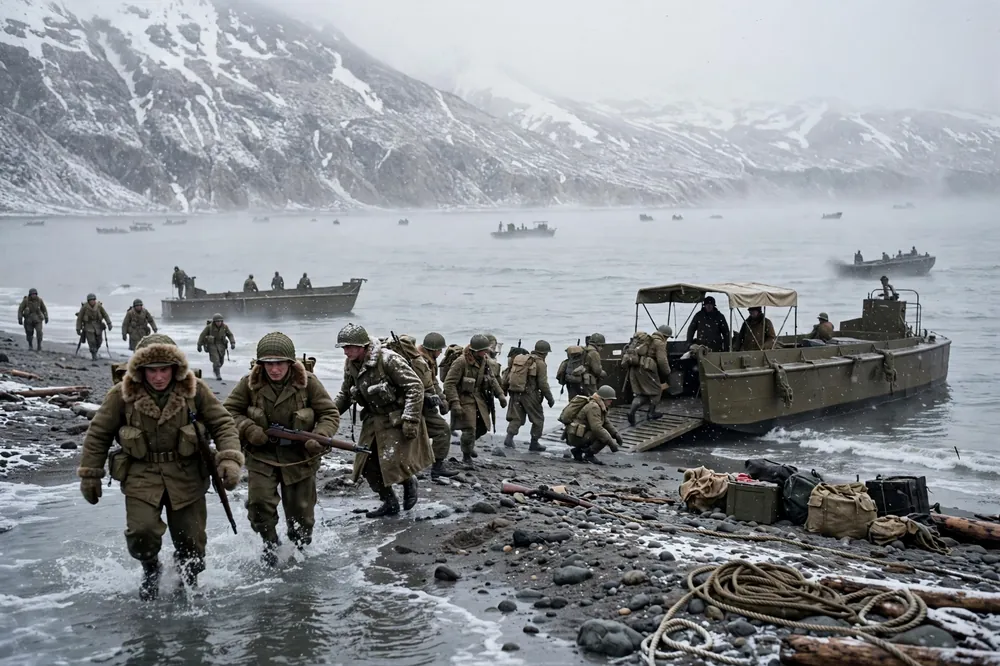
In the North Pacific, Kinkaid commanded the operation to retake the Aleutian Islands of Attu and Kiska, which Japanese forces had occupied in June 1942. The campaign was fought in difficult weather, over terrain with little cover, and with long and exposed supply lines.
Attu was invaded on 11 May 1943; the Japanese garrison of about 2,600 men resisted for more than two weeks, and the fighting ended on 29–30 May with the destruction of the garrison, including a final large-scale counterattack in which most of the remaining Japanese troops were killed.
American casualties were heavy relative to the size of the force engaged: more than 500 killed and more than 1,000 wounded, with many more evacuated for cold injuries and disease. Kiska was invaded on 15 August 1943 by a joint American–Canadian force, which landed to find the island empty; the Japanese garrison had been evacuated by sea in late July under fog, without American knowledge.
The Aleutian campaign had limited strategic value — the islands were remote and the Japanese occupation had posed no direct threat to the American mainland — but it ended Japanese control of American territory, which was the political reason for undertaking it. For Kinkaid it was a successful, if costly, independent command, and it brought him to MacArthur’s attention as a commander who could manage amphibious operations.
The Aleutian campaign also included the Battle of the Komandorski Islands on 27 March 1943, a daylight surface action south of the Soviet Komandorski Islands. An American force under Rear Admiral Charles McMorris, consisting of one heavy cruiser, one light cruiser and four destroyers, intercepted a Japanese convoy bound for the Aleutians, escorted by two heavy cruisers, two light cruisers and four destroyers under Vice Admiral Hosogaya. The American force was outgunned, and the heavy cruiser Salt Lake City was damaged, but the Japanese escort turned back and the convoy did not reach its destination. Kinkaid, as commander of the North Pacific Area, directed the operation from a distance and was not personally present at the battle.
From November 1943 Kinkaid commanded the Seventh Fleet — often called “MacArthur’s Navy” — directing United States and Royal Australian Navy forces in support of the advance along the northern coast of New Guinea. The Seventh Fleet of this period was not a fleet of battleships and fleet carriers; it was an amphibious force, built around landing ships, escort carriers, cruisers and destroyers, whose task was to put MacArthur’s army ashore, keep it supplied, and provide gunfire support.
Between December 1943 and mid-1944 Kinkaid’s ships supported a series of leapfrogging landings — at Arawe, Cape Gloucester, Saidor, the Admiralty Islands, Hollandia, Wakde, Biak and Noemfoor — each of which bypassed Japanese strongpoints and shortened the advance toward the Philippines. The work was repetitive, dependent on close coordination with the Army and with the Army Air Forces, and exposed to Japanese air attack.
Kinkaid’s reputation in this period rested on that coordination: he worked directly with MacArthur and his staff, accepted the army’s operational priorities, and built a fleet organisation suited to amphibious warfare rather than to fleet battle. The record of these operations is one of steady advance with comparatively limited losses, achieved against Japanese forces that were increasingly short of supplies, aircraft and shipping.
Kinkaid’s best-known action came at the Battle of Leyte Gulf, 23–26 October 1944, fought around the American landings on Leyte in the Philippines on 20 October. The battle was in fact four separate engagements. Kinkaid’s Seventh Fleet had two tasks: to support the landings, and to guard the southern approaches to Leyte Gulf.
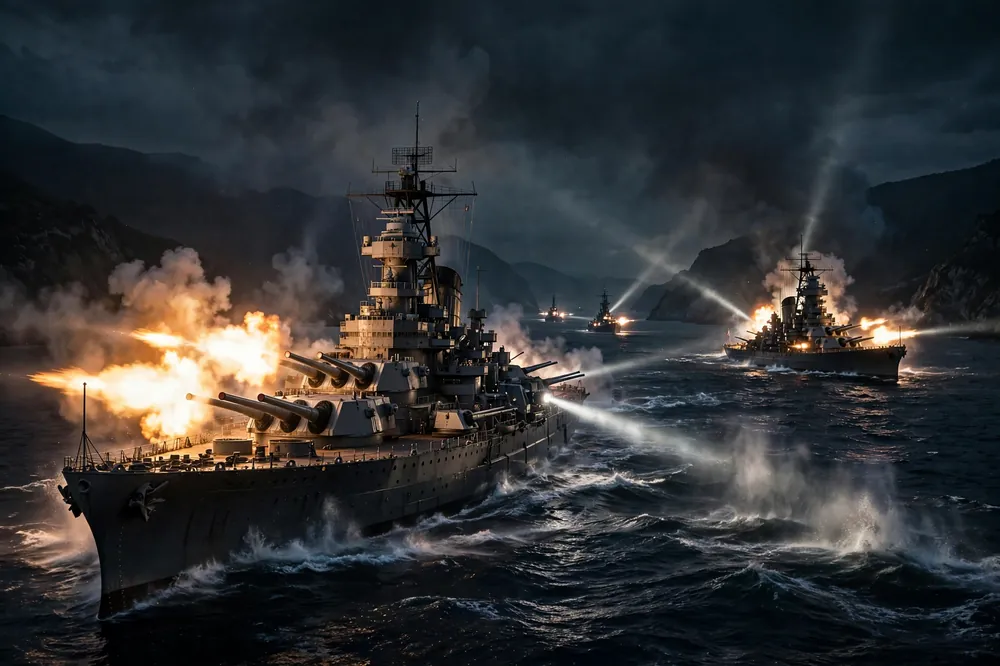
Admiral Halsey’s Third Fleet, with the fast carriers and fast battleships, was to guard the northern approaches and to destroy the Japanese fleet if it appeared. On the night of 24–25 October, Kinkaid’s old battleships under Rear Admiral Jesse Oldendorf met the Japanese Southern Force under Vice Admiral Nishimura in Surigao Strait and destroyed it; a second Japanese force under Vice Admiral Shima turned back.
This was the last naval battle between battleships. Meanwhile, the Japanese Northern Force under Admiral Ozawa, built around carriers with few aircraft, drew Halsey northward, away from Leyte. Halsey took his whole fleet north in pursuit, leaving the San Bernardino Strait — the northern entrance to Leyte Gulf — unguarded.
On the morning of 25 October the Japanese Centre Force under Vice Admiral Kurita, which had passed through the strait during the night, appeared off Samar and attacked the escort carriers of Rear Admiral Clifton Sprague’s Task Unit 77.4.3 (“Taffy 3”). The escort carriers and their destroyer screen fought a prolonged action against a much heavier surface force; Kurita eventually withdrew, for reasons that remain a subject of historical debate.
Kinkaid, who had expected Halsey to be guarding the strait, sent a series of urgent messages requesting support; Halsey’s response was delayed, in part by a communications failure involving the famous “the world wonders” padding added to a message from Nimitz.
The battle ended in an American victory, but at a cost: the escort carrier Gambier Bay and three destroyers and destroyer escorts were sunk off Samar, and the Southern Force was destroyed at Surigao Strait. The Japanese Navy, as an effective fleet, did not recover from Leyte Gulf.
After Leyte, Kinkaid’s Seventh Fleet supported the remaining operations of the Philippines campaign: the landings on Mindoro in December 1944 and at Lingayen Gulf on Luzon on 9 January 1945, and 27 further assault landings in the Philippines and three in Borneo during 1945, according to the fleet’s own records. He was promoted to full admiral on 3 April 1945 — his 57th birthday.
In September 1945 he directed the landing of American occupation forces in China and Korea. He remained commander of the Seventh Fleet until November 1945. The scale of this amphibious record is the basis for the statement, made in the Pacific War Online Encyclopedia, that Kinkaid commanded more amphibious operations than any other commander in history — a claim that reflects the count of landings his fleet supported rather than a comparison that can be verified against every other commander of the war, and it should be read in that light.
6. Key Decisions
Three decisions define Kinkaid’s command record. The first was his handling of Task Force 16 at Santa Cruz in October 1942, where he accepted battle against a larger Japanese carrier force rather than withdrawing; the result was the loss of Hornet, but also heavy Japanese aircrew losses that limited Japan’s ability to contest Guadalcanal from the air.
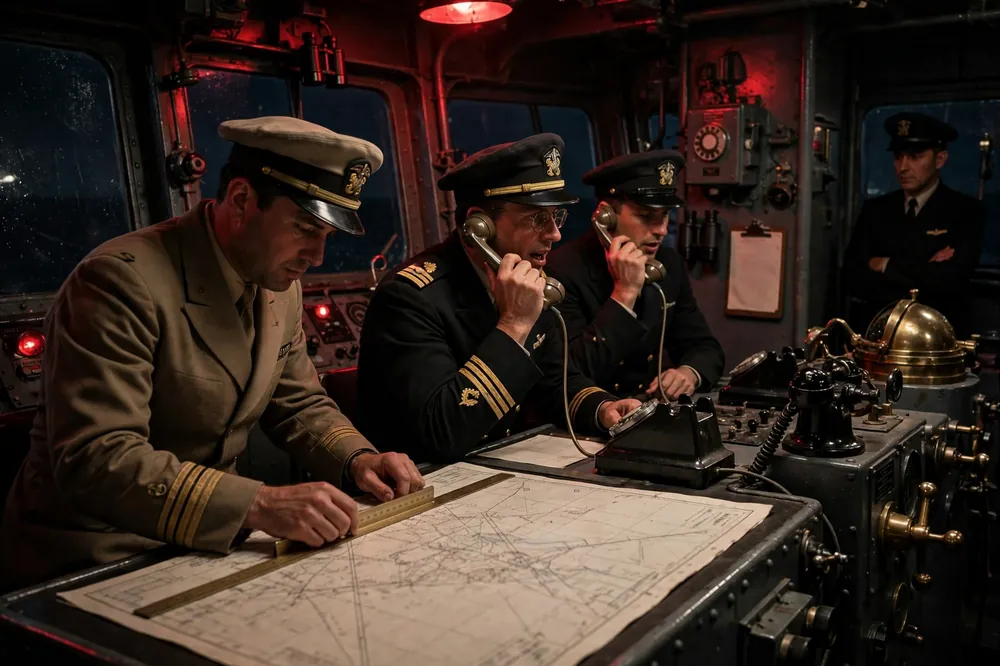
The second was his deployment of Oldendorf’s battleships at Surigao Strait on the night of 24–25 October 1944. Kinkaid had been warned of an approaching Japanese force, and he positioned his battleships across the northern exit of the strait — a classic crossing of the “T”, in which his ships could fire broadsides while the approaching Japanese ships could reply only with their forward guns.
The decision destroyed the Southern Force at limited cost to his own ships. The third was his response off Samar on the morning of 25 October 1944: with Kurita’s force attacking Sprague’s escort carriers and Halsey’s fleet far to the north, Kinkaid ordered Oldendorf’s battleships north from Surigao Strait toward Samar and sent urgent calls for air support and for Halsey’s return.
The calls were made in plain language, without the usual encryption delay, because speed mattered more than security at that point. Whether a different deployment of his forces before the battle — for example, leaving a stronger guard at San Bernardino Strait — would have changed the outcome is a question historians continue to debate, because Kinkaid’s orders and his understanding of Halsey’s intentions remain matters of record and of interpretation.
7. Controversies
The central controversy of Kinkaid’s career is the Battle off Samar and the unguarded San Bernardino Strait. Two accounts exist. Kinkaid’s account is that he believed Halsey’s Third Fleet was guarding the strait, because Halsey’s orders and the operation plan assigned that task to the Third Fleet, and that he therefore deployed his own forces to cover the southern approaches.
Halsey’s account, set out in his post-war writings, is that his orders gave priority to the destruction of the Japanese fleet, that he had informed Kinkaid of his movements, and that Kinkaid should have guarded the strait himself. The documentary record supports elements of both accounts: Halsey’s orders did prioritise destroying the Japanese fleet, and Kinkaid’s messages during the battle show that he expected Halsey to be covering the strait.
The question of who bore responsibility has been examined in detail by historians, including in the official United States Navy history of the battle, and no single assignment of blame has been accepted by all sides. Halsey later wrote critically of Kinkaid; Kinkaid, for his part, kept a public silence on the dispute, although those close to him recorded that he was hurt by Halsey’s account.
A second, smaller controversy concerns the Kiska landing of August 1943, in which a large Allied force landed on an island the Japanese had already left. The operation is sometimes presented as an intelligence failure; the record shows that American intelligence had indications of a possible evacuation but could not confirm them, and the decision to land in strength reflected the expectation of resistance based on the experience at Attu.
A third point of debate is the claim, noted above, about the number of amphibious operations Kinkaid commanded; it rests on the Seventh Fleet’s own count and has not been independently verified against other commands.
8. Later Life and Death
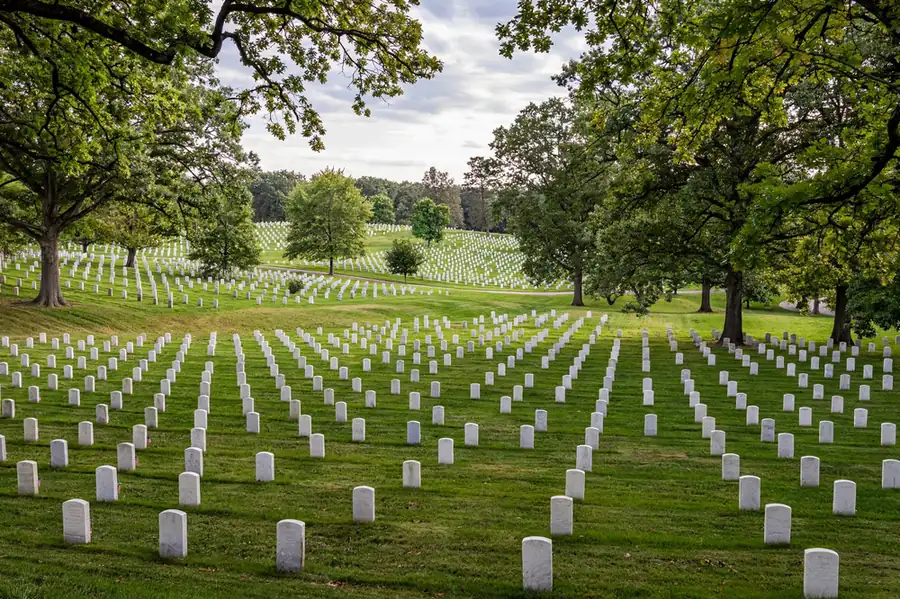
After the war Kinkaid held two further commands: the Eastern Sea Frontier at New York from January to June 1946, and the Atlantic Reserve Fleet from January 1947. He retired from the Navy on 1 May 1950. In retirement he lived in Washington, D.C., and was involved in naval history and veterans’ organisations. He rarely spoke publicly about the Leyte Gulf controversy. He died on 17 November 1972 at the National Naval Medical Center in Bethesda, Maryland, aged 84. He was buried at Arlington National Cemetery in Virginia. His wife, Helen Sherburne Ross Kinkaid (1892–1980), survived him. He left no children.
His decorations included three Navy Distinguished Service Medals, the Army Distinguished Service Medal and the Legion of Merit, together with foreign decorations including the Companion of the Order of the Bath from Australia and the Croix de Guerre with Palm from Belgium.
9. Legacy
Kinkaid’s legacy is that of a fleet commander whose work was primarily amphibious and logistical rather than centred on fleet battle, and whose record is therefore less visible than those of the carrier admirals of the Central Pacific. The Seventh Fleet he commanded from 1943 to 1945 remained in existence after the war and continues to operate in the western Pacific; its lineage traces directly to Kinkaid’s command.
The Battle of Surigao Strait, fought under his orders, is recorded as the last battle between battleships, and the action off Samar is studied in naval staff colleges as an example of how a lighter force used aircraft, smoke, torpedoes and manoeuvre to hold off a heavier surface force.
The Leyte Gulf controversy has also left a lasting institutional legacy: it is cited in discussions of command relations, of the division of responsibility between fleet commanders, and of the risks of ambiguous orders in joint operations. The destroyer USS Kinkaid (DD-965), launched in 1974, was named for him; she served until 2003 and was sunk as a target in 2004.
His career is documented in the official United States Navy histories of the Pacific War and in the biographical literature on the admirals of the Second World War.
10. Assessment by Historians
Historians’ assessments of Kinkaid have been shaped, above all, by Leyte Gulf. Samuel Eliot Morison, in the official history of United States naval operations in the Second World War, examined the San Bernardino Strait question in detail and concluded that the fault lay primarily in the division of command and in Halsey’s decision to take the whole Third Fleet north, while also noting that Kinkaid’s own dispositions reflected his understanding of the operation plan.
Later historians have generally followed this line: the failure is attributed to the command structure — two fleet commanders reporting to different superiors, MacArthur and Nimitz — rather than to a single officer. On his wider record, assessments are consistent: Kinkaid is described as a methodical, unshowy commander whose strength was organisation and coordination, particularly in amphibious operations, rather than in the aggressive pursuit of fleet battle.
His handling of the Seventh Fleet in the New Guinea and Philippines campaigns is generally assessed as effective, and his conduct at Santa Cruz as competent under difficult circumstances. He is not usually ranked among the most prominent American admirals of the war, a judgement that reflects both the nature of his commands — amphibious support rather than carrier battle — and the fact that his most famous battle is remembered principally for a controversy about command.
The assessment of the Pacific War Online Encyclopedia, that he commanded more amphibious operations than any other commander in history, is cited as a claim from that source rather than as an established comparative fact.
Frequently Asked Questions
Who was Thomas Kinkaid? Thomas Kinkaid was an admiral of the United States Navy who commanded the Seventh Fleet under General Douglas MacArthur in the Southwest Pacific during the Second World War, and led the Allied naval force at the Battle of Leyte Gulf in October 1944.
What was Thomas Kinkaid’s role at the Battle of Leyte Gulf? As commander of the Seventh Fleet, Kinkaid supported the Leyte landings and guarded the southern approaches to Leyte Gulf. His battleships under Rear Admiral Oldendorf destroyed the Japanese Southern Force at Surigao Strait, and his escort carriers fought off the Japanese Centre Force off Samar on 25 October 1944.
Why is the San Bernardino Strait controversial? Admiral Halsey’s Third Fleet left the strait unguarded while pursuing the Japanese Northern Force, and the Japanese Centre Force passed through it to attack the escort carriers off Samar. Kinkaid and Halsey gave different accounts of who was responsible for guarding the strait, and historians have not agreed on a single assignment of blame.
What happened at the Battle of the Santa Cruz Islands? On 26–27 October 1942, Kinkaid’s Task Force 16, with the carriers Enterprise and Hornet, fought a Japanese carrier force. Hornet was sunk and Enterprise was damaged; Japanese naval aviation also lost many trained aircrew, and the Japanese land offensive on Guadalcanal failed.
When did Thomas Kinkaid die? He died on 17 November 1972 at the National Naval Medical Center in Bethesda, Maryland, aged 84, and was buried at Arlington National Cemetery.
What was the Seventh Fleet? The Seventh Fleet was the United States naval force assigned to the Southwest Pacific Area under General MacArthur. Under Kinkaid it was organised mainly as an amphibious force, supporting Army landings along the New Guinea coast, in the Philippines and in Borneo.
Related articles
Sources
- Wikipedia, “Thomas C. Kinkaid” — dates, commands, career outline and the Leyte Gulf controversy, cross-checked against the sources below.
- Naval History and Heritage Command (history.navy.mil), “US People — Kinkaid, Thomas C., Admiral, USN” — biography, commands and death, 17 November 1972.
- Samuel Eliot Morison, History of United States Naval Operations in World War II, Vol. XII, Leyte, June 1944 – January 1945 (Little, Brown, 1958) — Surigao Strait, Samar and the San Bernardino Strait question.
- C. Vann Woodward, The Battle for Leyte Gulf (Macmillan, 1947).
- The Pacific War Online Encyclopedia, “Kinkaid, Thomas C.” (pwencycl.kgbudge.com) — service record, Aleutians, and the amphibious operations claim, cited as that source’s assessment.
- Encyclopædia Britannica, “Battle of Leyte Gulf” (britannica.com) — battle outline and dates, 23–26 October 1944.
- J. Rickard, “Admiral Thomas Kinkaid, 1888–1972” (historyofwar.org, 2012) — career summary and Leyte Gulf.
Further reading
- Thomas J. Cutler, The Battle of Leyte Gulf: 23–26 October 1944 (HarperCollins, 1994).
- H. P. Willmott, The Battle of Leyte Gulf: The Last Fleet Action (Indiana University Press, 2005).