 WAR ATLAS MILITARY HISTORY MAGAZINE · WWI — WWII
C-46 Commando
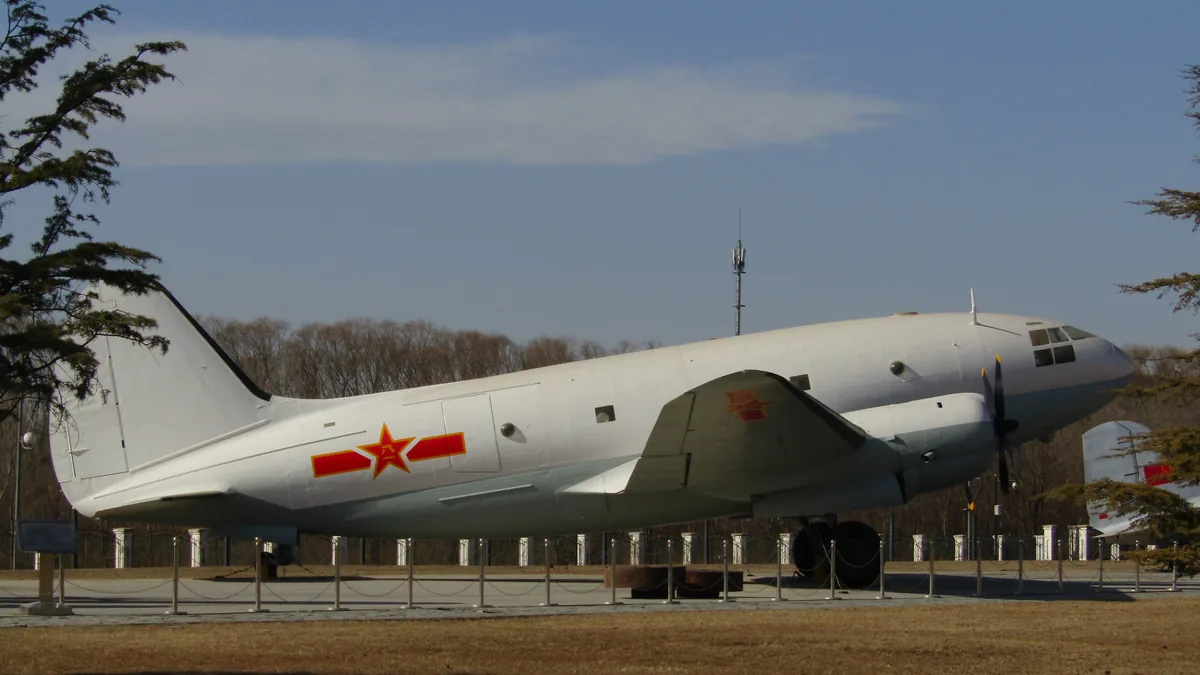
1. C-46 Commando — At a Glance
The Curtiss C-46 Commando was the largest and most powerful twin-engine transport aircraft operated by the United States during the Second World War. Developed from a pre-war commercial airliner design, the C-46 entered military service in 1942 and quickly became indispensable on the most demanding airlift route of the war: the Hump, the air corridor over the Himalayas between India and China.
There, at altitudes where most transports struggled to survive, the Commando carried fuel, ammunition, food, and spare parts to sustain China after Japan had cut the Burma Road. Larger, heavier, and more capable than the famous Douglas C-47 Skytrain, the C-46 could lift roughly twice the payload, climb higher, and operate from rough, high-altitude airfields.
It was also more expensive, more complex, and more demanding to maintain, and its early service was marked by engine fires, fuel leaks, and a reputation among crews that was far less affectionate than the one enjoyed by the C-47.
Yet by the end of the war the Commando had proved itself, and it went on to serve for decades in military and civilian hands around the world, in Korea, in Southeast Asia, in South America, and in remote cargo operations where its cavernous cabin and high-altitude performance remained unmatched by newer types.
The C-46 is remembered not as the most elegant transport of its era but as the workhorse that did the hardest job, in the worst weather, over the highest mountains, when no other aircraft could do it at all.
2. Key Facts
| Field | Value |
|---|---|
| Type | Twin-engine military transport aircraft |
| Role | Cargo and troop transport, airlift |
| Origin | United States |
| Manufacturer | Curtiss-Wright Corporation |
| First flight | 26 March 1940 (as CW-20 prototype) |
| Introduced | 1942 |
| Produced | Approximately 3,181–3,183 aircraft |
| Crew | 4 (pilot, co-pilot, radio operator, flight engineer; plus loadmaster) |
| Capacity | Up to 40 troops or approximately 6,800 kg (15,000 lb) of cargo |
| Length | 23.27 m (76 ft 4 in) |
| Wingspan | 32.92 m (108 ft 0 in) |
| Height | 6.63 m (21 ft 9 in) |
| Engine | 2 × Pratt & Whitney R-2800 Double Wasp radial engines |
| Power | Approximately 2,000 hp each |
| Max speed | Approximately 424–435 km/h (263–270 mph) |
| Range | Approximately 3,000–5,060 km depending on load |
| Service ceiling | Approximately 7,470–8,230 m (24,500–27,000 ft) |
| Armament | Normally unarmed |
| Primary users | United States Army Air Forces, United States Air Force, United States Navy and Marine Corps (as R5C), numerous civilian operators |
3. Background and Development
Origins as a Commercial Airliner
The C-46 began life not as a military design but as a commercial airliner. In the late 1930s the Curtiss-Wright Corporation sought to build a large, pressurised, twin-engine passenger aircraft that could compete with the Douglas DC-3 on longer, higher routes.
The result was the CW-20, a sleek, all-metal, low-wing monoplane with a distinctive double-bubble fuselage cross-section — two overlapping circles that gave a spacious cabin below and a raised flight deck above. The prototype, designated CW-20T, first flew on 26 March 1940.
It was an advanced design for its time, with retractable landing gear, a large cargo door, and provision for cabin pressurisation, although the pressurisation system was later deleted from production military aircraft to save weight and complexity. The airliner promised speed and comfort, but the market for large civil transports collapsed as war approached, and Curtiss soon found that its future lay with the military rather than with the airlines.
Military Adoption and Early Production
When the United States entered the Second World War, the Army Air Forces needed large transports urgently, and the CW-20 offered far more capacity than the C-47. The military version was ordered as the C-46, and production began at the Curtiss plant in Buffalo, New York, with a second line later opened in St. Louis, Missouri. The first military deliveries arrived in 1942.
The change from airliner to military transport was not simple. The large cabin doors, the heavy structure, and the powerful R-2800 engines — the same engines that powered the P-47 Thunderbolt fighter and the F4U Corsair — made the C-46 a formidable lifter, but also a complex machine that demanded skilled maintenance and careful handling.
Early aircraft suffered from fuel-system leaks, hydraulic problems, and engine fires, and the Air Transport Command imposed restrictions on the type until many of the faults were corrected. By 1943, improved versions were reaching the front, and the Commando began to show what it could do. Production continued until 1945, with approximately 3,181 to 3,183 aircraft built in total, a figure that reflects minor differences between factory and service records.
4. Design
Airframe and Cabin
The most distinctive feature of the C-46 was its fuselage. The double-bubble cross-section, formed by two intersecting circles, gave the cabin an unusually large volume for a twin-engine aircraft of the period. The lower lobe held the cargo hold, while the upper lobe carried the cockpit, raised above the cabin floor so that the pilots had a good view forward and the cargo space below remained unobstructed.
Large double doors on the left side of the rear fuselage, together with a smaller door on the right, allowed bulky loads — engines, artillery parts, fuel drums, and even light vehicles in pieces — to be loaded quickly. The floor was strengthened for heavy freight, and the cabin could be fitted with seats for up to forty troops, litters for wounded men, or paratroop static lines, although the C-46 was rarely used as a paratroop aircraft because its high landing speed and handling characteristics made it less suitable than the C-47 for that role.
Engines and Systems
The wing was a low-mounted, all-metal structure with a straight centre section and tapered outer panels. It carried two Pratt & Whitney R-2800 Double Wasp eighteen-cylinder radial engines, each producing approximately 2,000 horsepower. These engines gave the C-46 a substantial power advantage over the C-47, whose engines produced roughly 1,200 horsepower each, and they were the key to the Commando’s high-altitude performance.
The penalty was fuel consumption: the C-46 burned fuel at a much higher rate than the C-47, and its range with a full load was correspondingly shorter unless auxiliary tanks were fitted. The aircraft had a conventional tail with a large fin and rudder, retractable main landing gear that folded rearward into the engine nacelles, and a tailwheel.
De-icing equipment, including heated leading edges and propeller de-icers, was fitted because the Hump route demanded flight through icing conditions at high altitude. The cockpit was spacious and well equipped for the period, with dual controls, a flight engineer station, and a radio operator position.
5. Variants
Main Production Variants
The C-46 family included a number of variants, most of them distinguished by small changes in engines, cabin fittings, or equipment rather than by major redesigns. The C-46 was the initial production version, powered by R-2800-43 engines. The C-46A followed with a strengthened cargo floor, a large cargo door on the left side, and provision for forty troops or cargo; it became the most numerous variant and the standard against which the type was judged.
The C-46D introduced a second cargo door on the right side, improved heating, and minor equipment changes. The C-46E and C-46F were later production versions with improved propellers, revised cabin windows, and changes to the fuel and hydraulic systems intended to reduce the fire risk that had troubled early aircraft.
The XC-46B was an experimental version with a stepped windscreen and other aerodynamic changes, while the XC-46C was a single aircraft used for trials. None of these variants changed the basic formula, but together they show a design being steadily improved in service.
Naval and Civil Versions
The United States Navy and Marine Corps operated the type as the R5C, with approximately 160 aircraft delivered. The R5C-1 corresponded broadly to the C-46A and served in the Pacific, carrying supplies and personnel between island bases. After the war, many surplus C-46s were converted for civilian use. The most famous civil conversion was the C-46F, which continued to fly cargo in North and South America for decades.
A small number were fitted with more powerful engines or modified with a lengthened nose, and one civil operator experimented with a version fitted with a large rear loading door. In the 1950s and 1960s, surplus Commandos were a common sight at remote airfields, flown by small cargo airlines that valued their ability to carry heavy loads into short, rough strips.
The Japanese Air Self-Defense Force operated the type, as did the air forces of several South American and Asian countries. The C-46 therefore had a longer and more varied career after the war than most wartime transports.
6. Operational History
The Hump Airlift
The defining chapter of the C-46 story was the Hump. After Japan captured Burma in 1942, the overland Burma Road was closed, and the only way to supply China was by air from bases in Assam, in north-eastern India, over the eastern Himalayas to Kunming and other airfields in China.
The route crossed peaks rising to more than 4,500 metres, and the weather was among the worst in the world: violent thunderstorms, severe icing, turbulence, and high winds. The Air Transport Command flew the route around the clock, in all weathers, and the losses were heavy. The C-47 could fly the Hump, but only with a limited load and only by threading through passes at altitudes that left little margin.
The C-46, with its more powerful engines and higher ceiling, could carry roughly twice the load of a C-47 over the same route, and it could climb above much of the worst weather. By 1944 the Commando was the backbone of the Hump airlift, and the tonnage it carried made a real difference to the Chinese war effort.
Flying the Himalayas in Bad Weather
Flying the Hump in a C-46 was a test of endurance for crews as much as for the aircraft. Pilots climbed through cloud and icing to altitudes where oxygen was essential, navigated by dead reckoning and radio beacons that were often unreliable, and descended into Chinese airfields that were little more than graded earth surrounded by mountains.
Engine failure over the Himalayas left few options, and many aircraft were lost to weather, mechanical failure, and navigation error rather than to enemy action. Crews learned to respect the mountains and to trust the Commando’s power, but they also learned its weaknesses: fuel leaks that could fill the cabin with vapour, hydraulic failures that made the heavy controls harder still, and the sheer physical effort of flying a large, heavy aeroplane for hours at high altitude.
The men who flew the route called it the Hump for good reason, and the C-46 crews who survived it remembered it for the rest of their lives as the hardest flying they ever did.
Pacific, Korea and Civil Service
The type also served in the Pacific, in the China-Burma-India theatre more generally, and in the Mediterranean. C-46s carried supplies to forward airfields in New Guinea, the Philippines, and Okinawa, and they were used to evacuate wounded men and to move troops between islands.
In Europe the Commando played a smaller role, because the C-47 was sufficient for most tasks there and because the C-46’s high fuel consumption made it less attractive for the shorter European routes. After the war, the United States Air Force retained the C-46 for several years, and it saw combat again in Korea, where it flew cargo and casualty evacuation missions.
During the Berlin Airlift of 1948–1949, C-46s were not used in large numbers, but the type’s heavy-lift capability was noted by planners who remembered the Hump.
The day-to-day reality of operating this type was very different from the clean narrative of a campaign history. Crews spent far more time maintaining, fuelling, and waiting than they did in combat, and the weather, the state of the roads or airfields, and the availability of spare parts often mattered more than the enemy. When the machine did go into action, the result depended on training, on leadership, and on luck, as well as on the qualities of the design. Those unglamorous details are what made the difference between a unit that kept its machines flying or rolling and one that did not.
Civilian Cargo Work After the War
Civilian C-46s became legends in their own right. In South America, in the Caribbean, in Alaska, and in Southeast Asia, the Commando flew cargo into places that no other aircraft could reach. It was a favourite of small operators because it was cheap to buy as surplus, it could carry a heavy load, and it could operate from short, unpaved strips.
Its reputation for being hard to maintain was offset by the fact that its structure was rugged and its engines were widely available. Some civilian C-46s were still flying cargo in the early twenty-first century, more than sixty years after they were built — an extraordinary lifespan for a wartime design.
The aircraft’s long civil career is perhaps the best proof that, once its early problems were solved, the C-46 was a sound and capable machine.
The day-to-day reality of operating this type was very different from the clean narrative of a campaign history. Crews spent far more time maintaining, fuelling, and waiting than they did in combat, and the weather, the state of the roads or airfields, and the availability of spare parts often mattered more than the enemy. When the machine did go into action, the result depended on training, on leadership, and on luck, as well as on the qualities of the design. Those unglamorous details are what made the difference between a unit that kept its machines flying or rolling and one that did not.
7. Performance and Specifications
Speed, Range and Ceiling
The C-46A, the most representative variant, had a maximum take-off weight of approximately 22,700 kilograms. Its two R-2800 engines gave it a maximum speed of approximately 424 to 435 kilometres per hour at altitude, and a cruising speed of roughly 280 kilometres per hour. The service ceiling was approximately 7,470 metres, although later versions with improved engines could reach higher, and some sources give figures up to 8,230 metres.
Range depended heavily on load: with a full cargo load the practical range was around 2,000 to 3,000 kilometres, while with a lighter load and auxiliary fuel the aircraft could fly considerably farther, with some sources citing a maximum ferry range of over 5,000 kilometres.
The rate of climb was good for a transport of its size, and the aircraft could maintain altitude on one engine with a moderate load, a critical safety feature on the Hump where a forced landing meant almost certain loss.
Payload and Handling
The payload was the C-46’s great advantage. It could carry approximately 6,800 kilograms of cargo, or up to forty fully equipped troops, or thirty-three litters with attendants. The cabin volume was roughly twice that of the C-47, and the large doors made loading faster.
The penalty was fuel burn: the R-2800 engines consumed fuel at a rate that made the C-46 markedly more expensive to operate than the C-47 per ton-mile. Handling was also demanding. The aircraft was heavy on the controls, its landing speed was high, and it required a long runway.
Pilots who had learned on the forgiving C-47 found the Commando a different proposition, and the type acquired a reputation as a pilot’s aeroplane — rewarding for those who mastered it, unforgiving for those who did not. Ground crews found the fuel system and the hydraulic system troublesome in early aircraft, and fuel leaks into the cabin were a serious hazard until improved seals and ventilation were fitted.
8. Operators
Wartime Operators
The principal operator was the United States Army Air Forces, and later the United States Air Force, which flew the C-46 in the Air Transport Command, in the Troop Carrier Command, and in theatre airlift units. The United States Navy and Marine Corps operated the R5C in the Pacific and in the United States, using the aircraft to move personnel and supplies between island bases where its large cabin was particularly useful.
The Republic of China Air Force operated the C-46 during and after the war, flying the type on the Chinese side of the Hump and on internal supply routes. These wartime operators together accounted for the great majority of Commando flying hours, and their experience shaped the improvements that were built into later production aircraft, from better fuel seals to stronger floors and improved heating for high-altitude work.
The experience of the operators who used this type varied a great deal from one unit to another, because the same machine could be a reliable workhorse in one theatre and a constant source of trouble in another. Climate, the quality of spare parts, the length of supply lines, and the skill of the ground crews all shaped how the type performed in practice. Units that had time to learn its habits usually got far more from it than units that received it in a hurry and took it straight into combat. That pattern, in which training and maintenance mattered as much as the design itself, runs through almost every account left by the men who served with it.
Post-War and Civil Operators
After the war, the type was supplied to a wide range of allied air forces under military aid programmes. The Japanese Air Self-Defense Force, the South Korean Air Force, and the air forces of Brazil, Bolivia, Peru, Argentina, and several other South American countries all operated Commandos at various times. The Israeli Air Force used the type in the late 1940s and early 1950s.
In civilian service, the list of operators is very long and includes small cargo airlines in the United States, Canada, Central and South America, the Caribbean, Africa, and Southeast Asia. The diversity of operators is itself evidence of the type’s versatility: it served air forces on four continents and civilian operators in some of the most remote places on earth, often long after newer transports had replaced it on main routes.
The experience of the operators who used this type varied a great deal from one unit to another, because the same machine could be a reliable workhorse in one theatre and a constant source of trouble in another. Climate, the quality of spare parts, the length of supply lines, and the skill of the ground crews all shaped how the type performed in practice. Units that had time to learn its habits usually got far more from it than units that received it in a hurry and took it straight into combat. That pattern, in which training and maintenance mattered as much as the design itself, runs through almost every account left by the men who served with it.
9. Legacy and Influence
Influence on Airlift Doctrine
The C-46 never achieved the fame of the C-47, and it never received the affection that the Dakota inspired. It was more expensive, harder to fly, and harder to maintain, and it was built in far smaller numbers. Yet its legacy is substantial.
On the Hump, it proved that a large, powerful, high-altitude transport could sustain an army by air alone, a lesson that shaped post-war airlift doctrine and the design of later transports such as the C-119 and the C-130. The Commando demonstrated the value of a large cabin door and a strengthened floor, features that became standard on later cargo aircraft.
It also showed that pressurisation, although deleted from the production C-46, would be essential for future high-altitude transports, and that airlift planning had to take account of weather, maintenance, and crew fatigue as much as of aircraft performance.
Historians still debate how much weight to give to this type when they assess the wider war. Some emphasise its direct contribution in combat, while others point to the lessons it taught, the doctrines it shaped, and the later designs that borrowed from it. Both views have merit, because a machine can matter through influence as well as through its own record. What is not in doubt is that the type left a mark on the people who used it, and that their accounts, written years later, still convey a strong sense of what it was like to depend on it.
Historical Assessment
For historians, the C-46 is a reminder that the most important aircraft of a war are not always the most famous ones, and that the ability to lift a heavy load over a mountain in bad weather can matter more than speed or elegance.
The type’s reputation suffered from its early faults, and the comparison with the C-47 was always unflattering, because the Dakota was cheaper, simpler, and easier to love. Yet the Commando did a job that the Dakota could not do as well, and it did it at the time when that job mattered most, in 1944 and 1945, when the tonnage over the Hump rose to levels that sustained the Chinese war effort and tied down Japanese forces.
In civilian service it became a symbol of the bush cargo operator — the big, rugged, slightly battered freighter that kept remote communities supplied long after more modern aircraft had taken over the main routes.
10. Surviving Examples
Museum Examples
A number of C-46 Commandos survive in museums and in private hands. The National Museum of the United States Air Force in Dayton, Ohio, displays a C-46D, and the Pima Air and Space Museum in Arizona holds an example. The Smithsonian National Air and Space Museum has a C-46 in its collection, although it is not always on public display.
Other examples are preserved in China, where the Hump airlift is commemorated, and in museums in the United States and South America. Visitors to the museums that display the type can see for themselves the size of the cabin and the scale of the engines, and they can appreciate why the men who flew the Hump regarded the Commando, for all its faults, as the aircraft that could do the job when nothing else could.
Visitors who encounter a surviving example today are looking at far more than a static exhibit. The size, the wear on the controls, and the cramped working positions all help to explain what service in this machine felt like, in a way that a photograph or a specification table cannot. Museum staff usually place the vehicle or aircraft in context with the unit that used it, the theatre in which it served, and the men who maintained it, so that a casual visitor can understand why it mattered. That educational role is now one of the main reasons these survivors are preserved, and it keeps the history alive for people who never saw the machine in service.
Airworthy Survivors
A small number of airworthy C-46s remained in operation into the twenty-first century, flown by cargo operators and by historic flight organisations. Their survival is remarkable given the hard lives most Commandos led, and the fact that any still fly at all is a tribute to the ruggedness of the Curtiss design.
Maintaining a seventy-year-old transport with R-2800 engines is an expensive and skilled undertaking, requiring parts that are no longer manufactured and mechanics who understand radial engines. The airworthy examples that remain are therefore treasured by their owners and by the enthusiasts who see them at air shows, where the deep sound of the Double Wasp engines and the sheer bulk of the aircraft still draw a crowd.
They are flying reminders of the Hump, of the men who flew it, and of an aircraft that was never loved but was always needed.
Visitors who encounter a surviving example today are looking at far more than a static exhibit. The size, the wear on the controls, and the cramped working positions all help to explain what service in this machine felt like, in a way that a photograph or a specification table cannot. Museum staff usually place the vehicle or aircraft in context with the unit that used it, the theatre in which it served, and the men who maintained it, so that a casual visitor can understand why it mattered. That educational role is now one of the main reasons these survivors are preserved, and it keeps the history alive for people who never saw the machine in service.
Frequently Asked Questions
What was the C-46 Commando used for?
The C-46 was a military transport aircraft used to carry cargo and troops. Its most famous role was flying the Hump over the Himalayas to supply China during the Second World War.
How did the C-46 compare with the C-47?
The C-46 was larger and more powerful than the C-47, with roughly twice the payload and a higher ceiling. It was also more expensive to operate, burned more fuel, and was harder to fly and maintain.
Why was the C-46 important on the Hump route?
The Hump crossed the Himalayas at high altitude in severe weather. The C-46’s powerful engines and high ceiling allowed it to carry heavy loads over the mountains when the C-47 could carry only a limited load.
How many C-46s were built?
Approximately 3,181 to 3,183 aircraft were built between 1942 and 1945, according to factory and service records that differ slightly.
Did the C-46 serve after the Second World War?
Yes. It served in Korea, in the United States Air Force and Air National Guard, in many foreign air forces, and in civilian cargo service for decades, with some aircraft still flying in the early twenty-first century.
Was the C-46 a safe aircraft?
Early aircraft suffered from fuel leaks and engine fires, and the type had a difficult reputation. After improvements to the fuel and hydraulic systems, it became a reliable transport, although it always demanded skilled pilots and maintenance.
Related articles
Sources
- William Green, War Planes of the Second World War: Transport, Bombers and Reconnaissance Aircraft, Volume 7
- Curtiss-Wright Corporation, C-46 Commando technical manuals and pilot handbooks
- National Museum of the United States Air Force, C-46 Commando exhibit and aircraft history
- Smithsonian National Air and Space Museum, Curtiss C-46 Commando collection records
- Air Transport Command historical studies on the Hump airlift
- John M. Andrade, U.S. Military Aircraft Designations and Serials since 1909
- Wikipedia, "Curtiss C-46 Commando"