 WAR ATLAS MILITARY HISTORY MAGAZINE · WWI — WWII
Battle of Berlin
1. Lead
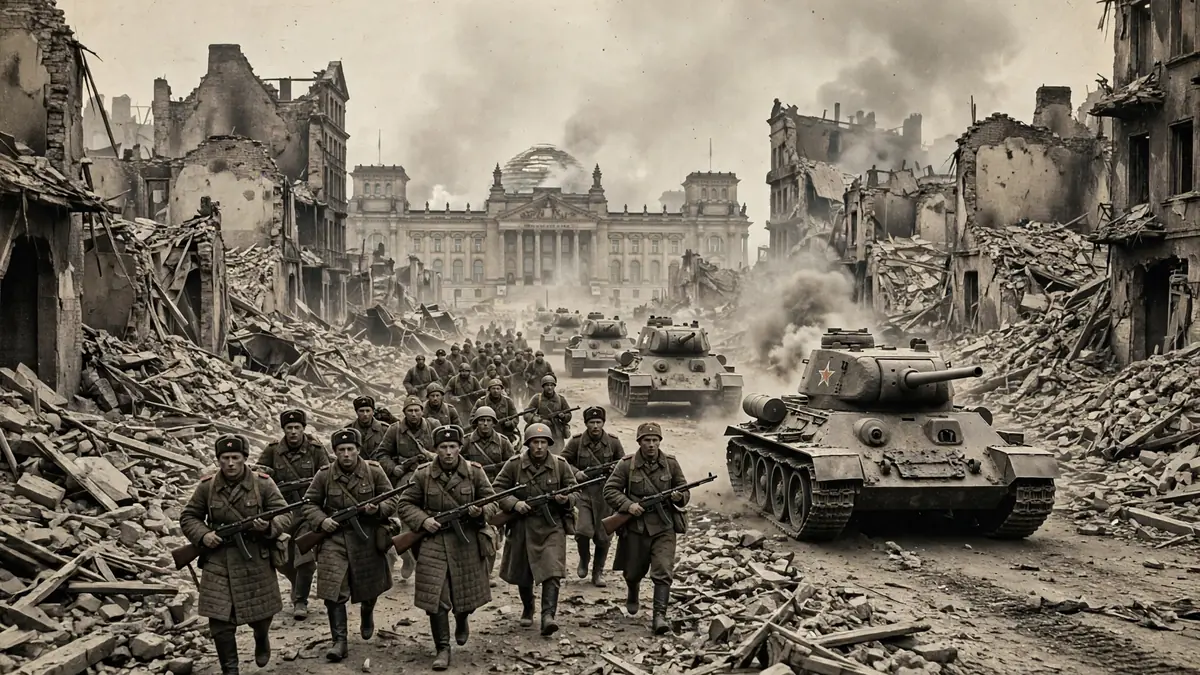
The Battle of Berlin, fought from 16 April to 2 May 1945, was the last great battle of the Second World War in Europe, and the one that ended it. About two and a half million Soviet soldiers, under Marshals Georgy Zhukov, Ivan Konev and Konstantin Rokossovsky, broke through the German defences on the Oder River, encircled the German capital, and fought their way, street by street, to the Reichstag and the Führerbunker, where Adolf Hitler killed himself on 30 April. Two days later, on 2 May, the Berlin garrison surrendered. A week later, Germany surrendered unconditionally, and the war in Europe was over.
Berlin was not only a military objective; it was the symbol of the Nazi regime, and its capture was the prize that the Soviet Union had fought for since 1941. The battle was fought with a ferocity that shocked even veterans of the Eastern Front: Soviet artillery fired more shells in the opening bombardment than had ever been fired before, German defenders — soldiers, old men of the Volkssturm and boys of the Hitler Youth — fought from the ruins of their own city, and the civilian population, trapped between the armies, suffered terribly. The city that emerged from the battle was a wasteland of rubble, and the Germany that emerged from the war was divided, occupied and broken.
2. Key Facts
| Date | 16 April – 2 May 1945 / 16/4 – 2/5/1945 |
| Location | Berlin, Germany, and the Oder River line to the east |
| Result | Soviet victory; Berlin captured, Hitler dead, Germany surrendered a week later |
| Soviet commanders | Marshal Georgy Zhukov (1st Belorussian Front); Marshal Ivan Konev (1st Ukrainian Front); Marshal Konstantin Rokossovsky (2nd Belorussian Front) / Nguyên soái Georgy Zhukov; Nguyên soái Ivan Konev; Nguyên soái Konstantin Rokossovsky |
| German commanders | General Gotthard Heinrici (Army Group Vistula); General Helmuth Weidling (Berlin garrison) |
| Soviet strength | About 2,500,000 men, 6,250 tanks, 7,500 aircraft, 41,600 guns |
| German strength | About 766,000-1,000,000 men, including Volkssturm and Hitler Youth; about 1,500 tanks |
| Soviet losses | About 78,000-81,000 killed, about 274,000 wounded (Krivosheev) |
| German losses | About 92,000-100,000 killed; about 480,000 taken prisoner; civilian deaths estimated in the tens of thousands to about 125,000 |
3. Background
3.1. The Strategic Background
By the spring of 1945, Germany was beaten, but not yet defeated. The Western Allies had crossed the Rhine in March, and the Soviet armies stood on the Oder River, less than 70 kilometres from Berlin. The German armed forces were broken: their divisions were shadows, their fuel was gone, their cities were in ruins from Allied bombing, and their leader, Hitler, refused to surrender and ordered his armies to fight to the end.
The Soviet high command, the Stavka, planned a final offensive to take Berlin before the Western Allies could reach it, and the race for the city became a matter of political as well as military importance: the army that took Berlin would shape the peace that followed.
Supply decided more of Battle of Berlin than any single order. Ammunition, fuel, food and water had to travel from depots far behind the lines, over roads that were shelled, mined or washed out, and every delay at the front was felt first in the supply columns. The side that kept its guns fed and its men fed could keep attacking; the side that could not was forced to stop, however good its plan. At Battle of Berlin, as in most battles of this period, the quartermasters and the drivers mattered as much as the generals, and the battle’s turning points can often be traced to a convoy that arrived — or did not arrive — in time.
3.2. The Opposing Plans
The German defence of Berlin was organised by General Gotthard Heinrici, commander of Army Group Vistula, a defensive specialist who had built his reputation on the Eastern Front. Heinrici’s armies held the Seelow Heights, the ridge east of Berlin that commanded the road to the city, and he had prepared a defence in depth: three lines of trenches, minefields and anti-tank obstacles along the Oder, and a final line around the city itself.
Inside Berlin, the garrison was a mixture of regular soldiers, SS units, Volkssturm militia — old men and boys called up in the last months of the war — and Hitler Youth teenagers, armed with rifles and Panzerfaust anti-tank weapons. The city had been fortified with barricades, anti-tank ditches and strongpoints in the great buildings, and the defenders were ordered to fight to the last man.
Neither side at Battle of Berlin knew as much about the enemy as its commanders pretended. Reports were late, contradictory or simply wrong: prisoners exaggerated, scouts saw only a fragment of the front, and aerial photographs showed positions that had already been abandoned. Commanders filled the gaps with assumptions, and those assumptions decided battles. The history of Battle of Berlin is full of such judgements — an enemy division believed to be elsewhere, a flank thought secure, a strength underestimated by half — and the side whose assumptions were closest to the truth usually won, not because its generals were cleverer, but because its information was better.
3.3. The Eve of Battle
The Soviet plan was drawn up by the Stavka and executed by three Fronts. Zhukov’s 1st Belorussian Front, the strongest, was to attack directly from the Oder, break through the Seelow Heights, and take Berlin from the east. Konev’s 1st Ukrainian Front was to cross the Neisse River to the south, advance on Berlin from the south-east, and encircle the city. Rokossovsky’s 2nd Belorussian Front was to attack to the north, pin down the German forces there, and prevent them from relieving Berlin. The Soviet armies had overwhelming superiority in men, tanks, guns and aircraft, and they had spent the winter preparing for the offensive. The attack was set for 16 April 1945.
Orders at Battle of Berlin travelled slowly and unreliably. Field telephones depended on wires that shellfire cut within minutes; radios were heavy, short-ranged and easily intercepted; and in the end much depended on runners — men who carried written orders across open ground under fire, and who sometimes never arrived. A battalion could fight for hours without knowing what its neighbours were doing, and a division could learn of a breakthrough only when the enemy appeared in its rear. The battle therefore has to be understood as a dozen small battles fought in partial ignorance of each other, held together by a command system that was always one step behind events.
3.3.1. The Wider War
The wider war shaped everything that happened at Battle of Berlin. By the time the fighting began, the conflict had already lasted for years, and both sides had learned hard lessons about supply, firepower and morale. Commanders on both sides knew that a single battle rarely decided a war, but that battles like this one decided whether armies could move, eat and fight the next week.
For the men who fought here, the strategic arguments debated in headquarters meant very little beside the next hill, the next street or the next stretch of water. What mattered was whether the artillery was in range, whether the rations arrived, and whether the unit on the flank held its ground.
The records of Battle of Berlin therefore have to be read on two levels at once: as a chapter in a much larger war, and as a human experience of fear, exhaustion and endurance that no headquarters map can capture.
4. Opposing Forces
4.1. The Attacking Force
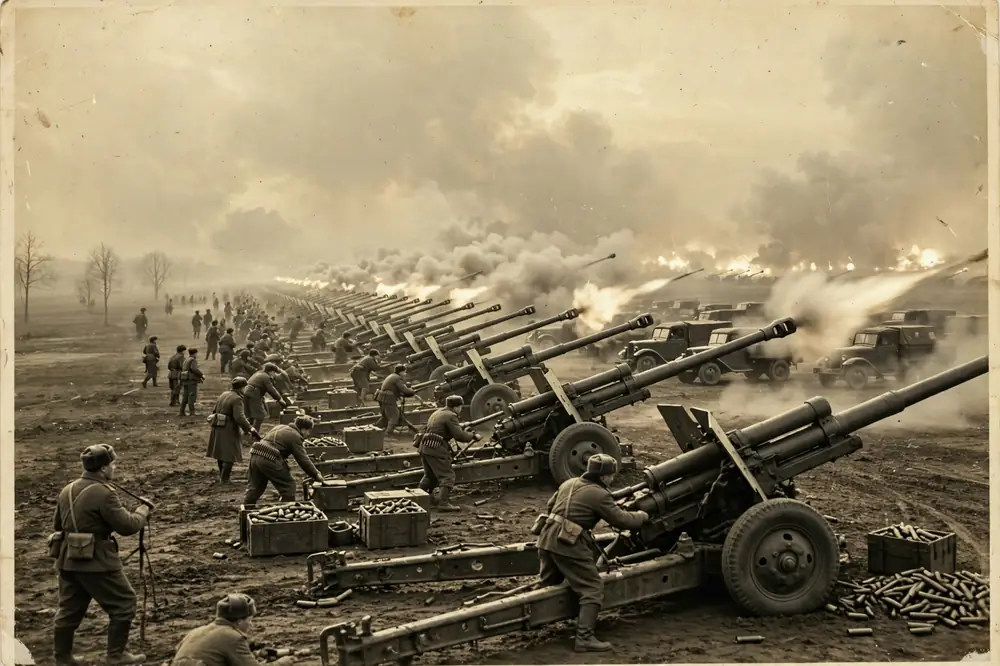
The Soviet force assembled for the Berlin operation was the largest ever fielded in a single battle: about two and a half million men, 6,250 tanks and self-propelled guns, 41,600 artillery pieces and mortars, and 7,500 aircraft. Zhukov’s 1st Belorussian Front alone had more than 900,000 men and 3,000 tanks, and the opening bombardment of 16 April was the heaviest in history, with more than 20,000 guns firing along a narrow front.
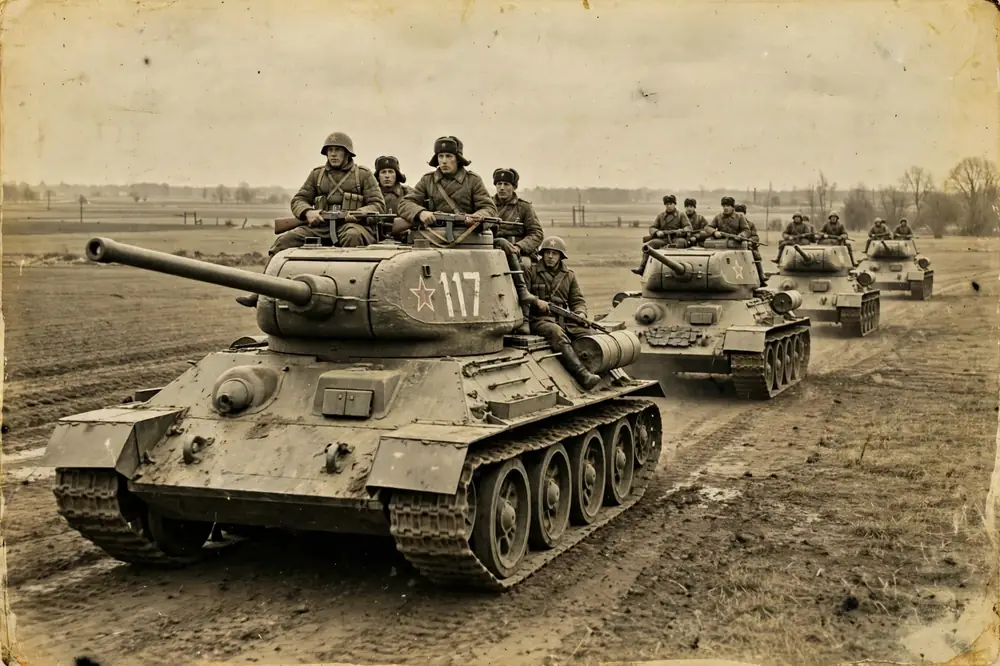
The Soviet armies were battle-hardened, well supplied, and confident, and they had learned, in four years of war, how to break through a prepared defence and exploit the breakthrough with tank armies. Their weakness, if they had one, was the rivalry between Zhukov and Konev, each of whom wanted the honour of taking Berlin, and the Stavka’s decision to let both Fronts race for the city.
The German forces were far weaker in numbers and in equipment. Army Group Vistula, under Heinrici, had about 700,000 men in total, but many of its divisions were understrength, its tanks numbered about 1,500, and its air force, the Luftwaffe, could put only a few hundred aircraft into the sky.
Inside Berlin, the garrison under General Helmuth Weidling numbered about 100,000 men, including some 45,000 regular soldiers and the rest Volkssturm, Hitler Youth, SS and police. The defenders had the advantage of fighting in a great city, with strong buildings, a metro system that allowed movement underground, and the desperation of men who knew that surrender meant the end of their world.
But they had no reserves, no fuel, and no hope of relief, and their commander, Hitler, issued orders from his bunker that bore no relation to the reality on the ground.
The ground at Battle of Berlin rewarded the side that studied it. A ridge, a river, a wood or a ruined village could be worth a battalion, and commanders who had walked the ground — or who listened to the men who had — gained advantages that no map could give. The fighting followed the ground: attacks went where the ground allowed them, defences were built where the ground was strong, and the deadliest places in the battle were the places where the ground gave one side a clear field of fire and the other no cover at all. To read the battle without the map is to miss half of it.
4.2. The Defenders and Their Methods
| | Soviet Union | Germany |
|—|—|—|—|
| Infantry | 1st Belorussian, 1st Ukrainian, 2nd Belorussian Fronts; about 2,500,000 men | Army Group Vistula; Berlin garrison; Volkssturm and Hitler Youth |
| Tanks | About 6,250 tanks and self-propelled guns | About 1,500 tanks and assault guns |
| Artillery | About 41,600 guns and mortars; the heaviest bombardment in history | Severely outnumbered; guns in the city and on the Seelow Heights |
| Air support | About 7,500 aircraft; total air superiority | A few hundred aircraft; Luftwaffe effectively grounded |
| Fortifications | Engineers to bridge the Oder and clear mines | Seelow Heights; Oder line; barricades and strongpoints in Berlin |
The imbalance of forces was so great that the outcome of the battle was never seriously in doubt; the question was how long it would take and how many men it would cost. The Soviet armies had learned at Stalingrad, Kursk and in the great offensives of 1944 how to conduct a breakthrough, and they had the men and the material to do it again.
The Germans had learned, in the same years, how to make an attacker pay for every street and every building, and Berlin, with its wide avenues, its great stone buildings and its underground railway, was a fortress in all but name. The battle would be won by weight of firepower, but it would be fought, house by house, by infantry, and the cost, on both sides, would be terrible.
The weapons used at Battle of Berlin shaped the fighting in ways that the men who carried them understood better than their generals. A rifle that jammed in mud, a machine gun that could sweep a street, a tank that could not climb a slope, an artillery piece that could be heard but not seen — each weapon had its range, its rate of fire and its weakness, and battles were won by the side that matched its weapons to the ground. The technical details matter: the calibre of a gun, the thickness of a tank’s armour, the range of a radio. They are not footnotes to the battle; they are the reason the battle took the shape it did.
4.2.1. Guns, Engineers and Supply
Beyond the divisions listed in the table, the battle was decided by the less visible arms: the artillery that fired the preparatory bombardments, the engineers who cleared mines and built bridges, the signals units that kept commanders in touch with their forward troops, and the supply columns that brought forward ammunition, fuel, food and water.
At Battle of Berlin, as in most battles of this period, the side that could keep its guns supplied and its wounded evacuated had a decisive advantage, and the side whose communications broke down first usually lost the initiative. Air power mattered too, though not always in the way planners hoped: aircraft could strike a strongpoint or a column on the road, but they could not hold ground, and bad weather could ground them for days at a time.
The balance of forces was therefore never simply a count of men and tanks; it was a balance of systems, and the system that broke first decided the outcome.
5. The Battle
5.1. The Opening Moves
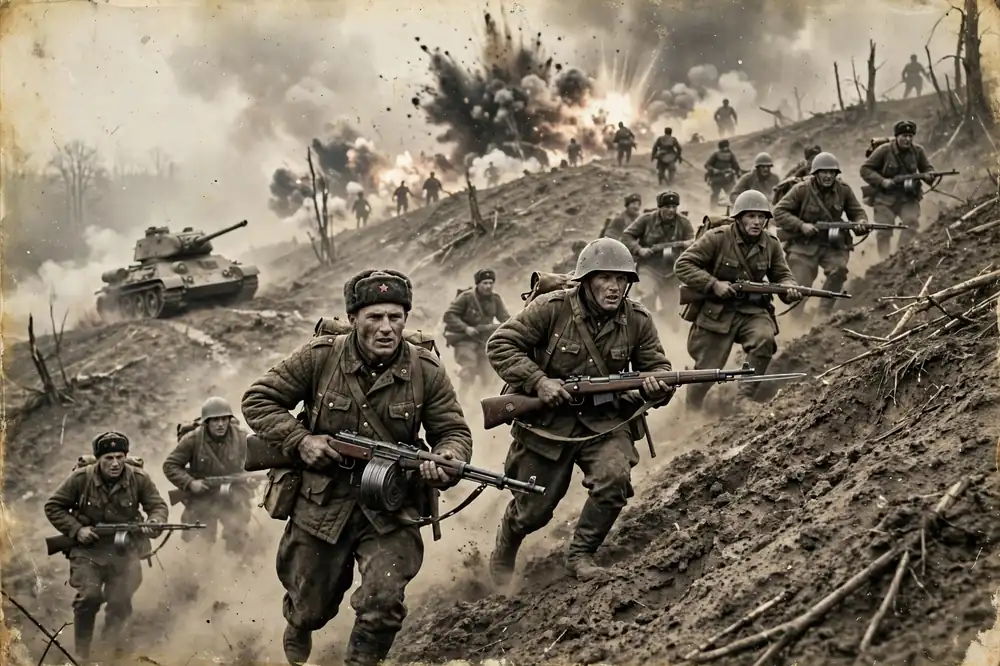
The Soviet offensive opened on 16 April 1945, in the early hours of the morning, with a bombardment of unprecedented scale. More than 20,000 guns opened fire along the Oder front, and searchlights were switched on to blind the German defenders — a tactic that failed, because the smoke and dust turned the light back on the attackers, and the Soviet infantry advanced into a haze of their own making.
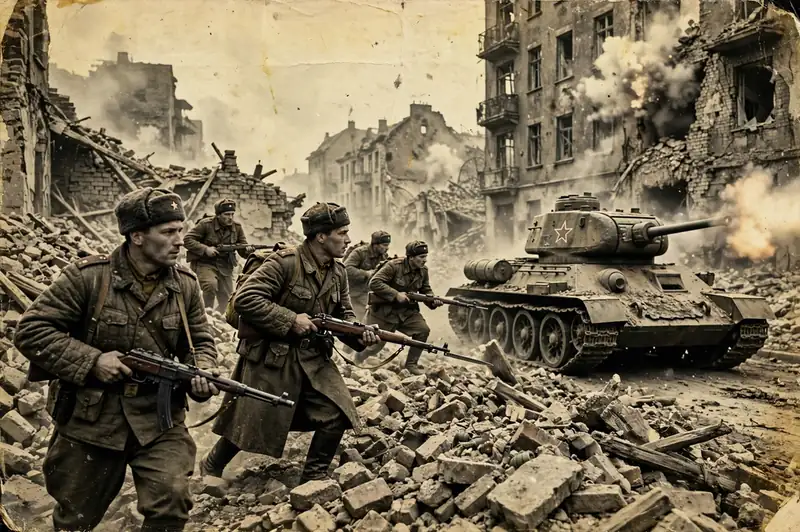
Zhukov’s attack on the Seelow Heights ran into the strongest German defence: Heinrici had thinned his forward lines, so that the Soviet bombardment fell largely on empty trenches, and his artillery and infantry, on the reverse slopes of the heights, held the Soviet advance for three days.
The Seelow Heights cost the Soviets thousands of men, and it was not until 19 April that the heights were taken and the road to Berlin was open.
Morale at Battle of Berlin was not a slogan but a physical fact. Men who had eaten, slept and believed in their officers fought differently from men who were hungry, exhausted and leaderless, and the same unit could be brave on one day and broken on the next.
Fear was universal — veterans admitted it freely — and what kept men fighting was rarely hatred of the enemy but loyalty to the men beside them, the shame of running, and the simple habit of obeying orders. The battle’s histories often describe morale as if it were a quality of armies; at Battle of Berlin it was a quality of small groups of men, and it could collapse in a single afternoon.
5.2. The Main Assault
While Zhukov fought at Seelow, Konev’s 1st Ukrainian Front crossed the Neisse River to the south and broke through more quickly, and on 20 April, Hitler’s birthday, Soviet artillery began to shell Berlin itself. The Stavka, impatient with Zhukov’s slow progress, allowed Konev to turn his tank armies towards Berlin, and the two Fronts raced for the city.
On 23 April, the Soviet armies met west of Berlin, encircling the city and trapping the German 9th Army to the south-east. The encirclement was complete on 25 April, when Soviet and American troops met at Torgau on the Elbe, far to the west — the first meeting of the two armies — and Berlin was cut off from the rest of Germany.
Inside the city, Hitler, in his bunker under the Reich Chancellery, refused to leave and ordered counterattacks that existed only on paper.
The wounded of Battle of Berlin depended on a chain of care that began with the man beside them. Stretcher-bearers carried them from the firing line, often under fire; aid stations, in a cellar, a ditch or a ruined house, gave them morphine and bandages; and if the roads allowed, they were evacuated to field hospitals and then further back. Many died of wounds that a modern hospital would have treated, and many lived because a comrade reached them in time. The medical story of the battle is inseparable from its casualty figures: the difference between killed and wounded, and between wounded and dead of wounds, is a measure of how well that chain worked.
5.3. The Crisis
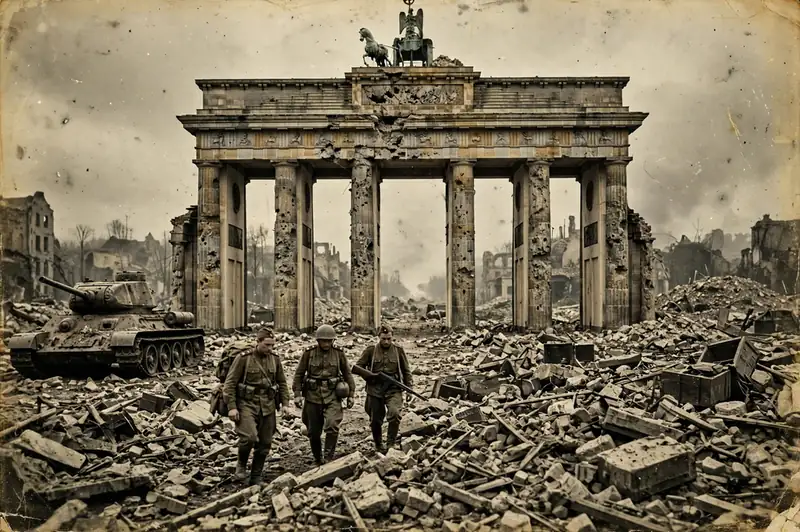
The street fighting in Berlin began on 24 April and lasted eight days. Soviet infantry, supported by tanks and artillery firing at point-blank range, fought through the suburbs and into the city centre, clearing one building at a time. The German defenders fought from the ruins, from the metro tunnels, and from the great flak towers, concrete fortresses that Soviet guns could not destroy.
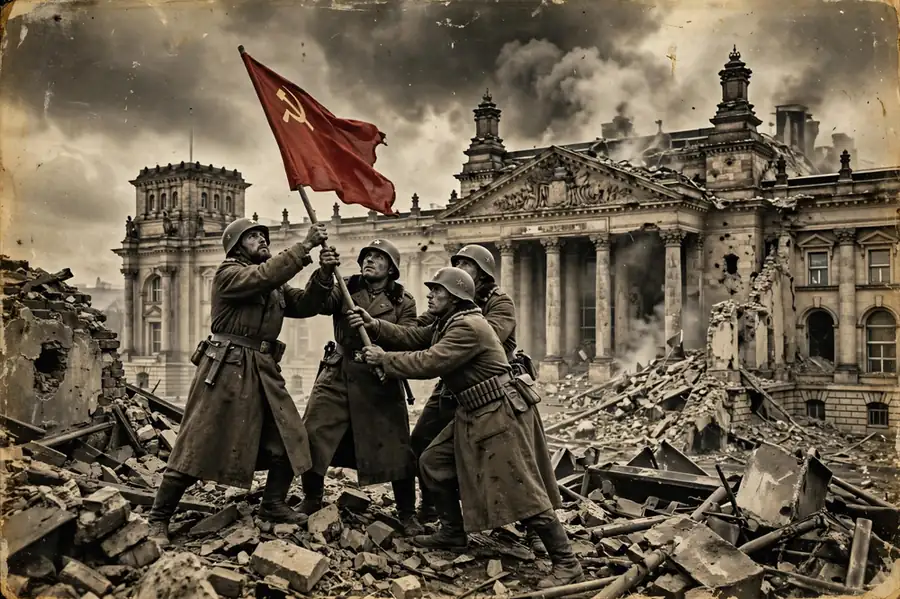
The fighting was at its worst around the Reichstag, the Tiergarten and the government quarter, where SS units fought to the death and Soviet soldiers raised the red flag over the Reichstag on 30 April — the famous photograph of Yegorov and Kantaria planting the flag, staged after the building was taken, became the iconic image of the victory.
On the same day, 30 April, Adolf Hitler killed himself in his bunker, together with Eva Braun, whom he had married the day before, and named Admiral Karl Dönitz as his successor.
Civilians were caught in Battle of Berlin in ways that the military histories often pass over. Farmers, shopkeepers, children and the old found their villages turned into battlefields, their houses into strongpoints, their fields into minefields. Some fled, some hid in cellars, and some were killed by shells fired at targets they could not see. Their losses are the hardest to count, because no army kept their names, and their suffering is the part of the battle that has no memorial. Any honest account of Battle of Berlin must remember that the battle was fought not on empty ground but in places where people lived, and that those people paid for it.
5.4. The End of the Battle
The end came quickly after Hitler’s death. On 1 May, the German chief of staff, General Hans Krebs, tried to negotiate a surrender with the Soviets, and was refused: the Soviet demand was unconditional surrender. On 2 May, General Weidling, commander of the Berlin garrison, surrendered the city, and Soviet troops took the Reich Chancellery and the bunker. The battle was over.
The Soviet losses in the Berlin operation, according to the official historian Krivosheev, were about 78,000–81,000 killed and 274,000 wounded; the German military dead were about 92,000 to 100,000, and about 480,000 German soldiers were taken prisoner. The civilian dead in Berlin are estimated in the tens of thousands, with some estimates reaching about 125,000, though the exact figure is disputed.
The sources for Battle of Berlin are uneven, and the historian must weigh them carefully. Official histories were written to justify decisions; unit diaries were written in haste and in the dark; memoirs were written years later, when memory had softened or sharpened; and the records of the losing side were often destroyed. Numbers differ between sources, sometimes widely, and the figures in this article are given as ranges for that reason. Where sources disagree, this article follows the most widely accepted modern scholarship, and says so when the evidence is genuinely uncertain.
5.4.1. The Soldier’s Battle
For the soldiers, the battle was experienced in fragments: a long march or a cramped landing craft, a sudden burst of fire, hours of waiting under shelling, a short rush across open ground, and then the work of digging in again.
Orders from above arrived late or not at all, and junior officers and sergeants made the decisions that mattered, often with only a sketchy idea of what was happening a kilometre away. Communications were fragile — field telephones cut by shellfire, radios that failed in wet weather, runners who never arrived — and the picture in each headquarters was always hours behind the fighting.
That is why the history of Battle of Berlin is written from many small accounts: a company diary, a pilot’s report, a surgeon’s notes, a prisoner’s interrogation. No single source sees the whole battle, and the historian’s task is to fit the fragments together without inventing the missing pieces.
6. Turning Point
6.1. The Decisive Moment
The turning point of the battle was the fall of the Seelow Heights on 19 April. Until then, Heinrici’s defence had held, and Zhukov’s attack, the main Soviet effort, was stalled. Once the heights fell, the road to Berlin was open, and the Soviet tank armies could advance on the city from the east while Konev’s armies closed in from the south.
The encirclement of Berlin on 23-25 April was the consequence of that breakthrough: the city was sealed, the German 9th Army was trapped to the south-east, and the battle became a siege that the Germans could not win. Hitler’s refusal to allow a breakout, and his insistence on counterattacks by armies that no longer existed, sealed the fate of the garrison.
The numbers at Battle of Berlin hide as much as they reveal. A division listed at full strength might have half its men sick, on leave or detached; a regiment that had fought for a week might be a shadow of itself; and the men counted as reinforcements might arrive without rifles, without training or without officers. Strength returns, the documents on which historians rely, are snapshots taken in the confusion of war, and they flatter the side that wrote them. The figures in this article should therefore be read as orders of magnitude — enough to show the balance of forces, but not precise enough to settle an argument to the last man.
6.2. The Tactical Lesson
A second turning point was the Stavka’s decision to let Konev race Zhukov for Berlin. The rivalry between the two marshals drove both Fronts forward at a speed that the Germans could not match, and it ensured that Berlin would be encircled quickly and completely. The decision was political as much as military: Stalin wanted Berlin taken by Soviet troops, and he wanted it taken quickly, before the Western Allies could reach the city. The race cost the Soviets men — the two Fronts attacked on converging lines and sometimes fired on each other — but it achieved its purpose, and Berlin fell to the Red Army alone.
Supply decided more of Battle of Berlin than any single order. Ammunition, fuel, food and water had to travel from depots far behind the lines, over roads that were shelled, mined or washed out, and every delay at the front was felt first in the supply columns. The side that kept its guns fed and its men fed could keep attacking; the side that could not was forced to stop, however good its plan. At Battle of Berlin, as in most battles of this period, the quartermasters and the drivers mattered as much as the generals, and the battle’s turning points can often be traced to a convoy that arrived — or did not arrive — in time.
6.2.1. How Turning Points Are Judged
Turning points are easy to name in hindsight and hard to recognise at the time, and Battle of Berlin is no exception. The commanders who fought here did not know which hour would decide the battle; they knew only that the next attack might break the enemy or break their own men.
Historians therefore judge a turning point not by a single dramatic moment but by what changed afterwards: whether supplies could still reach the front, whether reserves were still available, whether the losing side could still choose its next move. At Battle of Berlin, the change was visible in the orders that followed, in the ground that changed hands and stayed changed, and in the reports that grew more confident on one side and more desperate on the other.
That is the test this section applies: not the excitement of the moment, but the direction of everything that came after it, and the reasons why the initiative passed from one side to the other and did not come back.
7. Casualties and Losses
7.1. The Human Cost
The casualty figures for the Battle of Berlin are disputed, and the ranges are wide, particularly for German military and civilian deaths. The Soviet losses in the Berlin operation, as calculated by the official Soviet historian Grigori Krivosheev from Red Army records, were 78,291 killed and missing and 274,184 wounded, a total of about 352,000 casualties. Some Western historians put the Soviet dead higher, at about 81,000, but Krivosheev’s figures are the most widely cited. The German military losses are usually given as about 92,000 to 100,000 killed in the battle for the city and the fighting on the Oder, with about 480,000 German soldiers taken prisoner, many of whom died in Soviet captivity in the years that followed.
Neither side at Battle of Berlin knew as much about the enemy as its commanders pretended. Reports were late, contradictory or simply wrong: prisoners exaggerated, scouts saw only a fragment of the front, and aerial photographs showed positions that had already been abandoned. Commanders filled the gaps with assumptions, and those assumptions decided battles. The history of Battle of Berlin is full of such judgements — an enemy division believed to be elsewhere, a flank thought secure, a strength underestimated by half — and the side whose assumptions were closest to the truth usually won, not because its generals were cleverer, but because its information was better.
7.2. Counting the Losses
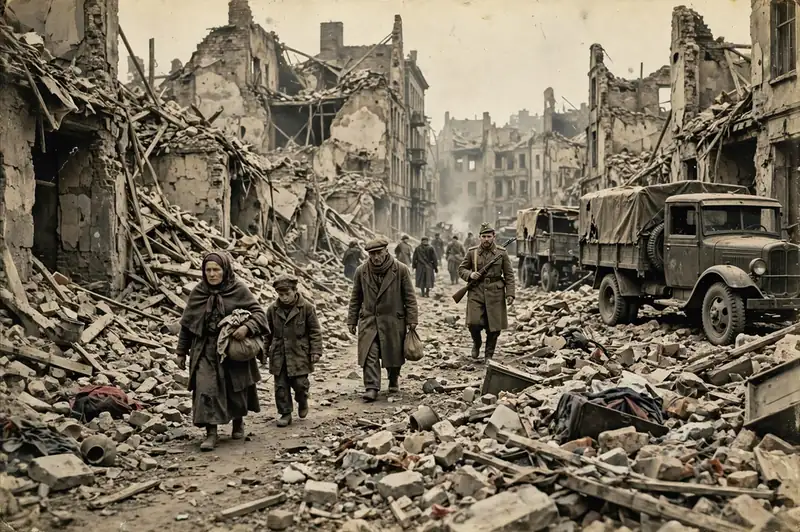
The civilian deaths in Berlin are the most disputed figure of all. Estimates range from tens of thousands to about 125,000, and the exact number will never be known, because the city’s records were destroyed, the dead were buried in mass graves, and many of the victims were refugees from the east whose names were never recorded.
The civilians died from Soviet shelling and bombing, from the street fighting, from hunger and disease, and in the violence that followed the city’s fall, including the mass rapes committed by Soviet soldiers, a crime that Soviet and Russian historians long denied and that is now documented in German and Western sources.
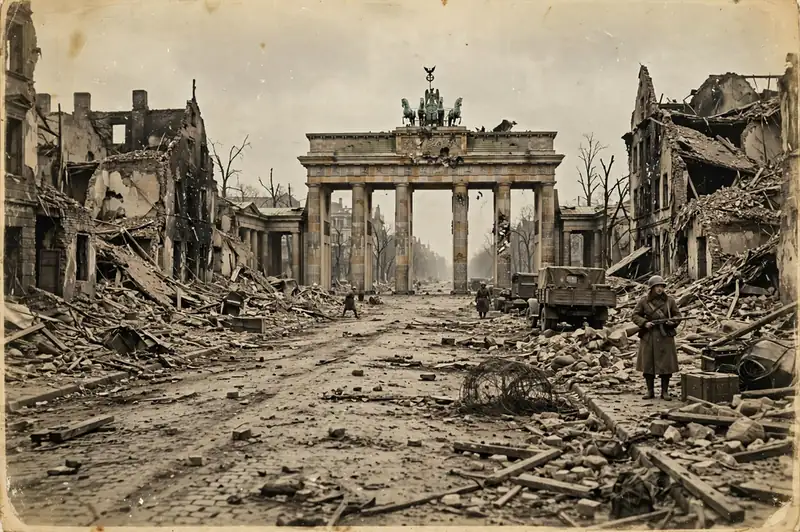
The battle also left about 100,000 Berliners homeless and the city itself in ruins: of Berlin’s buildings, about a third were destroyed and another third badly damaged.
| | Soviet Union | Germany |
|—|—|—|—|
| Killed | About 78,000-81,000 (Krivosheev) | About 92,000-100,000 |
| Wounded | About 274,000 | Unknown, very heavy |
| Prisoners | Few | About 480,000 |
| Civilians killed | — | Tens of thousands to about 125,000 (disputed) |
Orders at Battle of Berlin travelled slowly and unreliably. Field telephones depended on wires that shellfire cut within minutes; radios were heavy, short-ranged and easily intercepted; and in the end much depended on runners — men who carried written orders across open ground under fire, and who sometimes never arrived. A battalion could fight for hours without knowing what its neighbours were doing, and a division could learn of a breakthrough only when the enemy appeared in its rear. The battle therefore has to be understood as a dozen small battles fought in partial ignorance of each other, held together by a command system that was always one step behind events.
7.2.1. Wounds, Burial and Records
Behind every casualty figure lies a medical system under strain. Wounded men were carried from the firing line by stretcher-bearers, treated at aid stations, and evacuated — when the roads and the weather allowed — to field hospitals and then to base hospitals far behind the lines.
Many of the wounded at Battle of Berlin died not on the battlefield but of wounds, shock and infection in the hours and days that followed, and the difference between life and death often came down to how quickly a man could be reached and how far he had to travel.
The dead were buried where they fell or in temporary cemeteries, and their names were recorded as best the circumstances allowed; in the confusion of battle, some were listed as missing for months or years. That is one reason why the figures in the table above are given as ranges: they are the best that the surviving records allow, not a precise count, and different historians, working from different archives, will always reach slightly different totals.
8. Map and Geography
8.1. The Ground
Berlin stands on the North German Plain, on the River Spree, in a landscape of flat land, pine forests, lakes and marshes. The city is spread across a wide area, with broad avenues, great parks — above all the Tiergarten, in the centre of the city — and massive stone buildings, the legacy of its time as the capital of the German Empire.
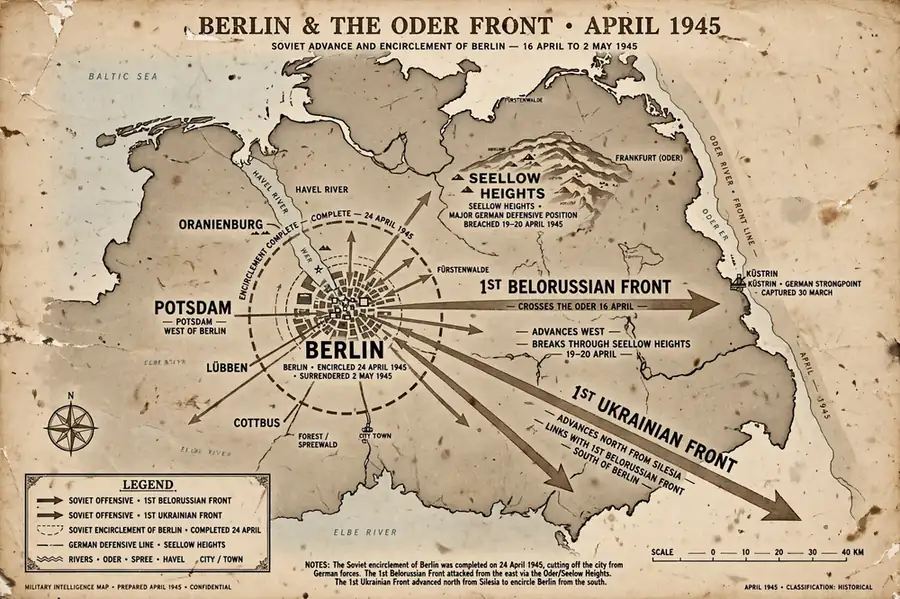
To the east, the Oder River runs north to south, and between the Oder and Berlin lies the Seelow Heights, a low ridge, 30 to 50 metres high, that commands the road to the city. The ground between the Oder and Berlin is flat and open, cut by canals and small rivers, and it offered the defenders little natural cover — which is why Heinrici fortified the Seelow Heights so heavily, and why the Soviet breakthrough there decided the battle.
The ground at Battle of Berlin rewarded the side that studied it. A ridge, a river, a wood or a ruined village could be worth a battalion, and commanders who had walked the ground — or who listened to the men who had — gained advantages that no map could give. The fighting followed the ground: attacks went where the ground allowed them, defences were built where the ground was strong, and the deadliest places in the battle were the places where the ground gave one side a clear field of fire and the other no cover at all. To read the battle without the map is to miss half of it.
8.2. Why the Ground Mattered
Inside the city, the geography favoured the defender. Berlin’s buildings were built of stone and brick, and they could withstand artillery fire that would have destroyed a town of wooden houses. The city’s underground railway, the U-Bahn and S-Bahn, allowed the defenders to move troops and supplies beneath the streets, out of reach of Soviet guns, and the great flak towers — concrete fortresses up to 40 metres high, with walls several metres thick — could not be destroyed by any weapon the Soviets brought to Berlin.
The Spree and the canals cut the city into sectors that had to be taken one by one, and the bridges over them became the objectives of bitter fighting. Berlin’s geography made the battle a slow, grinding urban fight, and it is the reason why the city, though encircled and outnumbered, held out for eight days of street fighting.
The weapons used at Battle of Berlin shaped the fighting in ways that the men who carried them understood better than their generals. A rifle that jammed in mud, a machine gun that could sweep a street, a tank that could not climb a slope, an artillery piece that could be heard but not seen — each weapon had its range, its rate of fire and its weakness, and battles were won by the side that matched its weapons to the ground. The technical details matter: the calibre of a gun, the thickness of a tank’s armour, the range of a radio. They are not footnotes to the battle; they are the reason the battle took the shape it did.
8.2.1. Weather and Season
Weather and season were as much a part of Battle of Berlin as any general’s plan. Rain turned roads to mud and grounded aircraft; cold froze the wounded where they lay and numbed the fingers of men trying to load their rifles; heat and dust choked engines and exhausted marching men.
Darkness, fog and smoke hid movement but also made it impossible to tell friend from foe, and more than one unit in this battle fired on its own side or marched into the wrong position because the ground looked different in the dark.
Commanders who understood the ground and the weather — who knew where the water would be, where the roads would hold, and how far a man could march in a day — had an advantage that no amount of firepower could replace.
The map of Battle of Berlin is therefore not only a record of where the fighting happened, but a reminder that geography and climate are actors in every battle, not merely its stage.
9. Outcome and Legacy
9.1. The Immediate Result
The fall of Berlin ended the war in Europe. On 7 May 1945, Germany surrendered unconditionally to the Western Allies at Reims, and on 8 May the surrender was repeated in Berlin, in the presence of Soviet commanders. The war in Europe was over, and the continent was divided between the victors: Berlin itself was divided into four occupation zones, and the division of the city became, within a few years, the division of Germany and of Europe, symbolised by the Berlin Wall, built in 1961 and standing until 1989. The battle that ended the war thus began the Cold War, and the ruins of Berlin were the landscape in which the new Europe was built.
Morale at Battle of Berlin was not a slogan but a physical fact. Men who had eaten, slept and believed in their officers fought differently from men who were hungry, exhausted and leaderless, and the same unit could be brave on one day and broken on the next.
Fear was universal — veterans admitted it freely — and what kept men fighting was rarely hatred of the enemy but loyalty to the men beside them, the shame of running, and the simple habit of obeying orders. The battle’s histories often describe morale as if it were a quality of armies; at Battle of Berlin it was a quality of small groups of men, and it could collapse in a single afternoon.
9.2. The Longer Legacy
The legacy of the battle is preserved in the city itself: the Reichstag, restored and now the seat of the German parliament, with a Soviet soldier’s graffiti still visible on its walls; the Brandenburg Gate, damaged in the battle and restored as a symbol of German unity; the Soviet War Memorial in the Tiergarten, where Soviet soldiers are buried in the heart of Berlin; and the site of the Führerbunker, now an unmarked car park, deliberately left without a memorial.
The battle is remembered in Russia as the crowning victory of the Great Patriotic War, celebrated every 9 May, and in Germany as the end of the Nazi regime and the beginning of a reckoning with its crimes that continues to this day.
The wounded of Battle of Berlin depended on a chain of care that began with the man beside them. Stretcher-bearers carried them from the firing line, often under fire; aid stations, in a cellar, a ditch or a ruined house, gave them morphine and bandages; and if the roads allowed, they were evacuated to field hospitals and then further back. Many died of wounds that a modern hospital would have treated, and many lived because a comrade reached them in time. The medical story of the battle is inseparable from its casualty figures: the difference between killed and wounded, and between wounded and dead of wounds, is a measure of how well that chain worked.
9.2.1. How Historians Judge the Battle
Historians still argue about Battle of Berlin, and the argument is part of the battle’s legacy. Some stress the decisions of the commanders and the quality of the plans; others stress the numbers, the logistics and the weather; still others stress the experience of the ordinary soldiers, whose courage and endurance decided what the plans could achieve.
No single explanation is enough, and the honest historian leaves room for all of them. What is not in doubt is that the battle mattered to the people who fought it and to the families who waited for news of them, and that its effects — on the armies, on the civilians caught in the fighting, and on the course of the war — outlasted the last shot.
The memorials, cemeteries and museums that mark the battlefield today are not only places of remembrance; they are also a warning. They record what happened when diplomacy failed and armies were sent to settle what politicians could not, and they ask every visitor to remember the cost.
10. Commanders
10.1. The Soviet Front Commanders
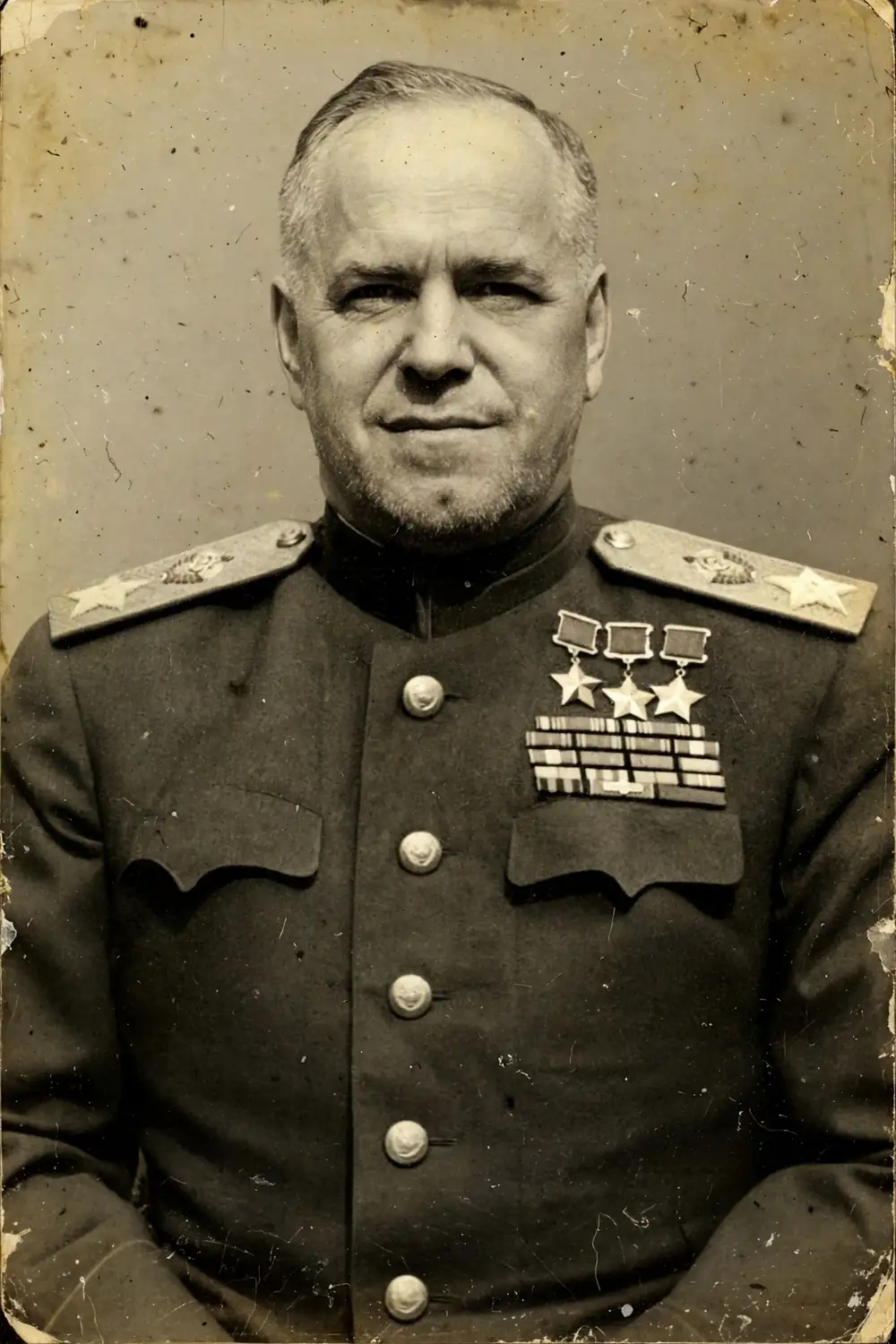
Marshal Georgy Zhukov (Soviet Union). Commander of the 1st Belorussian Front, the main Soviet force in the Berlin operation. Zhukov directed the attack across the Oder and the Seelow Heights and the assault on Berlin from the east. He took the German surrender in Berlin on 8 May 1945 and became the most celebrated Soviet commander of the war.
Marshal Ivan Konev (Soviet Union). Commander of the 1st Ukrainian Front, which crossed the Neisse, advanced on Berlin from the south, and encircled the city. Konev’s rivalry with Zhukov drove both Fronts forward, and his tank armies were the first to reach the southern suburbs of Berlin.
Civilians were caught in Battle of Berlin in ways that the military histories often pass over. Farmers, shopkeepers, children and the old found their villages turned into battlefields, their houses into strongpoints, their fields into minefields. Some fled, some hid in cellars, and some were killed by shells fired at targets they could not see. Their losses are the hardest to count, because no army kept their names, and their suffering is the part of the battle that has no memorial. Any honest account of Battle of Berlin must remember that the battle was fought not on empty ground but in places where people lived, and that those people paid for it.
10.2. The Northern Front and the German Defence
Marshal Konstantin Rokossovsky (Soviet Union). Commander of the 2nd Belorussian Front, which attacked north of Berlin and pinned down the German forces that might have relieved the city. Rokossovsky, a Polish-born Soviet commander, had led the defence of Moscow and the victory at Stalingrad.
General Gotthard Heinrici (Germany). Commander of Army Group Vistula and the architect of the German defence on the Oder and the Seelow Heights. Heinrici, a defensive specialist, held the Soviet advance for three days at Seelow, and was dismissed by Hitler on 28 April for ordering a retreat.
The sources for Battle of Berlin are uneven, and the historian must weigh them carefully. Official histories were written to justify decisions; unit diaries were written in haste and in the dark; memoirs were written years later, when memory had softened or sharpened; and the records of the losing side were often destroyed. Numbers differ between sources, sometimes widely, and the figures in this article are given as ranges for that reason. Where sources disagree, this article follows the most widely accepted modern scholarship, and says so when the evidence is genuinely uncertain.
10.3. The Last Defenders of Berlin
General Helmuth Weidling (Germany). Commander of the Berlin garrison in the last days of the battle. Weidling, an artillery general, organised the defence of the city and surrendered Berlin to the Soviets on 2 May 1945, against Hitler’s orders. He died in Soviet captivity in 1955.
Adolf Hitler (Germany). The German leader, who directed the defence of Berlin from his bunker under the Reich Chancellery, refused to leave the city, and ordered counterattacks by armies that no longer existed. He killed himself on 30 April 1945, and named Admiral Karl Dönitz as his successor.
The numbers at Battle of Berlin hide as much as they reveal. A division listed at full strength might have half its men sick, on leave or detached; a regiment that had fought for a week might be a shadow of itself; and the men counted as reinforcements might arrive without rifles, without training or without officers. Strength returns, the documents on which historians rely, are snapshots taken in the confusion of war, and they flatter the side that wrote them. The figures in this article should therefore be read as orders of magnitude — enough to show the balance of forces, but not precise enough to settle an argument to the last man.
10.3.1. Command and Responsibility
Command at Battle of Berlin carried a weight that is hard to grasp from the safety of hindsight. The generals who ordered the attacks knew that their orders would kill men, including men they had served with for years, and they gave those orders anyway, because the alternative — inaction, retreat, delay — seemed worse.
Some of them were right and some were wrong, and history has judged them accordingly, but the judgement is rarely simple: a commander who was cautious at Battle of Berlin might have been reckless elsewhere, and a commander who won here might have done so by spending lives that a better plan would have saved. The biographies in this section should be read with that in mind.
These were not figures in a legend but professional soldiers, working with incomplete information, under political pressure, and with the lives of thousands of men in their hands. Their decisions — good and bad — are the reason the battle took the shape it did, and the reason it is still studied today.
11. Frequently Asked Questions
When was the Battle of Berlin fought?
From 16 April to 2 May 1945. The Soviet offensive opened on 16 April, the city was encircled by 25 April, Hitler killed himself on 30 April, and the garrison surrendered on 2 May.
How many Soviet soldiers died at Berlin?
78,291 killed and missing according to the official historian Krivosheev, with some Western historians putting the Soviet dead higher, at about 81,000, and about 274,000 wounded. The total Soviet casualties in the Berlin operation were about 352,000.
Did Hitler really kill himself in the bunker?
Yes. Adolf Hitler killed himself in the Führerbunker on 30 April 1945, together with Eva Braun, whom he had married the day before. Their bodies were burned in the garden of the Reich Chancellery. The fact is established by the testimony of the bunker staff and by Soviet investigations.
Who raised the flag over the Reichstag?
Soviet soldiers Mikhail Yegorov and Meliton Kantaria raised the red flag over the Reichstag on 30 April 1945. The famous photograph of the flag-raising was staged after the building was taken, but the flag itself was real and the men named are the ones credited with it.
Why was the Battle of Berlin so bloody?
Because the Germans fought for their capital street by street, with regular soldiers, SS units, Volkssturm militia and Hitler Youth, and the Soviets attacked with overwhelming artillery and tanks in a great city of stone buildings. Both sides fought with the knowledge that the battle would decide the war.
What happened to Berlin after the battle?
Berlin was divided into four occupation zones — Soviet, American, British and French — and the division of the city became the division of Germany and of Europe. The Berlin Wall, built in 1961, stood until 1989, when Germany was reunified.
12. Sources
- Wikipedia, “Battle of Berlin” — dates, commanders, strength and casualty figures (Krivosheev).
- Antony Beevor, Berlin: The Downfall 1945 (Viking, 2002) — the standard English-language history of the battle.
- Encyclopædia Britannica, “Battle of Berlin” — background and outcome.
- Grigori Krivosheev, Soviet Casualties and Combat Losses in the Twentieth Century (Greenhill, 1997) — the official Soviet casualty figures.
- Cornelius Ryan, The Last Battle (Simon & Schuster, 1966) — the race for Berlin and the fall of the city.