 WAR ATLAS MILITARY HISTORY MAGAZINE · WWI — WWII
Operation Fortitude
1. Operation Fortitude — In Brief
Operation Fortitude was the Allied deception plan for the invasion of Normandy in 1944, and it was one of the most successful deceptions in the history of warfare. The plan, which was part of the wider Operation Bodyguard, aimed to convince the German high command that the main Allied invasion would land at the Pas-de-Calais, the narrowest part of the English Channel, rather than at Normandy, and that the Normandy landings, when they came, were only a feint.
To achieve this, the Allies created a fake army, the First United States Army Group, under the command of General George S. Patton, the Allied general whom the Germans feared most, and they placed it in south-east England, opposite the Pas-de-Calais, with dummy tanks, dummy landing craft, and fake radio traffic.
They also used double agents, notably Juan Pujol Garcia, codenamed Garbo, to feed false information to the Germans, and they carried out bombing raids and naval demonstrations to suggest that the Pas-de-Calais was the target. The deception worked: the Germans kept their strongest forces, including the 15th Army, at the Pas-de-Calais, and they did not send reinforcements to Normandy for weeks after D-Day, believing that the real invasion was still to come.
Operation Fortitude helped to make D-Day a success, and it remains a classic example of how deception, properly planned and executed, can win a battle before it is fought.
2. Key Facts
| Field | Value |
|---|---|
| Period | Early 1944 – July 1944 |
| Part of | Operation Bodyguard (overall Allied deception for Normandy) |
| Aim | Convince Germany the main invasion was at Pas-de-Calais, not Normandy |
| Allied commanders | General Dwight D. Eisenhower; Lieutenant Colonel Roger Hesketh (deception planner); General George S. Patton (figurehead of fake army) |
| Fake formation | First United States Army Group (FUSAG) — fictional, in south-east England |
| Key double agent | Juan Pujol Garcia, codenamed Garbo |
| German belief | Main landing at Pas-de-Calais; Normandy was a diversion |
| German forces misled | German 15th Army held at Pas-de-Calais for weeks after D-Day |
| Result | Germans delayed reinforcements to Normandy; D-Day breakout made easier |
| Notable feature | Dummy tanks, fake radio traffic, false bombing targets, double agents |
3. Background and Origins
Deception in War and Operation Bodyguard
Deception has been a part of warfare since ancient times, from the Trojan Horse to the dummy armies of the Second World War, but Operation Fortitude was the most elaborate deception ever attempted, because it involved the coordination of fake armies, double agents, radio traffic, bombing, and diplomacy, all aimed at a single purpose: to mislead the German high command about the place and time of the Allied invasion.
The overall deception plan for Normandy was codenamed Operation Bodyguard, and it included several separate deceptions, of which Fortitude was the most important. Bodyguard also included Operation Zeppelin, which suggested an invasion of the Balkans, and Operation Royal Flush, which suggested invasions of Norway and southern France.
The aim of Bodyguard was to make the Germans spread their forces thinly, defending many possible landing sites, rather than concentrating them in Normandy. Fortitude itself was divided into two parts: Fortitude North, which suggested an invasion of Norway, and Fortitude South, which suggested an invasion of the Pas-de-Calais. Fortitude South was the main effort, and it is the part that is usually meant when historians speak of Operation Fortitude.
The London Controlling Section
The deception was planned by the London Controlling Section, a small, secret organisation under Lieutenant Colonel John Bevan, which was responsible for all Allied deception in the Second World War. The London Controlling Section worked with the Twenty Committee, which controlled the double agents, and with the planners of Operation Overlord, the Normandy invasion, to ensure that the deception and the real operation were coordinated.
The chief planner of Fortitude South was Lieutenant Colonel Roger Hesketh, a young officer who had studied the German intelligence system and who understood what the Germans expected and what they feared. Hesketh’s plan was based on a simple idea: the Germans expected the invasion to come at the Pas-de-Calais, because it was the shortest crossing, because it offered the most direct route to Germany, and because it was where the Germans themselves would have landed if they had invaded Britain.
Hesketh therefore decided to confirm the German expectation, rather than to try to create a new one, and to make the Germans believe that the Pas-de-Calais was the target, by giving them the evidence they expected to see.
Why the Pas-de-Calais Was Believable
The Pas-de-Calais was believable as the invasion target because it was the narrowest part of the Channel, only about 35 kilometres wide, because it was the closest point to Germany, and because it was the most heavily defended part of the French coast, with the strongest German fortifications.
The Germans had built the Atlantic Wall, a system of bunkers, guns, and obstacles, along the whole French coast, but they had concentrated their strongest forces at the Pas-de-Calais, because they believed that was where the Allies would land. The Allies, who had studied the German defences, knew that the Pas-de-Calais was the hardest place to land, and they chose Normandy instead, because its beaches were wider, its defences were weaker, and it offered room to build up a large force.
The deception, therefore, was to make the Germans believe that the Allies would do the obvious thing, and land at the Pas-de-Calais, when in fact they would do the less obvious thing, and land in Normandy. The plan worked because it played on the Germans’ own assumptions, and because it gave them the evidence they wanted to see.
4. Core Principles
Confirming the Enemy’s Expectations
The core principle of Operation Fortitude was to confirm the enemy’s expectations, rather than to try to create a new belief. The Germans already believed that the invasion would come at the Pas-de-Calais, and the Allies did not try to change that belief, but to strengthen it, by providing evidence that seemed to confirm it.
The fake army in Kent, the dummy tanks and landing craft, the radio traffic, the bombing of the Pas-de-Calais, and the reports of the double agents all pointed to the same conclusion: that the main invasion was coming at the Pas-de-Calais, and that it would be led by Patton, the general whom the Germans feared most.
The principle of confirming expectations is a basic one in deception, because people are more likely to believe evidence that confirms what they already think, than evidence that contradicts it. Fortitude succeeded because it understood the German mind, and because it gave the Germans the story they wanted to hear, in a form that they could believe.
The Use of a Believable Commander
The use of General George S. Patton as the figurehead of the fake army was a key part of the deception, because Patton was the Allied general whom the Germans respected and feared most. Patton had commanded American forces in North Africa and Sicily, and he was known for his aggressive and daring style, which the Germans believed would be used in the main invasion.
The Allies placed Patton in command of the fake First United States Army Group, and they made sure that the Germans knew he was in south-east England, opposite the Pas-de-Calais, by allowing him to be seen in public, by mentioning him in radio traffic, and by having double agents report his presence.
The Germans, who had a high opinion of Patton, concluded that where Patton was, the main invasion would be, and they therefore kept their best troops at the Pas-de-Calais to meet him. The use of Patton was a masterstroke, because it gave the deception a human face, and because it played on the Germans’ respect for a single, identifiable commander.
Multiple Channels, One Story
Another core principle of Fortitude was to tell the same story through multiple channels, so that the Germans would receive the same message from different sources, and would therefore believe it. The Allies used physical deception, with dummy tanks and landing craft, signals deception, with fake radio traffic, human deception, with double agents, and operational deception, with bombing raids and naval demonstrations, all to tell the same story: that the invasion was coming at the Pas-de-Calais.
The use of multiple channels was important, because if the Germans had received the message from only one source, they might have doubted it, but when they received it from many sources, they were more likely to believe it. The coordination of the different channels was the work of the London Controlling Section and of Hesketh, who ensured that the dummy tanks, the radio traffic, and the agents’ reports all told the same story, at the same time, and in a way that was consistent.
The principle of multiple channels, telling one story, remains a basic rule of deception today.
5. How It Worked in Practice
The Fake First United States Army Group
The fake First United States Army Group, known as FUSAG, was the centrepiece of Fortitude South, and it was created in south-east England, in Kent and Sussex, opposite the Pas-de-Calais. FUSAG was a fictional formation, with no real troops, but it was given a headquarters, a commander in Patton, and a full order of battle, with corps, divisions, and supporting units, all of which existed only on paper and in the radio traffic that the Allies generated.
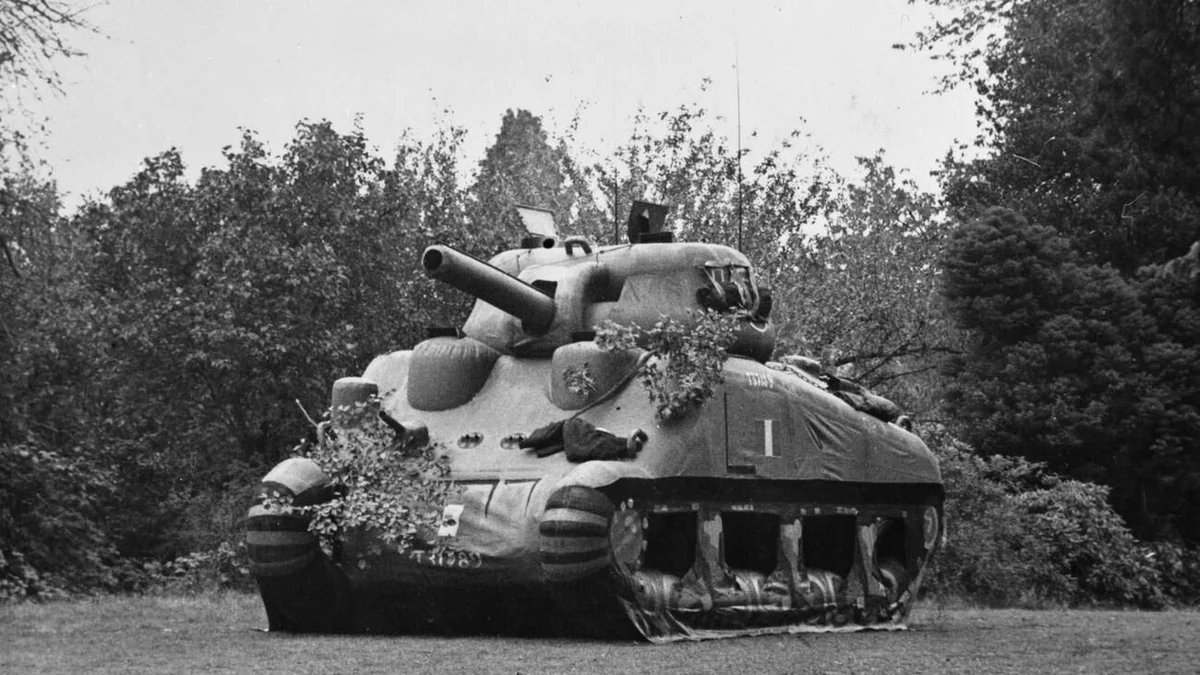
The Allies built dummy tanks, made of rubber and wood, dummy landing craft, made of canvas and scaffolding, and dummy airfields, with fake aircraft, and they placed them where German reconnaissance aircraft could see them. They also generated fake radio traffic, with operators sending messages in the style of a real army group, and they allowed German agents to report the presence of FUSAG in Kent.
The fake army was so convincing that the Germans believed it was real, and they kept the 15th Army, their strongest force in France, at the Pas-de-Calais to meet it, even after the Normandy landings had begun.
Dummy Tanks and Fake Radio Traffic
The dummy tanks and the fake radio traffic were two of the most important elements of FUSAG, because they provided the physical and the signals evidence that the Germans needed to believe in the fake army. The dummy tanks were inflatable rubber tanks, which could be set up quickly and which looked real from the air, and they were placed in fields and in woods where German reconnaissance aircraft would see them.
The dummy landing craft were made of canvas over a wooden frame, and they were placed in harbours and in rivers, to suggest that a large invasion fleet was being prepared. The fake radio traffic was generated by a small team of operators, who sent messages in the style of a real army, with the correct call signs, frequencies, and procedures, and who created the impression of a large formation preparing for an invasion.
The combination of dummy equipment and fake radio traffic was convincing, because it gave the Germans both visual and signals evidence, and because the two types of evidence agreed with each other.
The Double Agents: Garbo and Others
The double agents were the human element of Fortitude, and they were the most important channel for feeding false information to the Germans. The most famous of them was Juan Pujol Garcia, a Spanish businessman who had offered his services to the British and who was codenamed Garbo, because he was such a good actor.
Garbo built up a network of fictional sub-agents, all of whom existed only in his reports, and he sent hundreds of messages to the Germans, reporting on the fake army in Kent, on the bombing of the Pas-de-Calais, and on the Allied plans. The Germans trusted Garbo completely, and they awarded him the Iron Cross, not knowing that he was working for the British.
On the night of 5–6 June 1944, Garbo sent a message to the Germans, warning them that the Normandy landings were about to begin, but that they were only a feint, and that the real invasion would come at the Pas-de-Calais. The Germans believed him, and they did not send reinforcements to Normandy. Garbo’s work was the most successful deception by a single agent in the war.
6. Key Examples
Fortitude North: The Threat to Norway
Fortitude North was the northern part of the deception, and it aimed to convince the Germans that the Allies would invade Norway, in addition to, or instead of, France. The Allies created a fake Fourth Army in Scotland, under the command of Lieutenant General Andrew Thorne, and they generated radio traffic, carried out naval demonstrations, and used double agents to suggest that an invasion of Norway was being prepared.
The deception worked: the Germans kept about a dozen divisions in Norway, troops that could have been used in France, and they did not move them even after D-Day. Fortitude North was less important than Fortitude South, but it contributed to the overall success of Bodyguard, by making the Germans spread their forces thinly.
The fake Fourth Army, like FUSAG, was a fictional formation, but it was convincing enough to tie down German troops for the whole of 1944. The example of Fortitude North shows that deception can be used not only to mislead the enemy about the main attack, but also to create secondary threats that divert the enemy’s forces.
The Bombing of the Pas-de-Calais
The bombing of the Pas-de-Calais was another key example of Fortitude in practice, because the Allies deliberately bombed the Pas-de-Calais more heavily than Normandy in the months before D-Day, to suggest that it was the target. The Allied air forces attacked railway yards, bridges, and coastal defences in the Pas-de-Calais, and they did so in a way that was visible to the Germans, who concluded that the bombing was a preparation for an invasion there.
In fact, the bombing of the Pas-de-Calais was a deception, and the real preparation for Normandy was carried out more quietly, with the bombing of Normandy increasing only in the final days before D-Day. The bombing deception worked, because the Germans measured the weight of the bombing and concluded that the Pas-de-Calais was the target, a conclusion that was reinforced by the reports of their agents.
The example shows how even a real operation, such as bombing, can be used as a deception, by carrying it out in a way that suggests a false target.
The Night of D-Day and Garbo’s Message
The night of D-Day, 5–6 June 1944, was the climax of Operation Fortitude, when Garbo sent his most important message, warning the Germans that the Normandy landings were a feint. Garbo’s message, which was sent at about 03:00 on 6 June, said that the Allied force landing in Normandy was a diversion, and that the main invasion, under Patton, would land at the Pas-de-Calais in a few weeks.
The message was received by the Germans, and it was believed, because Garbo was trusted, and because it confirmed what the Germans already thought. The German high command, acting on Garbo’s message and on the evidence of FUSAG, decided not to send the 15th Army, which was at the Pas-de-Calais, to Normandy, and to keep it in place to meet the expected main invasion.
The decision was a disaster for the Germans, because it meant that the Normandy landings were not opposed by the strongest German forces, and that the Allies were able to establish a beachhead and to break out. Garbo’s message on D-Day was the single most important deception message of the war.
7. Strengths
Keeping German Forces Away from Normandy
The main strength of Operation Fortitude was that it kept German forces away from Normandy, by convincing the Germans that the main invasion was coming at the Pas-de-Calais. The German 15th Army, which was the strongest German force in France, with about 18 divisions, was held at the Pas-de-Calais for weeks after D-Day, and it did not move to Normandy until late July, by which time the Allies had broken out and the battle was lost.
The deception also kept German armoured divisions in reserve, because the Germans were waiting for the main invasion, and they were unwilling to commit their reserves to Normandy, for fear that they would be needed at the Pas-de-Calais. The strength of Fortitude, therefore, was not in destroying German troops, but in preventing them from fighting, by making them wait in the wrong place for an invasion that never came.
The deception saved Allied lives, by reducing the opposition on D-Day and in the weeks that followed.
The Economy of Deception
Another strength of Fortitude was its economy, because it achieved a great result with relatively few resources. The fake army, the dummy tanks, the radio traffic, and the double agents cost far less than a real army, but they tied down a whole German army, and they saved the Allies from having to fight that army in Normandy.
The deception was a force multiplier, in that it made a small investment produce a large return, by misleading the enemy and by making him waste his strength. The economy of deception is a general principle: a well-planned deception can achieve more than a direct attack, at a fraction of the cost, and it is therefore an attractive option for a commander who is outnumbered or who wants to avoid heavy casualties.
Fortitude is the classic example of the economy of deception, and it is studied as a model for how to use deception in war.
The Coordination of Many Channels
The coordination of many channels, all telling the same story, was another strength of Fortitude, because it made the deception convincing and difficult for the Germans to detect. The Allies used physical, signals, human, and operational deception, and they coordinated them so that they all pointed to the Pas-de-Calais, at the same time, and in a consistent way.
The coordination was the work of the London Controlling Section, which ensured that the dummy tanks, the radio traffic, the agents’ reports, and the bombing all told the same story, and that no channel contradicted another. The strength of the coordination was that it made the deception seem real, because the Germans received the same message from many different sources, and they therefore believed it.
The coordination of Fortitude remains a model for deception operations today, in which multiple channels must be used to create a believable false picture. Every message, dummy, and raid had to agree in timing and detail, because a single contradiction could alert the enemy, and the planners checked each element daily to ensure that the story remained consistent and believable.
8. Weaknesses and Limitations
Dependence on German Beliefs
The main weakness of Fortitude was its dependence on German beliefs, because the deception worked only because the Germans already believed that the invasion would come at the Pas-de-Calais. If the Germans had not held that belief, the deception would have failed, because the Allies would have had to create a new belief, which is much harder than confirming an old one.
The deception was therefore vulnerable to a change in German thinking, and if the Germans had realised that Normandy was the target, the fake army in Kent would have been useless. The dependence on German beliefs also meant that the Allies had to be careful not to do anything that would contradict the German expectation, such as bombing Normandy too heavily before D-Day, which might have alerted the Germans.
The weakness of Fortitude, therefore, was that it was based on the enemy’s assumptions, and it could have been undone if those assumptions had changed.
The Risk of Discovery
Another weakness of Fortitude was the risk of discovery, because if the Germans had discovered that FUSAG was fake, or that Garbo was a double agent, the deception would have collapsed, and the Germans would have known that Normandy was the target.
The Allies took great care to protect the deception, by keeping it secret, by limiting the number of people who knew about it, and by making the fake army as convincing as possible, but the risk was always there. A single German reconnaissance flight that photographed the dummy tanks closely, or a single German agent who reported that Patton was not in Kent, could have exposed the deception.
The risk of discovery was a constant worry for the planners, and it meant that Fortitude had to be maintained carefully, with constant attention to detail, for months. The fact that it was not discovered is a tribute to the skill of its planners, but the risk was real, and it shows the fragility of deception operations.
The Limits of Deception After D-Day
The limits of Fortitude became clear after D-Day, because the deception could not be maintained indefinitely, and the Germans eventually realised that Normandy was the real invasion. The Allies continued the deception after 6 June, with Garbo sending messages that the Normandy landings were a feint, and with FUSAG remaining in Kent, but the Germans gradually moved troops to Normandy, as it became clear that no second invasion was coming.
By late July, the deception had served its purpose, and the Allies were able to break out of Normandy, but the deception itself was no longer effective. The limits of deception are that it can delay the enemy, but it cannot prevent him from eventually learning the truth, and that it must be used as part of a wider plan, in which the real operation is carried out quickly, before the deception is discovered.
Fortitude succeeded because the Allies broke out of Normandy before the Germans could react, not because the deception lasted forever.
9. Evolution and Legacy
Deception in Later Wars
The legacy of Operation Fortitude includes its influence on deception in later wars, notably in the Gulf War in 1991, when the Allies used a similar deception to convince Iraq that the main attack would come from the sea, while the real attack came from the west, through the desert.
The Gulf War deception, like Fortitude, used fake units, dummy equipment, and false radio traffic, and it succeeded in misleading the enemy about the place of the main attack. The legacy of Fortitude is also seen in modern military doctrine, which includes deception as a central element of operations, and in the training of intelligence officers, who study Fortitude as a classic case.
The evolution of deception, from Fortitude to the present day, has been driven by technology, with the use of electronic deception, cyber deception, and information operations, but the principles remain the same: confirm the enemy’s expectations, tell one story through many channels, and use a believable figurehead. Fortitude remains the model for deception, even in the age of satellites and the internet.
The Story of Garbo and the Double Cross System
The legacy of Fortitude also includes the story of Garbo and of the Double Cross System, the British system for controlling German agents in Britain. The Double Cross System, run by the Twenty Committee, turned every German agent who landed in Britain, either by capturing him and making him work for the British, or by feeding him false information.
The system was a triumph of counter-intelligence, and it meant that the Germans received no true information from Britain during the whole war, and that all the information they received was controlled by the British. Garbo was the most successful of the double agents, but he was only one of many, and the Double Cross System as a whole was a key part of the Allied victory.
The legacy of the Double Cross System is that it showed the importance of counter-intelligence, and of controlling the enemy’s sources of information, as a way to deceive him. The story of Garbo, who was awarded the Iron Cross by the Germans and the MBE by the British, remains one of the most remarkable stories of the Second World War.
Fortitude in Popular Culture
Fortitude has entered popular culture, through books, films, and television, and it is one of the best-known deception operations of the Second World War. The story of the fake army, of Patton, and of Garbo has been told in many accounts, and it has become a symbol of Allied ingenuity and of the secret war.
The legacy of Fortitude in popular culture is that it has made deception a familiar idea, and that it has shown the public that wars are not only won by fighting, but also by thinking and by misleading the enemy. The popular image of Fortitude, with its dummy tanks and its double agents, is largely accurate, and it has helped to preserve the memory of the operation.
The historical study of Fortitude, however, goes beyond the popular image, and it shows the careful planning, the coordination, and the risk that were involved in the deception.
10. Comparison with Alternatives
Deception Versus Direct Attack
Deception is often compared with direct attack, as an alternative way to achieve a military aim, and Fortitude shows that deception can be more effective than a direct attack, at a lower cost. A direct attack on the Pas-de-Calais, for example, would have been costly and would probably have failed, because the Germans had concentrated their strongest forces there, while a deception that kept those forces in place allowed the Allies to land in Normandy with fewer losses.
The comparison shows that deception, when it works, can achieve results that a direct attack cannot, by making the enemy waste his strength in the wrong place. Deception, however, is not a substitute for fighting, and the Allies still had to land in Normandy and to fight their way across France, even after Fortitude had succeeded.
The alternative to deception, therefore, is not to avoid fighting, but to use deception to make the fighting easier, by misleading the enemy about where and when the main attack will come.
Fortitude Versus Other Deceptions
Fortitude is also compared with other deceptions of the Second World War, notably Operation Mincemeat, the deception that convinced the Germans that the Allied invasion of Sicily in 1943 was a feint, and that the real invasion would land in Greece.
Operation Mincemeat, which involved planting false documents on a dead body that washed ashore in Spain, was a smaller and simpler deception than Fortitude, but it was equally successful, and it shows that deception can take many forms, from a single false document to a whole fake army.
The comparison between Fortitude and Mincemeat shows that the principles of deception are the same, whatever the scale: confirm the enemy’s expectations, tell one story through many channels, and use a believable detail to make the story convincing. Fortitude was larger and more complex than Mincemeat, but both succeeded because they understood the German mind and because they gave the Germans the evidence they expected to see.
Deception and Intelligence
Deception is closely linked to intelligence, because a successful deception requires a good understanding of the enemy’s intelligence system, of what he knows, what he believes, and how he collects information. Fortitude succeeded because the Allies, through Ultra, the breaking of the German Enigma code, knew what the Germans believed and what they were doing, and they were able to tailor the deception to the German expectations.
The Allies also knew, through the Double Cross System, what the Germans were being told by their agents, and they were able to control that information. The comparison between deception and intelligence shows that the two are inseparable, and that a deception without intelligence is likely to fail, because it will not be based on a correct understanding of the enemy.
Fortitude remains a model for the integration of deception and intelligence, and it is studied as an example of how the two can work together to achieve a decisive result.
Frequently Asked Questions
What was Operation Fortitude?
Operation Fortitude was the Allied deception plan for D-Day, which convinced Germany that the main invasion would land at the Pas-de-Calais, not Normandy, using a fake army, double agents, and dummy equipment.
What was FUSAG?
FUSAG, the First United States Army Group, was a fictional army in south-east England, supposedly commanded by General George S. Patton, with dummy tanks, fake radio traffic, and no real troops.
Who was Garbo?
Juan Pujol Garcia, codenamed Garbo, was a Spanish double agent who fed the Germans false information, including the message on D-Day that Normandy was only a feint and the real invasion would come at the Pas-de-Calais.
Did Fortitude work?
Yes. The Germans kept their strongest force, the 15th Army, at the Pas-de-Calais for weeks after D-Day, delaying reinforcements to Normandy and helping the Allies to establish a beachhead and break out.
What was Fortitude North?
Fortitude North was a deception suggesting an Allied invasion of Norway, using a fake Fourth Army in Scotland, which tied down about a dozen German divisions in Norway.
Is Fortitude still studied today?
Yes. Fortitude is studied as a classic deception operation, and its principles — confirming enemy expectations, telling one story through many channels, using a believable figurehead — remain central to military deception doctrine.
Related articles
Sources
- The Imperial War Museum, D-Day and Deception collection
- Roger Hesketh, Fortitude: The D-Day Deception Campaign (2000)
- Ben Macintyre, Operation Mincemeat and Double Cross (2012)
- The National Archives, London Controlling Section records
- Juan Pujol Garcia, Garbo: The Spy Who Saved D-Day (1985)
- Michael Howard, Strategic Deception in the Second World War (1990)
- Wikipedia, "Operation Fortitude"