 WAR ATLAS MILITARY HISTORY MAGAZINE · WWI — WWII
Blitzkrieg
1. Lead
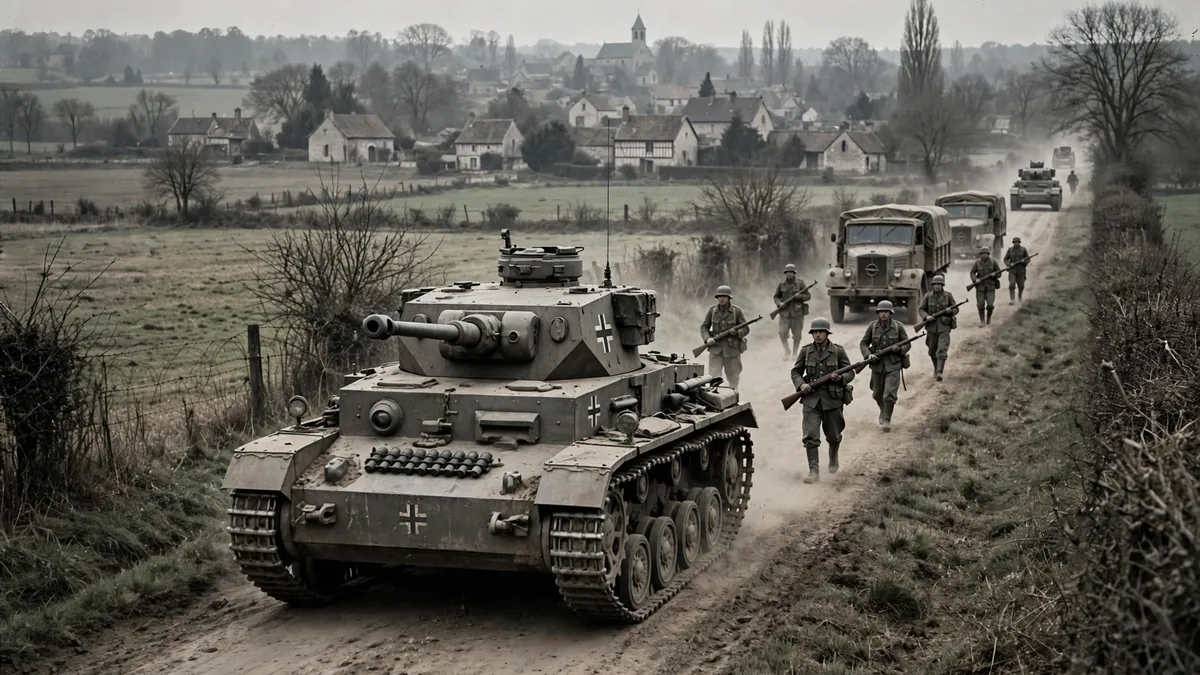
Blitzkrieg — German for “lightning war” — is the term commonly used to describe the fast, combined-arms offensives with which Germany opened the Second World War: armoured columns breaking through a narrow point in the enemy line, motorised infantry following to widen the gap, and aircraft providing close support, all coordinated by radio.
The method produced rapid results in Poland in September 1939 and in France and the Low Countries in May–June 1940, where France signed an armistice only six weeks after the attack began. One fact about the word itself is often misunderstood: Blitzkrieg was never an official doctrine or military term of the German armed forces.
The word appeared in a German military journal in 1935, but it was popularised by British and American journalists after the invasion of Poland, and German generals themselves, including Heinz Guderian, described it as a label invented by their enemies. Historians today use the term as a convenient description of Germany’s early-war method of manoeuvre warfare, not as the name of a codified German plan.
2. Key Facts
| Item | Detail |
|---|---|
| Definition | Fast combined-arms offensive warfare: concentrated armour, motorised infantry, artillery and close air support breaking through a narrow front and exploiting into the enemy rear |
| Origin | Roots in German interwar manoeuvre thinking (Bewegungskrieg); the word “Blitzkrieg” appeared in the German journal Deutsche Wehr in 1935 and was popularised by Western journalists in 1939–1940 |
| Used by | Germany, 1939–1941; later adapted in various forms by other armies, including the Soviet Union and the United States |
| Used in | Invasion of Poland (1939), invasion of France and the Low Countries (1940), invasion of Yugoslavia and Greece (1941), Operation Barbarossa (1941) |
| Key examples | The Ardennes breakthrough and encirclement at Dunkirk (May–June 1940); the encirclement battles of Minsk, Smolensk and Kiev (1941) |
| Effectiveness | Highly effective against unprepared opponents in 1939–1941; less effective against deep defences, long supply lines and determined resistance, as shown in the Soviet Union from late 1941 |
3. Origins
Blitzkrieg did not appear out of nowhere in 1939. Its roots lie in the German Army’s experience of the First World War and in the reforms that followed it. In 1918, German stormtrooper tactics had shown that small, well-trained infantry units could infiltrate an enemy line rather than attacking it head-on.
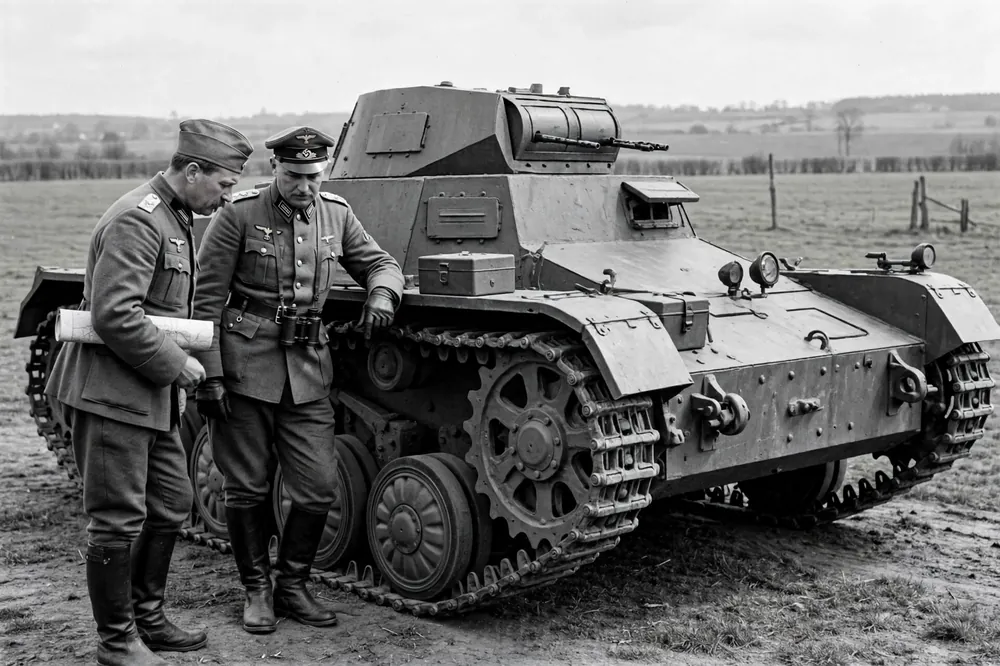
After the war, the Treaty of Versailles limited the German Army to 100,000 men and forbade it to possess tanks, but the small professional army that remained — the Reichswehr — used the restriction as an opportunity to think carefully about the next war.
Under General Hans von Seeckt, its chief from 1920 to 1926, the Reichswehr studied mobile warfare, emphasised the initiative of junior officers, and practised the principle of Auftragstaktik — mission command, in which a commander states the objective and leaves the method to the officer on the spot.
The technology that made the new method possible arrived in the 1930s. The tank, the radio and the aircraft matured together. In Britain, J. F. C. Fuller and B. H. Liddell Hart wrote about armoured warfare; their influence on German thinking is often claimed but remains a subject of debate among historians.
In Germany, Heinz Guderian, an officer in the transport troops who became the leading advocate of the tank, argued in his 1937 book Achtung — Panzer! that tanks should be concentrated in independent armoured divisions, supported by motorised infantry, artillery and aircraft, rather than scattered among infantry divisions as support weapons.
Guderian’s ideas were controversial inside the German Army, where many senior officers still regarded the tank as an auxiliary to the infantry. But the creation of the first Panzer divisions in 1935, and the experience of the Spanish Civil War (1936–1939), where German aircraft and tanks were tested in combat, moved German practice in Guderian’s direction.
The word itself has a separate history. “Blitzkrieg” appeared in 1935 in the German military periodical Deutsche Wehr (“German Defence”), in connection with quick or lightning warfare. Research at the German military history institute in Potsdam found it in only two military articles from the 1930s. In English, the term had been used since the 1920s, including in the writings of the Czech officer Ferdinand Otto Miksche.
After the invasion of Poland in September 1939, British journalists adopted the word to describe the speed of the German advance; the German popular press followed nine months later, after the fall of France. Guderian later wrote that “as a result of the successes of our rapid campaigns our enemies … coined the word Blitzkrieg“.
According to the historian David Reynolds, Hitler himself called the term “a completely idiotic word” (ein ganz blödsinniges Wort), and in a speech in November 1941 he said, “I have never used the word Blitzkrieg, because it is a very silly word.” The Wehrmacht never used the term as an official military concept, and no German manual or doctrine bore the name.
4. How It Works
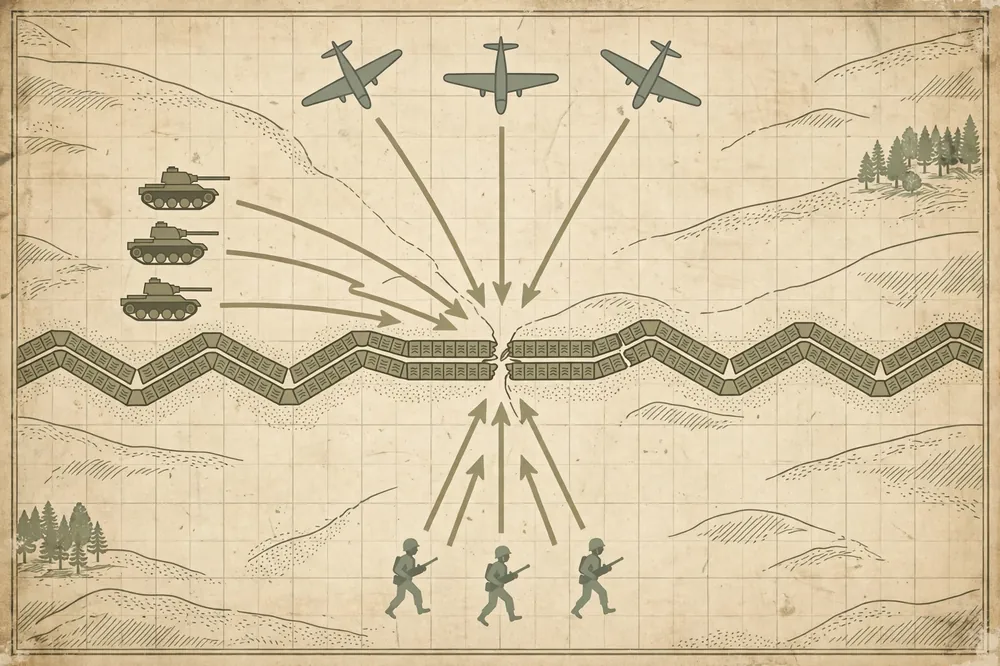
Blitzkrieg, as historians describe it, was not a single tactic but a combination of several elements working together. Its core was the Schwerpunkt — the point of main effort. Instead of attacking along the whole front, the attacker concentrated overwhelming force at one narrow sector, broke through, and then drove deep into the enemy’s rear before the defender could react.
The breakthrough was achieved by Panzer divisions: tanks, motorised infantry, engineers and artillery moving together. Close behind came the Luftwaffe, whose dive bombers and fighters attacked enemy headquarters, artillery, roads and railways — the nervous system of the defence rather than only its front line.
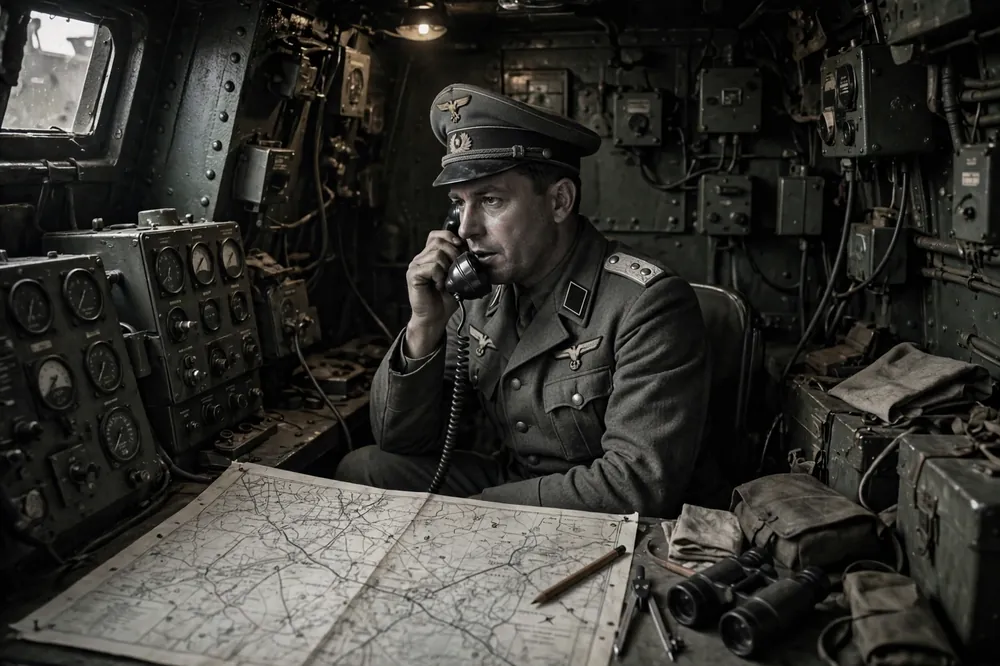
Every German tank carried a radio receiver, and command tanks carried transmitters, so that a Panzer commander could redirect his columns in the middle of a battle, something no other army of 1939–1940 could do at the same scale.
The second element was speed as a weapon in itself. Once through the front, the armoured columns did not stop to destroy every enemy unit they passed. They drove on, bypassing strongpoints and leaving them to the slower infantry divisions following behind. The aim was to paralyse the enemy’s command and control: to cut communications, seize road junctions and river crossings, and create confusion in the rear. When this worked, the defending army found itself unable to form a new defensive line, because German tanks were already behind it. Encirclement followed: the armoured spearheads would meet, trapping large enemy forces in pockets — Kessel — which the infantry then reduced.
The third element was the human factor: Auftragstaktik, or mission command. German junior officers were trained to act on their commander’s intent without waiting for detailed orders. In France in 1940, this allowed Panzer commanders such as Guderian and Erwin Rommel to exploit opportunities as they appeared, sometimes advancing far beyond what their superiors had authorised. It also carried risks, which are discussed in section 7: the same initiative could produce overextension and leave flanks exposed.
Blitzkrieg required specific conditions. It needed air superiority, or at least local air control, so that the Luftwaffe could operate freely over the battlefield. It needed good roads and passable terrain, and it needed an enemy whose command system was slower than the attacker’s. It consumed enormous quantities of fuel, and its supply columns — mostly horse-drawn in the German Army of 1940 — struggled to keep up with the tanks. When those conditions were absent, the method stalled, as it did before Moscow in the winter of 1941.
5. Historical Examples
Germany invaded Poland on 1 September 1939, and the campaign became the first demonstration of the new method — and the first occasion on which Western journalists used the word “Blitzkrieg”. German forces attacked from three directions, with Panzer divisions breaking through the Polish frontier defences and driving towards Warsaw, while the Luftwaffe attacked airfields, railways and command centres.
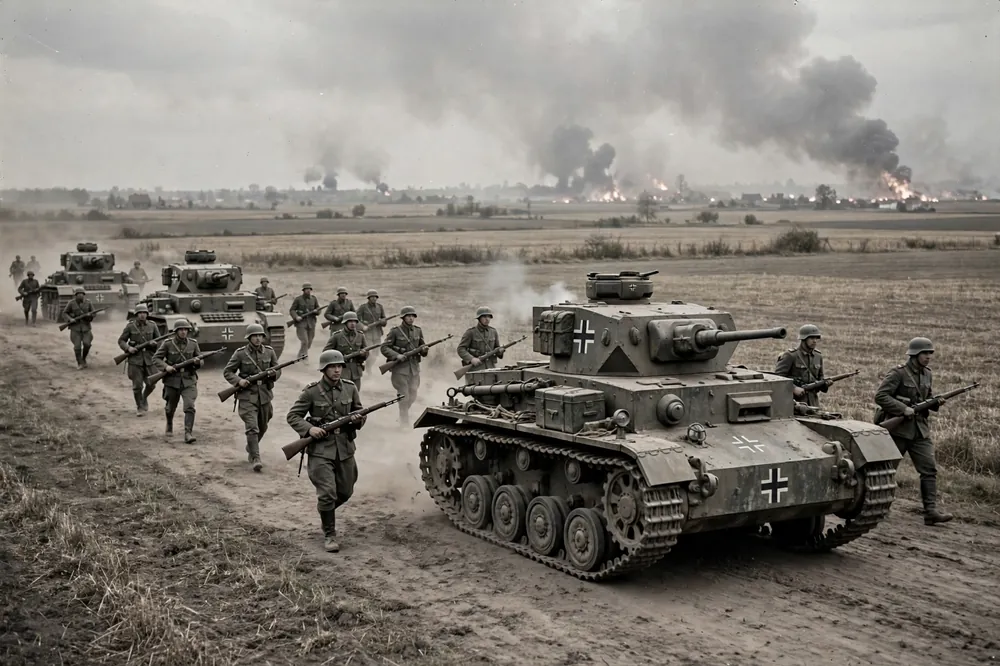
Polish forces, many of them on foot or horseback, were unable to form a continuous front, and large formations were encircled west of the Vistula. Warsaw surrendered on 27 September, and organised Polish resistance ended in early October, after the Soviet Union had invaded from the east on 17 September under the terms of the Molotov–Ribbentrop Pact. The campaign lasted about five weeks.
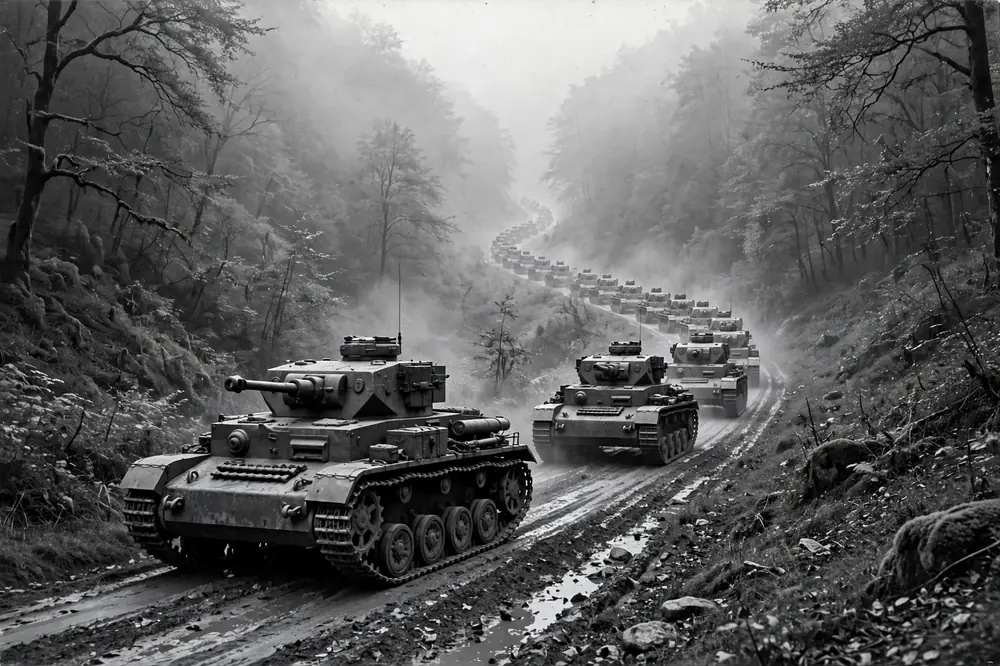
Poland’s defeat, however, owed as much to its strategic position — caught between two great powers — and to the disparity in equipment as to any German tactical novelty, a point historians regularly stress.
The campaign in the west in 1940 is the classic case study. The German plan, Fall Gelb (“Case Yellow”), was revised in early 1940 on the advice of General Erich von Manstein to place the main armoured effort through the Ardennes — a heavily forested region the French high command regarded as impassable to tanks. On 10 May 1940, Germany invaded the Netherlands, Belgium and Luxembourg.
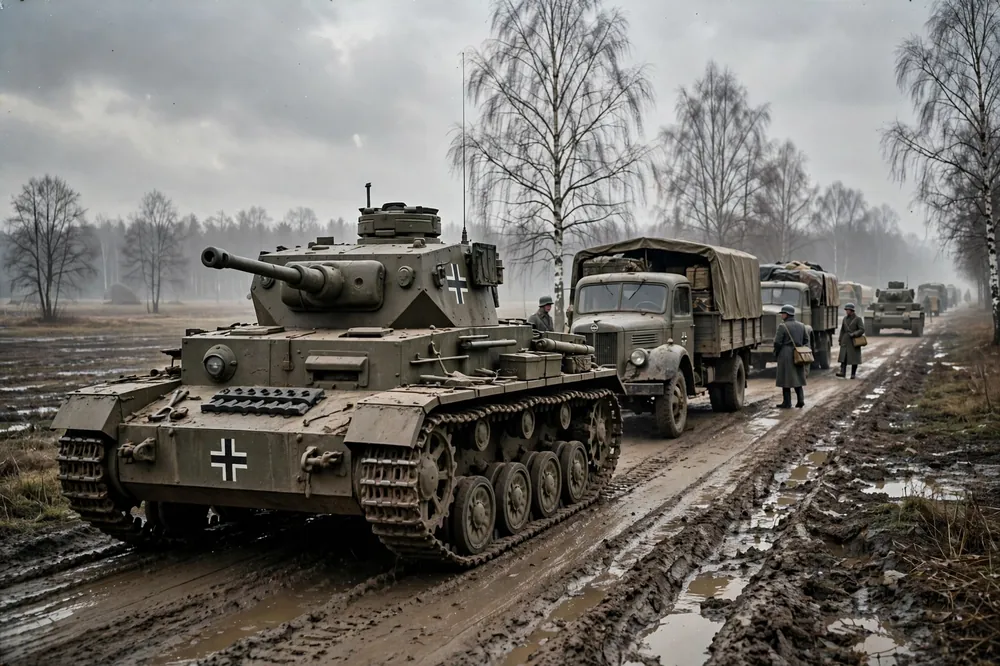
Allied armies advanced into Belgium as expected, but the main German blow fell further south. Between 13 and 15 May, Guderian’s Panzer corps crossed the River Meuse at Sedan, and within days German armour was racing for the English Channel. French attempts to form new defensive lines along rivers failed because German forces arrived first and pressed on.
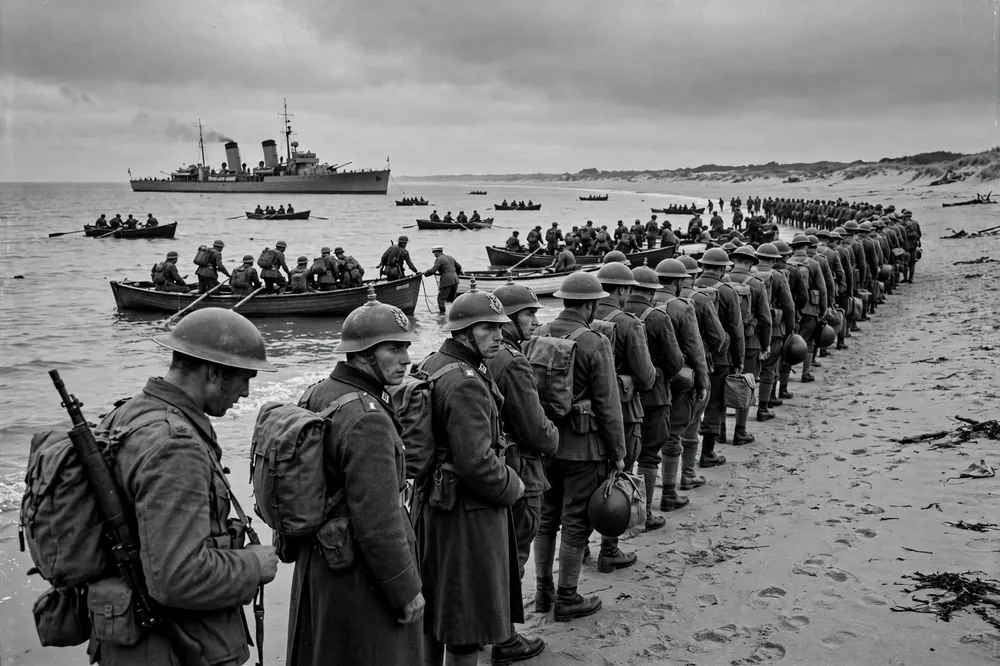
On 20 May, German tanks reached the Channel coast at Abbeville, cutting off the British Expeditionary Force and large French forces in the north. The Dunkirk evacuation (26 May–4 June 1940) took about 338,000 British and French troops off the beaches; the remainder of the northern armies surrendered. France signed an armistice on 22 June 1940, which came into effect on 25 June. The campaign had lasted six weeks.
The result is often attributed to Blitzkrieg alone, but historians note that French command failures, poor communications and the decision to advance into Belgium all contributed, and that the German Army itself was surprised by the speed of its own success.
The invasion of the Soviet Union, launched on 22 June 1941, began as the largest Blitzkrieg-style campaign of the war. In the first months, German Panzer groups encircled Soviet armies at Minsk, Smolensk and Kiev, taking large numbers of prisoners — at Kiev in September 1941, German records claimed more than 600,000 Soviet prisoners, a figure historians treat with caution because it includes many non-combatants and counts from German sources.
By the autumn, German forces had advanced hundreds of kilometres. But the conditions that had favoured Blitzkrieg in France were absent: the Soviet Union was vast, its roads were poor, its reserves seemed inexhaustible, and its command, after the initial shock, did not collapse. The German advance slowed, supply lines stretched, and in December 1941 a Soviet counter-offensive before Moscow pushed the Germans back.
The campaign that was supposed to end in weeks became a war of attrition that Germany could not win. The failure at Moscow marked the end of Blitzkrieg as a war-winning method.
In the spring of 1941, Germany applied the same method in south-eastern Europe. Yugoslavia was invaded on 6 April 1941 after a coup in Belgrade had overthrown the government that had signed an agreement with Germany. German forces, with Italian and Hungarian support, broke through Yugoslav defences and entered Belgrade on 12 April; Yugoslavia surrendered on 17 April.
Greece, which had already been fighting Italy since October 1940, was attacked from Bulgaria at the same time. The Greek Army surrendered on 23 April 1941, and British and Commonwealth forces withdrew to the island of Crete. On 20 May 1941, Germany launched the first large-scale airborne invasion in history against Crete, dropping paratroopers from the air.
The defenders, who included British, Australian, New Zealand and Greek troops, inflicted heavy losses on the German paratroopers, but the island was captured by 1 June 1941. The Balkan campaign showed the method working against a different kind of terrain and a different kind of opponent, but it also cost Germany time: the invasion of the Soviet Union, originally planned for May, did not begin until 22 June 1941.
Whether that delay mattered to the outcome in Russia is still debated by historians.
6. Strengths
Blitzkrieg’s strengths were real and measurable. First, it combined arms that other armies used separately: tanks, infantry, artillery and aircraft fought as one formation, coordinated by radio. Second, it attacked the enemy’s ability to command rather than only his front-line troops. By striking headquarters, communications and supply routes, it could paralyse a much larger force.
Third, it gave junior commanders freedom to act, which made the German Army faster at exploiting opportunities than armies that required permission from above for every move. Fourth, it was economical in one specific sense: a short campaign consumed fewer resources than a long war of attrition, which mattered greatly to Germany, a country with limited oil, rubber and industrial depth compared with its potential enemies.
These strengths explain why the method produced such rapid results in 1939 and 1940, when it was used against opponents who were still organised for the slower warfare of 1918.
Another strength lay in the supporting arms that made the breakthrough possible. At Sedan, German combat engineers built pontoon bridges across the Meuse under French fire, allowing the tanks to cross on the same day as the infantry assault. Reconnaissance units moved ahead of the main columns, reporting on roads, bridges and enemy positions by radio.
The Luftwaffe’s dive bombers acted as “flying artillery”, attacking French gun positions and command posts that the German artillery, still largely horse-drawn, could not reach quickly. None of these elements was decisive on its own; together, they meant that the Panzer divisions did not have to stop and wait for support, and that the advance could continue without pause.
It was the combination, rather than the tank alone, that gave the method its speed.
7. Weaknesses and Countermeasures
Blitzkrieg’s weaknesses were the other side of its strengths. It depended on conditions that could not be guaranteed. It needed air superiority, good roads, short supply lines and an enemy who would collapse quickly. In the Soviet Union, none of these held for long.
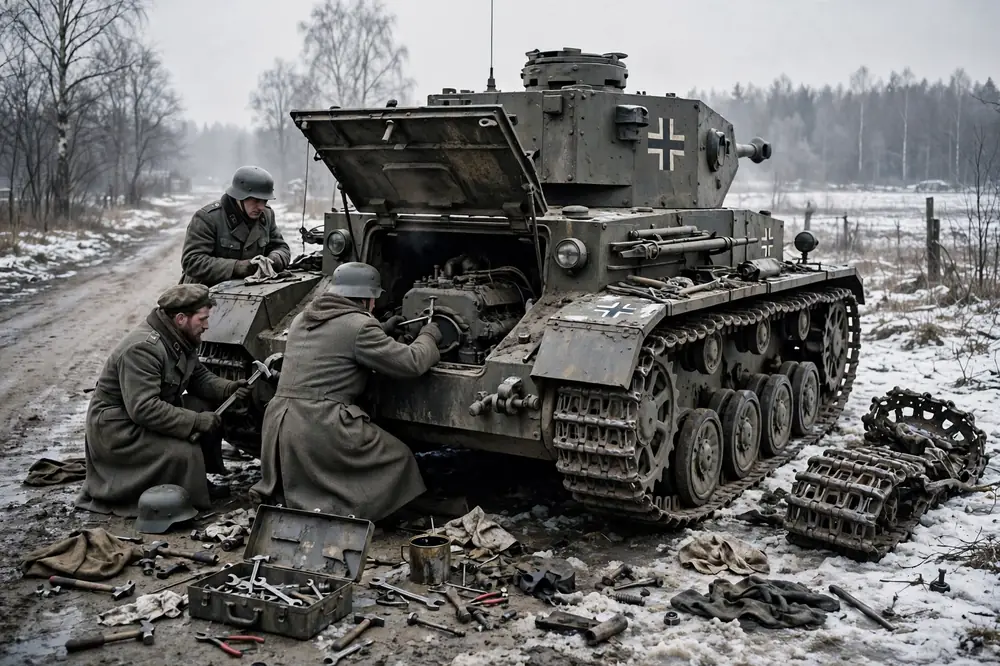
The German Army’s logistics were largely horse-drawn — of more than 100 German divisions that invaded the Soviet Union in 1941, only a minority were fully motorised — and the tanks regularly outran their fuel and ammunition. The armoured spearheads also exposed their flanks, and their commanders’ habit of advancing beyond orders sometimes left them isolated, as happened to Guderian’s forces at times in 1941.
The method was also wasteful of equipment: tanks broke down at high rates on long advances, and Germany’s industry could not replace losses as fast as the Soviet Union and the United States could replace theirs.
The counters were learned the hard way. The Soviet Union adopted defence in depth: successive defensive belts, minefields, anti-tank guns and reserves held back for counter-attack, so that a breakthrough in the first line did not mean a collapse of the whole front. This system, refined by 1943, stopped the German offensive at Kursk in July 1943 — the last major German offensive on the Eastern Front. The Western Allies developed their own answers: air superiority that denied the Luftwaffe freedom of action, and, from 1944, their own combined-arms offensives using far greater material resources. By the second half of the war, the method that Germany had pioneered was being used against it, on a scale Germany could not match.
8. Evolution
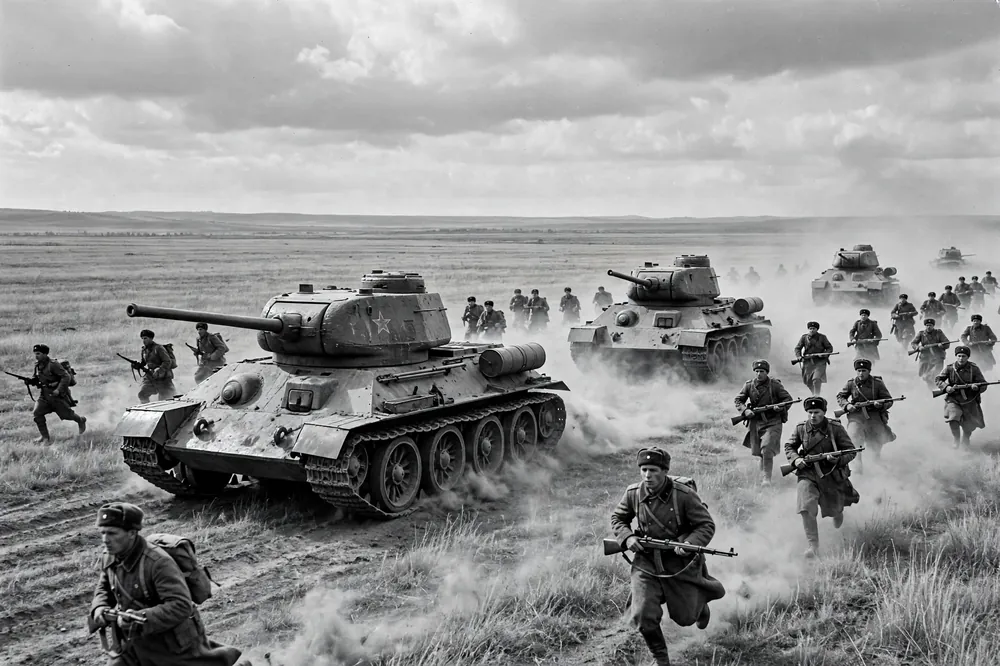
After 1941, Blitzkrieg ceased to be a German monopoly and became the common property of modern warfare. The Soviet Union developed its own doctrine of “deep battle” (glubokaya operatsiya), theorised in the 1930s by Mikhail Tukhachevsky and others, which used large mechanised formations to break through and exploit into the enemy rear — similar in intent to the German method, but conducted on a far larger scale and with artillery preparation of a weight the Germans never matched. Soviet deep battle produced the great encirclements of 1944–1945, including Operation Bagration in June 1944, which destroyed the German Army Group Centre.
In the West, the United States and Britain built their armoured doctrine around the same principles — concentration, speed, combined arms and radio communications — but with resources Germany never possessed: complete motorisation, overwhelming air power, and an industrial base that could replace every tank lost. The Normandy breakout of August 1944 and the Allied advance across France showed the method working at a scale far beyond 1940.
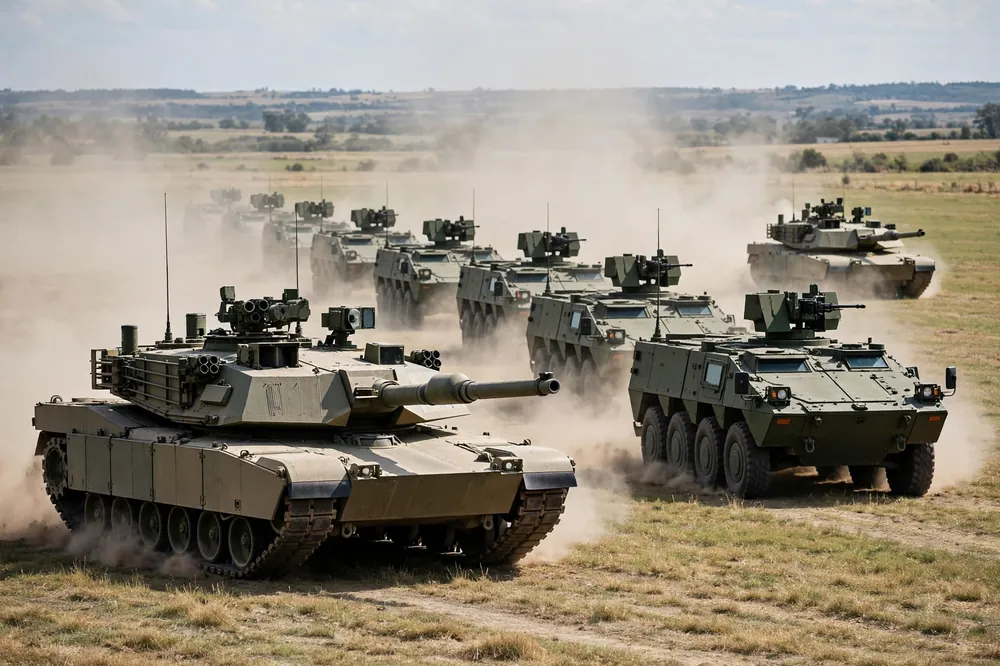
After the war, the idea continued to evolve: the Israeli offensives of 1967, the American “AirLand Battle” doctrine of the 1980s, and the coalition advance in the Gulf War of 1991 all drew on the same logic of speed, concentration and the disruption of enemy command. None of these later campaigns was called Blitzkrieg by its own commanders, but all of them belong to the same family of manoeuvre warfare.
9. Legacy and Modern Use
The legacy of Blitzkrieg is double-edged. On the one hand, it changed how armies fight: combined-arms manoeuvre, mission command and the integration of air power with ground forces are now standard in every modern army. Military staff colleges from Sandhurst to West Point still teach the campaigns of 1940 as case studies in the use of speed and concentration.
On the other hand, the word itself carries a heavy historical burden. It is associated with wars of aggression, and with the occupations that followed the rapid victories — occupations that brought repression, forced labour and, in the east, mass killing of civilians and prisoners of war.
Any honest account of Blitzkrieg has to hold both facts together: the method was militarily influential, and it was used in the service of a war of conquest.
In modern use, the term is often applied loosely to any fast military advance, from the 2003 invasion of Iraq to the opening weeks of the Russian invasion of Ukraine in 2022. Historians generally caution against this loose use: as Karl-Heinz Frieser and others have argued, Blitzkrieg is best understood as a description of a specific historical practice — the German manoeuvre warfare of 1939–1941 — rather than as a universal explanation for any rapid victory. Its lasting lesson is narrower and more useful: that speed, concentration and the disruption of enemy command can decide a campaign quickly, but only when logistics, air power and political objectives keep pace with the advancing tanks.
10. Assessment by Historians
Historians disagree about how much of Blitzkrieg was planned and how much was improvised. The traditional view, popular after the war, treated it as a deliberate doctrine devised by Guderian and imposed by Hitler. Karl-Heinz Frieser, in his study Blitzkrieg-Legende (1995, published in English as The Blitzkrieg Legend), argued the opposite: that the victories of 1940 were the result of improvisation, of German commanders exploiting opportunities, and of French mistakes, rather than of a pre-existing master plan. Frieser’s view is now widely accepted, though not uncontested. Other historians, such as Robert Citino, emphasise the continuity with older German traditions of manoeuvre warfare, going back to the Prussian wars of the nineteenth century.

There is broader agreement on two points. First, that the term “Blitzkrieg” is a journalistic label, not a German doctrine — a point on which the sources are clear. Second, that the method’s success depended on specific conditions that disappeared after 1941, and that its reputation has been inflated by the memory of the six weeks in France, at the expense of the four years of attrition that followed. As the historian Richard Overy has noted, Germany’s early victories were real, but they were won by an army that was smaller and less motorised than is often imagined, and the war was ultimately decided by industry, manpower and logistics — the areas in which Germany was weakest.
Frequently Asked Questions
What is Blitzkrieg? Blitzkrieg, German for “lightning war”, describes fast combined-arms offensives in which concentrated armour, motorised infantry and close air support break through a narrow front and exploit into the enemy rear. It is the term commonly used for Germany’s early campaigns of 1939–1941.
Was Blitzkrieg an official German doctrine? No. The word was never used as an official military term by the Wehrmacht and never appeared in a German doctrine or manual. It appeared in a German journal in 1935 and was popularised by British and American journalists after the invasion of Poland in 1939. Hitler himself called it “a completely idiotic word”.
Who invented Blitzkrieg? No single person invented it. Heinz Guderian was its leading advocate for armoured warfare, Erich von Manstein shaped the plan for France in 1940, and the method drew on older German traditions of manoeuvre warfare. Historians such as Karl-Heinz Frieser argue that the victories of 1940 were largely improvised rather than the execution of a pre-existing plan.
Why did Blitzkrieg fail in the Soviet Union? The Soviet Union was too large, its roads too poor, and its reserves too deep for a short campaign to succeed. German supply lines stretched, tanks broke down, and Soviet defence in depth absorbed the breakthroughs. The German advance was halted before Moscow in December 1941.
How long did it take Germany to defeat France in 1940? France signed an armistice on 22 June 1940, six weeks after the German attack began on 10 May 1940. The armistice came into effect on 25 June.
Is Blitzkrieg still used today? The word is still used loosely for any rapid offensive, but modern armies do not call their doctrine Blitzkrieg. The underlying principles — combined arms, speed, concentration and disrupting enemy command — remain central to modern manoeuvre warfare.
Related articles
Sources
- Wikipedia, “Blitzkrieg” — definition, the origin of the term, the 1935 Deutsche Wehr reference, and the statement that the Wehrmacht never officially adopted it as a concept or doctrine.
- Encyclopaedia Britannica, “Blitzkrieg” — summary of the method and its use in Poland and France.
- Karl-Heinz Frieser, The Blitzkrieg Legend: The 1940 Campaign in the West (Naval Institute Press, 2005; German original 1995) — the argument that the 1940 victories were improvised rather than planned doctrine.
- Heinz Guderian, Achtung — Panzer! (1937; English edition, Cassell, 1992) — Guderian’s own case for concentrated armoured divisions.
- Robert M. Citino, The German Way of War: From the Thirty Years’ War to the Third Reich (University Press of Kansas, 2005) — Blitzkrieg in the context of older German manoeuvre traditions.
- Richard Overy, Why the Allies Won (W. W. Norton, 1995) — the material and industrial limits behind Germany’s early victories.