 WAR ATLAS MILITARY HISTORY MAGAZINE · WWI — WWII
Utah Beach
1. Lead
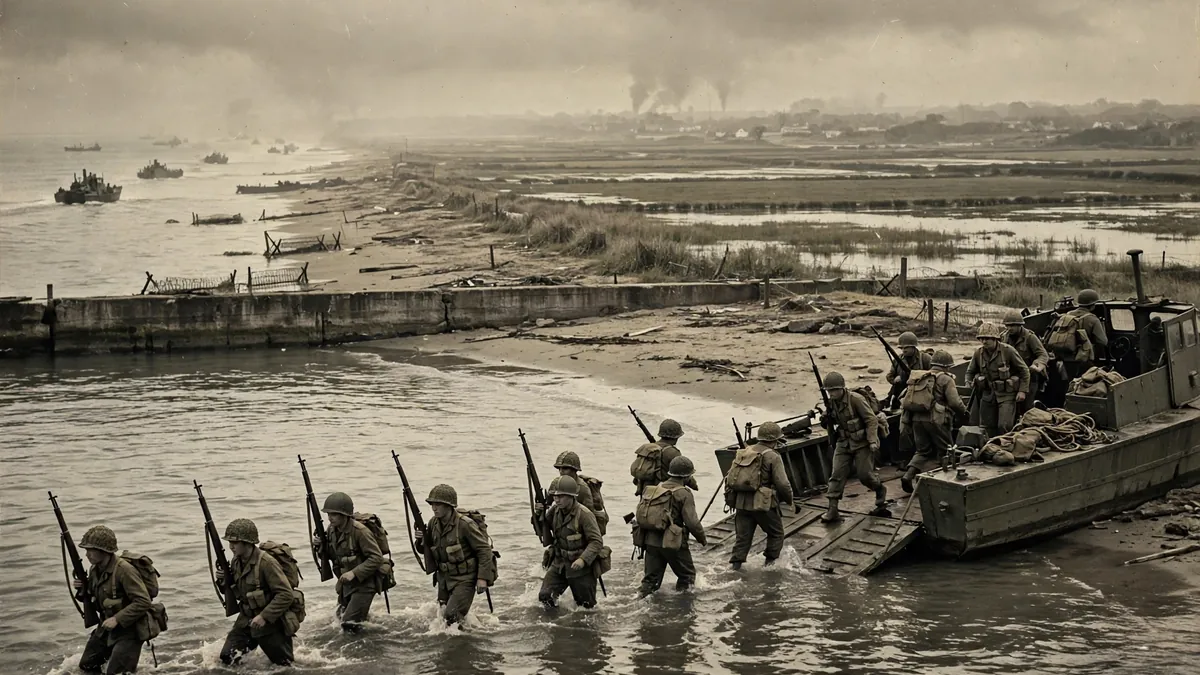
Utah Beach was the westernmost of the five Allied landing beaches on D-Day, 6 June 1944, and it was also the easiest. While American troops were being cut down a few dozen kilometres to the east at Omaha Beach, the men of the US 4th Infantry Division waded ashore at Utah through shallow water, under scattered fire, and reached the seawall with remarkably few losses. By the end of the day about 23,000 men had landed, at a cost of roughly 200 casualties, and the Americans held a beachhead several kilometres deep. Utah’s success was partly luck and partly design: the beach was weakly defended, the preliminary bombardment had done its work, and the landing force was led by a general who understood, within minutes of coming ashore, that the mistake in the landing itself was an opportunity rather than a disaster.
That mistake is the most famous part of the Utah story. The landing craft were carried about 2 kilometres south of their intended beaches by the strong tidal current, and the troops came ashore at a place the planners had not chosen, facing flooded fields instead of the planned exits. The assistant division commander, Brigadier General Theodore Roosevelt Jr., who landed with the first wave at the age of 56, looked at the ground, decided that the new landing place was as good as the old one, and ordered the attack to go ahead from where the men actually stood. His decision, summed up in the phrase “We’ll start the war from right here”, turned a navigational error into a rapid advance inland. Within days Utah was linked to Omaha Beach in the east, and the beach became one of the main supply ports for the Allied armies in Normandy.
Utah mattered for a second reason, beyond its own beachhead. It was the seaward end of the American airborne landings of the night before. The 82nd and 101st Airborne Divisions had dropped onto the Cotentin Peninsula to seize the causeways across the flooded fields behind Utah, so that the men landing from the sea could get inland. The paratroopers were scattered across the peninsula, fought in small groups through the night, and held enough of the causeways for the beach force to break out. Utah was therefore not a single landing but two operations — one from the sea and one from the air — that depended on each other, and both of them succeeded on the same day.
2. Key Facts
| Date | 6 June 1944 (D-Day) |
| Location | Western Cotentin Peninsula, Normandy, France, near Sainte-Marie-du-Mont |
| Result | Allied victory; beachhead secured with light losses; link-up with airborne forces inland |
| Allied commanders | Maj. Gen. Raymond O. Barton (4th Infantry Division); Brig. Gen. Theodore Roosevelt Jr. (assistant division commander); Maj. Gen. Matthew Ridgway (82nd Airborne); Maj. Gen. Maxwell Taylor (101st Airborne) |
| German commander | Generalleutnant Karl-Wilhelm von Schlieben (709th Infantry Division) |
| Allied strength | About 23,000 men landed on 6 June; 4th Infantry Division plus 82nd and 101st Airborne Divisions inland |
| German strength | About 12,000 men of the 709th Infantry Division, spread along the Cotentin coast |
| Allied losses | About 200 killed, wounded and missing on the beach on 6 June; airborne losses heavier (see Casualties section) |
| German losses | Several hundred killed and captured on 6 June; the 709th Division was destroyed in the following weeks |
3. Background
Why Utah Was Added to the Plan
Utah Beach was added to the invasion plan late, and its history begins with a decision about the size of the invasion itself. The original plan for Operation Overlord, drawn up in 1943, called for three divisions to land on three beaches. When General Dwight D. Eisenhower took command of the invasion in early 1944, he insisted that three divisions were not enough: the landing force had to be five divisions on a wider front, so that the beachhead would be too broad for the Germans to seal off. Two more beaches were added — Utah in the west and Sword in the east — and the front was extended to about 80 kilometres. Utah was the western anchor of the whole invasion. Its purpose was to give the Allies a foothold on the Cotentin Peninsula, from which they could capture the port of Cherbourg, and to protect the western flank of the landing while the main force drove south towards Saint-Lô.
A Wider Front, Anchored in the West
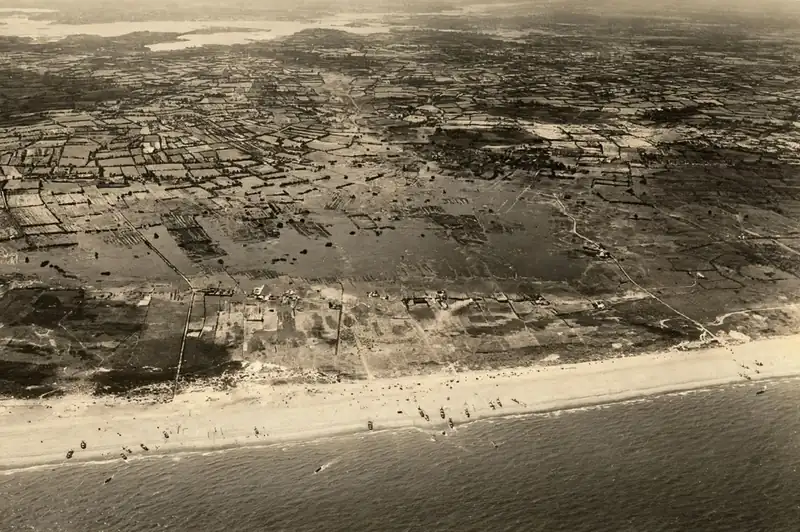
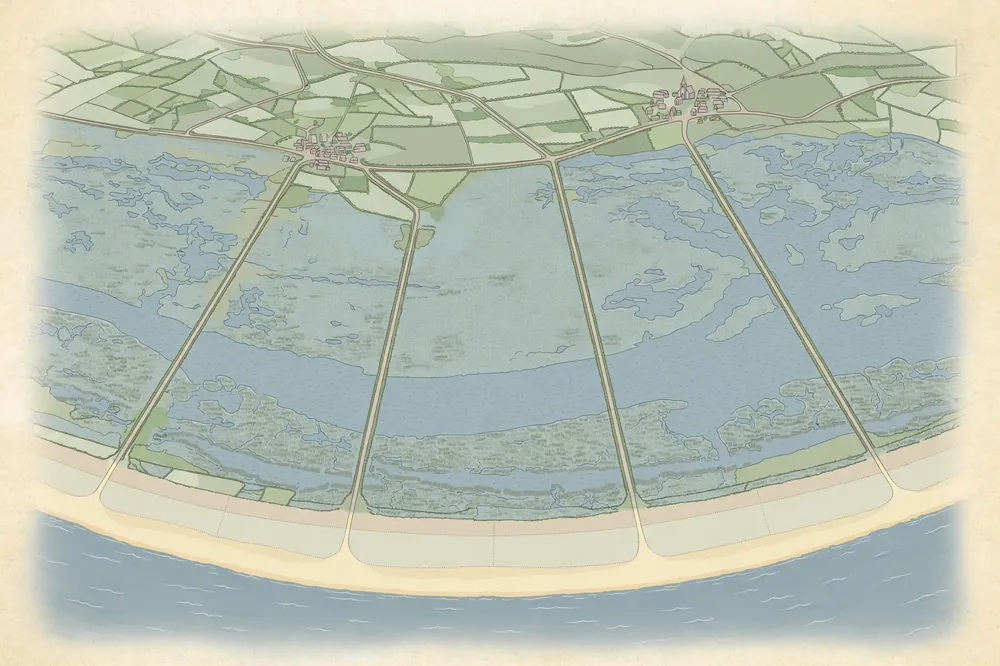
The beach the Americans called Utah was a stretch of sand about 5 kilometres long, on the eastern shore of the Cotentin Peninsula, between the villages of Sainte-Marie-du-Mont and La Madeleine. Behind the sand lay a low seawall and a road, and behind the road a belt of flooded fields, 1 to 2 kilometres wide, that the Germans had deliberately inundated by opening the sluice gates of the Douve and Merderet rivers. The only ways across the flooded ground were four narrow causeways — raised roads running inland from the beach exits — and whoever held the causeways controlled the movement of the landing force. The Allies divided the beach into sectors: from north to south, Tare Green, Uncle Red and Victor, with the main landings planned for Uncle Red and Tare Green.
The extra width mattered. A front of 80 kilometres was too broad for the Germans to seal off with the forces they had in Normandy, and Utah, as the western anchor, protected the flank of the whole landing while the main force drove south. Cherbourg, at the northern tip of the peninsula, was the prize: a deep-water port that would let the Allies supply their armies without depending on the beaches.
The German Defences and the Allied Plan
The German defences at Utah were far weaker than those at Omaha, and the reasons for that were partly geography and partly German priorities. The Cotentin Peninsula was a secondary sector for the Germans: their attention, and their best troops, were concentrated around Calais, where they expected the main invasion, and around Caen, the gateway to Paris. The beach at Utah was held by the 709th Infantry Division, a static coastal division made up largely of older men, convalescents and conscripts from occupied countries, including many Russians and Georgians who had been pressed into German service and were known as Osttruppen. The division’s commander, Generalleutnant Karl-Wilhelm von Schlieben, had about 12,000 men to cover the whole eastern coast of the peninsula, so the beach itself was thinly held: a single regiment, the 919th Grenadier Regiment, with a handful of artillery batteries behind it. The strongpoints were concrete bunkers and gun positions, but there were fewer of them than at Omaha, and the guns were lighter.
Two Operations, One Timetable
The Allied plan for Utah had two parts, and both depended on timing. The seaborne landing was the responsibility of VII Corps, under Major General J. Lawton Collins, with the 4th Infantry Division under Major General Raymond O. Barton landing first, followed by the 90th Infantry Division and the 4th Armored Division. H-Hour was set for 06:30, the same as Omaha. The airborne part was the responsibility of the 82nd Airborne Division under Major General Matthew Ridgway and the 101st Airborne Division under Major General Maxwell Taylor, who were to drop during the night of 5–6 June to seize the town of Sainte-Mère-Église, the causeways behind Utah, and the bridges over the Douve and Merderet. The paratroopers were also supposed to confuse the Germans about where the main landing was coming. If the airborne troops failed, the men landing at Utah would be trapped on a narrow beach with flooded ground behind them; if the seaborne landing failed, the paratroopers would be cut off inland. The two forces had to meet, and quickly.
4. Opposing Forces
The American Seaborne Force
The American seaborne force at Utah was built around a single division in the first wave, with powerful support behind it. The 4th Infantry Division, commanded by Major General Raymond O. Barton, was a regular division that had trained for the landing in England and had been chosen for Utah because of its thorough preparation. Its assistant commander, Brigadier General Theodore Roosevelt Jr., insisted on landing with the first wave — against the wishes of his superiors, who thought a general of his rank and age had no place in the first boats. Roosevelt was 56 years old, walked with a cane because of arthritis and a heart condition, and was the son of President Theodore Roosevelt. He had already fought in the First World War and in North Africa and Sicily, where he had earned a reputation for leading from the front. His presence in the first wave would matter more than anyone expected.
Naval Guns and Air Support
Behind the 4th Division stood the whole weight of VII Corps. The naval force supporting Utah was commanded by Rear Admiral Don P. Moon, and it included the battleship USS Nevada, the monitor HMS Erebus, cruisers and destroyers, and a force of landing craft. The air support came from the 9th US Air Force and the RAF, which bombed the German positions along the coast before H-Hour. The follow-on forces included the 90th Infantry Division, the 4th Armored Division and the 9th Infantry Division, which would land over the following days and drive west across the Cotentin towards Cherbourg.
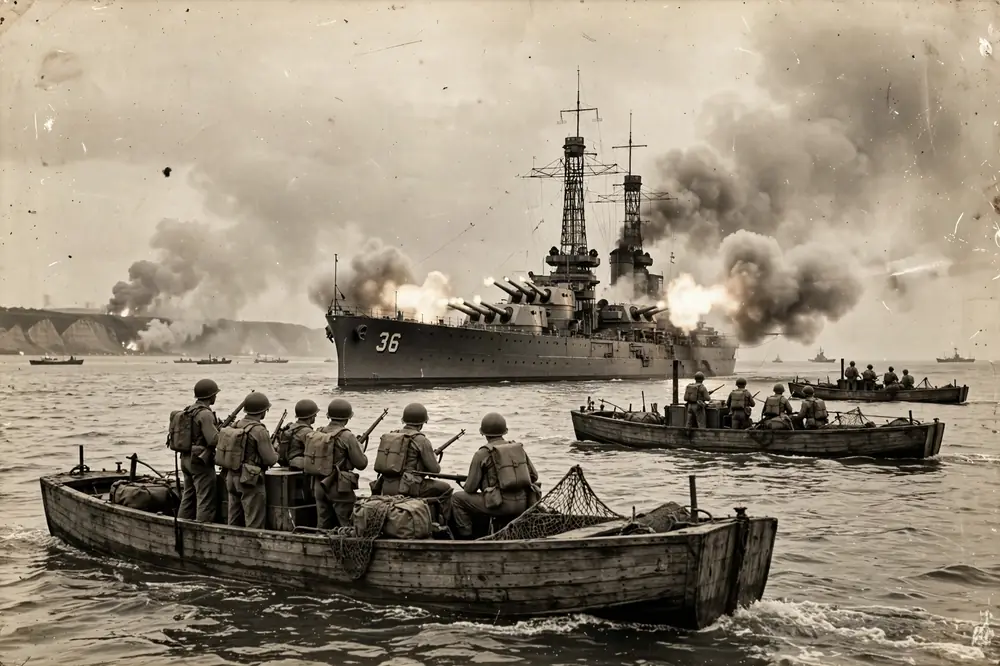
The bombardment was heavier and more accurate than at Omaha. The Nevada, a veteran of Pearl Harbor, fired her 14-inch guns at the German strongpoints, and the Erebus added her 15-inch guns to the weight of fire. Destroyers closed inshore to engage targets the larger ships could not see, and the air attack that preceded H-Hour struck the beach defences directly instead of falling inland.
| United States | Germany | |
|---|---|---|
| Infantry | 4th Infantry Division (8th, 12th, 22nd Regiments); 90th Infantry Division in follow-up | 709th Infantry Division: 729th, 739th, 919th Grenadier Regiments |
| Airborne | 82nd Airborne Division; 101st Airborne Division (about 13,000 paratroopers) | — |
| Tanks | 70th Tank Battalion; DD amphibious tanks (32 launched, most landed safely) | A small number of assault guns; no tanks on the beach |
| Artillery | Naval gunfire: battleship USS Nevada, monitor HMS Erebus, cruisers, destroyers | 709th Artillery Regiment; coastal batteries, mostly 75 mm and 105 mm |
| Air support | 9th US Air Force; RAF bombers before H-Hour | Luftwaffe: almost no aircraft over Normandy on 6 June |
| Engineers | Naval Combat Demolition Units and Army engineers to clear obstacles | Minefields, wire and beach obstacles, flooded fields inland |
The Airborne Force and the German Defenders
The airborne force was large and scattered. About 13,000 men of the 82nd and 101st Airborne Divisions jumped into Normandy during the night, along with about 4,000 men of the British 6th Airborne Division further east. The drops were badly scattered by cloud, anti-aircraft fire and the inexperience of the transport pilots: many paratroopers landed kilometres from their drop zones, some drowned in the flooded fields, and units were mixed together in the dark. The 101st Division was supposed to land around Sainte-Marie-du-Mont and the causeways; the 82nd around Sainte-Mère-Église and the Merderet crossings. In practice, the paratroopers fought the night in small groups, often led by junior officers and sergeants, attacking whatever German positions they found and holding crossroads and bridges until help arrived.
A Weak Division on a Long Coast
The German defenders were spread thin. The 709th Division’s three regiments covered the whole eastern Cotentin coast, and only the 919th Grenadier Regiment was on the Utah beaches themselves, supported by a few artillery batteries and a handful of strongpoints. The division’s men were a mixture of older Germans, convalescents and Osttruppen — Soviet prisoners of war, mostly Georgians and Russians, who had volunteered for German service to escape the prison camps. Their reliability was doubtful, and several of them surrendered at the first opportunity or deserted to the Americans. The German command structure was also slow: the 709th Division reported to the LXXXIV Corps, and the nearest German armoured reserves were far away. The 91st Air Landing Division, a better formation, was inland near Sainte-Mère-Église, but it was not positioned to reach the beach quickly. The Germans at Utah were, in short, a weak division in a quiet sector, facing the full weight of an American corps.
5. The Battle
The Night Drop
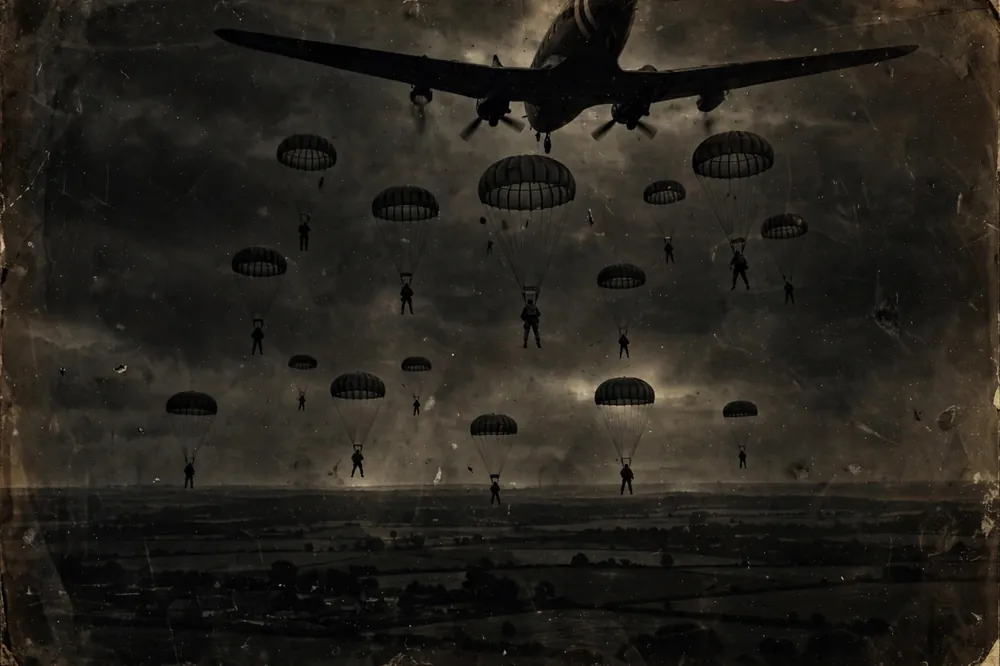
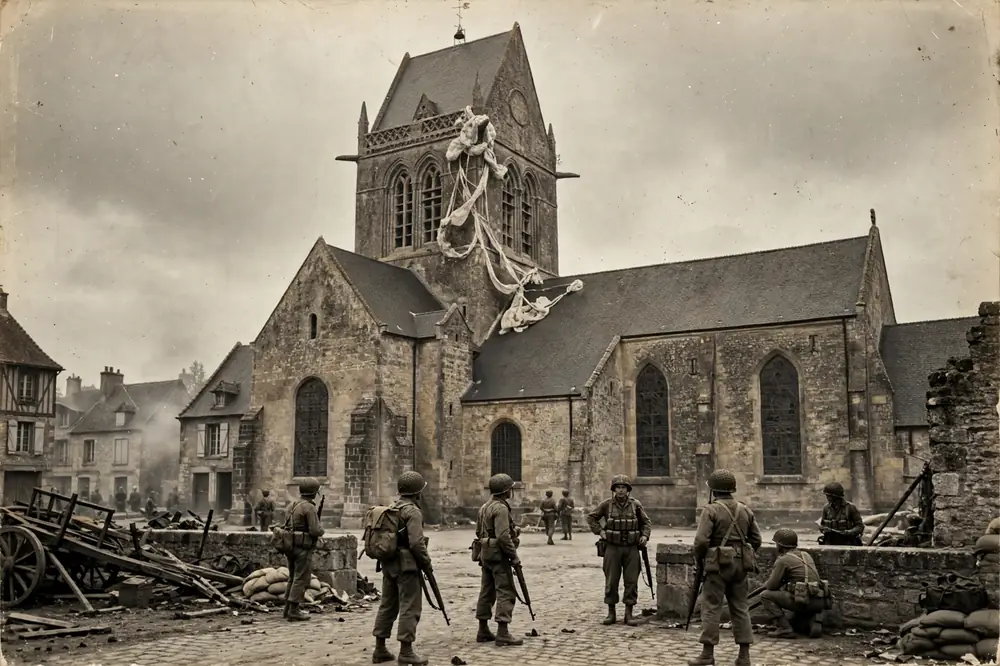
The night drop. The battle for Utah began in the air, hours before the first landing craft touched the sand. Shortly after midnight on 6 June, pathfinders dropped to mark the landing zones, and between about 01:30 and 02:30 the main airborne force followed — about 13,000 American paratroopers jumping from more than 800 transport aircraft. The drops went badly wrong in the sense that almost nobody landed where he was supposed to: cloud, flak and evasive manoeuvres by the pilots scattered the paratroopers across the Cotentin, and the sticks of men were broken up before they reached the ground. Some paratroopers drowned in the flooded fields, weighed down by their equipment. Others landed in Sainte-Mère-Église itself, where one man, Private John Steele of the 505th Parachute Infantry Regiment, famously hung from the church tower by his parachute for hours, playing dead while the fighting went on below him.
Scattered Drops, Confused Germans
But the scattering, which looked like a disaster, had an unexpected effect: it confused the Germans completely. German reports during the night spoke of paratroopers landing everywhere, and the German command could not tell where the main effort was. The paratroopers, fighting in small groups, attacked German patrols, cut telephone wires, ambushed convoys and seized bridges and crossroads wherever they found them. The 101st Division’s men fought for the causeways behind Utah through the night, and by dawn they held three of the four exits from the beach, though they were far too few to hold them against a serious counterattack. The 82nd Division seized Sainte-Mère-Église — the first town in France to be liberated — and held the crossings over the Merderet at La Fière, where a small force under Captain John Dolan held a causeway against German tanks for two days. German prisoners taken that night spoke of paratroopers landing in every direction, and German headquarters spent the night trying to make sense of contradictory reports.
H-Hour on the Beach
H-Hour, 06:30. The seaborne landing began at 06:30, after a naval bombardment that lasted about forty minutes and an air attack that, unlike at Omaha, hit its targets. The bombers of the 9th Air Force attacked the German strongpoints along the beach, and the naval guns, firing at visible targets, knocked out several of them. The landing craft carrying the first wave of the 4th Division’s 8th Infantry Regiment set off from the transports about 10 kilometres offshore — and then the current took them. The tidal stream running along the Cotentin coast pushed the craft south, and the coxswains, unable to see landmarks in the smoke and haze, did not correct for it. The first wave landed about 2 kilometres south of the planned beaches, at a place the planners had marked as Victor sector, facing the causeway known as Exit 2 instead of the planned exits.
Light Fire and a Quiet Beach
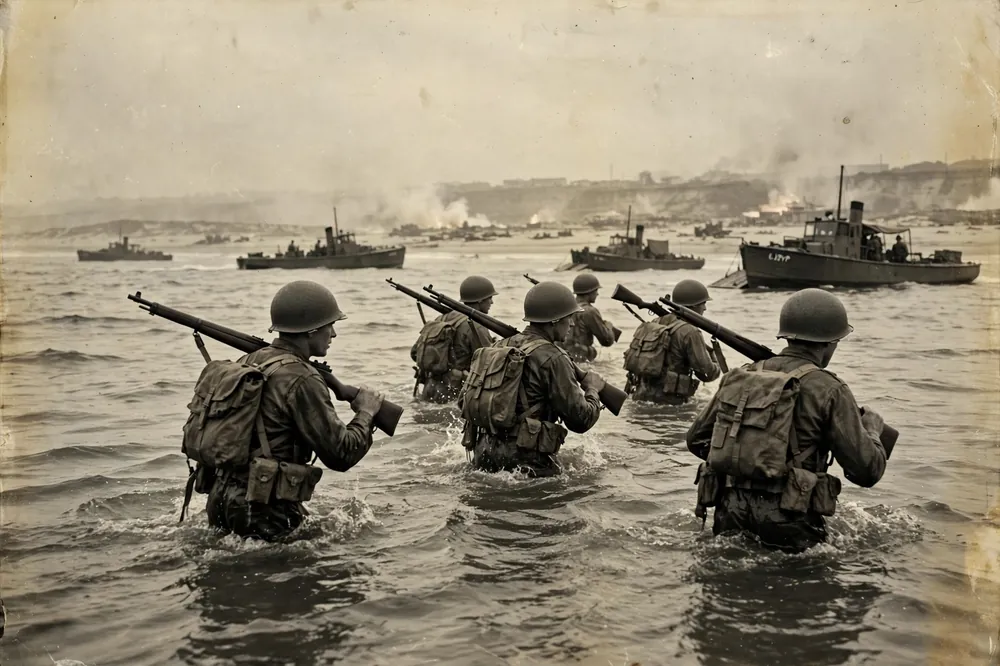
The fire the men met was light. The German strongpoints in the new landing area were few, and many of them had been silenced by the bombardment. The men waded ashore in water that was only waist-deep, crossed the sand without the slaughter seen at Omaha, and reached the seawall with few casualties. The engineers found fewer obstacles than expected and began clearing them at once. The DD amphibious tanks, launched closer to shore than at Omaha, mostly made it to the beach safely, and the naval gunfire continued to suppress the German positions. Within an hour the beach was, in the words of one officer, “quiet”.
Engineers moved quickly across the sand, marking lanes through the obstacles and blowing gaps for the follow-on waves. The DD tanks came ashore in good order, and the first prisoners — many of them Osttruppen who had no wish to fight — began to surrender in small groups. By 08:00 the beach was no longer a battlefield but a supply point, with men and vehicles moving steadily inland.
Roosevelt’s Decision and the Link-Up
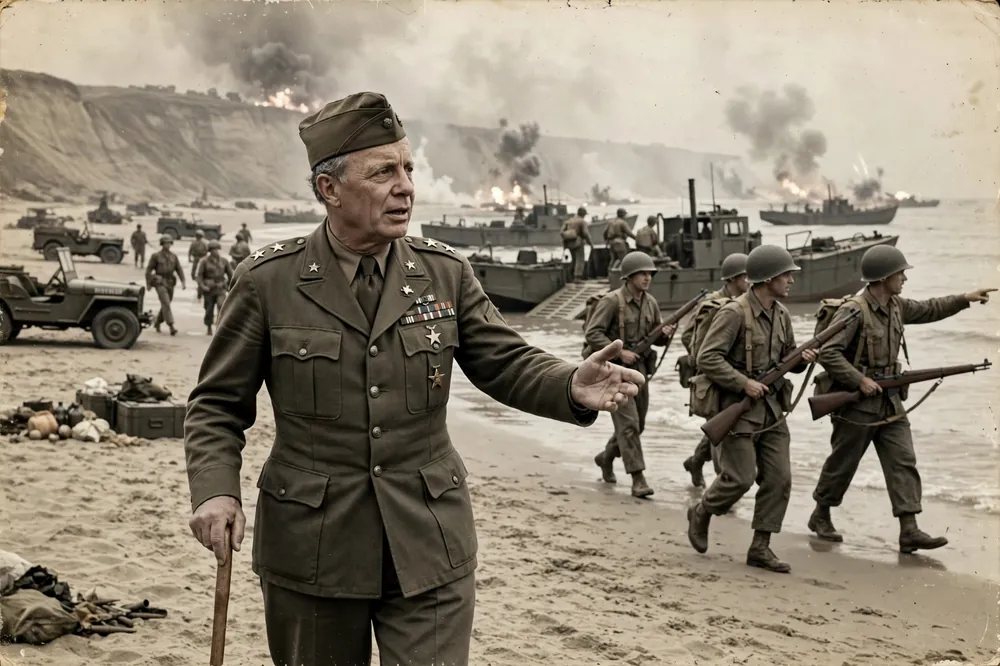
Roosevelt’s decision. The man who made Utah a success was already ashore. Brigadier General Theodore Roosevelt Jr. had landed with the first wave at about 06:30, walking ashore with his cane and his pistol, and he immediately grasped the situation. The landing was in the wrong place, and the planned exits were 2 kilometres to the north, behind flooded ground. The conventional response would have been to move the landing force north along the beach to the planned exits — a slow, dangerous movement under fire. Roosevelt did the opposite: he sent patrols to reconnoitre the exits in front of him, found that Exit 2 was usable and lightly defended, and ordered the division to advance inland from where it stood. “We’ll start the war from right here,” he told his staff, and then walked inland himself to direct the advance. The division’s commander, General Barton, came ashore later and confirmed the decision. The 8th Regiment pushed inland along the causeways, the engineers improved the exits, and by mid-morning the beachhead was several kilometres deep.
Meeting the Paratroopers
The link-up. By midday the seaborne force had met the paratroopers. The 8th Regiment, advancing inland, linked up with the 101st Airborne’s men holding the causeways, and the two forces together pushed towards Sainte-Marie-du-Mont and the high ground beyond. The German resistance was disorganised: the 919th Regiment’s strongpoints were being taken one by one, its artillery was being silenced by naval gunfire, and its men were surrendering in groups. The 709th Division’s headquarters lost contact with its regiments, and General von Schlieben, who had gone forward to see the landing for himself, was cut off and later captured. By nightfall about 23,000 men were ashore, the beachhead was about 6 kilometres deep in places, and the Americans had linked up with the airborne forces across the whole Utah sector. The 101st Division had taken Sainte-Marie-du-Mont, and the 82nd held Sainte-Mère-Église. The cost on the beach had been about 200 casualties — the lightest of any of the five D-Day beaches.
6. Turning Point
A Decision on the Sand
The turning point at Utah was not a battle but a decision, made on the sand within minutes of the landing. When the first wave came ashore 2 kilometres south of its planned beaches, the landing could easily have become a confused and costly attempt to get back to the plan. The men were in the wrong place, the exits they had rehearsed were not in front of them, and the flooded fields behind the beach blocked movement in every direction except along the causeways. A commander who insisted on the plan would have ordered the troops to move north along the exposed beach, under fire, to the intended exits — a movement that would have taken hours and cost lives. Roosevelt’s decision to fight from where the men stood, using the exits in front of him, removed the problem entirely. Within an hour the division was moving inland, and the landing error never mattered again.
The Night Before
The second turning point belonged to the night before. The airborne drop, scattered as it was, succeeded precisely because it was scattered: it put small groups of determined paratroopers all over the Cotentin, and the Germans spent the night chasing reports of landings in a dozen places at once. The paratroopers who held the causeways — above all the men of the 101st Division around Sainte-Marie-du-Mont and the men of the 82nd at La Fière — were the reason the seaborne force could get off the beach at all. If the Germans had held the causeways in strength, the 4th Division would have been trapped on the sand, however light the fire on the beach itself had been. The causeways were the real battlefield of Utah, and the paratroopers won them before dawn. Without those causeways, the beachhead would have been a trap rather than a doorway, and the 4th Division would have had nowhere to go.
A Failure of Command
The third turning point was German, and it was a failure of command. The 709th Division was too weak and too spread out to defend the beach, and its commander was captured early in the day. The German reserves that might have counterattacked — the 91st Air Landing Division and elements of the 243rd Division — were held back by confusion, by Allied air attacks on the roads, and by the German command’s uncertainty about whether Utah was the main landing or a diversion. By the time the Germans understood that the Cotentin landings were real and large, the Americans had already landed a full division, linked up with the airborne troops, and begun to move west. Utah was won in the first hours, and the Germans never got a second chance at it. The 91st Division, the nearest formation that might have changed the outcome, was still miles from the beach when the Americans were already moving inland.
Reserves That Never Came
The nearest German formation that might have intervened was the 91st Air Landing Division, a better-trained unit stationed inland near Sainte-Mère-Église, but it was not positioned to reach the beach quickly, and its first counterattacks were broken up by Allied air attacks on the roads and by the paratroopers holding the crossings. The German command also hesitated: reports during the night spoke of paratroopers landing in a dozen places at once, and the local commanders could not tell whether Utah was the main landing or a diversion. The armoured reserves that might have mattered were held far from the coast, and the German high command, which expected the main invasion at Calais, was slow to release them. By the time the Germans understood that the Cotentin landings were real, the Americans had already landed a full division and linked up with the airborne troops, and the battle for the beach was already over.
7. Casualties and Losses
Light Losses on the Beach
The casualty figures for Utah Beach itself are among the lightest of the Normandy landings, and that is the central fact of the battle. The 4th Infantry Division lost about 200 men killed, wounded and missing on the beach on 6 June — a figure that stands in sharp contrast to the roughly 2,400 American casualties at Omaha on the same day. Some sources give slightly different numbers, in the range of 150 to 250, but all agree that the beach landing was cheap. The reasons were the weak defences, the effective bombardment, the light fire, and the fact that the landing force was able to get off the beach quickly instead of being pinned on the sand.
| United States | Germany | |
|---|---|---|
| Killed | About 100 on the beach (estimate); airborne losses higher (see below) | Several hundred killed and captured |
| Wounded and missing | About 100 on the beach | Hundreds wounded and captured |
| Total on the beach | About 200 on 6 June | Several hundred killed, wounded and captured on 6 June |
| Airborne losses | 82nd Airborne: about 1,200 casualties; 101st Airborne: about 1,500 casualties on 6 June | — |
Why the Figures Differ
The figures vary because the sources count different things. Some counts include only the men of the 4th Infantry Division killed and wounded on the sand itself, while others add the engineers, the naval demolition teams and the men lost in the landing craft offshore. The United States Army’s official history gives a range rather than a single figure, and historians generally quote about 200 as a round number for the beach landing. The contrast with Omaha is what matters most: on the same morning, under the same sky, one American beach cost about 200 casualties and the other about 2,400. The difference was not courage — the men at Omaha fought as bravely as the men at Utah — but the ground, the defences and the bombardment. Utah’s light losses also hide a second figure: the DD tanks that sank or were knocked out, and the landing craft destroyed by mines, which cost the navy and the engineers men whose names appear in the naval casualty lists rather than the army’s.
The Airborne Price and German Losses
The airborne losses were far heavier than the beach losses, and they are part of the true cost of Utah. The 82nd Airborne Division suffered about 1,200 casualties on 6 June, and the 101st Airborne Division about 1,500, including men killed in the jump itself, men who drowned in the flooded fields, and men killed in the small-unit fighting of the night. The 101st Division’s losses included many of its most experienced officers and sergeants. Over the whole Normandy campaign the two airborne divisions would lose far more, but on D-Day itself their sacrifice bought the causeways, and the causeways bought the beach.
The Destruction of the 709th Division
German losses at Utah on 6 June are harder to establish with precision. The 919th Grenadier Regiment was badly damaged, with several hundred men killed, wounded or captured, and the 709th Division as a whole lost many of its strongpoints and much of its artillery. The division did not recover: in the following weeks it was driven back across the Cotentin, its regiments were broken up, and by the fall of Cherbourg on 26 June it had effectively ceased to exist as a fighting formation. Its commander, General von Schlieben, was captured on 23 June, and the remnants of his division surrendered with the Cherbourg garrison. The light losses of 6 June were, for the Germans, the beginning of the end of their hold on the Cotentin. Within three weeks of D-Day, the division had lost its commander, its artillery and most of its infantry, and the survivors were prisoners or scattered fugitives.
8. Map and Geography
The Beach and the Flooded Fields
Utah Beach lies on the eastern shore of the Cotentin Peninsula in north-western France, about 30 kilometres south-east of Cherbourg and about 25 kilometres north-west of Carentan. The beach faces east, into the Baie de la Seine, and the tides there are large: at low tide the sand stretches several hundred metres from the waterline, and at high tide the water reaches the seawall. The landing was timed for low tide, so that the beach obstacles would be visible to the engineers, but the low water also meant a long walk across open sand — a walk that, at Utah, was made under light fire rather than the storm of fire seen at Omaha.
Four Causeways, Four Keys
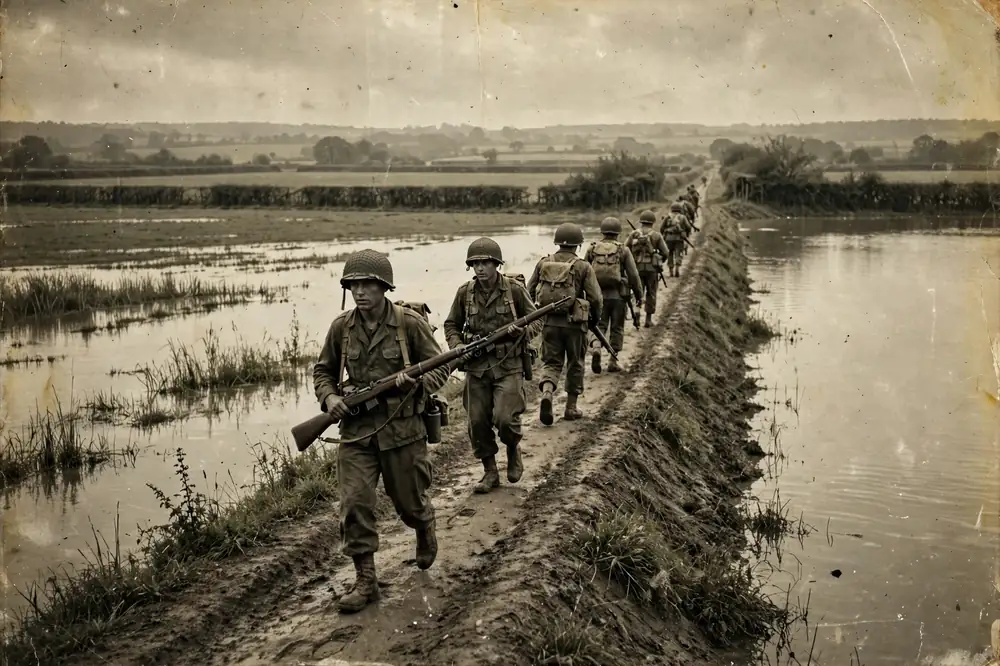
Behind the beach, the ground that mattered most was not the sand but the flooded fields. The Germans had opened the sluices of the Douve and the Merderet, two small rivers that drain the low country of the Cotentin, and flooded the fields behind Utah to a depth of 1 to 2 metres over an area several kilometres wide. The flooding was a deliberate defensive measure: it turned the ground behind the beach into a shallow lake, and the only dry routes across it were the four causeways, raised roads running inland from the beach exits. From north to south, the exits were known as Exit 1 (near Sainte-Marie-du-Mont), Exit 2, Exit 3 and Exit 4 (near La Madeleine). The 4th Division landed facing Exit 2, which led inland to Sainte-Marie-du-Mont, and from there the ground rose gently towards the high ground around the town. Each exit was covered by German strongpoints, and each one had to be fought for before the division could move.
Cherbourg, Carentan and the Bocage
To the north of Utah, the coast runs up to the port of Cherbourg, the great prize of the Cotentin campaign. To the south, the coast runs down to the Vire estuary and to Omaha Beach, about 25 kilometres away by sea. Inland, the ground is the bocage — the hedgerow country of small fields bounded by thick earth banks — which begins a few kilometres from the beach and would dominate the fighting in Normandy for weeks. The rivers Douve and Merderet, which the Germans used to flood the fields, also shaped the airborne battle: the 82nd Division fought for the crossings over the Merderet at La Fière and Chef-du-Pont, and the 101st for the crossings over the Douve. The geography of Utah explains the whole battle: a beach that was easy to land on, a belt of water that was hard to cross, and four narrow roads that were the keys to everything.
The Ground Beyond the Beach
Beyond the beach, the ground shaped everything that followed. The bocage — small fields bounded by thick earth banks topped with hedges — began a few kilometres inland, and it would slow the American advance for weeks, turning every field into a small fortress. The rivers Douve and Merderet, which the Germans had used to flood the fields, also shaped the airborne battle: the 82nd Division fought for the crossings at La Fière and Chef-du-Pont, and the 101st for the crossings over the Douve. To the south, the Vire estuary separated Utah from Omaha, and the link-up at Carentan, where the two beachheads joined, was the first great objective after the landing itself. The map of Utah is therefore a map of water as much as of land: beach, flooded fields, rivers and causeways, each of them a barrier and each of them a key. Every causeway, river and flooded field on that map had been fought over in June, and each one had cost lives to take and to hold.
9. Outcome and Legacy of Utah Beach
From Beachhead to Cherbourg
By the end of 6 June, Utah was secure and the beachhead was growing fast. Over the following days the follow-on divisions poured ashore — the 90th Infantry Division, the 4th Armored Division and the 9th Infantry Division — and VII Corps began its drive west across the Cotentin towards Cherbourg. The 82nd and 101st Airborne Divisions, after their costly night, held the southern flank of the beachhead around Carentan, and on 12 June the Americans linked up with the forces from Omaha at Carentan, joining the two beachheads into a single front. The drive on Cherbourg began in earnest on 18 June, and the port fell on 26 June, though the Germans had wrecked the harbour so thoroughly that it took weeks to bring it into use. Utah had done its job: it had given the Allies their foothold on the Cotentin, and the Cotentin had given them Cherbourg.
The Drive West
The drive west began on 18 June, when VII Corps cut across the base of the Cotentin Peninsula and sealed off Cherbourg from the rest of Normandy. The 90th Infantry Division and the 4th Armored Division pushed north, while the 9th Infantry Division attacked the port from the south. Cherbourg fell on 26 June, after a siege of several days, but the Germans had wrecked the harbour so thoroughly — sinking ships in the channels, destroying the cranes and mining the docks — that it took American engineers weeks to clear it and months before it could handle large ships. The first Liberty ship did not unload at Cherbourg until August. Utah’s beach, meanwhile, kept working as a supply port through the summer, and the road from Utah to Cherbourg became one of the busiest supply routes in Normandy. American engineers worked around the clock, and by September the port was unloading thousands of tons of supplies every day.
Memory and Military Lessons
Utah’s legacy is quieter than Omaha’s, and that is partly the point. There is no famous film about Utah, no single image that fixed it in the public imagination, and the beach itself is a peaceful place of sand dunes and holiday cottages. The memorials there are modest: a monument to the 4th Infantry Division at the beach, a museum at Sainte-Marie-du-Mont, and the small, moving memorials to the airborne divisions at Sainte-Mère-Église, where the church still bears the dummy paratrooper hanging from its tower in memory of John Steele. The Utah Beach Museum, built in a former German bunker at La Madeleine, tells the story of the landing with photographs, maps and a restored B-26 bomber. The beach is still used by fishermen and walkers, and the flooded fields behind it are farmland again.
What Utah Taught the Allies
Militarily, Utah taught the Allies two lessons that shaped the rest of the war. The first was about the value of initiative on the ground: Roosevelt’s decision to fight from where the men stood, rather than from where the plan said they should be, became a textbook example of mission command — the idea that a commander on the spot should be trusted to adapt the plan to the ground. The second was about airborne operations: the scattered drop at Utah, which looked like a failure, showed that paratroopers dispersed across a wide area could confuse and paralyse an enemy command, and it influenced the planning of later airborne operations, including Operation Market Garden in September 1944. Utah also confirmed, in the most practical way, that the Atlantic Wall was not a single wall but a system of strongpoints of very uneven strength — and that a landing aimed at a weak point, properly supported, could succeed cheaply. The contrast with Omaha, fought on the same morning a few dozen kilometres away, is the sharpest lesson of D-Day: the same plan, the same weather and the same enemy produced two very different battles, and the difference was the ground, the intelligence and the men on it.
10. Commanders
Barton and Roosevelt
Major General Raymond O. Barton (United States). Commander of the 4th Infantry Division at Utah Beach. Barton had trained the division thoroughly in England and commanded it through the landing and the drive on Cherbourg. He remained in command of the division through the Normandy campaign and into Germany, and he was known for his calm, methodical leadership.
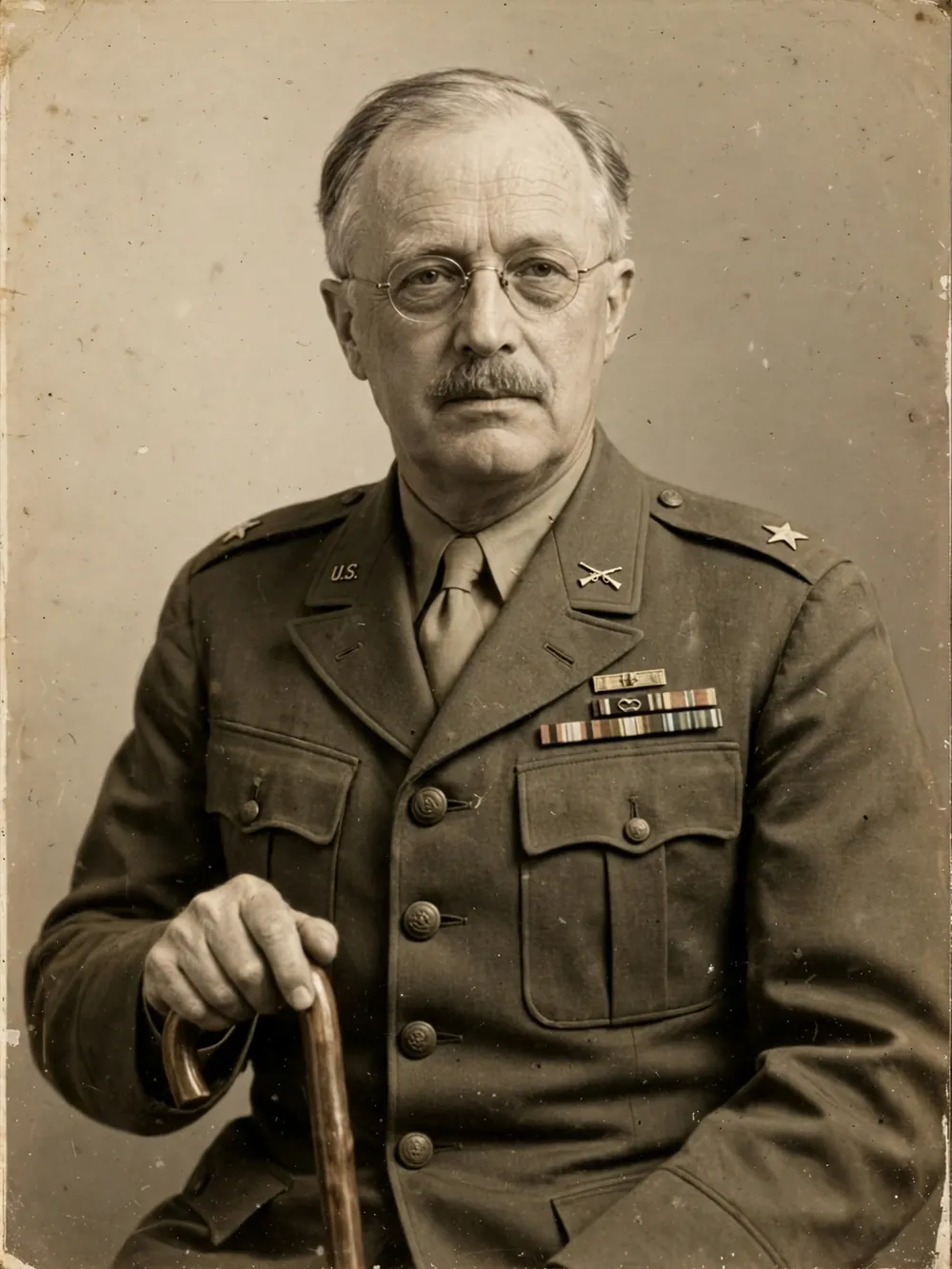
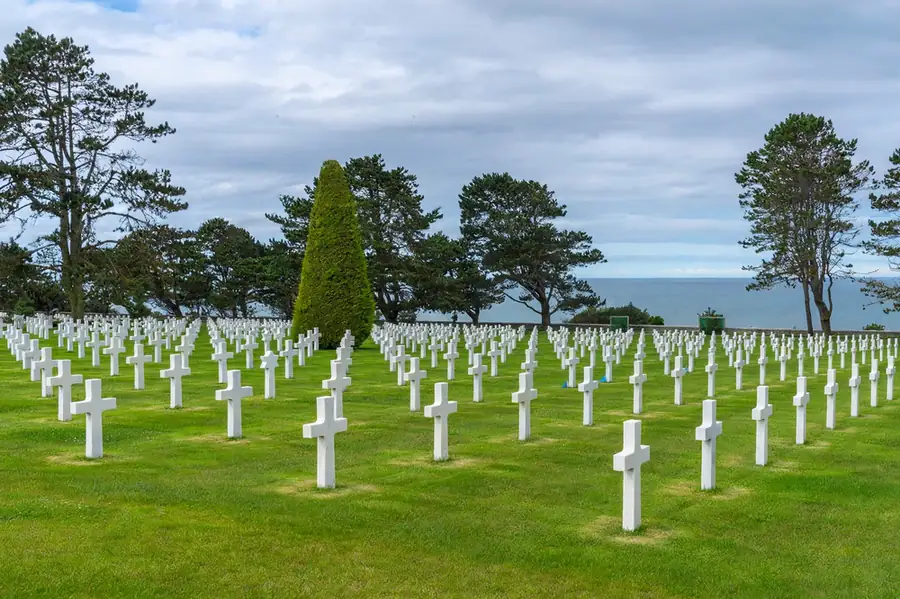
Brigadier General Theodore Roosevelt Jr. (United States). Assistant commander of the 4th Infantry Division, and the most famous figure of Utah Beach. Roosevelt, the son of President Theodore Roosevelt, landed with the first wave at the age of 56, walking with a cane, and made the decision to advance from the actual landing place rather than the planned one. He died of a heart attack on 12 July 1944, a month after the landing, and was awarded the Medal of Honor posthumously for his actions on D-Day. He is buried in the Normandy American Cemetery, next to his brother Quentin, who was killed in the First World War.
Roosevelt’s Medal of Honor
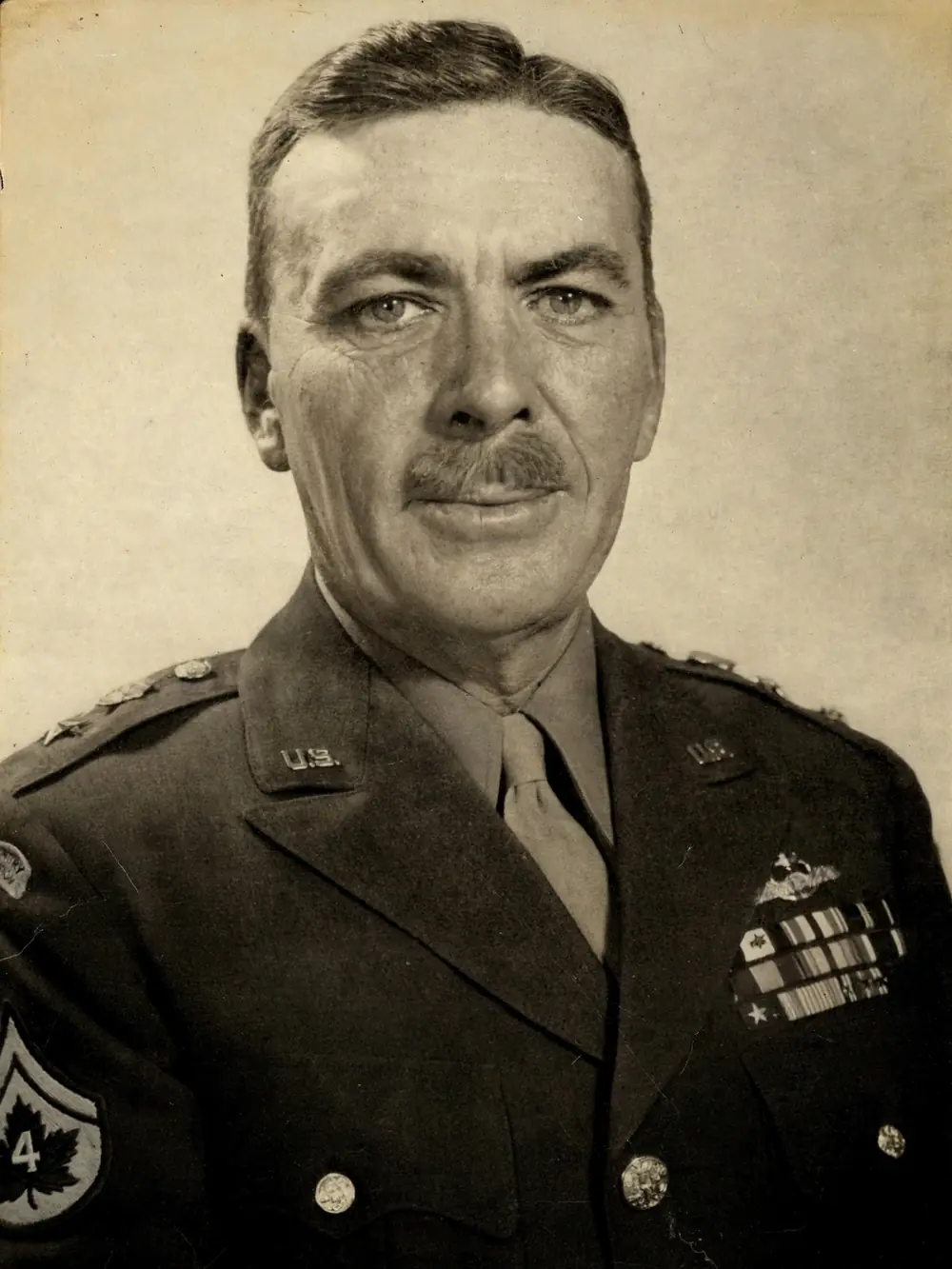
Roosevelt’s Medal of Honor citation records what the men on the beach saw: a 56-year-old general, walking with a cane and carrying a pistol, moving calmly among the troops under fire and directing the advance himself. He had already been wounded in the First World War and had fought in North Africa and Sicily, where his habit of leading from the front had earned him the respect of his men and the concern of his superiors. On Utah he landed in the first wave because he believed a commander should share the danger of his men, and his decision on the sand — to advance from where the division actually stood — was the act that made the landing a success. He died of a heart attack on 12 July 1944, while the division was fighting around Saint-Lô, and he was buried in the Normandy American Cemetery beside his younger brother Quentin, a pilot killed in the First World War.
Corps and Airborne Commanders
Major General J. Lawton Collins (United States). Commander of VII Corps, the corps responsible for the Utah landing and the Cotentin campaign. Collins, known as “Lightning Joe”, drove the advance on Cherbourg and later commanded VII Corps through the breakout from Normandy and the advance into Germany.
Major General Matthew Ridgway (United States). Commander of the 82nd Airborne Division, which dropped around Sainte-Mère-Église on the night of 5–6 June and held the Merderet crossings. Ridgway later commanded the XVIII Airborne Corps and, during the Korean War, the Eighth Army and the United Nations forces in Korea.
Major General Maxwell Taylor (United States). Commander of the 101st Airborne Division, which dropped around Sainte-Marie-du-Mont and fought for the causeways behind Utah. Taylor later commanded the division through the Battle of the Bulge and, after the war, served as Chairman of the Joint Chiefs of Staff.
The German Commander
Generalleutnant Karl-Wilhelm von Schlieben (Germany). Commander of the 709th Infantry Division, the division that held the Cotentin coast. Von Schlieben had about 12,000 men spread over a long coastline, and his division was too weak to hold the beach. He was cut off during the fighting, went into Cherbourg, and was captured when the port fell on 26 June 1944. He spent the rest of the war as a prisoner.
Von Schlieben’s division was a static coastal formation, built for defence rather than for manoeuvre, and its regiments were spread along too much coastline to hold any single beach in strength. Many of its men were Osttruppen — Soviet prisoners who had volunteered for German service — and their willingness to fight for Germany was doubtful from the start. When the Americans landed, the division’s headquarters lost contact with its regiments within hours, and the division never recovered, and its regiments were broken up in the fighting that followed.
Frequently Asked Questions
When was the Utah Beach landing?
On 6 June 1944, D-Day, with the first waves landing at 06:30, a few hours after the airborne drops of the night before. The beach was secure by the end of the day.
Why did the Americans land in the wrong place at Utah?
The strong tidal current along the Cotentin coast pushed the landing craft about 2 kilometres south of the planned beaches, and the coxswains could not see landmarks in the smoke and haze. General Roosevelt decided to advance from the actual landing place instead of moving north to the planned exits.
How many Americans died at Utah Beach?
About 100 Americans were killed on the beach itself on 6 June, with about 200 casualties in total on the beach itself on 6 June, the lightest losses of any D-Day beach. The airborne divisions lost far more: about 1,200 casualties in the 82nd Airborne and about 1,500 in the 101st Airborne on the same day.
What were the causeways behind Utah Beach?
Four raised roads across the flooded fields behind the beach, the only dry routes inland. The 101st Airborne Division fought through the night of 5–6 June to hold them, so that the men landing from the sea could get off the beach.
Who was Theodore Roosevelt Jr. at Utah Beach?
The assistant commander of the 4th Infantry Division, aged 56, who landed with the first wave and ordered the attack to go ahead from the actual landing place. He was awarded the Medal of Honor posthumously and died of a heart attack a month later, on 12 July 1944.
What happened after Utah Beach?
The Americans linked up with the Omaha beachhead at Carentan on 12 June, joining the two landings into a single front, and then drove west across the Cotentin and captured the port of Cherbourg on 26 June 1944.
Sources
- Wikipedia, “Utah Beach” — dates, strength, casualty figures (about 200 on the beach), the landing error and Roosevelt’s decision.
- US Army Center of Military History, Utah Beach to Cherbourg (6 June–27 June 1944), American Forces in Action series — official history, unit dispositions and the Cotentin campaign.
- Encyclopædia Britannica, “Utah Beach” — background, the landing and its cost.
- National D-Day Memorial and American Battle Monuments Commission, Normandy American Cemetery — Roosevelt’s burial and the cemetery’s history.
- Stephen E. Ambrose, D-Day, June 6, 1944: The Climactic Battle of World War II (Simon & Schuster, 1994) — the airborne drops, Roosevelt at Utah, and the link-up.
- Joseph Balkoski, Utah Beach: The Amphibious Landing and Airborne Operations on D-Day, June 6, 1944 (Stackpole, 2005) — the 4th Division, the causeways and the airborne battle.
Further reading
- Cornelius Ryan, The Longest Day (Simon & Schuster, 1959).
- John C. McManus, The Dead and Those About to Die: D-Day: The Big Red One at Omaha Beach (NAL, 2014).