 WAR ATLAS MILITARY HISTORY MAGAZINE · WWI — WWII
Kranji War Memorial
1. Lead
The Kranji War Memorial stands on a low hill at Kranji, on the northern coast of Singapore, overlooking the Straits of Johore. It is both a war cemetery and a memorial to the missing: in the cemetery below the memorial lie more than 4,400 Commonwealth servicemen and women who died in the Second World War, while the Singapore Memorial that rises above it bears the names of more than 24,000 Commonwealth soldiers and airmen who died in Singapore, Malaya and the wider region of South-East Asia and have no known grave.
The site is maintained by the Commonwealth War Graves Commission, and it is the principal place in Singapore where the dead of the Malayan campaign, the fall of Singapore and the prisoner-of-war camps are remembered.
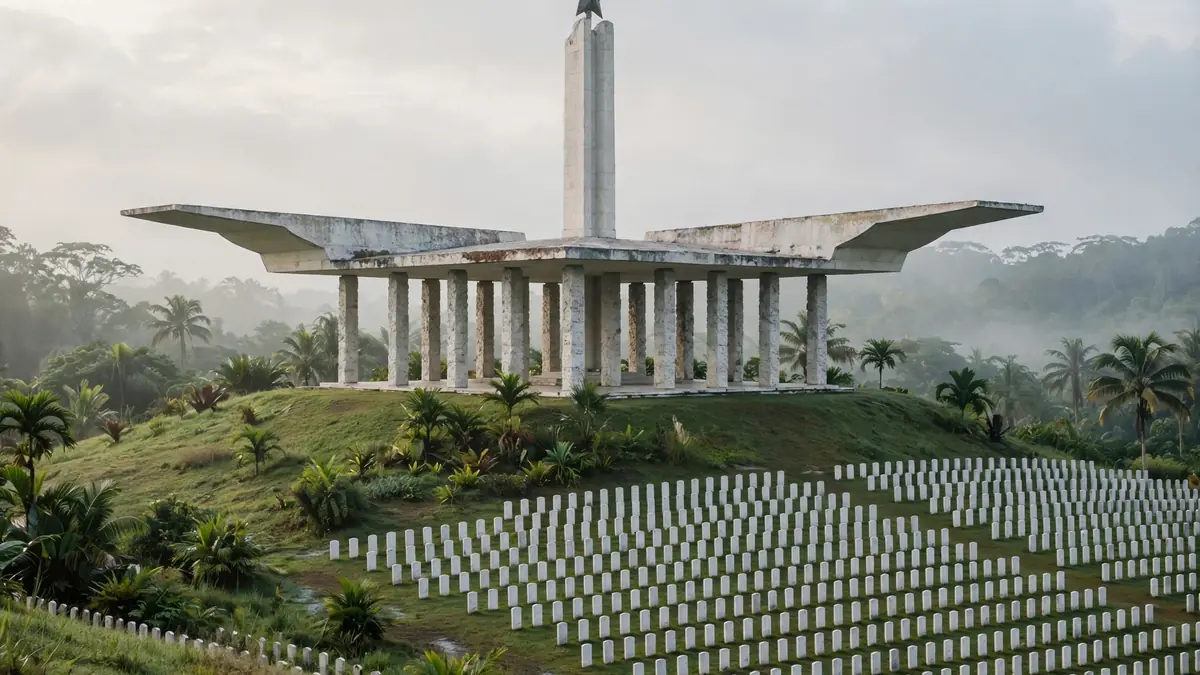
Kranji is a place of quiet order: rows of white headstones set in lawns on a hillside, a great wing-shaped roof carried on twelve columns, and a tall central pylon crowned with a star. The memorial was unveiled on 2 March 1957, just over eleven years after the end of the war, and it has since become the focus of remembrance in Singapore, visited every year on Remembrance Sunday and Anzac Day by veterans, families, schoolchildren and officials. This article explains how the memorial came to be built, who is buried and commemorated there, what the visitor sees today, and why Kranji still matters to Singapore and to the Commonwealth countries whose dead it holds.
2. Key Facts
| What | War cemetery and memorial to the missing, maintained by the Commonwealth War Graves Commission |
| Where | 9 Woodlands Road, Kranji, on the northern coast of Singapore, about 22 kilometres north of the city centre |
| Buried here | 4,461 Commonwealth casualties of the Second World War, including more than 850 unidentified burials; 64 First World War commemorations |
| Commemorated | More than 24,000 Commonwealth soldiers and airmen with no known grave, named on the Singapore Memorial |
| Unveiled | 2 March 1957, by Sir Robert Black, Governor of Singapore |
| Architect | Colin St Clair Oakes, a British architect and Second World War veteran |
| Design | Twelve columns carrying a wing-shaped roof, a central pylon about 22 metres high crowned with a star, and terraced rows of headstones |
| Today | Open to the public; the focus of Remembrance Sunday and Anzac Day services in Singapore |
3. Singapore in the Second World War
The fortress that fell
Singapore was the centrepiece of British defence in the Far East. The great naval base at Sembawang, the guns facing the sea, and the garrison of British, Australian, Indian and Malay troops were meant to deter any attacker, and before the war the island was described in Britain as an impregnable fortress. That reputation collapsed in a matter of weeks.
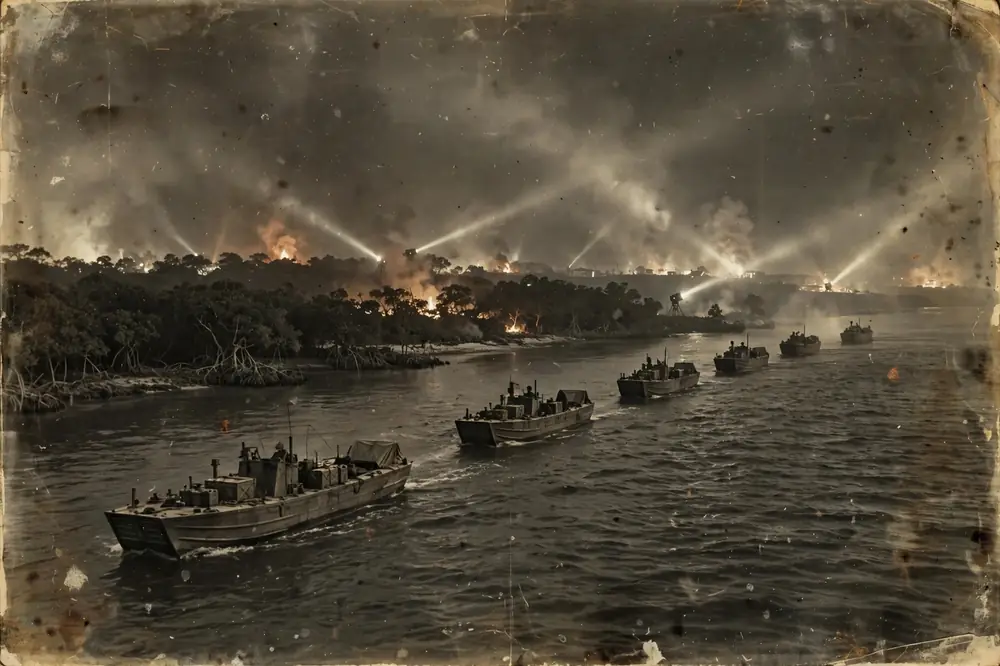
Japanese forces landed in northern Malaya on 8 December 1941, the same day as the attack on Pearl Harbor, and advanced down the peninsula far faster than the defenders expected, using bicycles, light tanks and close air support. By the end of January 1942 the Japanese had reached Johore, across the narrow strait from Singapore Island, and on 8 February they began landing on the island’s north-west coast, near Kranji and Sarimbun.
The fighting was confused and fierce, and within a week the defenders had been driven back into the city. On 15 February 1942, Lieutenant-General Arthur Percival surrendered Singapore to General Tomoyuki Yamashita. It was the largest surrender of British-led forces in history: about 80,000 British, Australian and Indian troops became prisoners, together with the thousands already captured in Malaya.
The occupation and the prisoner-of-war camps
The fall of Singapore began three and a half years of Japanese occupation, remembered in Singapore as the darkest period in the island’s history. The civilian population suffered food shortages, harsh military rule and the Sook Ching massacres of February and March 1942, in which thousands of Chinese men were killed.
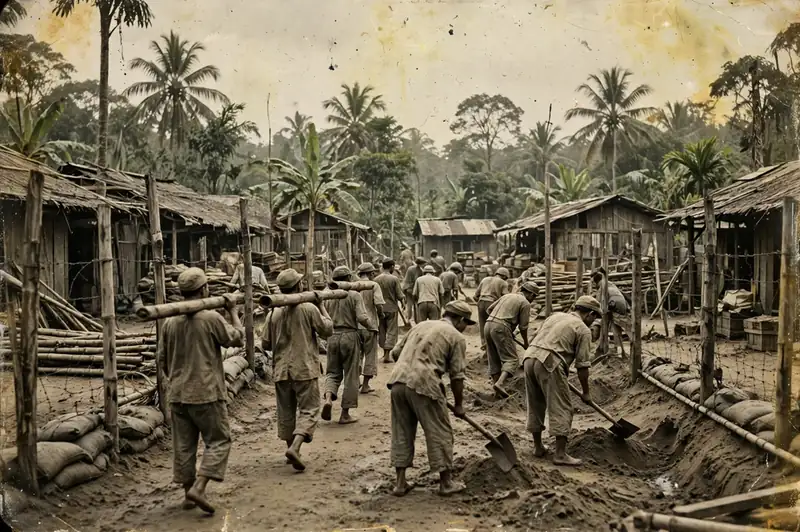
The prisoners of war were held first at Changi, on the eastern end of the island, and then sent in working parties across South-East Asia: to build the Burma-Thailand railway, to work in the mines and docks of Japan, and to labour on airfields in Malaya and Borneo. Conditions were brutal.
Prisoners died of malnutrition, dysentery, cholera, malaria and beatings, and of the hard labour itself, and thousands of Allied prisoners and Asian forced labourers never returned. The men buried at Kranji include many who died in Singapore itself — in the fighting of February 1942, in the Changi camps, and in the military hospital — and many whose bodies were later brought to Kranji from temporary graves across Malaya and Singapore when the Commonwealth War Graves Commission gathered the dead into one central cemetery after the war.
Why Kranji was chosen
Kranji was not chosen by accident. The hill at Kranji was already a place of war: it was the ground over which Japanese troops had fought their way ashore on the night of 8-9 February 1942, and it was close to the site of a wartime prisoner-of-war camp and a military hospital.
After the war, the Commonwealth War Graves Commission decided that Singapore needed one central war cemetery, rather than the scattered temporary burial grounds left by the fighting and the camps, and Kranji offered high, well-drained ground with a view across the strait to Malaya — the land over which so many of the dead had fought and marched.
The cemetery was formally established in 1946, and the dead were brought in from battlefields, temporary cemeteries and prisoner-of-war camps across Singapore and Malaya, and even from as far away as Vietnam. The choice gave the cemetery a double meaning that visitors still feel today: it is both a burial ground and a battlefield, a place where the men who died defending Singapore lie on the very ground where the defence failed.
4. The Cemetery and the Memorial
A cemetery built after the war
The Kranji War Cemetery was laid out in the years immediately after the war, and its design follows the principles the Commonwealth War Graves Commission had used since the First World War: headstones of uniform size and shape, lawns and planting kept in immaculate order, and a Cross of Sacrifice and a Stone of Remembrance as the two fixed elements of every large cemetery.
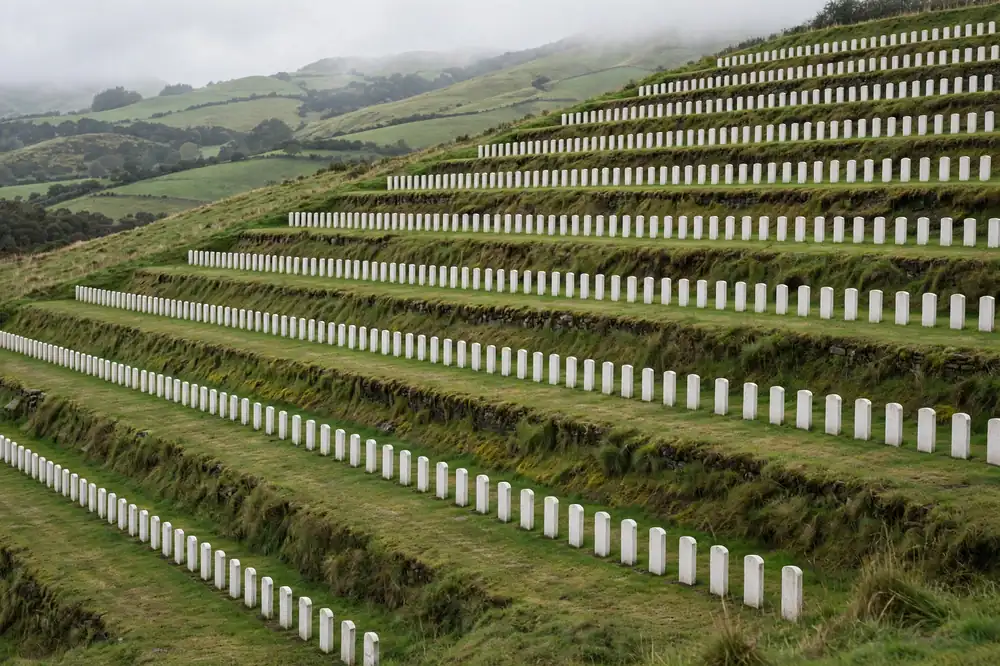
At Kranji the headstones are set in long terraces that climb the hillside, so that the cemetery reads from a distance as a series of white steps rising towards the memorial. The Commission’s records state that there are now 4,461 Commonwealth casualties of the Second World War buried or commemorated at Kranji, and that more than 850 of the burials are unidentified, their headstones bearing the words “Known Unto God”.
There are also 64 commemorations from the First World War, including special memorials to three casualties known to have been buried in civil cemeteries in Saigon and Singapore, but whose graves could not be located. The cemetery is not only for soldiers: it holds sailors and airmen, officers and other ranks, men from Britain, Australia, New Zealand, Canada, India, Malaya and other Commonwealth countries, and a small number of Dutch dead.
The design of Colin St Clair Oakes
Both the cemetery and the Singapore Memorial were designed by Colin St Clair Oakes, a British architect who had served in the Second World War and became a Principal Architect of the Commonwealth War Graves Commission. Oakes’s design is deliberately modern and symbolic rather than traditional.
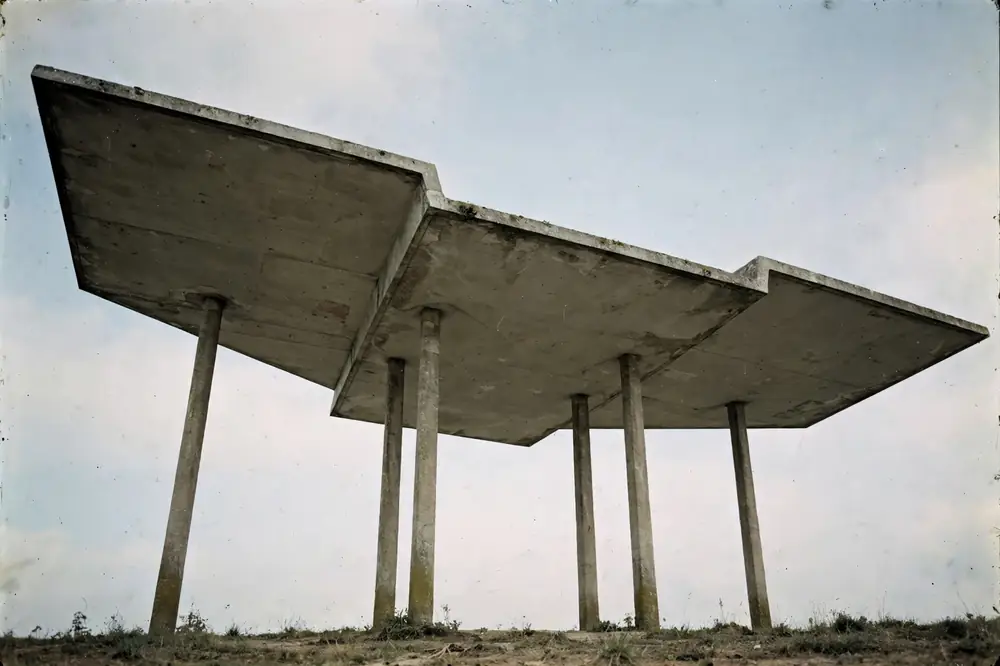
The memorial is shaped, in his own conception, like an aircraft: a flat, wing-shaped roof carried on twelve columns, with a tall central pylon at its heart crowned by a star. The twelve columns bear the names of the missing, and the roof seems to hover above the hillside, open to the sky on all sides.
The effect is very different from the classical monuments of the First World War, and it was a deliberate choice: Oakes wanted a memorial that spoke of flight, of the airmen who form so large a part of the missing, and of a modern war fought across vast distances.
The design has been praised for its simplicity and its command of the site, and it remains one of the most distinctive Commonwealth memorials in Asia.
The unveiling in 1957
The Singapore Memorial was officially unveiled on 2 March 1957 by Sir Robert Black, then Governor of Singapore, just over eleven years after the end of the war and fifteen years after the fall of Singapore. The ceremony was attended by veterans, by the families of the dead, and by representatives of the Commonwealth governments, and it marked the moment when the scattered graves and the unmarked losses of the Malayan campaign were finally gathered into one place of public remembrance.
The date matters: by 1957 Singapore was moving towards self-government, and the memorial was unveiled in a colony on the edge of independence. In the decades since, the meaning of the site has widened. It began as a Commonwealth military cemetery, but it is now also a Singaporean place of memory, visited by Singaporean schoolchildren learning about the occupation, and maintained as part of Singapore’s own heritage.
The memorial’s survival through Singapore’s rapid development — the city has grown around it, but the hill at Kranji has been preserved — is itself a sign of the respect in which it is held.
5. The Singapore Memorial
The names of the missing
The Singapore Memorial is the heart of the Kranji site, and its purpose is different from that of the cemetery below it. The cemetery holds the dead whose bodies were recovered; the memorial names the dead whose bodies were never found. According to the Commonwealth War Graves Commission, the memorial bears the names of more than 24,000 casualties of the Commonwealth land and air forces who have no known grave.
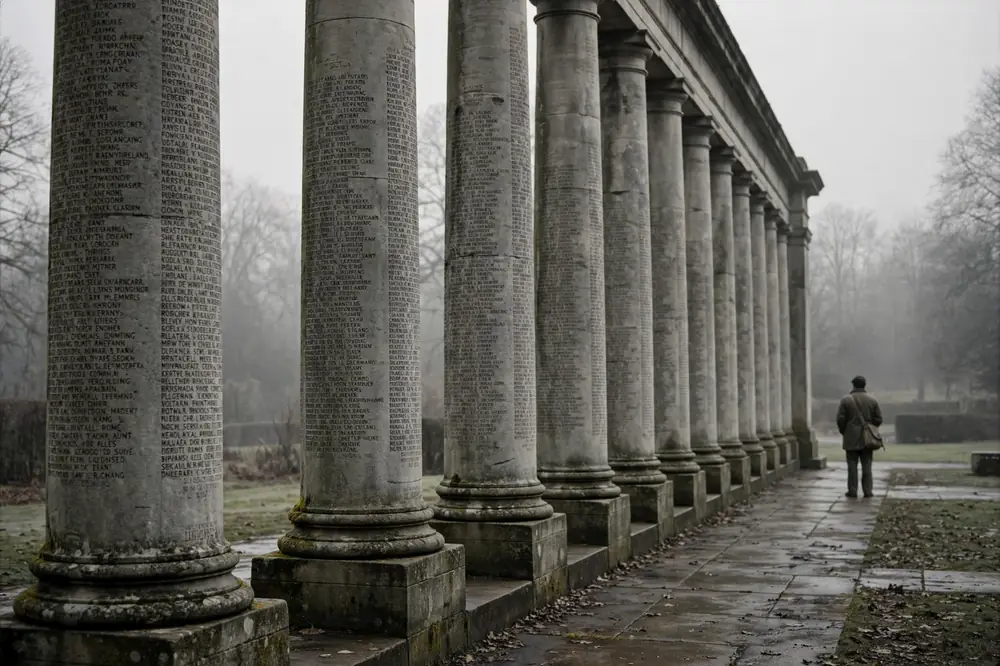
Many of them have no known date of death, and the Commission’s records give them the date or period from when they were known to be missing or captured. The names are inscribed on the twelve columns that carry the roof, and they cover the whole range of the war in South-East Asia: soldiers killed in the fighting in Malaya and Singapore in 1941-42, airmen lost over the jungles and seas of the region, and men who died as prisoners of war in camps whose burial grounds were never found.
For the families of these men, the memorial is the only grave they have, and the act of finding a name on a column is, for many visitors, the purpose of the visit.
The architecture and its meaning
The wing-shaped roof
The most striking feature of the memorial is its roof: a broad, flat slab, shaped like the wing of an aircraft, carried on twelve slender columns and open to the sky on every side. The roof has no walls beneath it, so that the visitor stands in a covered but open space, looking out over the cemetery terraces below and the strait beyond.
The shape is a deliberate reference to the air war: a large proportion of the missing named on the memorial were airmen, lost on operations over Malaya, Sumatra, Burma and the South China Sea, and Oakes chose the form of a wing to remember them.
The roof also gives the memorial its character as a place of shelter rather than enclosure — a roof under which the names are gathered, rather than a building that shuts the visitor in. At its centre rises the pylon, about 22 metres high, crowned with a star, which can be seen from far across the northern coast of Singapore and serves as a landmark for the whole site.
The twelve columns
The twelve columns that carry the roof are the memorial’s second great feature, and they are where the work of remembrance is actually done. Each column is clad in stone and inscribed with the names of the missing, arranged by service and regiment, and visitors walk slowly from column to column, searching the lists.
The number twelve has no single official explanation, but the columns serve a practical and a symbolic purpose at once: practically, they divide the enormous list of more than 24,000 names into sections that can be read; symbolically, they make the act of remembrance a physical one, a walk around a building whose walls are made of names.
The columns also carry the memorial’s only decoration of any size: the names themselves, with no sculpture and no rhetoric, so that the visitor’s attention is held entirely by the scale of the loss. It is a design that trusts the list to speak for itself, and for most visitors it does.
6. Who Is Buried and Commemorated
Soldiers, sailors and airmen
The dead at Kranji come from every service and from across the Commonwealth. The largest groups are British and Australian soldiers who died in the Malayan campaign and in the prisoner-of-war camps, and Indian soldiers of the British Indian Army, who formed a large part of the garrison of Singapore and Malaya and suffered heavily both in the fighting and in captivity.
There are also sailors from the ships lost in the waters around Singapore and Malaya, including men of the Royal Navy and the Royal Australian Navy, and airmen of the Royal Air Force and the Royal Australian Air Force who were shot down over the region.
The headstones record the variety of the force that defended Singapore: infantry regiments from Britain and Australia, artillerymen, engineers, signallers, medical orderlies, and the men of the local forces — the Malay Regiment, the Straits Settlements Volunteer Force, and the Singapore Volunteer Corps.
Among the most visited graves are those of the men of the Malay Regiment who died defending Singapore, and of the Australian soldiers of the 8th Division who fought at Kranji itself.
The unidentified dead
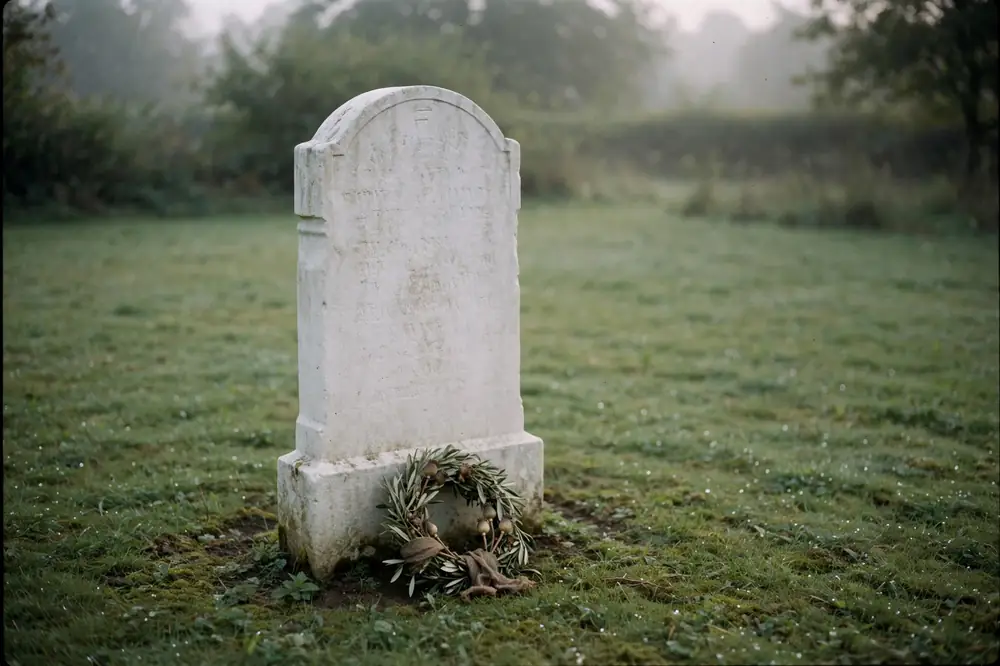
More than 850 of the burials at Kranji are unidentified, and their headstones carry no name, only the words “Known Unto God” and, where it is known, the regiment or service of the dead man. These are men whose bodies were recovered from the battlefields of Malaya and Singapore, or from the prisoner-of-war camps, in a state that made identification impossible, or whose identity discs and records had been lost.
The proportion of unidentified burials is high because so many of the dead were buried in haste during the fighting, or died in camps where record-keeping had broken down, and because the tropical climate made the recovery of remains difficult.
The Commonwealth War Graves Commission has continued to work on identification: where new evidence emerges — a document, a relic, a DNA match — a headstone can be replaced with a named one, and the Commission’s records are updated. For visitors, the unidentified graves are among the most moving parts of the cemetery, because they stand for the many more whose bodies were never recovered at all, and whose names are on the memorial above.
The other memorials at Kranji
The Singapore Memorial is the largest structure at Kranji, but it is not the only memorial on the site. The Commonwealth War Graves Commission records five memorials within the cemetery: the Singapore Memorial itself; the Singapore (Unmaintainable Graves) Memorial, which stands at the western end of the Singapore Memorial and commemorates more than 250 casualties who died in the campaigns in Singapore and Malaya, whose known graves in civil cemeteries could not be assured maintenance and on religious grounds could not be moved to a war cemetery; the Singapore Cremation Memorial, for servicemen whose remains were cremated; the Singapore Civil Hospital Grave Memorial, at the eastern end of the memorial, for more than 100 Commonwealth servicemen and civilians who died in a prisoner-of-war hospital and were buried in a mass grave; and the Chinese Memorial, for Chinese members of the Commonwealth forces.
Adjoining the war cemetery is the Kranji Military Cemetery, a separate and much larger burial ground with about 1,422 burials, which is not a Second World War site. Together, these memorials show how the Commission tried to remember every category of the dead, including those whose burial could not follow the usual form.
7. The Battle of Kranji
The Japanese landings of February 1942
The ground at Kranji was itself a battlefield, and the cemetery stands on land where men fought and died in the last days before the fall of Singapore. On the night of 8-9 February 1942, Japanese troops of the 5th and 18th Divisions crossed the Straits of Johore in landing craft and came ashore on the north-west coast of Singapore Island, at Sarimbun and Kranji, under cover of a heavy artillery bombardment.
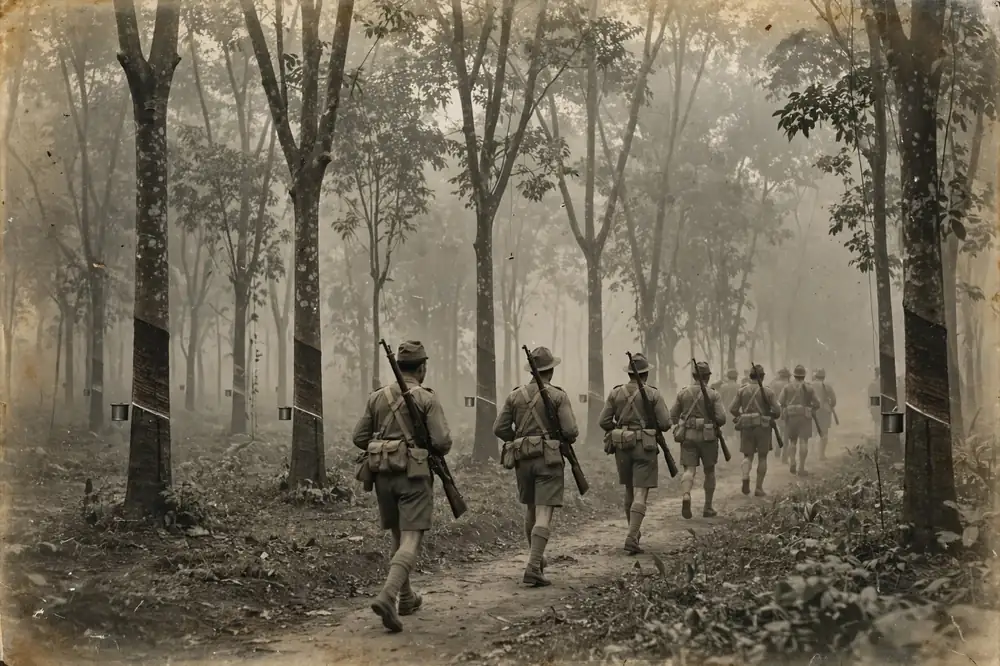
The defenders in this sector were Australian troops of the 8th Division, supported by British and Indian units, and the fighting in the mangrove swamps and rubber plantations along the coast was confused and costly on both sides. The Japanese established a beachhead, brought tanks and artillery across the strait, and drove inland towards the naval base and the causeway.
The battle at Kranji was not a single set-piece engagement but a series of sharp, disorganised fights in difficult country, and it is remembered less for any one action than for the speed with which the Japanese broke through a position the defenders had expected to hold.
The defence and the retreat
The Australian defence at Kranji was hampered by the terrain and by the breakdown of communications. The mangrove coast made it hard to see the landings, the Japanese attacked at night, and the defending units, spread thinly along a long coastline, could not concentrate quickly enough to throw the invaders back into the sea.
By the morning of 9 February the Japanese had secured their beachhead and were advancing south, and the Australian and British units fell back through the plantations towards the centre of the island. Within days the defence had collapsed into the fighting around Singapore city, and on 15 February the island surrendered.
The men who died at Kranji in those days were among the first Commonwealth dead of the Singapore campaign to be buried in the ground that would become the cemetery, and their graves are part of the reason the site was chosen.
Walking the cemetery today, the visitor is standing on the ground where the last battle for Singapore began, and that knowledge changes the way the rows of headstones are read.
Remembering a defeat
Kranji is unusual among great war memorials because it commemorates a defeat. Most famous memorials celebrate a victory or a sacrifice that led to victory; Kranji remembers a campaign that ended in surrender, and men who died in a cause that failed in the short term.
That makes the memorial’s tone different: there is no triumphal language anywhere on the site, and the architecture is deliberately quiet and open rather than monumental in the heroic sense. The lesson the site teaches is not about glory but about the cost of unpreparedness, the consequences of underestimating an enemy, and the endurance of prisoners who survived years of captivity.
It is a lesson that military colleges still teach, and that the cemetery makes visible in a way no classroom can: the names on the stones are the price of the failure, and they are the reason the failure is still studied today.
In Singapore, where the fall of the island is taught in schools as a national turning point, Kranji is the place where that lesson is given a physical form, and where the abstract fact of defeat is made concrete in the names and the graves.
8. Visiting the Site
Getting there and what to see
The Kranji War Memorial stands at 9 Woodlands Road, about 22 kilometres north of the centre of Singapore, and it is reached by road and by public transport: the nearest MRT station is Kranji, on the North-South Line, from which the memorial is a short walk. The site is open to the public and admission is free.
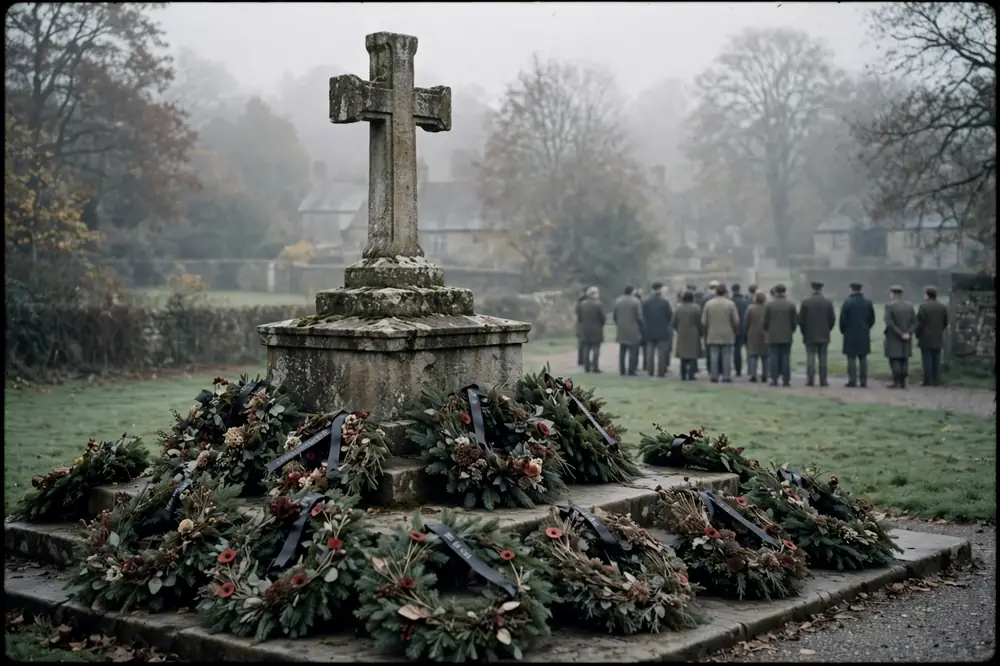
Visitors should allow at least an hour, and ideally two, to walk the terraces, read the headstones, climb to the memorial and look for names on the columns. The best approach is from the lower gate, walking up through the rows of headstones towards the memorial, so that the scale of the cemetery is felt before the scale of the missing is understood.
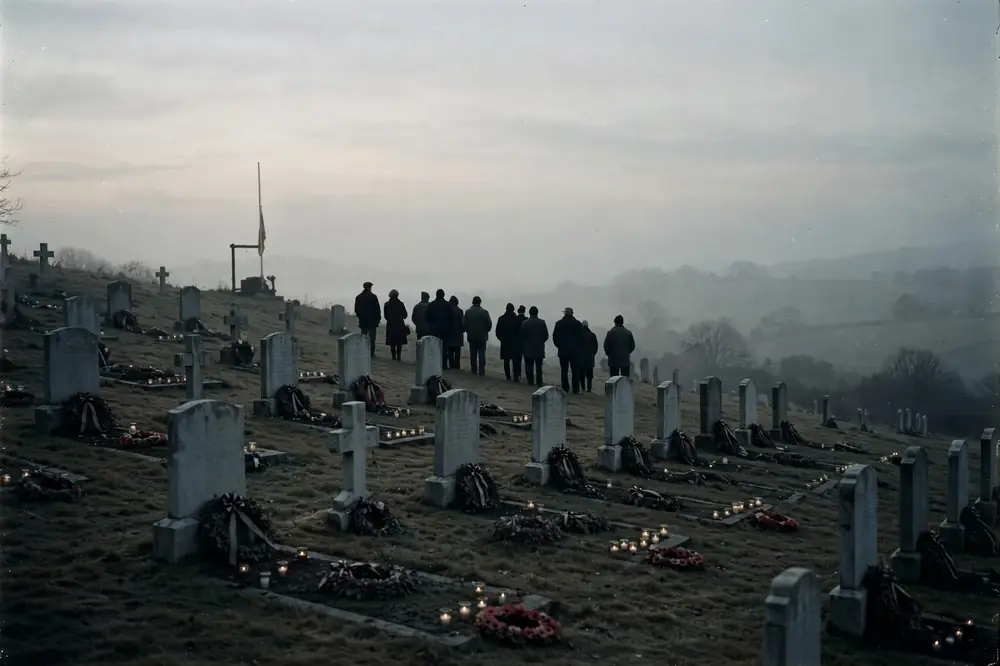
The memorial’s Place of Information is not a museum in the usual sense — there is no large exhibition — but the Commonwealth War Graves Commission provides information panels, and the Commission’s online database allows visitors to search for individual casualties before they arrive, so that they can find a particular grave or name.
Services and ceremonies
Remembrance Sunday
The principal annual ceremony at Kranji is the Remembrance Sunday service, held on the Sunday nearest to 11 November, the anniversary of the armistice of 1918. The service follows the Commonwealth pattern: a parade of veterans and serving personnel, the laying of wreaths at the Cross of Sacrifice and at the memorial, the two minutes’ silence, and the reading of the names of the dead.
It is attended by the high commissioners and ambassadors of the Commonwealth countries, by Singaporean officials, and by the families of the dead, and it is the occasion on which the memorial’s role as a diplomatic as well as a commemorative place is most visible.
For the families who travel to Singapore for the service, the ceremony is often the fulfilment of a journey planned for many years, and the laying of a wreath at a particular column is a private act performed in a public setting.
Anzac Day
The second great annual ceremony is Anzac Day, 25 April, which commemorates the landing at Gallipoli in 1915 and, by extension, the service of Australian and New Zealand forces. At Kranji the Anzac Day dawn service is held early in the morning, before sunrise, and it draws a large crowd, including many young Australians and New Zealanders living in Singapore and school groups from the Australian and New Zealand schools in the city.
The service is shorter and simpler than the Remembrance Sunday ceremony, and it is followed by a gunfire breakfast, in the Australian and New Zealand tradition. The presence of so many young people at the dawn service is one of the reasons the memorial remains a living place rather than a museum: for them, Kranji is not only a site of history but a place where their own countries’ connection to Singapore is renewed each year.
Many of them wear the medals of a grandfather or great-grandfather, and the service ends with families searching the columns together for a name they have only ever seen in a photograph.
Behaviour and respect
Kranji is a working cemetery as well as a memorial, and visitors are asked to behave with the respect due to a burial ground. The Commonwealth War Graves Commission asks visitors to speak quietly, not to walk on the graves, not to climb on the memorial, and not to take photographs in a way that disturbs other visitors or the ceremonies.
School groups are welcome, and the Commission and the Singapore authorities provide educational material, but the site is not a tourist attraction in the ordinary sense: there is no shop, no cafe and no entertainment, and the quiet of the place is part of its purpose.
Visitors who come with a name to find are helped by the Commission’s staff and by the register boxes at the site, which hold the cemetery and memorial registers. The best advice for any visitor is simple: walk slowly, read the headstones, and remember that every stone stands for a person whose family once waited for news that never came.
9. Commemoration and Education
Kranji in Singapore’s national memory
In Singapore, Kranji occupies a special place in the national memory of the Second World War, because the war is remembered there not as a distant European conflict but as an occupation that touched every family on the island. The fall of Singapore is taught in schools, the Changi Chapel and the museums of the occupation are visited by Singaporean students, and Kranji is the place where the military side of that story is given its most formal expression.
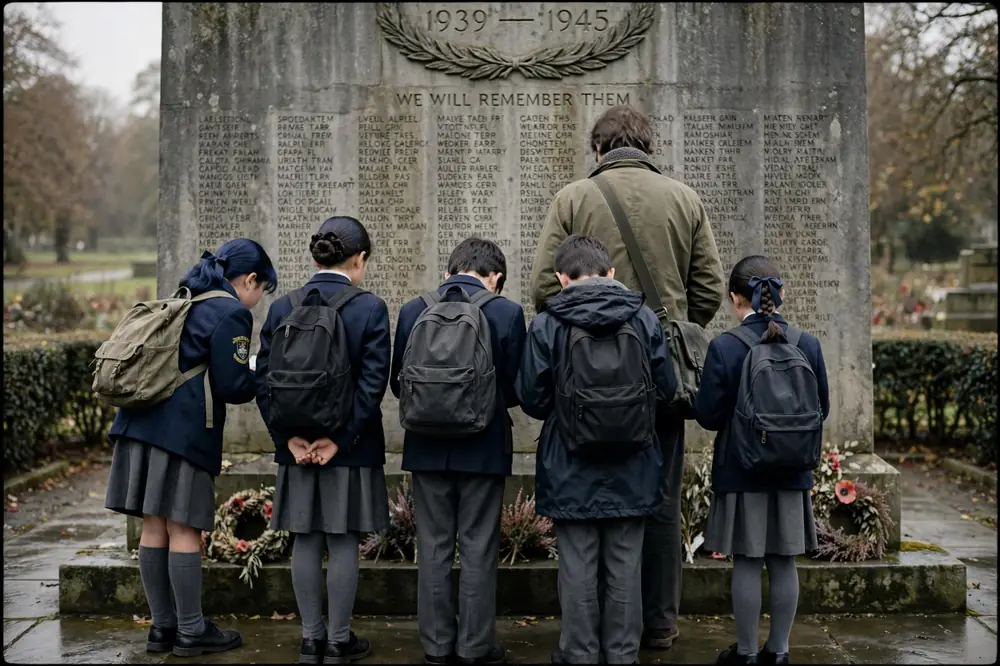
The memorial is therefore not only a Commonwealth site but a Singaporean one, and its preservation through the decades of Singapore’s transformation from a colony to an independent state and then to a global city is a deliberate act of the Singaporean government as much as of the Commission.
The site is listed in Singapore’s heritage records, and the land around it has been protected from development, so that the hill at Kranji remains a green and quiet place in a city that has grown dense around it.
The Commission’s database and research
The Commonwealth War Graves Commission maintains a public database of every casualty it commemorates, and for Kranji that database is the key that unlocks the site. A visitor who knows a name can find the grave or the panel on which it appears, the unit, the date of death or of disappearance, and often the age and the next of kin recorded at the time.
Historians and family researchers use the database to reconstruct the stories of individual men, and the Commission’s own historians have used it to correct and complete the records — for example, by identifying men previously listed as unknown, or by adding names to the memorial when new evidence shows that a man previously thought to have a grave in fact has none.
The database also makes it possible to see the patterns of the loss: the concentration of deaths in February 1942 and in the prisoner-of-war years, the spread of regiments and services, and the ages of the dead, many of whom were in their early twenties.
In this way Kranji is not only a place to visit but a research resource, and its records continue to grow in accuracy as new material comes to light.
Teaching the next generation
Singaporean schools bring students to Kranji as part of their history education, and the visit is designed to make the abstract facts of the occupation concrete. Students are given the name of one casualty to find, and they learn to read a headstone — the name, the rank, the regiment, the date, the age, and the personal inscription chosen by the family — and to understand that the war was made of individual lives.
Australian and New Zealand schools in Singapore use the Anzac Day service in the same way, and the Commission provides educational packs for teachers in all the Commonwealth countries. The purpose of this education is not to glorify war but to explain its cost, and Kranji, with its combination of a cemetery and a memorial to the missing, is particularly well suited to that purpose: the graves show what was lost, and the names on the columns show how much more was lost without a grave at all.
10. Legacy
The legacy of Kranji is, first, a record: 4,461 identified and unidentified burials, and more than 24,000 names of the missing, preserved in stone and in the Commission’s records, so that the dead of the Malayan campaign and the prisoner-of-war camps are not forgotten.
Second, it is a lesson: the memorial stands on the ground where the defence of Singapore failed, and it reminds every visitor that a reputation for strength is no substitute for preparation, and that the cost of failure falls on ordinary soldiers and on the civilians who live with the consequences.
Third, it is a living place of reconciliation: Singapore and the Commonwealth countries, and Singapore and Japan, have used the site as a place where former enemies can meet in remembrance, and where the memory of the war is carried forward not as hatred but as a shared commitment to peace.
The memorial’s wing-shaped roof, open to the sky, is a fitting symbol of that legacy — a structure that shelters the names of the dead while remaining open to the world around it, and to the future.
Why Kranji still matters
Kranji still matters because the questions it raises have not gone away. The fall of Singapore is still studied in military colleges as a case study in the failure of deterrence, the dangers of fighting the last war, and the importance of intelligence and preparation.
The prisoner-of-war experience is still studied as a case study in endurance, in the medical and psychological consequences of captivity, and in the obligations owed to prisoners. And the memorial itself is still studied as an example of how a society remembers a defeat without either denying it or being defined by it.
As long as those questions matter, Kranji will matter, and the rows of white headstones on the hill above the Straits of Johore will continue to be visited, read and remembered. Every year, new visitors arrive who were not alive during the war, and the memorial must explain itself to them without the help of living witnesses, which is why its stones, its names and its silence matter more with each passing year.
A place for the families
Above all, Kranji matters to the families. For the descendants of the men buried and commemorated there, the memorial is the one place in the world where a grandfather or a great-uncle they never met is remembered by name, in a place kept with care and visited by strangers who also stop to read.
The Commission’s records show that families still travel to Singapore every year to find a grave or a name, sometimes three generations after the war, and that the act of finding it — of touching the headstone, of taking a photograph, of leaving a flower — remains as important now as it was in 1957.
That is the deepest legacy of Kranji: not a lesson in strategy or a work of architecture, but a place where the dead are still known by name, and where the living still come to find them. The Commission’s staff say that the questions visitors ask have changed little over the decades — who was he, how old was he, where did he die — and that the memorial exists to answer them, one name at a time, for as long as anyone comes to ask.
Frequently Asked Questions
How many people are buried at Kranji War Memorial?
According to the Commonwealth War Graves Commission, 4,461 Commonwealth casualties of the Second World War are buried or commemorated at Kranji War Cemetery, and more than 850 of the burials are unidentified.
How many names are on the Singapore Memorial?
The Singapore Memorial bears the names of more than 24,000 Commonwealth soldiers and airmen who died in South-East Asia and have no known grave.
When was the Kranji War Memorial unveiled?
The Singapore Memorial was unveiled on 2 March 1957 by Sir Robert Black, Governor of Singapore. The cemetery itself was established in 1946.
Who designed the memorial?
The cemetery and the memorial were designed by Colin St Clair Oakes, a British architect and Second World War veteran who became a Principal Architect of the Commonwealth War Graves Commission.
Can I visit Kranji War Memorial?
Yes. The site at 9 Woodlands Road is open to the public and admission is free. The nearest MRT station is Kranji, and visitors should allow at least an hour for the visit.
Why is Kranji important?
Kranji is the principal Commonwealth war cemetery and memorial to the missing in Singapore. It remembers the dead of the Malayan campaign, the fall of Singapore and the prisoner-of-war camps, and it stands on the ground where the Japanese landed in February 1942.
Related articles
Sources
- Commonwealth War Graves Commission, “Kranji War Cemetery” and “Singapore Memorial” (cwgc.org) — casualty figures of 4,461 burials and more than 24,000 names, the unveiling of 2 March 1957, and the architect Colin St Clair Oakes.
- National Library Board, Singapore, BiblioAsia, “Lest We Forget: Kranji War Cemetery” — the history of the site and the five memorials within the cemetery.
- Wikipedia, “Kranji War Cemetery” and “Singapore Memorial” — the fall of Singapore, the Battle of Kranji, and the design of the memorial.
- Commonwealth War Graves Commission casualty database (cwgc.org) — individual records of the men buried and commemorated at Kranji.
- Louis Allen, Singapore 1941-1942 (Routledge, revised edition) — the Malayan campaign and the fall of Singapore.
- Brian Farrell, The Defence and Fall of Singapore (Monsoon Books, 2005) — the fighting in Malaya and the landings at Kranji and Sarimbun.
- Commonwealth War Graves Commission, Kranji War Cemetery and Singapore Memorial: site information — visiting information, ceremonies and the care of the site.