 WAR ATLAS MILITARY HISTORY MAGAZINE · WWI — WWII
Warsaw Ghetto Uprising
1. Lead
The Warsaw Ghetto Uprising began on 19 April 1943, the eve of the Jewish festival of Passover, when German forces entered the Warsaw Ghetto to deport its remaining inhabitants to the killing centre at Treblinka. They expected a routine operation, completed in three days.
Instead, they met armed resistance: about 750 young Jewish fighters, organised in two underground groups, the Jewish Combat Organisation (ŻOB) and the Jewish Military Union (ŻZW), fought the German army from bunkers, attics and sewers for nearly a month, until 16 May 1943, when the Germans destroyed the ghetto, street by street and building by building, and blew up the Great Synagogue of Warsaw.
About 13,000 Jews were killed during the uprising, by the most commonly cited estimates, and most of the survivors were deported to Treblinka and Majdanek, where they were murdered. The uprising did not save the ghetto, but it was the largest Jewish revolt of the Holocaust, and it has become a symbol of Jewish resistance and of the refusal to die without a fight.
This article tells the story of the ghetto, of the deportations that preceded the uprising, of the young people who decided to fight, of the month of fighting itself, and of what happened afterwards: the destruction of the ghetto, the trials of the German commander, and the memory of the uprising in Poland, in Israel and in the world. The numbers in this story are disputed, and the article gives them as ranges, with the sources, as the task requires. The uprising is remembered differently by different people — as a military action, as a moral act, as a tragedy — and this article presents the facts on which all of those memories rest.
2. Key Facts
| What | An armed Jewish revolt against the German deportation of the remaining inhabitants of the Warsaw Ghetto |
| When | 19 April-16 May 1943 (28 days) |
| Where | The Warsaw Ghetto, in occupied Poland |
| Jewish fighters | About 750, in the Jewish Combat Organisation (ŻOB) and the Jewish Military Union (ŻZW) |
| Jewish leader | Mordechai Anielewicz, aged 24, commander of the ŻOB |
| German commander | SS-Brigadeführer Jürgen Stroop |
| Jewish deaths | About 13,000 killed during the uprising, by the most commonly cited estimates; most survivors were deported and murdered at Treblinka and Majdanek |
| German losses | Stroop reported 16 killed and 85 wounded; historians consider this figure likely too low, but no reliable higher figure exists |
| End | 16 May 1943, with the destruction of the Great Synagogue of Warsaw |
| Today | The Monument to the Ghetto Heroes (1948) and the POLIN Museum of the History of Polish Jews (2013) stand on the site |
3. The Warsaw Ghetto
The creation of the ghetto
The Warsaw Ghetto was created by the German occupation authorities in the autumn of 1940, a year after the invasion of Poland. On 2 October 1940, the Germans ordered all Jews in Warsaw to move into a walled district in the centre of the city, and on 16 November 1940 the ghetto was sealed: its gates were closed, its walls were guarded, and no Jew was allowed to leave without a permit.
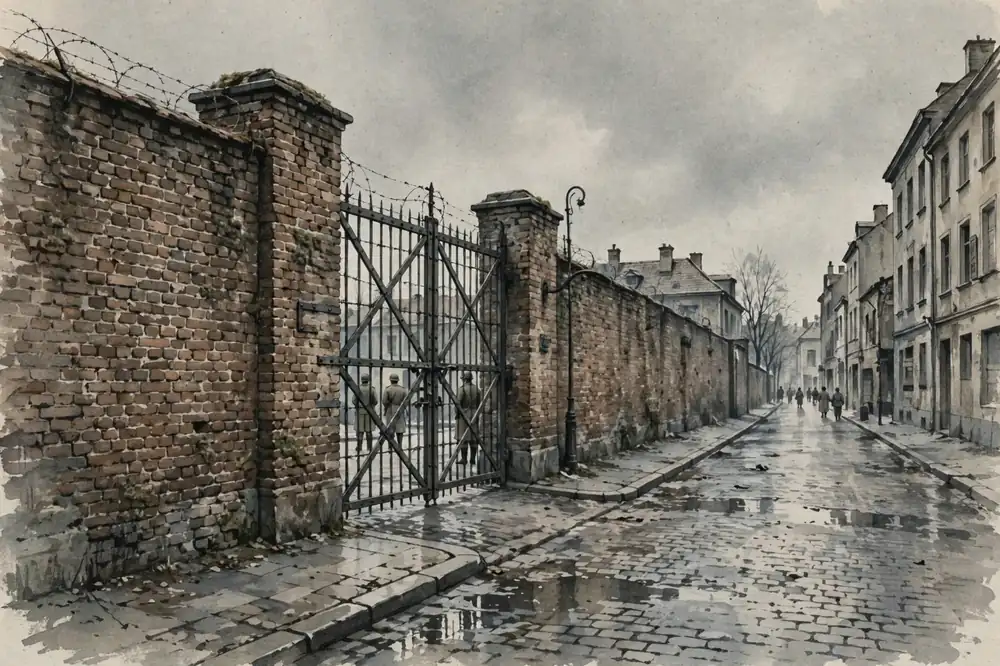
At its height, the ghetto held about 400,000 people — the largest Jewish community in Europe, and one of the largest ghettos in occupied Europe — crowded into an area of about 3.4 square kilometres, at a density of more than 100,000 people per square kilometre.
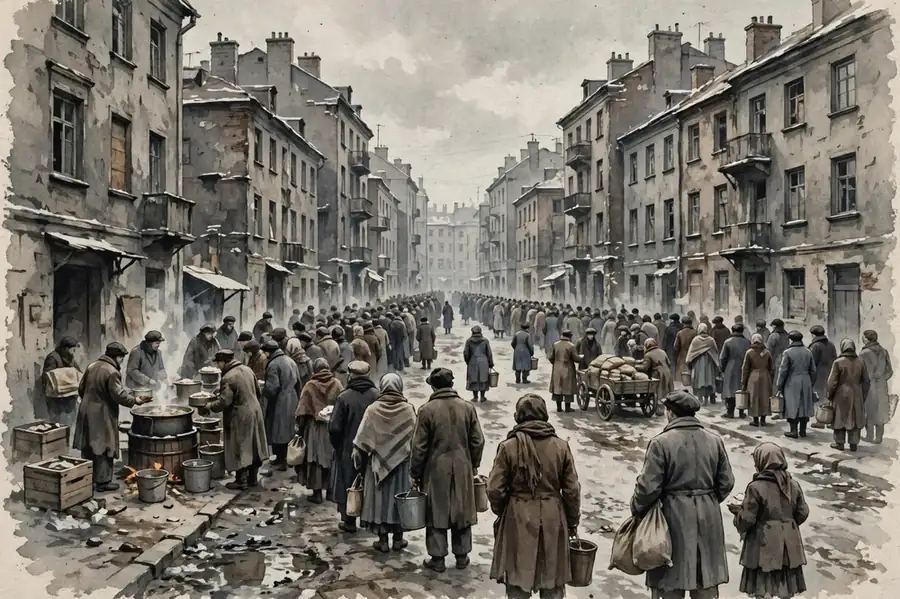
The ghetto was a city within a city, with its own administration, its own police, its own schools, hospitals and workshops, and its own cultural life, but it was also a prison: food was rationed to starvation levels, disease was rampant, and the Germans controlled every aspect of life within its walls.
Life and death in the ghetto
Life in the ghetto was a struggle for survival, and death was everywhere. The official food ration for Jews was about 180 calories a day — less than a tenth of what a person needs to live — and the ghetto’s inhabitants survived by smuggling, by begging, by selling their possessions, and by working in the German workshops.
Hunger and disease killed tens of thousands: in 1941, the worst year, about 43,000 people died in the ghetto, of starvation, typhus and other diseases, and their bodies were collected each morning from the streets. The ghetto also had a rich cultural and political life: underground schools, libraries, theatres, political parties and youth movements, and a secret archive, the Oyneg Shabbos archive, led by the historian Emanuel Ringelblum, which collected documents, diaries and testimonies about life in the ghetto and buried them in milk cans, so that the world would know what had happened.
The archive was recovered after the war, and it is one of the most important sources for the history of the Holocaust.
The Jewish Council and the ghetto police
The Germans governed the ghetto through a Jewish Council, the Judenrat, headed by Adam Czerniaków, and a Jewish police force, which carried out German orders. The Council’s position was impossible: it was ordered to supply workers for German factories, to collect taxes, and, from the summer of 1942, to supply people for deportation, and it had no power to refuse.
Czerniaków, who had tried to protect the ghetto’s inhabitants, killed himself on 23 July 1942, when the Germans ordered him to deliver 6,000 people a day for deportation, leaving a note that said he could no longer bear the responsibility.
His suicide is one of the most remembered acts of the ghetto’s history, and it is a reminder of the moral dilemmas that the ghetto’s leaders faced: cooperation, resistance, and the impossible choice between saving some and saving none. The Jewish police, who carried out the deportations, are remembered with bitterness by survivors, and their role is one of the most painful subjects in the history of the ghetto.
4. The Deportations of 1942
The Grossaktion Warsaw
In the summer of 1942, the Germans began the destruction of the Warsaw Ghetto. On 22 July 1942, they launched the Grossaktion Warsaw — the Great Action — a programme of mass deportation to the killing centre at Treblinka, which had been built for that purpose.
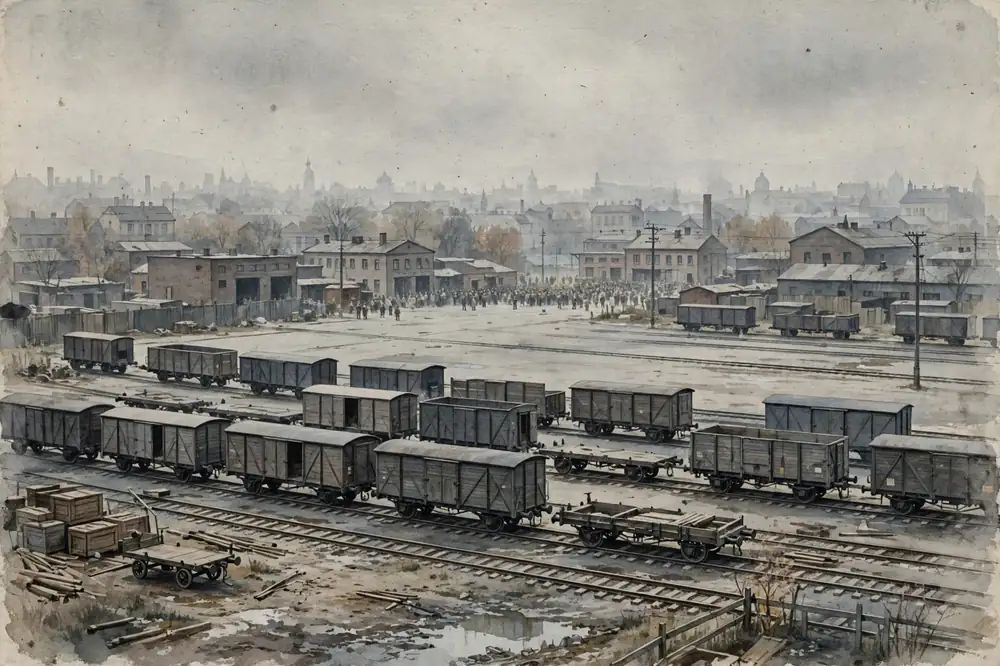
Over the next seven weeks, until 21 September 1942, about 265,000 Jews were deported from Warsaw to Treblinka, in trains that left the Umschlagplatz, the loading square on the edge of the ghetto, every day. About 10,000 more were killed in the ghetto itself, in the round-ups and in the streets, and about 35,000 were allowed to remain, as workers in the German factories.
The deportees were told that they were being resettled in the east, to work, and many believed it, because the alternative was unthinkable. In fact, almost all of them were murdered at Treblinka within hours of arrival. The Grossaktion was the largest single deportation of the Holocaust in Poland, and it reduced the ghetto from a city of 400,000 to a remnant of about 55,000 to 60,000 people.
The news from Treblinka
The turning point for the ghetto was the arrival of the news from Treblinka. In the autumn of 1942, escapees from Treblinka reached Warsaw and told the ghetto’s leaders what was happening there: that the deportees were not being resettled, but murdered, in gas chambers, on arrival.
The news was at first disbelieved — it seemed too terrible to be true — but it was confirmed by other reports, and by the fact that no one who had been deported had ever written back. The news changed everything: it destroyed the hope that cooperation would save the ghetto, and it convinced a growing number of young people that the only choice was between dying in Treblinka and dying fighting in Warsaw.
The decision to resist was not taken lightly, and it was opposed by many in the ghetto, who argued that resistance would bring German reprisals and the destruction of the remnant, but the young people who made the decision were convinced that the ghetto was doomed in any case, and that it was better to die fighting than to die in a gas chamber.
The January rising
The first test of the decision to resist came in January 1943, when the Germans entered the ghetto to deport a further 8,000 people. This time, they were met with armed resistance: a small group of ŻOB fighters, led by Mordechai Anielewicz, attacked the Germans in the streets, and the deportation was halted after four days, with only about 5,000 people deported, instead of the 8,000 the Germans had planned.
The January action was a small victory, but it was a great moral victory: it showed that the Germans could be fought, and it gave the ghetto’s inhabitants a hope they had not had since the summer of 1942. The Germans, for their part, learned that the ghetto would not be emptied without a fight, and they began to prepare for a final liquidation, with more troops, with tanks and artillery, and with the intention of destroying the ghetto altogether.
The three months between January and April 1943 were months of preparation on both sides: the fighters built bunkers and collected weapons, and the Germans assembled the forces that would crush them.
5. The Decision to Resist
The young people who chose to fight
ŻOB and ŻZW
The fighters of the Warsaw Ghetto Uprising were, for the most part, very young: their leaders were in their early twenties, and many of the fighters were teenagers. They were organised in two groups. The Jewish Combat Organisation, the ŻOB, was founded in July 1942, after the Grossaktion, and it was led by Mordechai Anielewicz, a 24-year-old youth leader of the Hashomer Hatzair movement.
The ŻOB was a coalition of left-wing and Zionist youth movements, and it had about 500 fighters. The Jewish Military Union, the ŻZW, was founded by former officers of the Polish army and by members of the right-wing Revisionist movement, and it had about 250 fighters, better armed than the ŻOB, with weapons bought from the Polish underground and from corrupt German soldiers.
The two groups did not always cooperate — they distrusted each other politically, and they fought in different parts of the ghetto — but on 19 April 1943 they fought side by side, and their combined strength was about 750 fighters, against a German force of more than 2,000 men, with tanks, artillery and aircraft.
Preparations
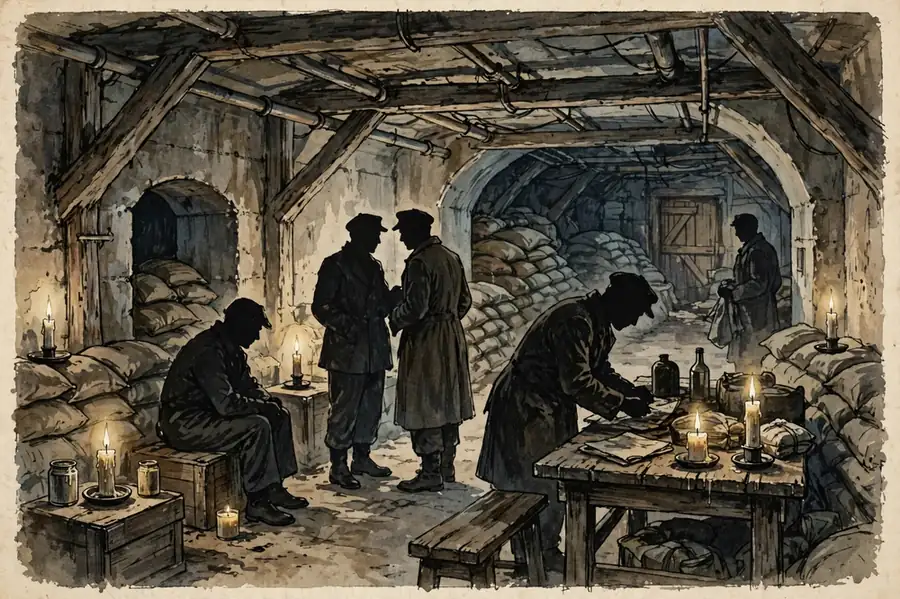
The preparations for the uprising were made in secret, in the three months between January and April 1943. The fighters built bunkers — underground shelters, some of them large enough to hold hundreds of people, with food, water, weapons and medical supplies — in the courtyards and cellars of the ghetto, and they dug tunnels and prepared the sewers as escape routes.
They collected weapons wherever they could: pistols and rifles bought from the Polish underground, grenades made in the ghetto’s workshops, Molotov cocktails, and a small number of machine guns. The weapons were few and poor — the fighters had, by most accounts, only a handful of rifles for every ten fighters, and many fought with pistols and grenades alone — but they were enough to fight a guerrilla war in the streets and the buildings of the ghetto.
The fighters also prepared the ghetto’s inhabitants: they told them to hide in the bunkers, not to report for deportation, and to resist if the Germans came for them. The preparations were known to the Germans, who had informers in the ghetto, but the Germans did not know how many bunkers there were, or how determined the fighters were.
The debate in the ghetto
The decision to resist was debated fiercely in the ghetto, and not everyone agreed with it. The Jewish Council, the leaders of the workshops, and many ordinary inhabitants argued that resistance would bring German reprisals and the destruction of the remnant, and that the best hope was to survive by working for the Germans, as the workshops had done.
The fighters argued that the workshops would not save anyone — the Germans had already shown, in the Grossaktion, that they would deport the workers when it suited them — and that the only honourable choice was to fight. The debate was not only about tactics but about the meaning of Jewish life and death: was it better to die fighting, or to live a little longer in the hope of survival?
The fighters chose to fight, and their choice has been debated ever since, but the fact of their choice — that young people, with almost no weapons and no hope of victory, chose to fight an army — is the reason the uprising is remembered.
The debate continues in Israel and in Poland, where the uprising is taught as a lesson in the dignity of resistance, and where the question of whether the fighters were right is still asked.
6. The Uprising
The first days
On the morning of 19 April 1943, German forces entered the ghetto to begin the final liquidation. They were met, at the corner of Zamenhofa and Miła Streets, by ŻOB fighters who opened fire from the windows and the rooftops, and by ŻZW fighters at Muranowska Square, who fought from fortified positions and flew the Polish and Jewish flags — the first time, it is said, that the Jewish flag had been flown in battle.
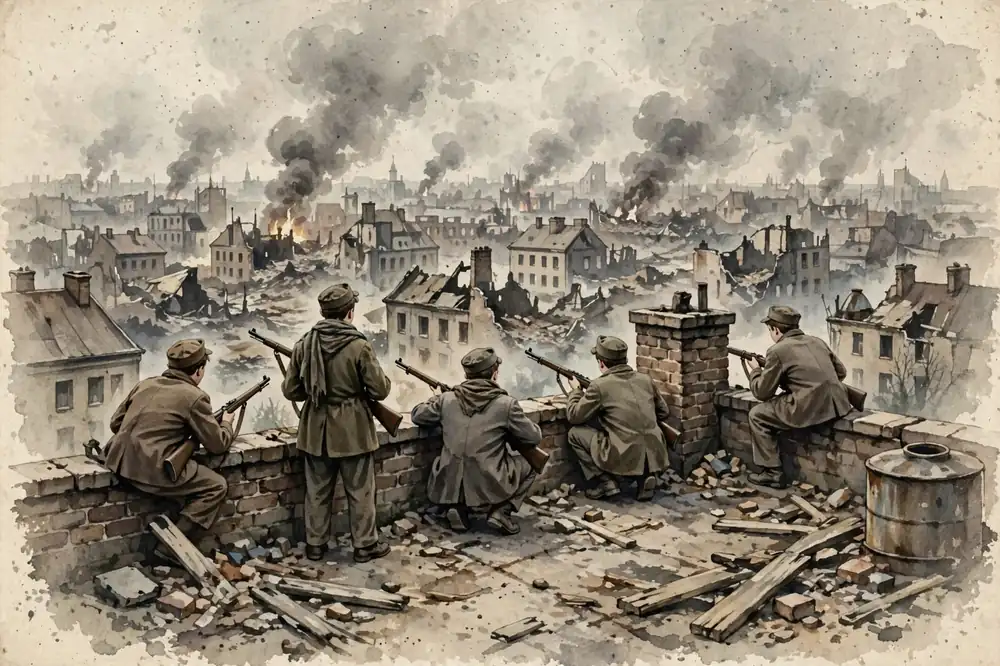
The Germans, taken by surprise, withdrew, and the first day of the uprising was a Jewish victory: the deportation was halted, the Germans suffered casualties, and the ghetto’s inhabitants, who had been hiding in the bunkers, came out to celebrate. The fighting continued for the next three days, with the ŻOB and the ŻZW holding their positions and the Germans unable to advance.
The German commander on the spot, SS-Oberführer Ferdinand von Sammern-Frankenegg, was relieved of his command for his failure, and he was replaced by SS-Brigadeführer Jürgen Stroop, who had been brought in to crush the uprising. Stroop’s arrival marked a change in German tactics: from an attempt to deport the ghetto’s inhabitants, to a decision to destroy the ghetto itself.
Street fighting
The street fighting lasted for about a week, from 19 to about 26 April, and it was the phase of the uprising in which the fighters had their greatest successes. The ŻOB and the ŻZW fought from buildings, from rooftops and from bunkers, using rifles, pistols, grenades and Molotov cocktails, and they inflicted casualties on the Germans, who had to advance street by street, under fire, against an enemy they could not see.
The Germans used tanks and artillery, but the tanks were vulnerable in the narrow streets, and several were destroyed by Molotov cocktails and by mines. The Polish underground, the Home Army, tried to help from outside the ghetto, with a small attack on the ghetto wall and with the supply of a few weapons, but the help was limited, and the fighters were, for the most part, on their own.
The street fighting ended when the Germans changed their tactics: they stopped trying to take the ghetto street by street, and they began to burn it down, building by building, with flamethrowers and with artillery, and to force the inhabitants out of the bunkers with gas and with fire.
The burning of the ghetto
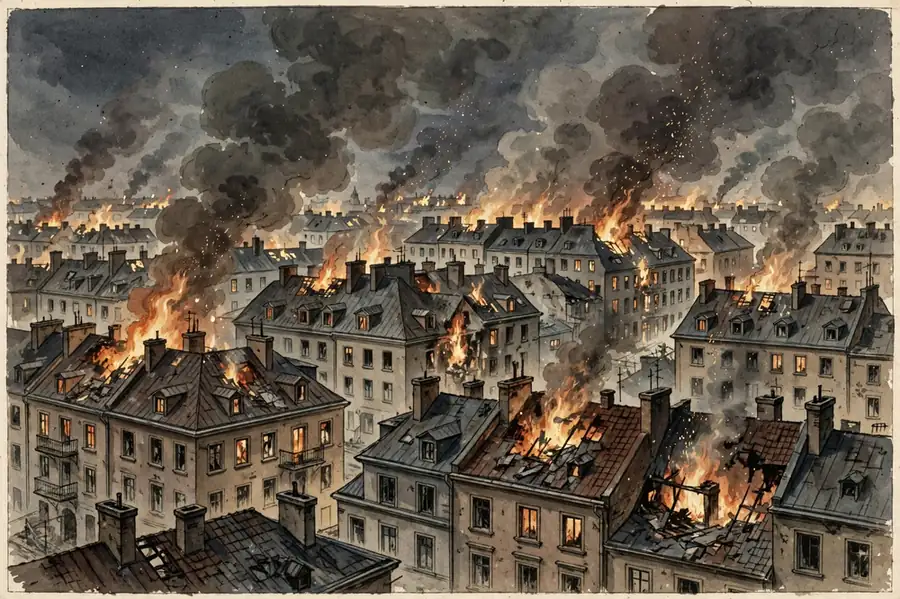
From about 26 April, the uprising became a fight for survival in the bunkers, as the Germans systematically burned the ghetto to the ground. Stroop’s method was to set fire to each building, to wait for its inhabitants to flee the flames, and to shoot them as they emerged, or to capture them and send them to the Umschlagplatz for deportation.
The bunkers, which had been built as shelters, became traps: the Germans pumped gas into them, flooded them, or blew them up, and the people inside died of suffocation, of fire, or of the explosions. The most famous bunker was at Miła 18, the headquarters of the ŻOB, where Mordechai Anielewicz and his comrades were surrounded on 8 May 1943.
Rather than surrender, they killed themselves, with their own weapons, and Anielewicz died at the age of twenty-four. The burning of the ghetto continued for three weeks, and by the middle of May the ghetto was a ruin: its buildings were destroyed, its streets were empty, and its inhabitants were dead, captured, or hidden in the sewers and the ruins.
7. The Destruction of the Ghetto
The final days
The uprising ended on 16 May 1943, when Stroop blew up the Great Synagogue of Warsaw, on Tłomackie Street, in a symbolic act that marked the destruction of the ghetto and of Jewish Warsaw. Stroop reported to his superiors that the operation was complete, and his report — the Stroop Report, with its photographs and its figures — is one of the most chilling documents of the Holocaust.
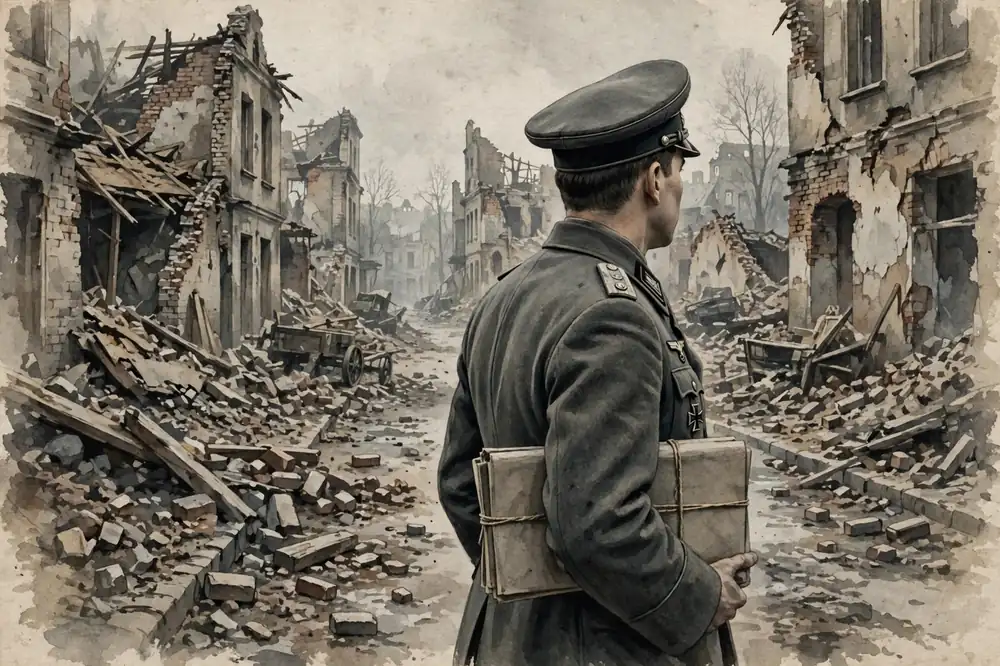
In it, Stroop reported that 56,065 Jews had been captured or killed during the operation, a figure that includes the people killed in the fighting, the people captured and deported, and the people killed in the ghetto itself. Historians have used the Stroop Report as a source, but they have also warned that its figures are those of the perpetrator, and that they must be treated with caution.
The most commonly cited figure for the Jews killed during the uprising itself is about 13,000, and the rest of the 56,065 were deported to Treblinka and Majdanek, where most of them were murdered. The ghetto itself was razed: its buildings were demolished, its streets were torn up, and the area was turned into a park and a concentration camp, so that nothing would remain of Jewish Warsaw.
The Stroop Report / Báo cáo Stroop
The Stroop Report is a bound volume, prepared by Stroop for his superiors, with a title page, a daily account of the operation, and photographs of the burning ghetto, the captured Jews, and the destroyed synagogue. It is a document of the perpetrator’s pride: Stroop presents the destruction of the ghetto as a military achievement, and he lists, with bureaucratic precision, the numbers of Jews captured, killed and deported, and the numbers of German casualties.
The report’s most famous line is its conclusion, in which Stroop writes that the Jewish quarter of Warsaw no longer exists. The report survived the war, and it was used as evidence at the Nuremberg trials and at Stroop’s own trial in Warsaw.
It is now one of the most important sources for the history of the uprising, and one of the most disturbing: it shows the murder of a community presented as an administrative success, with photographs, tables and a neat binding.
The report’s figures — 56,065 captured or killed, 16 Germans killed and 85 wounded — are the figures most often quoted, but historians have noted that the German casualty figures are almost certainly too low, and that the true German losses were probably higher, although no reliable higher figure exists.
The survivors
Only a small number of the ghetto’s inhabitants survived the uprising. Some escaped through the sewers, with the help of the Polish underground, and joined the partisans in the forests outside Warsaw. Some hid in the ruins of the ghetto, or in the “Aryan” side of Warsaw, with the help of Polish families who risked their lives to hide them.
Some were deported to Treblinka and Majdanek, and a small number survived those camps, or were transferred to labour camps and survived the war. The best-known survivor of the uprising was Marek Edelman, a commander of the ŻOB, who escaped through the sewers and survived the war, and who became a cardiologist in Łódź and a spokesman for the memory of the uprising, until his death in 2009, at the age of ninety.
Edelman was the last surviving commander of the uprising, and his testimony — in his book, The Ghetto Fights, and in his interviews — is one of the most important sources for the history of the uprising. The survivors’ stories are stories of luck, of help, and of endurance, and they are a reminder that the uprising, for all its heroism, was a tragedy for the people who lived through it.
8. Aftermath and Justice
Stroop’s trial
The trial in Warsaw
Jürgen Stroop was captured by the Americans after the war, extradited to Poland, and tried in Warsaw in 1951 for his crimes in the ghetto and elsewhere. The trial was held in the rebuilt Warsaw, in a city that was still in ruins, and it was attended by survivors of the uprising and by the families of the dead.
Stroop was convicted and sentenced to death, and he was executed in Warsaw on 6 March 1952. His trial was one of the most important war crimes trials in Poland, and it was the occasion on which the Stroop Report was presented as evidence, and on which the survivors gave their testimony.
Stroop showed no remorse at his trial, and he maintained that he had only carried out his orders, a defence that the court rejected. His execution, in the city where he had destroyed the ghetto, was seen in Poland as a fitting end to the man who had destroyed Jewish Warsaw.
The Nuremberg trials and the Stroop Report
The Stroop Report was also used as evidence at the Nuremberg trials, where it was presented as proof of the systematic murder of the Jews. The report’s photographs — of the burning ghetto, of the Jews being led to the Umschlagplatz, of the destroyed synagogue — were shown in the courtroom, and they became some of the most famous images of the Holocaust.
The Nuremberg trials did not try Stroop himself — he was tried in Poland — but they tried the men who had ordered the destruction of the ghetto, and the report was part of the evidence against them. The use of the report at Nuremberg is a reminder that the uprising was not only a Polish event but a part of the larger history of the Holocaust, and that its documentation, by the perpetrator himself, is one of the reasons it is so well known.
The report is now held in the archives in Warsaw and in Washington, and it is available to researchers and to the public.
The Warsaw Uprising of 1944
The Warsaw Ghetto Uprising of 1943 should not be confused with the Warsaw Uprising of 1944, a different and larger event. In August 1944, the Polish Home Army rose against the German occupation of Warsaw, in an attempt to liberate the city before the arrival of the Soviet army.
The 1944 uprising lasted for 63 days, involved tens of thousands of fighters, and ended in the destruction of Warsaw and the deaths of about 200,000 civilians, by the most commonly cited estimates. The two uprisings are linked — the ghetto uprising of 1943 was a part of the history of resistance in Warsaw, and the Home Army’s uprising of 1944 was inspired, in part, by the example of the ghetto fighters — but they were different in scale, in purpose, and in outcome.
The ghetto uprising was a revolt of a doomed community, fighting for honour and for the right to choose how to die; the 1944 uprising was an attempt to liberate a city, and it failed. Both are remembered in Warsaw, and both are commemorated on the same ground, in the city that was destroyed twice in two years.
The rebuilding of Warsaw
After the war, Warsaw was rebuilt, and the site of the ghetto was rebuilt with it. The area where the ghetto had stood was redeveloped, with new streets, new buildings, and a new monument, and the city that rose from the ruins was a different city from the one that had been destroyed.
The rebuilding was a deliberate act of the Polish government, which wanted to show that Warsaw had survived, and that Poland had survived, but it also meant that the physical traces of the ghetto were largely erased: the streets were renamed, the buildings were new, and only the monument and the museum mark the place where the ghetto stood.
The rebuilding is a reminder that memory is not only a matter of preserving places but of marking them, and that the monument and the museum are the markers that keep the memory of the ghetto alive in a city that has been rebuilt.
9. Memory and the Monument
The Monument to the Ghetto Heroes
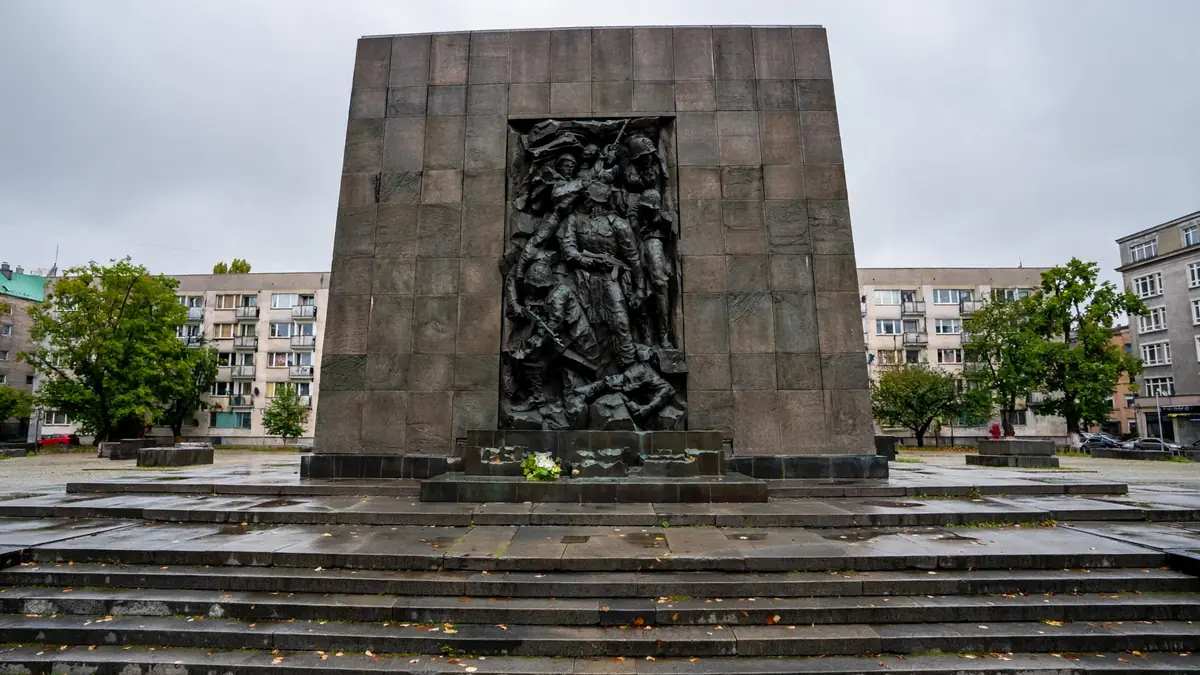
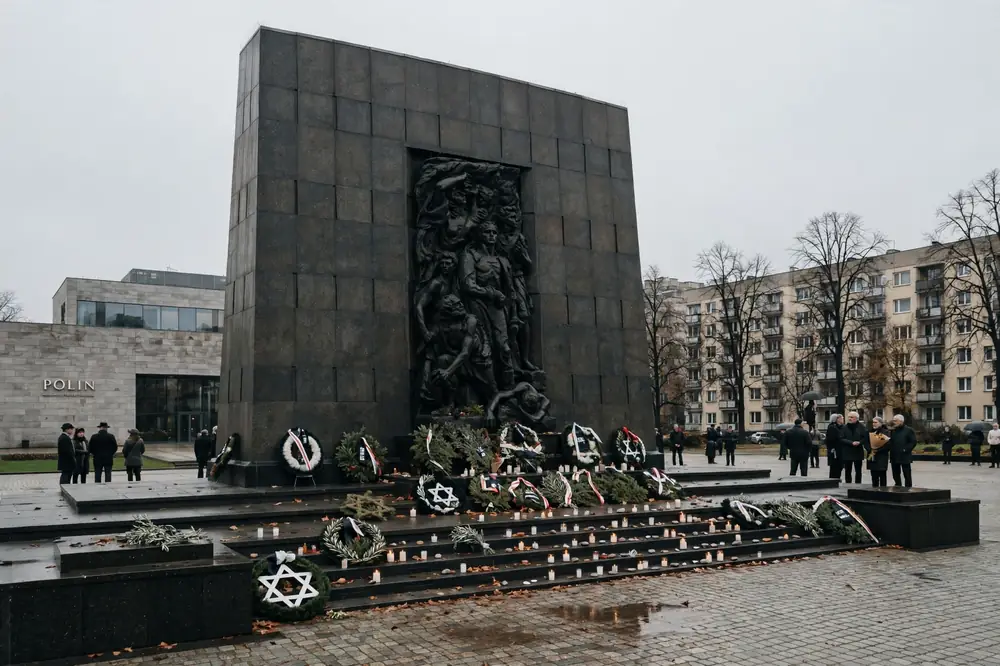
The Monument to the Ghetto Heroes, by the sculptor Nathan Rapoport, was unveiled on 19 April 1948, the fifth anniversary of the uprising, on the site of the ghetto, at the corner of Zamenhofa and Anielewicza Streets. The monument is a great block of stone, with a bronze relief on one side showing the fighters of the uprising — men and women with rifles, grenades and Molotov cocktails — and, on the other side, a relief showing the deportation of the ghetto’s inhabitants to Treblinka.
The stone for the monument was brought from Sweden, and it was chosen because it was the stone that the Germans had ordered for a monument to Hitler’s victory — a fact that Rapoport and the monument’s builders were proud of.
The monument is the central place of remembrance for the uprising, and it is the place where the annual ceremonies are held, on 19 April, the anniversary of the uprising, and where the leaders of Poland and of Israel lay wreaths. The monument’s inscription, in Polish, Yiddish and Hebrew, reads: “The Jewish people to its fighters and martyrs.”
The POLIN Museum
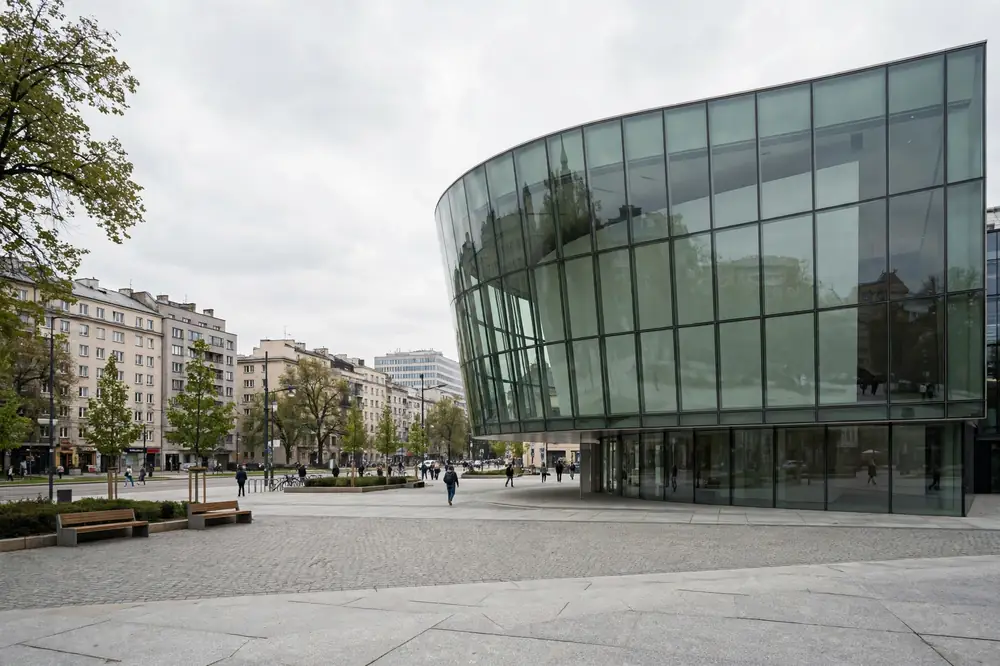
In 2013, the POLIN Museum of the History of Polish Jews opened on the same square as the Monument to the Ghetto Heroes, in a building designed by the Finnish architect Rainer Mahlamäki. The museum tells the thousand-year history of Jews in Poland, from their arrival in the Middle Ages to the present day, and the uprising is one part of that history, told in the museum’s Holocaust gallery.
The museum’s name, POLIN, is the Hebrew word for Poland, and it is also, according to legend, the word that the first Jews heard when they arrived in Poland — “polin”, meaning “rest here”. The museum has become one of the most visited museums in Poland, and it is a place where the history of Polish Jews is told not only as a history of persecution but as a history of a rich and creative civilisation.
The museum’s location, facing the monument, is deliberate: the visitor who comes to the monument to remember the uprising can go into the museum to learn the history of the people who fought it.
Willy Brandt’s kneeling
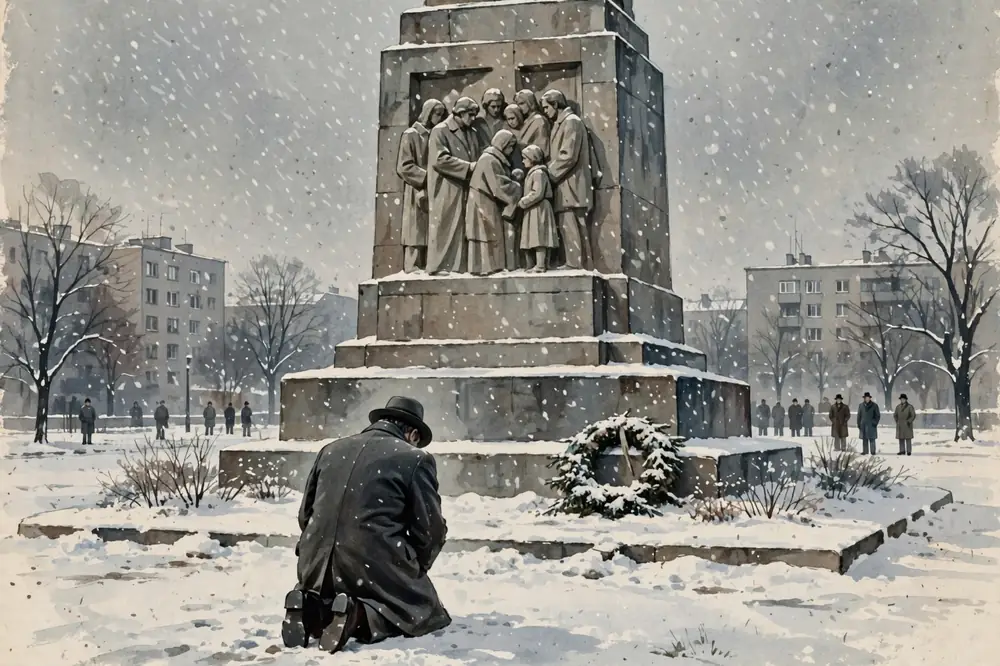
One of the most famous moments in the memory of the uprising took place on 7 December 1970, when Willy Brandt, the Chancellor of West Germany, visited the Monument to the Ghetto Heroes during a state visit to Poland, and, without warning, knelt before the monument in silence.
The gesture — the Kniefall von Warschau, the Warsaw Genuflection — was spontaneous, and it was not in the programme of the visit, but it became one of the most famous images of post-war Europe: a German chancellor kneeling before the monument to the Jews his country had murdered, in an act of atonement.
The gesture was controversial in Germany, where some criticised it as humiliating, but it was welcomed in Poland and in Israel, and it is now remembered as a turning point in Germany’s relationship with its past. The kneeling is commemorated at the site by a plaque, and it is taught in German schools as an example of how a country can acknowledge its crimes.
Brandt himself said little about the gesture afterwards, except that he had done what people do when words fail them.
10. Legacy
The legacy of the Warsaw Ghetto Uprising is, first, a symbol: the uprising has become the symbol of Jewish resistance during the Holocaust, and its fighters — young people with almost no weapons, who chose to fight rather than to die passively — are remembered as heroes in Israel, in Poland and in the world.
Second, it is a lesson: the uprising showed that resistance was possible, even in the most hopeless circumstances, and it inspired other revolts, at Treblinka in August 1943, at Sobibor in October 1943, and at Auschwitz in October 1944. Third, it is a warning: the uprising did not save the ghetto, and it did not stop the murder, and its memory is a reminder that resistance, however heroic, cannot by itself defeat a system of murder — that what is needed is not only the courage of the victims but the action of the world.
The uprising is remembered, above all, for the choice its fighters made: to die fighting, rather than to die without a fight, and that choice, which was made by young people in a doomed ghetto, continues to speak to every generation that learns about it.
The uprising in Israel and the world
In Israel, the Warsaw Ghetto Uprising is remembered as a founding event of the state, and its anniversary, 19 April, is marked by ceremonies and by education. The uprising is taught in Israeli schools as an example of Jewish heroism, and its fighters are honoured in the streets and squares named after them, and in the kibbutzim founded by survivors.
In the world, the uprising is remembered through the books, films and plays that have told its story, and through the monument in Warsaw, which is visited by Jews and non-Jews from around the world. The uprising’s memory is not confined to one country or one people: it is a part of the shared memory of the Second World War, and of the shared understanding that the victims of the Holocaust were not only victims but also fighters, and that their fight deserves to be remembered alongside their suffering.
The uprising’s place in that shared memory is secure, and it will remain so for as long as the monument stands in Warsaw and the story is told.
Why the uprising still matters
The Warsaw Ghetto Uprising still matters because the questions it raises have not gone away. The question of resistance — when to fight, when to survive, and what the cost of each choice is — is a question that every generation must answer for itself, and the uprising is the case that is most often cited in that debate.
The question of memory — how to remember the victims as fighters as well as victims — is a question that shapes how the Holocaust is taught, and the uprising is the example that is most often given. And the question of the world — what the world knew, what it did, and what it failed to do — is a question that the uprising forces us to ask, because the fighters of the ghetto fought alone, with almost no help from the outside, and their isolation is a reproach to the world that watched.
As long as those questions matter, the uprising will matter, and the monument in Warsaw will continue to be visited, by Jews and by non-Jews, by Poles and by Israelis, and by all those who come to stand where the ghetto stood and to remember the young people who fought there.
Frequently Asked Questions
When was the Warsaw Ghetto Uprising?
The uprising began on 19 April 1943 and ended on 16 May 1943, lasting 28 days.
How many fighters took part?
About 750 Jewish fighters took part, in the Jewish Combat Organisation (ŻOB) and the Jewish Military Union (ŻZW), against a German force of more than 2,000 men.
How many Jews were killed in the uprising?
About 13,000 Jews were killed during the uprising, by the most commonly cited estimates. Stroop reported that 56,065 Jews were captured or killed in total, including those deported to Treblinka and Majdanek.
Who led the uprising?
The Jewish Combat Organisation was led by Mordechai Anielewicz, aged 24. He died on 8 May 1943, in the bunker at Miła 18, rather than surrender.
What happened to the survivors?
Most survivors were deported to Treblinka and Majdanek, where they were murdered. A small number escaped through the sewers or hid in Warsaw. Marek Edelman, a ŻOB commander, survived and died in 2009.
Where is the uprising commemorated?
At the Monument to the Ghetto Heroes in Warsaw, unveiled in 1948, and at the POLIN Museum of the History of Polish Jews, opened in 2013 on the same square.
Related articles
Sources
- Emanuel Ringelblum, Notes from the Warsaw Ghetto (McGraw-Hill, 1958) — the Oyneg Shabbos archive and daily life in the ghetto.
- Marek Edelman, The Ghetto Fights (Bookmarks, 1990) — the testimony of a ŻOB commander and survivor of the uprising.
- Jürgen Stroop, The Stroop Report (1943) — the German commander’s report, with its figures of 56,065 captured or killed and 16 Germans killed.
- United States Holocaust Memorial Museum, Holocaust Encyclopedia, “Warsaw Ghetto Uprising” (encyclopedia.ushmm.org) — the chronology, the fighters, and the casualty estimates.
- Wikipedia, “Warsaw Ghetto Uprising” — the ghetto, the Grossaktion, the uprising and the aftermath.
- Yad Vashem, “The Warsaw Ghetto Uprising” (yadvashem.org) — the uprising, the fighters and the memory in Israel.
- Israel Gutman, Resistance: The Warsaw Ghetto Uprising (Houghton Mifflin, 1994) — the standard scholarly history of the uprising.