 WAR ATLAS MILITARY HISTORY MAGAZINE · WWI — WWII
Heinz Guderian
1. Lead
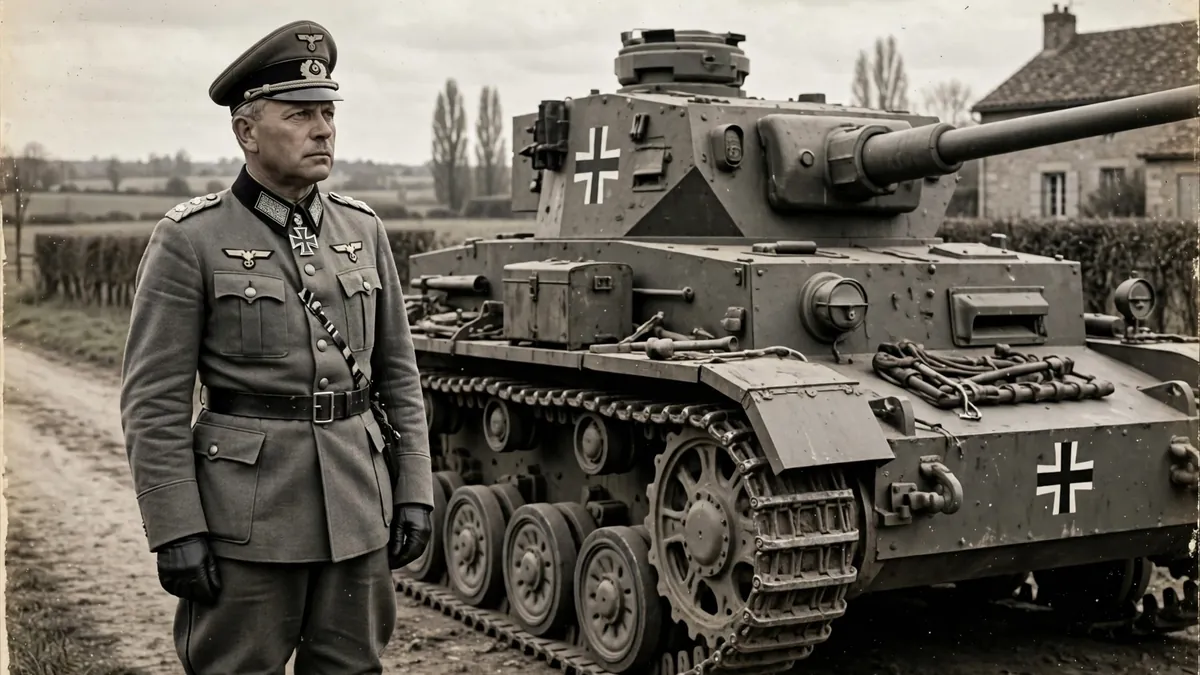
Heinz Guderian (17 June 1888 – 14 May 1954) was a German general and the most influential theorist of armoured warfare in the Second World War. Born in Kulm in West Prussia, the son of a Prussian officer, he rose through the small Reichswehr of the Weimar Republic to become the chief advocate of the tank as an independent weapon of decision. His book Achtung – Panzer!, published in 1937, argued that tanks should be concentrated in armoured divisions, supported by motorised infantry, artillery and close air support, and used to break through enemy lines and drive deep into the rear — the doctrine that became known in the English-speaking world as Blitzkrieg. In 1939 and 1940 he put that doctrine into practice, commanding the XIX Army Corps in Poland and France, where his Panzer columns advanced faster and further than any army had moved before, reaching the English Channel at Abbeville in May 1940 and helping to encircle the Allied armies in Belgium and northern France.
Guderian’s career in the war against the Soviet Union made him both famous and controversial. In 1941 he commanded Panzer Group 2 in Operation Barbarossa, leading the advance to Smolensk and the great encirclement at Kiev, the largest encirclement battle in history, in which German sources claimed more than 600,000 prisoners taken. His insistence on driving on Moscow, and his open quarrel with Adolf Hitler over the diversion of his Panzers to the south in August 1941, ended in his dismissal in December 1941 after the failure of the advance on Moscow. Recalled in 1943 as Inspector-General of Armoured Troops, he rebuilt Germany’s Panzer forces, and in July 1944, after the attempt on Hitler’s life, he became Chief of the General Staff of the Army, a post he held until his dismissal in March 1945. He was never tried as a war criminal, and his memoirs, Panzer Leader, published in 1952, shaped the Western image of the German army in the Second World War — an image that historians have since examined with far more scepticism than Guderian’s admirers once allowed.
2. Key Facts
| Born | 17 June 1888, Kulm, West Prussia, German Empire (now Chełmno, Poland) |
| Died | 14 May 1954 (aged 65), Schwangau, West Germany |
| Nationality | German |
| Role / Office | Generaloberst (Colonel General); commander of Panzer Group 2 / 2nd Panzer Army (1941); Inspector-General of Armoured Troops (1943–1944); Chief of the General Staff of the Army (1944–1945) |
| Known for | Achtung – Panzer! (1937); the theory and practice of Blitzkrieg; the Panzer advances in Poland (1939), France (1940) and the Soviet Union (1941); the encirclement at Kiev (1941) |
| Spouse / Family | Margarete Goerne (married 1913, died 1970); two sons, Heinz Günther Guderian and Kurt Guderian, both later generals in the Bundeswehr |
| Military rank | Generaloberst (Colonel General) |
3. Early Life and Education
Family and Childhood
Heinz Wilhelm Guderian was born on 17 June 1888 in Kulm, a garrison town in West Prussia on the River Vistula, into a family in which military service was a settled tradition. His father, Friedrich Guderian, was a Prussian officer who later rose to the rank of lieutenant general, and the household in which Heinz grew up was disciplined, Protestant and steeped in the values of the Prussian officer corps: duty, obedience, self-control and a belief that the army was the first servant of the state. The family moved with his father’s postings, and Heinz spent his childhood in garrison towns in the eastern provinces of the German Empire, a world of barracks, parades and regimental tradition that left him with a lifelong attachment to the army as an institution. He was not a brilliant schoolboy, and his own account of his youth stresses effort and application rather than talent; the qualities that later marked him — energy, stubbornness, a quick grasp of technical detail and a willingness to quarrel with his superiors — were already visible in the young cadet who entered the military school at Gross-Lichterfelde near Berlin in 1907.
The Prussian Officer Corps
The Prussian officer corps into which Guderian was born was one of the most professional military institutions in Europe, and it shaped him in ways that remained visible throughout his career. Its officers were trained to think in terms of movement, initiative and the offensive, and the General Staff system created by Helmuth von Moltke the Elder had taught generations of German officers that a war should be won quickly, by encirclement and manoeuvre, before the enemy could mobilise its full strength. At the same time, the corps was socially narrow and politically conservative, suspicious of democracy and of civilian control, and Guderian absorbed both its strengths and its weaknesses. He learned to plan carefully, to value speed and surprise, and to trust the judgement of the commander on the spot; he also learned to regard politicians, and above all the politicians of the Weimar Republic, with contempt, a habit that would later make it easy for him to serve a dictator who promised to restore the army’s standing.
Education and First Service
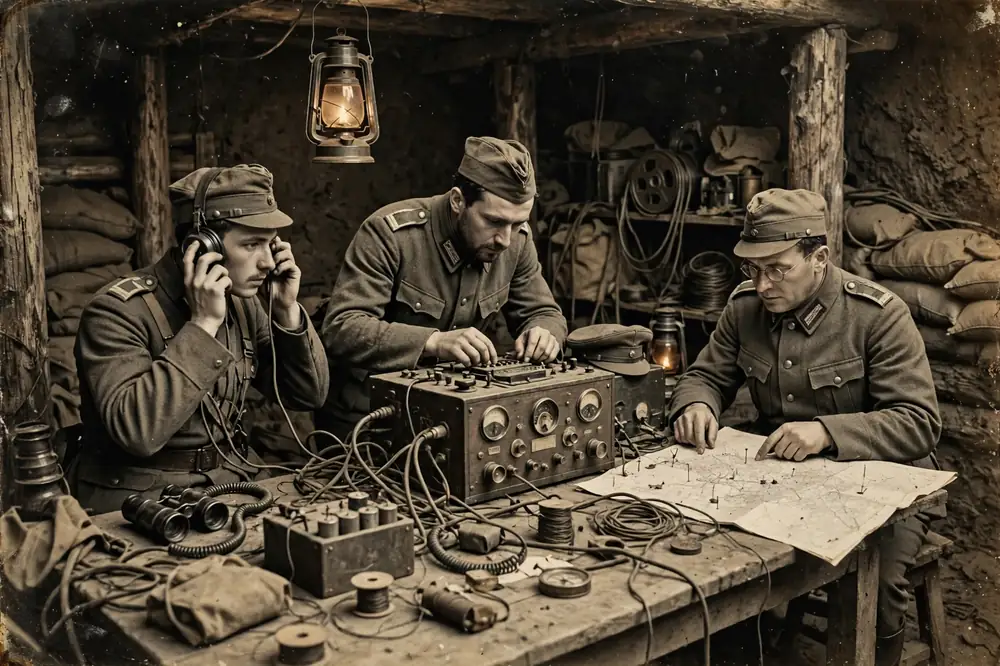
Guderian was commissioned as a second lieutenant in the 10th Hanoverian Jäger Battalion in February 1908, a light infantry unit in which he learned the practical business of leading soldiers in the field. His early service was conventional enough: regimental duty, staff courses and, from 1912, a posting to the 3rd Telegraph Battalion, where he first encountered the new technology of radio communications, a subject that would become central to his later thinking about armoured warfare. When the First World War broke out in August 1914 he was serving as a signals officer, and he spent the war largely on the staffs of divisions and corps on the Western Front, with periods at the front that gave him direct experience of the deadlock of trench warfare. He saw at first hand how the combination of the machine gun, barbed wire and massed artillery had made the offensive almost impossible, and he watched the first British tanks lumber across the battlefield at the Somme in 1916 and at Cambrai in 1917. Those early tanks were slow, unreliable and used in small numbers, but Guderian drew from them a different lesson from most of his contemporaries: the problem was not the tank itself, but the way it was used, dispersed in penny packets to support infantry instead of concentrated for a decisive blow.
4. Rise to Prominence
The Reichswehr Years
After the defeat of 1918, Guderian was one of the 4,000 officers permitted to remain in the Reichswehr, the 100,000-man army allowed to Germany by the Treaty of Versailles. The treaty forbade Germany to possess tanks, but the Reichswehr, under General Hans von Seeckt, evaded the restriction by studying armoured warfare in theory, by using dummy tanks made of wood and canvas in exercises, and by cooperating secretly with the Soviet Union at the tank school at Kazan. Guderian was assigned to the transport branch in 1922, which gave him responsibility for motorisation, and he became the army’s leading expert on the new weapon. He read the British theorists J. F. C. Fuller and Basil Liddell Hart, who had argued for the concentration of tanks, and he studied the German staff officer Ernst Volckheim’s writings on the tank battles of the First World War. By the end of the 1920s he was convinced that the tank, combined with motorised infantry, mobile artillery and aircraft, could restore movement to the battlefield, and he pressed his case in lectures, articles and staff papers with a persistence that won him both admirers and enemies in the War Ministry.
Achtung – Panzer! and the Panzer Divisions
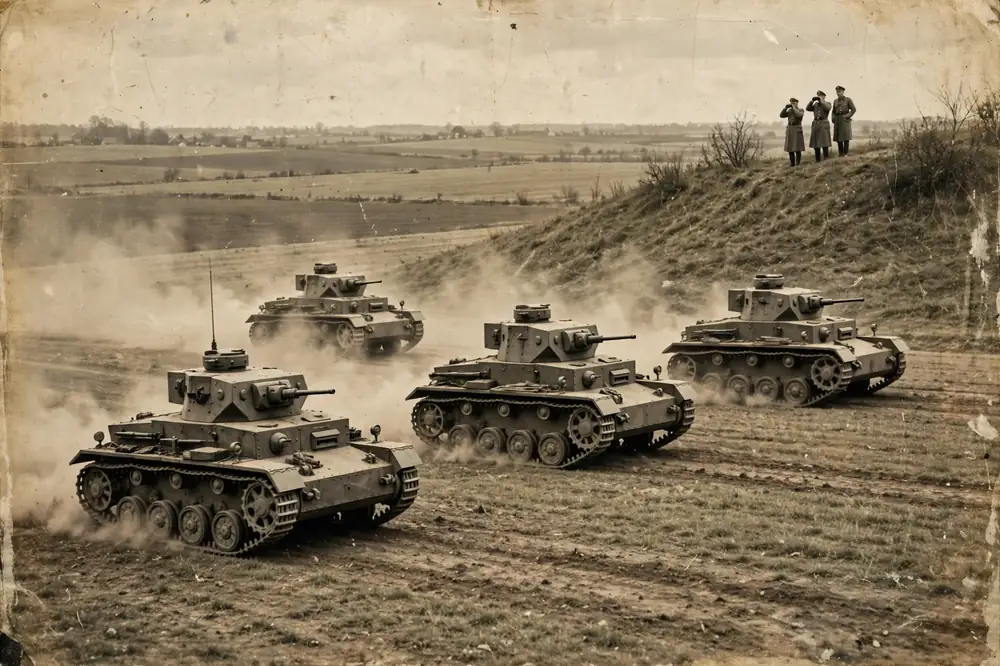
Guderian’s moment came with the coming to power of the National Socialists in 1933 and the open rearmament of Germany. Hitler, who shared his enthusiasm for speed and the offensive, gave him the chance to build the weapon he had imagined. In 1935 Guderian became chief of staff of the new Panzer Troops Command, and the first three Panzer divisions were formed, each built around a tank brigade, supported by a motorised infantry brigade, artillery and reconnaissance units, and — crucially — equipped with radios in every tank, so that a commander could control his division while it was moving. In 1937 he published Achtung – Panzer!, a popular exposition of his ideas that became his most famous book, arguing that the Panzer division, used in mass and directed at a single point, could break through a front and exploit into the enemy’s rear, where it would destroy headquarters, supply columns and artillery before the enemy could react. In 1938 he was promoted to lieutenant general and given command of the XVI Army Corps, a motorised corps, and in the same year he took part in the occupation of Austria and the Sudetenland, operations that exposed serious weaknesses in the new Panzer divisions but also gave him the political standing to demand more and better tanks.
5. Heinz Guderian’s Role in World War II
Poland and France, 1939–1940
In September 1939 Guderian commanded the XIX Army Corps in the invasion of Poland, leading his Panzer divisions across the Polish Corridor to the Vistula and then eastwards to Brest-Litovsk, where on 22 September his troops met the advancing Soviet forces and held a joint victory parade with them — a moment that captured the uneasy alliance created by the Nazi-Soviet Pact. The Polish campaign confirmed the value of the Panzer division, but it also showed that the German tanks were thinly armoured and that supply and maintenance were fragile. In May 1940, in the campaign in France, Guderian commanded the same corps in the decisive operation of the war in the West: the crossing of the Meuse at Sedan on 13 May, the breakthrough through the French defences, and the drive to the Channel coast, which he reached at Abbeville on 20 May. He advanced against the orders of his superiors, who feared that his exposed flanks would be cut off, and he was twice ordered to halt; on both occasions he argued, and on one occasion he resigned his command in protest before being reinstated. The advance cut off the Allied armies in Belgium, and although the halt order of 24 May allowed the British Expeditionary Force to escape at Dunkirk, the campaign ended in the fall of France in June 1940 and made Guderian, in the eyes of the German public, the hero of the new kind of war.
The Crossing of the Meuse at Sedan
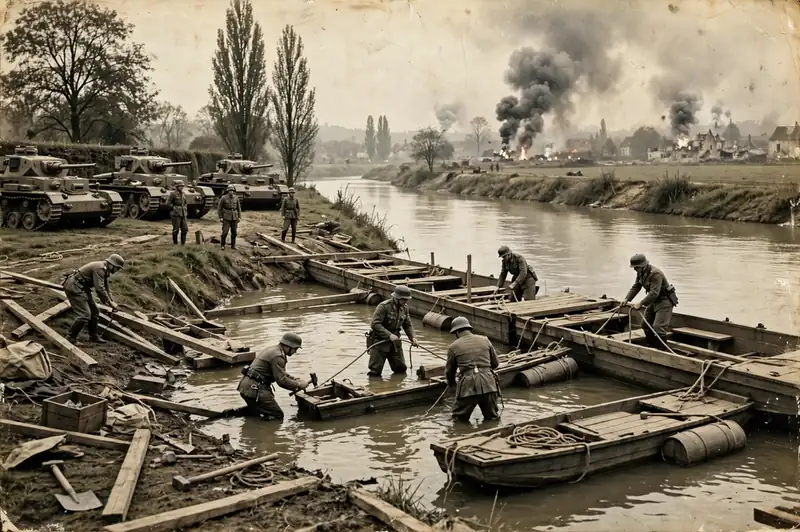
The crossing of the Meuse at Sedan on 13 May 1940 was the single most important tactical operation of Guderian’s career, and it deserves to be described in detail because it shows his doctrine in action. The French had regarded the Ardennes as impassable to tanks and the Meuse as a strong defensive line, and they had left the sector at Sedan held by second-rate reserve divisions. Guderian concentrated his three Panzer divisions on a narrow front, massed his artillery and the dive-bombers of the Luftwaffe against the French positions, and crossed the river on the first day with infantry in rubber boats, followed by tanks on pontoon bridges built under fire. Within two days his corps had broken through, and he refused to wait for the infantry to catch up, driving westwards with his tanks and leaving his flanks to be protected by the motorised divisions following behind. The operation worked because of the radio in every tank, the close cooperation with the Luftwaffe, and Guderian’s willingness to accept risk; it also worked because the French command, slow and centralised, could not react quickly enough to a breakthrough that moved faster than its orders could travel.
The Invasion of the Soviet Union, 1941
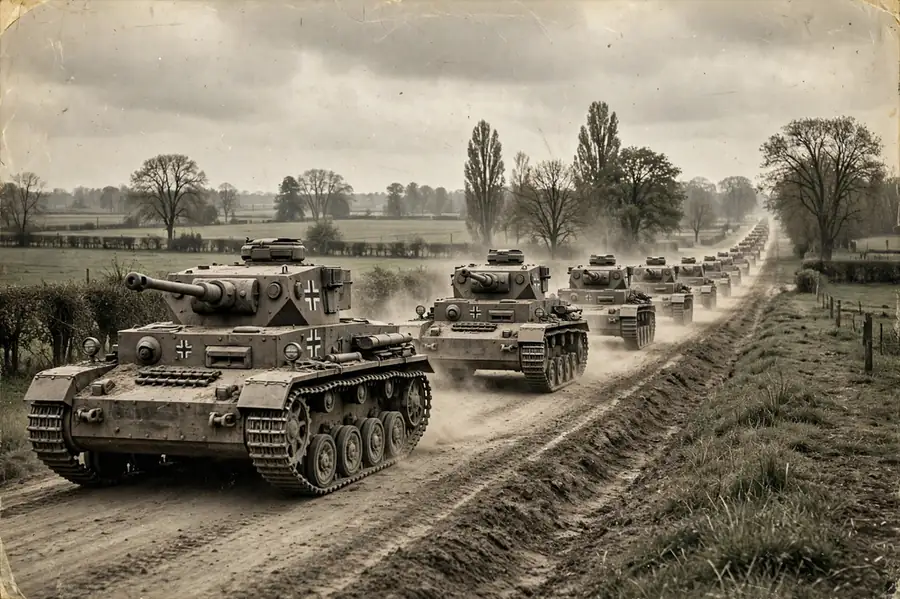
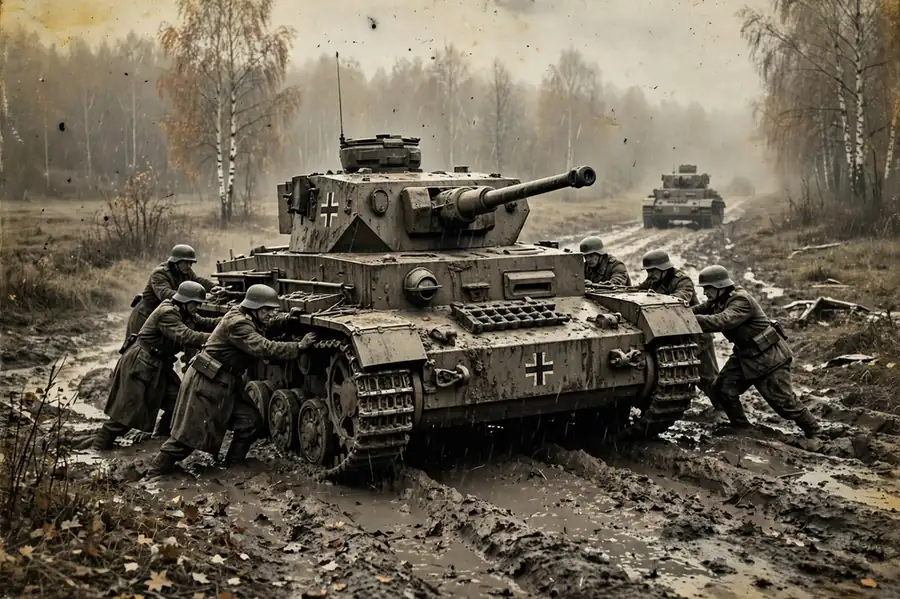
In June 1941 Guderian commanded Panzer Group 2, the southern pincer of Army Group Centre, in Operation Barbarossa, the invasion of the Soviet Union. His tanks advanced more than 300 kilometres in the first week, encircled Soviet armies at Minsk and then at Smolensk, and by the end of July had reached the Dnieper. In August Hitler ordered the Panzer group to turn south to encircle the Soviet armies at Kiev, a decision Guderian opposed because he believed that Moscow, the political and communications centre of the Soviet Union, should be the objective. He flew to Hitler’s headquarters to argue his case in person, and he failed; the turn south produced the encirclement at Kiev in September 1941, in which German sources claimed more than 600,000 Soviet prisoners, the largest encirclement in military history. Guderian then turned his exhausted divisions north again for the advance on Moscow, Operation Typhoon, but the autumn rains turned the roads to mud, the tanks broke down, and in December the Soviet counter-offensive before Moscow drove his forces back. On 26 December 1941 Hitler dismissed him, ostensibly for ordering a withdrawal against orders, but in reality because the advance on Moscow had failed and Hitler needed a scapegoat for the first great German defeat of the war.
Inspector-General and Chief of Staff, 1943–1945
After more than a year without a command, Guderian was recalled in March 1943 as Inspector-General of Armoured Troops, with responsibility for rebuilding the Panzer forces after the disaster at Stalingrad. He increased tank production, reorganised the Panzer divisions, introduced the Panther and Tiger tanks in larger numbers, and fought a bureaucratic war with the SS and with Albert Speer’s armaments ministry over the allocation of resources. His efforts could not reverse the strategic situation: Germany was now fighting a defensive war against enemies with overwhelming superiority in men and material, and the Panzer divisions he rebuilt were spent in costly counter-attacks on the Eastern Front and in Normandy. On 21 July 1944, the day after the attempt on Hitler’s life by Claus von Stauffenberg, Guderian was appointed Chief of the General Staff of the Army. In that post he was responsible for the Eastern Front during the Soviet offensives of 1944 and 1945, and he repeatedly quarrelled with Hitler over the need to withdraw troops from Courland and from other encircled positions to defend Germany itself. Hitler dismissed him for the last time on 28 March 1945, a few weeks before the fall of Berlin, and Guderian spent the last weeks of the war in a hospital, suffering from a heart condition.
6. Key Decisions
Decisions in Command
Concentrating the tanks (1935–1937). Guderian’s decision to build Panzer divisions around a tank brigade, rather than dispersing tanks to support infantry, was the foundation of his doctrine. It gave Germany an instrument for breakthrough and exploitation that no other army possessed in 1939, but it also meant that German infantry divisions remained largely unmotorised, a weakness that became obvious on the Eastern Front when the Panzers outran their support and their supplies.
Driving for the Channel (May 1940). His decision to advance to the Channel coast after Sedan, against the orders of his superiors, decided the campaign in France. It was a gamble that depended on the enemy’s slowness, and it succeeded; but the same habit of advancing beyond his orders, and of quarrelling with his superiors, would later make him an unreliable subordinate in Hitler’s eyes.
Opposing the diversion to Kiev (August 1941). Guderian flew to Hitler’s headquarters to argue that the Panzer group should continue towards Moscow rather than turn south to Kiev. He lost the argument, and the Kiev encirclement was a great tactical success; but historians still debate whether the delay of more than a month, and the wear on his tanks, cost Germany its chance of taking Moscow before the winter.
Decisions with Lasting Consequences
Accepting the post of Chief of Staff (July 1944). After the 20 July plot, Guderian accepted the post of Chief of the General Staff, knowing that it meant serving a dictator who had just survived an assassination attempt and who trusted almost no one. The decision gave him a final chance to influence strategy on the Eastern Front, but it also tied him publicly to the regime in its last months, and to the oath of loyalty he had sworn to Hitler.
Refusing to order a general withdrawal (1944–1945). As Chief of Staff, Guderian repeatedly asked Hitler to allow withdrawals from Courland and other exposed positions, and was repeatedly refused. He continued to serve rather than resign, arguing that resignation would change nothing; his critics argue that by remaining he lent his professional authority to a hopeless war, and that the soldiers who died in the encircled pockets were in part the price of his decision to stay.
7. Controversies
The Clean Wehrmacht and the War in the East
The central controversy about Guderian concerns his role in the war against the Soviet Union and the crimes committed there. Guderian’s memoirs present him as a soldier who fought a clean military war, opposed Hitler’s criminal orders, and knew nothing of the mass murder of Jews, Soviet prisoners of war and civilians behind the front. Historians have shown that this picture is false in important respects. As a Panzer group commander in 1941, Guderian’s troops operated in areas where the Einsatzgruppen murdered Jews and where Soviet prisoners died in large numbers, and his headquarters received reports about these events. In October 1941 he issued an order that his troops should not take part in the murder of civilians, and he later claimed that he had opposed the Commissar Order of June 1941, which directed German troops to execute captured Soviet political commissars; but there is no contemporary document proving that he refused to transmit the order, and his army group commander, Fedor von Bock, recorded that the order was passed on. Guderian was also involved, as Inspector-General, in the use of forced labour in tank production, and as Chief of Staff he was a member of the military leadership that continued a war in which the murder of civilians was a central part of German policy. His defenders argue that he was a front-line commander, not a policy-maker, and that he cannot be held responsible for crimes ordered by the SS and the Nazi leadership; his critics reply that a commander of his seniority, who saw the consequences of German policy in the East at first hand, cannot be acquitted by claiming ignorance.
The Memoirs as Self-Justification
The second controversy concerns the memoirs themselves. Panzer Leader, published in 1952 and widely read in the West, presented Guderian as a brilliant professional betrayed by Hitler’s amateur interference, and it became a central text of the myth of the “clean Wehrmacht” — the idea that the German army fought honourably while only the SS committed crimes. The book was written with the help of the former General Staff officer network and was translated into English at a time when the Western Allies, facing the Cold War, were eager to rehabilitate German officers for the defence of Western Europe. Modern historians, including Robert Citino, David Stahel and Benoît Lemay, have shown that Guderian’s account of the campaign of 1941 is selective: he exaggerates Hitler’s errors, minimises his own, and omits his own role in decisions that went wrong, above all the failure to prepare for winter and the logistical collapse of his Panzer group. The memoirs remain an important source, but they must be read as an apologia, not as a neutral record, and the picture of Guderian as a purely military figure, untouched by politics, does not survive a reading of the documents.
Blitzkrieg: Doctrine or Myth?
A third controversy is about the doctrine itself. Guderian and his admirers presented Blitzkrieg as a coherent German doctrine, invented by Guderian and executed according to plan in 1939 and 1940. Historians of the German army now argue that the term was largely invented by the Western press, that there was no single Blitzkrieg doctrine in the German staff before the war, and that the victories of 1939 and 1940 were the result of improvisation, of the weakness of Germany’s enemies, and of the particular circumstances of the campaign in France, rather than of a pre-planned theory. Guderian’s contribution was real — he built the Panzer divisions and taught the army to think in terms of deep, fast operations — but the doctrine was developed by many officers, including Walther Wever, Ludwig Beck and Erich von Manstein, and the success of 1940 owed as much to Manstein’s plan for the attack through the Ardennes as to Guderian’s tanks. The debate does not diminish Guderian’s importance, but it places him in a larger story: he was the most forceful advocate of a new kind of warfare, not its sole inventor, and the legend of Blitzkrieg owes as much to his own writings as to the battles themselves.
8. Later Life and Death
Captivity and the Question of a Trial
Guderian was taken prisoner by American troops in May 1945 and held in captivity until June 1948. He was considered for prosecution at Nuremberg, but the prosecutors decided not to charge him: there was no evidence that he had personally ordered war crimes, and the Western Allies, who were already thinking about the defence of Western Europe against the Soviet Union, were reluctant to put the most famous German tank commander on trial. The decision has been debated ever since. His defenders argue that he was a soldier who fought a military war and that the absence of a charge proves his innocence; his critics argue that the decision was political, that senior German commanders who served on the Eastern Front bore a share of responsibility for the war of annihilation, and that Guderian’s escape from trial allowed him to shape the history of the war in his own favour. During his captivity he was questioned extensively by American and British officers about German armoured doctrine, and his answers contributed to the Western study of the Panzer arm, a subject on which he remained the leading authority in the eyes of his interrogators.
The Memoirs and Final Years
After his release, Guderian settled in Schwangau in Bavaria, where he wrote his memoirs, Erinnerungen eines Soldaten, published in English as Panzer Leader in 1952. The book was an immediate success and made him the best-known German general in the English-speaking world after Erwin Rommel. He also advised the West German government on the creation of the Bundeswehr, the new West German army, and he argued — unsuccessfully — that it should be built around armoured divisions on the model he had created. His two sons both became generals in the Bundeswehr, a fact that Guderian regarded with pride. His health, weakened by a heart condition that had first troubled him during the war, declined in the early 1950s, and he died at Schwangau on 14 May 1954, aged 65. He was buried with military honours, and his grave in the cemetery at Schwangau became a place of pilgrimage for students of armoured warfare. He left behind a reputation that remains divided: to his admirers, the father of the Panzer arm and one of the great captains of the twentieth century; to his critics, a talented technician whose memoirs concealed his complicity in a criminal war.
9. Legacy of Heinz Guderian
The Father of Armoured Warfare
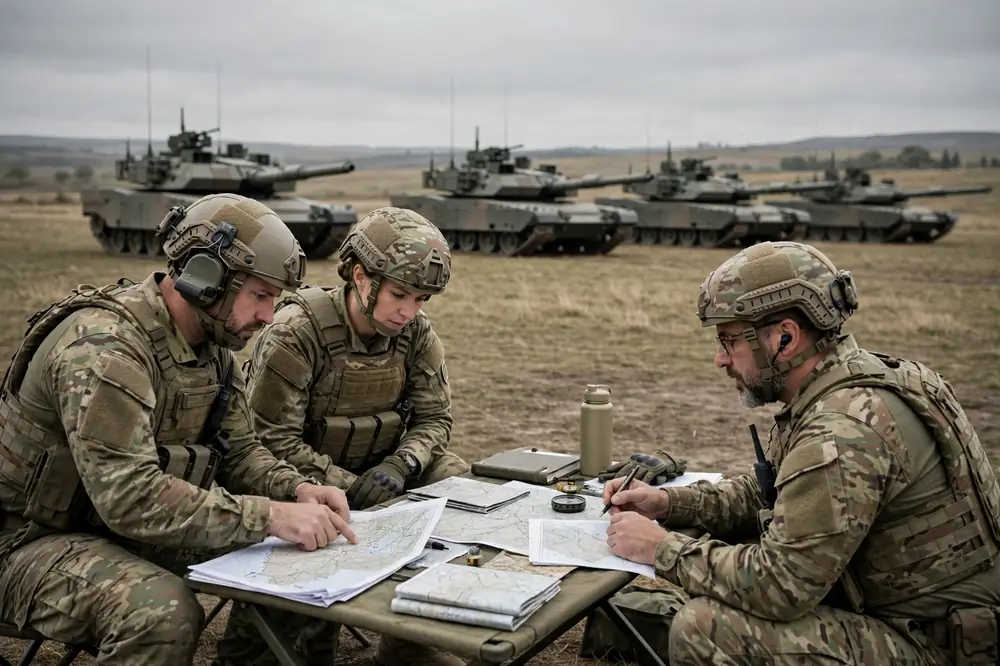
Guderian’s lasting legacy is the armoured division as it exists in every modern army. The combination of tanks, motorised infantry, self-propelled artillery, engineers and close air support, all linked by radio and commanded from the front, is the direct descendant of the Panzer division he built in the 1930s, and his ideas were studied by the armies of the United States, Britain, the Soviet Union and Israel after the war. The American doctrine of AirLand Battle in the 1980s, and the rapid armoured advance of the coalition forces in the Gulf War of 1991, both drew explicitly on the German experience of 1940 and 1941, and Guderian’s name was invoked in military schools around the world as the theorist who had shown how to restore movement to the battlefield. His book Achtung – Panzer! remains in print, and his memoirs remain one of the most widely read accounts of the German side of the war. In this technical sense, his influence on the art of war is beyond dispute, and it is the reason why his name is still taught to officer cadets more than seventy years after his death.
A Reputation Re-examined
In recent decades, Guderian’s reputation has been re-examined, and the heroic image created by his memoirs has been qualified. Historians now stress that his victories depended on the weakness of his enemies and on the particular circumstances of 1940, that his Panzer divisions were a small part of an army that remained dependent on horse-drawn transport, and that his own logistical and strategic judgement was fallible, above all in the failure to prepare for winter in Russia in 1941. They also stress his moral responsibility: he served a criminal regime, he commanded troops in a war of annihilation, and he used his memoirs to conceal that fact. The re-examination has not erased his achievement as a military thinker, but it has placed it in its proper context. Guderian is now remembered as a brilliant but flawed figure — a man who changed the way armies fight, and who did so in the service of a cause that history has condemned.
10. Assessment by Historians
The Military Assessment
Military historians assess Guderian as one of the most important soldiers of the twentieth century, and the assessment rests on his achievement as an organiser and a theorist rather than on his record as a commander in battle. As an organiser, he created the Panzer division, the first formation in history designed to fight as a combined-arms armoured force, and he did so against the resistance of the conservative majority of the German officer corps. As a theorist, he grasped earlier than any of his contemporaries that the radio, the tank and the aeroplane together made a new kind of warfare possible, and he expressed that insight in a book that remains readable and influential. As a field commander, his record is more mixed: brilliant in France in 1940, successful but increasingly strained in Russia in 1941, and ineffective as Chief of Staff in 1944–1945, when the strategic situation was beyond the power of any general to change. Historians such as Robert Citino argue that Guderian’s greatest strength was his energy and his willingness to take risks, and his greatest weakness was his inability to think in logistical terms — to understand that an army that advances faster than its supplies can follow will eventually stop, as his Panzer group did before Moscow.
The Moral Assessment
The moral assessment of Guderian is harsher, and it has become harsher over time. The generation of historians who wrote in the 1950s and 1960s, many of them former officers themselves, accepted his account of a clean, professional army and treated him as a soldier who had served his country and been betrayed by its political leadership. The historians of the last thirty years, working from the German military archives and from the records of the war in the East, have rejected that account. They point out that Guderian commanded troops in a war whose stated purpose was the destruction of the Soviet state and the murder of its Jewish population, that he was aware of the crimes committed behind his front, and that he chose to continue serving a regime he knew to be criminal. They also point out that his memoirs, by presenting the German army as the victim of Hitler’s interference, helped to delay the reckoning with the army’s crimes for a generation. The consensus that is emerging is that Guderian was a great military technician and a flawed human being — a man whose professional gifts were placed, without serious protest, at the service of a war of conquest and annihilation, and whose reputation must therefore be judged with both admiration for his talent and condemnation of the cause he served.
Frequently Asked Questions
Who was Heinz Guderian?
Heinz Guderian (1888–1954) was a German general and the leading theorist of armoured warfare. He created the Panzer divisions, wrote Achtung – Panzer! (1937), and commanded Panzer forces in Poland, France and the Soviet Union in the Second World War.
What is Blitzkrieg?
Blitzkrieg, or “lightning war”, is the name given in the English-speaking world to the German method of warfare in 1939–1941: a concentrated armoured breakthrough, supported by aircraft, followed by a rapid drive into the enemy’s rear. Historians note that the term was largely invented by the Western press, and that there was no single official German doctrine of that name.
Why was Guderian dismissed in December 1941?
Hitler dismissed him on 26 December 1941, after the failure of the advance on Moscow and a dispute over a withdrawal. Guderian had ordered a withdrawal of his exhausted Panzer army against Hitler’s orders, and Hitler used the incident to remove a general who had openly opposed his decision to divert the Panzers to Kiev.
Did Guderian write Achtung – Panzer!?
Yes. The book was published in 1937 and remains his most famous work. It argued for the concentration of tanks in armoured divisions, supported by motorised infantry, artillery and aircraft, and for the use of radio to control fast-moving armoured forces.
Was Guderian tried as a war criminal?
No. He was held in American captivity until June 1948, but he was not charged at Nuremberg. Historians continue to debate whether the decision was justified, given his senior command on the Eastern Front and his knowledge of the crimes committed there.
What happened to Guderian after the war?
After his release in 1948 he settled in Schwangau, Bavaria, wrote his memoirs Panzer Leader (1952), and advised the West German government on the creation of the Bundeswehr. He died on 14 May 1954, aged 65.
Sources
- Wikipedia, “Heinz Guderian” — consolidated biography: birth 17 June 1888, death 14 May 1954, Panzer Group 2, Kiev encirclement, dismissal December 1941, Chief of Staff 1944–1945.
- Heinz Guderian, Panzer Leader (1952) — memoirs; the crossing of the Meuse at Sedan, the advance to the Channel, the dispute over Kiev; to be read as an apologia, not a neutral record.
- Heinz Guderian, Achtung – Panzer! (1937) — the theory of the Panzer division and concentrated armoured warfare.
- Robert M. Citino, The German Way of War (University Press of Kansas, 2005) — the German tradition of manoeuvre warfare and the place of the Panzer arm within it.
- David Stahel, Operation Barbarossa and Germany’s Defeat in the East (Cambridge University Press, 2009) — the advance on Moscow, the failure before Moscow, and the logistical limits of the Panzer groups in 1941.
- Benoît Lemay, Erich von Manstein (2010) and the modern literature on the “clean Wehrmacht” — Guderian’s memoirs and the post-war rehabilitation of the German officer corps.