 WAR ATLAS MILITARY HISTORY MAGAZINE · WWI — WWII
Manfred von Richthofen
1. Lead
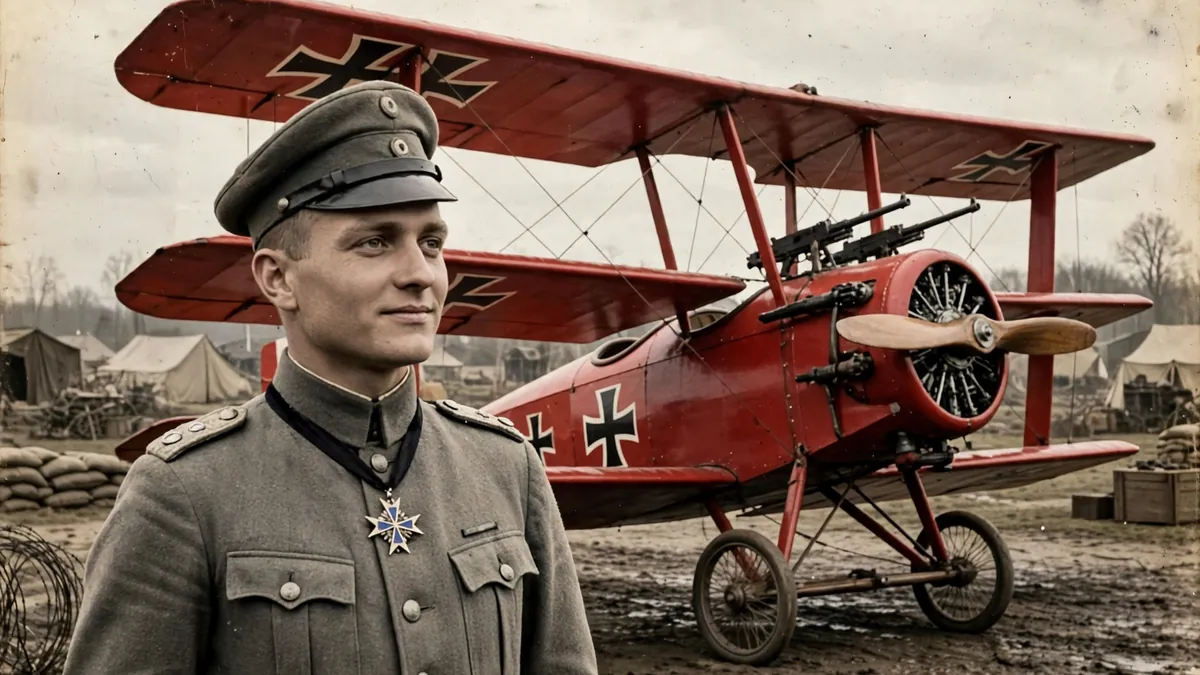
Manfred von Richthofen (2 May 1892 – 21 April 1918), known to the English-speaking world as the “Red Baron”, was a German fighter pilot in the First World War and the highest-scoring flying ace of the conflict. Born into a Prussian aristocratic family in Silesia, he began the war as a cavalry officer, transferred to the air service in 1915, and learned to fly under the guidance of Oswald Boelcke, the father of German fighter tactics. Between September 1916 and April 1918 he was officially credited with 80 air victories, more than any other pilot of the war, and he commanded Jagdgeschwader 1, the “Flying Circus”, a wing of four fighter squadrons whose brightly painted aircraft became famous on both sides of the front. His red Fokker triplane, in particular, became one of the most recognisable images of the First World War, and his name entered popular culture in a way that no other pilot of the period has matched.
Richthofen’s fame rested on more than a score. He was a systematic and disciplined hunter who treated air combat as a professional skill to be learned, practised and taught, and his leadership of the Flying Circus helped to turn the German fighter arm from a collection of individual pilots into an organised force. At the same time, he was a product of the propaganda of his own time: the German press made him a national hero, and the British and French press made him a chivalrous enemy, a gentleman of the air in a war that had otherwise destroyed the old codes of honour. He was killed in action on 21 April 1918, at the age of twenty-five, shot down over the Somme while pursuing a Canadian pilot, Lieutenant Wilfrid May, at low level; the question of who fired the fatal shot — a Canadian pilot, Captain Roy Brown, or Australian machine-gunners on the ground — has been debated ever since, and it remains one of the most famous controversies of the air war.
2. Key Facts
| Born | 2 May 1892, Kleinburg, near Breslau, Silesia, German Empire (now Wrocław, Poland) |
| Died | 21 April 1918 (aged 25), near Vaux-sur-Somme, France |
| Nationality | German |
| Role / Office | Rittmeister (Captain of Cavalry); commander of Jagdstaffel 11 (1917) and Jagdgeschwader 1, the “Flying Circus” (1917–1918) |
| Known for | The “Red Baron”; 80 officially credited air victories, the highest score of the First World War; the red Fokker Dr.I triplane; the Flying Circus |
| Spouse / Family | Unmarried; son of Major Albrecht von Richthofen and Kunigunde von Schickfus und Neudorff; younger brother Lothar von Richthofen, also a fighter ace with 40 victories |
| Military rank | Rittmeister (Captain) |
3. Early Life and Education
Family and Childhood
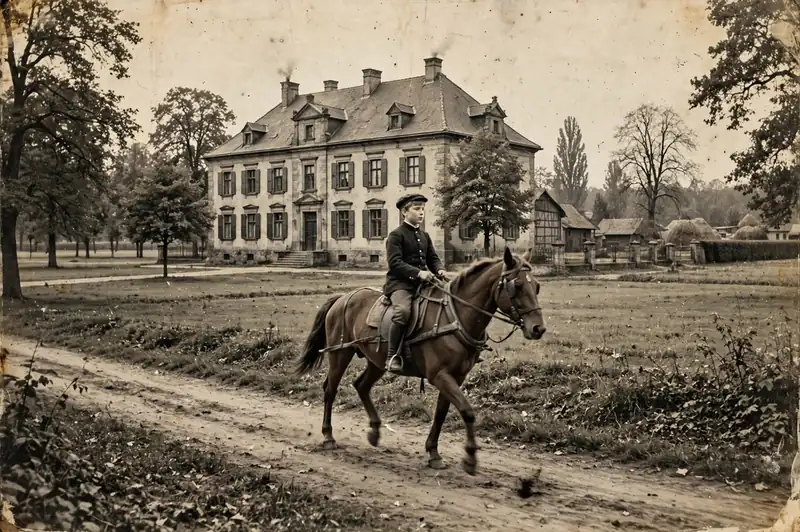
Manfred Albrecht Freiherr von Richthofen was born on 2 May 1892 at Kleinburg, the family estate near Breslau in Silesia, into a family of the Prussian landed aristocracy whose name went back to the sixteenth century. His father, Albrecht von Richthofen, was a major in the Prussian army, and his mother, Kunigunde, came from another old Silesian family; the household was conservative, Lutheran and military, and Manfred grew up in the expectation that he, like his father and his uncles, would become an officer. He was a vigorous and athletic boy, fond of hunting, riding and gymnastics, and his own account of his childhood stresses the outdoors rather than the classroom: he was, by his own admission, a mediocre pupil, more interested in sport than in study, and his school reports describe a boy who was physically strong, self-confident and impatient with routine. The family moved to Schweidnitz when his father was posted there, and Manfred spent his youth in the garrison towns of Silesia, a world of regimental tradition in which the army was not a career among others but the natural destiny of a young man of his class.
The Prussian Aristocracy and the Officer Corps
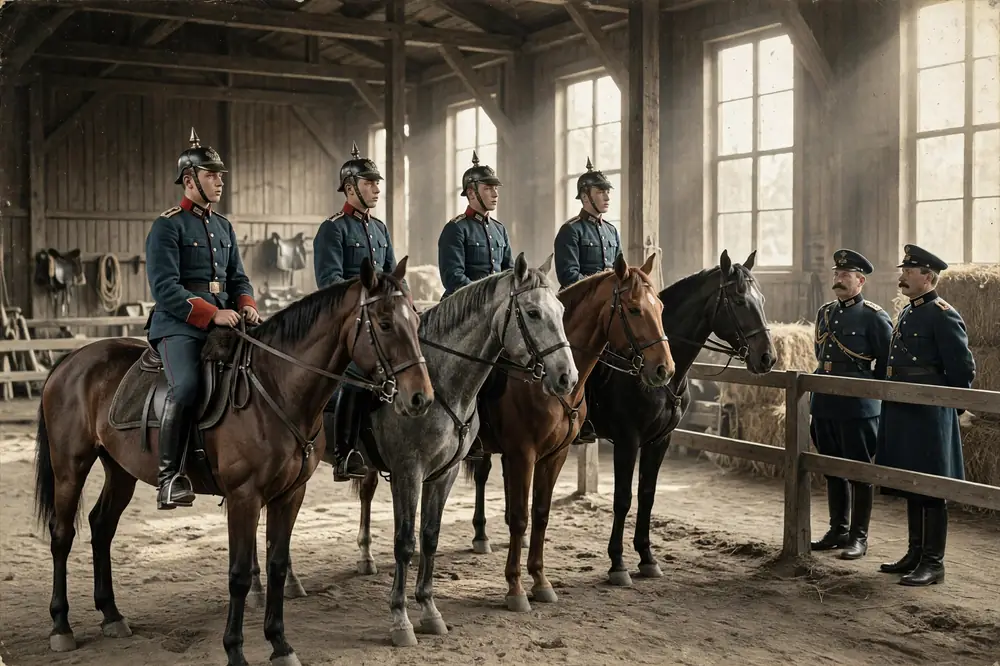
The world into which Richthofen was born was the world of the Prussian Junker, the landed aristocracy that supplied the German army with most of its officers. For a young man of that class, the choice of a regiment was a social decision as much as a military one, and the cavalry, with its horses, its uniforms and its traditions, was the most prestigious arm of all. Richthofen’s family expected him to join the cavalry, and he did, entering the cadet school at Wahlstatt in 1903 at the age of eleven and then the main cadet school at Gross-Lichterfelde near Berlin, the same school that had trained a generation of Prussian officers. The cadet schools taught discipline, riding, fencing and the rudiments of military science, and they also taught a code: an officer was a gentleman, he did not lie, he did not abandon his comrades, and he faced danger without flinching. That code, which Richthofen carried with him into the air, would later be celebrated in the image of the chivalrous airman, and it would also be criticised as an anachronism in a war of industrial slaughter.
Education and First Service
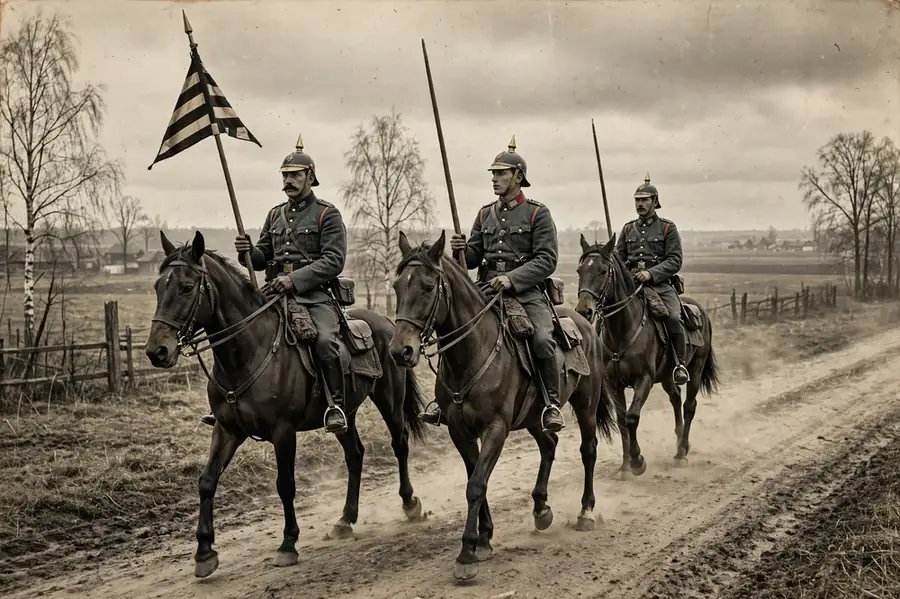
Richthofen was commissioned as a second lieutenant in the 1st Uhlan Regiment “Emperor Alexander III of Russia” in 1912, a cavalry regiment stationed in Silesia. He was a keen horseman and a successful competitor in riding and hunting, and he enjoyed the life of a young cavalry officer: the mess, the horses, the sport and the comradeship of the regiment. When the First World War broke out in August 1914, his regiment was sent first to the Eastern Front, where it fought in the battles in East Prussia and Poland, and then to the Western Front, where it took part in the advance into Belgium and France. The experience of 1914 taught him, as it taught most cavalry officers, that the age of the horse was over: machine guns and barbed wire had made the cavalry charge impossible, and by the winter of 1914 the regiment was dismounted, its men serving as infantry in the trenches. Richthofen found trench warfare intolerable — the mud, the waiting, the sense of being a target rather than a hunter — and in May 1915 he applied for a transfer to the air service, the Fliegertruppe, where he hoped to find the movement and the individual initiative that the trenches had destroyed.
4. Rise to Prominence
Observer, Pilot and Pupil of Boelcke
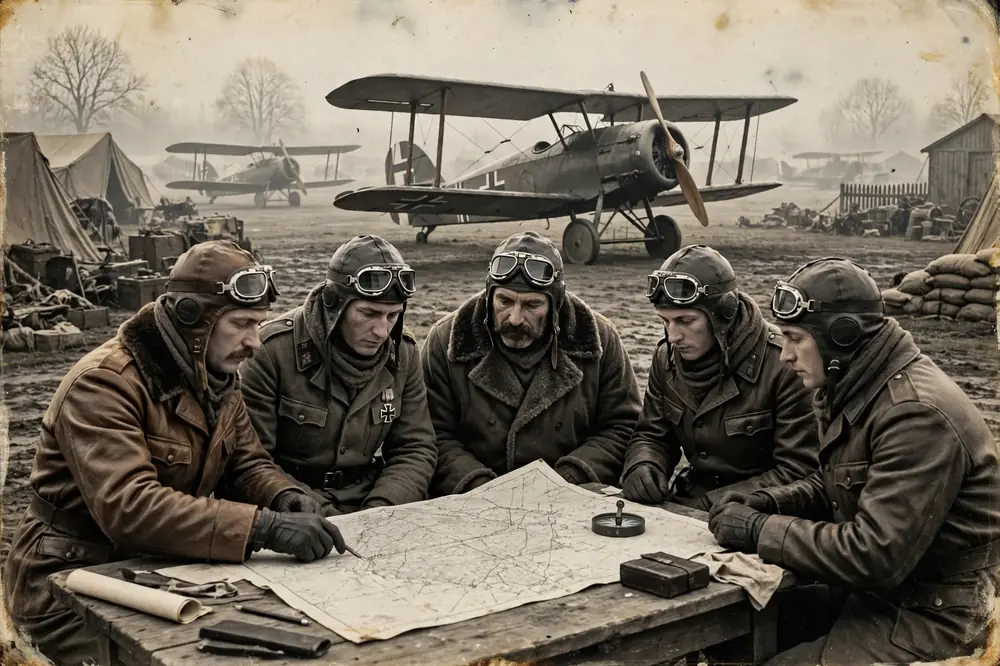
Richthofen began his air service as an observer, flying in two-seater reconnaissance aircraft over the Eastern Front in the summer of 1915, and he learned the business of the air from the back seat: navigation, observation, the reporting of artillery fire and the recognition of enemy aircraft. He was a brave and skilful observer, and he was awarded the Iron Cross Second Class, but he wanted to fly the aircraft himself, and in October 1915 he was accepted for pilot training. He learned to fly at Döberitz, and his first posting as a pilot was to a two-seater unit on the Western Front, where he flew reconnaissance and bombing missions through the winter of 1915–1916. The turning point of his career came in August 1916, when he was selected by Oswald Boelcke, the leading German fighter pilot of the time, to join the new Jagdstaffel 2, the first of the single-seater fighter squadrons. Boelcke was not only a great pilot but a great teacher, and he taught his pupils a set of rules for air combat — the Dicta Boelcke — that became the foundation of German fighter tactics: attack from above and from behind, with the sun behind you; do not fly alone; keep your formation; and fire at close range, when you cannot miss. Richthofen learned those rules thoroughly, and he never forgot them.
The First Victories and the Red Aircraft
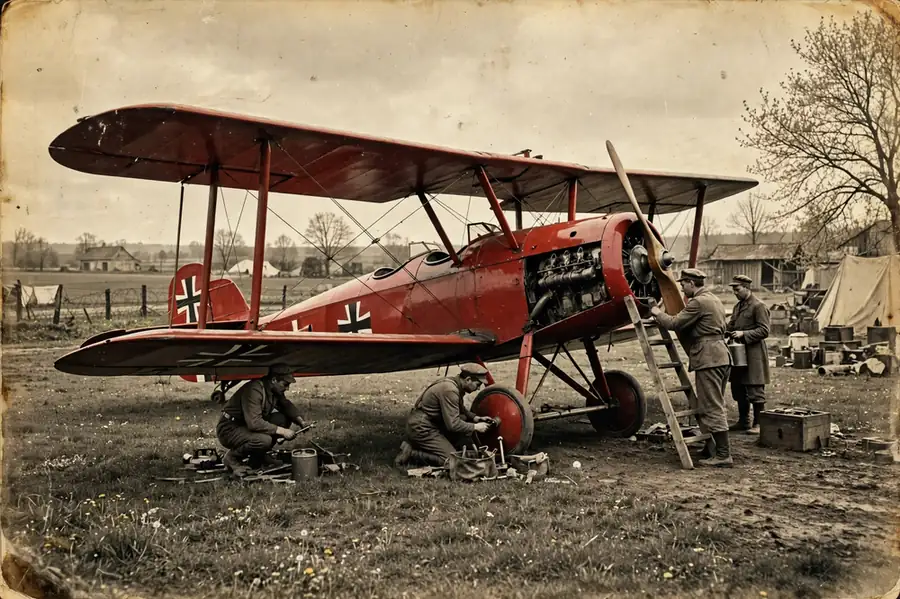
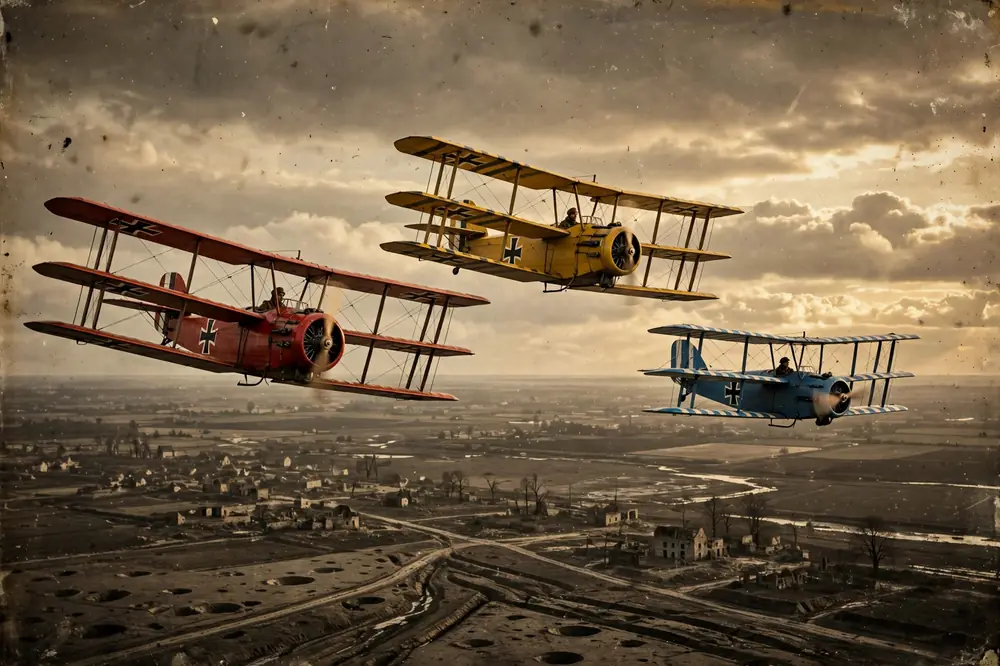
Richthofen scored his first air victory on 17 September 1916, shooting down a British F.E.2b over the Somme, and the victory was the first of a series that made his name. He was a methodical hunter rather than a flamboyant one: he preferred to attack from above, to fire at close range, and to break off rather than take unnecessary risks, and his early victories were mostly against two-seater reconnaissance aircraft and bombers, the slow and vulnerable targets that Boelcke had taught his pupils to seek. By the end of 1916 he had sixteen victories and had been awarded the Pour le Mérite, the highest German decoration for an officer, known as the “Blue Max”. In January 1917 he was given command of Jagdstaffel 11, and it was then that he began the practice that made him famous: he had his Albatros D.III painted red, partly so that his men could recognise him in the air and partly, as he admitted, for reasons of vanity and propaganda. The red aircraft became his trademark, and soon the whole of his squadron was flying in bright colours — red, yellow, blue and green — which led the British to call the unit the “Flying Circus”. In April 1917, “Bloody April”, the month in which the Royal Flying Corps lost more than 200 aircraft, Richthofen scored twenty-one victories, the most successful month of any pilot in the war.
5. Manfred von Richthofen’s Role in World War I
Command of Jagdstaffel 11
As commander of Jagdstaffel 11, Richthofen transformed a fighter squadron into a disciplined and effective fighting unit. He trained his pilots in Boelcke’s rules, he insisted on formation flying and on the discipline of attacking together and breaking off together, and he kept careful records of every combat, studying what had gone right and what had gone wrong. He was a demanding commander who expected his pilots to be aggressive but not reckless, and he led by example, flying more patrols than any of his men and taking the most dangerous position in the formation. Under his command, Jagdstaffel 11 became the most successful fighter squadron in the German air service, and its pilots — among them his younger brother Lothar, who joined the squadron in 1917 and scored forty victories, and Kurt Wolff, who scored thirty-three — became famous in their own right. Richthofen’s own score continued to grow through the summer of 1917, reaching sixty victories by September, and the German press celebrated him as a national hero, publishing his photograph, his autobiography Der rote Kampfflieger (The Red Battle Flyer), and accounts of his victories that made his name known in every German household.
The Flying Circus
In June 1917 Richthofen was given command of the newly formed Jagdgeschwader 1, a wing of four fighter squadrons — Jagdstaffeln 4, 6, 10 and 11 — which was the first formation of its kind in the German air service. The wing was mobile, moving by train and by road to the sector of the front where it was most needed, and its brightly coloured aircraft and its habit of appearing suddenly over a new sector gave it the nickname the “Flying Circus”, a name that Richthofen himself used with amusement. The creation of the wing marked a change in the air war: the Germans were now concentrating their fighters in larger formations, able to meet the growing strength of the British and French air services, and Richthofen’s leadership of the wing made him not only a successful pilot but a commander of a significant tactical formation. He continued to fly and to score victories — his sixtieth in September 1917, his seventieth in January 1918 — but he also spent more of his time on the ground, planning, training and writing, and he complained in his letters that the burden of command and of publicity was leaving him less and less time in the air.
The Last Months and the Spring Offensive
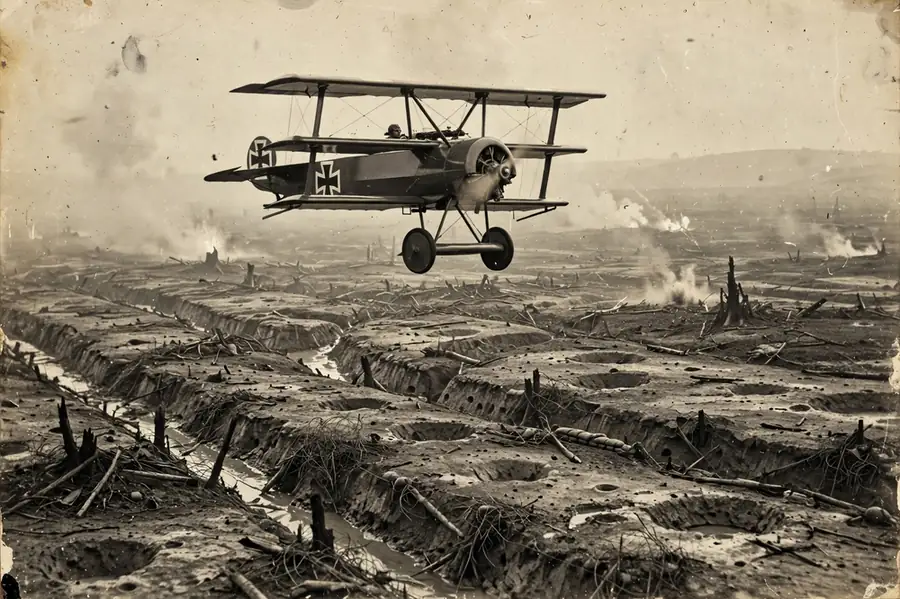
In the spring of 1918, Richthofen’s wing was committed to the German spring offensive, the last great German attempt to win the war on the Western Front before the arrival of the American armies in strength. His pilots flew in support of the advancing German infantry, attacking British and French aircraft and ground targets, and Richthofen himself scored his seventy-ninth and eightieth victories on 20 April 1918, the day before his death. By then he was a tired man: he had been wounded in the head in July 1917, suffering a serious skull wound that left him with headaches and, according to some accounts, affected his judgement, and he had flown more than 300 combat missions in less than two years. His letters from the last months show a man who was weary of the war and of the publicity that surrounded him, and who knew that the odds against him were growing as the British and French air services grew stronger and better equipped. On the morning of 21 April 1918 he took off from Cappy with his wing to intercept British aircraft over the Somme, and he pursued a young Canadian pilot, Lieutenant Wilfrid May, at low level across the British lines, breaking his own rule of never flying alone over enemy territory.
The Death of the Red Baron
Richthofen was shot down and killed on 21 April 1918 near Vaux-sur-Somme, and the circumstances of his death have been debated ever since. The official German account, and the account favoured by the British at the time, credited the victory to Captain Roy Brown, a Canadian pilot of No. 209 Squadron, Royal Air Force, who had dived on Richthofen’s triplane from above and behind. Later research, based on the entry and exit wounds in Richthofen’s body, on the position of his aircraft when it crashed, and on the testimony of Australian soldiers on the ground, has suggested that the fatal shot was fired by Australian machine-gunners of the 53rd Battery, who were firing at the triplane as it flew low over their positions. The most careful modern studies conclude that the ground fire is the more likely cause, but the question cannot be settled with certainty, and the debate continues. What is certain is that Richthofen was buried by the British with full military honours, that his grave was visited by British and Australian officers, and that his death, at the age of twenty-five, removed from the war its most famous pilot and left the German air service without the commander who had done most to organise it.
6. Key Decisions
Decisions in the Air
Leaving the cavalry for the air service (May 1915). Richthofen’s decision to transfer from the cavalry to the air service was the decisive choice of his life. It took him from a branch of the army that the war had made obsolete to the newest and most rapidly developing arm of all, and it gave him the opportunity to become famous in a way that would have been impossible in the trenches. The decision also reflected his temperament: he wanted movement, initiative and individual responsibility, and he found them in the air.
Adopting Boelcke’s rules (August 1916). His decision to learn and to follow Boelcke’s rules of air combat, rather than to fly as an individual duellist, made him a consistently successful pilot and, later, a successful commander. The rules were simple — attack from above, fire at close range, keep your formation — but they required discipline, and Richthofen’s discipline was the foundation of his score.
Painting his aircraft red (January 1917). The decision to paint his Albatros red was partly practical and partly propaganda, and it made him the most recognisable pilot of the war. It also made him a target, and his enemies knew his aircraft by sight; but the propaganda value, for Germany and for Richthofen himself, was immense, and the red aircraft became a symbol of the German air service.
Decisions as a Commander
Building the Flying Circus (June 1917). Richthofen’s acceptance of the command of Jagdgeschwader 1, and his organisation of four squadrons into a single mobile wing, was a significant step in the development of the air war. It showed that he understood that the future of air combat lay in larger formations, not in individual duels, and it gave the German air service a flexible instrument that could be moved to the point of greatest need.
Pursuing May across the lines (21 April 1918). His last decision, to pursue Lieutenant Wilfrid May at low level across the British lines, broke every rule he had taught his pilots: he flew alone, he flew low over enemy territory, and he allowed himself to be drawn into a chase. Historians have suggested that his head wound, his fatigue, or his desire for an eighty-first victory may have affected his judgement; whatever the cause, the decision cost him his life.
7. Controversies
Who Shot Down the Red Baron?
The most famous controversy about Richthofen is the question of who killed him. The British official history credited Captain Roy Brown, and Brown himself believed that he had fired the fatal shot, but the medical evidence — the bullet entered Richthofen’s chest from the right side and below, consistent with ground fire, and not from above and behind, as Brown’s attack would have required — has led most modern researchers to favour the Australian machine-gunners. The debate has been complicated by national pride: Canadians have defended Brown’s claim, Australians have defended the gunners’ claim, and Germans have generally been content to leave the question open. The controversy matters because it concerns the end of the war’s most famous pilot, but it also matters because it shows how difficult it is to establish the truth of a single event in the confusion of battle, and how the desire for a heroic story — a duel between two aces — can obscure a more prosaic truth, that Richthofen was probably killed by ordinary soldiers firing from the ground.
The Autopsy Evidence
The strongest evidence in the debate comes from the examination of Richthofen’s body by British medical officers after his death. The bullet that killed him entered the right side of his chest, passed through his heart and lungs, and exited on the left side, a trajectory that is difficult to reconcile with an attack from above and behind by another aircraft, and easy to reconcile with fire from the ground as the triplane flew low over the Australian positions. The evidence is not conclusive — a bullet can be deflected, and the position of the aircraft in the air is not known with certainty — but it has persuaded most historians who have studied the case in detail, including the authors of the most recent forensic reconstructions, that the ground fire is the more likely explanation. The controversy continues, however, because the evidence is circumstantial, and because the story of a duel in the air is more appealing than the story of a lucky shot from the ground.
The Score and the Propaganda
A second controversy concerns the score itself. Richthofen was officially credited with eighty victories, but the system of crediting victories in the First World War was imperfect: a victory required confirmation by observers on the ground or by other pilots, and the German system was stricter than the British or French systems, which credited pilots with victories on less evidence. Some historians have suggested that Richthofen’s true score may have been higher, because some of his victories were not confirmed; others have suggested that some of the victories credited to him were shared with other pilots, or were against aircraft that were already damaged. The debate is not about fraud — there is no evidence that Richthofen claimed victories he did not win — but about the limits of the records. What is certain is that his score was the highest of the war, that it was achieved in less than two years of flying as a fighter pilot, and that it made him a symbol of German air power in a way that no other pilot could match.
8. Later Life and Death
The Final Patrol
Richthofen’s later life was short, and it ended in the air. In the last weeks of his life he was, by the account of his brother Lothar and of his fellow pilots, a tired and increasingly withdrawn man, burdened by the command of the wing, by the publicity that surrounded him, and by the knowledge that the German air service was losing the war of attrition in the air. He had been offered a staff appointment that would have taken him out of danger, and he had refused it, insisting that a commander should fly with his men. On the morning of 21 April 1918 he led a patrol of his wing over the Somme, and he saw a young Canadian pilot, Lieutenant Wilfrid May, a novice who had been ordered to break off from a combat and was flying away from the battle. Richthofen pursued him, flying low over the British lines, and he was himself pursued by Captain Roy Brown, who dived on him from above. The triplane was hit, it crashed near the brickworks at Vaux-sur-Somme, and Richthofen was found dead in the wreckage, killed by a single bullet through the chest. He was twenty-five years old, and he had been a fighter pilot for less than two years.
Burial and the Search for the Body
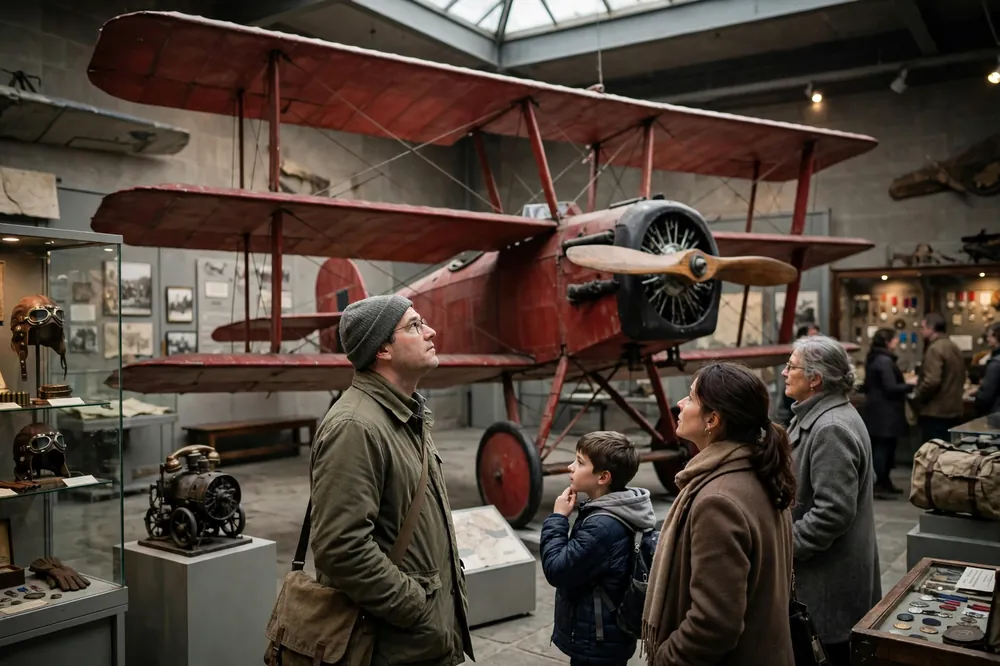
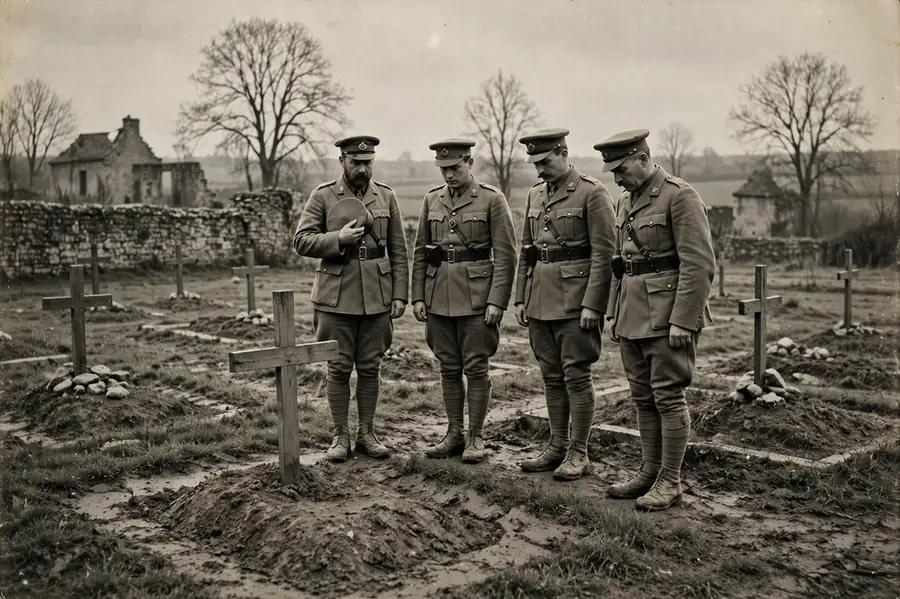
Richthofen was buried by the British with full military honours on 22 April 1918, in the cemetery at Bertangles, and his grave was marked with a cross made from the wreckage of his aircraft. The burial was attended by British and Australian officers, and the photographs of the ceremony — the guard of honour, the wreaths, the firing party — became famous, a rare moment of chivalry in a war that had little of it. After the war his body was moved, first to the German military cemetery at Fricourt, and then, in 1925, to the family grave in Berlin, where it remained until the Second World War. His grave in Berlin was damaged in the war, and his remains were later moved again; the history of his body, like the history of his death, is a story of movement and of uncertainty, and it reflects the way in which his memory has been claimed by different nations and different generations. The red triplane, of which only fragments survive, is remembered in museums and in reproductions, and the image of the Red Baron remains, more than a century after his death, the most famous image of the air war of 1914–1918.
9. Legacy of Manfred von Richthofen
The Red Baron in Popular Culture
Richthofen’s legacy is unique among the pilots of the First World War: he is remembered not only by historians but by the general public, and his name has entered the language in a way that no other pilot’s has. The “Red Baron” is a figure of popular culture — of songs, of films, of comic strips, of children’s books — and the image of the red triplane is one of the most recognisable images of the twentieth century. The song “Snoopy vs. the Red Baron”, the comic strip “Peanuts”, the films and the video games that have retold his story have made him a figure of myth, and the myth has, in many ways, replaced the man. The historical Richthofen was a disciplined professional, a systematic hunter and a demanding commander; the mythical Red Baron is a romantic hero, a knight of the air, a gentleman who fought duels in the sky. The distance between the man and the myth is a measure of his fame, and it is also a warning: the fame of the Red Baron tells us as much about the needs of the audiences who remembered him as it does about the pilot himself.
The Tactical Legacy
Richthofen’s tactical legacy is more solid than his popular fame. The rules he learned from Boelcke and taught to his pilots — the importance of height, of the sun, of formation, of close-range fire — became the foundation of fighter tactics in the Second World War and beyond, and the organisation of fighters into wings and groups, which he pioneered with the Flying Circus, became the standard organisation of every air force. His career also demonstrated the importance of the fighter pilot as a leader: he showed that a successful pilot could also be a successful commander, and that the discipline of the squadron was as important as the skill of the individual. The German air service of the Second World War, and the Luftwaffe’s fighter arm in particular, looked back to Richthofen as its founding hero, and the name of his wing, Jagdgeschwader 1, was revived in the Second World War. His influence on the air war is therefore both practical and symbolic: he helped to create the modern fighter force, and he gave it a hero whose name is still invoked whenever the history of air combat is told.
10. Assessment by Historians
The Pilot and the Commander
Historians assess Richthofen as the greatest fighter pilot of the First World War, and the assessment rests on the combination of his score and his leadership. His score of eighty victories, achieved in less than two years, has never been equalled in a war of that kind, and it was achieved against an enemy that was growing stronger and better equipped throughout the period. His leadership was equally important: he turned Jagdstaffel 11 into the most successful squadron in the German air service, and he created the first fighter wing, the Flying Circus, an organisation that anticipated the fighter groups of the Second World War. Historians also note his discipline: he was not a reckless duellist but a methodical hunter who followed Boelcke’s rules, and his success was the result of system rather than of luck. The assessment is not without qualification — his victories were mostly against two-seaters and against inexperienced pilots, and the German system of crediting victories was stricter than the Allied systems, which makes direct comparison difficult — but the consensus is that he was the outstanding pilot of the war, and one of the outstanding commanders of the air war in its first years.
The Man and the Myth
The assessment of Richthofen as a man is more complicated, because the man and the myth have become difficult to separate. The historical Richthofen was a professional soldier, a Prussian officer who did his duty and who wrote about the war in a matter-of-fact way that surprises readers who expect romance. His autobiography, Der rote Kampfflieger, is a straightforward account of his victories, written at the request of the German propaganda authorities, and it shows a man who was proud of his score, who enjoyed the fame that came with it, and who was also weary of the war and of the publicity. The mythical Red Baron, by contrast, is a romantic hero, a knight of the air who fought by a code of honour that the war itself had destroyed. Historians argue that the myth was created by the needs of the time — by the German need for a hero, by the British need for a chivalrous enemy, and by the post-war need for a story that could make the horror of the war bearable — and that the real Richthofen was a more ordinary and more interesting figure: a talented pilot, a demanding commander, and a young man who was killed at twenty-five in a war that had no place for the code he had been taught to live by.
Frequently Asked Questions
Who was Manfred von Richthofen?
Manfred von Richthofen (1892–1918), the “Red Baron”, was a German fighter pilot in the First World War, credited with 80 air victories, the highest score of the war. He commanded Jagdstaffel 11 and Jagdgeschwader 1, the “Flying Circus”.
How many victories did the Red Baron score?
He was officially credited with 80 air victories between September 1916 and April 1918. The German system of confirming victories was strict, requiring confirmation by ground observers or other pilots, so the figure is generally accepted by historians, although the exact number of aircraft he personally destroyed is debated.
Who shot down the Red Baron?
The question is still debated. Captain Roy Brown, a Canadian pilot, was officially credited with the victory, but modern forensic research suggests that the fatal bullet was probably fired by Australian machine-gunners on the ground. Most historians now favour the ground-fire explanation, but the evidence is circumstantial and the debate continues.
What was the Flying Circus?
The Flying Circus was Jagdgeschwader 1, a wing of four fighter squadrons commanded by Richthofen from June 1917. It was mobile, moving to the sector of the front where it was most needed, and its aircraft were painted in bright colours, which led the British to give it the nickname.
Why was his aircraft red?
Richthofen had his Albatros painted red in January 1917, partly so that his men could recognise him in the air and partly for propaganda. The red aircraft became his trademark, and soon his whole squadron was flying in bright colours.
What happened to Richthofen’s brother Lothar?
Lothar von Richthofen (1894–1922) was also a fighter ace, with 40 victories, and he flew in his brother’s squadron. He survived the war, but he was killed in a flying accident in 1922, while working as a commercial pilot in Germany.
Sources
- Wikipedia, “Manfred von Richthofen” — consolidated biography: birth 2 May 1892, death 21 April 1918, 80 victories, Jagdgeschwader 1, the question of who shot him down.
- Manfred von Richthofen, Der rote Kampfflieger (1917), published in English as The Red Baron — autobiography; first victories, Boelcke’s rules, the red aircraft.
- Norman Franks, Hal Giblin and Nigel McCrery, Under the Guns of the Red Baron (1998) — the forensic investigation of Richthofen’s death; the autopsy evidence and the Australian machine-gunners.
- Peter Kilduff, The Red Baron: Beyond the Legend (1993) — biography; the Flying Circus, the score, the last patrol.
- Dennis E. Showalter, Tannenberg: Clash of Empires (2004) and the literature on the German officer corps — the Prussian cavalry tradition and the cadet schools.
- Jon Guttman, The Red Baron: The Life and Death of Manfred von Richthofen (Osprey, 2009) — the air war of 1916–1918, Bloody April, and the spring offensive of 1918.