 WAR ATLAS MILITARY HISTORY MAGAZINE · WWI — WWII
Operation Barbarossa
1. Lead
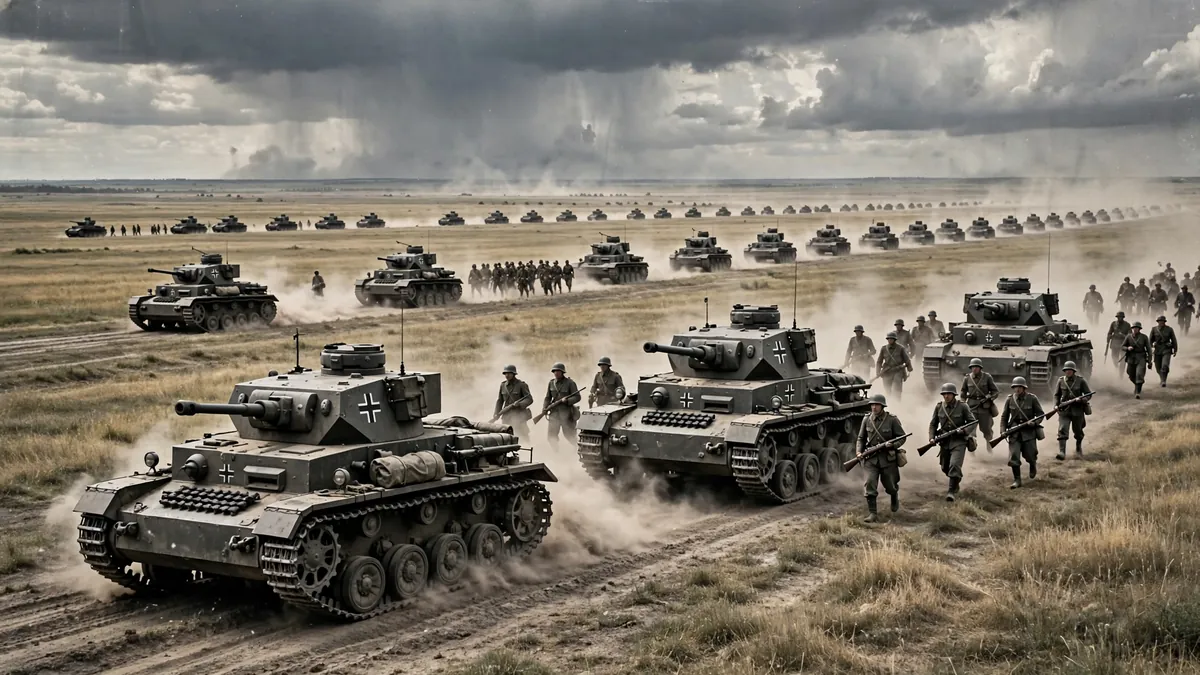
Operation Barbarossa was the German invasion of the Soviet Union, launched on 22 June 1941. It was the largest military operation in history: about 3 million Axis soldiers, 3,600 tanks and 2,700 aircraft attacked along a front nearly 3,000 kilometres long, from the Baltic Sea to the Black Sea.
In the first five months the German armies destroyed whole Soviet armies, took more than 3 million prisoners and advanced to the gates of Moscow — and then, in December 1941, the offensive stalled in the snow, the Soviet counterattack drove the Germans back, and the war in the east became the vast war of attrition that would decide the Second World War.
Barbarossa was also a war of annihilation: behind the front lines, the SS and the Einsatzgruppen murdered millions of Soviet civilians and prisoners of war, making the Eastern Front the deadliest theatre of the war.
2. Key Facts
| Date | 22 June – 5 December 1941 (the opening offensive; the Eastern Front continued until 1945) |
| Location | Western Soviet Union, from the Baltic to the Black Sea |
| Result | Initial Axis victories; Soviet Union survives; German offensive halted before Moscow in December 1941 |
| German commanders | Adolf Hitler (supreme command); Field Marshal Walther von Brauchitsch (Army); Field Marshals von Leeb, von Bock, von Rundstedt (army group commanders) |
| Soviet commanders | Joseph Stalin (supreme command); Marshal Semyon Timoshenko; General Georgy Zhukov |
| Axis strength | About 3 million German troops plus about 500,000 from Finland, Romania, Hungary, Italy and others; 3,600 tanks, 2,700 aircraft |
| Soviet strength | About 2.9 million troops in the western military districts; about 11,000 tanks (many obsolete), about 9,000 aircraft |
| Axis losses | About 830,000 killed, wounded and missing by 5 December 1941 |
| Soviet losses | About 4.5 million killed, wounded and captured by 5 December 1941, including over 3 million prisoners |
3. Background
Operation Barbarossa was the fulfilment of the central idea of Adolf Hitler’s politics: Lebensraum, “living space” — the conquest of the Soviet Union to give Germany the land, food and raw materials to become a world power, and the destruction of what the Nazis called “Jewish Bolshevism”. Hitler had written about the conquest of the east in Mein Kampf in the 1920s, and after the fall of France in 1940 he turned to it in earnest. The invasion was given the codename Barbarossa, after Frederick Barbarossa, the 12th-century Holy Roman Emperor who had led a crusade to the east.
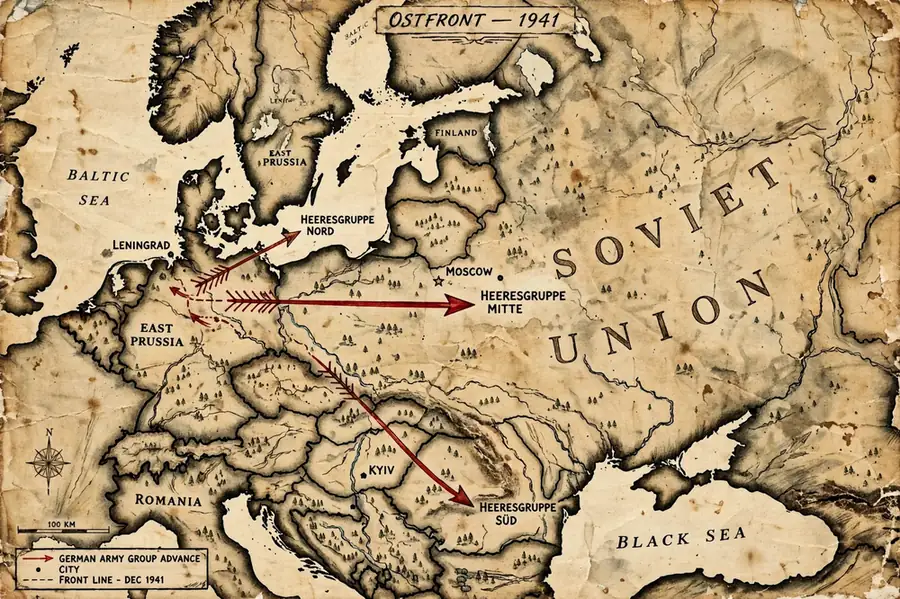
The immediate background was a paradox: Germany and the Soviet Union were, on paper, allies. The Molotov–Ribbentrop Pact of August 1939 had divided Eastern Europe between them, and the Soviet Union had supplied Germany with oil, grain and raw materials while Germany fought in the west. But Hitler never intended the pact to last. In December 1940 he issued Directive No. 21, ordering the armed forces to prepare for the invasion of the Soviet Union, and in the spring of 1941 the German armies massed in Poland, Romania and East Prussia under the cover of a supposed build-up against Britain.
The German plan was built on the success of blitzkrieg in Poland and France: fast armoured thrusts, encirclement battles and the destruction of the enemy army in the border regions, all before the Soviet Union could mobilise its reserves. The German Army was organised into three army groups: Army Group North under Field Marshal Wilhelm Ritter von Leeb, driving through the Baltic states towards Leningrad; Army Group Centre under Field Marshal Fedor von Bock, the strongest group, with two panzer groups, driving on Minsk, Smolensk and Moscow; and Army Group South under Field Marshal Gerd von Rundstedt, driving through Ukraine towards Kyiv and the Donets Basin.
The whole campaign was expected to last eight to ten weeks. The German General Staff’s planning assumed that the Red Army would be destroyed west of the Dnieper and Dvina rivers, and that the Soviet state would then collapse. There was no plan for a winter campaign, and no winter clothing was issued to the troops.
Stalin, for his part, refused to believe the invasion was coming. The Soviet Union received dozens of warnings — from its own spies, including Richard Sorge in Tokyo, from the British, and from German deserters — but Stalin dismissed them as provocations designed to drag him into war with Germany.
He feared that mobilising the Red Army would give Hitler a pretext to attack, and he ordered his commanders not to provoke the Germans. On the night of 21–22 June, when the German attack began, Soviet frontier troops were still under orders not to return fire without permission.
The result was catastrophic: the Red Army was caught in its peacetime deployment, its aircraft parked in neat rows on airfields, its divisions strung out along the border, its commanders forbidden to act.
The Red Army of 1941 was also weakened from within. Stalin’s purges of 1937–1938 had killed or imprisoned tens of thousands of officers, including three of the five marshals and most of the senior commanders. The officers who replaced them were young, inexperienced and afraid to take decisions without orders from above.
The Red Army was large — about 5 million men in total, with more tanks and aircraft than Germany — but its tanks were mostly obsolete light models, its aircraft were mostly old, and its command and communications were poor. The new T-34 medium tank and KV heavy tank were excellent machines, but there were only about 1,500 of them in June 1941, and their crews were untrained.
The Soviet Union’s real strength — its size, its industry east of the Urals and its ability to raise new armies — was not yet visible to the Germans, and it was not visible to Stalin either.
4. Opposing Forces
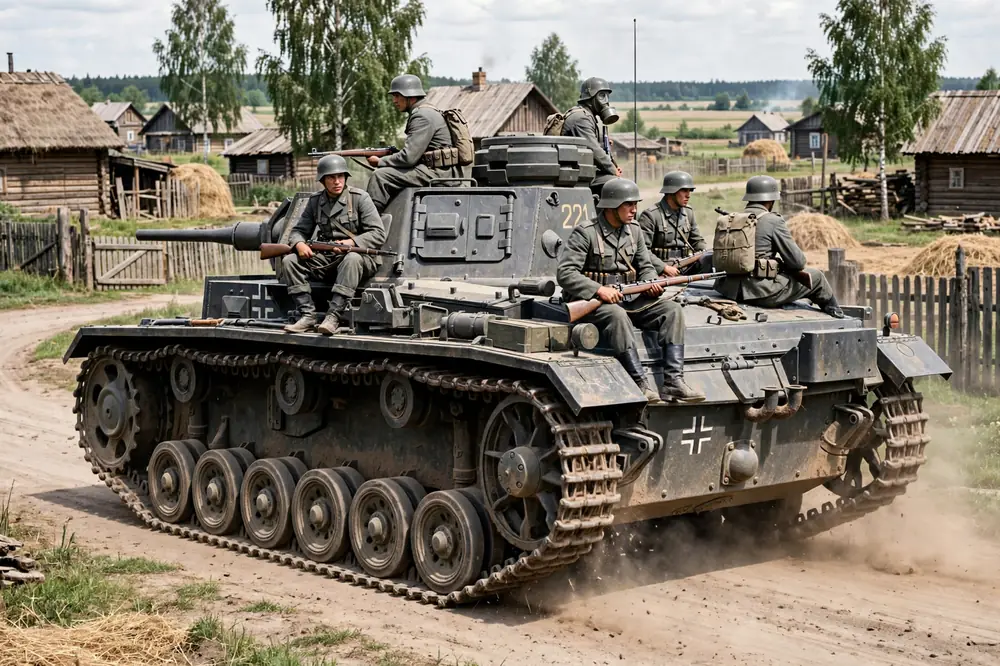
The Axis invasion force was the largest ever assembled. Germany committed 153 divisions, including 19 panzer divisions and 15 motorised divisions, with about 3,600 tanks, 7,000 artillery pieces and 2,700 aircraft. They were joined by the armies of Finland in the north, Romania in the south, and later Hungary, Italy, Slovakia and Croatia, bringing the total to about 3.5 million men. The German Army of 1941 was the finest fighting force in the world: its officers and men were veterans of Poland, France and the Balkans, its panzer divisions were the model of mobile warfare, and its Luftwaffe, under Hermann Göring, had destroyed every air force it had met.
| Axis | Soviet Union | |
|---|---|---|
| Men | About 3.5 million (3 million German) | About 2.9 million in the western districts; 5 million total |
| Divisions | 153 German divisions, plus Finnish, Romanian and others | About 170 divisions in the west, many understrength |
| Tanks | About 3,600 (Panzer III and IV, plus Czech-built tanks) | About 11,000, mostly light BT and T-26; about 1,500 T-34 and KV |
| Aircraft | About 2,700 (Luftwaffe) | About 9,000, mostly obsolete |
| Artillery | About 7,000 guns | About 33,000 guns, many obsolete or lacking transport |
| Army groups | North (Leeb), Centre (Bock), South (Rundstedt) | Western, Northwestern, Southwestern and Southern Fronts |
The Soviet forces facing the invasion were organised into four Fronts — the Soviet term for an army group — along the border: the Northwestern Front in the Baltic, the Western Front in Belorussia, the Southwestern Front in Ukraine and the Southern Front in Moldavia. On paper they outnumbered the Germans in tanks and aircraft, but the numbers were misleading.
The Soviet tanks were spread thinly among the divisions, their radios were few, their crews were untrained, and their commanders had no experience of large-scale mobile warfare. The Soviet Air Force lost most of its aircraft on the ground in the first days: the Luftwaffe claimed more than 1,800 Soviet aircraft destroyed on 22 June alone, and more than 3,000 in the first week.
The Soviet command system, built around Stalin’s personal control, was slow and rigid; orders from Moscow took hours to arrive, and by the time they did, the situation had changed.
The German advantage was not in numbers but in organisation, training and doctrine. The panzer divisions were combined-arms formations, with tanks, motorised infantry, artillery and engineers working together under radio control, and they were commanded by officers who had practised the doctrine for years. The Soviet advantage, which would only become clear over time, was depth: the Soviet Union could trade space for time, raise new armies from its vast population, and move its factories east of the Urals, beyond the reach of German bombers. In June 1941 none of that was yet visible. What was visible was a German Army at the peak of its power, attacking a Soviet Army at its weakest.
5. The Battle
The frontier battles, June–July 1941
The invasion began at 03:15 on 22 June 1941, along the whole front, without a declaration of war. German artillery opened fire, the Luftwaffe struck the Soviet airfields, and the panzer divisions crossed the border. The Soviet frontier troops, outnumbered and under orders not to provoke the enemy, were overrun. In the north, Army Group North advanced through Lithuania and Latvia towards Leningrad.
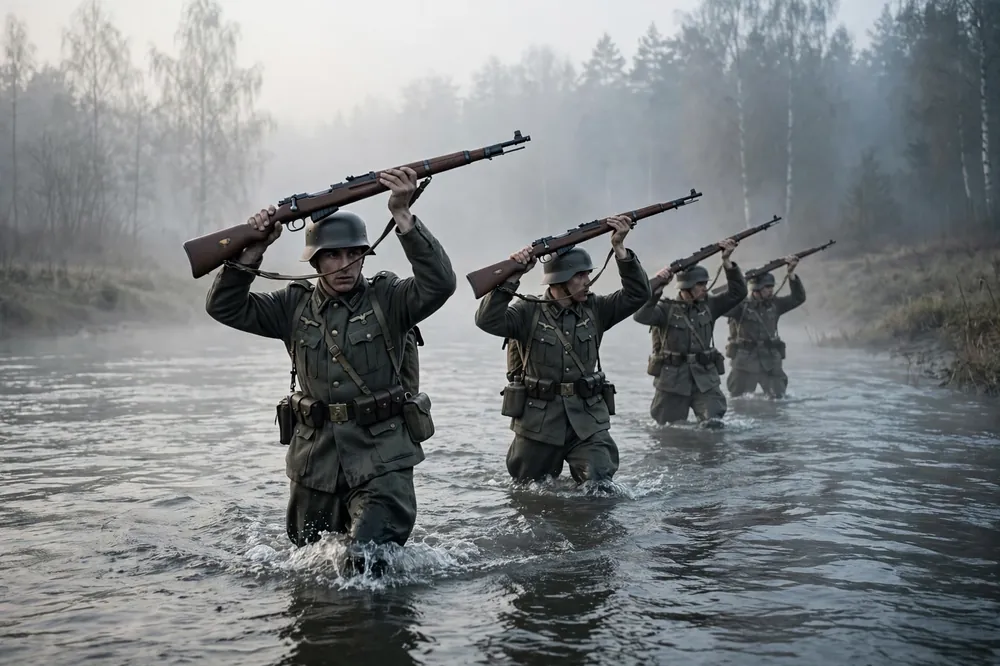
In the centre, the two panzer groups of Army Group Centre — Guderian’s 2nd Panzer Group and Hoth’s 3rd Panzer Group — drove deep into Belorussia, and by 28 June they had met east of Minsk, trapping the Soviet Western Front in a pocket. About 300,000 Soviet soldiers were taken prisoner at Minsk, and the Western Front was effectively destroyed.
In the south, Army Group South advanced more slowly through Ukraine, meeting the strongest Soviet resistance; the Soviet mechanised corps there launched counterattacks with hundreds of tanks, including T-34s and KVs, but the attacks were uncoordinated and were destroyed piecemeal by German anti-tank guns and aircraft.
The pattern repeated itself through the summer: German panzer pincers closed around Soviet armies, the infantry marched in to reduce the pockets, and hundreds of thousands of Soviet soldiers were taken prisoner. At Smolensk in July, two more Soviet armies were encircled, with about 300,000 prisoners.
At Kyiv in September, the largest encirclement of the war to that point trapped four Soviet armies — about 600,000 men, according to German claims, though Soviet sources give a lower figure — in a pocket east of the city. The German advance seemed unstoppable. By September the Germans had advanced 600 to 900 kilometres, had taken Minsk, Smolensk and Kyiv, and had reached the outskirts of Leningrad.
The Soviet Union had lost, by German estimates, more than 3 million men killed or captured, and the German General Staff believed the Red Army was finished.
But the advance was already slowing. The German supply lines stretched hundreds of kilometres over poor Soviet roads, and the panzer divisions were losing tanks to mechanical breakdown as fast as to enemy action. The Soviet Union was raising new armies: by the autumn of 1941, the Red Army had mobilised millions of reservists, and new divisions were forming behind the front. And in August, Hitler made the decision that historians still debate: instead of driving straight on Moscow, he ordered Army Group Centre’s panzers to turn south to help encircle the Soviet armies at Kyiv. The delay cost the Germans six weeks, and it cost them the summer.
The drive on Moscow, October–December 1941
The offensive against Moscow, codenamed Operation Typhoon, began on 30 September 1941. Army Group Centre, reinforced with the panzer groups returned from Kyiv, struck at the Soviet Western Front and encircled two more Soviet armies at Vyazma and Bryansk, taking about 600,000 prisoners. The road to Moscow seemed open. The German armies advanced through October, and by mid-October they were within 100 kilometres of the capital. The Soviet government evacuated to Kuibyshev, on the Volga, and Moscow prepared for a siege: anti-tank ditches were dug around the city, and the population was mobilised to defend it.
Then the weather changed. October brought the rasputitsa, the season of mud, when the autumn rains turned the Soviet roads into impassable quagmires. The German advance slowed to a crawl; tanks and trucks sank to their axles, and the supply columns could not keep up. In November the frost came, and then the cold: temperatures fell to minus 20, then minus 30, then minus 40 degrees Celsius. The German troops, who had been given no winter clothing, froze in their summer uniforms. Engines would not start, guns jammed, and frostbite disabled more men than Soviet bullets. The German Army was at the end of a supply line 1,000 kilometres long, fighting in a winter it had not prepared for.
The Soviet Union, meanwhile, had received two pieces of good news. The first was intelligence: Richard Sorge reported from Tokyo that Japan would not attack the Soviet Union in the Far East, and Stalin was able to transfer fresh, well-equipped divisions from Siberia to the Moscow front. The second was the man Stalin put in charge of the defence: General Georgy Zhukov, who had been recalled from Leningrad and given command of the Western Front. Zhukov organised the defence of Moscow in depth, with successive lines of trenches, anti-tank guns and artillery, and he husbanded his reserves for a counterattack.
The Soviet counterattack
On 5 December 1941, with the German advance stalled within sight of Moscow — the furthest German patrols reached the village of Khimki, about 20 kilometres from the Kremlin — Zhukov launched the counteroffensive. Fresh Siberian divisions, in white winter camouflage and on skis, struck the exhausted German flanks, and the German armies were driven back 100 to 250 kilometres in the following weeks. The German Army suffered its first major defeat of the war, and the myth of its invincibility was broken. Hitler, who had already dismissed the commander-in-chief of the Army, Brauchitsch, took personal command and ordered the army to stand fast — a decision that probably saved it from a rout, at the cost of enormous suffering.
The counterattack did not destroy the German Army, and the war in the east would go on for three and a half more years. But it proved that the Soviet Union would not collapse, that the German plan had failed, and that Barbarossa, the campaign meant to last eight weeks, had become a war the German economy and the German Army were not prepared to fight.
6. Turning Point
The turning point of Operation Barbarossa was not a single battle but the moment, in December 1941, when the German offensive ran out of men, machines and weather — and the Soviet Union did not collapse. Three things decided it.
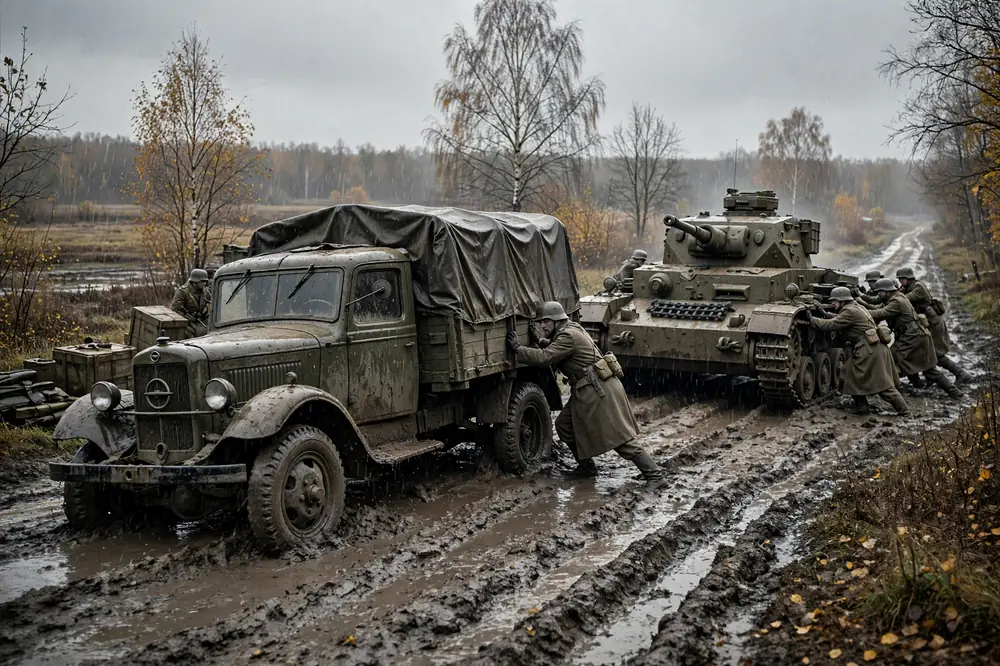
The first was the failure of the plan itself. Barbarossa assumed that the Red Army would be destroyed in the border regions and that the Soviet state would fall. Instead, the Soviet Union raised new armies faster than the Germans could destroy the old ones. By December 1941 the Red Army had mobilised millions of reservists, and the German intelligence estimate of Soviet strength — about 200 divisions — had been proved wrong by a factor of two: the Soviet Union had raised more than 400 divisions by the end of the year. The German Army was fighting a country it had fundamentally underestimated.
The second was the diversion to Kyiv. Hitler’s decision in August to turn the panzers south cost the Germans the summer and the chance to take Moscow before the mud and the cold. The argument is still debated — the Kyiv encirclement destroyed four Soviet armies, and Moscow’s defences were strengthening every week — but the delay is a fact, and the weather that followed it was decisive. Had the Germans reached Moscow in September, the city might have fallen. They reached it in December, in minus 40 degrees, at the end of a supply line they could not sustain.
The third was the Soviet counterattack of 5 December. It was not a large offensive by the standards of the later war, but it was the first time the German Army had been driven back, and it proved that the Red Army could attack and win. It also proved that the German Army, for all its skill, was not invincible — and that the war in the east would be a long war, decided by industry, population and endurance, not by a single campaign. The German General Staff had planned for a war of eight weeks; it got a war of four years, in which the Soviet Union would lose about 27 million people and Germany would lose the war.
7. Casualties and Losses
The losses of Operation Barbarossa were on a scale no previous campaign had approached, and the figures remain the subject of research and dispute. The table below gives the commonly cited totals for the period 22 June to 5 December 1941.
| Axis | Soviet Union | |
|---|---|---|
| Killed, wounded and missing | About 830,000 German (plus Axis allies) | About 4.5 million, including over 3 million taken prisoner |
| Killed | About 180,000–200,000 German | About 800,000–1,000,000 (estimates vary widely) |
| Prisoners | Few | Over 3 million; most died in German captivity (see below) |
| Tanks | About 2,700 lost | About 20,000 lost or captured |
| Aircraft | About 2,000 lost | About 10,000–12,000 lost |
The Soviet prisoner figures demand a separate note, because they are among the great crimes of the war. Of the roughly 3 million Soviet soldiers taken prisoner in 1941, about 2 million died in German captivity by the spring of 1942 — of starvation, exposure, disease and murder.
The German Army and the SS deliberately withheld food and shelter from Soviet prisoners, in accordance with the Nazi view of Slavs as subhuman and with the “Commissar Order” of June 1941, which ordered the summary execution of Soviet political officers.
The death rate among Soviet prisoners — about 60 per cent — stands in grim contrast to the death rate among British and American prisoners in German hands, which was about 3 to 4 per cent. This was not a by-product of the fighting; it was policy.
Behind the front lines, the war was even worse. The Einsatzgruppen — mobile SS killing squads — followed the army into the Soviet Union and murdered about 1 million Jews, Communists, Soviet officials and others in 1941 alone. The siege of Leningrad, which began in September 1941 and lasted until January 1944, killed about 1 million civilians by starvation and cold. The German occupation of the Soviet Union, guided by the “Hunger Plan” to feed the German Army from Soviet food at the expense of the Soviet population, killed millions more. The total Soviet death toll of the war — about 27 million, military and civilian — was the largest of any country, and it began with Barbarossa.
8. Map and Geography
The geography of Barbarossa was the geography of the Soviet Union itself: immense, flat and, for an invader, deceptive. The front stretched from the Baltic Sea in the north to the Black Sea in the south, about 3,000 kilometres, and the depth of the country — the distance from the border to Moscow is about 1,000 kilometres, and to the Urals more than 2,000 — meant that every German advance lengthened the supply lines and shortened the time available before winter.
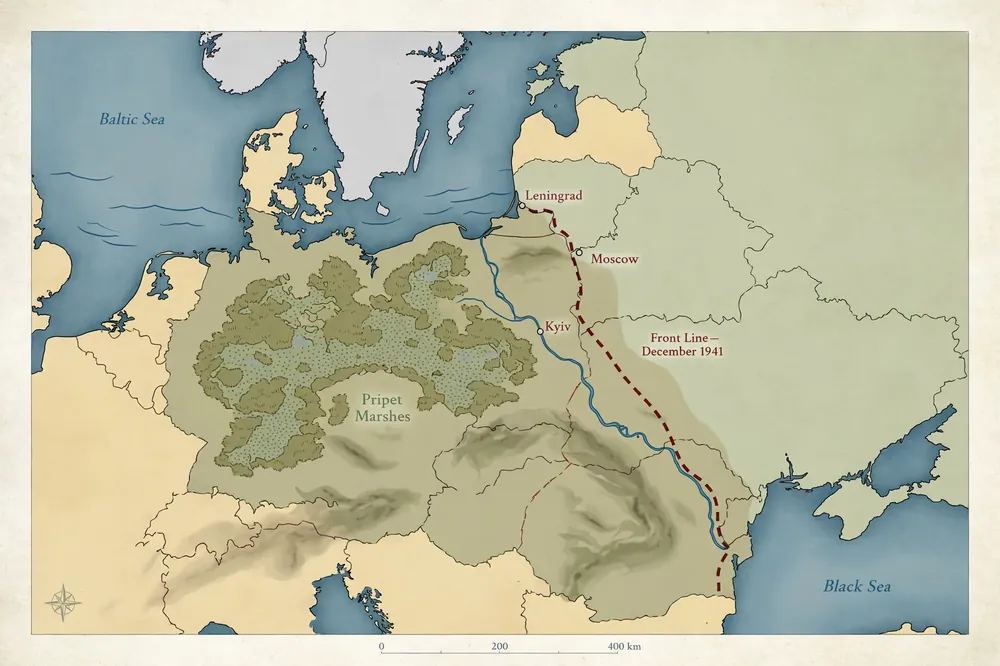
The western Soviet Union is a vast plain, broken by great rivers that run north to south — the Dvina, the Dnieper, the Don and the Volga — and each river was a natural defensive line that the Red Army tried to hold and the Germans had to cross.
The Pripet Marshes, a huge area of swamp and forest between Belorussia and Ukraine, split the front in two and channelled the German advance to the north and south of it.
The climate was the invader’s second enemy. The summer was hot and dusty, the autumn brought the rasputitsa, when rain turned the unpaved roads to mud, and the winter brought temperatures that German equipment and German clothing were not built for. The Soviet railways used a wider gauge than the German ones, so every supply train had to be unloaded and reloaded at the border, or the track had to be re-laid — a slow process that kept the German supply system permanently behind the front. The Germans captured Soviet railways and rolling stock, but never enough, and the trucks that carried supplies forward wore out on the bad roads.
The geography also worked for the Soviet Union in the long run. The factories of the western Soviet Union were dismantled and moved east, beyond the Urals, where German bombers could not reach them; by the end of 1941, more than 1,500 factories had been moved, and they were producing tanks and aircraft again within months. The population of the Soviet Union — about 190 million people — was more than twice Germany’s, and the Soviet Union could raise new armies from its reserves. The land itself was the Soviet Union’s greatest ally: it swallowed the German Army, stretched its supply lines, and froze it in the winter of 1941.
9. Outcome and Legacy of Operation Barbarossa
Operation Barbarossa failed in its purpose. It did not destroy the Red Army, it did not destroy the Soviet state, and it did not win the war in eight weeks. Instead it opened a front that consumed the German Army: by 1945, about 80 per cent of all German combat deaths in the Second World War were on the Eastern Front. The battles that followed Barbarossa — Stalingrad, Kursk, the siege of Leningrad, the Battle of Berlin — were the largest and deadliest battles in history, and they were fought because Barbarossa had failed to end the war in 1941.
The operation’s legacy is also a moral one. Barbarossa was conceived as a war of annihilation — a Vernichtungskrieg — and it was fought as one. The Commissar Order, the murder of Soviet prisoners, the Einsatzgruppen, the siege of Leningrad and the Hunger Plan were not excesses of the campaign; they were part of its design, ordered from the top and carried out by the Army as well as the SS.
The German Army’s complicity in these crimes, long denied after the war, is now established by historians beyond doubt. Barbarossa is remembered not only as the largest invasion in history but as the beginning of the greatest crime of the war: the murder of millions of Soviet civilians and prisoners, and the Holocaust, which moved from mass shootings in the east to the extermination camps in 1942.
For the Soviet Union, Barbarossa was the defining event of the war — the Great Patriotic War, as it is still called in Russia — and its memory shapes Russian identity to this day. The victory of 1945 was bought at a price of about 27 million dead, and the war’s memorials, from the Motherland Calls statue at Volgograd to the Tomb of the Unknown Soldier in Moscow, commemorate a sacrifice on a scale no other country endured.
For Germany, Barbarossa was the decision that lost the war: the invasion opened a two-front war that Germany could not win, and the armies that marched into the Soviet Union in June 1941 never came home. The Eastern Front, opened by Barbarossa, was where the Second World War was decided.
10. Commanders
Adolf Hitler (Germany). Supreme commander of the German armed forces and the author of Barbarossa. Hitler conceived the invasion, set its aims — the destruction of the Soviet Union and the conquest of Lebensraum — and intervened repeatedly in its conduct, most fatefully in the diversion to Kyiv in August 1941 and in the order to stand fast before Moscow in December. His insistence on holding ground and his refusal to allow retreats would shape the Eastern Front for the rest of the war.
Field Marshal Fedor von Bock (Germany). Commander of Army Group Centre, the strongest of the three army groups and the one charged with the drive on Moscow. Bock was one of Germany’s most experienced commanders, a veteran of the First World War and of the campaigns in Poland and France. He was dismissed by Hitler in December 1941, during the Soviet counteroffensive before Moscow.
General Heinz Guderian (Germany). Commander of the 2nd Panzer Group, the leading armoured force of Army Group Centre. Guderian was the chief theorist of the panzer arm and the author of Achtung – Panzer!; his tanks led the advance to Minsk, Smolensk and Kyiv, and then to the gates of Moscow. He was dismissed in December 1941 after clashing with Hitler over the retreat from Moscow.
Field Marshal Gerd von Rundstedt (Germany). Commander of Army Group South, which drove through Ukraine to Kyiv and the Donets Basin. Rundstedt, the oldest of the German field marshals, was dismissed in December 1941 and later commanded in the west, including during the Normandy campaign.
Joseph Stalin (Soviet Union). Leader of the Soviet Union and supreme commander of its armed forces. Stalin’s refusal to believe the invasion was coming contributed to the disaster of June 1941, but he remained in Moscow during the crisis of October 1941, took direct control of the war effort, and appointed Zhukov to defend the capital. His leadership — ruthless, centralised and, after 1941, increasingly reliant on his generals — carried the Soviet Union through the war.
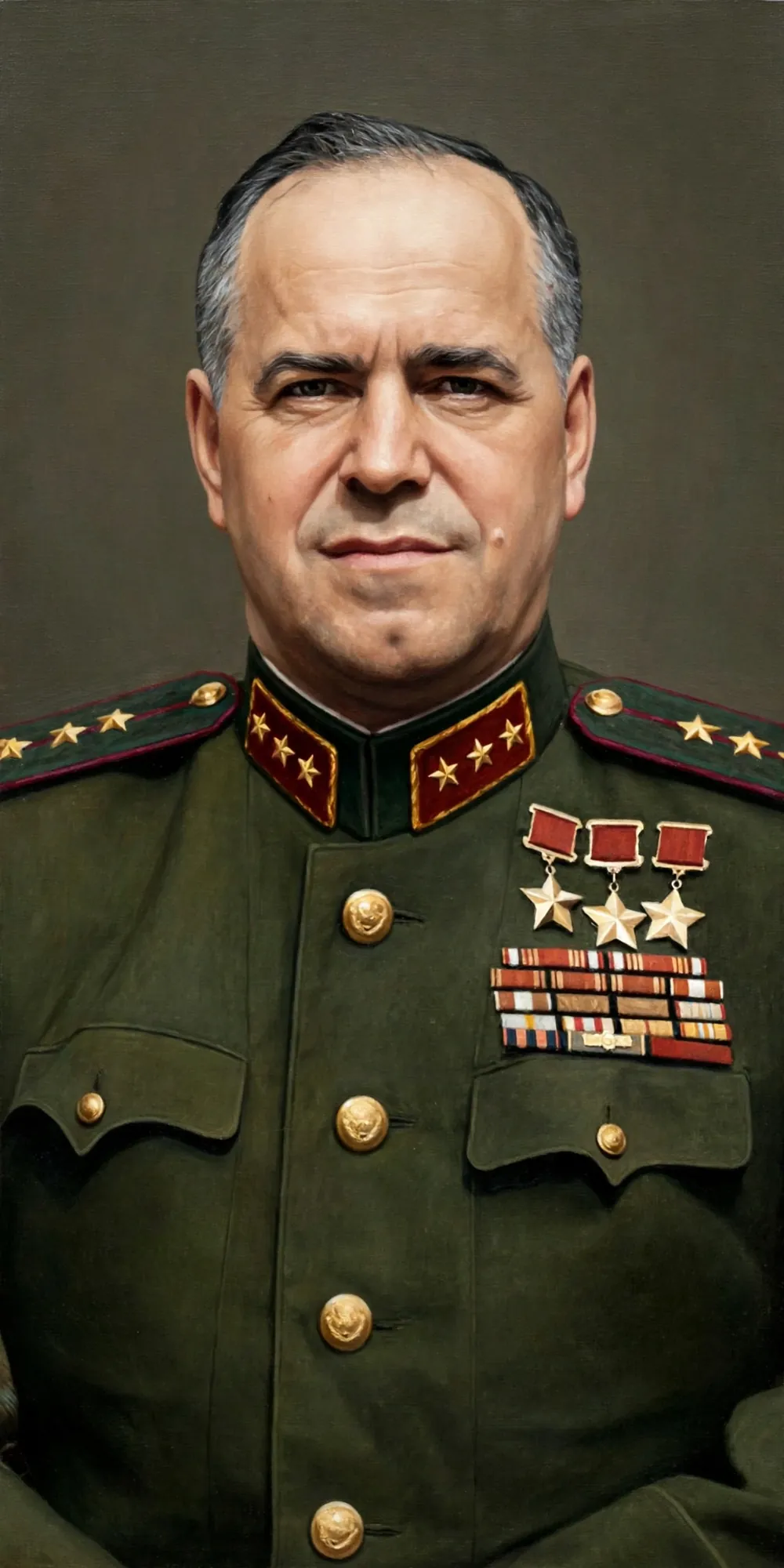
General Georgy Zhukov (Soviet Union). Chief of the General Staff at the start of the invasion, and the commander who organised the defence of Moscow in the autumn of 1941 and launched the counteroffensive of 5 December. Zhukov went on to command at Stalingrad, Kursk and Berlin, and became the Soviet Union’s most celebrated general of the war.
Marshal Semyon Timoshenko (Soviet Union). Commander of the Western Front in the first weeks of the invasion, and later commander of the Southwestern Front. Timoshenko, a veteran of the Russian Civil War, was one of the few senior Soviet commanders to survive the purges, and he held the front together during the catastrophic summer of 1941.
Frequently Asked Questions
Related articles
Sources
- Wikipedia, “Operation Barbarossa” — dates, strength, casualty figures and the course of the campaign.
- Encyclopædia Britannica, “Operation Barbarossa” — background, Hitler’s aims and the failure of the campaign.
- David M. Glantz and Jonathan House, When Titans Clashed: How the Red Army Stopped Hitler (University Press of Kansas, 1995) — the standard English-language operational history of the Eastern Front.
- Richard Overy, Russia’s War (Penguin, 1997) — the Soviet experience of the war, including the prisoner deaths and the evacuation of industry.
- Evan Mawdsley, Thunder in the East: The Nazi–Soviet War 1941–1945 (Bloomsbury, 2005) — the campaign, the Kyiv diversion and the battle for Moscow.
- Chris Bellamy, Absolute War: Soviet Russia in the Second World War (Macmillan, 2007) — Soviet mobilisation, the purges and the winter of 1941.
- Alan Clark, Barbarossa: The Russian–German Conflict 1941–45 (William Morrow, 1965).
- Geoffrey P. Megargee, War of Annihilation: Combat and Genocide on the Eastern Front, 1941 (Rowman & Littlefield, 2006).