 WAR ATLAS MILITARY HISTORY MAGAZINE · WWI — WWII
Battle of Okinawa
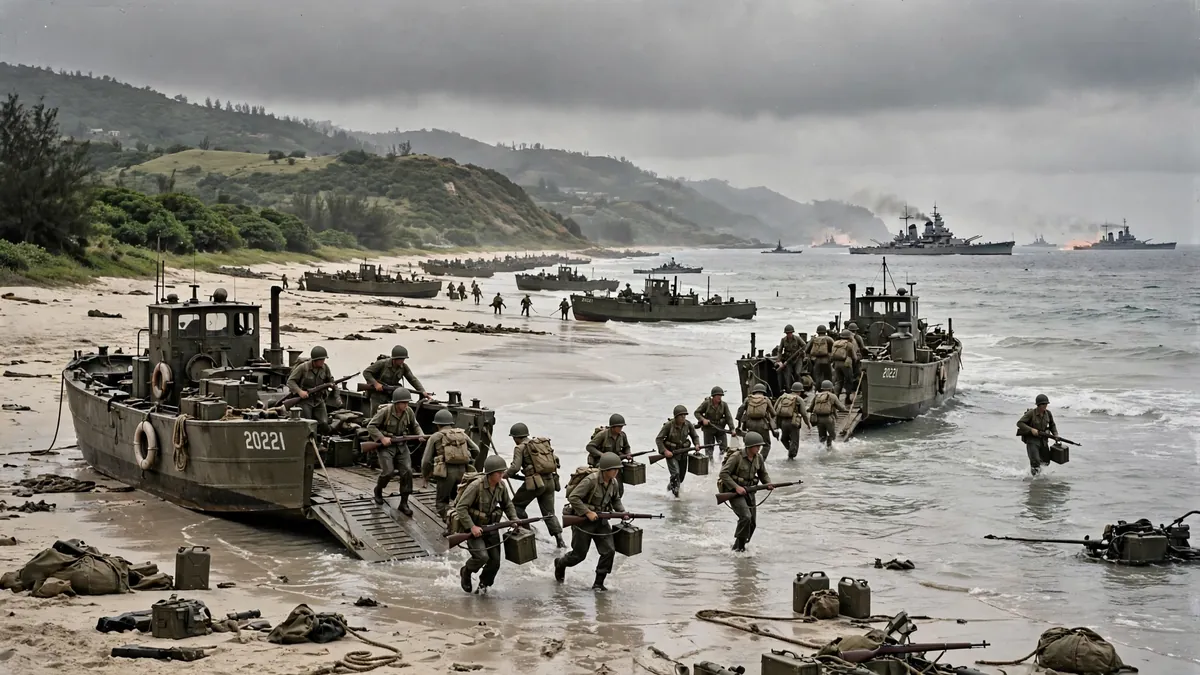
The Battle of Okinawa was the last great battle of the Pacific War, fought from 1 April to 22 June 1945 on the island of Okinawa, the largest of the Ryukyu Islands, about 550 kilometres south of the Japanese home islands.
It was the largest amphibious assault of the Pacific War — larger than the landings at Normandy in the number of ships involved — and it was the bloodiest: more than 200,000 people died, including about 12,500 Americans, about 110,000 Japanese soldiers, and more than 100,000 Okinawan civilians, many of them killed by Japanese troops, by American bombardment, or by their own hands.
The battle was fought in the rain and the mud, in caves and on ridgelines, and in the air and at sea, where the Japanese kamikaze — the “divine wind” — sank 34 American ships and damaged hundreds more. Okinawa was the battle that convinced the American command that an invasion of Japan itself would cost a million casualties — and it was one of the reasons the atomic bomb was used.
1. Key Facts
| Date | 1 April – 22 June 1945 |
| Location | Okinawa, Ryukyu Islands, Japan |
| Result | Allied victory; island captured; heavy losses on both sides and among civilians |
| Allied commanders | Lt. Gen. Simon Bolivar Buckner Jr. (10th Army; killed 18 June); Maj. Gen. Roy Geiger (acting, after Buckner); Adm. Raymond Spruance (5th Fleet) |
| Japanese commanders | Lt. Gen. Mitsuru Ushijima (32nd Army; killed 22 June); Lt. Gen. Isamu Chō (chief of staff; killed 22 June) |
| Allied strength | About 183,000 troops (10th Army: 4 Army divisions, 3 Marine divisions); 1,300 ships, 1,000 aircraft |
| Japanese strength | About 110,000 troops (32nd Army: 2 infantry divisions, 1 independent mixed brigade, plus naval and air units); about 40,000 Okinawan conscripts and labourers |
| Allied losses | About 12,500 killed, about 38,000 wounded (Army and Marines); 34 ships sunk, 368 damaged; 763 aircraft lost |
| Japanese losses | About 110,000 soldiers killed; about 7,000 taken prisoner; about 1,900 kamikaze aircraft lost |
| Civilian losses | Over 100,000 Okinawan civilians killed (estimates range from 100,000 to 150,000) |
2. Background
Okinawa was the last step before Japan itself. After the Battle of Iwo Jima in February–March 1945, the Americans needed an air base closer to Japan than Iwo Jima, and a staging area for the invasion of the home islands, planned for late 1945 under the codename Operation Downfall. Okinawa, the largest island in the Ryukyu chain, was the answer: it was about 550 kilometres from Kyushu, the southernmost home island, and its airfields, once captured, would put American bombers and fighters within range of Japan. The island was also a prefecture of Japan — its people were Japanese citizens, though the Okinawans, with their own language and culture, had long been treated as second-class citizens by Tokyo.
The Japanese knew Okinawa would be attacked, and they prepared for it. The island was defended by the 32nd Army under Lieutenant General Mitsuru Ushijima, a quiet, thoughtful officer who had served in Manchuria and who understood that the Japanese could not win a battle on the beaches.
Ushijima’s plan was the opposite of the beach defence that had failed at Tarawa, Saipan and Iwo Jima: he would let the Americans land unopposed, and then fight them from a series of fortified ridgelines in the south of the island — the Shuri Line, a line of caves, tunnels, concrete pillboxes and artillery positions built into the coral ridges around the ancient castle town of Shuri.
The Japanese had about 110,000 troops, including the 24th and 62nd Divisions, and they had stockpiled food and ammunition for a long siege. They also had the kamikaze: the airfields on Kyushu and Formosa (Taiwan) held about 2,000 aircraft, many of them assigned to suicide attacks on the American fleet.
The American plan, codenamed Operation Iceberg, was the largest amphibious operation of the Pacific War. The 10th Army, under Lieutenant General Simon Bolivar Buckner Jr. — the son of a Confederate general of the American Civil War — was made up of two corps: the III Amphibious Corps (Marines) under Major General Roy Geiger, and the XXIV Corps (Army) under Major General John Hodge.
The landing force was about 183,000 men, and the naval force, under Admiral Raymond Spruance, was about 1,300 ships, including 18 battleships, 40 aircraft carriers and hundreds of landing craft. The British Pacific Fleet, under Admiral Bruce Fraser, joined the operation, with four carriers, to cover the southern flank. The Americans expected the landing to be opposed on the beaches, as it had been at Iwo Jima.
They were wrong: the beaches were empty.
3. Opposing Forces
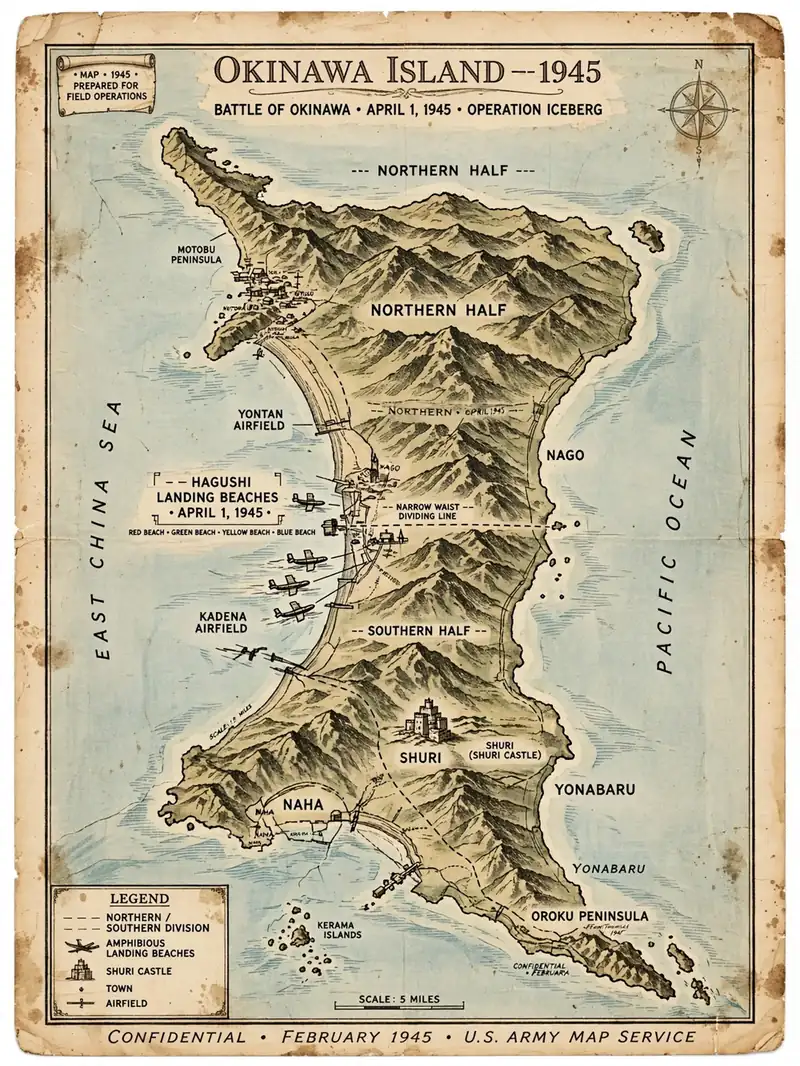
The American 10th Army was the largest ground force the United States had yet put ashore in the Pacific: four Army divisions (7th, 27th, 77th and 96th) and three Marine divisions (1st, 2nd and 6th), with artillery, tanks and engineers, supported by the 5th Fleet’s guns and aircraft and by the Army Air Forces. The Marines were to land on the western side of the island and drive north, to capture the airfields at Yontan and Kadena; the Army was to drive south, towards the Shuri Line. The two corps would then join for the assault on the south.
| United States | Japan | |
|---|---|---|
| Ground troops | About 183,000 (10th Army: 7 Army and Marine divisions) | About 110,000 (32nd Army: 24th and 62nd Divisions, 44th Independent Mixed Brigade, plus naval troops) |
| Tanks | About 800 (Sherman, plus Marine tanks) | About 60 (mostly light tanks) |
| Artillery | About 1,000 guns, plus naval gunfire from 18 battleships | About 300 guns, mostly in caves and tunnels |
| Aircraft | About 1,000 (carrier and land-based) | About 2,000, including about 1,900 kamikaze aircraft |
| Ships | About 1,300, including 18 battleships, 40 carriers | The battleship Yamato and its escorts (in Operation Ten-Go, 7 April) |
| Commanders | Buckner (10th Army); Geiger (III Amphibious Corps); Hodge (XXIV Corps); Spruance (5th Fleet) | Ushijima (32nd Army); Chō (chief of staff); Yahara (operations officer) |
The Japanese 32nd Army was outnumbered and outgunned, but it held the ground. Its positions on the Shuri Line were built into the coral ridges of southern Okinawa, and they were almost impervious to bombardment: the caves and tunnels, some of them 30 metres deep, survived the heaviest American shelling, and the Japanese artillery, firing from reverse slopes, could not be seen or hit by the American guns.
The Japanese infantry were veterans, and they were fighting on Japanese soil, for the first time in the war, with the knowledge that there was nowhere to retreat to. The Okinawan civilians — about 300,000 people on the island — were caught between the two armies: the Japanese conscripted about 40,000 of them as soldiers and labourers, and the rest were driven into the caves with the Japanese troops, where many of them died.
The kamikaze were the Japanese weapon that the Americans feared most. The word means “divine wind”, after the typhoons that destroyed the Mongol invasion fleets in the 13th century, and the kamikaze pilots were young men, many of them university students, who volunteered — or were ordered — to fly their aircraft into American ships. The kamikaze attacks at Okinawa, codenamed Kikusui (“floating chrysanthemum”), were the largest of the war: about 1,900 kamikaze aircraft were flown, and they sank 34 American ships and damaged 368 more, killing about 5,000 American sailors. The kamikaze were the reason the naval battle at Okinawa was the bloodiest of the Pacific War.
4. The Battle
The landing, 1 April 1945
The landing, on Easter Sunday, 1 April 1945, was the largest amphibious assault of the Pacific War, and it was almost unopposed. The 10th Army landed on the Hagushi beaches, on the west coast of Okinawa, in a stretch of about 8 kilometres, and by nightfall about 60,000 men were ashore.
The Japanese did not contest the landing: Ushijima’s plan was to let the Americans come ashore and then fight them in the south. The Americans, expecting a fight on the beaches, were surprised by the silence, and they advanced rapidly: the Marines drove north, and by 3 April they had captured the airfields at Yontan and Kadena; the Army drove south, and by 4 April it had reached the outskirts of the Shuri Line.
The northern half of the island was taken in about two weeks, with relatively light casualties. The southern half would take two months, and it would cost the Americans more casualties than any other battle of the Pacific War.
The Shuri Line
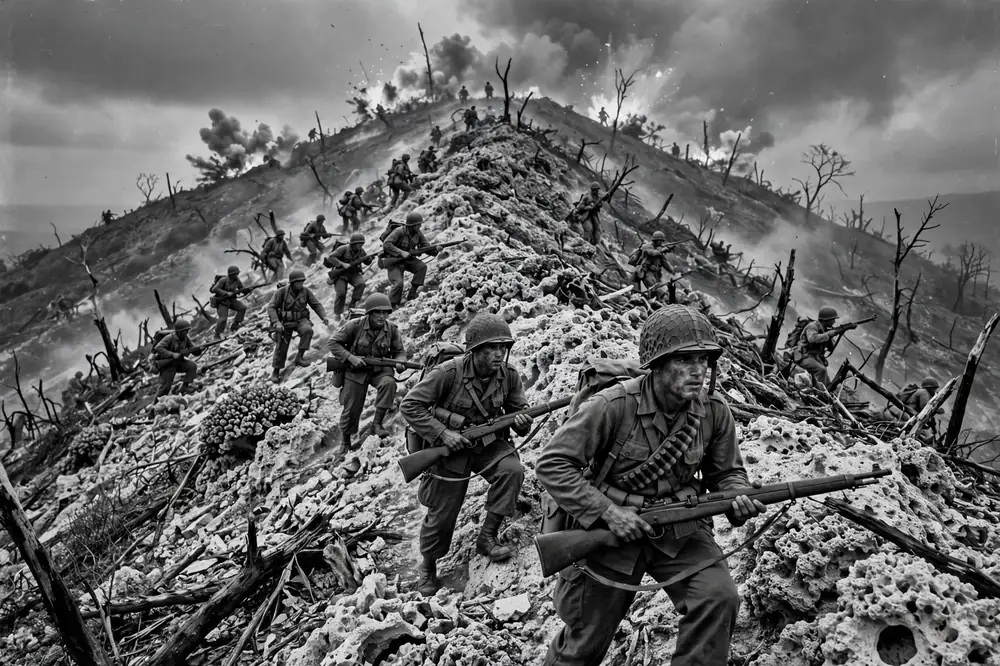
The Shuri Line was the heart of the battle. It was a line of ridges — Kakazu Ridge, Sugar Loaf Hill, the Horseshoe, the Half Moon — built into the coral of southern Okinawa, and it was defended by the 62nd Division, the best division in the 32nd Army. The American attack on the line began on 9 April, and it stalled almost at once.
The Japanese positions were in caves and tunnels, and the American artillery and naval gunfire, which had destroyed the beach defences at Iwo Jima, could not destroy them. The infantry attacks were met by machine-gun fire from positions that could not be seen, and by artillery fire from the reverse slopes.
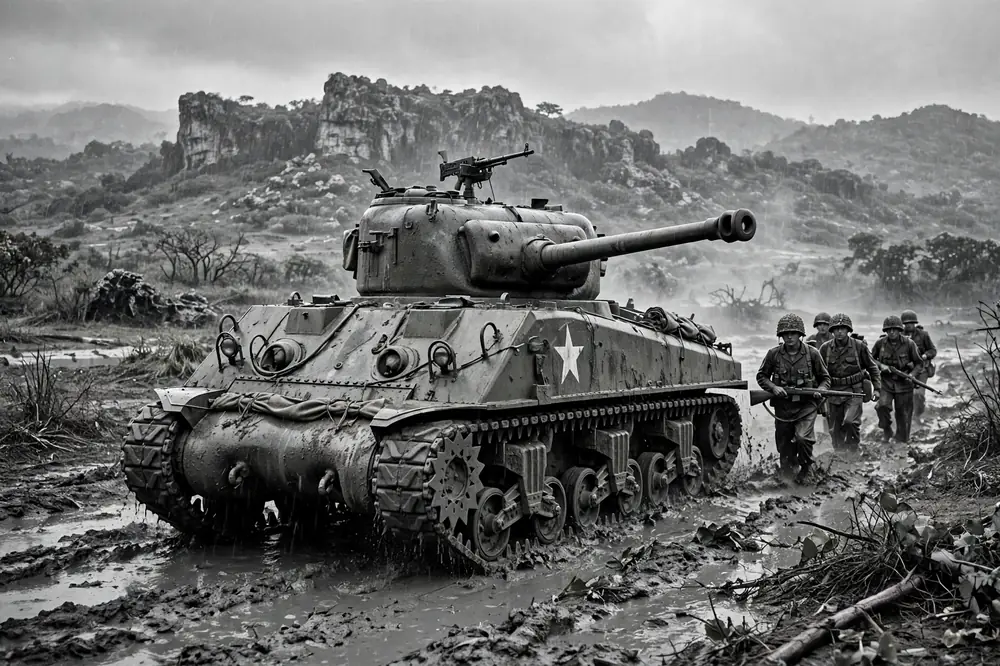
The fighting was at close quarters, in the rain and the mud, and it was fought hill by hill, cave by cave, with flamethrowers, satchel charges and grenades.
The worst of the fighting was at Sugar Loaf Hill, a small, steep hill that guarded the approaches to Shuri. The 6th Marine Division attacked Sugar Loaf on 12 May, and the hill changed hands eleven times in ten days. The Marines lost about 2,600 men taking it, and the Japanese lost about 3,000. The hill was, in the words of one Marine, “a meat grinder”.
The fighting at Kakazu Ridge, at the Horseshoe and at the Half Moon was the same: small hills, held by a few hundred Japanese, that cost the Americans hundreds of casualties each. The rain, which began in May and did not stop, turned the battlefield into a sea of mud, and the dead lay unburied in the rain.
The kamikaze and the Yamato
While the ground battle raged, the naval battle was fought offshore. The kamikaze attacks began on 6 April, with the first great Kikusui attack, and they continued, in waves, through April, May and June. The attacks were concentrated on the radar picket destroyers — the small ships stationed around the island to warn of incoming aircraft — and they were devastating: the destroyers were hit again and again, and the American sailors called their duty “the loneliest job in the Navy”.
The kamikaze sank 34 ships, including 3 destroyers sunk on a single day, 6 April, and damaged 368 more. About 5,000 American sailors were killed, and about 5,000 more were wounded. The kamikaze also sank the British carrier Formidable‘s aircraft and damaged the carrier Bunker Hill, killing 396 men in a single attack on 11 May.
On 7 April, the Japanese Navy made its last great sortie: the battleship Yamato, the largest battleship ever built, sailed from Japan with a cruiser and eight destroyers, on a one-way mission — Operation Ten-Go — to beach itself on Okinawa and fight as a shore battery. The Yamato never reached Okinawa: American carrier aircraft found it in the East China Sea and sank it, with the loss of about 3,000 of its crew. The Yamato‘s sinking was the end of the Japanese Navy as a fighting force.
The fall of Shuri and the end
The Shuri Line finally broke in late May. The Americans, after weeks of frontal attacks, outflanked the line: the 1st Marine Division drove around its western end, and the 77th Division drove around its eastern end, and on 29 May the Marines captured Shuri Castle, the ancient seat of the Ryukyu kings. Ushijima, his army broken, withdrew to the south, to the Kiyan Peninsula, and the Americans followed.
The last weeks of the battle were fought in the south, in the caves and on the cliffs of the Kiyan Peninsula, where the Japanese made their last stand. On 18 June, Lieutenant General Buckner, the American commander, was killed by a Japanese artillery shell while visiting the front — the highest-ranking American officer killed in the Pacific War.
He was replaced by Major General Roy Geiger, a Marine, who became the first Marine to command an army in the field. On 22 June, Ushijima and his chief of staff, Chō, committed ritual suicide — seppuku — in their cave headquarters, and the battle was over. The Americans had won, at a cost of about 12,500 killed and 38,000 wounded, and the Japanese had lost about 110,000 men.
The Okinawan civilians had lost more than 100,000.
5. Turning Point
The turning point of the Battle of Okinawa was the fall of the Shuri Line in late May 1945. The line had held for six weeks, and it had cost the Americans thousands of casualties, but once it was outflanked — by the Marines on the west and the 77th Division on the east — the Japanese Army was broken. Ushijima’s withdrawal to the Kiyan Peninsula was a retreat, not a redeployment, and the battle’s outcome was decided. The Japanese fought on for another month, in the caves of the south, but they were fighting a lost battle.
The second turning point was the kamikaze. The kamikaze attacks at Okinawa were the largest of the war, and they sank 34 ships and damaged 368 more, but they did not stop the invasion. The American fleet, though badly hurt, held its position, and the landing went ahead. The kamikaze proved that Japan would fight to the end, and that an invasion of the home islands would be even worse — and that proof was one of the reasons the Americans chose the atomic bomb over an invasion.
The third turning point was the death of General Buckner on 18 June. Buckner was the commander of the 10th Army, and his death, four days before the end of the battle, was a shock to the American command. His replacement, General Geiger, a Marine, finished the battle, and the Americans won. But Buckner’s death was a reminder of the battle’s cost: the Americans had lost a general, the Japanese had lost an army, and the Okinawans had lost a tenth of their population.
6. Casualties and Losses
The casualties of the Battle of Okinawa were the heaviest of any battle in the Pacific War, and the civilian losses were the heaviest of any battle in the war fought on Japanese soil. The table below gives the commonly cited totals.
| United States | Japan | Okinawan civilians | |
|---|---|---|---|
| Killed | About 12,500 (Army and Marines); about 5,000 Navy | About 110,000 soldiers | Over 100,000 (estimates 100,000–150,000) |
| Wounded | About 38,000 (Army and Marines); about 5,000 Navy | Few recorded | Unknown |
| Taken prisoner | Few | About 7,000 | — |
| Ships | 34 sunk, 368 damaged | Yamato and escorts sunk | — |
| Aircraft | 763 lost | About 1,900 kamikaze aircraft lost, plus others | — |
The American ground losses — about 12,500 killed and 38,000 wounded — were the heaviest of any single battle in the Pacific War, and they were higher, in absolute terms, than the American losses at Iwo Jima and at Tarawa combined. The naval losses — 34 ships sunk and 368 damaged, with about 5,000 sailors killed — were the heaviest naval losses of the war. The Japanese losses — about 110,000 soldiers killed, with only about 7,000 taken prisoner — were almost total: the 32nd Army was destroyed.
The civilian losses are the most terrible part of the battle. More than 100,000 Okinawan civilians died — about a third of the island’s population — killed by American bombardment, by Japanese troops who used them as shields or who ordered them to kill themselves, and by suicide.
The Japanese Army, retreating into the caves, drove the civilians into the caves with them, and when the Americans attacked the caves with flamethrowers and explosives, the civilians died with the soldiers. In some places, the Japanese ordered the civilians to kill themselves rather than surrender, and whole families died together.
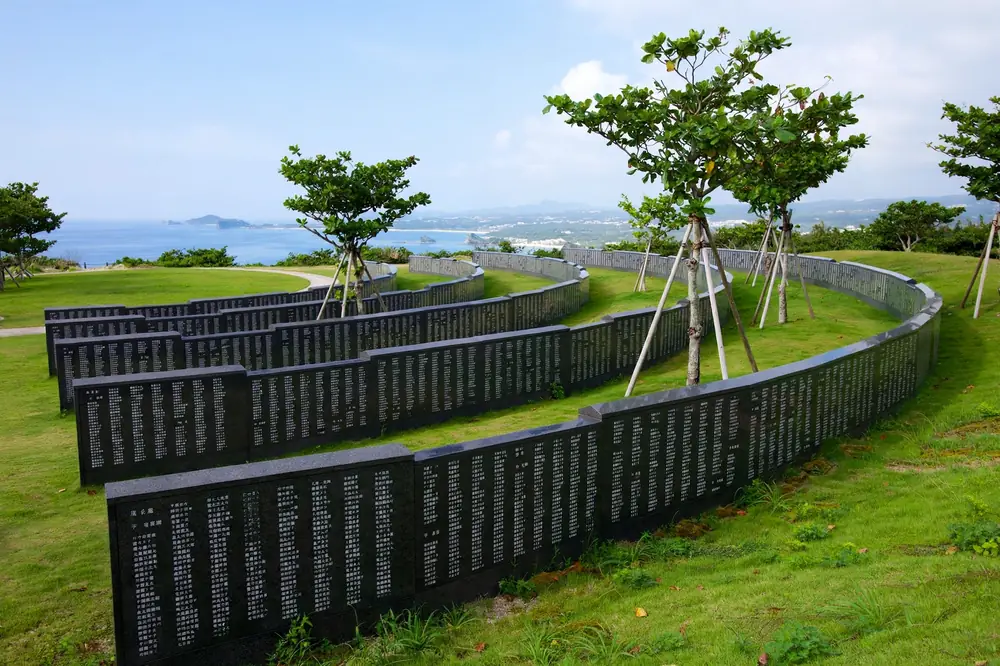
The Okinawan civilian dead are commemorated at the Cornerstone of Peace, a memorial at Mabuni, on the Kiyan Peninsula, where the names of the dead — Japanese, American and Okinawan — are carved in stone.
7. Map and Geography
Okinawa is the largest island in the Ryukyu chain, about 110 kilometres long and 10 to 15 kilometres wide, lying about 550 kilometres south of Kyushu, the southernmost of Japan’s home islands. The island is divided by the Ishikawa Isthmus into a northern half — the Motobu Peninsula and the Yambaru forest, mountainous and sparsely populated — and a southern half — the low, rolling country around Naha, Shuri and the Kiyan Peninsula, where most of the island’s population lived. The southern half was where the battle was fought, and its geography — the coral ridges, the caves and the tunnels — shaped the battle.
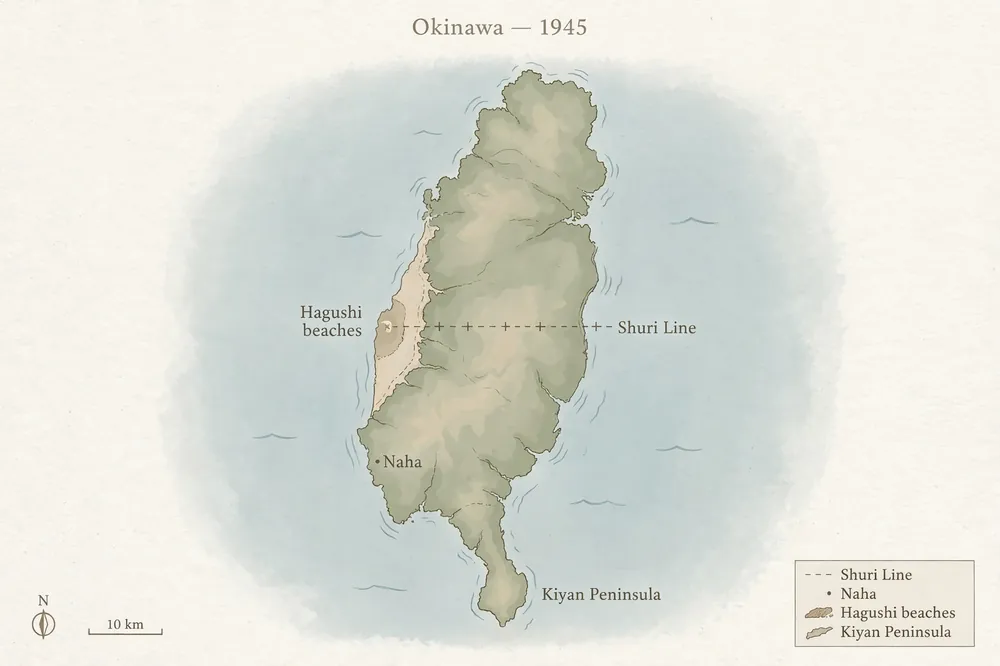
The coral ridges of southern Okinawa were the key to the Japanese defence. The ridges — Kakazu, Sugar Loaf, the Horseshoe, the Half Moon — were low, 50 to 100 metres high, but they were made of coral limestone, which was hard to dig through and which absorbed artillery fire.
The Japanese dug caves and tunnels into the ridges, some of them 30 metres deep, and they built concrete pillboxes and artillery positions that could not be destroyed by bombardment. The ridges gave the Japanese observation over the ground to the north, and they gave them a series of defensive lines that the Americans had to take one by one.
The rain, which began in May, turned the coral dust into mud, and the battlefield became a quagmire.
The island’s position — 550 kilometres from Japan — made it the ideal base for the invasion of the home islands, and it made it the target of the kamikaze. The airfields on Kyushu and Formosa were within range of Okinawa, and the kamikaze could reach the American fleet in an hour. The sea around Okinawa was the scene of the naval battle, and the radar picket destroyers, stationed in a ring around the island, were the first line of defence against the kamikaze. The geography of Okinawa — an island, close to Japan, with airfields and harbours — was the reason it was attacked, and the reason the battle was so costly.
8. Outcome and Legacy of the Battle of Okinawa
The Battle of Okinawa ended on 22 June 1945, with the island in American hands. The Americans had won, but the cost — about 12,500 American dead, about 110,000 Japanese dead, and more than 100,000 Okinawan civilians dead — was the heaviest of the Pacific War, and it changed American thinking about the war.
The battle convinced the American command, and President Harry Truman, that an invasion of Japan itself — Operation Downfall, planned for November 1945 — would cost a million American casualties, and it was one of the reasons the atomic bomb was used on Hiroshima and Nagasaki in August 1945.
The bomb, and the Soviet Union’s declaration of war on Japan, ended the war without an invasion, and Okinawa was the last great battle of the Pacific War.
Okinawa’s legacy in Japan is a painful one. The island was the only part of Japan where a land battle was fought, and its people suffered more than any other Japanese civilians in the war. The Okinawan civilian dead — more than 100,000 — are remembered at the Cornerstone of Peace, and the battle is still, in Okinawa, a living memory: the caves, the tunnels and the memorials are part of the island’s landscape, and the American bases that were built on Okinawa after the war — and that remain there today — are a reminder of the battle’s consequences.
The Okinawans, who had long been treated as second-class citizens by Tokyo, felt abandoned by the Japanese Army, which used them as shields and ordered them to die, and they felt betrayed by the American occupation, which took their land for bases. The battle’s legacy, in Okinawa, is a legacy of suffering and of a distinct Okinawan identity.
Militarily, Okinawa was the end of the Japanese Army as a fighting force in the Pacific, and the end of the kamikaze as a weapon. The 32nd Army was destroyed, the Yamato was sunk, and the Japanese air force was spent.
The battle also showed the limits of the kamikaze: the suicide attacks sank 34 ships and damaged 368 more, but they did not stop the invasion, and they cost Japan about 1,900 aircraft and their pilots — men it could not replace. The battle’s lesson, for the Americans, was that Japan would fight to the end, and that the end would be costly.
The atomic bomb, and the Soviet invasion of Manchuria, ended the war before the Americans had to learn that lesson again.
9. Commanders
Lieutenant General Simon Bolivar Buckner Jr. (United States). Commander of the 10th Army, which landed at Okinawa. Buckner was the son of a Confederate general, and he had commanded the Alaska Defense Command before Okinawa. He was killed by a Japanese artillery shell on 18 June 1945, four days before the end of the battle, while visiting the front. He was the highest-ranking American officer killed in the Pacific War.
Major General Roy Geiger (United States). Commander of the III Amphibious Corps (Marines) at Okinawa, and the officer who succeeded Buckner as commander of the 10th Army after Buckner’s death. Geiger was the first Marine to command an army in the field, and he finished the battle. He later commanded the Fleet Marine Force, Pacific.
Admiral Raymond Spruance (United States). Commander of the 5th Fleet, which covered the Okinawa operation. Spruance, who had commanded at Midway, was the naval commander of the battle, and he held the fleet in position despite the kamikaze attacks. He later became Chief of Naval Operations.
Lieutenant General Mitsuru Ushijima (Japan). Commander of the 32nd Army, which defended Okinawa. Ushijima was a quiet, thoughtful officer who had served in Manchuria, and his plan — to let the Americans land and then fight them from the Shuri Line — was the best defence Japan could mount. He committed seppuku on 22 June 1945, in his cave headquarters, rather than surrender.
Lieutenant General Isamu Chō (Japan). Chief of staff of the 32nd Army, and the officer who pushed for the counterattack of 4 May 1945, which failed with heavy losses. Chō committed seppuku with Ushijima on 22 June 1945.
Colonel Hiromichi Yahara (Japan). Operations officer of the 32nd Army, and the officer who opposed Chō’s counterattack and who argued for a defensive battle. Yahara survived the battle, was taken prisoner, and wrote the best-known Japanese account of Okinawa, The Battle for Okinawa.
Frequently Asked Questions
Related articles
Sources
- Wikipedia, “Battle of Okinawa” — dates, strength, casualty figures (about 12,500 American killed, about 110,000 Japanese killed, over 100,000 Okinawan civilians) and the course of the battle.
- Encyclopædia Britannica, “Battle of Okinawa” — background, the Shuri Line and the kamikaze.
- US Army Center of Military History, Okinawa: The Last Battle — the official history of the ground battle.
- George Feifer, Tennozan: The Battle of Okinawa and the Atomic Bomb (Ticknor & Fields, 1992) — the battle, the civilian losses and the decision to use the atomic bomb.
- Hiromichi Yahara, The Battle for Okinawa (John Wiley & Sons, 1995) — the Japanese operations officer’s account of the battle.
- Benis M. Frank and Henry I. Shaw Jr., Victory and Occupation: History of U.S. Marine Corps Operations in World War II, Vol. V — the Marine Corps’ history of Okinawa.
- E. B. Sledge, With the Old Breed: At Peleliu and Okinawa (Presidio Press, 1981) — the classic Marine memoir of the battle.
- Bill Sloan, The Ultimate Battle: Okinawa 1945 (Simon & Schuster, 2007).