 WAR ATLAS MILITARY HISTORY MAGAZINE · WWI — WWII
Battle of Britain
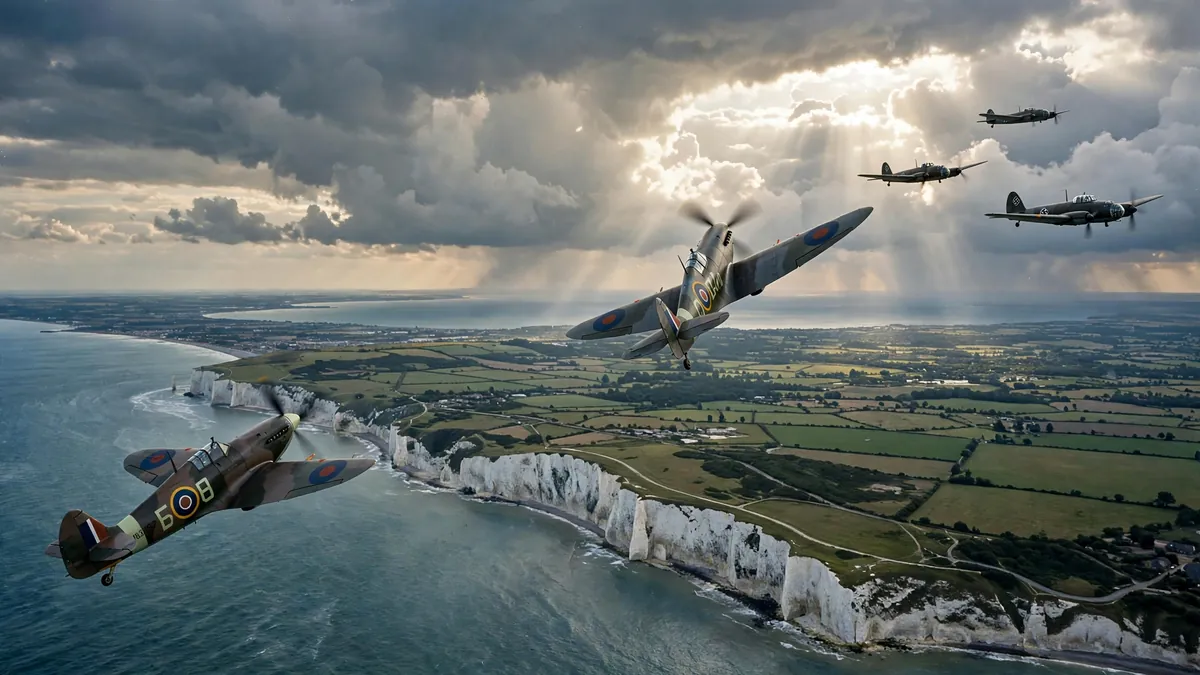
The Battle of Britain was the air battle fought over southern England in the summer and autumn of 1940, from July to October, between the Royal Air Force (RAF) and the German Luftwaffe. It was the first battle in history fought entirely in the air, and it was the first defeat of the German war machine: the Luftwaffe, which had destroyed the air forces of Poland, France and the Low Countries, failed to destroy the RAF, failed to win air superiority over the Channel, and forced Hitler to postpone — and then abandon — Operation Sea Lion, the invasion of Britain.
The battle was won by about 3,000 fighter pilots — “The Few”, as Winston Churchill called them in his speech of 20 August 1940: “Never in the field of human conflict was so much owed by so many to so few.” The RAF lost about 1,700 aircraft and about 540 pilots; the Luftwaffe lost about 1,900 aircraft and about 2,600 aircrew.
The battle did not win the war, but it ensured that Britain would survive to fight it.
1. Key Facts
| Date | 10 July – 31 October 1940 (the main battle; the Blitz continued into 1941) |
| Location | Southern England and the English Channel, above all London and south-east England |
| Result | British victory; Luftwaffe fails to gain air superiority; invasion of Britain postponed and then abandoned |
| British commanders | Air Chief Marshal Hugh Dowding (Fighter Command); Air Vice-Marshal Keith Park (No. 11 Group); Air Vice-Marshal Trafford Leigh-Mallory (No. 12 Group) |
| German commanders | Reichsmarschall Hermann Göring (Luftwaffe); Field Marshal Albert Kesselring (Luftflotte 2); Field Marshal Hugo Sperrle (Luftflotte 3) |
| British strength | About 1,000 fighter aircraft at the start (Hurricane and Spitfire); about 3,000 pilots (“The Few”); the Dowding System of radar and control |
| German strength | About 2,600 aircraft (about 1,000 bombers, 1,000 fighters, 300 dive bombers, 300 others); about 3,000 aircrew |
| British losses | About 1,700 aircraft destroyed; about 540 pilots killed; about 1,500 civilians killed in the Blitz during the battle |
| German losses | About 1,900 aircraft destroyed; about 2,600 aircrew killed or taken prisoner |
2. Background
The Battle of Britain was the consequence of the fall of France. In June 1940, after the German blitzkrieg had destroyed the French Army and driven the British Expeditionary Force into the sea at Dunkirk, Britain stood alone. Hitler expected Britain to make peace: he offered, in his speech of 19 July 1940, a settlement that would leave Britain its empire in return for a free hand in Europe.
The British government, under Winston Churchill, who had become prime minister in May 1940, refused. Hitler then ordered the invasion of Britain — Operation Sea Lion — and the Luftwaffe was given the task of destroying the RAF first, so that the invasion fleet could cross the Channel without being attacked from the air.
The German plan was simple: the Luftwaffe would destroy the RAF’s fighters in the air and on the ground, bomb its airfields and its aircraft factories, and win air superiority over southern England. The invasion would then follow, in September 1940, with the German Army landing on the beaches of Kent and Sussex. The Luftwaffe’s commander, Hermann Göring, was confident: his air force had destroyed every air force it had met, and he promised Hitler that the RAF would be destroyed in four days. He was wrong, and the reason he was wrong was a system, not a single weapon.
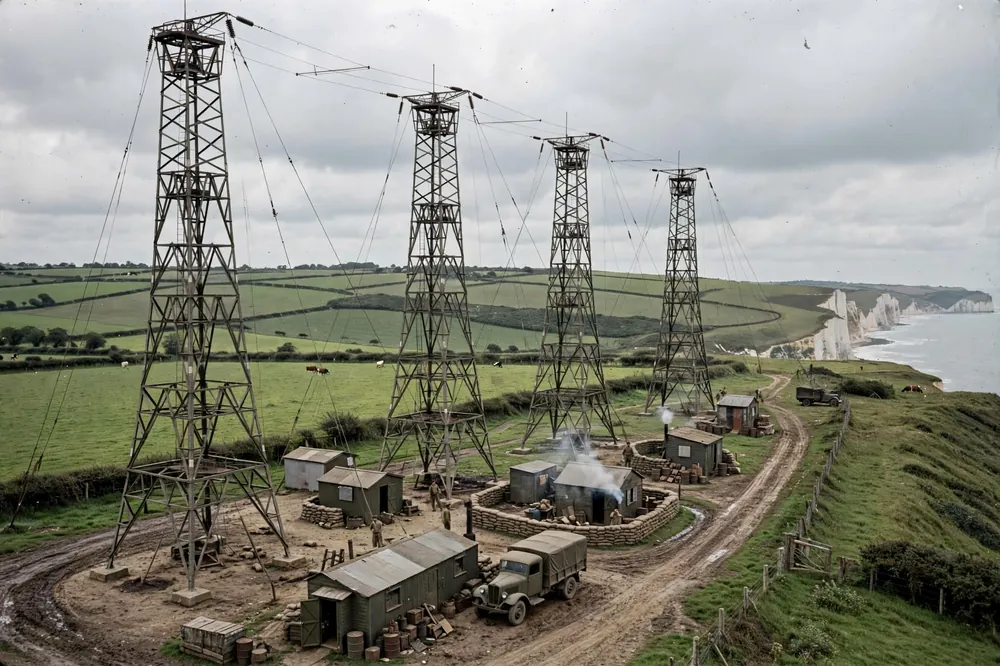
The British system was the Dowding System, named after Air Chief Marshal Hugh Dowding, the commander of Fighter Command. Dowding had built, in the 1930s, the world’s first integrated air defence system: a chain of radar stations along the south and east coasts — Chain Home — that could detect incoming aircraft 100 miles away; a network of observers, the Observer Corps, who tracked aircraft over land; and a control system, centred on Bentley Priory, that plotted the raids on a map and directed the fighters to intercept them.
The system meant that the RAF’s fighters did not have to patrol the skies, wasting fuel and tiring the pilots: they could wait on the ground, and take off only when a raid was detected, and be directed to the right place at the right height.
It was the first time in history that a battle had been fought with radar, and it gave the RAF an advantage that the Luftwaffe never understood.
The RAF’s fighters were the Hawker Hurricane and the Supermarine Spitfire. The Hurricane, which made up about two-thirds of Fighter Command’s strength, was a rugged, reliable aircraft, easy to repair and armed with eight machine guns. The Spitfire, which made up about a third, was faster, more manoeuvrable and more beautiful — and it became the symbol of the battle.
The German fighters were the Messerschmitt Bf 109, a superb aircraft, but one with a short range: flying from bases in France, the Bf 109 had only about 20 minutes of combat time over London before it had to turn for home.
The German bombers — the Heinkel He 111, the Dornier Do 17 and the Junkers Ju 88 — were medium bombers, designed for the short-range campaigns in Poland and France, and they were not built for a sustained strategic bombing campaign.
The Luftwaffe, in other words, was a tactical air force, built to support the army, and it was asked to do a strategic job — to destroy an air force and a country — for which it was not designed.
3. Opposing Forces
At the start of the battle, on 10 July 1940, Fighter Command had about 1,000 fighter aircraft — about 650 Hurricanes and about 350 Spitfires — and about 1,200 pilots. The Luftwaffe had about 2,600 aircraft in France and the Low Countries, of which about 1,000 were bombers, about 1,000 were fighters, and the rest were dive bombers, reconnaissance aircraft and transports.
The Luftwaffe outnumbered the RAF by more than two to one in aircraft, but the numbers were misleading: the Luftwaffe’s fighters could not stay over England for long, its bombers were vulnerable without fighter escort, and its pilots, when shot down, were taken prisoner, while RAF pilots who were shot down over England could be back in a new aircraft the same day.
| Britain | Germany | |
|---|---|---|
| Fighters | About 1,000 (Hurricane and Spitfire) | About 1,000 (Bf 109, Bf 110) |
| Bombers | None in Fighter Command (Bomber Command was not part of the battle) | About 1,000 (He 111, Do 17, Ju 88) |
| Dive bombers | — | About 300 (Ju 87 Stuka) |
| Pilots | About 1,200 at the start; about 3,000 in total during the battle | About 3,000 aircrew |
| Radar / Radar | Chain Home: about 20 stations, plus Chain Home Low | None comparable |
| Aircraft production | About 500 fighters a month (and rising) | About 200 fighters a month |
| Commanders | Dowding (Fighter Command); Park (No. 11 Group); Leigh-Mallory (No. 12 Group) | Göring (Luftwaffe); Kesselring (Luftflotte 2); Sperrle (Luftflotte 3) |
The RAF’s pilots were a remarkable group. They were young — the average age was about 20 — and they came from all over the British Empire and from the occupied countries of Europe: about 500 of the 3,000 pilots were not British, including about 150 Poles, about 100 Canadians, about 90 Czechs, and pilots from New Zealand, Australia, South Africa, France, Belgium and the United States.
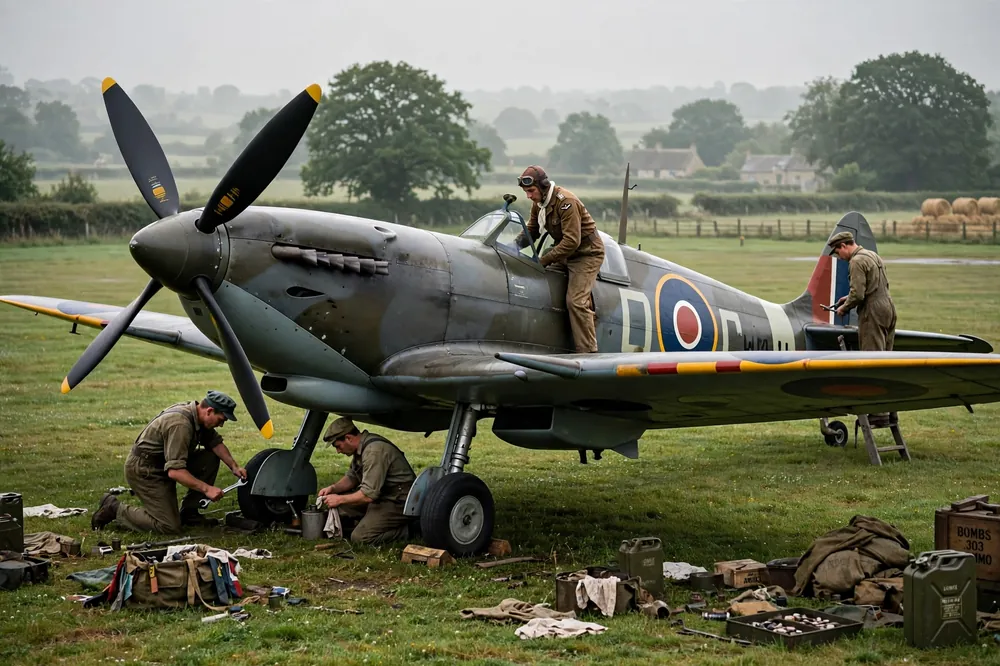
The Polish pilots of No. 303 Squadron, who had fought in Poland and in France, were among the most successful of the battle: they claimed 126 German aircraft destroyed, the highest score of any squadron. The RAF’s ground crews — the fitters, the riggers, the armourers — worked through the night to keep the fighters flying, and the Women’s Auxiliary Air Force (WAAF), who plotted the raids and operated the radar, were part of the battle too.
The Luftwaffe’s pilots were veterans, and they were good, but they were fighting a battle they did not understand. They did not know about the radar, and they did not understand why the RAF always seemed to be in the right place at the right time. Their intelligence was poor: they believed the RAF was weaker than it was, and they attacked the wrong targets.
Their bombers, flying in tight formations, were vulnerable to the Hurricanes and Spitfires, and their fighters, the Bf 109s, could not protect them for long. The Luftwaffe’s greatest weakness was its command: Göring, who had promised Hitler a quick victory, interfered constantly, changing the targets and the tactics, and his generals, Kesselring and Sperrle, disagreed with each other about how the battle should be fought.
4. The Battle
The Channel battles, July–August 1940
The battle began on 10 July 1940, with German attacks on British shipping in the Channel — the Kanalkampf, or Channel battle. The Luftwaffe attacked the convoys that carried coal and supplies along the south coast, and the RAF’s fighters rose to meet them. The fighting was over the sea, and it was a test of the Dowding System: the radar detected the raids, the controllers directed the fighters, and the Hurricanes and Spitfires shot down the German bombers and their escorts. The Germans lost more aircraft than the British, but the battle was a prelude, not the main event.
Adlerangriff — the attack on the airfields, August 1940
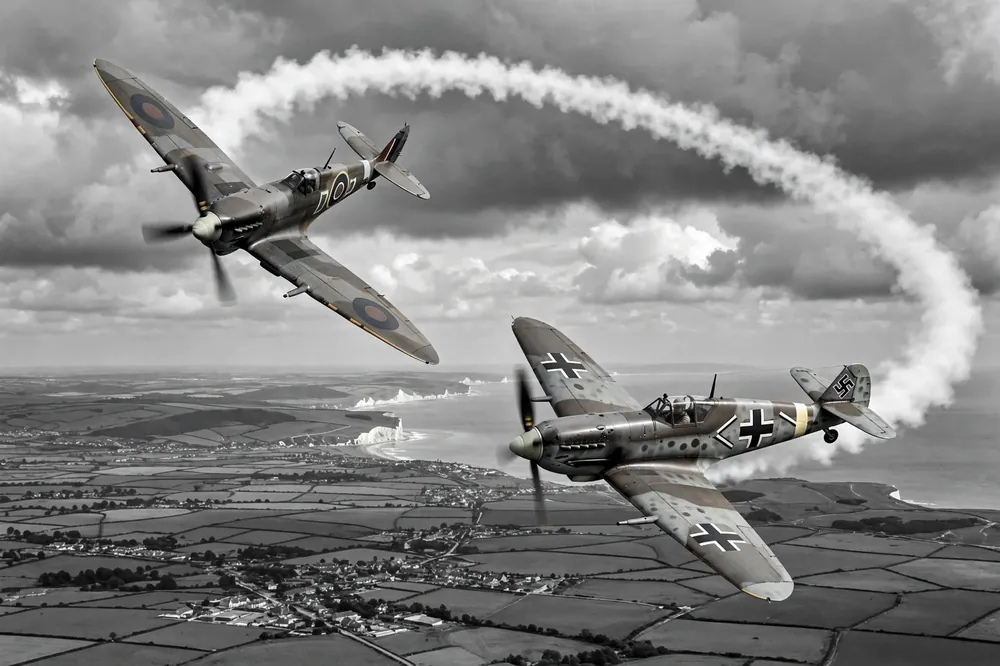
The main battle began on 13 August 1940 — Adlertag, “Eagle Day” — when the Luftwaffe launched Adlerangriff, the attack on the RAF’s airfields. The plan was to destroy Fighter Command on the ground: the bombers would attack the airfields in south-east England, and the fighters would destroy the RAF’s fighters in the air.
The attack was a failure: the German intelligence was wrong about which airfields mattered, the weather was bad, and the RAF’s fighters, directed by radar, met the raids and shot down more German aircraft than they lost. The Luftwaffe lost 45 aircraft on 13 August, and the RAF lost 13.
The battle continued through August, and the Luftwaffe’s losses mounted: on 18 August, “the Hardest Day”, the Luftwaffe lost 69 aircraft and the RAF lost 68 — the heaviest losses of the battle for both sides.
The critical period was late August and early September, when the Luftwaffe, realising that its attacks on the airfields were working, concentrated on the RAF’s sector stations — the airfields in south-east England from which the fighters were controlled. The stations at Biggin Hill, Kenley, Hornchurch and North Weald were bombed repeatedly, and the RAF’s losses rose.
The pilots were exhausted, the ground crews were working around the clock, and Dowding was running out of trained pilots. The RAF was, in the words of one historian, “on the edge”. The Luftwaffe, however, did not know how close it was to success: its intelligence told Göring that the RAF was finished, and Göring, believing the battle was won, made the decision that saved the RAF.
The Blitz on London, September 1940
On 7 September 1940, the Luftwaffe changed its target: instead of attacking the RAF’s airfields, it began to bomb London. The decision was made by Göring, and it was approved by Hitler, who wanted revenge for the RAF’s bombing of Berlin on 25 August — a small raid, but one that had embarrassed the German leadership, which had promised that no British bomb would ever fall on Berlin.
The bombing of London — the Blitz — was a strategic error of the first order: it gave the RAF’s airfields a rest, it gave the pilots a rest, and it gave Fighter Command time to repair its stations and to train new pilots. The Luftwaffe’s bombers, flying over London in daylight, were shot down in large numbers by the RAF’s fighters, and the Luftwaffe’s losses rose sharply.
The decisive day was 15 September 1940 — Battle of Britain Day, as it is still called in Britain. On that day, the Luftwaffe launched two great raids on London, with about 250 bombers and 600 fighters, and the RAF met them with every fighter it had. The battle was fought over London and the Thames Estuary, and it was watched by thousands of people on the ground.
The RAF claimed 185 German aircraft destroyed — the true figure was about 60 — and the Luftwaffe lost so many bombers that it never again attempted a large daylight raid on London. The 15th of September was the turning point: after it, the Luftwaffe switched to night bombing, and the battle was, in effect, won.
The RAF had survived, and the invasion of Britain — Operation Sea Lion — was postponed on 17 September, and then abandoned.
The Blitz continued into the winter of 1940–1941, and London and the other British cities were bombed at night, killing about 40,000 civilians in the Blitz as a whole. But the Blitz was not the Battle of Britain: the battle was the daylight air battle of July to October 1940, and it was won by the RAF. The official end of the battle is 31 October 1940, the date chosen by the British government, though the fighting continued into November.
5. Turning Point
The turning point of the Battle of Britain was 7 September 1940 — the day the Luftwaffe stopped attacking the RAF’s airfields and started bombing London. The airfields were the RAF’s weak point: the sector stations were being bombed, the pilots were exhausted, and Fighter Command was running out of men and machines. Had the Luftwaffe continued to attack the airfields for another two weeks, it might have destroyed Fighter Command. Instead, it attacked London, and it gave the RAF the rest it needed to survive. The decision was Göring’s, and it was Hitler’s, and it was a mistake that changed the war.
The second turning point was 15 September 1940, Battle of Britain Day. The Luftwaffe’s two great raids on London were met by the RAF in strength, and the German losses — about 60 aircraft — were so heavy that the Luftwaffe never again attempted a large daylight raid. The 15th of September proved that the RAF could not be destroyed, and it proved that the invasion of Britain could not succeed without air superiority. Two days later, Hitler postponed Operation Sea Lion, and the invasion was never attempted.
The third turning point was industrial: the British aircraft factories, under the direction of Lord Beaverbrook, the Minister of Aircraft Production, were producing more fighters than the RAF was losing. In August 1940, the British produced about 500 fighters, and the RAF lost about 300; in September, the British produced about 450, and the RAF lost about 250. The Luftwaffe, by contrast, was producing about 200 fighters a month, and it was losing more than it could replace. The battle was won, in the end, not only in the air but in the factories: Britain could replace its losses, and Germany could not.
6. Casualties and Losses
The losses of the Battle of Britain were heavy on both sides, but they were heavier for the Luftwaffe, and they were heavier in the sense that mattered: the Luftwaffe lost aircrew it could not replace, while the RAF lost pilots who could be replaced, and aircraft that could be rebuilt.
| Britain | Germany | |
|---|---|---|
| Aircraft destroyed | About 1,700 | About 1,900 |
| Pilots and aircrew killed | About 540 pilots killed | About 2,600 aircrew killed or taken prisoner |
| Civilians killed | About 1,500 during the battle (about 40,000 in the Blitz as a whole) | — |
| Aircraft production | About 500 fighters a month | About 200 fighters a month |
The RAF’s losses — about 1,700 aircraft and about 540 pilots killed — were severe, but they were sustainable: the British factories were producing more fighters than were being lost, and the Empire Training Plan was producing new pilots. The Luftwaffe’s losses — about 1,900 aircraft and about 2,600 aircrew killed or taken prisoner — were not sustainable: the German factories could not replace the aircraft, and the Luftwaffe’s training system could not replace the aircrew. The Luftwaffe never recovered from the Battle of Britain: it lost, in the summer of 1940, the experienced aircrew that had won the campaigns in Poland and France, and it never again had the strength to win air superiority over Britain.
The civilian losses of the battle — about 1,500 killed during the battle itself, and about 40,000 in the Blitz as a whole — were the first taste of the bombing war that would consume Europe. The Blitz, which began on 7 September 1940 and continued into 1941, killed about 40,000 British civilians and destroyed large parts of London, Coventry, Birmingham and other cities. The Blitz did not break British morale, and it did not force Britain to make peace. It did, however, show that the war would be fought against civilians as well as soldiers, and it set the pattern for the bombing war that would follow.
7. Map and Geography
The Battle of Britain was fought over southern England and the English Channel, above all over Kent, Sussex, Surrey and London. The geography of the battle was the geography of the Channel: a stretch of water about 30 kilometres wide at its narrowest, between Dover and Calais, that separated Britain from the German-occupied coast of France. The Luftwaffe’s bases were in northern France, in the Pas-de-Calais and Normandy, and its aircraft had to cross the Channel to reach England. The RAF’s bases were in south-east England — Biggin Hill, Kenley, Hornchurch, North Weald, Tangmere — and its fighters had to climb to meet the incoming raids over Kent and Sussex, the “Hell’s Corner” of the battle.
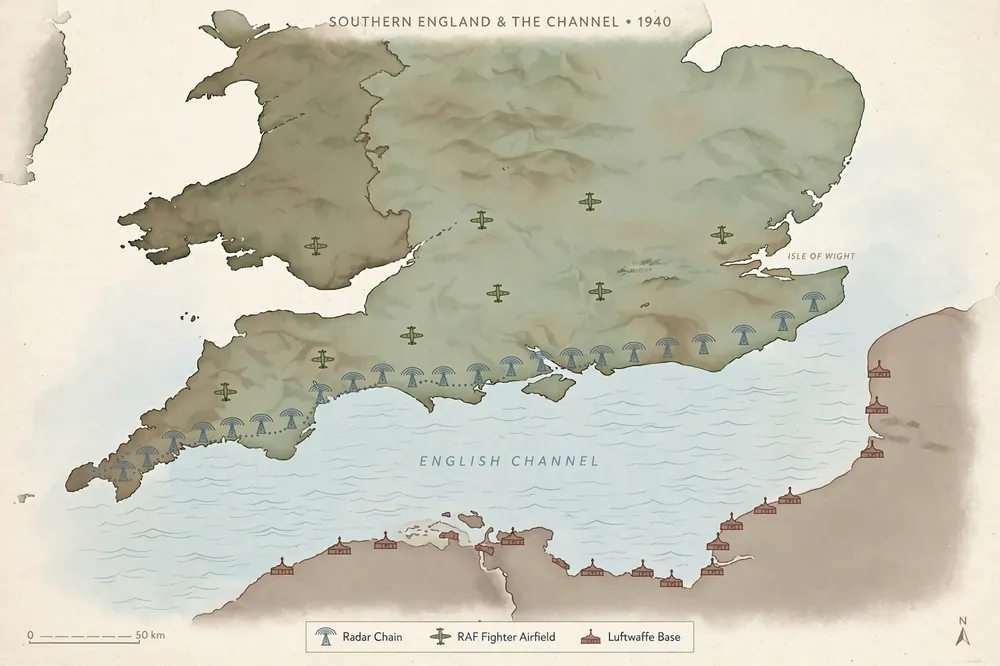
The radar chain — Chain Home — was built along the south and east coasts, from the Isle of Wight to the Thames Estuary, and it could detect incoming aircraft 100 miles away, over France. The Observer Corps, with its posts across southern England, tracked the raids once they crossed the coast. The control system, centred on Bentley Priory in Stanmore, plotted the raids and directed the fighters. The geography of the battle was, in other words, the geography of a system: the radar on the coast, the observers inland, the controllers at Bentley Priory, and the fighters in the air over Kent. The Luftwaffe, which had no radar and no comparable system, fought the battle blind.
The Channel was also the Luftwaffe’s greatest disadvantage. Its fighters, the Bf 109s, had only about 20 minutes of combat time over London before they had to turn for home, and its bombers, flying from France, had to cross the Channel twice — once to reach England, and once to return.
The RAF’s fighters, flying from bases in England, could stay over the battle longer, and their pilots, when shot down, landed in England and could fly again the same day. The Luftwaffe’s pilots, when shot down, were taken prisoner. The Channel, which had protected Britain from invasion for a thousand years, protected it again in 1940 — not by keeping the Germans out, but by giving the RAF the advantage of fighting over its own ground.
8. Outcome and Legacy of the Battle of Britain
The Battle of Britain ended on 31 October 1940, with the RAF intact and the Luftwaffe defeated. The invasion of Britain — Operation Sea Lion — was postponed on 17 September and abandoned in the spring of 1941, when Hitler turned his attention to the Soviet Union. Britain had survived, and it had survived alone: it was the only country in Europe that had not been conquered by Germany, and it became the base from which the liberation of Europe would be launched in 1944. The battle did not win the war, but it ensured that the war could be won.
The battle’s legacy is a cultural one, above all in Britain. “The Few” — the 3,000 fighter pilots who fought the battle — became national heroes, and Churchill’s speech of 20 August 1940, with its line “Never in the field of human conflict was so much owed by so many to so few”, is still quoted in Britain. The Spitfire became the symbol of the battle, and of Britain’s resistance, and the Battle of Britain Memorial, on the cliffs at Capel-le-Ferne, near Folkestone, bears the names of the 2,937 pilots who fought the battle. Every 15 September, Battle of Britain Day, the RAF flies a Spitfire and a Hurricane over London, and the battle is remembered.
Militarily, the Battle of Britain was the first defeat of the Luftwaffe, and it was the first proof that air power alone could not win a war. The Luftwaffe, which had been built to support the army, was asked to do a strategic job, and it failed. The battle also proved the value of radar and of an integrated air defence system — a lesson that shaped air defence for the rest of the century. The battle’s most important legacy, though, was strategic: it kept Britain in the war, and it kept the western front open. Without the Battle of Britain, there would have been no D-Day, no liberation of Europe, and no victory in 1945.
9. Commanders
Air Chief Marshal Hugh Dowding (Britain). Commander in Chief of Fighter Command, and the architect of the Dowding System. Dowding built the radar chain, the control system and the fighter force that won the battle, and he resisted the pressure to commit his fighters to France in May 1940, saving them for the defence of Britain. He was dismissed in November 1940, after the battle, in a dispute over tactics, and he died in 1970.
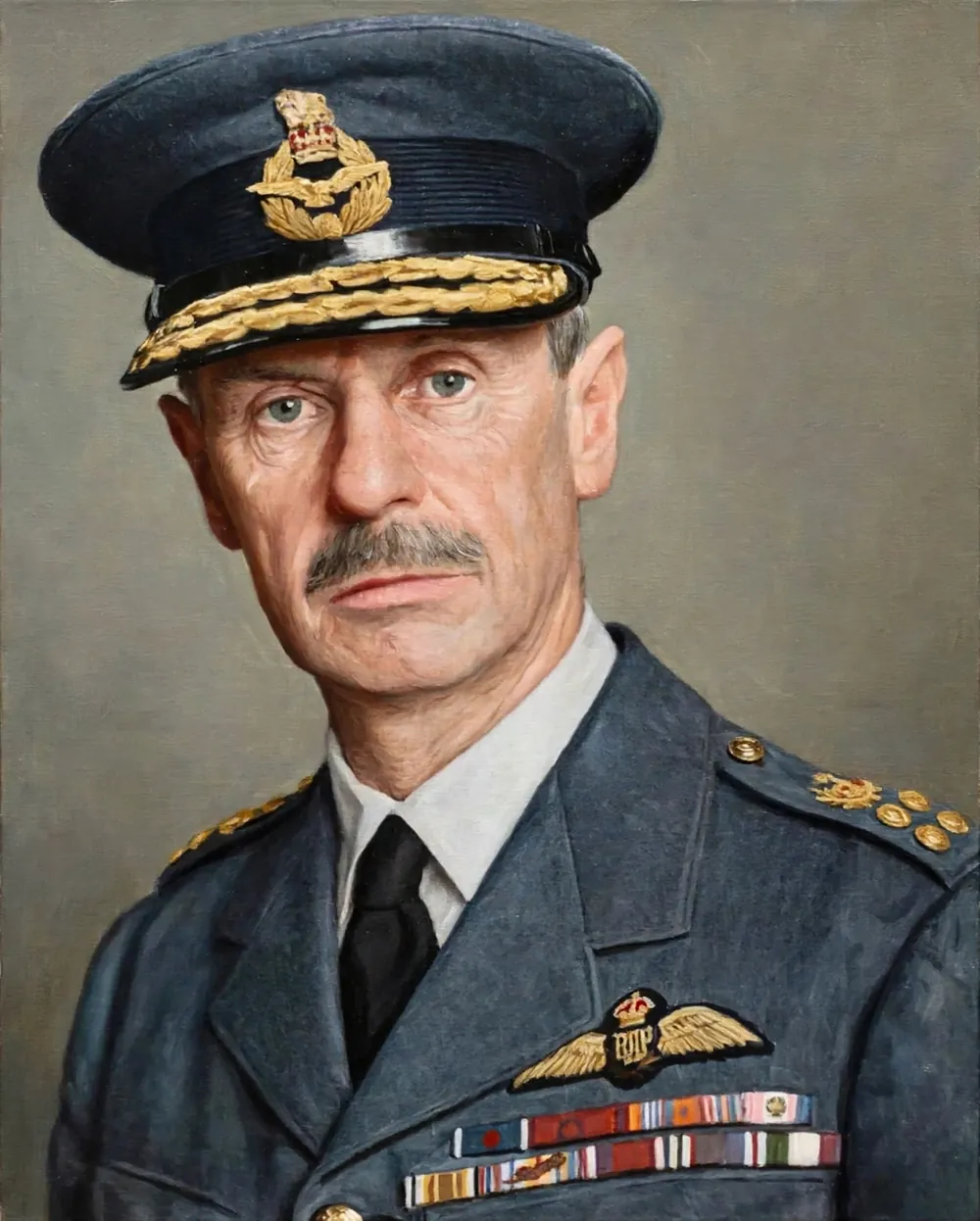
Air Vice-Marshal Keith Park (Britain). Commander of No. 11 Group, which defended London and south-east England, and which bore the brunt of the battle. Park’s tactical handling of his fighters — meeting the raids with small, flexible formations — was the key to the battle’s success. He was a New Zealander, and he was dismissed, with Dowding, in November 1940. He died in 1975.
Air Vice-Marshal Trafford Leigh-Mallory (Britain). Commander of No. 12 Group, which defended the Midlands and the north, and which argued for the “Big Wing” — large formations of fighters — against Park’s tactics. Leigh-Mallory succeeded Dowding as commander of Fighter Command, and he later commanded the Allied Expeditionary Air Force for D-Day. He was killed in an air crash in November 1944.
Reichsmarschall Hermann Göring (Germany). Commander in Chief of the Luftwaffe, and the man who promised Hitler that the RAF would be destroyed in four days. Göring’s interference in the battle — changing the targets, ordering the fighters to stay close to the bombers, and switching the attack to London — contributed to the Luftwaffe’s defeat. He was captured in 1945 and committed suicide at Nuremberg in 1946.
Field Marshal Albert Kesselring (Germany). Commander of Luftflotte 2, which attacked south-east England and London. Kesselring was one of Germany’s most able commanders, and he later commanded in Italy. He was convicted of war crimes after the war, but his sentence was commuted, and he died in 1960.
Frequently Asked Questions
Related articles
Sources
- Wikipedia, “Battle of Britain” — dates, strength, casualty figures and the course of the battle.
- Encyclopædia Britannica, “Battle of Britain” — background, the Dowding System and the battle’s outcome.
- Royal Air Force Museum, “Battle of Britain” — the Dowding System, the Few and the aircraft of the battle.
- Richard Overy, The Battle of Britain: The Myth and the Reality (Penguin, 2001) — the battle, the losses and the debate over its significance.
- Stephen Bungay, The Most Dangerous Enemy: A History of the Battle of Britain (Aurum Press, 2000) — the standard modern history of the battle.
- Winston Churchill, The Second World War, Vol. II, Their Finest Hour (Cassell, 1949) — Churchill’s account of the battle and the “Few” speech.
- James Holland, The Battle of Britain: Five Months That Changed History (St. Martin’s Press, 2010).
- John Ray, The Battle of Britain: Dowding and the First Victory, 1940 (Cassell, 1994).