 WAR ATLAS MILITARY HISTORY MAGAZINE · WWI — WWII
Battle of the Somme
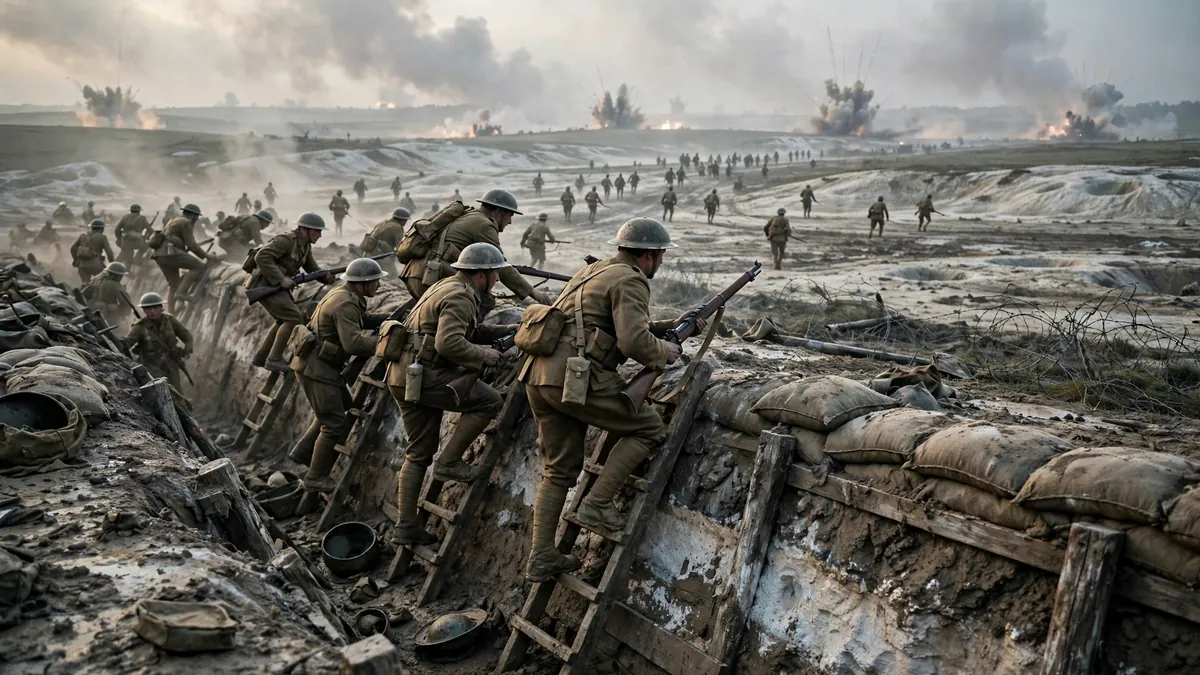
The Battle of the Somme was the great Anglo-French offensive on the Western Front in 1916, fought along the River Somme in northern France from 1 July to 18 November. It was meant to break the German line, relieve the pressure on the French at Verdun, and win the war.
Instead it became a byword for futility and slaughter: more than a million men were killed or wounded on both sides, and the Allies advanced, at most, about 10 kilometres. The first day, 1 July 1916, was the bloodiest day in the history of the British Army — 57,470 casualties, including 19,240 killed — most of them in the first hour. The Somme did not win the war.
It did, however, change it: the battle that began with men walking slowly across no-man’s-land ended with the first tanks in history lumbering into action, and with a British Army that had learned, at terrible cost, how modern war was fought.
1. Key Facts
| Date | 1 July – 18 November 1916 |
| Location | River Somme, Picardy, northern France |
| Result | Inconclusive; small Allied gains at enormous cost; German line holds |
| Allied commanders | Gen. Douglas Haig (British Expeditionary Force); Gen. Joseph Joffre (French Army); Gen. Ferdinand Foch (French Army Group North) |
| German commanders | Gen. Fritz von Below (2nd Army); Gen. Max von Gallwitz (1st Army, from July); Field Marshal Paul von Hindenburg and Gen. Erich Ludendorff (from August) |
| Allied strength | About 13 British and 5 French divisions on 1 July; rising to over 50 divisions during the battle |
| German strength | About 10 divisions on 1 July; rising to about 50 divisions during the battle |
| Allied losses | About 620,000 (about 420,000 British, about 200,000 French) |
| German losses | About 450,000–600,000 (estimates vary) |
2. Background
The Battle of the Somme was planned in the winter of 1915–1916, at the Chantilly conference of December 1915, where the Allies agreed to launch simultaneous offensives on all fronts in the summer of 1916: the British and French on the Somme, the Russians in the east, and the Italians on the Isonzo.
The Somme was chosen because it was the point where the British and French armies met, so the two could attack side by side, and because the ground there — the rolling chalk downland of Picardy — was thought to be good for an offensive. The original plan gave the French the leading role, with 40 divisions, and the British a supporting one. But the plan was overtaken by events.
In February 1916 the Germans attacked Verdun, and the French Army was drawn into a battle that consumed its men and its reserves. The French contribution to the Somme shrank from 40 divisions to 5, and the British, who had intended to play a supporting role, found themselves carrying the offensive.
The British Army of 1916 was a new army: the old regular army had been largely destroyed in 1914, and the force that attacked on the Somme was the “New Army” of volunteers raised by Lord Kitchener — the “Pals battalions”, men from the same town, the same factory, the same football club, who had enlisted together and trained together and would now fight together.
Many of them had never been in battle. Their commander, General Sir Douglas Haig, who had taken command of the British Expeditionary Force in December 1915, believed in the power of artillery: a week-long bombardment, he was assured, would destroy the German defences, cut the wire, and kill or bury the German defenders in their dugouts. The infantry would then walk across no-man’s-land and occupy the German trenches.
The German defences on the Somme were among the strongest on the Western Front. The Germans had held the ground since 1914, and they had spent two years fortifying it: deep dugouts, 10 metres or more below the surface, roofed with steel and concrete, where the garrison could survive any bombardment; concrete machine-gun positions sited to fire along the front, not across it; and belts of barbed wire 30 metres deep in places.
The German second line was built on the reverse slopes of the ridges, invisible to British observers, and the villages — Thiepval, Beaumont-Hamel, Ovillers, La Boisselle — had been turned into fortresses of cellars, rubble and concrete. The German commander on the Somme, General Fritz von Below, had about 10 divisions in the line on 1 July, but his men were veterans, and they were dug in.
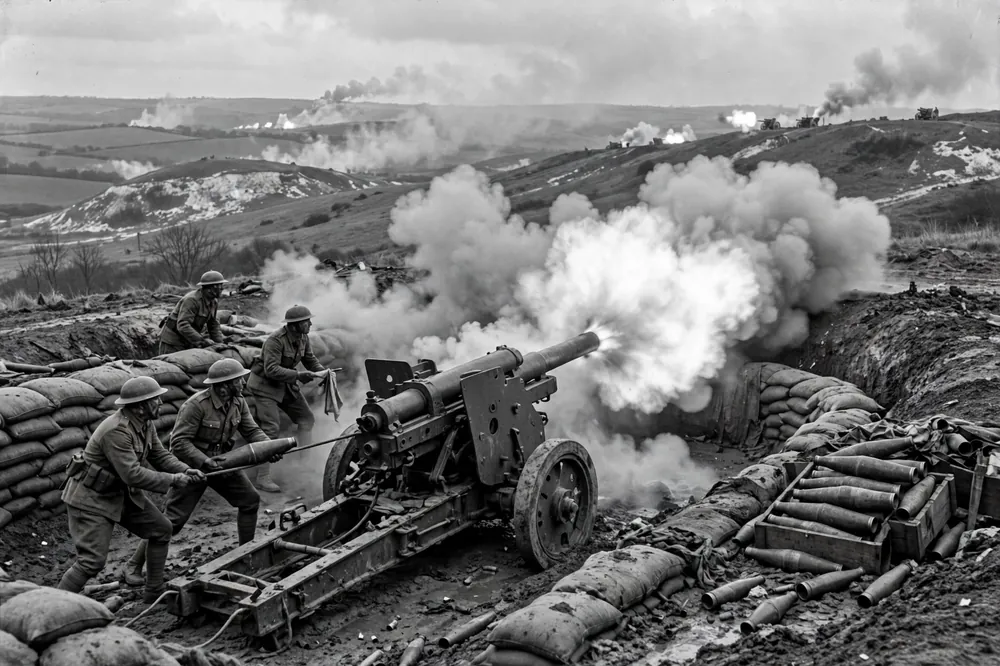
The preliminary bombardment began on 24 June 1916. For seven days, about 1,500 British guns and 800 French guns fired about 1.7 million shells at the German positions — the largest bombardment in history to that point. The British guns, however, were mostly field guns firing shrapnel, which was effective against men in the open but useless against deep dugouts and wire. The heavy guns were too few, and the shells were often defective: about a third of the British shells were duds. The wire was not cut. The German dugouts, deep underground, survived. And the bombardment gave the Germans a week’s warning of exactly where the attack would fall.
3. Opposing Forces
On 1 July 1916 the Allies attacked with 13 British divisions and 5 French divisions, along a front of about 25 kilometres. The British Fourth Army, under General Sir Henry Rawlinson, attacked on the northern and central sectors, from Serre in the north to Montauban in the south. The French Sixth Army, under General Marie-Émile Fayolle, attacked on the southern sector, astride the Somme river.
The British plan was a “bite and hold” — or, in Haig’s grander conception, a breakthrough: the infantry would advance in waves, walking at a steady pace behind a creeping artillery barrage, and would take the German first line, then the second line, on the first day. The men were ordered to walk, not run, so that they would arrive in formation and not outrun the artillery.
They carried 30 kilograms of equipment each.
| Allies | Germany | |
|---|---|---|
| Divisions on 1 July | 13 British, 5 French | About 10 |
| Men on 1 July | About 150,000 in the first attack | About 60,000 in the line |
| Guns | About 2,300 (1,500 British, 800 French) | About 800 |
| Aircraft | About 350 (Royal Flying Corps and French) | About 130 |
| Total divisions engaged | Over 50 British and French | About 50 |
| Commanders | Haig, Rawlinson, Fayolle | Von Below, then von Gallwitz; Hindenburg and Ludendorff from August |
The German defenders were the Second Army under General Fritz von Below, later reinforced and reorganised: in July the First Army was formed under General Max von Gallwitz to hold the northern sector, and in August the overall command passed to the new supreme command of Hindenburg and Ludendorff, who poured reinforcements into the Somme at the expense of other fronts.
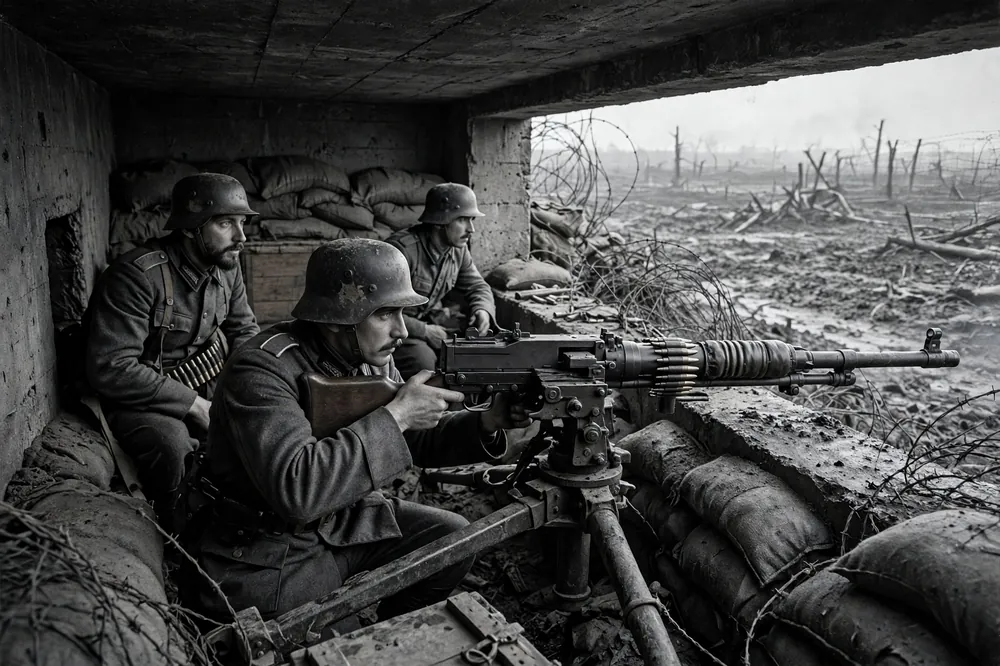
The German infantry of 1916 were veterans of two years of trench warfare, and their machine gunners — the men who would do most of the killing on 1 July — were the best-trained soldiers in the German Army. Their weapon, the MG 08, could fire 400 to 500 rounds a minute, and a single gun, well sited, could stop a battalion.
The British infantry, by contrast, were largely new. The Pals battalions — the Accrington Pals, the Sheffield Pals, the Leeds Pals, the Newfoundland Regiment, which was not strictly a Pals battalion but shared its character — were men who had enlisted together in 1914 and 1915, and who had trained in England for nearly two years. Their officers were often young men with no experience of battle, commissioned from the universities and the public schools. They were brave, and they were disciplined, and on 1 July they did what they were told: they walked, in line, across no-man’s-land, into the fire of the German machine guns.
4. The Battle
1 July 1916: the bloodiest day
The attack began at 07:30 on 1 July 1916, after a final bombardment and the explosion of great mines under the German lines — the largest, at Hawthorn Ridge, was heard in London. The infantry went over the top and walked towards the German trenches.
In the south, the attack succeeded: the French, with their heavier guns and their more experienced troops, took their objectives, and the British divisions on the southern sector — the 18th and 30th — took Montauban and made good progress. In the north and centre, it was a catastrophe.
The German machine gunners, who had survived the bombardment in their deep dugouts, came up as the bombardment lifted and opened fire. The British infantry, walking in line across open ground, were cut down in rows. The wire, uncut, stopped them in front of the German trenches, where they were shot down as they tried to find a way through.
The figures for the day are still shocking: 57,470 British casualties, of whom 19,240 were killed, and about 2,000 French casualties. The dead included whole Pals battalions: the Accrington Pals lost 235 killed and 350 wounded out of about 700 men; the Leeds Pals lost 15 officers and 233 men killed; the Newfoundland Regiment, attacking at Beaumont-Hamel, lost 255 killed and 386 wounded out of about 800 men — a casualty rate of about 80 per cent in half an hour.
The German casualties on 1 July were about 6,000 to 8,000. The British had gained, in the north, almost nothing; in the south, a few kilometres of ground. The attack had failed, and it had failed because the bombardment had not done what it was supposed to do.
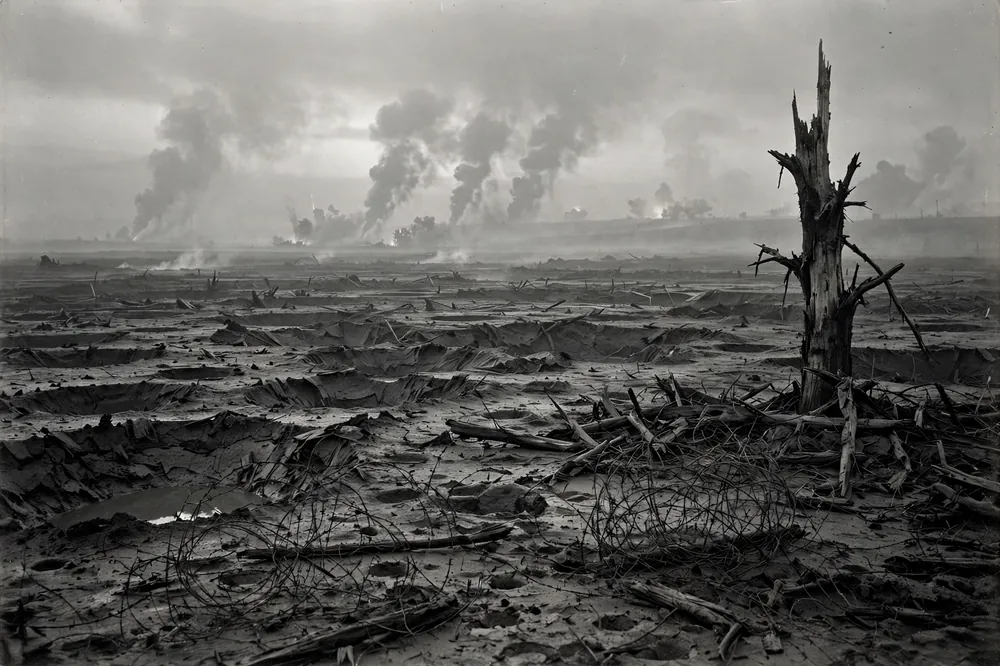
Haig, however, did not stop. He believed that the battle was wearing down the German Army, and that persistence would bring a breakthrough. The battle continued through July, August, September and October, in a series of smaller attacks — at Bazentin Ridge, at Delville Wood, at Guillemont, at Flers-Courcelette — each gaining a few hundred metres of ground at a cost of thousands of men. The fighting was in the chalk downland of Picardy, and as the summer wore on the ground became a churned wasteland of shell holes, mud and shattered trees. The villages were reduced to rubble, and the dead lay unburied in no-man’s-land.
The tanks, 15 September 1916
On 15 September 1916, at Flers-Courcelette, the British used a new weapon for the first time in history: the tank. The Mark I tank was a rhomboid-shaped machine, 8 metres long, armed with machine guns and small cannon, and capable of crossing trenches and crushing wire. Haig had 49 tanks available; 32 reached the start line, and 18 actually went into action.
The tanks achieved a local success at Flers, where they helped the infantry take the village, and they caused panic among the German troops who saw them for the first time. But they were slow, unreliable — many broke down before reaching the battle — and too few to change the course of the battle.
The tank’s debut was a promise, not a victory: it would take two more years, and a different generation of tanks, before the weapon fulfilled its promise at Cambrai and Amiens.
The autumn battles
The battle ground on through the autumn. In September the British and French took Flers, Martinpuich and Morval; in October they took the Thiepval Ridge, the fortress village that had held out since 1 July, after a long and costly fight. The weather turned in October: rain turned the battlefield into a sea of mud, and the fighting slowed to a crawl.
The last attack, at Beaumont-Hamel on 13 November, finally took the village that had cost the Newfoundland Regiment so dearly on 1 July. Five days later, on 18 November, Haig called off the offensive. The battle was over. The Allies had advanced, at most, about 10 kilometres, and the front line had moved a few miles east. The German line had not broken.
5. Turning Point
The turning point of the Battle of the Somme is hard to name, because the battle had no single decisive moment. Its turning point was the first day itself — not because the battle was won or lost on 1 July, but because 1 July destroyed the assumptions on which the battle had been planned.
The bombardment had not destroyed the German defences; the wire had not been cut; the infantry had not walked into empty trenches. After 1 July, the battle became a different kind of battle: not a breakthrough, but a grinding attritional struggle, fought in small attacks for small gains, in which the British Army learned, village by village and wood by wood, how to fight a modern battle.
The second turning point was the arrival of the tanks on 15 September. The tanks did not win the battle, but they showed that the deadlock of the trenches could be broken by machines — and they gave the British Army a weapon to develop.
The third turning point was German, and it was a decision made in August: Hindenburg and Ludendorff, taking command of the German Army, decided that the Somme had cost Germany too much, and they began to build a new defensive line — the Hindenburg Line — behind the front, to which the German Army would withdraw in the spring of 1917.
The Somme, in other words, convinced the German command that the ground it had held since 1914 was not worth the men it cost to hold it. The battle that failed to break the German line persuaded the Germans to give up the ground voluntarily.
The real turning point, though, was in the British Army itself. The Somme destroyed the New Army of 1914 — the Pals battalions, the volunteers — and forced the British to build a new army in its place: an army of conscripts, trained in the lessons of the Somme, with better artillery, better tactics and, eventually, tanks and aircraft used together. The British Army that fought at Amiens in August 1918, and that broke the German Army in the Hundred Days, was the army the Somme had created. The Somme was a defeat in its own terms, and a school for the victory of 1918.
6. Casualties and Losses
The casualty figures for the Somme are among the most debated of the First World War, and the totals below are the commonly cited ones. The British official history gives about 420,000 British casualties and about 200,000 French casualties, for an Allied total of about 620,000. German losses are harder to establish: the German official history gives about 450,000, but later research, notably by the historian William Philpott, suggests the German total may have been as high as 600,000. The combined total was over 1 million men killed, wounded or missing in less than five months.
| Allies | Germany | |
|---|---|---|
| Killed | About 125,000 British and French (estimates vary) | About 160,000–180,000 (estimates vary) |
| Wounded and missing | About 495,000 | About 290,000–420,000 |
| Total | About 620,000 | About 450,000–600,000 |
| 1 July 1916 | 57,470 British casualties (19,240 killed); about 2,000 French | About 6,000–8,000 |
The first day’s figures deserve a note of their own. The 57,470 British casualties of 1 July 1916 — 19,240 killed, 35,493 wounded and 2,737 missing or taken prisoner — were the worst single day’s losses in the history of the British Army, before or since. The losses fell hardest on the Pals battalions, whose character made the losses worse: when a Pals battalion was destroyed, a whole town lost a generation of its young men in a morning. The Accrington Pals, the Sheffield Pals, the Leeds Pals and the Newfoundland Regiment are still remembered in their home towns, and the Somme is still, in Britain, the symbol of the waste of the First World War.
The German losses, though smaller in total, were also severe, and they fell on the best of the German Army: the Somme consumed the German infantry’s experienced men, and the German Army never fully recovered. The German commander, Crown Prince Rupprecht, wrote in his diary that the Somme had cost Germany its best troops. The battle’s attritional logic — that the Allies, with their greater resources, could afford to lose more men than the Germans — was correct in the long run, but it was a logic that cost a million men to prove.
7. Map and Geography
The Battle of the Somme was fought on the chalk downland of Picardy, in the department of the Somme in northern France, about 120 kilometres north of Paris. The River Somme runs through the battlefield from east to west, and the ground on either side is a series of low ridges and shallow valleys, rising from about 30 metres in the river valley to about 150 metres on the high ground.
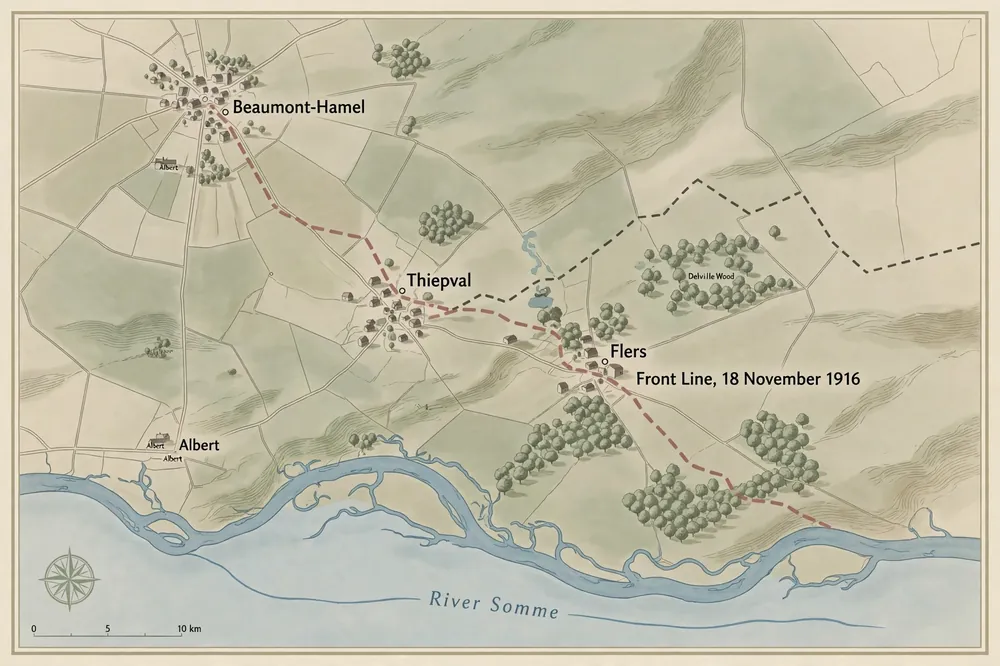
The ridges — the Thiepval Ridge, the Bazentin Ridge, the high ground around Flers and Gueudecourt — were the objectives of the battle, because they gave observation over the ground beyond, and the Germans held them. The villages of the Somme — Serre, Beaumont-Hamel, Thiepval, Ovillers, La Boisselle, Montauban, Fricourt, Mametz — sat in the valleys and on the ridges, and each of them became a fortress.
The chalk soil of Picardy shaped the battle in two ways. First, it was easy to dig: the German dugouts, 10 metres deep, were cut into the chalk, and the British trenches were dug in the same ground. Second, when the chalk was shelled, it turned to a fine white dust that choked the men and coated everything, and when it rained, the chalk turned to a clinging mud that made movement almost impossible. The battlefield of the Somme, by the autumn of 1916, was a landscape of shell holes filled with water, shattered trees and ruined villages — a landscape that the British war artist Paul Nash, who fought there, called “a place of desolation”.
The Somme was also a battle fought for ground that had no strategic value in itself. The villages and ridges were not important towns or junctions; they mattered only because they were where the German line was, and because the Allies had decided to attack there. The battle’s geography was the geography of the Western Front itself: a line drawn across France in 1914, which the Allies spent four years trying to break, and which the Somme showed could not be broken by infantry and artillery alone.
8. Outcome and Legacy of the Battle of the Somme
The Battle of the Somme ended on 18 November 1916 without a breakthrough and without a decision. The Allies had advanced about 10 kilometres on a front of about 25 kilometres, at a cost of over a million casualties. The German line had held. By the standards of the plan — a breakthrough that would win the war — the Somme was a failure. By the standards of attrition — the wearing down of the German Army — it was a partial success: the German Army lost some of its best troops, and the German command decided that the ground was not worth the cost of holding it, and began to build the Hindenburg Line.
The battle’s strategic consequences were real, even if they were not visible in 1916. The Somme relieved the pressure on Verdun: the Germans, forced to send divisions to the Somme, could no longer sustain their offensive at Verdun, and the French held the fortress. The Somme also drew German reserves away from the Eastern Front, where the Russian Brusilov Offensive was achieving its greatest successes of the war. And the Somme, together with Verdun, convinced the German command that the war could not be won on the Western Front — a conviction that led, in 1917, to the decision to resume unrestricted submarine warfare, which brought the United States into the war.
The Somme’s legacy in Britain is a cultural one. The battle is remembered as the symbol of the futility of the First World War, and of the waste of a generation: the Pals battalions, the volunteers of 1914, the young officers of the public schools, the poets — Rupert Brooke had died in 1915, but Wilfred Owen and Siegfried Sassoon fought on the Somme and wrote about it, and their poems are still read in British schools.
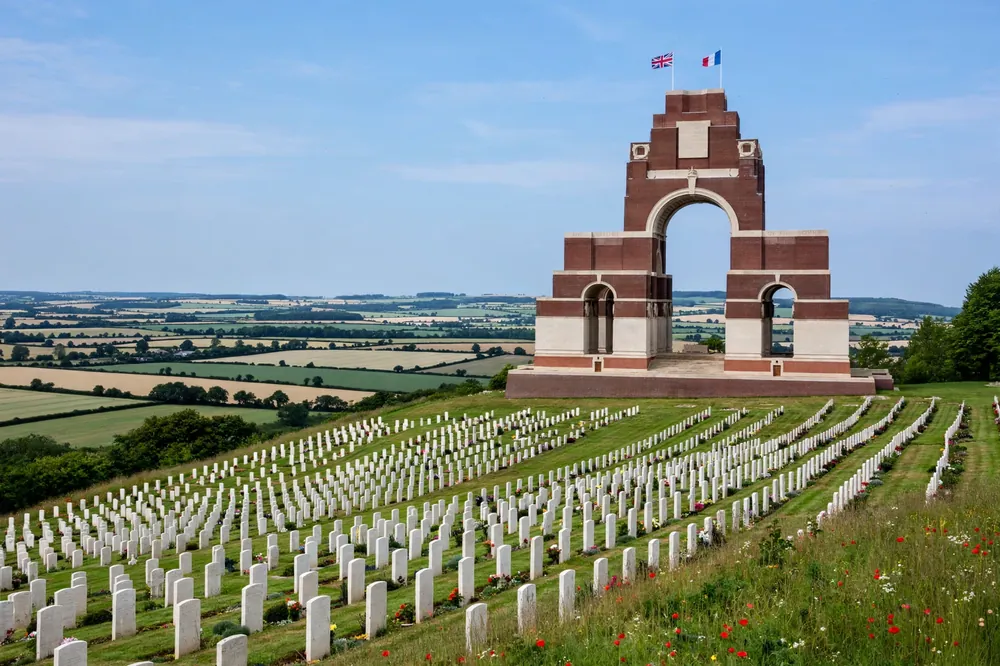
The Thiepval Memorial, the great arch on the Somme battlefield, bears the names of 72,000 British and South African soldiers who died on the Somme and have no known grave. Every 1 July, the anniversary is marked in Britain and in France, and the names of the Pals battalions are read aloud in their home towns.
The Somme did not win the war, but it defined, for Britain, what the war had cost.
Militarily, the Somme was a school. The British Army learned from it — the creeping barrage, the use of tanks, the coordination of infantry and artillery, the importance of air observation — and the army that won the war in 1918 was built on those lessons. The German Army learned from it too: the defence in depth, the use of machine guns in the open, and the elastic defence that would frustrate the Allies in 1917 and 1918, were developed on the Somme. The battle that changed nothing on the map changed everything about how the war was fought.
9. Commanders
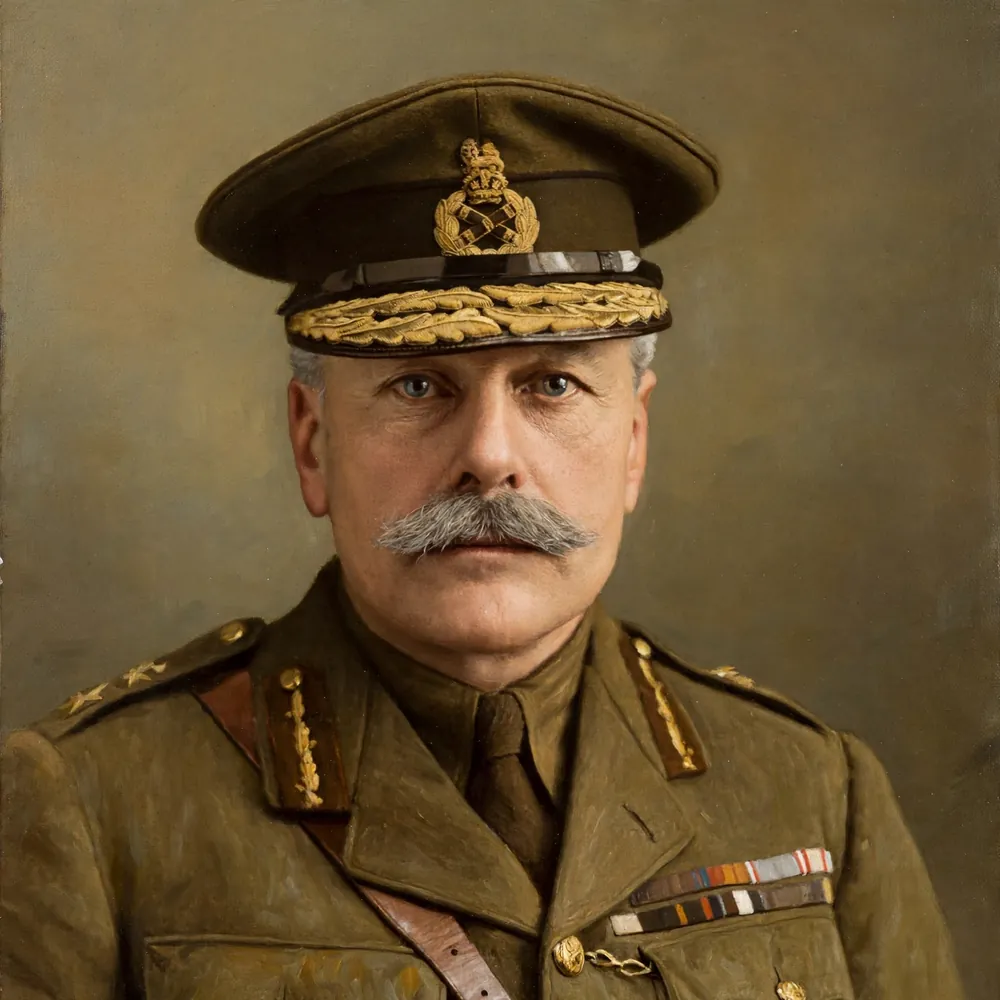
General Sir Douglas Haig (Britain). Commander in Chief of the British Expeditionary Force from December 1915 to the end of the war. Haig planned the Somme offensive and persisted with it through the autumn of 1916, believing that attrition would wear down the German Army. He remains the most controversial British commander of the war: to his defenders he was the general who learned from the Somme and won the war in 1918; to his critics he was the “butcher” who wasted a generation on 1 July 1916. The debate continues.
General Sir Henry Rawlinson (Britain). Commander of the Fourth Army, which carried out the main British attack on the Somme. Rawlinson had wanted a limited “bite and hold” attack, taking the German first line and holding it against counterattacks; Haig overruled him in favour of a deeper advance. Rawlinson later commanded the Fourth Army at Amiens in 1918.
General Joseph Joffre (France). Commander in Chief of the French Army, who planned the Somme offensive with Haig at Chantilly. Joffre’s original plan gave the French the leading role, but Verdun reduced the French contribution to five divisions. He was replaced as commander in chief in December 1916.
General Marie-Émile Fayolle (France). Commander of the French Sixth Army on the Somme, whose troops achieved the most success on 1 July, taking their objectives south of the river. Fayolle’s careful use of heavy artillery and his experienced troops were a contrast to the British experience in the north.
General Fritz von Below (Germany). Commander of the German Second Army on the Somme, who held the line on 1 July and through the summer. Von Below’s defence — deep dugouts, machine guns sited for enfilade fire, and a second line on the reverse slopes — was the model of the German defence on the Western Front.
Field Marshal Paul von Hindenburg and General Erich Ludendorff (Germany). The new German supreme command from August 1916, who took over the direction of the war and poured reinforcements into the Somme. Their decision to build the Hindenburg Line and to withdraw to it in the spring of 1917 was a direct consequence of the Somme.
Frequently Asked Questions
Related articles
Sources
- Wikipedia, “Battle of the Somme” — dates, strength, casualty figures (57,470 British casualties on 1 July, 19,240 killed) and the course of the battle.
- Encyclopædia Britannica, “Battle of the Somme” — background, the first day and the battle’s cost.
- Commonwealth War Graves Commission, Thiepval Memorial — 72,000 names of men with no known grave.
- Martin Gilbert, The Somme: Heroism and Horror in the First World War (Henry Holt, 2006) — the first day, the Pals battalions and the battle’s course.
- William Philpott, Bloody Victory: The Sacrifice on the Somme and the Making of the Twentieth Century (Little, Brown, 2009) — the battle as a whole, including revised German casualty estimates.
- Gary Sheffield, The Somme (Cassell, 2003) — concise operational history and the debate over Haig.
- Lyn Macdonald, Somme (Penguin, 1983) — the battle through the voices of the men who fought it.
- Peter Hart, The Somme (Weidenfeld & Nicolson, 2005).