 WAR ATLAS MILITARY HISTORY MAGAZINE · WWI — WWII
Saint-Chamond Tank: France’s Long-Hulled Assault Tank of the First World War
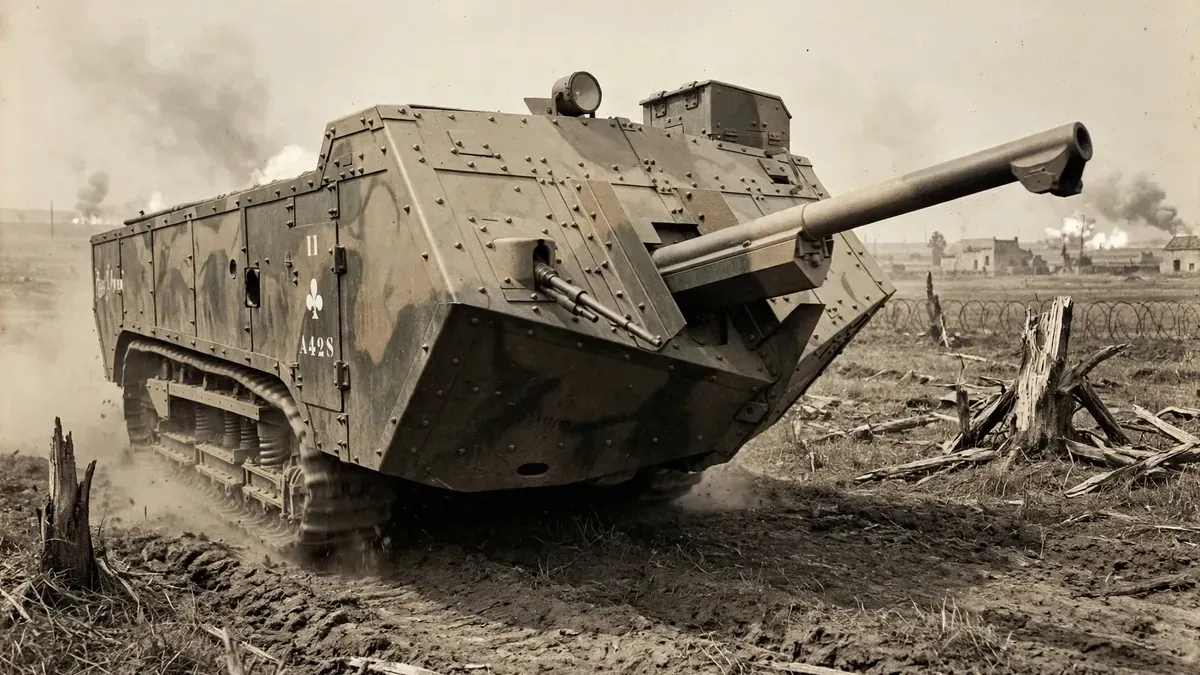
The Saint-Chamond was one of the first tanks ever built, a French assault tank of the First World War that was designed to break through German trenches and to support infantry with its powerful 75 mm gun. Named after the town of Saint-Chamond, where it was built by the Compagnie des Forges et Acieries de la Marine et d’Homecourt, the Saint-Chamond entered service in 1917 and fought in the great French offensives of that year and in the final Allied offensives of 1918. Approximately 400 Saint-Chamond tanks were built between 1917 and 1918, and the type served in the French Army until the end of the war, when it was withdrawn from service. The Saint-Chamond is remembered today as a symbol of French wartime improvisation and of the early, experimental days of tank warfare, when designers were still learning what a tank should be.
The Saint-Chamond was one of two French tanks developed in 1916, alongside the Schneider CA1, and it was the more powerful of the two, with a 75 mm gun mounted in the front of the hull and a long, overhanging nose that was designed to cross trenches. But the Saint-Chamond was also a flawed design: its long hull and its short tracks made it prone to bogging down in soft ground and to nosing into trenches, and its petrol-electric transmission was unreliable and difficult to maintain. The Saint-Chamond’s crews found it cramped and uncomfortable, and its performance in combat was mixed. At Laffaux in May 1917, Saint-Chamonds suffered heavy losses, but in later battles, notably at Soissons in July 1918, they performed well, supporting infantry in the Allied counter-offensive that turned the tide of the war.
The Saint-Chamond is remembered as a pioneering tank, one of the first to be built in significant numbers, and as a vehicle that showed both the promise and the limitations of early tank design. Its long hull and its 75 mm gun were innovative, but its mobility and its reliability were poor, and it was soon superseded by the lighter and more reliable Renault FT, which became the standard French tank of the war. The last surviving Saint-Chamond, at the Musee des Blindes at Saumur, is one of the most important artefacts of the First World War, and it is a reminder of the French Army’s contribution to the development of the tank.
1. Key Facts
| Field | Value |
|---|---|
| Type | Assault tank |
| Origin | France |
| Designed | 1916 (Compagnie des Forges et Acieries de la Marine et d’Homecourt) |
| In service | 1917-1918 (French Army) |
| Produced | Approximately 400 |
| Manufacturer | Compagnie des Forges et Acieries de la Marine et d’Homecourt, Saint-Chamond |
| Crew | 8-9 (commander, gunner, loaders, driver, mechanics) |
| Weight | Approximately 22-23 tons |
| Length | Approximately 8.63 m (28 ft 4 in) |
| Width | Approximately 2.67 m (8 ft 9 in) |
| Height | Approximately 2.34 m (7 ft 8 in) |
| Armour | Up to 17 mm (hull front); 11 mm on sides |
| Main armament | 75 mm Saint-Chamond gun (106 rounds) |
| Secondary armament | 8 mm Hotchkiss machine guns (2-4) |
| Engine | Panhard 4-cylinder petrol engine, approximately 90 hp, with electric transmission |
| Speed | Approximately 8 km/h (5 mph) maximum on roads |
| Range | Approximately 60 km (37 miles) on roads |
| Notable variants | Saint-Chamond (1917 model), Saint-Chamond (1918 model with wider tracks) |
2. Background and Development
The French Tank Programme
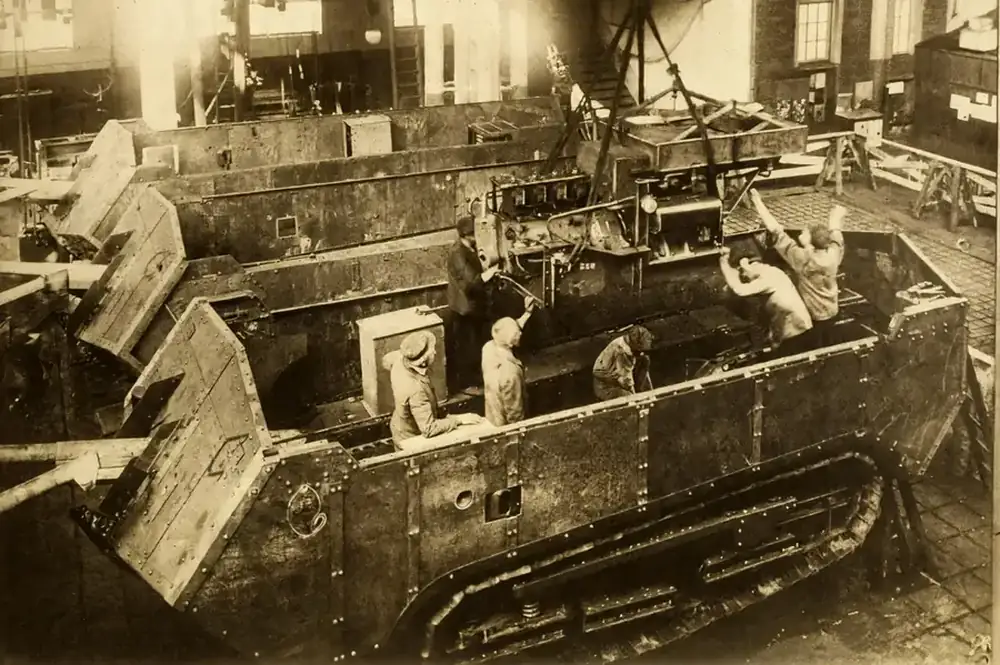
The origins of the Saint-Chamond lay in the French Army’s tank programme of 1915 and 1916, when the French, like the British, were searching for a vehicle that could cross trenches and break through German defences on the Western Front. The French Army’s first tank was the Schneider CA1, designed by the Schneider company, and the Saint-Chamond was developed in parallel by the Compagnie des Forges et Acieries de la Marine et d’Homecourt, a steel company based in Saint-Chamond. The two tanks were both based on the Holt tractor, an American agricultural machine, and they were both designed to carry a 75 mm gun and to support infantry in assaults. The Saint-Chamond was the larger and more powerful of the two, and it was intended to be the main French assault tank.
Colonel Estienne and the Assault Tank
The Saint-Chamond was developed under the direction of Colonel Jean-Baptiste Estienne, the French officer who is regarded as the father of the French tank corps. Estienne had proposed the use of tanks in 1915, and he was the driving force behind the French tank programme. The Saint-Chamond’s design was influenced by Estienne’s ideas: it was to be a long, heavily armed vehicle that could cross trenches and destroy German strongpoints with its 75 mm gun. The design team at Saint-Chamond, led by the company’s engineers, produced a tank with a long hull, a 75 mm gun mounted in the front, and a petrol-electric transmission, which was an innovative but unreliable system. The first prototype was delivered in 1916, and it was tested at the French Army’s proving ground, where its gun and its armour were praised, although its mobility was criticised.
A Design Shaped by the Holt Tractor
The Saint-Chamond’s design was shaped by the Holt tractor, which provided its chassis and its tracks. The Holt tractor was a successful agricultural machine, but it was not designed for military use, and its short tracks and its long overhang made the Saint-Chamond prone to bogging down and to nosing into trenches. The Saint-Chamond’s designers tried to address these problems by lengthening the hull and by fitting wider tracks, but the tank’s mobility remained poor. The Saint-Chamond’s petrol-electric transmission, which used a petrol engine to drive an electric generator that powered electric motors on the tracks, was also a problem: it was unreliable, difficult to maintain, and it consumed a great deal of fuel. The Saint-Chamond was thus a tank that was built on a flawed foundation, and its designers were never able to overcome the limitations of the Holt chassis.
3. Design
Hull, Tracks and Mobility
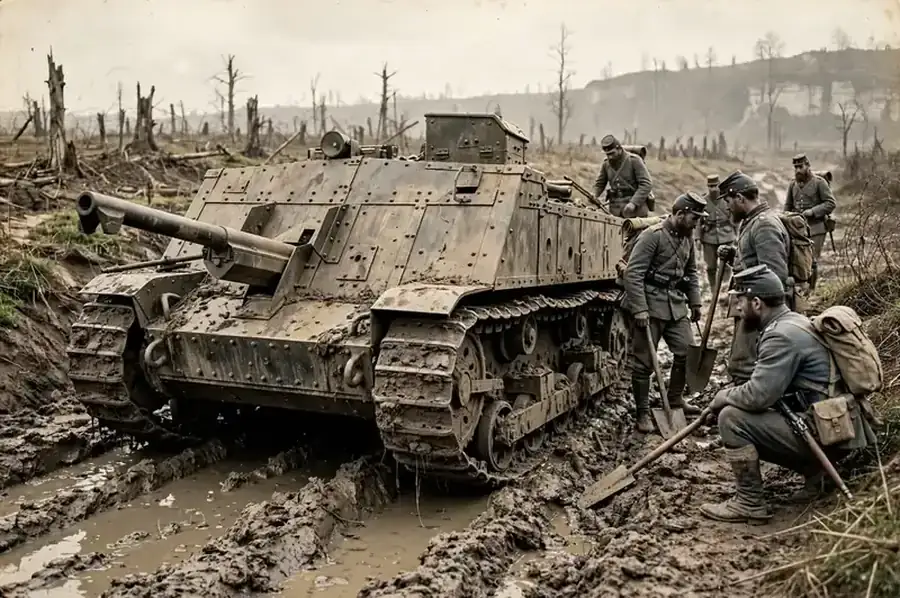
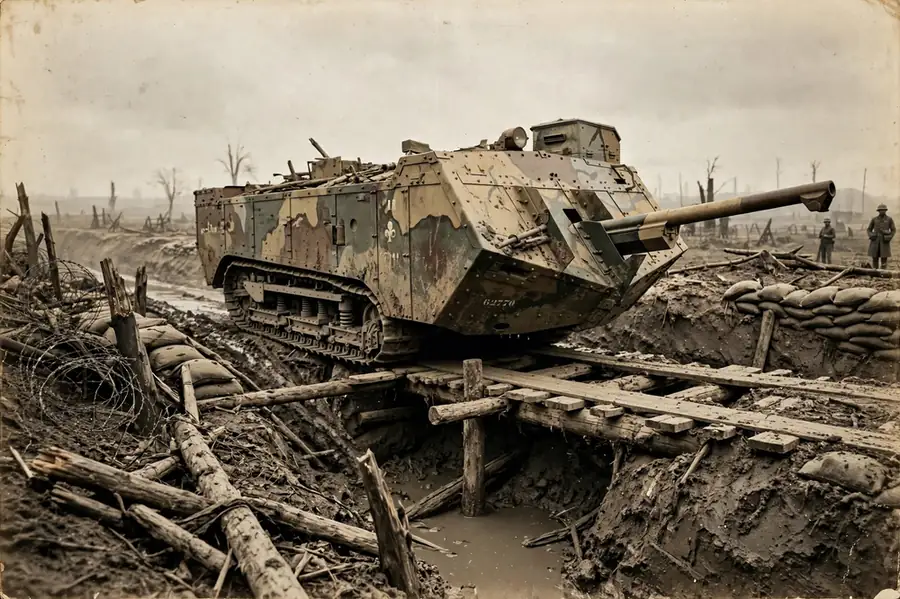
The Saint-Chamond’s most distinctive feature was its long hull, which measured about 8.63 metres, and its short tracks, which did not extend to the front of the hull. The hull overhung the tracks at the front by more than a metre, and this made the tank prone to nosing into trenches and to bogging down in soft ground. The Saint-Chamond’s top speed was only about 8 kilometres per hour on roads, and its cross-country speed was lower still. The tank’s suspension was simple, and its ground pressure was high, which made it difficult to operate in the mud of the Western Front. The Saint-Chamond’s mobility was its greatest weakness, and it limited the tank’s usefulness in combat. The 1918 model was fitted with wider tracks and a modified hull, which improved its mobility slightly, but the tank remained slow and prone to bogging down.
The 75 mm Gun and Armour
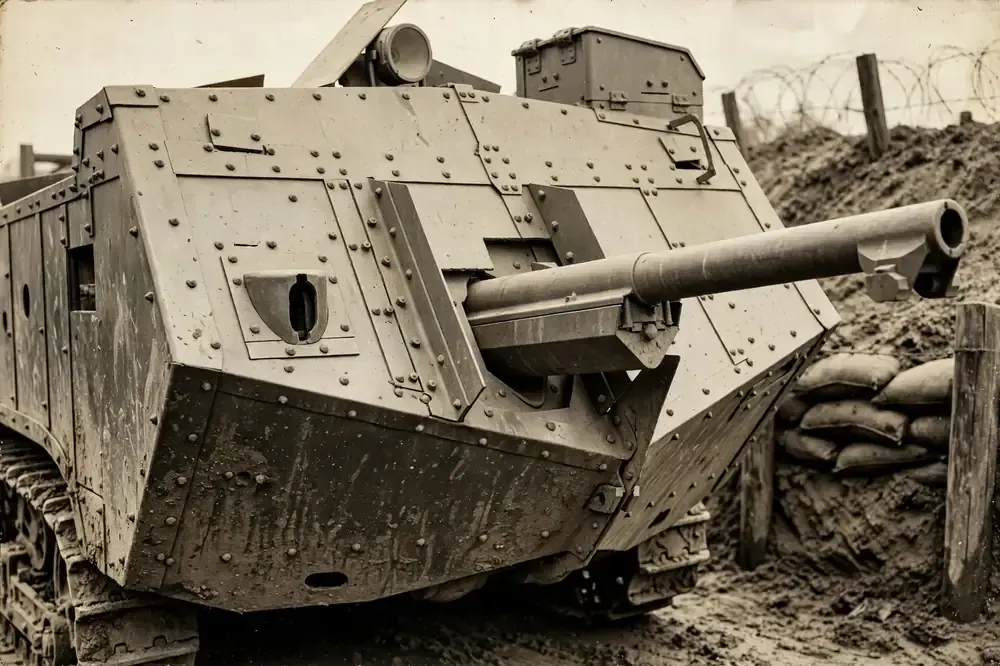
The Saint-Chamond’s main armament was its 75 mm gun, mounted in the front of the hull, which was one of the most powerful tank guns of the First World War. The gun was the French Army’s standard field gun, adapted for tank use, and it fired a high-explosive shell that could destroy a German strongpoint or a machine-gun nest. The tank carried 106 rounds of ammunition, and the gun’s crew, which included a gunner and two loaders, worked in the front of the hull. The Saint-Chamond’s armour was up to 17 mm thick on the hull front and 11 mm on the sides, which was enough to resist German machine-gun fire and shell splinters, but not German anti-tank guns, which were still in their infancy. The Saint-Chamond also carried two to four 8 mm Hotchkiss machine guns, mounted in the sides and rear of the hull, for defence against infantry.
Crew, Vision and Ergonomics
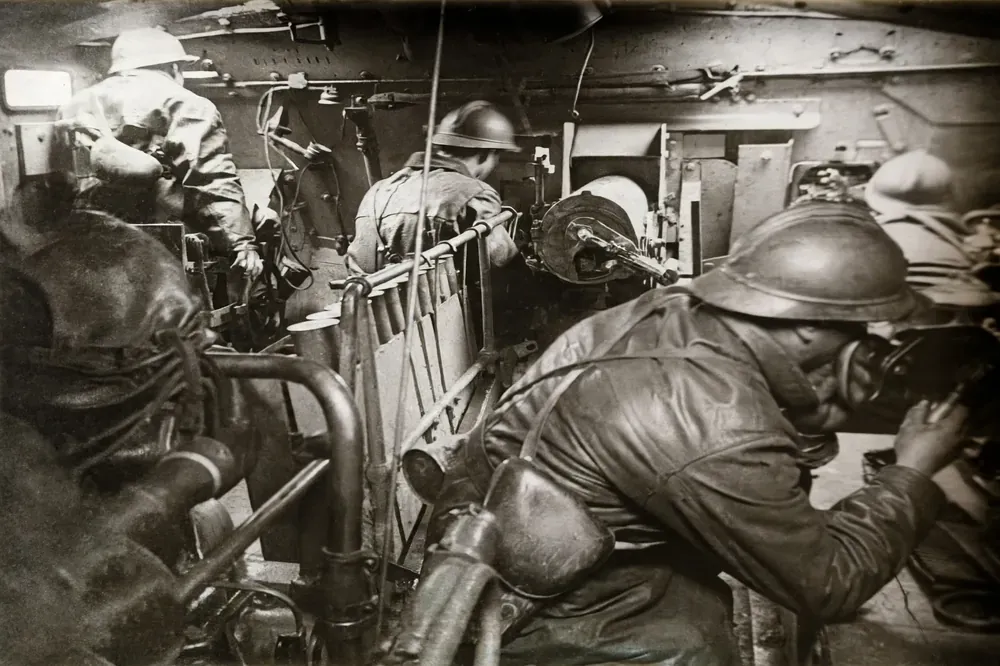
The Saint-Chamond carried a crew of eight or nine men, the largest of any tank of the First World War: a commander, a gunner, two loaders, a driver, two mechanics and a machine-gunner. The crew worked in a cramped, noisy and poorly ventilated hull, and the petrol-electric transmission produced a great deal of heat. The driver’s position was in the front of the hull, beside the gun, and the commander’s position was in a small cupola on the roof. The Saint-Chamond’s interior was divided into two compartments, with the engine and transmission in the rear and the fighting compartment in the front. The crew’s working conditions were poor, and the tank’s reliability was low, but the Saint-Chamond’s crews were proud of their vehicle, and they valued its 75 mm gun and its armour.
4. Variants
The 1917 and 1918 Models
The Saint-Chamond was built in two main production models, the 1917 model and the 1918 model, and the differences between them were mainly in the tracks and the hull. The 1917 model had narrow tracks and a long, overhanging nose, which made it prone to bogging down. The 1918 model, which entered production in early 1918, had wider tracks, a modified hull with a shorter overhang, and a redesigned gun mounting. The 1918 model also had improved ventilation and a better layout for the crew. The 1918 model was the version that fought in the final Allied offensives of 1918, and it is the version that is most often seen in photographs. The total production of about 400 vehicles was split between the two models, with the 1917 model accounting for the majority.
The End of Production
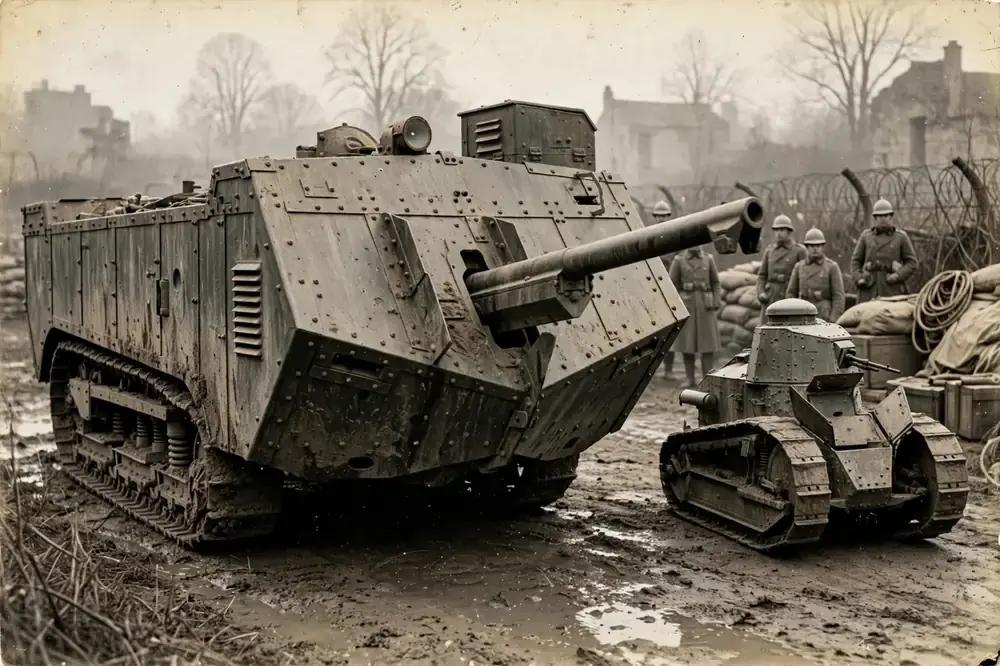
Saint-Chamond production ended in 1918, when the French Army decided that the Renault FT, a light tank with a rotating turret, was a better design and that the Saint-Chamond’s production should be stopped. The Renault FT was lighter, more reliable and easier to manufacture, and it became the standard French tank of the war. The Saint-Chamond’s chassis and engine were used for other purposes, and the 75 mm gun was returned to the artillery. The Saint-Chamond was thus a dead end in tank design, but its gun and its concept lived on in the Renault FT and in the later French tanks that followed. The Saint-Chamond’s place in tank history is thus as a stepping stone, a design that pointed the way to more successful vehicles even though it was itself a failure as a general-purpose tank.
The Saint-Chamond as a Supply Vehicle
After the war, some Saint-Chamond tanks were converted into supply vehicles, with the gun and turret removed and the hull used to carry ammunition and supplies. The Saint-Chamond’s long hull and its large interior made it suitable for this role, and the converted vehicles served in the French Army into the 1920s. The Saint-Chamond’s conversion into a supply vehicle shows how the French Army tried to make use of the tanks that had been built during the war, even after they had been superseded as fighting vehicles. The Saint-Chamond’s supply role was a modest end to a tank that had been designed as a breakthrough weapon, but it was a practical use for a vehicle that was otherwise obsolete.
5. Operational History
Laffaux and the First Battles
The Saint-Chamond’s combat debut came at Laffaux in May 1917, during the Nivelle Offensive, when Saint-Chamonds of the French tank corps supported infantry attacks on German positions on the Chemin des Dames. The attack was a costly failure, and many Saint-Chamonds were lost, either to German artillery or to mechanical breakdowns. The Saint-Chamond’s long hull and its short tracks made it prone to bogging down in the mud, and its petrol-electric transmission was unreliable. The Saint-Chamond’s first battle was thus a disappointment, and the French Army’s tank corps was criticised for its performance. But the Saint-Chamond’s crews learned from the experience, and the tank’s design was improved in the 1918 model.
Soissons and the Final Offensives
In July 1918, Saint-Chamonds took part in the Allied counter-offensive at Soissons, when French and American troops, supported by tanks, attacked the German salient on the Marne. The Saint-Chamonds performed well at Soissons, supporting infantry in the advance and destroying German strongpoints with their 75 mm guns. The tank’s mobility was still poor, but the dry summer ground made it easier to operate, and the Saint-Chamond’s crews were more experienced. The Saint-Chamond also fought in the final Allied offensives of 1918, including the battles of the Hindenburg Line and the advance to the German border. By the end of the war, the Saint-Chamond had become a reliable, if slow, support tank, and its service in the final offensives was a significant part of the French Army’s contribution to the Allied victory.
The End of Service
The Saint-Chamond was withdrawn from service at the end of the war, in 1918 and 1919, when the French Army decided that the Renault FT was a better tank and that the Saint-Chamond’s production should be stopped. The Saint-Chamond’s crews were transferred to the Renault FT, and the Saint-Chamond tanks were either scrapped or converted into supply vehicles. The Saint-Chamond’s service lasted only about eighteen months, but it was a significant part of the French tank corps’ history, and it showed what a heavy assault tank could do when it was used correctly. The Saint-Chamond’s withdrawal was thus not a rejection of its design, but a recognition that the tank had been superseded by a better vehicle.
The Saint-Chamond and the French Tank Corps
The Saint-Chamond was one of the first tanks of the French tank corps, which was created in 1916 under the direction of Colonel Estienne. The tank corps, known as the Artillerie Speciale, was the first armoured force in the French Army, and it pioneered the use of tanks in support of infantry. The Saint-Chamond’s service in the tank corps, alongside the Schneider CA1 and the Renault FT, was a significant part of the corps’ history, and it helped to establish the tank as a weapon of war. The Saint-Chamond’s legacy in the French tank corps is thus as a pioneering vehicle, one of the first tanks to be used in combat by the French Army.
6. Performance and Specifications
Strengths on the Battlefield
The Saint-Chamond’s greatest strength was its 75 mm gun, which was the most powerful tank gun in service in 1917. The gun’s high-explosive shell could destroy a German strongpoint or a machine-gun nest, and its range was greater than that of any other tank gun of the war. The Saint-Chamond’s armour, while thin by later standards, was enough to resist German machine-gun fire and shell splinters, and its long hull gave it a stable firing platform. The Saint-Chamond’s crew of eight or nine men meant that it could sustain a high rate of fire, and its large ammunition capacity of 106 rounds was a significant advantage. In the assault role, the Saint-Chamond was a formidable weapon, and its performance at Soissons showed what it could do when it was used correctly.
Weaknesses and Trade-offs
The weaknesses were severe. The Saint-Chamond’s top speed of about 8 kilometres per hour was slow, and its cross-country speed was lower still. Its fuel consumption was high, and its range of about 60 kilometres was limited. The petrol-electric transmission was unreliable and difficult to maintain, and the tank’s ground pressure was high, which made it prone to bogging down. The Saint-Chamond’s long hull and short tracks made it prone to nosing into trenches, and its height made it a conspicuous target. The Saint-Chamond was a specialised weapon with serious limitations, and its designers accepted those limitations because they believed that the 75 mm gun was worth the cost. The Saint-Chamond’s performance must be judged against its intended role: supporting infantry in assaults on prepared defences, where it was a useful, if flawed, weapon.
How the Saint-Chamond Compared with Rivals
Compared with the British Mark IV, the Saint-Chamond had a more powerful gun and a longer hull, but it was slower and less reliable. Compared with the Schneider CA1, the Saint-Chamond had a larger gun and a longer hull, but it was heavier and less mobile. Compared with the Renault FT, the Saint-Chamond had a larger gun and thicker armour, but it was slower, less reliable and much more expensive to build. The Saint-Chamond’s combination of a very large gun and a long hull was unique in 1917, but its mobility and reliability were poor, and it was soon superseded by more practical designs. The Saint-Chamond’s legacy is thus not as a successful tank, but as a bold experiment that showed what was possible and what was not.
7. Operators
France: The Sole Operator
The sole operator of the Saint-Chamond was the French Army, which used it in the Artillerie Speciale, the French tank corps. The Saint-Chamond was issued to the tank battalions of the corps, and it served in the fighting of 1917 and 1918. The Saint-Chamond’s crews were drawn from the French Army’s artillery and infantry, and the tank corps was regarded as an elite formation. The Saint-Chamond’s service was short, but its crews’ accounts of the tank’s gun and its armour have become part of the history of the First World War. The Saint-Chamond was never exported, and it was never used by any other country in combat.
The French Tank Corps
The French tank corps, the Artillerie Speciale, was created in 1916 and was the first armoured force in the French Army. The corps was commanded by Colonel Estienne, and it operated the Schneider CA1, the Saint-Chamond and the Renault FT. The corps’ doctrine was to use tanks in support of infantry, and its tactics were developed in the battles of 1917 and 1918. The Saint-Chamond’s service in the corps was a significant part of the corps’ history, and it helped to establish the tank as a weapon of war in the French Army. The corps was disbanded after the war, but its legacy lived on in the French Army’s armoured forces.
8. Legacy and Influence
A Pioneering Tank
The Saint-Chamond’s legacy is that of a pioneering tank. It was one of the first tanks ever built, and it showed that a tank could mount a powerful gun and carry thick armour. But it also showed that a tank based on a tractor chassis was impractical, and that a tank’s mobility and reliability were as important as its gun and its armour. The Saint-Chamond’s gun and its concept lived on in the Renault FT and in the later French tanks that followed, and the Saint-Chamond’s place in tank history is as a stepping stone, a design that pointed the way to more successful vehicles even though it was itself a failure as a general-purpose tank.
Cultural Memory and Historical Assessment
The Saint-Chamond is one of the most famous tanks of the First World War, and its image is closely associated with the French tank corps and with the battles of 1917 and 1918. Historians have assessed the Saint-Chamond as a flawed but fascinating design, a tank that was built for a specific purpose and that performed that purpose well, but that was not suited to the general fighting of the war. The Saint-Chamond’s reputation has been enhanced by the survival of the last example at Saumur, which is one of the most important artefacts of the First World War. The Saint-Chamond is remembered as a symbol of French wartime improvisation and of the early, experimental days of tank warfare.
The Saint-Chamond at Saumur
The last surviving Saint-Chamond, at the Musee des Blindes at Saumur, is one of the most important tanks in the world. It is a 1918 model, with wider tracks and a modified hull, and it is displayed alongside other French tanks of the First World War. The Saumur Saint-Chamond is a reminder of the French Army’s contribution to the development of the tank, and it is a popular exhibit for visitors to the museum. The tank’s survival ensures that future generations can see the vehicle that supported French infantry in the battles of 1917 and 1918, and that they can appreciate the scale and the ambition of the French tank programme.
9. Surviving Examples
The Last Saint-Chamond at Saumur
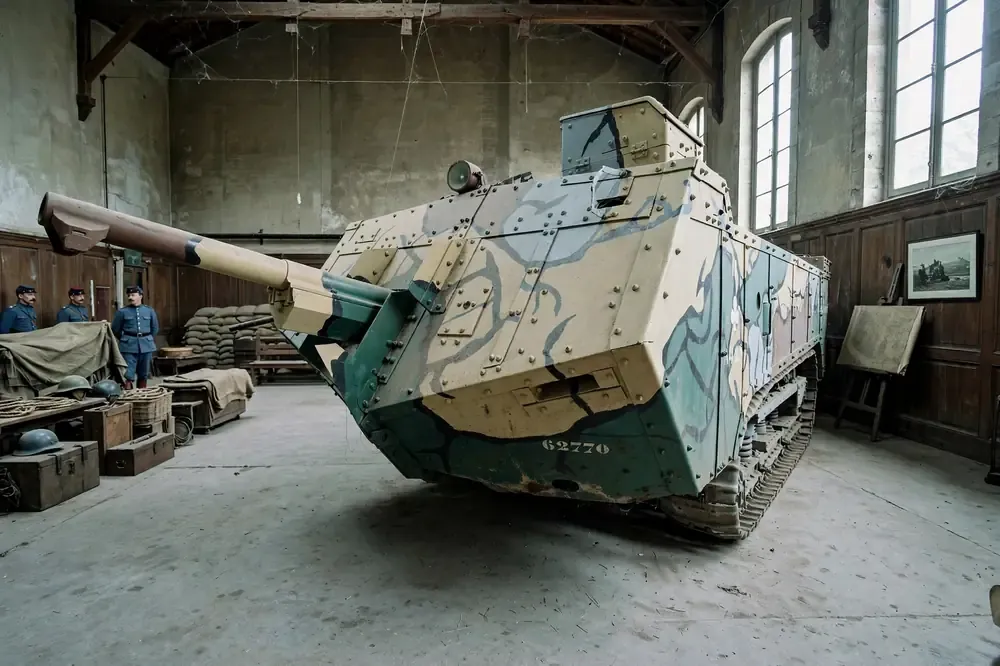
Only one Saint-Chamond survives today, at the Musee des Blindes at Saumur in France. The Saumur tank is a 1918 model, and it is one of the most important artefacts of the First World War. It is displayed in the museum’s First World War gallery, alongside a Schneider CA1 and a Renault FT, and it is a reminder of the French tank corps’ history. The Saumur Saint-Chamond is maintained by the museum, and it is occasionally displayed at commemorative events. The tank’s survival is a testament to the care with which the French Army and the museum have preserved it, and it ensures that the Saint-Chamond will be remembered.
No Other Survivors
No other Saint-Chamond survives, and the Saumur tank is unique. The Saint-Chamond’s production run of about 400 vehicles was small, and most of the tanks were scrapped after the war. The Saumur tank’s survival is thus a remarkable piece of luck, and it is a valuable artefact for historians of the First World War. The Saint-Chamond’s single survivor ensures that future generations can see the tank that was one of the first to be built, and that they can appreciate the ambition and the audacity of the French tank programme in 1916.
Frequently Asked Questions
Was the Saint-Chamond a good tank?
The Saint-Chamond was a good tank for its intended role, the destruction of fortifications with its 75 mm gun, but it was a poor general-purpose battle tank. Its mobility was poor, its transmission was unreliable, and it was prone to bogging down. But its gun was the most powerful tank gun of 1917, and its service at Soissons showed what it could do when it was used correctly.
How many Saint-Chamond tanks were built?
Approximately 400 Saint-Chamond tanks were built between 1917 and 1918, all by the Compagnie des Forges et Acieries de la Marine et d’Homecourt at Saint-Chamond. This was a significant production run for a First World War tank, and it reflected the importance that the French Army attached to the assault tank role.
Why was the Saint-Chamond so long?
The Saint-Chamond was 8.63 metres long because its hull was designed to cross trenches, and its long overhang at the front was intended to help it span wide ditches. The long hull also gave the tank a stable firing platform for its 75 mm gun. But the long hull and short tracks made the tank prone to nosing into trenches and to bogging down.
Did the Saint-Chamond fight in the First World War?
Yes. The Saint-Chamond fought in the French offensives of 1917 and 1918, including the battles of Laffaux in May 1917 and Soissons in July 1918. It served in the French tank corps, the Artillerie Speciale, and it was withdrawn from service at the end of the war.
How many Saint-Chamond tanks survive today?
Only one Saint-Chamond survives today, at the Musee des Blindes at Saumur in France. It is a 1918 model, with wider tracks and a modified hull, and it is one of the most important artefacts of the First World War.
What replaced the Saint-Chamond?
The Saint-Chamond was replaced by the Renault FT, a light tank with a rotating turret, which was lighter, more reliable and easier to manufacture. The Renault FT became the standard French tank of the war, and it was built in much larger numbers than the Saint-Chamond.
Sources
- Alain Gougaud, L’Aube de la Gloire: Les Autos-Mitrailleuses et les Chars Francais pendant la Grande Guerre (Musee des Blindes).
- Steven J. Zaloga, French Tanks of World War I (Osprey Publishing, New Vanguard series).
- The Musee des Blindes, Saumur, Saint-Chamond collection records.
- David Fletcher, British Battle Tanks: World War I to 1939 (Osprey Publishing).
- Chamberlain, Peter, and Ellis, Chris, British and American Tanks of World War II (Arms and Armour Press).
- Tim Gale, The French Army’s Tanks and Tank Corps in the Great War (academic articles).