 WAR ATLAS MILITARY HISTORY MAGAZINE · WWI — WWII
B-17 Flying Fortress
1. Lead
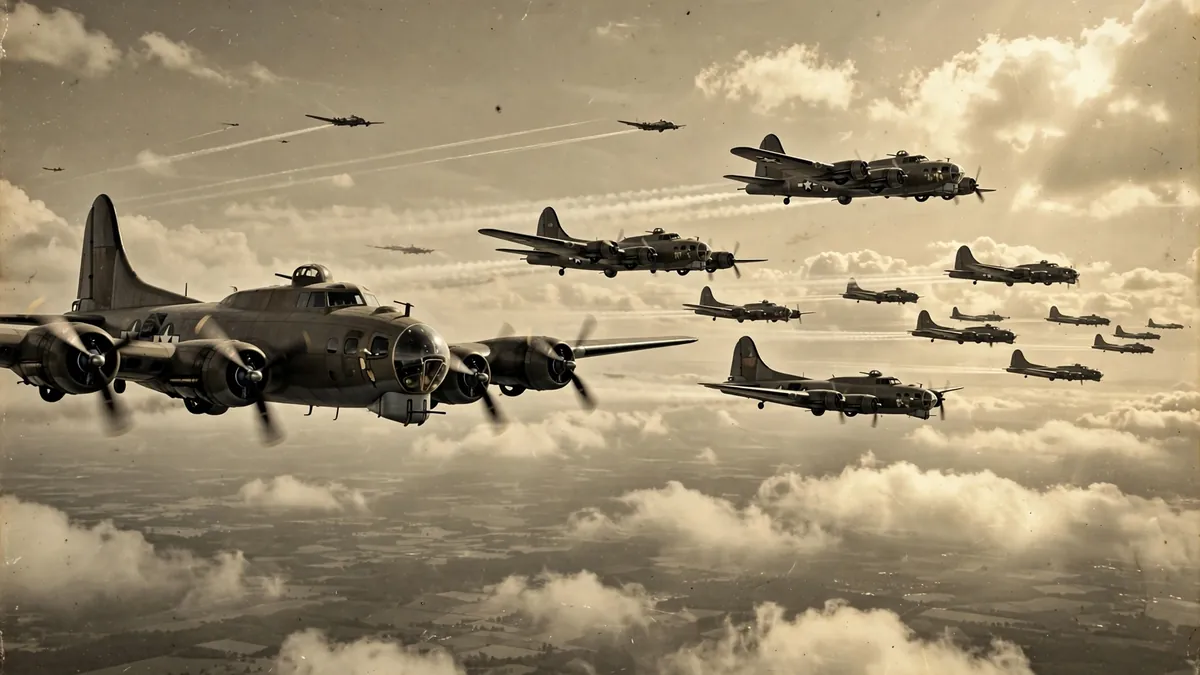
The Boeing B-17 Flying Fortress was the most famous American bomber of the Second World War, and the aircraft that carried the daylight strategic bombing campaign against Germany. A four-engined heavy bomber with a crew of ten, it was designed in the 1930s to defend the United States against an enemy fleet, and it became the weapon with which the United States Army Air Forces tried to destroy the German war economy from the air. The B-17 was heavily armed, with up to thirteen .50-calibre machine guns, and it was built to absorb punishment and to bring its crew home, and its crews called it the Flying Fortress because it bristled with guns and because it seemed, in the early years of the war, almost impossible to shoot down. Between 1942 and 1945, B-17s of the Eighth Air Force flew from England to attack German factories, oil refineries, railways and cities, and they dropped more than 640,000 tons of bombs on Germany, at a cost of about 4,700 aircraft lost and tens of thousands of airmen killed, wounded or captured. The B-17’s story is the story of the daylight bombing campaign, of the men who flew it and of the price they paid.
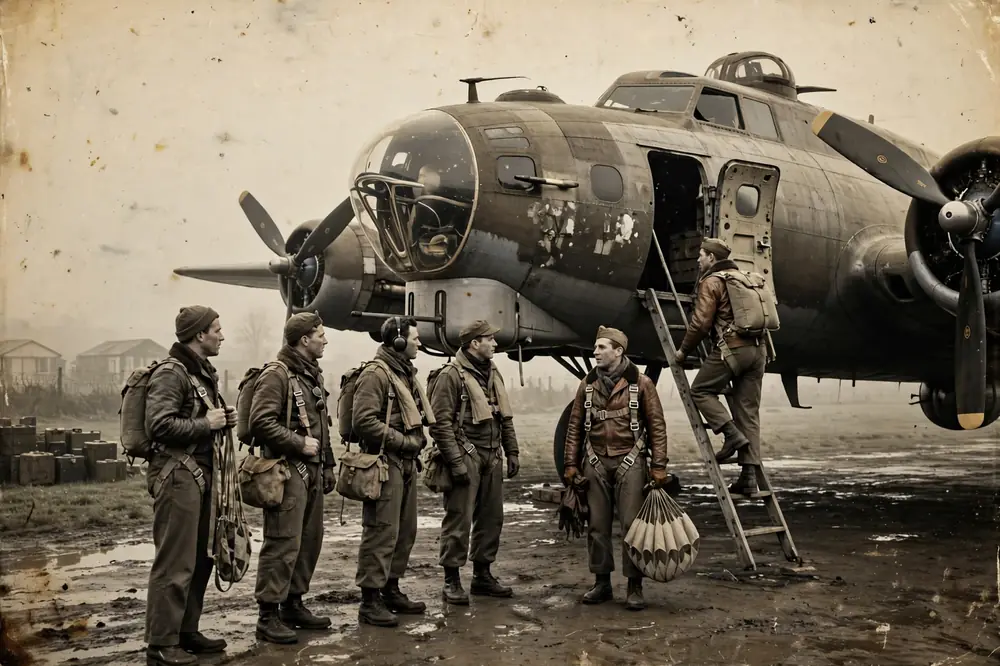
The B-17 was designed to a theory, and the theory was wrong, but the aircraft survived the theory and became a legend. The theory was that a formation of heavily armed bombers, flying in daylight and in close formation, could defend itself against enemy fighters without fighter escort, and could bomb with precision from high altitude, and could destroy the enemy’s industry and win the war without an invasion. The theory failed in 1943, when the German fighters and flak shot down B-17s in terrible numbers, and the Eighth Air Force was forced to suspend its deep raids until long-range fighters arrived, but the B-17 itself proved to be a superb aircraft, tough, reliable and beloved by its crews, and when the P-51 Mustang arrived to escort it, the B-17 became the weapon that the theory had promised. The B-17’s fame rests on its crews as much as on the aircraft itself, and on the films and the books that told their story, above all the Memphis Belle, the first B-17 to complete twenty-five missions and to return to the United States, and the subject of a famous documentary and a feature film.
2. Key Facts
| Type | Four-engined heavy bomber |
| Origin | United States |
| Designer | Boeing (E. Gifford Emery and Edward Curtis Wells) |
| Manufacturer | Boeing, Douglas, Lockheed (Vega) |
| First flight | 28 July 1935 (Model 299 prototype) |
| In service | 1938–1968 (USAF; later with other air forces) |
| Produced | 1936–1945; 12,731 built |
| Crew | 10 (pilot, co-pilot, navigator, bombardier, flight engineer, radio operator, 4 gunners) |
| Length | 22.8 m (74 ft 9 in) |
| Wingspan | 31.6 m (103 ft 9 in) |
| Height | 5.8 m (19 ft 1 in) |
| Max speed | About 462 km/h (287 mph) |
| Cruise speed | About 293 km/h (182 mph) |
| Range | About 3,219 km with a 2,700 kg bomb load; ferry range about 5,472 km |
| Service ceiling | 10,851 m (35,600 ft) |
| Engines | Four Wright R-1820-97 Cyclone radials, 1,200 hp each |
| Armament | Up to 13 × .50-calibre M2 machine guns (B-17G) |
| Bomb load | Up to 7,800 kg maximum; typically 1,800–2,700 kg on long-range missions |
3. Background and Development
The Army’s Requirement for a Long-Range Bomber
The B-17 was born of a requirement issued by the United States Army Air Corps in 1934, for a multi-engined bomber that could carry a useful bomb load over a long range and defend itself against enemy fighters. The Air Corps had been influenced by the theories of the Italian general Giulio Douhet and the American general Billy Mitchell, who argued that the bomber would be the decisive weapon of the next war, and it wanted an aircraft that could fly beyond the range of the coastal defences and attack an enemy fleet before it reached the American coast. Boeing answered the requirement with the Model 299, a four-engined bomber with a crew of five, a bomb load of 2,200 kilograms and a defensive armament of five machine guns, and the prototype first flew on 28 July 1935. The aircraft was impressive, and a newspaper reporter who saw its defensive guns called it a “flying fortress”, and the name stuck, but the prototype was lost in an accident in October 1935, when it crashed on take-off because its gust locks had not been removed, and the Army, which had been impressed by the aircraft, ordered a small number for service trials instead of the large production run it had planned.
From the Model 299 to the B-17G
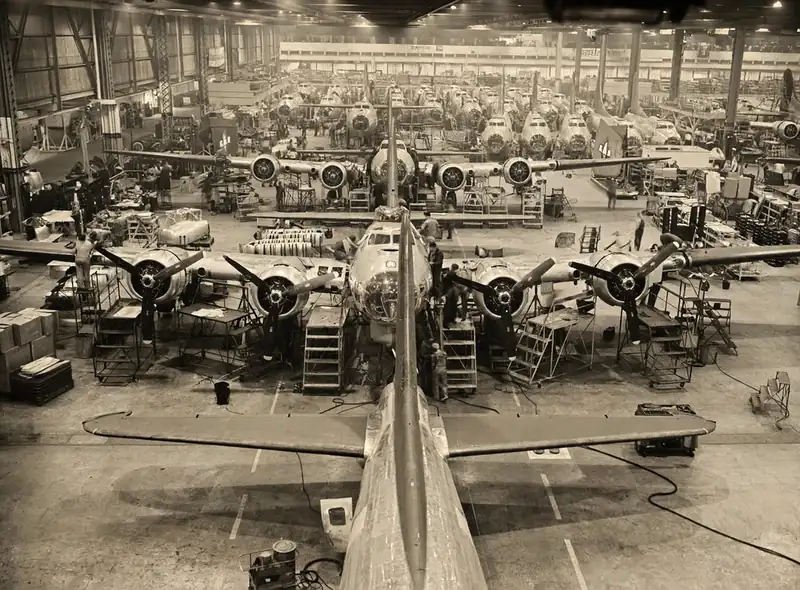
The B-17 went through a long development, from the Model 299 prototype through the Y1B-17 service-test aircraft, the B-17B, C and D, and the B-17E, F and G that fought the war. Each version was larger, heavier and more heavily armed than the last, and the B-17E, which entered service in 1941, was the first version with a tail gun, a dorsal turret and a ventral turret, and with a crew of ten, and it was the version that fought at Pearl Harbor, in the Philippines and at Midway. The B-17F, which entered service in 1942, was the version that fought the daylight bombing campaign over Germany, and it was built in larger numbers than any earlier version, with 3,405 built by Boeing, Douglas and Lockheed. The B-17G, which entered service in 1943, was the definitive version, with a chin turret under the nose to defend against head-on attacks by German fighters, and with thirteen .50-calibre machine guns, and 8,680 B-17Gs were built, more than any other version, and it was the B-17G that flew the great majority of the Eighth Air Force’s missions over Germany.
The Doctrine of Daylight Precision Bombing
The B-17 was designed to a doctrine, and the doctrine was that of daylight precision bombing, which held that a formation of heavily armed bombers, flying in daylight and in close formation, could defend itself against enemy fighters without fighter escort, and could bomb with precision from high altitude, and could destroy the enemy’s industry and win the war without an invasion. The doctrine was developed at the Air Corps Tactical School at Maxwell Field, Alabama, in the 1930s, and it was based on the belief that the bomber would always get through, and that the Norden bombsight, a secret American device, would let the bombardier hit a target from 20,000 feet with great accuracy. The doctrine was wrong in its details: the B-17 could not defend itself without fighter escort, and the Norden bombsight was far less accurate in combat than it was in trials, and the bombing campaign was far more costly than its advocates had promised, but the doctrine gave the B-17 its mission, and it shaped the aircraft’s design, its armament and its tactics, and it is impossible to understand the B-17 without understanding the doctrine that it was built to serve.
4. Design
Four Engines and a Tough Airframe
The B-17 was a four-engined, all-metal, low-wing monoplane, with a crew of ten and a bomb load of up to 7,800 kilograms, and it was powered by four Wright R-1820 Cyclone radial engines of 1,200 horsepower each, which gave it a top speed of about 462 kilometres per hour and a service ceiling of 10,851 metres. The aircraft’s airframe was built to be tough: its wings and fuselage were made of aluminium alloy, its structure was designed to absorb damage, and its engines, its fuel tanks and its control systems were separated and protected so that the aircraft could keep flying after taking hits that would have destroyed a less robust aircraft. B-17 crews told stories of aircraft that returned to England with engines shot away, with holes in their wings and fuselages, with their tail surfaces damaged and with their crews wounded, and the aircraft’s toughness became a legend, and it was one of the reasons the crews loved it and trusted it to bring them home.
Defensive Armament: Thirteen .50-Calibre Guns
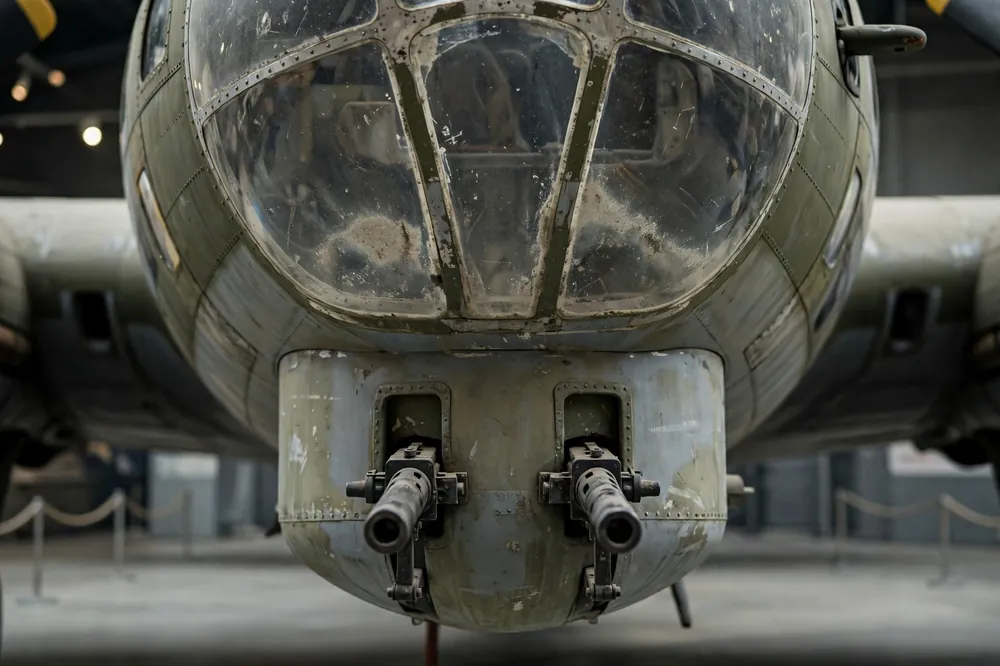
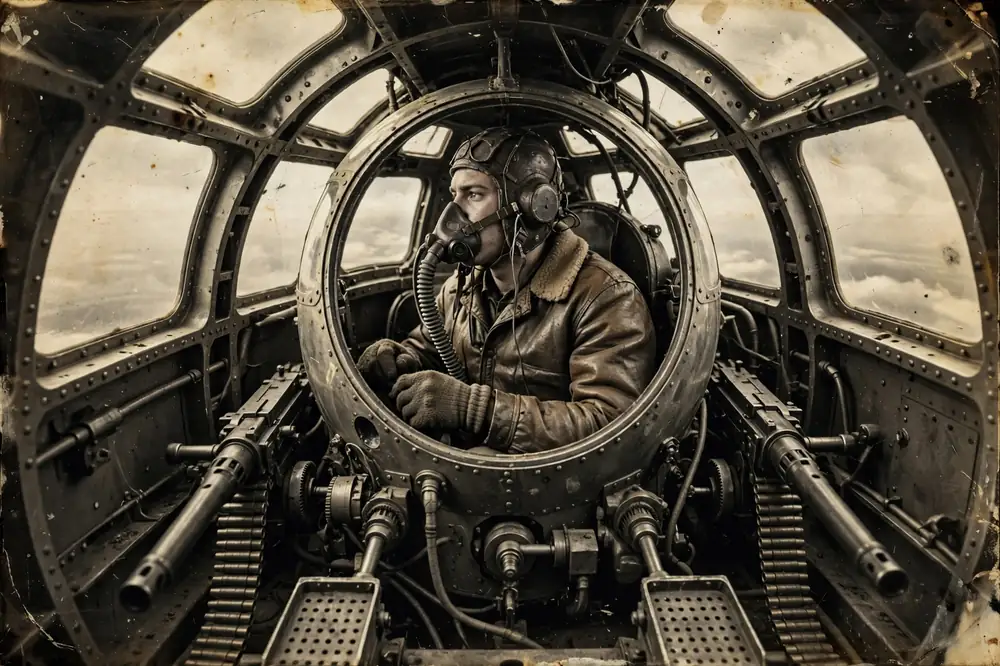
The B-17G, the definitive version, was armed with thirteen .50-calibre M2 Browning machine guns, mounted in a chin turret under the nose, in two cheek guns, in a dorsal turret, in a ventral ball turret, in two waist guns, in a radio-room gun and in a tail gun, and the guns were arranged so that the aircraft could bring fire to bear in almost every direction. The ball turret, a spherical glass and metal turret under the belly of the aircraft, was the most famous and the most feared position: the gunner sat in a cramped ball, with his knees against his chest, and he fired two .50-calibre guns at the fighters that attacked from below, and he could not leave his turret until it was cranked back into the fuselage, and if the aircraft had to make a belly landing he was trapped. The B-17’s defensive armament was the heaviest of any bomber of the war, and it was the reason the aircraft was called the Flying Fortress, but it was not enough: the German fighters learned to attack in head-on passes, where the bomber’s guns could not bear, and to concentrate their fire on a single bomber until it fell, and the B-17’s guns, for all their number, could not save it without fighter escort.
The Norden Bombsight and the Crew of Ten
The B-17’s crew of ten consisted of a pilot, a co-pilot, a navigator, a bombardier, a flight engineer, a radio operator and four gunners, and the bombardier, who sat in the glazed nose of the aircraft, was the most important man in the crew on the bombing run, because he operated the Norden bombsight, the secret American device that was supposed to let him hit a target from 20,000 feet with great accuracy. The Norden bombsight was a complex mechanical computer that calculated the release point from the aircraft’s speed, altitude and drift, and it was treated as a secret weapon: the bombardier was ordered to destroy it if the aircraft was in danger of capture, and the sight was removed from the aircraft and locked away when it was on the ground. In practice, the Norden bombsight was far less accurate in combat than it was in trials, because the aircraft was shaken by flak, the target was obscured by cloud and smoke, and the formation had to drop its bombs together on the leader’s signal, and the average error of a B-17’s bombs was measured in hundreds of metres, but the sight remained in service throughout the war, and it was a symbol of the American belief in precision bombing.
5. Variants
| Variant | Years | Key features | Production |
|---|---|---|---|
| B-17E | 1941–1942 | Tail gun, dorsal and ventral turrets; crew of 10 | 512 |
| B-17F | 1942–1943 | Improved engines and armament; the main version of the 1942–43 campaign | 3,405 |
| B-17G | 1943–1945 | Chin turret; 13 × .50-calibre guns; definitive version | 8,680 |
| B-17B/C/D, Y1B-17 and prototypes | 1939–1942 | Early service-test and production versions; Model 299 prototype and XB-38 | 134 |
| YB-40 | 1943 | Gunship escort version with extra guns and armour; too slow | 25 converted from B-17F airframes (not additional production) |
| F-9 | 1942–1945 | Photographic reconnaissance version of the B-17F/G | 107 converted from B-17F/G airframes (not additional production) |
| PB-1 | 1945–1950s | US Navy patrol version; later used by the Coast Guard | 48 transferred from USAAF stocks (not additional production) |
B-17E and B-17F
The B-17E was the first version of the Flying Fortress to be built in large numbers for combat, and it was the version that introduced the tail gun, the dorsal turret and the ventral turret that became standard on all later B-17s. The B-17E fought at Pearl Harbor, in the Philippines and at Midway, and it was the version that the Eighth Air Force took to England in 1942, where it flew the first American daylight bombing missions over Europe. The B-17F, which followed it in 1942, was an improved version with more powerful engines, a frameless nose and a larger bomb load, and it was built in larger numbers than any earlier version, with 3,405 built by Boeing, Douglas and Lockheed. The B-17F was the version that fought the daylight bombing campaign over Germany in 1942 and 1943, and it was the version that suffered the terrible losses of the Schweinfurt raids, and it was the version that the Memphis Belle was, the first B-17 to complete twenty-five missions and to return to the United States.
B-17G: The Definitive Fortress
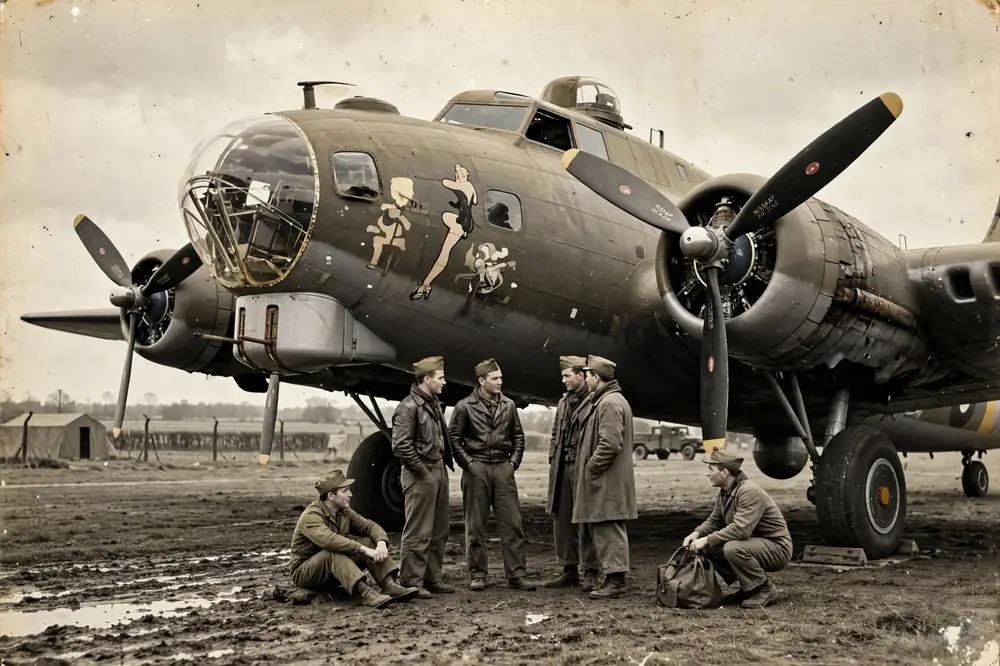
The B-17G was the definitive version of the Flying Fortress, and it was the version that flew the great majority of the Eighth Air Force’s missions over Germany in 1944 and 1945. The B-17G differed from the B-17F in one important respect: it had a chin turret under the nose, with two .50-calibre machine guns, which defended the aircraft against the head-on attacks by German fighters that had caused so many losses in 1943. The B-17G was armed with thirteen .50-calibre machine guns, more than any other bomber of the war, and it was built in larger numbers than any other version, with 8,680 built by Boeing, Douglas and Lockheed. The B-17G was the version that flew with the P-51 Mustang escort, and it was the version that bombed Germany in the last year of the war, when the Luftwaffe was broken and the bombing campaign could finally achieve what its advocates had promised. The B-17G is the version that most people picture when they think of the Flying Fortress, and it is the version that survives in museums and in the air today.
Special Versions: YB-40, F-9 and PB-1
The B-17 was adapted for several special roles, of which the most interesting was the YB-40, a gunship escort version built in 1943 to protect the bomber formations until long-range fighters arrived. The YB-40 carried extra guns and armour and a larger crew, but it was too slow and too heavy to keep up with the bombers after they had dropped their bombs, and only 25 were converted, and the idea was abandoned when the P-51 Mustang arrived. The F-9 was a photographic reconnaissance version of the B-17F and B-17G, with cameras in place of bombs, and it was used to photograph German targets and to assess the damage done by the bombing campaign. The PB-1 was a US Navy patrol version, with 48 B-17s transferred to the Navy and later to the Coast Guard, where they were used for search and rescue and for patrol work. These special versions were a small part of the B-17’s story, but they showed the versatility of the aircraft, and they are a reminder that the Flying Fortress was more than a bomber.
6. Operational History
Early Service: Pearl Harbor and the Pacific
The B-17’s first combat came in the Pacific, where B-17Es were based in the Philippines when Japan attacked on 7 December 1941, and where they were destroyed on the ground at Clark Field on the first day of the war, in a disaster that mirrored Pearl Harbor. The surviving B-17s flew from Australia and from Java, and they attacked Japanese shipping and Japanese bases, and they fought at Midway in June 1942, where they attacked the Japanese fleet from high altitude and scored no hits, a result that showed the limits of high-altitude bombing against ships. The B-17’s service in the Pacific was short, because the Army Air Forces decided that the B-17 would be used in Europe, and the Pacific was given the B-24 Liberator, which had a longer range, but the B-17’s early service in the Pacific was important: it showed that the aircraft was tough and reliable, and that its crews could fly it in the worst conditions, and it gave the Army Air Forces the experience it needed to build the Eighth Air Force in England.
The Daylight Campaign, 1942–1943
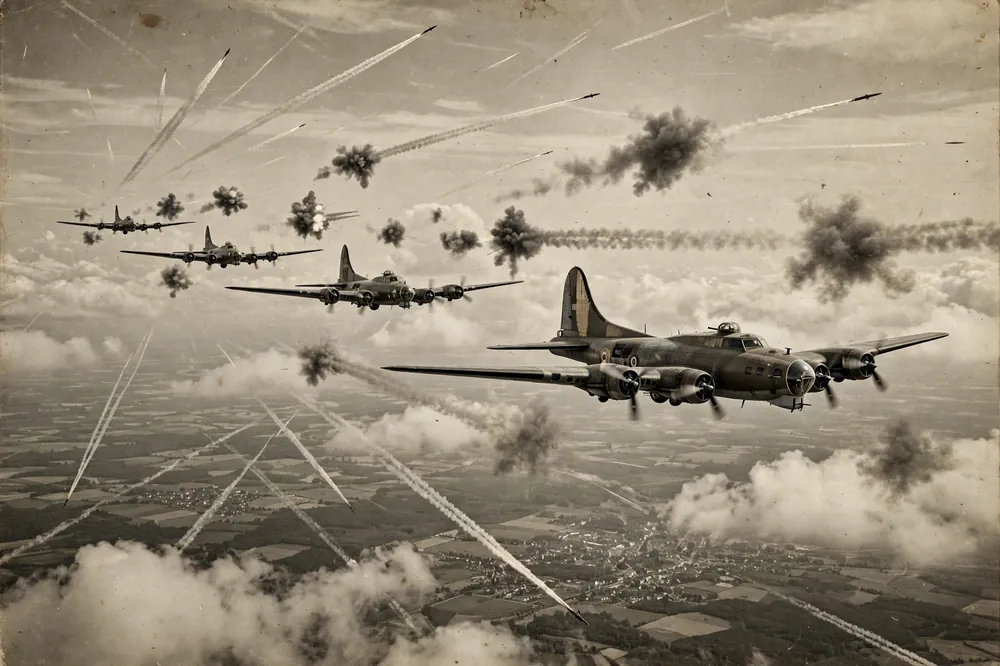
The daylight bombing campaign began in August 1942, when B-17s of the Eighth Air Force flew from England to attack targets in France, and it grew through 1943, when the Eighth Air Force attacked targets deep in Germany, including the ball-bearing factories at Schweinfurt and the aircraft factories at Regensburg. On 17 August 1943, the Eighth Air Force flew a double mission against Schweinfurt and Regensburg with 376 B-17s, and lost 60 bombers, a loss rate that shocked the American command and showed that the daylight bombing campaign could not be sustained without fighter escort. The Schweinfurt and Regensburg raids were the first great test of the daylight bombing doctrine, and they showed that the B-17, for all its guns, could not defend itself against the German fighters, and that the campaign would have to wait for the long-range fighter that could escort the bombers to their targets. The worst day of the campaign came on 14 October 1943, known as Black Thursday, when the Eighth Air Force flew a second mission against the ball-bearing factories at Schweinfurt with 291 B-17s, and lost 60 bombers, with 17 more damaged beyond repair, and 600 airmen killed, wounded or captured. The losses were so heavy that the Eighth Air Force suspended its deep raids into Germany for the rest of the year, and did not resume them until the P-51 Mustang arrived in early 1944, with the range to escort the bombers to their targets and back. Black Thursday was the low point of the B-17’s war, and the day that proved the daylight bombing doctrine wrong: the bomber could not defend itself, and the campaign could not be sustained without fighter escort — yet the B-17’s crews did not lose their faith in the aircraft, and the Eighth Air Force rebuilt its strength and returned.
Schweinfurt and Regensburg
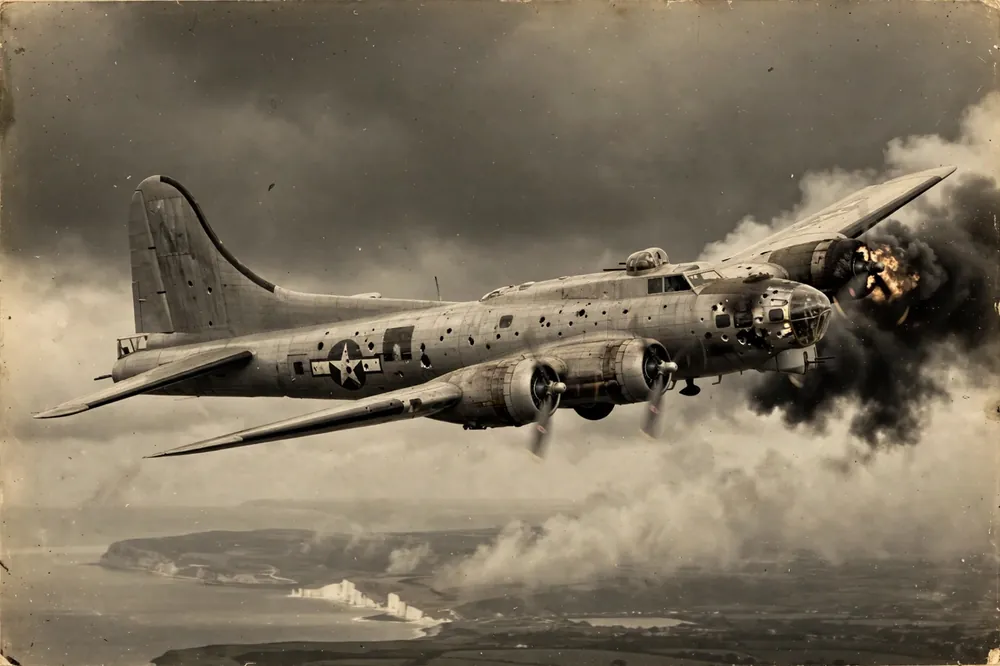
The daylight bombing campaign began in August 1942, when B-17s of the Eighth Air Force flew from England to attack targets in France, and it grew through 1943, when the Eighth Air Force attacked targets deep in Germany, including the ball-bearing factories at Schweinfurt and the aircraft factories at Regensburg. On 17 August 1943, the Eighth Air Force flew a double mission against Schweinfurt and Regensburg, with 376 B-17s, and it lost 60 bombers, a loss rate that shocked the American command and showed that the daylight bombing campaign could not be sustained without fighter escort. The Schweinfurt and Regensburg raids were the first great test of the daylight bombing doctrine, and they showed that the B-17, for all its guns, could not defend itself against the German fighters, and that the campaign would have to wait for the long-range fighter that could escort the bombers to their targets and back.
Black Thursday
The worst day of the daylight bombing campaign came on 14 October 1943, known as Black Thursday, when the Eighth Air Force flew a second mission against the ball-bearing factories at Schweinfurt, with 291 B-17s, and lost 60 bombers, with 17 more damaged beyond repair, and 600 airmen killed, wounded or captured. The losses were so heavy that the Eighth Air Force suspended its deep raids into Germany for the rest of the year, and it did not resume them until the P-51 Mustang arrived in early 1944, with the range to escort the bombers to their targets and back. Black Thursday was the low point of the B-17’s war, and it was the day that proved the daylight bombing doctrine wrong: the bomber could not defend itself, and the campaign could not be sustained without fighter escort. But the B-17’s crews did not lose their faith in the aircraft, and the Eighth Air Force rebuilt its strength, and when the Mustang arrived, the campaign resumed, and it never stopped until the end of the war.
The Mustang Arrives: 1944–1945
In 1944, the P-51 Mustang arrived, and the daylight bombing campaign changed. The Mustang, with its long range and its excellent performance, could escort the B-17s to their targets deep in Germany and back, and it could fight the German fighters on equal terms, and the losses of the B-17s fell dramatically. The Eighth Air Force grew to a strength of over 2,000 bombers, and it attacked the German oil industry, the aircraft industry, the railways and the cities, and it dropped more bombs in 1944 and 1945 than it had dropped in the whole of 1942 and 1943. The B-17G, with its chin turret and its thirteen guns, was the version that flew these missions, and it was the version that the crews loved, because it was tough, it was reliable, and it brought them home. By the end of the war, the B-17s of the Eighth Air Force had dropped more than 640,000 tons of bombs on Germany, and they had lost about 4,700 aircraft, and the men who flew them had paid a terrible price, but they had helped to destroy the German war economy and to win the war.
The Pacific and Other Theatres
The B-17 also served in other theatres, though its main service was in Europe. In the Pacific, B-17s flew from Australia and from New Guinea, and they attacked Japanese shipping and Japanese bases, and they were used as transports and as reconnaissance aircraft after the B-24 had taken over the bombing role. In the Mediterranean, B-17s of the Fifteenth Air Force flew from Italy to attack targets in southern Germany, in Austria and in the Balkans, and they bombed the oil refineries at Ploesti in Romania, which were among the most important targets of the war. In the Far East, B-17s were used by the Royal Air Force’s Coastal Command for anti-submarine patrols, and by the United States Navy as the PB-1 patrol aircraft. The B-17’s service in these theatres was a small part of its story, but it showed the versatility of the aircraft, and it is a reminder that the Flying Fortress served in every theatre of the war.
7. Performance and Specifications
| Specification | B-17G |
|---|---|
| Crew | 10 |
| Length | 22.8 m |
| Wingspan | 31.6 m |
| Height | 5.8 m |
| Empty weight | About 16,400 kg |
| Maximum take-off weight | About 29,700 kg |
| Engines | Four Wright R-1820-97 Cyclone radials, 1,200 hp each |
| Max speed | About 462 km/h |
| Cruise speed | About 293 km/h |
| Range | About 3,219 km with a 2,700 kg bomb load |
| Service ceiling | 10,851 m |
| Armament | 13 × .50-calibre M2 machine guns |
| Bomb load | Up to 7,800 kg; typically 1,800–2,700 kg |
Bombing Performance
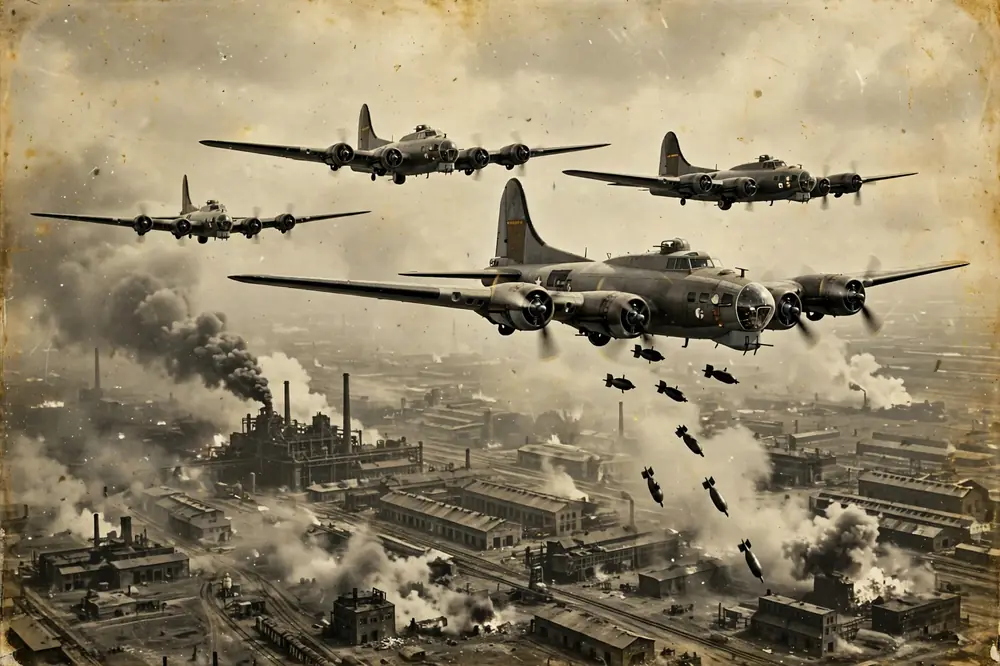
The B-17’s bombing performance was good for a heavy bomber of its generation, but it was far less accurate than its advocates had promised. The Norden bombsight, which was supposed to let the bombardier hit a target from 20,000 feet, was accurate in trials but far less accurate in combat, because the aircraft was shaken by flak, the target was obscured by cloud and smoke, and the formation had to drop its bombs together on the leader’s signal. The average error of a B-17’s bombs was measured in hundreds of metres, and only a small proportion of the bombs fell within 300 metres of the target, but the Eighth Air Force compensated for the inaccuracy by dropping large numbers of bombs, and by attacking area targets such as cities and industrial districts, where a miss of a few hundred metres still did damage. The B-17’s bomb load, typically 1,800 to 2,700 kilograms on long-range missions, was smaller than that of the B-24 and far smaller than that of the British Lancaster, but the B-17’s crews valued its toughness and its defensive armament over its bomb load, and they trusted it to bring them home.
Comparison with the B-24 Liberator and the Lancaster
Compared with the B-24 Liberator, the B-17 was slower and had a shorter range and a smaller bomb load, but it was tougher, it was easier to fly in formation, and it was more popular with its crews, who believed that it could absorb more damage and bring them home. The B-24, which was built in larger numbers than the B-17, with 18,188 built, had a longer range and a larger bomb load, and it was used in the Pacific and in the Mediterranean, where its range was an advantage, but its crews did not love it as the B-17’s crews loved the Fortress. Compared with the British Lancaster, the B-17 was more heavily armed and flew in daylight, while the Lancaster flew at night and carried a far larger bomb load, up to 10,000 kilograms, and the two bombers complemented each other: the B-17 attacked by day and the Lancaster by night, and together they kept Germany under attack around the clock. The B-17’s place in history is that of the daylight bomber, and it is remembered as the aircraft that carried the American bombing campaign against Germany, and that paid the price for it.
8. Operators
The United States
The B-17 was used by the United States Army Air Forces, and it was the main heavy bomber of the Eighth Air Force in England and of the Fifteenth Air Force in Italy, and it was also used by the air forces in the Pacific and in the Mediterranean. The B-17’s crews were the men of the Eighth Air Force, who flew from England to Germany and back, and who suffered the heaviest losses of any American air force in the war, with more than 26,000 airmen killed and tens of thousands more wounded or captured. The B-17 remained in service with the United States Air Force after the war, and it was used as a transport, as a reconnaissance aircraft, as a drone controller and as a search-and-rescue aircraft, and it was finally retired in 1968, thirty years after it had entered service. The B-17’s service with the United States was the longest and the most important of any operator, and it is the service for which the aircraft is remembered.
Other Operators
The B-17 was used by several other countries, most notably the United Kingdom, which received B-17s under Lend-Lease and used them with the Royal Air Force’s Bomber Command and Coastal Command, where they were used for daylight bombing and for anti-submarine patrols. The Soviet Union received a small number of B-17s, and it used them as transports and as reconnaissance aircraft, and it did not copy the B-17: its own Tupolev Tu-4 was a reverse-engineered copy of the B-29. After the war, the B-17 was used by the air forces of France, Brazil, Portugal, Denmark and several other countries, and by the Israeli Air Force, which used B-17s in the 1948 war. The B-17’s worldwide service was a measure of its success: a bomber designed in the 1930s was still in service in the 1950s and 1960s, in the hands of air forces that had never seen the United States, and it was still an effective aircraft.
9. Legacy and Influence
The Legend of the Flying Fortress
The B-17’s legacy is the legend of the Flying Fortress, and it is remembered as the most famous bomber of the Second World War, the aircraft that carried the daylight bombing campaign against Germany and that paid the price for it. The B-17’s toughness, its defensive armament and its crews’ courage became a legend, and the aircraft’s story was told in films, in books and in the memories of the men who flew it, and it became a symbol of American air power and of the sacrifice of the Eighth Air Force. The B-17’s legend rests on its crews as much as on the aircraft itself: the men who flew it were volunteers, they flew twenty-five missions and they faced terrible odds, and their story is one of the great stories of the war. The B-17’s legacy is therefore not only its service in the war, but its place in the memory of the war, and in the films and the books that have kept its story alive for eighty years.
The Memphis Belle and Popular Memory
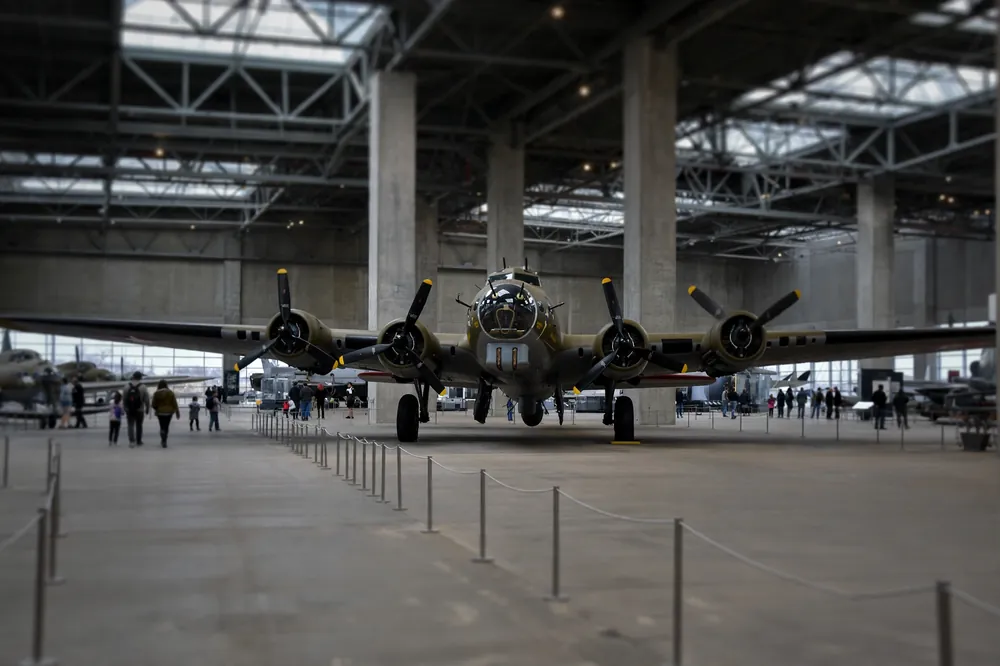
The Memphis Belle is the most famous B-17 of all, and its story is the B-17’s story in miniature. The Memphis Belle, a B-17F of the 91st Bomb Group, was the first B-17 to complete twenty-five missions and to return to the United States, and its crew, led by Captain Robert Morgan, became heroes, and their story was told in a famous documentary film of 1944, The Memphis Belle: A Story of a Flying Fortress, directed by William Wyler, and in a feature film of 1990, Memphis Belle. The aircraft itself is preserved at the National Museum of the United States Air Force in Dayton, Ohio, where it is displayed as a tribute to the men of the Eighth Air Force. The Memphis Belle‘s fame is a measure of the B-17’s place in popular memory: the aircraft that completed twenty-five missions and came home became the symbol of the bomber crews’ war, and its story is told to every visitor to the museum in Dayton, and to every viewer of the films that bear its name.
10. Surviving Examples
Flying Survivors
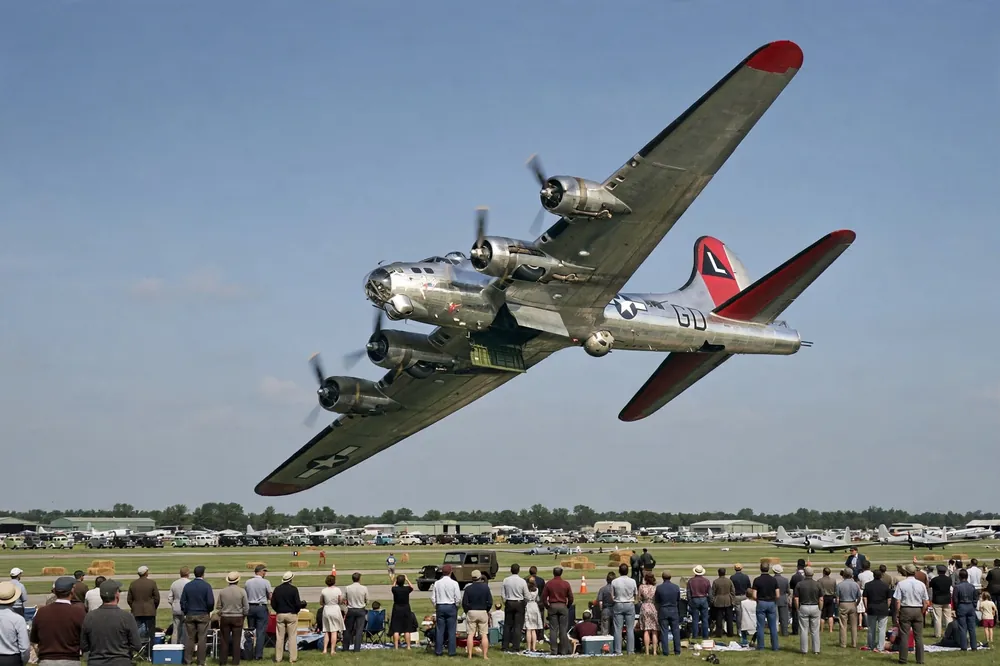
Only a handful of B-17s still fly, and they are among the most precious warbirds in the world. The most famous surviving B-17s are the Memphis Belle, which is preserved at the National Museum of the United States Air Force and does not fly, and the Aluminum Overcast, Yankee Lady and Texas Raiders, which fly at air shows in the United States and give the public a chance to see and to hear a Flying Fortress in the air. The flying B-17s are maintained by volunteer organisations, and they are flown by volunteer pilots, and they are a tribute to the men who flew them in the war and to the aircraft that brought them home. The loss of the B-17 Nine-O-Nine in a crash in Connecticut in 2019, in which seven people were killed, was a reminder of the risks of flying a seventy-year-old aircraft, and of the value of the survivors that remain.
Museums and Memorials
B-17s are displayed in museums around the world, including the National Museum of the United States Air Force in Dayton, Ohio, which holds the Memphis Belle and the Shoo Shoo Shoo Baby, the Smithsonian National Air and Space Museum in Washington, D.C., which holds the Swoose, the Imperial War Museum in Duxford, England, which holds the Sally B, the only B-17 based in Europe that still flies, and the Royal Air Force Museum in London, which holds a B-17G. The B-17 is also remembered in the memorials to the Eighth Air Force, including the American Air Museum at Duxford and the Mighty Eighth Air Force Museum in Savannah, Georgia, and in the cemeteries of the American Battle Monuments Commission in England and in France, where the men who flew the B-17 are buried. For the visitor, the B-17 is one of the most accessible aircraft of the Second World War, and it is displayed in almost every aviation museum that covers the daylight bombing campaign.
Frequently Asked Questions
What is the B-17 Flying Fortress?
The B-17 Flying Fortress was America’s four-engined heavy bomber of the Second World War, built by Boeing. It flew the daylight strategic bombing campaign against Germany with the Eighth Air Force, and 12,731 were built between 1936 and 1945.
How many B-17s were built?
12,731 B-17s were built by Boeing, Douglas and Lockheed between 1936 and 1945, of which 8,680 were B-17Gs, the definitive version.
What was the Memphis Belle?
The Memphis Belle was a B-17F of the 91st Bomb Group, and the first B-17 to complete twenty-five missions and return to the United States. Its story was told in a famous documentary of 1944 and a feature film of 1990, and the aircraft is preserved at the National Museum of the United States Air Force in Dayton, Ohio.
How many guns did the B-17G have?
The B-17G was armed with thirteen .50-calibre M2 machine guns, mounted in a chin turret, cheek guns, a dorsal turret, a ventral ball turret, waist guns, a radio-room gun and a tail gun.
What happened on Black Thursday?
On 14 October 1943, the Eighth Air Force flew a mission against the ball-bearing factories at Schweinfurt and lost 60 of 291 B-17s, with 600 airmen killed, wounded or captured. The losses were so heavy that deep raids were suspended until the P-51 Mustang arrived in 1944.
Where can I see a B-17 today?
B-17s are displayed at the National Museum of the United States Air Force in Dayton, Ohio, the Smithsonian National Air and Space Museum in Washington, D.C., and the Imperial War Museum in Duxford, England, and several B-17s still fly at air shows in the United States.
Sources
- Wikipedia, “Boeing B-17 Flying Fortress” — development, production of 12,731, the daylight bombing campaign, the Memphis Belle.
- Martin Caidin, The B-17: The Flying Fortress (Bantam Books, 1987) — the aircraft’s design and its combat record.
- Roger A. Freeman, The Mighty Eighth (Doubleday, 1970) — the Eighth Air Force and the daylight bombing campaign.
- Donald L. Miller, Masters of the Air (Simon & Schuster, 2006) — the bomber crews and the Schweinfurt raids.
- Martin W. Bowman, B-17 Flying Fortress Units of the Eighth Air Force (Osprey Publishing, 2000) — the B-17’s operational history.
- William Wyler, The Memphis Belle: A Story of a Flying Fortress (1944 documentary film) — the Memphis Belle and its crew.