 WAR ATLAS MILITARY HISTORY MAGAZINE · WWI — WWII
Messerschmitt Bf 110
1. Messerschmitt Bf 110 — At a Glance
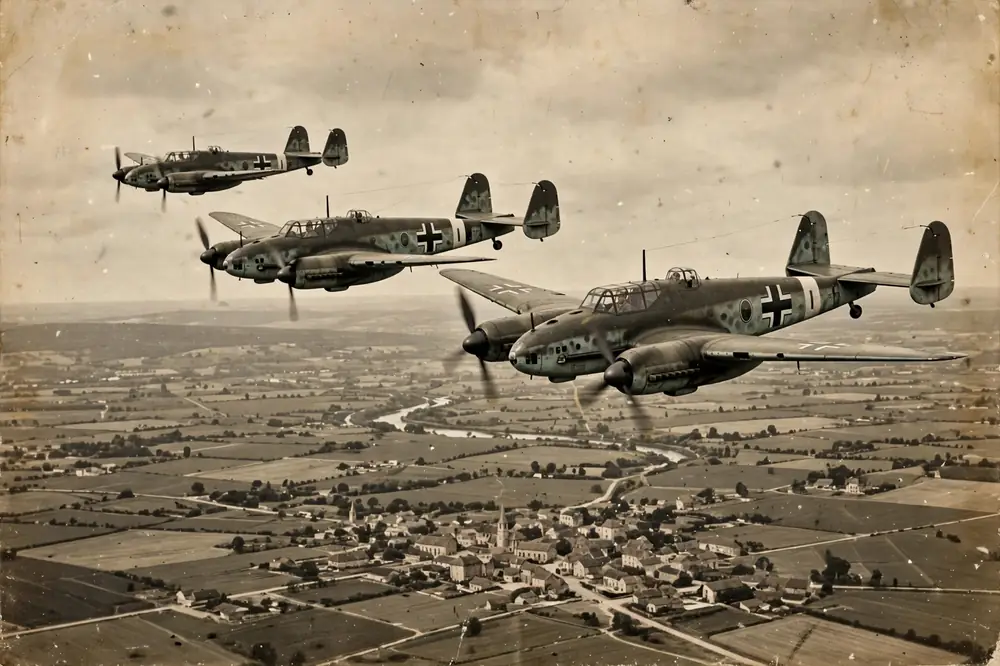
The Messerschmitt Bf 110 was Germany’s twin-engine heavy fighter — the Zerstörer, or “destroyer” — of the Second World War, and an aircraft of two very different reputations. In 1940, over Britain, it was a failure: designed as a long-range escort fighter, it was out-turned and out-fought by the RAF’s Hurricanes and Spitfires, and it suffered losses so heavy that it had to be withdrawn from daylight combat.
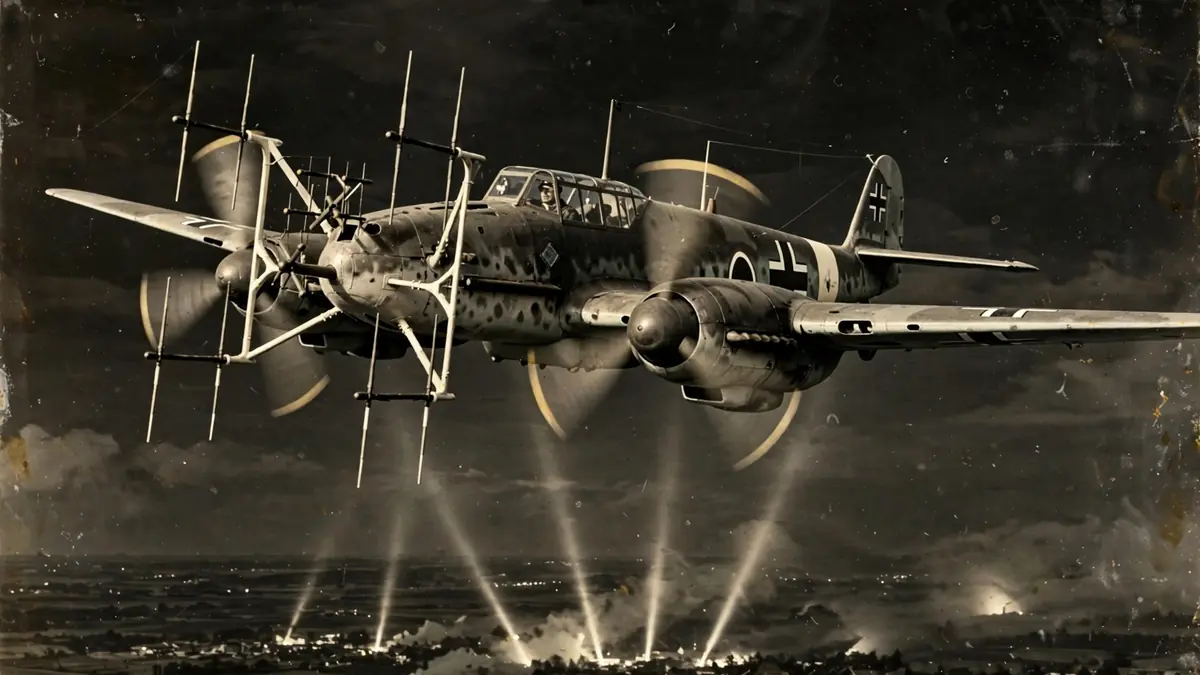
Yet the Bf 110 went on to become one of the most successful night fighters of the war, and in that role it was feared: fitted with radar and with upward-firing cannon, it hunted the RAF’s bombers over Germany in 1943 and 1944, and its pilots, above all Heinz-Wolfgang Schnaufer, the most successful night-fighter ace in history, became legends.
More than 6,100 were built, and the Bf 110 served on every front, as a fighter, a fighter-bomber, a reconnaissance aircraft and a night fighter, from 1939 to the end of the war in 1945.
The Bf 110’s story is the story of an idea that was wrong and an aircraft that was right. The idea was the Zerstörer: a long-range, twin-engine fighter, heavily armed, that could escort bombers deep into enemy territory and destroy the enemy’s fighters.
The idea failed, because a twin-engine fighter could never turn with a single-engine fighter, and because the Bf 110’s speed and manoeuvrability were not enough to protect the bombers it was meant to escort. The aircraft, however, was strong, reliable and adaptable, and it found new roles: as a fighter-bomber in the Blitzkrieg, as a reconnaissance aircraft over the Mediterranean, and above all as a night fighter, where its size, its range and its ability to carry radar and heavy armament made it ideal.
The Bf 110’s second career was longer and more successful than its first, and it is the night fighter that the aircraft is remembered as.
2. Key Facts
| Type | Twin-engine heavy fighter / night fighter |
| Origin | Germany |
| Designer | Willy Messerschmitt (Bayerische Flugzeugwerke) |
| Manufacturer | Messerschmitt AG |
| First flight | 12 May 1936 |
| In service | 1938–1945 |
| Produced | 1936–1945; 6,170 built |
| Crew | 2–3 (pilot, radio operator / rear gunner, and radar operator in night fighters) |
| Length | 12.1 m (Bf 110C) |
| Wingspan | 16.3 m |
| Height | 4.1 m |
| Empty weight | About 5,200 kg |
| Maximum take-off weight | About 7,000 kg |
| Engine | Two Daimler-Benz DB 601A, about 1,100 hp each (Bf 110C); DB 605 in later marks |
| Top speed | About 560 km/h (Bf 110C) |
| Range | About 1,100 km (about 2,400 km with drop tanks) |
| Service ceiling | About 10,000 m |
| Armament | Two 20 mm MG FF cannon and four 7.92 mm MG 17 machine guns forward; one 7.92 mm MG 15 in the rear (Bf 110C); night fighters added 30 mm cannon and Schräge Musik upward-firing guns |
| Radar | Lichtenstein airborne interception radar (night fighters) |
3. Background and Development
The Zerstörer idea
The Bf 110 was born of a doctrine. In the 1930s, the Luftwaffe believed that the bomber would always get through, and that it needed a long-range fighter to escort it — a fighter that could fly as far as the bombers, fight the enemy’s interceptors, and destroy them with heavy firepower.
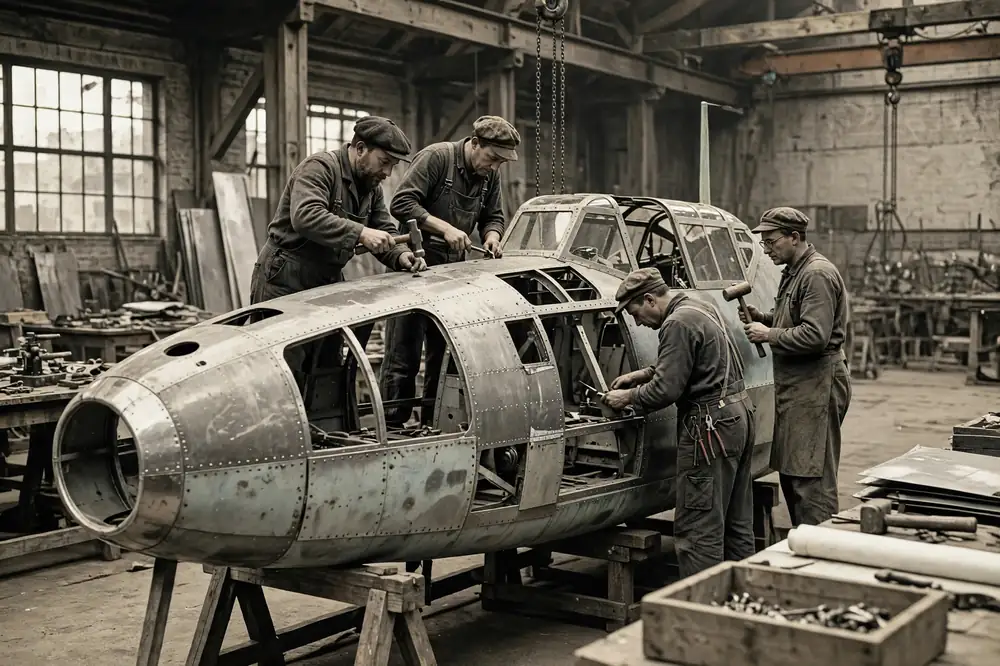
The specification for such an aircraft, the Zerstörer, was issued in 1934, and Messerschmitt, Focke-Wulf and Henschel were invited to compete. Messerschmitt’s design, led by Willy Messerschmitt, won: it was a twin-engine, all-metal monoplane, with a crew of two or three, a heavy forward armament of cannon and machine guns, and a long range. The first prototype flew on 12 May 1936, and the aircraft entered service in 1938.
The Luftwaffe was confident: the Bf 110 was, on paper, the most heavily armed fighter in the world, and its commanders believed that it would sweep the enemy’s fighters from the sky.
Poland and France: the idea seems to work
In Poland in September 1939, and in France in May and June 1940, the Bf 110 seemed to work. The Polish and French air forces were small and poorly organised, and the Bf 110’s speed and firepower were enough to destroy the fighters it met, while its range allowed it to escort the bombers deep into enemy territory.
The Bf 110’s crews claimed large numbers of victories, and the Luftwaffe’s confidence grew. The aircraft’s limitations — its poor turning circle, its vulnerability to a single-engine fighter that got behind it — were not yet apparent, because the enemy’s fighters were too few and too disorganised to exploit them.
The Bf 110’s early war was a success, and it was a success that misled the Luftwaffe about what the aircraft could do.
The Battle of Britain: the idea fails
Over Britain in the summer of 1940, the Bf 110’s idea failed. The RAF’s Hurricanes and Spitfires were faster in a turn, more manoeuvrable, and better able to fight at close quarters, and the Bf 110s that were sent to escort the bombers were shot down in large numbers.
The Bf 110’s crews learned to fly in defensive circles, with each aircraft protecting the one in front of it, but the tactic was a confession of failure: a fighter that has to defend itself cannot escort a bomber. The Bf 110’s losses were so heavy that, by the autumn of 1940, the Luftwaffe had to withdraw it from daylight operations over Britain, and the Bf 109, the single-engine fighter, had to escort the bombers instead — a job for which it had too little range.
The Battle of Britain was the end of the Zerstörer as a daylight escort fighter, and it was the beginning of the Bf 110’s second career.
4. Design
Airframe and engines
The Bf 110 was a clean, twin-engine, all-metal monoplane, with a low wing, a twin tail and a glazed nose. Its two Daimler-Benz DB 601 engines, each of about 1,100 horsepower in the Bf 110C, gave it a top speed of about 560 km/h, which was fast for a twin-engine aircraft of its day, and a range of about 1,100 km, or about 2,400 km with drop tanks.
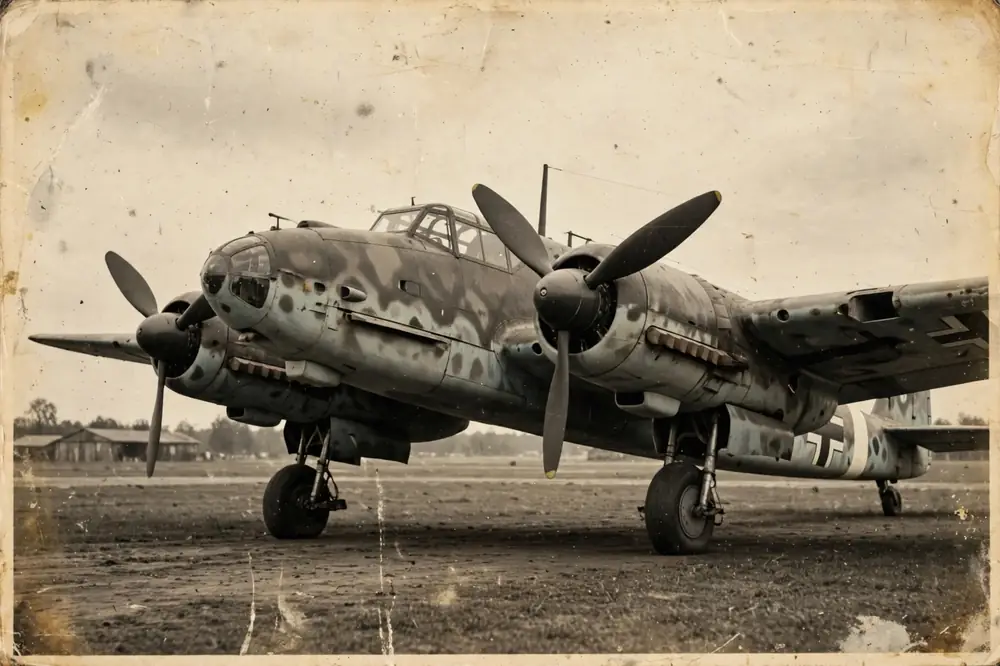
The later Bf 110G used the more powerful DB 605 engine, of about 1,475 horsepower, which improved the aircraft’s performance at altitude. The airframe was strong and well built, and it could carry a heavy armament and, in the night-fighter versions, a radar and a third crew member.
The Bf 110’s size was its strength and its weakness: it was large enough to carry the weapons and the equipment that a single-engine fighter could not, but it was too large to turn with a single-engine fighter, and its size made it an easy target in daylight.
Crew and armament
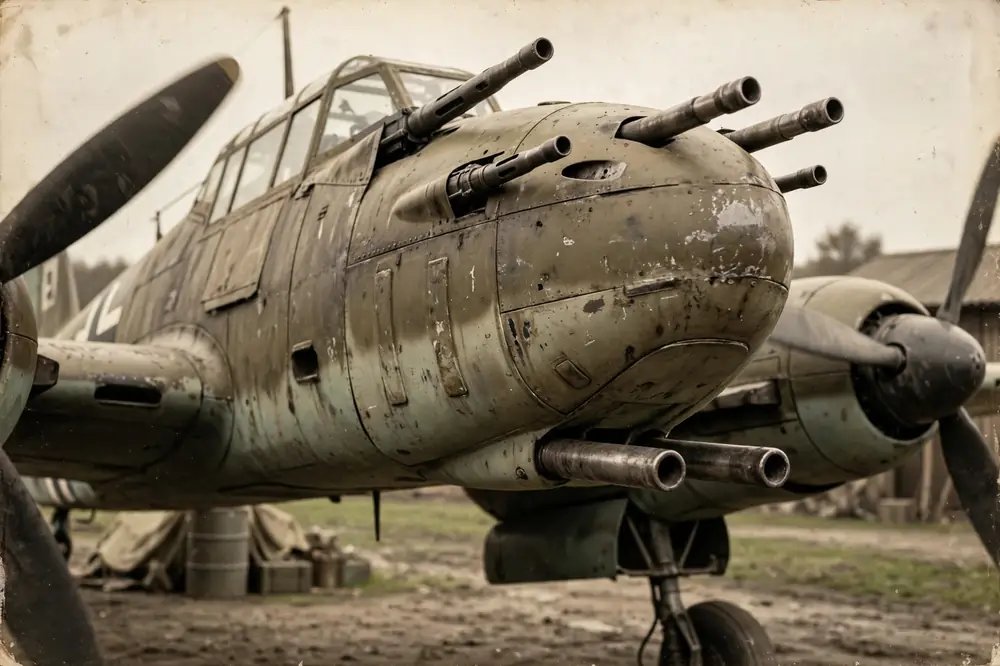
The Bf 110’s crew was two men in the early versions — the pilot and the radio operator, who also served as the rear gunner — and three in the night-fighter versions, where a radar operator was added. The pilot sat in front, with the forward armament below and ahead of him: two 20 mm MG FF cannon and four 7.92 mm MG 17 machine guns, a concentration of firepower that was unmatched by any other fighter of 1940.
The radio operator sat behind the pilot, with a single 7.92 mm MG 15 machine gun on a flexible mount, to defend the aircraft from behind. The night fighters carried a heavier armament: two 20 mm MG 151 cannon and two 30 mm MK 108 cannon, and, in the most famous version, the Schräge Musik — two 20 mm cannon mounted in the fuselage and firing upward and forward, so that the night fighter could attack a bomber from below, where the bomber’s defences were weakest.
Radar and the night fighter
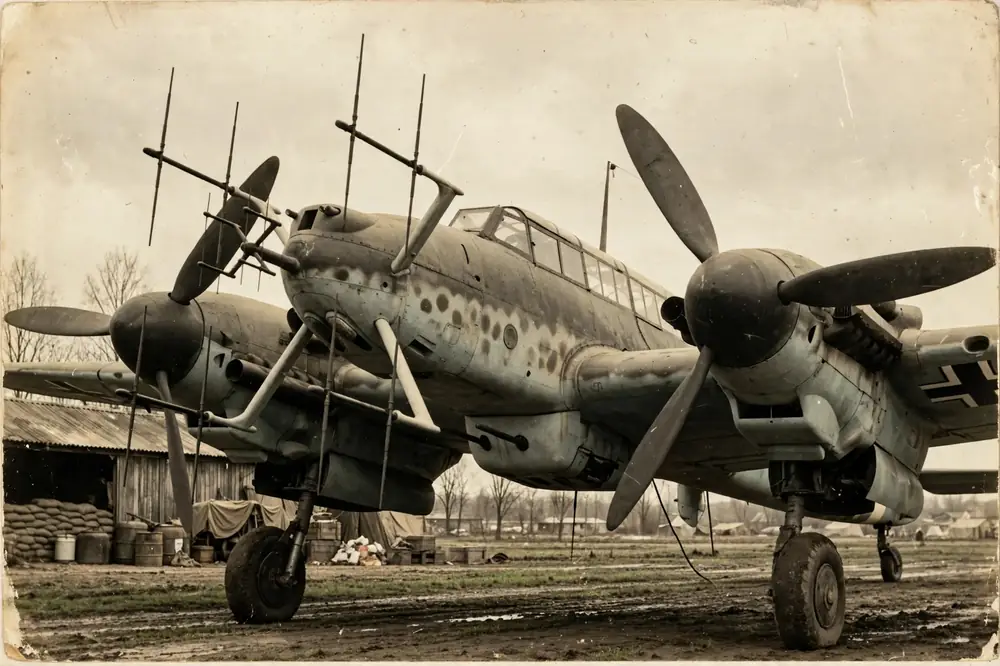
The Bf 110’s transformation into a night fighter was made possible by radar. The Lichtenstein radar, with its distinctive aerials on the nose, allowed the night fighter to find a bomber in the dark, and the radar operator, sitting behind the pilot, talked the pilot onto the target.
The early Lichtenstein sets were crude and short-ranged, but they improved over the war, and by 1943 the Bf 110G-4, with the Lichtenstein SN-2 radar, was the Luftwaffe’s principal night fighter. The aircraft’s size, which had been a weakness in daylight, was a strength at night: it had room for the radar, for a third crew member, and for the heavy cannon that could destroy a bomber in a single burst.
The night fighter’s other advantage was its endurance: it could stay in the air for hours, patrolling the bomber stream, and it could follow the bombers to their targets and back.
5. Variants
| Variant | Years | Key features | Production |
|---|---|---|---|
| Bf 110A | 1937–1938 | Pre-production; Jumo 210 engines | About 10 |
| Bf 110B | 1938–1939 | Jumo 210 engines; early service | About 50 |
| Bf 110C | 1939–1941 | DB 601 engines; main early-war version | About 1,000 |
| Bf 110D | 1940–1941 | Long-range version with drop tanks | About 250 |
| Bf 110E | 1940–1942 | Fighter-bomber; bomb racks | About 800 |
| Bf 110F | 1941–1943 | DB 601F engines; improved performance | About 700 |
| Bf 110G | 1942–1945 | DB 605 engines; main night-fighter version | About 3,000 |
| Bf 110H | 1944–1945 | Proposed improved G; few built | Small numbers |
The Bf 110C was the aircraft of the Battle of Britain, and the Bf 110G was the aircraft of the night war. The G model, which entered service in 1942, was the most numerous version, and it was built in several sub-variants: the G-2 was a fighter-bomber, the G-3 was a reconnaissance aircraft, and the G-4 was the night fighter, with radar, a third crew member and the Schräge Musik cannon.
The Bf 110E, the fighter-bomber, was used in the Blitzkrieg and in North Africa, where it attacked ground targets and shipping, and the Bf 110F, with its improved engines, was the last of the daylight versions. The Bf 110’s production ended in 1945, when Germany’s industry was collapsing, and the last aircraft were built as night fighters, for a war that was already lost.
The night-fighter G-4
The Bf 110G-4 deserves a note of its own, because it was the most successful night fighter of the war. It carried the Lichtenstein SN-2 radar, with its large aerials on the nose, and it carried two 20 mm cannon and two 30 mm cannon in the nose, plus the Schräge Musik upward-firing cannon in the fuselage.
Its crew of three — pilot, radar operator and radio operator — worked as a team, and its pilots, above all Heinz-Wolfgang Schnaufer, became the most successful night-fighter aces in history. The G-4 was not a fast aircraft, and it was not a manoeuvrable one, but at night, against a bomber that could not see it coming, it did not need to be: it needed to find its target, to approach it unseen, and to destroy it with a single burst, and the G-4 did all three.
Production and the shift to night fighting
The Bf 110 was built in large numbers, and its production shows how the aircraft’s role changed during the war. Messerschmitt built 6,170 Bf 110s between 1936 and 1945, and the production was at its height in 1943 and 1944, when the night fighter was the Luftwaffe’s priority.
The most numerous version was the G model, with about 3,000 built, and most of them were night fighters, with radar and a crew of three. The early versions, the C and the E, were built in about 1,000 and 800 examples, and they were the aircraft of the Blitzkrieg and the Battle of Britain.
The Bf 110’s production ended in 1945, when Germany’s industry was collapsing, and the last aircraft were built as night fighters, for a war that was already lost.
6. Operational History
The Blitzkrieg and the Battle of Britain, 1939–1940
The Bf 110’s first combat was in Poland, where it escorted the bombers and attacked Polish airfields, and in France, where it did the same. In these campaigns, the Bf 110’s speed and firepower were enough, and its crews claimed large numbers of victories. Over Britain, the aircraft’s weaknesses were exposed: the RAF’s fighters were more manoeuvrable, and the Bf 110s were shot down in large numbers. The Bf 110’s daylight career ended in 1940, but its service did not: it was withdrawn from the Battle of Britain, and it was sent to other theatres, where it could still be useful.
The Mediterranean and the Eastern Front, 1941–1943
Fighter-bomber and reconnaissance
In the Mediterranean, the Bf 110 served as a fighter-bomber and a reconnaissance aircraft, attacking Allied shipping and ground targets in North Africa, Malta and the Aegean. Its range made it useful in a theatre where distances were large, and its armament made it effective against ships and ground targets. On the Eastern Front, the Bf 110 served as a fighter-bomber in support of the German advance, attacking Soviet airfields and ground forces, and as a reconnaissance aircraft, flying long missions over Soviet territory. In both theatres, the Bf 110 was used in roles for which it was well suited, and it served successfully until the night-fighter version took over its production.
The night war begins
The Bf 110’s night war began in 1941, when the first night-fighter units were formed, and it became the aircraft’s principal role in 1942 and 1943. The night fighters defended Germany against the RAF’s night bombing offensive, and they were at their most successful in 1943 and early 1944, when the RAF’s losses were at their highest. The Bf 110’s crews learned to work with the ground-controlled interception system, which guided them to the bomber stream, and with their own radar, which found the individual bomber. The night war was a war of patience and of skill, and the Bf 110’s crews became expert at it.
The night war over Germany, 1943–1945
The Bf 110’s night war reached its height in 1943 and 1944, when the RAF’s Bomber Command was bombing German cities every night, and the Luftwaffe’s night fighters were shooting down bombers in large numbers. The most successful night-fighter pilot was Heinz-Wolfgang Schnaufer, who flew the Bf 110G-4 and was credited with 121 victories, all at night, making him the most successful night-fighter ace in history.
Schnaufer’s success was due to his skill, to his radar operator’s skill, and to the Schräge Musik cannon, which allowed him to attack a bomber from below, where the bomber’s defences were weakest. The night war declined in 1944 and 1945, as the RAF’s bombers were fitted with better defences and as the Luftwaffe’s fuel and pilot shortages grew, but the Bf 110 remained in service until the end of the war, flying its last sorties in the defence of Berlin.
7. Performance and Specifications
| Specification | Bf 110C-4 | Bf 110G-4 |
|---|---|---|
| Engine | Two DB 601A, about 1,100 hp each | Two DB 605B, about 1,475 hp each |
| Top speed | About 560 km/h | About 550 km/h |
| Range | About 1,100 km (2,400 km with drop tanks) | About 1,300 km |
| Service ceiling | About 10,000 m | About 9,000 m |
| Forward guns | Two 20 mm MG FF, four 7.92 mm MG 17 | Two 20 mm MG 151, two 30 mm MK 108 |
| Rear gun | One 7.92 mm MG 15 | One 7.92 mm MG 81Z |
| Schräge Musik | None | Two 20 mm MG FF |
| Crew | 2 | 3 |
| Number built | About 1,000 (C total) | About 3,000 (G total) |
Speed and firepower
The Bf 110’s performance was good for a twin-engine fighter, but it was never enough in daylight. Its top speed of about 560 km/h was faster than the bombers it escorted and slower than the single-engine fighters it met, and its turning circle was too wide to fight a Hurricane or a Spitfire.
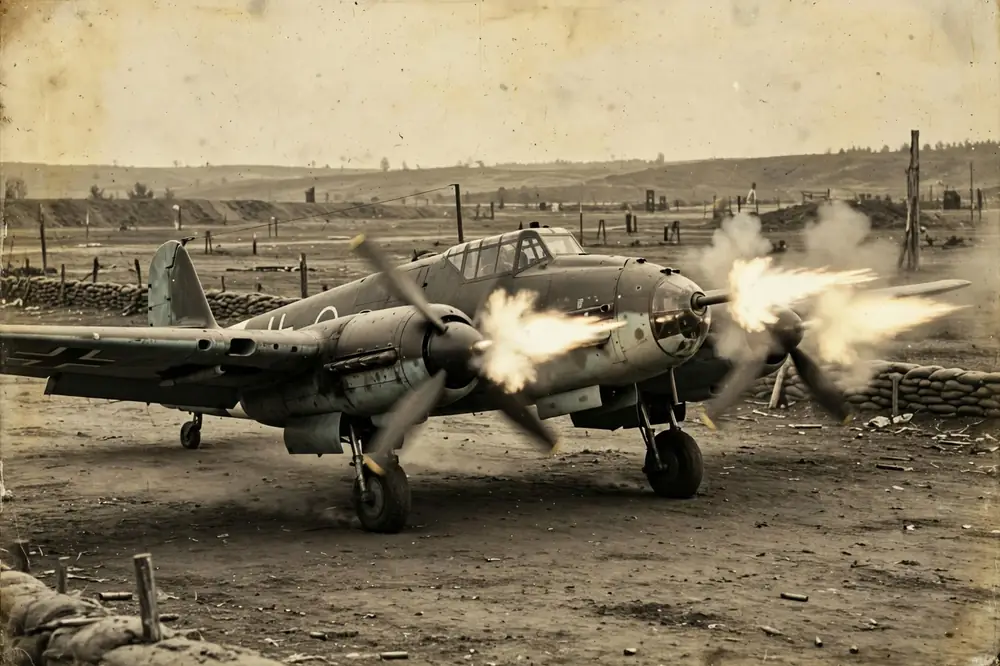
Its firepower, however, was unmatched: two 20 mm cannon and four machine guns, firing together, could destroy a fighter in a single burst, and the night fighter’s cannon, including the 30 mm MK 108, could destroy a bomber in a single burst.
The Bf 110’s performance was built for the night war, where speed and turning mattered less than radar, endurance and firepower, and in that war it was the best aircraft the Luftwaffe had.
Against its contemporaries
Compared with the British Bristol Beaufighter, the Bf 110’s closest equivalent, the German aircraft was faster but less heavily armed and less rugged, and it was less successful as a night fighter in the early years, when the Beaufighter’s radar was better.
Compared with the de Havilland Mosquito, which replaced the Beaufighter as a night fighter, the Bf 110 was slower and less elegant, but it was available earlier, and it carried a heavier armament. Compared with the American P-38 Lightning, the Bf 110 was a similar aircraft in a similar role, and the two were evenly matched: the P-38 was faster and more manoeuvrable, while the Bf 110 was more heavily armed.
The Bf 110’s place was as a night fighter, and in that role it had few equals.
8. Operators
Germany and the Luftwaffe
The Bf 110 was used above all by Germany, by the Luftwaffe’s heavy fighter wings (Zerstörergeschwader) and later by the night-fighter wings (Nachtjagdgeschwader). The heavy fighter wings fought in Poland, France and Britain, and the night-fighter wings fought over Germany, defending the Reich against the RAF’s night bombing offensive.
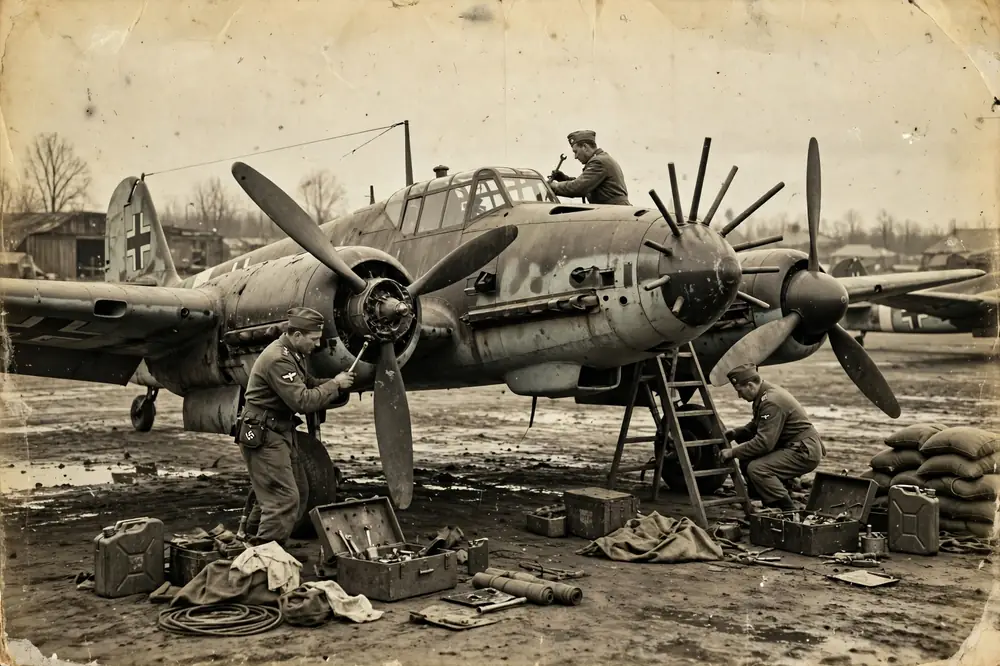
The Bf 110’s units were among the most heavily engaged in the Luftwaffe, and their losses, especially in the daylight battles of 1940, were high. The night-fighter wings, above all Nachtjagdgeschwader 1 and Nachtjagdgeschwader 4, became famous, and their pilots, above all Schnaufer, became legends.
The night-fighter wings were formed in 1940, and they grew rapidly as the RAF’s bombing offensive grew: by 1944, the Luftwaffe had more than a dozen night-fighter groups, most of them flying the Bf 110. The heavy fighter wings, which had fought in Poland, France and Britain, were converted into night-fighter and fighter-bomber units as the war went on.
Hungary, Romania and others
The Bf 110 was also exported, in small numbers, to Germany’s allies. Hungary received Bf 110s and used them as night fighters over Hungary, Romania received Bf 110s and used them on the Eastern Front, and Italy received a small number for evaluation.
The Bf 110 was never a major export aircraft — it was a German aircraft, built for the Luftwaffe’s way of war — but its service in Hungary and Romania shows how widely it was used, and how highly it was regarded by Germany’s allies.
The Hungarian Bf 110s were used to defend Hungarian cities against Allied bombing, and they flew alongside the German night fighters in the last year of the war. The Romanian aircraft served on the Eastern Front, where they flew in support of the Romanian Army, and they were among the last Bf 110s in service when Romania changed sides in August 1944.
9. Legacy and Influence
The night fighter
The Bf 110’s most important legacy is the night fighter. It was the Luftwaffe’s principal night fighter, and it proved that a twin-engine aircraft, with radar and a crew of three, could find and destroy a bomber in the dark.
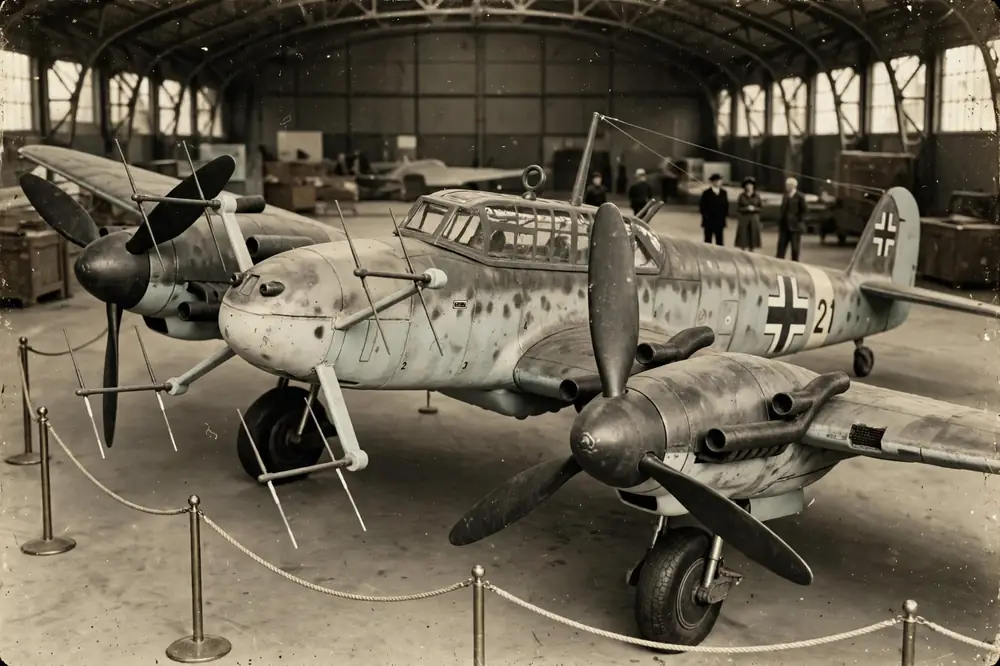
That lesson shaped the night fighters that followed, from the Heinkel He 219 to the jet night fighters of the post-war years, and it shaped the whole idea of the airborne interception system that air forces use today. The Bf 110’s night-fighter crews, and the radar operators in particular, were pioneers: they learned a new kind of warfare, in which the battle was fought on a radar screen as much as in the sky, and their experience was passed on to the generations that followed.
A cautionary tale
The Bf 110’s second legacy is a cautionary one. It showed that a doctrine — the Zerstörer, the long-range escort fighter — could be wrong, and that an aircraft built for a wrong doctrine could fail in the role for which it was designed. The Luftwaffe’s faith in the Bf 110, and its failure to recognise the aircraft’s limitations until the Battle of Britain, cost it heavily in 1940, and it is one of the reasons the Luftwaffe lost the Battle of Britain. The Bf 110’s later success as a night fighter does not change that: it shows that a good aircraft can find a new role, but it also shows that a wrong idea can waste a good aircraft.
10. Surviving Examples
Where to see one today
Only two complete Bf 110s survive, and both are in museums in Germany and Britain. The best known is a Bf 110G-4 at the Royal Air Force Museum in Hendon, London, which was captured by British forces in 1945 and brought to Britain for evaluation; it is displayed as an example of the Luftwaffe’s night fighter, with its Lichtenstein radar aerials and its Schräge Musik cannon.
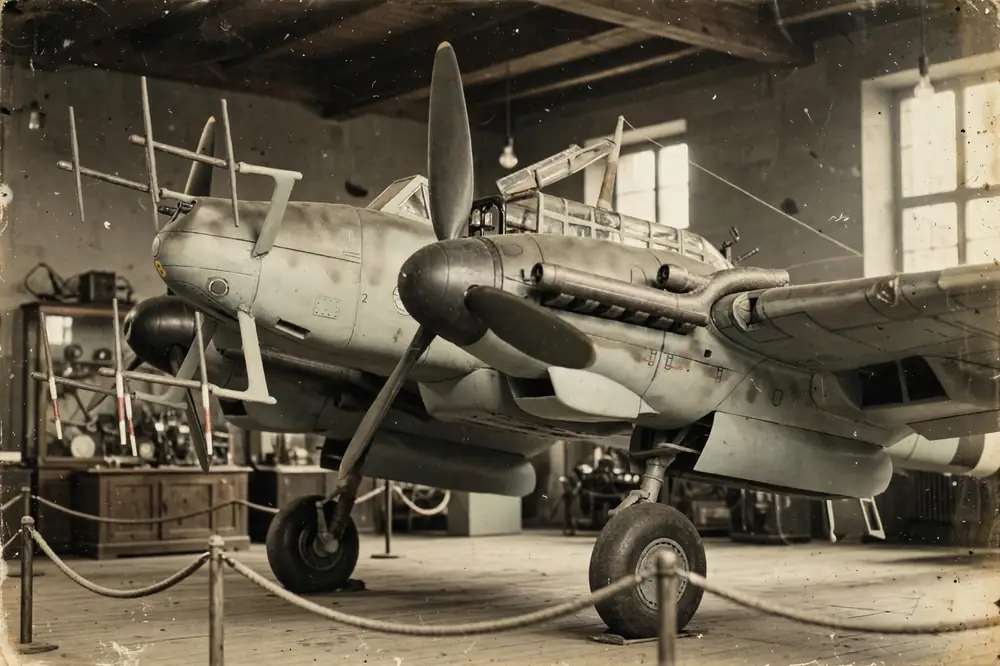
The other is a Bf 110G-4 at the German Museum of Technology in Berlin, which was restored in Germany and is displayed as an example of the aircraft that defended the Reich. The surviving aircraft are few, compared with the 6,170 that were built, but they are enough to show visitors the aircraft’s twin engines, its glazed nose and the radar that made it a night fighter.
Wrecks and memory
Many Bf 110s were lost over Germany, and their wrecks are still being found in the forests and fields of Germany, where they fell in the night war. Some of these wrecks have been recovered and are held in museums, and others remain where they fell, as war graves and as reminders of the night war. The Bf 110 is remembered through its crews, above all Schnaufer, and through the museums that hold the surviving aircraft. For most visitors, the easiest way to see a Bf 110 is at Hendon or in Berlin, where the surviving G-4s stand as reminders of the night fighter that hunted the RAF’s bombers over Germany.
Frequently Asked Questions
What was the Messerschmitt Bf 110?
The Messerschmitt Bf 110 was a German twin-engine heavy fighter of the Second World War, designed as a long-range escort fighter and later used as a night fighter. 6,170 were built.
Why did the Bf 110 fail in the Battle of Britain?
The Bf 110 was too slow in a turn and too vulnerable to the RAF’s Hurricanes and Spitfires, which were more manoeuvrable. Its losses were so heavy that it had to be withdrawn from daylight operations over Britain.
What was Schräge Musik?
Schräge Musik, “slanting music”, was a pair of cannon mounted in the fuselage of the Bf 110 night fighter, firing upward and forward, so that the fighter could attack a bomber from below, where the bomber’s defences were weakest.
Who was Heinz-Wolfgang Schnaufer?
Heinz-Wolfgang Schnaufer was the most successful night-fighter ace in history, credited with 121 victories, all at night, flying the Bf 110G-4.
How many Bf 110s were built?
6,170 Bf 110s were built between 1936 and 1945.
Where can I see a Bf 110 today?
A Bf 110G-4 is at the Royal Air Force Museum in Hendon, London, and another is at the German Museum of Technology in Berlin.
Related articles
Sources
- Wikipedia, “Messerschmitt Bf 110” — first flight, production of 6,170, specifications, variants and operational history.
- John Weal, Messerschmitt Bf 110 Zerstörer (Osprey Publishing, 1999) — development, the Battle of Britain and the night war.
- Jerry Scutts, Messerschmitt Bf 110 Night Fighters (Osprey Publishing, 1998) — the night-fighter versions and Schnaufer.
- Martin Bowman, German Night Fighters (Pen and Sword, 2013) — the night war over Germany.
- Alfred Price, The Luftwaffe (Arms and Armour Press, 1996) — the Zerstörer doctrine and its failure.
- The Royal Air Force Museum, Hendon, “Messerschmitt Bf 110G-4” — the surviving aircraft.