 WAR ATLAS MILITARY HISTORY MAGAZINE · WWI — WWII
Battle of the Bulge
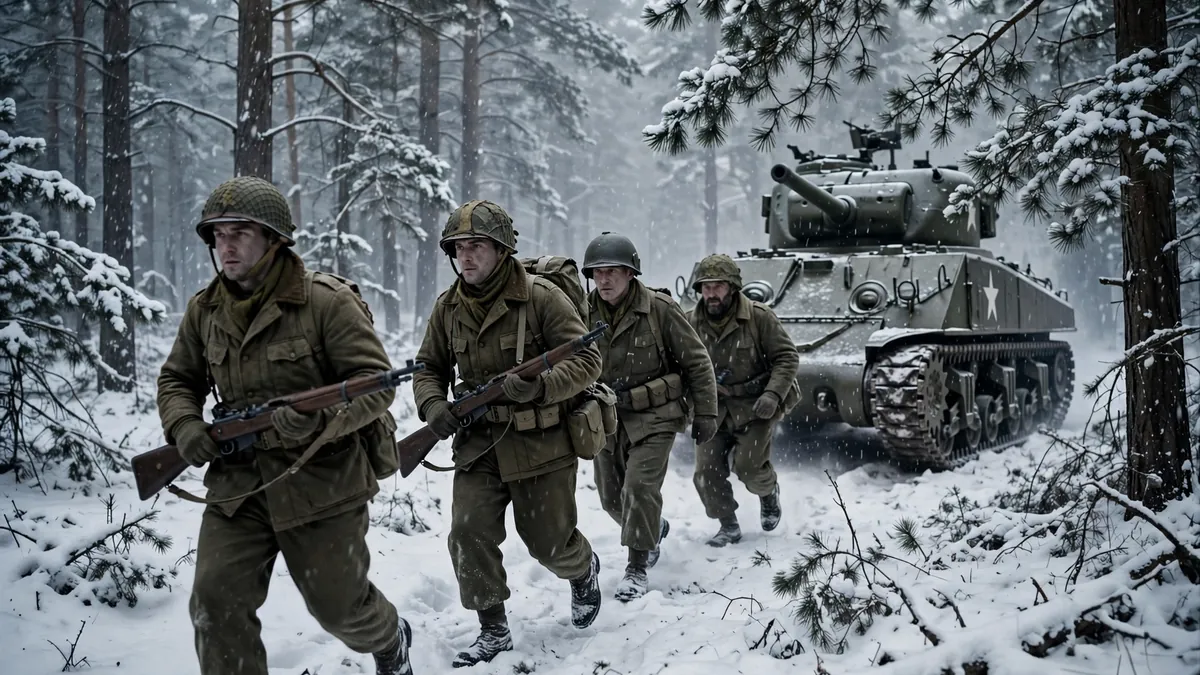
The Battle of the Bulge, fought from 16 December 1944 to 25 January 1945 in the Ardennes forest of Belgium and Luxembourg, was the last major German offensive on the Western Front in World War II — and the largest and bloodiest battle ever fought by the United States Army.
In a surprise dawn attack, more than 200,000 German troops broke through a thinly held American line, driving a large “bulge” some 80 kilometres deep into Allied territory and aiming for the port of Antwerp. The Allies held the vital road junctions at Elsenborn Ridge, St. Vith and Bastogne, and once the weather cleared, Allied air power and General George S. Patton’s Third Army turned the tide.
By late January the bulge had been erased, at the cost of about 81,000 American casualties and German losses estimated at 63,000 to more than 100,000 men. Germany had spent its last reserves in the West, and it never mounted another offensive of this scale.
1. Key Facts
| Category | Details |
|---|---|
| Date | 16 December 1944 – 25 January 1945 (U.S. Army campaign period; mopping up continued to 28 January 1945) |
| Location | The Ardennes, Belgium, Luxembourg and western Germany |
| Other names | Ardennes Offensive; Ardennes Counteroffensive; German code name Unternehmen Wacht am Rhein (Operation Watch on the Rhine) |
| Result | Decisive Allied victory; last major German offensive in the West |
| Allied commanders | Gen. Dwight D. Eisenhower (Supreme Commander); Gen. Omar Bradley (12th Army Group); Lt. Gen. Courtney Hodges (First Army); Lt. Gen. George S. Patton (Third Army); Field Marshal Bernard Montgomery (21st Army Group, took command of the northern front on 20 December) |
| German commanders | Adolf Hitler (overall); Field Marshal Gerd von Rundstedt (OB West); Field Marshal Walter Model (Army Group B); SS-Gen. Sepp Dietrich (Sixth Panzer Army); Gen. Hasso von Manteuffel (Fifth Panzer Army); Gen. Erich Brandenberger (Seventh Army) |
| Allied strength | About 83,000 men on the attacked front on 16 December, rising to more than 700,000 men by early January; eventually over 600,000 Americans committed |
| German strength | Over 410,000 men committed in total; more than 200,000 men, about 1,400 tanks and armoured fighting vehicles, some 2,600 artillery pieces and over 1,000 combat aircraft in the opening assault |
| Allied casualties | About 81,000 Americans (8,407 killed, 46,170 wounded, 20,905 missing, per the preliminary U.S. Army report); about 1,400 British (200 killed); about 3,000 civilians killed |
| German casualties | Estimated 63,000 to 103,900 (U.S. estimate); no official German total was ever computed |
| Tanks lost | About 800 American tanks destroyed; 527–554 German tanks, tank destroyers and assault guns lost |
2. Background
By the autumn of 1944, the Allies seemed to be winning the war in the West. After the Normandy landings in June and the breakout across France, Allied armies had reached the German border by September. But the advance had outrun its supplies: the great port of Antwerp had been captured in September, yet the Germans still held the Scheldt estuary, so the port could not be used until November.
The airborne operation Operation Market Garden in September had failed to secure a crossing of the Rhine, and the fighting in the Hürtgen Forest was inflicting heavy losses on American divisions. The front had settled into a long line from the Netherlands to Switzerland, and the Allies were preparing for a slow winter campaign.
Hitler saw an opportunity. He believed that a sudden, powerful blow through the Ardennes — the same densely forested, hilly region through which German armour had broken through in 1940 — could split the British and American armies, recapture Antwerp, and encircle and destroy four Allied armies. Such a shock, he hoped, would force the Western Allies to negotiate a peace, freeing Germany to concentrate on the Eastern Front against the Soviet Union. His generals, including Field Marshal Gerd von Rundstedt and Field Marshal Walter Model, considered the full plan impossible with the forces available and argued for a more limited offensive, but Hitler insisted on the ambitious version, code-named Unternehmen Wacht am Rhein (Operation Watch on the Rhine).
Germany secretly assembled its forces in the Eifel, just east of the Ardennes, under strict radio silence and with great care to hide the build-up from Allied intelligence. Three armies were gathered under Model’s Army Group B: the Sixth Panzer Army in the north, the Fifth Panzer Army in the centre, and the Seventh Army in the south.
The plan called for the Sixth Panzer Army to drive through the Losheim Gap toward Liège and Antwerp, the Fifth Panzer Army to push through St. Vith and Bastogne toward the Meuse, and the Seventh Army to guard the southern flank along the Sauer river.
The Germans also counted on bad winter weather to keep Allied aircraft grounded, and they prepared two supporting operations: Greif, in which English-speaking German commandos under Otto Skorzeny, wearing American uniforms, would seize bridges and sow confusion behind Allied lines; and Bodenplatte, a mass Luftwaffe strike on Allied airfields, held back until the weather allowed.
The Allies, meanwhile, had placed the Ardennes sector low on their list of worries. The front there, some 130 kilometres long, was held by only four American divisions — the inexperienced 99th and newly arrived 106th Infantry Divisions in the north, and the 28th and 4th Infantry Divisions in the south, both resting and refitting after heavy fighting. Allied intelligence had detected signs of a German build-up, but most commanders expected at most a local spoiling attack, not a full-scale offensive. The Ardennes was considered “quiet” — a place to rest tired divisions. On the morning of 16 December, that assumption collapsed.
The surprise was not total — Allied intelligence had picked up signs of a German build-up, including the movement of the Sixth Panzer Army and the stockpiling of fuel and ammunition in the Eifel. But the warnings were misread. Ultra intercepts were limited because the Germans maintained strict radio silence, and the few indicators that did reach Allied headquarters were interpreted as preparations for a defensive stand east of the Rhine, or at most a local counterattack.
The Ardennes was judged too difficult for a large offensive, and the sector was deliberately left thin so that Allied strength could be concentrated further north and south. The result was that four divisions, two of them new or resting, faced the weight of three German armies on the morning of 16 December.
3. Opposing Forces
On paper the Germans attacked with the larger force in the sector, but the balance changed fast as Allied reinforcements poured in. The table below shows the opening strengths and how the battle grew.
| Allies | Germany | |
|---|---|---|
| Men on 16 December | About 83,000 on the attacked front (228,741 in the wider First Army sector) | About 406,000 men committed overall; over 200,000 in the first wave |
| Men at peak | About 705,000 (2 January 1945) | About 449,000 (24 December 1944) |
| Divisions on 16 December | 6 infantry divisions, 2 armoured divisions on the front | 13 infantry divisions, 7 panzer divisions, 1 panzer brigade |
| Tanks and assault guns | 483 tanks, 499 tank destroyers and assault guns (16 December) | 557 tanks, 667 tank destroyers and assault guns (16 December) |
| Artillery | 971 anti-tank and artillery pieces (16 December) | About 2,600 artillery pieces; 4,224 anti-tank and artillery pieces counted on 16 December |
| Aircraft | Thousands of Allied aircraft in theatre, grounded by weather at first; once the skies cleared, the U.S. Eighth and Ninth Air Forces and the RAF Second Tactical Air Force dominated | Over 1,000 combat aircraft, including about 850–900 committed to Operation Bodenplatte on 1 January |
| Main armies | U.S. First Army (Hodges), U.S. Third Army (Patton); British XXX Corps and 21st Army Group (Montgomery) | Sixth Panzer Army (Dietrich), Fifth Panzer Army (Manteuffel), Seventh Army (Brandenberger) — all under Army Group B (Model) |
| Key units | 101st and 82nd Airborne Divisions, 2nd and 99th Infantry Divisions, 7th Armored Division, 4th Armored Division, 2nd Armored Division | 1st SS Panzer Division Leibstandarte, 12th SS Panzer Division Hitlerjugend, Panzer Lehr Division, 2nd Panzer Division, 116th Panzer Division |
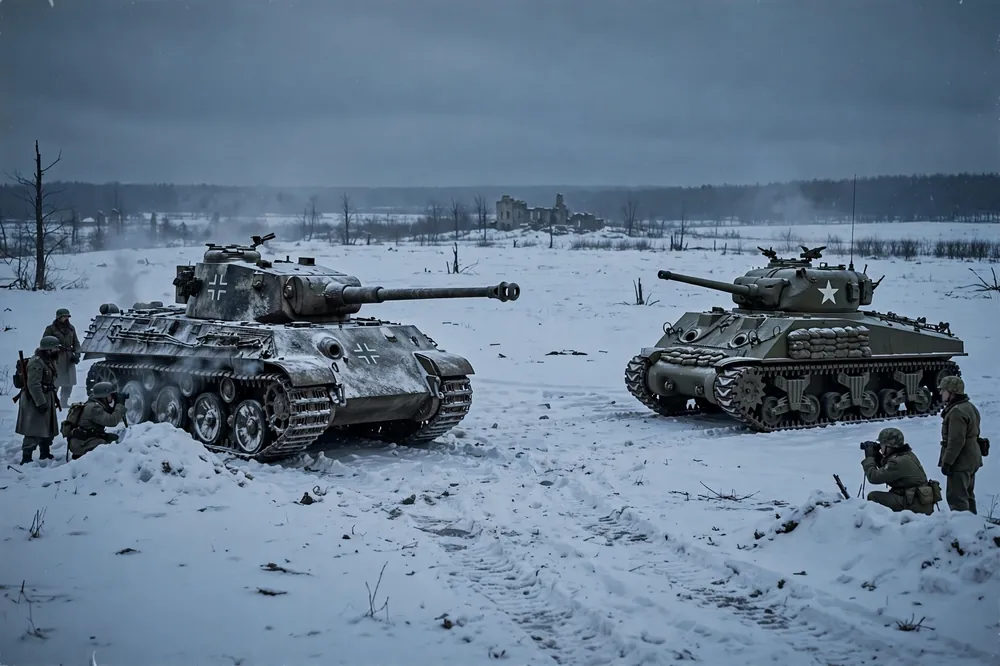
The German force was powerful but had weaknesses. Many of its divisions had been rebuilt after heavy losses in France, and a large share of its infantry were inexperienced Volksgrenadier divisions. Its tanks — Panthers, Tiger IIs and the new Jagdtiger — were heavily gunned and armoured, but the offensive depended on capturing Allied fuel dumps, because German supply columns could not keep up across the Ardennes’ few narrow roads.
Air power was the largest imbalance between the two sides, but it only became decisive once the weather cleared. The Allies had thousands of aircraft in north-west Europe, including the U.S. Eighth and Ninth Air Forces and the RAF Second Tactical Air Force, against a Luftwaffe that could put up only about 1,000 combat aircraft for the offensive.
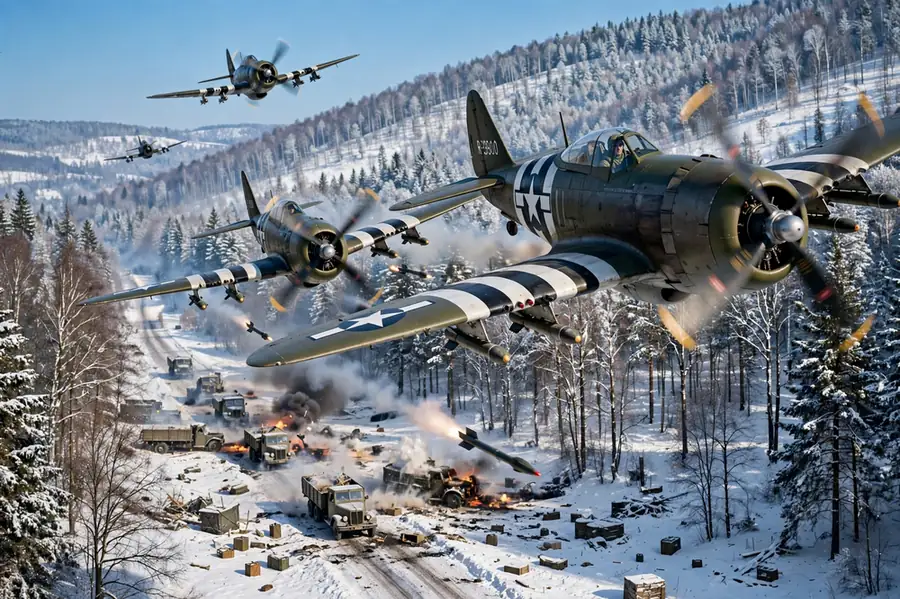
For the first week, low cloud, fog and snow kept almost all aircraft on the ground, which was a central part of the German plan. From 23 December, when the skies cleared, Allied fighter-bombers attacked German columns, bridges and supply lines around the clock, while transport aircraft dropped supplies to Bastogne.
The Luftwaffe’s one large effort, Operation Bodenplatte on 1 January, destroyed aircraft on the ground but cost it pilots it could not replace.
4. The Battle
At 05:30 on 16 December 1944, some 1,900 German guns opened fire along a 130-kilometre front. The barrage was followed by infantry and tanks advancing through fog and snow. The attack achieved complete surprise. In the north, the Sixth Panzer Army struck the Losheim Gap, but the inexperienced American 99th Infantry Division, fighting alongside the veteran 2nd Infantry Division around the twin villages of Krinkelt-Rocherath, held its ground and blocked the road to Elsenborn Ridge.
In the centre, the Fifth Panzer Army hit the 28th Infantry Division and the green 106th Infantry Division; by 19 December, two regiments of the 106th — some 8,000 men, as reported at the time — were surrounded and forced to surrender near Schönberg, the largest mass surrender of American troops in the European war. In the south, the Seventh Army made only a shallow advance along the Sauer.
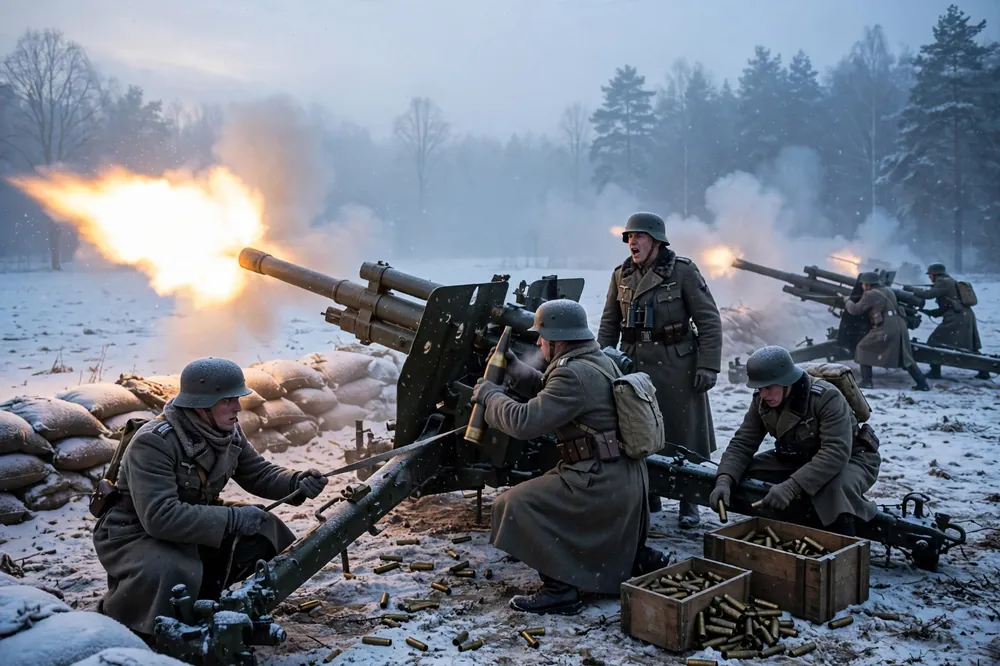
The same day, troops of Kampfgruppe Peiper — the armoured spearhead of the 1st SS Panzer Division under Joachim Peiper — committed a war crime that became known as the Malmedy Massacre. On 17 December, at the Baugnez crossroads near Malmedy, men of Kampfgruppe Peiper captured about 113 American prisoners from Battery B of the 285th Field Artillery Observation Battalion and shot them in a field.
At least 84 American soldiers were killed; just over 40 survived, some by playing dead. News of the killings spread quickly among American troops. Peiper’s column pushed on toward Stavelot and La Gleize, but American engineers blew bridges ahead of it, and it ran out of fuel and was destroyed piecemeal before the end of the month. Peiper himself escaped on foot.
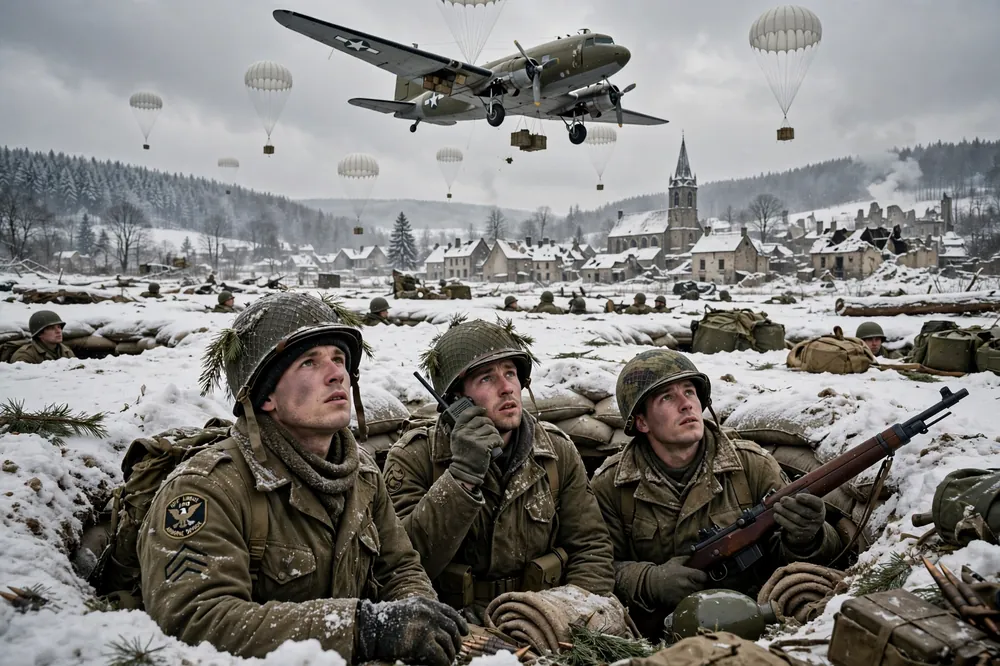
Two road junctions now decided the battle. At St. Vith, the 7th Armored Division, rushed forward under Brigadier General Robert Hasbrouck, held the town for five days against overwhelming odds, delaying the Fifth Panzer Army’s advance long enough for the Allies to organise. The defenders withdrew in good order on 21–22 December, having bought precious time. At Bastogne, a vital crossroads of seven roads, the 101st Airborne Division arrived by truck on 19 December, together with elements of the 10th Armored Division. The paratroopers, under Brigadier General Anthony McAuliffe (acting commander while Major General Maxwell Taylor was in Washington), dug in around the town. By 20–21 December the Germans had surrounded Bastogne completely.
On 20 December, Eisenhower made two decisive command decisions. He gave Field Marshal Montgomery command of all Allied forces north of the bulge, and he ordered Patton’s Third Army — then attacking east into the Saar — to turn 90 degrees north and relieve Bastogne. Patton’s staff had already prepared contingency plans, and within days three divisions were wheeling north through snow and ice.
In the central sector, the delay that made the defence of Bastogne possible was bought by the 28th Infantry Division. Spread thinly across some 40 kilometres of front, its regiments fought a series of delaying actions as the Fifth Panzer Army advanced: the 110th Infantry Regiment held the town of Clervaux, on the Clerf river, through 17 December against armoured attacks, and other elements fought at Wiltz and along the roads leading west.
The division was pushed back with heavy losses, but it held the German columns up for two to three days — long enough for the 101st Airborne Division to reach Bastogne by truck from France on 19 December and take up its defensive positions around the town.
Without that delay, the Germans would have reached Bastogne first, and the crossroads that controlled movement through the central Ardennes would have been in their hands.
On 22 December, German officers approached the Bastogne perimeter under a flag of truce, demanding “the honourable surrender” of the town. McAuliffe’s reply became widely known: a single typed word — “NUTS!” The Germans attacked again on Christmas Day, but the garrison held. The 101st Airborne’s casualties from 19 December to 6 January were 341 killed, 1,691 wounded and 516 missing — heavy losses, but the town never fell.
Meanwhile the German advance was running out of steam. The furthest point of the offensive was the village of Foy-Notre-Dame, south-east of Dinant, where the leading tanks of the 2nd Panzer Division were stopped by the U.S. 2nd Armored Division on 24 December — only a few kilometres short of the Meuse.
German spearheads had reached Celles, a few kilometres from the river, but they were out of fuel, out of reach of their supplies, and exposed. On 23 December the weather finally cleared, and Allied aircraft swarmed over the battlefield, attacking German columns, bridges and supply lines.
On 26 December, at about 16:50, the first tank of Lieutenant Colonel Creighton Abrams’ 37th Tank Battalion — the Sherman Cobra King — broke through to the 101st Airborne’s lines at Assenois, and the siege of Bastogne was lifted. The corridor was narrow and had to be fought over for days, but the town was saved.
The Germans had one more card to play. On the morning of 1 January 1945, the Luftwaffe launched Operation Bodenplatte, a mass low-level attack by some 850–900 fighters and fighter-bombers — mostly Focke-Wulf Fw 190s and Messerschmitt Bf 109s — against 17 Allied airfields in Belgium, the Netherlands and France. The raid destroyed an estimated 305 Allied aircraft on the ground and damaged about 190 more, but it cost the Luftwaffe about 280 aircraft and, far worse, some 213 pilots killed, missing or captured — including many of its remaining experienced fighter pilots. The Allies replaced their lost aircraft within a week; the Luftwaffe never recovered. It was the last major operation the Luftwaffe ever mounted.
On the ground, the Allies now went over to the attack. Patton’s Third Army pushed north from Bastogne while Hodges’ First Army attacked south from the Elsenborn Ridge sector, aiming to pinch off the bulge. The fighting in January was slow and costly in deep snow and bitter cold, and the Germans fought hard to keep an escape route open. On 16 January, American patrols from the First and Third Armies met near Houffalize, cutting the salient in two. Most of the German troops had already slipped out to the east, but they left behind their heavy equipment. The battle was effectively over, though mopping-up operations along the Our river continued until 28 January, when the line was essentially restored.
The defence of Bastogne is widely remembered. Many historians consider the defence of Elsenborn Ridge the decisive one. The Sixth Panzer Army’s main effort was supposed to drive through the Losheim Gap to Liège and the Meuse, and the shortest route ran through the twin villages of Krinkelt-Rocherath and up onto the ridge. From 17 to 19 December, the U.S.
2nd and 99th Infantry Divisions fought off repeated attacks by the 12th SS Panzer Division Hitlerjugend and other units personally selected by Hitler for the attack. The Americans were pushed out of the villages, but they held the ridge itself, and with it the road network west toward Liège and the large Allied fuel dumps near Spa.
Denied those roads, the Sixth Panzer Army was funnelled south into the narrow corridor that ended at Celles, and its armoured formations spent the battle fighting for ground that did not lead to their objective. The 82nd Airborne Division, rushed forward from France, helped hold the northern shoulder around Werbomont, and British XXX Corps under Lieutenant General Brian Horrocks moved up to guard the Meuse crossings at Liège, Namur and Dinant.
One unusual feature of the offensive was Operation Greif, the commando operation led by SS-Obersturmbannführer Otto Skorzeny. Small teams of English-speaking German soldiers, wearing captured American uniforms and driving captured American vehicles, slipped through the lines to seize bridges over the Meuse, cut telephone wires and spread confusion.
They captured few bridges, and most of the teams were caught within days — but the rumours they spread caused disruption behind the front. American checkpoints began challenging every vehicle with questions about baseball and American geography, and traffic behind the front jammed as sentries stopped even senior officers.
Several captured commandos were tried and executed as spies, because soldiers fighting in enemy uniform were not protected by the laws of war. The operation also added to the confusion of the first days, when reports of German paratroopers and infiltrators were greatly exaggerated.
The winter of 1944–1945 was described by veterans as one of the coldest in the Ardennes for decades, and the weather was an enemy to both sides. Snow, fog and freezing rain grounded aircraft for the first week, kept roads icy, and filled field hospitals with cases of trench foot and frostbite. At Bastogne, the surrounded garrison ran short of food, ammunition and medical supplies within days.
When the skies cleared on 23 December, C-47 transport aircraft began dropping supplies by parachute to the 101st Airborne — the first drops came on 23 December, and on 26 December the men watched whole formations of C-47s overhead while the relief column fought its way in.
The airdrops were not enough on their own, and many bundles fell outside the perimeter or into German hands, but they kept the garrison fighting until the ground corridor opened. For the Germans, the same weather that had hidden their build-up now worked against them: their supply columns could not keep up with the spearheads, their wounded could not be evacuated, and their tanks ran out of fuel on the roads west of Bastogne.
The Fifth Panzer Army’s advance in the centre was the deepest German penetration of the battle. Its leading formation, the 2nd Panzer Division, pushed past Bastogne to the north, through Rochefort, and reached the village of Celles, only a few kilometres from the Meuse, on 23–24 December.
Behind it, its fuel columns were stuck in traffic jams on the narrow Ardennes roads, under attack from Allied aircraft once the weather cleared. On 24 December, the U.S. 2nd Armored Division, together with the British 29th Armoured Brigade, counterattacked the exposed spearhead at Celles and at Foy-Notre-Dame, south-east of Dinant.
The German tanks, short of fuel and ammunition and cut off from resupply, were destroyed or abandoned; the survivors withdrew east on foot. The furthest point of the offensive — the tip of the “bulge” — was less than halfway to Antwerp, and the Germans never came closer to the Meuse.
5. Turning Point
There was no single moment when the Battle of the Bulge was won, but the days of 23–26 December 1944 decided it. Three things came together. First, the weather broke: on 23 December the fog and low cloud that had grounded Allied aircraft for a week finally lifted, and hundreds of Allied fighter-bombers began attacking German columns that were stuck on a handful of narrow forest roads.
Second, the German spearheads ran out of fuel and reached their limit — the 2nd Panzer Division was stopped at Foy-Notre-Dame, a few kilometres from the Meuse, on 24 December, and could go no further. Third, Bastogne held: the “NUTS!” reply of 22 December and the relief of the town by Patton’s Third Army on 26 December broke the German timetable and freed Allied forces to counterattack.
Some historians argue that the true turning point came earlier, on the northern shoulder, where the 2nd and 99th Infantry Divisions held Elsenborn Ridge and denied the Sixth Panzer Army the roads to Liège and the large Allied fuel dumps near Spa. Without those roads, the main German effort was funnelled south into the narrow corridor that ended at Celles. Either way, by Christmas Day the offensive had failed: the Germans had not crossed the Meuse, had not taken Antwerp, and had not split the Allied armies. Everything after that was a fighting retreat.
The Allied response was decided at Verdun on 19 December, when Eisenhower met his senior commanders and ordered the counterattack. Patton, whose Third Army was then fighting in the Saar, promised that he could turn his army north and attack with three divisions within 48 hours — a promise his staff, who had prepared contingency plans in advance, made good. That meeting, and the speed with which the Third Army wheeled north through snow and ice, is one of the reasons the German timetable collapsed: the offensive had been planned on the assumption that the Allies would need a week or more to react, and they reacted in days.
Fuel was the offensive’s weakest point, and it shaped the turning point as much as any battle. The German plan assumed that advancing columns would capture Allied fuel dumps, but the dumps near Spa and Liège were never reached, because the Sixth Panzer Army was stopped at Elsenborn Ridge.
German supply columns, moving on a few narrow forest roads in winter, could not carry enough fuel forward, and by Christmas the leading panzer divisions were running dry. Tanks were abandoned for lack of fuel at Celles and La Gleize, and Peiper’s column, which had advanced furthest in the north, was destroyed after its tanks ran out of fuel and could not be resupplied.
The offensive was planned to move fast and live off captured supplies; when neither happened, it stopped.
6. Casualties and Losses
Casualty figures for the Battle of the Bulge vary widely between sources, because different counts cover different dates and different groups of units. The figures below are the most commonly cited, with their sources stated. They should not be added together across rows.
| United States | United Kingdom / Anh | Germany | |
|---|---|---|---|
| Total casualties | About 81,000 (80,987 per the U.S. Army official histories) | 1,408–1,462 | 63,000–103,900 (estimated; no official German total) |
| Killed | 8,407 (preliminary U.S. Army report; a widely repeated figure of about 19,000 killed is an estimate that has not been traced to an official battle return — treat as disputed) | 200–222 | About 12,652 killed (German reports cited by historians), within the total range above |
| Wounded | 46,170 | 969–977 | About 38,600 (German reports) |
| Missing | 20,905 | 239–263 | About 30,000 (German reports); U.S. estimate of total German casualties 103,900 |
| Tanks lost | About 800 destroyed | — | 527–554 tanks, tank destroyers and assault guns |
| Aircraft lost | About 1,000 (including 353 in Operation Bodenplatte) | — | About 800 (including about 280 in Operation Bodenplatte) |
| Civilians | About 3,000 Belgian and Luxembourgish civilians killed |
The battle was the bloodiest the United States fought in World War II, and the losses fell unevenly. The 106th Infantry Division alone lost some 8,000 men captured in the first days. Cold injuries were counted separately from battle casualties: more than 17,000 men in the First, Third and Seventh Armies were admitted to hospital for trench foot, frostbite and other cold injuries. For Germany, the losses could not be replaced. Historians describe the men and tanks committed in the Ardennes as Germany’s last strategic reserves in the West; the fuel burned could not be replaced, and the pilots lost on 1 January 1945 were among the Luftwaffe’s last experienced fighter pilots.
Why do the figures differ so much? The main reason is that different sources count different things. The U.S. Army’s official histories count battle casualties for the First and Third Armies over the campaign period 16 December 1944 to 28 January 1945, giving a total of 80,987. The preliminary Army report, restricted to the First and Third Armies, gives 75,482 (8,407 killed, 46,170 wounded and 20,905 missing).
A separate SHAEF accounting presented to Eisenhower in February 1945 gives different totals again. The widely quoted figure of about 19,000 Americans killed has not been traced to an official battle return, and historians who have examined the returns note that the recorded killed and died-of-wounds total is about 10,276, with thousands more listed as missing, some of whom were later found dead.
For Germany, the range is wider still: German casualty reports for the engaged armies show about 63,000 casualties, while the U.S. estimate was 103,900. No official German total was ever computed, so every German figure is an estimate, and the true total probably lies between the two.
7. Map and Geography
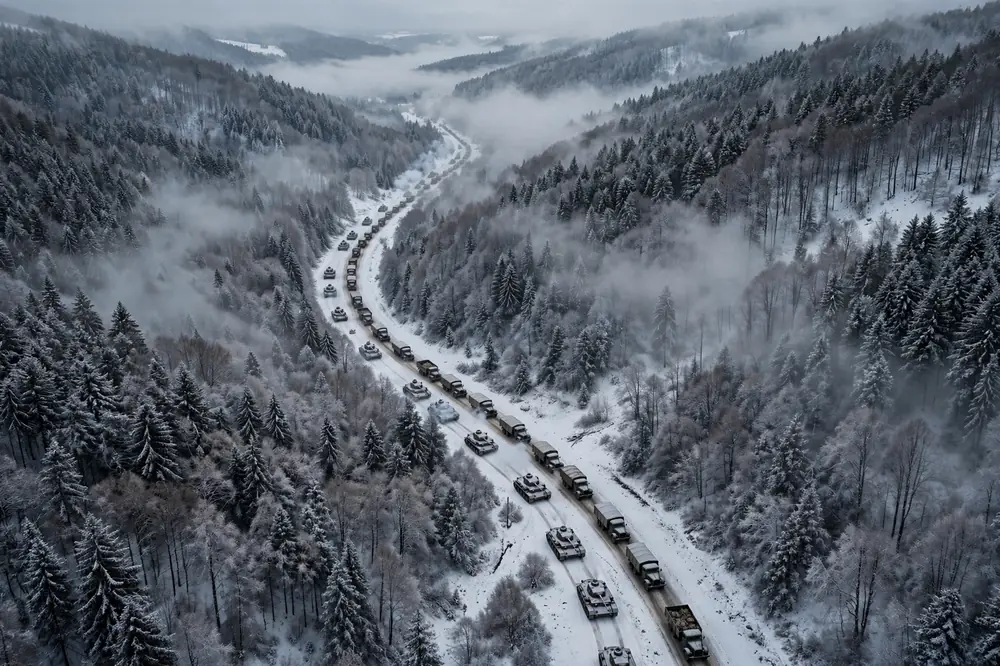
The Ardennes is a region of dense forest, steep valleys and few roads, straddling eastern Belgium, northern Luxembourg and the German border. In December 1944 it was cold, snow-covered and fog-bound — the worst winter in the region for decades. The terrain shaped the battle completely. There were only a handful of usable east–west roads, and almost all of them ran through a few crossroads towns: Monschau and Elsenborn in the north, St. Vith and Bastogne in the centre, Clervaux and Diekirch in the south. Whoever held those towns controlled movement through the forest.
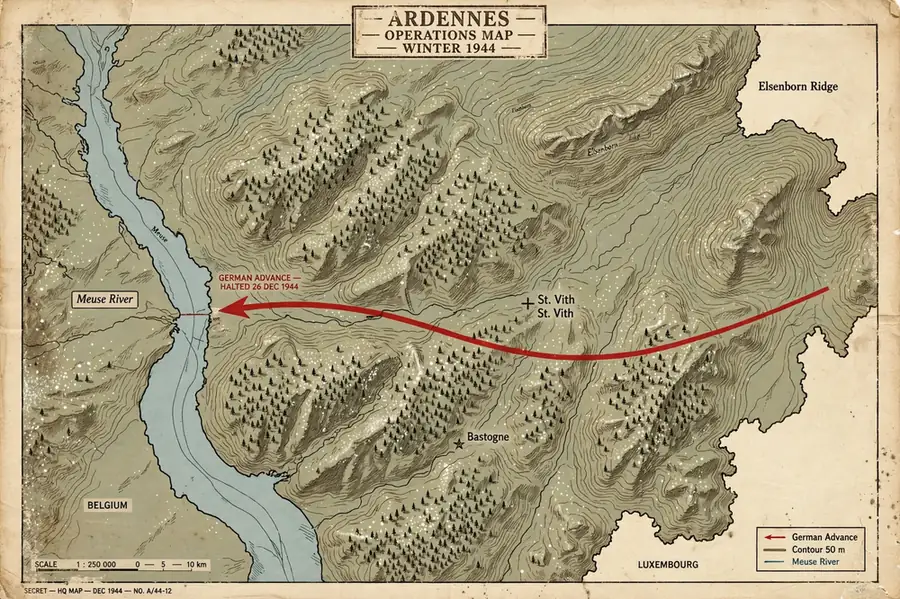
The German plan depended on speed along those roads: from the start line near the German border, through St. Vith and Bastogne, across the Meuse at Dinant or Namur, and on to Antwerp, about 160 kilometres from the front. The furthest the offensive ever reached was Foy-Notre-Dame, south-east of Dinant — a penetration of roughly 80 kilometres, less than halfway to Antwerp, on a front so narrow that the salient was almost impossible to supply or defend.
The Meuse itself, a wide river running north through Liège, Namur and Dinant, was the barrier the Germans never crossed; by 21 December its crossings were held by a thin screen of British and American troops, including the British 29th Armoured Brigade, while the main German columns were still stuck east of it.
The map of the battle is therefore the map of a bulge: a deep, narrow wedge pointing west from the German border, its tip at Celles and Foy-Notre-Dame, its shoulders anchored at Elsenborn Ridge in the north and Bastogne in the south, and its base on the Our and Sauer rivers. When the Allies counterattacked from north and south in January, they squeezed that wedge from both sides until it disappeared.
The road network explains why the battle took the shape it did. The Ardennes has few east–west roads, and they run through valleys that are easy to block. The northern route, through Monschau, Krinkelt-Rocherath and Elsenborn, leads to Liège and the Meuse; the central route, through St. Vith and Bastogne, leads to Dinant and Namur; the southern route, along the Sauer and through Diekirch, leads toward Luxembourg City.
The German plan needed all three routes at once, and it needed them fast: Antwerp lay about 160 kilometres from the start line, and the offensive was planned to reach the Meuse within days. In practice, the northern route was blocked at Elsenborn Ridge, the southern route made little progress, and only the central route advanced — on a front so narrow that a single blown bridge or a single traffic jam could halt an entire panzer division.
The distances mattered as much as the fighting: by the time the leading German tanks reached Celles, they were some 80 kilometres from their start line, at the end of supply lines that ran through forest roads in winter, while Allied reinforcements were arriving on good roads from the west.
8. Outcome and Legacy
The Battle of the Bulge ended in a decisive Allied victory. Germany’s last major offensive in the West had failed to reach the Meuse, let alone Antwerp, and it had cost Germany men, tanks, fuel and aircraft it could not replace. Within weeks, the Allies resumed their advance to the Rhine; within four months, Germany had surrendered. Hitler’s aim had been to force the Western Allies to negotiate a peace; the failure of the offensive ended that prospect. Rundstedt and Model had told Hitler they considered the full plan impossible with the forces available. About 3,000 Belgian and Luxembourgish civilians were killed during the battle.
For the United States, the Bulge became the largest land battle the U.S. Army fought in the war in Europe, involving more than 600,000 American troops, and the bloodiest, with about 81,000 casualties. The battle is remembered through the paratroopers of the 101st Airborne holding Bastogne, the single word “NUTS!”, and Patton’s Third Army wheeling north through the snow, as well as through points later studied by historians, including the value of holding road junctions in difficult terrain and the role of air power once the weather clears.
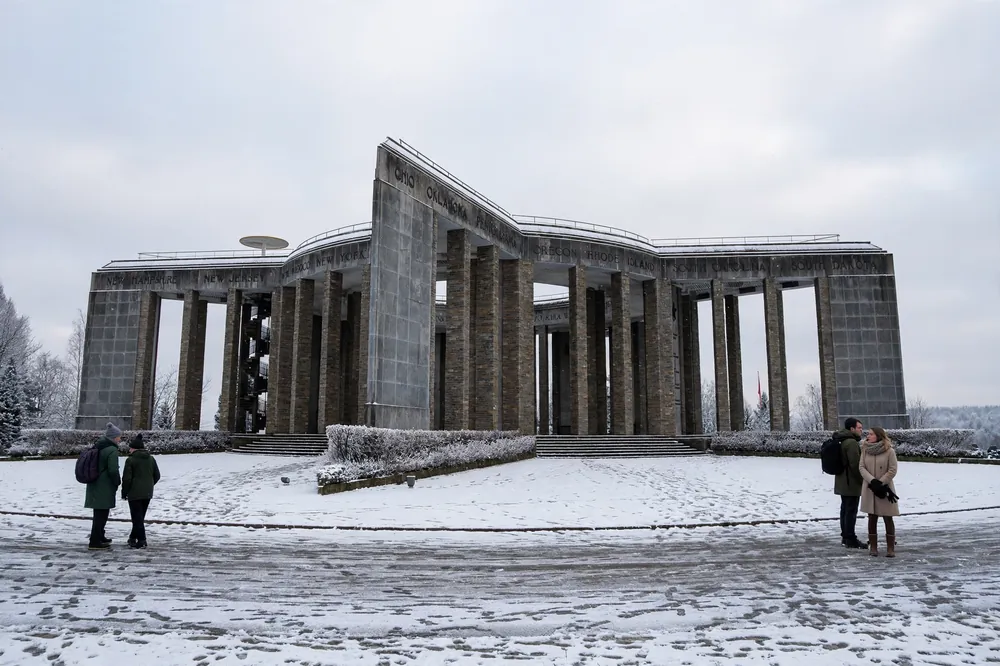
The battle is remembered in the places where it was fought. The Mardasson Memorial stands outside Bastogne; the Henri-Chapelle American Cemetery in Belgium holds the graves of nearly 8,000 American dead, most of them from the Bulge; the German war cemetery at Sandweiler in Luxembourg holds more than 10,000 German dead. The Malmedy Massacre is commemorated by a memorial at the Baugnez crossroads, where 84 stones bear the names of the murdered men. The battle also entered popular culture through books such as Stephen Ambrose’s Band of Brothers and the television series of the same name, which told the story of Easy Company, 506th Parachute Infantry Regiment, at Bastogne.
The Ardennes was not the only German offensive that winter. On 31 December 1944, while the Bulge was still being fought, Germany launched Operation Nordwind against the U.S. Seventh Army in Alsace, aiming for Strasbourg. It inflicted heavy losses but did not reach its objective, and it was called off in late January. Together, the two offensives spent the last of Germany’s reserves in the West.
The battle also delayed the Allied advance toward the Rhine by weeks, and the fighting in January 1945 was among the hardest of the winter war, in deep snow and severe cold. One episode that outlived the battle was Montgomery’s press conference of 7 January 1945, in which he described his part in the fighting; his remarks were resented by some American commanders and became a lasting source of friction between the Allies.
The command arrangements themselves — Montgomery commanding the northern front, Bradley the southern — were a practical response to the German breakthrough, and they were reversed once the bulge had been erased.
9. Commanders
Allies. General Dwight D. Eisenhower, Supreme Allied Commander, made the key decisions of the battle: reinforcing the Ardennes, giving Montgomery command of the northern front, and ordering Patton north. He had been appointed Supreme Commander in December 1943. General Omar Bradley commanded the 12th Army Group, whose First and Third Armies bore the brunt of the fighting; he had commanded the group since August 1944.
Lieutenant General Courtney Hodges commanded the First Army, which held the northern shoulder at Elsenborn Ridge and St. Vith; he had taken command of the First Army in August 1944. Lieutenant General George S. Patton commanded the Third Army, which he had led since its activation in August 1944; his 90-degree turn north and relief of Bastogne on 26 December is often cited by historians as a notable example of large-unit manoeuvre.
Field Marshal Bernard Montgomery commanded the 21st Army Group and took charge of all Allied forces north of the bulge from 20 December to mid-January. Brigadier General Anthony McAuliffe, acting commander of the 101st Airborne Division at Bastogne, gave the “NUTS!” reply to the German surrender demand; he was the division’s artillery commander, acting in place of Major General Maxwell Taylor, who was in the United States.
Germany. Adolf Hitler conceived and imposed the offensive over the objections of his generals, and supervised it from the Western Front from 10 December. Field Marshal Gerd von Rundstedt, Commander-in-Chief West, was the nominal overall commander but had little influence over the plan; he had commanded in the West since 1942, with a break in 1944.
Field Marshal Walter Model commanded Army Group B, which executed the offensive; he had taken command of Army Group B in August 1944. SS-Oberst-Gruppenführer Sepp Dietrich commanded the Sixth Panzer Army, the main effort in the north, which was stopped at Elsenborn Ridge; he had led Waffen-SS formations since the start of the war.
General Hasso von Manteuffel commanded the Fifth Panzer Army in the centre; his forces came closest to the Meuse, reaching Celles. General Erich Brandenberger commanded the Seventh Army on the southern flank. SS-Standartenführer Joachim Peiper commanded the armoured spearhead Kampfgruppe Peiper, whose men carried out the Malmedy Massacre; he was tried for war crimes at Dachau in 1946 and sentenced to death, though the sentence was later commuted.
Related articles
FAQ
Sources
- Wikipedia, “Battle of the Bulge” — dates, strength by date, casualty ranges, commanders and order of battle, cross-checked against the U.S. Army official histories cited there (Cole, The Ardennes: The Battle of the Bulge; MacDonald, A Time for Trumpets / The Last Offensive).
- U.S. Army Center of Military History, Hugh M. Cole, The Ardennes: The Battle of the Bulge (United States Army in World War II series, 1965) — the official U.S. Army history; American strength on the attacked front, casualty phases (41,315 in the defensive phase; 39,672 in the counteroffensive).
- U.S. Army Center of Military History, Charles B. MacDonald, A Time for Trumpets: The Untold Story of the Battle of the Bulge (1985) — 81,000 American casualties; German loss estimates.
- U.S. Army Center of Military History, Roger Cirillo, Ardennes–Alsace (CMH Publication 72-26) — initial German assault force (200,000+ men), campaign dates, casualty accounting.
- United States Holocaust Memorial Museum, Holocaust Encyclopedia, “The Malmedy Massacre” (encyclopedia.ushmm.org) — 17 December 1944, at least 84 U.S. soldiers dead, just over 40 survivors; the 1946 Dachau trial.
- Encyclopaedia Britannica, “Battle of the Bulge” — overview, dates, Antwerp objective, and the battle’s place as the last major German offensive in the West.
- National WWII Museum, “The Battle of the Bulge” (nationalww2museum.org) — overview, Bastogne, and the battle’s significance.
- U.S. Army, “The Battle of the Bulge” (army.mil) and Airborne & Special Operations Museum, “The Battle of the Bulge” (asomf.org) — 101st Airborne at Bastogne, the “NUTS!” reply, relief on 26 December 1944.
- Imperial War Museum, “What was the Battle of the Bulge?” (iwm.org.uk) — overview and significance.
- Antony Beevor, Ardennes 1944: Hitler’s Last Gamble (Viking, 2015) — the German plan, the debate among Hitler’s generals, and the course of the offensive.
- Stephen E. Ambrose, Band of Brothers (Simon & Schuster, 1992) — Easy Company, 506th Parachute Infantry Regiment, at Bastogne.
- Danny S. Parker, Fatal Crossroads: The Untold Story of the Malmedy Massacre at the Battle of the Bulge (Da Capo Press, 2012).
- John S. D. Eisenhower, The Bitter Woods: The Battle of the Bulge (G. P. Putnam’s Sons, 1969).