 WAR ATLAS MILITARY HISTORY MAGAZINE · WWI — WWII
F4U Corsair
1. Lead
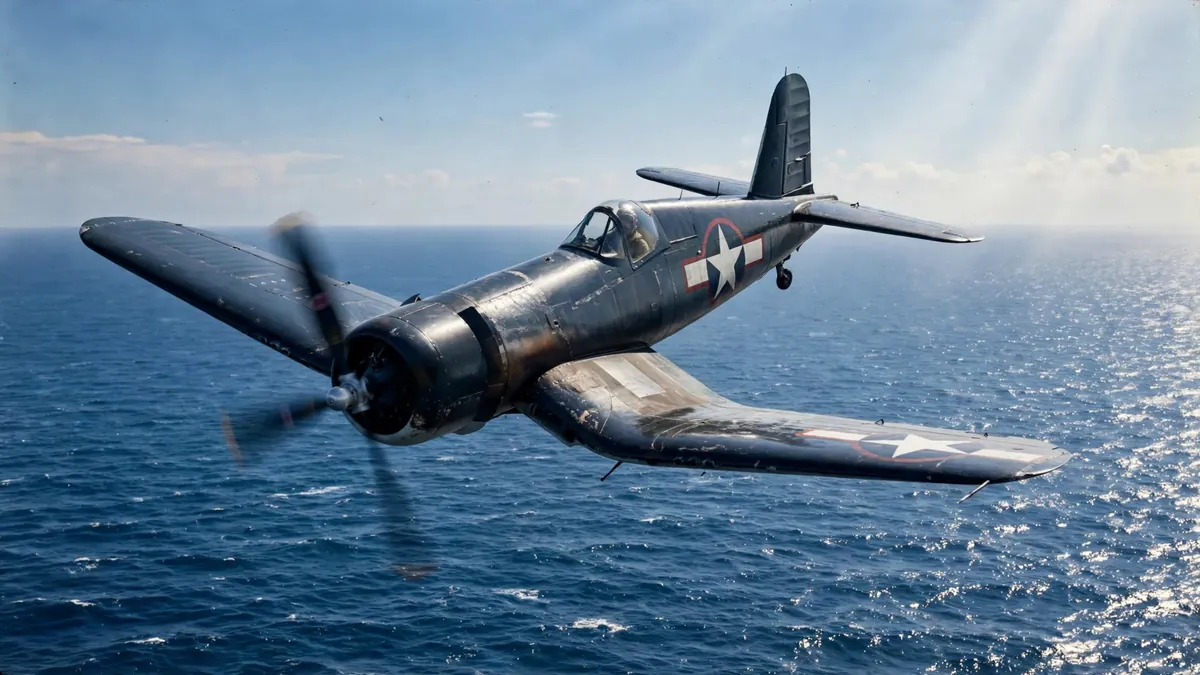
The F4U Corsair was the American carrier-based fighter of the Second World War, and one of the most recognisable aircraft of the war, with its inverted gull wing, its huge propeller and its powerful Pratt & Whitney R-2800 Double Wasp engine. Designed by Vought and first flown in 1940, the Corsair was the fastest American fighter of its day, and it served with the U.S. Navy, the U.S.
Marine Corps and the Royal Navy in the Pacific, where it was flown by aces including Gregory “Pappy” Boyington of the “Black Sheep” squadron, VMF-214. About 12,571 Corsairs were built between 1942 and 1953, and the aircraft remained in service through the Korean War, where it flew ground-attack missions.
The Corsair’s bent wing, its speed and its record — a claimed kill ratio of 11 to 1 in the Pacific — have made it one of the most famous fighters of the Second World War.
2. Key Facts
| Type | Carrier-based fighter-bomber |
| Origin | United States |
| Designer | Vought (Rex Beisel, chief designer) |
| Manufacturer | Vought; also Goodyear (FG) and Brewster (F3A) under licence |
| First flight | 29 May 1940 |
| In service | 1942–1953 (U.S. production); in service with other air forces into the 1960s |
| Produced | 1942–1953; about 12,571 built |
| Crew | 1 |
| Length | 10.26 m |
| Wingspan | 12.49 m |
| Height | 4.90 m |
| Empty weight | About 4,170 kg |
| Max take-off weight | About 6,650 kg |
| Engine | Pratt & Whitney R-2800-8W Double Wasp, 2,000 hp (later versions up to 2,450 hp) |
| Top speed | About 671 km/h (417 mph) at 6,000 m |
| Range | About 1,630 km |
| Armament | Six .50 in (12.7 mm) M2 Browning machine guns; up to 1,800 kg of bombs or eight rockets |
| Notable units | VMF-214 “Black Sheep” (USMC); VF-17 “Jolly Rogers” (USN); Royal Navy Fleet Air Arm squadrons |
3. Background and Development
The Corsair was designed to a U.S. Navy requirement of 1938 for a carrier-based fighter that would be faster than any fighter then in service. Vought’s chief designer, Rex Beisel, and his team designed an aircraft around the most powerful engine available, the Pratt & Whitney R-2800 Double Wasp, an 18-cylinder radial engine of 2,000 horsepower.
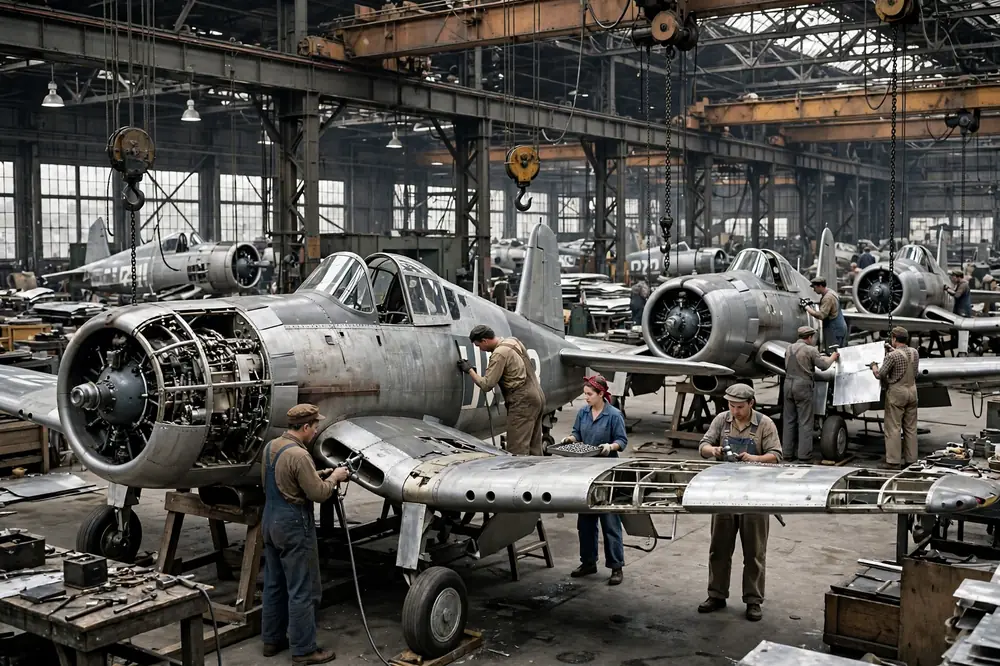
The engine was so large, and its propeller so large — 4.06 metres in diameter, the largest propeller then fitted to a fighter — that the aircraft needed long landing gear to keep the propeller clear of the ground. Beisel’s solution was the inverted gull wing: the wing bent down from the fuselage and then up again, so that the landing gear, which was attached at the lowest point of the wing, could be short and strong, while the propeller had the clearance it needed.
The inverted gull wing also gave the pilot a good view over the wing, and it allowed the wing to be folded for storage on a carrier.
The prototype, the XF4U-1, first flew on 29 May 1940, and in October 1940 it became the first American single-engined aircraft to exceed 400 mph (about 640 km/h) in level flight. The Navy ordered the aircraft into production in 1941, but the Corsair’s development was troubled: the aircraft was difficult to land on a carrier, because its long nose restricted the pilot’s view forward, and because it tended to bounce on landing and to stall without warning; and its cockpit, which was placed behind the fuel tank, gave the pilot a poor view.
The Navy at first refused to clear the Corsair for carrier operations, and the aircraft was issued to the U.S. Marine Corps, which operated it from land bases in the Pacific. It was not until 1944, after the British Fleet Air Arm had shown that the Corsair could be landed on a carrier by approaching in a curved path, and after Vought had modified the aircraft with a raised cockpit and a longer tail wheel, that the U.S.
Navy cleared the Corsair for carrier service.
4. Design
The Corsair was a large, powerful and heavily armed fighter, and its design showed it. The inverted gull wing, which gave the aircraft its distinctive silhouette, was the key to its design: it allowed the short, strong landing gear and the large propeller, and it gave the aircraft a good rate of roll.
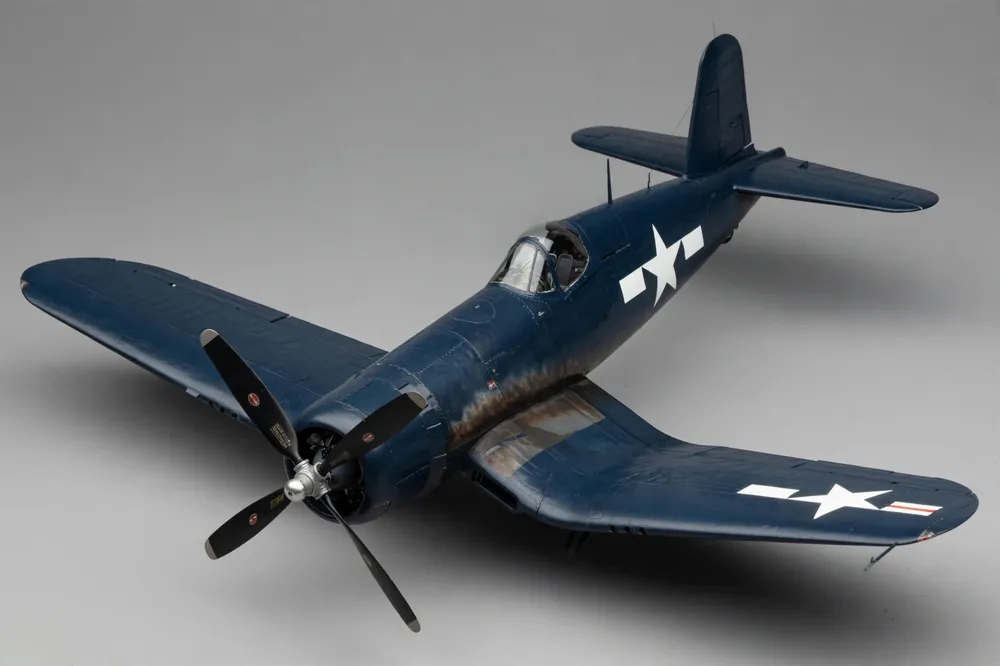
The aircraft was built around the R-2800 engine, which was housed in a cowling with a large air intake, and the cockpit was placed well back in the fuselage, behind the main fuel tank. The Corsair was armed with six .50 in (12.7 mm) M2 Browning machine guns, three in each wing, with 400 rounds per gun, and it could carry up to 1,800 kg of bombs or eight 5-inch rockets under its wings.
Later versions, the F4U-4 and the F4U-5, had a more powerful engine, a four-bladed propeller, and a bubble canopy that improved the pilot’s view.
The Corsair’s performance was outstanding for its day: its top speed of about 671 km/h made it faster than the Japanese Zero, and its diving speed was higher than that of any Japanese fighter. Its armament of six .50 in machine guns gave it a heavy punch, and its ability to carry bombs and rockets made it a fighter-bomber as well as a fighter.
Its weaknesses were its handling on landing, its poor forward view, and its weight: at about 6,650 kg at maximum take-off weight, it was heavier than the Zero, and it could not turn with the Zero at low speed. The Corsair’s pilots learned to fight the Zero in the vertical plane — diving, shooting and climbing away — rather than turning with it, and the tactic worked: the Corsair’s claimed kill ratio in the Pacific was 11 to 1, with 2,140 Japanese aircraft claimed destroyed against 189 Corsairs lost in air combat, according to U.S.
Navy figures.
5. Variants
| Variant | Years | Key features | Production |
|---|---|---|---|
| XF4U-1 | 1940 | Prototype; first flight 29 May 1940 | 1 |
| F4U-1 | 1942–1943 | First production model; “birdcage” canopy; six .50 in guns | About 2,000 |
| F4U-1A | 1943–1944 | Raised cockpit, bubble canopy, longer tail wheel; carrier-capable | About 2,100 |
| F4U-1D | 1944–1945 | Fighter-bomber; bomb racks and rocket rails; water injection | About 1,700 |
| FG-1D | 1944–1945 | Goodyear-built F4U-1D | About 1,500 |
| F4U-4 | 1944–1946 | More powerful R-2800-18W engine (2,450 hp); four-bladed propeller | About 2,350 |
| F4U-5 | 1946–1951 | Post-war version; more powerful engine; improved cockpit | About 230 |
| F4U-7 | 1952–1953 | French version for the French Navy; built for Indochina and Algeria | About 90 |
| AU-1 | 1952–1953 | Ground-attack version for the Marine Corps in Korea | About 110 |
The Corsair was built by Vought, and under licence by Goodyear (as the FG) and Brewster (as the F3A), and production continued after the war, with the last Corsair, an F4U-7 for the French Navy, delivered in 1953. The F4U-4, with its more powerful engine and four-bladed propeller, was the best of the wartime Corsairs, and it served in the Korean War alongside the F4U-5 and the AU-1 ground-attack version. The Royal Navy’s Corsairs, which were built to British specifications with clipped wings to fit the smaller British carriers, were designated Corsair Mk I to Mk IV, and they served with the Fleet Air Arm in the Pacific and in the Atlantic.
6. Operational History
The Pacific, 1943–1944
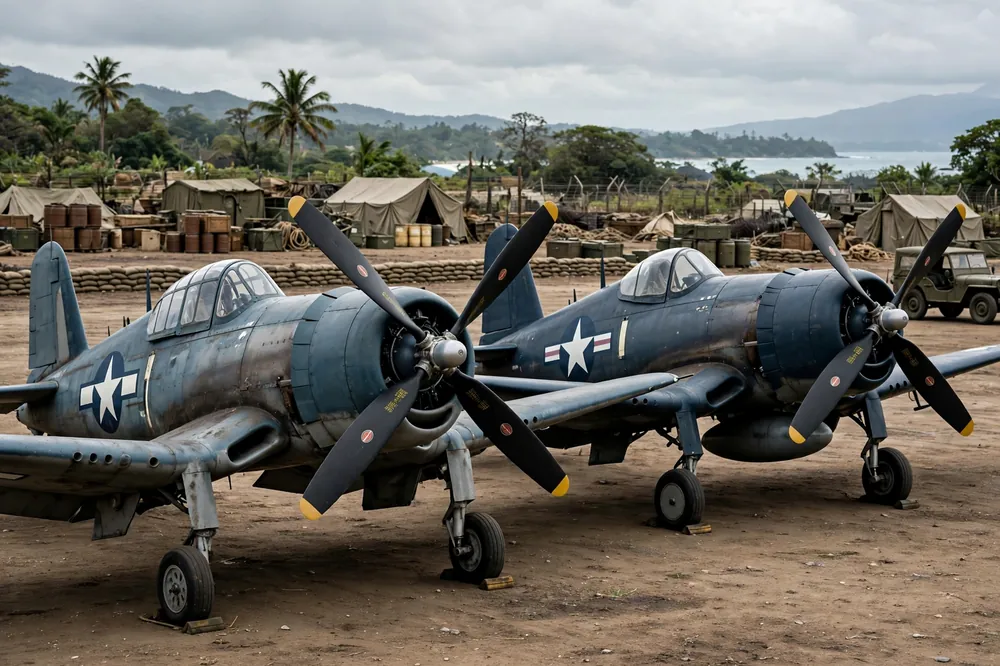
The Corsair entered combat with the U.S. Marine Corps in February 1943, in the Solomon Islands, where VMF-124, the first Marine Corsair squadron, flew from Henderson Field on Guadalcanal. The Corsair’s speed and firepower made it an effective fighter against the Japanese Zero, and the Marine squadrons — including VMF-214, the “Black Sheep”, under Major Gregory “Pappy” Boyington — became famous.
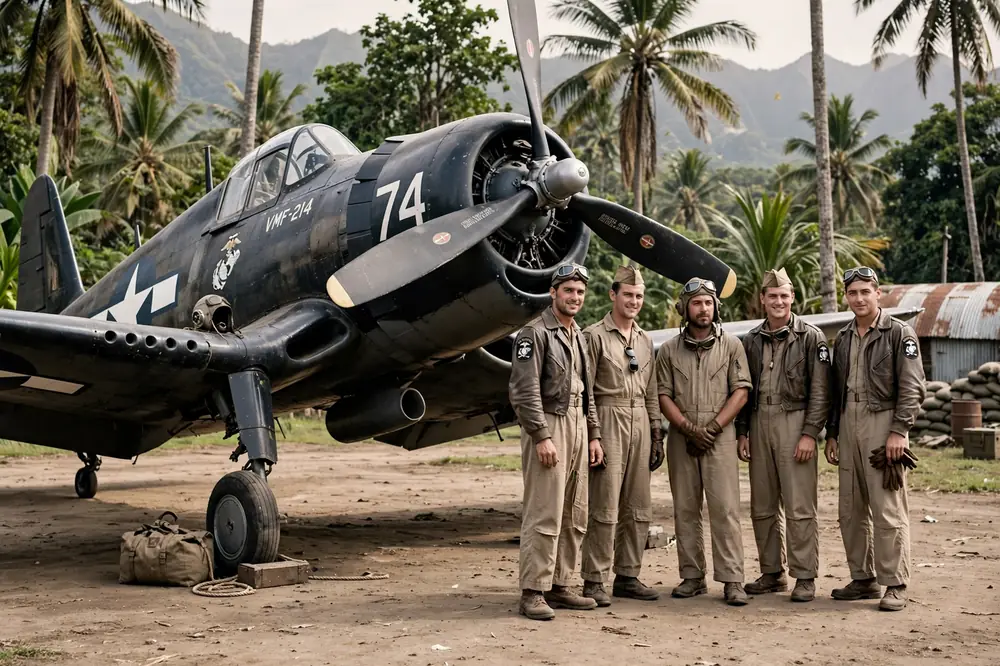
Boyington, who had flown with the American Volunteer Group, the “Flying Tigers”, in China, took command of VMF-214 in September 1943, and the squadron, which called itself the “Black Sheep” because its pilots were the misfits of other squadrons, claimed 97 Japanese aircraft destroyed in 84 days.
Boyington himself was credited with 28 victories, though the figure includes his victories in China, and he was shot down on 3 January 1944 and taken prisoner; he was awarded the Medal of Honor and the Navy Cross, and his story was told in his memoir, Baa Baa Black Sheep (1958), and in the television series of the same name.
VF-17 and the Royal Navy
The U.S. Navy’s first Corsair squadron, VF-17, the “Jolly Rogers”, under Lieutenant Commander John Blackburn, flew from land bases in the Solomons in 1943-1944 and claimed 154 Japanese aircraft destroyed, the highest score of any Navy squadron in the war.
The Royal Navy’s Fleet Air Arm also flew the Corsair, from 1943, in the Pacific and in the Atlantic, where its squadrons flew from the carriers Illustrious, Victorious and Formidable, and took part in the attacks on the German battleship Tirpitz in Norway and in the British Pacific Fleet’s operations against Japan in 1945.
The Royal Navy’s Corsairs, with their clipped wings, were the first Corsairs to operate from carriers in combat, and the British technique of approaching the carrier in a curved path — the “curved approach” — was adopted by the U.S. Navy and made the Corsair’s carrier operations possible.
Korea and after
In the Korean War (1950-1953), the Corsair flew ground-attack missions for the U.S. Navy and Marine Corps, attacking North Korean and Chinese troops, tanks and supply columns. The Corsair’s ability to carry a heavy load of bombs and rockets, and to operate from carriers, made it valuable in a war in which the jet fighters of the day could not carry as much ordnance or stay over the target as long.
The Corsair’s most famous Korean War mission was the support of the Marines at the Chosin Reservoir in December 1950, where Corsairs flew close air support in extreme cold. The Corsair remained in service with the French Navy in Indochina and Algeria, and with the air forces of Honduras, El Salvador and other countries, into the 1960s.
The last Corsairs in combat were flown by Honduras and El Salvador in the “Football War” of 1969, in which a Honduran Corsair shot down a Salvadoran aircraft — the last air-to-air victory by a piston-engined fighter in the Americas.
7. Performance and Specifications
| Specification | F4U-1D | F4U-4 |
|---|---|---|
| Engine | Pratt & Whitney R-2800-8W, 2,000 hp | Pratt & Whitney R-2800-18W, 2,450 hp |
| Top speed | About 671 km/h (417 mph) | About 721 km/h (448 mph) |
| Range | About 1,630 km | About 1,600 km |
| Service ceiling | About 11,300 m | About 12,600 m |
| Rate of climb | About 15 m/s | About 19 m/s |
| Armament | Six .50 in M2 Browning machine guns | Six .50 in M2 Browning machine guns (four 20 mm cannon on some F4U-4B) |
| Bombs/rockets | Up to 1,800 kg of bombs or eight rockets | Up to 1,800 kg of bombs or eight rockets |
| Crew | 1 | 1 |
| Length | 10.26 m | 10.26 m |
| Wingspan | 12.49 m | 12.49 m |
Compared with its contemporaries, the Corsair was the fastest American fighter of the early war, and one of the most heavily armed. The Japanese Zero was more manoeuvrable and could turn inside the Corsair, but it was slower, more lightly armed and less well protected; the American Hellcat, the Navy’s other carrier fighter, was easier to fly and to land on a carrier, but it was slower than the Corsair.
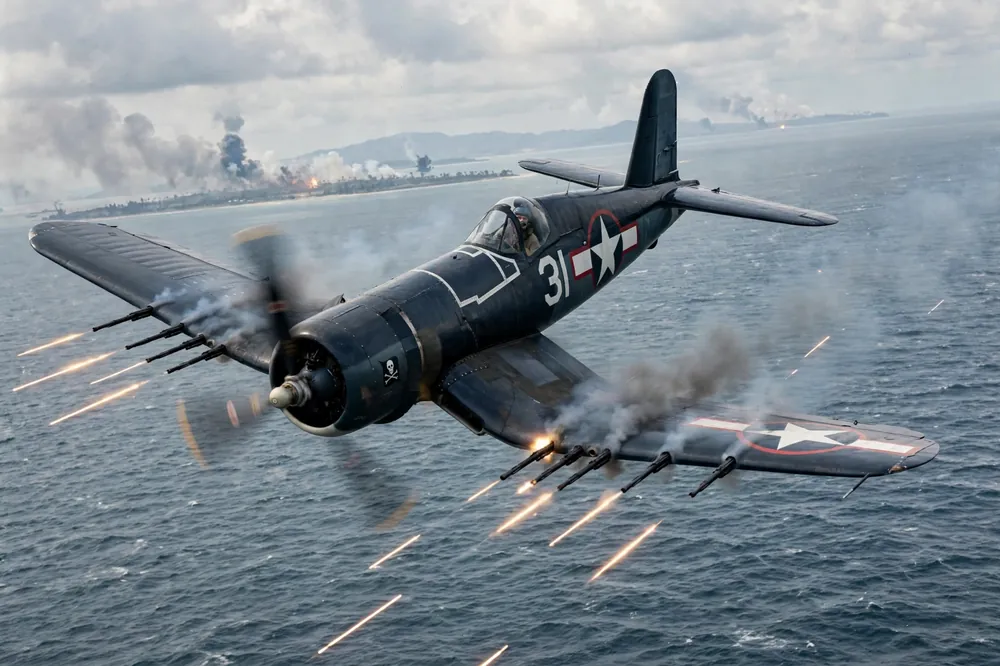
The Corsair’s advantage was its speed, its diving performance and its firepower; its disadvantage was its handling on landing and its poor forward view, which kept it off carriers until 1944. In the hands of a pilot who fought in the vertical plane, the Corsair was the best American fighter in the Pacific; in the hands of a pilot who tried to turn with the Zero, it was vulnerable.
8. Operators
The Corsair was used by the United States — the Navy, the Marine Corps and, after the war, the Air National Guard — and by the Royal Navy’s Fleet Air Arm, which operated about 2,000 Corsairs. After the war, the Corsair was used by France, which operated it in Indochina and Algeria; by Argentina, which used it until the 1960s; by Honduras and El Salvador, which used it until the 1960s and in the “Football War” of 1969; and by New Zealand, which operated it in the Pacific during the war and after. The Corsair’s wide distribution is one reason it appears in the photographic record of the Pacific War and of the post-war conflicts in which it served.
9. Legacy and Influence
The Corsair’s legacy is the carrier fighter itself, and the aircraft that followed it. The Corsair’s inverted gull wing, which was a solution to the problem of the large propeller, became the aircraft’s signature, and it has made the Corsair one of the most recognisable aircraft of the Second World War.
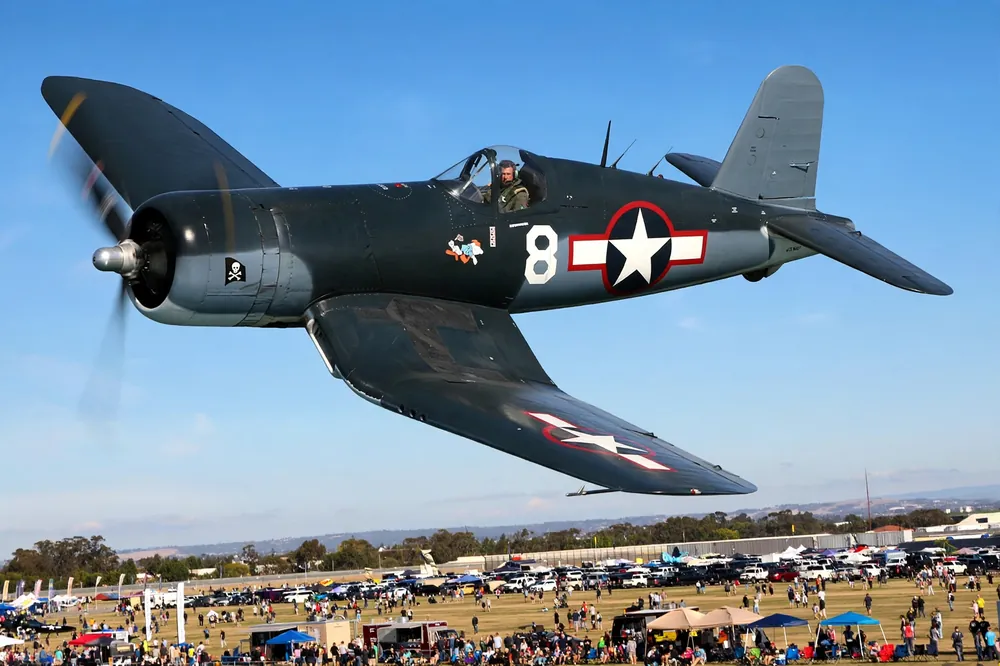
The Corsair also left a cultural legacy: the “Black Sheep” squadron, and Pappy Boyington’s memoir and the television series Baa Baa Black Sheep (1976-1978), made the Corsair famous to a generation that had not lived through the war, and the aircraft has appeared in films, novels and video games ever since.
The Corsair’s record in the Pacific — 2,140 Japanese aircraft claimed destroyed against 189 Corsairs lost in air combat — is the best of any American fighter in the war, though the figures, like all kill claims, are disputed. The Corsair’s long service — from 1942 to 1969 in combat, and to the present day in the hands of warbird operators — is a measure of its design.
10. Surviving Examples
Because about 12,571 Corsairs were built, surviving examples are relatively common, and the Corsair is one of the most popular warbirds in the world. Flying examples are operated by the Commemorative Air Force, the Planes of Fame Air Museum in California, the Collings Foundation, and other warbird operators in the United States, the United Kingdom and New Zealand, and they appear at air shows around the world.
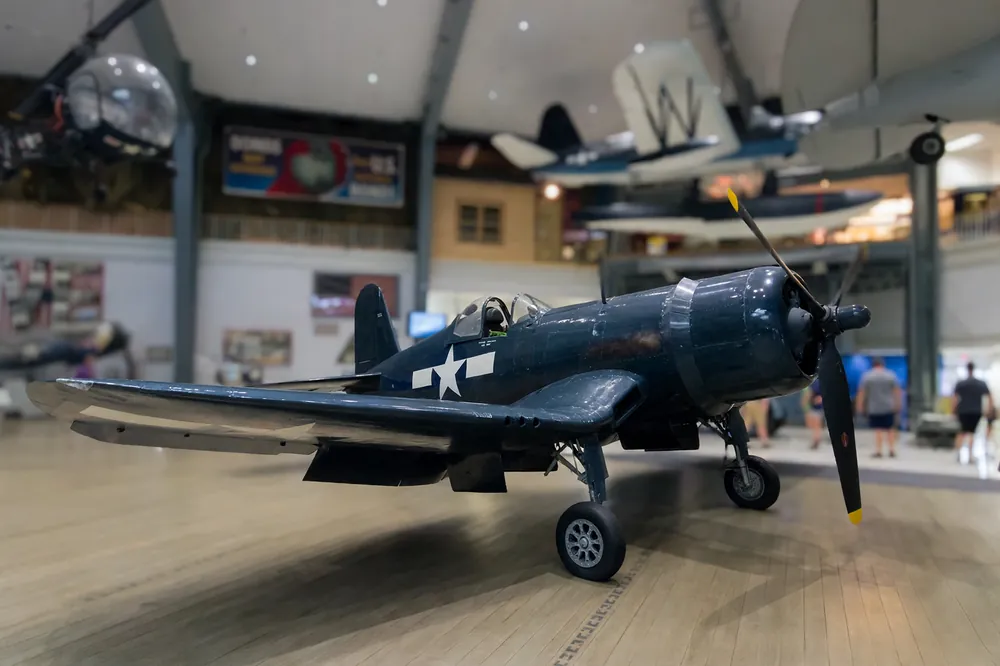
Museum examples are held by the National Naval Aviation Museum in Pensacola, Florida, the National Air and Space Museum in Washington, D.C., the Imperial War Museum in London, the Fleet Air Arm Museum in Yeovilton, England, and the Royal New Zealand Air Force Museum in Christchurch.
For most visitors, the easiest way to see a Corsair is at an air show, where the aircraft’s inverted gull wing and the sound of its R-2800 engine are unmistakable.
Frequently Asked Questions
What is the F4U Corsair?
The F4U Corsair was an American carrier-based fighter of the Second World War, with an inverted gull wing and a Pratt & Whitney R-2800 engine. About 12,571 were built between 1942 and 1953.
How many Corsairs were built?
About 12,571 F4U Corsairs were built by Vought, Goodyear and Brewster between 1942 and 1953.
Why does the Corsair have a bent wing?
The inverted gull wing allowed the Corsair to use a large propeller — 4.06 metres in diameter — with short, strong landing gear, and it gave the pilot a good view over the wing.
Who was Pappy Boyington?
Major Gregory “Pappy” Boyington commanded VMF-214, the “Black Sheep” squadron, in the Pacific in 1943-1944. He was credited with 28 victories, was shot down and taken prisoner in January 1944, and was awarded the Medal of Honor.
What was the Corsair’s kill ratio?
The U.S. Navy claimed a kill ratio of 11 to 1 in the Pacific, with 2,140 Japanese aircraft claimed destroyed against 189 Corsairs lost in air combat. Like all kill claims, the figures are disputed.
Where can I see a Corsair today?
Flying Corsairs appear at air shows in the United States, the United Kingdom and New Zealand, and museum examples are at the National Naval Aviation Museum in Pensacola, the National Air and Space Museum in Washington, D.C., and the Fleet Air Arm Museum in Yeovilton.
Related articles
Sources
- Wikipedia, “Vought F4U Corsair” — production of about 12,571, specifications, first flight 29 May 1940, kill ratio 11:1.
- Barrett Tillman, Corsair: The F4U in World War II and Korea (Naval Institute Press, 1979) — the standard history of the Corsair.
- National Naval Aviation Museum, Pensacola, “F4U Corsair” — service history and specifications.
- Gregory Boyington, Baa Baa Black Sheep (Putnam, 1958) — memoir of VMF-214.
- Martin W. Bowman, Vought F4U Corsair (Crowood Press, 2002) — development, variants and operational use.
- Imperial War Museum, London — the Corsair in Royal Navy service and the “curved approach” to carrier landings.