 WAR ATLAS MILITARY HISTORY MAGAZINE · WWI — WWII
StG 44
1. Lead
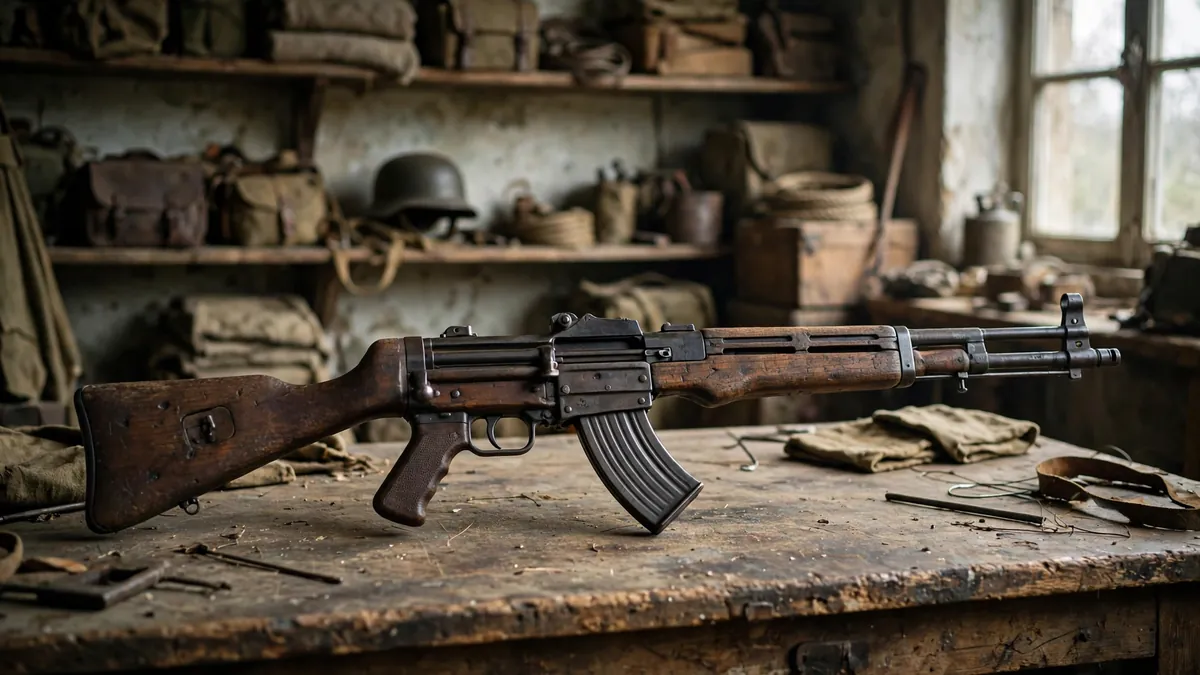
The StG 44 (Sturmgewehr 44, “assault rifle 44”) was the German assault rifle of the Second World War, and the first weapon of its kind in the world. Developed by Hugo Schmeisser and built by C. G. Haenel, it combined the automatic fire of a submachine gun with the range and accuracy of a rifle, firing a new intermediate cartridge, the 7.92×33 mm Kurz, from a 30-round curved magazine.
It entered service in 1943, was used on the Eastern Front and in the West, and was so effective that it influenced the design of every assault rifle that followed, including the Soviet AK-47 and the American M16. About 425,000 StG 44s were built between 1943 and 1945, and the weapon gave its name to a whole class of firearms: the “assault rifle”.
2. Key Facts
| Type | Assault rifle |
| Origin | Germany |
| Designer | Hugo Schmeisser (C. G. Haenel); developed from the MKb 42(H) |
| Manufacturer | C. G. Haenel, Suhl; also Erma and Steyr |
| In service | 1943–1945 (German service); used after the war by East Germany, Yugoslavia, Czechoslovakia and others |
| Produced | 1943–1945; about 425,000–426,000 built |
| Weight | About 4.6 kg empty; about 5.2 kg loaded with 30-round magazine |
| Length | 940 mm |
| Barrel length | 419 mm |
| Cartridge | 7.92×33 mm Kurz (short) |
| Action | Gas-operated, tilting bolt; selective fire |
| Rate of fire | About 550–600 rounds per minute (cyclic) |
| Muzzle velocity | About 685 m/s |
| Effective range | About 300 m (automatic fire); about 600 m (single shots) |
| Feed system | 30-round detachable curved box magazine |
3. Background and Development
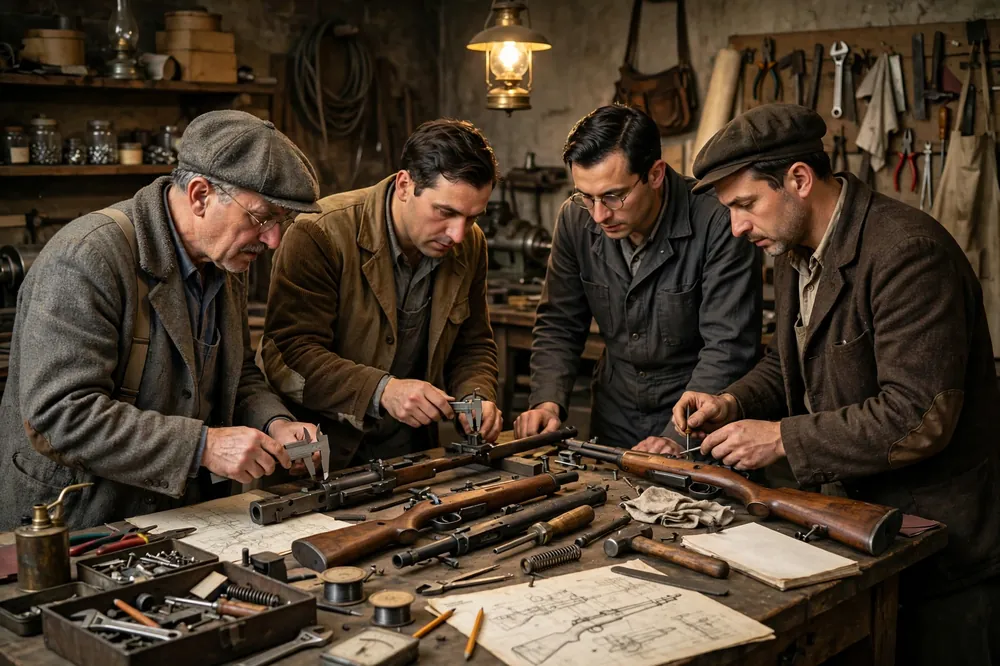
The StG 44 was born of a problem that German infantry had faced since the First World War: the rifle was too long and too slow for close combat, and the submachine gun was too short-ranged for open battle. In the First World War, German storm troops had used the MP 18 submachine gun, which fired a pistol cartridge and was effective only at short range.
In the Second World War, the German Army’s standard rifle, the Karabiner 98k, was a bolt-action rifle firing the full-power 7.92×57 mm cartridge, which was accurate at long range but slow to fire, while the MP 40 submachine gun fired the 9 mm pistol cartridge and was effective only to about 100 metres.
The gap between the two weapons was the problem: most infantry combat took place at ranges of 100 to 300 metres, where the rifle was too slow and the submachine gun was too weak.
The answer was an intermediate cartridge: a cartridge more powerful than a pistol round, but less powerful than a full rifle round, which could be fired from a lightweight automatic weapon at ranges of up to 300 metres. German researchers had studied the idea since the 1930s, and in 1938 the Army’s weapons office asked the firms Haenel and Walther to develop a weapon for the new cartridge, the 7.92×33 mm Kurz.
Haenel’s design, by Hugo Schmeisser, was the Maschinenkarabiner 42(H), the MKb 42(H); Walther’s was the MKb 42(W). The two were tested on the Eastern Front in 1942, and the Haenel design was chosen. It was renamed the MP 43, then the MP 44, in an attempt to disguise it from Hitler, who had opposed the development of a new rifle and had ordered that no new infantry rifle be developed.
When Hitler learned of the weapon and tested it himself, he was impressed, and he gave it its final name: Sturmgewehr 44, the “assault rifle 44”.
Hugo Schmeisser
Hugo Schmeisser (1884-1953) was the son of the firearms designer Louis Schmeisser, and he had designed the MP 18, the first submachine gun to see large-scale service, in the First World War. After the war he worked for C. G. Haenel in Suhl, where he designed the MP 28 and the MKb 42(H).
After the Second World War, Schmeisser was taken to the Soviet Union, where he worked at the Izhevsk arms factory — the same factory where Mikhail Kalashnikov was developing the AK-47. The extent of Schmeisser’s influence on the AK-47 is debated by historians: the AK-47 uses a different operating system from the StG 44, but it uses the same concept — an intermediate cartridge in a selective-fire rifle — and Schmeisser’s presence at Izhevsk has led to speculation that he contributed to its design.
What is not debated is that the StG 44 was the first assault rifle, and that the AK-47, the most widely produced assault rifle in history, follows the concept the StG 44 introduced.
Hugo Schmeisser
4. Design
The StG 44 was a gas-operated, selective-fire rifle, built largely from stamped steel — a construction method that made it cheaper and faster to produce than the machined weapons it replaced. The receiver was a stamped-steel tube, the barrel was 419 mm long, and the weapon was fitted with a wooden stock and handguard, a pistol grip, and a 30-round curved magazine.
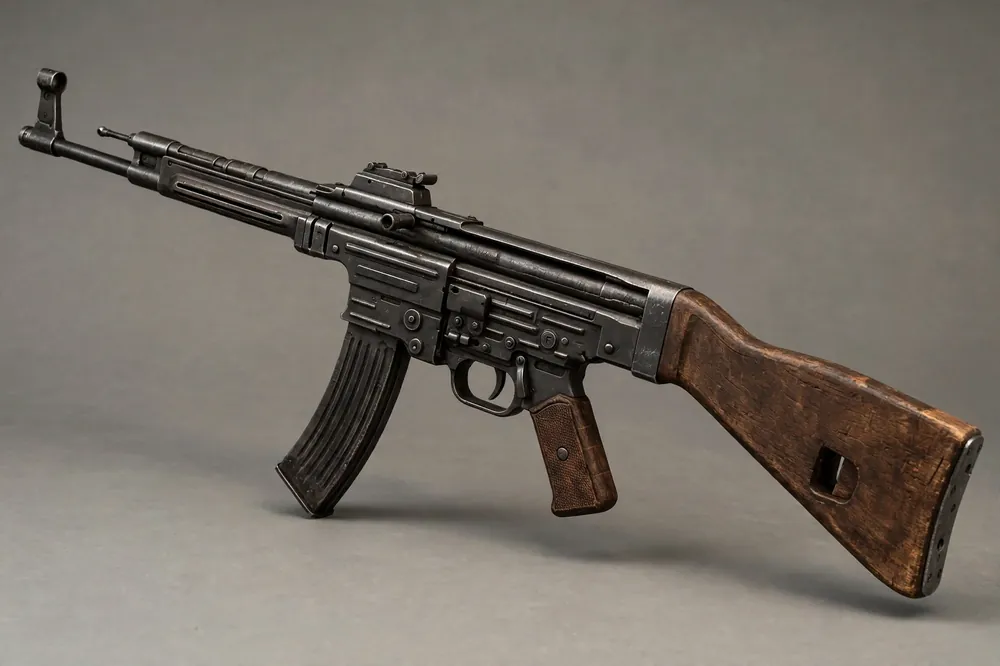
The gas system used a long-stroke piston above the barrel, and the bolt tilted to lock, a design that was simple and robust. The weapon had a fire selector for semi-automatic and fully automatic fire, and a rear sight adjustable to 800 metres, though its effective range in automatic fire was about 300 metres.
The StG 44 was fitted with a muzzle nut that could accept a grenade launcher, and some weapons were fitted with the Vampir infrared night sight, the first night-vision device to be used in combat in significant numbers.
The StG 44 weighed about 4.6 kg empty and about 5.2 kg loaded, and it was 940 mm long — shorter than the Karabiner 98k, which was 1,110 mm long, and longer than the MP 40, which was 833 mm long with its stock extended.
The intermediate cartridge, the 7.92×33 mm Kurz, fired a bullet of about 8 grams at about 685 metres per second, giving it a muzzle energy of about 1,900 joules — about half that of the full-power 7.92×57 mm rifle cartridge, and about four times that of the 9 mm pistol cartridge.
The cartridge’s shorter case meant that the weapon’s action could be shorter and lighter, and that the soldier could carry more ammunition: a soldier with an StG 44 could carry about twice as many rounds as a soldier with a Karabiner 98k, for the same weight.
5. Variants
| Variant | Years | Key features | Production |
|---|---|---|---|
| MKb 42(H) | 1942 | Haenel prototype; selective fire; 30-round magazine | About 8,000 (trial production) |
| MKb 42(W) | 1942 | Walther prototype; different operating system; not adopted | About 200 |
| MP 43 | 1943 | First production model; renamed to disguise the weapon from Hitler | Included in StG 44 total |
| MP 44 | 1943–1944 | Production model; minor changes to the MP 43 | Included in StG 44 total |
| StG 44 | 1944–1945 | Final designation; the standard production model | About 425,000 in total (all designations) |
| StG 45(M) | 1945 | Mauser prototype using roller-delayed blowback; not produced in quantity | A few prototypes |
| Krummlauf | 1944–1945 | Curved-barrel attachment for firing around corners; fitted to some StG 44s | Small numbers |
The StG 44’s production was spread across three firms: C. G. Haenel at Suhl, Erma at Erfurt, and Steyr in Austria. The weapon’s design changed little during production, and the main differences between the MP 43, the MP 44 and the StG 44 are in the markings, not in the mechanism.
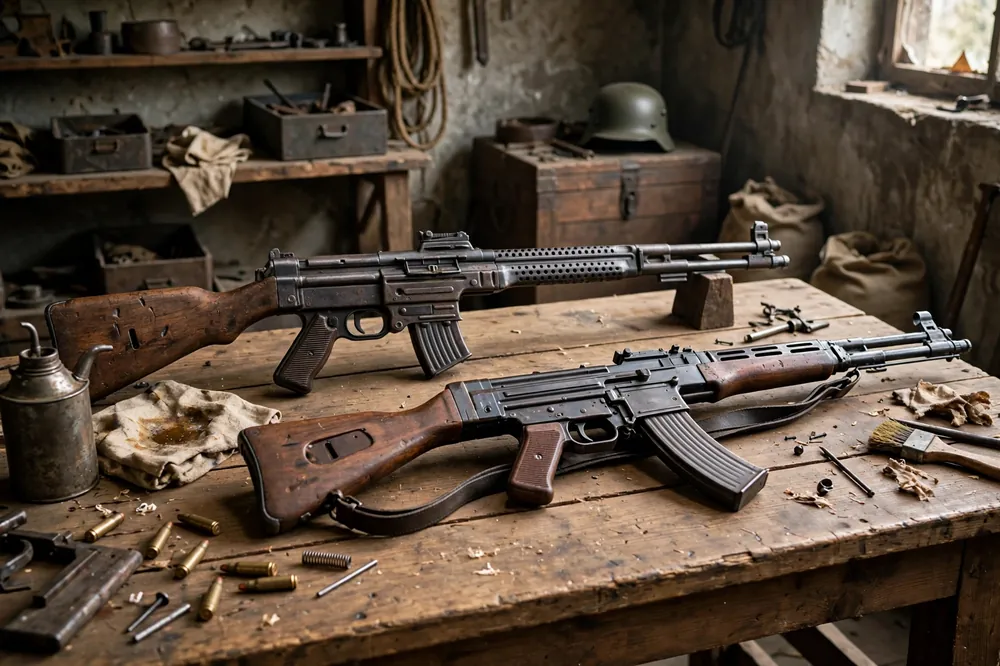
The most unusual variant was the Krummlauf, a curved barrel attachment that allowed the weapon to be fired around corners and from inside armoured vehicles; the attachment was produced in small numbers and was used in the defence of Berlin in 1945.
The StG 45(M), developed by Mauser in 1945, used a roller-delayed blowback system that would later be used in the Heckler & Koch G3 rifle, but the war ended before it could be produced in quantity.
6. Operational History
The Eastern Front
The StG 44 first saw combat on the Eastern Front, where the MKb 42(H) was tested in 1942 and where the MP 43 was issued to troops in 1943. The weapon’s first large-scale use was in the fighting in the Ukraine and in the Baltic states, where German infantry found that the StG 44’s automatic fire at ranges of 100 to 300 metres gave them a decisive advantage over Soviet infantry armed with bolt-action rifles and with the PPSh-41 submachine gun, which was effective only at short range.
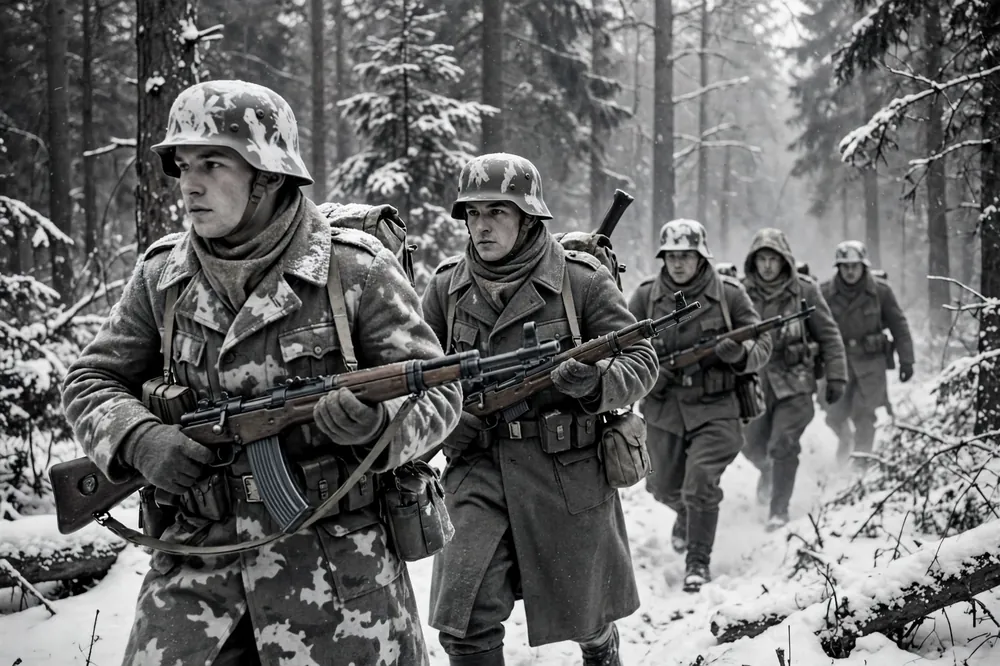
Soviet troops who captured the StG 44 prized it, and the weapon was used by Soviet units as well as by German ones. The StG 44 was issued first to the Waffen-SS and to the Army’s elite divisions, and later to the Volksgrenadier divisions formed in 1944, which were built around the weapon: a Volksgrenadier division was to have about 700 StG 44s, and its tactics were based on the weapon’s firepower.
The West and the end of the war
In the West, the StG 44 was used in Normandy, in the Ardennes and in the defence of Germany. At the Battle of the Bulge in December 1944, German Volksgrenadier divisions armed with the StG 44 fought American infantry, and the weapon’s firepower was noted by American troops, who captured examples and sent them home for study.
In the defence of Berlin in April-May 1945, the StG 44 was used by the defenders, including the Hitler Youth and the Volkssturm, and the Krummlauf curved-barrel attachment was used in street fighting. By the end of the war, about 425,000 StG 44s had been built, but production had been disrupted by Allied bombing, and the weapon was never issued in the numbers the German Army had planned: the Army had wanted a million, and it received less than half that.
7. Performance and Specifications
| Specification | StG 44 |
|---|---|
| Cartridge | 7.92×33 mm Kurz |
| Action | Gas-operated, tilting bolt; selective fire |
| Weight (empty) | About 4.6 kg |
| Weight (loaded, 30-round magazine) | About 5.2 kg |
| Length | 940 mm |
| Barrel length | 419 mm |
| Rate of fire (cyclic) | About 550–600 rounds per minute |
| Rate of fire (practical, automatic) | About 100 rounds per minute |
| Muzzle velocity | About 685 m/s |
| Muzzle energy | About 1,900 joules |
| Effective range (automatic) | About 300 m |
| Effective range (semi-automatic) | About 600 m |
| Feed system | 30-round detachable curved box magazine |
| Sights | Post front; tangent rear, adjustable to 800 m |
Compared with its contemporaries, the StG 44 was a revolution. The German Karabiner 98k was accurate at long range but slow, firing about 15 aimed shots per minute; the Soviet PPSh-41 was fast, firing about 900 rounds per minute, but it fired a pistol cartridge effective only to about 100 metres; the American M1 Garand was semi-automatic and accurate, but it could not fire automatically.
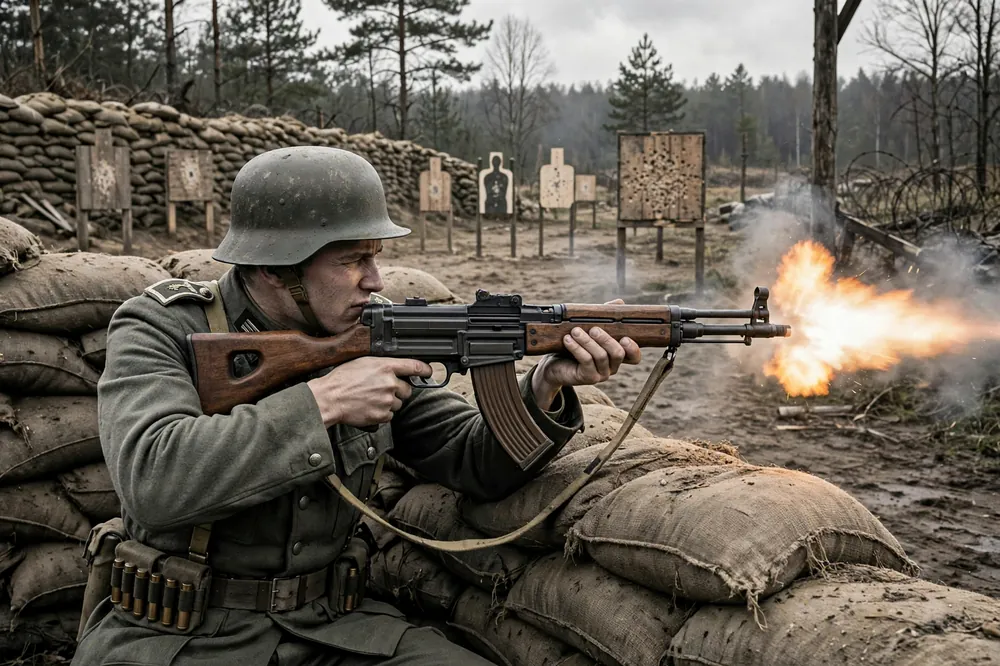
The StG 44 combined the best of both: it could fire single aimed shots to 600 metres, and automatic fire to 300 metres, and it did so from a weapon that was lighter than a rifle and more controllable than a submachine gun.
Its disadvantage was its weight — at 5.2 kg loaded, it was heavier than the Karabiner 98k — and its dependence on a new cartridge, which complicated German supply.
8. Operators
The StG 44 was used by Germany during the war, and by a number of countries after it. East Germany used the StG 44 as its standard rifle until the 1960s, when it was replaced by the AK-47; Yugoslavia used it until the 1980s, and produced its own copies; Czechoslovakia used it after the war, and the weapon was also used by the French Foreign Legion in Indochina and by the Viet Minh, who captured examples from the French.
In the 1960s and later, the StG 44 appeared in the Middle East and Africa, where it was used by the Palestine Liberation Organization and by various armies and militias, and examples captured in Syria in the 2010s showed that the weapon was still in use, seventy years after it was built.
The StG 44’s long service life is a measure of its design: a weapon built in 1944 was still being used in combat in the 2010s.
9. Legacy and Influence
The StG 44’s legacy is the assault rifle itself. The weapon introduced the concept — an intermediate cartridge, a selective-fire rifle, a 30-round magazine — that every assault rifle since has followed, and it gave the class its name: “Sturmgewehr”, assault rifle.
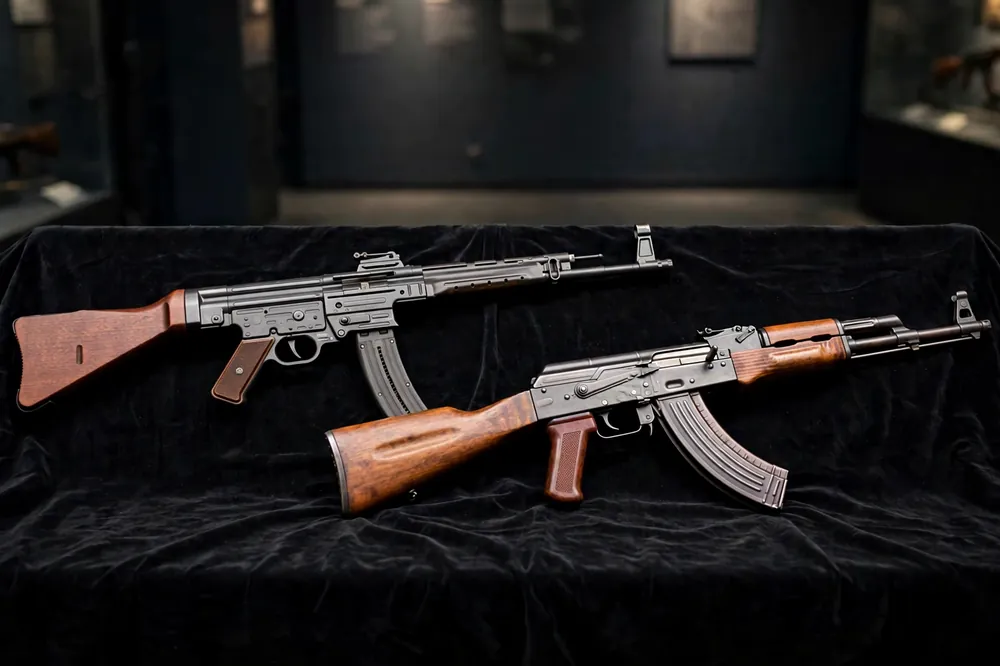
The Soviet AK-47, designed by Mikhail Kalashnikov and adopted in 1947, uses the same concept, with a 7.62×39 mm intermediate cartridge; the American M16, adopted in the 1960s, uses a 5.56×45 mm intermediate cartridge; and the German G3, the British SA80 and the French FAMAS all follow the same pattern.
The StG 44 also influenced the design of the Soviet SKS and the German StG 45(M), whose roller-delayed blowback system was used in the G3. The StG 44 is now one of the most sought-after firearms in private collections, and surviving examples are held by museums around the world, including the Imperial War Museum in London, the Bundeswehr Museum of Military History in Dresden, and the National Firearms Museum in the United States.
10. Surviving Examples
Because about 425,000 StG 44s were built, surviving examples are not rare, though original, unmodified examples in good condition are sought after by collectors. The Imperial War Museum in London holds StG 44s in its collection, as does the Bundeswehr Museum of Military History in Dresden, the National WWII Museum in New Orleans, and the National Firearms Museum in Fairfax, Virginia.
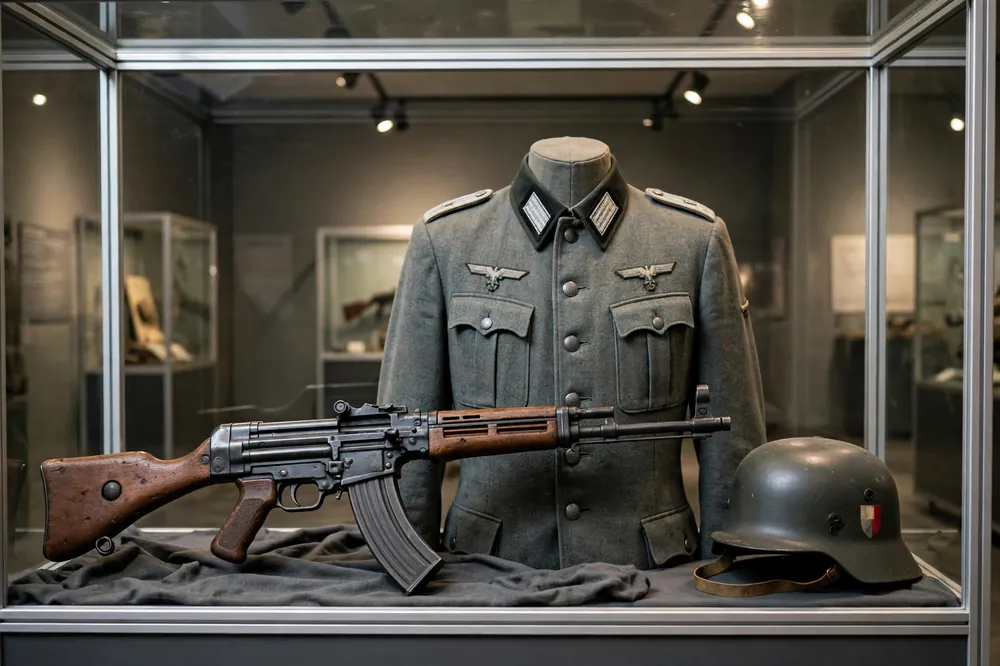
In the United States, original selective-fire StG 44s are among the most valuable transferable machine guns on the civilian collector market, and semi-automatic reproductions are manufactured for the civilian market. The weapon also appears in films and video games, where it is often shown as the archetypal German assault rifle of the Second World War.
For most visitors, the easiest way to see an StG 44 is in a museum display on the Second World War, where it is usually shown alongside the Karabiner 98k and the MP 40, as the weapon that replaced them both.
Frequently Asked Questions
What is the StG 44?
The StG 44 was the German assault rifle of the Second World War, and the first assault rifle in the world. It fired the 7.92×33 mm Kurz intermediate cartridge from a 30-round magazine.
How many StG 44s were built?
About 425,000 StG 44s (including the MP 43 and MP 44 designations) were built between 1943 and 1945.
What does “StG 44” mean?
“StG” is short for “Sturmgewehr”, German for “assault rifle”, and “44” is the year of its adoption, 1944. The name was given by Hitler himself.
What is the difference between the StG 44 and the AK-47?
The StG 44 was the first assault rifle, and the AK-47, adopted in 1947, follows the same concept — an intermediate cartridge in a selective-fire rifle — but uses a different operating system and a different cartridge, the 7.62×39 mm.
Was the StG 44 used after the Second World War?
Yes. East Germany used it until the 1960s, Yugoslavia until the 1980s, and it was used in the Middle East and Africa for decades afterwards; examples were still in use in Syria in the 2010s.
Where can I see an StG 44 today?
In the Imperial War Museum in London, the Bundeswehr Museum of Military History in Dresden, the National WWII Museum in New Orleans, and the National Firearms Museum in Fairfax, Virginia.
Related articles
Sources
- Wikipedia, “StG 44” — production of about 425,000, specifications, Hugo Schmeisser, the 7.92×33 mm Kurz cartridge.
- Ian V. Hogg, German Small Arms of World War II (Greenhill Books, 2003) — the StG 44, the MKb 42 and the intermediate cartridge.
- Gordon L. Rottman, The AK-47: Kalashnikov-series Assault Rifles (Osprey Publishing, 2011) — the StG 44’s influence on the AK-47.
- Chris McNab, German Automatic Rifles 1941–45: Gew 41, Gew 43, FG 42 and StG 44 (Osprey Publishing, 2013) — development and operational use.
- John Walter, Guns of the Third Reich (Greenhill Books, 2004) — the StG 44 and its variants.
- National WWII Museum, “The StG 44” (nationalww2museum.org) — the first assault rifle and its influence.