 WAR ATLAS MILITARY HISTORY MAGAZINE · WWI — WWII
IS-2 Tank: The Soviet Heavy Tank with the 122 mm Gun
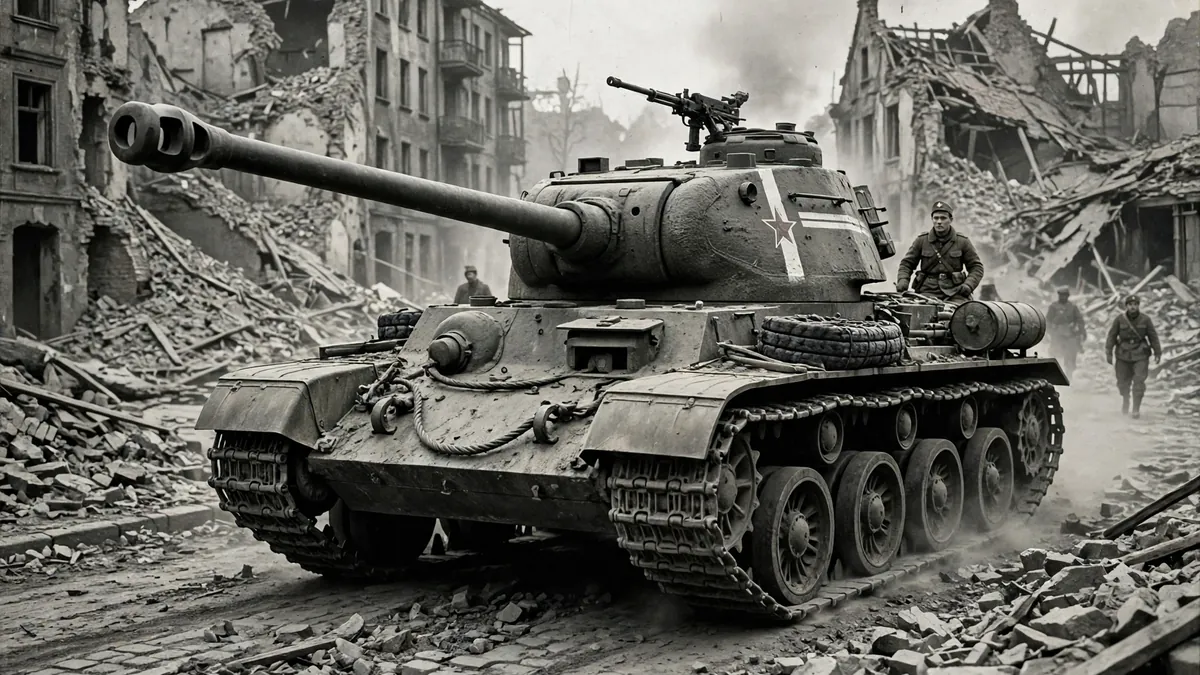
The IS-2, named for Soviet leader Joseph Stalin, was the most important Soviet heavy tank of the Second World War and the vehicle that carried the Red Army’s armoured spearheads into Germany in 1944 and 1945. Armed with a 122 mm D-25T gun, one of the most powerful tank weapons of the war, the IS-2 was designed to break through fortified German defences, destroy heavy tanks and assault guns, and support infantry in the street fighting of Eastern European cities. It entered service in late 1943 and fought in every major Soviet offensive from the Korsun-Cherkassy pocket to the Battle of Berlin, where its high-explosive shells proved devastating against buildings, bunkers and barricades. Approximately 3,854 IS-2 tanks were built between 1943 and 1945, and the type remained in Soviet and allied service for decades after the war.
The IS-2 was the successor to the KV-1, the Soviet heavy tank that had dominated the battlefield in 1941 but had become slow, unreliable and outgunned by 1943. Its designers at the Chelyabinsk Kirov Plant kept the KV’s heavy armour and powerful diesel engine but mounted a far larger gun in a new turret and redesigned the hull to save weight. The result was a tank that weighed about 46 tons, roughly the same as the KV-1, yet carried a gun that could defeat the German Tiger and Panther at combat ranges and fire a high-explosive shell weighing 25 kilograms. The 122 mm gun had a slow rate of fire and only 28 rounds of ammunition, but its effect on targets was enormous, and German troops learned to fear the distinctive crack of the IS-2’s main gun.
The IS-2 is remembered as one of the great tanks of the Second World War, a symbol of Soviet industrial power and of the Red Army’s transformation from the defeats of 1941 into the force that took Berlin. It served in the Soviet Army until the 1960s, in the armies of Poland, Czechoslovakia, China and other allies, and in combat in Korea and in the Middle East. Surviving examples stand in museums and on memorials across Eastern Europe, and the IS-2’s distinctive silhouette, with its long 122 mm gun and sloped frontal armour, remains one of the most recognisable images of the Eastern Front.
1. Key Facts
| Field | Value |
|---|---|
| Type | Heavy tank |
| Origin | Soviet Union |
| Designed | 1943 (Object 237) |
| In service | 1943-1960s (Soviet Union; later with other users) |
| Produced | Approximately 3,854 (IS-2, including IS-2M conversions) |
| Manufacturer | Chelyabinsk Kirov Plant (ChKZ) |
| Crew | 4 (commander, gunner, loader, driver) |
| Weight | Approximately 46 tons |
| Length | Approximately 9.90 m (with gun); hull about 6.77 m |
| Width | Approximately 3.07 m |
| Height | Approximately 2.73 m |
| Armour | Up to 120 mm (hull front); turret front up to 100-120 mm |
| Main armament | 122 mm D-25T gun (28 rounds) |
| Secondary armament | 12.7 mm DShK heavy machine gun, 7.62 mm DT machine guns |
| Engine | V-2-IS V-12 diesel engine, approximately 520 hp |
| Speed | Approximately 37 km/h (23 mph) maximum on roads |
| Range | Approximately 240 km (150 miles) on roads |
| Notable variants | IS-2 (1943 model), IS-2 (1944 model), IS-2M |
2. Background and Development
The Limits of the KV-1
By the middle of 1943, the Soviet Union’s heavy tank, the KV-1, had reached the end of its useful development. The KV-1 had been a shock to the Germans in 1941, when its thick armour made it almost immune to German anti-tank guns, but by 1943 it was slow, mechanically unreliable and outgunned. The German Tiger I, which appeared in late 1942, outranged it with its 88 mm gun, and the Panther, which appeared in 1943, combined thick sloped armour with a high-velocity 75 mm gun. The KV-1’s 76.2 mm gun could not reliably penetrate either of these tanks, and its weight of about 47 tons gave it a poor power-to-weight ratio. Soviet tank commanders demanded a new heavy tank, and the State Defence Committee ordered the Chelyabinsk Kirov Plant, the great tank factory in the Urals, to produce one. The result was the IS series, named for Joseph Stalin, which would replace the KV in production and in service.
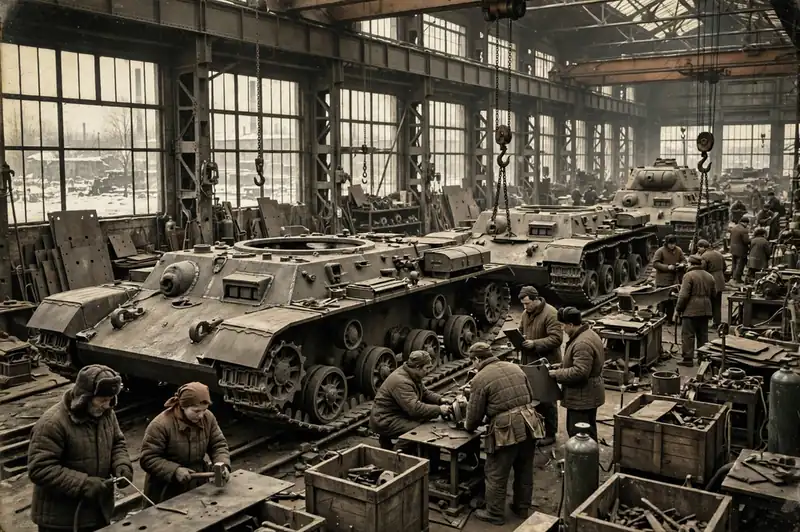
The Object 237 Programme
The IS-2 was developed from the Object 237 prototype, which was itself a development of the earlier IS-1, armed with an 85 mm gun. In the summer of 1943, Soviet engineers tested the 85 mm gun against captured Tiger tanks and found that it could penetrate the Tiger’s armour at moderate ranges, but the Red Army wanted a heavier weapon for the breakthrough role. The 122 mm A-19 field gun, a proven artillery piece, was adapted for tank use as the D-25T, and trials showed that its armour-piercing shell could penetrate the Tiger’s frontal armour at ranges of more than 1,000 metres. The decision was made in late 1943 to put the 122 mm gun in the IS tank, even though it meant a larger turret, a four-man crew with a separate loader, and a slow rate of fire. The first IS-2 tanks were delivered in December 1943, and the type entered service with the Guards heavy tank regiments that were the Red Army’s breakthrough force.
The Breakthrough Role
The IS-2 was designed for a specific role in Soviet doctrine: the breakthrough tank. It was not meant to race across open ground like a medium tank, but to support infantry and medium tanks in assaults on fortified positions, destroying strongpoints, anti-tank guns and enemy tanks at close range. Soviet Guards heavy tank regiments, equipped with 21 IS-2 tanks, were attached to armies and fronts for major offensives, and they were used to punch holes in German defences through which the mobile tank armies could pass. The IS-2’s high-explosive shell, weighing 25 kilograms, was its most important ammunition: it could demolish a building, destroy a concrete bunker or clear a barricade in a single hit. This made the IS-2 a formidable weapon in street fighting, where its armour protected it against infantry anti-tank weapons and its gun could reduce any strongpoint.
3. Design
Hull, Armour and Mobility
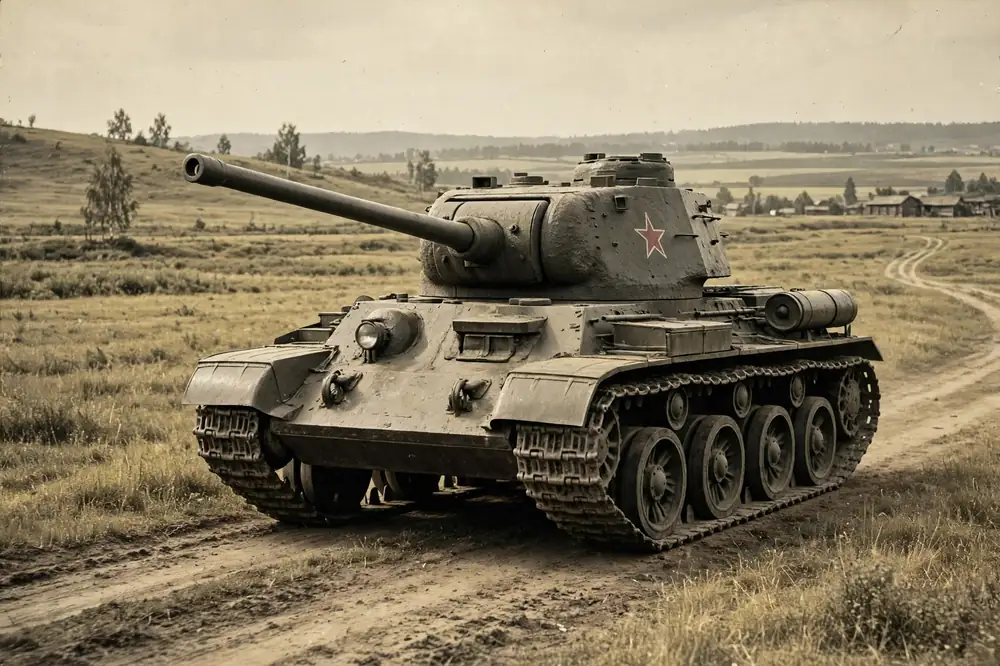
The IS-2’s hull was a development of the KV-1’s, but it was redesigned to save weight and improve protection. The frontal armour was up to 120 mm thick on the 1944 model, with a sloped glacis plate that gave good protection against the German 75 mm and 88 mm guns at normal combat ranges. The sides were protected by 90 mm of armour, and the turret front by up to 100 mm. The tank weighed about 46 tons, roughly the same as the KV-1, but its V-2-IS diesel engine produced about 520 horsepower, giving a power-to-weight ratio that was noticeably better than its predecessor’s. The top speed was about 37 kilometres per hour on roads, and the tank could cross a trench about 2.5 metres wide and climb a vertical step of about one metre. The suspension used torsion bars, an improvement over the KV-1’s, and the tank was more reliable than the KV, although its transmission and final drives still required careful maintenance.
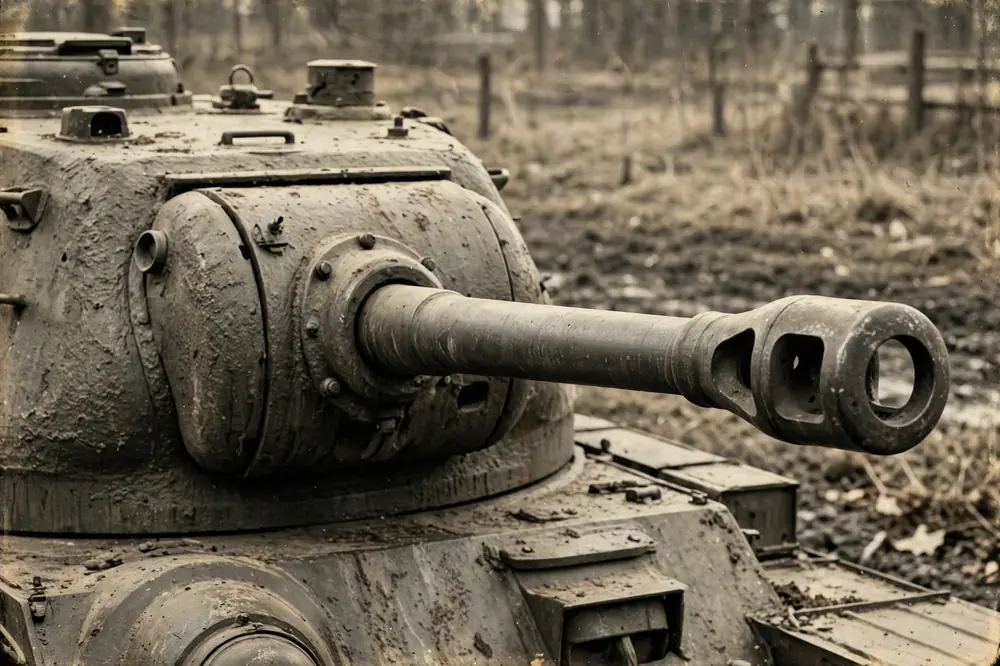
The 122 mm D-25T Gun
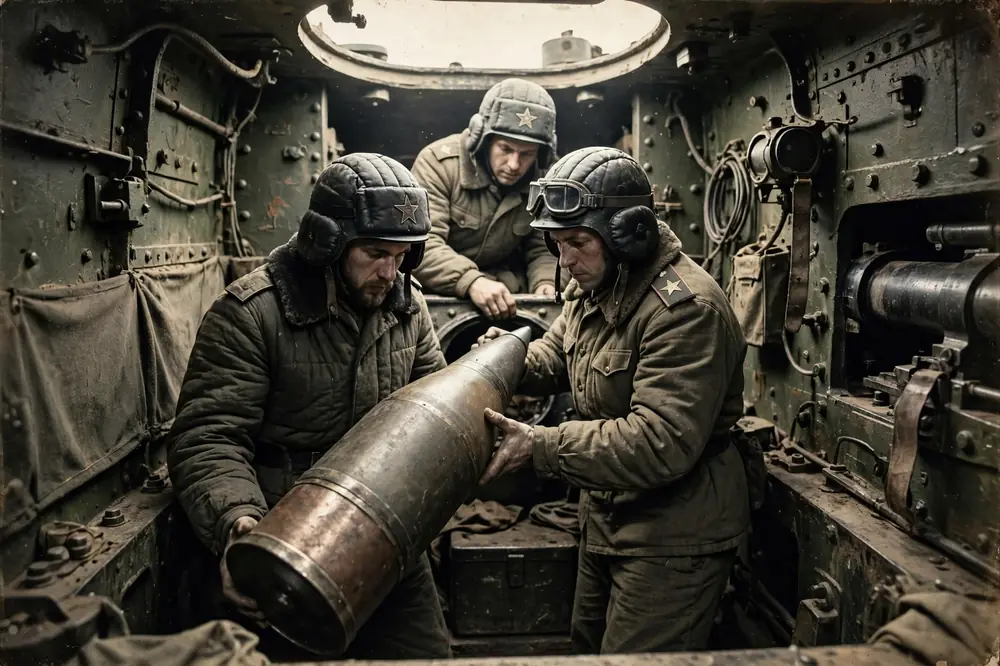
The heart of the IS-2 was its 122 mm D-25T gun, adapted from the A-19 field gun. It fired two separate rounds, a shell and a propellant charge, which had to be loaded separately by the loader, giving a rate of fire of only about two to three rounds per minute. The tank carried only 28 rounds of ammunition, a serious limitation in a prolonged engagement. But the gun’s power compensated for these weaknesses. Its armour-piercing shell could penetrate about 140 mm of armour at 1,000 metres, enough to defeat the Tiger I and the Panther, and its high-explosive shell was devastating against fortifications and buildings. The gun’s muzzle brake was large and distinctive, and its firing produced a tremendous blast and dust cloud that could obscure the tank’s vision. Soviet crews accepted the slow rate of fire because the IS-2’s role was to deliver a small number of very powerful shots, not to engage in rapid duels.
Crew, Vision and Ergonomics
The IS-2 carried a crew of four: a commander, a gunner, a loader and a driver. The commander had a cupola with vision devices, and the gunner and loader worked in the turret, which was larger than the KV-1’s but still cramped when the long 122 mm rounds were being handled. The driver’s position was in the front of the hull, and the tank had a radio for communication with other vehicles. The interior was spartan, and the loader’s job was physically exhausting, handling separate shells and charges that each weighed more than 20 kilograms. Crews praised the tank’s protection and its gun, but they complained about the low ammunition capacity and the slow rate of fire, and about the poor visibility from the driver’s position. The IS-2 was a demanding tank to fight, but its crews had confidence in it, and the heavy tank regiments were regarded as elite formations within the Red Army.
4. Variants
The 1943 and 1944 Models
The IS-2 was built in two main production models, the 1943 model and the 1944 model, and the differences between them were significant. The 1943 model had a stepped frontal hull plate, inherited from the KV, with a driver’s hatch in the upper plate, and it was armed with the D-25T gun with a German-style muzzle brake. The 1944 model, which entered production in mid-1944, had a simplified, single sloped glacis plate that was thicker and better angled, and it was the most numerous version of the tank. The 1944 model also had a redesigned mantlet and an improved gun, and later production vehicles received a 12.7 mm DShK anti-aircraft machine gun on the turret roof. The 1944 model was the version that fought in the battles for Poland and Germany, and it is the version most often seen in museums and memorials today.
The IS-2M Modernisation
After the war, many IS-2 tanks were modernised to the IS-2M standard in the 1950s. The IS-2M received a new engine, improved fire control equipment, a new radio, additional fuel tanks and a revised ammunition stowage that increased the number of rounds carried. The modernisation also included night-driving equipment and improved vision devices. The IS-2M remained in Soviet service into the 1960s, mainly with reserve and training units, and it was exported to several allied countries. The IS-2M is recognisable by its additional fuel tanks on the rear hull and by its revised stowage, and most of the IS-2 tanks preserved in museums today are IS-2M vehicles rather than wartime production tanks.
Experimental and Related Designs
The IS-2 was the basis for several experimental designs, including the IS-3, which used a new hull and turret and entered service just as the war in Europe ended, and the ISU-122 and ISU-152 self-propelled guns, which used the IS chassis with a fixed casemate mounting a 122 mm or 152 mm gun. The ISU-152, nicknamed the Beast Killer by Soviet troops, became one of the most famous Soviet assault guns of the war. The IS-2’s chassis and engine were also used for post-war heavy tank designs, and the IS series continued with the IS-3, IS-4 and the T-10, which served in the Soviet Army into the 1970s. The IS-2 thus stands at the head of a family of Soviet heavy tanks that dominated the Red Army’s armoured forces for a generation.
5. Operational History
First Combat: Korsun and the Ukraine
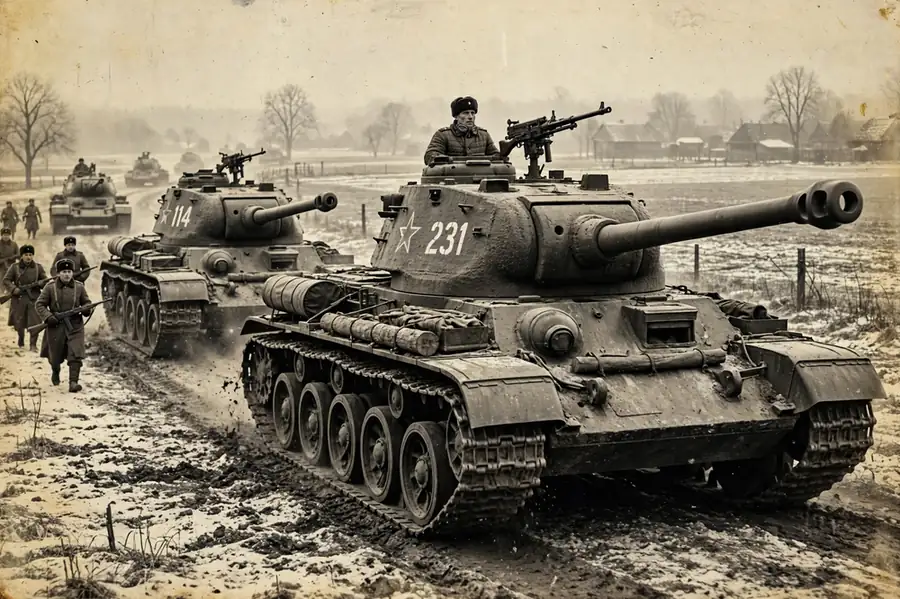
The IS-2 entered combat in February 1944, during the Korsun-Cherkassy operation in the Ukraine, when the first Guards heavy tank regiments equipped with the new tank were committed against German forces trapped in the Korsun pocket. The IS-2s performed well, destroying German tanks and assault guns and supporting infantry in the fighting around the pocket. Soviet reports praised the 122 mm gun’s power and the tank’s armour, although they noted the slow rate of fire and the low ammunition capacity. The IS-2’s first battles confirmed the design’s value in the breakthrough role, and the type was soon in demand across the front. By the summer of 1944, IS-2 regiments were attached to the armies that took part in Operation Bagration, the great Soviet offensive that destroyed Army Group Centre in Belorussia.
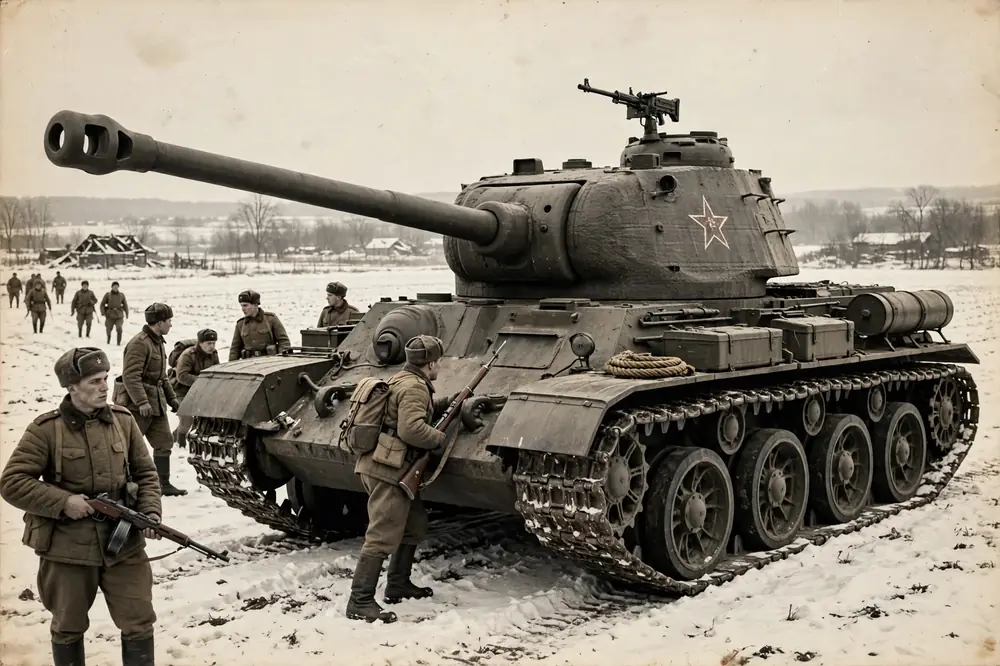
Poland, the Vistula and the Drive on Berlin
In 1944 and 1945, the IS-2 fought in the great offensives that carried the Red Army across Poland and into Germany. During Operation Bagration, IS-2 regiments supported the infantry armies that broke through the German defences in Belorussia and advanced to the Vistula. In January 1945, the Vistula-Oder operation saw IS-2 tanks leading the assaults on German fortified lines in Poland, where their high-explosive shells demolished bunkers and strongpoints. The IS-2s fought in the battles for Poznan and in the advance to the Oder, and in April 1945 they took part in the Battle of Berlin. In the street fighting of the German capital, the IS-2’s 122 mm gun proved ideal for reducing buildings held by German troops, and its armour protected it against the Panzerfaust and other infantry weapons at close range, although many IS-2s were lost to these weapons in the final weeks of the war.
The Far East and Post-War Service
After the defeat of Germany, IS-2 tanks were sent to the Far East for the Soviet offensive against Japan in August 1945, where they took part in the invasion of Manchuria and the fighting in northern China. The IS-2’s last wartime campaign was against the Japanese Kwantung Army, and it performed well in the rapid advance across Manchuria. After the war, the IS-2 remained in Soviet service and was supplied to the armies of Poland, Czechoslovakia, East Germany, China and other allies. Chinese IS-2 tanks fought in the Korean War, and Egyptian and Syrian IS-2 tanks were used in the Arab-Israeli wars, where they were already obsolete. The IS-2 was finally withdrawn from front-line service in the 1960s, but it remained in reserve and training units into the 1970s.
Berlin: The 122 mm Gun in Street Fighting
The Battle of Berlin was the IS-2’s most famous campaign, and it demonstrated both the strengths and the weaknesses of the design. In the street fighting, the IS-2’s high-explosive shell could demolish a building floor by floor, and Soviet assault groups used the tanks to blast their way through the city. But the close-range fighting also exposed the IS-2 to German Panzerfaust teams, who attacked from upper floors and cellars, and the tank’s slow rate of fire made it vulnerable when it was engaged by several targets at once. Soviet tactics adapted: IS-2s advanced with infantry screens and with medium tanks providing rapid fire, and the combination proved effective. By the time the Reichstag fell, the IS-2 had become a symbol of the Soviet victory, and photographs of IS-2 tanks in the ruins of Berlin are among the most famous images of the war.
6. Performance and Specifications
Strengths on the Battlefield
The IS-2’s greatest strength was the sheer power of its 122 mm gun. No other Allied tank gun of the war could match its high-explosive effect, and its armour-piercing performance was enough to defeat the Tiger and Panther at normal combat ranges. The tank’s armour was thick and well sloped on the 1944 model, and its diesel engine gave it a good range and a lower risk of fire than the petrol engines used in many German and American tanks. The IS-2 was also more reliable than the KV-1, and its production was efficient: the Chelyabinsk plant built more than 3,800 IS-2s in less than two years, a remarkable achievement for a heavy tank. In the breakthrough role, the IS-2 was the best heavy tank in Soviet service, and it was the only Soviet tank that could engage the Tiger and Panther with confidence.
Weaknesses and Trade-offs
The weaknesses were equally clear. The rate of fire of two to three rounds per minute was slow, and the ammunition capacity of 28 rounds was low, which meant that the IS-2 could not sustain a prolonged engagement without resupply. The two-part ammunition was heavy and awkward to handle, and the loader’s work was exhausting. The tank’s optics and fire control were inferior to German equipment, and its accuracy at long range was limited. The IS-2’s armour, while thick, was not proof against the German 88 mm gun at close range, and the tank’s side armour was vulnerable to German anti-tank guns and to the Panzerfaust in street fighting. The IS-2 was also expensive in fuel and maintenance, and its weight limited the bridges it could cross. Nevertheless, the IS-2’s overall record was impressive, and it was the most successful Soviet heavy tank of the war.
How the IS-2 Compared with Rivals
Compared with the German Tiger I, the IS-2 had a more powerful gun in high-explosive terms and thicker frontal armour on the 1944 model, but it had a much slower rate of fire and inferior optics. Compared with the Tiger II, the IS-2 was outclassed in armour and gun performance, but it was far more numerous and more reliable. Compared with the American M26 Pershing, which appeared late in the war, the IS-2 had a larger gun but a slower rate of fire and a less refined fire control system. Compared with the British Churchill, the IS-2 was faster, better armed and better protected. The IS-2’s combination of a very large gun, good armour and reasonable mobility made it one of the most effective heavy tanks of the war, and it was the only Allied tank that could match the German heavy tanks in a direct engagement.
7. Operators
The Soviet Union
The principal operator of the IS-2 was the Red Army, which used it in the Guards heavy tank regiments that were attached to armies and fronts for major offensives. Each regiment had 21 IS-2 tanks, organised in four companies of five tanks plus a regimental command tank. The regiments were elite formations, and their crews were among the best trained in the Red Army. The IS-2 also equipped the heavy tank brigades that were formed late in the war, and it served in the Soviet Army after the war, mainly with reserve and training units. The IS-2’s Soviet service lasted into the 1960s, and the type was finally withdrawn when the T-10 and the T-55 had fully replaced it in front-line service.
Export Users and Allies
The IS-2 was exported to several Soviet allies, including Poland, Czechoslovakia, East Germany, China, North Korea, Egypt, Syria and Cuba. Poland received IS-2 tanks during the war and used them in the fighting for Berlin, and Polish IS-2s remained in service into the 1960s. China received IS-2 tanks in the 1950s and used them in the Korean War and in the fighting on the Sino-Soviet border. Egypt and Syria used IS-2 tanks in the Arab-Israeli wars of 1967 and 1973, where they were already obsolete and suffered heavy losses against Israeli tanks. North Korea used IS-2 tanks in the Korean War, and Cuba received IS-2 tanks in the 1960s. The IS-2’s export service shows how long the design remained in use, and how widely Soviet heavy tank doctrine was spread to allied armies.
8. Legacy and Influence
The Peak of the Soviet Heavy Tank
The IS-2 was the most successful Soviet heavy tank of the war, and it set the pattern for the heavy tanks that followed. The IS-3, which entered service in 1945, used a new hull and turret but kept the 122 mm gun, and the IS-4 and T-10 continued the line into the 1960s. The IS-2’s 122 mm gun became the standard heavy tank weapon in Soviet service, and it remained in use on the T-10 into the 1970s. The IS-2 also influenced the design of Soviet self-propelled guns, notably the ISU-122 and ISU-152, which used the IS chassis and became famous in their own right. The IS-2’s legacy is thus not only its own combat record, but the family of heavy tanks and assault guns that it founded.
Cultural Memory and Historical Assessment
The IS-2 is one of the most famous tanks of the Second World War, and its image is closely associated with the Soviet victory in Europe. It appears in countless photographs, films and memorials, and it is a symbol of the Red Army’s power in the final year of the war. Historians have assessed the IS-2 as a successful design, well suited to its breakthrough role, although they note its slow rate of fire and low ammunition capacity. The IS-2’s reputation has been enhanced by its service in Berlin, where its 122 mm gun became a legend, and by its long post-war career. The tank is remembered as a symbol of Soviet industrial might and of the Red Army’s transformation into the force that defeated Germany.
The IS-2 in Popular Culture
The IS-2 appears in many films, books and video games about the Eastern Front, and it is a popular subject for model makers and military historians. Its distinctive long gun and sloped armour make it instantly recognisable, and it is often used as a symbol of the Soviet war effort. The IS-2’s appearance in the victory parade in Berlin in 1945, and in the post-war parades in Moscow, cemented its place in Soviet military culture. Today, the IS-2 is one of the most popular tanks in military museums, and its image is used in exhibitions about the Second World War across Eastern Europe and Russia.
9. Surviving Examples
Museums in Russia and Eastern Europe
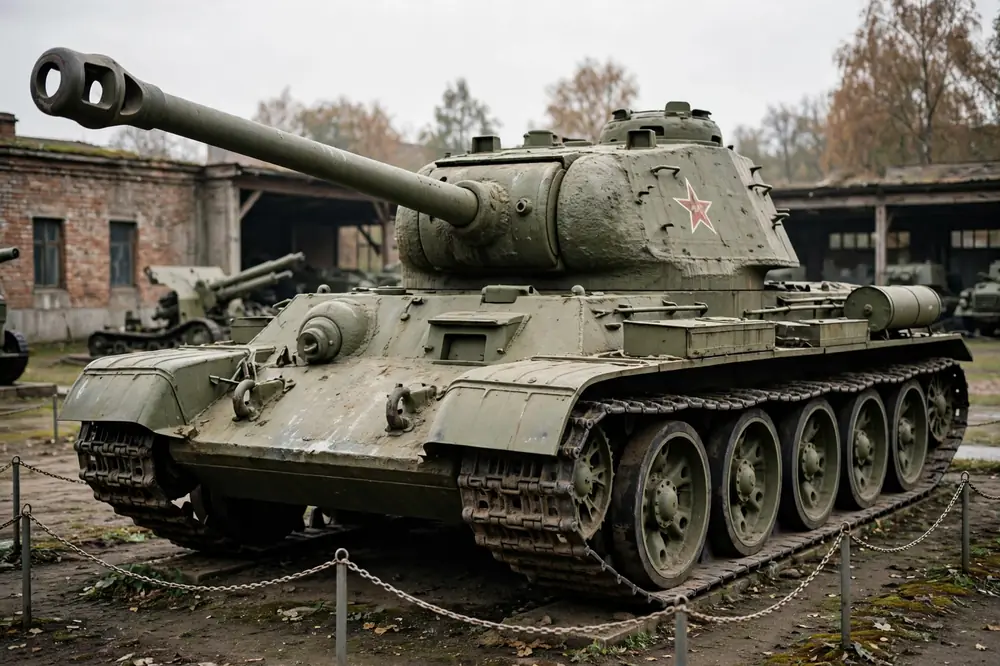
Many IS-2 tanks survive in museums and on memorials across Russia and Eastern Europe. The Central Armed Forces Museum in Moscow holds an IS-2, and the Kubinka Tank Museum, now part of the Patriot Park complex, displays several IS-2 tanks, including wartime production vehicles. The Museum of the Great Patriotic War in Moscow also holds an IS-2, and the tank appears on memorials in many Russian cities. In Belarus, the Museum of the Great Patriotic War in Minsk displays an IS-2, and in Ukraine, the National Museum of the History of Ukraine in the Second World War in Kyiv holds examples. The large number of surviving IS-2 tanks reflects the type’s production run and its long service, and it ensures that the tank remains visible to the public.
Survivors Abroad and Running Examples
Other surviving IS-2 tanks include examples in the Polish Army Museum in Warsaw, the Military History Museum in Prague, the National Military Museum in Bucharest, and the Tank Museum in Bovington in Britain. Several IS-2 tanks are preserved in China, including examples in the Military Museum of the Chinese People’s Revolution in Beijing. A small number of IS-2 tanks are maintained in running condition by museums and private collectors, and they appear at military vehicle shows and commemorative events. The running examples are particularly valuable, because they demonstrate the IS-2’s distinctive engine note and its slow, deliberate movement, which no photograph can convey, and which helps visitors understand why the tank’s crews described it as a weapon that delivered a small number of very powerful blows.
Frequently Asked Questions
Was the IS-2 a good tank?
The IS-2 was a very good heavy tank for its intended breakthrough role. Its 122 mm gun was one of the most powerful tank weapons of the war, and its armour was thick enough to resist most German anti-tank guns at combat ranges. Its weaknesses were a slow rate of fire and a low ammunition capacity, but in the breakthrough role, where it delivered a small number of powerful shots against fortifications and enemy tanks, it was highly effective.
How many IS-2 tanks were built?
Approximately 3,854 IS-2 tanks were built between 1943 and 1945, all at the Chelyabinsk Kirov Plant in the Urals. This was a large production run for a heavy tank, and it reflected the importance that the Soviet Union attached to the breakthrough role in the final offensives of the war.
Could the IS-2 defeat a Tiger tank?
Yes. The IS-2’s 122 mm gun could penetrate the Tiger I’s frontal armour at ranges of more than 1,000 metres, and its high-explosive shell was devastating against any target. The Tiger had better optics and a faster rate of fire, but the IS-2’s gun was more powerful, and in a direct engagement the IS-2 had a good chance of destroying a Tiger before the Tiger could destroy it.
Why did the IS-2 have such a slow rate of fire?
The IS-2’s 122 mm gun fired two-part ammunition, a separate shell and propellant charge, each weighing more than 20 kilograms. The loader had to handle both parts for every shot, which limited the rate of fire to about two to three rounds per minute. The tank also carried only 28 rounds, which meant that it could not sustain a prolonged engagement without resupply.
Did the IS-2 fight in the Battle of Berlin?
Yes. IS-2 tanks took part in the Battle of Berlin in April and May 1945, where their 122 mm guns were used to demolish buildings held by German troops. The IS-2’s high-explosive shell could reduce a building floor by floor, and the tank’s armour protected it against infantry weapons at close range, although many IS-2s were lost to Panzerfaust teams in the street fighting.
How long did the IS-2 remain in service?
The IS-2 remained in Soviet service into the 1960s, mainly with reserve and training units, and it was exported to allied countries where it served even longer. Chinese, Egyptian and Syrian IS-2 tanks fought in the Korean War and in the Arab-Israeli wars, and the type was finally withdrawn from service in the 1970s in some countries.
Sources
- Steven J. Zaloga, IS-2 Heavy Tank 1944-73 (Osprey Publishing, New Vanguard series).
- Mikhail Baryatinskiy, The IS Tanks: IS-1, IS-2, IS-3 (Russian Armour series).
- Steven J. Zaloga and Jim Kinnear, T-34-85 vs Tiger (Osprey Publishing, Duel series).
- David Glantz and Jonathan House, When Titans Clashed (University Press of Kansas).
- The Central Armed Forces Museum, Moscow, IS-2 collection records.
- Chamberlain, Peter, and Ellis, Chris, British and American Tanks of World War II (Arms and Armour Press).