 WAR ATLAS MILITARY HISTORY MAGAZINE · WWI — WWII
KV-1 Tank: The Soviet Heavy Tank That Shocked Germany in 1941
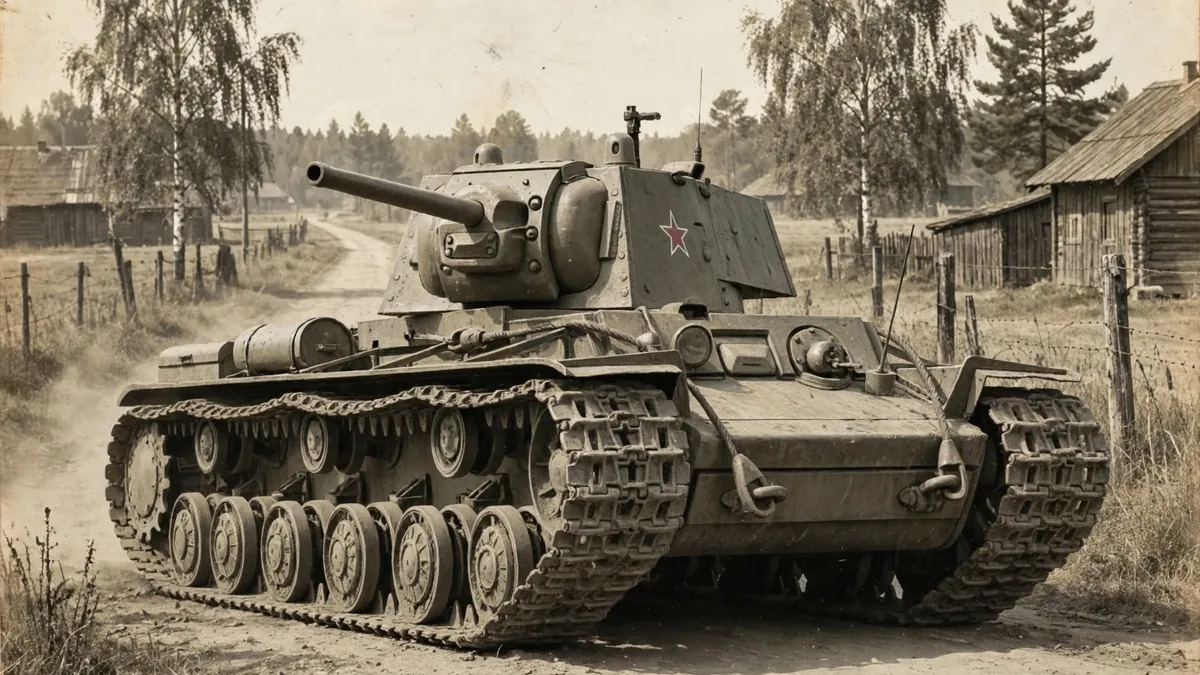
The KV-1, named for Soviet defence commissar Kliment Voroshilov, was the Soviet Union’s main heavy tank at the start of the Second World War and the vehicle that gave the German Army one of its greatest shocks in the summer of 1941. With armour up to 110 mm thick and a 76.2 mm gun, the KV-1 was almost immune to German anti-tank guns and tank guns in 1941, and single KV-1 tanks held up entire German columns, most famously at Raseiniai in Lithuania, where one KV-1 blocked the advance of the 6th Panzer Division for a day. Approximately 5,219 KV-1 tanks were built between 1939 and 1943, and the type served on the Eastern Front from the first day of the German invasion to the Battle of Kursk, when it was replaced by the IS-2. The KV-1 is remembered as a symbol of Soviet industrial power and of the Red Army’s resistance in the darkest months of the war.
The KV-1 was developed in the late 1930s, when the Soviet Union, like other European powers, was searching for a heavy tank that could break through fortified defences. The KV-1’s design, by Zhosef Kotin at the Kirov Plant in Leningrad, used a thickly armoured hull, a powerful diesel engine, and a 76.2 mm gun mounted in a cast turret. The KV-1 entered service in 1939, and it first saw combat in the Winter War against Finland, where its armour proved effective against Finnish anti-tank guns. By June 1941, when Germany invaded the Soviet Union, about 500 KV-1s were in service, and they were distributed among the mechanised corps that were the Red Army’s armoured reserve. The KV-1’s thick armour made it a formidable opponent in 1941, although its slow speed, its mechanical unreliability and its weak gun soon became apparent.
The KV-1 is remembered as one of the most important Soviet tanks of the war, a vehicle that showed the Germans that Soviet tank design was more advanced than they had expected, and that forced them to develop more powerful anti-tank guns and tanks. It appears in museums in Russia, Finland and Britain, and it is a popular subject for military historians and model makers. The KV-1’s distinctive silhouette, with its long hull and its cast turret, remains one of the most recognisable images of the Eastern Front in 1941.
1. Key Facts
| Field | Value |
|---|---|
| Type | Heavy tank |
| Origin | Soviet Union |
| Designed | 1938-1939 (Zhosef Kotin; Kirov Plant, Leningrad) |
| In service | 1939-1943 (Red Army; later with other users) |
| Produced | Approximately 5,219 (all KV-1 variants) |
| Manufacturers | Kirov Plant, Leningrad; Chelyabinsk Kirov Plant (ChKZ) |
| Crew | 5 (commander, gunner, loader, driver, hull gunner) |
| Weight | Approximately 45-47 tons |
| Length | Approximately 6.75 m (hull); 7.30 m with gun |
| Width | Approximately 3.32 m |
| Height | Approximately 2.71 m |
| Armour | Up to 110 mm (hull front); turret front up to 110 mm |
| Main armament | 76.2 mm F-32 or ZiS-5 gun (114 rounds) |
| Secondary armament | 7.62 mm DT machine guns (2-3) |
| Engine | V-2K V-12 diesel engine, approximately 500 hp |
| Speed | Approximately 35 km/h (22 mph) maximum on roads |
| Range | Approximately 250 km (155 miles) on roads |
| Notable variants | KV-1 (1939 model), KV-1 (1940 model), KV-1S, KV-1E (with applique armour), KV-8 flamethrower |
2. Background and Development
The Soviet Heavy Tank Programme
The origins of the KV-1 lay in the Soviet Union’s heavy tank programme of the 1930s, when the Red Army, like other European armies, was searching for a tank that could break through fortified defences. The Soviet Union had built the T-35, a huge, multi-turreted heavy tank, but it was slow, unreliable and difficult to maintain, and the Red Army wanted a simpler, more practical heavy tank. In 1938, the Kirov Plant in Leningrad was ordered to design a new heavy tank, and the project was entrusted to Zhosef Kotin, the chief designer of Soviet heavy tanks. The result was the KV-1, a tank with a single turret, thick armour, and a 76.2 mm gun, which was a significant advance over the T-35. The KV-1 was named for Kliment Voroshilov, the Soviet defence commissar, and it entered service in 1939.
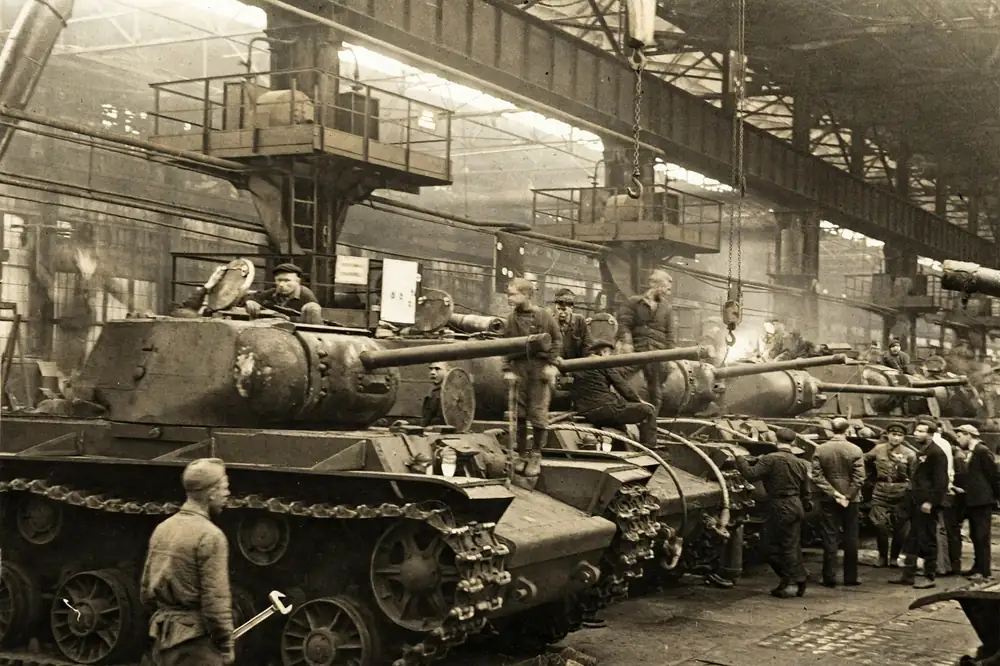
Zhosef Kotin and the Kirov Plant
The KV-1 was developed by the design bureau of the Kirov Plant, under the direction of Zhosef Kotin, who had designed the T-35 and who was one of the Soviet Union’s most experienced tank designers. The KV-1’s design used a welded hull, with armour up to 75 mm thick on the early models and up to 110 mm on later models, and a cast turret, which was easier to manufacture than a welded turret. The KV-1 was powered by the V-2K diesel engine, which produced about 500 horsepower, and it used a torsion bar suspension, which was an improvement over the T-35’s. The first prototype was built in 1939, and it was tested at the Kubinka proving ground, where its armour and its gun were praised. The KV-1 was accepted for service in late 1939, and production began at the Kirov Plant.
The Winter War and the First Combat
The KV-1’s first combat came in the Winter War of 1939-1940, when the Soviet Union invaded Finland and KV-1s were used in the fighting on the Karelian Isthmus. In Finland the KV-1’s thick armour shrugged off Finnish anti-tank fire, and the tank did well in the assaults on the Mannerheim Line. The Winter War was a valuable test for the KV-1, and it showed that the tank’s armour and gun were adequate for the breakthrough role. The KV-1’s service in Finland was its first major campaign, and it established the tank’s reputation as a heavily armoured breakthrough vehicle. By June 1941, when Germany invaded the Soviet Union, about 500 KV-1s were in service, and they were the Red Army’s most powerful tanks.
3. Design
Hull, Armour and Mobility
The KV-1’s hull was a welded structure, with armour up to 110 mm thick on the front of later models, and 75 mm on the sides. The turret was a casting, with up to 110 mm of armour on its front, and it housed the 76.2 mm gun and two of the tank’s five crew members. The KV-1 weighed about 45 to 47 tons, and its V-2K diesel engine produced about 500 horsepower, giving a top speed of about 35 kilometres per hour on roads. The KV-1’s suspension used torsion bars, and its ground pressure was high, which made it prone to bogging down in soft ground. The KV-1’s mobility was its greatest weakness: it was slow, it consumed fuel rapidly, and its transmission was prone to failure under the tank’s weight. The KV-1’s reliability was poor in 1941, and many KV-1s broke down or ran out of fuel and were abandoned by their crews.
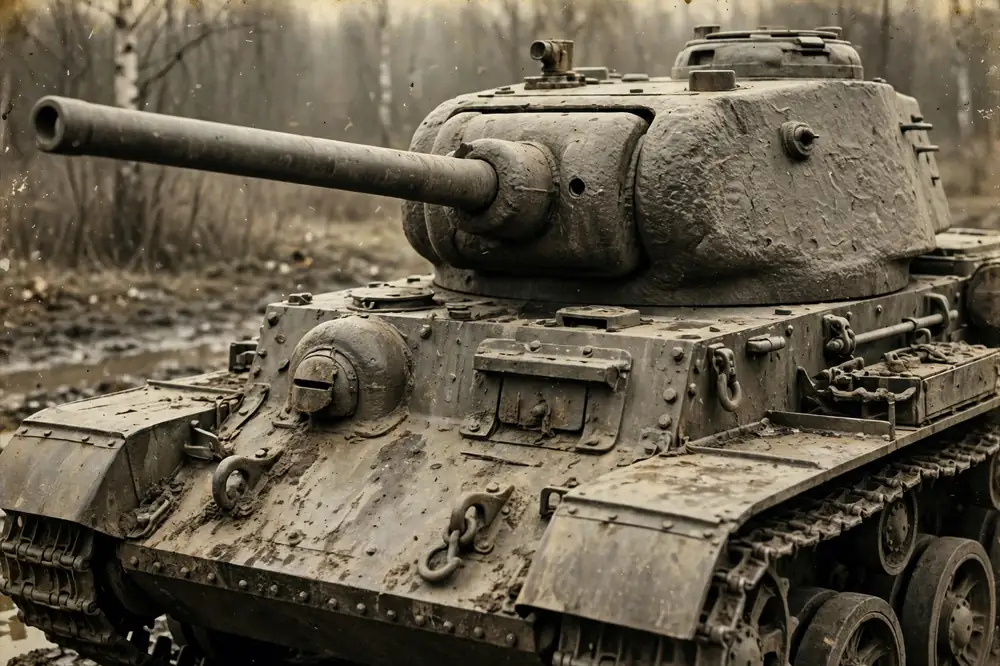
The 76.2 mm Gun
The KV-1’s main armament was its 76.2 mm gun, initially the L-11 and later the F-32 and ZiS-5, which fired an armour-piercing shell that could penetrate about 70 mm of armour at 500 metres, and a high-explosive shell that was effective against infantry and soft targets. The KV-1 carried 114 rounds of ammunition, and its rate of fire was about six rounds per minute. The 76.2 mm gun was adequate against German tanks in 1941, when the Panzer III and Panzer IV had thin armour, but it could not penetrate the Tiger’s frontal armour, and it was soon outclassed by the German 75 mm and 88 mm guns. The KV-1’s gun was its most important limitation, and it was one of the reasons why the tank was replaced by the IS-2, with its 122 mm gun, in 1943.
Crew, Vision and Ergonomics
The KV-1 carried a crew of five: a commander, a gunner, a loader, a driver and a hull gunner. The commander and gunner worked in the turret, which was cramped, and the driver and hull gunner sat in the front of the hull. The KV-1’s interior was spartan, and its ventilation was poor. The tank’s optics were inferior to German equipment, and its visibility from the driver’s position was limited. The KV-1’s crews praised its armour and its gun, but they complained about its slow speed, its unreliability, and its poor visibility. The KV-1 was a demanding tank to fight, but its crews had confidence in its armour, and the heavy tank regiments that operated it were regarded as elite formations.
4. Variants
The KV-1 (1939 and 1940 Models)
The KV-1 was built in several models, and the differences between them were mainly in the gun, the turret and the armour. The 1939 model had the L-11 gun and a welded turret, while the 1940 model had the F-32 gun and a cast turret. The 1941 model had the ZiS-5 gun and thicker armour, with up to 110 mm on the hull front. Each model reflected the lessons of the previous one, and the steady improvement in armament and protection mirrored the changing demands of the battlefield. The KV-1’s production run of about 5,219 vehicles was shared between the Kirov Plant in Leningrad and the Chelyabinsk Kirov Plant, to which production was moved after the German invasion.
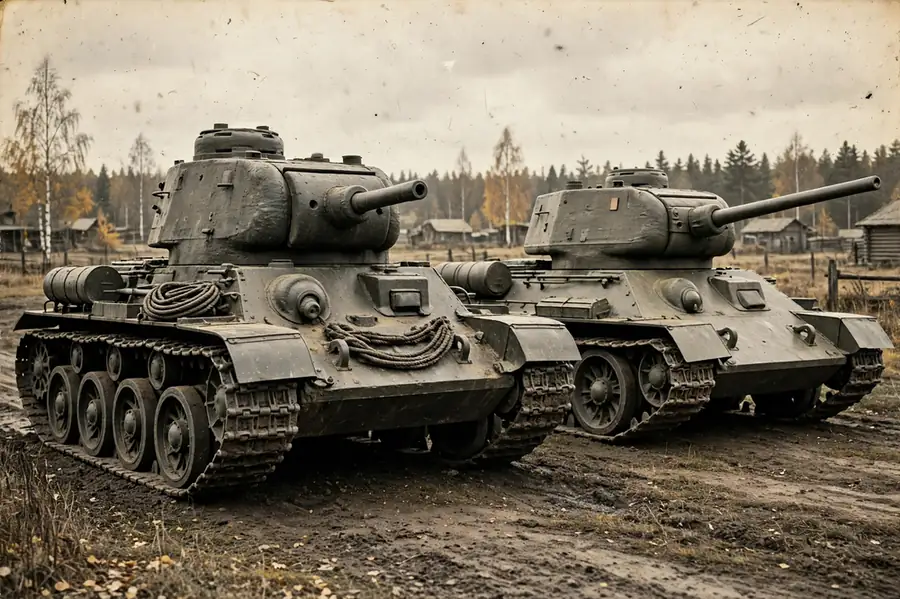
The KV-1S and the KV-1E
The KV-1S was a lighter, faster version of the KV-1, introduced in 1942, with thinner armour and a new turret, which gave it a top speed of about 43 kilometres per hour. The KV-1S was an attempt to address the KV-1’s slow speed and poor mobility, but it sacrificed the armour that had been the KV-1’s greatest strength, and it was not a success. The KV-1E was a version with applique armour, fitted to early KV-1s to increase their protection, and it was used in the fighting around Leningrad. The KV-1’s variants show how the Soviet tank industry tried to improve the design, and how the KV-1’s limitations led to its replacement by the IS-2.
The KV-8 Flamethrower
The KV-8 was a flamethrower variant of the KV-1, with a flame projector replacing the hull machine gun and a fuel tank in the hull. The KV-8 was used in the fighting around Leningrad and in the battles of 1942 and 1943, where its flame was used to clear bunkers and fortified positions. The KV-8’s flame had a range of about 60 metres, and it was feared by German defenders. The KV-8 was one of several specialised variants of the KV-1, and it shows how the tank’s hull could be adapted for different roles. The KV-8’s service was limited, but it was a significant part of the KV-1’s history.
5. Operational History
The Winter War and the First Deployments
The KV-1’s first combat came in the Winter War, when it was used in the fighting on the Karelian Isthmus. In that first campaign the KV-1’s armour held up well against Finnish anti-tank guns, and the tank proved itself in the assaults on the Mannerheim Line. After the Winter War, the KV-1 was issued to the mechanised corps of the western military districts, and by June 1941, about 500 KV-1s were in service. The KV-1’s first combat against Germany came in the chaotic fighting of the summer of 1941, when Soviet tank units were thrown into battle against the German panzer divisions.
Raseiniai and the Summer of 1941
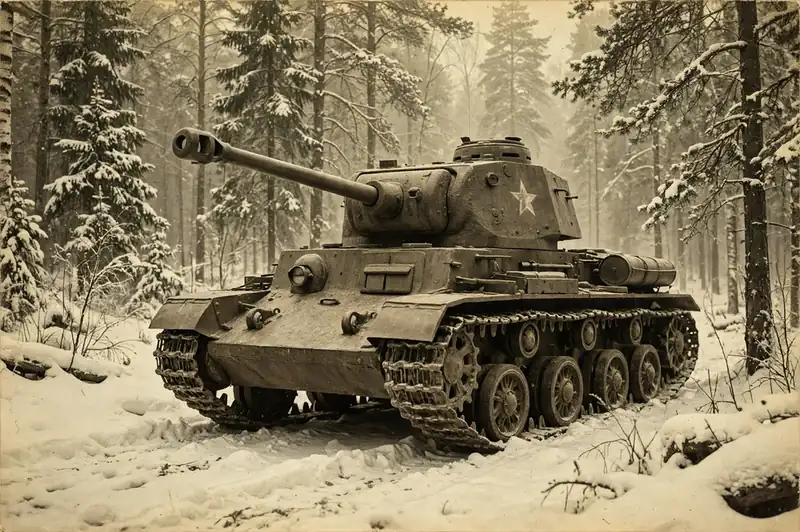
The most famous action of the KV-1, and one of the most famous tank actions of the war, took place at Raseiniai in Lithuania on 24 June 1941, when a single KV-1, supported by a KV-2, blocked the road used by the German 6th Panzer Division and held up the division for a full day. German anti-tank guns could not penetrate the KV-1’s armour, and the tank destroyed several German guns and vehicles before it was finally disabled. The German account of the action, written by officers of the 6th Panzer Division, describes the KV-1 as a monster that could not be stopped, and the story has become a legend in the history of armoured warfare. The KV-1’s action at Raseiniai, like the KV-2’s, showed the Germans that Soviet tank design was more advanced than they had expected.
Leningrad, Moscow and Kursk
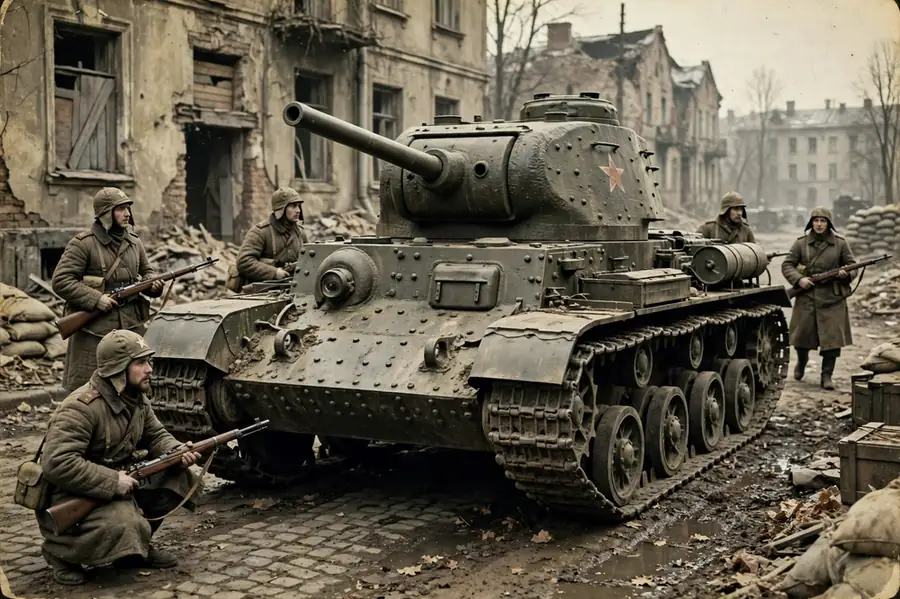
After Raseiniai, the KV-1 fought in the battles of the summer of 1941, in the defence of Leningrad, and in the Battle of Moscow in the winter of 1941-1942. The KV-1’s thick armour made it difficult for the Germans to destroy, but its mechanical unreliability and its slow speed meant that many KV-1s broke down or ran out of fuel and were abandoned. The KV-1 also fought at Stalingrad in 1942 and at Kursk in 1943, where it was used in the heavy tank regiments that supported the infantry armies. By Kursk, the KV-1 was already obsolete, and it was replaced by the IS-2 in late 1943. The KV-1’s combat career lasted from 1939 to 1943, and it fought in every major battle on the Eastern Front in that period.
The German Encounter
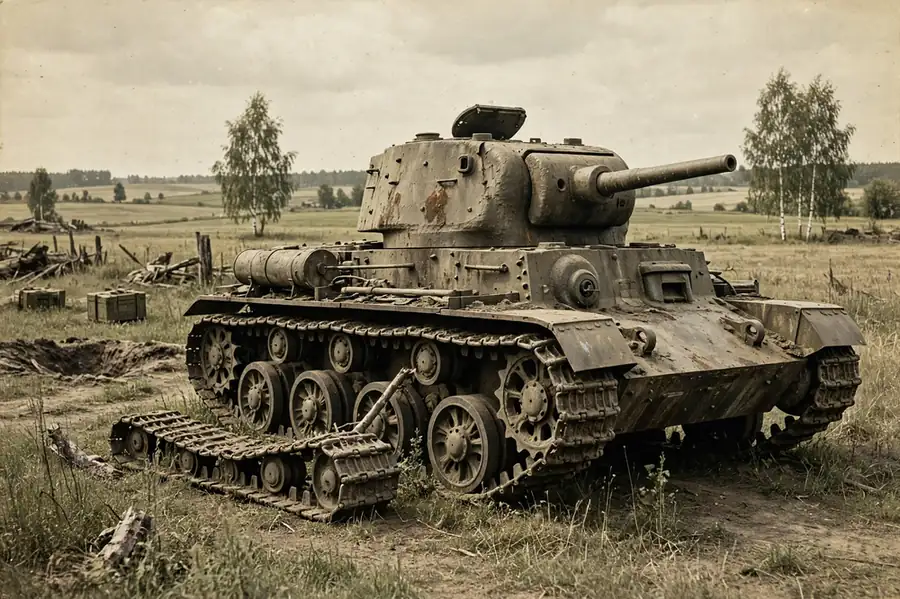
The German encounter with the KV-1 in 1941 was a shock. German anti-tank guns, which had been effective against Soviet light and medium tanks, could not penetrate the KV-1’s armour, and German tank crews found that their 37 mm and 50 mm guns were useless against it. The Germans were forced to bring up 88 mm anti-aircraft guns to deal with the KV-1, and the experience accelerated the development of more powerful German anti-tank guns and tanks. The KV-1, like the T-34, showed the Germans that Soviet tank design was more advanced than they had expected, and it contributed to the German decision to develop the Tiger and Panther. The KV-1’s legacy in German tank design is thus indirect but real.
6. Performance and Specifications
Strengths on the Battlefield
The KV-1’s greatest strength was its armour. In 1941, no German anti-tank gun in service could penetrate its 75 to 110 mm frontal armour at normal combat ranges, and the tank could advance under fire that would have destroyed any other Soviet tank. Its 76.2 mm gun was adequate against German tanks in 1941, and its diesel engine gave it a good range and a lower risk of fire than petrol-engined tanks. The KV-1’s psychological impact was also significant: German troops who encountered it were intimidated by its size and its armour, and Soviet troops were encouraged by its presence. In the breakthrough role, the KV-1 was a formidable weapon, and its performance at Raseiniai showed what a single heavy tank could do when it was well handled.
Weaknesses and Trade-offs
The weaknesses were severe. The KV-1’s top speed of about 35 kilometres per hour was slow, and its cross-country speed was lower still. Its fuel consumption was high, and its range was limited. The transmission was prone to failure under the tank’s weight, and the tank’s ground pressure was high, which made it prone to bogging down. The 76.2 mm gun could not penetrate the Tiger’s armour, and the tank’s optics were inferior to German equipment. The KV-1 was a specialised weapon with serious limitations, and its designers accepted those limitations because they believed that the tank’s armour was worth the cost. The KV-1’s performance must be judged against its intended role: a breakthrough tank, where it was useful in 1941, but obsolete by 1943.
How the KV-1 Compared with Rivals
Compared with the German Panzer IV, the KV-1 had thicker armour and a larger gun, but it was slower, less reliable and more expensive to build. Compared with the Soviet T-34, the KV-1 had thicker armour but was slower, less mobile and less reliable, and it could not be built in the same numbers. Compared with the British Matilda II, the KV-1 had a larger gun and thicker armour, but it was heavier and less reliable. The KV-1’s combination of very thick armour and a 76.2 mm gun was unique in 1941, but its mobility and reliability were poor, and it was soon superseded by more practical designs. The KV-1’s legacy is thus as a tank that was formidable in 1941 but obsolete by 1943.
7. Operators
The Red Army
The sole operator of the KV-1 in combat was the Red Army, which used it in the heavy tank regiments of the mechanised corps and in the Guards heavy tank regiments. The KV-1 was issued to the mechanised corps in the western military districts, and it served in the fighting of 1941 to 1943. The KV-1’s crews were drawn from the Red Army’s tank troops, and the heavy tank regiments were regarded as elite formations. The KV-1’s service was long, but its crews’ accounts of the tank’s armour and gun have become part of the history of the Eastern Front. The KV-1 was never exported in large numbers, and it was never used by any other country in combat.
Captured Vehicles
The Germans captured a number of KV-1 tanks in 1941 and used them for training and evaluation. Some captured KV-1s were sent to Germany, where they were tested at the Kummersdorf proving ground, and others were used by German units on the Eastern Front for a short time. The Germans designated the captured KV-1 as the Panzerkampfwagen KV-IA 753(r), and they used it in the same way as the captured KV-2, as a heavy tank for training and for second-line duties. The Finnish Army captured KV-1s and used them for evaluation, and the tanks are now displayed in the Parola Tank Museum in Finland. The captured KV-1s show how much the Germans respected the design.
8. Legacy and Influence
A Shock to German Tank Design
The KV-1’s legacy is that of a shock to German tank design. It showed that a tank could carry very thick armour and a powerful gun, and it forced the Germans to develop more powerful anti-tank guns and tanks. The KV-1’s armour and its gun influenced the design of the Tiger and Panther, and its concept, a heavily armoured breakthrough tank, lived on in the IS-2 and IS-3. The KV-1’s place in tank history is thus as a stepping stone, a design that pointed the way to more successful vehicles even though it was itself superseded.
Cultural Memory and Historical Assessment
The KV-1 is one of the most famous Soviet tanks of the war, and its image is closely associated with the story of Raseiniai. Historians have assessed the KV-1 as a flawed but important design, a tank that was formidable in 1941 but obsolete by 1943, and that showed the potential and the limitations of Soviet heavy tank design. The KV-1’s reputation has been enhanced by its appearance in video games and popular culture, where its thick armour and its 76.2 mm gun make it instantly recognisable. The KV-1 is remembered as a symbol of Soviet resistance in the summer of 1941.
The Raseiniai Legend
The story of the KV-1 at Raseiniai has become one of the legends of armoured warfare, and it is told in histories of the war in many languages. The German account, written by officers of the 6th Panzer Division, describes a tank that could not be stopped, and the story has been used to illustrate the power of Soviet heavy tanks and the courage of their crews. The KV-1’s Raseiniai legend ensures that the tank will be remembered long after the last surviving example has gone.
9. Surviving Examples
Museums in Russia and Finland
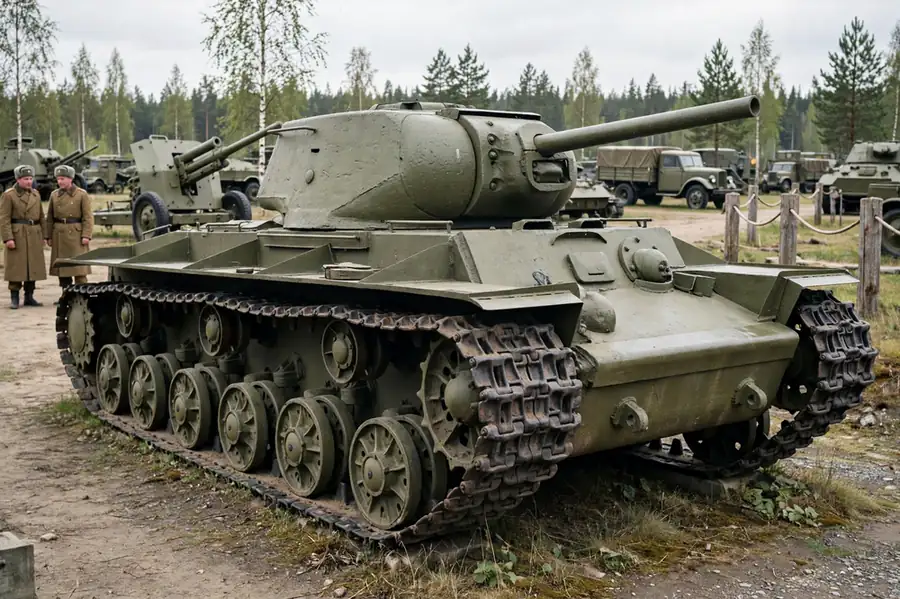
A number of KV-1 tanks survive in museums. The Central Armed Forces Museum in Moscow holds a KV-1, and the Kubinka Tank Museum displays examples. The Parola Tank Museum in Finland holds KV-1s that were captured by the Finnish Army, and they are among the most popular exhibits in the museum. The large number of surviving KV-1s, relative to the production run, reflects the type’s fame and the care with which museums have preserved it. The surviving examples are mostly 1941 models, with the cast turret that is most often seen in photographs.
Survivors Abroad and Running Examples
Other surviving KV-1 tanks include examples in the Military History Museum in St Petersburg and in the Tank Museum in Bovington in Britain. A small number of KV-1 tanks are maintained in running condition by museums and private collectors, and they appear at military vehicle shows. The running examples are particularly valuable, because they demonstrate the KV-1’s slow, deliberate movement and its distinctive engine note, which no photograph can convey. Visitors who see a KV-1 running gain a far better sense of the tank’s weight and presence than any static display can offer, and the sound of its diesel engine is a vivid reminder of the Eastern Front in 1941.
Frequently Asked Questions
Was the KV-1 a good tank?
The KV-1 was a good tank in 1941, when its thick armour made it almost immune to German anti-tank guns. But it was slow, unreliable and outgunned by 1943, when the Tiger and Panther appeared. It was a formidable tank in its time, but it was soon superseded by the IS-2.
How many KV-1 tanks were built?
Approximately 5,219 KV-1 tanks were built between 1939 and 1943, at the Kirov Plant in Leningrad and the Chelyabinsk Kirov Plant. This was a large production run for a heavy tank, and it reflected the importance that the Soviet Union attached to the heavy tank role.
What happened at Raseiniai?
At Raseiniai in Lithuania on 24 June 1941, a single KV-1, supported by a KV-2, blocked the road used by the German 6th Panzer Division and held up the division for a full day. German anti-tank guns could not penetrate its armour, and the tank was finally disabled by an 88 mm gun. The action has become one of the legends of armoured warfare.
Why was the KV-1 replaced?
The KV-1 was replaced by the IS-2 in 1943 because its 76.2 mm gun could not penetrate the Tiger’s armour, and because its slow speed and poor reliability made it unsuitable for the mobile warfare of 1943. The IS-2, with its 122 mm gun and better armour, was a significant improvement.
Did the KV-1 fight in the Winter War?
Yes. The KV-1 first saw combat in the Winter War of 1939-1940, when it was used in the fighting on the Karelian Isthmus. Its armour proved effective against Finnish anti-tank guns, and the tank performed well in the assaults on the Mannerheim Line.
How long did the KV-1 remain in service?
The KV-1 served from 1939 to 1943, when it was replaced by the IS-2. Some KV-1s remained in service with training and second-line units into 1944, but the type was withdrawn from front-line service in 1943.
Sources
- Steven J. Zaloga, KV-1 and KV-2 Heavy Tanks 1939-45 (Osprey Publishing, New Vanguard series).
- Mikhail Baryatinskiy, The KV-1 and KV-2 Tanks (Russian Armour series).
- David Glantz and Jonathan House, When Titans Clashed (University Press of Kansas).
- The Central Armed Forces Museum, Moscow, KV-1 collection records.
- The Parola Tank Museum, Finland, KV-1 exhibit records.
- Chamberlain, Peter, and Ellis, Chris, British and American Tanks of World War II (Arms and Armour Press).