 WAR ATLAS MILITARY HISTORY MAGAZINE · WWI — WWII
M6 Heavy Tank: America’s 57-Ton Heavy Tank That Never Fought
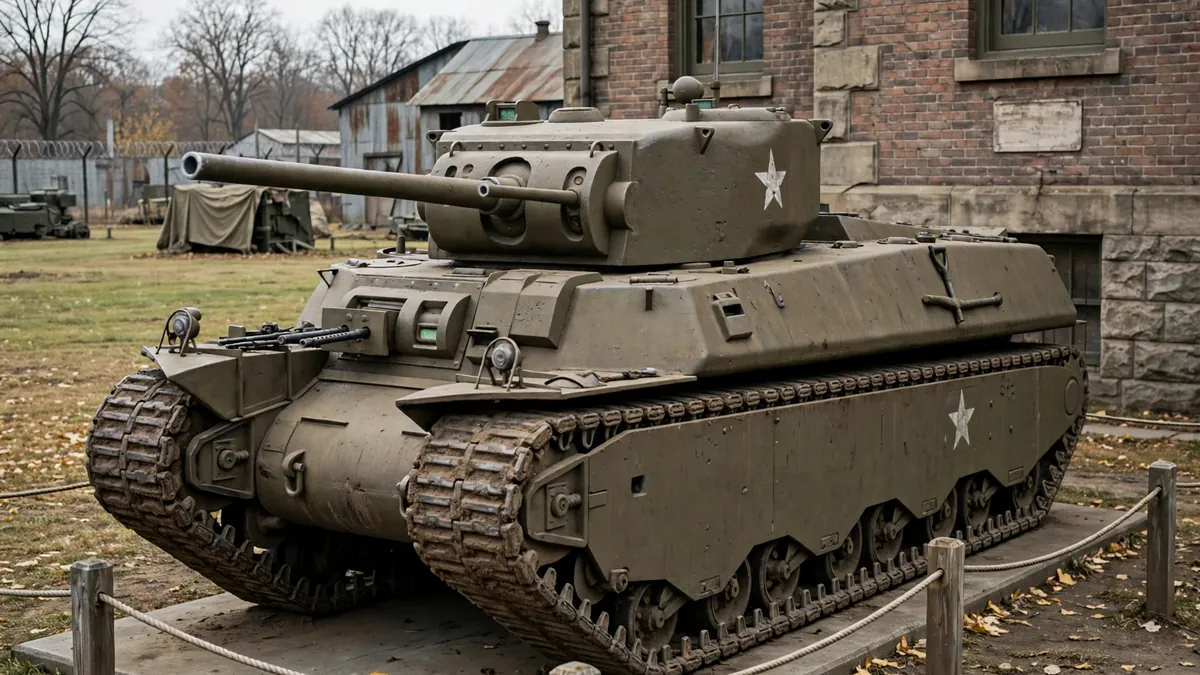
The M6 Heavy Tank was the United States Army’s only heavy tank of the Second World War, a massive 57-ton vehicle armed with a 76 mm gun and a 37 mm gun, built in a production run of only 40 vehicles and never sent into combat. Designed in 1940, when the US Army believed that it needed a heavy tank to break through fortified defences, the M6 was the largest and heaviest tank ever built in the United States, and it was a symbol of American industrial ambition. But by the time the M6 was ready for service in 1942, the US Army had decided that the medium tank, the M4 Sherman, was the weapon it needed, and the M6 was relegated to training and testing. The M6 never fired a shot in anger, but it influenced the design of later American heavy tanks, notably the M26 Pershing and the T29, and it remains a fascinating subject for historians of American armour.
The M6 was developed in response to the US Army’s experience in the First World War, when American troops had used British and French tanks, and to the lessons of the early Second World War, when German tanks had shown the value of a heavy, well-armed vehicle. The US Army’s Ordnance Department ordered the development of a heavy tank in 1940, and the design was entrusted to the Baldwin Locomotive Works, which built the first prototype in 1941. The M6 was a large, complex vehicle, with a cast hull, a turret mounting two guns, and a Wright radial engine, and it was the most ambitious tank project undertaken by the United States up to that time. The M6’s production run of 40 vehicles, built between 1942 and 1944, was small, but it was a significant achievement for American industry, which had never built a heavy tank before.
The M6 is remembered as a symbol of the US Army’s search for a heavy tank, and as a vehicle that was overtaken by events. It appears in museums in the United States, including the National Armor and Cavalry Museum at Fort Benning, where the sole surviving M6 is displayed, and it is a popular subject for military historians and model makers. The M6’s distinctive silhouette, with its long hull and its turret mounting two guns, remains one of the most recognisable images of American armour in the Second World War.
1. Key Facts
| Field | Value |
|---|---|
| Type | Heavy tank |
| Origin | United States |
| Designed | 1940-1941 (Baldwin Locomotive Works) |
| In service | 1942-1944 (US Army, training and testing only) |
| Produced | 40 (8 M6, 12 M6A1, 20 M6A2) |
| Manufacturer | Baldwin Locomotive Works |
| Crew | 6 (commander, gunner, loader, driver, assistant driver, radio operator) |
| Weight | Approximately 57 tons |
| Length | Approximately 8.43 m (with gun); hull about 6.83 m |
| Width | Approximately 3.12 m |
| Height | Approximately 2.99 m |
| Armour | Up to 100 mm (hull front); turret front up to 83 mm |
| Main armament | 76 mm M7 gun (75 rounds) and 37 mm M6 gun (202 rounds, coaxial) |
| Secondary armament | 12.7 mm M2 Browning machine guns (2), 7.62 mm M1919 machine guns (2) |
| Engine | Wright G-200 9-cylinder radial petrol engine, approximately 825 hp |
| Speed | Approximately 22 mph (35 km/h) maximum on roads |
| Range | Approximately 100 miles (161 km) on roads |
| Notable variants | M6, M6A1, M6A2 |
2. Background and Development
The US Army and the Heavy Tank
The origins of the M6 lay in the US Army’s search for a heavy tank in the late 1930s, when the Army, which had used British and French tanks in the First World War, realised that it needed a modern heavy tank for the next war. The US Army’s Ordnance Department issued a specification in 1940 for a heavy tank weighing about 50 tons, with a 76 mm gun and thick armour, and the design was entrusted to the Baldwin Locomotive Works, a railway locomotive manufacturer with experience in building heavy machinery. The M6 was the result, a tank that was larger and heavier than any American tank built before, and that represented the US Army’s ambition to build a heavy tank that could match the German and Soviet heavy tanks.
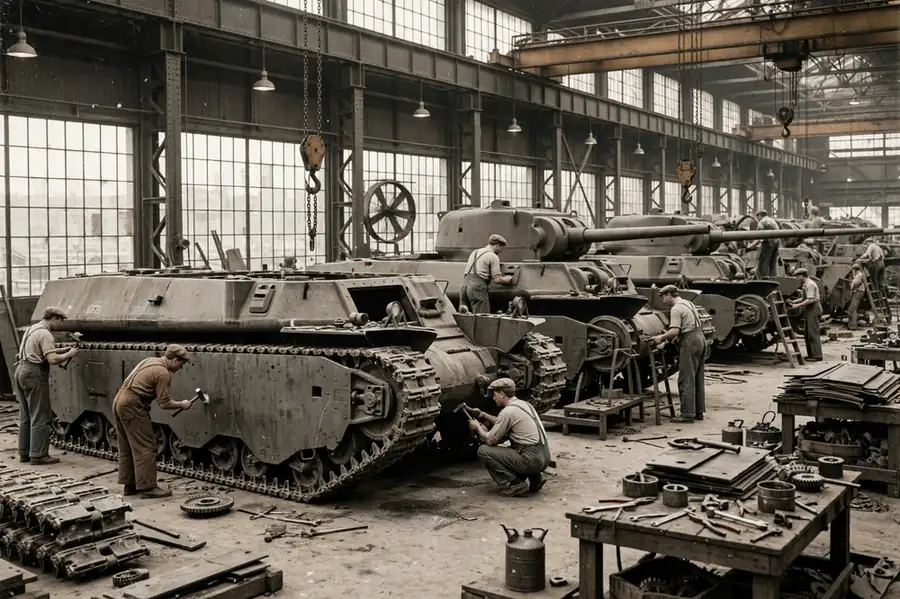
Baldwin Locomotive Works and the T1
The M6 was developed from the T1 prototype, which was built by Baldwin in 1941 and which was tested at the Aberdeen Proving Ground in Maryland. The T1 was a large, complex vehicle, with a cast hull, a turret mounting a 76 mm gun and a 37 mm gun, and a Wright radial engine. The T1’s tests showed that the design was sound, although its weight and its fuel consumption were high, and the US Army ordered the M6 into production in 1942. The M6 was built in three versions: the M6, with a welded hull, the M6A1, with a cast hull, and the M6A2, with a cast hull and a different transmission. The total production of 40 vehicles was built between 1942 and 1944, and the type was issued to the US Army’s armoured units for training and testing.
A Tank Designed for a Different War
The M6 was designed for a war that never came: a war in which the US Army would need a heavy tank to break through fortified defences in Europe. By the time the M6 was ready for service in 1942, the US Army had decided that the medium tank, the M4 Sherman, was the weapon it needed, and that the heavy tank was not a priority. The M6’s weight of 57 tons made it difficult to transport, its fuel consumption was high, and its 76 mm gun was no more powerful than the Sherman’s. The M6 was thus a tank designed for a different war, and it was overtaken by the changing doctrine of the US Army, which favoured the medium tank over the heavy tank.
3. Design
Hull, Armour and Mobility
The M6’s hull was a large, cast or welded structure, with armour up to 100 mm thick on the front and 83 mm on the turret front. The hull was 6.83 metres long and 3.12 metres wide, and the tank weighed about 57 tons, making it the heaviest tank ever built in the United States. The M6 was powered by a Wright G-200 9-cylinder radial petrol engine, which produced about 825 horsepower, giving a top speed of about 22 miles per hour on roads. The M6’s suspension used vertical volute springs, and its ground pressure was high, which made it prone to bogging down in soft ground. The M6’s mobility was poor for a tank of its size, and its fuel consumption was high, with a range of only about 100 miles. The M6’s reliability was also poor, and its engine and transmission required frequent maintenance.
The Dual Guns: 76 mm and 37 mm
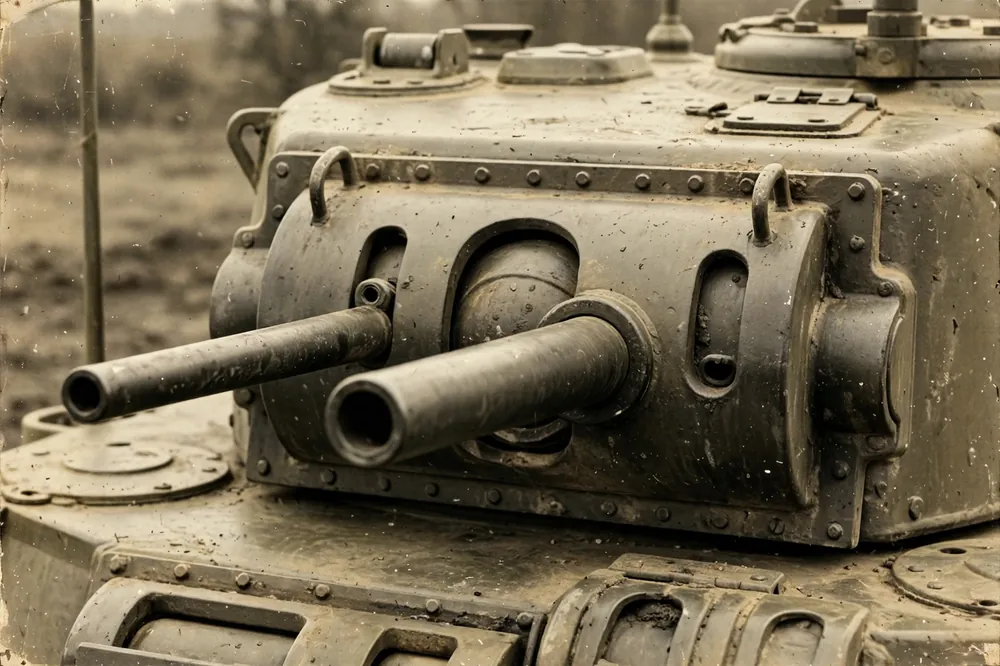
The M6’s most distinctive feature was its turret, which mounted two guns: a 76 mm M7 gun and a 37 mm M6 gun, mounted coaxially. The 76 mm gun was the M6’s main armament, firing an armour-piercing shell that could penetrate about 90 mm of armour at 500 metres, and a high-explosive shell that was effective against infantry and soft targets. The 37 mm gun was a secondary weapon, intended for use against lightly armoured targets and for firing smoke shells, although it was soon recognised as unnecessary. The M6 carried 75 rounds of 76 mm ammunition and 202 rounds of 37 mm ammunition, and its rate of fire was about six rounds per minute for the 76 mm gun. The dual-gun turret was a complex design, and it made the turret cramped and difficult to operate.
Crew, Vision and Ergonomics
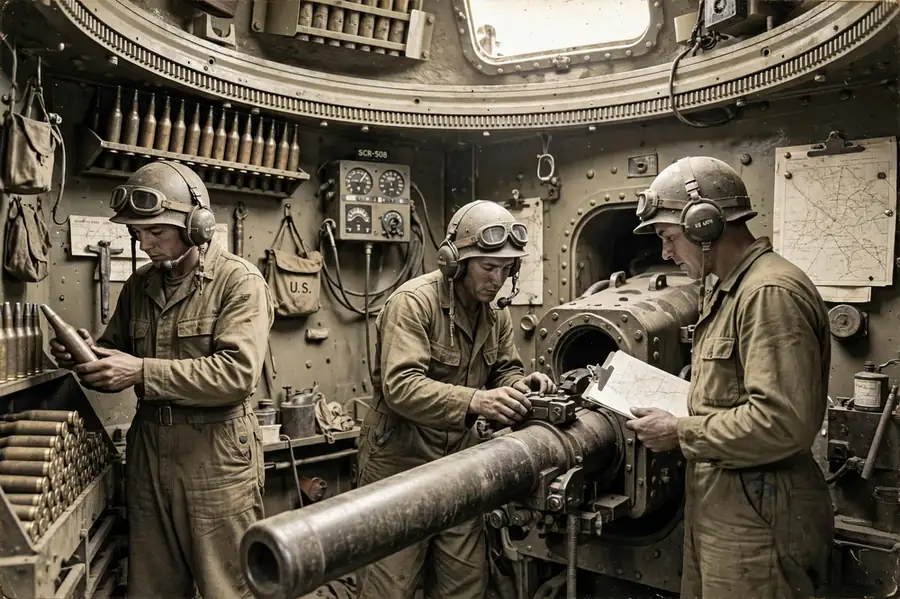
The M6 carried a crew of six, the largest of any American tank of the war: a commander, a gunner, a loader, a driver, an assistant driver and a radio operator. The commander, gunner and loader worked in the turret, while the driver and assistant driver sat in the front of the hull, and the radio operator worked in the hull. The M6’s interior was spacious by the standards of the time, but the dual guns made the turret cramped, and the tank’s ventilation was poor. The M6’s optics were good, and its crews praised its visibility, but they complained about its slow speed, its high fuel consumption, and its poor reliability. The M6 was a demanding tank to operate, but its crews were proud of its size and its firepower.
4. Variants
M6, M6A1 and M6A2
The M6 was built in three versions: the M6, with a welded hull, of which 8 were built; the M6A1, with a cast hull, of which 12 were built; and the M6A2, with a cast hull and a different transmission, of which 20 were built. The differences between the versions were mainly in the hull construction and the transmission, and all three versions had the same turret and the same guns. The M6’s production run of 40 vehicles was small, but it was a significant achievement for American industry, which had never built a heavy tank before. The M6’s three versions show how the US Army tried to improve the design, and how the tank’s production was limited by the Army’s decision that the heavy tank was not a priority.
The End of Production
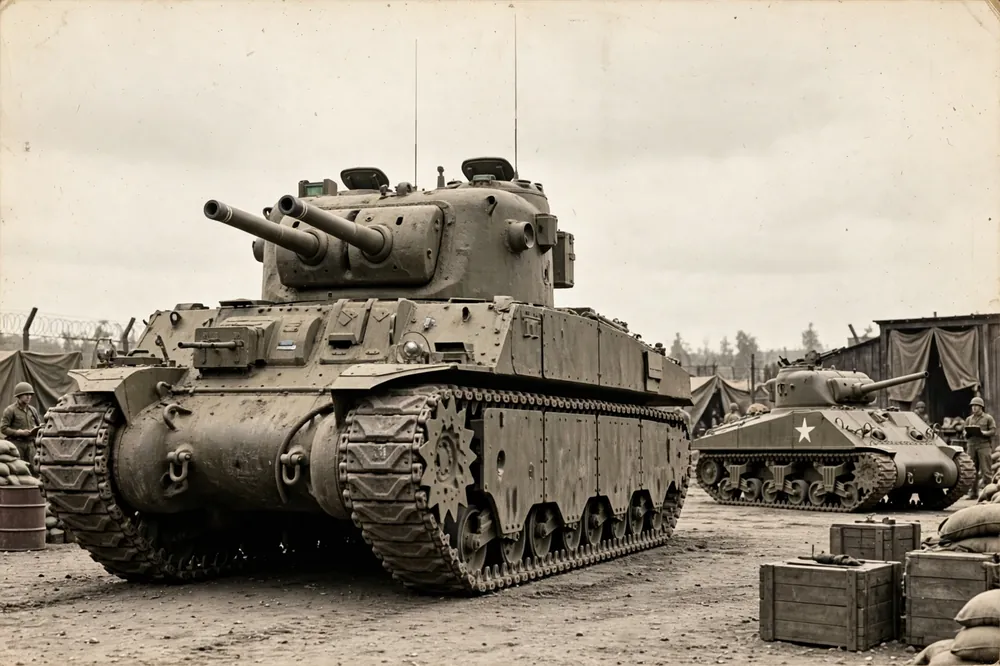
M6 production ended in 1944, when the US Army decided that the heavy tank was not needed and that the resources would be better spent on the M4 Sherman and on the M26 Pershing, which was under development. The M6’s chassis and engine were used for other purposes, and the 76 mm gun was used in the M10 tank destroyer and in the Sherman. The M6 was thus a dead end in American tank design, but its gun and its concept lived on in the M26 Pershing, which became the US Army’s first heavy tank to see combat, in the final months of the war in Europe and in the Korean War. The M6’s place in American tank history is as a stepping stone, a design that pointed the way to more successful vehicles.
The T29 Connection
The M6 was the basis for the T29, a heavy tank that was designed in 1944 and which used a larger turret and a 105 mm gun. The T29 was built in small numbers after the war, and it influenced the design of the M103, the US Army’s Cold War heavy tank. The M6’s legacy is thus not only its own service record, but the family of American heavy tanks that it founded, including the T29 and the M103. The M6’s design, with its large hull and its powerful engine, showed that the United States could build a heavy tank, even if the M6 itself was never used in combat.
5. Operational History
Testing at Aberdeen
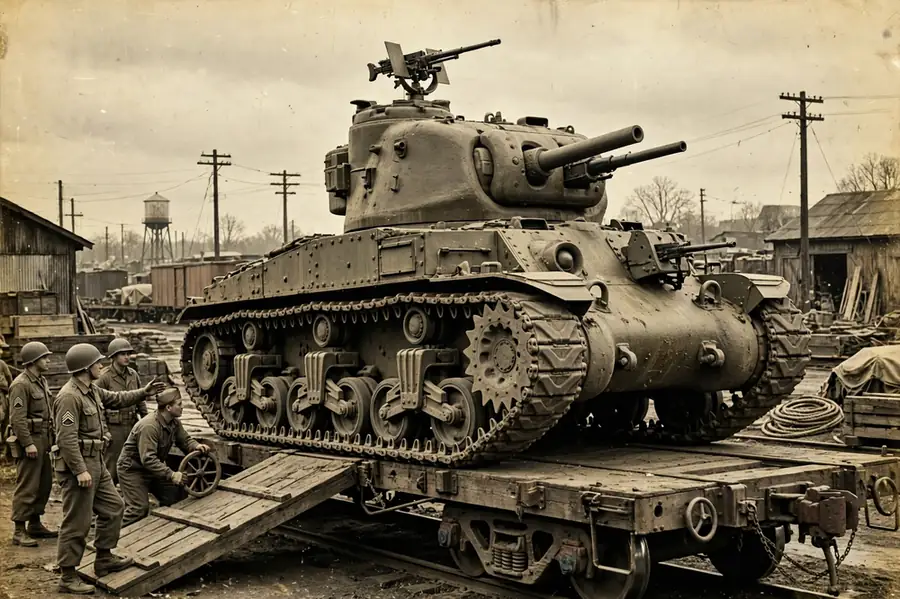
The M6’s operational history is brief, because the tank never entered combat. The M6 was tested at the Aberdeen Proving Ground in Maryland, where it was evaluated for its mobility, its armour and its gun. The tests showed that the M6 was a capable tank, although its weight and its fuel consumption were high, and its reliability was poor. The M6 was also tested by the US Army’s armoured units, including the 1st Armored Division, which used it for training and for evaluation. The M6’s testing was thus its main service, and its performance in tests was the basis for the US Army’s decision that the heavy tank was not a priority.
Training and Evaluation
The M6 was issued to US Army training units, where it was used to train tank crews and to evaluate heavy tank doctrine. The M6’s crews found that the tank was slow, difficult to transport, and expensive to maintain, and that its 76 mm gun was no more powerful than the Sherman’s. The US Army’s Armored Force, under General Jacob Devers, concluded that the M6 was not needed, and that the medium tank was the weapon of the future. The M6 was withdrawn from service in 1944, and most of the vehicles were scrapped, although one was preserved at Aberdeen. The M6’s training service was thus its only service, and it never fired a shot in anger.
The M6 in the Final Year of the War
The M6 project was cancelled in 1944, when the US Army decided that the resources would be better spent on the M4 Sherman and on the M26 Pershing. The M26, which entered service in early 1945, was the US Army’s first heavy tank to see combat, and it fought in the final battles in Germany and in the Korean War. The M6’s cancellation was thus not a rejection of its design, but a recognition that the US Army’s doctrine had changed, and that the heavy tank was no longer a priority. The M6’s story is a reminder of the difficulties that the US Army faced in developing a heavy tank, and of the changing doctrine that made the M6 obsolete before it could be used.
Why the M6 Never Fought
The M6 never fought for several reasons. The first was its weight: at 57 tons, it was too heavy to be transported by the landing craft and bridges that the US Army used in Europe. The second was its fuel consumption: the M6’s Wright engine consumed a great deal of fuel, and its range of only 100 miles was too short for the mobile warfare of 1944. The third was the US Army’s doctrine: General Devers and the Armored Force believed that the medium tank was the weapon of the future, and that the heavy tank was a waste of resources. The M6’s cancellation was thus a practical decision, not a judgement on the design, and it reflects the realities of the US Army in 1944.
6. Performance and Specifications
Strengths on Paper
On paper, the M6 was a formidable tank. Its frontal armour was up to 100 mm thick, and its 76 mm gun could penetrate about 90 mm of armour at 500 metres. Its Wright engine produced about 825 horsepower, and its top speed was about 22 miles per hour. The M6’s crew of six gave it a high rate of fire, and its dual guns gave it flexibility in combat. On paper, the M6 was a capable heavy tank, and it would have been a significant threat to German tanks in 1942 and 1943. But the M6’s strengths were theoretical, because the tank was never tested in combat, and its performance in battle remains unknown.
Weaknesses and Trade-offs
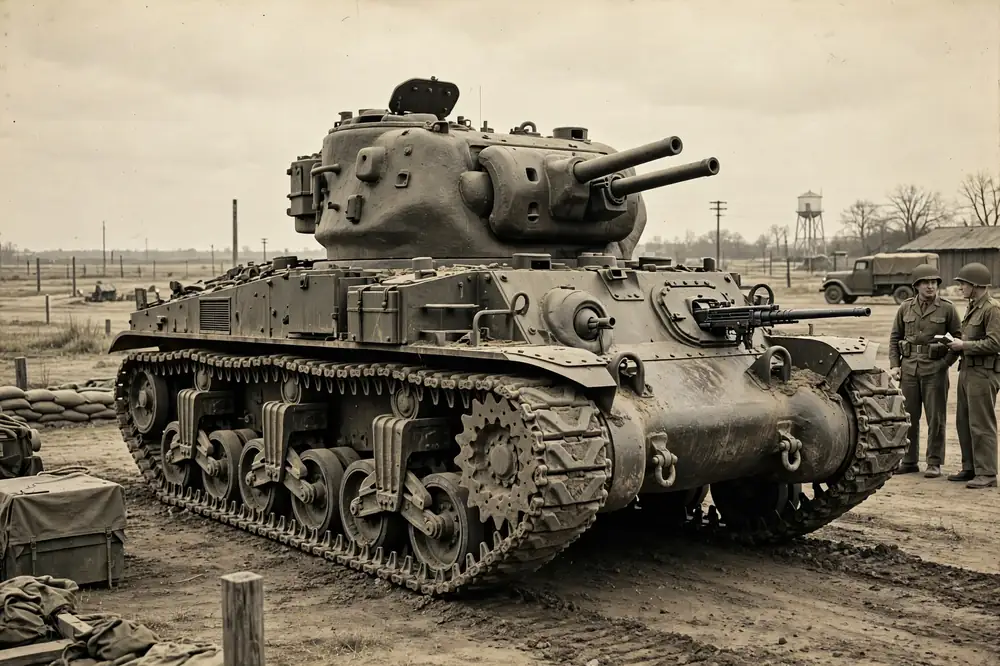
The M6’s weaknesses were clear, even on paper. Its weight of 57 tons made it difficult to transport, and its fuel consumption was high. Its 76 mm gun was no more powerful than the Sherman’s, and its 37 mm gun was unnecessary. The M6’s reliability was poor, and its engine and transmission required frequent maintenance. The M6 was also expensive to build, and its production was limited to 40 vehicles. The M6’s design was a product of its time, and it reflected the US Army’s ambition to build a heavy tank, but it was overtaken by the changing doctrine of the Army, which favoured the medium tank. The M6’s performance must be judged against its intended role: a heavy breakthrough tank, where it was adequate on paper, but never tested in combat.
How the M6 Might Have Compared
If the M6 had entered service, it would have been compared with the German Tiger I, the Soviet KV-1, and the British Churchill. The M6’s 100 mm frontal armour and its 76 mm gun would have made it a formidable opponent for the Tiger, although the Tiger’s 88 mm gun was more powerful. Compared with the KV-1, the M6 had a similar gun and similar armour, but it was heavier and less reliable. Compared with the Churchill, the M6 was faster and better armed, but it was also heavier and more expensive. The M6’s hypothetical performance is a subject of debate among historians, and it is impossible to know whether it would have been a significant improvement over the Sherman or a costly distraction.
7. Operators
The United States: The Only Operator
The M6 was intended for the US Army, and no other country was ever considered as an operator. The tank was designed for the US Army’s armoured divisions, which were the main users of the M4 Sherman, and it was to have been issued to the same units that operated the Sherman. The M6’s cancellation meant that it never served with any unit in combat, and its only operator, in a sense, was the US Army’s training and testing units, which used it at Aberdeen and at Fort Knox. The M6’s story is thus one of a tank that was designed for the US Army but never served with it in combat.
The Aberdeen Display
The sole surviving M6, an M6A2, was displayed by the US Army at the Aberdeen Proving Ground for many years, and it was later moved to the National Armor and Cavalry Museum at Fort Benning, where it is displayed today. The American display of the M6 has made it one of the most famous American prototype tanks, and it is a popular exhibit for visitors to the museum. The M6’s American service, as a museum piece, is a reminder of the tank’s strange history: an American tank that was never built in large numbers, and that was never used in combat, but that is preserved as a symbol of American industrial ambition.
8. Legacy and Influence
A Symbol of American Ambition
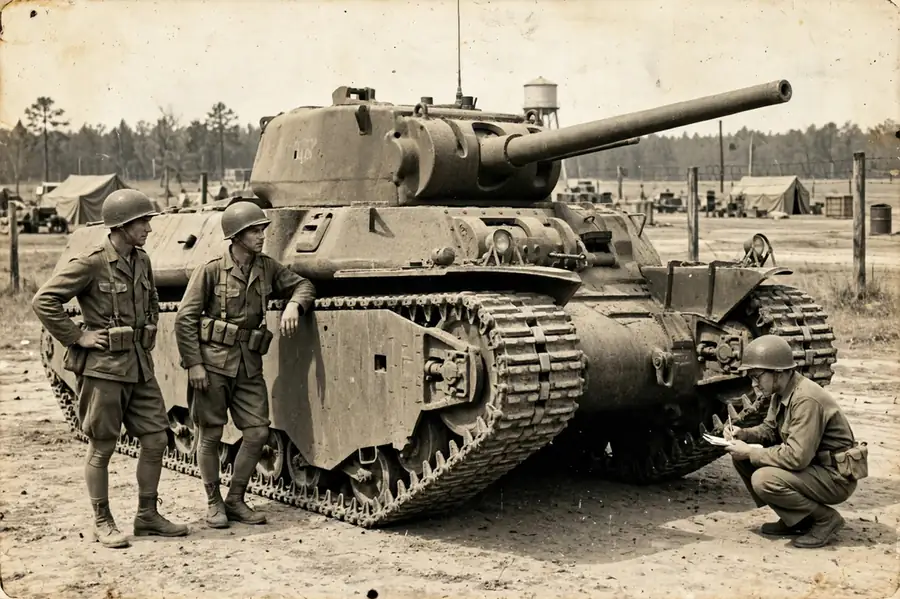
The M6’s legacy is that of a symbol of American ambition and of the difficulties of the US Army in developing a heavy tank. It showed that the United States could build a heavy tank, and it influenced the design of the M26 Pershing and the T29, which became the US Army’s first heavy tanks to see combat. The M6’s hull and engine were used for the T29, and its 76 mm gun was used in the M10 and the Sherman. The M6’s legacy is thus not as a tank that fought, but as a design that pointed the way to the next generation of American tanks.
Cultural Memory and Historical Assessment
The M6 is one of the most famous American prototype tanks, and its image, with its dual guns and its large hull, is widely recognised. Historians have assessed the M6 as a sound design that was overtaken by events, and as a reminder of the US Army’s difficulties in 1942. The M6’s reputation has been enhanced by its appearance in video games and popular culture, where it is often depicted as a powerful tank that never fought. The M6 is remembered as a symbol of the US Army’s search for a heavy tank, and of the industrial and doctrinal problems that made that search futile in 1942.
The M6 in Popular Culture
The M6 appears in many video games, books and models about the Second World War, and it is a popular subject for military historians and enthusiasts. Its distinctive hull, with its dual guns, makes it instantly recognisable, and it is often used as a symbol of American tank design. The M6’s appearance in popular culture has ensured that it will be remembered long after the last surviving example has gone, and it is a reminder of the fascination that prototype tanks hold for the public.
9. Surviving Examples
The Single M6A2 at Fort Benning
The only surviving M6 is an M6A2, which is displayed at the National Armor and Cavalry Museum at Fort Benning in Georgia, in the United States. The M6A2 is the only physical evidence of the M6 project, and it is a valuable artefact for historians of American tank design. The M6A2’s display at Fort Benning, where it is shown alongside other American tanks, is a reminder of the tank’s strange history, and it is one of the most popular exhibits in the museum. The M6A2 is maintained by the museum, and it is displayed in running condition on occasion.
No Other Survivors
No other M6 was ever preserved, and the Fort Benning M6A2 is unique. The M6’s production run of 40 vehicles was small, and most of the tanks were scrapped after the war. The Fort Benning M6A2’s survival is thus a remarkable piece of luck, and it is a valuable artefact for historians of the Second World War. The M6’s single survivor ensures that future generations can see the tank that might have been, and that they can appreciate the scale of the US Army’s search for a heavy tank in 1940.
Frequently Asked Questions
Did the M6 Heavy Tank ever fight in combat?
No. The M6 never entered combat and never fired a shot in anger. Only 40 vehicles were built, and they were used for training and testing at Aberdeen and Fort Knox. The M6 was withdrawn from service in 1944, before it could be sent overseas.
How many M6 Heavy Tanks were built?
Only 40 M6 Heavy Tanks were built between 1942 and 1944, by the Baldwin Locomotive Works: 8 M6, 12 M6A1, and 20 M6A2. This was a very small production run for a tank, and it reflected the US Army’s decision that the heavy tank was not a priority.
Why was the M6 cancelled?
The M6 was cancelled in 1944 because the US Army decided that the medium tank, the M4 Sherman, was the weapon it needed, and that the heavy tank was a waste of resources. The M6’s weight, fuel consumption and poor reliability also contributed to the decision.
Where is the M6 today?
The only surviving M6, an M6A2, is displayed at the National Armor and Cavalry Museum at Fort Benning in Georgia, in the United States. It was previously displayed at the Aberdeen Proving Ground. No other M6 survives.
What guns did the M6 carry?
The M6 carried two guns in its turret: a 76 mm M7 gun as its main armament, and a 37 mm M6 gun mounted coaxially. The 37 mm gun was intended for use against lightly armoured targets, although it was soon recognised as unnecessary.
Was the M6 a heavy tank?
Yes. The M6 was a heavy tank, weighing about 57 tons, which made it the heaviest tank ever built in the United States. It was the US Army’s only heavy tank of the Second World War, although it never saw combat.
Sources
- R. P. Hunnicutt, Firepower: A History of the American Heavy Tank (Presidio Press).
- Steven J. Zaloga, M26/M46 Pershing Tank 1943-53 (Osprey Publishing, New Vanguard series).
- The National Armor and Cavalry Museum, Fort Benning, M6 collection records.
- Chamberlain, Peter, and Ellis, Chris, British and American Tanks of World War II (Arms and Armour Press).
- David Fletcher, The Great Tank Scandal: British Armour in the Second World War (HMSO).
- US Army Ordnance Department, M6 Heavy Tank Handbook (wartime technical manual).