 WAR ATLAS MILITARY HISTORY MAGAZINE · WWI — WWII
Sd.Kfz. 232
1. Lead
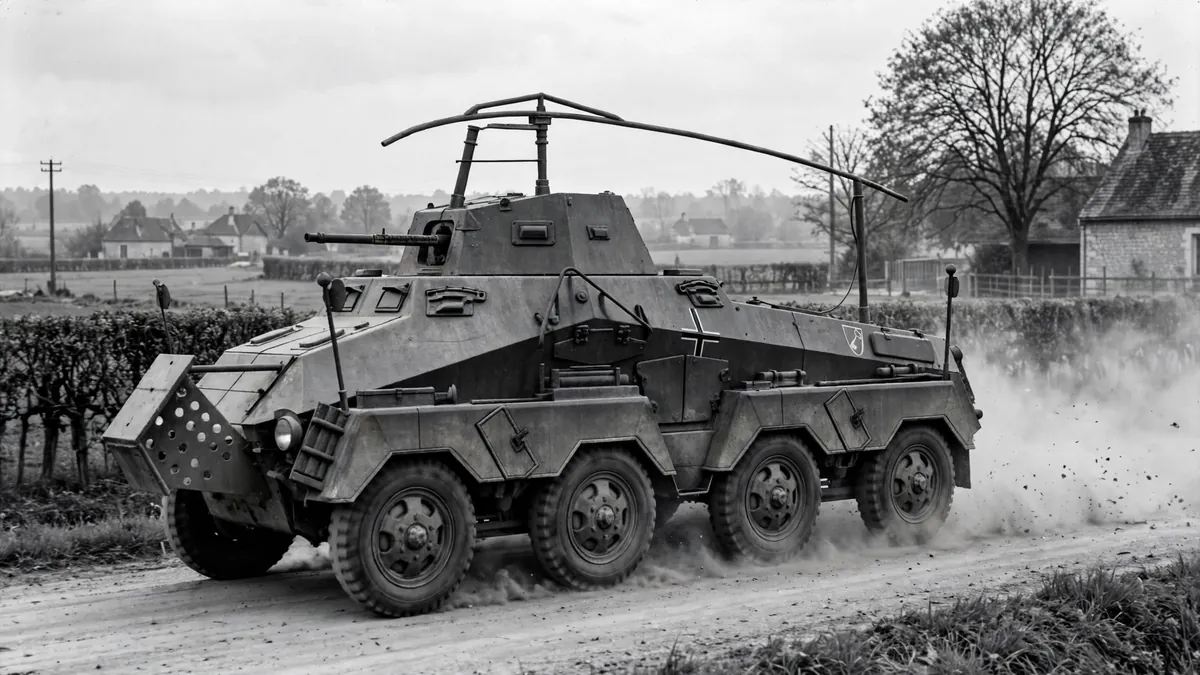
The Sd.Kfz. 232 was Germany’s standard eight-wheeled heavy armoured car of the Second World War, and one of the most recognisable reconnaissance vehicles of the war. Built on the chassis of the Sd.Kfz. 231, the Sd.Kfz. 232 was distinguished by its large frame antenna — the Rahmenantenne — mounted over the hull, which gave the vehicle a long-range radio and made it instantly recognisable in photographs.
Armed with a 20 mm KwK 30 autocannon in a small turret, with a top speed of about 85 kilometres per hour on roads, and with eight-wheel drive and a rear driver, the Sd.Kfz. 232 was the eyes of the panzer divisions: it ranged far ahead of the main force, found the enemy, reported back by radio, and fought its way out of trouble when it was discovered.
More than 1,000 Sd.Kfz. 231 and 232 vehicles were built between 1937 and 1943, and they served in every theatre of the war, from Poland and France to North Africa and the Eastern Front.
The Sd.Kfz. 232’s story is the story of German armoured reconnaissance in the Second World War: a story of a vehicle that was well-designed for its role, that was used aggressively and effectively by the panzer divisions, and that was eventually overtaken by the changing nature of the war — by the need for heavier armour, by the shortage of fuel and spare parts, and by the arrival of the Sd.Kfz. 234, the vehicle that replaced it. The Sd.Kfz. 232 is remembered today for its frame antenna, for its speed, and for its role in the blitzkrieg campaigns of 1939–1941, when the German reconnaissance battalions ranged ahead of the panzers and reported the enemy’s positions by radio.
2. Key Facts
| Vehicle | Sd.Kfz. 232 (Schwerer Panzerspähwagen 8-Rad), German heavy armoured car |
| Built | 1937–1943; more than 1,000 Sd.Kfz. 231/232 built (sources vary) |
| Manufacturer | Büssing-NAG (chassis), Deutsche Werke (hull) |
| Weight | About 8.3 tons |
| Crew / Kíp lái | 4 (commander/gunner, loader, driver, rear driver/radio operator) |
| Main armament | 20 mm KwK 30 autocannon; 1 × 7.92 mm MG 34 machine gun |
| Armour / Giáp | 8–15 mm / 8–15 mm |
| Engine | Büssing-NAG 8-cylinder petrol, about 150 hp |
| Speed | About 85 km/h on roads |
| Range | About 300 km on roads |
| Distinguishing feature | Large frame antenna (Rahmenantenne) over the hull |
3. Design and Development
The German reconnaissance requirement
In the mid-1930s, the German Army needed a heavy armoured car for the reconnaissance battalions of its new panzer divisions — a vehicle that could range far ahead of the tanks, find the enemy, and report back by radio. The existing German armoured cars were six-wheeled vehicles, the Sd.Kfz. 231 (6-Rad) and Sd.Kfz. 232 (6-Rad), which were based on commercial truck chassis and which had poor cross-country mobility.
In 1934, the German Army issued a requirement for a new eight-wheeled armoured car, with all-wheel drive, a rear driver, a turret-mounted gun, and a long-range radio. The Büssing-NAG company won the contract with a design that used a purpose-built eight-wheel chassis, with all eight wheels driven and steered, and a hull built by Deutsche Werke. The first vehicles, designated Sd.Kfz.
231 (8-Rad), were delivered in 1937, and the radio version, the Sd.Kfz. 232 (8-Rad), followed shortly afterwards.
Eight wheels and all-wheel drive
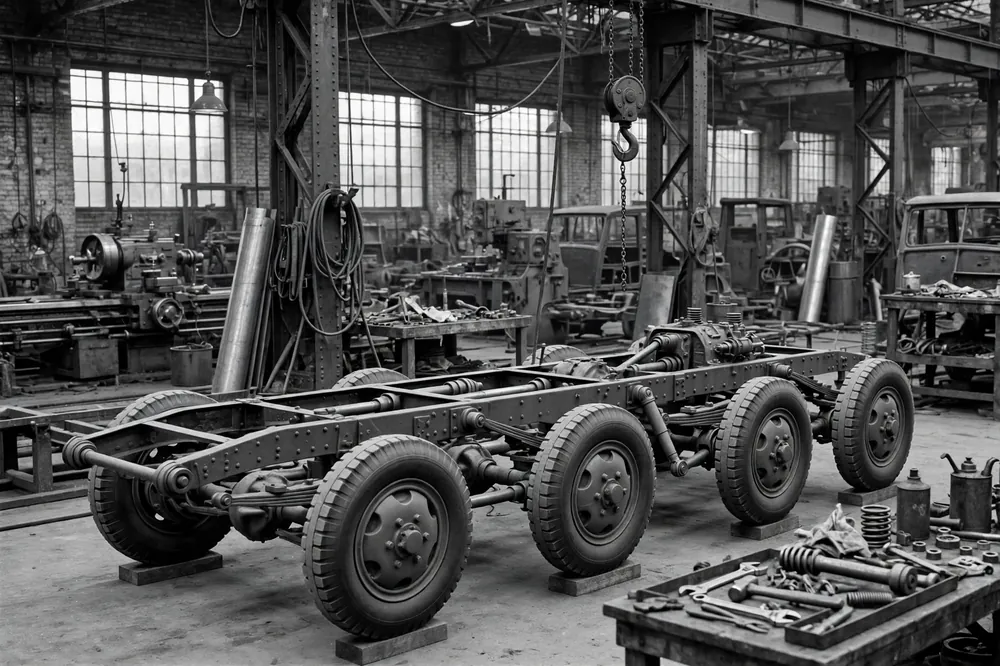
The Sd.Kfz. 232’s eight-wheel chassis was its defining feature. All eight wheels were driven, and all eight wheels were steered — the front four axles steered in the normal way, and the rear axles steered in the opposite direction at low speed, which gave the vehicle a very tight turning circle.
The chassis could cross trenches up to about 1.3 metres wide, climb obstacles, and operate on soft ground that would have stopped a four-wheeled vehicle. The vehicle also had a rear driver, seated at the back of the hull, who could drive the vehicle in reverse at full speed — a feature that, like the Panhard 178, was invaluable for a reconnaissance vehicle breaking contact.
The engine was a Büssing-NAG eight-cylinder petrol engine, producing about 150 horsepower, which gave the 8.3-ton vehicle a top speed of about 85 km/h on roads — one of the fastest armoured vehicles of the war.
The frame antenna
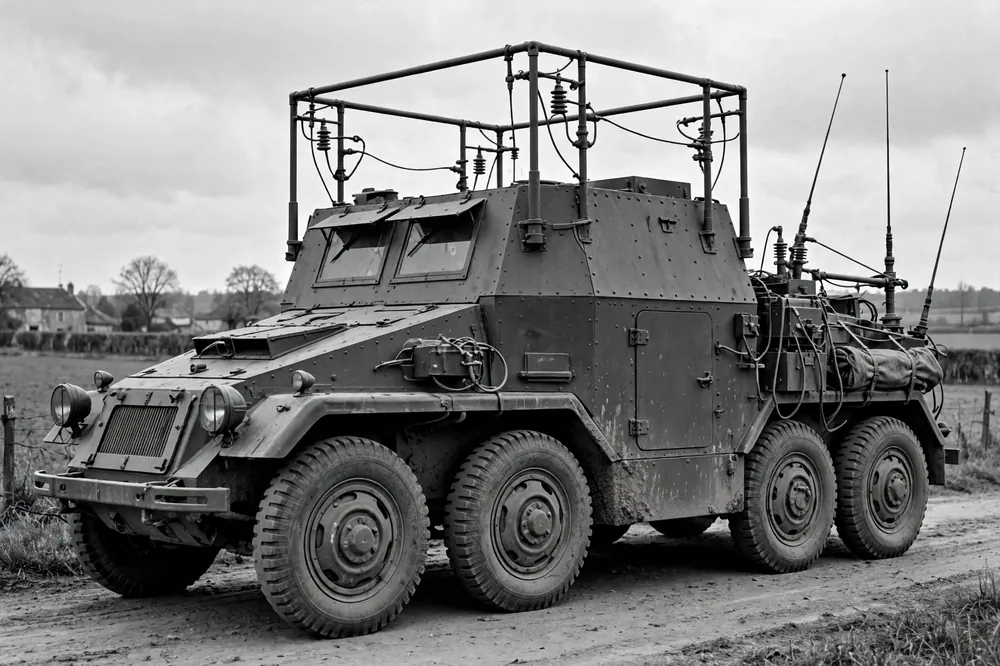
The Sd.Kfz. 232 was distinguished from the Sd.Kfz. 231 by its radio equipment and by its frame antenna. The Sd.Kfz. 231 carried a short-range radio with a whip antenna, while the Sd.Kfz. 232 carried a long-range radio — the FuG 12 — with a large frame antenna mounted over the hull, supported by two masts.
The frame antenna gave the vehicle a radio range of up to 100 kilometres or more, which allowed it to report directly to divisional headquarters from far ahead of the main force. The antenna was also the vehicle’s most recognisable feature, and it is the reason the Sd.Kfz. 232 is so easily identified in wartime photographs.
The antenna was fragile, however, and it was often damaged in combat or by low branches, and the vehicle’s crews learned to repair it in the field.
4. Armament and Protection
The 20 mm gun
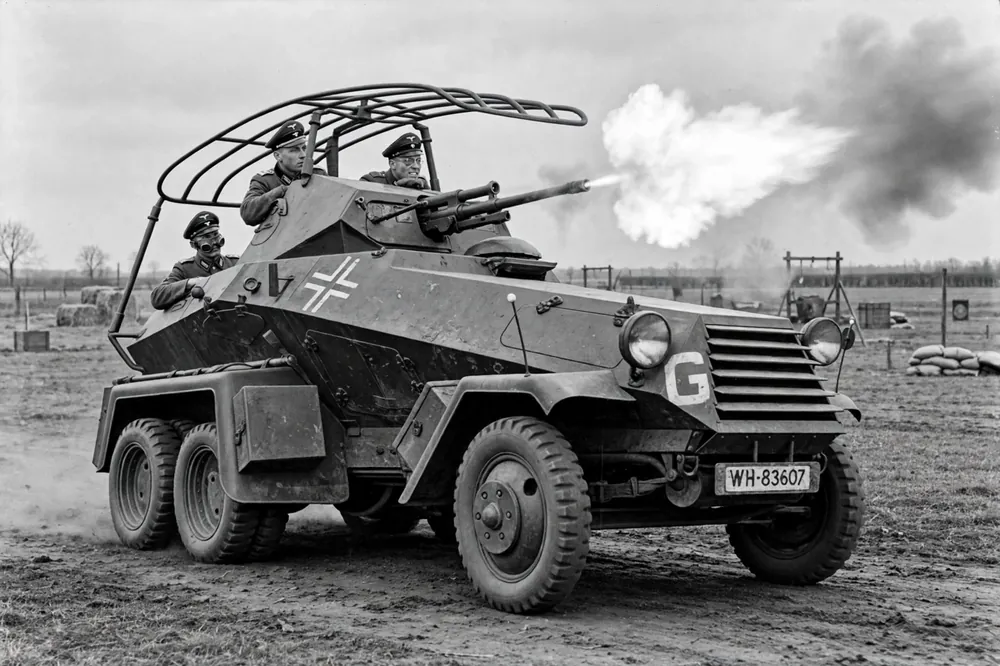
The Sd.Kfz. 232’s main weapon was the 20 mm KwK 30 autocannon, mounted in a small, open-topped turret — later versions had a fully enclosed turret — together with a coaxial 7.92 mm MG 34 machine gun. The 20 mm gun fired a 20 mm armour-piercing shell that could penetrate about 20 mm of armour at 500 metres — enough to defeat light armoured vehicles, soft vehicles and infantry, but not enough to defeat a tank.
The gun’s high rate of fire — about 280 rounds per minute — made it effective against infantry, against anti-tank guns, and against aircraft at low altitude, and it was the weapon that made the Sd.Kfz. 232 a credible fighting vehicle in the reconnaissance role. Later in the war, some Sd.Kfz.
232s were up-gunned with the 20 mm KwK 38, a more powerful version of the same gun, but the 20 mm remained the vehicle’s standard armament throughout its service.
Armour and the four-man crew
The Sd.Kfz. 232’s armour was 8–15 mm thick, with the thickest armour on the turret front and the hull front. That was enough to stop rifle bullets and machine-gun fire, but not enough to stop an anti-tank gun or a tank gun. The vehicle’s protection was its speed, its mobility and its low silhouette, not its armour, and its crews understood that: the Sd.Kfz.
232 was a reconnaissance vehicle, and its job was to find the enemy and report back, not to fight a pitched battle. The crew of four — commander/gunner, loader, driver and rear driver/radio operator — was a good crew for a reconnaissance vehicle, and the rear driver was also the radio operator, which meant that the vehicle could report while it was moving. The Sd.Kfz.
232’s crew was trained to work as a team, and the vehicle’s effectiveness depended on the crew’s ability to observe, to report, and to withdraw.
The radio / Radio
The Sd.Kfz. 232’s radio was its most important piece of equipment, and it was the reason the vehicle existed in its 232 form. The FuG 12 long-range radio, with its frame antenna, allowed the vehicle to communicate with divisional headquarters from up to 100 kilometres away, and it was the link between the reconnaissance battalion and the panzer division it served.
The German reconnaissance doctrine depended on the radio: the Sd.Kfz. 232 was to find the enemy, report by radio, and withdraw, and the division would then act on the report. The German radio was better than the French radio, and it was better integrated into the German doctrine, and the Sd.Kfz. 232’s radio was one of the reasons the German reconnaissance battalions were so effective in 1939–1941.
The radio was also the vehicle’s greatest vulnerability: the frame antenna was fragile, and a vehicle that lost its antenna lost its ability to report.
5. Service in Poland and France
The blitzkrieg campaigns
The Sd.Kfz. 232 first saw combat in the invasion of Poland in September 1939, where the reconnaissance battalions of the panzer divisions ranged ahead of the tanks, found the Polish positions, and reported them by radio. In France in May–June 1940, the Sd.Kfz.
232s were in the forefront of the German advance: they crossed the Meuse, they raced through France, and they reported the French positions to the panzer divisions behind them. The vehicles’ speed and their radios made them ideal for the blitzkrieg: they could move fast, they could report fast, and they could fight their way out of trouble. The Sd.Kfz.
232’s service in 1939–1940 was the vehicle’s finest hour, and it was the period in which the German reconnaissance doctrine — the doctrine the vehicle was built for — worked as its designers intended.
The reconnaissance battalion
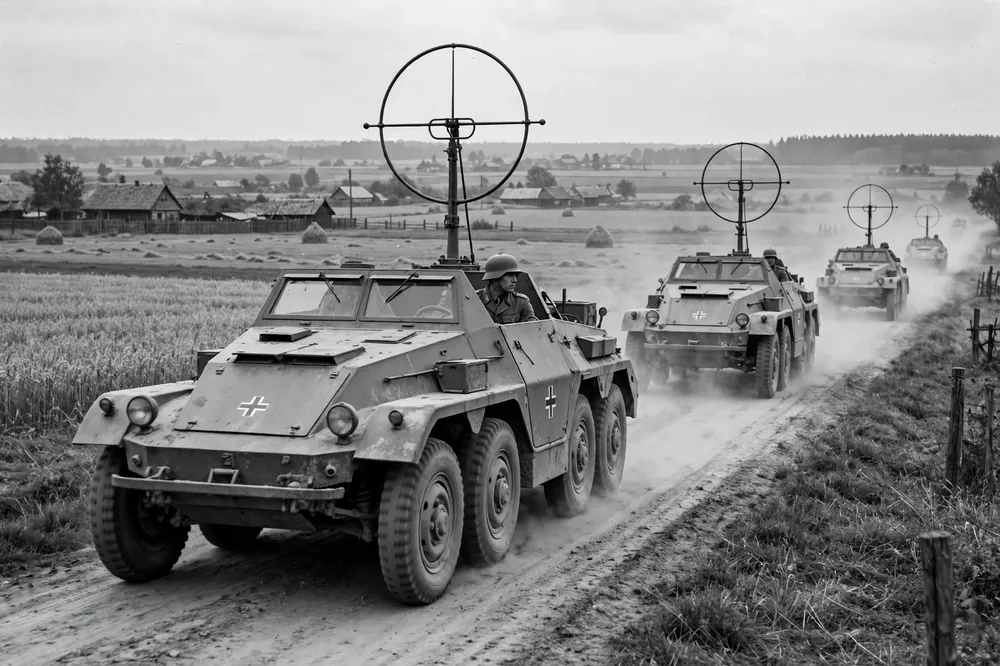
The Sd.Kfz. 232 served in the reconnaissance battalions (Aufklärungs-Abteilungen) of the panzer divisions, which were the divisions’ eyes and ears. A typical reconnaissance battalion included a company of Sd.Kfz. 232s, together with motorcycle infantry, light armoured cars, and anti-tank guns, and it operated far ahead of the division, screening its advance, finding the enemy, and seizing bridges and road junctions.
The battalion’s work was dangerous — the reconnaissance vehicles were often the first to meet the enemy, and they were often outnumbered and outgunned — but it was essential to the panzer division’s ability to move fast and to fight. The Sd.Kfz. 232 was the battalion’s most capable vehicle, and its crews were among the best-trained soldiers in the German Army.
The battalion’s organisation reflected the German belief that reconnaissance was a fighting task, not a passive one. The Sd.Kfz. 232 company did not merely observe: it fought for information, probing the enemy’s positions, drawing his fire to reveal his guns, and seizing the ground the division would need.
That doctrine demanded crews who were aggressive, well-trained and well-led, and the reconnaissance battalions attracted some of the best officers in the panzer divisions — men who understood that the information their vehicles brought back was worth more than the vehicles themselves, and who were willing to risk the vehicles to get it. The cost was high: reconnaissance battalions suffered heavy casualties in every campaign, and the Sd.Kfz.
232 companies were often the hardest-hit units in a panzer division. But the division commanders accepted the cost, because without the reconnaissance battalion’s reports, the division was blind.
6. North Africa and the Eastern Front
The desert war
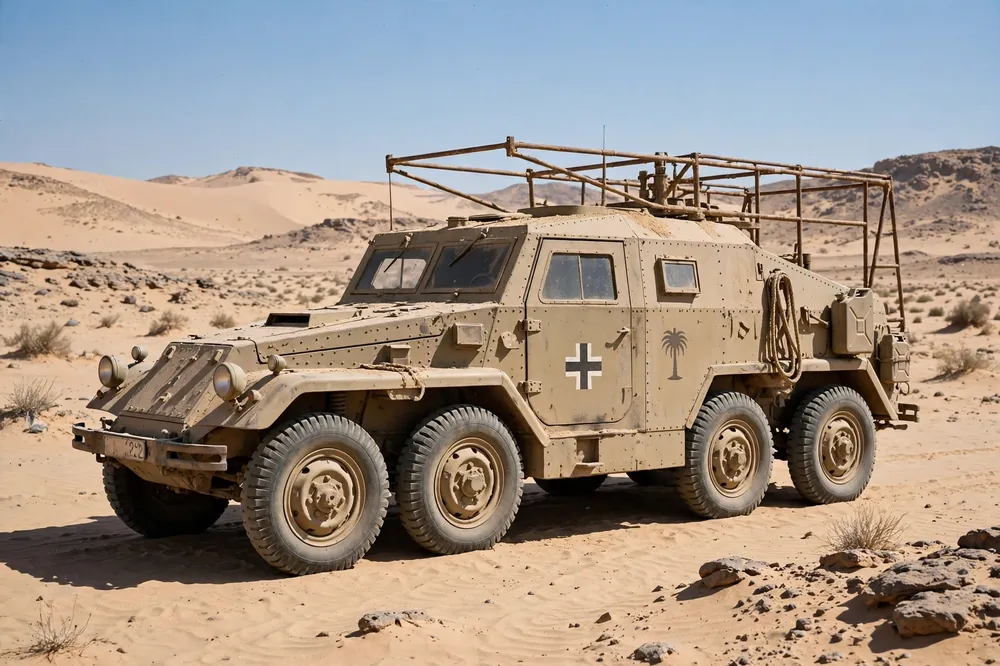
In North Africa, the Sd.Kfz. 232 served with the Afrika Korps, where its speed and its range made it ideal for desert reconnaissance. The vehicles operated in the open desert, where their long-range radios allowed them to report from far ahead of the main force, and where their 20 mm guns were effective against British armoured cars and soft vehicles.
The desert was hard on the vehicles — the sand wore out the engines, the heat cracked the tyres, and the dust clogged the radios — but the Sd.Kfz. 232s kept working, and they were among the most reliable vehicles in the Afrika Korps. The desert war was the Sd.Kfz.
232’s second great campaign, after France, and it was a campaign in which the vehicle’s qualities — speed, range and radio — were exactly what the desert required.
The Eastern Front
On the Eastern Front, the Sd.Kfz. 232 served from the invasion of the Soviet Union in June 1941 until the end of the war. The vast distances of Russia suited the vehicle’s range and its radio, and the vehicles ranged far ahead of the panzer divisions, reporting the Soviet positions and seizing bridges. But the Eastern Front was also where the Sd.Kfz.
232’s weaknesses became apparent: its thin armour made it vulnerable to Soviet anti-tank rifles and guns, its petrol engine was thirsty and unreliable in the Russian winter, and its wheeled layout limited its cross-country mobility in the mud of the rasputitsa — the spring and autumn mud seasons. The Sd.Kfz. 232s suffered heavy losses on the Eastern Front, and by 1943 they were being replaced by the Sd.Kfz.
234, a vehicle with a more powerful gun, better armour and a diesel engine.
7. The Sd.Kfz. 234 and Replacement
The successor
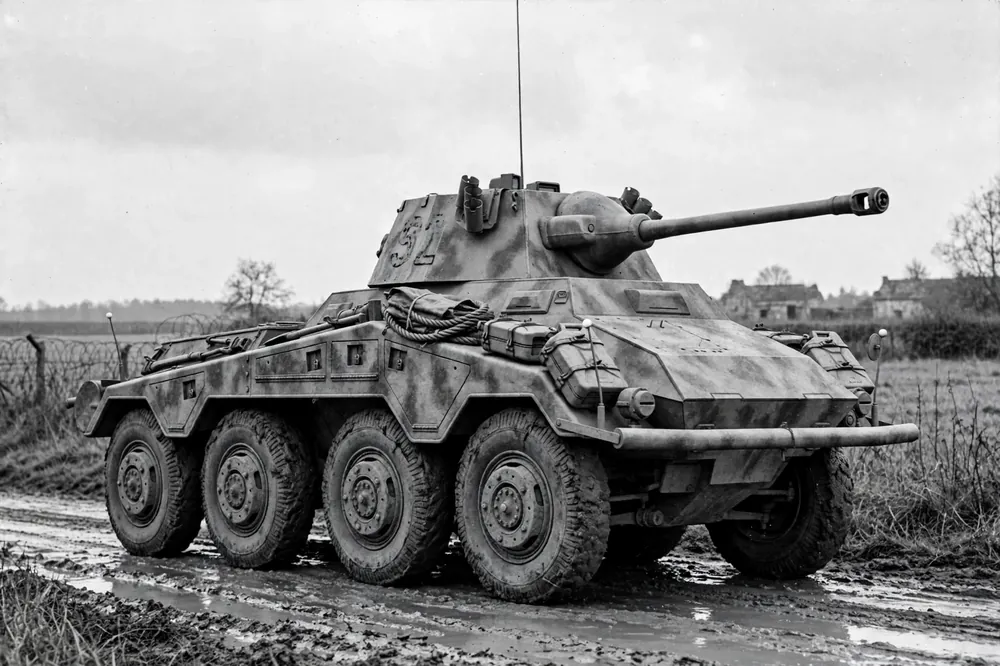
The Sd.Kfz. 234, which entered service in 1943, was the Sd.Kfz. 232’s successor, and it was a better vehicle in almost every way: it had a more powerful engine, a diesel in some versions, thicker armour, and a more powerful gun — the 20 mm gun in the Sd.Kfz. 234/1, the 50 mm gun in the Sd.Kfz. 234/2 “Puma”, and the 75 mm gun in the Sd.Kfz. 234/4. The Sd.Kfz.
234 was also an eight-wheeled vehicle, with all-wheel drive and a rear driver, and it inherited the Sd.Kfz. 232’s layout and its role. The Sd.Kfz. 232 was not withdrawn immediately — it served alongside the Sd.Kfz. 234 until the end of the war, in second-line units and in units that had not yet received the new vehicle — but its days as the German Army’s standard heavy armoured car were over.
The Sd.Kfz. 234 was the vehicle the Sd.Kfz. 232 had pointed towards, and it was the last and best of the German eight-wheeled armoured cars.
The last years
In the last years of the war, the surviving Sd.Kfz. 232s served in France, in Italy, and on the Eastern Front, in reconnaissance units that were increasingly short of fuel, of spare parts, and of trained crews. The vehicles were old, their engines were worn out, and their radios were often unserviceable, but they kept working — because the German Army had nothing else to replace them with, and because a reconnaissance vehicle, even an old one, was better than no reconnaissance vehicle at all.
The last Sd.Kfz. 232s were destroyed or captured in the final battles of the war, in Berlin and in the Ruhr, and the type disappeared from service in 1945. A small number survive today in museums, where they are displayed as the classic German armoured car of the Second World War.
8. Variants
The 231 and 232 family
The Sd.Kfz. 231 (8-Rad) and Sd.Kfz. 232 (8-Rad) were the two main versions of the eight-wheeled heavy armoured car, differing only in their radio equipment: the 231 carried a short-range radio, the 232 carried the long-range FuG 12 radio with the frame antenna. There were also command versions, the Sd.Kfz. 263 (8-Rad), which carried additional radio equipment and no turret, and which served as command vehicles for the reconnaissance battalions.
The six-wheeled predecessors, the Sd.Kfz. 231 (6-Rad) and Sd.Kfz. 232 (6-Rad), were built in small numbers and served in the early war, but they were replaced by the eight-wheeled versions as soon as they were available. The family shows the German habit of building a series of related vehicles on a single chassis, and of distinguishing them by their radio equipment — a habit that reflected the importance the German Army placed on communications.
Field modifications
Sd.Kfz. 232s in the field were often modified by their crews: additional armour plate was bolted on, spare wheels were carried on the hull, and captured weapons were sometimes fitted. The most common field modification was the addition of a 20 mm gun shield, or the replacement of the 20 mm gun with a captured weapon, but the vehicles were generally used as they were delivered, because the German Army’s supply system was not designed for field modifications on a large scale. The Sd.Kfz. 232’s crews were resourceful, but they were also disciplined, and they used the vehicle as its designers intended — as a reconnaissance vehicle, not as a tank.
9. The Sd.Kfz. 232 in Detail
The vehicle’s layout
The Sd.Kfz. 232’s layout was a model of German engineering: the engine was at the rear, the driver sat at the front, the rear driver sat at the back, and the turret sat in the middle, over the fighting compartment. The hull was made of welded and riveted armour plate, with a sloped front and a low, angular shape that gave the vehicle a distinctive, purposeful appearance.
The vehicle’s eight wheels were arranged in four axles, with all eight wheels driven and steered, and the suspension was by coil springs. The vehicle’s frame antenna, mounted over the hull on two masts, was its most distinctive feature, and it is the feature that makes the Sd.Kfz. 232 instantly recognisable.
The vehicle was a machine built for a purpose, and its purpose was written on its shape: speed, mobility, and the ability to see and to report.
The crew’s life
Life in an Sd.Kfz. 232 was hard, cramped and dangerous. The crew of four lived in the vehicle for days at a time, eating, sleeping and working in a space that was barely large enough for them, and they were often the first to meet the enemy and the last to withdraw.
The vehicle’s petrol engine was noisy and hot, the radio was temperamental, and the frame antenna was a constant worry. But the crews were proud of their vehicles, and they were proud of their role: the reconnaissance battalion was an elite formation, and the Sd.Kfz. 232 was its most capable vehicle.
The crews’ accounts of their service — in France, in North Africa, and on the Eastern Front — are among the most vivid accounts of the German Army in the Second World War, and they show a vehicle and a crew that were, for a time, the best in the world at what they did.
10. Assessment and Legacy
The Sd.Kfz. 232 was one of the best reconnaissance vehicles of the Second World War, and it is remembered as the vehicle that made the blitzkrieg possible — not by fighting, but by seeing. Its speed, its radio and its mobility made it the eyes of the panzer divisions, and its crews’ reports were the information on which the panzer commanders acted.
The vehicle’s weaknesses — its thin armour, its 20 mm gun, its fragile antenna — were the weaknesses of a reconnaissance vehicle, and they were accepted because the vehicle’s job was not to fight but to find. The Sd.Kfz. 232’s story is a reminder that in war, information is as important as firepower, and that the vehicle that finds the enemy is as important as the vehicle that kills him.
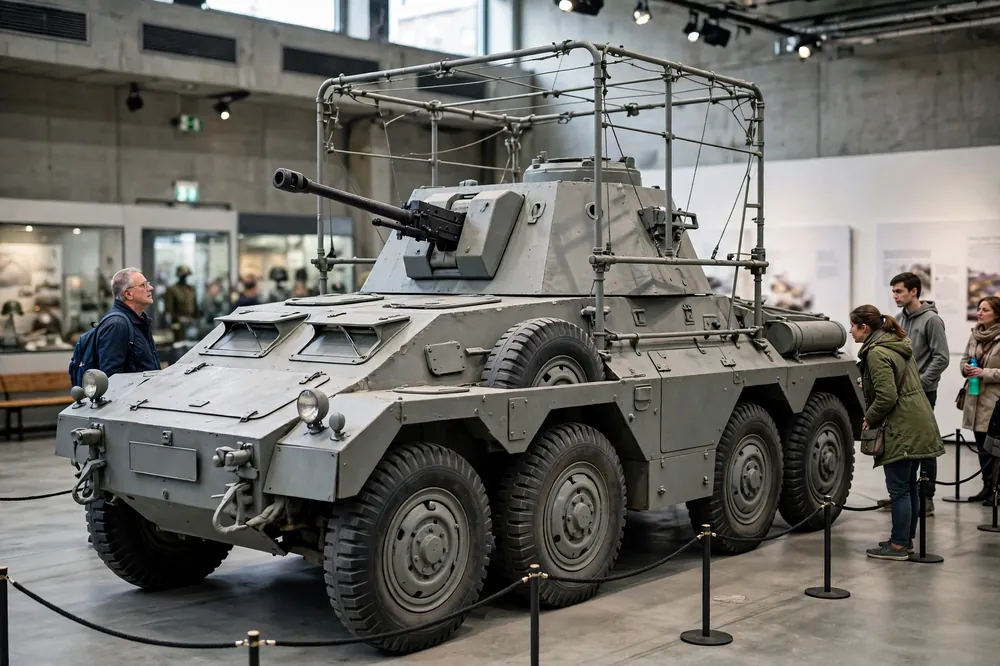
The Sd.Kfz. 232’s legacy is the Sd.Kfz. 234 “Puma”, the vehicle that replaced it and that is often called the best armoured car of the war, and it is the modern reconnaissance vehicle — the fast, well-armed, radio-equipped vehicle that every army now operates. The Sd.Kfz. 232 itself survives in museums in Germany and in other countries, where it is displayed with its frame antenna, instantly recognisable, and as a reminder of a vehicle that was, for a time, the eyes of the most formidable army in the world.
11. Frequently Asked Questions
What is the difference between the Sd.Kfz. 231 and the Sd.Kfz. 232?
The Sd.Kfz. 231 and Sd.Kfz. 232 were the same eight-wheeled heavy armoured car, differing only in their radio equipment. The Sd.Kfz. 231 carried a short-range radio with a whip antenna, while the Sd.Kfz. 232 carried the long-range FuG 12 radio with the large frame antenna mounted over the hull. The frame antenna is the easiest way to tell the two apart in photographs. The difference mattered because it decided what the car could do: the 231 could talk to its own unit, while the 232 could report directly to divisional headquarters from far ahead of the main force.
How fast was the Sd.Kfz. 232?
The Sd.Kfz. 232 had a top speed of about 85 km/h on roads, which made it one of the fastest armoured vehicles of the war, and a range of about 300 kilometres. Its eight-wheel drive and its rear driver gave it excellent cross-country mobility for a wheeled vehicle, and it could cross trenches up to about 1.3 metres wide. The speed made the 232 one of the fastest armoured vehicles of the war, and it was the car’s protection: a reconnaissance vehicle that could outrun what it found did not need heavy armour.
What gun did the Sd.Kfz. 232 carry?
The Sd.Kfz. 232 carried the 20 mm KwK 30 autocannon in its turret, together with a coaxial 7.92 mm MG 34 machine gun. The 20 mm gun could penetrate about 20 mm of armour at 500 metres, which was enough against light armoured vehicles and soft vehicles, but not enough against a tank. Later vehicles received the more powerful 20 mm KwK 38, and the successor Sd.Kfz. 234 carried 50 mm and 75 mm guns. The gun was enough for the car’s role: it could defeat light armoured vehicles and soft vehicles, which were the targets a reconnaissance car was meant to find.
How many Sd.Kfz. 232s were built?
More than 1,000 Sd.Kfz. 231 and Sd.Kfz. 232 eight-wheeled vehicles were built between 1937 and 1943, with sources varying on the exact split between the two types. The vehicles were built by Büssing-NAG (chassis) and Deutsche Werke (hull), and they served in the reconnaissance battalions of the panzer divisions in every theatre of the war. The total covers both types together, because the 231 and the 232 were the same vehicle with different radios, and the sources vary on the exact split between them.
What was the frame antenna for?
The frame antenna — the Rahmenantenne — was the antenna for the Sd.Kfz. 232’s long-range FuG 12 radio, and it gave the vehicle a radio range of up to 100 kilometres or more. The antenna allowed the vehicle to report directly to divisional headquarters from far ahead of the main force, and it is the vehicle’s most recognisable feature. The antenna was fragile and was often damaged in combat, and the crews learned to repair it in the field. The antenna is what makes the 232 recognisable: no other armoured car carried a frame like it. It was a weakness, because it was fragile and was often damaged in combat.
What replaced the Sd.Kfz. 232?
The Sd.Kfz. 232 was replaced by the Sd.Kfz. 234, which entered service in 1943. The Sd.Kfz. 234 was an eight-wheeled vehicle with a more powerful engine, thicker armour, and a more powerful gun — 20 mm in the 234/1, 50 mm in the 234/2 “Puma”, and 75 mm in the 234/4. The Sd.Kfz. 232 served alongside the Sd.Kfz. 234 until the end of the war, in second-line units. The 234 was a better vehicle in every way: a more powerful engine, thicker armour, and a more powerful gun, with 20 mm, 50 mm and 75 mm versions.
12. Sources
- Wikipedia, “Sd.Kfz. 232” — production figures, specifications, service history and the frame antenna.
- Thomas L. Jentz and Hilary Louis Doyle, Panzer Spähwagen: Armored Cars Sd.Kfz. 3 to Sd.Kfz. 263 (Panzer Tracts, 2001) — the definitive technical history of the German eight-wheeled armoured cars.
- Thomas L. Jentz, Panzertruppen: The Complete Guide to the Creation and Combat Employment of Germany’s Tank Force 1933–1942 (Schiffer, 1996) — the reconnaissance battalions and the Sd.Kfz. 232 in service.
- Bryan Perrett, German Armoured Cars and Reconnaissance Half-Tracks 1939–45 (Osprey New Vanguard, 1999) — the Sd.Kfz. 232 and its rivals.
- Walter J. Spielberger, Armored Vehicles of the German Army 1905–1945 (Schiffer, 2008) — design and production of the eight-wheeled armoured cars.
- Robert Forczyk, Case White: The Invasion of Poland 1939 and Case Red: The Collapse of France (Osprey, 2019 and 2017) — the Sd.Kfz. 232 in the blitzkrieg campaigns.
- Hilary Louis Doyle, German Military Vehicles (in the Panzer Tracts series).
- Steven J. Zaloga, German Armoured Cars (in the Osprey New Vanguard series).