 WAR ATLAS MILITARY HISTORY MAGAZINE · WWI — WWII
Admiral Hipper-class Cruiser
1. Lead
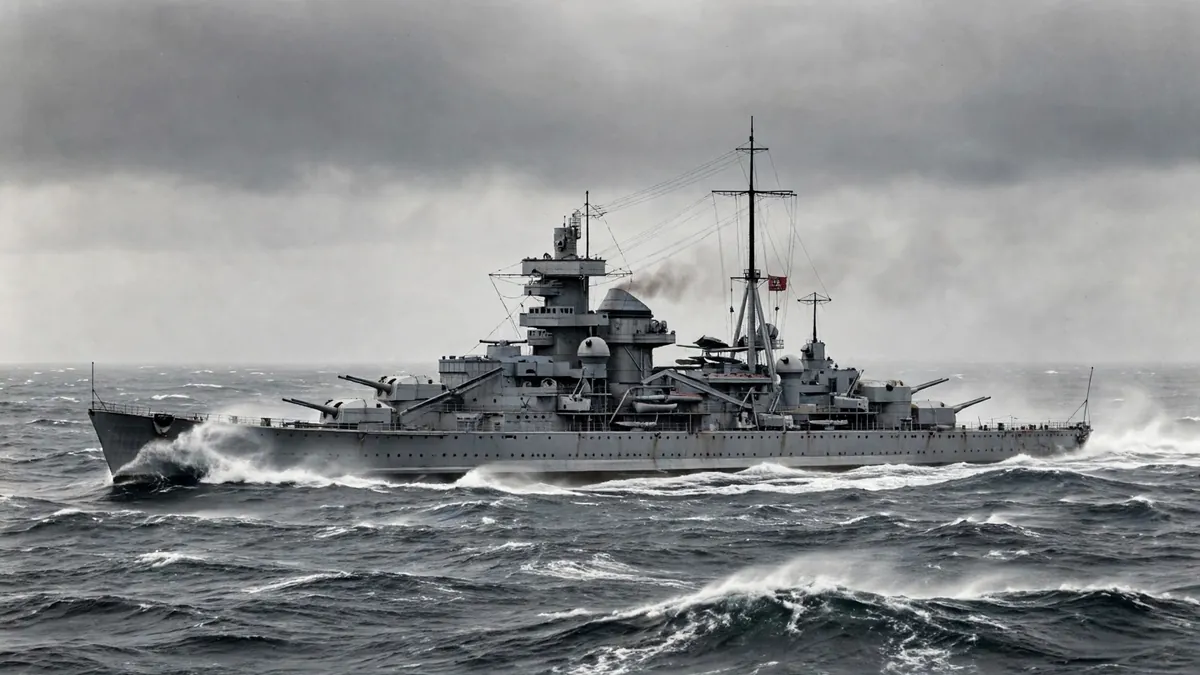
The Admiral Hipper-class cruiser was the Kriegsmarine’s heavy cruiser design of the Second World War, and the most powerful surface warships Germany completed before the war apart from its battleships. Five ships were built: Admiral Hipper, Blücher, Prinz Eugen, Seydlitz and Lützow.
Three of them entered service and fought in the Atlantic, the Arctic and the Baltic; one was sunk on her first operation, one was converted into an aircraft carrier that was never finished, and one was sold to the Soviet Union before completion.
The class embodied both the ambition and the contradictions of German naval policy in the 1930s: ships designed to outgun any cruiser they might meet and to outrun any battleship that could catch them, built under treaty limits that forced their designers into compromises, and operated by a navy that never had enough of them to use them as they were intended.
The best known of the class is Prinz Eugen, which sailed with the battleship Bismarck on her fatal Atlantic sortie in May 1941, survived the war, and ended her life as a target ship in the American atomic tests at Bikini Atoll in 1946.
The most tragic is Blücher, sunk in Oslo Fjord on 9 April 1940 by Norwegian coastal guns and torpedoes on the first day of the invasion of Norway, with the loss of about 1,000 men. The most active is Admiral Hipper herself, which raided Allied shipping in the Atlantic and the Arctic, fought in the Battle of the Barents Sea, and ended the war as a wreck in Kiel.
Together, the five ships tell the story of the German surface fleet in miniature: ambitious, technically accomplished, and ultimately too few and too late to change the course of the war at sea.
2. Key Facts
| Class | Admiral Hipper-class heavy cruiser, Kriegsmarine |
| Built | 1935–1940; 5 ships laid down, 3 completed as cruisers |
| Ships | Admiral Hipper, Blücher, Prinz Eugen, Seydlitz (carrier conversion, unfinished), Lützow (sold to USSR) |
| Displacement | About 14,050 tons standard; about 18,200 tons full load |
| Length | About 205.9 m (675 ft 6 in) |
| Speed | About 32.5 knots |
| Main armament | 8 × 203 mm (8-inch) guns in four twin turrets |
| Secondary armament | 12 × 105 mm guns; 12 × 37 mm; 8 × 20 mm; 12 torpedo tubes |
| Armour / Giáp | Belt 70–80 mm; deck 20–50 mm; turrets up to 105 mm |
| Aircraft | 3 Arado Ar 196 floatplanes, 1 catapult |
| Complement | About 1,382–1,600 officers and men |
3. Design and Development
Treaty limits and the 10,000-ton fiction
The Admiral Hipper class was designed under the Washington Naval Treaty system, which limited heavy cruisers to 10,000 tons standard displacement and 8-inch guns. Germany, which had been bound by the Treaty of Versailles to a navy of 10,000-ton “pocket battleships”, signed the Anglo-German Naval Agreement in 1935, which allowed it to build up to 35 per cent of British naval strength — including five heavy cruisers of nominally 10,000 tons.
The German designers, like the designers of every other navy, treated the 10,000-ton limit as a fiction: the Hipper class was designed at about 14,000 tons standard and completed at more than 18,000 tons full load, and the fiction was maintained only in official publications.
The extra weight bought speed, armour and habitability, but it also meant that Germany built five heavy cruisers when its treaty allowance, honestly counted, would have allowed fewer.
Hull, propulsion and protection
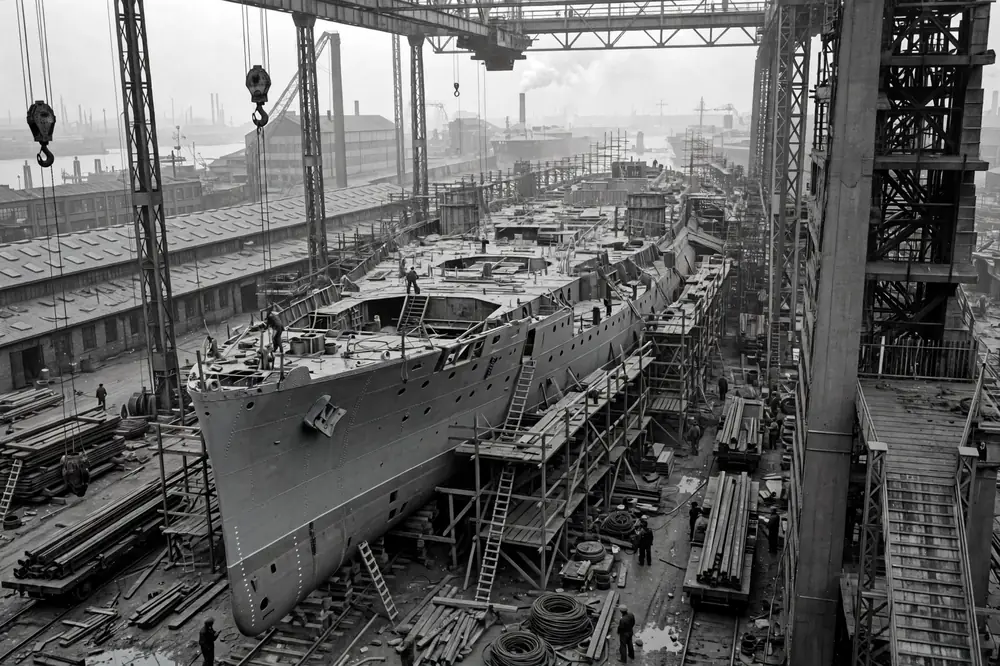
The Hipper-class hull was about 206 metres long, with a raked Atlantic bow and a high freeboard that made the ships good sea boats. Propulsion was by three sets of geared steam turbines driving three shafts, producing about 132,000 shaft horsepower and a designed speed of 32.5 knots — fast enough to outrun any battleship except the newest fast battleships, and fast enough to catch any merchant ship.
The machinery, however, was unreliable: the high-pressure steam plant was complex and prone to breakdowns, and the ships spent a great deal of their service lives in dockyard hands. Protection was a compromise: an 80 mm armoured belt, a 20–50 mm armoured deck, and turret armour of up to 105 mm — enough to resist 8-inch shells at long range and 6-inch shells at any range, but not enough to stand in a gun duel with a battleship.
The design accepted that a heavy cruiser’s defence was its speed, not its armour.
The five ships
The five ships of the class were laid down between 1935 and 1937 at Blohm & Voss in Hamburg and the Deutsche Werke yard in Kiel. Admiral Hipper was commissioned in April 1939, Blücher in September 1939, and Prinz Eugen in August 1940. Seydlitz was launched in 1939 but never completed as a cruiser: in 1942 she was selected for conversion into an aircraft carrier, a project that consumed scarce resources and was abandoned unfinished in 1943. Lützow was sold to the Soviet Union in February 1940 under the Molotov–Ribbentrop Pact, towed to Leningrad incomplete, and renamed Petropavlovsk; she was later renamed Tallinn and never completed as a cruiser, serving instead as a floating battery during the siege of Leningrad.
Of the five ships, therefore, only three ever fought as the cruisers they were designed to be.
4. Armament and Sensors
The 8-inch main battery
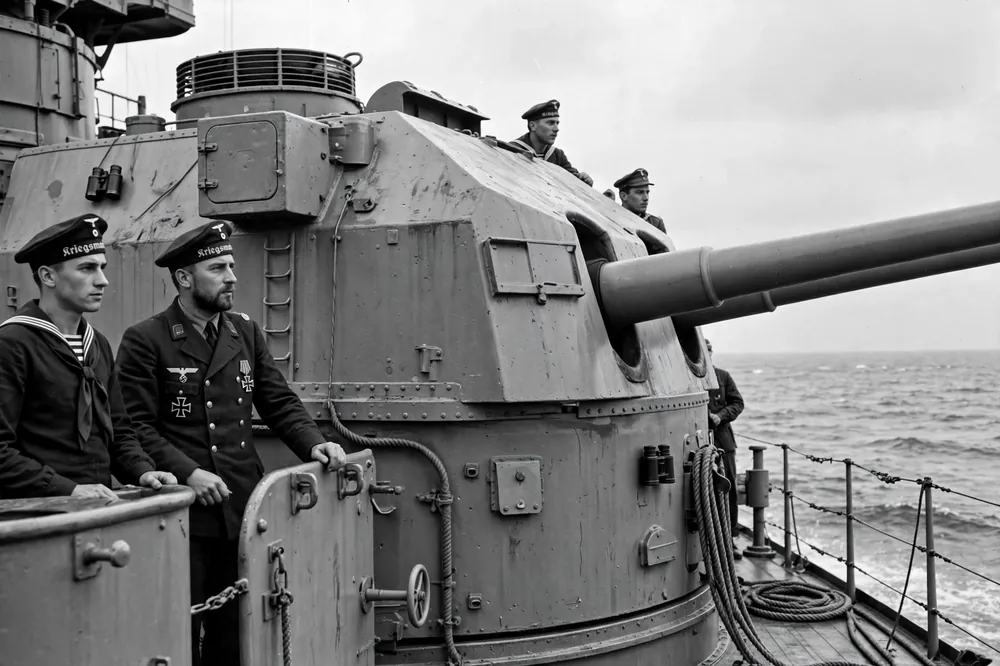
The main armament of the Hipper class was eight 203 mm (8-inch) guns in four twin turrets, two forward and two aft. The guns were among the best 8-inch weapons of the war: they fired a 122-kilogram shell to a range of about 33,500 metres, and they were accurate, hard-hitting and fast-firing for their calibre.
The turrets were electrically trained and elevated, and the fire-control system, with its rangefinders and director, was sophisticated for its day. In action, the 8-inch battery proved effective against merchant ships, destroyers and cruisers, and it was the weapon that made the Hipper class a threat to any convoy it could catch.
The class’s weakness was not its guns but its numbers: eight guns on a single ship were formidable, but Germany had only three such ships in service at any one time, and they could not be everywhere.
Anti-aircraft guns and torpedoes
The secondary armament was twelve 105 mm dual-purpose guns in six twin mountings, intended for use against both surface targets and aircraft, together with twelve 37 mm and eight 20 mm anti-aircraft guns — a fit that was adequate in 1939 but increasingly inadequate as the air threat grew, and the ships received additional 20 mm and 37 mm guns during the war.
The class also carried twelve 533 mm torpedo tubes in four triple mountings, two on each side, a heavy torpedo armament for a cruiser that reflected German doctrine: the cruiser was expected to fight at close range, and its torpedoes were a weapon for use against battleships and carriers.
The ships also carried three Arado Ar 196 floatplanes, launched from a catapult amidships, for reconnaissance and spotting — aircraft that proved useful in the Atlantic and the Arctic, where the cruisers often operated far from land-based air cover.
Radar and fire control
German radar, the FuMO 22 and later the FuMO 27, was fitted to the Hipper-class ships from the start, and it gave them a surface-search capability that was ahead of most of their opponents in 1939–1940. The radar was used for navigation, for detecting convoys at night and in poor weather, and for fire control, and it was one of the reasons the Hipper class was so dangerous as a commerce raider.
The fire-control system, centred on the foretop director with its large rangefinders, was excellent, and the ships’ gunnery in action — notably Prinz Eugen‘s shooting at HMS Hood and HMS Prince of Wales in the Denmark Strait — was accurate and effective.
The weakness was that German radar development lagged behind the British after 1941, and by 1943 the British ships the Hippers faced had better radar and better gunnery radar than the German ships did.
5. Admiral Hipper in the Atlantic and Arctic
The first Atlantic sortie
Admiral Hipper was the most active ship of the class. In December 1940 she sailed into the Atlantic on a commerce-raiding cruise, and on Christmas Day 1940 she attacked convoy WS 5A, sinking one transport and damaging several others before being driven off by the escorting cruisers.
In February 1941 she sailed again, and this time she found convoy SLS 64, unescorted, in the Atlantic: in a single action she sank seven merchant ships totalling about 33,000 tons, and returned to Brest without damage. The two sorties showed what the class could do — and what it could not do. Hipper could destroy an unescorted convoy, but she could not stand up to a properly escorted convoy, and she could not stay at sea for long: her unreliable machinery and her heavy fuel consumption limited her endurance, and she spent as much time in dockyard hands as she did at sea.
The Battle of the Barents Sea
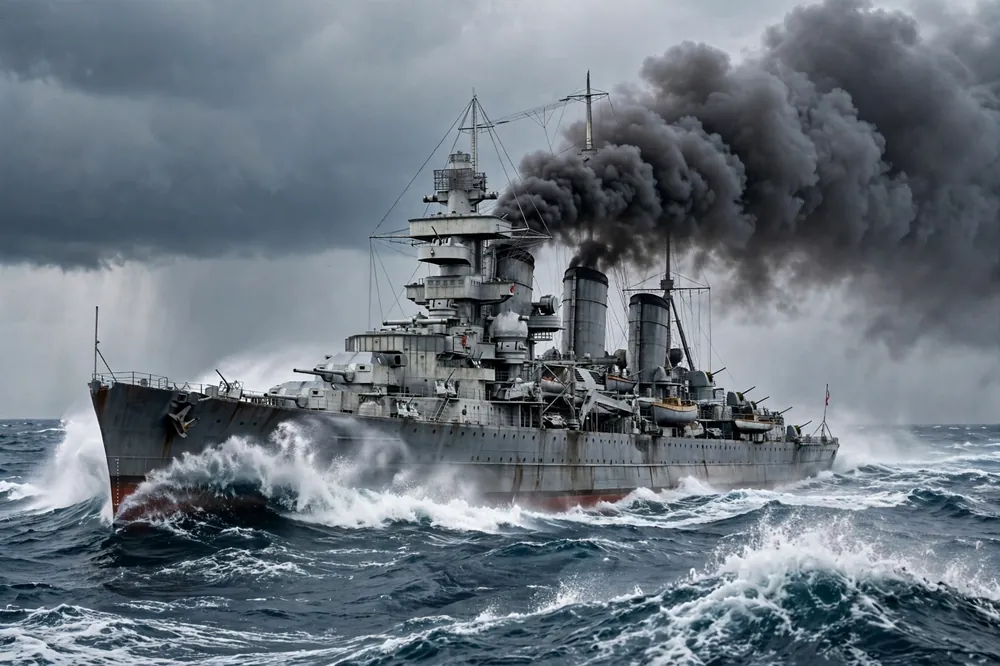
Admiral Hipper‘s most famous action was the Battle of the Barents Sea on 31 December 1942, when she and the pocket battleship Lützow attacked the Arctic convoy JW 51B. The convoy was escorted by destroyers and two light cruisers, HMS Sheffield and HMS Jamaica, and in a confused action fought in darkness and snow, Hipper sank the destroyer HMS Achates and the minesweeper HMS Bramble, but she was damaged by Sheffield and Jamaica and forced to withdraw without reaching the merchant ships.
The German destroyer Friedrich Eckoldt was sunk, and the convoy got through intact. The battle was a tactical failure for the Germans and a strategic disaster: Hitler, furious at the failure of the surface fleet, ordered the scrapping of the big ships, and Grand Admiral Erich Raeder resigned. Hipper herself was damaged, and she never fully recovered: she spent the rest of the war in refit or in the Baltic, and she was scuttled at Kiel in May 1945.
6. Blücher and the Invasion of Norway
The sinking in Oslo Fjord
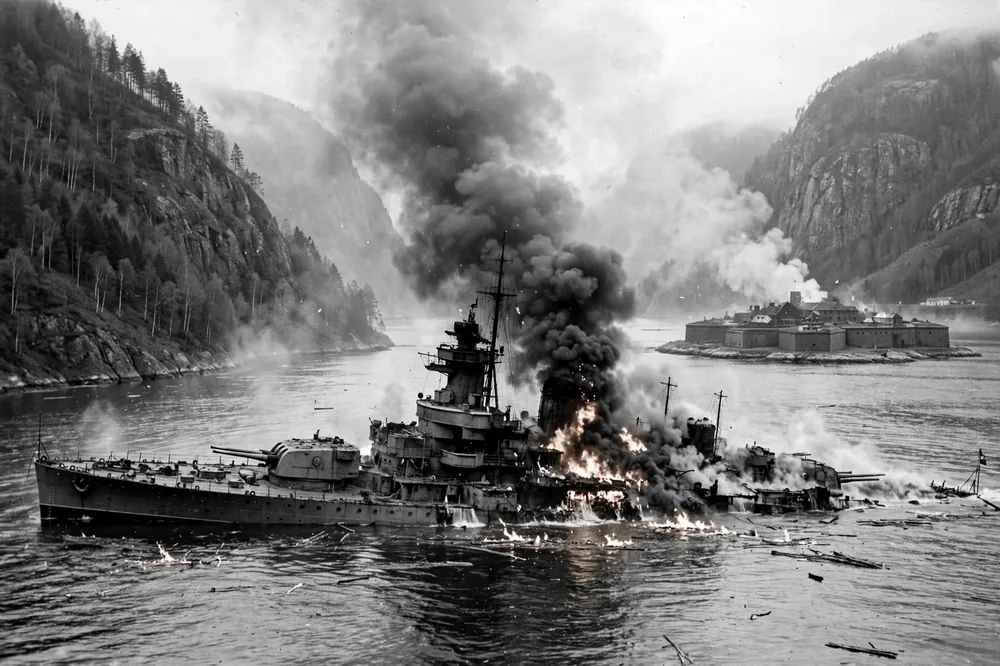
Blücher‘s career lasted less than a day. On 9 April 1940, as the flagship of the German invasion force for Oslo, she led a group of warships up Oslo Fjord in darkness, carrying troops intended to seize the Norwegian capital.
At the Oscarsborg fortress, the Norwegian coastal guns opened fire: two old 28 cm Krupp guns, installed in the 1890s and manned by a scratch crew, hit Blücher at close range, and torpedoes from a shore battery finished her. The ship caught fire, her magazines exploded, and she capsized and sank with the loss of about 800–1,000 men, including many of the troops she carried.
The delay caused by her sinking gave the Norwegian government and the royal family time to escape Oslo, and it gave the Allies time to land troops in Norway. Blücher‘s loss was a shock to the Kriegsmarine, and a reminder that a modern warship, however powerful, was vulnerable to a well-sited coastal battery.
The wreck and its legacy
Blücher‘s wreck lies in Oslo Fjord to this day, in about 90 metres of water, and it has become a symbol of Norwegian resistance. The wreck still contains oil, and in the 1990s the Norwegian authorities removed much of the fuel to prevent pollution.
The loss of Blücher also had a lasting effect on German naval thinking: it showed that the heavy cruiser, for all its speed and firepower, was not a ship for forcing a defended narrows, and it reinforced the caution that already characterised German surface operations.
For Norway, the sinking is remembered as the moment the invasion was delayed long enough for the country to fight on — and as the action of a handful of Norwegian gunners, led by Colonel Birger Eriksen, who opened fire on their own initiative and changed the course of the invasion.
7. Prinz Eugen and the Bismarck Operation
The Denmark Strait
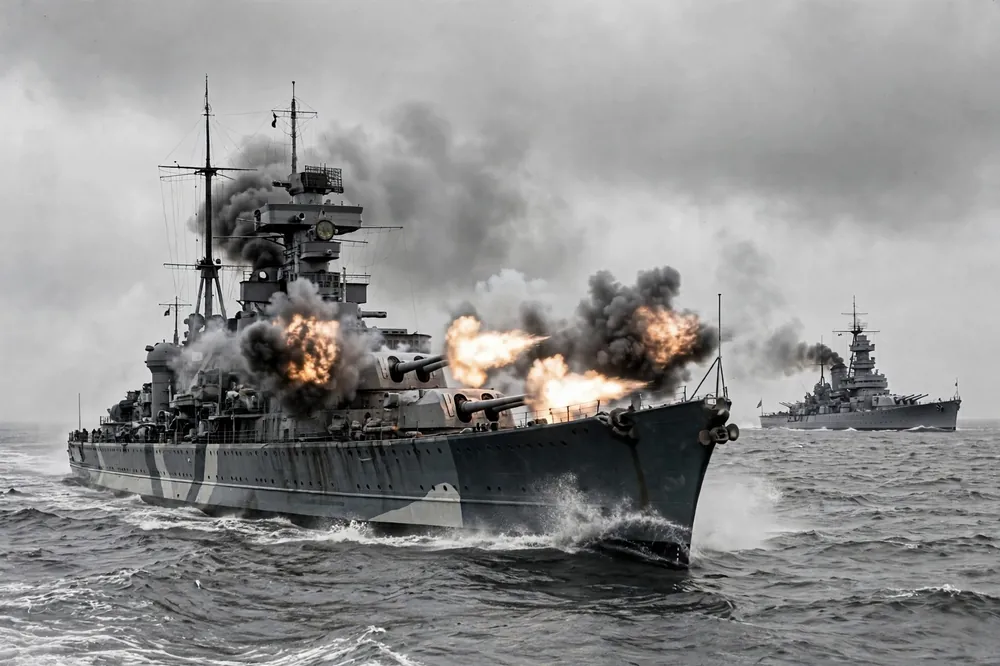
Prinz Eugen‘s most famous operation was Operation Rheinübung, the Atlantic sortie of May 1941 in company with the battleship Bismarck. Prinz Eugen sailed as Bismarck‘s consort, and in the Denmark Strait on 24 May 1941 she fought alongside Bismarck against the battlecruiser HMS Hood and the battleship HMS Prince of Wales. Prinz Eugen‘s gunnery was accurate — her shells are credited with starting the fire on Hood that preceded the magazine explosion that destroyed the ship — and she emerged from the action undamaged. After the battle, Prinz Eugen separated from Bismarck to raid shipping independently, while Bismarck was hunted down and sunk. Prinz Eugen reached Brest safely, and she had survived the operation that killed her consort.
The Channel Dash and the Baltic
In February 1942, Prinz Eugen took part in the Channel Dash — Operation Cerberus — in which the German battleships Scharnhorst and Gneisenau and Prinz Eugen herself sailed from Brest to Germany through the English Channel in broad daylight, under the noses of the British.
The operation was a propaganda triumph and a tactical success, though Prinz Eugen was torpedoed by the British submarine HMS Trident on the way home and spent months in repair. For the rest of the war, Prinz Eugen served in the Baltic, supporting the German army against the Soviet advance, bombarding Soviet positions along the coast, and evacuating German troops and civilians from East Prussia in 1945.
She was the only major German surface ship to survive the war in operational condition, and she was surrendered to the British at Copenhagen in May 1945.
Bikini Atoll
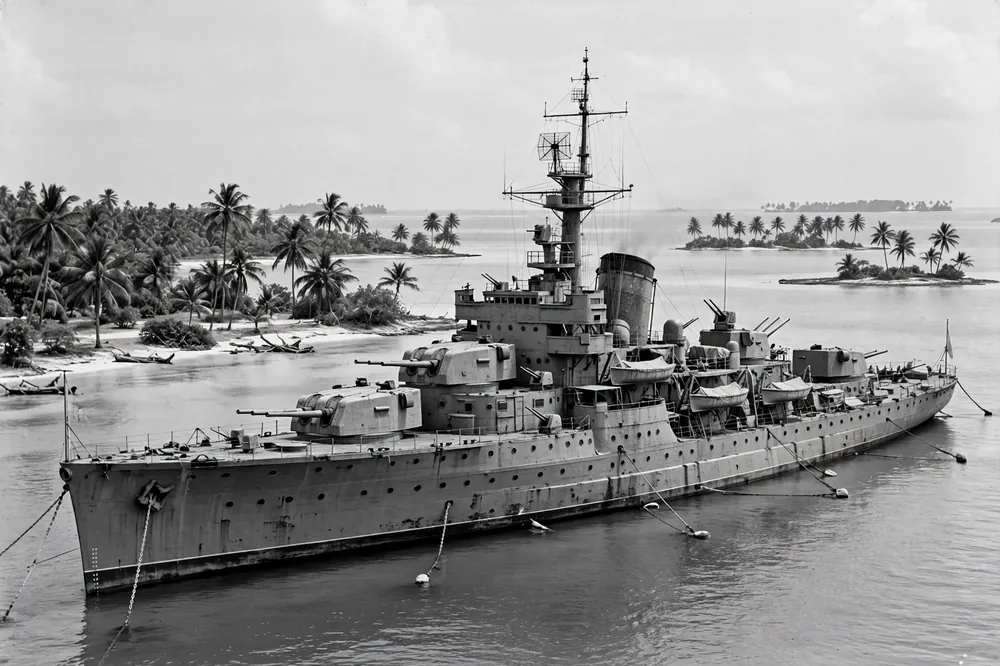
Prinz Eugen‘s final chapter was as an American prize. Transferred to the United States after the war, she was used as a target ship in the atomic bomb tests at Bikini Atoll in July 1946 — Operation Crossroads. She survived both the airburst and the underwater test, though she was heavily contaminated, and she was towed to Kwajalein Atoll, where she capsized and sank in December 1946.
Her wreck remains there today, upside down in shallow water, with one of her propellers still visible above the surface at low tide. Prinz Eugen is the best-known ship of the class, and her survival through the war and her death in the atomic age make her a symbol of the transition from the battleship era to the nuclear era.
8. Seydlitz and Lützow: The Unfinished Ships
Seydlitz and the carrier conversion
Seydlitz was launched in January 1939 but never completed as a cruiser. In 1942, after the loss of the battleship Bismarck and the failure of the surface fleet, the Kriegsmarine decided to convert her into an aircraft carrier — a decision that reflected the growing recognition that aircraft carriers, not heavy cruisers, were the future of naval warfare.
The conversion was ambitious: it required removing the cruiser’s superstructure, fitting a flight deck and hangar, and installing new machinery. The work proceeded slowly, hampered by material shortages and by the competing demands of the U-boat programme, and it was abandoned in 1943 when the hull was about 95 per cent complete as a carrier. Seydlitz was scuttled at Königsberg in January 1945 to prevent her capture by the Soviets, and her wreck was later scrapped by the Soviet Union.
Lützow and the Soviet Union
Lützow was sold to the Soviet Union in February 1940, before she was completed, as part of the economic and military cooperation that followed the Molotov–Ribbentrop Pact. She was towed to Leningrad, where Soviet workers were to complete her with German assistance, but the German invasion of the Soviet Union in June 1941 ended the cooperation, and the ship was never completed.
Renamed Petropavlovsk and later Tallinn, she served as a floating battery during the siege of Leningrad, her 8-inch guns firing at German positions from the Neva. After the war she was used as a training hulk, and she was scrapped in the late 1950s. Lützow‘s career is a footnote to the class’s history, but it is a revealing one: the ship that was supposed to be a German cruiser ended her life as a Soviet gun platform, a victim of the alliance that had sold her and of the war that had destroyed it.
9. Operations in the Baltic
Shore bombardment and evacuation
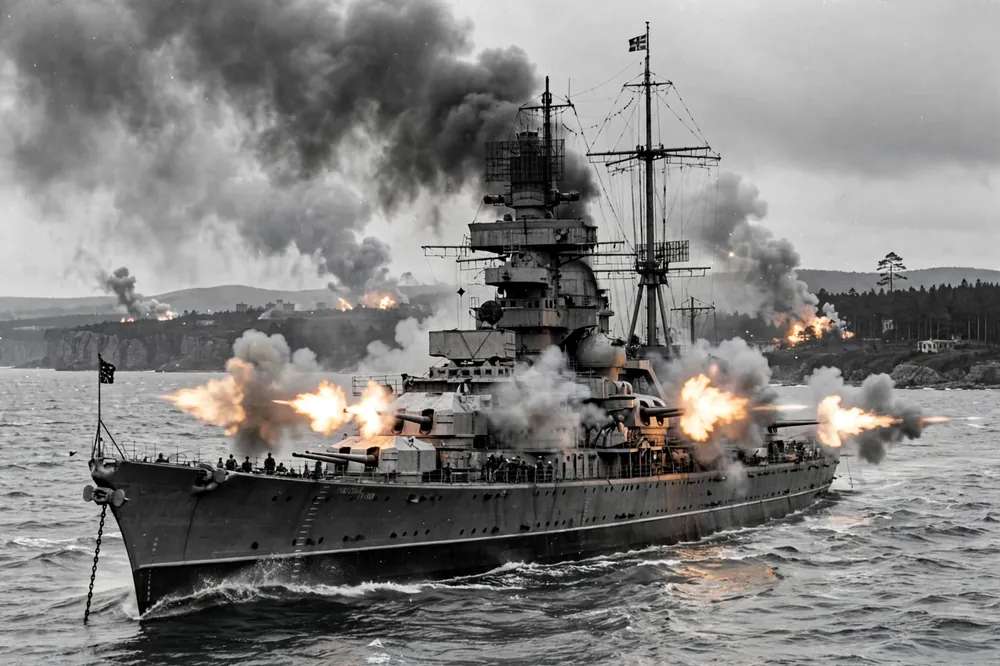
In the last two years of the war, the surviving Hipper-class ships — Admiral Hipper and Prinz Eugen — served in the Baltic, where their 8-inch guns were used to support the German army against the Soviet advance along the coast.
The work was unglamorous but important: the cruisers bombarded Soviet positions, covered the retreat of German troops, and protected the evacuation convoys that carried German soldiers and civilians from East Prussia and Courland to Germany in 1945. Prinz Eugen fired thousands of 8-inch shells in support of the army, and her guns were among the heaviest the Germans could bring to bear on the Baltic coast.
The Baltic service showed the class in a role its designers had never intended — as a floating artillery battery — but it was a role the ships performed well, and it was the last service of the German surface fleet.
The end of the class
Admiral Hipper was badly damaged by Royal Air Force bombers at Kiel in April 1945 and was scuttled in May 1945; her wreck was raised and scrapped after the war. Prinz Eugen, as described above, survived to become an American atomic test target. Blücher lay in Oslo Fjord. Seydlitz was scuttled at Königsberg. Lützow was scrapped in the Soviet Union.
Of the five ships, none survives today except as a wreck, and the class exists now only in photographs, in models, and in the memory of the men who served in her. The end of the Hipper class was the end of the German heavy cruiser as a type, and the end of the Kriegsmarine’s ambition to build a balanced surface fleet.
10. Assessment and Legacy
The Admiral Hipper class was a good design built for the wrong war. The ships were fast, well-armed and well-built, and their 8-inch guns were among the best of their calibre. But they were built in too small numbers, their machinery was unreliable, and they were operated by a navy that had no clear doctrine for their use and no air cover to protect them.
The class’s most successful operations — Hipper‘s destruction of convoy SLS 64, Prinz Eugen‘s part in the sinking of Hood — were tactical successes that changed nothing strategically, because Germany never had enough heavy cruisers to sustain a commerce-raiding campaign.
The ships were, in the end, a luxury that a navy built around U-boats could not afford, and their story is a cautionary tale about building expensive ships without a strategy to use them.
The class’s legacy is a mixed one. Technically, the Hipper class influenced post-war cruiser design, and its machinery problems taught the German navy — and the navies that studied it — hard lessons about the limits of high-pressure steam plant. Historically, the class is remembered for Prinz Eugen and Blücher, for the Denmark Strait and Oslo Fjord, and for the Channel Dash.
The ships themselves are gone, but their names live on in naval history, and the Hipper class remains the standard against which German cruiser design is judged. For the historian of the war at sea, the class is a reminder that a navy is not measured by the quality of its individual ships, but by the coherence of its strategy — and that the Kriegsmarine, for all its technical skill, never had a strategy that its surface ships could win.
11. Frequently Asked Questions
How many Admiral Hipper-class cruisers were built?
Five ships were laid down: Admiral Hipper, Blücher, Prinz Eugen, Seydlitz and Lützow. Only three were completed as cruisers and entered service — Admiral Hipper, Blücher and Prinz Eugen. Seydlitz was converted into an aircraft carrier that was never finished, and Lützow was sold to the Soviet Union before completion. The figures matter because they show how small the class was: only three of the five ships fought as cruisers. The two unfinished ships — Seydlitz, turned into a carrier that was never completed, and Lützow, sold to the Soviet Union — are as much a part of the class’s story as the three that served.
What sank the Blücher?
Blücher was sunk on 9 April 1940 in Oslo Fjord by the Norwegian coastal fortress at Oscarsborg. Two old 28 cm Krupp guns hit her at close range, and torpedoes from a shore battery finished her. She capsized and sank with the loss of about 800–1,000 men, on the first day of the German invasion of Norway. The sinking mattered because it happened on the first day of the invasion of Norway, and it showed that a modern cruiser could be destroyed by old guns and torpedoes in a narrow fjord. Blücher’s loss was one of the heaviest losses of the Norwegian campaign.
What happened to Prinz Eugen after the war?
Prinz Eugen was surrendered to the British at Copenhagen in May 1945 and transferred to the United States as a war prize. She was used as a target ship in the atomic bomb tests at Bikini Atoll in July 1946, survived both tests, and was towed to Kwajalein Atoll, where she capsized and sank in December 1946. Her wreck remains there today. Her survival is remarkable: she survived two atomic bomb tests at Bikini Atoll, when the bombs were meant to destroy her, and she was only lost when she capsized at Kwajalein months later.
How did the Hipper class compare with British heavy cruisers?
The Hipper class was larger, faster and more heavily armed than most British heavy cruisers, such as the County class, and its 8-inch guns were excellent. However, British cruisers were built in much larger numbers, they were supported by a far larger navy with aircraft carriers and air cover, and by 1943 British radar and gunnery were superior. The Hipper class was individually formidable but strategically outnumbered. The comparison shows the limits of building fine ships in small numbers: individually, the Hipper class was formidable, but it fought a navy that could replace its losses and cover its cruisers with carriers and aircraft.
Why was Seydlitz never finished?
Seydlitz was launched in 1939 but her completion as a cruiser was delayed, and in 1942 she was selected for conversion into an aircraft carrier. The conversion consumed scarce materials and labour, it competed with the U-boat programme, and it was abandoned in 1943 when the hull was about 95 per cent complete as a carrier. She was scuttled at Königsberg in January 1945. The conversion shows how Germany’s priorities changed during the war: the carrier was begun when the surface fleet still mattered, and it was abandoned when the U-boat programme took the steel and the labour.
What was the Battle of the Barents Sea?
The Battle of the Barents Sea, fought on 31 December 1942, was the action in which Admiral Hipper and the pocket battleship Lützow attacked the Arctic convoy JW 51B. The convoy’s destroyer escort and two British light cruisers fought them off, Hipper was damaged, a German destroyer was sunk, and the convoy got through intact. The failure enraged Hitler, led to the resignation of Grand Admiral Raeder, and marked the effective end of the German surface fleet as an offensive force.
12. Sources
- Wikipedia, “Admiral Hipper-class cruiser” — construction figures, dimensions, armament and individual ship histories.
- Gerhard Koop and Klaus-Peter Schmolke, Heavy Cruisers of the Admiral Hipper Class (Naval Institute Press, 2001) — design, construction and service of all five ships.
- Norman Friedman, Naval Weapons of World War One and British Cruisers of World War Two (Seaforth) — comparative cruiser design and armament.
- Jak P. Mallmann Showell, German Naval Code Breakers and The German Navy in World War Two (Naval Institute Press) — Kriegsmarine operations and the surface fleet.
- Vincent P. O’Hara, The German Fleet at War, 1939–1945 (Naval Institute Press, 2004) — operations of the Hipper class in the Atlantic, Arctic and Baltic.
- Geirr H. Haarr, The German Invasion of Norway, April 1940 (Seaforth, 2009) — the sinking of Blücher at Oscarsborg.
- Siegfried Breyer, Battleships and Battle Cruisers 1905–1970 (Doubleday, 1973).
- M. J. Whitley, German Cruisers of World War Two (Naval Institute Press, 1995).