 WAR ATLAS MILITARY HISTORY MAGAZINE · WWI — WWII
T-28 Tank
1. Lead
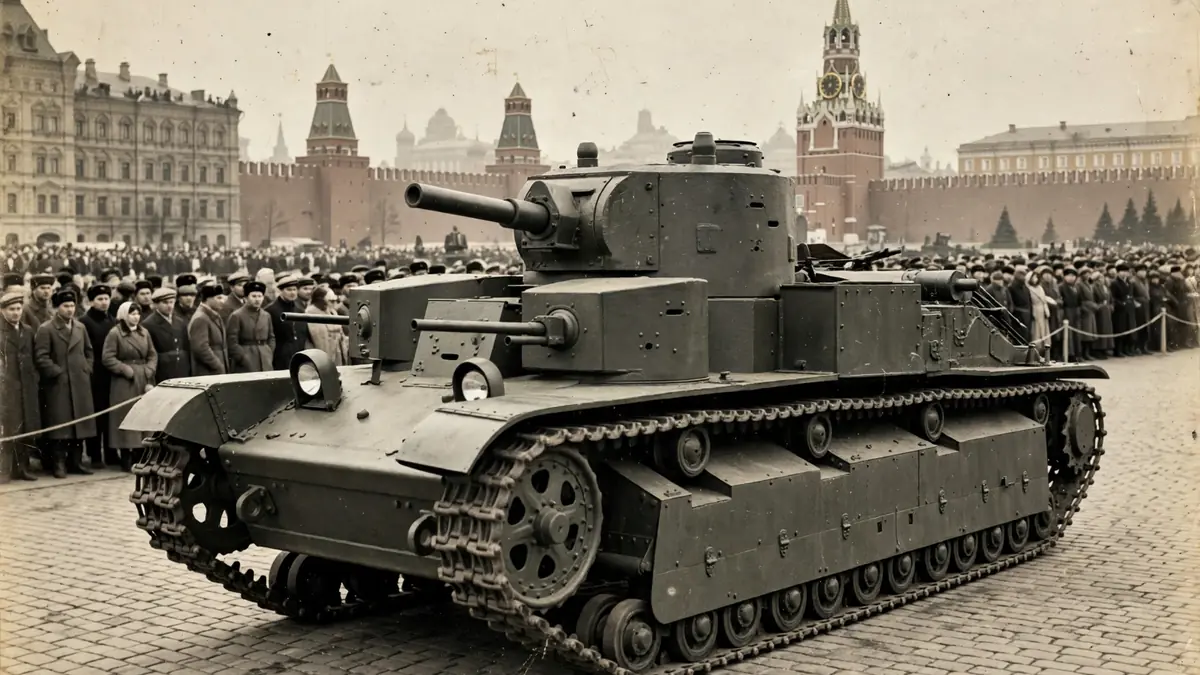
The T-28 was one of the strangest tanks ever to enter mass production: a Soviet medium tank with three turrets, a crew of six, and a silhouette that looked like a battleship on tracks. Designed in the early 1930s, when the Soviet Union was still learning how to build tanks and when the multi-turreted tank was fashionable in every army in Europe, the T-28 was intended to break through enemy defences, supporting the infantry with fire from its 76.2 mm main gun and its two machine-gun turrets.
A total of 503 T-28s were built between 1933 and 1940, and they served in the Soviet invasion of Poland in 1939, in the Winter War against Finland in 1939–1940, and in the first desperate months of the German invasion in 1941, where they were outclassed by the newer German tanks and destroyed in large numbers.
By the end of 1941 the T-28 was effectively extinct, and only a handful survive today. The T-28’s story is the story of an idea that seemed modern in 1932 and obsolete by 1940, and of a tank that was a symbol of Soviet ambition in the 1930s and a casualty of the war that followed.
2. Key Facts
The table below summarises the T-28 in its main production form, with the principal figures for the type.
| Type | Medium tank, multi-turreted |
| Country of origin | Soviet Union (Kirov Plant, Leningrad) |
| Designer | Semyon Ginzburg and the Kirov design bureau |
| Entered service | 1933 |
| Number built | 503 (1933–1940) |
| Crew / Kíp lái | 6 (commander, gunner, loader, driver, 2 machine gunners) |
| Weight | About 28 tons |
| Length | 7.44 m (24 ft 5 in) / 7,44 m |
| Width | 2.87 m (9 ft 5 in) / 2,87 m |
| Height | 2.82 m (9 ft 3 in) / 2,82 m |
| Engine | M-17L V-12 petrol, 500 hp |
| Speed | About 23 mph (37 km/h) on roads |
| Range | About 140 miles (220 km) on roads |
| Main gun | 76.2 mm KT-28 (later L-10) |
| Secondary armament | 2 × 7.62 mm DT machine guns in sub-turrets; 1–2 more DT in hull |
| Armour / Giáp | 20–30 mm (later up-armoured to 50–80 mm on T-28E) |
3. Background
3.1. The multi-turret fashion of the 1930s
The T-28 was a product of a fashion that swept through tank design in the early 1930s: the multi-turreted tank. The idea was simple and, at the time, persuasive: a tank with several turrets could engage several targets at once, it could fire in several directions, and it could support the infantry with a volume of fire that no single-turreted tank could match.
The British built the Vickers A1E1 Independent, a five-turreted tank that was never mass-produced but that influenced designers around the world; the Germans built the Neubaufahrzeug, a three-turreted tank that was built in small numbers; and the Soviets built the T-28 and its larger brother, the T-35, a five-turreted heavy tank.
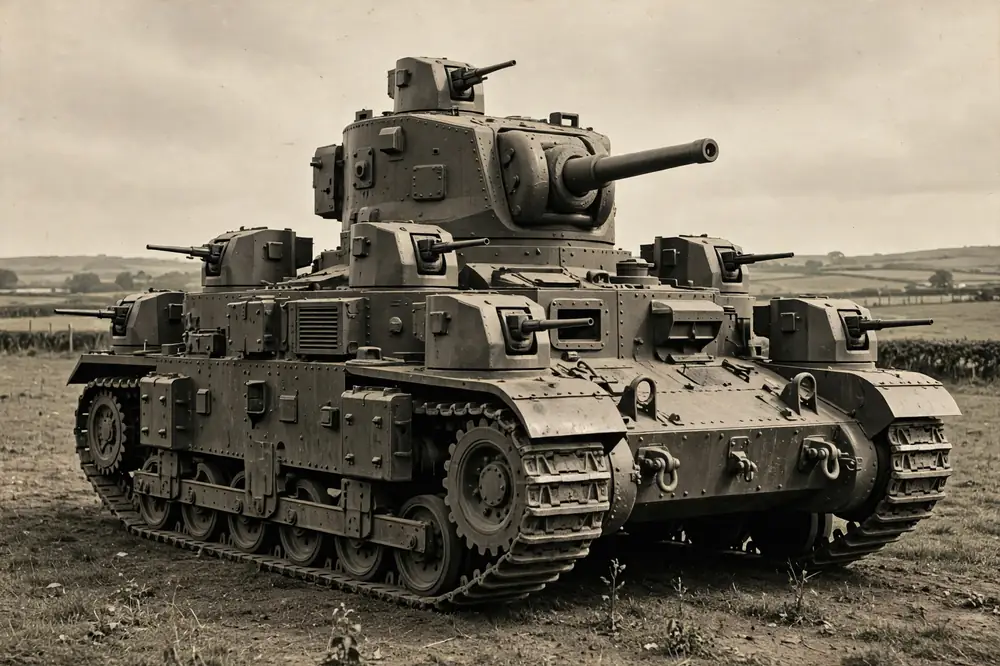
The multi-turreted tank was a response to the tactical thinking of the period, which imagined the tank as a mobile fortress that would break through enemy defences and then fight in all directions, and which had not yet grasped the importance of the single, powerful gun in a single, well-armoured turret.
By the end of the 1930s the fashion had passed, and the multi-turreted tank was recognised as a dead end: it was too large, too heavy, too complex, and its firepower was spread too thinly to be effective. The T-28 was one of the last multi-turreted tanks to enter mass production, and its career was a demonstration of the idea’s limits.
3.2. The Soviet tank programme and the Kirov Plant
The T-28 was designed at the Kirov Plant in Leningrad, the Soviet Union’s most important tank factory, under the direction of Semyon Ginzburg, one of the leading Soviet tank designers of the period. The design was influenced by the British Vickers A1E1 Independent, which the Soviets had studied, and by the Soviet T-35, which was being designed at the same time, and it was intended to be a medium tank that could be built in large numbers, unlike the T-35, which was a heavy tank that was built in only 61 examples.
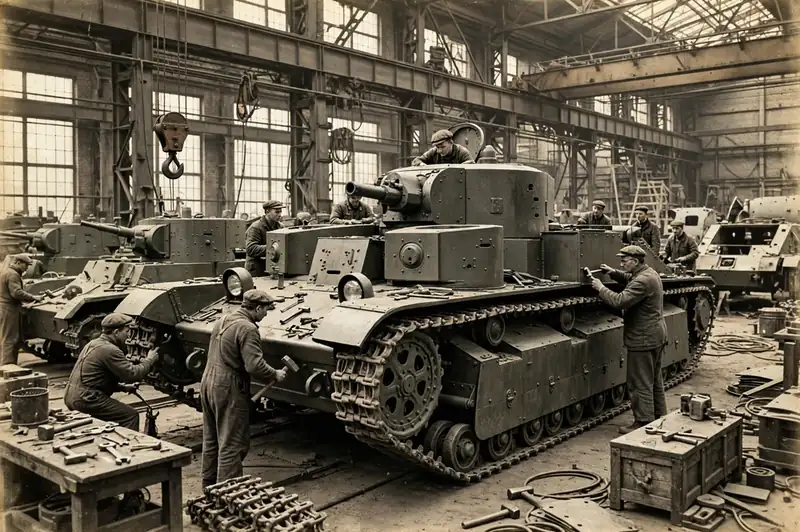
The T-28’s design was finalised in 1932, and the first production tanks were delivered in 1933, at a time when the Soviet Union was industrialising rapidly and when the Red Army was expanding its armoured forces. The T-28 was one of the first Soviet tanks to be designed and built entirely in the Soviet Union, without foreign assistance, and it was a symbol of Soviet industrial ambition, a tank that was meant to show that the Soviet Union could build a modern medium tank of its own design.
The tank’s production was slow, however, and only 503 were built in seven years, a small number beside the thousands of T-26 light tanks and BT fast tanks that were built in the same period.
3.3. The T-28 in the Red Army of the 1930s
In the Red Army of the 1930s, the T-28 was a prestige weapon, issued to the independent tank brigades and to the mechanised corps that were the spearhead of the Soviet deep-battle doctrine. The tank’s three turrets and its large size made it an impressive sight on parade, and it was prominently displayed in the May Day parades in Moscow, where it was presented as evidence of Soviet military power.
In service, however, the T-28 was less impressive: it was mechanically unreliable, it was difficult to maintain, and its crew of six was hard to train and to coordinate, because the commander had to direct three turrets and a driver, a task that was beyond the capabilities of most Soviet tank commanders of the period.
The T-28’s armour was thin — 20 to 30 millimetres — and it was vulnerable to anti-tank guns, and its 76.2 mm gun, though powerful, was a short-barrelled howitzer-type weapon that was designed for infantry support rather than for tank fighting, and it could not penetrate the armour of the newer German tanks.
The T-28’s service in the 1930s was therefore a mixture of prestige and practicality, and the tank’s limitations were exposed as soon as it went into combat.
4. Design and Development
4.1. Three turrets and six men
The T-28’s most distinctive feature was its three turrets, and the arrangement of those turrets defined the tank’s design and its limitations. The main turret, in the centre of the hull, carried the 76.2 mm gun and a coaxial machine gun, and it was manned by the commander, the gunner and the loader.
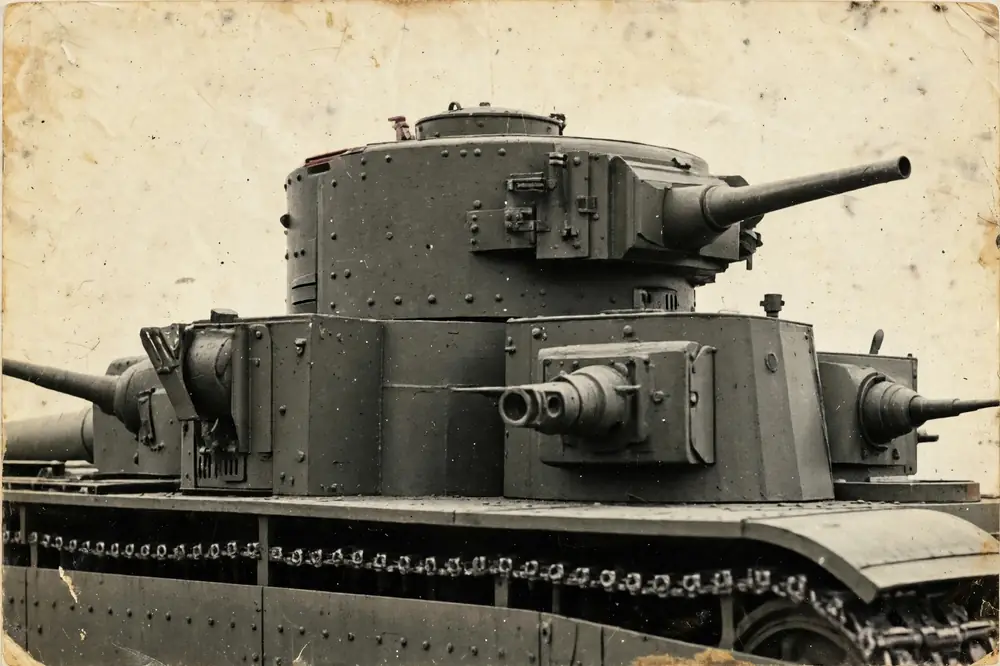
The two sub-turrets, one in front of the main turret and one behind it, each carried a single 7.62 mm DT machine gun, and each was manned by a machine gunner. The driver sat in the front of the hull.
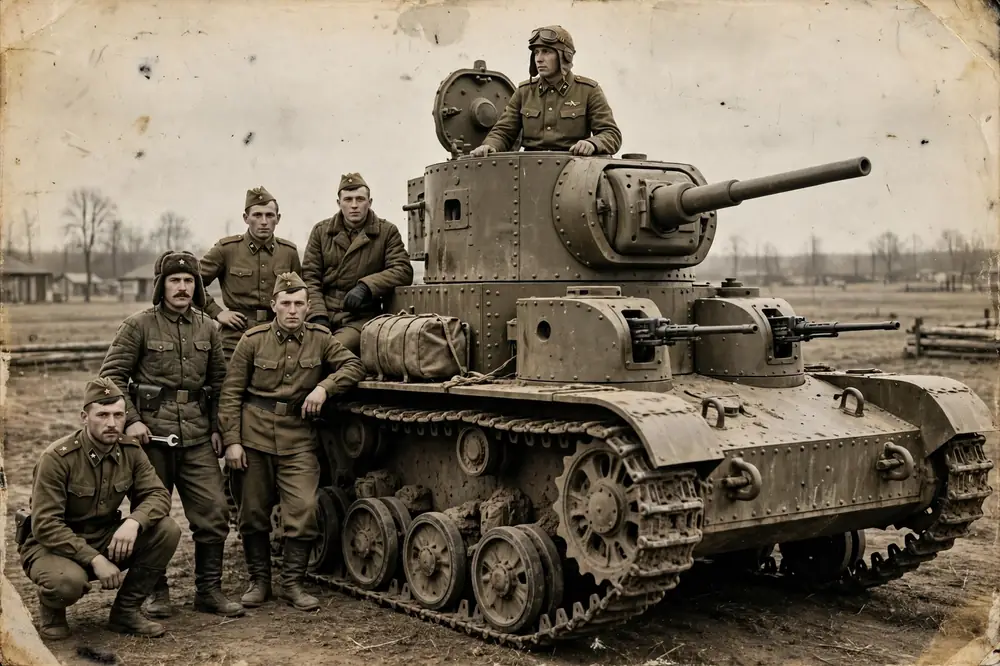
In the vehicles that carried a radio — which was not always the case — the commander in the main turret usually operated it himself; there was no separate radio operator in most T-28s. The arrangement gave the tank a formidable volume of fire: it could engage targets in three directions at once, and it could suppress infantry and anti-tank guns with its machine guns while its main gun engaged bunkers and strongpoints.
But the arrangement also had serious drawbacks: the tank was large and tall, which made it an easy target; the crew of six was large and hard to coordinate; the sub-turrets had limited traverse and limited elevation; and the tank’s weight was spread across a large hull, which made it slow and which limited its armour.
The three-turret layout was the T-28’s defining feature, and it was also its fatal flaw.
4.1.1. Command and control in a three-turret tank
Commanding a T-28 was one of the most difficult jobs in the Red Army, and it illustrates why the multi-turreted tank was abandoned. The commander sat in the main turret, and he had to direct the gunner and the loader in his own turret, the two machine gunners in the sub-turrets, and the driver in the hull, a total of five men, in the noise and confusion of battle, with only a voice tube and hand signals to communicate.
The sub-turret gunners could not see what the commander saw, and they could not hear his orders clearly, and the result was that the sub-turrets were often ineffective, firing at targets that the commander had not designated or failing to fire at targets that he had.
The commander was also the tank’s radio operator in many T-28s, because the tank’s radio — when it was fitted — was in the main turret, and the commander had to operate it while also commanding the tank, a task that was beyond the capabilities of most men.
The Soviet tank commanders who fought in the T-28 were brave and determined, but they were fighting a design that made their job almost impossible, and the T-28’s command problems were one of the reasons the tank performed poorly in combat, even when its gun and its armour should have been adequate.
4.2. The 76.2 mm gun and the machine guns
The T-28’s main armament was the 76.2 mm KT-28 gun, a short-barrelled weapon that was derived from the 76.2 mm regimental gun and that was designed for infantry support rather than for tank fighting. The gun fired a high-explosive shell that was effective against infantry, machine-gun nests and field fortifications, and it could fire an armour-piercing shell that could penetrate about 30 millimetres of armour at 500 metres, which was adequate against the light tanks and armoured cars of the early 1930s but which was inadequate against the newer German tanks of 1941.
Later T-28s were fitted with the longer-barrelled L-10 gun, which had a higher muzzle velocity and better armour penetration, but the improvement was modest, and the T-28’s gun remained a weakness throughout its service life. The tank’s secondary armament consisted of two 7.62 mm DT machine guns in the sub-turrets, one in each, and one or two more DT machine guns in the hull, which gave the tank a total of three or four machine guns and a formidable volume of fire against infantry.
The machine guns were effective, but they were also a symptom of the tank’s design philosophy: the T-28 was built to fight infantry, not tanks, and when it met German tanks in 1941, its gun was inadequate and its armour was too thin.
4.3. Engine, suspension and mobility
The T-28 was powered by a M-17L V-12 petrol engine, which produced 500 horsepower and gave the tank a top speed of about 23 miles per hour on roads and a power-to-weight ratio of about 17.8 horsepower per ton, which was respectable for a tank of the period.
The engine was a development of the BMW VI aircraft engine, built under licence in the Soviet Union, and it was a powerful but thirsty unit, consuming large quantities of petrol and requiring frequent refuelling. The tank’s suspension was a coil-spring system with eight small road wheels per side, which gave it a smooth ride but which was complex and difficult to maintain, and the tank’s tracks were narrow, which gave it a high ground pressure and which made it prone to bogging down in mud and snow.
The T-28’s mobility was adequate for the operations of the 1930s, but it was poor by the standards of 1941, when the tank had to operate in the mud and snow of the Eastern Front, and its narrow tracks and its high ground pressure were a serious handicap.
The tank’s range was about 140 miles on roads, which was adequate, but its fuel consumption was high, and its engine was prone to overheating, which limited its practical mobility.
5. Technical Specifications
5.1. Dimensions and weight
The T-28 measured 7.44 metres in length, 2.87 metres in width and 2.82 metres in height, and it weighed about 28 tons in combat order, which made it heavier than the T-26 light tank, at about 10 tons, and heavier than the BT fast tank, at about 14 tons, but lighter than the T-35 heavy tank, at about 45 tons.
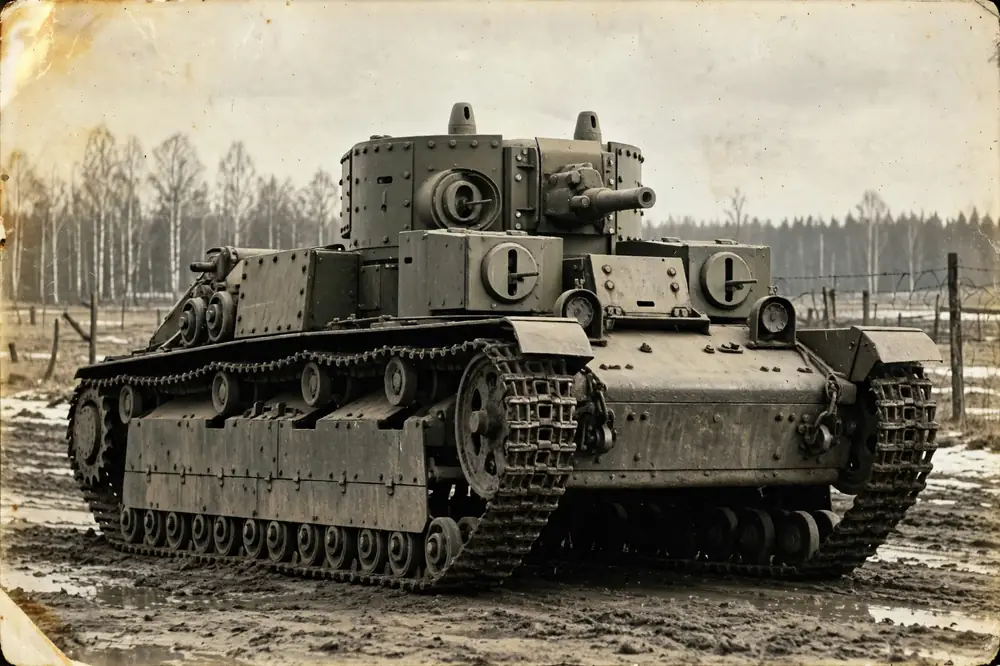
The tank’s size was a consequence of its three turrets: the hull had to be long enough to accommodate the main turret and the two sub-turrets, and the result was a tank that was large for a medium tank, but that was still smaller than the T-35.
The T-28’s ground pressure was high, because its tracks were narrow, and it was prone to bogging down in soft ground, a weakness that was exposed in the Winter War, when the tank had to operate in the snow and the forests of Finland.
The tank carried 69 rounds of 76.2 mm ammunition and about 8,000 rounds of 7.62 mm machine-gun ammunition, which gave it a substantial ammunition load, though the stowage of the ammunition was cramped and the loader had difficulty reaching the rounds in combat. The crew of six was large, and it made the tank’s interior crowded, which reduced the crew’s efficiency and made the tank’s operation more difficult.
5.2. Armour and protection
The T-28’s armour was thin by the standards of 1941, and it was the tank’s most serious weakness. The glacis plate was 30 millimetres thick, the turret front was 30 millimetres thick, and the sides and rear were 20 millimetres thick, which was adequate against rifle fire and machine-gun fire, but which was inadequate against anti-tank guns, which could penetrate the T-28’s armour at long range.
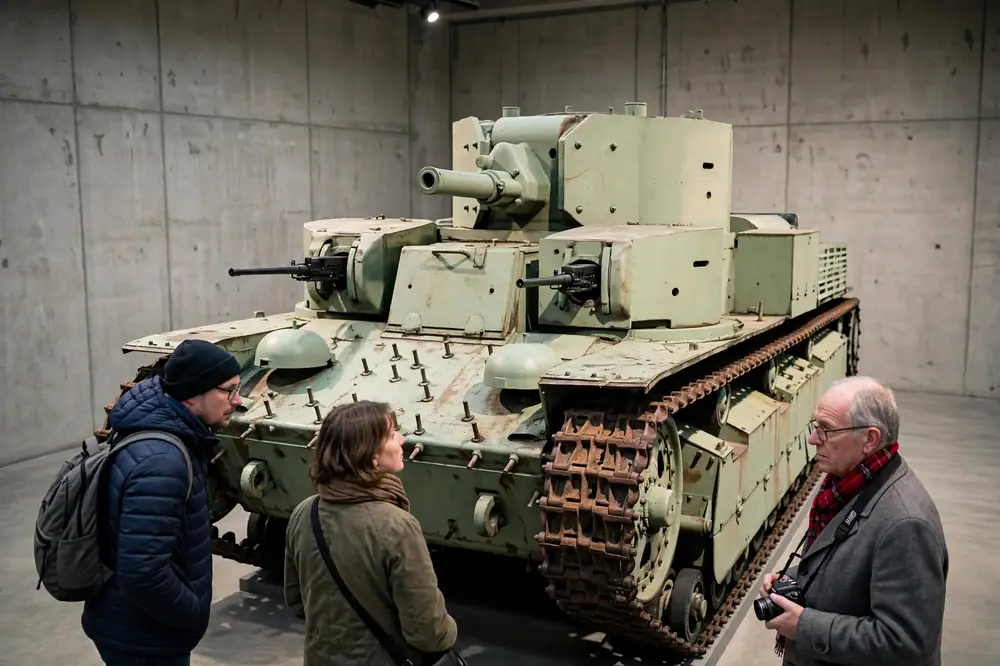
The Winter War exposed the armour’s weakness, when Finnish anti-tank guns destroyed large numbers of T-28s, and the Soviets responded by fitting some T-28s with additional armour plates, in a version known as the T-28E, which had 50 to 80 millimetres of armour on the front and which was much better protected, though it was also heavier and slower.
The T-28E’s additional armour was bolted onto the existing armour, which gave the tank a distinctive appearance, with plates that stood out from the hull and the turret, and it was a practical solution to a problem that the tank’s designers had not anticipated.
The T-28’s armour was a product of the early 1930s, when anti-tank guns were less powerful, and it was obsolete by 1941, when the German 37 mm and 50 mm anti-tank guns could penetrate it with ease.
| T-28 / T-28 | |
|---|---|
| Weight | About 28 tons |
| Length | 7.44 m (24 ft 5 in) / 7,44 m |
| Width | 2.87 m (9 ft 5 in) / 2,87 m |
| Height | 2.82 m (9 ft 3 in) / 2,82 m |
| Engine | M-17L V-12 petrol, 500 hp |
| Speed | About 23 mph (37 km/h) on roads |
| Range | About 140 miles (220 km) on roads |
| Main gun | 76.2 mm KT-28 (later L-10) |
| Armour / Giáp | 20–30 mm (T-28E: 50–80 mm front) |
| Crew / Kíp lái | 6 |
| Number built | 503 |
5.3. Mobility and reliability
The T-28’s mobility was adequate for the 1930s but poor by the standards of 1941, and its reliability was a constant problem. The tank’s top speed of about 23 miles per hour on roads was respectable, but its cross-country speed was much lower, and its narrow tracks gave it a high ground pressure that made it prone to bogging down in mud and snow.
The M-17 engine was powerful but unreliable, and it was prone to overheating and to failure of its cooling system, particularly in the summer, when the tank’s engine compartment became very hot. The tank’s transmission was a five-speed gearbox that was difficult to operate, and the driver’s position was cramped and uncomfortable, which made long marches exhausting.
The T-28’s reliability was poor, and the tank required frequent maintenance, which was difficult to provide in the field, particularly in the Winter War, when the tanks had to operate in the snow and the forests of Finland, far from their bases.
The T-28’s mobility and reliability were adequate for the parades and the exercises of the 1930s, but they were inadequate for the war that followed, and the tank’s mechanical problems were one of the reasons it was withdrawn from service so quickly.
5.3.1. The Winter War as a test
The Winter War of 1939–1940 was the T-28’s first serious test in combat, and it exposed the tank’s weaknesses in a way that no exercise could have done. The T-28s were committed to the breakthrough of the Mannerheim Line, the Finnish defensive line on the Karelian Isthmus, where they had to operate in deep snow, in forests and in temperatures of minus 30 degrees Celsius, conditions for which the tank had not been designed.
The tanks bogged down in the snow, their engines overheated or failed to start in the cold, and their thin armour was penetrated by Finnish anti-tank guns, which destroyed large numbers of T-28s. The Finnish defenders, who were skilled in winter warfare and who knew the terrain, used Molotov cocktails and satchel charges to destroy T-28s at close range, and the Soviet tank crews, who were poorly trained and who had no experience of winter warfare, suffered heavy losses.
The Winter War was a disaster for the T-28, and it was a disaster for the Red Army as a whole, but it was also a lesson: the Soviets learned from the Winter War, and they applied the lessons to the T-34, which was designed to operate in the conditions that had defeated the T-28.
6. Variants
6.1. The main production models
The T-28 was produced in a series of small batches, and the differences between them were minor, reflecting the tank’s slow and intermittent production. The early T-28s, built in 1933 and 1934, had the short-barrelled KT-28 gun and thin armour, and they were the versions that served in the parades and exercises of the 1930s.
Later production models, built from 1938 onwards, had the longer-barrelled L-10 gun, which had a higher muzzle velocity and better armour penetration, and they had minor improvements to the engine and the transmission. The most important variant was the T-28E, which was produced in 1940 as a response to the Winter War: it had additional armour plates bolted onto the hull and the turret, increasing the frontal armour to 50 to 80 millimetres, and it was much better protected, though it was also heavier and slower.
About 100 T-28s were converted to the T-28E standard, and they were the versions that fought in the first months of the German invasion in 1941, where their thicker armour made them more survivable, though it could not save them from the newer German tanks. The T-28’s production ended in 1940, when the Soviet tank industry shifted to the T-34, and the T-28 was never produced again.
6.2. The T-28E and the end of production
The T-28E was the last variant of the T-28, and it was a practical response to a combat lesson, rather than a new design. The additional armour plates were bolted onto the existing hull and turret, which was a quick and cheap way to improve the tank’s protection, and the T-28E’s frontal armour of 50 to 80 millimetres was enough to resist the Finnish anti-tank guns that had destroyed so many T-28s in the Winter War.
The T-28E was heavier than the standard T-28, at about 32 tons, and it was slower, with a top speed of about 20 miles per hour, but it was more survivable, and it was the version that the Soviet tank crews preferred. The T-28E’s production was limited, because the Soviet tank industry was already shifting to the T-34, and the T-28E was a stopgap, not a new tank.
The T-28’s production ended in 1940, and the Kirov Plant shifted to the production of the KV heavy tank and then to the T-34, and the T-28’s career as a production tank came to an end. The T-28E’s additional armour was a lesson that was applied to the T-34, which was designed with thicker armour from the start, and the T-28’s fate was a reminder that a tank that is designed for one war may not survive the next.
7. Combat Service
7.1. Poland 1939 and the Winter War
The T-28’s first combat service was in the Soviet invasion of Poland in September 1939, where it served with the mechanised corps that advanced into eastern Poland and where it met little resistance, because the Polish Army was already collapsing under the German invasion from the west. The T-28’s service in Poland was brief and uneventful, and it taught the Soviet tank crews little about the tank’s combat capabilities.
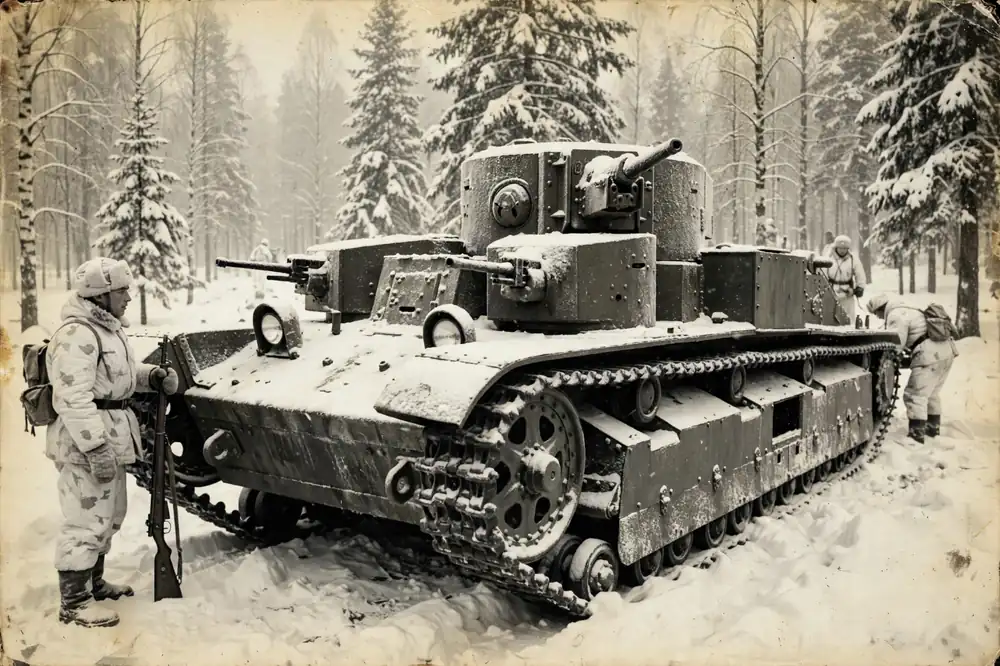
The Winter War against Finland, which began in November 1939, was a different matter: the T-28s were committed to the breakthrough of the Mannerheim Line, where they had to operate in deep snow, in forests and in extreme cold, and where they suffered heavy losses to Finnish anti-tank guns, to Molotov cocktails and to satchel charges.
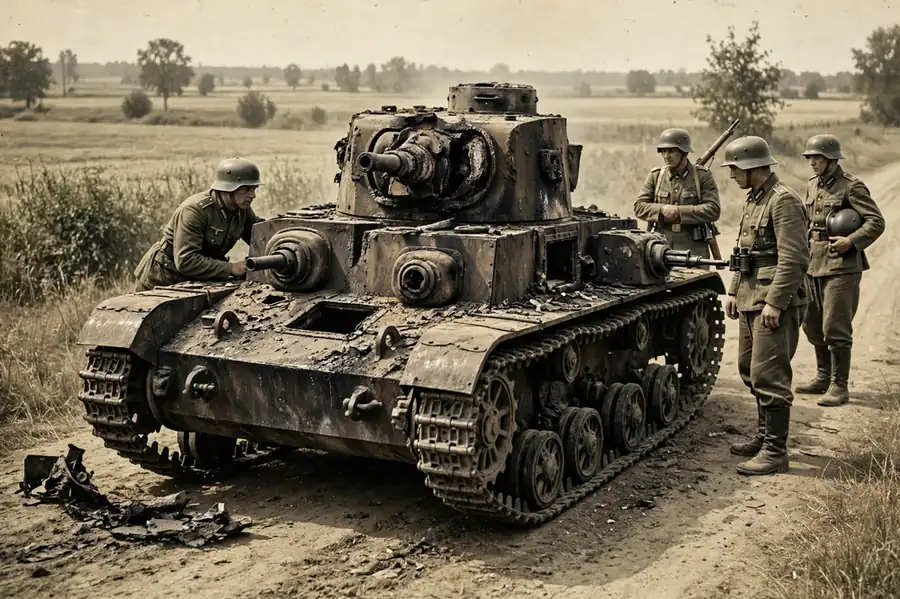
The Finnish defenders destroyed large numbers of T-28s, and the Soviet tank crews learned that their tank’s thin armour and its poor mobility in snow were serious liabilities. The Winter War was the T-28’s first real test, and it failed that test, but the lessons of the Winter War were applied to the T-34, which was designed to operate in the conditions that had defeated the T-28, and the T-28’s failure was therefore not without value.
7.2. Operation Barbarossa, 1941
The T-28’s last combat service was in the first months of the German invasion of the Soviet Union, Operation Barbarossa, which began on 22 June 1941. About 200 T-28s were still in service at the start of the invasion, and they were committed to the desperate defensive battles of the summer of 1941, where they were outclassed by the German Panzer III and Panzer IV and destroyed in large numbers.
The T-28’s thin armour could not resist the German 37 mm and 50 mm anti-tank guns, and its 76.2 mm gun could not penetrate the armour of the newer German tanks at the ranges at which the battles were fought.
The T-28s were also mechanically unreliable, and many were abandoned when they broke down or ran out of fuel, and they were captured by the Germans, who used a small number of them as training vehicles and as armoured recovery vehicles.
By the end of 1941, the T-28 was effectively extinct as a front-line tank, and the survivors were withdrawn to training units and to the Far East, where they served until 1944 in the defence of the Soviet Union’s eastern border.
The T-28’s service in 1941 was a tragedy for its crews, who fought bravely in a tank that was obsolete, and a lesson for the Soviet tank industry, which had already shifted to the T-34.
7.3. Captured T-28s and the Finnish service
The Finns captured a number of T-28s during the Winter War and during the Continuation War of 1941–1944, and they used them in their own army, where the tanks served until 1944 and where they were valued for their 76.2 mm gun and their three turrets, which the Finns found useful for infantry support.
The Finns captured at least seven T-28s, of which two were the up-armoured T-28E, and they used them in the Karelian Isthmus and in the defence of Finland, where the tanks’ thin armour was less of a liability because the Finns used them in defensive positions rather than in mobile warfare.
The Finnish T-28s were maintained by the Finnish Army’s workshops, and they were kept in service until the end of the Continuation War, when they were withdrawn and scrapped, with one survivor preserved in the Parola Tank Museum in Finland.
The Finnish service of the T-28 is a footnote to the tank’s history, but it is a reminder that a tank that is obsolete in one army can be useful in another, and that the T-28’s story did not end with its withdrawal from the Red Army, but continued in the hands of its former enemy.
7.3.1. The Parola survivor
The T-28 preserved at the Parola Tank Museum in Finland is one of only a handful of T-28s to survive, and it is the most complete and the best preserved of them. The tank is a T-28E, the up-armoured version, and it was captured by the Finns during the Continuation War and used by the Finnish Army until 1944, when it was withdrawn and stored.
The tank was restored by the Parola museum, and it is now displayed as an example of the Soviet multi-turreted tank, a reminder of a design philosophy that has long since passed. The Parola T-28 is a popular exhibit, and it is visited by thousands of people each year, who come to see the three turrets and the large, ungainly silhouette that made the T-28 one of the strangest tanks ever built.
The tank’s survival is a testament to the Finnish Army’s care in preserving its captured equipment, and to the interest that the T-28 continues to attract, eighty years after it was built, as a symbol of a vanished era of tank design.
8. Strengths and Weaknesses
8.1. Strengths
The T-28’s strengths were the direct consequence of its design as an infantry-support tank, and they were real, though they were limited to the role for which the tank was designed. Its 76.2 mm gun was effective against infantry, machine-gun nests and field fortifications, and its high-explosive shell was more powerful than the shells of the light tanks and the fast tanks that served alongside it.
Its three turrets gave it a formidable volume of fire, and it could engage targets in three directions at once, which made it effective in the breakthrough role for which it was designed. Its crew of six gave it a large number of men to serve its guns and to maintain the tank, and its size made it an impressive sight, which had a moral effect on the infantry it supported.
The T-28’s strengths were the strengths of a tank designed for the 1930s, when the enemy was expected to be infantry and field fortifications rather than tanks, and they were adequate for that role. The T-28’s failure was not that it lacked strengths, but that the war it fought was not the war it had been designed for.
8.2. Weaknesses
The T-28’s weaknesses were numerous, and they were the reasons it was withdrawn from service so quickly. Its armour was too thin, at 20 to 30 millimetres, and it could be penetrated by anti-tank guns at long range, which made it vulnerable in combat.
Its gun was a short-barrelled howitzer-type weapon that was designed for infantry support, and it could not penetrate the armour of the newer German tanks, which made it ineffective in tank fighting. Its three turrets made it large, tall and easy to hit, and they made the commander’s job almost impossible, because he had to direct five men in three turrets and a driver.
Its mechanical reliability was poor, its engine was prone to overheating, and its narrow tracks gave it a high ground pressure that made it prone to bogging down in mud and snow. Its production was slow, with only 503 built in seven years, and its crew of six was hard to train and to coordinate.
The T-28’s weaknesses were the weaknesses of a design that was obsolete before it entered service, and they were the reasons the tank’s career was so short.
9. Comparison with Rivals
9.1. Against the T-34
The T-28’s most important comparison is with the T-34, the tank that replaced it, and the comparison shows why the T-28 was obsolete. The T-34 was faster, better armoured and better armed than the T-28, and it was simpler, more reliable and cheaper to build.
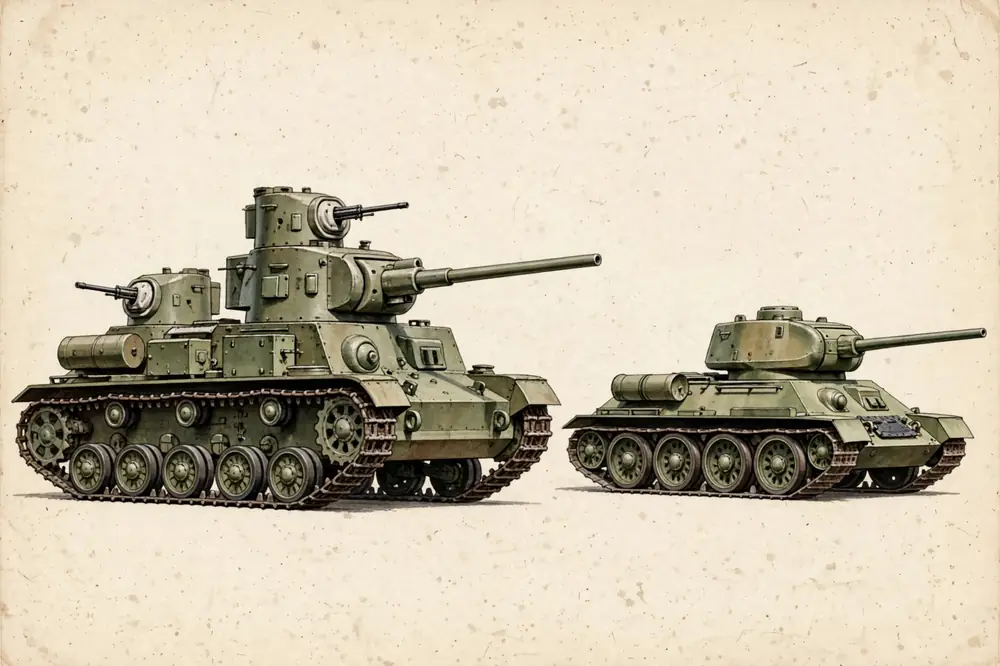
The T-34’s sloped armour was 45 millimetres thick, against the T-28’s 20 to 30 millimetres, and it could resist the German 37 mm anti-tank gun at all ranges, while the T-28’s armour could be penetrated at long range. The T-34’s 76.2 mm gun was a long-barrelled weapon with a higher muzzle velocity and better armour penetration than the T-28’s short-barrelled gun, and it could destroy German tanks at ranges where the T-28 could not.
The T-34’s single turret was easier to command than the T-28’s three turrets, and its crew of four was easier to train than the T-28’s crew of six. The T-34 was built in numbers — more than 35,000 — that dwarfed the T-28’s 503, and it became the most important Soviet tank of the war.
The T-28’s failure and the T-34’s success were two sides of the same lesson: the future of the tank lay in a single, powerful gun in a single, well-armoured turret, not in three turrets and a large crew.
9.2. Against the German Panzer III and Panzer IV
Against the German Panzer III and Panzer IV, the T-28 was outclassed, and the comparison shows why the tank was destroyed in such numbers in 1941. The Panzer III’s 50 mm gun could penetrate the T-28’s armour at long range, while the T-28’s 76.2 mm gun could not penetrate the Panzer III’s frontal armour at the ranges at which the battles were fought.
The Panzer IV’s 75 mm gun was even more effective, and it could destroy a T-28 at ranges of more than 1,000 metres. The German tanks were faster, more reliable and better commanded than the T-28, and their crews were better trained and had more combat experience.
The T-28’s three turrets, which were meant to give it a volume of fire, were a liability in tank fighting, because the tank’s commander could not direct them effectively, and the tank’s large size made it an easy target for the German gunners.
The T-28’s service in 1941 was a demonstration of the gap between Soviet tank design in the 1930s and German tank design in 1941, a gap that the T-34 closed and that the T-28 could not.
10. Legacy
10.1. The end of the multi-turreted tank
The T-28’s legacy is the end of the multi-turreted tank, and it is a legacy that is shared with the T-35 and with the British and German multi-turreted tanks of the same period. The T-28’s failure in combat, and the T-34’s success, demonstrated that the future of the tank lay in a single turret with a single, powerful gun, and that the multi-turreted tank was a dead end.
The T-28’s lessons were applied to the T-34, which was designed with a single turret, with sloped armour and with a long-barrelled gun, and which became the most successful tank of the war. The T-28’s legacy is therefore not the tank itself, but the lesson that it taught: that a tank’s firepower should be concentrated in a single gun, that its armour should be sloped and thick, and that its crew should be small and well-trained.
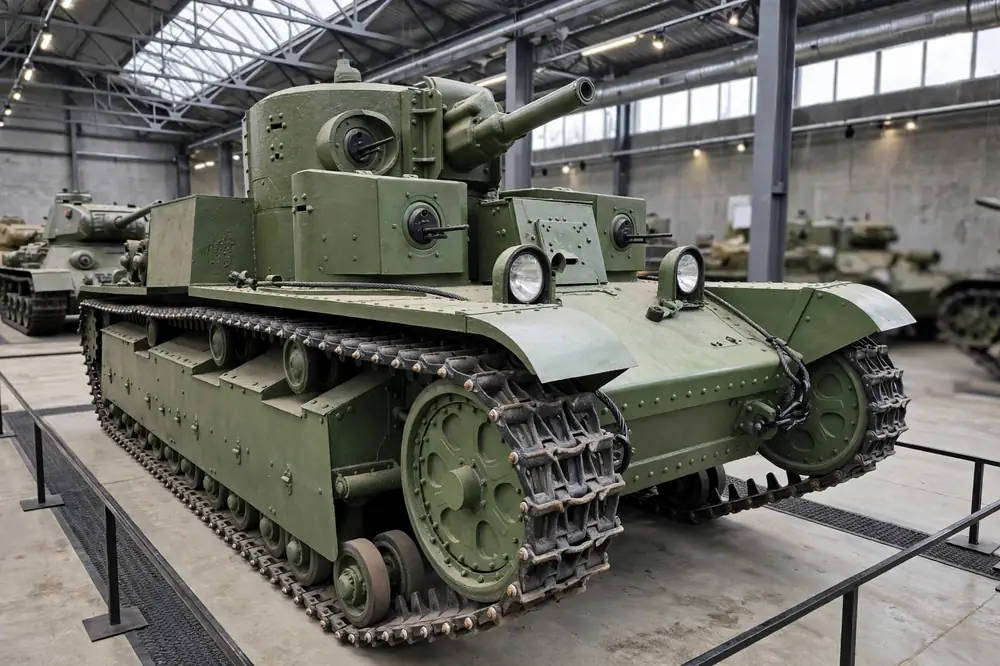
The T-28’s failure was a necessary step on the road to the T-34, and its story is a reminder that the history of tank design is a history of ideas that are tried, that fail, and that are replaced by better ideas.
10.2. Survivors and memory
Only a handful of T-28s survive today, and they are among the rarest tanks of the Second World War. The most famous survivor is the T-28E at the Parola Tank Museum in Finland, which was captured by the Finns and which is the best-preserved T-28 in the world.
Other survivors are held in the Central Armed Forces Museum in Moscow, in the Kubinka Tank Museum, and in private collections, and they are visited by enthusiasts who come to see the three turrets and the strange, battleship-like silhouette that made the T-28 one of the most distinctive tanks ever built.
The T-28’s place in popular memory is as a curiosity, a tank that looks like it came from a different era, and that is exactly what it was: a tank of the 1930s, designed for a war that never came, and destroyed in a war for which it was not designed.
The T-28’s memory is a reminder of the Soviet Union’s ambition in the 1930s, and of the price that ambition paid when the war came.
11. Frequently Asked Questions
How many T-28 tanks were built?
A total of 503 T-28s were built between 1933 and 1940 at the Kirov Plant in Leningrad, a small number beside the thousands of T-26 and BT tanks built in the same period.
Why did the T-28 have three turrets?
Because the multi-turreted tank was fashionable in the early 1930s, and designers believed that several turrets would allow a tank to engage several targets at once and to support the infantry with a greater volume of fire. The idea proved to be a dead end, and the T-28 was one of the last multi-turreted tanks to enter mass production.
What gun did the T-28 carry?
The 76.2 mm KT-28, a short-barrelled gun designed for infantry support, later replaced by the longer-barrelled L-10. The gun was effective against infantry and fortifications but could not penetrate the armour of the newer German tanks.
When did the T-28 see combat?
In the Soviet invasion of Poland in 1939, in the Winter War against Finland in 1939–1940, and in the first months of the German invasion in 1941. By the end of 1941 the T-28 was effectively extinct as a front-line tank.
How many T-28s survive today?
Only a handful survive, of which the best-preserved is the T-28E at the Parola Tank Museum in Finland, captured by the Finns during the Continuation War. Others are held in Moscow and Kubinka.
What replaced the T-28?
The T-34 medium tank, which was faster, better armoured and better armed, and which was built in numbers — more than 35,000 — that dwarfed the T-28’s 503. The T-34’s lessons were learned from the T-28’s failure.
12. Sources
- Wikipedia, “T-28 (medium tank)” — production total of 503, the three-turret layout, the Winter War and service history.
- Steven J. Zaloga, Soviet Tanks and Combat Vehicles of World War Two (Arms and Armour Press, 1984) — the T-28, the T-35 and the Soviet tank programme of the 1930s.
- Parola Tank Museum, T-28E collection records — the Finnish-captured survivor and its history.
- Mikhail Baryatinskiy, Soviet Medium Tanks (Ian Allan, 2007) — the T-28, the T-28E and the transition to the T-34.
- David R. Higgins, T-34 vs Panther (Osprey Duel, 2013) — the T-28 as the predecessor of the T-34.
- Central Armed Forces Museum, Moscow, T-28 collection records — the surviving T-28s in Russia.
Further reading
- James Kinnear, Soviet T-28 Medium Tank (Osprey New Vanguard, 2014).
- Artem Drabkin, T-34 in Action (Pen and Sword, 2008).