 WAR ATLAS MILITARY HISTORY MAGAZINE · WWI — WWII
FG 42
1. Lead
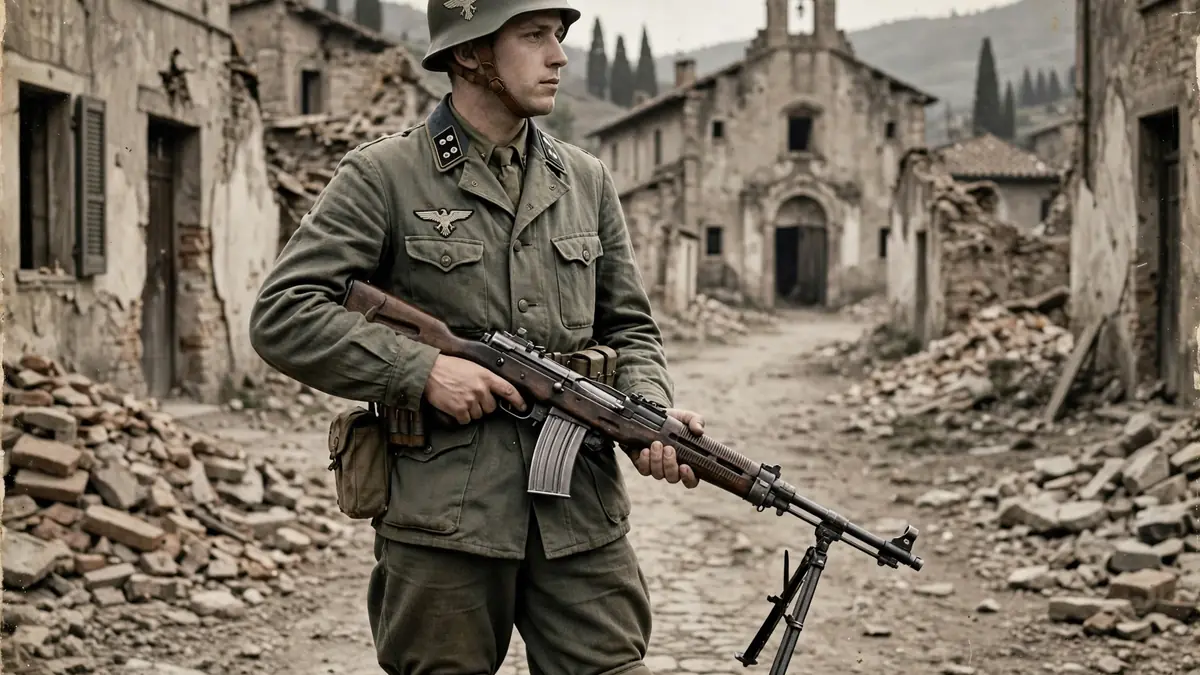
The FG 42 — Fallschirmjägergewehr 42, the paratrooper rifle of 1942 — was one of the most advanced infantry weapons of the Second World War, and one of the rarest. It was a selective-fire automatic rifle, chambered for the full-power 7.92×57 mm Mauser cartridge, that combined the firepower of a light machine gun with the handling of a rifle, and it was designed for a single, specific purpose: to give German paratroopers, who jumped with only the weapons they could carry, a rifle that could do the work of a rifle, a submachine gun and a light machine gun, all in one weapon.
Only about 7,000 FG 42s were built, in two main types, and they served with the Luftwaffe’s Fallschirmjäger divisions in Italy, in Normandy and on the Eastern Front, where they earned a reputation as a superb but complex weapon, loved by the men who carried it and feared by the men who faced it.
The FG 42’s influence far outlived its service: its gas system, its layout and its concept were studied by the Allies after the war, and they influenced the design of the American M60 machine gun, the British EM-2 and the modern assault rifle.
The FG 42 was a weapon ahead of its time, built in numbers too small to change the war, but large enough to change the future of infantry weapons.
2. Key Facts
The table below summarises the FG 42 in its main production forms, the early Type I and the later Type II.
| Type | Selective-fire automatic rifle |
| Country of origin | Germany (Rheinmetall, Krieghoff, L. O. Dietrich) |
| Designer | Louis Stange (Rheinmetall) / Louis Stange (Rheinmetall) |
| Entered service | 1942–1943 / 1942–1943 |
| Number built | About 7,000 (Type I about 2,000; Type II about 5,000) |
| Calibre | 7.92×57 mm Mauser / 7,92×57 mm Mauser |
| Weight | About 9.3 lb (4.2 kg) unloaded (Type II) |
| Length | About 37 in (940 mm) (Type II) |
| Barrel length | 20 in (500 mm) / 500 mm |
| Rate of fire | About 750–900 rounds per minute (automatic) |
| Muzzle velocity | About 2,460 ft/s (750 m/s) |
| Feed | 10- or 20-round detachable box magazine, side-mounted |
| Effective range | About 500 yards (450 m) automatic; 800 yards (730 m) semi-automatic |
| Sights | Iron sights; ZF 4 telescopic sight on many examples |
3. Background
3.1. Crete and the paratrooper’s problem
The FG 42 was born from the Battle of Crete in May 1941, where the German Fallschirmjäger won a costly victory that exposed a serious weakness in their equipment. The German paratroopers jumped with only a pistol and a knife, because their rifles and machine guns were dropped separately in containers, and many paratroopers were killed while trying to reach their weapons, which had landed far from them or had been captured by the enemy.
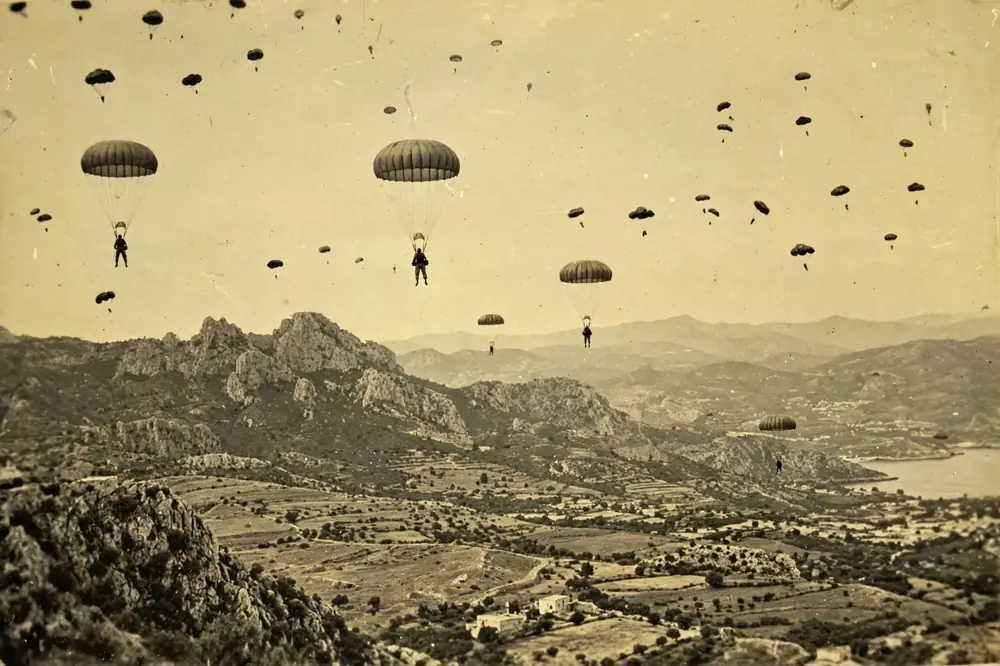
The losses at Crete were so heavy — about 6,000 casualties, including about 4,000 killed — that Hitler forbade large-scale airborne operations for the rest of the war, but the Luftwaffe’s paratrooper arm, under General Kurt Student, was determined to solve the problem.
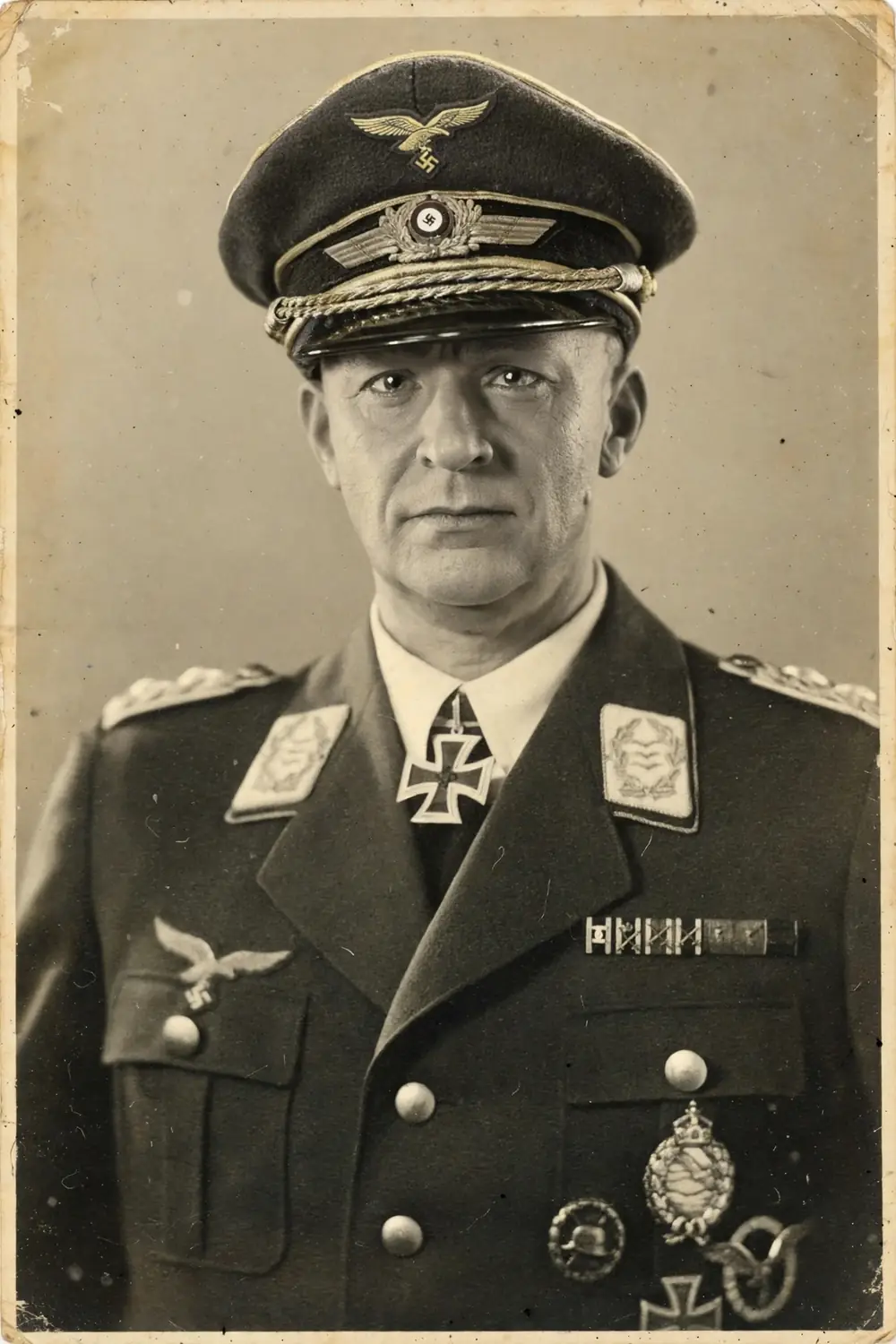
Student demanded a weapon that a paratrooper could jump with, that was light enough to carry, and that could provide the firepower of a rifle, a submachine gun and a light machine gun, all in one weapon. The result was the FG 42, a rifle that was designed from the start to be jumped with, to be carried by a single man, and to give that man the firepower of a squad.
The FG 42 was a direct response to Crete, and it was a weapon that could only have been designed by an army that had learned, at great cost, what its paratroopers needed.
3.2. The Luftwaffe’s rifle
The FG 42 was a Luftwaffe weapon, not an Army weapon, and that distinction shaped its design and its production. The German Army had its own rifle programme, which produced the Gewehr 43 semi-automatic rifle and the StG 44 assault rifle, but the Luftwaffe’s paratroopers were a separate service, and they had their own procurement system, their own factories and their own requirements.
The Luftwaffe’s ordnance office issued the specification for the FG 42 in 1941, and it was developed by Louis Stange at Rheinmetall, one of Germany’s leading arms designers, who had previously designed the MG 34 machine gun. The specification was demanding: the rifle had to weigh less than 4.5 kilograms, it had to be less than one metre long, it had to fire the standard 7.92 mm cartridge, it had to be selective-fire, and it had to be capable of being used as a rifle, as a submachine gun and as a light machine gun.
Stange’s design met the specification, but it was complex and expensive, and it required precision manufacturing that was difficult to provide in wartime Germany. The FG 42’s production was assigned to Krieghoff, a small firm that specialised in high-quality sporting guns, and to other small manufacturers, which limited the numbers that could be built.
3.3. The race against time
The FG 42’s development was a race against time, because the Luftwaffe needed the rifle quickly and because the German war economy was already under strain. The first prototypes were tested in 1942, and the rifle was adopted in 1943, after trials in which it proved to be accurate, reliable and effective, though also complex and expensive.
The first production FG 42s, the Type I, were issued to the Fallschirmjäger divisions in 1943, and they saw their first combat in Italy, where they were used in the defence of Monte Cassino and in the fighting around Anzio. The Type II, which was a simplified and improved version, entered production in 1944, and it was the version that fought in Normandy and on the Eastern Front.
The FG 42’s production was always limited by the capacity of the small firms that built it, and by the competing demands of the Army’s rifle programmes, and only about 7,000 were built in total, a small number beside the millions of Karabiner 98k rifles and the hundreds of thousands of StG 44s that were built in the same period.
The FG 42’s small numbers were a consequence of its complexity and of its status as a Luftwaffe weapon, and they were the reason it never became a standard German infantry weapon.
4. Design and Development
4.1. A rifle, a submachine gun and a light machine gun
The FG 42’s design was an attempt to combine three weapons in one, and its features reflect that ambition. The rifle fired the full-power 7.92×57 mm Mauser cartridge, which gave it the range and the stopping power of a rifle, and it had a selective-fire mechanism that allowed the firer to choose between semi-automatic fire, for accurate shooting at long range, and fully automatic fire, for close-range suppressive fire.
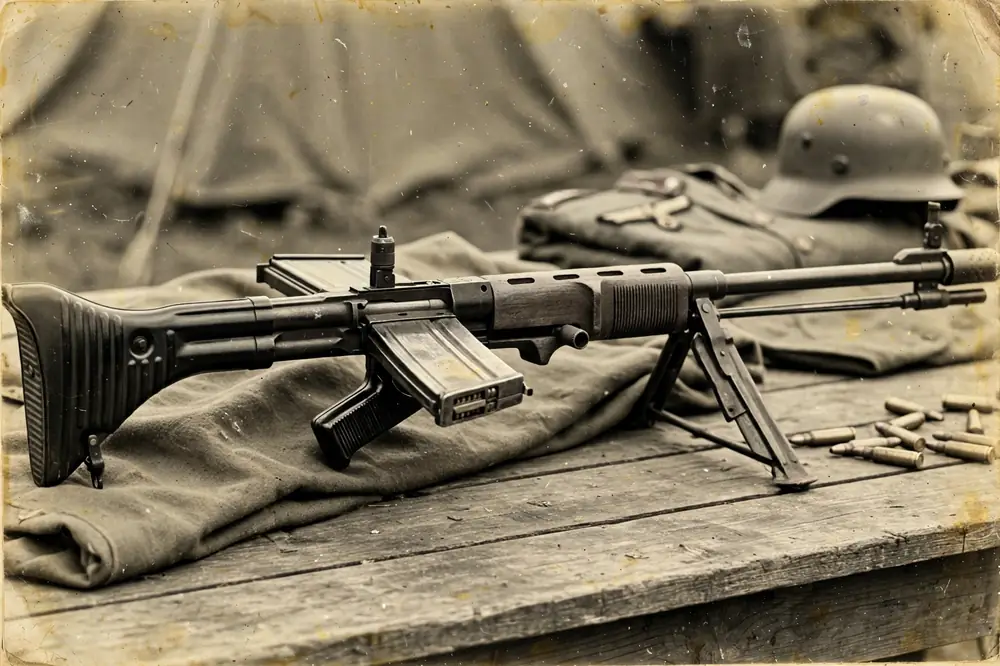
The rifle’s gas system was a long-stroke piston, derived from the Lewis gun, which was reliable and which gave the rifle a smooth action, and the rifle’s bolt was a rotating bolt, which locked securely and which allowed the rifle to fire the powerful 7.92 mm cartridge safely.
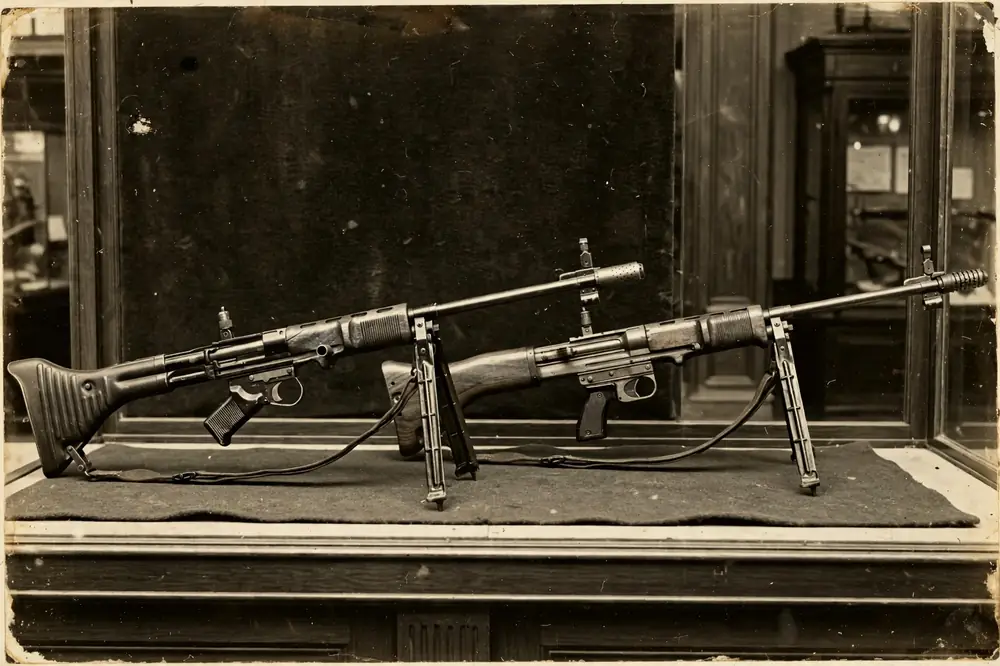
The rifle’s barrel was 20 inches long, with a muzzle brake that reduced recoil and a spike bayonet that folded under the barrel, and the rifle was fitted with a bipod, which allowed it to be used as a light machine gun, and with a telescopic sight, the ZF 4, which allowed it to be used as a sniper rifle.
The FG 42’s magazine was mounted on the left side of the receiver, horizontally, which allowed the rifle to be fired from the prone position with a low profile, and which gave the weapon a distinctive appearance. The rifle’s stock was made of stamped steel in the Type I and of wood in the Type II, and it was designed to be light and strong, with a pistol grip that gave the firer a firm hold.
4.1.1. The gas system and the rotating bolt
The FG 42’s gas system and its rotating bolt were the heart of the design, and they were the features that most influenced post-war weapons. The gas system used a long-stroke piston, in which the piston was attached to the bolt carrier and moved with it, a system that was derived from the Lewis gun and that was reliable and smooth, though it added weight to the rifle.
The rotating bolt locked by turning, with lugs that engaged recesses in the receiver, a system that was strong enough to handle the powerful 7.92 mm cartridge and that became the standard locking system for almost every assault rifle that followed, from the AK-47 to the M16.
The FG 42’s bolt was also notable for its firing mechanism: the rifle fired from a closed bolt in semi-automatic mode, which improved accuracy, and from an open bolt in fully automatic mode, which improved cooling and reduced the risk of cook-off, a sophisticated arrangement that was ahead of its time.
The gas system and the bolt were the FG 42’s most important contributions to weapons design, and they were studied by the Allies after the war, who recognised that Stange had solved problems that their own designers were still struggling with.
4.2. Type I and Type II
The FG 42 was produced in two main types, and the differences between them show the weapon’s evolution from a complex and expensive design to a simpler and more practical one. The Type I, of which about 2,000 were built, had a stamped-steel stock, a sharply angled pistol grip, a muzzle brake with a distinctive shape, and a bipod that was mounted near the muzzle, and it was the version that was issued in 1943 and that fought in Italy.
The Type I was accurate and effective, but it was also complex, expensive and difficult to manufacture, and its stamped-steel stock was uncomfortable and its muzzle brake was too effective, producing a large muzzle blast and a loud report that gave away the firer’s position.
The Type II, of which about 5,000 were built, was a simplified version, with a wooden stock, a more conventional pistol grip, a simpler muzzle brake, a bipod mounted near the centre of the barrel, and a number of small simplifications that reduced the cost and the manufacturing time.
The Type II was heavier than the Type I, at about 4.2 kilograms against 4.0 kilograms, but it was more comfortable to shoot, it was easier to manufacture, and it was the version that most soldiers knew, and that fought in Normandy and on the Eastern Front.
4.3. The bayonet, the bipod and the telescopic sight
The FG 42’s accessories were an integral part of its design, and they reflected the weapon’s ambition to do the work of three weapons. The bayonet was a spike that folded under the barrel, and it was intended for close combat, though it was rarely used in practice, because the FG 42 was primarily a firearm rather than a melee weapon.
The bipod was mounted on the barrel, and it allowed the rifle to be used as a light machine gun, providing suppressive fire from a stable platform, and it was particularly valued by the Fallschirmjäger, who used the FG 42 to provide covering fire for their comrades.
The telescopic sight, the ZF 4, was a 4× sight that was fitted to many FG 42s, and it allowed the rifle to be used as a sniper rifle, with an effective range of about 800 yards in semi-automatic mode.
The FG 42’s accessories made it a versatile weapon, but they also added weight and complexity, and they were one of the reasons the rifle was expensive and difficult to manufacture. The accessories were nevertheless an essential part of the FG 42’s concept, and they were the features that made it more than just a rifle.
5. Technical Specifications
5.1. Dimensions and weight
The FG 42 Type II measured about 37 inches (940 millimetres) in length and weighed about 9.3 pounds (4.2 kilograms) unloaded, which made it lighter than the MG 34 light machine gun, at about 12 kilograms, and heavier than the Karabiner 98k rifle, at about 3.9 kilograms, a weight that reflected its ambition to do the work of both weapons.
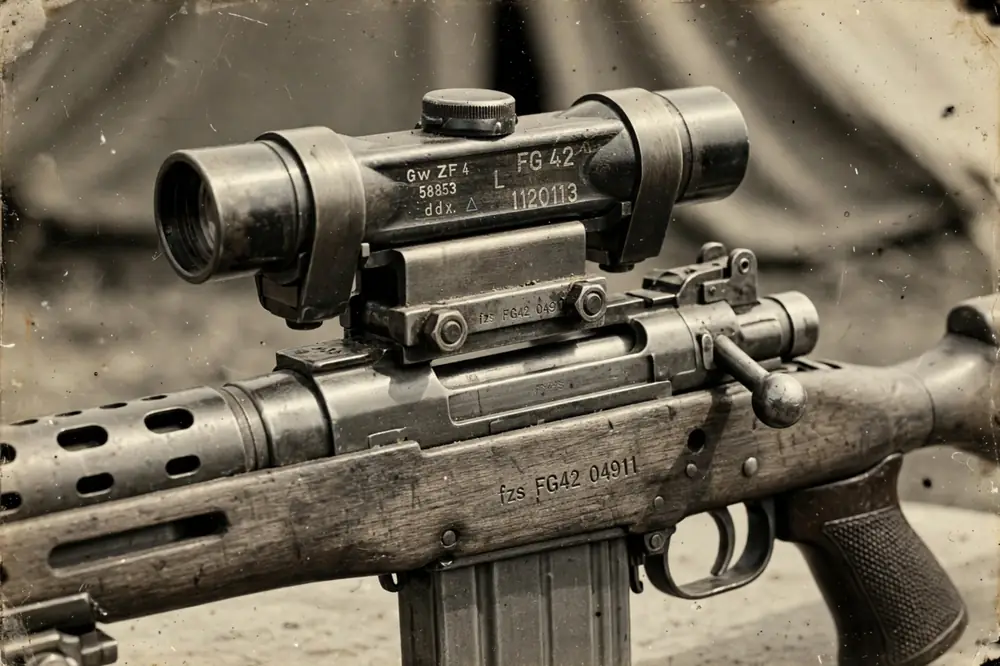
The barrel was 20 inches long, and the rifle was fitted with a muzzle brake that reduced recoil by about 30 per cent, which was essential for a rifle that fired the powerful 7.92 mm cartridge in fully automatic mode.
The rifle’s stock was made of wood in the Type II, which was more comfortable than the stamped-steel stock of the Type I, and the rifle’s pistol grip was angled to give the firer a firm hold in both semi-automatic and fully automatic fire.
The FG 42’s dimensions were a compromise between the requirements of a rifle and the requirements of a light machine gun, and the compromise was successful: the rifle was short enough to be jumped with, light enough to be carried by a single man, and powerful enough to provide the firepower of a squad.
5.2. Cartridge, magazine and ballistics
The FG 42 fired the 7.92×57 mm Mauser cartridge, the standard German rifle and machine-gun cartridge, which fired a 198-grain (12.8-gram) bullet at a muzzle velocity of about 2,460 feet per second (750 metres per second), giving it a muzzle energy of about 2,700 foot-pounds.
The cartridge was powerful, with a flat trajectory and a long effective range, and it was the same cartridge used by the Karabiner 98k, the MG 34 and the MG 42, which simplified ammunition supply. The FG 42’s magazine held 10 or 20 rounds, and it was mounted on the left side of the receiver, horizontally, which allowed the rifle to be fired from the prone position with a low profile.
The 20-round magazine was the standard, and it gave the rifle a substantial volume of fire, though it was small beside the 50-round belt of the MG 34, and the FG 42’s automatic fire was limited by its magazine capacity.
The rifle’s effective range was about 500 yards in fully automatic mode and about 800 yards in semi-automatic mode with the telescopic sight, which made it effective at the ranges at which most infantry combat took place. The FG 42’s ballistics were excellent, and its accuracy in semi-automatic mode was comparable to that of a bolt-action rifle, which made it a formidable weapon in the hands of a trained marksman.
| FG 42 Type II / FG 42 Type II | |
|---|---|
| Calibre | 7.92×57 mm Mauser / 7,92×57 mm Mauser |
| Weight unloaded | About 9.3 lb (4.2 kg) |
| Length | 37 in (940 mm) / 940 mm |
| Barrel / Nòng | 20 in (500 mm) / 500 mm |
| Rate of fire | About 750–900 rounds/min |
| Muzzle velocity | About 2,460 ft/s (750 m/s) |
| Magazine | 10- or 20-round box, side-mounted |
| Effective range | About 500 yards auto; 800 yards semi-auto |
| Number built | About 7,000 |
5.3. Reliability and handling
The FG 42’s reliability in the field was good, though not perfect, and its reputation among the Fallschirmjäger who used it was high. The rifle’s gas system was reliable, and it tolerated dirt and cold better than more complex weapons, which was important for a weapon that was used in Italy, in Normandy and on the Eastern Front, in conditions that ranged from the dust of the Italian summer to the mud of the Normandy winter.
The rifle’s main reliability problems came from its magazine, which was a side-mounted design that could be damaged if the rifle was dropped, and from its complexity, which made it difficult to maintain in the field and which required a level of armourer’s support that was not always available.
The FG 42’s handling was excellent: it was well balanced, its pistol grip gave the firer a firm hold, and its selective-fire mechanism was easy to operate, which made it a popular weapon with the men who carried it. The rifle’s recoil in fully automatic mode was heavy, however, and the muzzle brake produced a large muzzle blast that gave away the firer’s position, which were the rifle’s main handling drawbacks.
The FG 42’s reliability and handling were good enough for the weapon to be loved by its users, and its reputation as a superb rifle was well deserved.
5.3.1. Full-power automatic fire: the recoil problem
The FG 42’s most serious handling problem was the recoil of the full-power 7.92 mm cartridge in fully automatic fire, and it deserves a closer look, because it illustrates the fundamental problem of the automatic rifle. The 7.92 mm cartridge was designed for a bolt-action rifle and for a machine gun, and it produced a recoil that was manageable in single shots but that was heavy and difficult to control in fully automatic fire, particularly from a rifle that weighed only 4.2 kilograms.
The FG 42’s muzzle brake reduced the recoil by about 30 per cent, and its bipod allowed the rifle to be fired from a stable platform, but in fully automatic fire from the shoulder the rifle climbed sharply, and its accuracy was poor beyond short range.
The Fallschirmjäger learned to fire the FG 42 in short bursts, and to use the bipod whenever possible, and they found that the rifle was effective in that role, but the recoil problem was never fully solved, and it was one of the reasons the post-war assault rifles — the StG 44, the AK-47 and the M16 — used intermediate cartridges, which produced less recoil and which could be controlled in fully automatic fire.
The FG 42’s recoil problem was a lesson that the designers of the assault rifle learned well, and it was a reminder that a rifle that fires a full-power cartridge in fully automatic mode will always be difficult to control.
6. Variants
6.1. Type I: the first FG 42
The Type I was the first production FG 42, and it was the version that was issued in 1943 and that fought in Italy. About 2,000 Type Is were built, and they were recognisable by their stamped-steel stock, their sharply angled pistol grip, their distinctive muzzle brake and their bipod mounted near the muzzle.
The Type I was accurate and effective, but it was also complex, expensive and difficult to manufacture, and its stamped-steel stock was uncomfortable and its muzzle brake produced a large muzzle blast. The Type I’s production was limited by the capacity of the small firms that built it, and by the competing demands of the Army’s rifle programmes, and the Type I was soon replaced by the Type II, which was simpler and more practical.
The Type I’s service in Italy was nevertheless notable: the Fallschirmjäger who carried it at Monte Cassino and at Anzio found it to be a superb weapon, and its reputation as a rifle that could do the work of three weapons was established in those battles.
The Type I is now the rarest of the FG 42s, and surviving examples are highly prized by collectors, who value them as the first of a revolutionary design.
6.2. Type II: the definitive FG 42
The Type II was the definitive FG 42, and it was the version that most soldiers knew and that fought in Normandy and on the Eastern Front. About 5,000 Type IIs were built, and they were recognisable by their wooden stock, their more conventional pistol grip, their simpler muzzle brake and their bipod mounted near the centre of the barrel.
The Type II was heavier than the Type I, at about 4.2 kilograms against 4.0 kilograms, but it was more comfortable to shoot, it was easier to manufacture, and it was the version that the Fallschirmjäger preferred. The Type II’s production was still limited, because the rifle was built by small firms and because the German war economy was under strain, but it was the version that saw the most combat, and it was the version that earned the FG 42’s reputation as a superb rifle.
The Type II remained in service until the end of the war, and it was the version that was studied by the Allies after the war, who recognised its gas system and its rotating bolt as the future of infantry weapons. The Type II’s legacy is the modern assault rifle, and its influence can be seen in every selective-fire rifle that followed it.
7. Combat Service
7.1. Italy: Monte Cassino and Anzio
The FG 42’s first combat service was in Italy, where the Fallschirmjäger divisions fought in the defence of Monte Cassino and in the fighting around Anzio in 1943 and 1944. The Type I FG 42 was issued to the 1st Fallschirmjäger Division, which defended the Gustav Line and the monastery at Monte Cassino, and to the units that fought at Anzio, where the Allied landings were contained by German counterattacks.
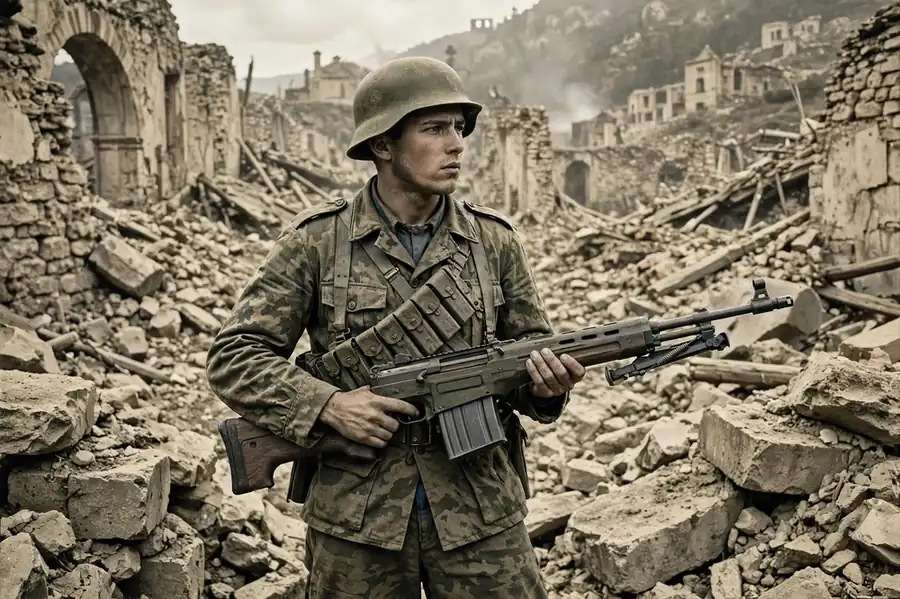
In Italy, the FG 42 proved itself as a weapon for the close, confused fighting of the mountains and the towns, where its selective fire and its high rate of fire were valuable, and where its ability to provide suppressive fire from a bipod was appreciated.
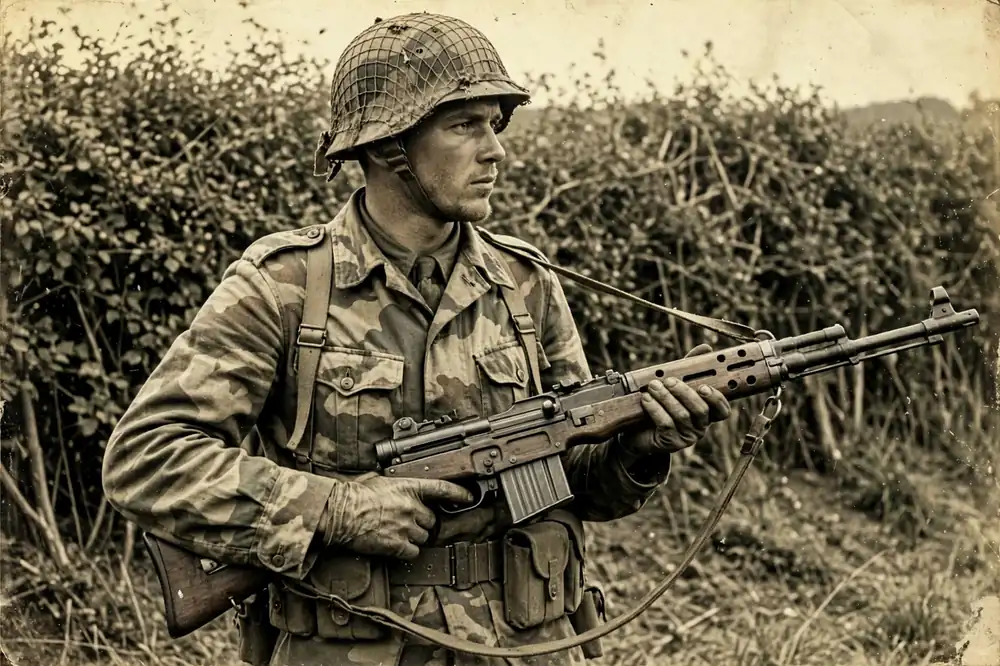
The Fallschirmjäger who carried the FG 42 at Monte Cassino found it to be a superb weapon, and its reputation as a rifle that could do the work of three weapons was established in those battles. The FG 42’s service in Italy was nevertheless limited by its small numbers: only a few thousand were available, and they were issued to a small number of units, which meant that the weapon’s impact on the campaign was limited, even though its performance was excellent.
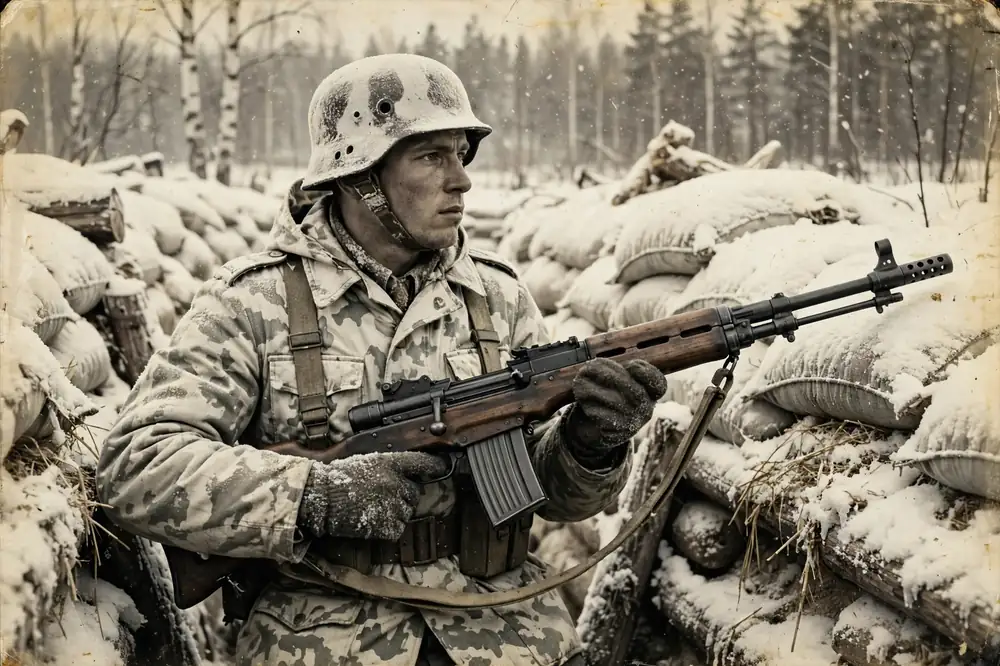
7.2. Normandy and the Western Front
In Normandy, the FG 42 served with the Fallschirmjäger divisions that fought against the Allied landings in June 1944, and it was used in the close fighting in the bocage, where its selective fire and its high rate of fire were valuable.
The 3rd Fallschirmjäger Division, which fought in Normandy, was equipped with the Type II FG 42, and its men used the rifle in the hedgerow fighting, where engagements took place at short range and where the FG 42’s automatic fire could suppress an enemy position.
The FG 42’s service in Normandy was notable for the weapon’s effectiveness in the hands of well-trained paratroopers, who used its bipod and its telescopic sight to engage targets at long range, and its automatic fire to suppress targets at short range.
The FG 42’s small numbers meant that it was never a standard weapon in Normandy, and it was issued only to the Fallschirmjäger, but its performance in the campaign was excellent, and it earned the respect of the Allied soldiers who faced it. The FG 42’s service in the West continued in the Ardennes and in the defence of Germany, where it fought in the last battles of the war.
7.3. The Eastern Front and the last battles
On the Eastern Front, the FG 42 served with the Fallschirmjäger divisions that fought in the defensive battles of 1944 and 1945, and it was used in the fighting in Poland, in East Prussia and in Berlin, where it was valued for its firepower and its versatility.
The FG 42’s service on the Eastern Front was a demonstration of the weapon’s quality in the most demanding conditions of the war, where the fighting was close, the weather was harsh, and the enemy was numerous. The Fallschirmjäger who carried the FG 42 on the Eastern Front found it to be reliable and effective, and its reputation as a superb rifle was confirmed in those battles.
The FG 42’s last service was in Berlin, in April 1945, where the last Fallschirmjäger fought in the streets of the city, in a desperate defence that could not change the outcome of the war. The FG 42’s career ended where the war ended, in the ruins of Berlin, and the weapon’s small numbers meant that its impact on the war was limited, even though its performance was excellent.
The FG 42’s service on the Eastern Front was a measure of its quality and of its tragedy: a superb weapon, fighting for a lost cause, in numbers too small to matter.
7.3.1. Monte Cassino: the FG 42’s proving ground
Monte Cassino was the FG 42’s proving ground, and it was the battle in which the rifle’s reputation was established. The 1st Fallschirmjäger Division defended the monastery and the town of Cassino for four months, from January to May 1944, against repeated Allied attacks, and the FG 42 was used in the close fighting in the ruins of the town and in the mountains around it.
The Fallschirmjäger used the FG 42’s bipod to provide suppressive fire from the ruins, and its telescopic sight to engage Allied soldiers at long range, and its automatic fire to break up Allied infantry attacks at short range. The FG 42’s performance at Monte Cassino was excellent, and it was one of the reasons the Fallschirmjäger were able to hold the position for so long, despite being outnumbered and outgunned.
The battle was a demonstration of the FG 42’s versatility: a single weapon that could do the work of a rifle, a submachine gun and a light machine gun, in the hands of well-trained soldiers who knew how to use it.
Monte Cassino was the FG 42’s finest hour, and it was a battle that showed what the rifle could do when it was used as it had been designed to be used.
8. Strengths and Weaknesses
8.1. Strengths
The FG 42’s strengths were formidable, and they made it one of the finest infantry weapons of the Second World War. Its selective fire gave it the versatility of three weapons in one, and its full-power cartridge gave it the range and the stopping power of a rifle.
Its gas system was reliable, its rotating bolt was strong, and its accuracy in semi-automatic mode was comparable to that of a bolt-action rifle, which made it effective at long range. Its bipod allowed it to be used as a light machine gun, and its telescopic sight allowed it to be used as a sniper rifle, which made it the most versatile infantry weapon of the war.
Its handling was excellent, its balance was good, and its selective-fire mechanism was easy to operate, which made it popular with the men who carried it. The FG 42’s strengths were the strengths of a weapon designed by a master designer, for a specific purpose, and they were demonstrated in battle after battle, from Monte Cassino to Berlin, where the rifle proved itself to be a superb weapon in the hands of well-trained soldiers.
8.2. Weaknesses
The FG 42’s weaknesses were the price of its ambition, and they were the reasons it was built in such small numbers. Its complexity made it expensive and difficult to manufacture, and it required precision machining that was difficult to provide in wartime Germany, which limited its production to about 7,000 rifles.
Its recoil in fully automatic fire was heavy, and its muzzle blast was large, which gave away the firer’s position and which made the rifle difficult to control. Its magazine capacity was small — 10 or 20 rounds — which limited its volume of fire in the light machine gun role, and its side-mounted magazine could be damaged if the rifle was dropped.
Its weight, at about 4.2 kilograms, was heavy for a rifle, though light for a light machine gun, and its size made it awkward to carry in close terrain. The FG 42’s weaknesses were the weaknesses of a weapon that tried to do too much, and they were the reasons the post-war assault rifles used intermediate cartridges and simpler designs, which solved the problems that the FG 42 had exposed.
9. Comparison with Rivals
9.1. Against the StG 44
The FG 42’s most important comparison is with the StG 44, the German assault rifle that was developed by the Army at the same time, and the comparison shows the two weapons’ different philosophies. The StG 44 fired an intermediate cartridge, the 7.92×33 mm Kurz, which was less powerful than the FG 42’s full-power 7.92×57 mm cartridge, but which produced less recoil and which could be controlled in fully automatic fire, and which allowed the StG 44 to be used as a true assault rifle.
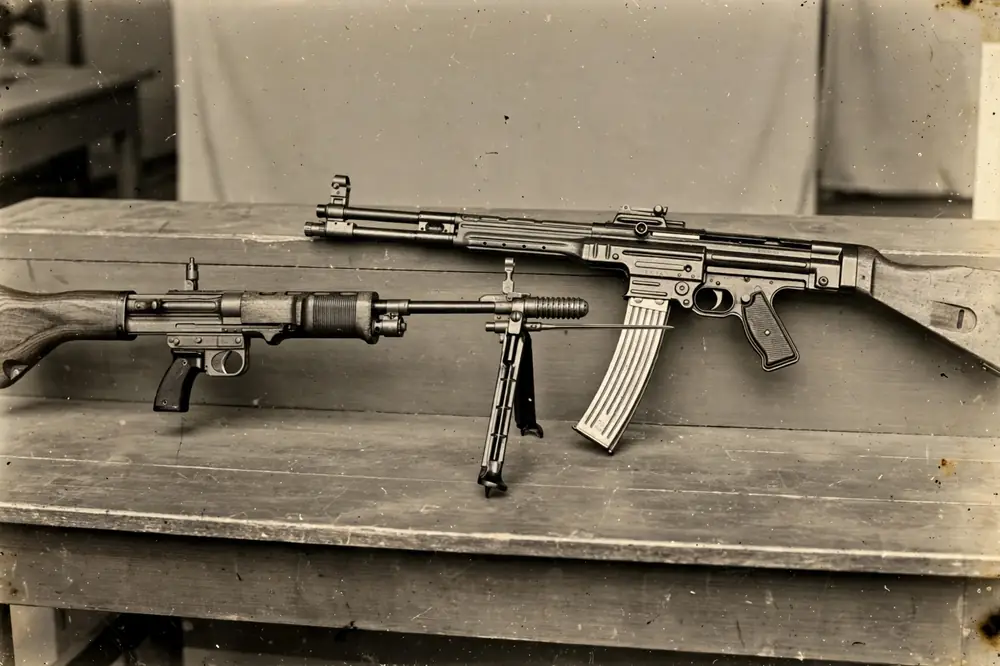
The StG 44 was simpler and cheaper to build than the FG 42, and it was produced in much larger numbers — about 425,000, against the FG 42’s 7,000 — which made it the standard German infantry weapon of the last year of the war.
The FG 42 was the better weapon in terms of range and accuracy, and it was more versatile, but the StG 44 was the better weapon in terms of cost, simplicity and controllability, and it was the weapon that pointed the way to the future.
The FG 42 and the StG 44 were both revolutionary weapons, but the StG 44 was the one that changed the world, because it was built in numbers that mattered, while the FG 42 was built in numbers that did not.
9.2. Against the American M1 Garand and the M60
Against the American M1 Garand, the FG 42 was superior in firepower and in versatility, but inferior in simplicity and in numbers. The M1 Garand was a semi-automatic rifle that fired the .30-06 cartridge, and it was the standard American infantry weapon, produced in millions, while the FG 42 was a selective-fire rifle that could do the work of three weapons, but that was produced in only 7,000 examples.
The FG 42’s influence on American weapons was nevertheless significant: its gas system and its layout were studied by the Americans after the war, and they influenced the design of the M60 machine gun, which used a gas system derived from the FG 42 and a feed system derived from the MG 42.
The M60 became the standard American general-purpose machine gun, serving in Vietnam and in every conflict since, and its lineage can be traced directly to the FG 42. The FG 42’s influence on the M60 is a measure of the weapon’s importance: a rifle that was built in only 7,000 examples influenced the design of a machine gun that was built in hundreds of thousands, and that served for half a century.
10. Legacy
10.1. The ancestor of the assault rifle
The FG 42’s legacy is its influence on the assault rifle, and it is one of the most important legacies of any infantry weapon of the Second World War. The FG 42’s gas system, its rotating bolt and its selective-fire mechanism became the standard features of the modern assault rifle, and they can be seen in the AK-47, the M16, the FN FAL and every other selective-fire rifle that followed.
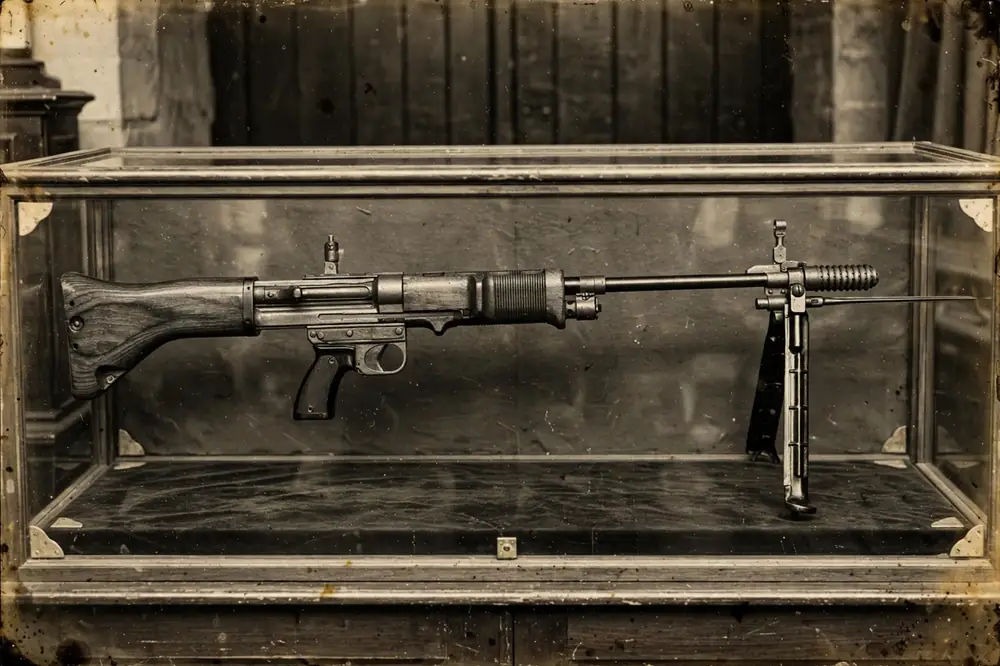
The FG 42’s concept — a single weapon that could do the work of a rifle, a submachine gun and a light machine gun — became the concept of the assault rifle, and its realisation in the StG 44 and the AK-47 changed infantry warfare forever.
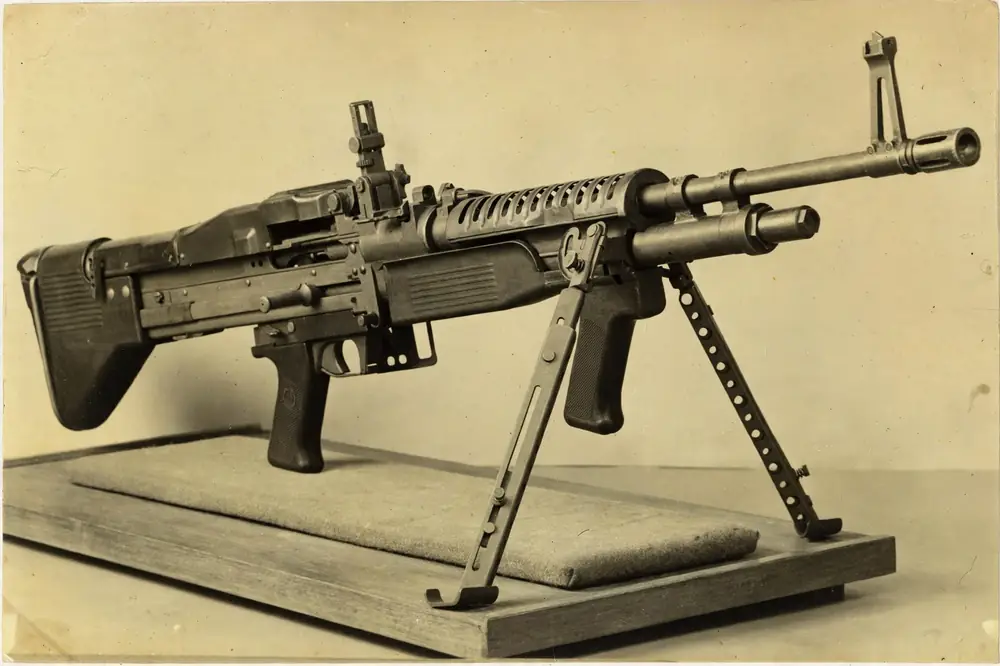
The FG 42’s influence was also direct: its gas system was copied in the American M60 machine gun, and its layout was studied by the British designers of the EM-2, the first assault rifle to be adopted by a major army. The FG 42 was a weapon ahead of its time, and its legacy is the modern infantry weapon, a debt that is rarely acknowledged but that is real.
10.2. Survivors and collectors
Surviving FG 42s are among the rarest and most valuable firearms of the Second World War, and they are highly prized by collectors, who value them as the first of a revolutionary design. Fewer than 100 FG 42s are known to survive in museums and in private collections, and transferable examples in the United States command prices of hundreds of thousands of dollars, making the FG 42 one of the most expensive firearms in the world.
Museums that hold the FG 42 include the National Firearms Museum in Fairfax, Virginia, the Imperial War Museum in London, the Bundeswehr Museum of Military History in Dresden, and the United States Army Ordnance Museum, where the rifle is displayed as an example of the most advanced German infantry weapon of the war.
The FG 42’s rarity is a consequence of its small production and of the destruction of many examples in the war, and it is a measure of the weapon’s importance that a rifle built in only 7,000 examples is remembered as one of the most significant infantry weapons of the Second World War.
11. Frequently Asked Questions
How many FG 42 rifles were built?
About 7,000 FG 42s were built in total, of which about 2,000 were the early Type I and about 5,000 were the later Type II. The small production was a consequence of the rifle’s complexity and of its status as a Luftwaffe weapon built by small firms.
What does FG 42 mean?
Fallschirmjägergewehr 42 — paratrooper rifle of 1942. The rifle was designed for the Luftwaffe’s Fallschirmjäger divisions, and it was intended to give a paratrooper the firepower of a rifle, a submachine gun and a light machine gun in a single weapon.
What calibre was the FG 42?
The full-power 7.92×57 mm Mauser cartridge, the standard German rifle and machine-gun cartridge. The powerful cartridge gave the FG 42 a long range and a heavy recoil in fully automatic fire, which was one of the rifle’s main drawbacks.
Did the FG 42 influence the M60 machine gun?
Yes. The M60’s gas system was derived from the FG 42, and its feed system was derived from the MG 42. The M60 became the standard American general-purpose machine gun, and its lineage can be traced directly to the FG 42.
Where did the FG 42 first see combat?
In Italy, in 1943, with the 1st Fallschirmjäger Division at Monte Cassino and Anzio. The rifle’s reputation as a superb weapon was established in those battles, and it was confirmed in Normandy and on the Eastern Front.
How much is an FG 42 worth today?
Surviving FG 42s are among the most valuable firearms of the Second World War, and transferable examples in the United States command prices of hundreds of thousands of dollars. Fewer than 100 are known to survive in museums and private collections.
12. Sources
- Wikipedia, “FG 42” — production total of about 7,000, Type I and Type II, and service history.
- National Firearms Museum, FG 42 collection records — design, the Louis Stange gas system and the M60 influence.
- Imperial War Museum, FG 42 collection records — the Fallschirmjäger, Monte Cassino and Normandy service.
- Thomas B. Dugelby, FG 42: The German Paratroop Rifle (Collector Grade Publications, 2008) — development, production and combat service.
- Ian V. Hogg, German Small Arms of World War II (Greenhill Books, 1997) — the FG 42, the StG 44 and the German rifle programmes.
- Chris McNab, German Automatic Rifles 1941–45 (Osprey Weapon Series, 2013) — the FG 42, the Gewehr 43 and the StG 44.
Further reading
- W. Darrin Weaver, Desperate Measures: The Last-Ditch Weapons of the Nazi Volkssturm (Collector Grade Publications, 2005).
- John Walter, The German Rifle (Arms and Armour Press, 1979).