 WAR ATLAS MILITARY HISTORY MAGAZINE · WWI — WWII
P-51 Mustang
1. Lead
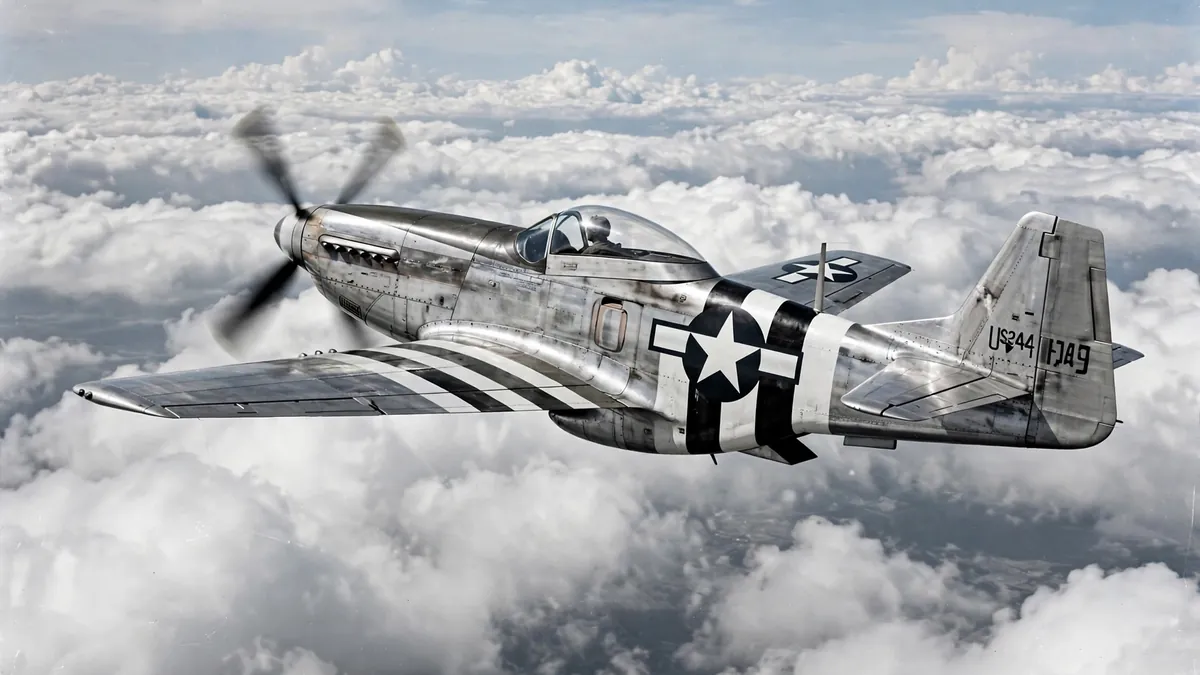
The P-51 Mustang was a single-seat, single-engine fighter aircraft built by North American Aviation in the United States, and one of the most widely used Allied fighters of the Second World War. Designed originally for the British Royal Air Force, it first flew on 26 October 1940 and entered service in January 1942.
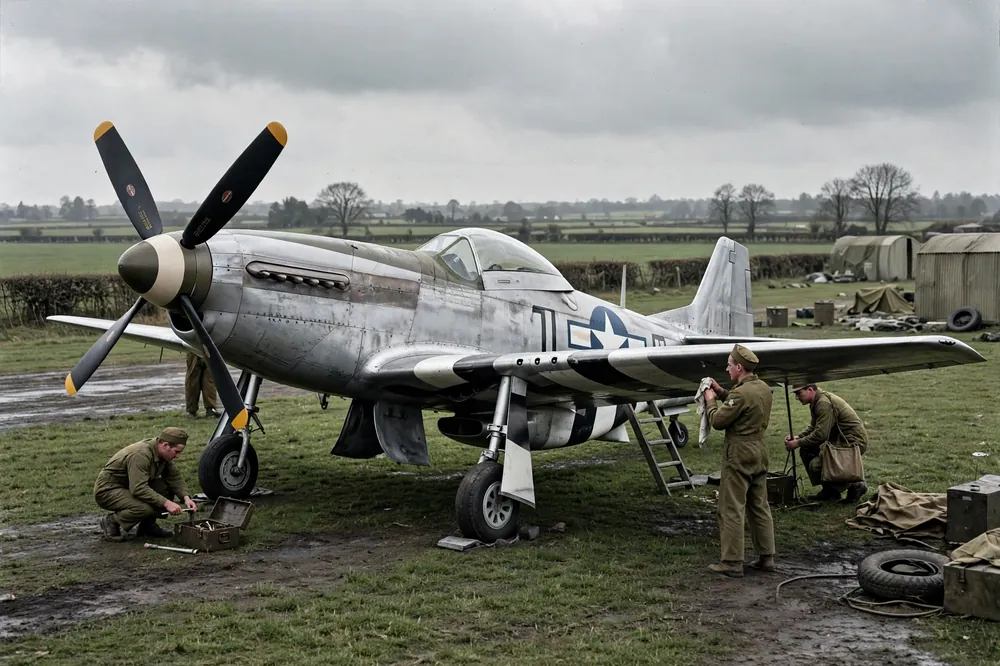
Early models, powered by the Allison V-1710 engine, performed well at low altitude but poorly at high altitude; the fitting of the Rolls-Royce Merlin engine, built under licence in the United States by Packard, transformed the aircraft into a fast, long-range, high-altitude fighter.
The definitive model, the P-51D, carried six .50 calibre machine guns, reached 440 mph (710 km/h), and had a range of 1,650 miles (2,660 km) with external fuel tanks — enough to escort American bombers from England to Berlin and back. More than 15,000 Mustangs were built, and the type served in the Second World War, the Korean War, and with air forces around the world into the 1980s.
2. Key Facts
| Type | Single-seat fighter / fighter-bomber |
| Origin | United States |
| Manufacturer | North American Aviation (Inglewood, California, and Dallas, Texas) |
| Designer | Edgar Schmued (chief designer) |
| First flight | 26 October 1940 (NA-73X prototype) |
| Introduced | January 1942 (RAF Mustang Mk I) |
| In service | 1942–1984 (last military operator, Dominican Republic) |
| Number built | 15,686 (sources vary between about 15,500 and 15,700) |
| Crew | 1 |
| Engine (P-51D) | 1 × Packard V-1650-7 Merlin V-12, 1,490 hp (1,720 hp at war emergency power) |
| Maximum speed (P-51D) | 440 mph (710 km/h) |
| Range (P-51D) | 1,650 mi (2,660 km) with external tanks |
| Service ceiling (P-51D) | 41,900 ft (12,800 m) |
| Armament (P-51D) | 6 × .50 in (12.7 mm) M2 Browning machine guns; up to 1,000 lb of bombs or 10 rockets |
| Length (P-51D) | 32 ft 3 in (9.83 m) |
| Wingspan (P-51D) | 37 ft 0 in (11.28 m) |
3. Background and Development
The P-51 Mustang was born from a British purchasing problem. In 1940, after the fall of France, Britain needed fighter aircraft in large numbers and in a hurry. The British Purchasing Commission approached North American Aviation, a company that had so far built only trainers, and asked it to build the Curtiss P-40 fighter under licence. North American’s president, James H.
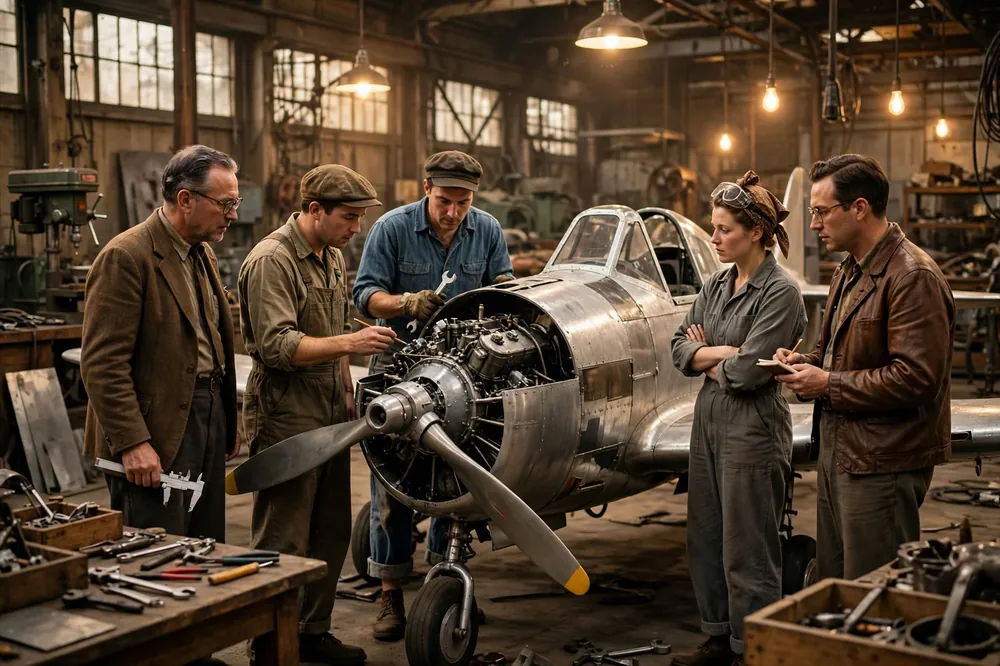
Kindelberger, replied that his company could design a better fighter of its own, and in the same time, and the British agreed — on the condition that a prototype be ready in 120 days. The design team, led by chief designer Edgar Schmued, worked to that deadline: the prototype, designated NA-73X, was rolled out on 9 September 1940 and first flew on 26 October 1940, with test pilot Vance Breese at the controls.
The British named the aircraft “Mustang,” and the name was adopted by the Americans as well.
The first production aircraft, the Mustang Mk I, entered Royal Air Force service in January 1942. It was powered by the Allison V-1710 engine, a liquid-cooled V-12 that produced about 1,150 hp. The aircraft was fast at low altitude — about 390 mph — and it handled well, but the Allison’s single-stage supercharger lost power rapidly above 15,000 feet, and the Mustang could not compete with German fighters at the altitudes where bomber escort missions were flown. The RAF therefore used its early Mustangs for low-level reconnaissance and ground attack, roles in which the aircraft’s speed and range were valuable, while the high-altitude fighter role remained with the Spitfire.
The solution was already available. The Rolls-Royce Merlin, the engine that powered the Spitfire and the Lancaster bomber, used a two-stage, two-speed supercharger that maintained power at high altitude. In mid-1942, Rolls-Royce fitted a Merlin 65 to a Mustang airframe in Britain, in a project known as the Mustang X, and North American fitted a Packard-built Merlin to two airframes in the United States, initially designated XP-78 and later XP-51B.
The results were immediate: the XP-51B reached 441 mph at nearly 30,000 feet, about 100 mph faster than the Allison-powered models at that altitude. The United States Army Air Forces ordered the Merlin-powered Mustang into production as the P-51B and P-51C, and the Packard Motor Car Company, which built the Merlin under licence as the V-1650, produced more than 55,000 of the engines during the war.
The P-51B and P-51C entered service in late 1943, and the definitive P-51D followed in 1944, with a cut-down rear fuselage and a bubble canopy that gave the pilot all-round vision, six .50 calibre machine guns instead of four, and the Packard V-1650-7 engine. By the end of the war, North American had built Mustangs at Inglewood, California, and at Dallas, Texas, and the aircraft had become the standard long-range escort fighter of the United States Army Air Forces in Europe.
The British order that started the programme was for 320 aircraft, later increased, and the first British aircraft were delivered in late 1941. The choice of the Allison engine for the first models was a matter of availability rather than preference: the Merlin was in short supply in 1940, and the British needed an engine that could be delivered in quantity.
The Allison was a sound engine at low altitude, and the early Mustang’s performance below 15,000 feet was better than that of the Spitfire Mk V in level speed, but the absence of a two-stage supercharger set a ceiling on what the aircraft could do.
The decision to re-engine the Mustang was taken in Britain and in the United States independently in 1942, and both programmes reached the same conclusion within months of each other. The Merlin conversion did not change the airframe in any fundamental way — the engine was heavier and the radiator and oil cooler had to be rearranged — but it changed what the aircraft was for, from a low-level reconnaissance and ground-attack machine to a high-altitude escort fighter.
4. Design
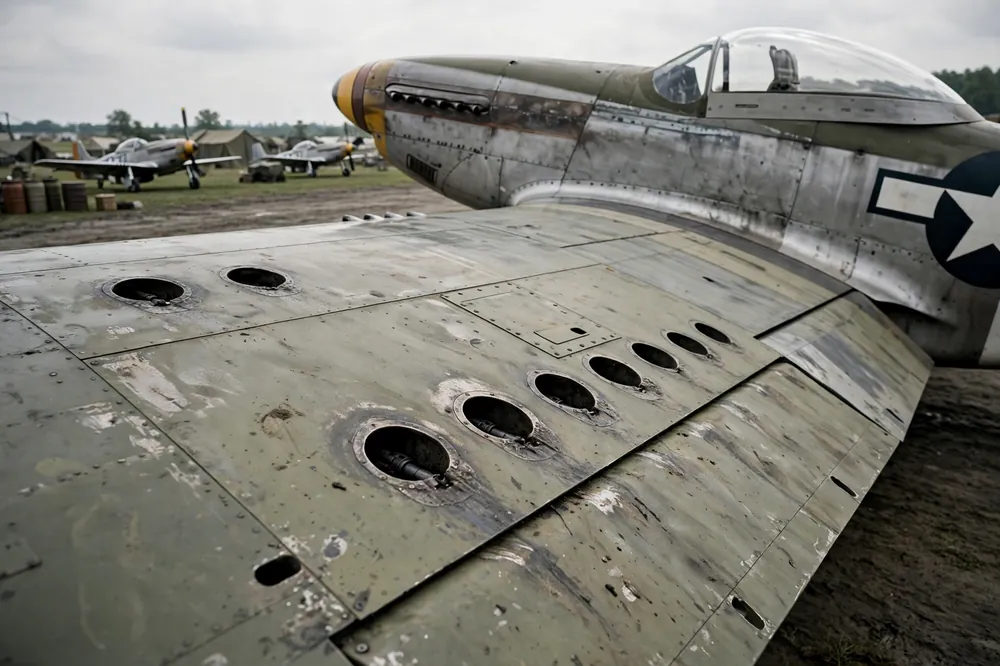
The P-51 Mustang’s design combined several features that were advanced for 1940. The most important was the wing. North American used a laminar-flow wing section, a profile designed to keep the airflow smooth over a greater part of the wing’s surface and so reduce drag. The laminar-flow wing was difficult to manufacture to the required precision, and in service it did not always deliver the full theoretical benefit, because dirt and minor surface damage disrupted the airflow, but it contributed to the Mustang’s low drag and high speed. The wing also carried the aircraft’s main fuel tanks and, on the P-51D, the six .50 calibre machine guns, three in each wing.
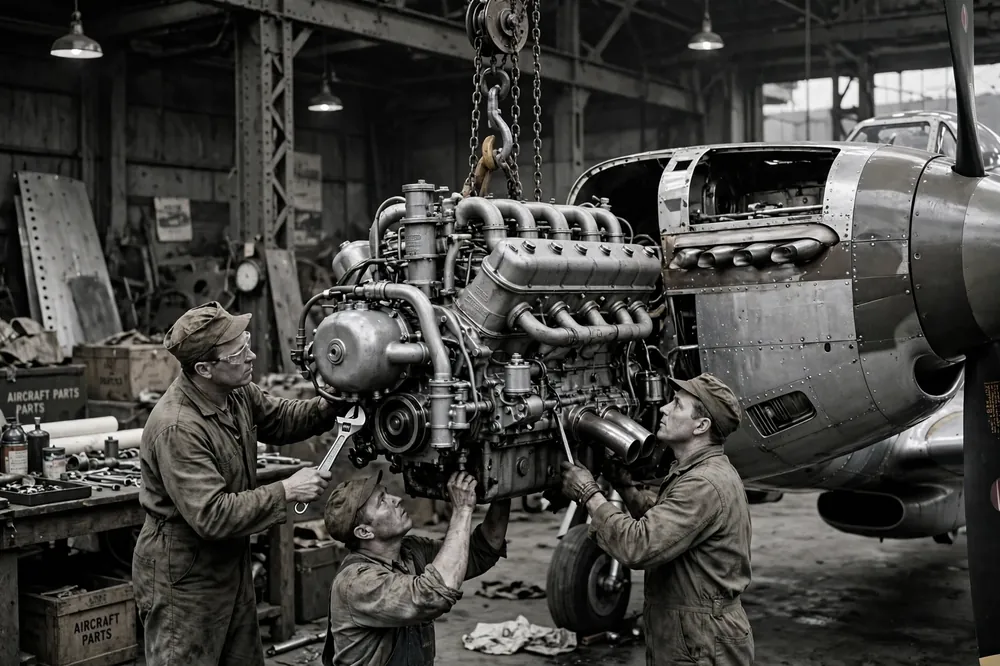
The second important feature was the ventral radiator. The Mustang’s engine was liquid-cooled, and the radiator was housed in a duct beneath the fuselage, behind the cockpit. The duct was designed so that the air passing through it was heated and then expelled at high speed, producing a small amount of forward thrust — an effect known as the Meredith effect, after the British engineer F. W. Meredith, who first described it. The arrangement also kept the nose of the aircraft slim, reducing drag, and it gave the Mustang its distinctive deep-bellied silhouette. The duct could be adjusted by a flap at the rear, and pilots learned to manage it as part of the aircraft’s operation.
The third feature was fuel capacity. The Mustang carried 184 gallons of fuel internally, including an 85-gallon tank behind the pilot that was added on the P-51B and later models, and it could carry two drop tanks of up to 108 gallons each under the wings. With external tanks, the P-51D had a range of 1,650 miles and a combat radius of about 750 miles, enough to fly from bases in East Anglia to Berlin and back with fuel for combat. That range was the Mustang’s decisive advantage: no other Allied single-engine fighter of the period could escort bombers that far, and it was the reason the aircraft was assigned to the long-range escort role.
The P-51D’s cockpit, with its bubble canopy, gave the pilot an unobstructed view in all directions, a significant improvement over the framed, “razorback” canopy of the P-51B and P-51C, which restricted rearward vision. The aircraft was armed with six .50 calibre M2 Browning machine guns, with a total of 1,880 rounds, and it could carry two 1,000 lb bombs or ten 5-inch rockets for ground attack.
The Mustang was not the most manoeuvrable fighter of the war — the Spitfire and the Japanese Zero turned more tightly — and its liquid-cooled engine was vulnerable to ground fire, since a single hit to the cooling system could force the aircraft down.
But its combination of speed, range, high-altitude performance, and firepower made it the most versatile American fighter of the war, and pilots valued its handling and its ability to fight at the altitudes where the bomber streams flew.
Later P-51Ds were fitted with the K-14 gyroscopic gunsight, which computed the lead angle for the pilot and made deflection shooting — firing at a target that is crossing in front of the aircraft — considerably easier than the fixed ring-and-bead sights it replaced.
The gunsight was one of several small improvements that accumulated over the production run: the P-51D also received a revised canopy, a new propeller, and, in the final blocks, a small fin extension on the tail to improve stability at high speed. The drop tanks that gave the Mustang its range were themselves a logistical achievement.
The tanks were made of paper and plastic laminate in Britain and of metal in the United States, and they were produced in large numbers and shipped to the airfields in East Anglia, where they were fitted to the aircraft before each mission and jettisoned when empty or when combat began.
A Mustang that had dropped its tanks could fight unencumbered; a Mustang that kept them could fly further but manoeuvred poorly, and pilots were instructed to drop them at the first sign of enemy fighters.
5. Variants
| Variant | Years | Key features | Number built |
|---|---|---|---|
| NA-73X | 1940 | Prototype; Allison V-1710 engine | 1 |
| Mustang Mk I / P-51 | 1941–1942 | RAF service; Allison engine; 4 × .50 cal + 4 × .30 cal guns | About 620 (Mk I) |
| P-51A | 1942–1943 | USAAF version of the Allison Mustang; 4 × .50 cal guns | 310 |
| A-36 Apache | 1942–1943 | Dive-bomber version with dive brakes; Allison engine | 500 |
| P-51B | 1943–1944 | First Merlin-powered model; Packard V-1650-3; 4 × .50 cal guns; built at Inglewood | 1,988 |
| P-51C | 1943–1944 | Same as P-51B; built at Dallas | 1,750 |
| P-51D | 1944–1945 | Definitive model; bubble canopy; 6 × .50 cal guns; Packard V-1650-7 | 7,956 |
| P-51K | 1944–1945 | P-51D with Aeroproducts propeller; built at Dallas | 1,337 |
| F-6 | 1942–1945 | Photographic reconnaissance version of the P-51 | About 480 |
| P-51H | 1945 | Lightweight, fastest Mustang; Packard V-1650-9; 487 mph; arrived too late for combat | 555 |
| TF-51D / F-51 | Post-war | Two-seat trainer conversions; F-51 was the post-war USAF designation | — |
The P-51D was the largest single block, with 7,956 aircraft built — 6,502 at Inglewood (P-51D-NA) and 1,454 at Dallas (P-51D-NT). The P-51H, the last production model, was lighter and faster than the P-51D, with a top speed of 487 mph, but only 555 were built and the type did not see combat in the Second World War. The A-36 Apache, the dive-bomber version, is sometimes counted separately from the fighter Mustangs, but it shared the same airframe and Allison engine. In total, sources give the number of Mustangs built as between about 15,500 and 15,700, with 15,686 the figure most commonly cited; the variation comes from differences in how cancelled orders, Australian-assembled aircraft, and post-war rebuilds are counted.
6. Operational History
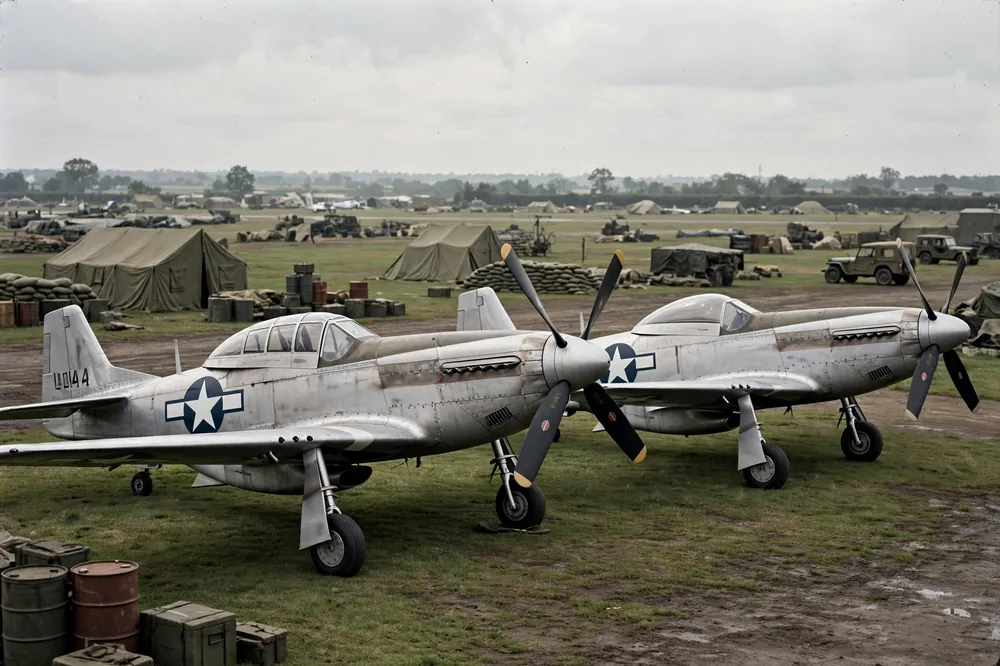
The Mustang entered service with the Royal Air Force in January 1942, and the RAF’s early use of the aircraft showed both its strengths and its limits. The Mustang Mk I was assigned to Army Co-operation Command, where its speed at low altitude and its long range made it well suited to tactical reconnaissance — flying fast and low over occupied France to photograph enemy positions and report on troop movements.
RAF Mustangs flew reconnaissance missions before and during the Dieppe Raid of August 1942, and they continued in the reconnaissance role through 1943. The RAF also used the Mustang for ground attack, and Mustang squadrons took part in the fighting in North Africa and in the invasion of Normandy.
The British received more than 1,000 Mustangs during the war, and the RAF continued to operate the type after the war, in the fighter and reconnaissance roles, until the early 1950s.
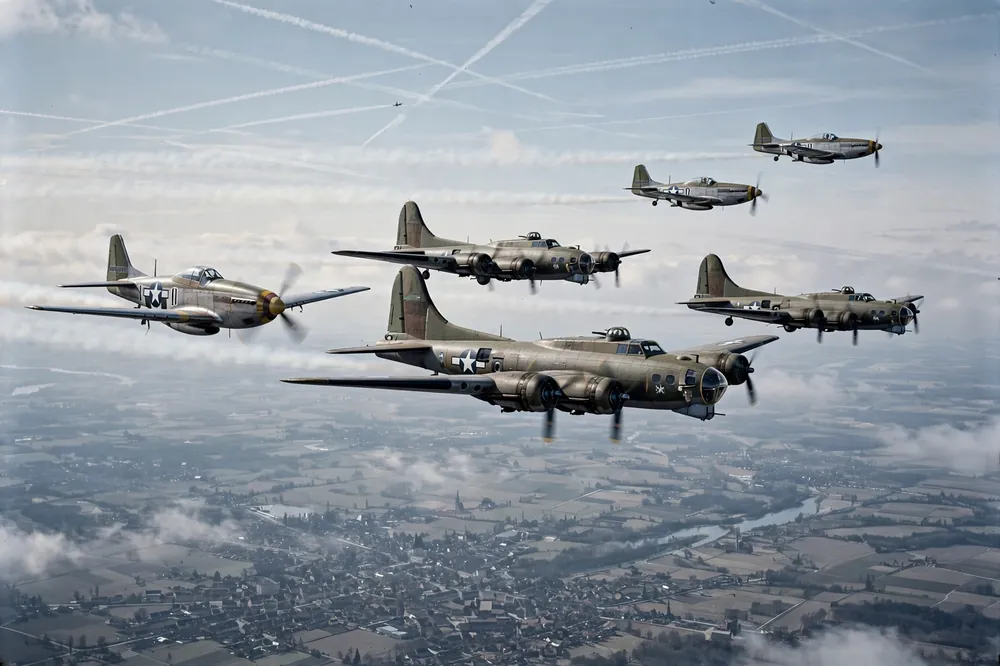
The P-51 Mustang’s best-known role was as the long-range escort fighter of the United States Eighth Air Force, which was conducting daylight bombing raids against Germany from bases in England. In 1943, the bombing campaign was suffering heavy losses: on the Schweinfurt–Regensburg mission of 17 August 1943, the Eighth Air Force lost 60 bombers, and on the second Schweinfurt raid of 14 October 1943 — “Black Thursday” — it lost 77 bombers.
The escorts available at the time, the P-47 Thunderbolt and the P-38 Lightning, did not have the range to accompany the bombers all the way to their targets in Germany, and the bombers flew the last part of the mission without fighter cover. The P-51B, with its Merlin engine and its drop tanks, could escort the bombers to Berlin and back, and it began to do so in early 1944.
The first American fighter escort to Berlin took place on 6 March 1944, when P-51s accompanied the bombers on a raid against the German capital. From that point, the Eighth Air Force’s fighters were no longer tied to the bombers: under the command of Major General William Kepner, they were ordered to seek out and destroy German fighters wherever they could be found, including by attacking airfields on the ground.
The change in tactics, combined with the Mustang’s range and performance, reduced the Luftwaffe’s ability to contest the daylight bombing campaign, and by the summer of 1944 the German fighter force was losing pilots and aircraft faster than it could replace them.
United States Army Air Forces records credit the Mustang with 4,950 enemy aircraft destroyed in the air and 4,131 destroyed on the ground in the European theatre — figures that count claims recorded by the units concerned, and that historians treat as credits rather than as independently verified totals, since claims from all sides in the air war were subject to over-counting.
The turning point of the daylight bombing campaign came in February 1944, during “Big Week,” a series of coordinated raids by the Eighth and Fifteenth Air Forces against the German aircraft industry. From 20 to 25 February 1944, American bombers attacked aircraft factories at Leipzig, Regensburg, Augsburg, and other cities, and the escorting fighters — including P-51s, P-47s, and P-38s — engaged the Luftwaffe’s fighters in large numbers.
The raids cost the Eighth Air Force about 150 bombers, but German aircraft production was disrupted, and the Luftwaffe lost pilots it could not replace: German fighter pilot training, already shortened by fuel shortages and by the demands of the Eastern Front, could not produce replacements at the rate the spring battles consumed them.
Through the spring of 1944, the Mustang groups of the Eighth Air Force flew escort missions on almost every day the weather allowed, and their presence over Germany forced the Luftwaffe to meet the bombers far from its bases, at a cost in fuel and in aircraft.
By June 1944, when the Allies landed in Normandy, the Luftwaffe could put only a small number of fighters over the invasion beaches, and the Allied air forces operated over France with little opposition in the air.
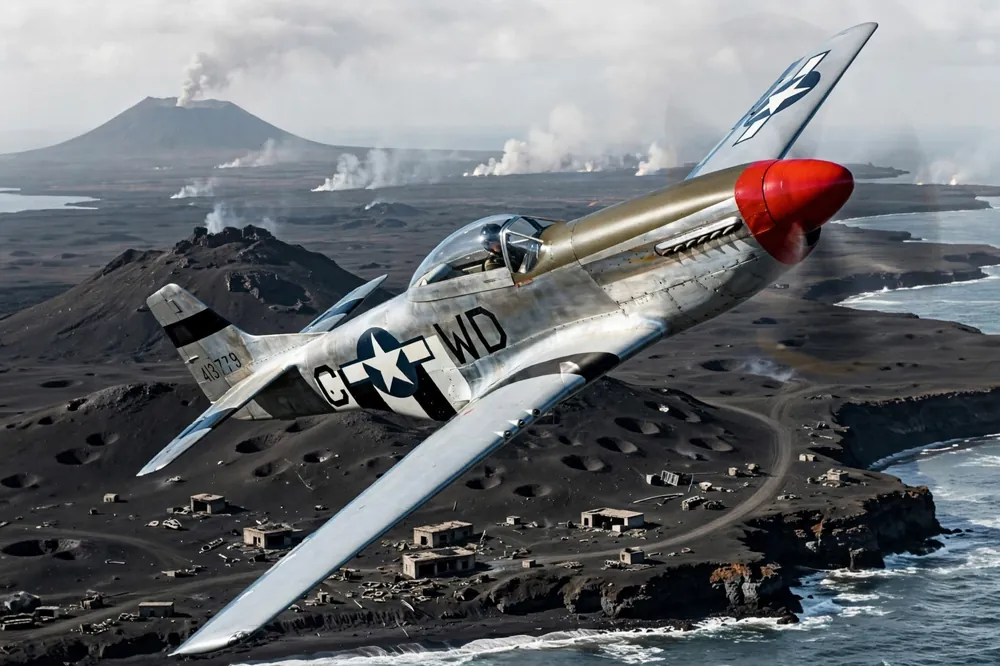
The Mustang also served in the Mediterranean, where the Fifteenth Air Force flew escort missions from bases in Italy, and in the Pacific, where P-51s operated from Iwo Jima from March 1945, escorting B-29 bombers on raids against Japan. In the Pacific, the Mustang’s long range was again its principal advantage: from Iwo Jima, P-51s could reach the Japanese home islands, and they flew escort and ground-attack missions in the last months of the war. The type also served in China, where the Fourteenth Air Force used Mustangs for escort and ground attack, and with the Royal Australian Air Force, which operated Mustangs in the South West Pacific and continued to use them after the war.
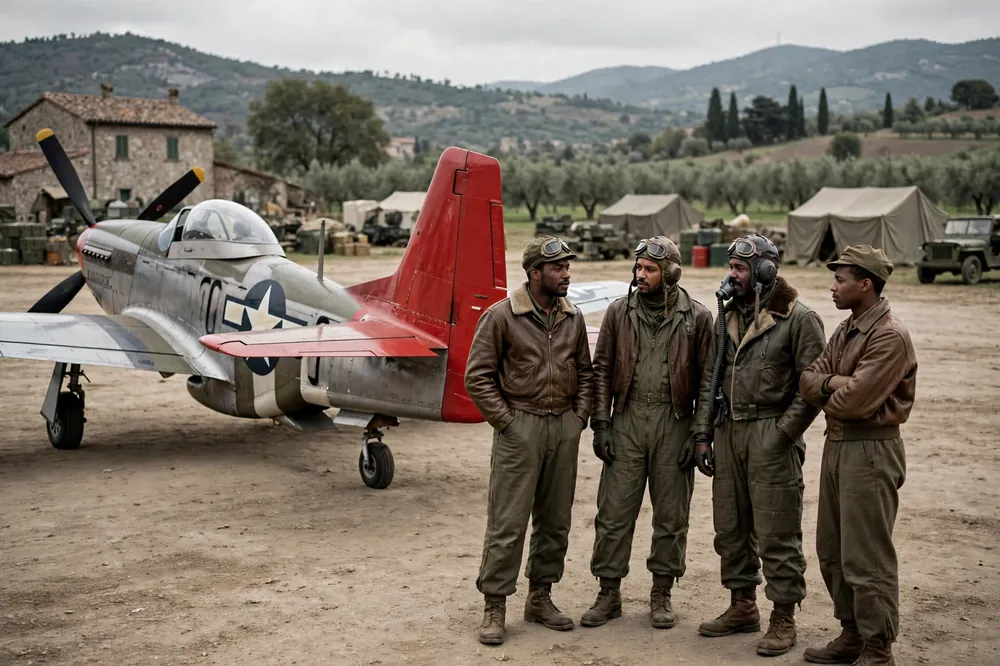
Among the units that flew the Mustang was the 332nd Fighter Group of the United States Army Air Forces, whose pilots were African Americans trained at Tuskegee, Alabama, under the segregation policies then in force in the United States armed forces.
The 332nd flew P-47s and then P-51s on bomber escort missions from Italy in 1944 and 1945, and its aircraft were identified by the red paint on their tails, which gave the unit its later nickname, the “Red Tails.” The group’s record has been the subject of public attention since the war, and some accounts of its service — including the claim, repeated in popular histories, that the group never lost a bomber it was escorting to enemy fighters — have been examined by historians and by the United States Air Force, whose research found that bombers escorted by the 332nd were lost on several occasions.
The unit’s documented record includes the award of the Distinguished Unit Citation for a mission on 24 March 1945, when it escorted bombers to Berlin and engaged German jet fighters.
In China, the Mustang served with the Fourteenth Air Force, whose 23rd Fighter Group — the successor to the American Volunteer Group, the “Flying Tigers” — converted to P-51s in 1944 and used them for escort and ground attack against Japanese forces in China and Burma. The 23rd’s Mustangs operated from airfields in southern China, where the long supply lines and the monsoon weather made operations difficult, and they flew missions against Japanese airfields, supply columns, and river traffic. The Mustang’s range mattered in China as it did in Europe: the distances were large, the targets were dispersed, and the aircraft’s ability to carry external fuel tanks and still fight on arrival was the quality that commanders valued most.
After the Second World War, the Mustang remained in service with the United States Air Force, redesignated F-51, and it was one of the first aircraft committed to the Korean War in June 1950. In Korea, the F-51 was used mainly for ground attack, a role for which its liquid-cooled engine made it vulnerable: North Korean and Chinese ground fire brought down a substantial number of Mustangs, and the type was gradually replaced by jet fighters.
The Mustang’s last combat service with the United States Air Force ended in 1953, but the aircraft continued in service with other air forces for decades. The last military operator was the Dominican Republic, which retired its Mustangs in 1984.
In total, the Mustang served with at least 55 air forces around the world, and it was also used by civilian operators, racing pilots, and film companies after its military service ended.
7. Performance and Specifications
| Specification | P-51D Mustang |
|---|---|
| Crew | 1 |
| Length | 32 ft 3 in (9.83 m) |
| Wingspan | 37 ft 0 in (11.28 m) |
| Height | 13 ft 8 in (4.17 m) |
| Wing area | 235 sq ft (21.8 m²) |
| Empty weight | 7,635 lb (3,463 kg) |
| Gross weight | 11,600 lb (5,262 kg) |
| Maximum takeoff weight | 12,100 lb (5,488 kg) |
| Engine | 1 × Packard V-1650-7 Merlin V-12 |
| Power | 1,490 hp (1,110 kW); 1,720 hp (1,280 kW) at war emergency power |
| Maximum speed | 440 mph (710 km/h) at 25,000 ft |
| Cruise speed | 362 mph (580 km/h) |
| Range | 1,650 mi (2,660 km) with external tanks; 950 mi (1,530 km) on internal fuel |
| Combat radius | About 750 mi (1,200 km) with two 108-gallon drop tanks |
| Service ceiling | 41,900 ft (12,800 m) |
| Rate of climb | 3,200 ft/min (16 m/s) |
| Armament | 6 × .50 in (12.7 mm) M2 Browning machine guns, 1,880 rounds |
| External stores | 2 × 1,000 lb bombs or 10 × 5 in rockets |
Compared with its contemporaries, the P-51D’s combination of speed, range, and high-altitude performance was unmatched among single-engine fighters. The German Focke-Wulf Fw 190 and Messerschmitt Bf 109 were comparable in speed and manoeuvrability at the altitudes where they operated, but neither could match the Mustang’s range.
The British Spitfire, in its later marks, was faster in the climb and tighter in the turn, but it carried less fuel and could not escort bombers to Berlin. The Soviet Yakovlev Yak-3 was lighter and more agile at low altitude, but it was a short-range tactical fighter.
The Mustang’s strength was not that it was the best fighter in any single respect, but that it combined high speed, good high-altitude performance, heavy firepower, and the range to use those qualities deep inside enemy territory.
The figures in the table above are for the P-51D, the model most commonly cited in the published literature. Figures for other models differ: the Allison-powered Mustang Mk I was slower at altitude but carried a different gun armament, and the P-51H was faster than the P-51D but lighter and less heavily armed. Readers comparing sources should check which model a figure refers to, since the Mustang’s performance changed substantially between the first Allison models and the final Merlin models.
8. Operators
The Mustang served with at least 55 air forces. The largest operator was the United States, where the United States Army Air Forces and later the United States Air Force flew the type in the Second World War and the Korean War, and the Air National Guard continued to operate it into the 1950s.
The Royal Air Force was the second-largest operator, with more than 1,000 aircraft, and the Royal Australian Air Force operated Mustangs in the South West Pacific and built 200 of them under licence at Fishermans Bend, near Melbourne. Other wartime operators included Canada, China (Nationalist forces), France, the Netherlands, Poland (in RAF service), South Africa, and the Soviet Union, which received a small number under Lend-Lease for evaluation.
After the war, the Mustang was supplied to a long list of air forces, including those of Bolivia, Cuba, El Salvador, Guatemala, Haiti, Indonesia, Israel, Italy, Japan, Nicaragua, the Philippines, Sweden, Switzerland, and Uruguay. The last military operator, the Dominican Republic, retired its Mustangs in 1984, more than forty years after the first aircraft entered service.
9. Legacy and Influence
The P-51 Mustang’s place in the history of air warfare rests on two things: its technical design and its operational role. Technically, the Mustang showed what could be achieved by combining an airframe of low drag with a powerful, high-altitude engine and a large fuel capacity. The laminar-flow wing and the ventral radiator were widely studied after the war, and the aircraft’s design influenced the development of post-war fighters.
Operationally, the Mustang is associated with the change in the air war over Germany in 1944, when the Eighth Air Force’s fighters moved from close escort to offensive sweeps against the Luftwaffe. Historians differ on how much of that change should be attributed to the aircraft itself, to the change in tactics, and to the wider attrition of the German fighter force, which was also being attacked by the Royal Air Force at night and by the Soviet air force in the east.
The Mustang did not win the air war on its own, and the daylight bombing campaign continued to suffer losses until the end of the war, but the aircraft’s range made the offensive fighter sweeps possible, and its performance made them effective.
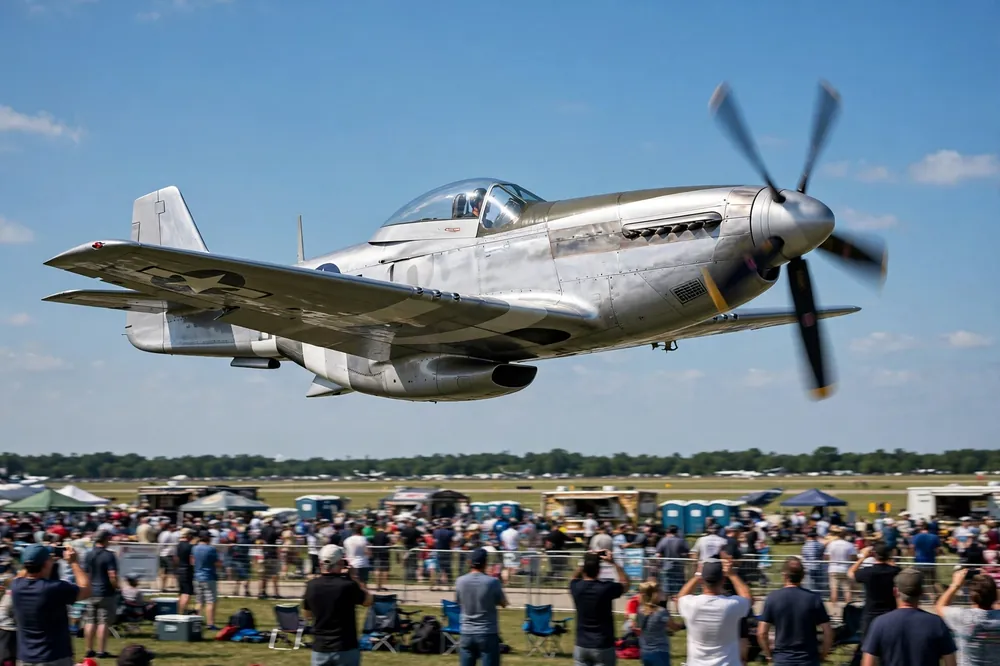
The Mustang also has a lasting public presence. It is one of the most recognisable aircraft of the Second World War, and it appears in films, in museum collections, and at airshows around the world. The association with the Tuskegee Airmen has given the aircraft a place in the history of the desegregation of the American armed forces, and the 332nd Fighter Group’s story is taught in American schools and commemorated at the Tuskegee Airmen National Historic Site in Alabama.
In aviation, the Mustang’s name has been reused: the Ford Motor Company named its sports car, introduced in 1964, after the aircraft, and the name has remained in use since. The aircraft’s reputation among pilots is documented in memoirs and interviews: they valued its range, its handling at high altitude, and its ability to bring them home after long missions, while noting its vulnerability to ground fire and its demanding handling on takeoff, when the torque of the Merlin engine pulled the aircraft to the left.
After the war, surplus Mustangs were sold cheaply to civilian buyers, and the aircraft found a second career in air racing. Modified Mustangs have competed in the Reno Air Races in Nevada since the 1960s, and the fastest of them have exceeded 500 mph on the closed course — faster than the aircraft ever flew in military service.
The racing Mustangs are heavily modified, with clipped wings, racing engines, and stripped interiors, and they bear little resemblance to the wartime fighter except in outline. The civilian Mustang market has also kept the aircraft flying: restored P-51s are among the most expensive warbirds in private hands, and their value reflects both their scarcity and their place in the public memory of the war.
10. Surviving Examples
An estimated 280 Mustangs survive worldwide, of which more than 150 remain airworthy — figures that vary by source, since the count depends on how incomplete airframes and aircraft under restoration are classified. The largest collections are in the United States, where the National Museum of the United States Air Force at Wright-Patterson Air Force Base, Ohio, displays a P-51D, and the Smithsonian National Air and Space Museum in Washington, D.C., holds a P-51D in its collection.
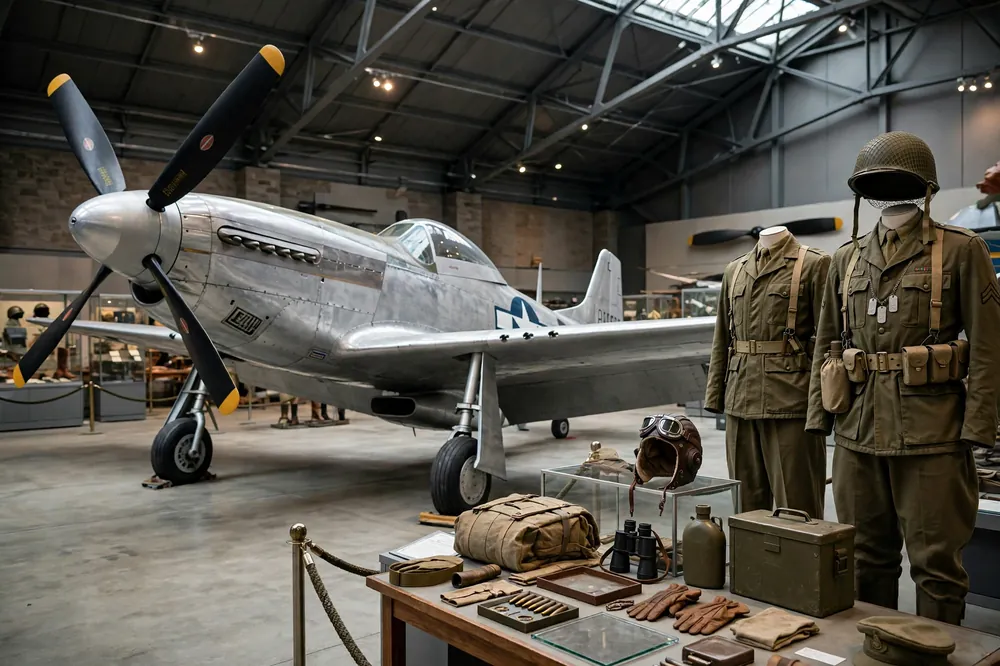
The Imperial War Museum Duxford in England displays Mustangs in its American Air Museum, and the Australian War Memorial in Canberra holds an Australian-built CA-18 Mustang. The Collings Foundation and the Commemorative Air Force in the United States operate airworthy P-51s that fly at airshows, including two-seat TF-51D conversions that carry passengers.
In Britain, the Rolls-Royce Heritage Trust and private operators fly airworthy Mustangs, and the aircraft is a regular participant in the Flying Legends airshow at Duxford. For most visitors, the easiest way to see a P-51 Mustang is at an airshow, where the aircraft’s Merlin engine — with its distinctive sound — is as much a part of the experience as the aircraft itself.
Frequently Asked Questions
What is the P-51 Mustang? The P-51 Mustang was a single-seat, single-engine fighter built by North American Aviation in the United States. It first flew in October 1940, entered service with the Royal Air Force in January 1942, and became the standard long-range escort fighter of the United States Army Air Forces in Europe during the Second World War.
How fast was the P-51 Mustang? The definitive P-51D had a maximum speed of 440 mph (710 km/h) at 25,000 feet, and a service ceiling of 41,900 feet. The later P-51H was faster, at 487 mph, but it arrived too late to see combat in the Second World War.
Why was the P-51 Mustang important? The Mustang’s importance came from its range. With external fuel tanks it could escort American bombers from England to Berlin and back, which no other Allied single-engine fighter could do. That range, combined with its speed and high-altitude performance, allowed the Eighth Air Force to take the offensive against the Luftwaffe in 1944.
What engine did the P-51 Mustang use? Early Mustangs used the Allison V-1710 engine, which performed poorly at high altitude. The Merlin-powered models used the Packard V-1650, a licence-built version of the Rolls-Royce Merlin V-12, built by the Packard Motor Car Company in Detroit. The P-51D used the Packard V-1650-7, producing 1,490 hp, or 1,720 hp at war emergency power.
How many P-51 Mustangs were built? More than 15,000 Mustangs were built. The figure most commonly cited is 15,686, but sources vary between about 15,500 and 15,700, depending on how cancelled orders, Australian-assembled aircraft, and post-war rebuilds are counted. The largest single model was the P-51D, with 7,956 built.
Is the P-51 Mustang still flying today? Yes. An estimated 280 Mustangs survive worldwide, and more than 150 remain airworthy. Airworthy examples fly at airshows in the United States, Britain, and Australia, and two-seat TF-51D conversions carry passengers on experience flights.
Related articles
Sources
- Wikipedia, “North American P-51 Mustang” — specifications (P-51D), production figures (15,686), and variant details, cross-checked against the sources below.
- National Museum of the United States Air Force, “North American P-51D Mustang” (nationalmuseum.af.mil) — specifications, service history, and the Eighth Air Force escort role.
- Smithsonian National Air and Space Museum, “North American P-51D Mustang” (airandspace.si.edu) — development, the Merlin conversion, and museum holdings.
- Imperial War Museum Duxford, American Air Museum — P-51 Mustang exhibits and the Eighth Air Force in East Anglia.
- United States Air Force, Air Force Historical Research Agency — 332nd Fighter Group records, including the Distinguished Unit Citation of 24 March 1945 and the research on bomber losses while escorted by the group.
- Jeffrey L. Ethell, P-51 Mustang (Motorbooks, 1981) and Robert Gruenhagen, Mustang: The Story of the P-51 Fighter (Arco, 1969) — development history and operational service.
Further reading
- William N. Hess, P-51 Mustang (Crowood Press, 1998).
- John R. Bruning, Tuskegee Airmen (various editions) — for the 332nd Fighter Group; claims about the group’s escort record should be checked against Air Force Historical Research Agency records.