 WAR ATLAS MILITARY HISTORY MAGAZINE · WWI — WWII
D-Day: The Normandy Landings
1. Lead
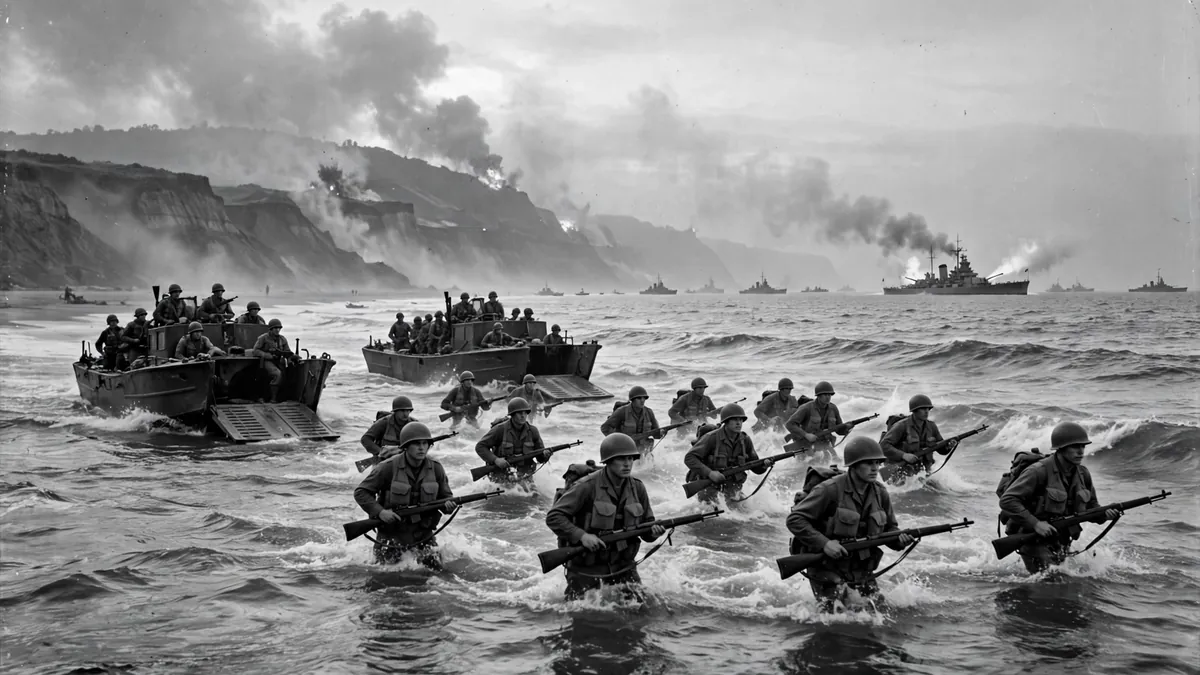
D-Day was the Allied landing in Normandy, France, on 6 June 1944 — the largest seaborne invasion in history and the opening of a second front in western Europe against Nazi Germany. Codenamed Operation Neptune, the assault phase of the wider Operation Overlord, it put about 156,000 Allied troops ashore on a 50-mile (80 km) stretch of coast in a single day, supported by 6,939 vessels and more than 11,000 aircraft.
By nightfall the Allies held five beachheads — Utah, Omaha, Gold, Juno and Sword — at a cost of at least 10,000 Allied casualties, with 4,414 confirmed dead. The heaviest fighting was at Omaha Beach, where American troops were pinned down for hours before breaking through.
D-Day did not end the war, but it established the foothold from which the Allies advanced across France, and it forced Germany to fight a two-front war it could not sustain.
2. Key Facts
| Date | 6 June 1944 |
| Location | Normandy, France — 80 km of coast from Utah Beach (west) to Sword Beach (east) |
| Result | Allied victory; five beachheads established |
| Allied commanders | General Dwight D. Eisenhower (SHAEF); General Bernard Montgomery (21st Army Group); Lt. Gen. Omar Bradley (US First Army); Lt. Gen. Miles Dempsey (British Second Army) |
| German commanders | Field Marshal Gerd von Rundstedt (OB West); Field Marshal Erwin Rommel (Army Group B); General Friedrich Dollmann (Seventh Army) |
| Allied strength | About 156,000 troops landed (73,000 American, 61,715 British, 21,400 Canadian); about 24,000 airborne troops; 6,939 vessels; 11,590 aircraft available |
| German strength | Four infantry divisions on the coast (352nd, 709th, 716th, plus elements of others), 21st Panzer Division in reserve near Caen |
| Allied losses | At least 10,000 casualties, including 4,414 confirmed dead; 185 M4 Sherman tanks; 127 aircraft lost |
| German losses | Estimated 4,000–9,000 killed, wounded, missing or captured |
| Civilian losses | Estimated 3,000 French civilians killed on D-Day and D+1 |
3. Background
By the spring of 1944, the Second World War in Europe had been running for nearly five years, and the Soviet Union had been carrying the main weight of the land war against Germany since June 1941. The Western Allies — the United States, Britain and Canada — had fought in North Africa, Sicily and Italy, but the Soviet leadership had pressed since 1942 for a second front in France, to draw German divisions away from the east. At the Tehran Conference in November 1943, the Allies agreed: the invasion of France would take place in the spring of 1944, under the codename Operation Overlord.
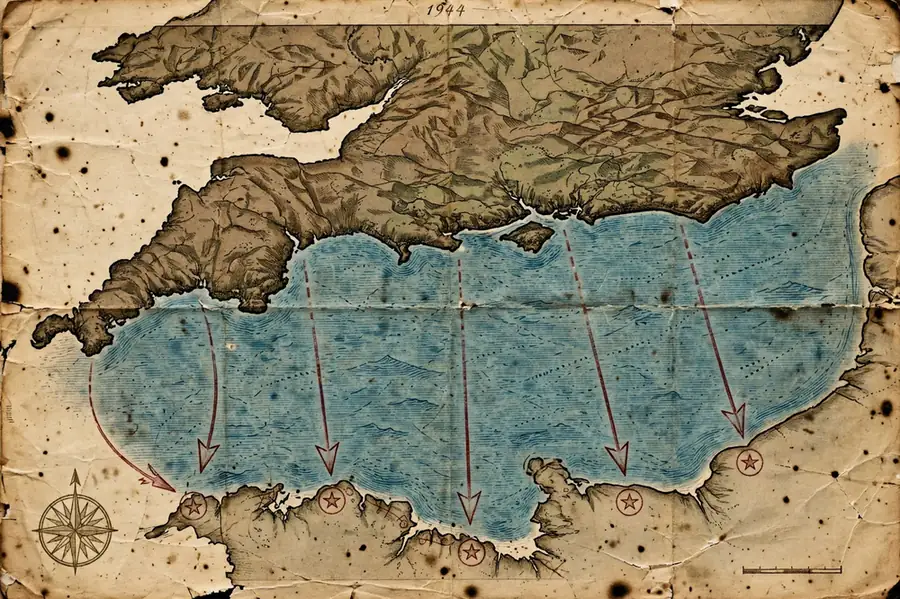
The choice of Normandy was a compromise between competing demands. The Pas-de-Calais, at the narrowest point of the English Channel, offered the shortest crossing and the fastest route to Germany — which was exactly why the Germans expected the attack there and fortified it most heavily. Normandy, further west, offered wider beaches, weaker defences and ports that could be captured, at the cost of a longer sea crossing and a longer overland route to Germany. The planners chose Normandy and built the invasion around it: five landing beaches, two artificial harbours to be towed across the Channel, and an airborne assault on both flanks to protect the landings.
The preparations were on a scale never attempted before. In southern England, more than 1.5 million American troops had assembled by the spring of 1944, alongside British and Canadian forces. Ports, airfields and training grounds were built or expanded across the south coast. Landing craft were produced in their thousands. The air forces bombed railways, bridges and airfields across northern France for months, in a campaign that cost the Allied air forces nearly 12,000 men and more than 2,000 aircraft in April and May 1944 alone — before a single soldier had landed.
Deception was as important as firepower. Under Operation Fortitude, part of the wider Operation Bodyguard deception plan, the Allies built a fictitious army in southeast England, supposedly commanded by General George S. Patton and preparing to cross to the Pas-de-Calais. Dummy tanks, false radio traffic and double agents fed the German command a picture of an invasion aimed at Calais. The deception worked: on 6 June, German commanders still expected the main landing to come at the Pas-de-Calais, and held their armoured reserves back for an attack that never came there.
On the German side, the defences were formidable but incomplete. Since 1942, the Germans had built the Atlantic Wall — a chain of concrete gun emplacements, bunkers and obstacles along the coast from Norway to Spain. In early 1944, Field Marshal Erwin Rommel took command of Army Group B, responsible for the defence of northern France, and ordered the defences strengthened: millions of mines, steel obstacles on the beaches, flooded fields inland, and gun positions covering every landing beach.
Rommel’s view was that the invasion had to be defeated on the beaches, in the first hours, because once the Allies were ashore with their air and naval superiority, they could not be thrown back. His superior, Field Marshal Gerd von Rundstedt, commander in the west, disagreed: he wanted to hold the armoured divisions inland and counterattack once the landing’s main effort was clear.
The argument was never settled, and on 6 June the German command was divided — and, crucially, the release of the armoured reserves required Hitler’s personal approval.
The date itself was decided by the weather. The landings needed a full moon, for the airborne drops, and a low tide at dawn, so that the beach obstacles would be exposed for the engineers. The first suitable window was 5 June. On 4 June, with storms sweeping the Channel, General Eisenhower postponed the invasion by 24 hours.
His chief meteorologist, Group Captain James Stagg, forecast a brief break in the weather on 6 June. Eisenhower took the decision to go. The next suitable tides would not have come until 19 June — when, as it turned out, a great storm struck the Channel and would have made a landing impossible. The forecast, and the decision to trust it, set the date of D-Day.
4. Opposing Forces
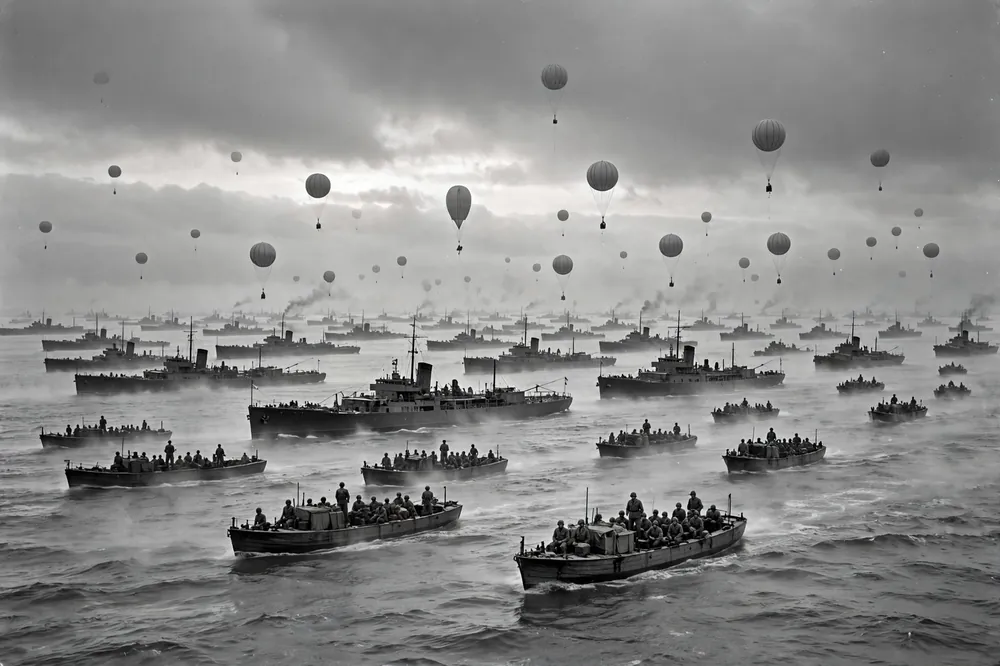
The Allied invasion force was the largest amphibious force ever assembled. Operation Neptune, the naval component, involved 6,939 vessels: 1,213 naval combat ships, 4,126 landing ships and landing craft, 736 ancillary craft and 864 merchant vessels, manned by some 195,700 naval personnel. In the air, 11,590 aircraft were available to support the landings, and on D-Day itself Allied aircraft flew 14,674 sorties and lost 127 aircraft. On land, the assault force was organised into two armies under General Montgomery’s 21st Army Group: the American First Army under Lieutenant General Omar Bradley in the west, and the British Second Army under Lieutenant General Miles Dempsey in the east.
| Allies | Germany | |
|---|---|---|
| Troops landed on 6 June | About 156,000 (73,000 American, 61,715 British, 21,400 Canadian) | About 50,000 men in the divisions facing the beaches, with armoured reserves inland |
| Airborne troops | About 24,000 (US 82nd and 101st Airborne, British 6th Airborne) | — |
| Vessels | 6,939 (1,213 warships, 4,126 landing ships and craft) | Few naval forces in the Channel; E-boats and mines |
| Aircraft | 11,590 available; 14,674 sorties on D-Day | About 300 serviceable fighters in northern France |
| Armour | DD (amphibious) Sherman tanks, specialised armoured vehicles (“Hobart’s Funnies”) on British beaches | 21st Panzer Division near Caen; 12th SS Panzer and Panzer Lehr in reserve |
| Naval gunfire support | 5 battleships, 23 cruisers, over 100 destroyers | Coastal gun batteries, including the Merville and Longues batteries |
| Overall commander | Gen. Dwight D. Eisenhower (SHAEF) | Field Marshal Gerd von Rundstedt (OB West) |
| Ground commander | Gen. Bernard Montgomery (21st Army Group) | Field Marshal Erwin Rommel (Army Group B) |
The German forces in Normandy were weaker than the numbers suggest. The Seventh Army, under General Friedrich Dollmann, held the coast with four infantry divisions: the 352nd at Omaha, the 709th at Utah, and the 716th covering Gold, Juno and Sword, with the 91st Air Landing Division and other units inland.
Two of these — the 709th and 716th — were static divisions, made up of older men, conscripts from occupied countries and troops rated unfit for service on the Eastern Front, with limited transport and few vehicles. The 352nd, by contrast, was a full-strength field division, and its presence at Omaha — where Allied intelligence had expected only a single regiment of the 716th — was one of the reasons the fighting there was so much harder than planned.
Behind the coast stood the 21st Panzer Division near Caen, the only armoured division close enough to intervene on the first day. Two more panzer divisions, the 12th SS and Panzer Lehr, were held in reserve further inland, and could only be released with Hitler’s approval.
The contrast in the air and at sea was stark. The Allies had complete control of the Channel and overwhelming air superiority: German air activity over the beaches on 6 June was minimal, and the Luftwaffe could put only a few hundred fighters into the air across northern France. The German navy in the Channel consisted of a handful of torpedo boats and mines. The invasion force, by contrast, included five battleships — among them USS Nevada, a veteran of the Attack on Pearl Harbor — and more than a hundred destroyers, whose guns could reach targets miles inland. The battle would be decided on land, but it was fought under an Allied sky and off an Allied sea.
5. The Battle: D-Day Hour by Hour
D-Day began in the air, shortly after midnight on 6 June. About 24,000 American, British and Canadian airborne troops were dropped or landed by glider behind the beaches, on both flanks of the invasion area. On the western flank, the US 82nd and 101st Airborne Divisions were dropped around Sainte-Mère-Église and Carentan, to secure the causeways across the flooded fields behind Utah Beach and to block German reinforcements from reaching the coast. On the eastern flank, the British 6th Airborne Division was dropped east of the River Orne, to hold the bridges over the Orne and the Caen Canal and to protect the invasion’s left flank.
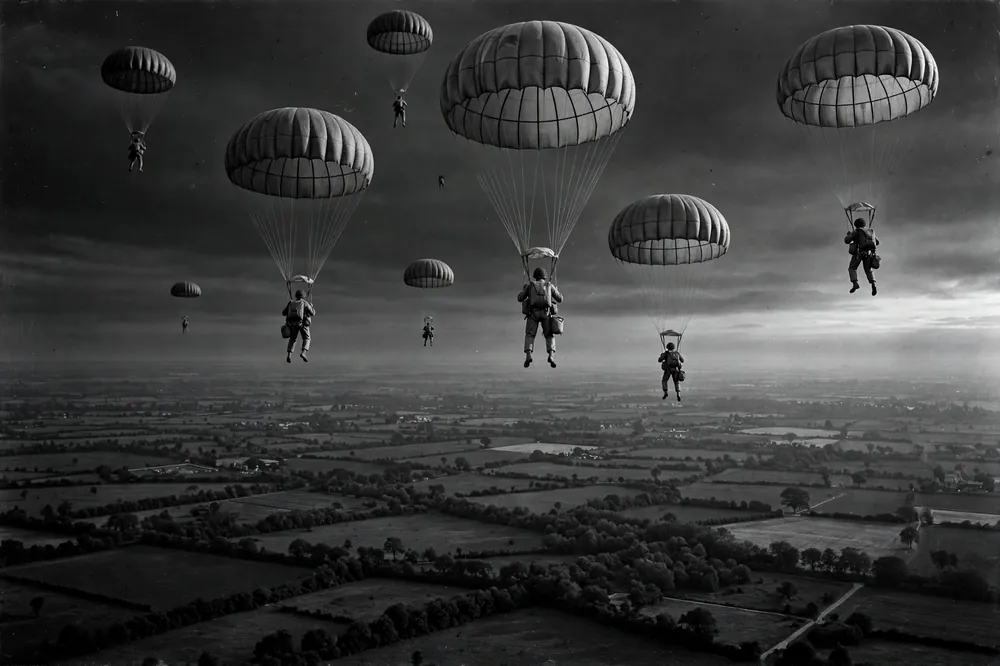
The drops were widely scattered. Low cloud, German anti-aircraft fire and inexperienced pilots put many paratroopers miles from their intended landing zones. Units landed in small groups, mixed together, and fought through the night to find their officers and their objectives. Despite the confusion, the airborne troops achieved most of what was asked of them: the causeways behind Utah were secured, German movements toward the beaches were disrupted, and the bridges on the eastern flank were taken.
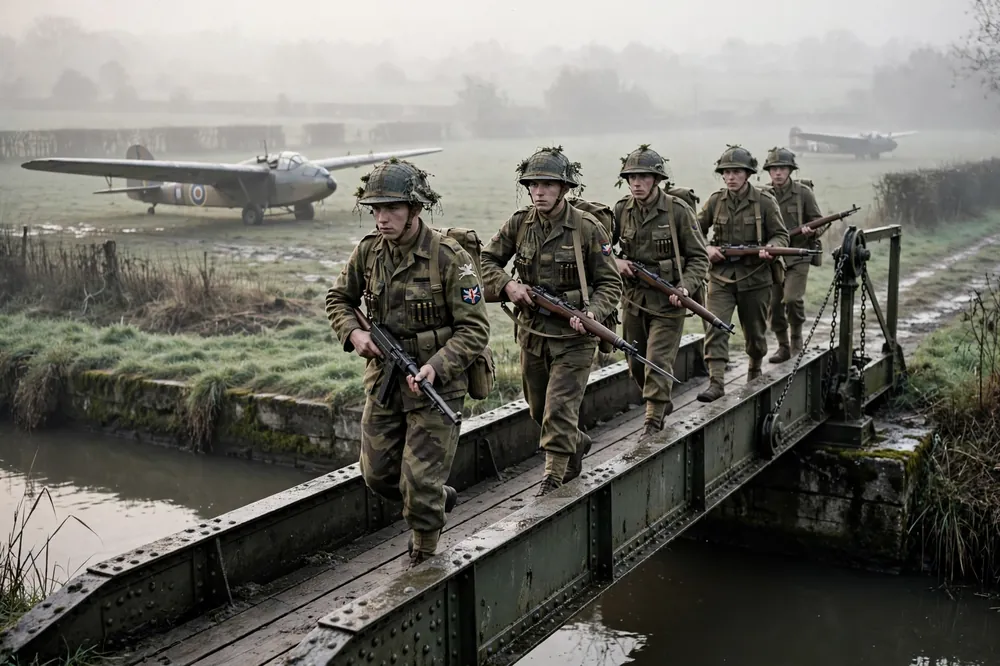
The first action of the day came on the eastern flank, at about 00:16, when gliders carrying men of the Oxfordshire and Buckinghamshire Light Infantry, under Major John Howard, landed within yards of Pegasus Bridge over the Caen Canal and captured it intact within minutes.
At the Merville Battery, Lieutenant Colonel Terence Otway’s 9th Battalion of the Parachute Regiment attacked a German gun position whose four guns could have fired on Sword Beach; the battalion took the battery at heavy cost, though the guns proved to be smaller calibre than intelligence had reported.
At Sainte-Mère-Église, paratroopers of the 82nd Airborne took the town in the early hours — one man, Private John Steele, became known after his parachute caught on the church steeple and left him hanging there while the fighting went on below.
At dawn, the bombardment began. From about 05:30, the battleships, cruisers and destroyers offshore opened fire on the German defences, while more than 2,000 bombers attacked the coast. The scale was enormous — more than 10,000 tons of bombs were dropped on Normandy during 6 June — but the results were uneven. At Utah, the bombardment was effective. At Omaha, it was not: low cloud forced the bombers to delay their release so as not to hit the landing craft, and their bombs fell inland, beyond the beach defences. The naval guns fired at targets they could not always see, and many German positions survived to meet the first waves.
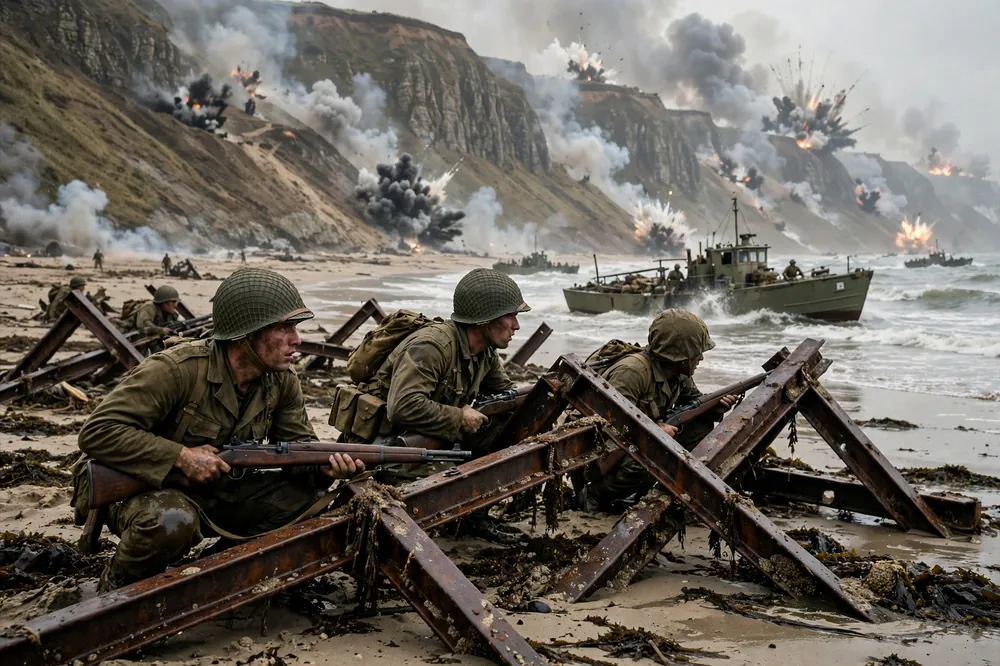
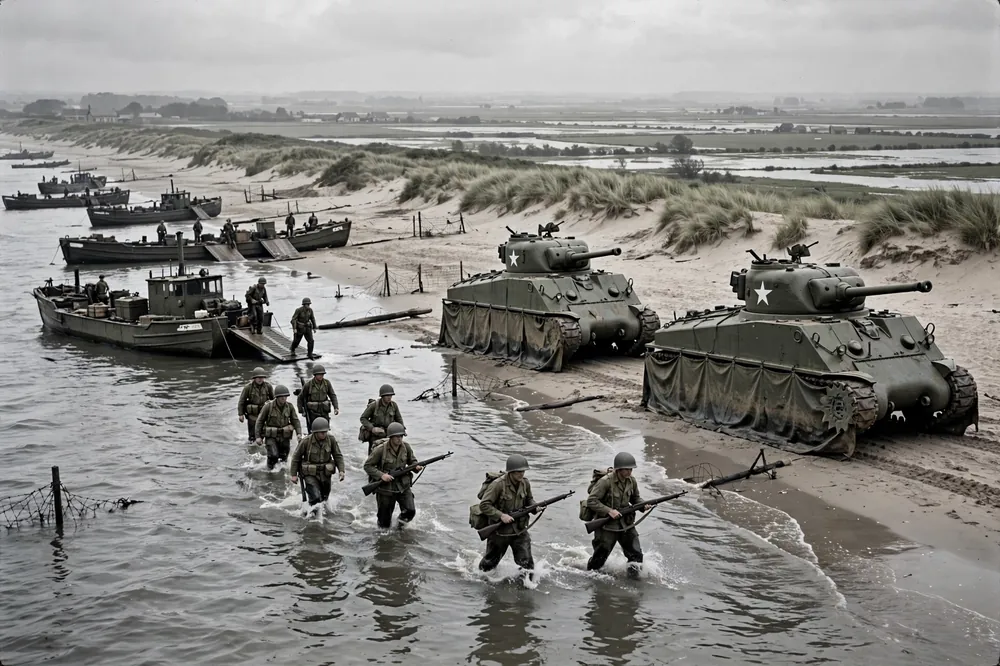
The first seaborne troops reached the beaches at 06:30 on the American beaches, and from 07:25 on the British and Canadian beaches — the later hour dictated by the tides. The landing craft had crossed the Channel overnight in rough seas; many men were seasick before they ever saw the shore. Strong winds pushed the craft east of their intended positions, particularly at Utah and Omaha. The men landed under fire from gun emplacements overlooking the beaches, and the shore was mined and covered with obstacles — wooden stakes, steel hedgehogs, barbed wire — that made the work of the beach-clearing engineers slow and dangerous.
Utah, the westernmost beach, was the least costly of the five. The US 4th Infantry Division, part of VII Corps, came ashore at 06:30 — but about 2,000 yards south of its intended landing point, carried off course by the strong current. The officer who landed with the first wave, Brigadier General Theodore Roosevelt Jr., judged that the ground here was as good as the planned beach and ordered the landings to continue where they were. His reported words — “We’ll start the war from right here” — became one of the best-known remarks of the day.
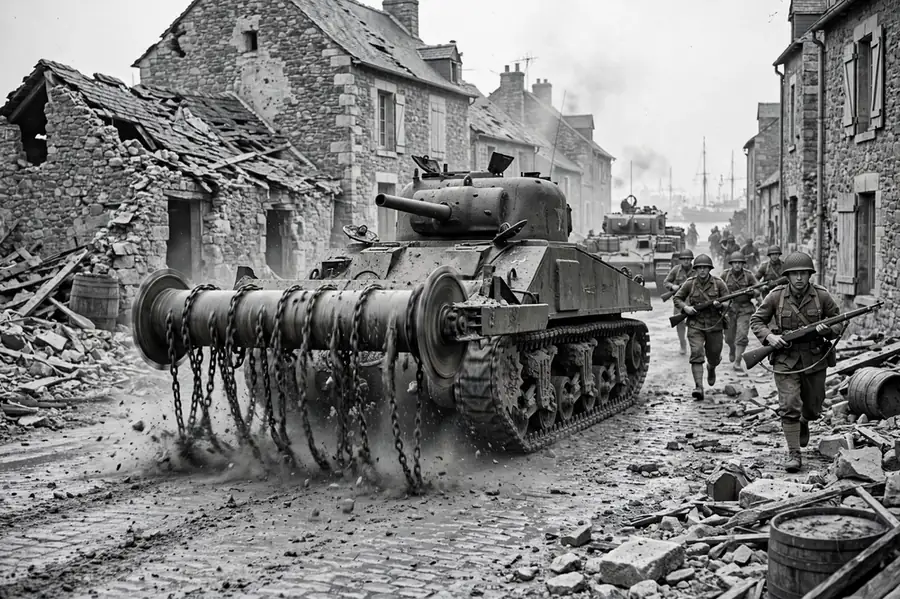
Resistance at Utah was light. The 709th Static Division, thinly spread and already disrupted by the airborne landings behind it, could not hold the beach. The naval bombardment had silenced many of its guns, and the amphibious DD tanks arrived on the beach in good order, unlike at Omaha. By midday, American troops were off the beach and moving inland; by the end of the day, 23,250 men had landed at Utah at a cost of 197 casualties, including 60 missing — the lowest of any beach. The 4th Division linked up with the 101st Airborne inland and began the advance toward Cherbourg.
Omaha was the hardest fight of the day, and the one that came closest to failure. The beach, about 6 miles long, lay beneath steep bluffs, with only a few narrow draws — valleys — leading inland. The German 352nd Infantry Division, a full-strength field division that Allied intelligence had not expected to find there, held the bluffs with well-sited machine guns, mortars and artillery, much of it protected in concrete positions that the bombardment had failed to destroy.
The first waves landed at 06:30 into heavy fire. The naval bombardment had left the defences largely intact, and the aerial bombing had fallen inland. Of the 29 DD amphibious Sherman tanks launched offshore to support the infantry, 27 sank in the rough seas before reaching the beach. The specialised armoured vehicles that had helped on the British beaches were not used at Omaha. Landing craft were hit as they approached; men wading ashore were caught by machine-gun fire from the bluffs and by mines and obstacles on the sand. The first waves took severe losses and were pinned down on the open beach, with no cover, for hours.
By late morning, the situation began to change. Destroyers moved in close to shore — some to within a few hundred yards — and fired directly at the German positions on the bluffs, at great risk to themselves. Small groups of infantry, led by junior officers and non-commissioned officers, began to work their way up the draws, outflanking the strongpoints one by one.
Engineers cleared paths through the mines and wire under fire. By the afternoon, the draws were open, the bluffs were being cleared, and troops were moving inland. By the end of the day, 34,250 men had landed at Omaha. The cost was about 2,000 casualties among the 1st and 29th Divisions — the highest of any beach, though some later estimates run higher, up to around 4,000 American casualties at Omaha in total.
The beachhead was held, but only narrowly, and only after hours in which the landing had hung in the balance.
On the eastern beaches, the landings went more nearly to plan. At Gold Beach, the British 50th (Northumbrian) Infantry Division, part of XXX Corps, landed from 07:25 with the support of specialised armoured vehicles — tanks fitted with flails to clear mines, bridges to cross ditches, and petards to destroy concrete defences.
The division took the coastal towns in house-to-house fighting, disabled two major gun emplacements with the specialised tanks, and advanced inland toward Bayeux. About 25,000 men landed at Gold, at a cost of roughly 1,000 casualties. The port of Arromanches, where the British artificial harbour — Mulberry B — would be built, was secured.
Bayeux itself was taken the next day, 7 June, and was the first town of its size to come under Allied control in France.
At Juno Beach, the 3rd Canadian Infantry Division, part of I Corps, landed at 07:35 — ten minutes late, after the landing craft had to wait for the tide. The Canadians faced two heavy batteries of 155 mm guns and nine medium batteries, as well as machine-gun nests, pillboxes and a seawall twice the height of the one at Omaha. They cleared the beach towns in close fighting and advanced further inland than any other division on D-Day, reaching positions about 6 miles (10 km) from the coast by nightfall. Canadian losses were 340 killed and 574 wounded — 946 casualties in all. The cost was concentrated in the first hours; once the beach was cleared, the advance was rapid.
At Sword Beach, the easternmost landing, the British 3rd Infantry Division, also of I Corps, landed from 07:25 and linked up during the day with the 6th Airborne Division holding the Orne bridges. The landing was supported by the 1st Special Service Brigade of commandos, who marched inland to reinforce the airborne troops — their commander, Brigadier Lord Lovat, is recorded as having crossed the beach accompanied by his personal piper.
About 28,845 men landed at Sword, at a cost of roughly 1,000 casualties. The division’s first-day objective was Caen, a city of strategic importance and a road and rail centre. It was not taken — the 21st Panzer Division, the only German armoured division near the beaches, counterattacked during the day and held the approaches to the city. Caen would not be fully captured until 21 July.
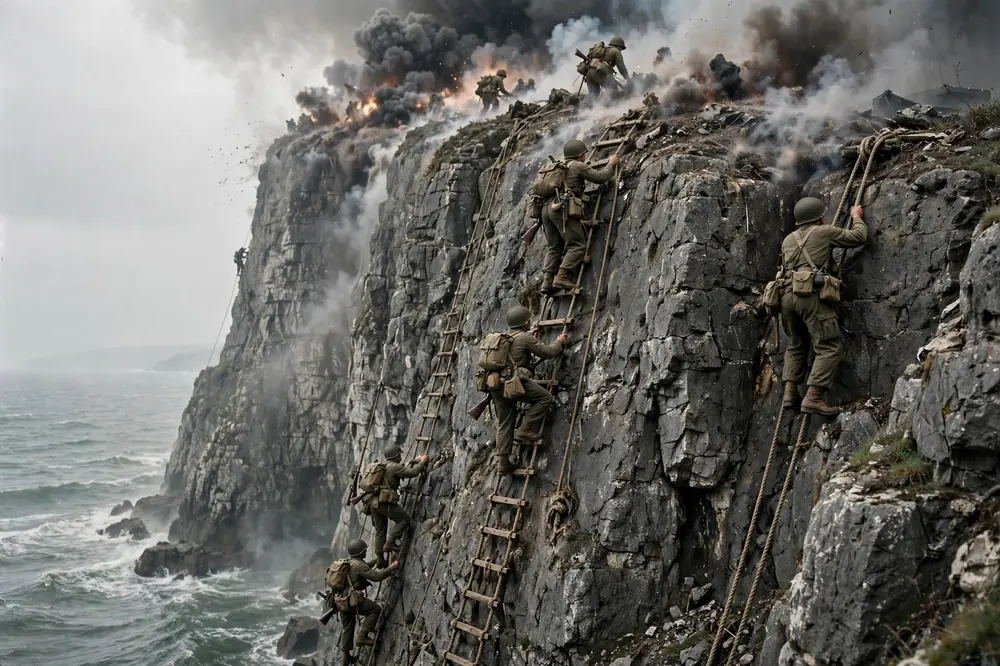
Between Omaha and Utah stood Pointe du Hoc, a cliff-top German gun position overlooking both beaches. At 07:10, about 225 men of the 2nd Ranger Battalion, under Lieutenant Colonel James Rudder, landed at the base of the 30-metre cliffs and scaled them with ropes and ladders under fire. When they reached the top, they found the guns had been moved inland; the Rangers located and destroyed them later that day, and then held the position for two days against German counterattacks, at heavy cost. The action removed a battery that could have fired on both landing beaches.
By nightfall on 6 June, all five beachheads were held. About 156,000 men had come ashore. But the objectives of the first day had only partly been met: Carentan, Saint-Lô and Bayeux remained in German hands on the evening of 6 June (Bayeux fell the next day), Caen was not taken, and only two of the beaches — Gold and Juno — were linked. The five beachheads were not connected until 12 June. The Allies had landed, and they were there to stay — but the battle for Normandy was only beginning.
6. Turning Point
The turning point of D-Day came not in a single attack but in a series of German decisions — and non-decisions — during the first hours. The most important was the failure to move the armoured reserves. The 21st Panzer Division, near Caen, was the only armoured formation close enough to reach the beaches on 6 June, and its commander spent much of the day waiting for orders while his division was held back by confusion in the chain of command.
The division’s counterattack, when it finally came in the afternoon, drove a wedge between the British and Canadian beaches — but it was too late and too weak to reach the sea. The 12th SS Panzer and Panzer Lehr divisions, held further inland, could not move without orders from Hitler’s headquarters, and those orders did not come until late in the day.
By then, the beachheads were established and Allied naval gunfire and air power made any large armoured movement in daylight extremely costly.
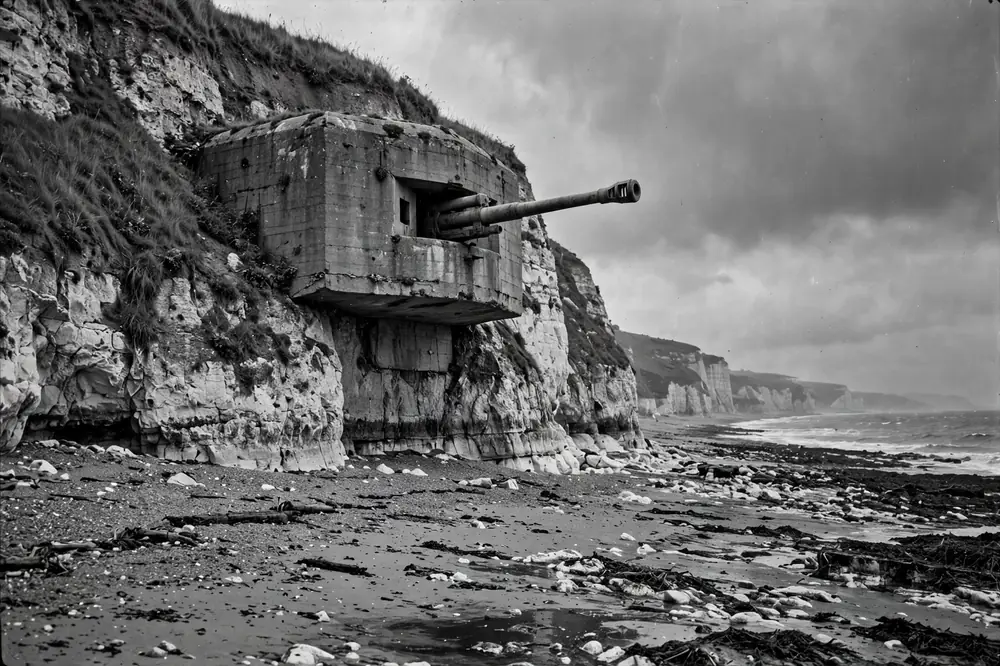
A second turning point was at Omaha, in the late morning. For several hours the landing there had stalled on the open beach, and the American commanders offshore considered whether the follow-up waves should be diverted to Utah or to the British beaches. They were not diverted. Instead, destroyers closed to point-blank range and fired directly into the German positions, and small infantry groups worked up the draws. The decision to persist at Omaha — made on the spot by junior officers, naval captains and the men on the beach as much as by generals — turned a landing that had come close to failure into a secured beachhead by nightfall.
A third turning point was invisible to the men on the beaches: the deception held. Throughout 6 June, the German high command continued to treat Normandy as a diversion and to expect the main landing at the Pas-de-Calais. The Fifteenth Army, the strongest German army in France, stayed in the Pas-de-Calais area and did not move toward Normandy for days.
By the time the German command accepted that Normandy was the main effort, the Allies had landed more than 300,000 men, and the opportunity to throw them back into the sea had passed. The historian’s judgement, widely shared, is that the invasion could only have been defeated on 6 June itself; after that day, the balance of men, ships and aircraft made an Allied defeat in Normandy unlikely.
7. Casualties and Losses
There is no official, final figure for D-Day casualties, and the numbers used here should be read as estimates. The chaos of the landings, the scattered airborne drops and the loss of records mean that no complete count was ever made on the day. The figures below are the most widely used, drawn from the D-Day Museum in Portsmouth and from research by the National D-Day Memorial Foundation in the United States.
| Allies | Germany | |
|---|---|---|
| Killed | 4,414 confirmed dead (2,499 American, 1,915 other Allied) | Included in the estimate below |
| Total casualties | At least 10,000 (killed, wounded, missing, captured) | Estimated 4,000–9,000 |
| By beach | Utah 197; Omaha about 2,000 (1st and 29th Divisions); Gold about 1,000; Juno 946 (340 killed, 574 wounded); Sword about 1,000 | Highest at Omaha; not broken down by beach in German records |
| Tanks | 185 M4 Sherman tanks lost | Not reliably recorded for 6 June |
| Aircraft | 127 lost on D-Day | Few engaged; losses small |
| French civilians | — | About 3,000 killed on D-Day and D+1 (all causes, including Allied bombing and naval gunfire) |
Two points about the Allied dead deserve explanation. The older, commonly quoted figure was about 2,500 Allied dead on D-Day. More recent research by the National D-Day Memorial Foundation, which recorded the names of individual Allied personnel killed on 6 June 1944, verified 2,499 American dead and 1,915 from the other Allied nations — a total of 4,414. The higher figure does not mean more men died than was thought at the time; it means the dead were counted more completely, by name. The commonly quoted total of about 10,000 Allied casualties includes the dead, the wounded, the missing and prisoners.
German casualties on D-Day are estimated at between 4,000 and 9,000 men — a wide range that reflects the absence of reliable German records for the day. German losses were heaviest at Omaha, where the 352nd Division bore the main weight of the American attack, and lightest at Utah, where the 709th Division was overrun quickly.
French civilian deaths on 6 and 7 June are estimated at about 3,000, caused by Allied bombing and naval gunfire as well as by the fighting on the ground. Over the whole Battle of Normandy, which lasted until August 1944, around 20,000 French civilians are estimated to have been killed — a figure that belongs to the wider campaign, not to D-Day itself, but which is part of the human cost of the liberation of France.
8. Map and Geography
The landing beaches lie along the Normandy coast of northern France, on the southern shore of the English Channel, between the Cotentin Peninsula in the west and the mouth of the River Orne in the east. The 80-kilometre stretch was divided, from west to east, into Utah, Omaha, Gold, Juno and Sword.
Behind Utah lay the flooded fields of the Cotentin lowlands, crossed by a few raised causeways — the reason the airborne drops there mattered so much. Behind Omaha rose steep bluffs, cut by only five narrow draws. Behind Gold, Juno and Sword, the ground was lower and more open, with coastal towns — Arromanches, Courseulles, Ouistreham — standing directly on the shore, which is why the fighting there was house-to-house from the first hours.
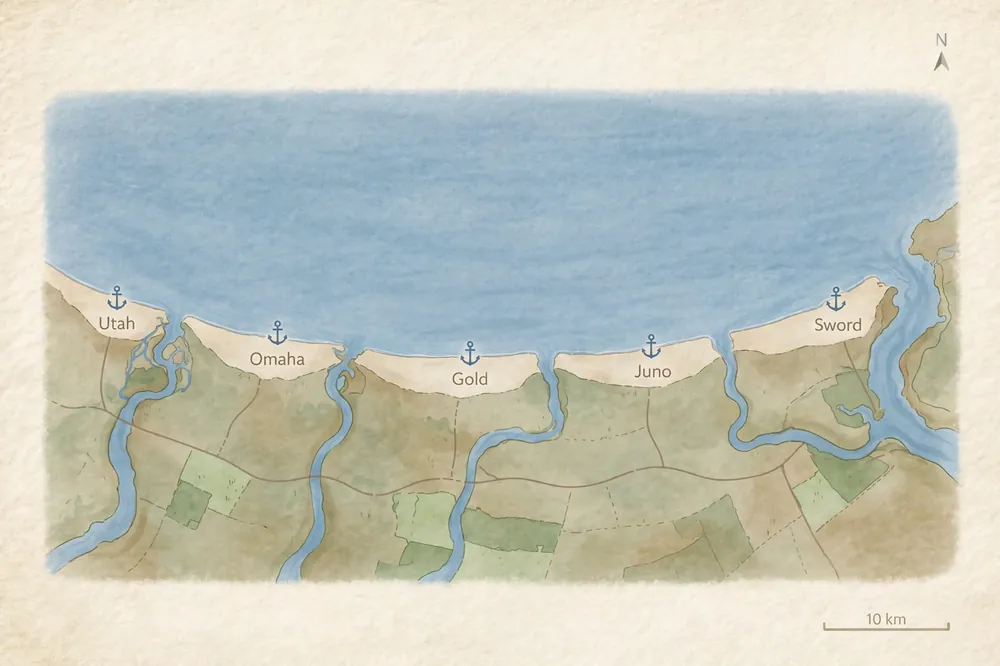
The geography of the coast shaped the battle in detail. The tides in the Channel are among the strongest in the world, with a range of several metres, and the timing of the landings was set by them: low tide at dawn to expose the beach obstacles, and a rising tide to carry the landing craft in.
The wind on 6 June blew from the west, pushing the landing craft east of their intended beaches — most seriously at Utah, where the 4th Division landed 2,000 yards south of its target. The beaches themselves were wide, flat expanses of sand at low tide, backed by a seawall or by bluffs, and covered at high tide — which meant that men landing at dawn had hundreds of yards of open sand to cross under fire, with obstacles and mines between them and the shore.
Inland, the ground changes quickly. Behind the beaches lies the Norman bocage — small fields enclosed by high earth banks topped with thick hedgerows, which would dominate the fighting for weeks after D-Day, giving defenders cover at every field boundary and making armoured movement slow and costly.
The key terrain of the first day was not the beaches themselves but the ground just behind them: the causeways at Utah, the draws at Omaha, the Orne bridges in the east, and the road centre of Caen, which controlled the routes to Paris and to the ports of the Seine.
The Allies’ first-day objectives — Carentan, Saint-Lô, Bayeux and Caen — were all inland towns, not beach positions, because the beachheads were only useful if the troops could get off them and move.
9. Outcome and Legacy of D-Day
D-Day established the second front. By the end of 6 June, about 156,000 men were ashore; by 11 June, 326,547 troops, 54,186 vehicles and 104,428 tons of supplies had been landed; by the end of June, 875,000 men had disembarked in Normandy. The two artificial harbours, the Mulberries, were towed across the Channel and installed off Omaha and Arromanches. The American harbour at Omaha was wrecked by the great storm of 19–22 June, but the British harbour at Arromanches — Port Winston — operated for months and supplied the armies through the summer. The beachheads, linked on 12 June, became a lodgement that the Germans could not dislodge, and the flow of men and supplies across the Channel never stopped.
The campaign that followed was harder and slower than the planners had hoped. Caen, a first-day objective, was not fully captured until 21 July. Cherbourg, the deep-water port the Allies needed, fell on 26 June, but its harbour had been so thoroughly demolished that it took weeks to bring back into use.
The bocage country slowed the advance to a crawl, and the fighting in July — around Saint-Lô, Caen and Villers-Bocage — was costly on both sides. The breakout came on 25 July, with Operation Cobra, the American offensive south from Saint-Lô; within weeks the German armies in Normandy were encircled in the Falaise Pocket, and on 25 August Allied troops entered Paris.
The campaign in the west had become a pursuit, and Germany, now fighting the Soviet Union in the east and the Western Allies in the west, faced the two-front war its strategy had always sought to avoid.
D-Day’s significance is therefore not that it won the war in a day — it did not — but that it made the outcome in the west a matter of time and logistics. Before 6 June 1944, Germany could concentrate its forces against the Soviet Union and hold the Atlantic coast with relatively few divisions.
After 6 June, it had to fight a second major land front, supplied across a Channel it did not control, against an enemy whose industrial output was several times its own. The invasion also changed the war at sea and in the air: the airfields built in Normandy brought Allied fighters within range of Germany, and the ports captured in the following months supplied the armies that advanced to the German border by the autumn of 1944.
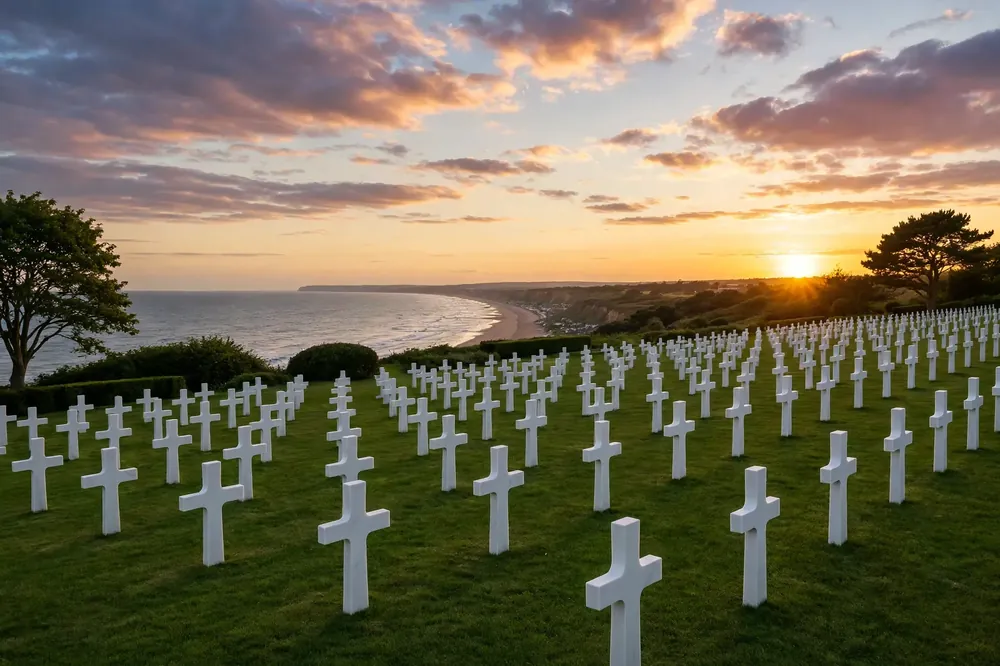
The human legacy is recorded in the cemeteries of Normandy. The Normandy American Cemetery at Colleville-sur-Mer, above Omaha Beach, holds the graves of 9,388 American dead of the Normandy campaign, with a further 1,557 names on the Walls of the Missing.
British and Canadian cemeteries — at Bayeux, Ranville, Bény-sur-Mer and elsewhere — hold their own dead, and German cemeteries, notably at La Cambe, hold the German dead of the campaign. The beaches themselves remain largely as they were: the concrete gun emplacements still stand, the Mulberry harbour’s remains still lie off Arromanches, and the Pointe du Hoc cliff-top, with its craters and bunkers, is preserved as it was left in 1944.
The D-Day Museum in Portsmouth, the Mémorial de Caen, and the many small museums along the coast record the day from the perspectives of all who were there — soldiers of many nations, and the French civilians who lived through it.
Historians continue to debate D-Day: whether the casualties at Omaha could have been reduced by heavier bombing or by the use of specialised armour; whether the airborne drops were worth their cost; whether the failure to take Caen on the first day mattered as much as was thought at the time; and how much the deception plan, rather than German command failures, decided the outcome. What is not debated is the scale of the achievement: the largest amphibious operation in history, planned for two years and executed in a single day, which put an army ashore in occupied Europe and kept it there.
10. Commanders
General Dwight D. Eisenhower (United States). Supreme Commander of the Allied Expeditionary Force (SHAEF). Eisenhower made the final decisions on the date and the plan, and took the decision to launch on 6 June on the basis of a weather forecast that offered only a brief break in the storms. He had also prepared a note accepting personal responsibility in case the landings failed — a note that was never needed. He later served as Supreme Commander of NATO and as President of the United States (1953–1961).
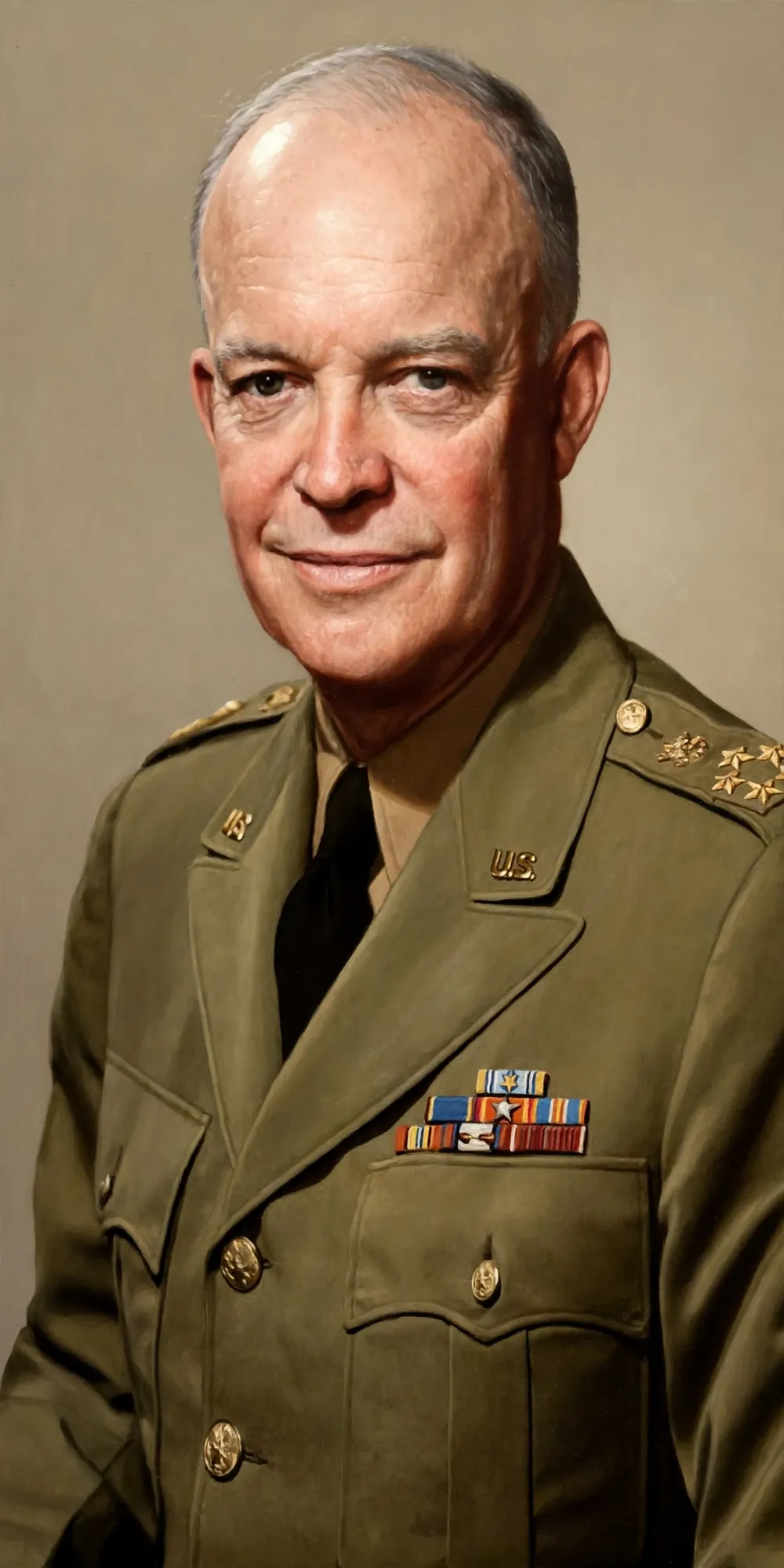
General Bernard Montgomery (United Kingdom). Commander of the 21st Army Group, responsible for the ground forces of the invasion. Montgomery revised the original plan, widening the front from three beaches to five, and commanded the land battle in Normandy until September 1944. His conduct of the campaign, particularly the long fight for Caen, remains a subject of debate among historians.
Lieutenant General Omar Bradley (United States). Commander of the US First Army, responsible for the American landings at Utah and Omaha. Bradley commanded the American forces in Normandy through the breakout of Operation Cobra and went on to command the 12th Army Group in the advance across France and Germany.
Lieutenant General Miles Dempsey (United Kingdom). Commander of the British Second Army, responsible for the landings at Gold, Juno and Sword and for the fighting around Caen.
Admiral Bertram Ramsay (United Kingdom). Allied Naval Commander for Operation Neptune, responsible for the movement of nearly 7,000 vessels across the Channel and for the naval bombardment. Ramsay had previously organised the evacuation of Dunkirk in 1940.
Air Chief Marshal Trafford Leigh-Mallory (United Kingdom). Commander of the Allied Expeditionary Air Force, responsible for the air plan, including the airborne drops and the bombing campaign that preceded the landings.
Field Marshal Gerd von Rundstedt (Germany). Commander in Chief in the West (OB West). Rundstedt favoured holding the armoured divisions inland and counterattacking once the landing’s main effort was clear. He was dismissed by Hitler in July 1944, after the Normandy front collapsed, and later restored to command in the west.
Field Marshal Erwin Rommel (Germany). Commander of Army Group B, responsible for the defence of the coast from the Netherlands to Brittany. Rommel believed the invasion had to be defeated on the beaches in the first hours and worked to strengthen the Atlantic Wall. He was in Germany on 6 June 1944 and did not return to Normandy until that evening. He was later implicated in the 20 July 1944 plot against Hitler and, given the choice between trial and suicide, took his own life on 14 October 1944.
General Friedrich Dollmann (Germany). Commander of the Seventh Army, which held the Normandy coast. Dollmann died on 28 June 1944, during the battle for Cherbourg, of a heart attack — according to some accounts, after being told he faced a court martial over the loss of the port. His death left the Seventh Army without its commander at a critical moment.
Frequently Asked Questions
Related articles
Sources
- Wikipedia, “Normandy landings” — dates, strength, casualty figures (Allied 10,000+ casualties, 4,414 confirmed dead; German 4,000–9,000; 156,000 troops landed), cross-checked against the D-Day Museum.
- D-Day Museum, Portsmouth (ddaymuseum.co.uk), “D-Day and the Battle of Normandy: Your Questions Answered” — vessel and aircraft figures (6,939 vessels, 11,590 aircraft, 14,674 sorties), per-beach casualty breakdowns, and the 4,414 confirmed dead.
- Encyclopædia Britannica, “D-Day” and “Normandy Invasion” — background, Operation Overlord, commanders and consequences.
- National WWII Museum (nationalww2museum.org), “D-Day” — the decision to launch, the landings by beach, and the campaign that followed.
- Imperial War Museums (iwm.org.uk), “D-Day” — the airborne landings, the deception plan, and the fighting on the beaches.
- U.S. Army Center of Military History, Cross-Channel Attack (Gordon A. Harrison, 1951) — the official American history of the Normandy landings.
- Antony Beevor, D-Day: The Battle for Normandy (Viking, 2009) — modern narrative history of the landings and the Normandy campaign.
- Stephen E. Ambrose, D-Day, June 6, 1944: The Climactic Battle of World War II (Simon & Schuster, 1994).
- Richard Holmes, D-Day: The Landings (BBC, 2004).