 WAR ATLAS MILITARY HISTORY MAGAZINE · WWI — WWII
Holocaust Memorial Berlin
1. Holocaust Memorial Berlin — Remembered
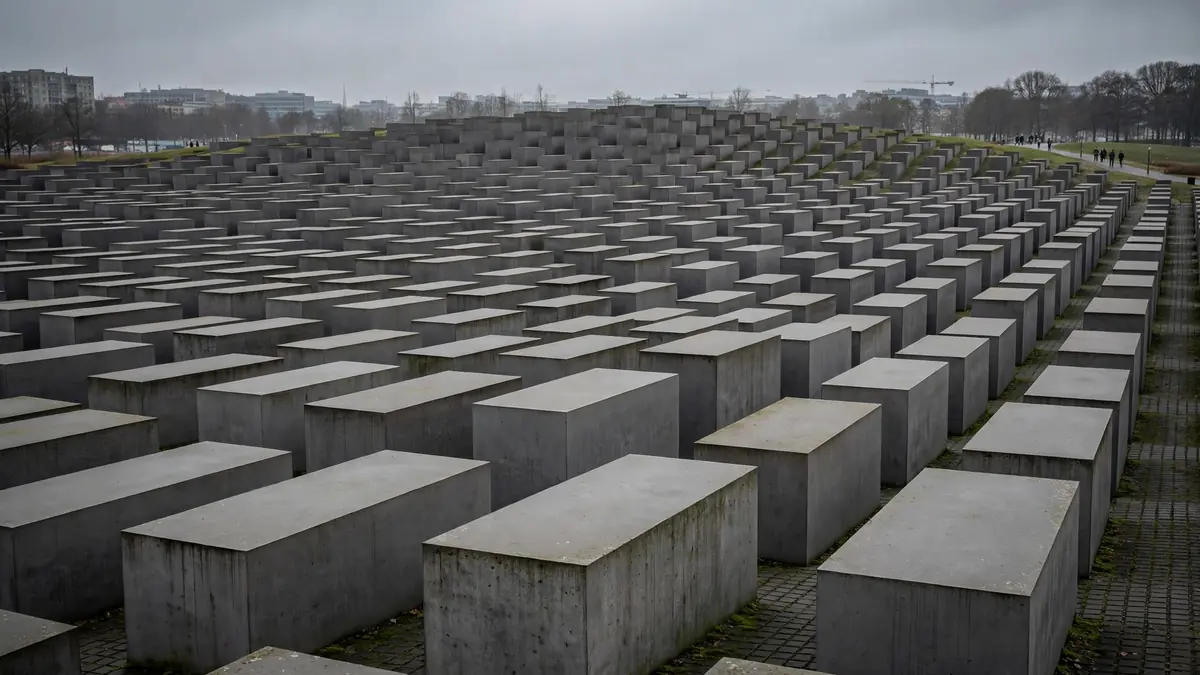
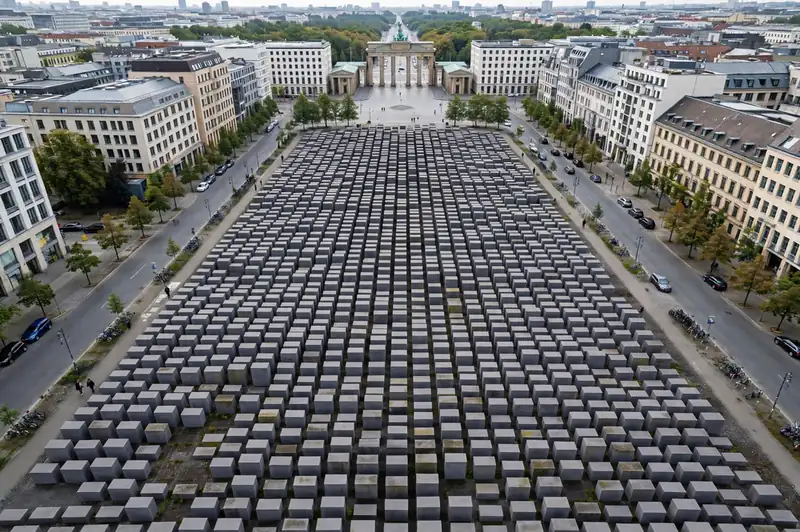
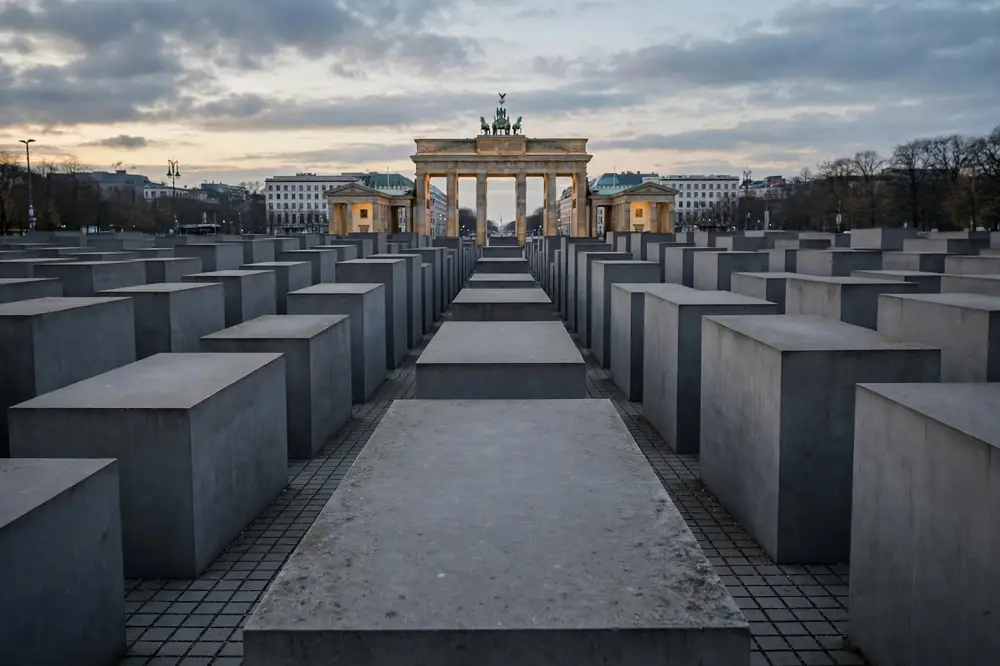
The Holocaust Memorial Berlin, officially the Memorial to the Murdered Jews of Europe, stands in the heart of Berlin, a short walk from the Brandenburg Gate and the Reichstag. It is a field of 2,711 grey concrete slabs — stelae — set in a grid on undulating ground, with no names, no inscriptions and no single point of entry.
Beneath the field, in an underground exhibition called the Place of Information, the names and stories of the victims are told in detail. The memorial was opened on 10 May 2005, sixty years after the end of the Second World War in Europe, after more than fifteen years of debate about whether Germany should build a central memorial to the Jews it had murdered, what form it should take, and where it should stand.
The memorial is one of the most visited and most argued-about monuments in Germany. Some visitors find it profoundly moving; others find it abstract, confusing, or too large to understand. Its architect, the American Peter Eisenman, intended exactly that ambiguity: the memorial is not a monument that tells you what to feel, but a place that makes you feel lost, and that loss is the point. This article explains the history behind the memorial, how it was designed and built, what visitors experience in the field of stelae and in the exhibition below, and how it fits into Berlin’s wider landscape of remembrance.
2. Key Facts
| What | Memorial to the Murdered Jews of Europe: a field of 2,711 concrete stelae and an underground exhibition, the Place of Information |
| Where | Cora-Berliner-Strasse 1, 10117 Berlin, near the Brandenburg Gate, in the centre of Berlin |
| Architect | Peter Eisenman, American architect; the design was chosen in a competition in 1997-1998 |
| Opened | 10 May 2005, opened to the public on 12 May 2005 |
| Size | About 19,000 square metres; stelae from 0.2 to 4.7 metres high |
| Cost | About 25 million euros, paid by the German federal government |
| Maintained by | The Foundation Memorial to the Murdered Jews of Europe |
| Today | Open to the public at all times; the Place of Information is open Tuesday to Sunday, admission free; millions of visitors each year |
3. The Murdered Jews of Europe
The Holocaust in brief
The memorial remembers the six million Jews murdered by Nazi Germany and its collaborators between 1933 and 1945, in what is known as the Holocaust. The murder began with discrimination and exclusion after Adolf Hitler came to power in January 1933, accelerated with the Nuremberg Laws of 1935 and the pogrom of Kristallnacht in November 1938, and became systematic mass murder after the invasion of the Soviet Union in June 1941 and the Wannsee Conference of January 1942, at which senior German officials coordinated the deportation of Jews from across Europe to the killing centres in occupied Poland.
Jews were murdered in ghettos, in mass shootings by the Einsatzgruppen, in gas chambers at Auschwitz, Treblinka, Sobibor, Bełżec, Chełmno and Majdanek, and in forced labour camps, on death marches and in the camps of the Reich itself. The victims included about one and a half million children, and entire communities — in Poland, Lithuania, Ukraine, Greece, the Netherlands and Hungary — were destroyed.
The memorial in Berlin does not try to tell this whole history in the field of stelae; it leaves that to the exhibition below, and to the museums and memorials across Europe.
Why a memorial in Berlin
Berlin was the capital of the regime that ordered the murder, and the decision to build the central memorial to the murdered Jews in Berlin was itself a statement: the country that committed the crime would remember it in the centre of its capital, on land that had once belonged to the ministers of the Nazi state.
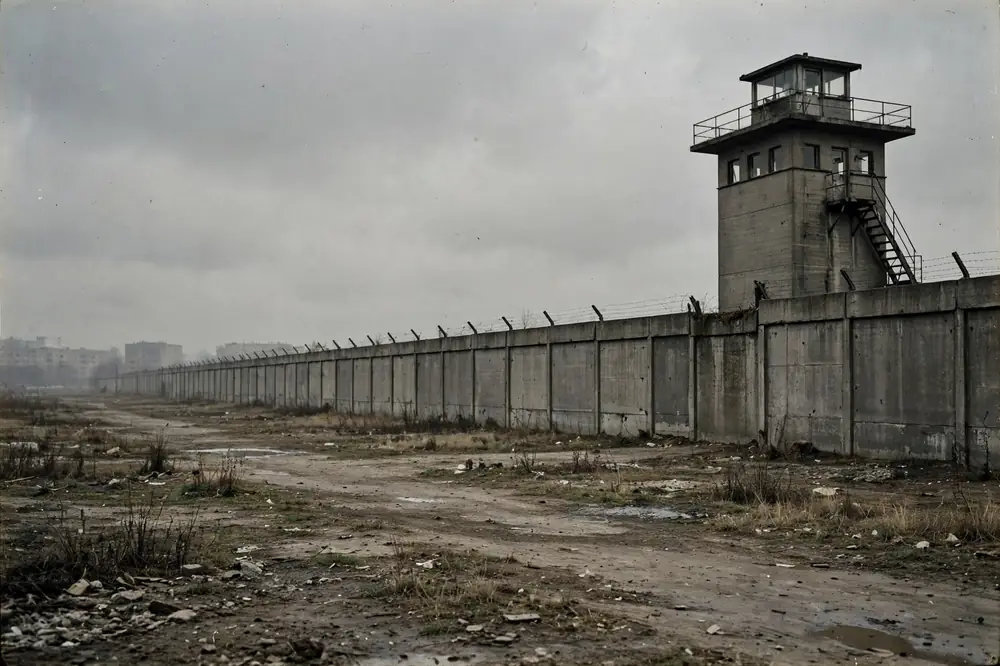
The site, a 19,000-square-metre plot between the Brandenburg Gate and Potsdamer Platz, was the former location of the gardens of the Reich Chancellery, and it lay in the death strip of the Berlin Wall during the division of the city. Its history is therefore layered: a place of Nazi power, then a place of Cold War division, then a place of remembrance.
The choice of the site was controversial, and some argued that a memorial should be built at the site of a camp rather than in the capital, but the supporters of a Berlin memorial argued that the murder was ordered from Berlin, and that the memory of it belonged in the place where the orders were given.
The German parliament, the Bundestag, voted in June 1999 to build the memorial, after a debate that had lasted more than a decade.
The long debate
The debate about the memorial began in 1988, when the journalist Lea Rosh and the historian Eberhard Jäckel proposed a central memorial to the murdered Jews of Europe, and it continued through two competitions, in 1994-95 and 1997, through arguments in the press and in parliament, and through questions that had no easy answer. Should the memorial remember only the Jews, or all the victims of the Nazis?
Should it be a work of art, or a place of information? Should it have names, or should it be abstract? Should it be in Berlin at all? The first competition, in 1994-95, produced a winning design that was then rejected, and the second competition, in 1997, produced the design by Peter Eisenman and Richard Serra that was finally built, after Serra withdrew from the project in 1998.
Chancellor Helmut Kohl supported the memorial, and his successor, Gerhard Schröder, carried it through. The debate was itself part of the memorial’s meaning: Germany was arguing, in public, about how to remember the greatest crime in its history, and the argument was carried on in the open, in parliament and in the press, rather than being settled behind closed doors.
4. The Idea of a Memorial
A memorial without names
The most striking decision in Eisenman’s design is that the field of stelae carries no names. There are no inscriptions on the slabs, no lists of the dead, and no explanation of what the memorial means. The visitor must bring that knowledge with them, or find it in the exhibition below.
This was a deliberate choice, and it was controversial: many people argued that a memorial to murdered people should name them, and that an abstract field of concrete was an inadequate response to the murder of six million people. Eisenman’s answer was that no list could contain six million names, and that a memorial that tried to list them would fail, while a memorial that offered no names would force the visitor to think about the scale of the loss in a different way — not as a list to be read, but as a space to be entered.
The names are not absent from the memorial as a whole: they are in the Place of Information, where the database of victims and the rooms of families and names give the dead back their individuality.
Abstraction and emotion
Eisenman’s memorial belongs to a tradition of abstract memorials that began after the Second World War, when artists and architects found that the traditional forms of the monument — the statue, the obelisk, the heroic figure — were inadequate to the crimes they were asked to remember. The field of stelae does not depict anything, and it does not tell a story; it creates an experience.
The visitor walks between the slabs, the ground rises and falls, the slabs grow taller, the sky disappears, and the visitor is alone. The experience is different for every person, and it is different at different times of day and in different weather: in sunlight the field is bright and almost playful, and children run between the slabs; in rain or in winter it is cold, grey and oppressive.
The memorial’s supporters say that this is its strength — that it does not prescribe an emotion, but allows one to arise — while its critics say that it is its weakness, that a memorial should teach and should mourn, and that abstraction lets the visitor off too easily.
Who the memorial is for
The memorial was built by Germany, for the German public and for the world, and its audience has always been part of its design. It is a place for Germans to confront their own history, for the descendants of the victims to mourn, and for foreign visitors to learn.
The fact that it stands in the centre of Berlin, on a site that any tourist will pass, means that it cannot be avoided: it is part of the daily life of the city, and Berliners walk through it on their way to work, eat lunch on its edges, and bring their children to play in it.
That everyday use has been criticised — some have called it disrespectful — but the Foundation that maintains the memorial has defended it, arguing that a memorial that is only visited on anniversaries is a dead memorial, and that a memorial woven into the life of the city is a living one.
The question of who the memorial is for has no single answer, and the memorial’s openness to different uses is part of what makes it a subject of continuing debate.
5. The Design of Peter Eisenman
The field of stelae
The grid and the ground
The field consists of 2,711 concrete stelae, arranged in a grid of 54 rows running north-south and 87 rows running east-west, on a site of about 19,000 square metres. Each stele is 2.38 metres long and 0.95 metres wide, and their heights vary from 0.2 metres at the edges of the field to 4.7 metres at its centre, so that the field rises towards the middle like a wave.
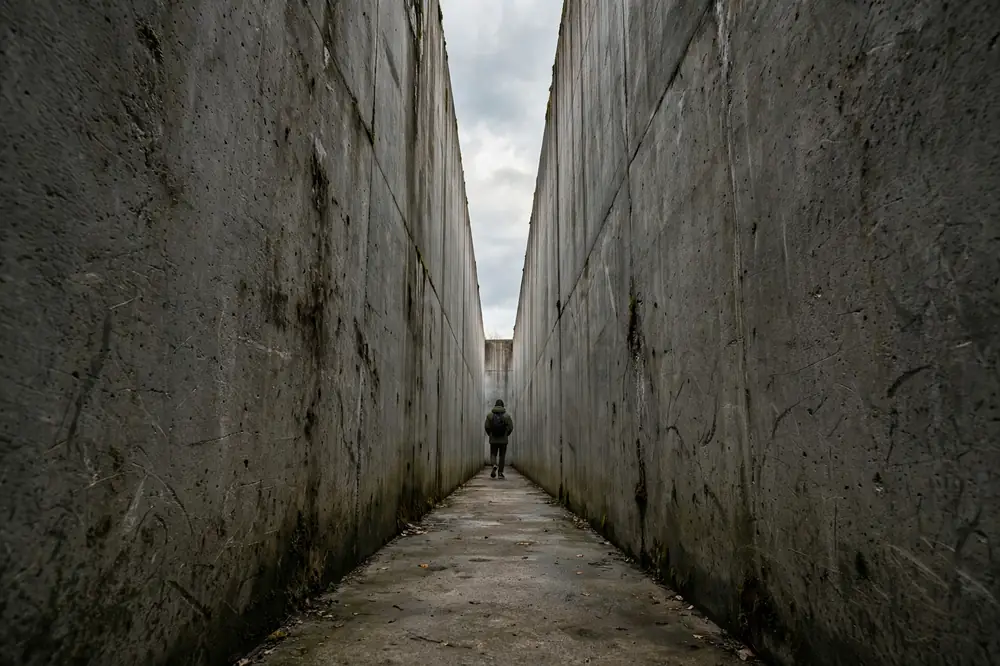
The ground itself is not flat: it undulates, rising and falling by as much as two metres, so that the visitor walking through the field is constantly going up and down, and the tops of the stelae, which are level, seem to tilt and shift.
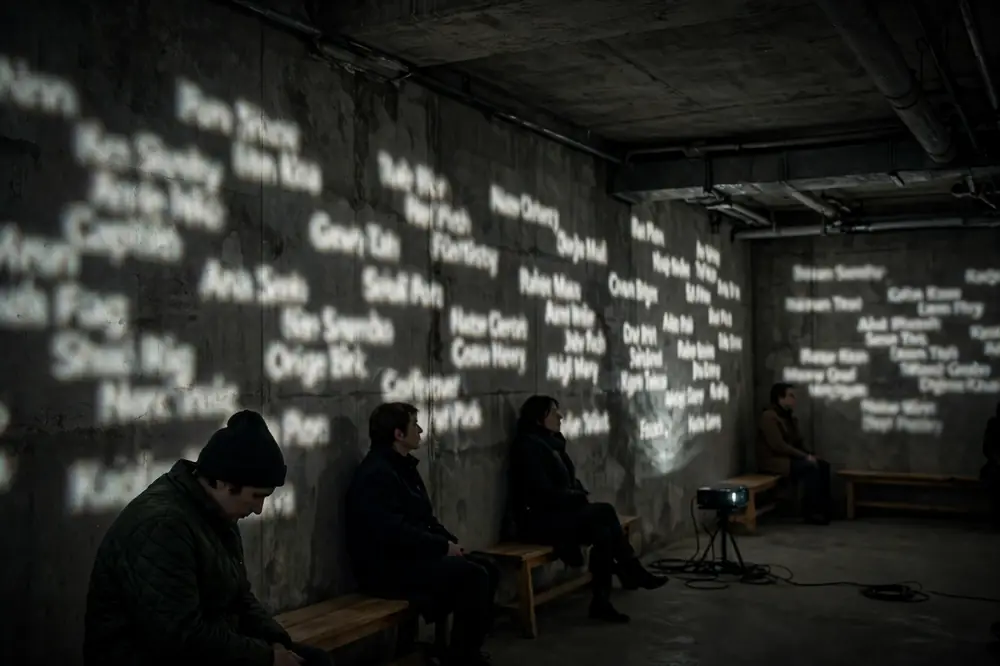
The stelae are made of concrete with a special surface that resists graffiti, and they are spaced 0.95 metres apart, so that the passages between them are narrow and only one person can walk comfortably in each. The grid is strict and regular, and the ground is irregular, and the tension between the two — order and disorder, system and chaos — is the central idea of the design.
Eisenman has said that the number 2,711 has no symbolic meaning, and that the field was not designed to represent anything in particular: it is a system that produces an experience, and the experience is the memorial.
Walking through the field
The experience of walking through the field is the heart of the memorial, and it is difficult to describe without experiencing it. At the edges, the stelae are low, no higher than a kerb, and the visitor can see across the whole field to the city beyond.
As the visitor walks towards the centre, the stelae grow taller, the ground falls away, and the passages become corridors of grey concrete, open to the sky but closed on both sides. Sound changes: the noise of the city fades, footsteps echo, and the visitor hears their own breathing.
At the centre, the stelae are nearly five metres high, the sky is a narrow strip above, and the visitor is alone — or, if the field is busy, alone among strangers, each in their own corridor, unable to see each other. Then the ground rises again, the stelae shrink, and the visitor emerges back into the city, blinking in the light.
The walk takes only a few minutes, but for many visitors it is the most memorable part of the visit, and it is the part that photographs cannot capture.
The Place of Information
Beneath the south-eastern corner of the field, reached by two staircases, lies the Place of Information, an underground exhibition of about 800 square metres that tells the story the field does not. The exhibition is organised in four rooms: the Room of Dimensions, which presents the numbers of the murder — six million Jews, the numbers deported from each country, the numbers murdered in each camp — on illuminated panels in the floor; the Room of Families, which tells the stories of fifteen Jewish families from across Europe, from their lives before the war to their murder; the Room of Names, in which the names of victims are read aloud, one by one, in a continuous recording, while their names and dates are projected on the walls; and the Room of Places, which presents the history of 220 places of persecution and murder across Europe, from the ghettos to the camps.
The exhibition also holds a database, based on the records of Yad Vashem in Jerusalem, in which visitors can search for the names of about three million victims. The contrast between the field above and the exhibition below is deliberate: above, abstraction and silence; below, names, faces and stories.
6. The Controversies
The Degussa affair
The most damaging controversy in the building of the memorial concerned the company that supplied the anti-graffiti coating for the stelae. In 2003, it was revealed that the coating was made by Degussa, a German chemical company whose subsidiary, Degesch, had produced Zyklon B, the gas used in the gas chambers at Auschwitz and other camps.
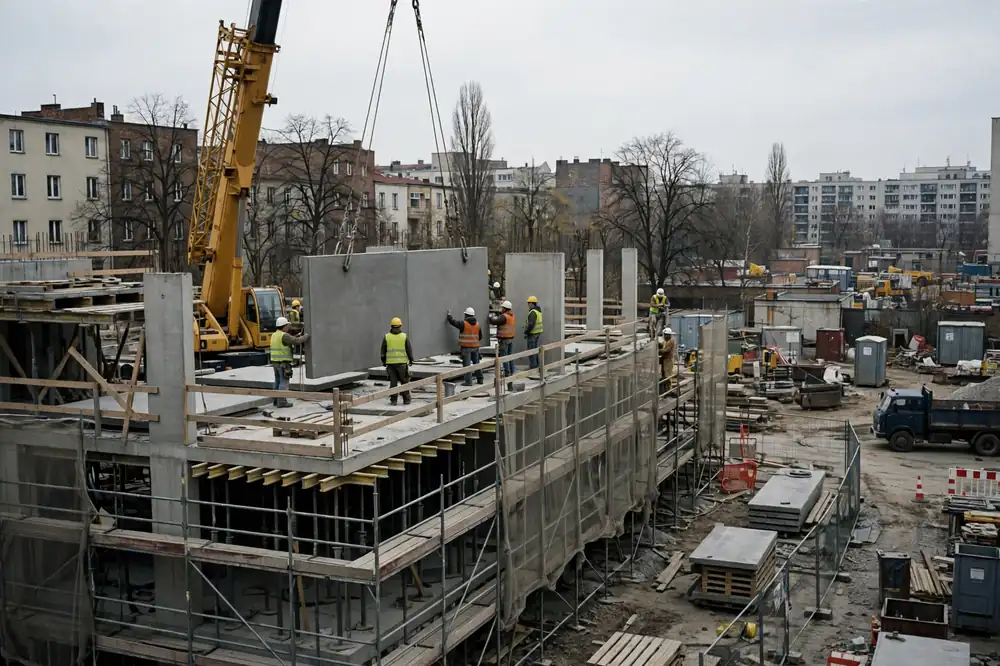
The revelation caused an outcry: critics argued that a memorial to the murdered Jews could not be coated with a product from a company connected, however indirectly, to the murder itself. The Foundation and the architect defended the choice, arguing that the coating was necessary to protect the stelae, that Degussa had acknowledged its history, and that no other product would do the job.
After weeks of debate, the building continued, and the coating was applied. The affair left a mark on the memorial’s history, and it is still cited as an example of how the past intrudes on the present in Germany — how even the materials of remembrance carry a history of their own.
Criticism of the design
The design has been criticised from the beginning, and the criticisms have not gone away. Some critics argue that the field of stelae is too abstract, that it says nothing about the Jews, the murder, or the perpetrators, and that a visitor who knows nothing about the Holocaust could walk through it without understanding what it is.
Others argue that the memorial is too large, that it dominates the centre of Berlin, and that its scale is a form of self-congratulation — Germany showing the world how well it remembers, rather than remembering quietly. Still others argue that the memorial’s openness to everyday use — children playing, tourists taking photographs, people sunbathing on the stelae — is disrespectful, and that the field should be treated as a sacred place.
The Foundation has responded to these criticisms by improving the information available at the site, by employing guides and educators, and by maintaining the Place of Information as the place where the history is told. The debate continues, and it is, in a sense, part of the memorial’s purpose: a memorial that no one argued about would be a memorial that no one thought about.
Vandalism and misuse
The memorial has suffered from vandalism and misuse since it opened. The stelae have been sprayed with graffiti, including swastikas, and the Foundation has had to clean them repeatedly, using the anti-graffiti coating that caused the Degussa affair. Visitors have been photographed climbing on the stelae, jumping between them, and, in the most notorious cases, taking smiling selfies and playing games in the field.
In 2017, the Israeli artist Shahak Shapira published a project, “Yolocaust”, in which he combined photographs of tourists posing at the memorial with photographs from the camps, in order to shame the visitors into behaving with more respect. The project caused a storm of debate, and Shapira later took it down, saying that the debate it had started was more important than the project itself.
The Foundation’s response has been to increase the presence of staff at the site, to put up signs asking for respectful behaviour, and to argue that the memorial must remain open and ungated, because a memorial behind a fence would be a different, and a lesser, memorial.
7. What Visitors Experience
Arriving at the memorial
The memorial is open at all times, and there is no ticket, no gate and no fixed route. Most visitors arrive from the Brandenburg Gate, walking south along Ebertstrasse, and the field appears suddenly, a grey grid on the right-hand side of the street, with the city continuing around it.
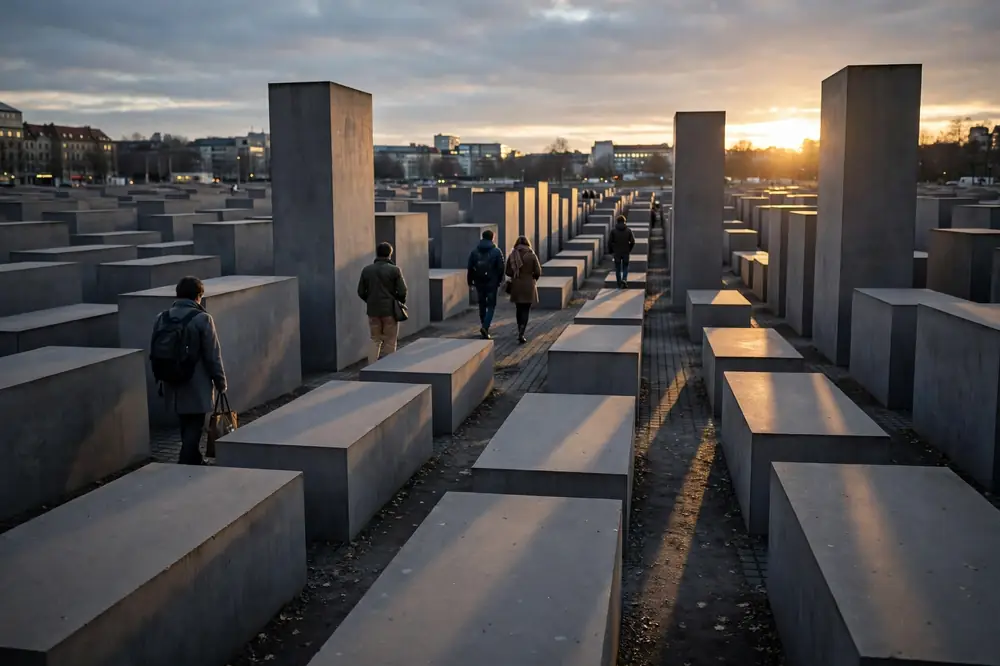
The first impression is of scale: the field is large, the stelae are numerous, and the memorial seems to go on further than the eye can follow. There is no sign at the entrance explaining what the memorial is — the Foundation has deliberately kept the signage minimal — and visitors who do not know the site must work out for themselves what they are looking at.
Some walk straight into the field; others walk around its edges first, reading the small information panels; others go directly to the Place of Information, to learn the history before entering the field. All three approaches are valid, and the memorial is designed to reward each of them.
The exhibition below
Visitors who descend into the Place of Information find a very different experience from the field above. The exhibition is quiet, dark and intimate, and it is designed to be visited slowly. The Room of Dimensions confronts the visitor with numbers, but the numbers are presented in a way that makes them human: the six million is broken down by country, by year, by camp, so that the scale becomes comprehensible.
The Room of Families is the most moving part of the exhibition for many visitors, because it tells the stories of individual families — their photographs, their letters, their last addresses — and because it shows that the victims were not a number but people with lives, jobs, children and plans.
The Room of Names is a place of listening: the names are read aloud, without interruption, and the visitor sits and listens, understanding that the reading will never end, because there are too many names. The exhibition takes about an hour to visit properly, and the Foundation recommends visiting it before, or after, walking through the field, so that the abstraction above and the information below complete each other.
Guided tours and education
The Foundation offers guided tours of the memorial and the exhibition in German, English and other languages, and it runs an extensive education programme for school groups, teachers and students. The tours are led by trained guides who explain the history of the memorial, the debate about its design, and the stories of the victims, and who answer the questions that visitors ask — the same questions that have been asked since the memorial opened: why are there no names, why are the stelae different heights, why is the ground uneven, what does it mean?
The education programme includes workshops for schoolchildren, in which students research the story of one victim and present it to their classmates, and training for teachers, who are given material to use in the classroom. The Foundation also publishes guides and books about the memorial, and it maintains a website with information in several languages.
The aim of all this work is to make sure that the memorial is not only a place to visit but a place to learn, and that the abstraction of the field is always connected to the history in the exhibition below.
8. The Memorial in Berlin’s Landscape of Memory
A city of memorials
The neighbouring memorials
Berlin is a city of memorials, and the Holocaust Memorial does not stand alone. Within a few minutes’ walk are the Memorial to the Homosexuals Persecuted under the National Socialist Regime, opened in 2008 in the Tiergarten, across Ebertstrasse from the Holocaust Memorial; the Memorial to the Sinti and Roma Victims of National Socialism, opened in 2012, also in the Tiergarten; and the Topography of Terror, the documentation centre on the site of the former Gestapo and SS headquarters, on Niederkirchnerstrasse.
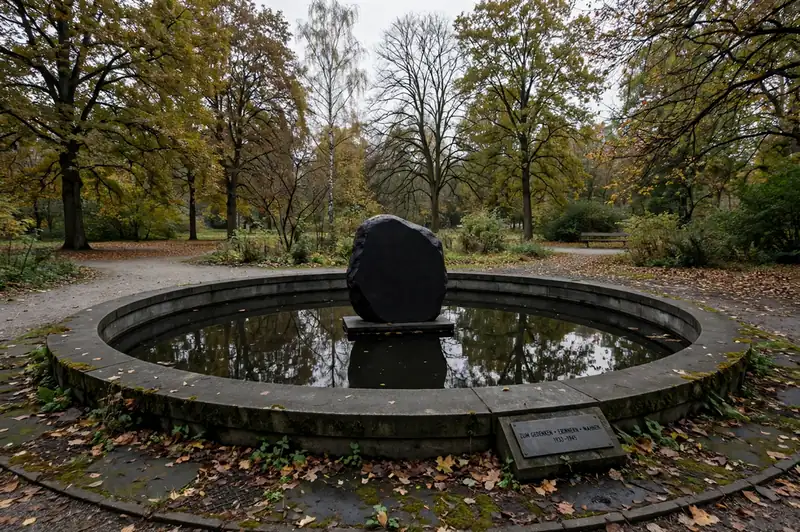
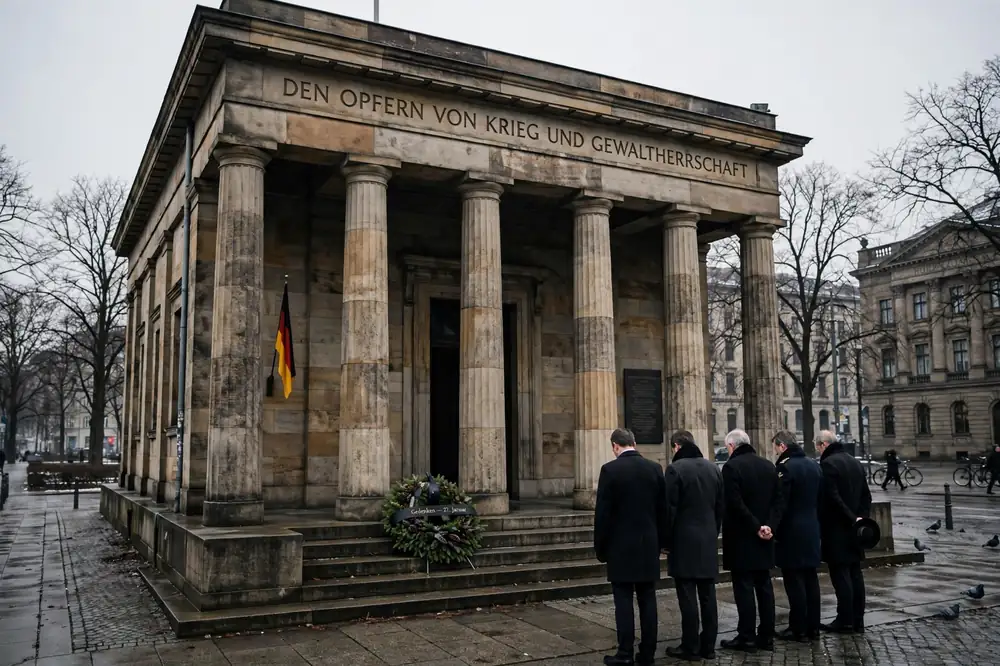
A short distance away are the Jewish Museum Berlin, designed by Daniel Libeskind, and the Memorial to the Murdered Members of the Reichstag, in front of the Reichstag itself. Together, these sites form a landscape of memory that covers the different groups of victims — Jews, homosexuals, Sinti and Roma, political opponents, the disabled — and the different institutions of the Nazi state.
The Holocaust Memorial is the largest and the most central of them, and it is the one that most visitors see, but it is important to understand that it is part of a larger whole, and that the memory of the Nazi crimes in Berlin is distributed across many sites, not concentrated in one.
The Brandenburg Gate and the Reichstag
The memorial’s neighbours also include the two most famous symbols of Berlin: the Brandenburg Gate, a few hundred metres to the north, and the Reichstag, a few hundred metres to the north-east. The Gate was the symbol of the divided city during the Cold War, and of reunification after 1989; the Reichstag, burned in 1933 and rebuilt after reunification with a glass dome by Norman Foster, is the seat of the German parliament.
The memorial stands between them, in the heart of the new Berlin, and its presence changes the meaning of both: the Gate and the Reichstag are symbols of German history, and the memorial is a reminder of the darkest part of that history, placed where it cannot be avoided by anyone who visits the symbols of the new Germany.
The juxtaposition is deliberate, and it is the reason the memorial’s site was chosen: the new Berlin would not be built on forgetting, but on remembering, and the memory would be placed at the centre, not at the margins.
The memorial and the city
The memorial has become part of the daily life of Berlin, and Berliners have made it their own in ways that its designers did not foresee. Office workers eat lunch on the low stelae at the edges of the field; children play hide-and-seek between the slabs; couples sit on the stelae in the evening; and the field is a shortcut for pedestrians crossing the city centre.
Some of these uses have been criticised as disrespectful, but others have been defended as a sign that the memorial is alive, that it belongs to the city rather than standing apart from it. The Foundation has tried to strike a balance: it asks for respectful behaviour, it employs staff to talk to visitors, and it has put up signs, but it has refused to fence the field or to charge admission, because a memorial that is closed off from the city would fail in its purpose.
The memorial’s integration into the city is, in the end, its greatest strength and its greatest vulnerability, and the argument about how Berliners should use it is likely to continue for as long as the memorial stands.
Remembering the other victims
The decision to build a memorial specifically to the murdered Jews of Europe was itself controversial, and the question of the other victims of the Nazis has been raised at every stage. The Nazis murdered not only six million Jews but also millions of others: Soviet prisoners of war, Polish civilians, Sinti and Roma, disabled people, homosexuals, Jehovah’s Witnesses, political opponents and others.
The Bundestag’s decision in 1999 was to build the central memorial to the Jews, and to build separate memorials to the other groups — a decision that was criticised by some as creating a hierarchy of victims, and defended by others as recognising that the murder of the Jews was distinct in its intention: the complete extermination of a people.
The separate memorials to the homosexuals and to the Sinti and Roma, built in the years after the Holocaust Memorial, were part of that decision, and the debate about them continues. The Holocaust Memorial does not claim to remember all the victims, and the Foundation is clear about that: it remembers the murdered Jews of Europe, and the other victims are remembered elsewhere, in their own memorials, in their own places.
9. Education and Remembrance
The Foundation’s work
The Foundation Memorial to the Murdered Jews of Europe, established by the German federal government, is responsible for the memorial and for its educational work. The Foundation maintains the field and the exhibition, organises the guided tours and the education programme, publishes research, and runs the memorials to the homosexuals and to the Sinti and Roma as well.
It also works with schools, universities and other memorials in Germany and abroad, and it supports research into the history of the Holocaust and into the memory of it. The Foundation’s work is funded by the federal government, and it is independent of political parties, although its directors are appointed by the government.
The Foundation’s annual reports show that the memorial receives millions of visitors each year, and that the Place of Information is one of the most visited exhibitions in Berlin. The Foundation’s task is not only to maintain a monument but to keep a conversation going — about the Holocaust, about German responsibility, and about the future of remembrance in a country where the generation that lived through the war is gone.
Ceremonies and anniversaries
The principal ceremony at the memorial is held on 27 January, the International Holocaust Remembrance Day, which marks the anniversary of the liberation of Auschwitz in 1945. On that day, the German president, the chancellor and other leaders lay wreaths at the memorial, and the names of victims are read aloud in the Place of Information.
The opening anniversary, 10 May, is also marked, and the Foundation organises events throughout the year — lectures, exhibitions, concerts and readings — that connect the memorial to current questions about anti-Semitism, racism and the memory of the past. The ceremonies are attended by survivors and by the descendants of survivors, and their number grows smaller each year, which makes the work of the memorial more, not less, important: when the witnesses are gone, the memorial and the exhibition must speak for them.
In recent years the ceremonies have also included the reading of names by schoolchildren and by volunteers, a practice that brings the abstract field above into direct contact with the individual lives remembered below.
Teaching young Germans
For young Germans, the memorial is often the first place where they confront the Holocaust not as a chapter in a textbook but as a physical reality. School groups visit the memorial as part of their history education, and the Foundation’s education programme is designed to make the visit more than a walk through a field: students are given the story of one victim to research, they visit the Place of Information, and they discuss what they have seen.
The programme also addresses the questions that young Germans ask: what does it mean to be German after the Holocaust, what responsibility do they bear for a crime committed before they were born, and how should they respond to anti-Semitism today?
The Foundation’s answer is that responsibility is not guilt, and that remembering is not a burden but a task — a task that each generation must take up for itself. The memorial’s success, in this sense, will be measured not by the number of visitors but by the number of young people who leave it understanding something they did not understand before.
10. Legacy
The legacy of the Holocaust Memorial Berlin is still being written, because the memorial is young — it has stood for only twenty years — and because the questions it raises are still open. Its first legacy is architectural: it showed that a memorial could be abstract, open and part of a city, and it has influenced memorials around the world, from the 9/11 Memorial in New York to the memorials of the Rwandan genocide.
Its second legacy is political: it showed that a country could build a central memorial to a crime it had committed, in the centre of its capital, and that the debate about the memorial could itself be a form of remembrance.
Its third legacy is educational: the Place of Information has become a model for how to tell the story of the victims, name by name, family by family, place by place, and it has shown that information and emotion are not opposites but partners. The memorial’s critics are right that it does not tell the whole story, and its supporters are right that no single memorial could.
Its achievement is to have created a place where the story can be entered, walked through, and remembered — and where the memory of the murdered Jews of Europe is now part of the daily life of Berlin.
The memorial in twenty years
Twenty years after its opening, the memorial is no longer new, and its concrete has weathered, its stelae have been cleaned many times, and its exhibition has been updated. The generation that built it is passing, and the generation that will inherit it has grown up with the memorial as a familiar part of Berlin.
The questions that will decide its future are the questions that face every memorial: how to keep it relevant when the witnesses are gone, how to protect it from misuse without closing it off, and how to make sure that the names in the exhibition below are not forgotten when the field above becomes familiar.
The Foundation’s answer, so far, has been to keep the memorial open, to keep the exhibition current, and to keep the conversation going — in schools, in parliament, in the press, and in the field itself, where every visitor who walks between the stelae is part of the memorial’s continuing life.
Why it matters
The Holocaust Memorial Berlin matters because it is the central place where Germany remembers the central crime of its history, and because it does so in a way that refuses to make the memory easy. It does not offer a statue to admire, a story to follow, or a lesson to learn and then forget.
It offers a field to walk through, a silence to stand in, and an exhibition below in which the names of the dead are read aloud, without end. For the visitor, the memorial is an invitation: to enter the field, to feel lost, to go below and learn the names, and to leave understanding something about the scale of what was done, and about the responsibility of remembering it.
The memorial also matters to the survivors and their families, for whom it is a public recognition, in the capital of the country that murdered their relatives, that the murder happened and that it will not be forgotten. That invitation is the memorial’s legacy, and it will remain open for as long as the memorial stands.
Frequently Asked Questions
How many stelae are there in the Holocaust Memorial Berlin?
There are 2,711 concrete stelae, arranged in a grid on a site of about 19,000 square metres. Their heights vary from 0.2 metres at the edges to 4.7 metres at the centre.
When was the memorial opened?
The memorial was opened on 10 May 2005, sixty years after the end of the Second World War in Europe, and opened to the public on 12 May 2005.
Who designed the memorial?
The memorial was designed by the American architect Peter Eisenman. His design was chosen in a competition in 1997, originally together with the artist Richard Serra, who withdrew from the project in 1998.
What is the Place of Information?
The Place of Information is an underground exhibition beneath the field of stelae. It has four rooms — the Room of Dimensions, the Room of Families, the Room of Names and the Room of Places — and a database of about three million victims’ names.
Why are there no names on the stelae?
The architect, Peter Eisenman, chose an abstract design without names, arguing that no list could contain six million names. The names of the victims are given in the Place of Information below the field.
Can I visit the memorial?
Yes. The field of stelae is open at all times and admission is free. The Place of Information is open Tuesday to Sunday, and admission is free. Guided tours are available in German, English and other languages.
Related articles
Sources
- Foundation Memorial to the Murdered Jews of Europe, official site (stiftung-denkmal.de) — the history of the memorial, the design, the Place of Information and visiting information.
- Peter Eisenman, Memorial to the Murdered Jews of Europe — the architect’s account of the design and its ideas.
- Wikipedia, “Memorial to the Murdered Jews of Europe” — the competition, the construction, the Degussa affair and the Place of Information.
- United States Holocaust Memorial Museum, Holocaust Encyclopedia, “The Holocaust” — the murder of six million Jews and the history of the killing centres.
- James E. Young, At Memory’s Edge: After-Images of the Holocaust in Contemporary Art and Architecture (Yale University Press, 2000) — abstract memorials and the debate about the Berlin memorial.
- Yad Vashem, Central Database of Shoah Victims’ Names (yadvashem.org) — the database of victims’ names used in the Place of Information.
- Stiftung Denkmal, The Memorial to the Murdered Jews of Europe: Guide — the field of stelae, the four rooms and the history of the site.