 WAR ATLAS MILITARY HISTORY MAGAZINE · WWI — WWII
Italian Fascism
1. Lead
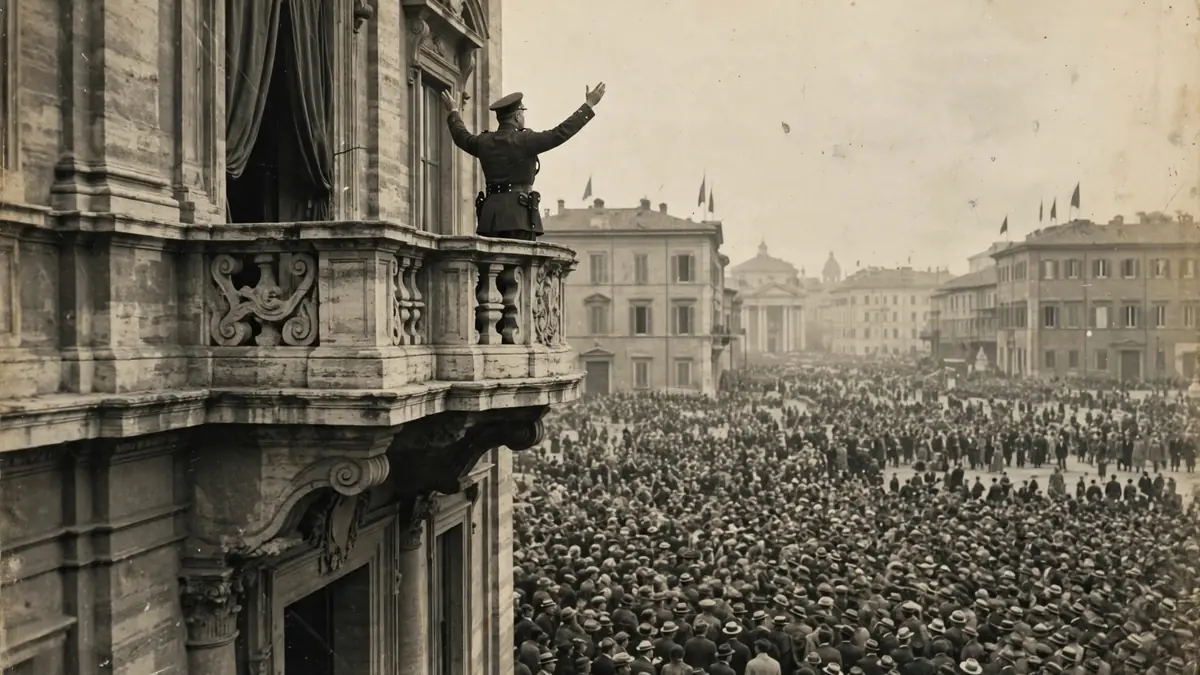
Italian Fascism was the first fascist movement to take power in Europe, and the model from which the word “fascism” itself comes. Founded by Benito Mussolini in 1919, in the turmoil that followed the First World War, it promised national renewal, order and empire to an Italy that felt cheated by the peace settlement and frightened by revolution.
Mussolini became prime minister in October 1922, after the March on Rome, and within four years he had destroyed parliamentary democracy and built a one-party dictatorship that lasted until July 1943. Fascist Italy invaded Ethiopia, intervened in the Spanish Civil War, passed anti-Jewish racial laws in 1938, and entered the Second World War on the side of Nazi Germany in June 1940 — a war that ended in military disaster, the fall of Mussolini, a civil war between fascists and anti-fascists, and the execution of Mussolini himself in April 1945.
This article tells the story of Italian Fascism as history, not as propaganda: where it came from, how it took and held power, what it did at home and abroad, how it fell, and how Italy remembers it today. The subject is still contested in Italy, where the memory of Fascism divides families and politics, and this article therefore presents the facts as historians understand them, notes where interpretations differ, and avoids the language of both the regime’s admirers and its enemies.
2. Key Facts
| What | A nationalist, authoritarian political movement and regime, the first fascist regime in Europe |
| Founder and leader | Benito Mussolini (1883-1945) |
| Founded | March 1919, as the Fasci di Combattimento in Milan |
| In power | October 1922-July 1943, as a one-party dictatorship from 1925-1926 |
| Key events | March on Rome (1922); Lateran Treaty (1929); invasion of Ethiopia (1935-1936); racial laws (1938); entry into the Second World War (June 1940); fall of Mussolini (25 July 1943); Salò Republic (1943-1945); Mussolini executed (28 April 1945) |
| Ideas | Extreme nationalism, the cult of the leader, corporatism, the glorification of war and empire, hostility to liberalism, socialism and communism |
| Victims | Political opponents, anti-fascists, Slovenes and Croats under Italian rule, Ethiopians, Libyans, and Italian Jews after 1938 |
| Today | The Italian constitution forbids the re-founding of the Fascist Party; the memory of Fascism remains politically contested |
3. The Origins of Fascism
Italy after the First World War
Italy entered the First World War in 1915 on the Allied side, after the secret Treaty of London promised it large territorial gains at the expense of Austria-Hungary. The war cost Italy more than 600,000 dead and over a million wounded, and the fighting on the Isonzo front and the disaster of Caporetto in 1917 left deep scars.
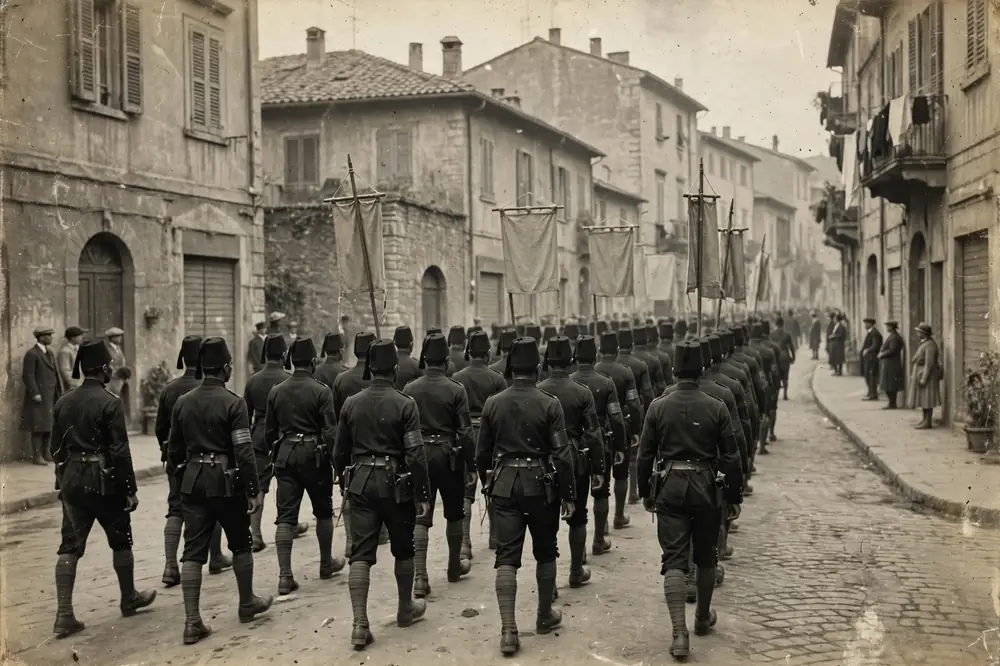
When the peace came, Italy received far less than it had been promised: it gained Trentino, South Tyrol and Trieste, but not Dalmatia and not the city of Fiume, which became the subject of a bitter nationalist campaign. Nationalists called the outcome a “mutilated victory”, and the phrase caught the mood of a country that felt it had paid the price of victory without receiving its reward.
At the same time, Italy faced economic crisis, mass unemployment, strikes and land occupations, and the fear — among landowners, industrialists and the middle classes — that a socialist revolution like the one in Russia in 1917 was coming to Italy.
Mussolini and the Fasci di Combattimento
Benito Mussolini was a former socialist journalist who had been expelled from the Socialist Party in 1914 for supporting Italy’s entry into the war. In March 1919, in Milan, he founded the Fasci di Combattimento — “combat groups” — a movement that mixed nationalism, the cult of violence, and promises of radical social change.
The early fascists were a small and incoherent group: former soldiers, students, adventurers and unemployed veterans, united less by a programme than by a style — the black shirt, the Roman salute, the language of war applied to politics — and by a willingness to use violence against their enemies.
Their first targets were socialists, trade unionists and Catholic peasant organisations, and the fascist squads, the squadristi, beat, burned and killed with the tolerance, and often the open support, of the police and the army. By 1921 the movement had become a political party, the National Fascist Party, and it won 35 seats in the elections of that year.
Mussolini presented himself as the only man who could save Italy from both revolution and disorder, and a growing number of Italians — and of Italian institutions — were willing to believe him.
The crisis of 1922
By the autumn of 1922, Italy was in a political crisis. Strikes and occupations had paralysed parts of the country, the liberal governments had lost authority, and the fascist squads controlled large areas of the Po Valley, where they had destroyed the socialist and trade union organisations.
Mussolini demanded power, and on 28 October 1922 his followers marched on Rome — a demonstration of force rather than a military coup, since the army could have stopped it and King Victor Emmanuel III refused to declare martial law. The king invited Mussolini to form a government, and on 31 October 1922 Mussolini became prime minister at the head of a coalition. He was 39 years old.
He had not won an election and he had not seized power by force alone; he had been given it by a king who feared civil war, by a parliament that hoped to tame him, and by a country that was tired of disorder. All three were wrong, and within four years Mussolini would destroy the system that had raised him.
4. Mussolini and the March on Rome
The road to power
The March on Rome was the founding myth of Fascism, and Mussolini spent the next twenty years turning it into a legend. In reality, the march was carefully staged: while thousands of fascists gathered outside Rome, Mussolini himself waited in Milan, ready to leave the country if the king resisted, and only travelled to Rome by train once he had been invited to form a government.
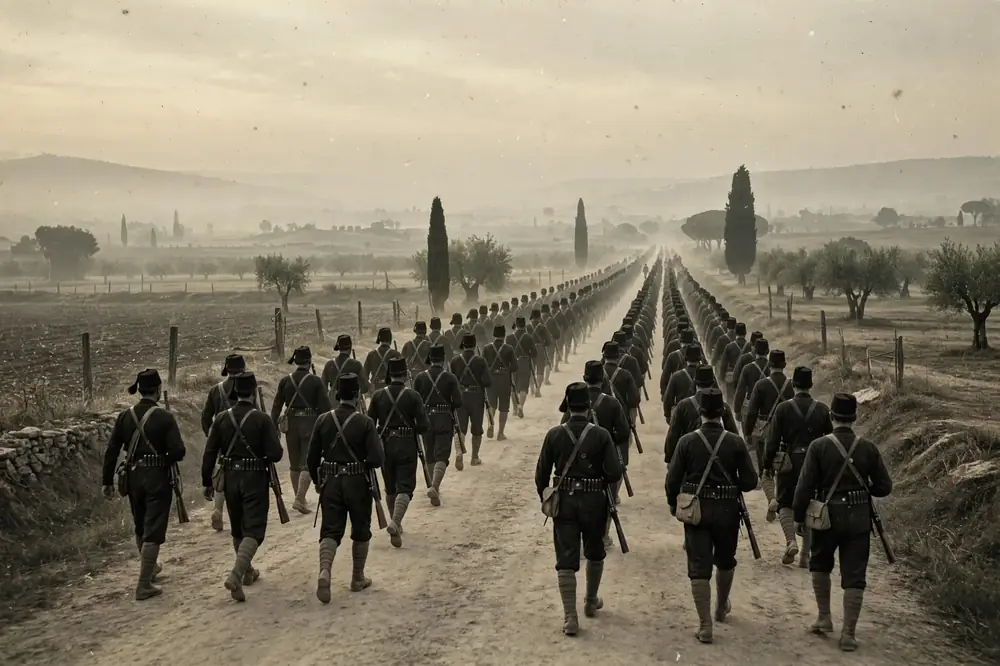
The myth mattered more than the fact, because it gave the regime a story of its own birth — a revolution, not an appointment — and that story was taught in schools, celebrated in anniversaries, and carved into monuments. The regime’s first years were a period of consolidation rather than revolution: Mussolini governed in coalition with liberals, conservatives and nationalists, and he presented himself as a strong prime minister within the existing system, not as its destroyer.
The destruction came gradually, through laws that were passed one by one, each presented as a temporary measure, until the day when there was no parliament left to oppose him.
The Matteotti crisis
The turning point came in 1924, with the murder of Giacomo Matteotti. Matteotti was a socialist deputy who, in May 1924, denounced the Fascist Party in parliament for its use of violence and fraud in the elections of April 1924, and demanded that the elections be annulled. On 10 June 1924 he was kidnapped and murdered by fascist thugs, and his body was found two months later.
The murder caused a crisis: the opposition deputies withdrew from parliament in protest — the so-called Aventine Secession — and for a moment it seemed that Mussolini might fall. Instead, the king refused to dismiss him, the army stood by him, and the opposition had no plan beyond protest.
On 3 January 1925, Mussolini took responsibility for the murder in a famous speech to parliament — “I declare here, before this assembly, that I assume political, moral and historical responsibility for everything that has happened” — and announced that Italy would now be governed by force.
The speech is remembered as the open declaration of the dictatorship, and within two years the opposition parties were banned, the free press was destroyed, and Mussolini ruled alone.
The one-party state
Between 1925 and 1926, Mussolini completed the destruction of Italian democracy. The “exceptional laws” of 1926 banned all political parties except the Fascist Party, abolished the free press, established a special tribunal for political crimes, and created a secret police, the OVRA, to watch, arrest and exile opponents.
Thousands of anti-fascists were imprisoned on the island of Lipari and in other places of confinement, or forced into exile in France, Britain and the Americas, where they formed the nucleus of the anti-fascist resistance. Mussolini also restructured the state: parliament was reduced to a rubber stamp, local government was placed under appointed officials, and the Fascist Party became the only route to public life.
He called himself Il Duce — the Leader — and his image was everywhere: in schools, in offices, in the newspapers, and in the vast public works of the regime. The dictatorship was not as total as the Nazi regime in Germany, and the king, the army and the Catholic Church retained a measure of independence, but for the ordinary Italian there was no legal opposition, no free press, and no protection against the police.
5. The Fascist State
The Lateran Treaty and the Church
In 1929, Mussolini settled the oldest quarrel in Italian politics: the conflict between the Italian state and the Catholic Church, which had refused to recognise the Kingdom of Italy since the seizure of Rome in 1870. The Lateran Treaty, signed on 11 February 1929, created the Vatican City as an independent state, compensated the Church for its losses, and made Catholicism the state religion of Italy.
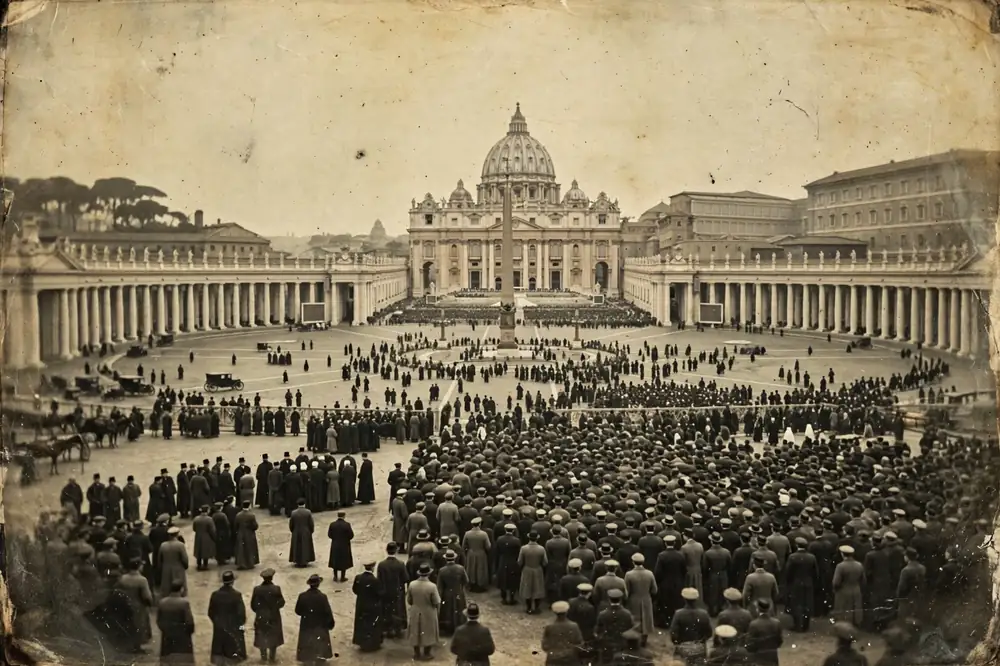
For Mussolini, the treaty was a great political victory: it won him the support, or at least the neutrality, of the Church and of millions of Catholic Italians, and it presented him as the man who had reconciled Italy with its faith.
For the Church, the treaty brought protection and privilege, including control over religious education in schools, but it also bound the Church to a regime that would later embarrass it. Pope Pius XI, who signed the treaty, later criticised the regime’s racial laws and its alliance with Nazi Germany, but the concordat remained in force, and it was confirmed, in amended form, by the Italian Republic after the war.
The treaty is still cited today as the moment when Fascism gained a respectability it had not previously enjoyed.
Corporatism and the economy
Corporatism in theory and practice
Fascist economic policy was built on an idea called corporatism: the organisation of the economy into corporations, each bringing together employers and workers from a single industry under state supervision, with strikes and lockouts banned and disputes settled by the state. In theory, corporatism was a third way between capitalism and socialism, a system in which class conflict would be replaced by national cooperation.
In practice, it was a system of state control that favoured employers and the regime’s friends: workers lost the right to strike and to choose their own unions, wages were held down, and the corporations became bureaucratic bodies that served the state rather than the industries they claimed to represent.
The regime also pursued grand public works — the draining of the Pontine Marshes, the building of new towns, the construction of roads and railways — and it used these works as propaganda, presenting Mussolini as the builder of a new Italy.
The economic record was mixed: Italy industrialised and its infrastructure improved, but living standards for most Italians rose slowly, and the economy remained dependent on imports and vulnerable to the shocks of the 1930s.
Propaganda and the cult of the leader
The Fascist regime was one of the first in Europe to make propaganda a central instrument of government, and Mussolini understood the power of the image better than any Italian politician before him. His face was on posters, stamps, coins and newsreels; his speeches were broadcast on the radio and reported in every newspaper; and the regime invented ceremonies — the Roman salute, the mass rallies, the anniversaries of the March on Rome — that turned politics into theatre.
Schools taught children to admire the Duce, youth organisations enrolled boys and girls from the age of six, and the press was forbidden to print anything that criticised the regime. The propaganda was effective in the short term: many Italians, especially the young, believed in the regime and in Mussolini personally, and the Duce’s popularity reached its height in the mid-1930s, after the conquest of Ethiopia.
But the propaganda also created a dangerous illusion: it convinced Mussolini himself that Italy was stronger than it was, and that the Italian people would follow him into any war he chose. That illusion would be tested, and broken, in the Second World War.
6. Foreign Policy and Empire
The invasion of Ethiopia
Fascist foreign policy was built on a single idea: Italy must become a great empire, as the Roman Empire had been, and the Mediterranean must become an Italian sea. The first test of that idea was Ethiopia, the last independent African state and a member of the League of Nations.
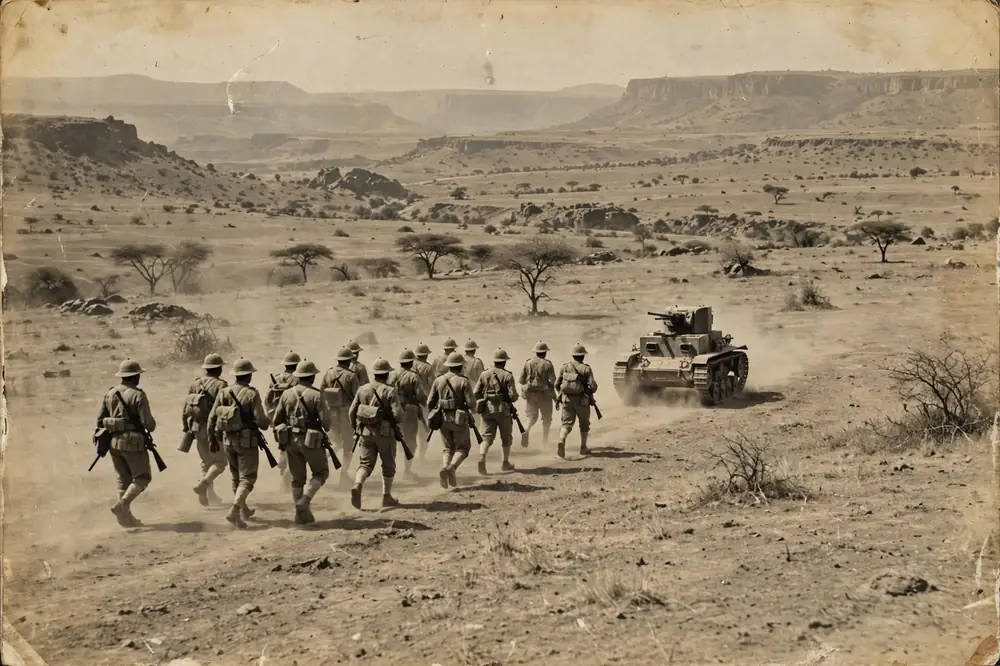
In October 1935, Italian forces invaded Ethiopia from Eritrea and Somaliland, using modern weapons — aircraft, tanks, poison gas — against an army that was brave but poorly equipped. The League of Nations condemned the invasion and imposed sanctions, but the sanctions were half-hearted and did not include oil, and Britain and France were unwilling to risk a war with Italy.
By May 1936, the Italian army had taken Addis Ababa, and Mussolini proclaimed the Italian Empire. The conquest was a triumph for the regime at home, and Mussolini’s popularity soared, but it was also a disaster in the longer term: it isolated Italy diplomatically, pushed Mussolini towards an alliance with Hitler, and committed Italy to holding an African empire it could not afford.
The occupation of Ethiopia was brutal: the Italians used poison gas, massacred civilians, and killed an estimated hundreds of thousands of Ethiopians, a figure that remains contested but is now recognised by historians as a war crime of great scale.
The alliance with Nazi Germany
The conquest of Ethiopia changed the direction of Italian foreign policy. Before 1935, Mussolini had presented himself as a defender of the European order, and he had opposed Hitler’s ambitions in Austria. After Ethiopia, isolated by the League and condemned by the democracies, he turned to Germany.
The two dictators signed the Rome-Berlin Axis in October 1936, and in May 1939 they signed the Pact of Steel, a military alliance that committed each country to support the other in war. The alliance was unequal from the start: Germany was the stronger partner, and Mussolini’s dream of an equal partnership between two fascist empires was never realised.
Italian intervention in the Spanish Civil War (1936-1939), where Mussolini sent tens of thousands of troops and aircraft to support Franco, deepened the alliance and emptied the Italian treasury. Historians disagree about how much choice Mussolini had: some argue that he was driven into Hitler’s arms by the democracies, while others argue that he chose the alliance because he shared Hitler’s contempt for democracy and his belief in war as the test of nations.
What is not in doubt is that the alliance led Italy into a war it was not ready to fight.
The empire in Libya
Italy had held Libya since 1911, and under Fascism the colony became a laboratory for the regime’s ideas about empire and race. The governor of Libya, Italo Balbo, built roads, settled Italian farmers, and presented Libya as Italy’s “fourth shore”. At the same time, the regime waged a brutal campaign against the Libyan resistance, led by Omar Mukhtar, who was captured and hanged in 1931.
The Italian army used concentration camps in the Libyan desert, into which tens of thousands of Bedouin civilians were driven, and historians estimate that tens of thousands of Libyans died in the camps and in the fighting — a figure that, like the Ethiopian dead, is still debated but is now recognised as one of the great crimes of Italian colonialism.
The Libyan experience matters for the story of Italian Fascism because it shows that the regime’s violence was not invented in the Second World War: it was practised first on colonial peoples, and the men who commanded in Libya and Ethiopia would later command in the Balkans and in Russia.
7. The Racial Laws and the War
The racial laws of 1938
Until 1938, Italian Fascism had not been an anti-Semitic movement in the Nazi sense. Italian Jews were a small community — about 40,000 to 50,000 people — and they were well integrated into Italian life; some were even members of the Fascist Party, and Mussolini had Jewish friends and a Jewish mistress.
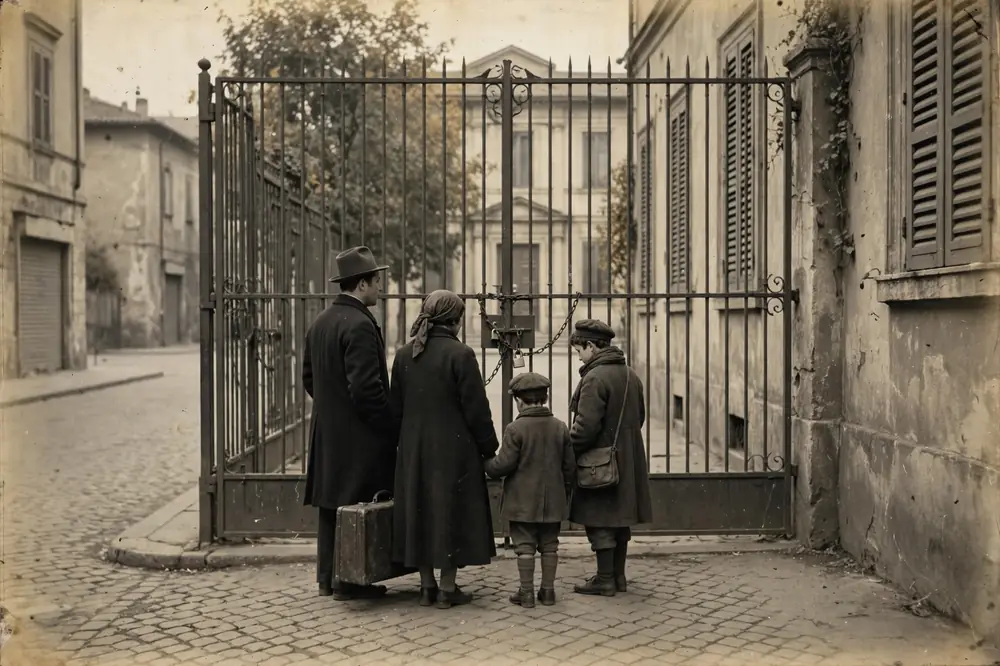
That changed in 1938, under pressure from the alliance with Germany and from Mussolini’s own desire to prove that Italian Fascism was as radical as Nazism. In September and November 1938, the regime issued the racial laws: Jews were expelled from schools and universities, banned from public office and from the armed forces, forbidden to marry non-Jews, and stripped of their property and their citizenship rights.
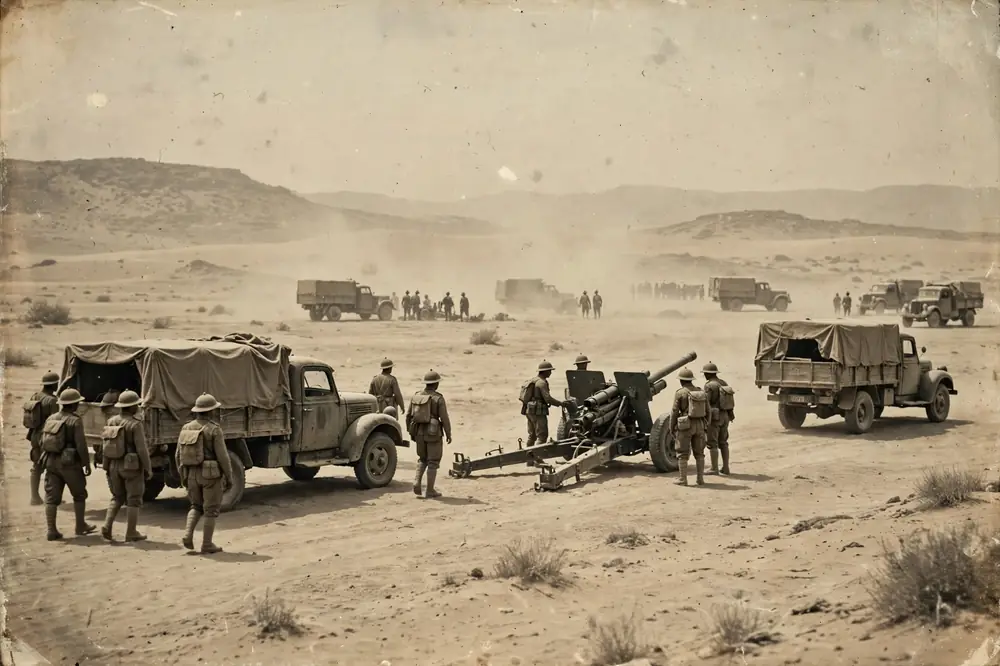
The laws were a shock to Italian Jews, many of whom had considered themselves Italians first and Jews second, and they were a turning point for the regime: they showed that Fascism, which had once claimed to be a purely national movement, was now willing to persecute its own citizens on the basis of race.
The laws also marked the point at which many Italians, including some within the regime, began to doubt Mussolini’s judgement.
Entry into the Second World War
On 10 June 1940, Mussolini declared war on Britain and France, from the balcony of the Palazzo Venezia in Rome, to a crowd that cheered. He believed that the war was almost over, that France was about to fall and Britain would soon make peace, and that Italy could join the war at the last moment and claim its share of the spoils — Nice, Corsica, Tunisia, Egypt.
He was wrong on every count. The Italian army was unprepared: its tanks were light and unreliable, its aircraft were out of date, its industry could not produce enough weapons, and its generals had not planned for a long war.
The first campaigns were disasters: the invasion of Greece in October 1940 was repulsed, the Italian army in North Africa was routed by the British, and the Italian navy suffered heavy losses. Germany had to rescue its ally again and again, in Greece, in North Africa and in the Balkans, and each rescue made Italy more dependent on Germany.
By 1942, Italian soldiers were dying in Russia, in the desert and in the Balkans, in a war that Mussolini had promised would be short and glorious, and the Italian people were beginning to understand that they had been led into a catastrophe.
Defeat and disillusion
The turning point for Italian public opinion was the winter of 1942-43: the defeat at El Alamein, the loss of Libya, the destruction of the Italian army on the Don in Russia, and the Allied bombing of Italian cities, including Milan, Turin and Genoa. Food was short, the black market flourished, and the regime’s propaganda, which had promised victory, was now contradicted by the daily experience of defeat.
The king, the army and the industrialists began to look for a way out of the war, and even within the Fascist Party there were men who believed that Mussolini had to go. The Allied invasion of Sicily on 10 July 1943 made the crisis acute: within two weeks, the Allies had landed, the Italian army in Sicily was collapsing, and the bombing of Rome on 19 July brought the war to the capital itself.
Mussolini’s twenty-one years in power were about to end, and they would end not in a popular uprising but in a vote of his own Fascist Grand Council.
8. The Fall of Mussolini
The vote of 25 July 1943
The Grand Council turns
On the night of 24-25 July 1943, the Fascist Grand Council met for the first time in years, and Dino Grandi, a former foreign minister, proposed a motion calling for the restoration of the king’s constitutional powers — in effect, a vote of no confidence in Mussolini. The debate lasted through the night, and in the early hours of 25 July the motion passed by 19 votes to 8.
Mussolini, who had expected to win, was stunned. The next day he went to the king, Victor Emmanuel III, to report on the meeting, and the king dismissed him, had him arrested, and appointed Marshal Pietro Badoglio as prime minister. The news was greeted with rejoicing across Italy: crowds tore down Mussolini’s portraits, the Fascist Party dissolved itself, and for a few days it seemed that the war was over.
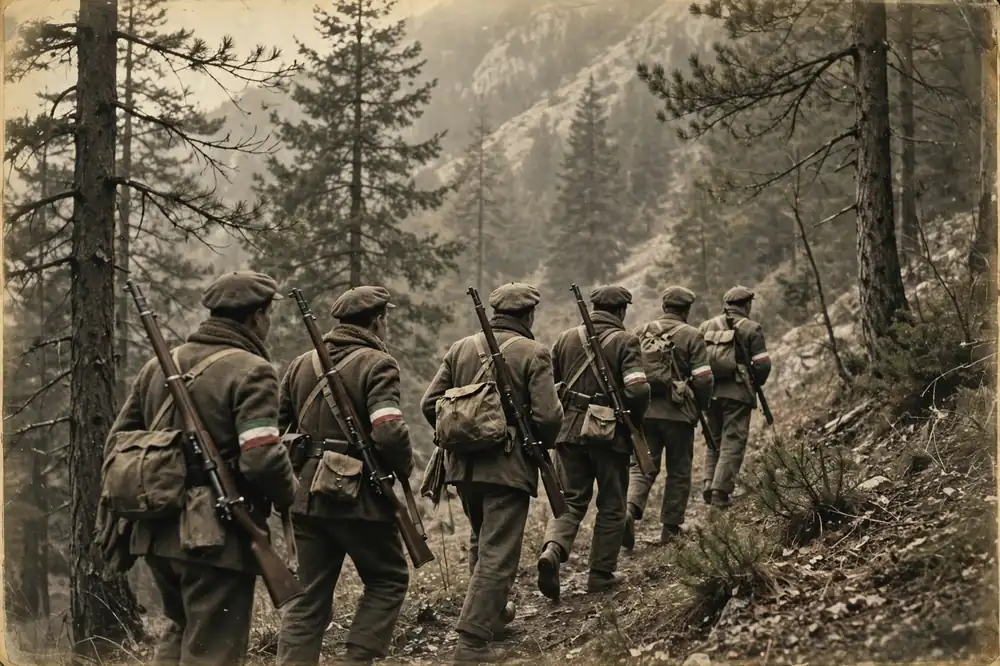
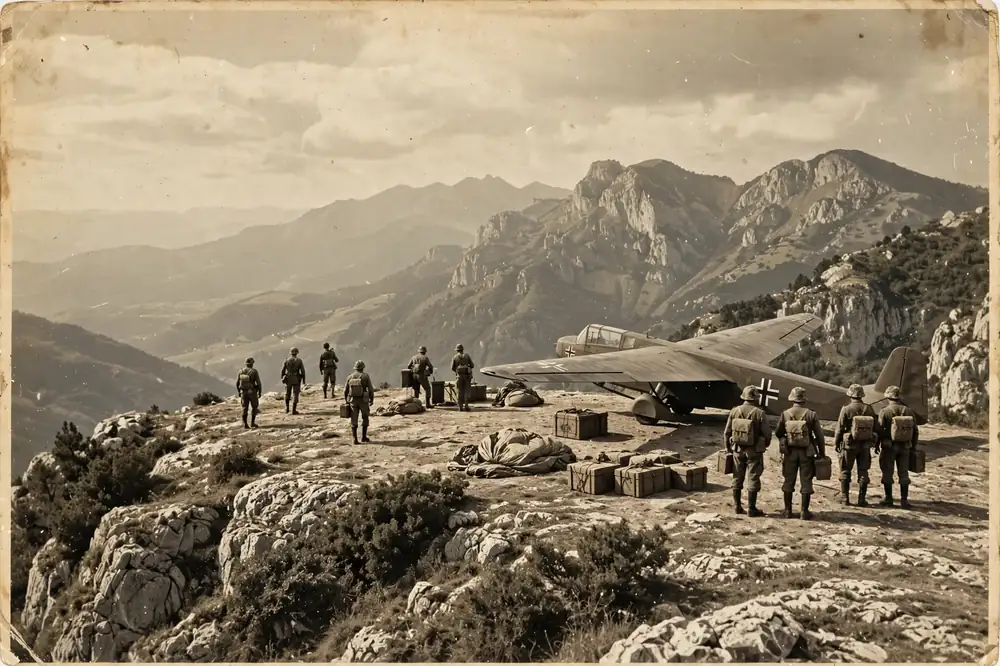
It was not over. Badoglio’s government tried to negotiate a secret armistice with the Allies, and on 8 September 1943 the armistice was announced — but the Germans, who had expected it, moved swiftly to occupy Italy, disarm the Italian army, and rescue Mussolini from his prison on the Gran Sasso, in a daring raid by German paratroops on 12 September.
The armistice and the German occupation
The armistice of 8 September 1943 divided Italy in two. In the south, the king and Badoglio, who had fled Rome, formed a government under Allied protection and declared war on Germany in October 1943. In the centre and north, the Germans occupied the country, and Mussolini, rescued by the Germans, was installed as the head of a new Fascist state, the Italian Social Republic, based at Salò on Lake Garda.
The Italian army disintegrated: many soldiers were captured by the Germans and sent to labour camps in Germany, where thousands died, and many more simply went home. The country was now in a civil war as well as a world war, and the fighting that followed — between Germans and fascists on one side, and the Allies and the Italian partisans on the other — would last until the spring of 1945 and cost tens of thousands of Italian lives.
The armistice is remembered in Italy as one of the most shameful and confused episodes in the country’s history, and the date, 8 September, is still a byword for betrayal and disorder.
The Salò Republic
The Italian Social Republic, known as the Republic of Salò, was a German puppet state in all but name. Mussolini was its Duce, but real power lay with the German ambassador and the German military commander, and the Republic’s territory shrank as the Allies advanced up the peninsula.
The Republic’s most terrible act was its participation in the Holocaust: after the German occupation, Italian Jews, who had been protected by the racial laws but not deported, were now hunted, arrested and deported to Auschwitz. Of the roughly 40,000 Jews in Italy, about 8,000 were deported, and most of them were murdered.
The Republic also waged a brutal war against the partisans, with massacres of civilians — at the Fosse Ardeatine in Rome, where 335 people were murdered in March 1944 in reprisal for a partisan attack, and at Marzabotto, where more than 700 civilians were killed in the autumn of 1944.
These crimes were committed by Germans and by Italian fascists together, and they are the darkest part of the Salò period.
The death of Mussolini
In April 1945, as the Allies broke through the last German lines in Italy and the partisans rose in the northern cities, Mussolini fled Milan with his mistress, Clara Petacci, and a small group of followers, hoping to reach Switzerland or to make a last stand in the mountains.
On 27 April 1945, near the village of Dongo on Lake Como, the convoy was stopped by partisans, and Mussolini, disguised in a German coat and helmet, was recognised and arrested. The next day, 28 April 1945, he and Petacci were shot by partisans, on the orders of the partisan command.
Their bodies, and those of other fascist leaders, were taken to Milan and hung upside down in the Piazzale Loreto, where a crowd abused them — a scene that has become one of the most famous images of the end of the war in Europe.
Mussolini’s body was later buried, exhumed and reburied several times, and it now lies in the family tomb at Predappio, in Romagna, which has become a place of pilgrimage for his admirers. Two days after his death, Adolf Hitler killed himself in Berlin, and a week later the war in Europe was over.
9. Memory and the Debate Today
Predappio and the cult of Mussolini
The memory of Mussolini is still alive in Italy, and nowhere more visibly than at Predappio, the small town in Romagna where he was born and where he is buried. Every year, on the anniversaries of his birth, his death and the March on Rome, thousands of people come to Predappio to visit the tomb, lay flowers, and buy souvenirs — busts, posters, bottles of wine with Mussolini’s face on the label — from the shops of the town.
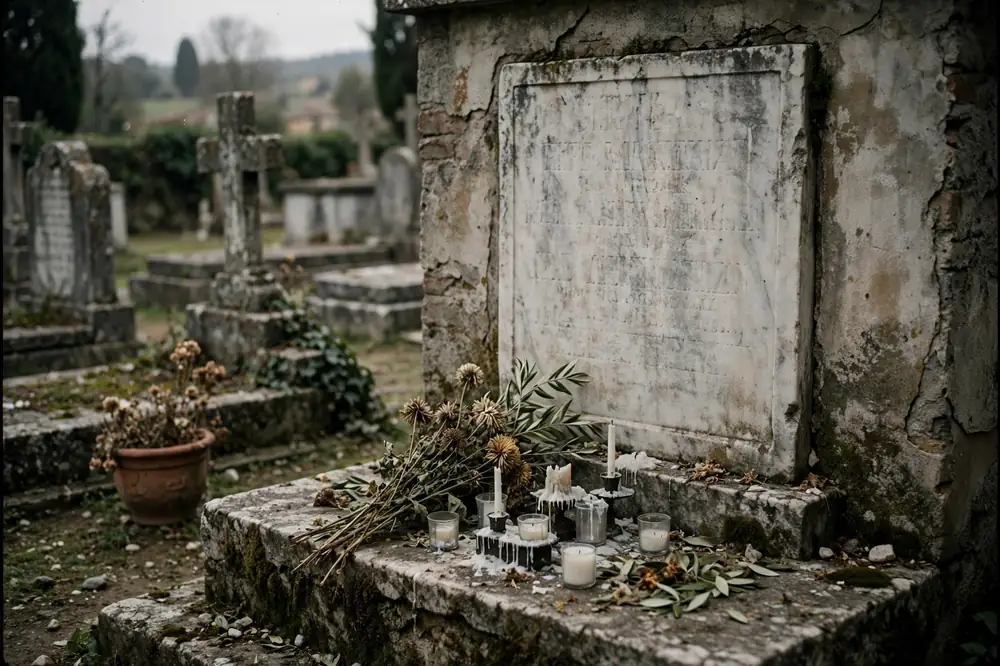
The pilgrims include old fascists, young men of the far right, and tourists, and their presence is a source of embarrassment and anger for many Italians, who see it as a celebration of a dictator. The town’s authorities have tried to manage the phenomenon, and in recent years there have been proposals to turn Mussolini’s birthplace into a museum of Fascism, a place of education rather than of veneration.
The debate over Predappio is a debate about how Italy should remember its dictator: as a criminal to be condemned, as a historical figure to be studied, or as a leader to be admired. The fact that the debate is still unresolved, eighty years after his death, shows how deep the divisions of the Fascist period still run.
The constitution and the ban
The Italian Republic, founded in 1946, was built on the rejection of Fascism. The constitution of 1948, in its twelfth transitory provision, forbids the reorganisation, in any form, of the dissolved Fascist Party, and a law of 1952, the Scelba Law, makes it a crime to apologise for Fascism or to reconstitute the party.
In practice, the ban has been applied unevenly: neo-fascist parties have existed under other names, and the line between historical discussion and apology for Fascism has been hard to draw. The debate flared again in recent years, as parties of the far right have gained votes, and as politicians have been accused of minimising the crimes of Fascism or of praising Mussolini’s public works.
Historians have generally argued that the ban should be understood as a defence of democracy, not as a prohibition on studying the period, and that the best answer to the cult of Mussolini is not censorship but education — a full and honest account of what Fascism did, at home and abroad, and of what it cost.
Historians and the debate
The historical debate about Italian Fascism is one of the richest in modern European history, and it has produced very different judgements. Renzo De Felice, the great biographer of Mussolini, argued that Fascism was a distinct phenomenon, different from Nazism, and that Mussolini was a man of his time who was carried along by events he did not fully control.
Emilio Gentile, another leading historian, has argued that Fascism was a totalitarian movement with its own ideology, its own religion of politics, and its own project of creating a new Italian. Others have stressed the violence of the regime from the beginning, and have argued that the distinction between Italian Fascism and German Nazism, while real, should not be used to minimise the crimes of either.
What the historians agree on is the importance of the facts: the numbers of the dead in Ethiopia and Libya, the racial laws, the deportation of the Jews, the massacres of the civil war — and on the need to teach those facts to each new generation, so that the memory of Fascism is based on evidence rather than on myth.
10. Legacy
The legacy of Italian Fascism is written into the landscape and the politics of Italy. It is written in the architecture of Rome, where the regime’s monumental buildings still stand; in the new towns of the Pontine Marshes, which still bear the names the regime gave them; in the roads and the railways; and in the constitution that forbids the return of the party.
It is written, too, in the memory of the victims: the Ethiopians and Libyans who died under Italian rule, the anti-fascists who were imprisoned and exiled, the Jews who were deported after 1943, and the partisans and civilians who died in the civil war.
The regime’s defenders once argued that Mussolini “made the trains run on time”, a claim that historians have shown to be largely a myth, and that he built an empire, a claim that the war destroyed. What remains is a cautionary tale: a democracy that gave power to a man who promised order, and discovered too late that order without freedom is not order at all, but the silence of a country that has lost the right to speak.
The lessons for today
The lessons of Italian Fascism are still argued about, but three are widely accepted by historians. First, that democracies can be destroyed from within, by legal means, one law at a time, and that the defence of democracy requires more than elections: it requires a free press, an independent judiciary, and citizens willing to defend them.
Second, that the glorification of war and empire leads, sooner or later, to real wars with real victims, and that a leader who promises glory will eventually have to pay for it in the lives of his own people. Third, that memory matters: how a country remembers its dictators shapes how it governs itself, and a country that forgets or minimises its past is more likely to repeat it.
Italy has not forgotten Fascism, and the argument about how to remember it is itself a sign of a healthy democracy — a democracy that, unlike the regime it replaced, can argue with itself in public, and can change its mind.
Fascism and the word itself
Italian Fascism gave the world a word, and the word has outlived the regime by eighty years. “Fascism” is now used, often loosely, to describe any authoritarian movement, and historians have spent decades arguing about what the word should mean.
Some argue that it should be reserved for movements like Mussolini’s and Hitler’s, with their specific combination of nationalism, mass mobilisation, the cult of the leader and the glorification of violence. Others argue that the word describes a broader pattern, a style of politics that can appear in many countries and many periods.
The debate matters because the word carries a moral charge: to call a movement fascist is to condemn it, and to deny that a movement is fascist is often to defend it. The history of Italian Fascism is the best place to begin that debate, because it is the original case, the movement that invented the word and the style, and the regime whose rise and fall show, more clearly than any other, what fascism is and what it costs.
Frequently Asked Questions
What was Italian Fascism?
Italian Fascism was a nationalist, authoritarian movement founded by Benito Mussolini in 1919. It ruled Italy as a one-party dictatorship from 1922 to 1943, and it was the first fascist regime in Europe.
How did Mussolini come to power?
Mussolini became prime minister on 31 October 1922, after the March on Rome, when King Victor Emmanuel III invited him to form a government. He then destroyed parliamentary democracy through a series of laws in 1925-1926.
What were the racial laws of 1938?
The racial laws of 1938 stripped Italian Jews of their rights: they were expelled from schools and universities, banned from public office and the armed forces, and forbidden to marry non-Jews. About 8,000 Italian Jews were later deported, most of them murdered.
When did Mussolini fall?
Mussolini was dismissed by the king on 25 July 1943, after a vote of no confidence by the Fascist Grand Council. He was rescued by the Germans and led the puppet Salò Republic until he was captured and executed by partisans on 28 April 1945.
What is the Salò Republic?
The Italian Social Republic, known as the Republic of Salò, was a German puppet state in northern Italy from 1943 to 1945, headed by Mussolini. It took part in the deportation of Italian Jews and in massacres of civilians and partisans.
Is Fascism banned in Italy today?
The Italian constitution forbids the re-founding of the Fascist Party, and the Scelba Law of 1952 makes it a crime to apologise for Fascism. The memory of Fascism, and the tomb of Mussolini at Predappio, remain politically contested.
Related articles
Sources
- Renzo De Felice, Mussolini (multi-volume biography, Einaudi) — the standard scholarly biography of Mussolini and the Fascist regime.
- Emilio Gentile, The Sacralization of Politics in Fascist Italy (Harvard University Press, 1996) — Fascism as a totalitarian movement and a political religion.
- R. J. B. Bosworth, Mussolini’s Italy: Life Under the Fascist Dictatorship, 1915-1945 (Penguin, 2006) — daily life, the regime and the war.
- Wikipedia, “Italian Fascism“, “March on Rome”, “Italian racial laws” and “Italian Social Republic” — chronology, the racial laws and the Salò Republic.
- United States Holocaust Memorial Museum, Holocaust Encyclopedia, “Italy” and “The Italian Social Republic” — the racial laws and the deportation of Italian Jews.
- Paul Corner, The Fascist Party and Popular Opinion in Mussolini’s Italy (Oxford University Press, 2012) — popular opinion under the regime.
- Alexander De Grand, Italian Fascism: Its Origins and Development (University of Nebraska Press, 2000) — the origins and the development of the movement.