 WAR ATLAS MILITARY HISTORY MAGAZINE · WWI — WWII
Tiger I Tank
1. Lead
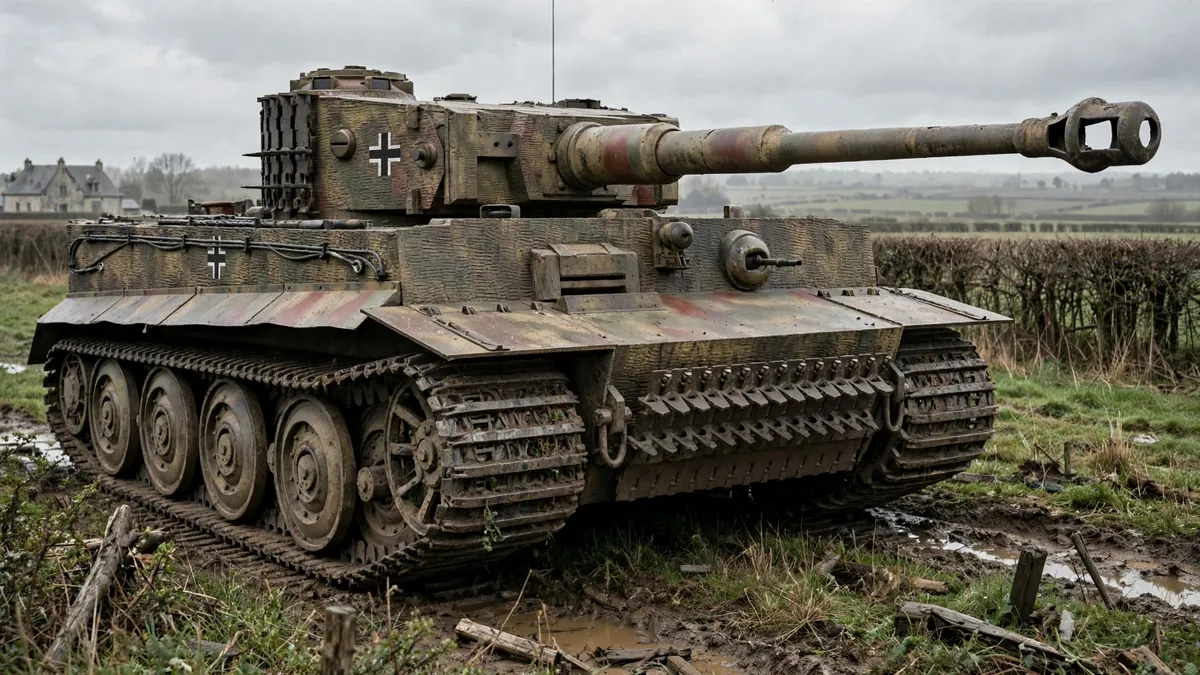
The Tiger I (Panzerkampfwagen VI Tiger Ausf. E) was the German heavy tank of the Second World War, and the most feared tank of the war in the eyes of the Allied soldiers who met it. Armed with the 88 mm KwK 36 gun — adapted from the famous 88 mm anti-aircraft gun — and protected by armour up to 100 mm thick, the Tiger could destroy any Allied tank at long range while remaining almost immune to their guns at ordinary combat distances.
It entered service in 1942, fought on the Eastern Front, in North Africa and in Normandy, and became a symbol of German engineering and of the German war effort. Only about 1,347 Tigers were built, and its weight, its cost and its mechanical complexity limited its numbers; but the Tiger’s reputation — above all after the action at Villers-Bocage in Normandy in June 1944 — has made it the best-known tank of the Second World War.
2. Key Facts
| Type | Heavy tank |
| Origin | Germany |
| Designer | Henschel & Son (Erwin Aders); competing design by Porsche |
| Manufacturer | Henschel & Son, Kassel |
| In service | 1942–1945 |
| Produced | August 1942–August 1944; about 1,347 built |
| Weight | About 56–57 tonnes (combat weight) |
| Length | 8.45 m (with gun); 6.32 m (hull) |
| Width | 3.56 m |
| Height | 3.00 m |
| Crew | 5 (commander, gunner, loader, driver, radio operator/bow machine-gunner) |
| Armour | 25–100 mm; 100 mm front hull and turret |
| Main armament | 8.8 cm KwK 36 L/56 gun (92 rounds) |
| Secondary armament | Two 7.92 mm MG 34 machine guns |
| Engine | Maybach HL230 P45 V-12 petrol, 690 hp |
| Top speed | About 38 km/h on road; about 20–25 km/h cross-country |
| Range | About 195 km on road; about 110 km cross-country |
3. Background and Development
The Tiger was born of the shock of the German invasion of the Soviet Union in June 1941. In the first months of Operation Barbarossa, German tank crews met the Soviet T-34 medium tank and the KV-1 heavy tank, and found that their own tanks — the Panzer III and Panzer IV, armed with 37 mm and short 75 mm guns — could not penetrate the Soviet tanks’ armour at ordinary ranges, while the Soviet 76.2 mm gun could penetrate theirs.
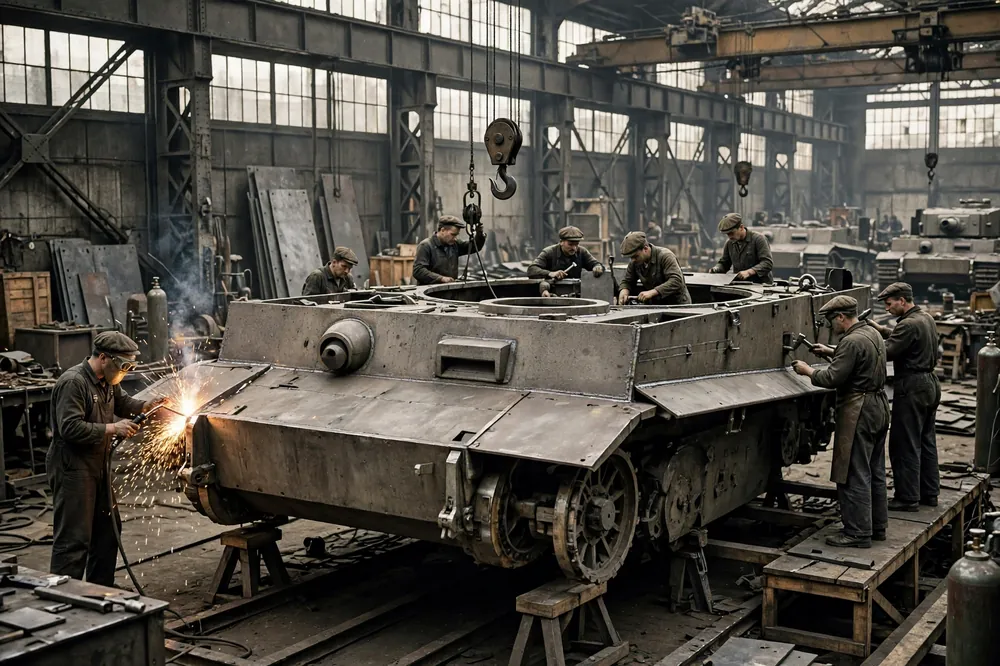
The German Army had been working on a heavy tank since 1937, but the experience of 1941 gave the programme urgency. In May 1941, before the invasion, Hitler had ordered the development of a heavy tank armed with the 88 mm gun; after the invasion, the programme was accelerated, and two firms were asked to build prototypes: Henschel, under Erwin Aders, and Porsche, under Ferdinand Porsche.
The two prototypes were demonstrated to Hitler on his birthday, 20 April 1942, at the Rastenburg headquarters in East Prussia. The Porsche design, the VK 45.01 (P), used a petrol-electric drive that proved unreliable, and its turret — designed by Krupp — was later used on the early Henschel Tigers. The Henschel design, the VK 45.01 (H), used a conventional transmission and a Maybach engine, and it was chosen for production. The first Tigers were built at the Henschel works in Kassel, and production began in August 1942. The tank was given the designation Panzerkampfwagen VI Tiger Ausf. E, and it was issued to the newly formed heavy tank battalions (schwere Panzer-Abteilungen), each of which was to have 45 Tigers.
The 88 mm gun
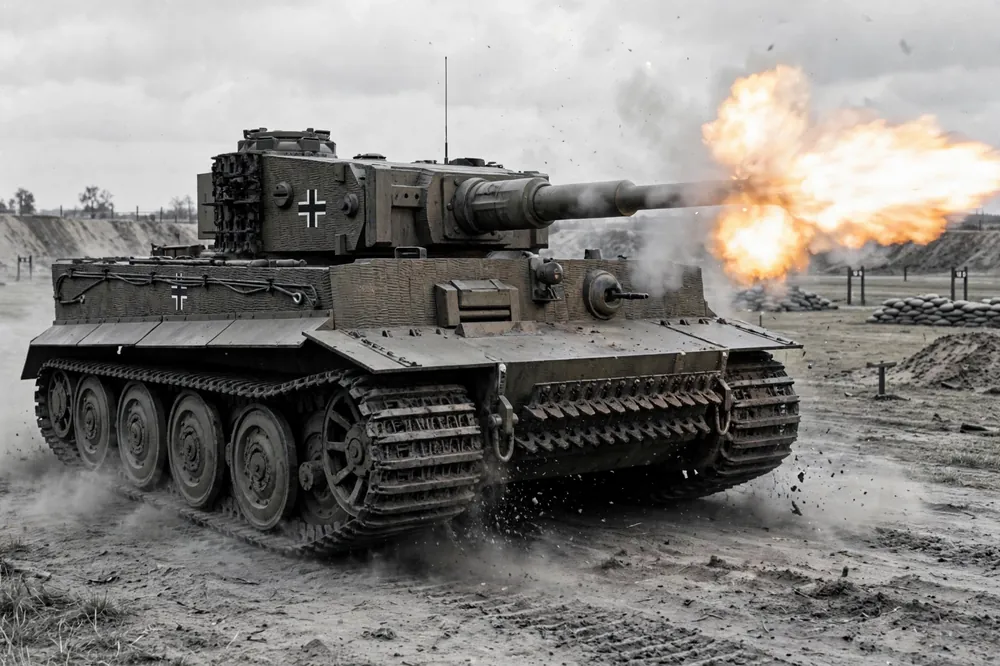
The Tiger’s gun was the 8.8 cm KwK 36 L/56, adapted from the 8.8 cm Flak 36 anti-aircraft gun, which German troops had already used as an anti-tank gun in France and North Africa. The gun fired an armour-piercing shell that could penetrate about 110 mm of armour at 1,000 metres, and a high-explosive shell for use against infantry and soft targets.
At the time of its introduction, no Allied tank could match it: the British Churchill and the American Sherman, armed with 75 mm guns, could not penetrate the Tiger’s frontal armour at any range, and had to close to point-blank range and attack from the side or the rear. The Tiger’s gun, and the fear it inspired, is the reason the tank is remembered as it is.
4. Design
The Tiger was a large, heavy and expensive tank, and its design showed it. The hull was a simple box, with vertical armour plates up to 100 mm thick on the front and 80 mm on the sides and rear, and the turret was a large, roomy box that housed the gun, the commander, the gunner and the loader.
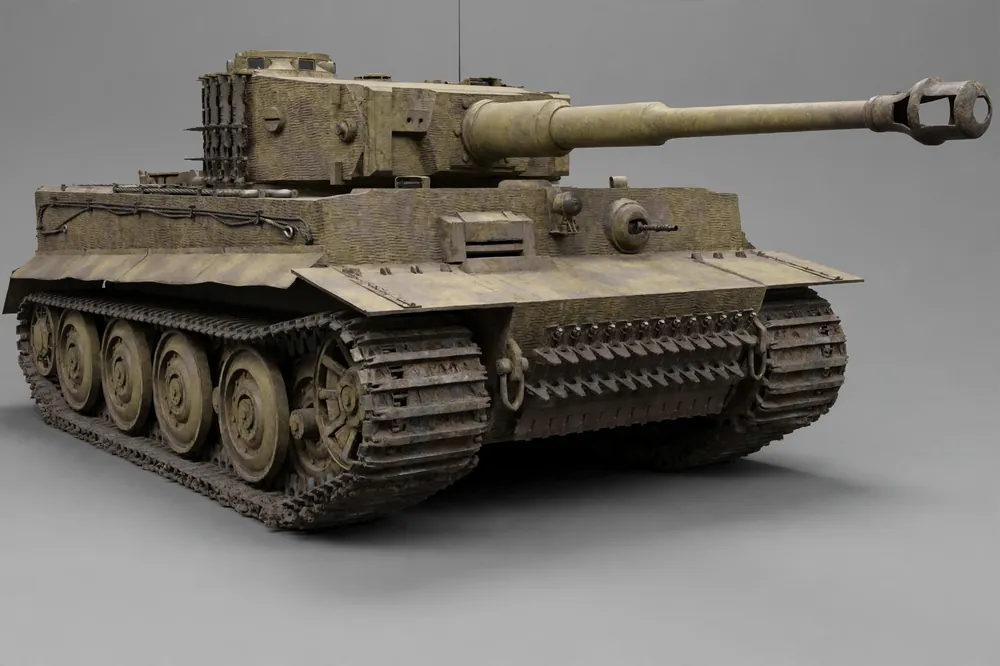
The armour was not sloped, as it was on the T-34 and on the later Panther, because the German designers believed that thickness alone would be enough — and, for the first two years of the Tiger’s service, it was.
The tank weighed about 56 tonnes, and it was powered by a Maybach HL230 P45 V-12 petrol engine of 690 horsepower, which gave it a road speed of about 38 km/h. The Tiger’s suspension used interleaved road wheels — a design that spread the tank’s weight and gave a smooth ride, but that was difficult to maintain, and that clogged with mud, ice and stones in the Russian winter.
The Tiger’s crew of five worked in a spacious fighting compartment, and the tank was fitted with a binocular gun sight, a commander’s cupola with periscopes, and a radio. The tank’s main weakness, apart from its weight, was its mechanical reliability: the engine, the transmission and the final drives were overstressed by the tank’s weight, and Tigers broke down frequently.
The tank’s fuel consumption was high — about 500 litres per 100 kilometres on the road, and far more cross-country — and its width, at 3.56 metres, meant that it could not be transported by rail without removing its outer road wheels and fitting narrower transport tracks.
The Tiger was, in short, a powerful weapon that was difficult to keep running, and its crews needed skilled mechanics and a large supply of spare parts.
5. Variants
| Variant | Years | Key features | Production |
|---|---|---|---|
| Tiger I (P) | 1942 | Porsche prototype; petrol-electric drive; not accepted for production; 10 built as chassis | 10 chassis |
| Tiger I (H) / Ausf. E | 1942–1944 | Production model; Henschel design; Maybach HL230 engine; 88 mm KwK 36 gun | About 1,347 |
| Tiger (P) / Ferdinand | 1943 | Porsche chassis converted to tank destroyers (Ferdinand/Elefant) with 88 mm PaK 43 gun | 91 |
| Befehlstiger | 1942–1944 | Command version with additional radio equipment and reduced ammunition | Small numbers |
| Sturmtiger | 1944–1945 | Assault gun on Tiger I chassis with 380 mm rocket mortar | 18 |
| Bergetiger | 1943–1944 | Armoured recovery vehicle on Tiger I chassis | Small numbers |
The Tiger I was produced in a single main variant, the Ausf. E, with small changes during production: early Tigers had a Krupp turret with a low cupola and a distinctive “drum” shape, while later Tigers had a Henschel turret with a higher cupola; early Tigers had a muzzle brake with two baffles, later ones with one; and the road wheels, the air filters and the stowage changed over time.
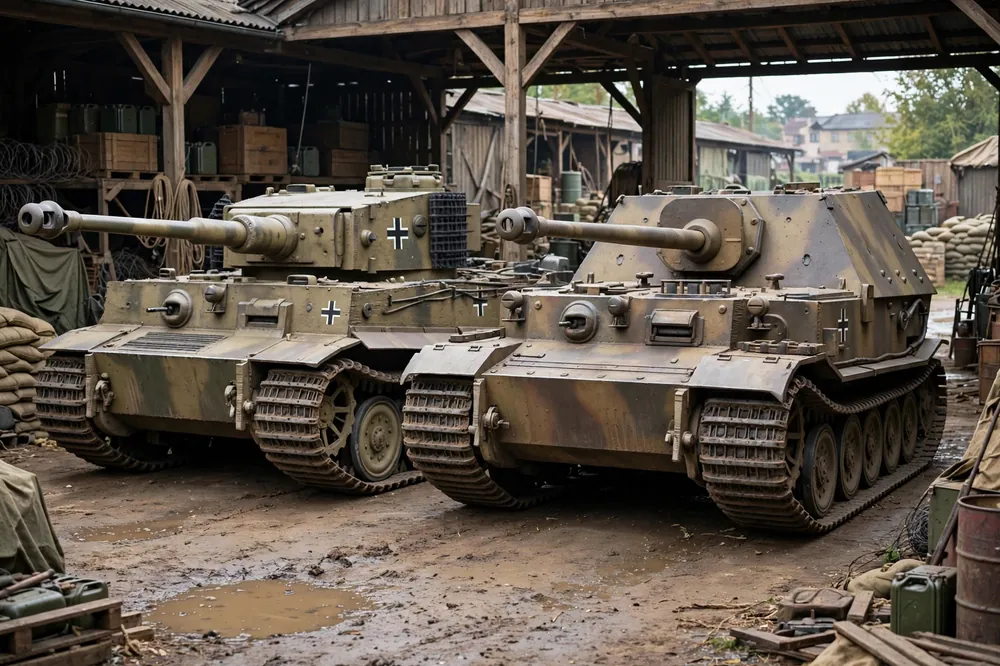
The Porsche chassis that lost the competition were converted into the Ferdinand tank destroyer, armed with the long 88 mm PaK 43 gun, which fought at Kursk in 1943. The Tiger’s successor, the Tiger II (Königstiger), entered production in 1944, with thicker, sloped armour and the long 88 mm KwK 43 gun, but only about 490 were built, and the Tiger I remained in service until the end of the war.
6. Operational History
The Eastern Front, 1942–1943
The Tiger first saw action on the Eastern Front, near Leningrad, in September 1942, where four Tigers of the 502nd Heavy Tank Battalion were committed in marshy ground for which they were unsuited, and three broke down or were bogged down.
The debut was inauspicious, but the Tiger’s combat value soon became clear: in the fighting around Leningrad and in the Ukraine, Tigers destroyed Soviet tanks at ranges at which the Soviet tanks could not reply, and the Soviet command issued orders to its tank crews to avoid engaging Tigers at long range.
At Kursk in July 1943, the Tigers of the SS Panzer Corps and of the Army’s heavy tank battalions spearheaded the German attack, and they destroyed large numbers of Soviet tanks — but the battle was a German defeat, and the Tigers, like the rest of the German Army, were forced onto the defensive.
For the rest of the war on the Eastern Front, the Tiger was used as a “fire brigade”, rushed to the points where the Soviet advance threatened a breakthrough, and its crews fought a series of defensive battles as the German Army retreated westwards.
North Africa
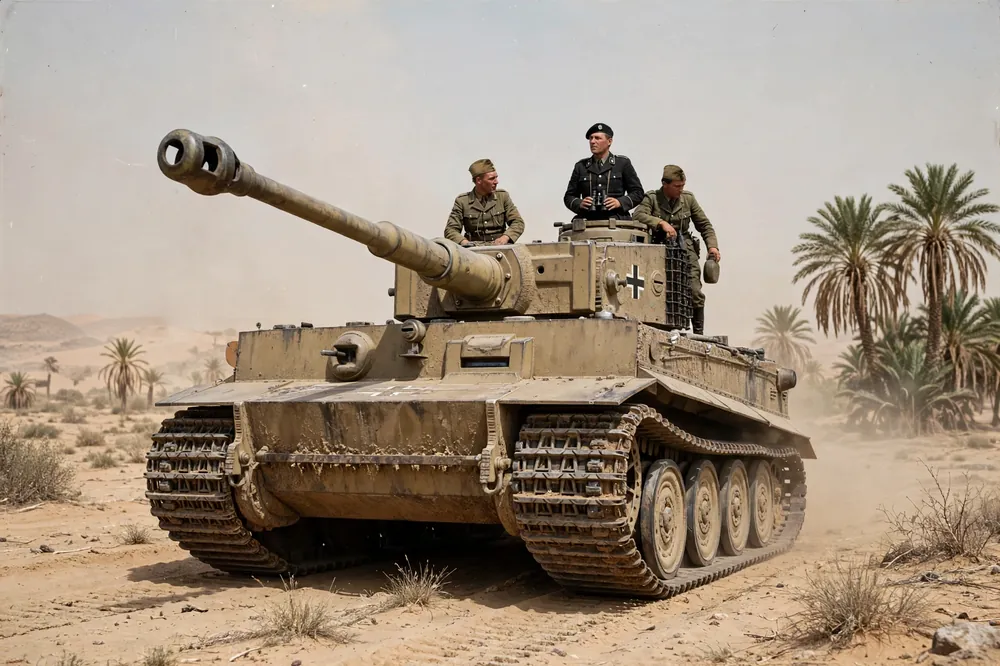
In North Africa, the Tigers of the 501st Heavy Tank Battalion arrived in Tunisia in late 1942, in time for the final phase of the North African campaign. The Tigers fought well in the open desert, where their long-range gun was at its best, and they destroyed a number of American and British tanks, including at the Battle of Kasserine Pass in February 1943.
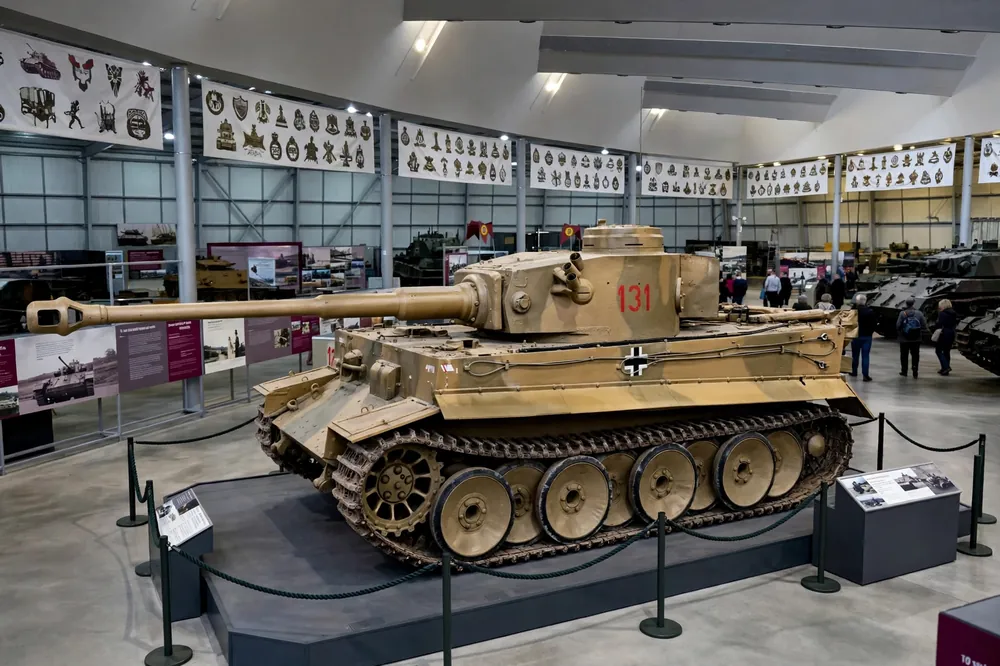
But the campaign was lost, and the Tigers in Tunisia were destroyed or captured when the Axis forces in North Africa surrendered in May 1943. The most famous Tiger of the campaign, Tiger 131 of the 504th Heavy Tank Battalion, was captured by British forces on 21 April 1943, after its crew abandoned it when its gun was damaged and its turret jammed; Tiger 131 is now the only running Tiger I in the world, preserved at the Tank Museum in Bovington, England.
Normandy and Villers-Bocage
In Normandy, the Tigers of the SS heavy tank battalions fought the British and Canadian forces around Caen, and the Tiger’s reputation reached its height on 13 June 1944, at Villers-Bocage. There, a single Tiger, commanded by SS Second Lieutenant Michael Wittmann, attacked a column of British tanks and vehicles of the 7th Armoured Division, and destroyed about 14 tanks and a number of other vehicles before withdrawing.
The action, which was widely reported in the German press, made Wittmann a hero in Germany and made the Tiger a byword for German tank power in Britain. Historians have since qualified the account — Wittmann was supported by other Tigers, and the British column was caught unprepared — but the action remains the Tiger’s most famous.
Wittmann was killed on 8 August 1944, near Cintheaux, when his Tiger was destroyed, probably by a Sherman Firefly of the Canadian or British forces. The Tigers in Normandy were outnumbered and outmatched by Allied air power, and most were destroyed or abandoned during the German retreat in August 1944.
The end of the war
In the last months of the war, the remaining Tigers fought in the Ardennes, in Hungary and in the defence of Berlin. By then, the Tiger was outnumbered by the thousands of Soviet T-34s and American Shermans, and its crews fought a losing battle.
The last Tigers were destroyed or abandoned in the ruins of Berlin in April-May 1945, and the Tiger’s production had already ended in August 1944, when the Henschel works were bombed and the production line was switched to the Tiger II.
The Tiger’s combat record — the ratio of enemy tanks destroyed to Tigers lost — is often quoted as high, but the figures are disputed, and they reflect the Tiger’s use in defence, at long range, against tanks that could not penetrate its armour, rather than a simple measure of the tank’s quality.
7. Performance and Specifications
| Specification | Tiger I (Ausf. E) |
|---|---|
| Main gun | 8.8 cm KwK 36 L/56 |
| Armour penetration (APCBC) | About 110 mm at 1,000 m; about 100 mm at 1,500 m |
| Armour (front hull) | 100 mm |
| Armour (front turret) | 100 mm |
| Armour (side hull) | 80 mm (60 mm on early models) |
| Armour (rear) | 80 mm |
| Weight | About 56–57 tonnes |
| Engine | Maybach HL230 P45, 690 hp |
| Power-to-weight | About 12 hp per tonne |
| Top speed (road) | About 38 km/h |
| Range (road) | About 195 km |
| Fuel capacity | 540 litres |
| Crew | 5 |
| Number built | About 1,347 |
Compared with its contemporaries, the Tiger was superior in firepower and protection, and inferior in mobility, reliability and numbers. The Soviet T-34, which weighed about 30 tonnes, was faster, more reliable and produced in far larger numbers — about 35,000 T-34s were built during the war, against about 1,347 Tigers.
The American Sherman, which weighed about 30 tonnes, was also produced in far larger numbers — about 50,000 were built — and, in its Firefly version, armed with the British 17-pounder gun, it could penetrate the Tiger’s armour at combat ranges.
The Tiger’s advantage was that, in a one-to-one fight at long range, it would usually win; its disadvantage was that the war was not fought one-to-one, and that the Allies could afford to lose tanks that the Germans could not afford to build.
8. Operators
The Tiger was used almost exclusively by Germany. It was issued to the heavy tank battalions of the German Army (Heer) and of the Waffen-SS, and to a few independent companies. The Army’s battalions, numbered 501 to 510, fought on the Eastern Front, in North Africa and in Normandy; the SS battalions, numbered 101 to 103, fought in the Soviet Union and in Normandy, and included the battalion commanded by Michael Wittmann.
A small number of Tigers were supplied to Hungary in 1944, and a single Tiger was given to Japan, though it was never shipped and remained in Germany. After the war, the French Army used a few captured Tigers for trials, and the Soviet Union tested captured Tigers at Kubinka. The Tiger was never exported in significant numbers, and it remained a German weapon throughout its service.
9. Legacy and Influence
The Tiger’s legacy is, above all, its reputation. It became the symbol of the German heavy tank, and the tank against which all Allied tanks were measured. The fear of the Tiger — “Tigerphobia” — affected Allied tactics: Allied tank crews were told to call in artillery and air support rather than to engage a Tiger, and the British and Americans developed new tanks and new guns, including the Sherman Firefly and the Pershing, in part to counter it.
The Tiger also influenced tank design: its 88 mm gun set a standard for tank armament, and its successor, the Tiger II, and the Soviet IS-2 and the American Pershing, all carried guns of similar power. But the Tiger’s legacy is also a cautionary one: it showed that a tank that is too heavy, too expensive and too difficult to maintain cannot win a war of production, and that the tank that wins is often the one that can be built in large numbers and kept running — the T-34 and the Sherman, not the Tiger.
10. Surviving Examples
Only a handful of Tiger I tanks survive, and only one — Tiger 131 at the Tank Museum in Bovington, England — is in running order. Tiger 131 was captured in Tunisia in April 1943, brought to Britain for trials, and preserved at Bovington, where it was restored to running order in 2003 and is now the star of the museum’s annual Tankfest.
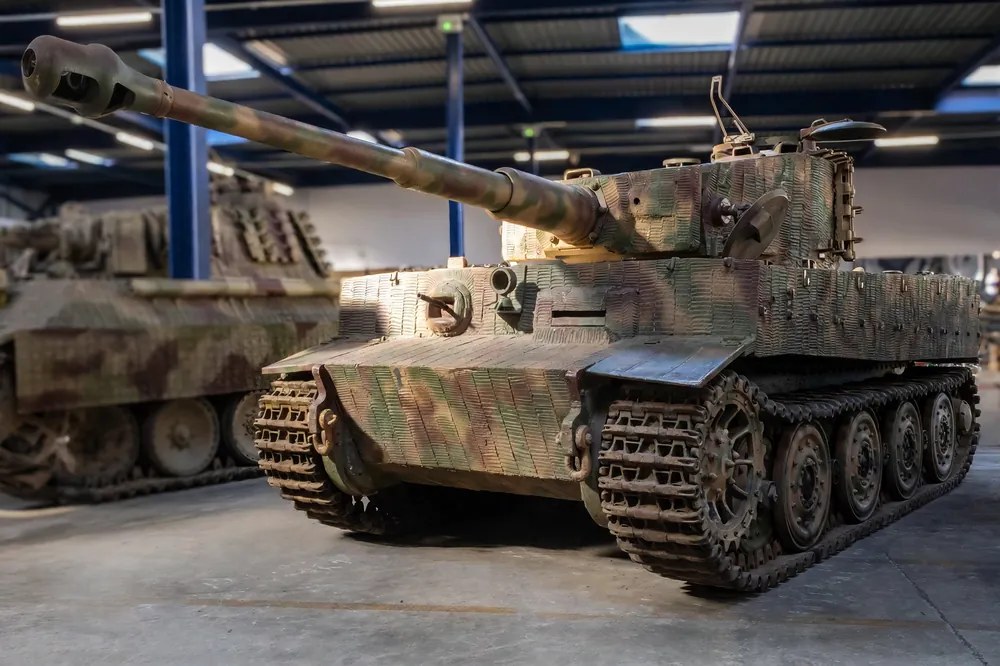
Other surviving Tigers are held at the Musée des Blindés in Saumur, France (a Tiger in running order was restored there in recent years, though Tiger 131 remains the best known); at the Kubinka Tank Museum in Russia; at the U.S. Army Armor and Cavalry Collection at Fort Benning, Georgia; and at the Deutsches Panzermuseum in Munster, Germany.
Several Tigers are held as wrecks or as partial vehicles, and a number of replicas — built on the chassis of other tanks, or as full-scale models — are used in films, including the Tiger built for the film Fury (2014), which used the real Tiger 131. For most visitors, the easiest way to see a Tiger I is at Bovington, where Tiger 131 runs on special occasions.
Frequently Asked Questions
What is the Tiger I tank?
The Tiger I was a German heavy tank of the Second World War, armed with an 88 mm gun and protected by armour up to 100 mm thick. About 1,347 were built between 1942 and 1944.
How many Tiger I tanks were built?
About 1,347 Tiger I tanks were built by Henschel between August 1942 and August 1944.
What gun did the Tiger I have?
The 8.8 cm KwK 36 L/56 gun, adapted from the 88 mm anti-aircraft gun. It could penetrate about 110 mm of armour at 1,000 metres.
What happened at Villers-Bocage?
On 13 June 1944, a Tiger commanded by Michael Wittmann attacked a British column at Villers-Bocage in Normandy and destroyed about 14 tanks and a number of other vehicles.
Where can I see a Tiger I today?
Tiger 131, the only running Tiger I in the world, is at the Tank Museum in Bovington, England. Other Tigers are at Saumur in France, Kubinka in Russia and Fort Benning in the United States.
What is the difference between the Tiger I and the Tiger II?
The Tiger II (Königstiger) was larger and heavier, with thicker, sloped armour and the long 88 mm KwK 43 gun. Only about 490 Tiger IIs were built, against about 1,347 Tiger Is.
Related articles
Sources
- Wikipedia, “Tiger I” — production of about 1,347, specifications, Villers-Bocage, Tiger 131.
- The Tank Museum, Bovington, “Tiger 131” — the capture of Tiger 131 in Tunisia on 21 April 1943 and its restoration.
- Thomas L. Jentz and Hilary L. Doyle, Germany’s Tiger Tanks: Tiger I and Tiger II (Schiffer, 2000) — development, production and variants.
- Michael Green and James D. Brown, Tiger Tanks at War (Zenith Press, 2008) — operational history and the Villers-Bocage action.
- Wolfgang Schneider, Tigers in Combat (Stackpole Books, 2004) — the heavy tank battalions and their combat record.
- Steven J. Zaloga, Tiger I vs T-34 (Osprey Publishing, 2013) — comparison with the Soviet T-34.