 WAR ATLAS MILITARY HISTORY MAGAZINE · WWI — WWII
Delaying Action
1. Lead
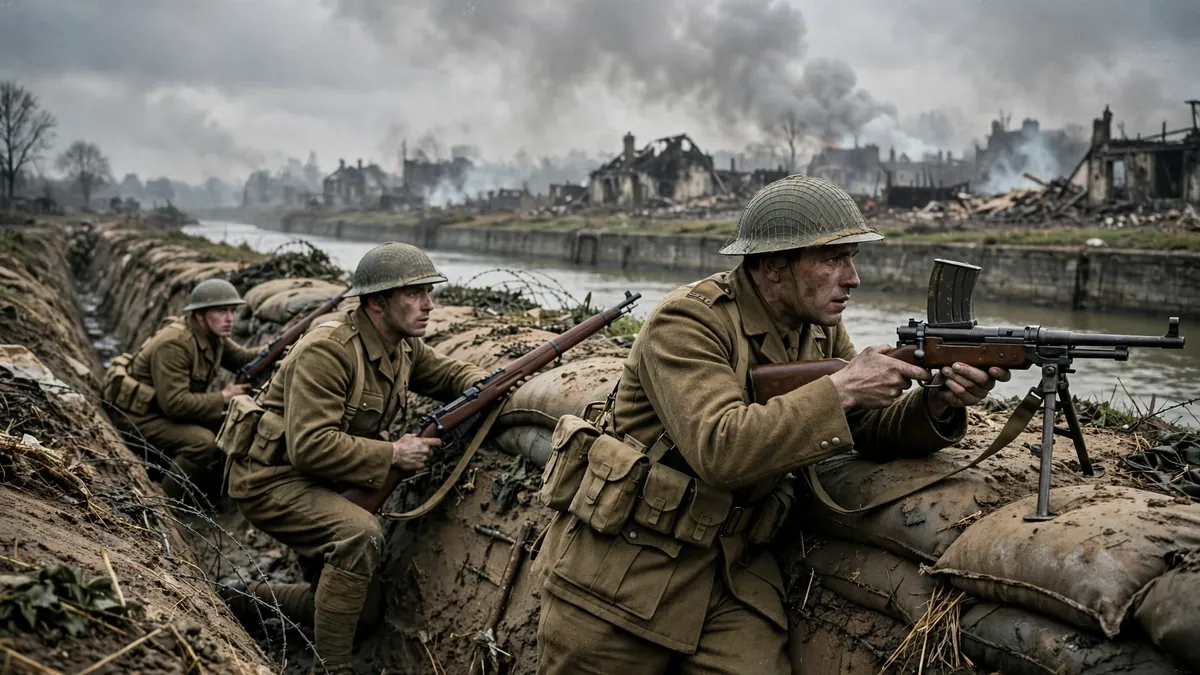
A delaying action is a military operation in which a force deliberately gives ground, fighting a series of short, sharp stands, in order to slow a stronger enemy and buy time. It is one of the oldest tactics in war, and one of the least glamorous: the force that delays does not expect to win the battle, and it knows it will end the operation further back than it started.
Its victory is measured in hours and days, not in ground held. The delaying force trades space for time — time for the main army to retreat to a new line, time for reinforcements to arrive, time for a river to be crossed, or time for a political decision to be made.
The delaying action is closely related to the rearguard action, and the two terms are often used together: the rearguard is the force that does the delaying, covering the withdrawal of the main body. History is full of examples, from the Spartans at Thermopylae in 480 BC to the British rearguard at Dunkirk in 1940 and the Soviet delaying battles of 1941. This article explains the principles of the delaying action, the techniques commanders use to make it work, its most famous examples, and the fine line between a successful delay and a disaster — because a delay that goes on too long, or that is pressed too hard, becomes a battle of annihilation that the delaying force cannot win.
2. Key Facts
| Tactic | Delaying action; rearguard action |
| Purpose | Trade space for time; slow a stronger enemy; protect a withdrawal |
| Key principle | Fight, break contact, fall back to the next position — never accept a decisive battle |
| Classic example | Thermopylae, 480 BC — the Spartan rearguard |
| Second World War examples | Dunkirk perimeter, 1940; Soviet delaying battles, 1941; the Ardennes, December 1944 |
| Force required | Usually a small, mobile force with good knowledge of the ground |
| Main risk | The delaying force is cut off and destroyed |
| Opposite tactic | The pursuit, and the battle of annihilation |
3. Origins
The delaying action is as old as retreat itself. Whenever an army has had to withdraw in the face of a stronger enemy, it has needed a force to stand between the enemy and the main body, and to slow the pursuit. The ancient world understood the tactic well.
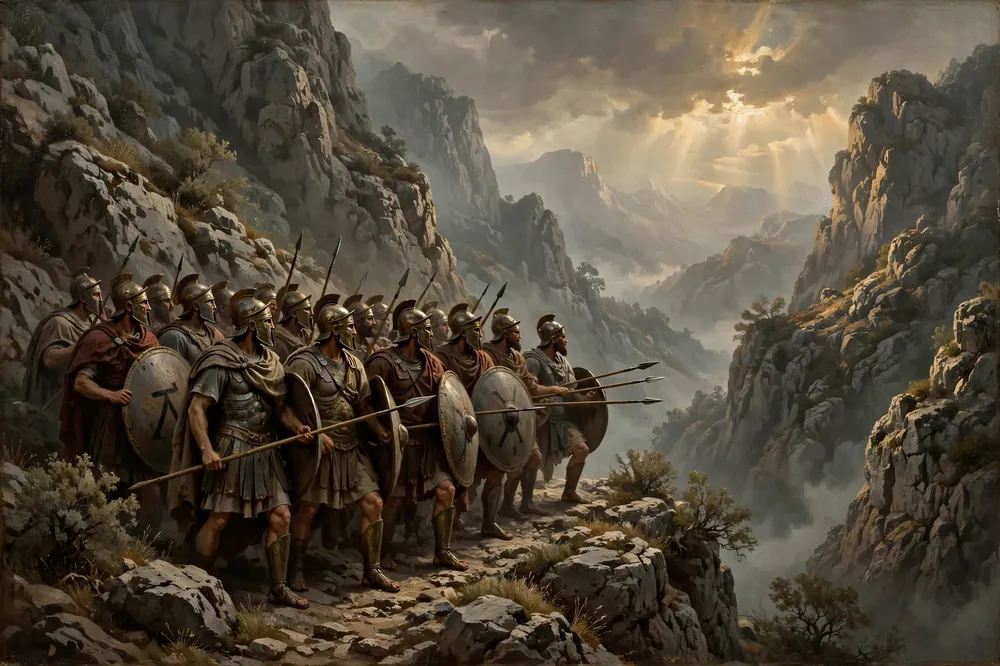
At Thermopylae in 480 BC, King Leonidas of Sparta held the narrow pass with about 7,000 Greeks against the Persian army of Xerxes, and when the position was outflanked, he remained with about 300 Spartans and a few hundred allies to cover the retreat of the rest.
The rearguard was destroyed, but the delay of three days gave the Greek cities time to prepare, and the battle became the model of the heroic rearguard — a model that has been remembered, and sometimes romanticised, ever since.
In the age of muskets and rifles, the delaying action became a formal part of military doctrine. The rearguard was given a defined task: to occupy a succession of positions, to fight from each one until the enemy deployed to attack it, and then to withdraw before the attack could develop.
The delay was produced not by the fighting itself, but by the time the enemy spent deploying, bringing up artillery, and forming for the attack — time that was wasted, from the pursuer’s point of view, on a position that would be abandoned anyway.
The French Revolutionary and Napoleonic Wars produced many examples, and the Prussian and later German staffs studied the rearguard as a standard operation, with manuals prescribing its strength, its composition and its distances.
The rearguard in the twentieth century
The two world wars changed the delaying action without changing its principles. In the First World War, the German retreat to the Hindenburg Line in 1917 was covered by a systematic delaying operation, with demolitions, minefields and booby traps slowing the Allied advance.
In the Second World War, the speed of armoured warfare made delaying harder and more dangerous: a rearguard that stayed too long could be outflanked and cut off by tanks, and the delay had to be conducted by mobile forces — motorised infantry, anti-tank guns and engineers — that could move as fast as the pursuer.
The Soviet Union’s delaying battles of 1941, the British rearguard at Dunkirk, and the German rearguards of 1944–45 all show the same pattern: the principles were old, but the tempo was new.
4. Principles
The first principle of the delaying action is that the delaying force must never accept a decisive battle. Its task is to fight and then to leave, and the decision to leave is made in advance, not in the heat of the fighting. A commander who allows his rearguard to be drawn into a full-scale battle has failed, however bravely his men fight, because the rearguard is by definition weaker than the force pursuing it, and a decisive battle can only end one way. The discipline of the delaying action is therefore a discipline of restraint: to hold a position long enough to force the enemy to deploy, and then to break contact before the enemy’s attack falls.
Successive positions
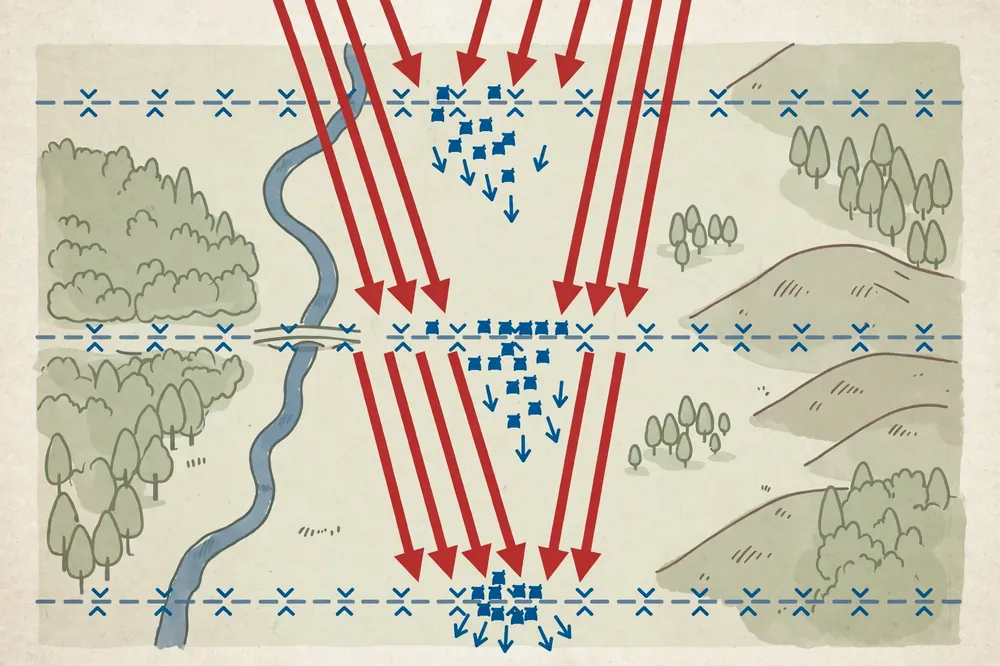
The second principle is the use of successive positions. The delaying force does not fight on a single line; it fights on a series of lines, each one chosen for its defensive value — a river, a ridge, a wood, a town — and each one abandoned in turn.
The enemy must attack each position in turn, and each attack costs it time: time to reconnoitre, time to bring up artillery, time to deploy. The delaying force, which knows the ground and has prepared the next position in advance, moves faster than the attacker, and the gap between the two grows with each position.
The classic image is of a boxer giving ground: each step back is not a defeat, it is a way of making the opponent spend energy on empty air.
Deception and demolitions
The third principle is to make the enemy uncertain. A delaying force uses deception — dummy positions, false radio traffic, patrols that suggest a larger force — to make the pursuer cautious, and caution is slow. It uses demolitions — blown bridges, mined roads, destroyed railways — to force the pursuer to repair the route before it can advance. And it uses the night: the delaying force withdraws under cover of darkness, when the pursuer cannot follow effectively, and the pursuer wakes to find the position empty and the road ahead mined. The delaying action is, in this sense, a war of the engineer’s and the scout’s as much as of the rifleman’s.
5. Application in Battle
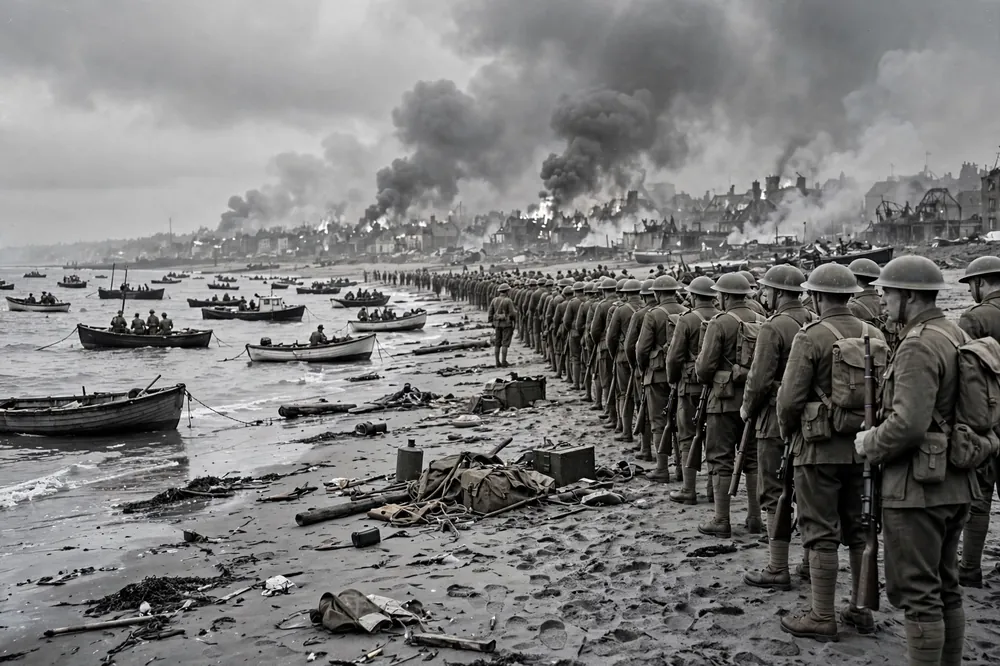
The most famous delaying action of the Second World War was the defence of the Dunkirk perimeter in May–June 1940. After the German sickle cut of the Manstein Plan reached the Channel, the British Expeditionary Force and the French First Army were trapped in a pocket around Dunkirk, with their backs to the sea.
The evacuation, Operation Dynamo, needed time — time to bring ships to the beaches, time to embark the men, time that the German Army was determined not to give. The rearguard — British divisions on the perimeter and French divisions holding the southern flank — fought a series of delaying actions, holding each canal line and each village until the enemy deployed, then falling back to the next.
The perimeter shrank day by day, but it held for nine days, and in that time about 338,000 men were evacuated. The rearguard itself paid a heavy price: many of the French divisions that held the perimeter were destroyed, and thousands of British soldiers were taken prisoner. But the delay achieved its purpose, and the army was saved.
The Soviet delaying battles of 1941
In the summer of 1941, the Soviet Union’s delaying actions were conducted on a continental scale. As the German Army advanced on Moscow, Leningrad and Kiev, Soviet armies fought a succession of delaying battles — at Smolensk, at Vyazma, at Mozhaisk — each one costing the Germans time and men, and each one buying days for the Soviet Union to raise new armies, move factories east, and prepare the defence of Moscow.
The Soviet delaying actions were often costly and sometimes disastrous: whole armies were encircled and destroyed, and the delay was bought with enormous losses. But the delay worked in the strategic sense: the German advance, which had covered hundreds of kilometres in weeks, was slowed to a crawl by December 1941, and the Soviet counter-offensive before Moscow began the turn of the war.
The Ardennes, December 1944
A smaller but clearer example came in the Ardennes in December 1944, during the German offensive that became the Battle of the Bulge. At Bastogne, the American 101st Airborne Division was surrounded, and at St. Vith, the 7th Armored Division held the road junction for six days against overwhelming German strength. The defence of St.
Vith was a classic delaying action: the American force was too weak to hold the town indefinitely, and it did not try to. It fought from successive positions, inflicted heavy losses, and withdrew — but the six days it bought delayed the German timetable, disrupted the offensive’s schedule, and gave the Allies time to bring up reinforcements.
The German offensive, which depended on speed, lost its tempo, and the delay at St. Vith is now regarded as one of the decisive contributions to the Allied victory in the Ardennes.
6. Strengths
The delaying action’s first strength is economy. A small force can delay a large one, because the delay is produced by the attacker’s own procedures — its need to deploy, to reconnoitre, to bring up artillery — rather than by the defender’s firepower. A battalion in a good position can hold up a division for a day, and a division can hold up an army for a week. The delaying action is therefore the tactic of the weaker side, and it is the tactic that allows a weaker side to survive long enough to become stronger, or to withdraw in good order, or to reach a position where it can fight on equal terms.
Its second strength is that it preserves the main force. The army that delays well does not lose its army: it trades ground, which can be retaken, for the survival of its soldiers, which cannot be replaced so easily. The British Army of 1940 survived because its rearguard delayed; the Soviet armies of 1941 survived, in the end, because their delaying battles bought the time to build new armies. The delaying action is, in this sense, an act of strategic patience: it accepts a short-term defeat in order to make a long-term victory possible.
7. Weaknesses
The delaying action’s weaknesses are severe, and they are the reason it is a tactic of necessity rather than of choice. First, the delaying force is always at risk of being cut off. A rearguard that stays a day too long, or that misjudges the speed of the pursuer, can be encircled and destroyed, and the loss of the rearguard can turn a withdrawal into a rout.
The German rearguards of 1944–45, fighting on the Eastern Front, were repeatedly encircled because the German Army was retreating faster than its rearguards could move, and the rearguards were sacrificed to buy time that the main force did not have. The delaying action is therefore a gamble with the lives of the men who fight it, and commanders have always known it.
Second, the delaying action depends on ground and on time, and both can run out. A delaying force needs successive positions to fall back to, and if the ground is flat and open, or if the next position is too far away, the delay fails. It also needs time: the delay is only useful if something is being bought with it — a withdrawal, a reinforcement, a decision.
A delay that buys nothing is simply a slow defeat, and the men who fight it know it. The morale of a delaying force is therefore fragile: soldiers will fight a delaying action if they believe the main force is escaping, but they will not fight it if they believe they have been abandoned.
8. Evolution
After the Second World War, the delaying action remained a standard part of military doctrine, but its form changed with technology. The arrival of helicopters gave the delaying force a new way to move: a rearguard could be lifted out of a position by air, and airmobile reserves could be dropped into the next position before the enemy arrived.
The arrival of guided anti-tank missiles gave small infantry forces a new way to stop tanks, and the delaying action became, in the Cold War, a central part of NATO’s plan for the defence of Western Europe: outnumbered NATO forces would fight a series of delaying actions across West Germany, trading space for the time needed for American reinforcements to cross the Atlantic.
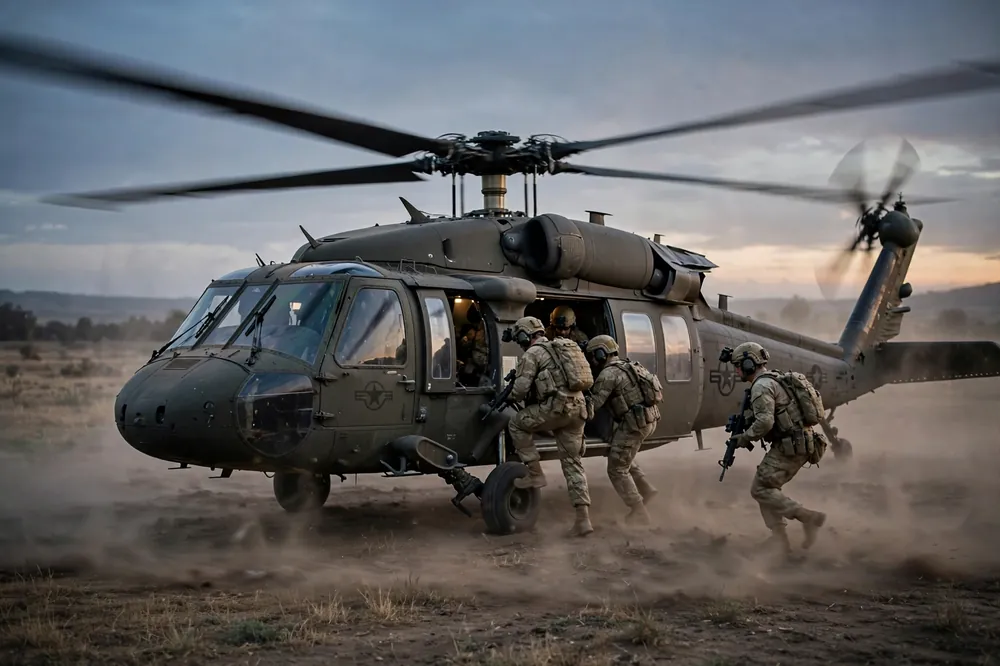
In the wars of the late twentieth and early twenty-first centuries, the delaying action has been fought by irregular forces as often as by regular armies. Guerrilla forces, by their nature, fight delaying actions: they ambush, they withdraw, they deny the enemy a decisive battle, and they trade space for time — time measured in years rather than days. The principle is the same, even though the scale and the weapons are different. The delaying action, in all its forms, is the tactic of the side that cannot win today and refuses to lose today either.
9. Legacy
The legacy of the delaying action is written in the armies that survived because of it. The British Army survived Dunkirk because of its rearguard; the Soviet Union survived 1941 because of its delaying battles; the American forces in the Ardennes survived December 1944 because of the delay at St. Vith. In each case, the delaying action did not win the war, but it made winning possible, and that is its proper measure. Military history tends to celebrate the offensive and the decisive battle, and to forget the rearguard, but the rearguard’s work is the condition of everything else: without it, there is no army left to fight the decisive battle.
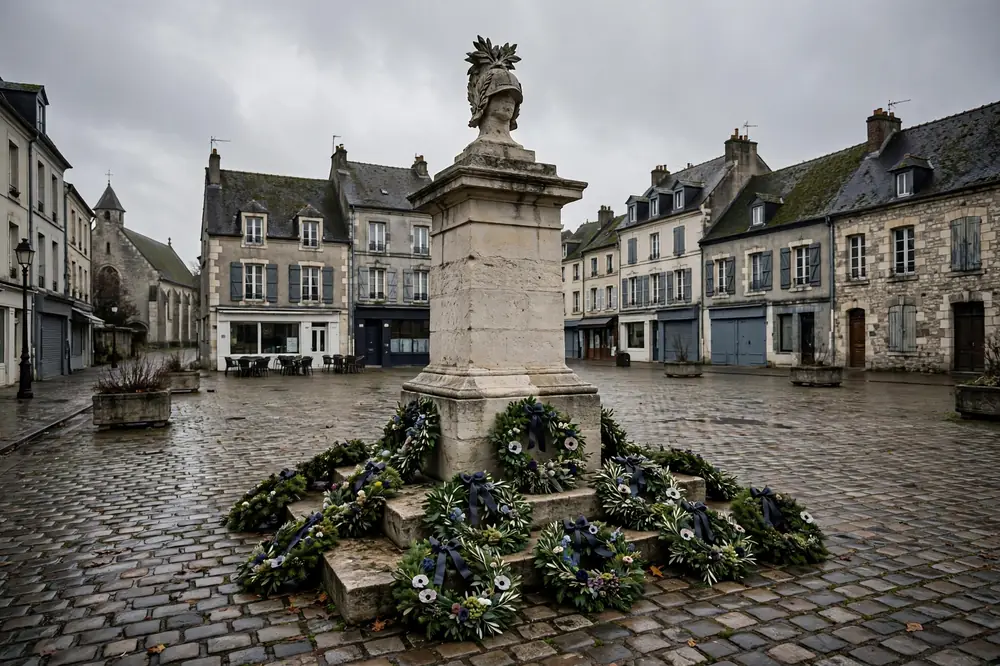
The rearguard also has a moral legacy, and it is a complicated one. The men who fight a delaying action know that they are being asked to risk their lives so that others can escape, and the decision to order a rearguard to stand is one of the hardest a commander can make.
The Spartans at Thermopylae, the French divisions at Dunkirk, the Soviet soldiers at Smolensk — all of them were asked to give time with their lives, and the question of whether the time was worth the lives is a question that history answers differently in each case.
The delaying action’s legacy is therefore not only tactical but ethical: it is the tactic that most plainly shows that war is a matter of trading lives for time, and that the trade must be justified by what the time is used for.
10. Key Figures
Leonidas of Sparta (Greece). King of Sparta, commander of the Greek rearguard at Thermopylae in 480 BC. With about 300 Spartans and a few hundred allies, he held the pass after the main Greek force withdrew, and was killed with his men. His stand became the archetype of the rearguard sacrifice.
Lord Gort (Britain). Commander of the British Expeditionary Force in 1940. Gort organised the withdrawal to Dunkirk and the rearguard that held the perimeter while the evacuation proceeded. His decision to withdraw, against French orders, saved the British Army.
General Louis Faury and the French rearguard (France). The French divisions that held the southern flank of the Dunkirk perimeter — including the 68th Infantry Division and others under the command of officers such as General Fagalde — fought delaying actions that cost them their freedom: many were destroyed or captured, but their stand bought the days the evacuation needed.
Major General Robert Hasbrouck (United States). Commander of the 7th Armored Division at St. Vith in December 1944. His division’s six-day delaying action in the Ardennes disrupted the German offensive timetable and is regarded as one of the decisive contributions to the Allied victory in the Battle of the Bulge.
Marshal Georgy Zhukov (Soviet Union). The Soviet commander who organised the delaying battles before Moscow in the autumn of 1941, trading space for the time needed to bring Siberian reserves to the front. His direction of the defence of Moscow turned a series of delaying actions into the first great Soviet victory of the war.
11. Frequently Asked Questions
What is a delaying action?
A military operation in which a force deliberately gives ground, fighting a series of short stands, to slow a stronger enemy and buy time for the main force to withdraw, regroup or receive reinforcements. The delaying force fights from a succession of positions, each one chosen for its defensive value — a river, a ridge, a wood or a town — and it withdraws from each one before the enemy’s attack can develop. The delay is produced not by the fighting itself, but by the time the enemy spends deploying, bringing up artillery and forming for the attack on a position that will be abandoned anyway.
What is the difference between a delaying action and a rearguard action?
They overlap. A delaying action is the operation — trading space for time. A rearguard action is the force and the task: the rearguard is the unit that covers a withdrawal, and it usually does so by fighting delaying actions. The rearguard is the force that covers a withdrawal, and the delaying action is the method it uses: successive positions, demolitions, deception and night withdrawals, all designed to make the pursuer spend time. The two terms are often used together because the rearguard’s task is almost always a delaying action, and the delaying action is almost always fought by a rearguard.
Why is the delaying force not supposed to win?
Because it is by definition weaker than the pursuing force. Its purpose is not to defeat the enemy but to slow it. If it tries to win a decisive battle, it risks being encircled and destroyed, and the withdrawal it was protecting collapses. Its purpose is not to defeat the enemy but to slow it, and to buy time for the main force to withdraw, regroup or receive reinforcements. The discipline of the delaying action is the discipline of restraint: to hold a position long enough to force the enemy to deploy, and then to break contact before the enemy’s attack falls, because a rearguard that is drawn into a decisive battle will be destroyed.
What was the most famous delaying action of the Second World War?
The defence of the Dunkirk perimeter in May–June 1940, which held for nine days while about 338,000 Allied troops were evacuated. The Soviet delaying battles of 1941 and the defence of St. Vith in December 1944 are also famous examples. The perimeter shrank day by day, but it held for nine days, and in that time about 338,000 men were evacuated. The Soviet delaying battles of 1941 and the defence of St. Vith in December 1944 are also famous examples: at St. Vith, the American 7th Armored Division held the road junction for six days, disrupting the German offensive timetable in the Battle of the Bulge.
How does a delaying force avoid being cut off?
By withdrawing before the enemy’s attack develops, by using successive prepared positions, by withdrawing at night, and by keeping its routes of retreat open. The discipline of leaving on time is the heart of the tactic. It uses successive prepared positions, it withdraws at night when the pursuer cannot follow effectively, and it keeps its routes of retreat open, with engineers ready to blow bridges behind it. The discipline of leaving on time is the heart of the tactic, and it is also its hardest part: a commander must order his men to leave a position they have just fought for, before the enemy’s attack arrives.
Is the delaying action still used today?
Yes. It remains a standard part of military doctrine, and guerrilla forces use its principles constantly — ambush, withdraw, deny the enemy a decisive battle, and trade space for time measured in years. It remains a standard part of military doctrine, and guerrilla forces use its principles constantly — ambush, withdraw, deny the enemy a decisive battle, and trade space for time measured in years rather than days. In the Cold War it was a central part of NATO’s plan for the defence of Western Europe, where outnumbered forces would delay a Soviet advance while reinforcements crossed the Atlantic.
12. Sources
- Wikipedia, “Delaying action” and “Rearguard” — definitions, principles and examples.
- Wikipedia, “Battle of Thermopylae” — Leonidas and the Spartan rearguard, 480 BC.
- Wikipedia, “Battle of Dunkirk” — the perimeter, the rearguard and the evacuation of about 338,000 troops.
- Wikipedia, “Battle of St. Vith” — the 7th Armored Division’s six-day delaying action, December 1944.
- Wikipedia, “Battle of Moscow” — the Soviet delaying battles of autumn 1941 and the counter-offensive.
- Encyclopædia Britannica, “Dunkirk evacuation” — Operation Dynamo and the rearguard.
- David Glantz, Barbarossa Derailed (2010) — the Soviet delaying battles of 1941, including Smolensk.
- Hugh Sebag-Montefiore, Dunkirk: Fight to the Last Man (2006) — the rearguard and the perimeter.