 WAR ATLAS MILITARY HISTORY MAGAZINE · WWI — WWII
KV-85 Tank
1. Lead
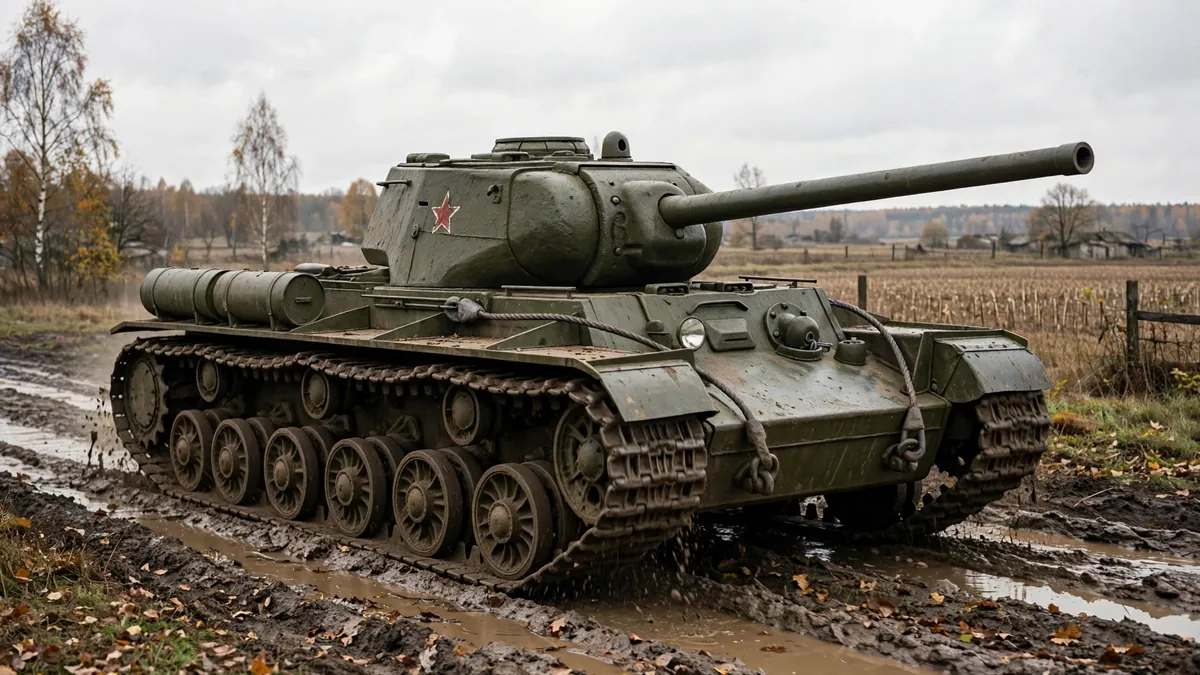
The KV-85 tank was the Soviet Union’s stopgap heavy tank of 1943, a machine born of urgency. In the summer of 1943, after the Battle of Kursk, the Red Army discovered that its heavy tank, the KV-1S, could not defeat the new German Tiger and Panther tanks, and that its 76.2 mm gun was no longer enough.
The new heavy tank that was meant to replace it, the IS-1, was not yet ready. The answer was the KV-85: the hull and running gear of the KV-1S, fitted with a new, larger turret carrying the powerful 85 mm D-5T gun. Only 148 KV-85s were built, in the second half of 1943, and they served for only a few months before the IS-1 and then the IS-2 replaced them.
But the KV-85 was an important tank: it was the first Soviet tank to carry the 85 mm gun that would arm the T-34-85 and the IS-1, and it was the bridge between the KV series and the IS series — the heavy tanks that would carry the Red Army to Berlin.
The KV-85’s short life tells a larger story about Soviet tank production in 1943: a story of a tank industry that could design a new gun, build a new turret, and put a new tank into production in a matter of months, and of an army that needed that tank immediately, even if only 148 of them could be built.
The KV-85 fought in the autumn of 1943, in the battles that liberated Ukraine, and it fought well — but it was always a temporary solution, and its crews knew it. The tank’s real importance is not in what it did, but in what it made possible: the 85 mm gun, the new turret, and the experience of building a heavy tank with a gun that could kill a Tiger.
2. Key Facts
| Tank | KV-85, Soviet heavy tank (stopgap) |
| Built | August–October 1943; 148 built |
| Manufacturer | Chelyabinsk Kirov Plant (ChKZ), Soviet Union |
| Weight | About 46 tons |
| Crew / Kíp lái | 4 (commander, gunner, loader, driver) |
| Main armament | 85 mm D-5T gun; 3 × 7.62 mm DT machine guns |
| Armour / Giáp | Hull 75 mm front; turret 100 mm front |
| Engine | V-2K diesel, about 500 hp |
| Speed | About 42 km/h on roads |
| Range | About 250 km on roads |
| Service | Autumn 1943, Ukraine; replaced by IS-1 and IS-2 |
3. Design and Development
The crisis of the summer of 1943
By the summer of 1943, the Soviet heavy tank was in crisis. The KV-1, which had been the Red Army’s heavy tank since 1939, had been replaced by the KV-1S — a lighter, faster version with thinner armour — in 1942, but the KV-1S still carried the 76.2 mm ZiS-5 gun, and that gun could not penetrate the frontal armour of the German Tiger I at normal combat ranges.
At Kursk in July 1943, Soviet tank crews discovered the scale of the problem: the Tiger’s 88 mm gun could destroy a KV-1S at ranges where the KV-1S could not reply, and the new Panther, with its 75 mm gun and sloped armour, was equally dangerous. The Red Army needed a heavy tank with a bigger gun, and it needed it immediately.
The new heavy tank, the IS-1, was in development at Chelyabinsk, but it would not be ready until the end of 1943. The interim solution was to put the IS-1’s gun — the 85 mm D-5T — into the KV-1S, and the result was the KV-85.
The 85 mm gun
The 85 mm D-5T gun was the heart of the KV-85. It was derived from the 85 mm anti-aircraft gun, the 52-K, which had proved capable of penetrating the Tiger’s armour when used as an anti-tank gun, and it was developed by the design bureau of Fyodor Petrov.
The D-5T fired an 85 mm armour-piercing shell that could penetrate about 100 mm of armour at 1,000 metres — enough to defeat the Tiger’s side armour and the Panther’s side armour at normal combat ranges, though not the Tiger’s frontal armour at long range.
The gun was a major step forward from the 76.2 mm, and it was the gun that would arm the T-34-85, the IS-1 and the SU-85 tank destroyer. The KV-85 was the first tank to carry it, and its service proved that the 85 mm gun worked — a proof that mattered enormously for the Soviet tank programme, because the 85 mm gun became the standard Soviet tank gun of the second half of the war.
The new turret
Fitting the 85 mm gun into the KV-1S required a new turret. The KV-1S turret was too small for the larger gun and its ammunition, so the Chelyabinsk designers built a new, larger turret — essentially the turret designed for the IS-1, adapted to fit the KV-1S hull — with thicker armour (up to 100 mm at the front) and a wider turret ring.
The new turret gave the KV-85 a four-man crew, with a dedicated gunner and a commander who was freed from the need to aim and fire the gun — a major improvement over the KV-1S, where the commander had also been the gunner. The turret also carried a commander’s cupola and a radio, which the KV-1S had often lacked.
The KV-85’s turret was, in effect, the IS-1’s turret on a KV-1S hull, and it was the turret that made the tank a genuine improvement rather than a mere re-gunning.
4. Armament and Protection
Firepower against the Tiger
The KV-85’s 85 mm gun was a weapon that could fight the Tiger and the Panther on something approaching equal terms. Against the Tiger, the 85 mm could penetrate the side and rear armour at ranges of up to 1,000 metres, and it could penetrate the frontal armour at close range — a capability the 76.2 mm gun had never possessed.
Against the Panther, the 85 mm could penetrate the side armour at long range and the frontal armour at close range, though the Panther’s sloped frontal armour remained difficult to defeat. The gun’s high-explosive shell was also effective against infantry, guns and fortifications, which made the KV-85 a useful support tank as well as a tank-killer.
The KV-85 carried 70 rounds of 85 mm ammunition, together with three DT machine guns — one coaxial, one in the hull, and one on the turret roof for anti-aircraft use — and its firepower was the best of any Soviet heavy tank in service in the autumn of 1943.
Armour: good enough, not great
The KV-85’s armour was the KV-1S’s armour: 75 mm on the hull front, 60 mm on the hull sides, and up to 100 mm on the turret front. That was good armour by 1943 standards — better than the T-34’s 45 mm, and enough to resist the German 50 mm and 75 mm guns at long range — but it was not enough to resist the Tiger’s 88 mm gun or the Panther’s 75 mm gun at normal combat ranges.
The KV-85’s designers knew this, and they accepted it: the KV-85 was a stopgap, and its protection was the protection of a tank designed in 1939, not of a tank designed in 1943. The IS-1, which followed it, would carry thicker, better-sloped armour, and the IS-2 would carry armour that could resist the 88 mm gun.
The KV-85’s armour was good enough for the autumn of 1943, but it was not the armour of the future.
Mobility and the V-2K engine
The KV-85 was powered by the V-2K diesel engine, producing about 500 horsepower, which gave the 46-ton tank a road speed of about 42 km/h and a cross-country speed of about 20–25 km/h. The V-2 diesel was one of the great successes of Soviet tank design: it was reliable, it was fuel-efficient, and it was less prone to catching fire than a petrol engine — a lesson learned from the BT-5 and the early T-34s.
The KV-85’s mobility was adequate for a heavy tank, though it was slower than the T-34 and heavier than the KV-1S, and its range of about 250 km on roads was enough for the operations of the autumn of 1943. The tank’s running gear — the KV-1S’s torsion-bar suspension and its wide tracks — was proven and reliable, and the KV-85’s crews found it a steady, predictable machine to drive.
5. Production at Chelyabinsk
Tankograd / Tankograd
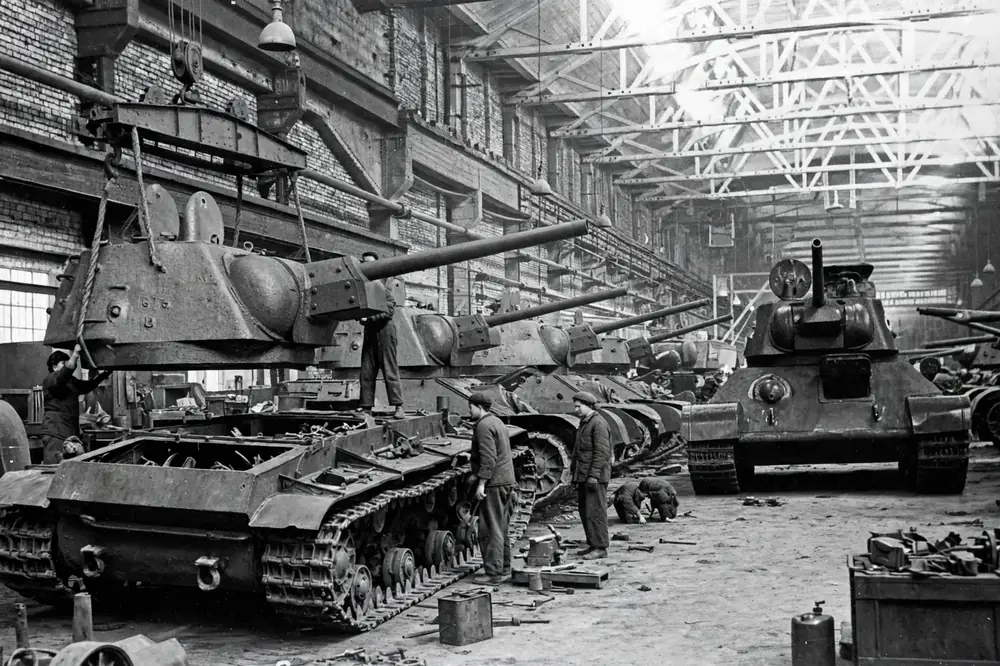
The KV-85 was built at the Chelyabinsk Kirov Plant, known as ChKZ and nicknamed “Tankograd” — Tank City — the great tank factory in the Urals to which the Soviet tank industry had been evacuated in 1941. Chelyabinsk was the centre of Soviet heavy tank production, and it built the KV-1, the KV-1S, the KV-85, the IS-1 and the IS-2 in succession.
The KV-85 was built on the KV-1S production line, using the same hulls and the same running gear, with the new turret fitted in place of the old one. The production run was short — August to October 1943 — and only 148 tanks were built, because the factory was already tooling up for the IS-1, and the KV-85 was only ever intended as an interim type.
The short production run is a measure of how quickly the Soviet tank industry could change over: in three months, Chelyabinsk designed a new turret, built 148 tanks, and then moved on to the next design.

Why only 148?
The KV-85’s production was limited by design: it was a stopgap, and the Soviet leadership did not want to commit the Chelyabinsk factory to a tank that was already obsolescent. The IS-1, which was the tank the Red Army really wanted, was in development, and the factory’s resources were needed for it.
The KV-85’s role was to fill the gap between the KV-1S and the IS-1, to give the Red Army a heavy tank with an 85 mm gun for the autumn campaign of 1943, and to prove the 85 mm gun in service. Once the IS-1 was ready, the KV-85’s production stopped, and the factory moved on.
The 148 tanks that were built were enough for the purpose: they equipped a small number of heavy tank regiments, they fought in the autumn of 1943, and they proved the gun that would arm the next generation of Soviet tanks.
6. Combat Service in Ukraine
The autumn of 1943
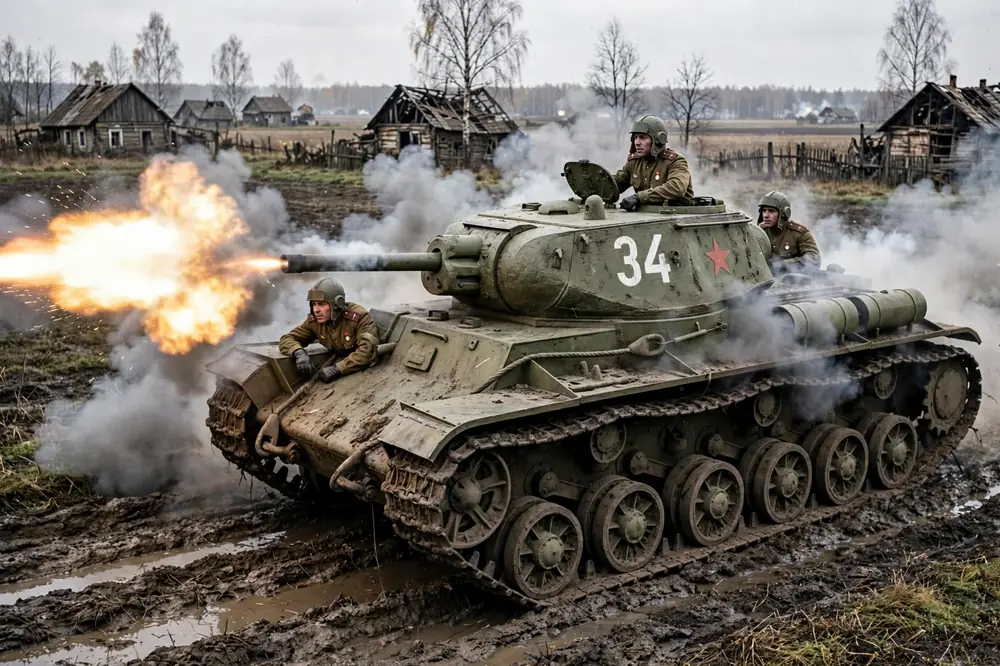
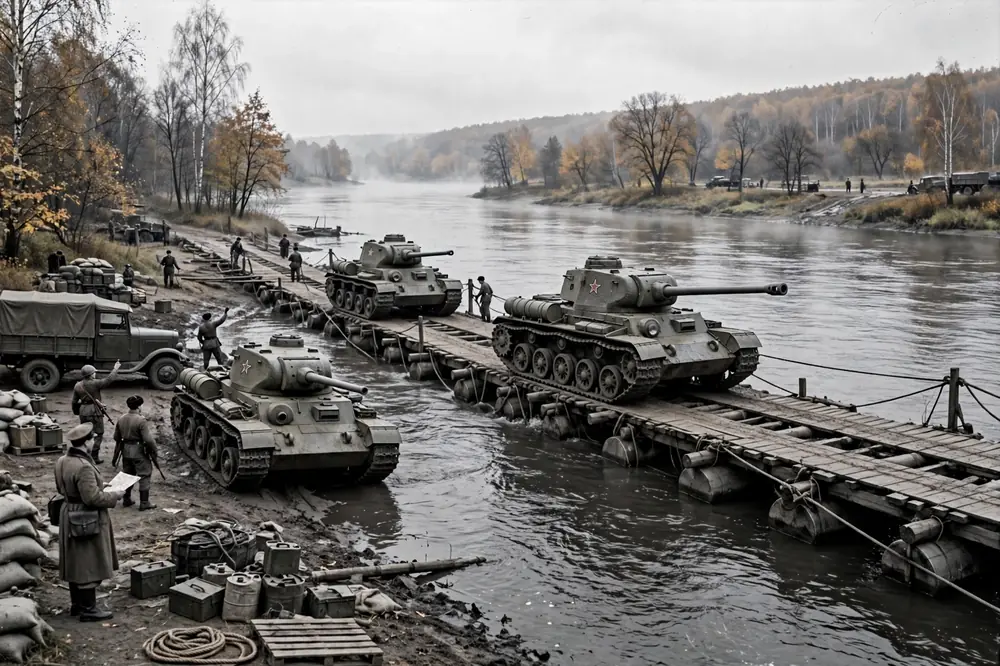
The KV-85s were issued to heavy tank regiments in the autumn of 1943, and they fought in the battles that liberated Ukraine — in the crossing of the Dnieper, in the fighting around Kiev, and in the advance towards the Polish border.
The tanks were used as breakthrough tanks, leading the assault on German positions, and as tank-killers, engaging the Tigers and Panthers that the Germans deployed to stop the Soviet advance. The KV-85’s crews reported that the 85 mm gun was a major improvement: it could kill a Tiger from the side at ranges where the 76.2 mm gun had been useless, and it gave the Soviet heavy tank a chance in a duel with a German heavy tank.
The tanks also suffered losses — to German anti-tank guns, to mines, and to mechanical breakdowns — but their service was judged a success, and the 85 mm gun was vindicated.
The tank’s limitations in combat
The KV-85’s combat service also exposed its limitations. The tank’s armour, though adequate, was not enough to resist the 88 mm gun, and KV-85s were lost to Tigers at ranges where they could not reply. The tank’s production was too small to make a strategic difference: 148 tanks, spread across several regiments, could not change the balance of the tank war, and the Red Army’s real heavy tank of the autumn of 1943 was still the KV-1S, with its inadequate gun.
The KV-85’s crews also found that the tank was heavy and slow, and that its turret, though larger than the KV-1S’s, was still cramped for a four-man crew. The KV-85 was a good tank, but it was not a great tank, and its crews knew that the IS-1, with its thicker armour and its better hull, was the tank they were waiting for.
7. The Transition to the IS Series
The IS-1 and the IS-2
The KV-85 was replaced by the IS-1, which entered service at the end of 1943, and by the IS-2, which entered service in early 1944. The IS-1 used the KV-85’s turret and gun on a new hull, designed by Nikolai Dukhov and his team at Chelyabinsk, with thicker, better-sloped armour and a more powerful engine.
The IS-2 replaced the 85 mm gun with the 122 mm D-25T gun, a weapon that could destroy a Tiger at long range and that became the standard heavy tank gun of the Red Army. The KV-85’s role in this transition was to prove the 85 mm gun and the new turret, and to give the Red Army a heavy tank with a gun that could fight the Tiger while the IS series was being developed.
The IS-1 was built in small numbers — about 100 — and the IS-2 was built in large numbers, more than 3,800, and it was the IS-2 that carried the Red Army’s heavy tank force to Berlin.
The end of the KV series
The KV-85 was the last KV tank. The KV series, which had begun with the KV-1 in 1939, ended with the KV-85 in 1943, and the IS series took its place. The KV name — after Kliment Voroshilov, the Soviet defence commissar — was dropped, and the new tanks were named IS, after Joseph Stalin. The change of name was a political act, but it was also a technical one: the IS tanks were new designs, not developments of the KV, and they represented a new generation of Soviet heavy tanks. The KV-85 was the bridge between the two generations, and it was the last tank to carry the KV name into battle.
8. The KV-85 in Detail
Crew and ergonomics
The KV-85’s four-man crew — commander, gunner, loader and driver — was a major improvement over the KV-1S’s three-man crew, in which the commander had also been the gunner. The dedicated gunner meant that the commander could command, observe and direct the tank, and the gunner could concentrate on aiming and firing — a division of labour that made the tank faster to acquire targets and more effective in combat.
The loader, however, had a hard job: the 85 mm ammunition was heavy, the turret was cramped, and the rate of fire was limited by the loader’s ability to handle the large shells. The driver sat in the hull, with limited visibility, and the tank’s controls were heavy and tiring to operate.
The KV-85’s ergonomics were typical of Soviet tanks of the period — functional, but not comfortable — and they were a reminder that Soviet tank design prioritised firepower and protection over crew comfort.
The tank’s appearance
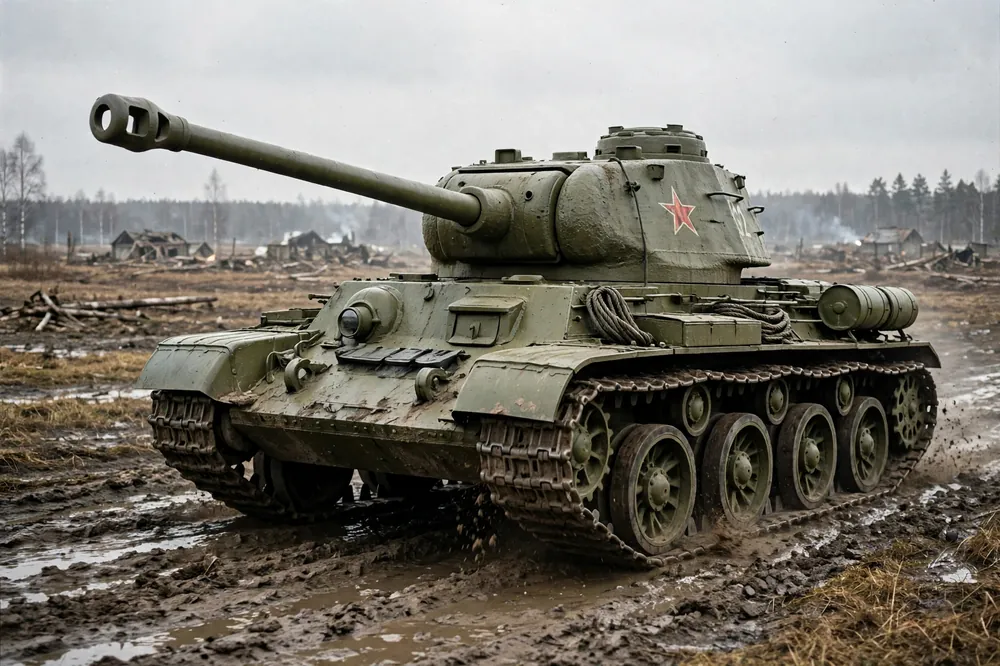
The KV-85 was a distinctive-looking tank: the familiar KV hull, with its angular shape and its wide tracks, topped by a large, rounded turret that was noticeably bigger than the KV-1S’s turret, with a long 85 mm gun and a commander’s cupola.
The tank was painted in the standard Soviet green, and it carried the white tactical markings of its regiment — numbers and symbols that identified the tank to its own side. The KV-85’s appearance was the appearance of a tank in transition: the hull of the old generation, the turret of the new, and the gun that would define the next generation.
For the historian, the KV-85 is recognisable at a glance, and its photograph is one of the most distinctive images of the Soviet tank force in 1943.
9. Survivors and Memory
The surviving KV-85s
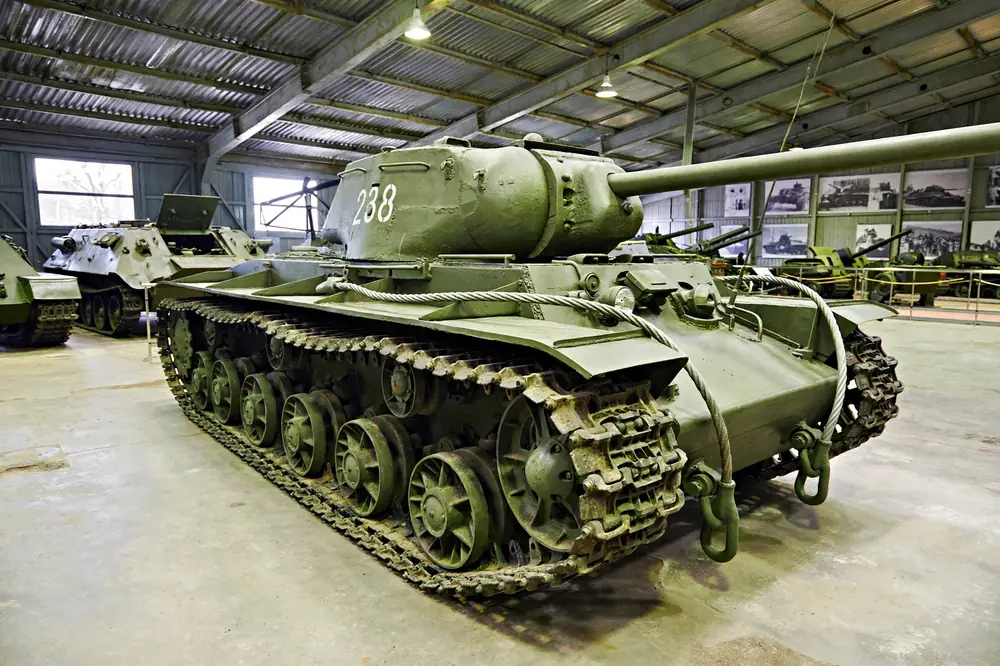
Only a small number of KV-85s survive today, and they are among the rarest Soviet tanks in museums. The best-known survivor is at the Kubinka Tank Museum in Russia, where a KV-85 is displayed alongside the KV-1S and the IS-2, so that visitors can see the three generations of Soviet heavy tank side by side. Other examples are preserved in museums in Russia and in Belarus, and a small number of KV-85 hulls and turrets have been recovered from battlefields in Ukraine and restored. The rarity of the KV-85 is a direct result of its small production run: only 148 were built, and most of them were destroyed in combat or scrapped after the war, so the survivors are precious.
The KV-85 in history
The KV-85 is remembered today as the tank that brought the 85 mm gun to the Soviet heavy tank force, and as the bridge between the KV and the IS series. It is a tank that is often overlooked — overshadowed by the T-34, by the IS-2, and by the Tiger and the Panther — but it is a tank that mattered, because it proved a gun, it filled a gap, and it did so in a matter of months.
For the historian of Soviet tank design, the KV-85 is a case study in how a tank industry under pressure can improvise, and in how a stopgap can become a milestone. The 85 mm gun that the KV-85 carried would arm the T-34-85, the tank that won the war on the Eastern Front, and that is the KV-85’s true legacy.
10. Assessment and Legacy
The KV-85 was a good tank that was built for a short life, and it did its job. It gave the Red Army a heavy tank with a gun that could fight the Tiger, it proved the 85 mm gun in service, and it bridged the gap between the KV-1S and the IS-1.
Its weaknesses — its thin armour, its small production run, its cramped turret — were the weaknesses of a stopgap, and they were accepted because the tank was never meant to be more than a stopgap. The KV-85’s story is a reminder that in war, the perfect is often the enemy of the good enough, and that a tank that arrives in time, even in small numbers, can matter more than a perfect tank that arrives too late.
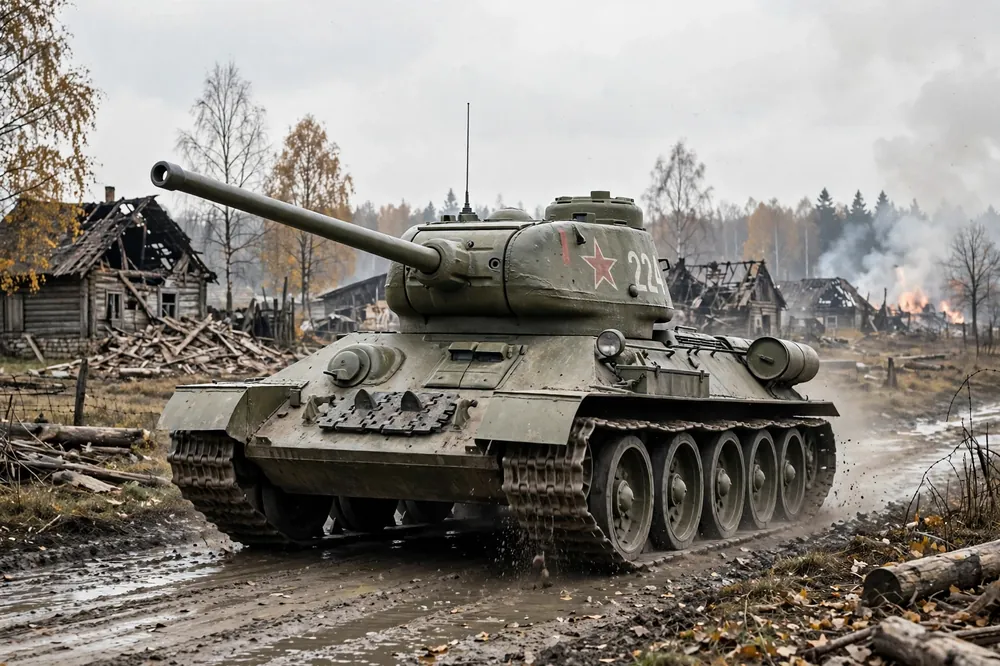
The KV-85’s legacy is the 85 mm gun. The gun that the KV-85 carried would arm the T-34-85, the IS-1 and the SU-85, and it would become the standard Soviet tank gun of the second half of the war. The KV-85’s turret, its four-man crew, and its commander’s cupola would all be carried over into the IS series, and the lessons of its production — that a new turret and a new gun could be fitted to an existing hull in a matter of months — would be applied again and again by the Soviet tank industry.
The KV-85 is a small footnote in the history of the war, but it is a footnote that points to the T-34-85 and the IS-2, and to the victory on the Eastern Front.
11. Frequently Asked Questions
How many KV-85 tanks were built?
Only 148 KV-85 tanks were built, between August and October 1943 at the Chelyabinsk Kirov Plant. The production run was deliberately short because the KV-85 was a stopgap: it was meant to fill the gap between the KV-1S and the IS-1, and the factory was already tooling up for the IS series. The short run was deliberate: the KV-85 was a stopgap, built only until the IS-1 was ready, and the factory at Chelyabinsk was already tooling up for the IS series. Only 148 were built, and that small number is why the KV-85 is one of the rarest Soviet tanks in museums today.
What gun did the KV-85 carry?
The KV-85 carried the 85 mm D-5T gun, derived from the 85 mm anti-aircraft gun and developed by Fyodor Petrov’s design bureau. The gun could penetrate about 100 mm of armour at 1,000 metres, which was enough to defeat the Tiger’s side armour and the Panther’s side armour at normal combat ranges. It was the first tank gun of its calibre in Soviet service, and it later armed the T-34-85, the IS-1 and the SU-85. The gun mattered because it could defeat the Tiger’s side armour and the Panther’s side armour at normal combat ranges, which the 76.2 mm gun of the KV-1S could not do.
How was the KV-85 different from the KV-1S?
The KV-85 used the KV-1S hull and running gear, but it carried a new, larger turret with the 85 mm D-5T gun instead of the KV-1S’s 76.2 mm gun, and it had a four-man crew with a dedicated gunner instead of the KV-1S’s three-man crew. The turret armour was thicker (up to 100 mm at the front), and the tank carried a commander’s cupola and a radio. The KV-85 was heavier than the KV-1S, at about 46 tons.
Where did the KV-85 fight?
The KV-85 fought in the autumn of 1943 in Ukraine, in the battles that liberated the country from German occupation — including the crossing of the Dnieper and the fighting around Kiev. The tanks were used as breakthrough tanks and as tank-killers against the Tiger and the Panther, and their service was judged a success, though the type was replaced by the IS-1 and the IS-2 within a few months. The service was short but judged a success: the tanks were used as breakthrough tanks and as tank-killers, and they proved the 85 mm gun in combat before the IS-1 and the IS-2 took over.
Why was the KV-85 replaced so quickly?
The KV-85 was replaced quickly because it was a stopgap, and because the IS-1 — the tank the Red Army really wanted — was ready at the end of 1943. The IS-1 used the KV-85’s turret and gun on a new hull with thicker, better-sloped armour, and the IS-2, which followed in early 1944, carried the far more powerful 122 mm gun. The KV-85 had done its job — proving the 85 mm gun — and it was no longer needed. The KV-85 had done its job: it had proved the 85 mm gun, and the IS-1 carried that gun on a better hull.
Did any KV-85 tanks survive?
Yes, a small number survive. The best-known is at the Kubinka Tank Museum in Russia, where it is displayed alongside the KV-1S and the IS-2. Other examples are preserved in museums in Russia and Belarus. The KV-85 is one of the rarest Soviet tanks in museums, because only 148 were built and most were destroyed in combat or scrapped after the war. The survivors are rare because so few were built and most were destroyed in combat or scrapped after the war. The best-known, at the Kubinka Tank Museum, stands next to the KV-1S and the IS-2, showing visitors the link between the two designs.
12. Sources
- Wikipedia, “KV-85” — production figures (148 built), specifications, service history and the transition to the IS series.
- Steven J. Zaloga and James Grandsen, Soviet Tanks and Combat Vehicles of World War Two (Arms and Armour Press, 1984) — KV series design and the KV-85.
- Steven J. Zaloga, KV-1 and KV-2 Heavy Tanks 1939–45 (Osprey New Vanguard, 2017) — KV-1S, KV-85 and the 85 mm gun.
- Mikhail Baryatinskiy, The KV-85 and IS Tanks (in Russian, translated extracts) — Chelyabinsk production and the KV-85’s service.
- David M. Glantz and Jonathan House, When Titans Clashed: How the Red Army Stopped Hitler (University Press of Kansas, 1995) — the autumn 1943 campaign in Ukraine.
- Robert Forczyk, Tank Warfare on the Eastern Front 1943–1945 (Pen & Sword, 2016) — the 85 mm gun against the Tiger and the Panther.
- Steven J. Zaloga, IS-2 Heavy Tank 1944–73 (Osprey New Vanguard, 1994).
- David R. Higgins, T-34-85 vs M4A3E8 Sherman: Korea 1950 (Osprey Duel, 2016) — for the 85 mm gun’s later career.