 WAR ATLAS MILITARY HISTORY MAGAZINE · WWI — WWII
Megiddo 1918
1. Lead
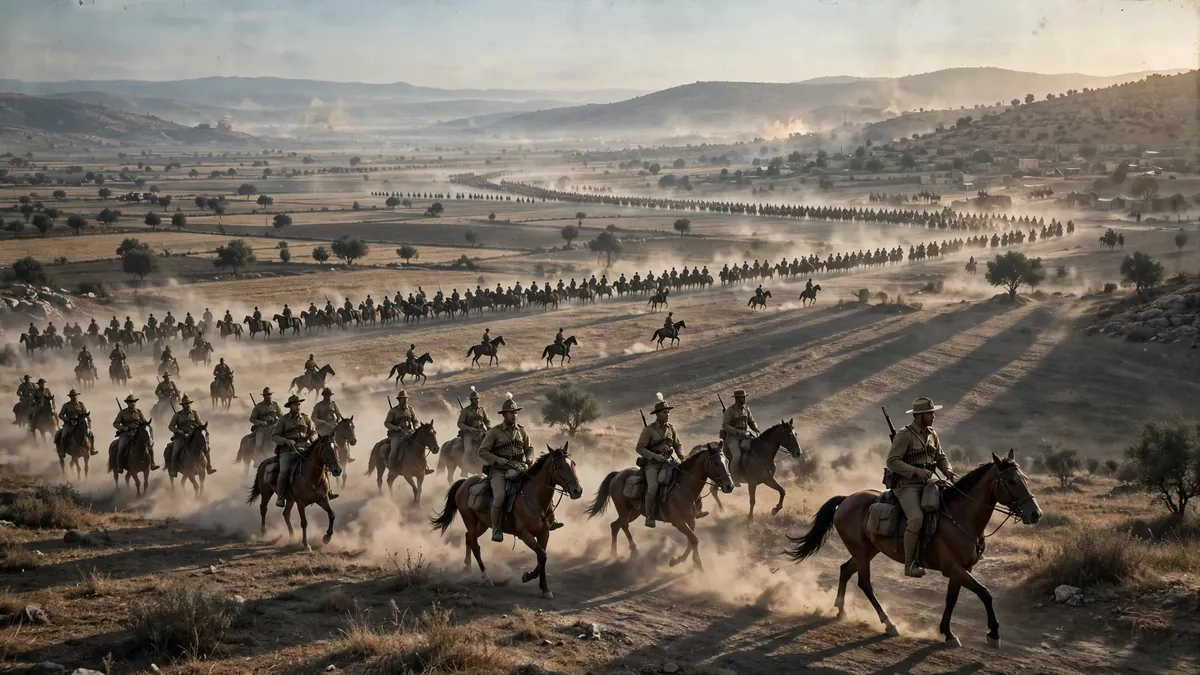
Megiddo 1918 was the decisive battle of the Sinai and Palestine Campaign in the First World War, fought from 19 to 25 September 1918 in northern Palestine. General Edmund Allenby, commander of the Egyptian Expeditionary Force, attacked the Ottoman Yildirim Army Group under the German general Otto Liman von Sanders with a plan of deception, overwhelming artillery and a great cavalry sweep through the gap in the hills at Megiddo — the ancient battlefield of Armageddon.
In a week, the Ottoman armies in Palestine were destroyed: about 25,000 prisoners were taken, and the survivors fled north towards Damascus, which the Allies entered on 1 October. The battle is remembered as one of the last great cavalry victories in history and as the most complete victory won by the British Army in the First World War.
2. Key Facts
| Date | 19–25 September 1918 (Damascus taken 1 October) |
| Location | Sharon plain, Jezreel Valley and Megiddo, northern Palestine |
| Result | Decisive Allied victory; Ottoman armies in Palestine destroyed |
| Allied commander | Gen. Edmund Allenby (Egyptian Expeditionary Force) |
| Ottoman commander | Gen. Otto Liman von Sanders (Yildirim Army Group) |
| Allied strength | About 57,000 infantry, 12,000 cavalry, 540 guns, 90+ aircraft |
| Ottoman strength | About 32,000–35,000 men of the 7th and 8th Armies, with German and Austrian troops |
| Allied losses | About 5,000 killed, wounded and missing (estimates vary) |
| Ottoman losses | About 25,000 prisoners; thousands killed and wounded; most guns lost |
3. Background
Palestine in 1917–1918
By the autumn of 1917, the British had taken Jerusalem and driven the Ottoman Army north into the hills of Samaria. The front then settled along a line from the Mediterranean coast, through the hills, to the Jordan valley — a line the Ottoman Army held through the winter and spring of 1918.
Allenby, who had taken command of the Egyptian Expeditionary Force in June 1917, wanted to break that line, but he was held back: in the spring of 1918, when the Germans attacked in France, his best divisions were taken from him and sent to the Western Front.
It was not until the summer of 1918 that he was given the troops he needed — Indian cavalry, Indian infantry and new divisions from the British Empire — and he began to plan the offensive that became Megiddo.
Allenby’s plan
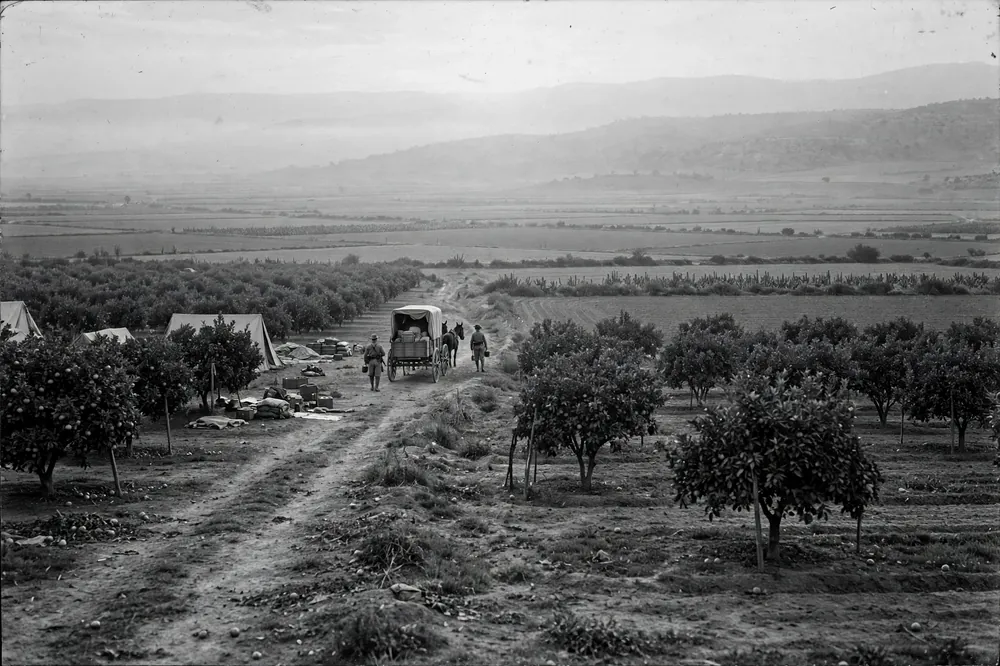
Allenby’s plan was a classic of military deception. He would make the Ottomans believe that the attack would come in the Jordan valley, in the east, where the British had attacked twice before — at Amman and Es Salt — and where his Arab allies under T. E. Lawrence were active.
To do this, he built dummy camps and dummy horse lines in the Jordan valley, moved troops there by day and moved them back by night, and let the Ottomans see what they expected to see. In fact, the real attack would come on the coast, in the west, on the flat Sharon plain, where the ground was ideal for cavalry.
There, the infantry would break through the Ottoman line, and the cavalry — the Desert Mounted Corps, under Lieutenant General Harry Chauvel — would ride through the gap, over the hills at Megiddo, and into the Jezreel Valley behind the Ottoman armies, cutting their lines of retreat.
The Arab forces under Lawrence would cut the railways further north, and the Royal Air Force would bomb the Ottoman headquarters and the retreating columns.
The Ottoman position
The Ottoman defence was the Yildirim Army Group, under the German general Otto Liman von Sanders, a veteran of Gallipoli who had been sent to command the Ottoman forces in Palestine. His army was made up of the 7th Army, under Mustafa Kemal, and the 8th Army, under Cevat Pasha, with German and Austrian troops in support.
The Ottoman Army of 1918 was a shadow of the army of 1914: its divisions were understrength, its men were short of food and equipment, its transport was primitive, and its morale was low. Many of its soldiers were Arab conscripts who had no wish to fight for the Ottoman Empire, and desertion was common.
Liman von Sanders knew that an attack was coming, but he believed, as Allenby intended, that it would come in the Jordan valley, and he kept his reserves there. On the coast, where the attack actually came, his defences were thin.
4. Opposing Forces
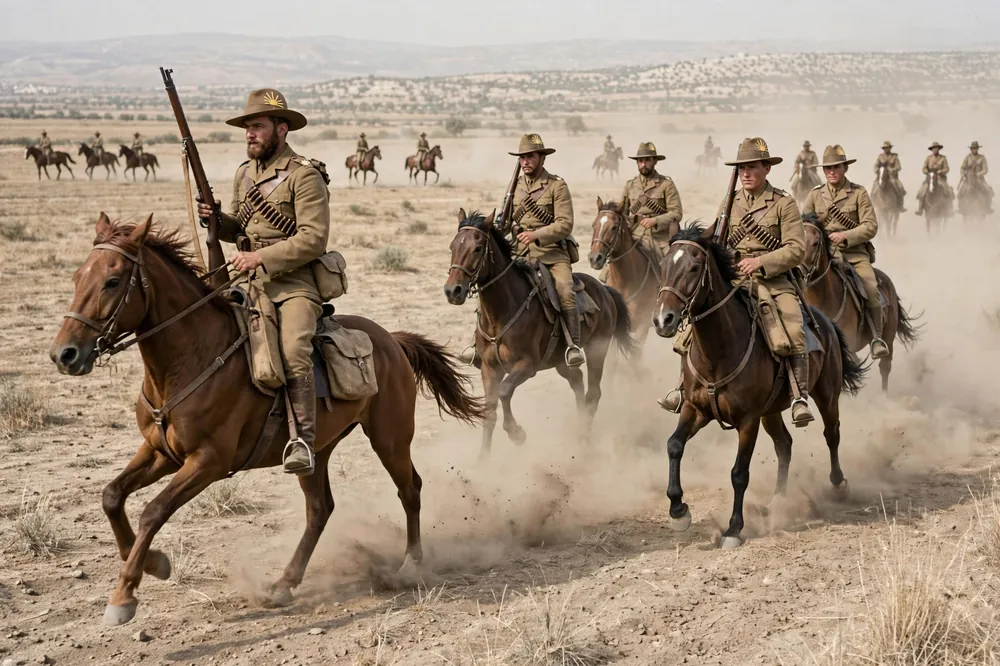
The Egyptian Expeditionary Force at Megiddo numbered about 57,000 infantry, 12,000 cavalry and 540 guns, with more than 90 aircraft. Its infantry was largely Indian — the 3rd, 7th and 75th Divisions and the Indian brigades that had replaced the British divisions sent to France — and its cavalry was the Desert Mounted Corps, made up of Australian, New Zealand, Indian and British mounted troops, the finest cavalry force in the British Empire.
The force was well supplied, well equipped and well led, and it had spent the summer training for the offensive. Its weakness, if it had one, was that much of its infantry was new to the theatre, and its cavalry depended on water and fodder that had to be carried forward as it advanced.
| Allies | Ottoman / Ottoman | |
|---|---|---|
| Infantry | XXI Corps (3 divisions) on the coast; XX Corps in the hills; Indian divisions | 8th Army on the coast; 7th Army in the hills; 4th Army east of the Jordan |
| Cavalry | Desert Mounted Corps: Australian, New Zealand, Indian and British mounted divisions | Little cavalry; German cavalry squadron and Arab irregulars |
| Artillery | 540 guns, with a heavy concentration on the coastal sector | About 250 guns, short of ammunition |
| Aircraft | 90+ RAF aircraft; bombing and reconnaissance | Few aircraft; no air superiority |
| Supply | By rail and motor transport from Egypt; water and fodder carried forward | By rail from Damascus; transport short of animals and fuel |
The Ottoman Yildirim Army Group numbered about 32,000 to 35,000 men on the front, with the 8th Army on the coast, the 7th Army in the hills, and the 4th Army east of the Jordan. Its divisions were at half strength or less, its artillery numbered only about 250 guns, and it had almost no aircraft.
Its commander, Liman von Sanders, was a capable German officer, but he was commanding an army that was falling apart: its men were hungry, its transport was breaking down, and its Arab soldiers were deserting to the forces of the Arab Revolt.
The one strong point of the Ottoman position was the ground itself — the hills of Samaria, which were difficult for an attacker to cross — but Allenby’s plan did not attack the hills. It went around them, through the gap at Megiddo.
5. The Battle
19 September: the breakthrough on the Sharon plain
The attack began at 04:30 on 19 September 1918, with a short, intense artillery bombardment on the coastal sector. The infantry of XXI Corps, under Lieutenant General Edward Bulfin, attacked the Ottoman 8th Army on the Sharon plain, and within hours the Ottoman front was broken.
The bombardment had been so heavy, and the deception so complete, that the Ottoman defenders were taken by surprise, and their reserves were in the wrong place. By nightfall, the infantry had advanced 15 kilometres, and the cavalry was moving through the gap.
The Desert Mounted Corps, under Lieutenant General Harry Chauvel, rode through the night, covering more than 60 kilometres in 24 hours, and by the morning of 20 September its leading divisions were in the Jezreel Valley, behind the Ottoman armies. The gap at Megiddo — the pass through the hills that the Bible calls Armageddon — had been forced, and the Ottoman 7th and 8th Armies were cut off.
20–21 September: the encirclement
On 20 September, the cavalry closed the trap. The Australian Mounted Division and the 5th Cavalry Division rode north and east, taking Nazareth — where Liman von Sanders had his headquarters, and from which he escaped by a few hours — and cutting the roads and railways that the Ottoman armies needed to retreat. The 4th Cavalry Division rode east to the Jordan valley, closing the last escape route.
Meanwhile, the infantry of XX Corps, under Lieutenant General Philip Chetwode, attacked in the hills, driving the Ottoman 7th Army back on to the cavalry. The Ottoman armies, caught between the infantry in front and the cavalry behind, began to disintegrate.
On 21 September, the Royal Air Force found a great column of Ottoman troops, guns and transport retreating through the Wadi Fara, a narrow gorge in the hills, and bombed and machine-gunned it for hours. The column was destroyed — hundreds of vehicles and guns were abandoned, and thousands of men were killed or captured.
The Wadi Fara became a symbol of the battle, and of the power of aircraft against an army on the march.
22–25 September: the pursuit to Damascus
By 22 September, the Ottoman 7th and 8th Armies had ceased to exist as organised forces. Their survivors were fleeing north in small groups, and the Allies were in pursuit. The cavalry rode on towards Damascus, 150 kilometres to the north, through country that was short of water and full of Ottoman stragglers. The Arab forces under T. E.
Lawrence and the Emir Feisal cut the railways around Deraa, and the Australian and Indian cavalry entered Damascus on 1 October, after a ride of more than 200 kilometres in a week. The Ottoman 4th Army, east of the Jordan, retreated north as well, and by the end of October the Allies held all of Syria.
The battle of Megiddo was over, and with it the Ottoman Empire’s hold on the Middle East.
6. Turning Point
The ride through Megiddo
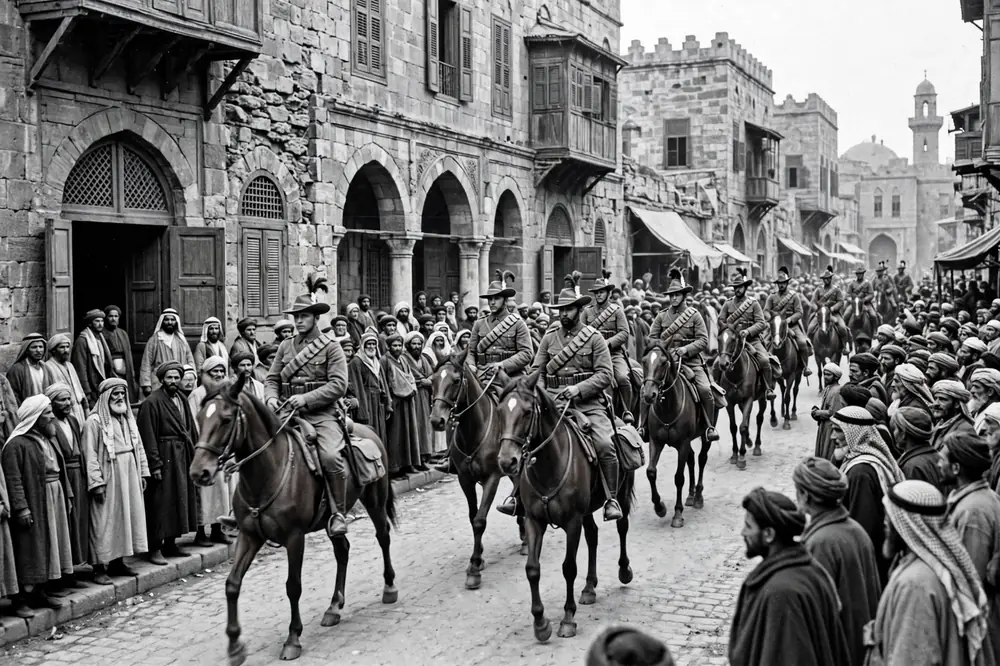
The turning point of the battle was the cavalry’s ride through the gap at Megiddo on the night of 19–20 September. Everything else — the deception, the bombardment, the infantry breakthrough — was preparation for that ride, and the ride itself was a gamble: if the cavalry had been stopped in the pass, the whole plan would have failed, and the Ottoman armies would have escaped.
Chauvel’s horsemen rode through the night, in the dark, over ground they had never seen, and by dawn they were in the Jezreel Valley, behind the enemy. The Ottoman armies, which had been facing south, suddenly found an enemy in their rear, and their command and supply collapsed.
Liman von Sanders, who had been confident on the evening of 19 September, was by the morning of 20 September a fugitive, fleeing his headquarters at Nazareth. The battle was won in that one night’s ride, and the rest of the week was pursuit.
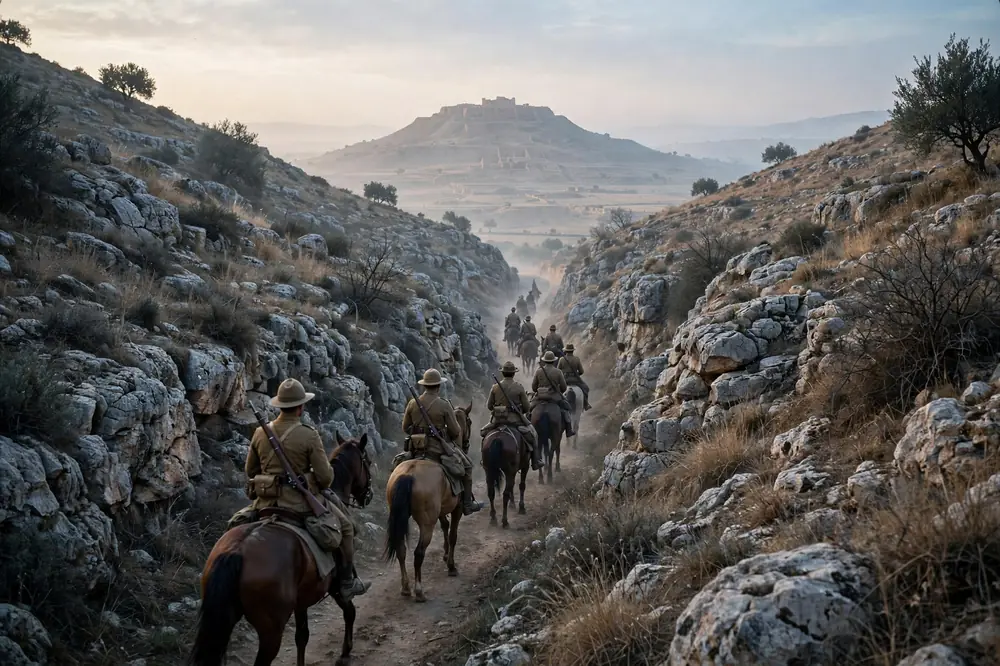
The Wadi Fara / Wadi Fara
The second turning point was the air attack on the Wadi Fara on 21 September. The Royal Air Force, which had spent the first two days of the battle bombing Ottoman headquarters and railways, found the retreating Ottoman column in the gorge and destroyed it.
The attack showed, for the first time in a major battle, that aircraft alone could destroy an army on the march, and it became a model for the air forces of the Second World War. It also showed that the Ottoman Army had lost the ability to move: its transport was horse-drawn and motorised, and once it was caught in a gorge, it could neither advance nor retreat.
The Wadi Fara was the moment the battle turned from a victory into a rout, and it is remembered as one of the first great air victories in history.
7. Casualties and Losses
Casualty figures for Megiddo are estimates, and sources differ, but the scale of the Ottoman defeat is not in doubt. Allied losses were about 5,000 killed, wounded and missing, including about 1,000 killed. Ottoman losses were far heavier: about 25,000 men taken prisoner, thousands more killed and wounded, and the loss of almost all the guns and transport of the 7th and 8th Armies. The Ottoman 4th Army, east of the Jordan, also lost heavily in the retreat to Damascus. The figures are the more striking because they were achieved in a week, and because they were achieved at a cost to the victors that was small by the standards of the First World War.
| Allies | Ottoman / Ottoman | |
|---|---|---|
| Killed | About 1,000 (estimate) | Several thousand (estimate) |
| Wounded and missing | About 4,000 (estimate) | Thousands (estimate) |
| Prisoners | Small numbers | About 25,000 |
| Total | About 5,000 | About 30,000+ (estimate) |
| Guns lost | Few | Most guns of the 7th and 8th Armies |
The low Allied casualties were the product of the plan: the deception, the bombardment and the cavalry sweep meant that the infantry rarely had to fight a prepared defence, and the battle was won by movement rather than by frontal attack. The Ottoman casualties were the product of the same plan: an army that is cut off and attacked from the rear does not surrender in an orderly way, and many of its men were killed in the retreat, in the Wadi Fara and on the roads to Damascus. The battle also cost the Ottoman Empire its army in Palestine, and with it its ability to defend Syria. Within six weeks of Megiddo, the Ottoman Empire asked for an armistice.
8. Map and Geography
The Sharon plain and the hills of Samaria
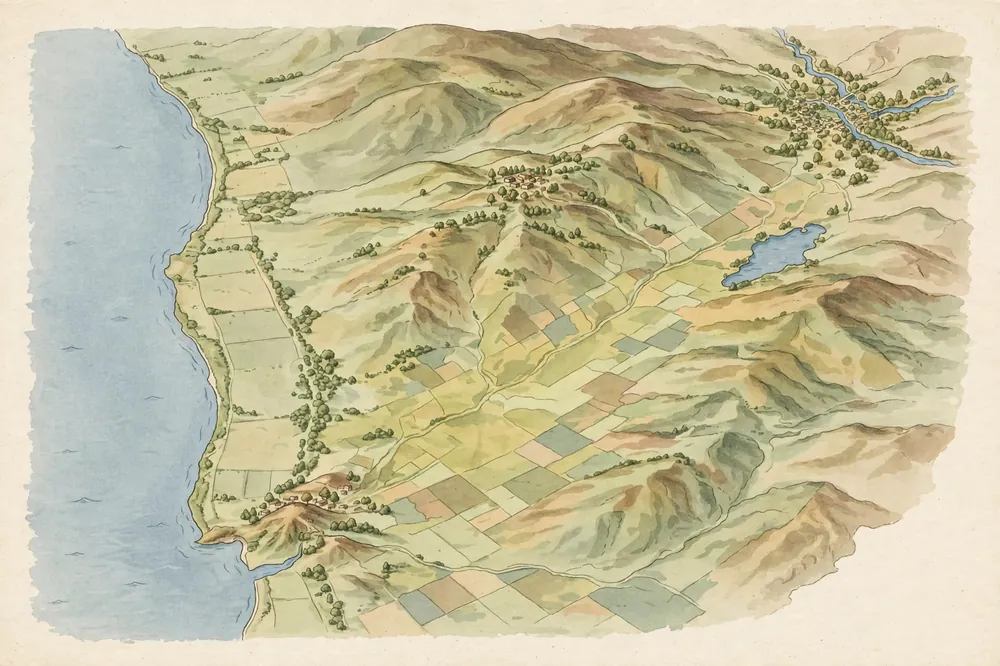
The battlefield of Megiddo was a landscape of three parts: the flat coastal plain of Sharon, where the attack began; the hills of Samaria, which the Ottoman armies held; and the Jezreel Valley, the broad, flat valley behind the hills, where the cavalry struck.
The Sharon plain, about 15 kilometres wide, was ideal for cavalry and for the movement of guns: it was flat, open and well watered, and it ran north from the coast to the foot of the hills. The hills themselves were steep and broken, cut by wadis — dry river valleys — that were the only routes through them.
The most important of these was the pass at Megiddo, which led from the Sharon plain over the hills and down into the Jezreel Valley. Whoever held that pass held the key to the battle, and Allenby’s plan was to seize it before the Ottomans could defend it.
Armageddon / Armageddon
Megiddo is one of the oldest battlefields in the world. The pass through the hills has been fought over for more than 3,000 years: the Egyptians fought there under Thutmose III, the Israelites under Deborah and Barak, and the Crusaders under Richard the Lionheart. The name Megiddo, in the Book of Revelation, became Armageddon — the place of the final battle between good and evil.
Allenby and his staff knew this, and they knew that the battle they were about to fight would be remembered for its name as much as for its result. The Ottoman Army, too, knew the ground: its headquarters at Nazareth, in the hills above the Jezreel Valley, was the town of the New Testament, and its soldiers fought in a landscape that was sacred to three religions.
The battle of 1918 added a new chapter to a very old story, and it is remembered, in part, because of the name of the place where it was fought.
9. Outcome and Legacy of Megiddo 1918
The fall of the Ottoman Empire
Megiddo destroyed the Ottoman Army in Palestine, and with it the Ottoman Empire’s ability to defend its Arab provinces. The Allies took Damascus on 1 October, Aleppo on 25 October, and on 30 October the Ottoman Empire signed the Armistice of Mudros, ending its part in the First World War.
The battle also shaped the Middle East that followed: the British and French divided the Ottoman Arab provinces between them under the Sykes-Picot Agreement, and the new states of Syria, Lebanon, Iraq, Transjordan and Palestine were created from the ruins of the empire. The Arab forces under Feisal, who had fought alongside Allenby, entered Damascus hoping for independence, and were disappointed.
The consequences of Megiddo — and of the promises made during the war — are still felt in the Middle East today.
The last great cavalry battle
Megiddo is remembered as one of the last great cavalry victories in history. The Desert Mounted Corps, which rode more than 200 kilometres in a week, was the last cavalry force to win a major battle by the sword, and its ride is studied in military schools as a model of exploitation.
The battle is also remembered as a model of deception and combined arms: the dummy camps in the Jordan valley, the short bombardment, the infantry breakthrough, the cavalry sweep and the air attack on the Wadi Fara were all parts of a single plan, and they worked together in a way that few battles of the First World War did.
Allenby, who was made a viscount after the war, is remembered as the most successful British general of the First World War in the Middle East, and Megiddo as his masterpiece.
The advance to Aleppo and the armistice
After Damascus, the pursuit continued north. The cavalry, which had already ridden more than 200 kilometres in a week, advanced on Aleppo, the great city of northern Syria, and took it on 25 October 1918, after a short fight. The Ottoman Army in Syria had ceased to exist, and the Ottoman government, which had lost its Arab provinces and its army in Palestine, asked for an armistice.
On 30 October 1918, the Ottoman Empire signed the Armistice of Mudros, on the island of Lemnos, ending its part in the First World War. The armistice left the British in occupation of Syria, Mesopotamia and Palestine, and it left the Arab forces under Feisal in Damascus, where they set up an Arab administration that lasted until the French took Syria in 1920.
The campaign that had begun at Megiddo had, in six weeks, destroyed an empire that had ruled the Middle East for four centuries.
10. Commanders
General Edmund Allenby (Britain). Commander of the Egyptian Expeditionary Force and the architect of the victory. Allenby, a cavalry officer who had commanded the Third Army in France, took command in Egypt in June 1917, took Jerusalem in December 1917, and planned and won Megiddo in September 1918. He was made Viscount Allenby of Megiddo after the war.
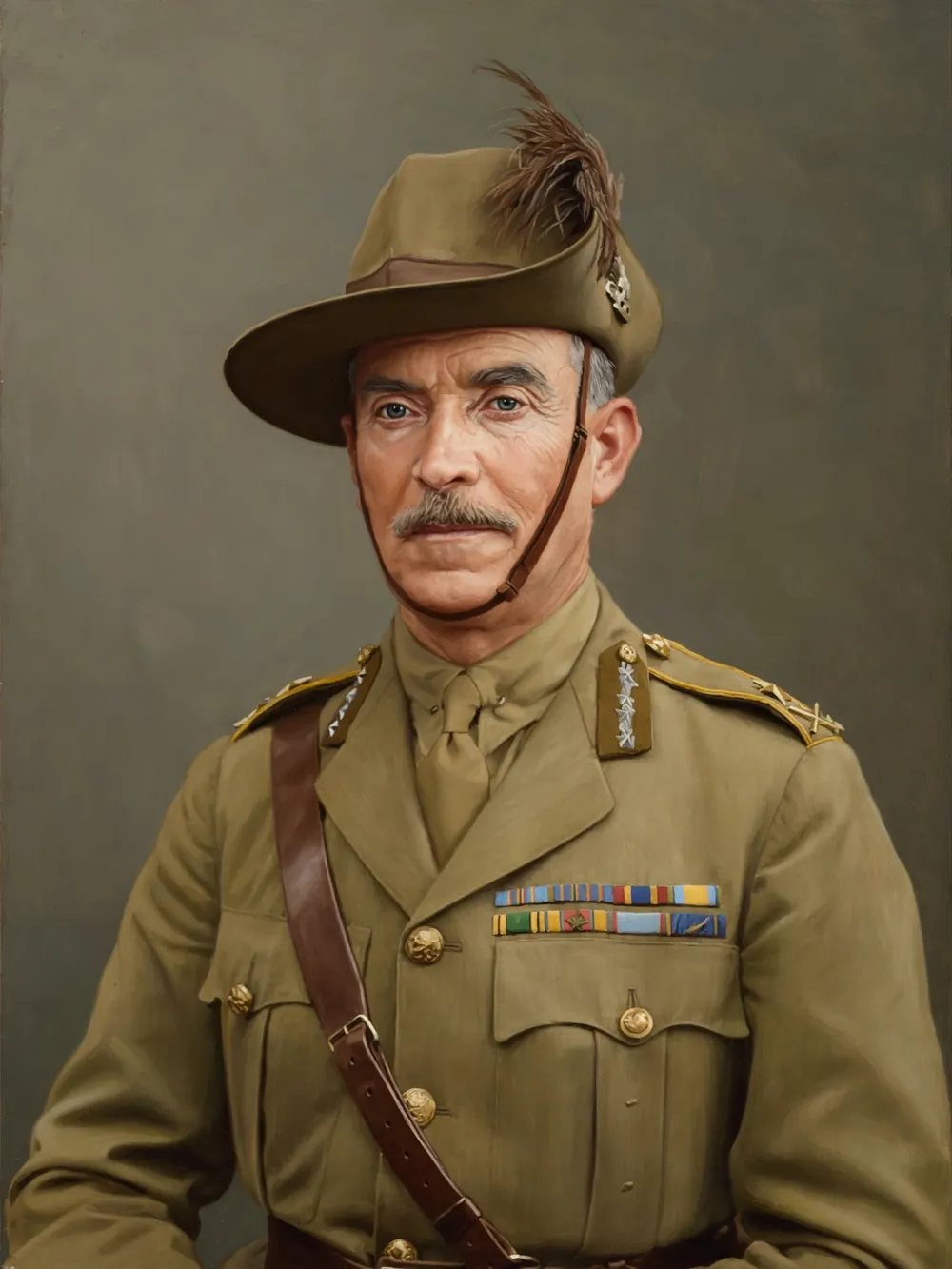
Lieutenant General Harry Chauvel (Australia). Commander of the Desert Mounted Corps, whose cavalry rode through the gap at Megiddo and took Damascus. Chauvel, an Australian regular officer, was the first Australian to command a corps in the field, and his ride to Damascus is remembered as one of the great cavalry exploits of the war.
Lieutenant General Edward Bulfin (Britain). Commander of XXI Corps, whose infantry broke through the Ottoman line on the Sharon plain on 19 September. Bulfin, an Irish officer, had commanded a division on the Western Front and was given the coastal corps for the Megiddo offensive.
Lieutenant General Philip Chetwode (Britain). Commander of XX Corps, whose infantry attacked in the hills of Samaria and drove the Ottoman 7th Army back on to the cavalry. Chetwode later became Commander-in-Chief in India.
General Otto Liman von Sanders (Germany). Commander of the Yildirim Army Group and the Ottoman defence. Liman von Sanders, a German officer who had commanded at Gallipoli in 1915, was sent to Palestine in 1918 and was deceived by Allenby’s plan. He escaped from his headquarters at Nazareth by a few hours and retreated to Damascus.
Mustafa Kemal (Ottoman Empire). Commander of the Ottoman 7th Army in the hills of Samaria. Kemal, who had fought at Gallipoli, conducted a skilful retreat after Megiddo, saving much of his army, and after the war he became the founder of the Republic of Turkey as Atatürk.
11. Frequently Asked Questions
When was the Battle of Megiddo fought?
From 19 to 25 September 1918, in northern Palestine, on the Sharon plain and in the Jezreel Valley. The infantry broke through on 19 September, the cavalry rode through the gap at Megiddo on the night of 19–20 September, and the Ottoman 7th and 8th Armies were destroyed in the days that followed. The pursuit continued after the battle: the Allies entered Damascus on 1 October 1918, took Aleppo on 25 October, and on 30 October the Ottoman Empire signed the Armistice of Mudros, ending its part in the First World War.
What is the connection between Megiddo and Armageddon?
Megiddo is the ancient battlefield at the pass through the hills of Samaria, and its name, in the Book of Revelation, became Armageddon — the place of the final battle between good and evil. The battle of 1918 was fought at the same pass that had been fought over for more than 3,000 years. The name matters because it gave the battle a resonance no other battle of the campaign possessed: newspapers and soldiers alike understood at once that the fighting was taking place on ground sacred to three religions. That ancient reputation is part of why Megiddo is remembered, while other victories of the same campaign are largely forgotten.
How did Allenby deceive the Ottomans?
He made the Ottomans believe the attack would come in the Jordan valley, in the east, by building dummy camps and horse lines there, moving troops there by day and back by night, and letting the Arab forces under T. E. Lawrence operate there. The real attack came on the coast, in the west, where the Ottoman defences were thin. The deception worked because the Ottomans expected an attack in the east, where Lawrence’s forces were active. By the time they realised the real blow had fallen on the coast, the cavalry was already through the gap.
What happened at the Wadi Fara?
On 21 September 1918, the Royal Air Force found a great column of Ottoman troops, guns and transport retreating through the Wadi Fara, a narrow gorge, and bombed and machine-gunned it for hours. The column was destroyed, and the attack became one of the first great air victories in history. The attack mattered because it showed what air power could do to an army on the move: the column had no room to scatter, no cover from the air, and no way to fight back. The destruction at Wadi Fara helped turn a retreat into a rout, because the survivors had lost their guns, their transport and their organisation.
How many prisoners were taken at Megiddo?
About 25,000 Ottoman soldiers were taken prisoner, and thousands more were killed or wounded. The Ottoman 7th and 8th Armies ceased to exist as organised forces, and the Allies lost about 5,000 men. The scale of the capture shows how complete the victory was: the two Ottoman armies did not retreat, they dissolved, and their men surrendered in groups wherever the cavalry found them. The Allies, by contrast, lost few men, because the breakthrough had been so sudden that the Ottoman guns had little time to fire. Megiddo was therefore not a battle of attrition but a battle of manoeuvre, won by surprise and by speed.
Did Megiddo end the Ottoman Empire?
Not by itself, but it destroyed the Ottoman Army in Palestine and opened the way to Damascus and Aleppo. On 30 October 1918, six weeks after Megiddo, the Ottoman Empire signed the Armistice of Mudros, ending its part in the First World War. Megiddo broke the Ottoman Army in Palestine so thoroughly that there was nothing left to defend Syria: Damascus fell within a week, and Aleppo within a month. The empire’s armies had been destroyed in the field, and its government, with no army left to fight with, had no choice but to seek an armistice.
12. Sources
- Wikipedia, “Battle of Megiddo (1918)” — dates, strength, casualties and the course of the battle.
- Encyclopædia Britannica, “Battle of Megiddo” — background and the cavalry breakthrough.
- Cyril Falls, Armageddon: 1918 (Weidenfeld & Nicolson, 1964) — the standard history of the battle.
- Matthew Hughes, Allenby and British Strategy in the Middle East, 1917–1919 (Frank Cass, 1999) — Allenby’s planning and the deception.
- T. E. Lawrence, Seven Pillars of Wisdom (Jonathan Cape, 1935) — the Arab Revolt and the campaign in the north.
- Henry Gullett, The Australian Imperial Force in Sinai and Palestine (Angus & Robertson, 1923) — the Desert Mounted Corps and the ride to Damascus.
- Jonathan Newell, Allenby’s Victory: The Battle of Megiddo (Osprey, 2013).
- David R. Woodward, Hell in the Holy Land: World War I in the Middle East (University Press of Kentucky, 2006).