 WAR ATLAS MILITARY HISTORY MAGAZINE · WWI — WWII
Gewehr 43
1. Lead
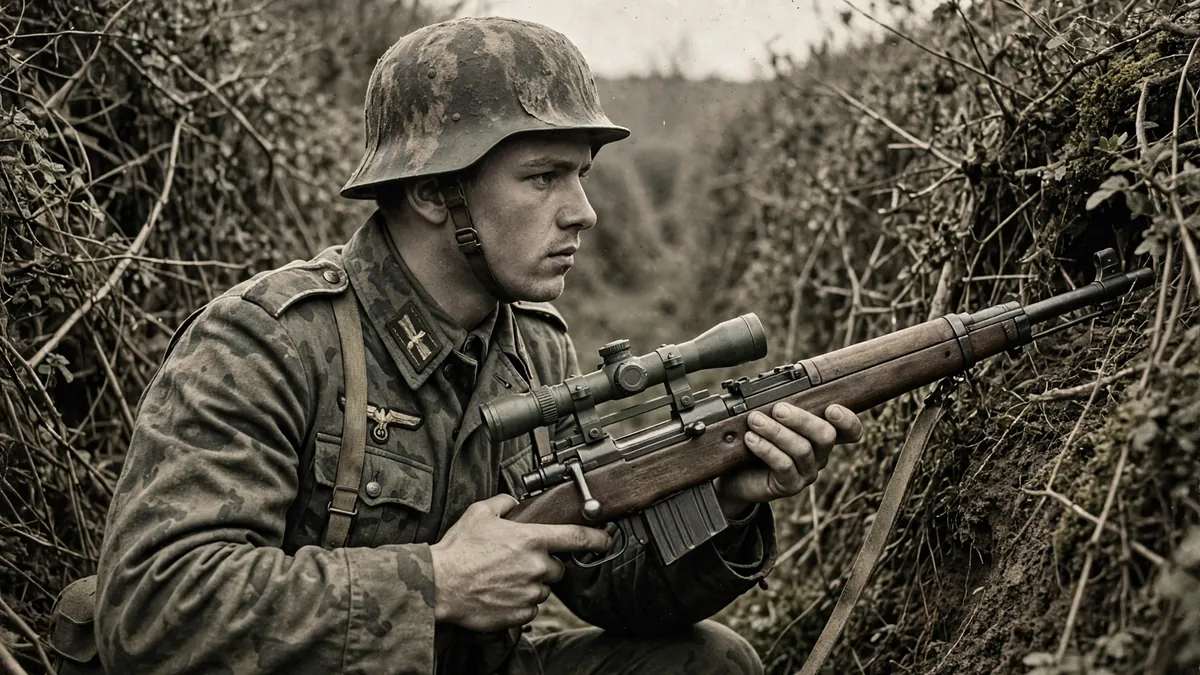
The Gewehr 43 (G43), also known as the Karabiner 43 (K43), was Germany’s semi-automatic rifle of the Second World War, and the first self-loading rifle to be issued in large numbers by the German Army. Chambered for the standard 7.92×57 mm cartridge, it gave the German infantryman a rate of fire far greater than that of the bolt-action Karabiner 98k, and it could be fitted with a telescopic sight to serve as a sniper rifle, a role in which it was widely used on the Eastern Front and in Normandy. Designed by Walther and adopted in 1943, about 402,000 Gewehr 43 rifles were built before the end of the war, and they were issued to snipers, to squad leaders and to the best marksmen of the infantry, and later to the Volksgrenadier divisions raised in the last months of the war. The Gewehr 43 never replaced the Karabiner 98k as the standard German rifle, and it was less reliable than the American M1 Garand that inspired its development, but it was a significant step towards the modern assault rifle, and it is remembered as one of the most important German small arms of the war.
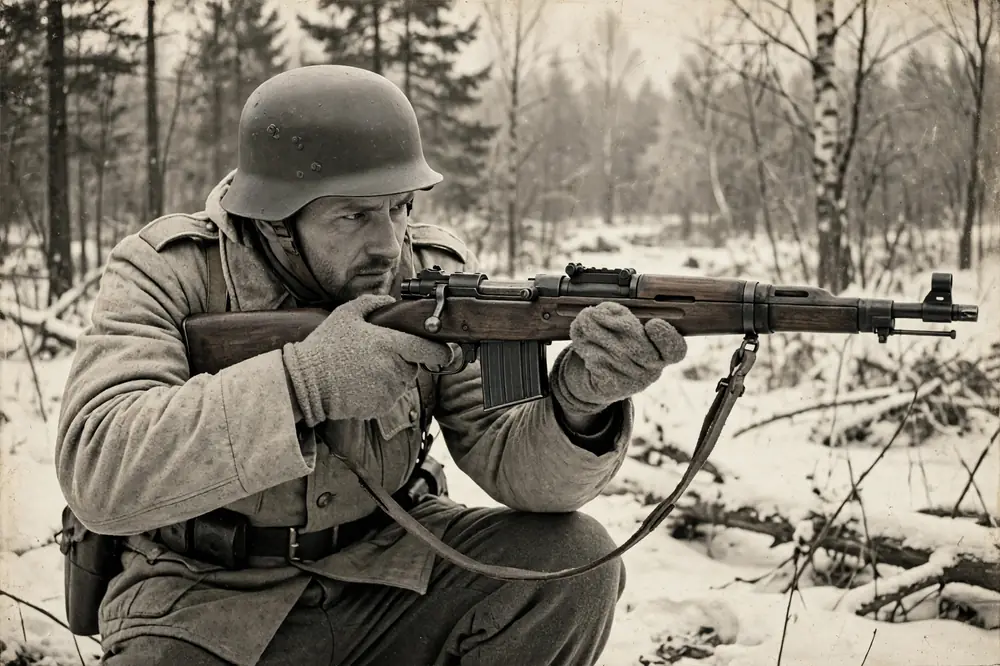
The Gewehr 43 was the answer to a problem that the German Army had recognised since the invasion of the Soviet Union in 1941: the Soviet soldier was armed with the SVT-40 semi-automatic rifle, and the German soldier, with his bolt-action Karabiner 98k, was outgunned in the close fighting of the Eastern Front. The German Army had tried to build a semi-automatic rifle before the war, but its first design, the Gewehr 41, had failed, and it was only when German engineers studied the captured SVT-40 and borrowed its gas system that they produced a rifle that worked. The Gewehr 43 was that rifle, and it arrived too late and in too small numbers to change the course of the war, but it changed the German infantryman’s experience of combat, and it pointed the way to the Sturmgewehr 44, the first true assault rifle, which was developed alongside it. For the historian of small arms, the Gewehr 43 is the bridge between the bolt-action rifle of the nineteenth century and the self-loading rifle of the twentieth.
2. Key Facts
| Type | Semi-automatic rifle |
| Origin | Germany |
| Designer | Walther (Carl Walther GmbH) |
| Manufacturer | Walther, Berlin-Lübecker Maschinenfabrik, Gustloff-Werke |
| In service | 1943–1945 (German service); later with other armies |
| Produced | 1943–1945; about 402,000 built |
| Calibre | 7.92×57 mm Mauser |
| Weight | 4.4 kg unloaded (about 5 kg loaded) |
| Length | 1,117 mm |
| Barrel length | 550 mm |
| Rate of fire | Semi-automatic; about 20–30 aimed rounds per minute |
| Muzzle velocity | About 745 m/s |
| Effective range | About 500 m; about 800 m with telescopic sight |
| Feed | 10-round detachable box magazine |
| Operation | Gas-operated, short-stroke piston, rotating bolt |
| Sights | Iron sights; ZF4 4× telescopic sight on sniper versions |
3. Background and Development
The German Search for a Semi-Automatic Rifle
The German Army began looking for a semi-automatic rifle in the 1930s, when it became clear that the bolt-action rifle, which had been the standard infantry weapon since the nineteenth century, was reaching the limits of its usefulness. A semi-automatic rifle could fire as fast as the soldier could pull the trigger, and it let the soldier keep his aim and his position while he fired, instead of working a bolt and losing his sight picture after every shot. The German Army issued a requirement in 1935, and two firms, Mauser and Walther, submitted designs, but the army’s requirements were demanding: the rifle had to be reliable, it had to be accurate, it had to use the standard 7.92 mm cartridge, and it had to have no gas port drilled into the barrel, because the army believed that a hole in the barrel would weaken it and let in dirt. The requirement for no gas port forced the designers into complicated solutions, and it delayed the programme for years, while the Soviet Union and the United States moved ahead with their own semi-automatic rifles.
The Gewehr 41 and Its Failures
The result of the first programme was the Gewehr 41, adopted in 1941 in two versions, the Mauser G41(M) and the Walther G41(W), of which the Walther design was chosen for production. The Gewehr 41 used the so-called Bang system, in which gas from the muzzle was trapped in a cone at the front of the barrel and drove a piston that operated the action, and it had no gas port in the barrel, as the army had demanded. But the system was unreliable: the muzzle cone fouled quickly, the rifle was heavy and awkward, and it was difficult to clean and to maintain in the field. About 70,000 Gewehr 41 rifles were built, and they were issued to troops on the Eastern Front, where they performed poorly in the mud and the cold, and the soldiers who used them preferred the Karabiner 98k that they had been issued before. The Gewehr 41 was a failure, but it taught the German Army and the Walther engineers what would not work, and it set the stage for the rifle that replaced it.
Walther’s Gewehr 43 and Mass Production
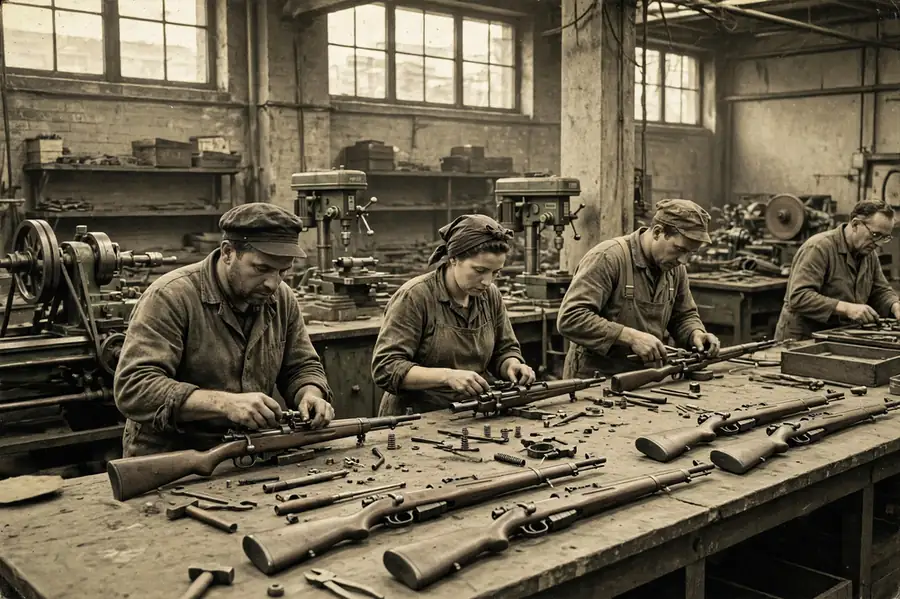
The breakthrough came from the enemy. In the first months of the invasion of the Soviet Union, German troops captured large numbers of the Soviet SVT-40 semi-automatic rifle, and Walther’s engineers studied it and found that its gas system — a simple gas port in the barrel driving a short-stroke piston — worked well and was easy to manufacture. Walther redesigned the Gewehr 41 around the Soviet system, with a gas port in the barrel, a short-stroke piston above the barrel, and a 10-round detachable box magazine in place of the Gewehr 41’s fixed magazine, and the result was the Gewehr 43, adopted in October 1943. The new rifle was simpler, lighter and more reliable than the Gewehr 41, and it could be made in large numbers: Walther, Berlin-Lübecker Maschinenfabrik and Gustloff-Werke built about 402,000 Gewehr 43 rifles before the end of the war, and production was still rising when the war ended. In 1944 the rifle was renamed the Karabiner 43, because the army had decided that all rifles would be called carbines, but the two names refer to the same weapon.
4. Design
Gas Operation and the Detachable Magazine
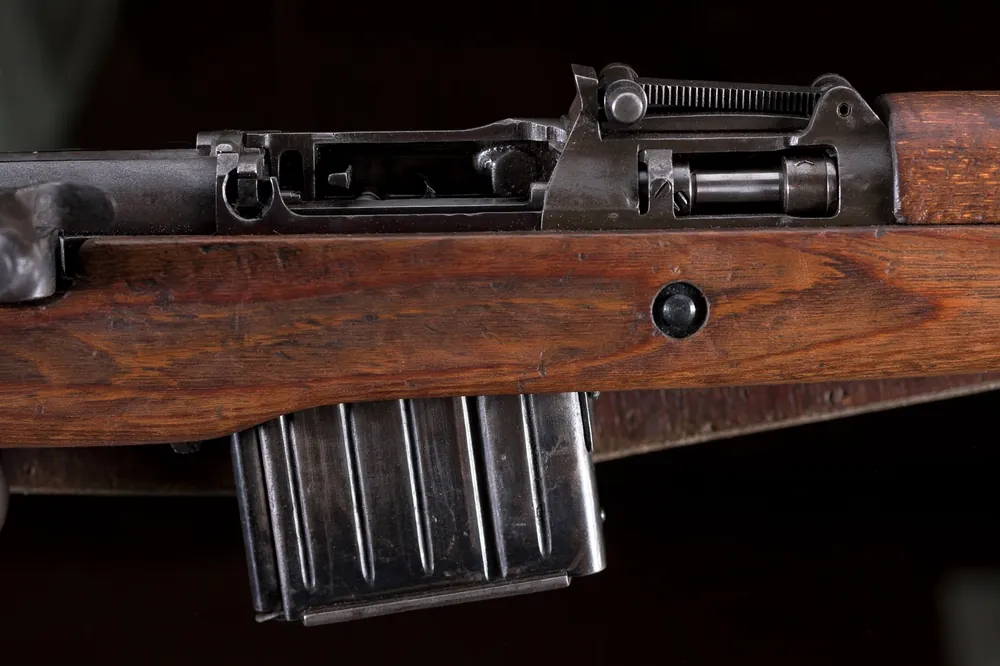
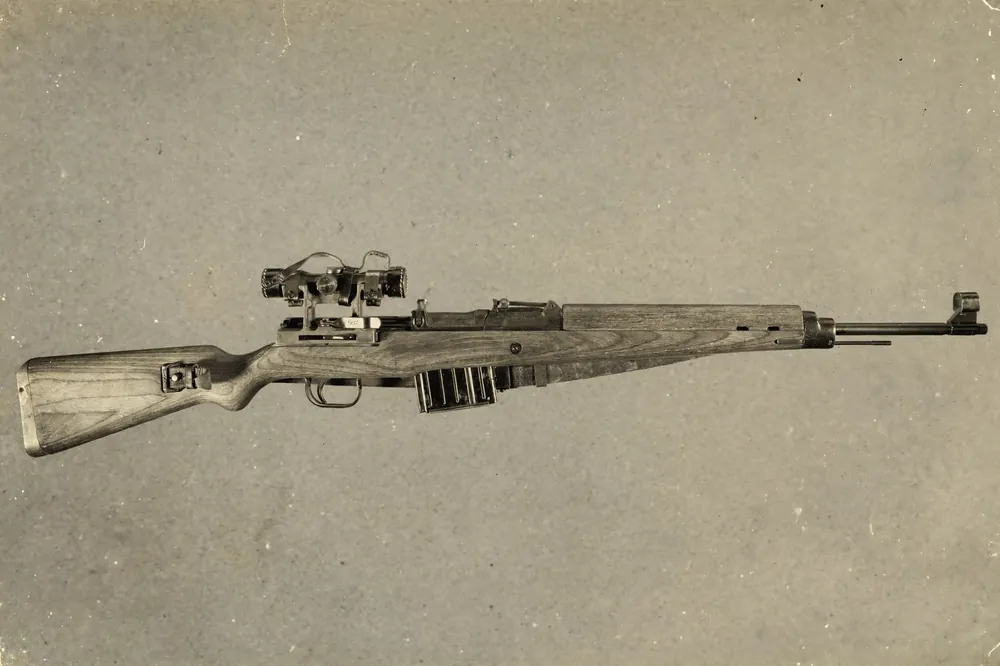
The Gewehr 43 was gas-operated, with a short-stroke piston mounted above the barrel that was driven back by gas tapped from the barrel through a port, and that in turn drove the bolt carrier to the rear, unlocking the rotating bolt and ejecting the empty case before a spring returned the action to battery. The system was simple and robust, and it was borrowed directly from the Soviet SVT-40, though Walther’s engineers improved it with a gas regulator that let the soldier adjust the rifle for different conditions. The rifle was fed from a 10-round detachable box magazine, which could be loaded from the top with stripper clips or removed and replaced with a loaded magazine, and this was a great improvement over the Gewehr 41’s fixed magazine, which had to be loaded one round at a time. The rifle weighed 4.4 kilograms unloaded, and it was 1,117 millimetres long, with a barrel of 550 millimetres, and it was balanced well enough to be fired from the shoulder or from a rest with good accuracy.
Accuracy and the Sniper Variant
The Gewehr 43 was accurate enough for a semi-automatic rifle, and it was at its best in the hands of a trained marksman. Its effective range was about 500 metres with iron sights, and about 800 metres when it was fitted with the ZF4 4× telescopic sight, which was mounted on a rail on the side of the receiver and could be removed and refitted without losing its zero. About 53,000 Gewehr 43 rifles were fitted with the ZF4 sight and issued as sniper rifles, and they were used by German snipers on the Eastern Front and in Normandy, where their semi-automatic action let the sniper fire a second shot quickly if the first missed, a great advantage over the bolt-action sniper rifles that both sides otherwise used. The rifle’s accuracy was limited by its gas system, which disturbed the barrel when it fired, and by the quality of its wartime manufacture, which declined as the war went on, but a good Gewehr 43 with a good barrel and a ZF4 sight was a formidable sniper’s weapon, and Soviet and Allied soldiers learned to respect it.
Strengths and Weaknesses
The Gewehr 43’s strengths were its rate of fire, its detachable magazine and its suitability as a sniper rifle, and its weaknesses were its reliability and its cost. The rifle was more reliable than the Gewehr 41 that it replaced, but it was still sensitive to dirt and to poor maintenance, and its gas system fouled quickly in the mud of the Eastern Front, where soldiers found that they had to clean it constantly to keep it working. The rifle was also expensive to make, and its production never reached the scale that the German Army wanted: about 402,000 were built, against millions of Karabiner 98k rifles, and the Gewehr 43 was never issued to the whole army, but only to selected men. The rifle’s wooden stock was prone to cracking, its magazine was sometimes difficult to seat, and its safety catch was awkward to use, but the soldiers who were issued the Gewehr 43 generally liked it, and they valued the firepower that it gave them over the bolt-action rifle that it supplemented.
5. Variants
| Variant | Years | Key features | Production |
|---|---|---|---|
| Gewehr 43 (G43) | 1943–1944 | Original designation; 10-round detachable magazine; ZF4 scope on sniper versions | About 402,000 (G43 and K43 combined) |
| Karabiner 43 (K43) | 1944–1945 | Renamed G43; identical weapon; late-war simplified production | Included in the 402,000 total |
| G43 sniper | 1943–1945 | ZF4 4× telescopic sight on a side rail | About 53,000 fitted with scopes |
| G43 with grenade launcher | 1944–1945 | Rifle grenade launcher (Gewehrgranatgerät) fitted to the muzzle | Small numbers |
| G41(W) | 1941–1943 | Predecessor; Bang muzzle system; fixed 10-round magazine | About 70,000 |
Gewehr 43
The Gewehr 43 was the original version of the rifle, adopted in October 1943 and built by Walther, Berlin-Lübecker Maschinenfabrik and Gustloff-Werke. It was a gas-operated, semi-automatic rifle with a 10-round detachable box magazine, and it was issued to snipers, to squad leaders and to the best marksmen of the infantry, and later to the Volksgrenadier divisions. The rifle’s production rose steadily through 1944, and by the end of the war about 402,000 Gewehr 43 and Karabiner 43 rifles had been built, a large number for a German weapon of the period, though far fewer than the millions of Karabiner 98k rifles that remained the standard German rifle. The Gewehr 43 was the rifle that proved the semi-automatic concept to the German Army, and it was the weapon that German soldiers asked for when they could get it, because it gave them a rate of fire that the bolt-action rifle could not match.
Karabiner 43
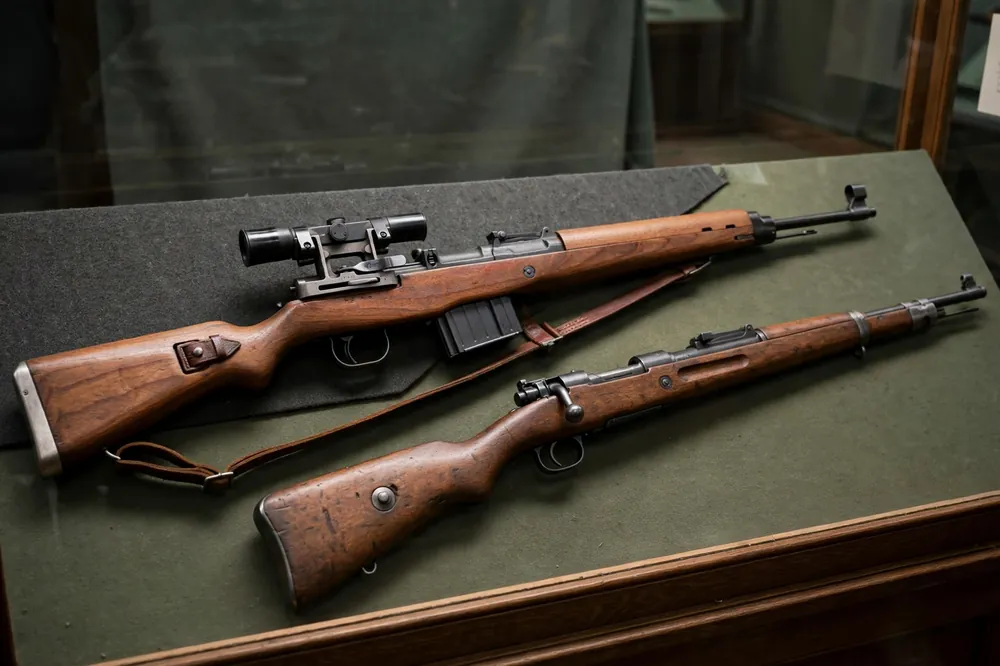
In 1944, the Gewehr 43 was renamed the Karabiner 43, because the German Army had decided that all rifles would be called carbines, and the change of name was a matter of nomenclature rather than of design: the Karabiner 43 was the same rifle as the Gewehr 43, with the same gas system, the same magazine and the same sights. The late-war Karabiner 43 rifles were simplified in production, with rougher finishes, stamped parts and less careful fitting, and the quality of the rifles declined as the war went on and as the German arms industry came under bombing and lost its skilled workers and its materials. The last Karabiner 43 rifles were built in 1945, in the final months of the war, and they were issued to the Volkssturm and to the last divisions raised by Germany, who used them in the defence of the Reich. The two names, Gewehr 43 and Karabiner 43, are used interchangeably by collectors and historians today, and they refer to the same weapon.
Sniper Rifles and Accessories
About 53,000 Gewehr 43 rifles were fitted with the ZF4 4× telescopic sight and issued as sniper rifles, and they were among the most important sniper weapons of the German Army. The ZF4 sight was mounted on a rail on the side of the receiver, and it could be removed and refitted without losing its zero, which let the sniper use his rifle with iron sights when he did not need the telescope, and fit the sight when he needed to shoot at long range. The Gewehr 43 could also be fitted with a rifle grenade launcher, the Gewehrgranatgerät, which let the soldier fire explosive grenades at ranges of up to 300 metres, and with a flash hider and a sling for carrying. The rifle’s accessories were simple and practical, and they reflected the German Army’s recognition that the Gewehr 43 was a weapon for the trained marksman, and that its value lay in its accuracy and its rate of fire rather than in its complexity.
6. Operational History
The Eastern Front
The Gewehr 43’s first combat came on the Eastern Front, where it was issued to snipers and to the best marksmen of the infantry in late 1943 and early 1944, and the front was the ideal ground for a sniper’s rifle: the fighting was often static, the ranges were long, and a single sniper could dominate a sector and kill dozens of enemy soldiers. The rifle’s semi-automatic action let the sniper fire a second shot quickly if the first missed, a great advantage over the bolt-action sniper rifles that both sides otherwise used, and German snipers with the Gewehr 43 and the ZF4 sight were feared by Soviet soldiers, who learned to keep their heads down when they heard the crack of a German sniper’s rifle. The Soviet Army’s own snipers, armed with the Mosin-Nagant and the SVT-40, fought a deadly duel with their German counterparts in the forests of Byelorussia and in the streets of Budapest. As production rose, the rifle was issued more widely, to squad leaders and to the best marksmen of the infantry, who used it as a personal weapon and as a means of giving their squad a higher rate of fire: the squad leader with a Gewehr 43 could fire rapidly at targets his riflemen could not reach, and engage the enemy at ranges at which the Karabiner 98k was slow and clumsy, and the detachable magazine let him reload quickly in the middle of a firefight. But the Gewehr 43 was never issued to the whole army, and most German infantrymen fought the whole war with the Karabiner 98k, while the Gewehr 43 remained a weapon for the few — a distribution that reflected the German Army’s priorities, giving the best weapons to the snipers and marksmen who could make the most of them.
Snipers in the East
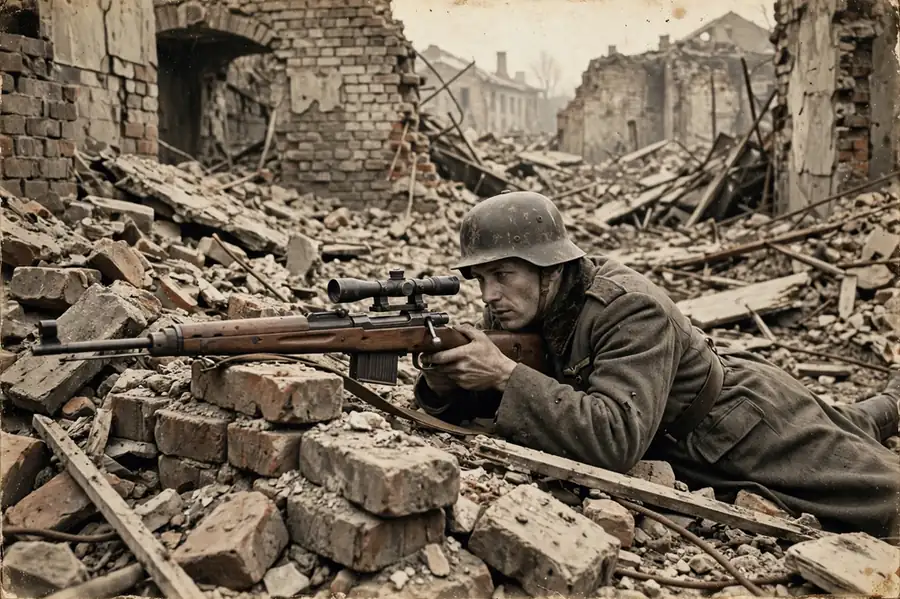
The Gewehr 43’s first combat came on the Eastern Front, where it was issued to snipers and to the best marksmen of the infantry in late 1943 and early 1944. The Eastern Front was the ideal ground for a sniper’s rifle: the fighting was often static, the ranges were long, and a single sniper could dominate a sector and kill dozens of enemy soldiers, and the Gewehr 43’s semi-automatic action let the sniper fire a second shot quickly if the first missed, a great advantage over the bolt-action sniper rifles that both sides otherwise used. German snipers with the Gewehr 43 and the ZF4 sight were feared by Soviet soldiers, who learned to keep their heads down when they heard the crack of a German sniper’s rifle, and the Soviet Army’s own snipers, armed with the Mosin-Nagant and the SVT-40, fought a deadly duel with their German counterparts in the ruins of Stalingrad, in the forests of Byelorussia and in the streets of Budapest. The Gewehr 43’s record as a sniper’s rifle is one of its most important legacies, and it is the role for which the rifle is best remembered.
Issue to Squad Leaders and Marksmen
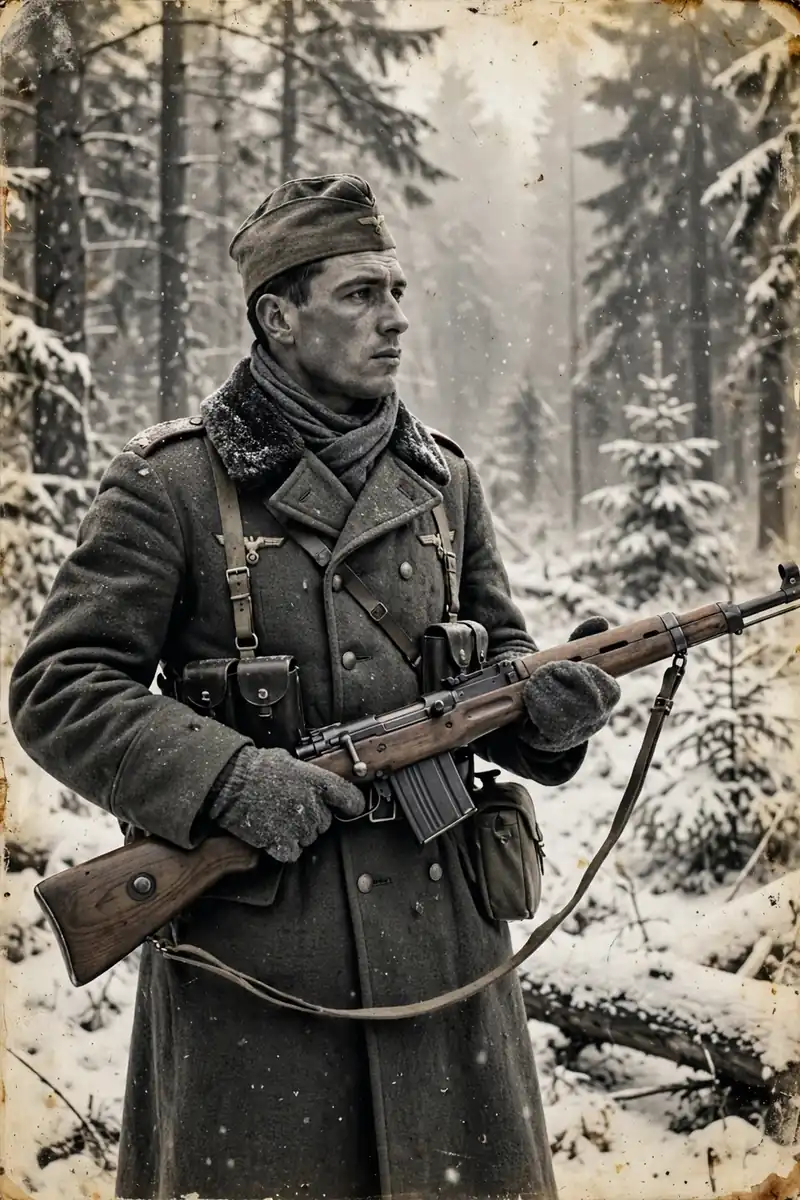
As production rose, the Gewehr 43 was issued more widely, to squad leaders and to the best marksmen of the infantry, who used it as a personal weapon and as a means of giving their squad a higher rate of fire. The squad leader with a Gewehr 43 could fire rapidly at targets that his riflemen could not reach, and he could engage the enemy at ranges at which the Karabiner 98k was slow and clumsy, and the rifle’s detachable magazine let him reload quickly in the middle of a firefight. But the Gewehr 43 was never issued to the whole army, and most German infantrymen fought the whole war with the Karabiner 98k, while the Gewehr 43 remained a weapon for the few. The rifle’s distribution reflected the German Army’s priorities: the best weapons went to the snipers and the marksmen, who could make the most of them, and the ordinary rifleman kept the bolt-action rifle that he had been trained on, and that the German arms industry could make in the millions.
Normandy and the West
In Normandy in 1944, the Gewehr 43 was used by German snipers and marksmen in the hedgerows, where its accuracy and its rate of fire made it a feared weapon. The hedgerows of Normandy were ideal ground for a sniper: the fields were small, the ranges were short, and a single sniper could hold up a whole platoon, and the Allied soldiers who fought in Normandy learned to fear the German sniper above all other German weapons, because he could kill without warning and without revealing his position. The Gewehr 43’s semi-automatic action was an advantage in the hedgerows, where the fighting was close and fast, and where a second shot was often needed, and the rifle’s ZF4 sight let the sniper pick off Allied soldiers at ranges of several hundred metres. The rifle was also used in the fighting in the Ardennes in December 1944, where it was issued to the Volksgrenadier divisions, and in the defence of the West Wall, where it was used by the second-line troops who held the fortifications against the Allied advance.
The Last Months: Volksgrenadier
In the last months of the war, the Gewehr 43 was issued to the Volksgrenadier divisions, the new infantry divisions raised in the autumn of 1944 from the remnants of destroyed divisions, from training units and from the Volkssturm, and it was one of the weapons with which Germany tried to rebuild its army. The Volksgrenadier divisions were given the best weapons that Germany could still make, including the Gewehr 43, the Sturmgewehr 44 and the Panzerfaust, and they were intended to be more heavily armed than the divisions they replaced, though they were smaller and less well trained. The Gewehr 43 served with these divisions in the Ardennes, in the defence of the Rhine and in the defence of Berlin, and it was among the last German weapons to fall silent in May 1945. The rifle’s service ended with the war, but its design lived on in the post-war rifles of several countries, and in the lessons that the German Army had learned about the semi-automatic rifle.
7. Performance and Specifications
| Specification | Gewehr 43 |
|---|---|
| Calibre | 7.92×57 mm Mauser |
| Weight (unloaded) | 4.4 kg |
| Weight (loaded) | About 5 kg |
| Length | 1,117 mm |
| Barrel length | 550 mm |
| Rate of fire | Semi-automatic; 20–30 aimed rounds per minute |
| Muzzle velocity | About 745 m/s |
| Effective range | About 500 m; about 800 m with ZF4 sight |
| Feed | 10-round detachable box magazine |
| Operation | Gas-operated, short-stroke piston, rotating bolt |
Firing Performance
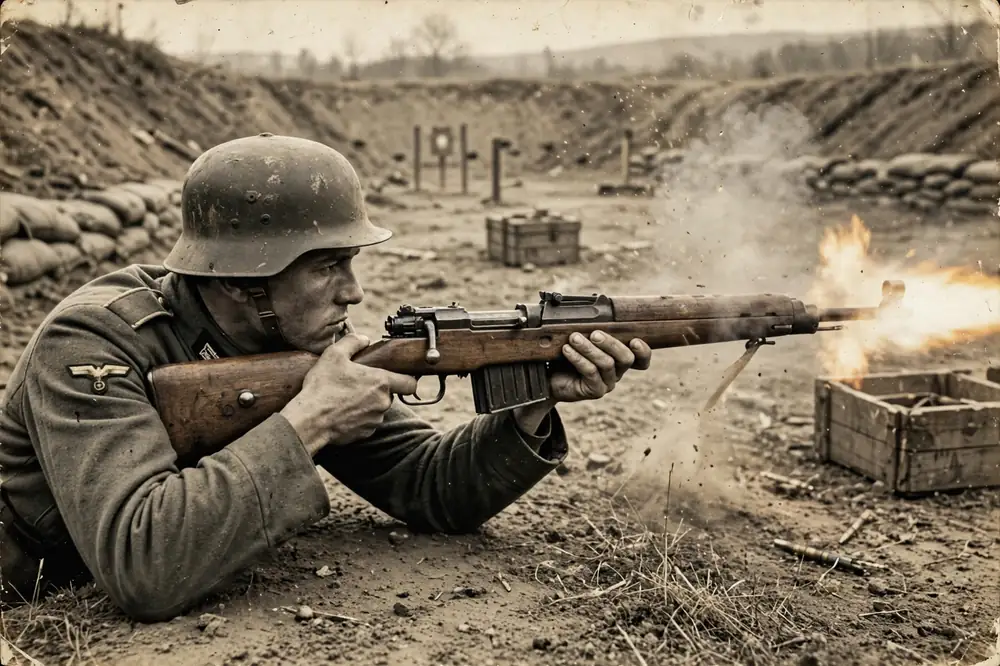
The Gewehr 43’s firing performance was good for a semi-automatic rifle of its generation, and it was a great improvement over the bolt-action Karabiner 98k in rate of fire. A trained soldier could fire 20 to 30 aimed rounds per minute with the Gewehr 43, against 10 to 15 rounds per minute with the Karabiner 98k, and the semi-automatic action let him keep his aim and his position while he fired, instead of working a bolt and losing his sight picture after every shot. The rifle’s 7.92 mm bullet, fired at about 745 metres per second, had the range and the penetration to kill at 500 metres and to wound at longer ranges, and its trajectory was flat enough for accurate fire at the ranges at which infantry fought. But the rifle’s accuracy was limited by its gas system, which disturbed the barrel when it fired, and by the quality of its wartime manufacture, which declined as the war went on, and a Gewehr 43 was never as accurate as a bolt-action sniper rifle of the same calibre, though it was accurate enough for the roles for which it was used.
Comparison with the M1 Garand and the SVT-40
Compared with the American M1 Garand, the Gewehr 43 was less reliable and less well made, but it had a detachable magazine, which the Garand lacked, and it could be fitted with a telescopic sight, which the Garand could not easily be. The Garand, which fired the .30-06 cartridge from an 8-round en bloc clip, was the standard rifle of the American Army, and it was issued to every American soldier, while the Gewehr 43 was issued only to selected men, and the Garand’s production, at over 5 million rifles, dwarfed the Gewehr 43’s 402,000. Compared with the Soviet SVT-40, the rifle from which it borrowed its gas system, the Gewehr 43 was heavier and more complex, but it was more accurate and better made, and it was a better sniper’s rifle. The Gewehr 43’s place in history is therefore that of a good rifle that arrived too late and in too small numbers, and that pointed the way to the modern self-loading rifle without ever becoming the standard weapon of its army.
8. Operators
Germany
The Gewehr 43 was used only by Germany during the war, and it was issued to the German Army, the Waffen-SS and the Luftwaffe’s ground units, though the army was by far the largest user. It was issued to snipers, to squad leaders and to the best marksmen of the infantry, and later to the Volksgrenadier divisions, and it was never issued to the whole army, because production never reached the scale that would have been needed to replace the Karabiner 98k. The rifle’s service in Germany ended with the war, but its design and its lessons lived on in the German Army’s post-war rifles, which kept the concept of the semi-automatic rifle that the Gewehr 43 had introduced, and in the assault rifles that followed it. The Gewehr 43’s users were the elite of the German infantry, and the rifle’s reputation among German soldiers was high, even though it was never the standard weapon of the army.
Post-War Users
After the war, the Gewehr 43 was used by several countries, most notably Czechoslovakia, which used captured rifles and built its own versions, and East Germany, which used the Gewehr 43 as the Karabiner 43 in the early years of the National People’s Army. The rifle was also used by the French Army, which captured large numbers of Gewehr 43 rifles and used them in Indochina, and by the armies of several other countries that had captured German weapons. The Gewehr 43’s post-war career was short, because the semi-automatic rifle was soon replaced by the assault rifle, and because the Gewehr 43’s 7.92 mm cartridge was replaced by the intermediate cartridges of the post-war period, but the rifle’s design influenced the post-war rifles of Czechoslovakia and of East Germany, and its ZF4 sight was copied and used on other weapons. The Gewehr 43’s post-war users were the armies that had inherited Germany’s weapons, and they used the rifle until it was replaced by more modern designs.
9. Legacy and Influence
A Step Towards the Modern Rifle
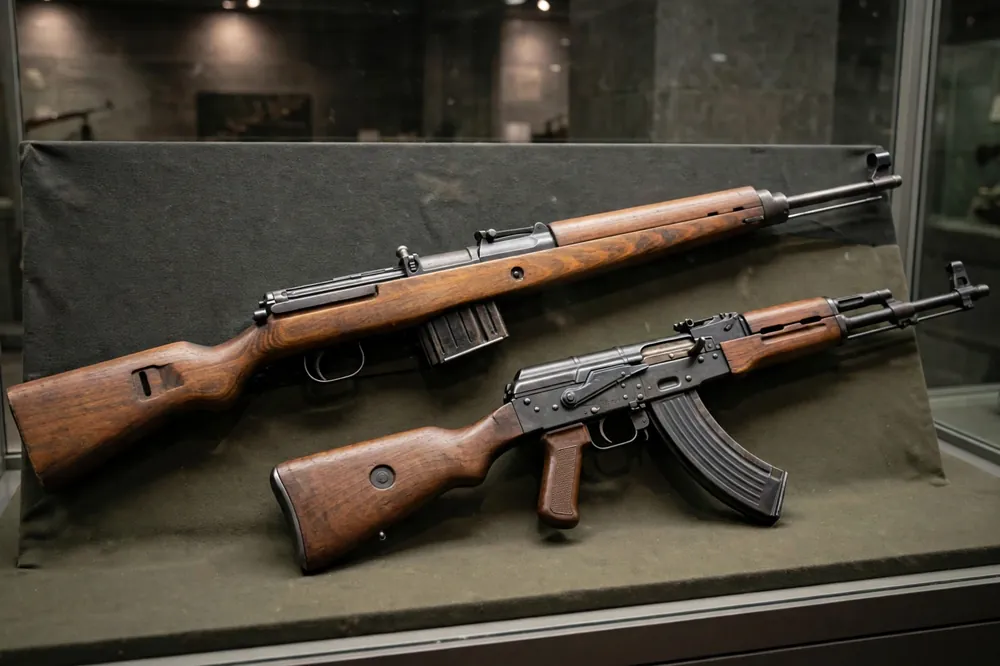
The Gewehr 43’s legacy is that of a bridge between the bolt-action rifle and the modern self-loading rifle, and it is remembered as the rifle that taught the German Army the value of the semi-automatic action. Before the Gewehr 43, the German Army had believed that the bolt-action rifle was sufficient for the infantryman, and it had resisted the semi-automatic rifle for years, demanding a rifle with no gas port and a fixed magazine that could not be made to work. After the Gewehr 43, the German Army accepted the semi-automatic rifle, and it developed the Sturmgewehr 44, the first true assault rifle, which was issued alongside the Gewehr 43 in the last months of the war and which became the model for every assault rifle since. The Gewehr 43’s gas system, borrowed from the SVT-40, and its detachable magazine, which the M1 Garand lacked, were both features that became standard on the rifles that followed it, and the rifle’s place in history is secure as the weapon that pointed the way to the modern infantry rifle.
The Sniper’s Rifle
The Gewehr 43 is also remembered as a sniper’s rifle, and its service with the ZF4 sight on the Eastern Front and in Normandy made it one of the most feared weapons of the war. The semi-automatic sniper rifle, which let the sniper fire a second shot quickly if the first missed, was a new concept, and the Gewehr 43 was one of the first rifles to prove it in combat, and its success influenced the design of the sniper rifles that followed it, including the Soviet SVD Dragunov, which was also a semi-automatic sniper rifle. The Gewehr 43’s snipers were among the most effective soldiers of the German Army, and their kills were counted in the hundreds, and the rifle’s reputation among Allied and Soviet soldiers was that of a weapon to be feared, a rifle that could kill from a distance without warning. The Gewehr 43’s legacy as a sniper’s rifle is one of its most important contributions to the history of small arms, and it is the role for which the rifle is best remembered today.
10. Surviving Examples
Museums and Collections
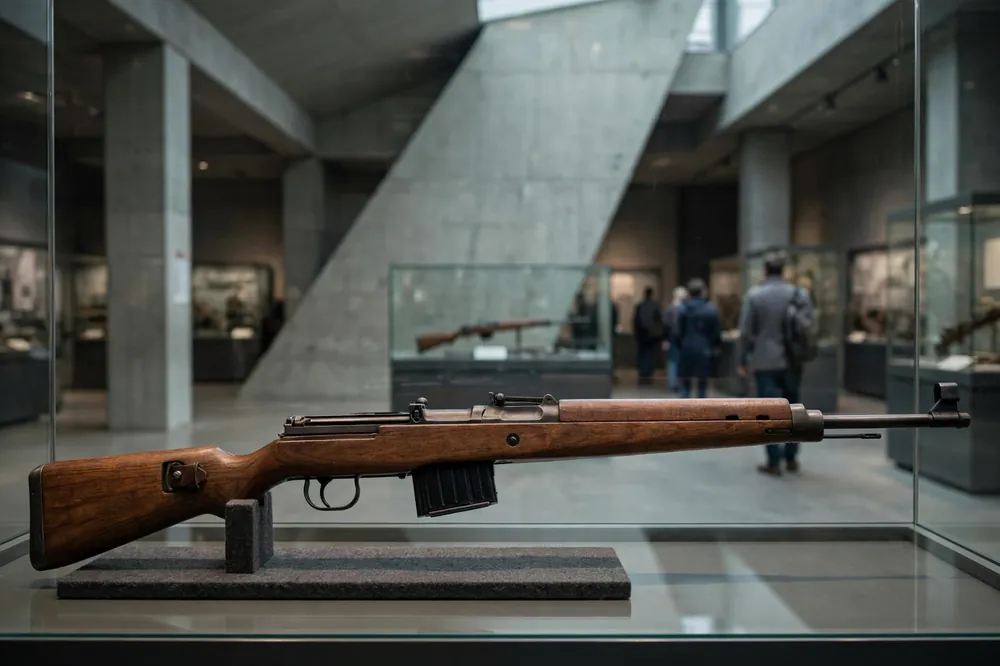
Gewehr 43 rifles survive in large numbers in museums and in private collections around the world, because about 402,000 were built and many were captured and preserved. The Bundeswehr Military History Museum in Dresden holds Gewehr 43 rifles in its collection, as do the Imperial War Museum in London, the National WWII Museum in New Orleans, the Musée de l’Armée in Paris and the Central Armed Forces Museum in Moscow, which holds captured German weapons from the Eastern Front, and the Royal Armouries in Leeds also displays examples of the rifle. The Waffenmuseum in Suhl, in the heart of the German arms industry, holds examples from the factories that built them, including rifles with the ZF4 sight and rifles in the late-war simplified form. For the visitor, the Gewehr 43 is one of the most accessible German small arms of the Second World War, and it is displayed in almost every military museum that covers the German infantry.
Replicas and the Collector Market
The Gewehr 43 is a popular weapon with collectors, and original rifles in good condition are among the most sought-after German small arms on the collector market, with prices that reflect their rarity and their historical importance, and with sniper versions fitted with the ZF4 sight commanding the highest prices of all. Deactivated Gewehr 43 rifles are legally owned by collectors in several European countries, and they are displayed in private collections and in museums, and they are used in re-enactments and in films about the Second World War, where the rifle’s distinctive appearance — its long barrel, its gas piston above the barrel and its detachable magazine — makes it instantly recognisable. Replicas of the Gewehr 43, built to fire blank cartridges, are used in films and in re-enactments, and the rifle’s survival in museums and in private hands ensures that its story will continue to be told, and that the weapon that bridged the bolt-action rifle and the assault rifle will not be forgotten.
Frequently Asked Questions
What is the Gewehr 43?
The Gewehr 43 was Germany’s semi-automatic rifle of the Second World War, adopted in 1943. It fired the 7.92×57 mm cartridge from a 10-round detachable magazine and was widely used as a sniper rifle with the ZF4 telescopic sight.
How many Gewehr 43 rifles were built?
About 402,000 Gewehr 43 and Karabiner 43 rifles were built between 1943 and 1945 by Walther, Berlin-Lübecker Maschinenfabrik and Gustloff-Werke.
What is the difference between the Gewehr 43 and the Karabiner 43?
There is no difference in design: the Karabiner 43 is the same rifle as the Gewehr 43, renamed in 1944 when the German Army decided that all rifles would be called carbines.
How was the Gewehr 43 used as a sniper rifle?
About 53,000 Gewehr 43 rifles were fitted with the ZF4 4× telescopic sight and issued to German snipers, who used them on the Eastern Front and in Normandy, where the semi-automatic action let them fire a second shot quickly if the first missed.
What calibre was the Gewehr 43?
The Gewehr 43 fired the standard German 7.92×57 mm Mauser rifle cartridge, the same cartridge used by the Karabiner 98k rifle and the MG34 machine gun.
Where can I see a Gewehr 43 today?
Gewehr 43 rifles are displayed in the Bundeswehr Military History Museum in Dresden, the Imperial War Museum in London, the National WWII Museum in New Orleans and the Musée de l’Armée in Paris, among other museums.
Sources
- Wikipedia, “Gewehr 43” — development from the Gewehr 41 and the SVT-40, production of about 402,000, sniper use.
- Chris McNab, German Small Arms of World War II (Osprey Publishing, 2013) — the Gewehr 43’s design and its service as a sniper rifle.
- Ian V. Hogg, German Small Arms of World War II (Greenhill Books, 1999) — the Gewehr 41 programme and the Gewehr 43’s gas system.
- Gordon L. Rottman, The Gewehr 43 (Osprey Publishing, 2014) — the rifle’s development, variants and combat use.
- United States War Department, Handbook on German Military Forces (1945) — the Gewehr 43’s organisation and tactical employment.
- John Walter, Guns of the Third Reich (Greenhill Books, 2004) — the Gewehr 43’s production and its place in the German infantry.