 WAR ATLAS MILITARY HISTORY MAGAZINE · WWI — WWII
Imphal-Kohima
1. Lead
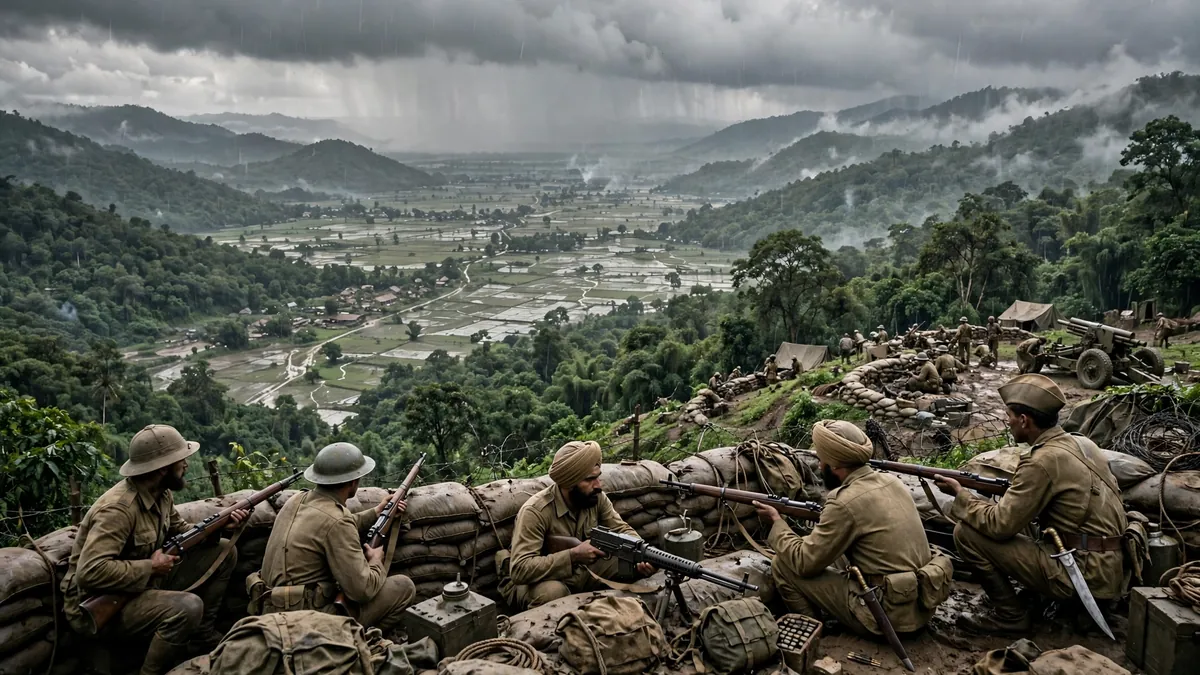
Imphal-Kohima was the decisive battle of the Burma Campaign in the Second World War, fought from March to July 1944 in the hills and plains of north-east India. The Japanese 15th Army, under Lieutenant General Renya Mutaguchi, crossed the Chindwin River and invaded India in Operation U-Go, aiming to capture the British supply bases at Imphal and Kohima and then march on to the Brahmaputra valley.
If Imphal fell, the Allies believed, the road to India would be open and the airlift supplying China over the Himalayas would be cut. Instead, the Japanese offensive collapsed in the monsoon rain. The British Fourteenth Army, under Lieutenant General William Slim, held both towns, and when the Japanese ran out of food and ammunition they retreated through the jungle in one of the worst disasters in the history of the Imperial Japanese Army.
Japanese casualties are estimated at 50,000 to 55,000 men, against about 12,000 to 17,000 Allied casualties.
2. Key Facts
| Date | 8 March – 3 July 1944 (Kohima relieved 22 June; Imphal siege lifted 22 June) |
| Location | Imphal and Kohima, Manipur and Nagaland, north-east India |
| Result | Decisive Allied victory; Japanese 15th Army destroyed as a fighting force |
| Allied commander | Lt. Gen. William Slim (Fourteenth Army) |
| Japanese commander | Lt. Gen. Renya Mutaguchi (15th Army) |
| Allied strength | About 120,000–150,000 British and Indian troops, with air supply |
| Japanese strength | About 85,000–100,000 men of the 15th Army |
| Allied losses | About 12,000–17,000 killed, wounded and missing |
| Japanese losses | About 50,000–55,000 killed, wounded, missing and dead of disease and starvation |
3. Background
Burma and the road to India
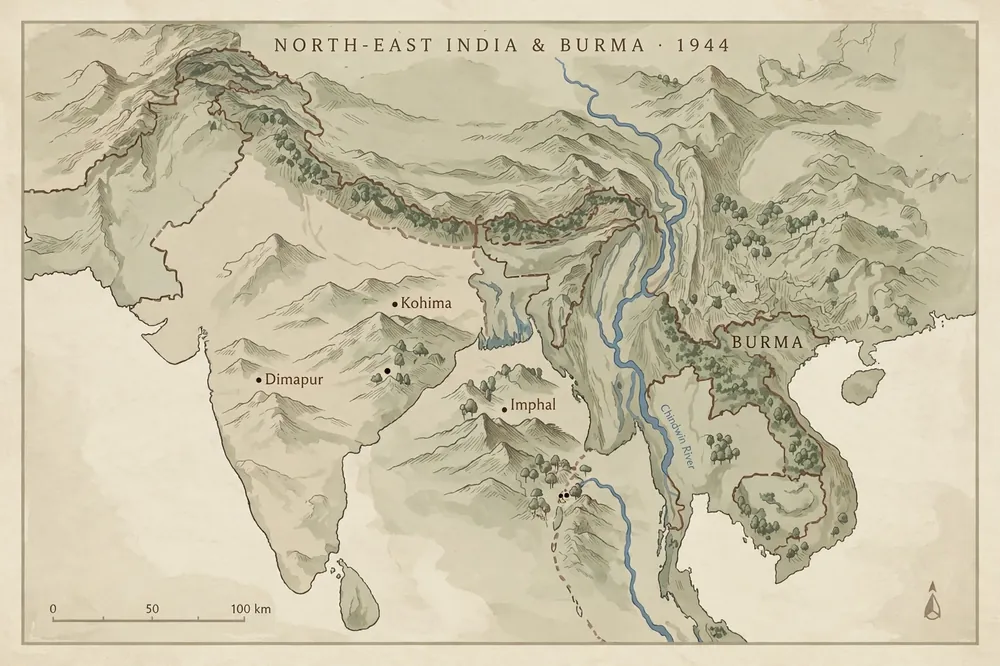
By early 1944 Japan held Burma, conquered in 1942, and Britain held India. The front between them ran along the Chindwin River, a line of jungle hills with almost no roads. The British position depended on two things: the airfield complex around Imphal, the plain in the state of Manipur, and the road that ran north from Imphal through Kohima to Dimapur, the railhead on the Brahmaputra.
Dimapur was the supply base for the whole front, and from it the railway ran west to Calcutta. If the Japanese cut the Imphal–Kohima–Dimapur road, the British force at Imphal would be isolated, and the airlift that supplied China from India would lose its bases. The Japanese command in Burma knew this, and the British command knew that they knew it.
Mutaguchi’s gamble
Lieutenant General Renya Mutaguchi, commander of the Japanese 15th Army, proposed Operation U-Go: three divisions would cross the Chindwin, surround Imphal, and take it in about three weeks. His plan rested on a single, fragile assumption — that his army could live off captured British supplies.
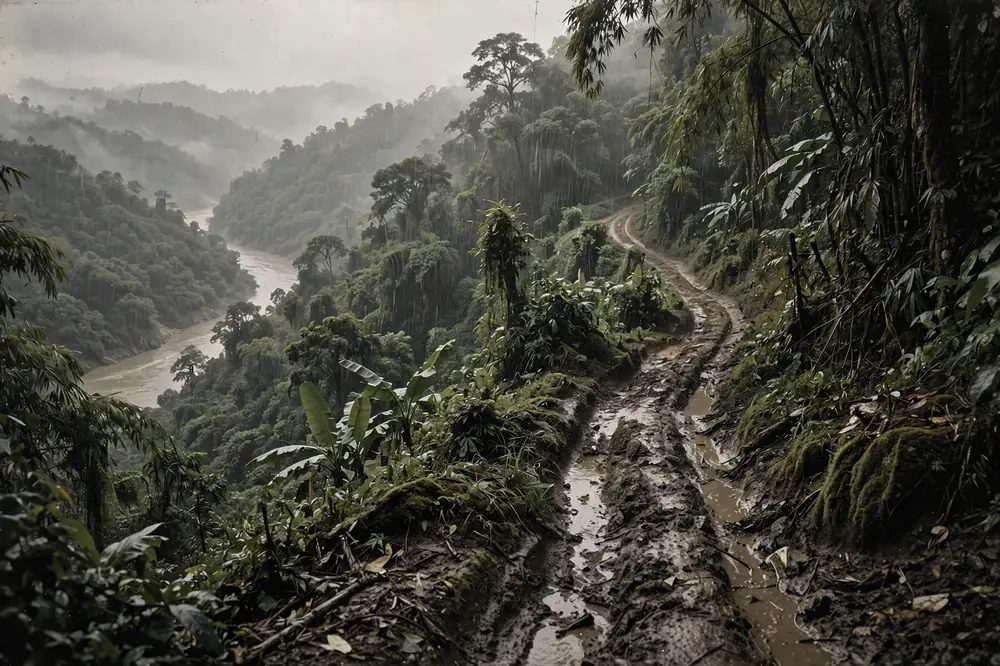
The Japanese carried only about three weeks of rations, and their supply line back across the Chindwin was a single jungle track that the monsoon would soon turn to mud. Mutaguchi’s own staff officers warned him that the plan was impossible, and his superior, General Masakazu Kawabe, commander of the Burma Area Army, doubted it too.
But Mutaguchi had the support of Tokyo, where the offensive was sold as a blow that would cut the Allied supply line to China and encourage the Indian independence movement led by Subhas Chandra Bose, whose Indian National Army fought alongside the Japanese. Mutaguchi overruled his critics and ordered the attack for March 1944, before the monsoon broke.
Slim’s answer
Lieutenant General William Slim, commander of the British Fourteenth Army, expected the attack. He had studied the ground and concluded that Imphal, with its airfields and its stores, was the best place to fight: his troops would be supplied by air, while the Japanese, at the end of a jungle track, would starve. Slim’s plan was deliberately defensive.
The forward divisions on the Chindwin would fight a delaying action and fall back on Imphal, and the Japanese would be allowed to surround the plain — and then be destroyed there, in a battle of supply. The one part of the plan that went wrong was Kohima. Slim believed the Japanese would send at most a regiment towards Kohima, and he left only a small garrison there.
In fact Mutaguchi sent a whole division, the 31st, under Lieutenant General Kotoku Sato, and Kohima became a siege in its own right, fought over a few hundred metres of ground around a district commissioner’s bungalow and its tennis court.
4. Opposing Forces
The Japanese attacking force was the 15th Army: three infantry divisions — the 15th, 31st and 33rd — plus the 1st Division of the Indian National Army and supporting artillery and engineers, about 85,000 to 100,000 men in total. The 33rd Division, under Lieutenant General Yanagida, was to attack Imphal from the south; the 15th Division, under Lieutenant General Yamauchi, from the north; and the 31st Division, under Lieutenant General Sato, was to cut the road at Kohima and then come south to join the attack on Imphal.
The Japanese infantry was tough and experienced, and its soldiers were prepared to endure hardship that would have broken most armies. But the army had almost no tanks, very little artillery by Western standards, and a supply system that depended on cattle, porters and captured stores.
| Allies | Japan | |
|---|---|---|
| Infantry | 17th, 20th, 23rd Indian Divisions; 5th Indian Division; 2nd British Division; 7th Indian Division; Chindits and special forces | 15th, 31st, 33rd Divisions of the 15th Army; Indian National Army 1st Division |
| Tanks | Lee/Grant and Stuart tanks of the armoured brigades; used at Imphal and Kohima | Almost none; a few light tanks, rarely used in the hills |
| Artillery | Field and mountain artillery, well supplied by air | Limited field guns; ammunition ran short within weeks |
| Air power | RAF and USAAF transport aircraft; fighters and bombers in close support | Few aircraft; no air superiority over Imphal |
| Supply | By air: Dakota transports flew in food, ammunition and reinforcements daily | On foot and by cattle across the Chindwin; collapsed in the monsoon |
Slim’s Fourteenth Army was a force of British and Indian divisions — the 17th, 20th and 23rd Indian Divisions around Imphal, the 5th and 7th Indian Divisions in reserve, and later the 2nd British Division sent to relieve Kohima. It was, by 1944, a veteran army.
Its men had learned jungle fighting the hard way in the defeats of 1942 and 1943, and Slim had rebuilt it with better training, better medical care against malaria, and a supply system that used the air. The crucial difference was the Dakota transport aircraft.
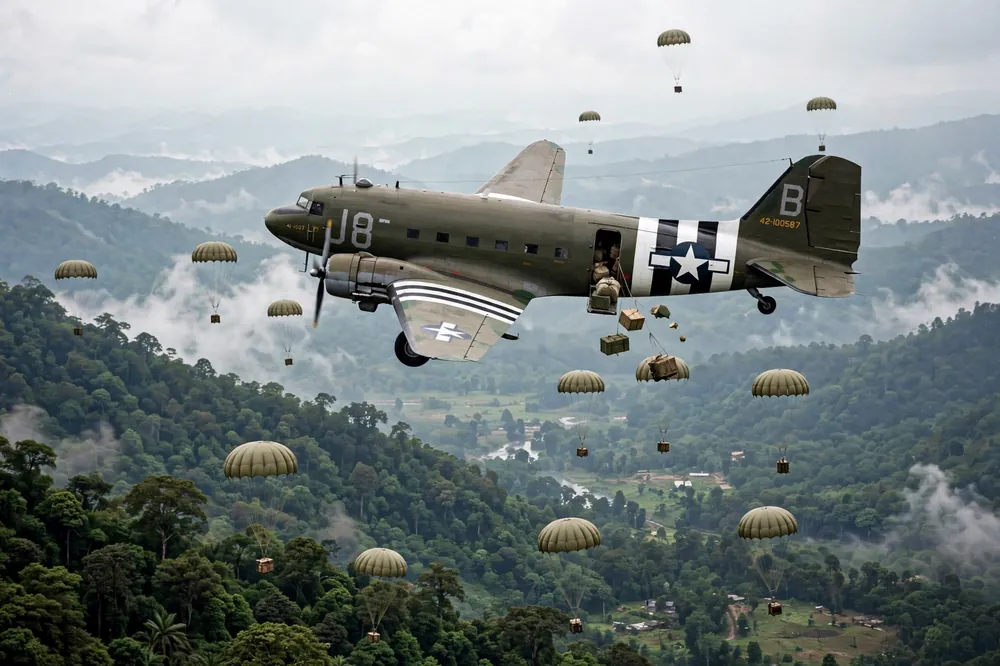
Every day of the siege, Dakotas landed at Imphal and dropped supplies to cut-off units, carrying in food, ammunition and even whole battalions, and carrying out the wounded. The Japanese had no answer to this: they could surround a position, but they could not starve it.
5. The Battle
The crossing of the Chindwin
The Japanese attack began on 8 March 1944, when the 33rd Division crossed the Chindwin and struck at the 17th Indian Division around Tiddim, south of Imphal. At the same time the 15th Division crossed further north, and the 31st Division marched on Kohima.
Slim’s forward divisions fought delaying actions as planned, but the withdrawal was harder than expected: the 17th Division had to fight its way back through the jungle along a single track, harassed by Japanese columns that had slipped through the hills.
The division reached Imphal on 29 March, having lost many of its vehicles and much of its equipment, but it arrived as a fighting force, and its stand had cost the Japanese time they could not afford. By the end of March the Japanese were around Imphal, and on 4 April the 31st Division reached Kohima.
The siege of Kohima
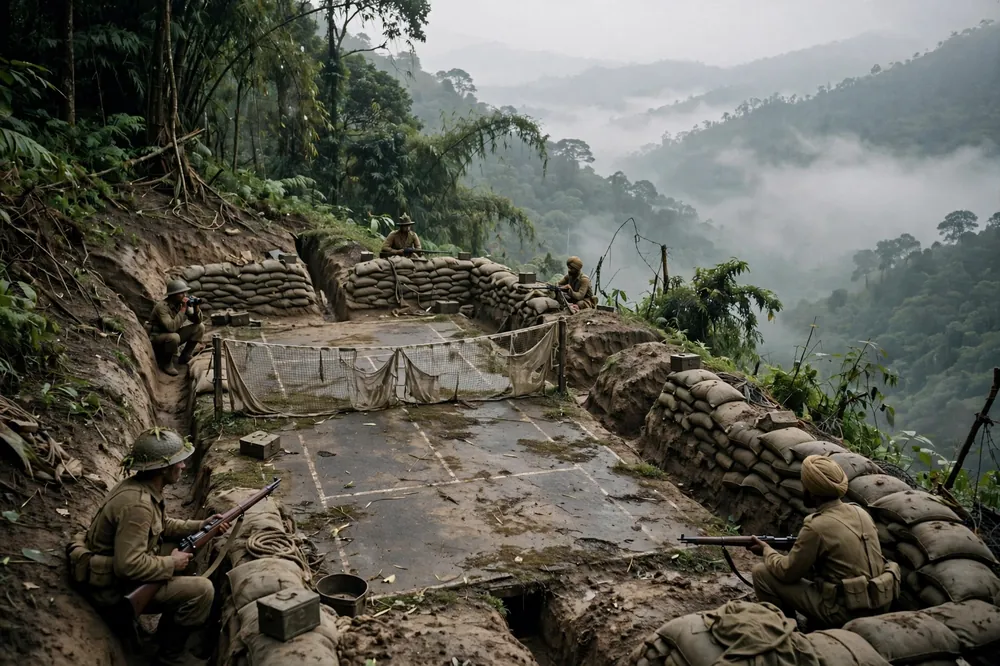
Kohima was a small hill town, and its garrison was tiny: about 1,500 men, mostly from the 4th Battalion, Royal West Kent Regiment, with some Indian troops and Assam Rifles, under Lieutenant Colonel Hugh Richards. Against them Sato brought some 12,000 to 15,000 men. The battle was fought over a ridge about a kilometre long, and at its centre was the bungalow of the district commissioner and its tennis court.
For two weeks, from 5 to 18 April, the fighting was hand to hand across a few dozen metres of ground: the tennis court itself changed hands repeatedly, and men fought with grenades, bayonets and entrenching tools. The garrison held the ridge, though by the end it was down to a few hundred effective men, short of water and ammunition, and supplied only by air drop.
On 18 April the leading troops of the British 2nd Division, which had marched and fought its way up the road from Dimapur, broke through to the garrison. The siege was lifted, but the battle for the Kohima ridge went on until late May, as the 2nd Division slowly pushed Sato’s men off the surrounding hills.
The siege of Imphal
At Imphal itself, the Japanese attacked the plain from the north, south and east through April and May. The fighting was a series of small, bitter actions around villages, airfields and hill features with names that became famous in the Indian Army: Nunshigum, Bishenpur, Nungshigum, the Shenam saddle.
The 5th Indian Division, flown in from the Arakan front, held the southern approaches; the 17th and 23rd Divisions held the north and east. The Japanese came close several times — at Bishenpur, in May, they reached the edge of the Imphal plain itself — but they never broke through. Their attacks grew weaker as their food ran out.
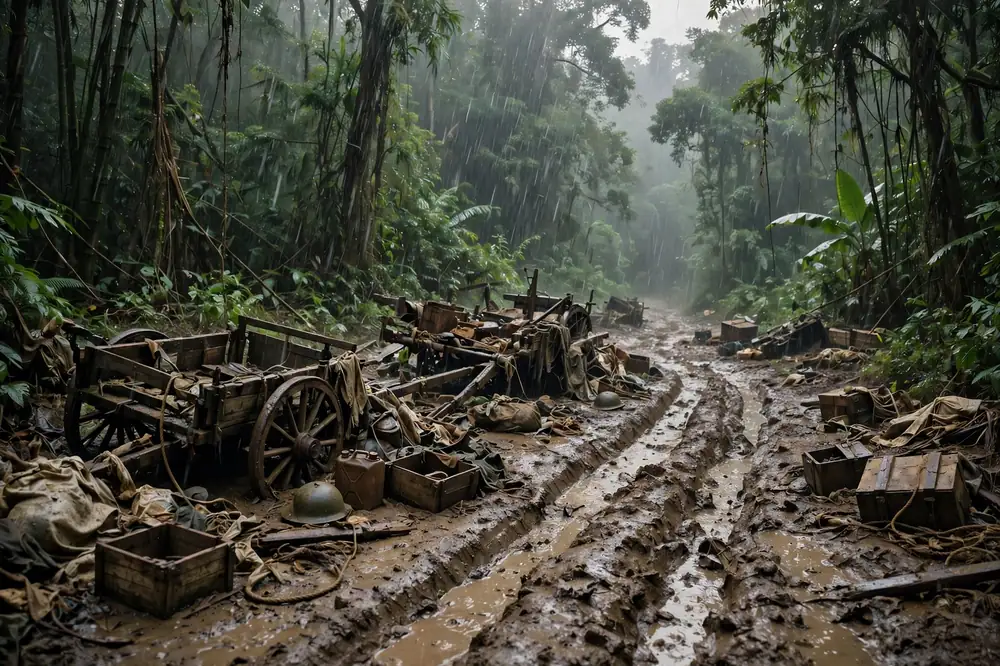
By May, Japanese soldiers were eating grass, roots and their own pack animals, and disease — malaria, dysentery and cholera — killed more men than British bullets. The monsoon broke in May, and the jungle tracks back to the Chindwin became rivers of mud. The Japanese supply system, which had always been thin, collapsed completely.
6. Turning Point
Air supply and the relief of Kohima
The turning point at Imphal was not a single battle but the failure of Japanese supply. Slim had designed the battle as a test of logistics, and the test was decided in the air. Dakota transports of the RAF and the USAAF flew thousands of sorties into Imphal, landing on airfields that were sometimes under Japanese shellfire, and dropping supplies to isolated units.
In June alone, the airlift delivered tens of thousands of tons of stores and flew in reinforcements, including the 5th Indian Division. The Japanese, by contrast, had planned to capture British stores and captured almost none. By early June, Mutaguchi’s divisions were starving, and their attacks had stopped.
The second turning point was the relief of Kohima on 22 June, when the 2nd Division finally linked up with the 5th Indian Division advancing north from Imphal along the Kohima road. The road was open again, and the Japanese at Imphal were cut off from their own retreat.
Sato’s disobedience
At Kohima, the turning point came from inside the Japanese command. Lieutenant General Sato, whose 31st Division had fought the garrison to a standstill and then been pushed off the ridge, received orders from Mutaguchi to stay and fight to the last man. Sato refused.
His division was starving, riddled with disease, and down to a fraction of its strength, and he believed the order was a waste of his men’s lives. At the end of May he withdrew his division towards the Chindwin, against orders — an act of disobedience almost unheard of in the Japanese Army, and one for which he was later dismissed.
His withdrawal opened the Kohima road and allowed the British to concentrate against Imphal. Mutaguchi, meanwhile, refused to accept that the offensive had failed, and kept his remaining divisions around Imphal until early July, when he finally ordered a retreat. By then it was too late for many of his men.
7. Casualties and Losses
The figures for Imphal-Kohima are estimates, and sources differ, but the scale of the Japanese disaster is not in doubt. The Japanese 15th Army lost about 50,000 to 55,000 men — killed in battle, dead of disease and starvation, wounded or missing — out of an army of about 85,000 to 100,000. Some estimates put Japanese deaths alone at more than 30,000.
The retreat to the Chindwin was a catastrophe: men died of hunger and sickness on the jungle tracks, and units that had marched into India as divisions came back as shattered remnants. The 31st Division, for example, is reported to have lost more than half its strength, and the 15th Division was effectively destroyed.
Allied casualties were far lighter, about 12,000 to 17,000 killed, wounded and missing, including heavy losses among the Indian divisions that bore most of the fighting and among the small Kohima garrison.
| Allies | Japan | |
|---|---|---|
| Killed | About 4,000–5,000 (estimate) | About 30,000+ dead, many of disease and starvation |
| Wounded and missing | About 8,000–12,000 (estimate) | About 20,000–25,000 (estimate) |
| Total | About 12,000–17,000 | About 50,000–55,000 |
| Disease | Malaria and dysentery controlled by medical care and air evacuation | Malaria, dysentery and cholera killed thousands on the retreat |
The disparity was the product of supply. The British wounded were flown out to hospitals in India; the Japanese wounded were carried on stretchers through the jungle, and many died on the way. The British sick were treated with quinine and new anti-malarial drugs; the Japanese sick had almost no medicine.
The battle also cost the Indian National Army heavily: its 1st Division, which had fought alongside the Japanese, lost many men and its survivors were disillusioned, and the movement it represented never recovered its credibility as a military force. For the Indian soldiers of the Fourteenth Army, by contrast, Imphal-Kohima became a point of pride — a battle won by Indian divisions, in which Indian officers and men had held the line against a Japanese army that had seemed invincible two years before.
8. Map and Geography
The Imphal plain and the Kohima road
Imphal lies on a plain about 35 kilometres long and 25 kilometres wide, ringed by jungle-covered hills, at an altitude of about 800 metres. The plain held the airfields, the supply depots and the headquarters of the Fourteenth Army, and it was the only flat ground in the region large enough for an army to operate.
Around it, the hills rise steeply, cut by narrow tracks and a few roads: the Tiddim road to the south, the Tamu road to the east, and the road north through Kohima to Dimapur. Whoever held the plain held the campaign, and whoever held the roads controlled the plain.
The Japanese plan depended on seizing the roads before the British could concentrate, and it failed because the British held both the plain and the northern road.
Jungle, monsoon and the Chindwin
The geography that made Imphal defensible also made the Japanese retreat a disaster. The Chindwin River, which the Japanese had crossed in March, lay about 150 kilometres west of Imphal through some of the most difficult country in Asia: steep, forested ridges, crossed by streams that became torrents in the monsoon. There were no roads, only tracks, and the monsoon rain of May, June and July turned them into mud.
Japanese soldiers retreating on foot, without food and often without boots, died in large numbers on those tracks. The monsoon also grounded aircraft and made air supply difficult, but by then the British no longer needed it: the road from Dimapur was open, and supplies came by truck.
The battle was, in the end, decided by the map — by a plain that could be supplied by air, a road that could be held, and a river that could not be crossed twice.
9. Outcome and Legacy of Imphal-Kohima
The destruction of the 15th Army
On 3 July 1944 Mutaguchi ordered the retreat, and the Japanese 15th Army ceased to exist as an effective force. The Fourteenth Army followed up, crossing the Chindwin in December 1944 and advancing into central Burma, and in 1945 it retook Mandalay and Rangoon. Imphal-Kohima was the turning point of the Burma Campaign: before it, the Japanese had always advanced; after it, they never mounted another major offensive in Asia.
The battle is sometimes called the “Stalingrad of the East”, a comparison that is misleading in scale but fair in meaning — it was the battle in which the Japanese Army’s offensive power was broken. In 2013, a panel of historians convened by the British National Army Museum voted Imphal-Kohima the greatest British battle of all time, ahead of Waterloo and D-Day, on the grounds that it was the battle that saved India and broke the Japanese Army.
Memory in India and Britain
Imphal-Kohima is remembered very differently in the three countries that fought it. In Britain it is the Fourteenth Army’s finest hour, remembered in the Kohima epitaph — “When you go home, tell them of us and say, for your tomorrow, we gave our today” — carved on the war memorial at Kohima, words taken from the Greek poet Simonides and written by John Maxwell Edmonds.
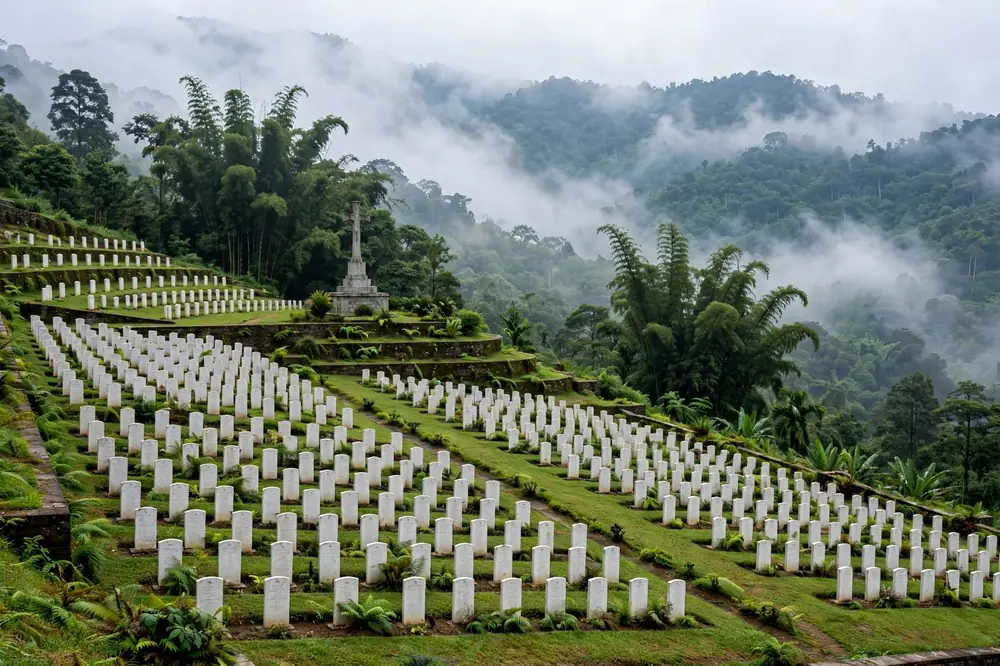
In India, the battle is remembered as a victory won largely by Indian soldiers, and the Imphal War Cemetery and the Kohima War Cemetery, maintained by the Commonwealth War Graves Commission, are visited by the families of the men buried there. In Japan, the battle is remembered as one of the worst disasters of the war, and Mutaguchi, who was dismissed in late 1944, became a symbol of reckless command.
The tennis court at Kohima, preserved as a memorial, remains one of the most visited battlefields of the Second World War in Asia.
10. Commanders
Lieutenant General William Slim (Britain). Commander of the Fourteenth Army and the architect of the victory. Slim, a former Indian Army officer who had been wounded at Gallipoli in the First World War, rebuilt the Fourteenth Army after its defeats of 1942 and 1943 and designed the battle of Imphal as a deliberate test of supply. After the war he became Chief of the Imperial General Staff and later Governor-General of Australia. He is remembered as one of the finest British generals of the Second World War.
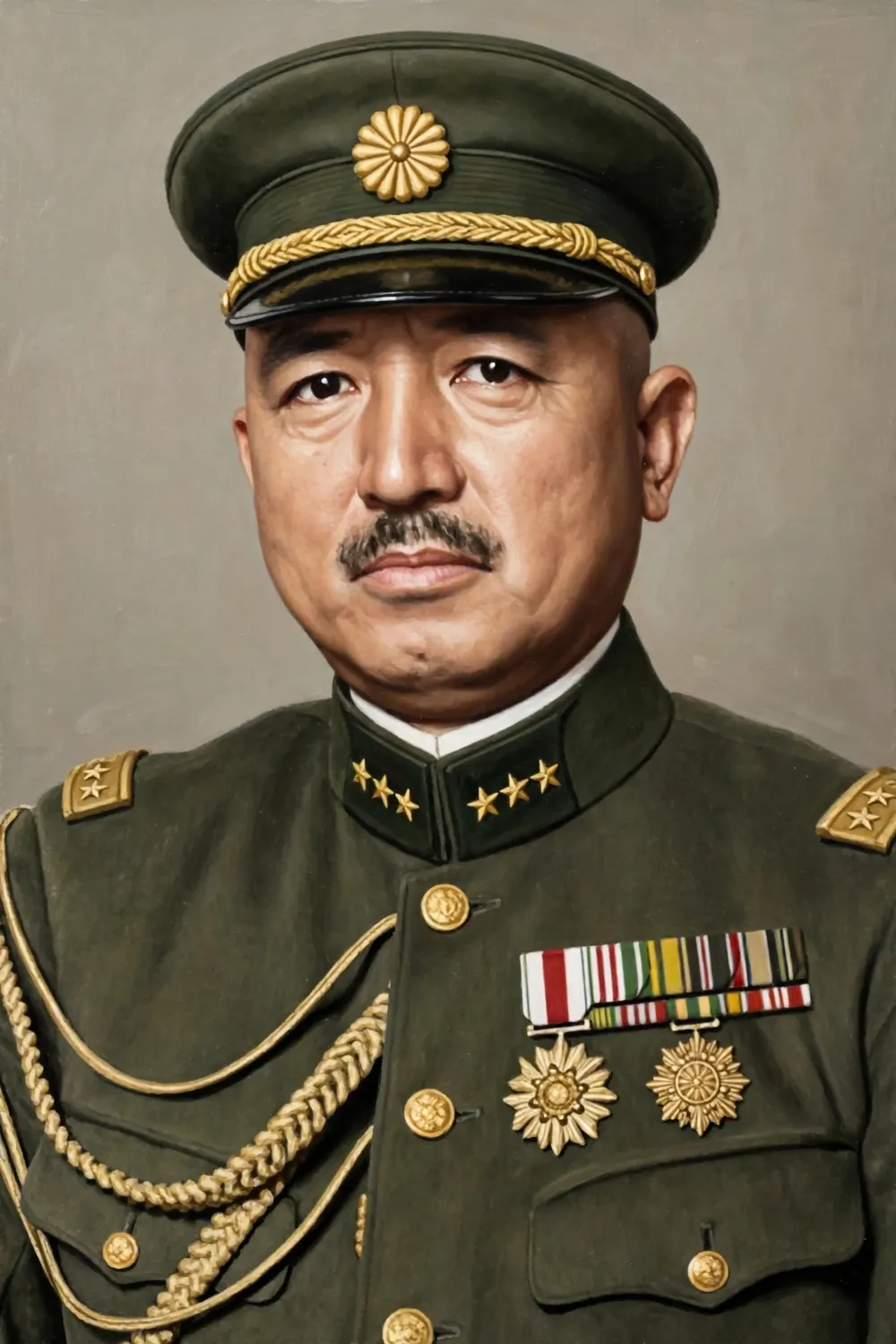
Lieutenant General Renya Mutaguchi (Japan). Commander of the 15th Army and the author of Operation U-Go. Mutaguchi, a veteran of the war in China, gambled his army on capturing British supplies and lost it. He refused to call off the offensive until July, by which time his army was destroyed, and he was dismissed in late 1944. He remained unrepentant, blaming his divisional commanders for the failure.
Lieutenant General Kotoku Sato (Japan). Commander of the 31st Division at Kohima. Sato fought the Kohima garrison to a standstill, then withdrew his starving division against orders in May 1944, an act of disobedience that saved many of his men and opened the Kohima road. He was dismissed and spent the rest of the war in obscurity.
Lieutenant Colonel Hugh Richards (Britain). Commander of the Kohima garrison. Richards, a Royal West Kent officer, held the Kohima ridge for two weeks with about 1,500 men against a division, directing the defence from his headquarters in the district commissioner’s bungalow. He was awarded the Distinguished Service Order.
Major General John Grover (Britain). Commander of the 2nd British Division, which relieved Kohima on 18 April 1944 and then fought the long battle for the surrounding hills. Grover’s division had marched up from Dimapur through the monsoon and fought its way through Japanese roadblocks to reach the garrison.
Lieutenant General Montagu Stopford (Britain). Commander of XXXIII Corps, which directed the relief of Kohima and the reopening of the Kohima–Imphal road. Stopford coordinated the 2nd Division’s advance and the 5th Indian Division’s push north from Imphal, and the two forces linked up on 22 June 1944.
11. Frequently Asked Questions
When were the Battles of Imphal and Kohima fought?
From 8 March to 3 July 1944. The siege of Kohima lasted from 4 to 18 April, though fighting on the ridge continued into June, and the siege of Imphal was lifted on 22 June, when the Kohima road was reopened. The dates matter because the two sieges were linked: Kohima guarded the road to Dimapur, and Imphal could only be relieved once that road was reopened. Fighting on the Kohima ridge went on into June, well after the siege itself was lifted, because the Japanese still held the high ground around the town.
Why is Kohima famous for a tennis court?
The battle was fought over a ridge about a kilometre long, and at its centre stood the bungalow of the district commissioner and its tennis court. The court changed hands repeatedly in hand-to-hand fighting, and it has become the symbol of the battle. It is preserved today as a memorial. The court became famous precisely because the fighting was so close and so personal: men fought across a space no larger than a garden, and neither side could bring its full firepower to bear. That is why the tennis court, rather than any larger feature of the ridge, came to stand for the whole battle in British memory.
How many Japanese soldiers died at Imphal-Kohima?
Japanese losses are estimated at 50,000 to 55,000 men, including those killed in battle and those who died of disease and starvation on the retreat. The exact figures are estimates, and sources differ, but the scale of the disaster is not disputed. The figure is so large because most of the losses came not in battle but on the retreat, when starving and sick men died on the jungle tracks back to the Chindwin. That is what makes Imphal-Kohima a disaster rather than simply a defeat: the Japanese Army lost not only a battle but the men and the organisation it needed to fight on in Burma.
What was Operation U-Go?
Operation U-Go was the Japanese offensive of March 1944, in which the 15th Army crossed the Chindwin River and invaded India, aiming to capture Imphal and Kohima. Its commander, Lieutenant General Mutaguchi, planned to supply his army from captured British stores, a gamble that failed. The gamble failed because the British did not collapse as Mutaguchi expected: Slim had stocked Imphal for a siege and planned to be supplied by air, so the captured stores the Japanese needed never materialised. U-Go therefore destroyed the army it was meant to save, and it ended Japan’s last attempt to invade India.
Who was William Slim? / William Slim là ai?
Lieutenant General William Slim commanded the British Fourteenth Army at Imphal-Kohima. He had rebuilt the army after its defeats of 1942 and 1943 and designed the battle as a deliberate test of supply, relying on air transport. He is remembered as one of the finest British generals of the Second World War. Slim’s achievement was to turn a defeated army into a victorious one: he retrained it for jungle fighting, rebuilt its confidence, and taught it to fight with air supply rather than with long road convoys. At Imphal-Kohima he deliberately let the Japanese come to him, and then held them until hunger and the monsoon did the rest.
Why is Imphal-Kohima called the greatest British battle?
In 2013, a panel convened by the National Army Museum voted it the greatest British battle, ahead of Waterloo and D-Day, because it saved India from invasion and destroyed the Japanese 15th Army. The verdict is a matter of judgement, not of fact, but it reflects the battle’s strategic importance. The vote surprised many people, because Waterloo and D-Day are far better known, but the panel judged the battle by its consequences: it saved India from invasion, it destroyed an entire Japanese army, and it opened the way for the reconquest of Burma.
12. Sources
- Wikipedia, “Battle of Imphal” and “Battle of Kohima” — dates, strength, casualty estimates and the course of the sieges.
- Louis Allen, Burma: The Longest War 1941–45 (J. M. Dent, 1984) — the standard history of the campaign, including the Japanese side.
- Field Marshal William Slim, Defeat into Victory (Cassell, 1956) — Slim’s own account of the Fourteenth Army and the battle.
- Fergal Keane, Road of Bones: The Siege of Kohima 1944 (HarperPress, 2010) — the siege of Kohima and the garrison’s defence.
- Commonwealth War Graves Commission, Kohima and Imphal War Cemeteries — the Kohima epitaph and the cemeteries’ history.
- National Army Museum, “Imphal and Kohima” — the 2013 vote naming the battle Britain’s greatest.
- Robert Lyman, Kohima 1944: The Battle That Saved India (Osprey, 2010).
- Raymond Callahan, Burma 1942–1945 (Davis-Poynter, 1978).