 WAR ATLAS MILITARY HISTORY MAGAZINE · WWI — WWII
Jisaburo Ozawa
1. Lead
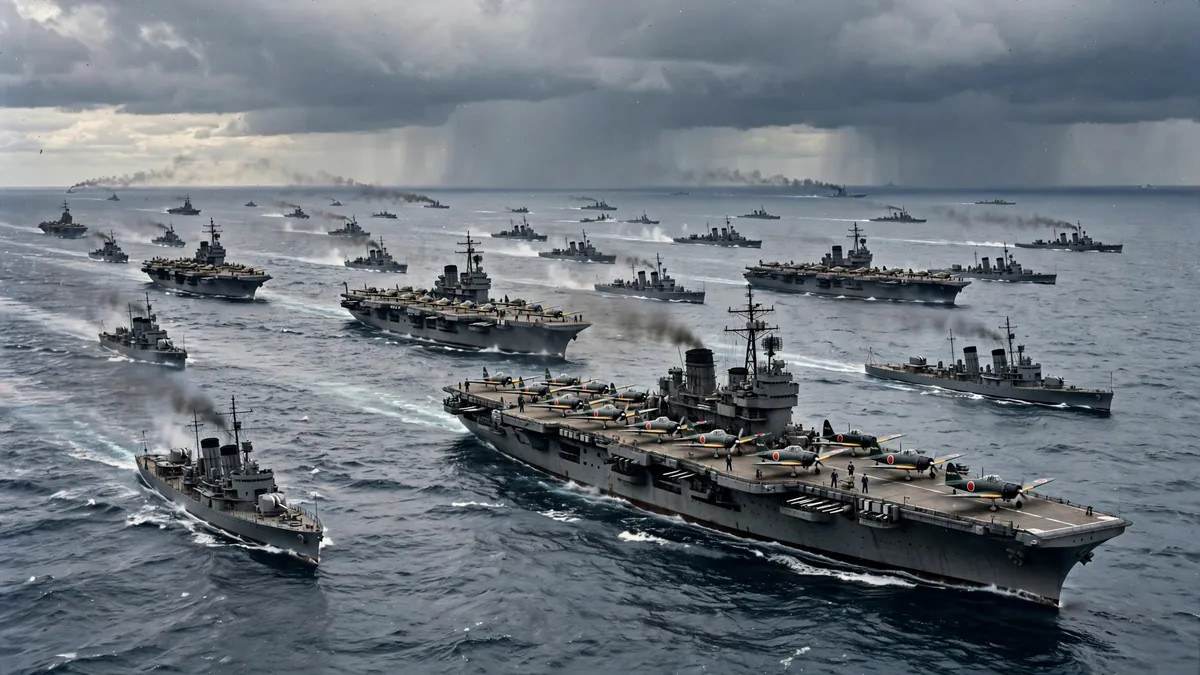
Jisaburo Ozawa (1886–1966) was the most important Japanese naval aviator of the Second World War and the man known as the father of Japanese naval aviation. A vice admiral who had spent his career building the Imperial Japanese Navy’s carrier air arm, he commanded the First Mobile Fleet in the great carrier battle of the Philippine Sea in June 1944, and he commanded the decoy Northern Force in the Battle of Leyte Gulf in October 1944, the largest naval battle in history.
Ozawa was a thoughtful, innovative officer, who understood carrier warfare better than any other Japanese admiral, and who warned, before the war, that Japan could not win a long war against the United States. His warnings were ignored, and he was left to fight the war he had predicted, with an air arm that had been destroyed and a fleet that was, by 1944, a shadow of its former self.
2. Key Facts
| Born | 2 October 1886, Miyazaki Prefecture, Japan |
| Died | 9 November 1966, Tokyo, Japan (aged 80) |
| Service | Imperial Japanese Navy, 1909–1945 |
| Commands | First Mobile Fleet; Northern Force (Leyte Gulf) |
| Known as | “Father of Japanese naval aviation” |
| Major battles | Philippine Sea (June 1944); Leyte Gulf (October 1944) |
| Final rank | Vice Admiral |
| Post-war role | Adviser on naval history; witness at war crimes trials |
3. Early Life and Naval Career
A samurai family
Jisaburo Ozawa was born on 2 October 1886 in Miyazaki Prefecture, on the island of Kyushu, into a family of samurai origin. He entered the Imperial Japanese Naval Academy at Etajima in 1906, graduating in 1909, and he served as a young officer in the Russo-Japanese War’s aftermath and in the First World War, in which Japan fought on the Allied side.
Ozawa was, from the start, a man of the new navy: he was interested in aviation, in submarines, and in the new technologies that were transforming naval warfare, and he was, by the standards of the Japanese navy, an independent thinker. He served in a series of sea and staff appointments, and he studied at the Naval War College, where he developed his ideas about carrier warfare.
By the 1930s he was one of the leading advocates of naval aviation in Japan, and he was known, even then, as the father of Japanese naval aviation.
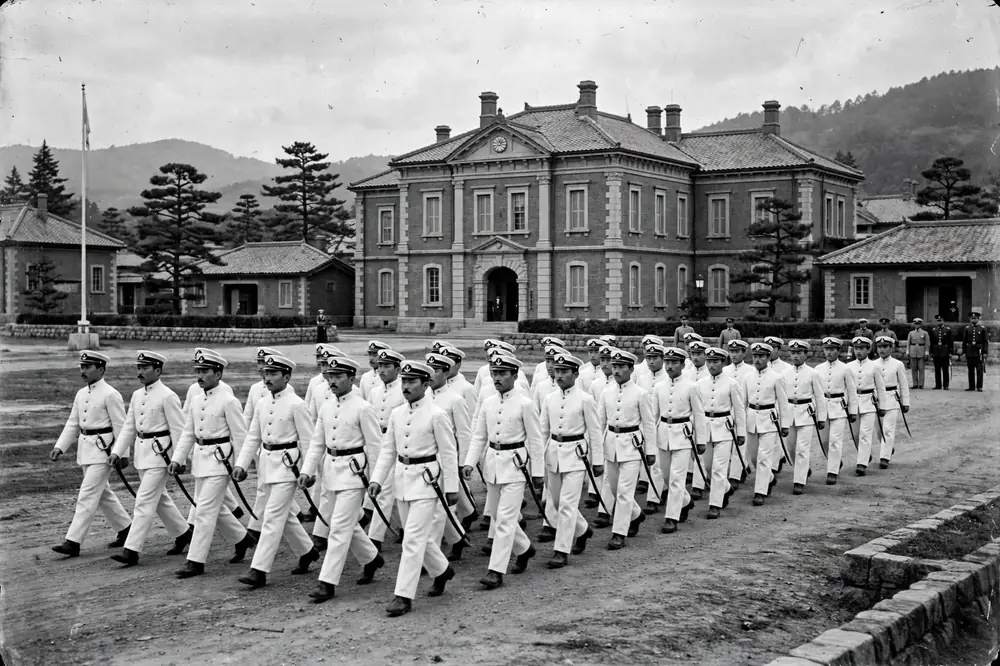
Ozawa entered the Imperial Japanese Naval Academy at Etajima in 1906, at the age of twenty, and he graduated in 1909, in a class that would supply many of the admirals of the Second World War. The Etajima academy, modelled on the British Royal Naval College at Dartmouth, trained its cadets in a demanding programme of seamanship, gunnery, navigation and tactics, and it instilled in them the values of the samurai tradition: duty, honour and self-sacrifice.
Ozawa, who was a serious and thoughtful young officer, took to the navy with enthusiasm, and he served in a series of sea appointments, aboard battleships and cruisers, where he learned the practical business of a ship at sea. He studied at the Naval War College, where he developed his ideas about carrier warfare, and he rose through the ranks, becoming, by the 1930s, one of the leading advocates of naval aviation in Japan.
Building the carrier force
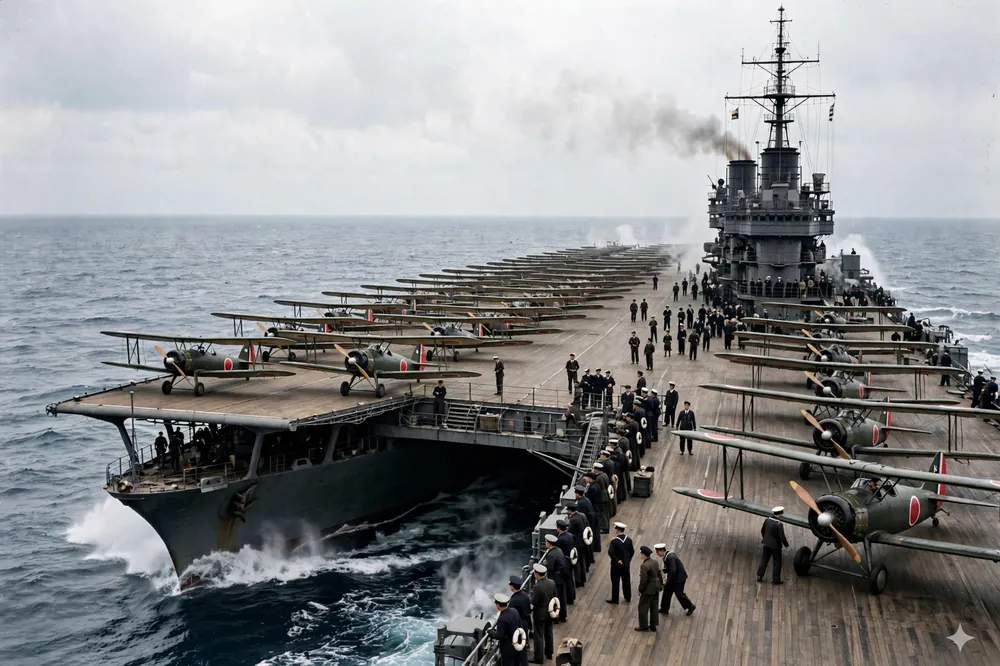
Ozawa’s great work in the 1930s was the building of Japan’s carrier air arm. He commanded the aircraft carrier Akagi, one of the two great carriers that would lead the attack on Pearl Harbor, and he served as chief of staff of the Combined Fleet’s air arm, where he was responsible for the training and the doctrine of Japan’s naval aviators.
Under his leadership, the Japanese naval air arm became the best in the world: its pilots were superbly trained, its aircraft — notably the Mitsubishi A6M Zero — were among the best in the world, and its tactics, developed for the attack on Pearl Harbor and for the great carrier battles of 1942, were revolutionary.
Ozawa’s contribution to this achievement is often overlooked, because he was not in command at Pearl Harbor or at Midway, but it was his work, in the 1930s, that made those operations possible.
4. The Pacific War
Warning against war
Ozawa, like Admiral Isoroku Yamamoto, warned before the war that Japan could not win a long war against the United States. He understood, better than most Japanese officers, the industrial power of the United States, and he knew that Japan’s carrier air arm, however good, could not be replaced once it was destroyed. His warnings were ignored, as Yamamoto’s were, and Japan went to war in December 1941.
Ozawa served in the early campaigns of the Pacific War, commanding naval forces in the South China Sea and in the Dutch East Indies, and he was, in 1942, given command of the naval forces in the Indian Ocean, where he led a raid against British shipping.
But the decisive battles of the carrier war — the Coral Sea, Midway, the Eastern Solomons and Santa Cruz — were fought by other admirals, and Ozawa, who was senior to many of them, was kept in secondary commands, in part because of his outspoken views and in part because of the politics of the Japanese navy.
The destruction of the air arm
By 1943, the Japanese naval air arm that Ozawa had built was being destroyed. The great carrier battles of 1942 had cost Japan four fleet carriers and, more importantly, the core of its trained naval aviators, and the battles of 1943 — in the Solomons and in the Central Pacific — cost it more.
The Japanese training system could not replace the lost pilots, and the new pilots, hastily trained, were no match for the Americans. Ozawa, who understood what was happening, argued for a conservation of the remaining carriers and pilots, and for a strategy that would preserve them for a decisive battle.
His arguments were, in the end, accepted, and in 1944 he was given command of the First Mobile Fleet, the reorganised Japanese carrier force, with orders to fight the decisive battle against the American fleet in the Marianas.
The battles of 1943, in the Solomons and in the Central Pacific, cost Japan more of its trained naval aviators, and the Japanese training system, which was slow and rigid, could not replace them. The American training system, by contrast, was producing pilots in large numbers, and the American pilots, who were, in 1941, less well trained than the Japanese, became, by 1944, the best in the world.
Ozawa, who understood what was happening, argued for a conservation of the remaining carriers and pilots, and for a strategy that would preserve them for a decisive battle, but his arguments were, for a time, ignored, and the Japanese naval air arm continued to be spent in battles it could not win.
By 1944, when Ozawa was given command of the First Mobile Fleet, the air arm he had built was a shadow of its former self, and the battle he was ordered to fight was one that Japan could not win.
5. The Battle of the Philippine Sea
The Great Marianas Turkey Shoot
The Battle of the Philippine Sea, fought on 19–20 June 1944, was the greatest carrier battle of the war, and it was a disaster for Japan. Ozawa, commanding the First Mobile Fleet, with nine carriers and some 430 aircraft, sailed to attack the American Fifth Fleet, under Admiral Raymond Spruance, which was supporting the invasion of Saipan.
Ozawa’s plan was sound: his aircraft, launched from beyond the range of the American carriers, would attack the American fleet, and his carriers, using their superior range, would remain out of reach. But the plan depended on his pilots, and his pilots, who were mostly inexperienced, were no match for the Americans.
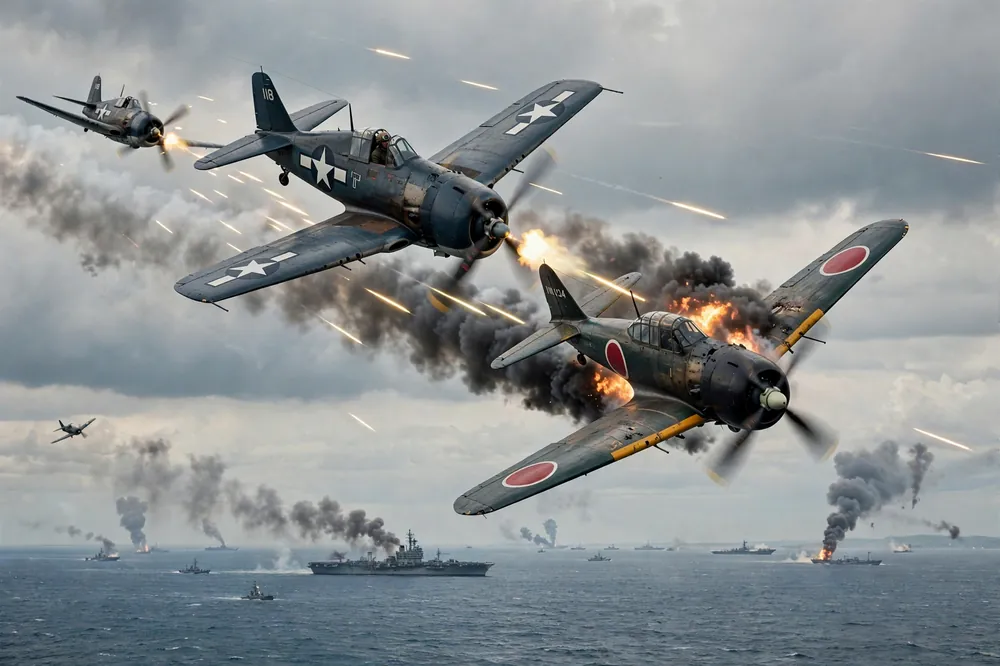
The American fighters, using radar and superior tactics, shot down the Japanese aircraft in large numbers — the battle became known to the Americans as the “Great Marianas Turkey Shoot” — and the American submarines sank three of Ozawa’s carriers, including his flagship, the Taiho, which was sunk by a single torpedo.
The loss of the air arm
The Philippine Sea cost Japan more than 400 aircraft and three carriers, and it destroyed, for the second time, the Japanese naval air arm. Ozawa, who had built that air arm, was left with a fleet of carriers that had almost no aircraft and almost no pilots, and with a navy that could no longer fight a carrier battle.
His conduct of the battle has been criticised — he underestimated the Americans, he overestimated his pilots, and he failed to coordinate his attacks — but historians today recognise that the battle was, in large part, lost before it was fought, because the Japanese pilots were not good enough and the American advantages in radar, in training and in numbers were too great.
Ozawa’s defeat at the Philippine Sea was not, in the end, a failure of command but a failure of the system that had produced his pilots, and of the war itself, which Japan could not win.
6. The Battle of Leyte Gulf
The decoy force
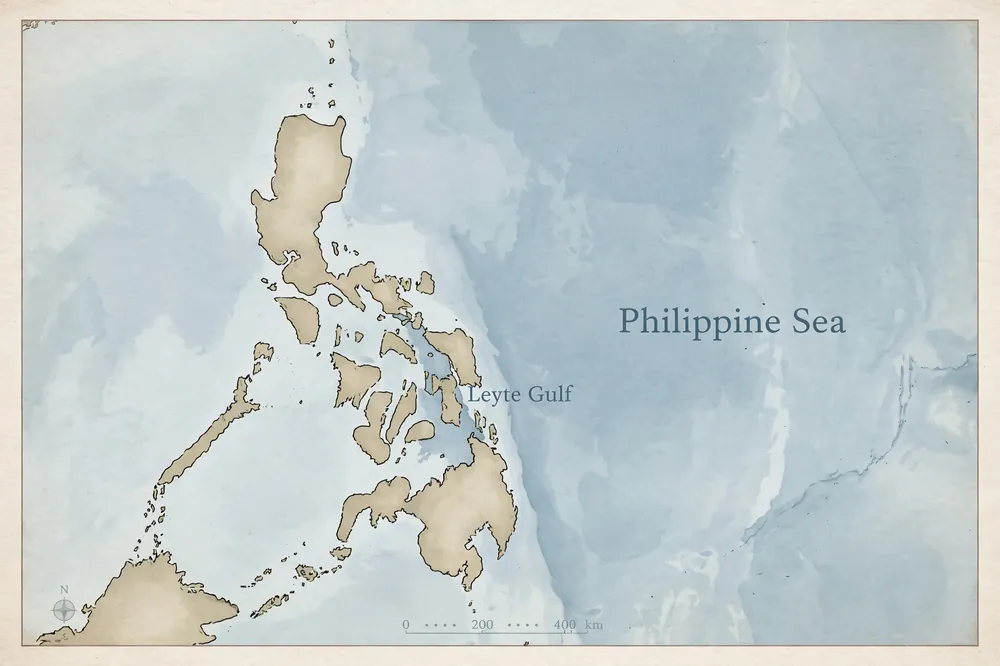
Ozawa’s last battle was the Battle of Leyte Gulf, fought on 23–26 October 1944, the largest naval battle in history. By October 1944 the Japanese carrier force was a hollow shell: Ozawa’s Northern Force, which sailed from Japan to the waters off the Philippines, consisted of four carriers — the Zuikaku, the last survivor of the Pearl Harbor attack, and three light carriers — with only about a hundred aircraft between them, most of them flown by inexperienced pilots.
The Japanese plan, known as Sho-Go, was a desperate one: Ozawa’s carriers would sail south, as a decoy, to lure the American Third Fleet, under Admiral William Halsey, away from the invasion beaches at Leyte, while the Japanese battleships, under Admirals Kurita and Nishimura, attacked the American invasion fleet.
Ozawa understood the plan, and he understood that his force was a sacrifice: his carriers, with almost no aircraft, could not fight a carrier battle, and their task was to be seen, to be attacked, and to draw Halsey away.
The Battle off Cape Engaño
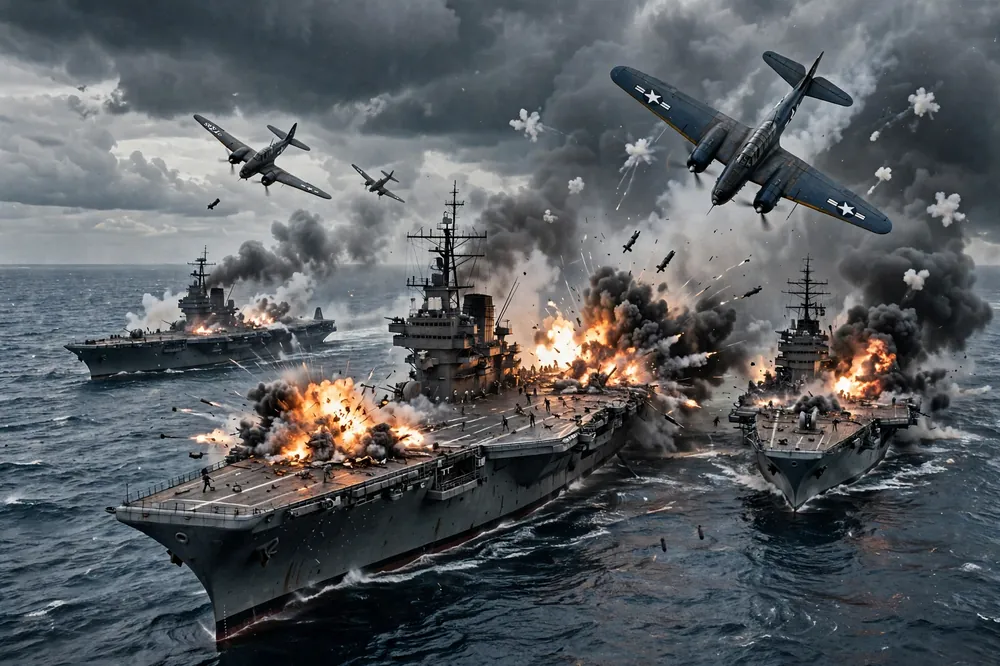
The decoy worked. Halsey, believing that Ozawa’s carriers were the main Japanese force, took his fleet north to attack them, leaving the invasion beaches at Leyte unprotected. On 25 October 1944, the American carriers attacked Ozawa’s force off Cape Engaño, sinking all four of his carriers, including the Zuikaku, and destroying his remaining aircraft.
Ozawa himself survived, transferring his flag to a cruiser, and he watched his carriers sink, knowing that he had done his duty: he had drawn Halsey away, and the Japanese battleships had, for a time, a clear run at the invasion fleet. But the battleships, after their own battles — the Surigao Strait and the Battle off Samar — turned back, and the Sho-Go plan failed.
Leyte Gulf was a decisive American victory, and it destroyed, for the last time, the Japanese carrier force that Ozawa had built. Ozawa’s sacrifice, like the sacrifice of his carriers, had been in vain.
7. The End of the War
The last months
After Leyte Gulf, Ozawa was given command of the Combined Fleet, the Imperial Japanese Navy’s main fleet, but there was, by then, almost no fleet left to command. The Japanese navy, which had once been the third largest in the world, was reduced to a handful of damaged ships, with no fuel, no aircraft and no trained crews, and Ozawa’s task was, in effect, to preside over its dissolution.
He was, in the last months of the war, a commander without a fleet, and he watched, from Tokyo, as the American bombers destroyed Japan’s cities and as the Soviet Union entered the war against Japan. When Japan surrendered in August 1945, Ozawa, who had warned against the war, was one of the officers who accepted the surrender, and he cooperated with the American occupation authorities, giving evidence about the Japanese navy’s operations and about the war itself.
After the war
After the war, Ozawa lived quietly in Tokyo, working as an adviser on naval history and giving evidence at the war crimes trials, where he testified about the Japanese navy’s operations and about the decisions that had led to the war. He was not, himself, charged with war crimes, and he was regarded by the Americans as a professional officer who had done his duty.
He wrote about the war, and he reflected on its lessons, and he was, in his later years, a respected figure in Japan’s naval history community. He died in Tokyo on 9 November 1966, aged eighty, one of the last of the great Japanese admirals of the Second World War.
His death was little noted outside Japan, but his place in history — as the father of Japanese naval aviation, and as the commander who fought the last carrier battles of the war — is secure.
8. Leadership and Character
A thinking admiral
Ozawa was, by the standards of the Imperial Japanese Navy, an unusual officer: he was thoughtful, innovative, and willing to question the orthodoxies of his service. He was a pioneer of carrier aviation, at a time when many Japanese admirals still believed in the battleship, and he was a critic of the navy’s training system, which he believed was too rigid and too slow to replace lost pilots.
His warnings about a long war with the United States, and his arguments for conserving the carrier force, were prescient, and they are remembered today as evidence of his strategic judgement. His men respected him, and his fellow officers, even those who disagreed with him, recognised his ability.
He was, in the words of one historian, “the most intelligent admiral in the Japanese navy”, and his career is a study in the tragedy of a man who understood the war he was fighting and could not prevent it.
The man behind the legend
Behind the public image of the father of Japanese naval aviation, Ozawa was a private and reserved man, devoted to his family and to his profession, and uncomfortable with the fame that his wartime commands had brought him. He was, by the standards of Japanese admirals, a man of the new navy, interested in technology and in ideas, rather than in tradition and in ceremony.
His life, from a samurai family in Miyazaki to the command of the First Mobile Fleet, is a story of a man who embraced the modern world, and who was, in the end, destroyed by it. His death, in 1966, at the age of eighty, was the end of a career that had spanned the whole history of Japanese naval aviation, from its beginnings in the 1920s to its destruction in 1944.
9. Legacy and Assessment
The father of Japanese naval aviation
Ozawa’s legacy is, above all, the Japanese naval air arm itself. He built it, in the 1930s, into the best carrier air arm in the world, and he commanded it, in 1944, in its last battles. His achievement in building the air arm is often overlooked, because the battles he fought were defeats, but it was a remarkable achievement, and it is the reason why he is remembered as the father of Japanese naval aviation.
His warnings about a long war, and his arguments for conserving the carrier force, are remembered as evidence of his strategic insight, and his conduct at Leyte Gulf — the willing sacrifice of his carriers as a decoy — is remembered as an act of duty, however futile.
His life is a reminder that the Japanese navy, for all its skill and its courage, was fighting a war it could not win, and that Ozawa, who understood this, was left to fight it anyway.
How history remembers him
Historians today remember Ozawa as one of the great admirals of the Pacific War, and as a figure whose importance goes beyond his battles. He is studied not only as a commander but as a military thinker, and his ideas about carrier warfare are compared with those of the great American admirals, Nimitz, Spruance and Halsey.
His life, from Miyazaki to Leyte Gulf, is a story of a man who built a weapon, warned that it could not win the war, and then used it in the war’s last battles, knowing that it would be destroyed. His name is remembered in Japan as one of the great naval officers of the twentieth century, and his story continues to be told in histories of the Pacific War.
10. The Pacific Naval War
The carrier war
Ozawa’s career is, in miniature, the story of the carrier war in the Pacific: from the building of the Japanese carrier force in the 1930s, through its triumphs at Pearl Harbor and in the Indian Ocean, to its destruction at Midway, in the Solomons, at the Philippine Sea and at Leyte Gulf.
The carrier war was the decisive naval war of the Second World War, and it was fought, in large part, by the men Ozawa had trained. The American victory in the carrier war was a victory of industry, of training, and of numbers, and it was also a victory of a system that could replace its losses, against a system that could not.
Ozawa understood this, and he warned against it, and his career is a testament to the tragedy of a navy that built the best carrier air arm in the world and then lost it, in two years, because it could not replace what it had lost.
The lessons of the Pacific War
The Pacific War’s lessons, as Ozawa understood them, were lessons about industry, about training, and about the limits of courage and skill. The Japanese naval aviators were, in 1941, the best in the world, but they were too few, and they could not be replaced, and the American naval aviators, who were, in 1941, less well trained, became, by 1944, the best in the world, because the American training system could produce them in large numbers.
Ozawa’s story is a reminder that wars are not won by heroes alone, but by systems, and that the side with the better system, in the end, wins. His life, and his warnings, are a part of the history of the Pacific War, and they are still studied today by naval historians and by students of military strategy.
11. Frequently Asked Questions
Who was Jisaburo Ozawa? / Jisaburo Ozawa là ai?
He was a Japanese vice admiral, known as the father of Japanese naval aviation, who commanded the First Mobile Fleet at the Battle of the Philippine Sea in June 1944 and the decoy Northern Force at the Battle of Leyte Gulf in October 1944. He was a vice admiral who had spent his career building the Imperial Japanese Navy’s carrier air arm, and he was known as the father of Japanese naval aviation. He commanded the First Mobile Fleet in the great carrier battle of the Philippine Sea in June 1944, and he commanded the decoy Northern Force in the Battle of Leyte Gulf in October 1944.
What was the Battle of the Philippine Sea?
It was the greatest carrier battle of the war, fought on 19–20 June 1944, in which Ozawa’s First Mobile Fleet lost three carriers and more than 400 aircraft to the American Fifth Fleet. The Americans called it the “Great Marianas Turkey Shoot”. Ozawa’s First Mobile Fleet, with nine carriers and some 430 aircraft, sailed to attack the American Fifth Fleet, under Admiral Raymond Spruance, which was supporting the invasion of Saipan. The battle cost Japan more than 400 aircraft and three carriers, and it destroyed, for the second time, the Japanese naval air arm.
What was Ozawa’s role at Leyte Gulf?
He commanded the Northern Force, four carriers with only about a hundred aircraft, as a decoy to lure Admiral Halsey’s Third Fleet away from the invasion beaches at Leyte. The decoy worked, but the Japanese battleships failed to destroy the invasion fleet, and all four of Ozawa’s carriers were sunk. Ozawa understood the plan, and he understood that his force was a sacrifice: his carriers, with almost no aircraft, could not fight a carrier battle, and their task was to be seen, to be attacked, and to draw Halsey away.
Why is Ozawa called the father of Japanese naval aviation?
Because he built Japan’s carrier air arm in the 1930s, commanding the carrier Akagi and serving as chief of staff of the Combined Fleet’s air arm, where he was responsible for the training and doctrine of Japan’s naval aviators. He commanded the aircraft carrier Akagi, one of the two great carriers that would lead the attack on Pearl Harbor, and he served as chief of staff of the Combined Fleet’s air arm. Under his leadership, the Japanese naval air arm became the best in the world, with superbly trained pilots and the Mitsubishi A6M Zero, among the best aircraft in the world.
Did Ozawa warn against war with the United States?
Yes. Like Admiral Yamamoto, he warned that Japan could not win a long war against the United States, because of American industrial power. His warnings were ignored, and Japan went to war in December 1941. He understood, better than most Japanese officers, the industrial power of the United States, and he knew that Japan’s carrier air arm, however good, could not be replaced once it was destroyed. His warnings were ignored, as Yamamoto’s were, and Japan went to war in December 1941, in a war that Ozawa had predicted it could not win.
When did Ozawa die?
He died in Tokyo on 9 November 1966, aged eighty, one of the last of the great Japanese admirals of the Second World War. He was not charged with war crimes, and he was regarded by the Americans as a professional officer who had done his duty, and who had warned against the war before it began. He was not charged with war crimes, and he was regarded by the Americans as a professional officer who had done his duty, and he lived quietly in Tokyo, working as an adviser on naval history.
12. Sources
- Wikipedia, “Jisaburo Ozawa” — birth and death dates, First Mobile Fleet, Philippine Sea, Leyte Gulf, father of Japanese naval aviation.
- Wikipedia, “Battle of the Philippine Sea” — the battle, the “Great Marianas Turkey Shoot”, the loss of three carriers.
- Wikipedia, “Battle of Leyte Gulf” — the largest naval battle in history, Ozawa’s decoy force, the Battle off Cape Engaño.
- Samuel Eliot Morison, History of United States Naval Operations in World War II, Vols. VIII and XII — the Philippine Sea and Leyte Gulf.
- Paul S. Dull, A Battle History of the Imperial Japanese Navy, 1941–1945 (Naval Institute Press, 1978) — the Japanese navy and its admirals.
- Mark R. Peattie, Sunburst: The Rise of Japanese Naval Air Power, 1909–1941 (Naval Institute Press, 2001) — the building of Japanese naval aviation.
- Jonathan Parshall and Anthony Tully, Shattered Sword: The Untold Story of the Battle of Midway (Potomac, 2005).
- H. P. Willmott, The Battle of Leyte Gulf (Indiana University Press, 2005).