 WAR ATLAS MILITARY HISTORY MAGAZINE · WWI — WWII
Juno Beach
1. Lead
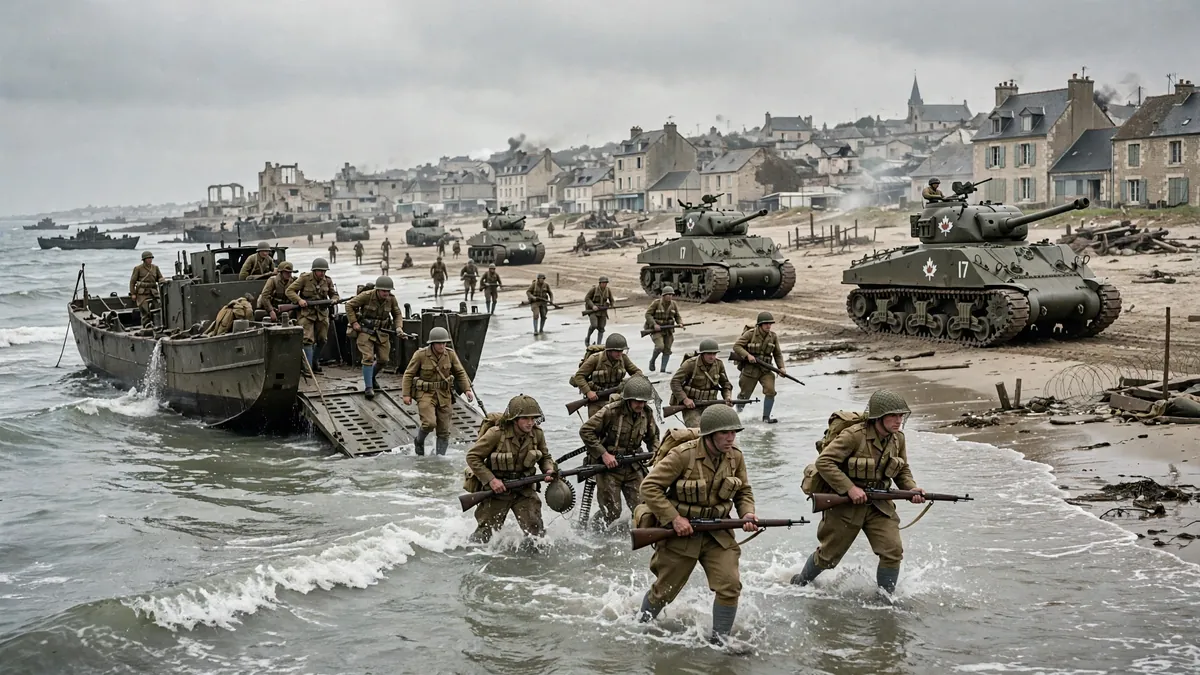
Juno Beach was the Canadian landing beach on D-Day, 6 June 1944. On a stretch of Normandy coast about 8 kilometres long, between the villages of Saint-Aubin-sur-Mer and Courseulles-sur-Mer, the 3rd Canadian Infantry Division — supported by the 2nd Canadian Armoured Brigade and the guns of the Royal Navy — came ashore against the German 716th Infantry Division and elements of the 21st Panzer Division.
The Canadians fought through flooded ground, strongpoints and a fortified seaside town, and by nightfall they had advanced further inland than any other Allied force that day, reaching almost to the Caen–Bayeux road. The cost was about 1,200 Canadian casualties, including about 340 killed. Juno was Canada’s D-Day, and it was the day the Canadian Army came of age.
2. Key Facts
| Date | 6 June 1944 (D-Day) |
| Location | Normandy coast between Saint-Aubin-sur-Mer and Courseulles-sur-Mer, France |
| Result | Allied victory; Canadians advance furthest inland of any beach on D-Day |
| Allied commanders | Maj. Gen. Rod Keller (3rd Canadian Infantry Division); Lt. Gen. John Crocker (British I Corps) |
| German commanders | Generalleutnant Wilhelm Richter (716th Infantry Division); Generalleutnant Edgar Feuchtinger (21st Panzer Division) |
| Allied strength | About 21,400 men landed on 6 June; 3rd Canadian Infantry Division, 2nd Canadian Armoured Brigade, plus British Commandos |
| German strength | About 7,000 men of the 716th Infantry Division on the beach; 21st Panzer Division inland |
| Allied losses | About 1,200 Canadian casualties (about 340 killed, about 570 wounded, about 250 missing or taken prisoner) |
| German losses | Estimated 1,000 or more killed, wounded and captured |
3. Background
Juno Beach was one of the five landing beaches of Operation Neptune, the seaborne invasion of Normandy. It lay between Gold Beach, the British beach to the west, and Sword Beach, the British beach to the east, and its objectives were the most ambitious of any beach on D-Day: the Canadians were to land, clear the beach, and advance about 15 kilometres inland to the Caen–Bayeux road and the airfield at Carpiquet, west of Caen. No other beach was asked to go so far on the first day.
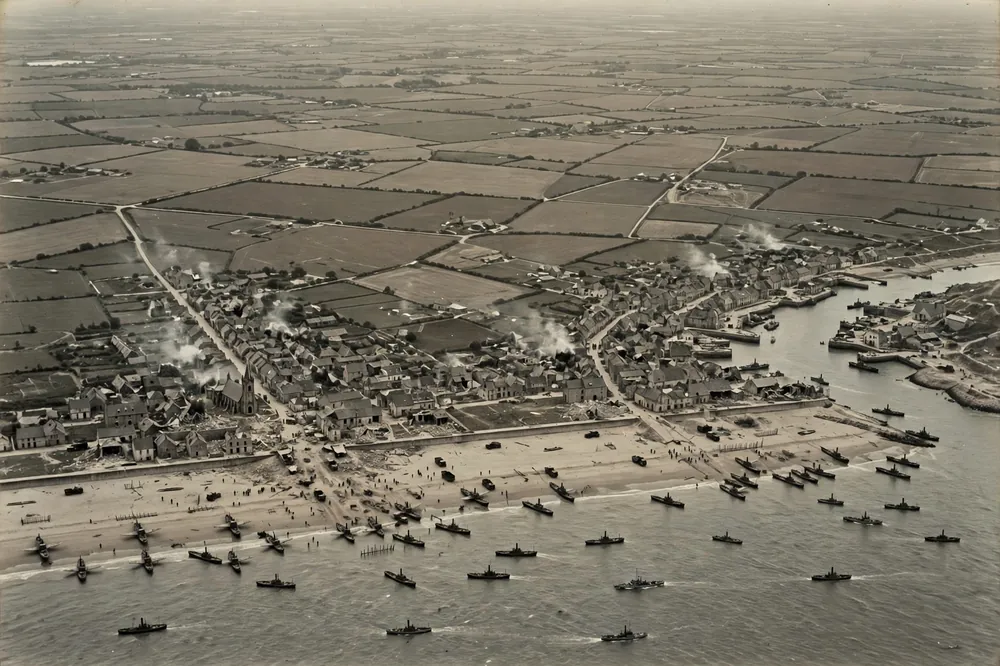
The beach itself was about 8 kilometres long, from Saint-Aubin-sur-Mer in the east to Courseulles-sur-Mer in the west, and it was divided into three sectors: Nan White, Nan Red and Mike. Behind the sand lay a seawall, and behind the seawall the seaside villages of Bernières-sur-Mer, Saint-Aubin-sur-Mer and Courseulles-sur-Mer, whose houses, hotels and villas had been fortified by the Germans into strongpoints.
Behind the villages the ground was low and flat, with marshes and flooded fields, and then it rose gently towards the Caen–Bayeux road. The beach was defended by the German 716th Infantry Division, a static coastal division under Generalleutnant Wilhelm Richter, with its 736th Grenadier Regiment on the beach itself.
The 716th was not a first-rate formation — it was made up largely of older men and conscripts from occupied countries — but it was well dug in, and its positions were covered by concrete gun casemates, machine-gun nests and artillery.
The Canadian force was the 3rd Canadian Infantry Division under Major General Rod Keller, a division that had been training in England for two years and had never been in battle. It was supported by the 2nd Canadian Armoured Brigade, whose tanks — including the Sherman DD amphibious tanks — were to land with the infantry, and by the guns of the Royal Navy’s Force J, which included the cruisers Belfast and Diadem and eleven destroyers.
The Royal Air Force and the Royal Canadian Air Force provided air support. The Canadians were also joined by British Commandos of No. 48 (Royal Marine) Commando, who landed at Saint-Aubin-sur-Mer, and by the French Commandos of No. 10 (Inter-Allied) Commando, under Commandant Philippe Kieffer, who landed at Ouistreham, on Sword Beach, but whose story is part of the Juno landings.
The Canadian plan was a model of careful preparation. The beach had been photographed from the air, the German positions had been plotted, and the assault was rehearsed in England. The infantry were to land at 07:35, five minutes after the British at Gold and Sword, and the tanks were to land with them. The engineers were to clear the beach obstacles, and the follow-on brigades were to push inland.
The plan, like the plan at Omaha Beach, depended on the preliminary bombardment destroying the German defences. At Juno, unlike Omaha, the bombardment worked: the naval guns, firing at close range, and the air attacks, which were more accurate than at Omaha, knocked out many of the German gun positions before the infantry landed.
4. Opposing Forces
The Canadian landing force was built around the 3rd Canadian Infantry Division, with three infantry brigades — the 7th, 8th and 9th — and the 2nd Canadian Armoured Brigade, with three tank regiments. The first wave was made up of the 7th and 8th Brigades, landing on Nan and Mike sectors, with the tanks of the 2nd Armoured Brigade landing alongside them. The 9th Brigade was the reserve, to be landed later in the day and to push inland. The whole force was supported by the Royal Navy’s Force J, by the Royal Air Force, and by the engineers and artillery that followed the infantry ashore.
| Allies | Germany | |
|---|---|---|
| Infantry | 3rd Canadian Infantry Division: 7th, 8th and 9th Brigades (Regina Rifles, Royal Winnipeg Rifles, Canadian Scottish, North Shore, Queen’s Own Rifles, North Nova Scotia Highlanders, Highland Light Infantry, Stormont, Dundas and Glengarry Highlanders) | 716th Infantry Division: 736th Grenadier Regiment on the beach; 171st Grenadier Regiment in reserve |
| Tanks | 2nd Canadian Armoured Brigade: 6th, 10th and 27th Armoured Regiments (Sherman, including DD tanks) | 21st Panzer Division inland (about 120 tanks), plus assault guns |
| Naval gunfire | Cruisers Belfast and Diadem, 11 destroyers, plus landing craft gun support | Coastal batteries at Courseulles and Saint-Aubin |
| Air support | RAF and RCAF | Luftwaffe: almost no aircraft over Normandy on 6 June |
| Commandos | No. 48 (Royal Marine) Commando; French Commandos of No. 10 Commando | — |
The German defenders on the beach were the 736th Grenadier Regiment of the 716th Infantry Division, about 3,000 men, in strongpoints along the beach and in the fortified villages. Their positions were concrete: gun casemates, machine-gun nests and observation posts, protected by minefields, wire and beach obstacles. Behind them, inland, was the 21st Panzer Division under Generalleutnant Edgar Feuchtinger, the only German armoured division close to the beaches on D-Day, with about 120 tanks. The 21st Panzer was the division that would counterattack the Canadians during the day, and its failure to do so effectively was one of the reasons the Canadians got so far inland.
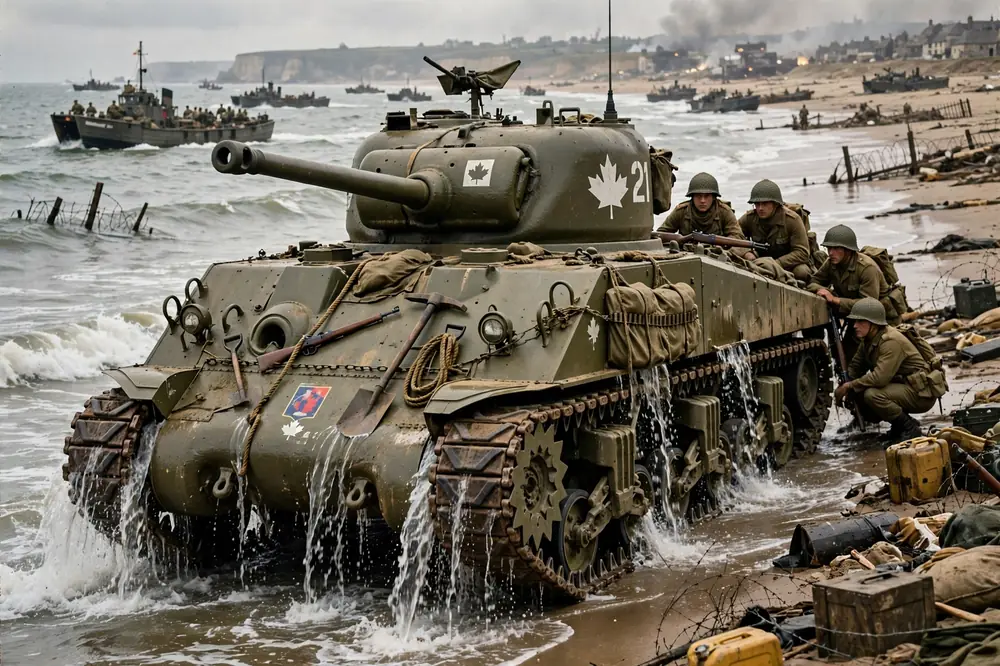
The Canadian tanks were the key to the landing. The Sherman DD tanks of the 6th and 10th Armoured Regiments were launched offshore and swam to the beach, and — unlike at Omaha, where the sea was rougher — most of them made it ashore. The tanks gave the infantry the fire support they needed to reduce the German strongpoints, and they were the reason the Canadians were able to get off the beach and inland. The Canadian infantry, for their part, were well trained and well led: their officers had studied the lessons of Dieppe, the disastrous Canadian raid of 1942, and they were determined not to repeat them.
5. The Battle
The landing, 07:35
The first Canadians landed at 07:35, ten minutes late — the tide was higher than expected, and the beach obstacles were already partly submerged, which made the engineers’ work harder and forced the landing craft to come in further. The first waves came under fire from the German strongpoints, and the casualties were heavy in the first minutes: the Queen’s Own Rifles of Canada, landing at Bernières-sur-Mer, lost more men in the first minutes than any other Canadian unit on D-Day. But the tanks were ashore with the infantry, and the naval gunfire had done its work: many of the German gun positions were already destroyed, and the infantry, supported by the tanks, began to clear the beach.
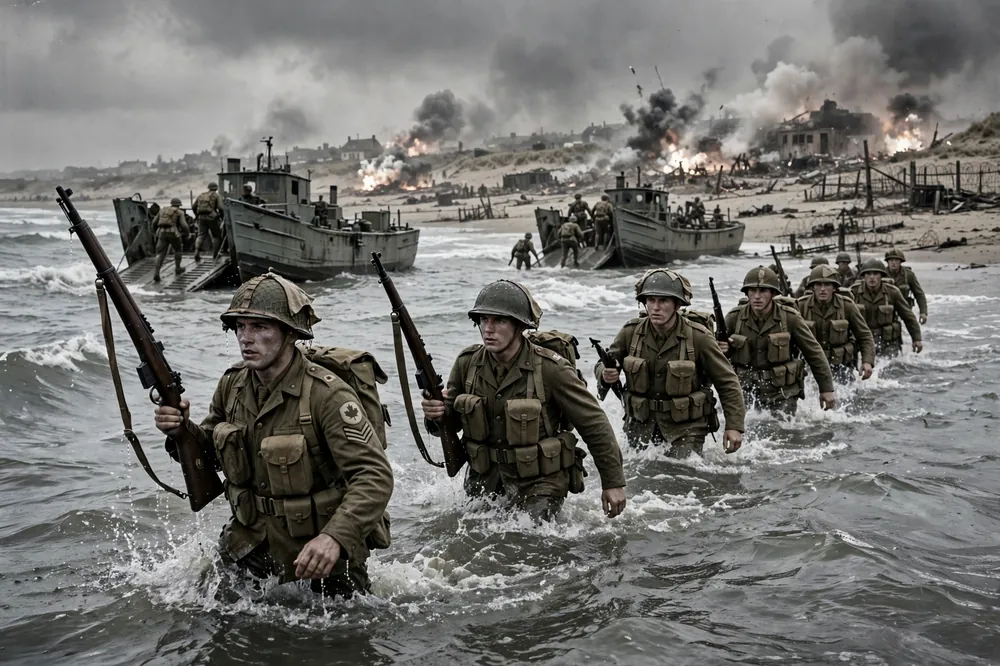
The fighting in the villages was house to house. At Courseulles-sur-Mer, the Royal Winnipeg Rifles and the Regina Rifles fought through the fortified houses, clearing them one by one with grenades and small-arms fire. At Bernières-sur-Mer, the Queen’s Own Rifles and the North Shore Regiment cleared the seafront houses and pushed inland. At Saint-Aubin-sur-Mer, the North Shore Regiment and No. 48 Commando fought through the strongpoint that guarded the eastern end of the beach. By about 10:00, the beach was largely clear, and the follow-on brigades were landing. The Canadians were off the beach — and ahead of schedule.
Inland
The advance inland was rapid, and it was led by the tanks. The 9th Brigade, landing in the late morning, pushed south towards the Caen–Bayeux road, and by the afternoon the Canadians were fighting in the villages of Authie, Buron and Villons-les-Buissons, a few kilometres from Caen. The North Nova Scotia Highlanders and the Sherbrooke Fusiliers reached Authie by the evening, and the Highland Light Infantry reached Buron. The Canadians had advanced about 10 kilometres inland — further than any other Allied force on D-Day — and they were within sight of the road to Caen.
The advance was stopped, not by the beach defences, but by the 21st Panzer Division and by the 12th SS Panzer Division, which was moving up from the south. The 21st Panzer, which had spent the morning counterattacking the British at Sword Beach, turned west in the afternoon and struck the Canadian flank.
The 12th SS Panzer Division, the Hitler Youth division, was still moving into position, and its leading elements met the Canadians at Authie and Buron on the evening of 6 June and the morning of 7 June. The fighting at Authie and Buron was fierce: the North Nova Scotia Highlanders were overrun at Authie, losing about 100 men killed and many more taken prisoner, and the Highland Light Infantry were driven out of Buron.
The Canadian advance stopped short of Caen, and the line stabilised a few kilometres from the city.
The 21st Panzer Division’s counterattack was, in the end, a failure. Its commander, Feuchtinger, had spent the morning waiting for orders, and by the time the division attacked, the Allies were already ashore in strength. The division’s tanks reached the coast between Juno and Sword in the late afternoon, but they were alone, without infantry support, and they were driven back by naval gunfire and by the Allied tanks. The German counterattack that might have driven the Allies back into the sea — the attack the German command had planned for — never materialised, because the German command was slow, divided and, above all, unable to move its armoured reserves without Hitler’s order.
By nightfall on 6 June, the Canadians held a beachhead about 10 kilometres deep, the deepest of any beach that day. They had taken about 1,200 casualties, including about 340 killed. The beach was secure, the follow-on divisions were landing, and the Canadians were dug in on the road to Caen. The next day, 7 June, the fighting continued at Authie and Buron, and the Canadians held their ground. Caen itself would not fall until July, after a long and costly battle, but the Canadians had done what they were asked to do on D-Day, and they had done it further and faster than anyone else.
6. Turning Point
The turning point at Juno was the moment, in the first hour, when the tanks got ashore. The DD tanks of the 6th and 10th Armoured Regiments, launched offshore in a rough sea, mostly made it to the beach — and their fire, directed at the German strongpoints, was what allowed the infantry to get off the sand. At Omaha, where the DD tanks sank, the infantry were pinned for hours; at Juno, where the tanks landed, the infantry were off the beach by mid-morning. The difference between the two beaches was, in large part, the difference between tanks that swam and tanks that sank.
The second turning point was the failure of the German counterattack. The 21st Panzer Division was the only German armoured division in a position to strike the beaches on D-Day, and it spent the day divided between two objectives — the British at Sword and the Canadians at Juno — and waiting for orders that came too late.
Its tanks reached the coast in the late afternoon, but they were alone, and they were driven back. Had the 21st Panzer attacked in strength in the morning, with the 12th SS Panzer Division behind it, the Canadian advance might have been stopped on the beach. Instead, the Canadians were 10 kilometres inland by nightfall, and the German chance to drive the Allies back into the sea was gone.
The third turning point was at Authie and Buron, on the evening of 6 June and the morning of 7 June. The fighting there stopped the Canadian advance short of Caen, and it set the pattern for the next month: the Canadians would fight a hard, attritional battle for the ground south of Juno, against the SS panzer divisions, and Caen would not fall until July. Juno’s success on D-Day was real, but it was not the end of the battle. It was the beginning of a longer, harder fight for Normandy.
7. Casualties and Losses
The Canadian casualties at Juno Beach on 6 June 1944 were about 1,200, of whom about 340 were killed. The commonly cited breakdown is about 340 killed, about 570 wounded and about 250 missing or taken prisoner, though the exact figures vary by source. The Queen’s Own Rifles suffered the heaviest losses of any Canadian unit on D-Day, with about 60 killed and many more wounded in the first minutes at Bernières-sur-Mer.
| Canada / Canada | Germany | |
|---|---|---|
| Killed | About 340 | Estimated 400–500 |
| Wounded | About 570 | Estimated 400–500 |
| Missing or taken prisoner | About 250 | Estimated 200–300 |
| Total | About 1,200 on 6 June | About 1,000 or more on 6 June |
| Tanks | Several DD tanks lost offshore; others knocked out on the beach | A number of tanks of the 21st Panzer Division destroyed |
German losses at Juno are harder to establish, because the 716th Division’s records for 6 June are incomplete. The figure of about 1,000 German casualties is an estimate. The 716th Division was badly hurt: its 736th Regiment was largely destroyed on the beach, and the division never recovered as a fighting formation. The 21st Panzer Division lost tanks in its counterattack, but it remained in action.
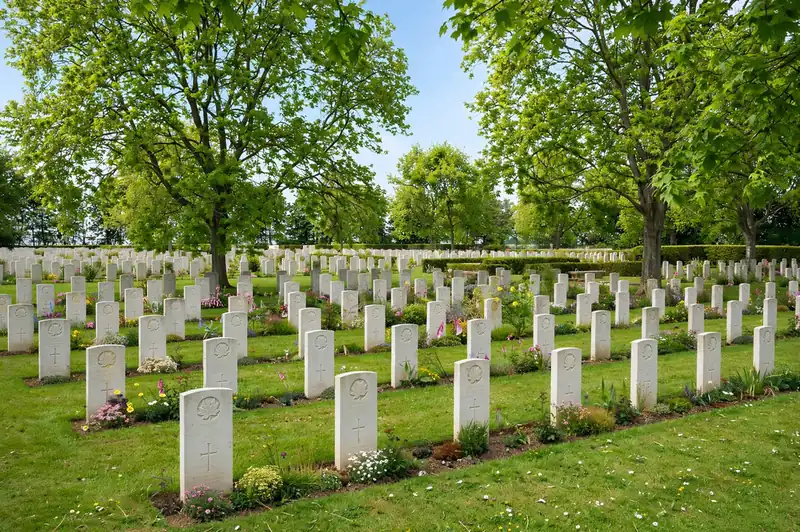
The Canadian losses at Juno, though heavy, were lighter than at Omaha, where the Americans lost about 2,400 men, and they were the price of the deepest advance of the day. The Canadian dead of 6 June are buried in the Canadian war cemeteries in Normandy, above all at Bény-sur-Mer, where 2,048 Canadians are buried, most of them killed in the Normandy campaign. The Juno Beach Centre, at Courseulles-sur-Mer, tells the story of the Canadian landing and of Canada’s war.
8. Map and Geography
Juno Beach lies on the Calvados coast of Normandy, between Gold Beach to the west and Sword Beach to the east, about 15 kilometres north of Caen. The beach faces north, into the English Channel, and it is about 8 kilometres long, from Saint-Aubin-sur-Mer in the east to Courseulles-sur-Mer in the west. Behind the beach, the ground is low and flat, with marshes and the small rivers — the Seulles at Courseulles, the Mue further east — running through it, and then it rises gently towards the Caen–Bayeux road, about 10 kilometres inland, and towards Caen itself, about 15 kilometres to the south-east.
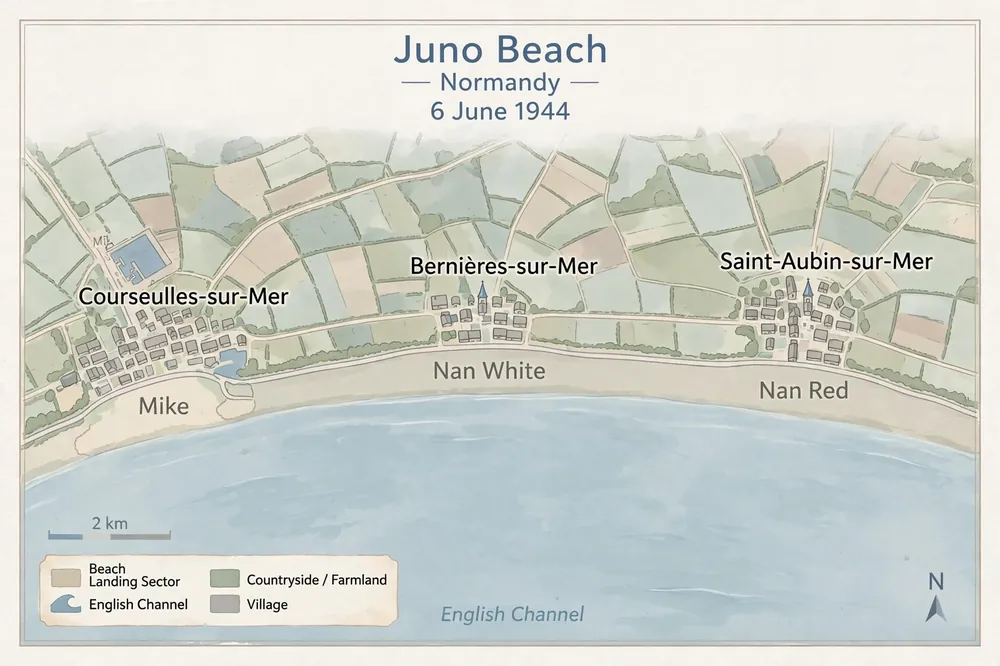
The ground behind Juno was the key to the battle. The Canadians were asked to advance further inland than any other beach, and the ground they had to cross — flat, open farmland, with villages every few kilometres — was good tank country, but it was also good country for the German defenders to counterattack in. The villages of Authie, Buron and Villons-les-Buissons, where the Canadians fought on the evening of 6 June, sit on the low ridge south of the beach, and they guarded the approaches to Caen. The airfield at Carpiquet, west of Caen, was the Canadians’ ultimate objective on D-Day, and it was not taken until July.
The beach’s geography also explains the flooding. The Germans had flooded the low ground behind the beach, to make it harder for the Allies to move inland, and the Canadians had to cross marshes and flooded fields to reach the higher ground. The Seulles river, at Courseulles, was an obstacle in itself, and the engineers had to bridge it before the tanks could cross.
The geography of Juno — a flat beach, a fortified seafront, and low, flooded ground behind — was the geography of a landing that had to be won quickly, before the Germans could bring up their armour. The Canadians won it quickly, and they paid for the ground behind the beach in the fighting at Authie and Buron.
9. Outcome and Legacy of Juno Beach
By nightfall on 6 June, the Canadians had achieved more than any other Allied force that day: they had landed, cleared the beach, and advanced about 10 kilometres inland, to within a few kilometres of Caen. They had done so at a cost of about 1,200 casualties, and they had done it with a division that had never been in battle before. The beachhead was secure, and the follow-on divisions — the 7th Armoured Division and the 2nd Canadian Infantry Division — landed in the following days and pushed the line south.
The fighting after D-Day was long and hard. The Canadians fought the 12th SS Panzer Division at Authie and Buron, at Carpiquet and at Caen, and they suffered heavy casualties in the battles for the city. Caen did not fall until 19 July, after the British Operation Goodwood, and the Canadians did not take Carpiquet airfield until 8 July. The Normandy campaign cost Canada about 18,000 casualties, including about 5,000 killed. But Juno was the beginning, and it was the day the Canadian Army proved itself.
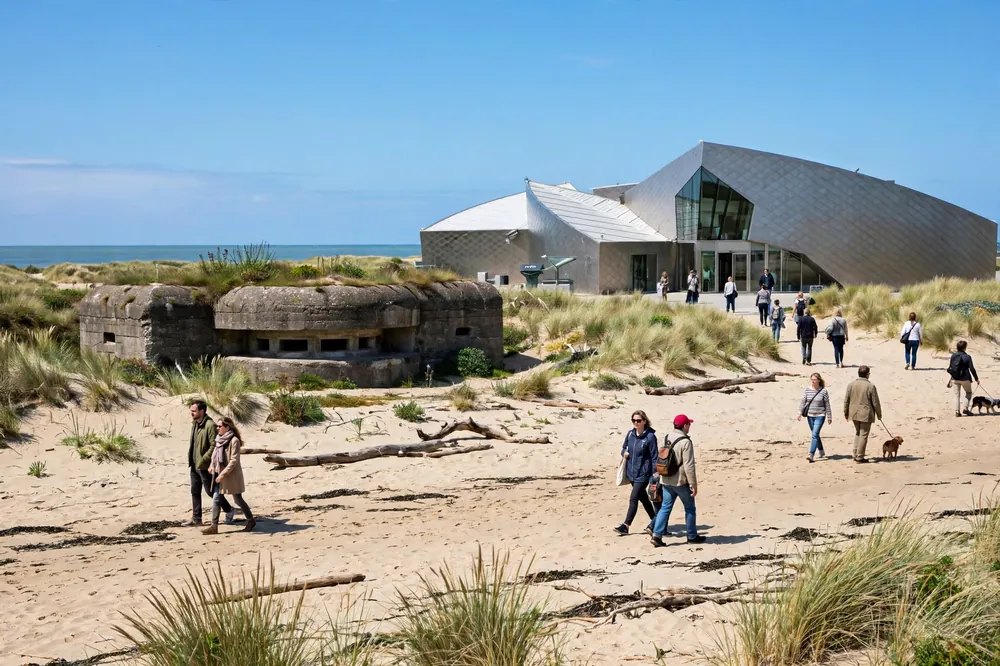
Juno’s legacy in Canada is a national one. The landing is remembered as Canada’s D-Day, and the Juno Beach Centre at Courseulles-sur-Mer, opened in 2003 on the 59th anniversary of the landing, is Canada’s memorial in Normandy. The centre tells the story of the landing and of Canada’s war, and it is staffed by young Canadians who guide visitors around the beach and the German bunkers that still stand there. The Canadian war cemetery at Bény-sur-Mer, with its 2,048 graves, is the resting place of the men who died in Normandy, and every 6 June, Canadians gather there and at Juno to remember them.
Militarily, Juno showed what a well-prepared amphibious assault could achieve: the bombardment worked, the tanks landed, the infantry got off the beach, and the advance inland was rapid. The contrast with Omaha, where the bombardment failed and the tanks sank, is instructive: Juno was the landing that went according to plan, and it was the landing that advanced furthest. The Canadian Army that landed at Juno went on to fight through Normandy, the Scheldt and the Rhineland, and to liberate the Netherlands in 1945 — and it did so because, on 6 June 1944, it had learned to fight on the beaches of Normandy.
10. Commanders
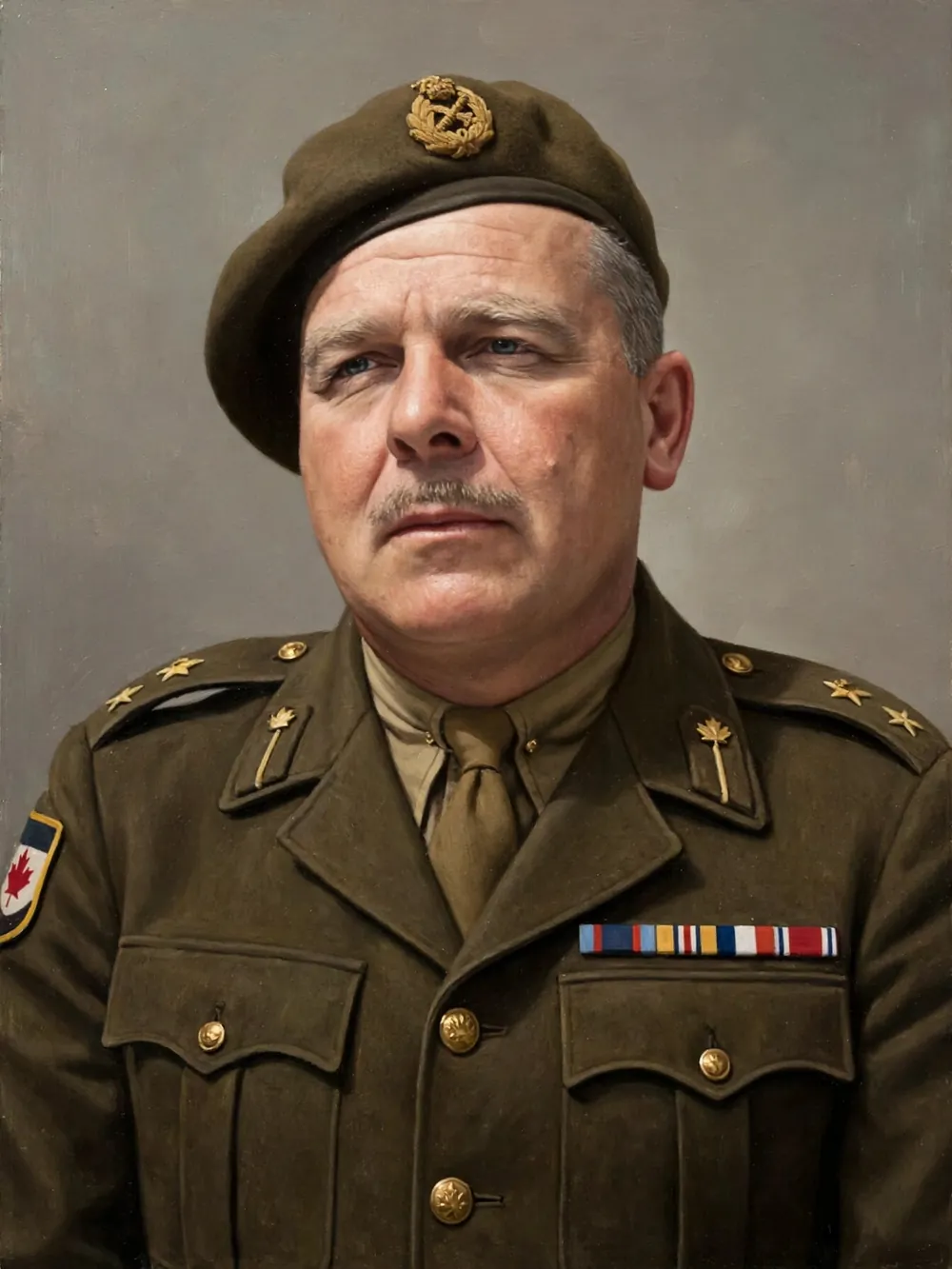
Major General Rod Keller (Canada). Commander of the 3rd Canadian Infantry Division, which landed at Juno. Keller was a veteran of the First World War and had commanded the division since its formation. He was wounded in August 1944 and did not return to command. He died in 1954.
Lieutenant General John Crocker (Britain). Commander of the British I Corps, which included the 3rd Canadian Division and the British 3rd Division at Sword Beach. Crocker was responsible for the overall plan for Juno and Sword, and he coordinated the two landings on D-Day.
Brigadier Harry Foster (Canada). Commander of the 7th Canadian Infantry Brigade, which landed on Mike sector at Courseulles-sur-Mer. Foster’s brigade cleared the beach and pushed inland, and he later commanded the 4th Canadian Armoured Division.
Lieutenant Colonel J. D. Mingay (Canada). Commander of the 6th Armoured Regiment (1st Hussars), whose DD tanks landed with the first wave at Juno. The 1st Hussars’ tanks gave the infantry the fire support that made the landing possible.
Generalleutnant Wilhelm Richter (Germany). Commander of the 716th Infantry Division, which defended Juno Beach. Richter’s division was a static coastal division, and it was largely destroyed on D-Day. He was later captured by the Allies.
Generalleutnant Edgar Feuchtinger (Germany). Commander of the 21st Panzer Division, the only German armoured division close to the beaches on D-Day. Feuchtinger’s division spent the day divided between Sword and Juno, and its counterattack failed. He was later dismissed and died in 1960.
Frequently Asked Questions
Related articles
Sources
- Wikipedia, “Juno Beach” — dates, strength, casualty figures (about 1,200 Canadian casualties, about 340 killed) and the course of the landing.
- Juno Beach Centre (junobeach.org), Courseulles-sur-Mer — the Canadian landing, the advance inland and the centre’s history.
- Canadian War Museum, “Juno Beach” — the 3rd Canadian Infantry Division, the landing and the casualties.
- Encyclopædia Britannica, “Juno Beach” — background and the D-Day landing.
- Mark Zuehlke, Juno Beach: Canada’s D-Day Victory, June 6, 1944 (Douglas & McIntyre, 2004) — the landing, the advance to Authie and Buron, and the fighting after D-Day.
- Terry Copp, Fields of Fire: The Canadians in Normandy (University of Toronto Press, 2003) — the Canadian Army in Normandy, including Juno and the battle for Caen.
- J. L. Granatstein and Desmond Morton, Canada and the Two World Wars (Key Porter, 2003).
- David J. Bercuson, Maple Leaf Against the Axis (Stoddart, 1995).