 WAR ATLAS MILITARY HISTORY MAGAZINE · WWI — WWII
Liberation of Paris
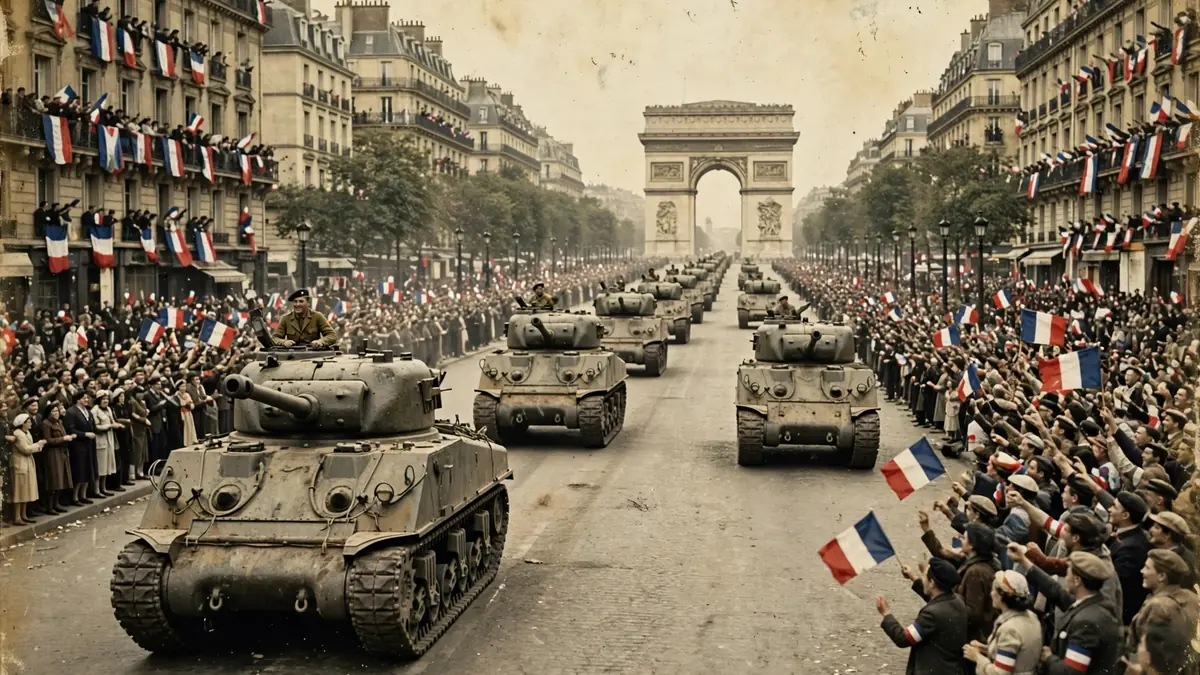
The Liberation of Paris in August 1944 ended four years of German occupation of the French capital and became one of the most famous moments of the Second World War. Between 19 and 25 August, an uprising by the French Resistance inside the city, the arrival of General Leclerc’s French 2nd Armoured Division, and the surrender of the German garrison under General Dietrich von Choltitz freed Paris with far less destruction than anyone had dared to hope.
On 25 August, General Charles de Gaulle entered the capital and proclaimed that Paris was liberated, by itself and by France. The liberation was a military operation of modest scale beside the great battles of Normandy, yet its political and symbolic weight was enormous: it restored the capital of France to the French, ended the authority of the Vichy regime in the city, and gave the Allied cause its most photographed victory of the summer of 1944.
The fighting in Paris lasted only a week, and the city itself was never subjected to the kind of bombardment that destroyed so many other European cities. That outcome was not an accident. It was the result of a chain of decisions — by the Paris Resistance, which rose before the Allies arrived; by the Allied command, which changed its plans and sent Leclerc to the city; and by Choltitz, who refused, or at least failed, to carry out Hitler’s order to leave Paris as a field of ruins.
Historians still argue about how much credit each of these decisions deserves, and about how close Paris came to destruction. What is not in doubt is the result: on 26 August 1944, de Gaulle walked down the Champs-Élysées in front of cheering crowds, and Paris, after 1,542 days of occupation, was free.
1. Key Facts
| Date | 19–25 August 1944 (uprising 19 August; surrender 25 August) |
| Location | Paris, France |
| Result | Allied victory; Paris liberated, German garrison surrendered, city largely intact |
| Allied commanders | Maj. Gen. Philippe Leclerc (2nd Armoured Division); Gen. Charles de Gaulle; Col. Henri Rol-Tanguy (FFI Paris) |
| German commander | Gen. Dietrich von Choltitz, military governor of Paris |
| Allied strength | French 2nd Armoured Division (~16,000 men); elements of US 4th Infantry Division; tens of thousands of FFI fighters in Paris |
| German strength | About 20,000 garrison troops in and around Paris |
| Allied losses | About 1,000–1,500 FFI killed; about 130 French 2nd Armoured Division killed; several hundred French civilians killed (see Casualties section) |
| German losses | About 3,200 killed and about 12,000 taken prisoner (estimates vary) |
2. Background
Four Years of Occupation
Paris had been under German occupation since 14 June 1940, when German troops marched into the city at the end of the Battle of France. The French government had declared Paris an open city, and the Germans entered without a fight. For four years the capital lived under a German military administration, while the collaborationist government of Marshal Pétain ruled from Vichy in the south.
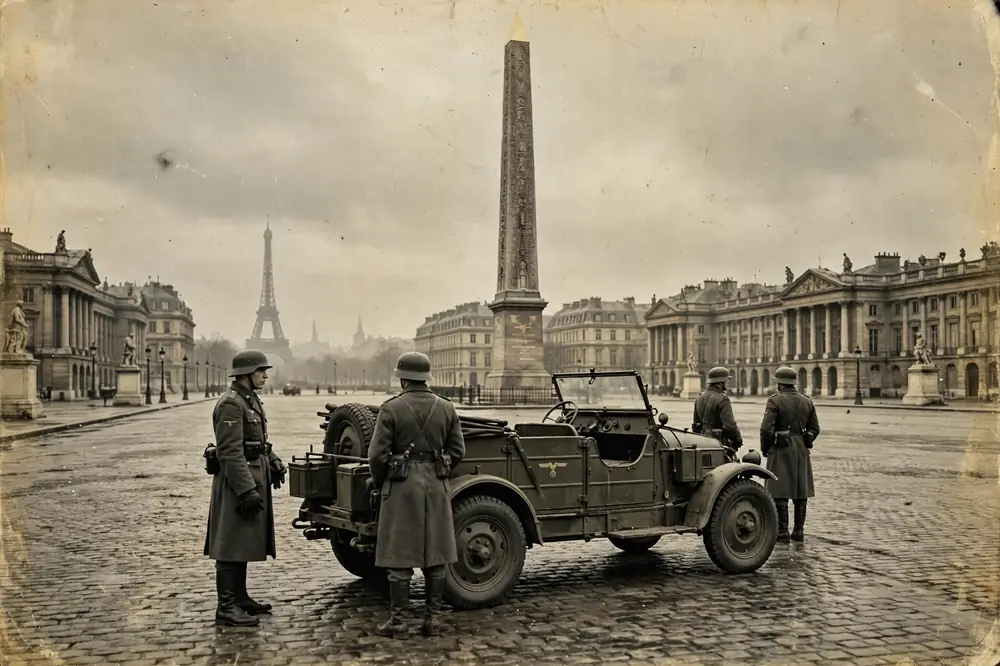
The city became a symbol of occupied Europe: its monuments stood, its cafés stayed open, and its people endured rationing, curfews, round-ups of Jews and resisters, and the daily humiliation of seeing the swastika fly over the Hôtel de Ville.
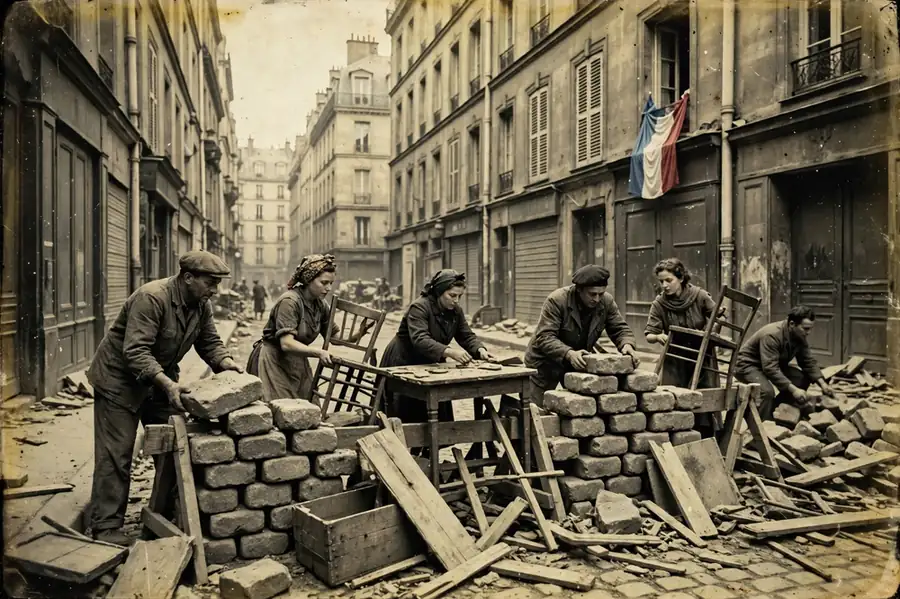
The Resistance in Paris grew slowly at first, then faster after 1942, as the tide of the war turned and as the forced labour draft known as the STO drove thousands of young Frenchmen into hiding or into the maquis.
The occupation also brought persecution: in July 1942, French police rounded up more than 13,000 Jews in Paris in the Vel’ d’Hiv roundup, and most were deported to Auschwitz. The Resistance answered with sabotage, intelligence for the Allies and, from 1943, open attacks on German soldiers. By 1944 the Paris Resistance was no longer a handful of conspirators but a movement that could put thousands of armed fighters on the streets.
The Allies Approach — and Plan to Bypass Paris
By the summer of 1944 the war had reached the gates of the city. The Allies had landed in Normandy on D-Day, 6 June 1944, and after two months of hard fighting in the bocage they had broken out through Operation Cobra in late July. In early August the American armies swung east and south, and the German armies in Normandy were being encircled in the Falaise Pocket.
Paris lay about 200 kilometres east of the Normandy beaches, and the Allied armies were advancing on it from the west and south-west. Yet the Supreme Allied Commander, General Dwight D. Eisenhower, did not originally intend to liberate Paris at all. His plan was to bypass the city to the north and south, cross the Seine downstream and upstream, and drive on towards Germany.
Paris, in his view, was a trap: a great city of millions that would need to be fed, policed and rebuilt, and a battle inside it would cost time, troops and civilian lives. The Allied armies, he believed, could not afford to stop for Paris.
De Gaulle and the Politics of Liberation
General Charles de Gaulle, the leader of Free France, saw the matter very differently. For de Gaulle, Paris was not a logistical problem but the prize of the war. He feared that if the Allies bypassed Paris, the city would rise on its own, be crushed by the Germans, or be liberated by the Communists, whose Resistance organisation, the FTP, was the strongest armed force inside the city.
A Communist-led liberation would give the French Communist Party a claim to power in post-war France, and de Gaulle was determined that the liberation of Paris should be a French liberation, carried out by French troops under his authority. He had already argued with Eisenhower about the composition of the forces that would enter the city, insisting that Leclerc’s 2nd Armoured Division — a French division, formed in North Africa and equipped by the Americans — should have the honour.
Eisenhower agreed in principle, but the date was left open.
The Resistance Prepares
Inside Paris, the Resistance was preparing its own answer. The Paris committee of the French Forces of the Interior (FFI) was commanded by Colonel Henri Rol-Tanguy, a Communist veteran of the Spanish Civil War, and his deputy, Roger Cocteau-Gallois. By August 1944 the FFI in the Paris region numbered tens of thousands of men and women, though only a minority were well armed.
On 18 August, railway workers went on strike, and the strike spread to the police and to other services. The German military governor of Paris, General Dietrich von Choltitz, had arrived on 9 August with orders from Hitler: the city was to be held, and if it could not be held, it was to be destroyed.
Bridges, monuments, factories and public buildings were to be mined, and Paris was to be left as a field of ruins. Choltitz, a veteran of the Eastern Front who had taken part in the destruction of Rotterdam and Sevastopol, knew exactly what such an order meant — and, as events would show, he did not carry it out.
19 August: The Uprising Begins
The uprising began on 19 August. FFI fighters seized public buildings, police stations and the Hôtel de Ville, and Parisians built barricades across the streets as their grandparents had done in 1870 and 1871. The Germans, caught by surprise and uncertain of their orders, reacted slowly.
On 20 August the Swedish consul-general in Paris, Raoul Nordling, negotiated a truce between Choltitz and the Resistance, but the truce was fragile, and fighting continued in many districts. Meanwhile, outside the city, Eisenhower was changing his mind. The uprising, the threat of a Communist takeover, the risk of a massacre in the streets, and the simple fact that Paris could not be left to starve all pointed in the same direction.
On 22 August he ordered Leclerc’s division to Paris, and the race for the capital began.
The barricades of August 1944 were built in the Parisian tradition: paving stones torn from the streets, furniture, overturned cars and felled trees. Behind them, men and women who had never fired a shot held off German patrols, while the police, who had joined the uprising, fought from their stations. The city that the Germans had ruled for four years was, street by street, becoming French again.
3. Opposing Forces
The French 2nd Armoured Division
The spearhead of the liberation was General Philippe Leclerc’s French 2nd Armoured Division (2e Division Blindée), a formation of about 16,000 men equipped with American Sherman tanks, half-tracks and artillery. Leclerc, whose real name was Philippe de Hauteclocque, had led Free French forces from Chad across the Sahara to join the campaign in North Africa, and his division had landed in Normandy on 1 August 1944 as part of the American Third Army under General George S.
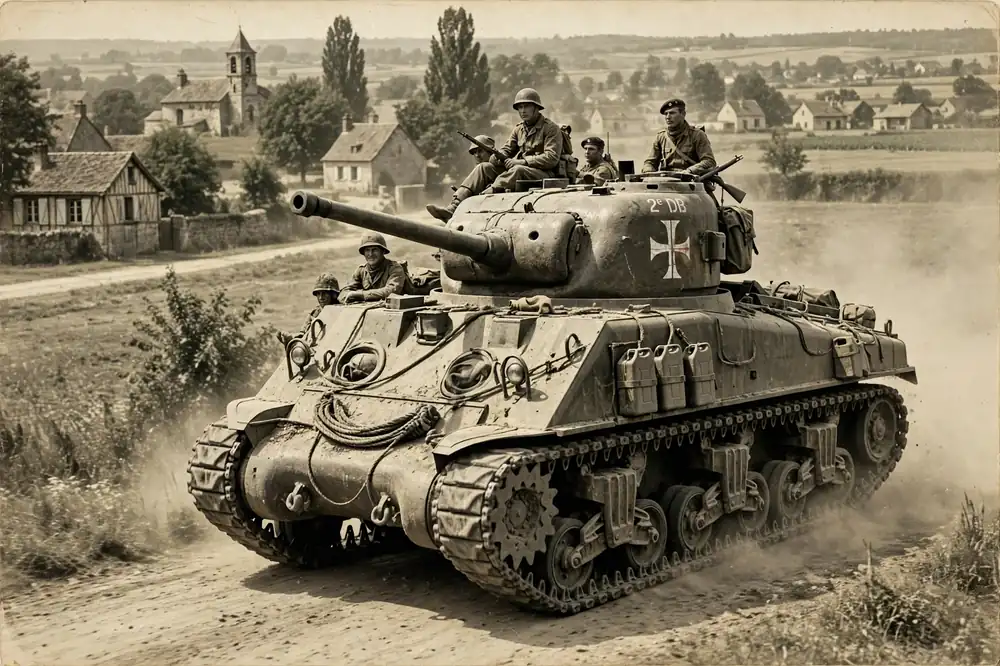
Patton. The division was unusual among Allied formations: roughly a tenth of its men were Spanish Republicans of the famous “La Nueve” company, veterans of the Spanish Civil War who had fled to France and then to North Africa, and its tanks bore the names of French towns, battles and Resistance heroes.
Leclerc’s orders, when he finally received them on 22 August, were to drive on Paris as fast as possible, enter the city from the south, and take the surrender of the German garrison. Behind him came elements of the American 4th Infantry Division under Major General Raymond Barton, which would enter Paris from the east and help clear the city.
The Paris Resistance
Inside the city, the French Forces of the Interior under Colonel Rol-Tanguy fielded tens of thousands of fighters, though their armament was uneven. Many had only rifles, pistols, grenades and captured German weapons; heavy weapons were almost non-existent, and ammunition was short. What the FFI lacked in firepower it made up for in numbers, local knowledge and determination.
Its fighters knew every street, courtyard and cellar of Paris, and they could appear behind German positions that the regular troops could not reach. The FFI had been organised into neighbourhood groups, and during the uprising it seized the Hôtel de Ville, police stations, ministries and newspaper offices, and built some 600 barricades across the city.
The Resistance also included the Paris police, who had gone over to the uprising on 19 August under the prefect of police, Charles Luizet, and whose Prefecture on the Île de la Cité became one of the centres of the fighting.
The cost of this courage was high: the FFI fought German tanks and artillery with small arms, and its casualties during the week were the heaviest of any Allied force in the battle.
The German Garrison
The German garrison of Paris numbered about 20,000 men under General Dietrich von Choltitz, who had been appointed military governor of the city on 9 August 1944. His troops were a mixed force: the 325th Security Division, various support and administrative units, Luftwaffe ground personnel, and a number of tanks and assault guns, including a detachment of Panther tanks.
They held strongpoints at the Senate in the Luxembourg Palace, the École Militaire, the Hôtel Meurice on the Rue de Rivoli, the Chamber of Deputies and the Ministry of Marine on the Place de la Concorde. The garrison’s fighting value is debated by historians: many of its men were second-line troops, and some units were already withdrawing eastwards as the Allied armies approached.
Yet the Germans still held the main public buildings, they had artillery and armour, and they had prepared demolitions on the city’s bridges and monuments. The question was not whether they could fight — they could — but whether Choltitz would order them to fight to the last man and destroy the city, as Hitler had commanded.
| Allies | Germany | |
|---|---|---|
| Main force | French 2nd Armoured Division (~16,000 men, Sherman tanks); US 4th Infantry Division (elements) | About 20,000 garrison troops, incl. 325th Security Division |
| Inside the city | FFI Paris (tens of thousands, lightly armed); Paris police | Strongpoints at Luxembourg, École Militaire, Hôtel Meurice, Place de la Concorde |
| Armour | ~200 Sherman tanks and armoured vehicles of the 2nd Armoured Division | A detachment of Panther tanks and assault guns; limited armour |
| Air support | Allied tactical air forces overhead | Luftwaffe: almost no aircraft over Paris |
| Command | Leclerc (2nd Armoured); Rol-Tanguy (FFI); de Gaulle (political) | Choltitz (military governor of Paris) |
4. The Battle
19–22 August: Uprising and Stalemate
The uprising of 19 August spread fast. FFI fighters took the Hôtel de Ville, where the Resistance leader Alexandre Parodi installed himself as the delegate of de Gaulle’s provisional government, and seized police stations across the city. Parisians, many of them armed only with hunting rifles and petrol bombs, built barricades from paving stones, furniture and overturned vehicles — some 600 in all — and the tricolour appeared in windows that had shown nothing but shutters for four years.
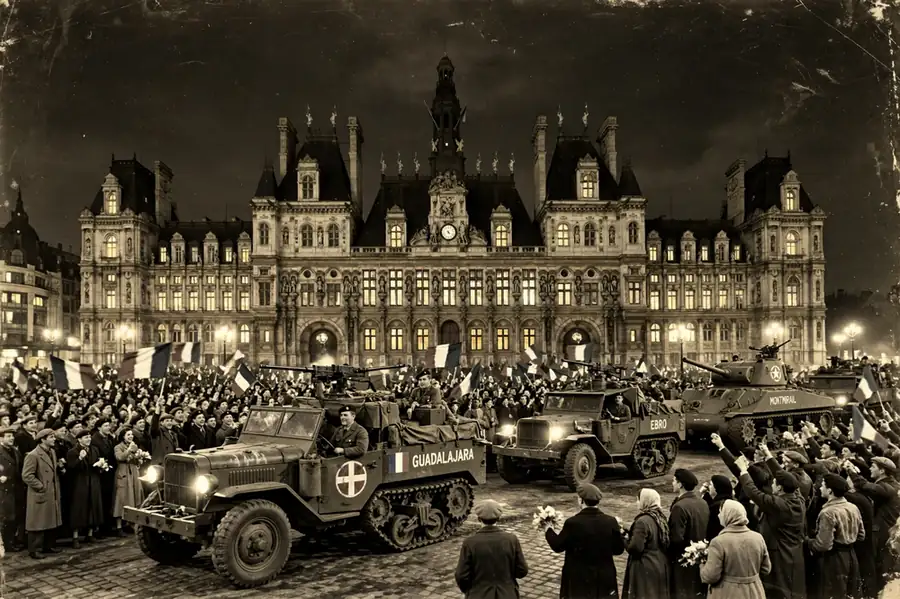
The Germans at first reacted with caution: Choltitz’s troops fired on FFI positions from their strongpoints, and German tanks shelled the barricades, but there was no general assault. On 20 August, the Swedish consul Raoul Nordling brokered a truce, but it held only in part.
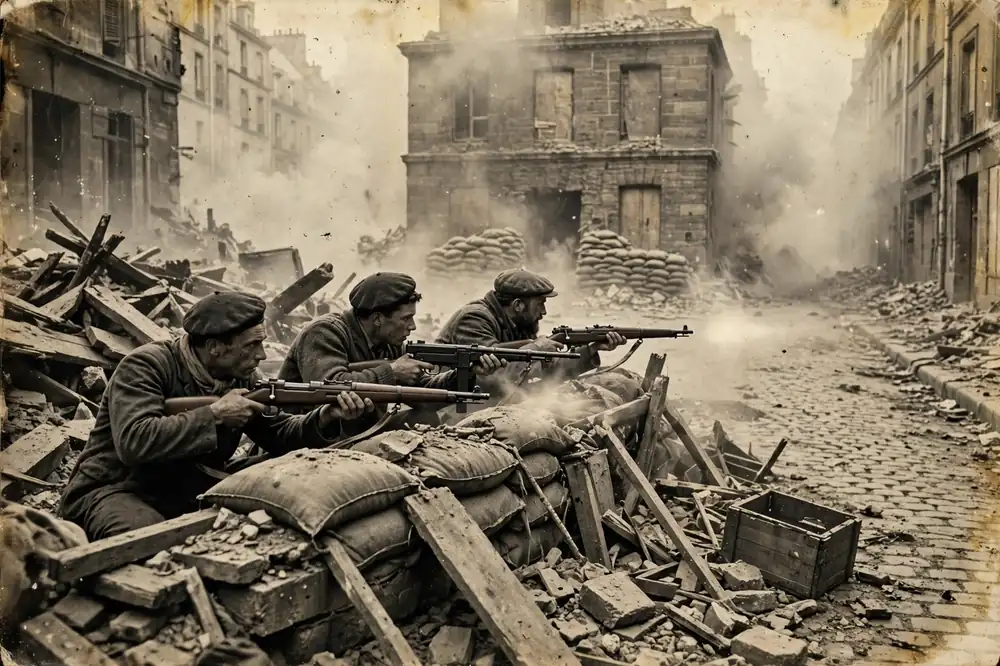
Fighting flared again on 21 and 22 August, notably around the Hôtel de Ville and the Prefecture of Police, where the police held out under fire for days. Meanwhile the Resistance sent a messenger, Roger Cocteau-Gallois, through the German lines to tell the Allies that Paris was rising and needed help at once.
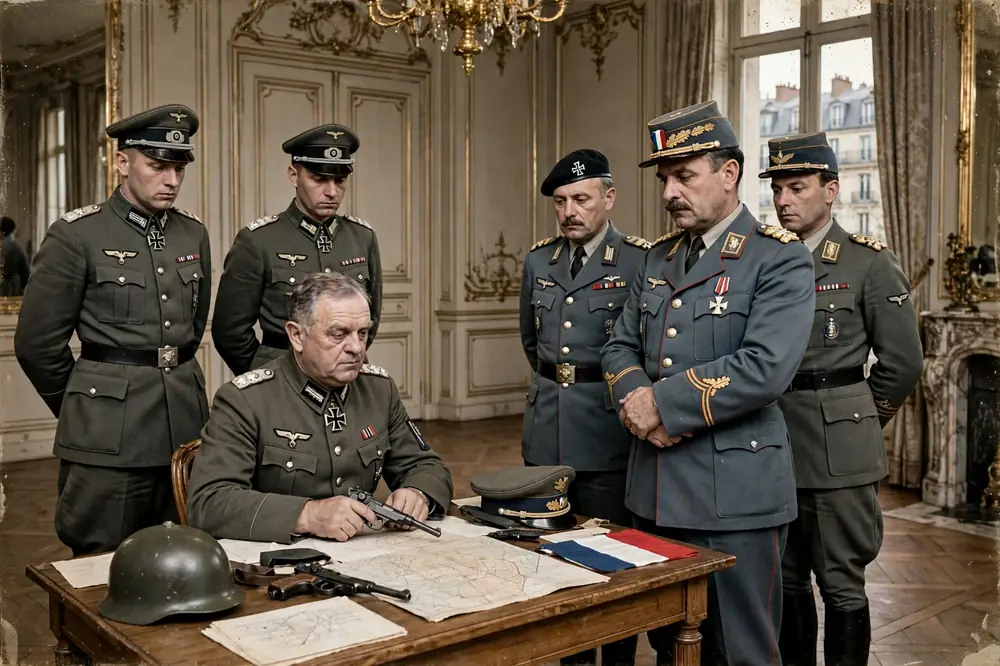
The message reached Leclerc on 22 August, the same day Eisenhower gave the order to march on Paris.
23–24 August: The Race for Paris
Leclerc’s division moved fast, covering more than 200 kilometres in two days over roads crowded with retreating German columns and cheering French villagers. The advance was not unopposed: German rearguards fought delaying actions, and the division’s vanguard had to fight its way through German positions at Longjumeau and Massy.
On the evening of 24 August, Leclerc sent ahead a small detachment under Captain Raymond Dronne, whose company, the 9th of the Régiment de marche du Tchad, was made up largely of Spanish Republicans. Dronne’s column — three tanks and a handful of half-tracks — reached the Hôtel de Ville at about 9:22 p.m., to scenes of delirium.
The first Allied soldiers to enter Paris were thus Spaniards fighting under the French flag, and their tanks bore names like “Guadalajara” and “Ebro”, in memory of the battles of the Spanish Civil War. Dronne’s arrival told the Parisians that liberation had come, and it told Choltitz that the game was up.
During the night, more of Leclerc’s division poured into the city from the south, through the Porte d’Orléans and the Porte d’Italie.
25 August: Surrender
The main battle for the city took place on 25 August. Leclerc’s tanks, supported by the FFI, attacked the German strongpoints one by one. At the Luxembourg Palace, the German garrison held out for hours behind the Senate’s thick walls before surrendering; at the École Militaire, French tanks fought a sharp engagement against German armour; at the Place de la Concorde, the Ministry of Marine was taken after heavy firing.
Meanwhile the American 4th Infantry Division entered from the east, through the Porte de Bagnolet, and moved towards the centre. The fighting was fierce in places but brief: many German units, seeing French tanks in the streets and hearing that the Allies were in the city in force, surrendered without a fight.
At about 3:30 p.m., Choltitz surrendered at his headquarters in the Hôtel Meurice, and was taken to the Prefecture of Police, where he signed the surrender document in the presence of Leclerc and Rol-Tanguy. The document, signed in a room still scarred by the fighting, ended the German occupation of Paris.
That evening, de Gaulle arrived at the Hôtel de Ville and addressed the crowd from its balcony, in a speech that has become one of the most famous in French history: “Paris outraged! Paris broken! Paris martyred! But Paris liberated!”
26–29 August: A Free City — and Its Dangers
Liberation did not mean the end of danger. On 26 August, de Gaulle walked down the Champs-Élysées from the Arc de Triomphe to Notre-Dame, in front of vast crowds, and shots rang out — German snipers and stragglers, and perhaps nervous FFI men, fired into the crowd, killing several people and wounding many more.
The shooting at Notre-Dame, where de Gaulle attended a service of thanksgiving while bullets struck the cathedral, became one of the enduring images of the liberation. German rearguards and isolated snipers continued to fire on Allied troops for days, and the city was still within range of German artillery and V-1 flying bombs.
On 29 August, the American 28th Infantry Division marched through Paris in a parade that was also a movement to the front: the division marched down the Champs-Élysées and straight on to the fighting in the north-east. Paris was free, but the war was not over, and the city now had to be fed — the first Allied supply convoys brought food to a population that had been living on starvation rations.
5. Turning Point
The Decision to March on Paris
The turning point of the liberation was not a battle but a decision. Until 22 August, Eisenhower’s plan was to bypass Paris, and the city’s fate hung on that plan. The uprising changed the calculation. The Resistance had risen before the Allies were ready, and the Allied command now faced a choice: let the Parisians fight alone and risk a massacre and a Communist-led liberation, or change the plan and send troops into the city.
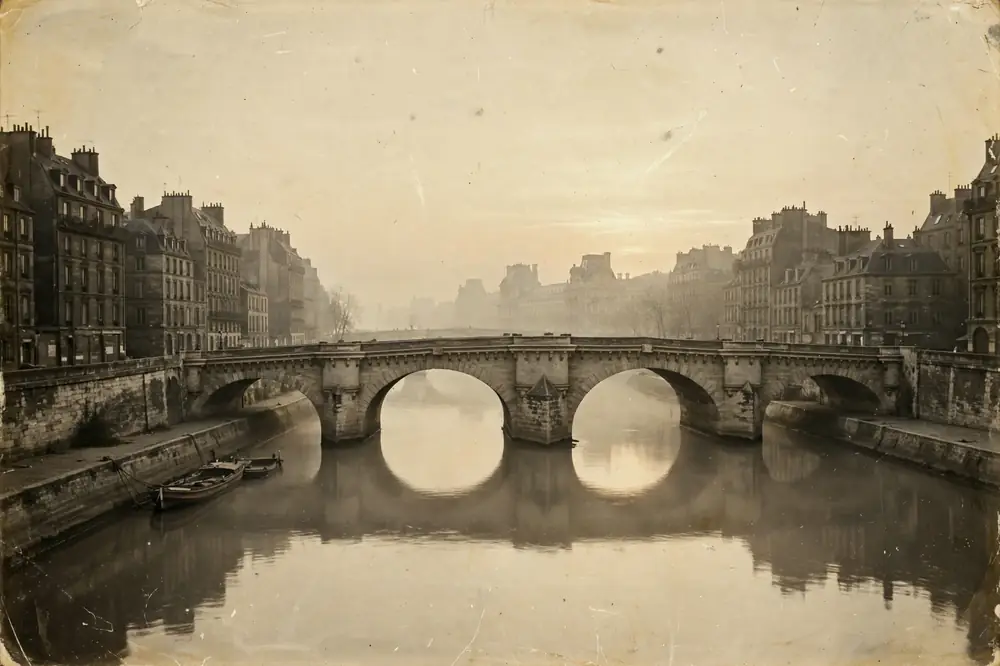
De Gaulle’s pressure, the reports from the Resistance, and the simple humanitarian fact that Paris was starving all pointed the same way. On 22 August Eisenhower ordered Leclerc to Paris, with the American 4th Infantry Division in support. The decision was made late, and it was made under political pressure, but it saved Paris from the worst outcomes.
Had the Allies waited even a few more days, the uprising might have been crushed, or the Germans might have carried out their demolition orders in earnest.
Choltitz and the Order to Destroy Paris
The second turning point was Choltitz’s refusal to destroy the city. Hitler’s order of 23 August 1944 was explicit: Paris was not to fall into enemy hands except as a field of ruins, and its bridges and monuments were to be destroyed. Demolition charges had been placed on the bridges over the Seine, and the city’s landmarks were prepared for destruction. Choltitz did not detonate them.
Why he disobeyed is still debated. In his memoirs, published after the war, Choltitz presented himself as a man who deliberately saved Paris, moved by the city’s beauty and by the knowledge that the war was lost. Other historians argue that his motives were more practical: his troops were too few and too disorganised to carry out a systematic demolition under fire, the FFI had already seized many of the prepared sites, and a German commander who destroyed Paris would have faced certain execution after the war.
Some argue that the demolition preparations were never as complete as the legend suggests. Whatever the mixture of motives, the result is clear: the bridges stood, Notre-Dame stood, and the city survived. The turning point was an act of omission — a commander who, at the decisive hour, did not give the order he had been given.
6. Casualties and Losses
The Cost
The human cost of the liberation of Paris was modest by the standards of the Second World War, but it was not small, and the figures are still uncertain. The heaviest losses fell on the Paris Resistance. Estimates of FFI dead during the uprising range from about 1,000 to about 1,500, with several thousand more wounded.
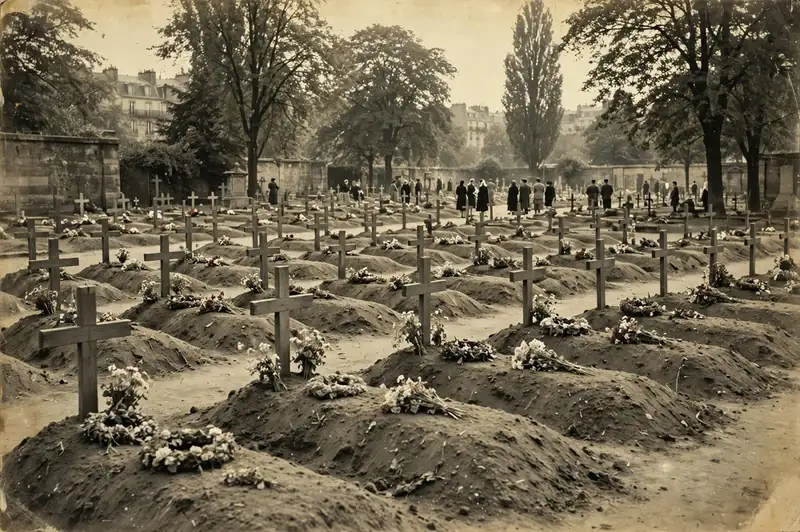
French civilian deaths are usually put at several hundred, though some estimates are higher; the fighting in the streets, German shelling and the shooting on 26 August all added to the toll. The French 2nd Armoured Division lost about 130 men killed and about 300 wounded in the drive on Paris and the fighting in the city.
American losses were light: the 4th Infantry Division suffered only a handful of casualties in Paris itself. German losses are usually given as about 3,200 killed and about 12,000 taken prisoner, though these figures, like the French ones, are estimates drawn from incomplete records.
The total of about 1,500 to 2,000 Allied and French dead, set against a city of millions, explains why the liberation is remembered as a moment of joy rather than of mourning — but the dead were real, and their names are recorded on the plaques that mark the barricades of August 1944 all over Paris.
| Allies and French | Germany | |
|---|---|---|
| Killed | About 1,000–1,500 FFI; about 130 men of the 2nd Armoured Division; several hundred civilians | About 3,200 (estimate) |
| Wounded | Several thousand FFI; about 300 men of the 2nd Armoured Division | Not reliably recorded |
| Prisoners | — | About 12,000 taken prisoner |
| Total | About 1,500–2,000 dead (estimates vary) | About 3,200 killed, about 12,000 captured |
Remembering the Dead
The dead of the liberation are remembered all over Paris. Small black marble plaques mark the places where FFI fighters fell at the barricades, giving their names, their ages and the date of their death, and they are still decorated with flowers every August.
A monument to Leclerc stands at the Porte d’Orléans, where his division entered the city, and a memorial to the Spanish Republicans of La Nueve stands near the Hôtel de Ville. The Musée de la Libération de Paris, opened in the Place Denfert-Rochereau, tells the story of the uprising and of the men and women who fought in it, and every 25 August the city holds ceremonies at the Hôtel de Ville and along the route of Leclerc’s advance.
The liberation is remembered as a week of joy, but the plaques on the walls of Paris are a reminder that the joy was bought with lives, and that many of those who died were very young — students, workers and policemen who had taken up arms for the first time in the week of the uprising.
7. Map and Geography
The Shape of the City
Paris in 1944 was a city of about 2.8 million people, built around the River Seine, which flows through it from east to west in a great bend. The historic heart of the city is the Île de la Cité, the island in the Seine where Notre-Dame stands, and around it the great public buildings that became the strongpoints of August 1944: the Hôtel de Ville on the right bank, the Prefecture of Police on the island itself, the Luxembourg Palace and the Senate on the left bank, the École Militaire near the Eiffel Tower, and the Place de la Concorde with the Ministry of Marine.
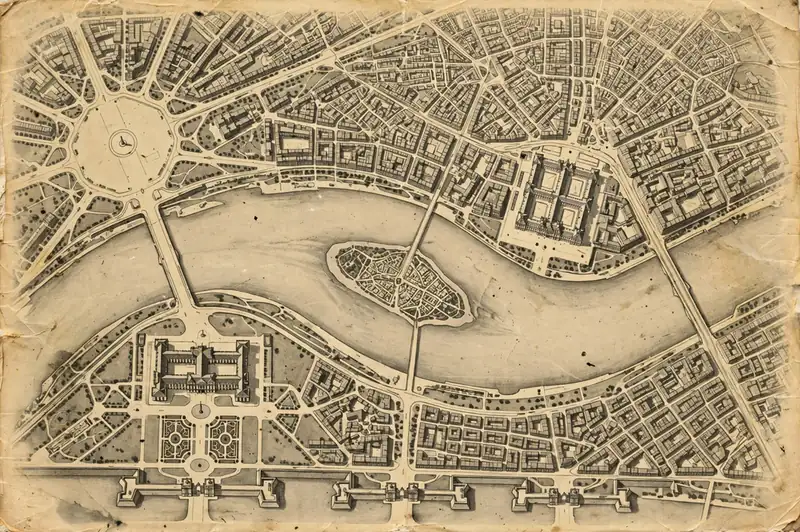
The city’s boulevards — the Champs-Élysées running west from the Place de la Concorde to the Arc de Triomphe, the great north-south axis of the Boulevard Sébastopol — were built wide and straight, and in August 1944 they became both avenues of advance for the tanks and fields of fire for the defenders.
The narrow streets of the old quarters, by contrast, favoured the Resistance: barricades could close them in minutes, and a handful of men with rifles could hold a street against tanks that could not turn.
Approaches and Strongpoints
Leclerc’s division approached Paris from the south-west, through Rambouillet, Longjumeau and Massy, and entered through the Porte d’Orléans and the Porte d’Italie — the southern gates of the city. The American 4th Infantry Division came from the east, through the Porte de Bagnolet. The German strongpoints were concentrated in the centre, around the public buildings, and the fighting of 25 August moved inward from the gates towards the Seine.
The bridges over the Seine were the critical points of the whole battle: had Choltitz destroyed them, the city would have been cut in two and the liberation would have been a different and far bloodier affair. The geography of Paris also explains why the battle was short.
Paris is a compact city, and once the Allied tanks were inside the gates, the distance to the centre was only a few kilometres. The German garrison, spread across the public buildings, could be attacked strongpoint by strongpoint, and it had no reserves to plug the gaps.
8. Outcome and Legacy
A Capital Restored
The liberation of Paris had immediate political consequences. On 25 August, de Gaulle established his provisional government in the capital, and the authority of the Vichy regime collapsed in the city. The liberation settled, at least for the moment, the question of who would govern France: it would be de Gaulle and the Free French, not the Communists and not the Allies.
Eisenhower’s headquarters had considered setting up an Allied military government in France, but de Gaulle’s swift installation of a French administration in Paris made that impossible. Militarily, Paris became a great supply and transport hub for the Allied advance towards Germany, and the French 2nd Armoured Division went on to fight in Lorraine and Alsace and into Germany itself.
The liberation also had a less happy side: in the weeks that followed, collaborators were rounded up, and summary executions and public humiliations — notably the shaving of women’s heads — took place across France. The liberation was a moment of national unity, but the reckoning with collaboration, the épuration, divided France for years.
Memory and Myth
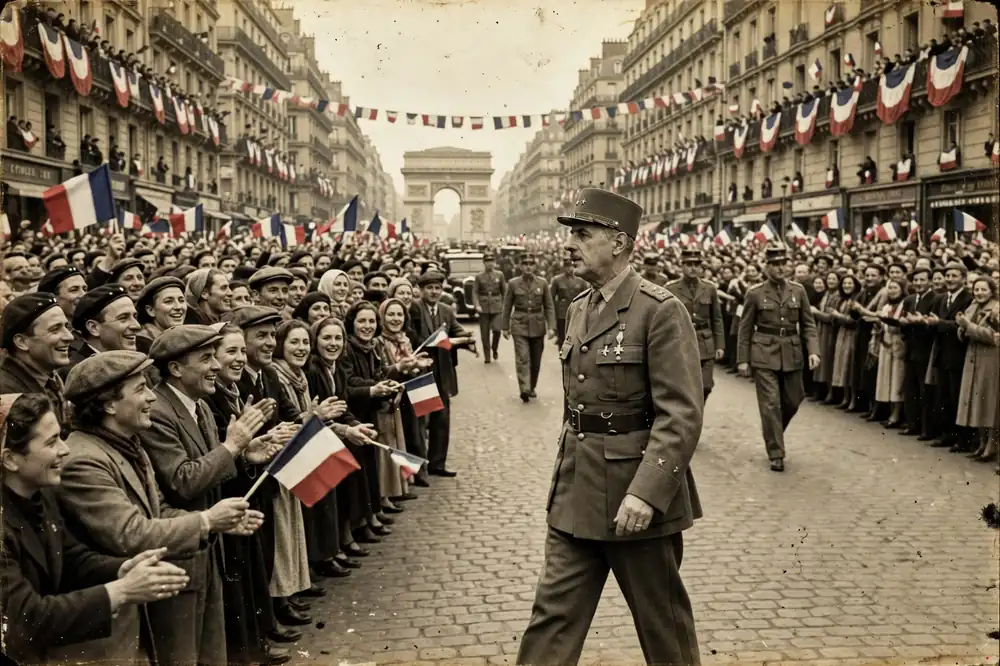
The liberation of Paris has been remembered, above all, in images: the tanks of Leclerc’s division rolling down the Champs-Élysées, de Gaulle walking to Notre-Dame, the crowds kissing soldiers, the tricolour flying again from the Eiffel Tower. Every 25 August, Paris commemorates the liberation with ceremonies at the Hôtel de Ville and along the route of Leclerc’s advance.
The story has also acquired its myths, and the most durable of them concerns Choltitz. The phrase “Is Paris burning?”, Hitler’s supposed question to his chief of staff on the evening of 25 August, comes from the best-selling book of that name by Larry Collins and Dominique Lapierre, published in 1965, and from the film that followed.
Historians have questioned whether Hitler ever asked the question in those words, and whether Choltitz’s disobedience was as deliberate and heroic as the legend claims. The debate does not diminish the liberation. Paris was saved, and the city remembers the week of August 1944 as the week it became itself again.
9. Commanders
Allied Commanders
General Philippe Leclerc (France). Commander of the French 2nd Armoured Division. Leclerc, born Philippe de Hauteclocque, had fought in the Battle of France in 1940, escaped to London, and led Free French forces from Chad across the Sahara. He commanded the division that liberated Paris, and later fought in Lorraine, Alsace and Germany. He was killed in an air crash in Algeria in 1947, and was made a Marshal of France posthumously in 1952.
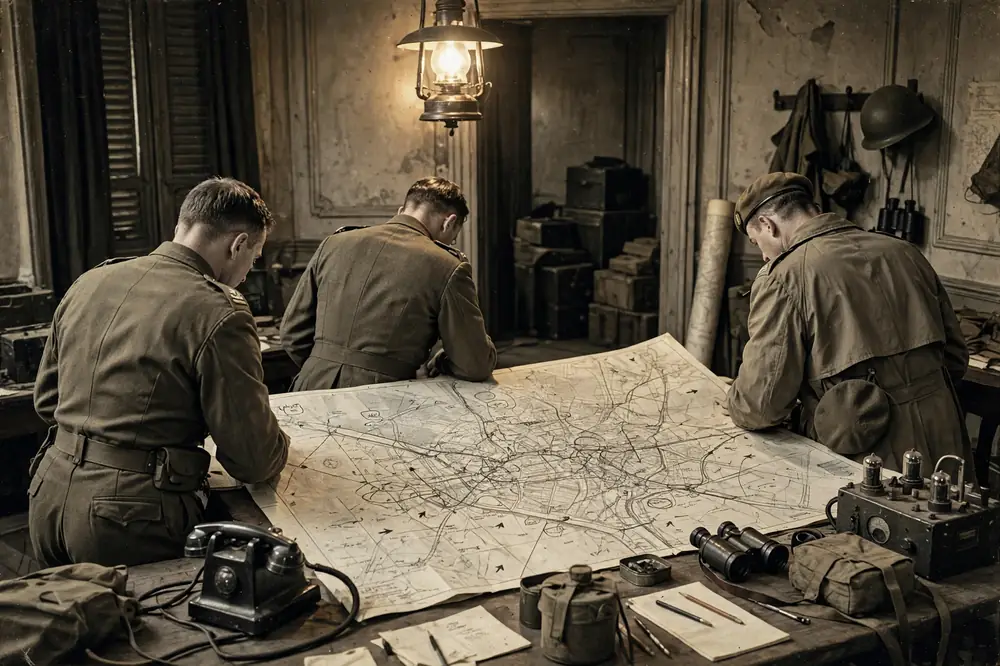
General Charles de Gaulle (France). Leader of Free France and head of the provisional government. De Gaulle had refused the armistice of 1940 and called on the French to continue the fight from London. He insisted that French troops liberate Paris, entered the city on 25 August 1944, and led the provisional government until 1946. He later founded the Fifth Republic and served as its president from 1959 to 1969.
Colonel Henri Rol-Tanguy (France). Commander of the FFI in the Paris region. Rol-Tanguy, a Communist and a veteran of the Spanish Civil War, organised the uprising of 19 August and commanded the Resistance forces in the city during the week of the liberation. He was present when Choltitz signed the surrender, and after the war he served in the French Army and in the government.
German Commanders
General Dietrich von Choltitz (Germany). Military governor of Paris. Choltitz was a career officer who had fought in Poland, the Netherlands, the Balkans and the Soviet Union, and had taken part in the sieges of Rotterdam and Sevastopol. Appointed to Paris in August 1944, he refused — or failed — to carry out Hitler’s order to destroy the city, and surrendered on 25 August. He was held as a prisoner of war until 1947, and died in 1966. His memoirs, and the legend of the man who saved Paris, remain contested by historians.
Major General Raymond Barton (United States). Commander of the US 4th Infantry Division, whose troops entered Paris from the east on 25 August and helped clear the city. Barton had commanded the division since 1942 and had led it ashore at Utah Beach on D-Day. He continued in command through the advance into Germany.
Captain Raymond Dronne (France). Commander of the 9th Company of the Régiment de marche du Tchad, the “La Nueve”, whose detachment was the first Allied unit to enter Paris, reaching the Hôtel de Ville on the evening of 24 August 1944. Dronne’s men were mostly Spanish Republicans, and their entry into Paris became one of the most famous moments of the liberation. Dronne later wrote a memoir of the campaign and served as a senator.
Frequently Asked Questions
When was Paris liberated?
Paris was liberated between 19 and 25 August 1944. The uprising began on 19 August, the first Allied troops reached the Hôtel de Ville on the evening of 24 August, and the German garrison surrendered on 25 August.
Who liberated Paris?
Paris was liberated by a combination of forces: the Paris Resistance (FFI) under Colonel Rol-Tanguy, which rose on 19 August; General Leclerc’s French 2nd Armoured Division, which entered the city on 24–25 August; and elements of the American 4th Infantry Division. General de Gaulle entered the city on 25 August as the political leader of the liberation.
Why did Hitler order Paris to be destroyed?
Hitler ordered that Paris should not fall into Allied hands except as a field of ruins. He wanted to deny the Allies a great capital and a transport hub, and to punish the city for its uprising. General von Choltitz, the military governor, did not carry out the order, and the city’s bridges and monuments survived.
Did the Allies plan to liberate Paris?
No, not at first. Eisenhower originally intended to bypass Paris and drive on towards Germany, because the city would need to be fed and policed. He changed his mind on 22 August, under pressure from de Gaulle and because the Paris uprising made a bypass politically and humanly impossible.
Who was the first Allied soldier to enter Paris?
The first Allied detachment to reach the centre of Paris was Captain Raymond Dronne’s company of the Régiment de marche du Tchad, which reached the Hôtel de Ville at about 9:22 p.m. on 24 August 1944. Most of Dronne’s men were Spanish Republicans of the “La Nueve” company.
How many people died in the liberation of Paris?
Estimates vary, but about 1,000–1,500 FFI fighters were killed, several hundred French civilians died, and the French 2nd Armoured Division lost about 130 men killed. German losses were about 3,200 killed and about 12,000 taken prisoner.
Related articles
Sources
- Wikipedia, “Liberation of Paris” — dates, strength, casualty figures, the uprising and the surrender.
- US Army Center of Military History, The Siegfried Line Campaign and The Lorraine Campaign — the Allied advance and the decision to march on Paris.
- Encyclopædia Britannica, “Liberation of Paris” — background, the uprising and its cost.
- Larry Collins and Dominique Lapierre, Is Paris Burning? (Simon & Schuster, 1965) — the uprising, Choltitz and the demolition order; note that the book’s account of Hitler’s question is not confirmed by other sources.
- Musée de la Libération de Paris – Musée du général Leclerc – Musée Jean Moulin, Paris — the uprising, the FFI and Leclerc’s division.
- Charles de Gaulle, War Memoirs, Vol. III, The Salvation — de Gaulle’s account of the liberation and his entry into Paris.
Further reading
- Jean-Pierre Azéma, 1940–1944: Les années noires (Seuil, 2002).
- Alistair Horne, Seven Ages of Paris (Knopf, 2002), chapter on the liberation.