 WAR ATLAS MILITARY HISTORY MAGAZINE · WWI — WWII
MG34
1. Lead
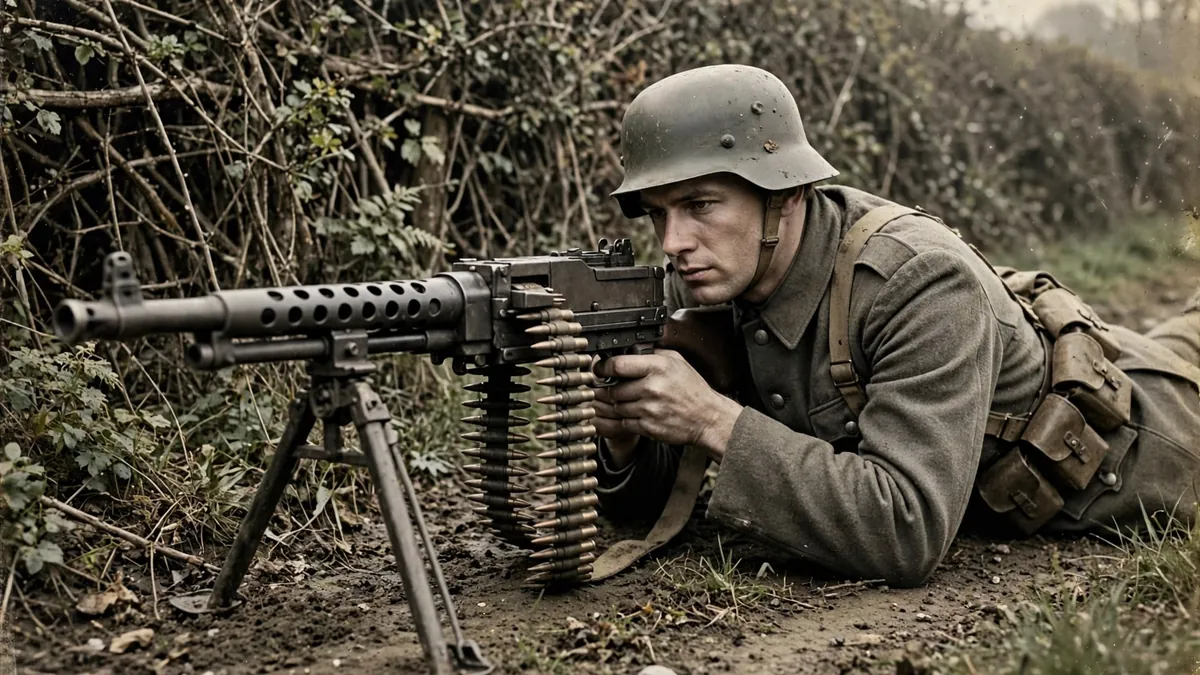
The MG34 (Maschinengewehr 34) was the first general-purpose machine gun in the world, and the weapon that defined the German infantry squad of the Second World War. Designed by Rheinmetall and adopted by the German Army in 1936, it could be used as a light machine gun on a bipod, as a medium machine gun on a tripod, as a vehicle weapon and as an anti-aircraft gun, and it did the work of several different weapons with a single design. Chambered for the standard German 7.92×57 mm rifle cartridge, it fired at 800 to 900 rounds per minute, and its quick-change barrel let its crew keep it firing in sustained combat. The MG34 served on every front of the war, from Poland in 1939 to Berlin in 1945, and it became the most feared weapon in the German infantry arsenal, the gun around which the whole squad was organised. It was expensive and slow to manufacture, and from 1942 it was gradually replaced by the cheaper and simpler MG42, but it remained in service until the end of the war and set the pattern for every general-purpose machine gun that followed.
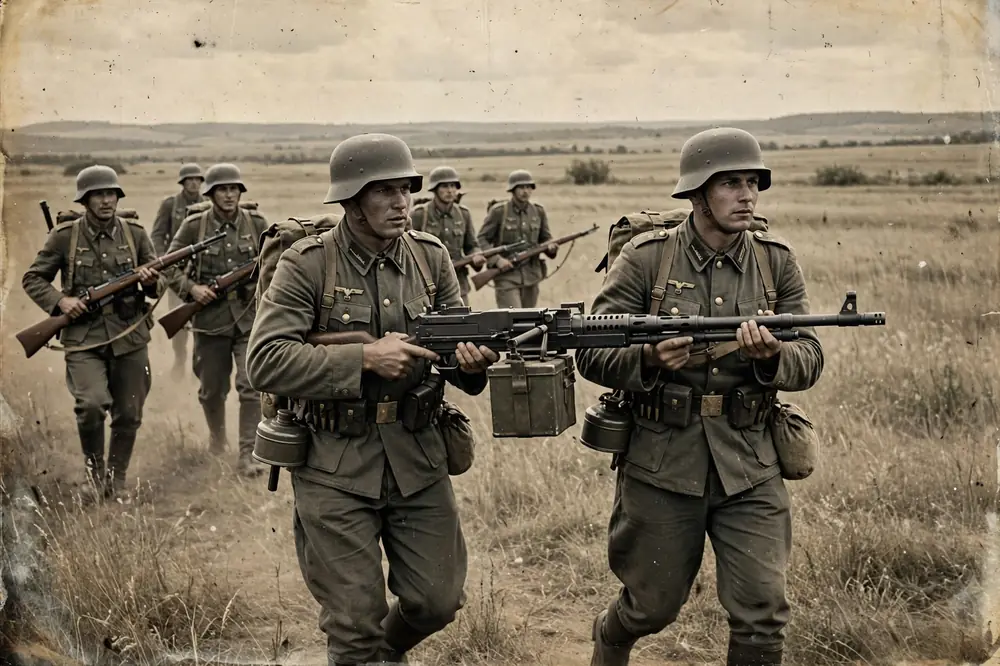
The MG34 was the centre of the German infantry squad in a way that no other army’s machine gun was. In the German Army, the squad of ten men was built around a single MG34, and the riflemen existed to carry its ammunition, to protect its crew and to support its fire, while in the British and American armies the rifle was still the squad’s main weapon and the machine gun was a supporting weapon held at platoon or company level. The MG34’s high rate of fire gave a German squad a weight of fire that no Allied squad could match, and German infantry tactics — the attack in which the machine gun laid down a base of fire while the riflemen moved, and the defence in which the machine gun dominated the ground in front of the position — were built on its performance. Allied soldiers who faced it remembered its sound, a tearing buzz that they called the “buzzsaw”, and the name passed to the MG42 that succeeded it, but it was the MG34 that first earned it.
2. Key Facts
| Type | General-purpose machine gun |
| Origin | Germany |
| Designer | Louis Stange, Rheinmetall |
| Manufacturer | Rheinmetall, Mauser, Steyr and others |
| In service | 1936–1945 (German service); later with other armies |
| Produced | 1935–1945; about 577,000 built |
| Calibre | 7.92×57 mm Mauser |
| Weight | 12.1 kg (gun alone); about 32 kg with tripod mount |
| Length | 1,219 mm |
| Barrel length | 627 mm |
| Rate of fire | 800–900 rounds per minute |
| Muzzle velocity | About 755 m/s |
| Effective range | About 1,200 m on bipod; over 2,000 m on tripod |
| Feed | 50-round belt; 75-round drum; 250-round belt on tripod |
| Operation | Recoil-operated, rotating bolt; air-cooled, quick-change barrel |
3. Background and Development
The Search for a Universal Machine Gun
After the First World War, the German Army faced a problem that every army faced: it had two kinds of machine gun, a heavy water-cooled gun for sustained fire from a fixed position and a light air-cooled gun for the infantry squad, and it wanted one gun that could do both jobs. The Treaty of Versailles banned Germany from developing new machine guns, but the German Army evaded the ban by working through foreign subsidiaries and by disguising its development as civilian work, and in the early 1930s it asked the arms industry for a single gun that could serve as a light machine gun on a bipod, a medium machine gun on a tripod, a tank and aircraft gun, and an anti-aircraft weapon. The idea was revolutionary: no army had built a gun that could fill all of these roles, and the gun that answered the requirement, the MG34, became the first general-purpose machine gun in history and the model for every such weapon since.
Louis Stange and the Rheinmetall Design
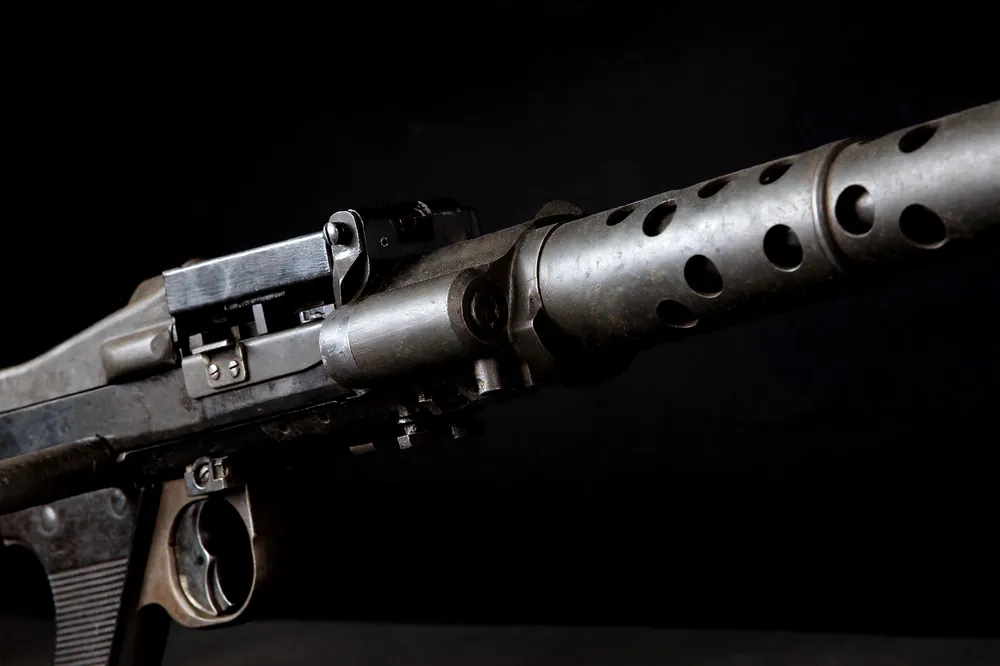
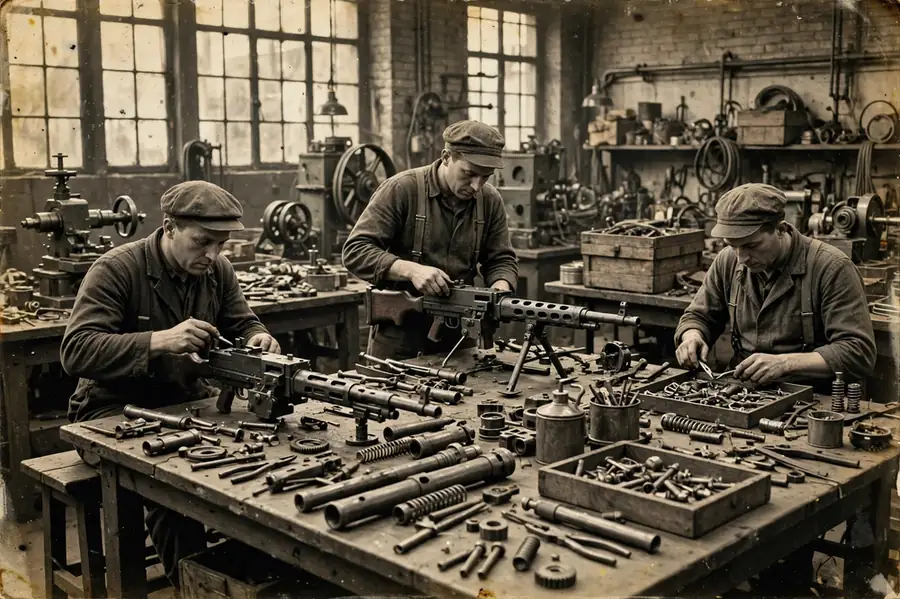
The MG34 was designed by Louis Stange, an engineer at Rheinmetall, who built on the work of an earlier Rheinmetall design, the MG30, which had been developed in Switzerland to evade the Versailles restrictions. Stange’s design used a short-recoil system with a rotating bolt, in which the barrel and the bolt recoiled together for a short distance before the bolt unlocked and rotated, and it was fed by a belt that was pulled through the gun by a feed mechanism driven by the recoiling parts. The gun was air-cooled, with a perforated barrel jacket, and its barrel could be changed in seconds by a trained crew, which let it keep firing in sustained combat without overheating. The MG34 was built to a very high standard, with machined steel parts and close tolerances, and it was a beautiful piece of engineering, but that quality was also its weakness: it was expensive, it took a long time to make, and it demanded skilled labour and scarce materials that Germany could not spare once the war became a war of mass production.
Adoption and Early Production
The MG34 was adopted by the German Army in 1936, after trials against competing designs, and it entered service with the infantry, the armoured forces and the Luftwaffe’s ground units. Production began at Rheinmetall and was soon taken up by Mauser, Steyr and other firms, and by the outbreak of war in September 1939 the German Army had about 40,000 MG34s in service, with more being produced every month. The gun was issued at the rate of one per infantry squad, with additional guns at platoon and company level on tripods, and it was fitted to tanks as a coaxial and hull weapon and to aircraft as a flexible defensive gun. The MG34’s first combat came in Poland, where its high rate of fire and its reliability made an immediate impression, and by the French campaign of 1940 it was the standard machine gun of the German Army, the weapon on which the whole infantry system depended.
4. Design
Recoil Operation and the Quick-Change Barrel
The MG34 operated on the short-recoil principle, in which the barrel and bolt moved back together for a short distance after firing, and the bolt then rotated to unlock and continued to the rear, extracting and ejecting the empty case before a spring drove it forward to chamber the next round. The system was smooth and reliable, and it gave the gun its high rate of fire of 800 to 900 rounds per minute, which was roughly twice the rate of the British Bren gun and the American Browning M1919. The gun was air-cooled, and its barrel was surrounded by a perforated steel jacket that allowed air to flow around it, but in sustained fire the barrel still overheated, and the MG34 was therefore designed so that the barrel could be changed quickly: the crew opened a latch, twisted the barrel jacket and pulled the hot barrel out, and a spare barrel was fitted in its place in a matter of seconds. Each gun was issued with spare barrels, and the crew were trained to change them after every 250 rounds of rapid fire.
Feed, Sights and the Lafette Tripod
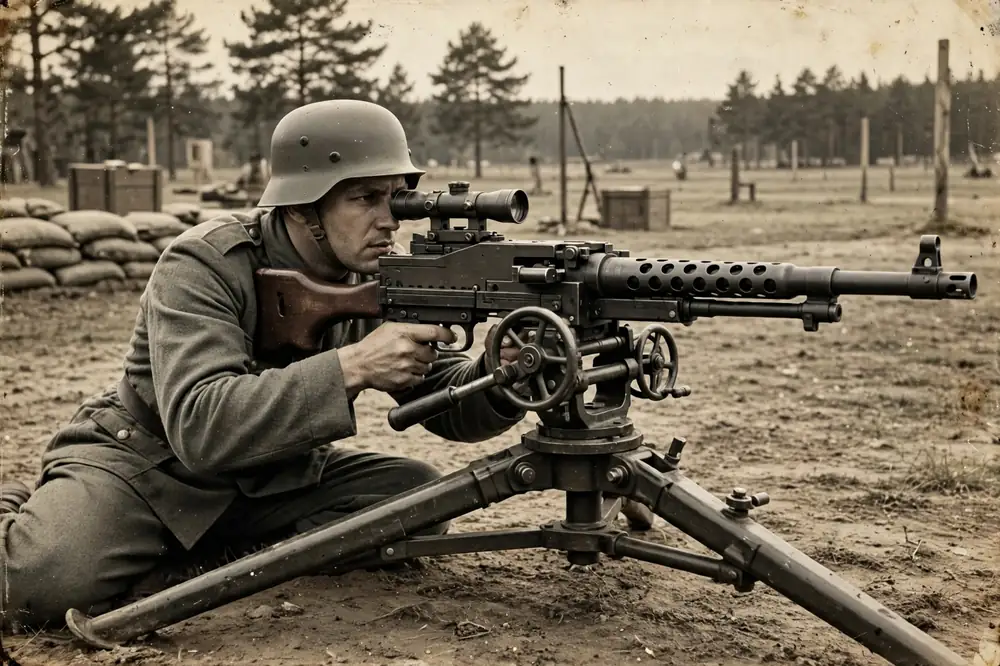
The MG34 was fed by a metallic link belt of 50 rounds, which could be joined together to make longer belts, and it could also be fed from a 75-round saddle drum, the Patronentrommel 34, which was used for anti-aircraft work and for assault, and from a 250-round belt when the gun was mounted on a tripod. The belt was fed from the left, and the gun could be set to fire single shots as well as fully automatically, a feature that was unusual for a machine gun and that made it useful for accurate fire at long range. The gun’s sights were a simple tangent rear sight graduated to 2,000 metres, and when the gun was mounted on the Lafette 34 tripod it could be fitted with a telescopic sight and fired by a trigger at the rear of the mount, which let the gunner aim and fire with great accuracy at ranges of over 2,000 metres. The tripod, which weighed about 20 kilograms, was a sophisticated piece of equipment in its own right, with a recoil-absorbing mechanism and a traversing and elevating gear that let the gun be laid on a target and fired in controlled bursts.
Strengths and Weaknesses
The MG34’s strengths were its versatility, its rate of fire and its accuracy, and its weaknesses were its cost, its complexity and its sensitivity to dirt. The gun was built from machined steel to very close tolerances, and it performed beautifully when it was clean and well maintained, but mud, dust and ice could jam its finely fitted parts, and on the Eastern Front in the winter of 1941–1942 German soldiers found that their MG34s stopped working in the cold and the mud while the simpler Soviet machine guns kept firing. The gun was also expensive: it took about 150 hours of skilled labour to make one MG34, and it used large amounts of high-quality steel, and as the war went on Germany could not afford to make it in the numbers it needed. The answer was the MG42, which was designed to be stamped and pressed from sheet metal and could be made in a fraction of the time, and from 1942 the MG42 replaced the MG34 in front-line infantry service, though the MG34 remained in use as a vehicle weapon, where its smooth operation and its ability to fire single shots made it better suited to the confined space of a tank.
5. Variants
| Variant | Years | Key features | Notes |
|---|---|---|---|
| MG34 (infantry) | 1936–1945 | Bipod or Lafette tripod; 50-round belt or 75-round drum | Standard infantry version |
| MG34 Panzerlauf | 1939–1945 | Armoured barrel jacket; no bipod; for tanks | Coaxial and hull gun in Panzer III, IV, Tiger |
| MG34 (aircraft) | 1936–1945 | Lighter barrel jacket; flexible mount | Defensive gun in bombers and transports |
| MG34/41 | 1941 | Higher rate of fire, about 1,200 rpm; strengthened parts | Small numbers; forerunner of the MG42 |
| MG34S | 1939 | Simplified prototype with fewer machined parts | Experimental; not adopted |
Infantry Versions
The standard infantry MG34 was issued in two forms: as a light machine gun on a bipod, carried by the squad and fired from the shoulder or from the ground, and as a medium machine gun on the Lafette 34 tripod, served by a crew of three and used for sustained fire at long range. The two forms used the same gun, and the difference was the mount and the accessories: the light gun was carried with a 50-round belt and a 75-round drum, while the tripod gun was fed from a 250-round belt and fitted with a telescopic sight. The gun could also be fired from an anti-aircraft tripod, the Dreibein 34, which let it engage low-flying aircraft, and it was sometimes mounted on a simple wooden post in a fixed defensive position. The MG34’s versatility was its greatest strength, and it was the reason the German Army could standardise on a single machine gun for the whole infantry, but it also meant that the gun was heavier and more complicated than a specialised light machine gun, and that it demanded a well-trained crew to use it to its full effect.
Vehicle, Aircraft and Anti-Aircraft Mounts
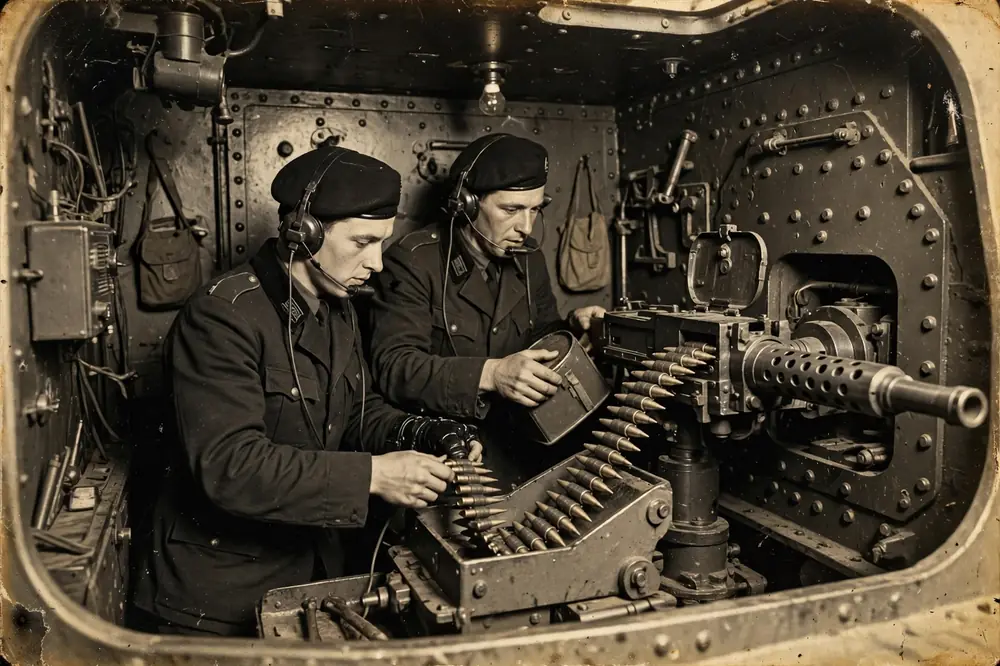
The MG34 was widely used as a vehicle weapon, and the Panzerlauf version, with an armoured barrel jacket and no bipod, was fitted as the coaxial and hull machine gun in the Panzer III, the Panzer IV, the Panther, the Tiger and most other German tanks and armoured vehicles. In the tank, the MG34’s smooth recoil operation and its ability to fire single shots made it well suited to the confined space of the fighting compartment, and it remained the standard tank machine gun of the German Army even after the MG42 had replaced it in the infantry. The MG34 was also used as a flexible defensive gun in German bombers and transport aircraft, and as an anti-aircraft gun on a high tripod, where its high rate of fire made it effective against low-flying aircraft, though its 7.92 mm bullet was too light to damage a modern aircraft at any great range. The gun’s adaptability to so many mounts was a tribute to its design, and it is one of the reasons the MG34 remained in production until the end of the war.
Foreign Copies and the MG34/41
The MG34 was copied abroad, most notably in Yugoslavia, where the Zastava factory built it after the war as the M53, chambered for the 7.92 mm cartridge and used by the Yugoslav Army for decades. The MG34/41 was an improved version built in small numbers in 1941, with a higher rate of fire of about 1,200 rounds per minute and strengthened parts, and it was an important step towards the MG42, which borrowed its feed system and its quick-change barrel. The MG34S was a simplified prototype of 1939, with fewer machined parts, but it was not adopted, and the German Army chose instead to develop the entirely new MG42. The MG34 was also supplied to Germany’s allies, including Romania, Hungary and Finland, and captured MG34s were used by the Soviet Union, by the French resistance and by the British Home Guard, who prized the gun for its rate of fire and its reliability when it was properly maintained.
6. Operational History
Poland and France, 1939–1940
The MG34’s first combat came in Poland in September 1939, where it was issued at the rate of one per infantry squad and proved itself in the fast-moving battles of the Polish campaign. The Polish Army, which had few automatic weapons, was outgunned by the German infantry, and the MG34’s high rate of fire let German squads dominate the firefight and pin down Polish troops while the tanks and the artillery moved around them. In France in May and June 1940, the MG34 was again the centre of the German infantry squad, and it played a vital part in the breakthrough at Sedan and in the fighting in the hedgerows and villages of northern France, where its ability to lay down a heavy base of fire let the German riflemen close with the enemy. The French and British soldiers who faced it were impressed and frightened by its rate of fire, and the British after-action reports from the campaign noted that the German infantry seemed to have far more automatic weapons than their own, a judgement that was true in effect, if not in numbers.
The Eastern Front
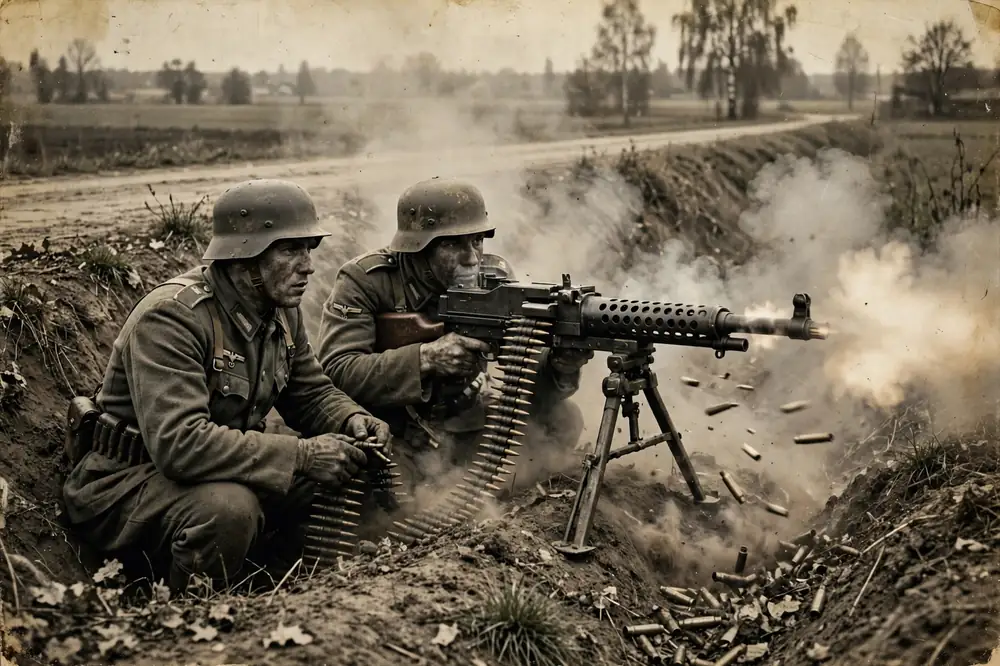
On the Eastern Front, the MG34 was the German infantryman’s most important weapon, and the fighting of 1941 and 1942 showed both its strengths and its weaknesses in the harshest conditions of the war. In the summer of 1941, during Operation Barbarossa, the gun’s high rate of fire let German squads break up Soviet attacks and hold positions against far larger forces, and its accuracy on the tripod made it a formidable defensive weapon. But in the winter of 1941–1942, the cold and the mud exposed the gun’s sensitivity to dirt: the finely machined parts froze and jammed, the lubricant thickened, and German soldiers found that their MG34s stopped working while the simpler Soviet DP-28 and Maxim guns kept firing. The German Army issued special winter lubricants and trained its soldiers to keep their guns clean and warm, but the problem never went away, and it was one of the reasons the simpler MG42 was welcomed when it arrived. Through all of this, the MG34 remained the core of the German infantry squad, and German tactics were built around it: the squad attacked with the machine gun laying down a base of fire while the riflemen moved forward in short rushes, and it defended with the gun sited to cover the ground in front of the position. The machine gunner was the most important man in the squad, protected by the riflemen who carried his ammunition and watched his flanks, and Soviet soldiers learned to identify the sound of the MG34 and to target its crew first, so German machine gunners suffered heavy casualties even as a single well-sited gun could hold a position against a whole Soviet company.
Barbarossa and the Winter
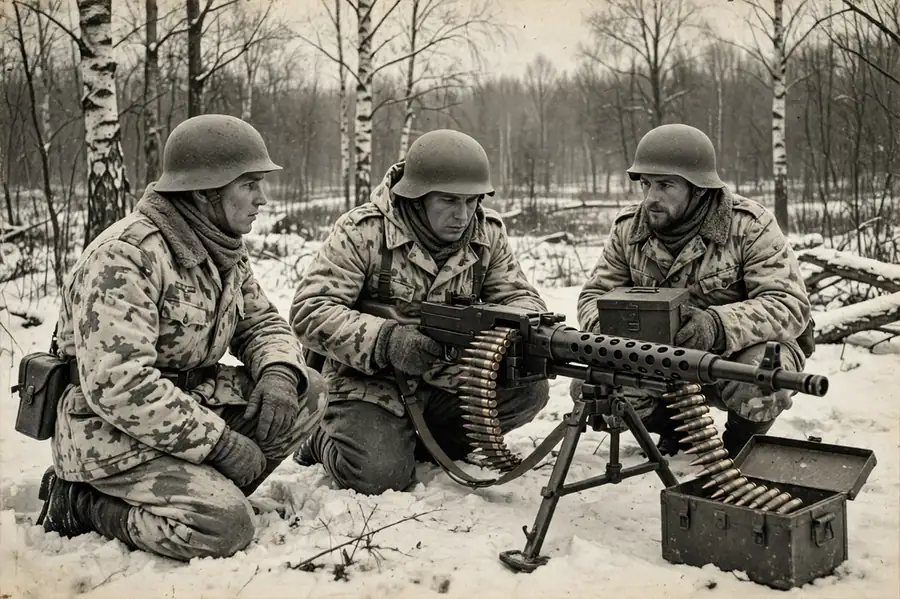
On the Eastern Front, the MG34 was the German infantryman’s most important weapon, and the fighting of 1941 and 1942 showed both its strengths and its weaknesses. In the summer of 1941, during Operation Barbarossa, the MG34’s high rate of fire let German squads break up Soviet attacks and hold positions against far larger forces, and the gun’s accuracy on its tripod made it a formidable defensive weapon. But in the winter of 1941–1942, the cold and the mud exposed the gun’s sensitivity to dirt: the finely machined parts froze and jammed, the lubricant thickened, and German soldiers found that their MG34s stopped working while the simpler Soviet DP-28 and Maxim guns kept firing. The German Army issued special winter lubricants and trained its soldiers to keep their guns clean and warm, but the problem never went away, and it was one of the reasons the simpler MG42 was welcomed when it arrived. The MG34’s record on the Eastern Front is therefore a mixed one: a superb weapon in the summer, and a demanding one in the winter.
The Squad’s Core Weapon
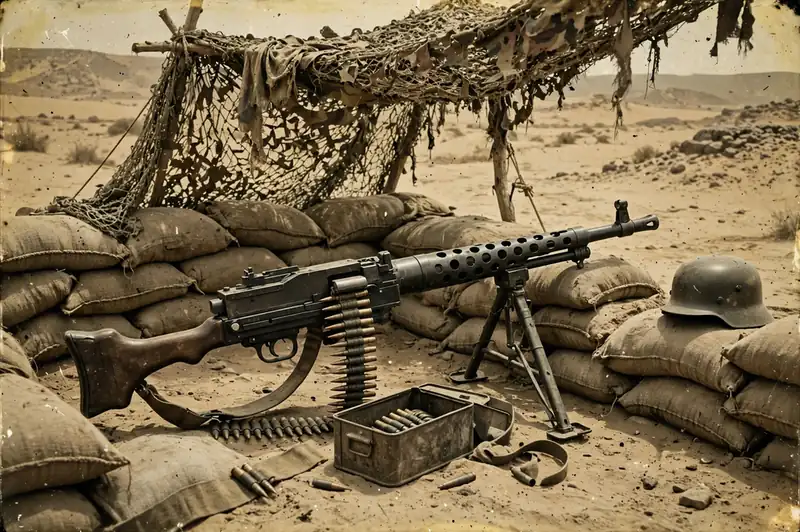
Throughout the war on the Eastern Front, the MG34 remained the core of the German infantry squad, and German tactics were built around it. The squad attacked with the machine gun laying down a base of fire while the riflemen moved forward in short rushes, and it defended with the machine gun sited to cover the ground in front of the position, its fields of fire carefully planned and its spare barrels and ammunition laid out ready for use. The machine gunner was the most important man in the squad, and he was protected by the riflemen, who carried his ammunition and watched his flanks, and the loss of the machine gunner was a serious blow to the squad’s fighting power. Soviet soldiers learned to identify the sound of the MG34 and to target its crew first, and German machine gunners suffered heavy casualties, but the gun’s performance meant that a single well-sited MG34 could hold a position against a whole Soviet company, and the gun’s reputation grew with every battle of the Eastern Front.
North Africa, Italy and Normandy
In North Africa, the MG34 served with the Afrika Korps, where its high rate of fire was well suited to the open desert, and where its sensitivity to dust was a constant problem that the crews met by cleaning their guns obsessively and by keeping them covered when they were not in use. In Italy, the MG34 was the main weapon of the German defence of the Gustav Line and of the fighting at Monte Cassino, where its tripod-mounted guns dominated the valleys and the roads and made the Allied advance slow and costly. In Normandy in 1944, the MG34 was still in service alongside the MG42, and it was the gun that Allied soldiers met in the hedgerows, where a single machine gun in a well-sited position could hold up a whole platoon, and where the sound of its fire told the attackers that they faced a German position that would have to be outflanked rather than assaulted frontally. By 1944 the MG34 was being replaced by the MG42 in the infantry, but it remained in service in second-line units and as a vehicle weapon until the end of the war.
The Last Years of the War
In the last years of the war, the MG34 was increasingly found in second-line units, in the Volkssturm and in fixed defensive positions, while the MG42 took its place in the front-line infantry. But the gun remained in production until 1945, because it was still needed as a tank weapon, and because the German arms industry could not make enough MG42s to replace it entirely, and the factories that built it kept working until the last weeks of the war. In the defence of Berlin in April and May 1945, MG34s were used in the street fighting and in the defence of the government quarter, and they were among the last German weapons to fall silent. The gun’s service ended with the war, but its design lived on: the Yugoslav M53, a direct copy of the MG34, remained in service for decades, and the MG34’s concept — the general-purpose machine gun — became the standard for every army in the world.
7. Performance and Specifications
| Specification | MG34 |
|---|---|
| Calibre | 7.92×57 mm Mauser |
| Weight (gun) | 12.1 kg |
| Weight (with Lafette tripod) | About 32 kg |
| Length | 1,219 mm |
| Barrel length | 627 mm |
| Rate of fire | 800–900 rounds per minute |
| Muzzle velocity | About 755 m/s |
| Effective range (bipod) | About 1,200 m |
| Effective range (tripod) | Over 2,000 m |
| Maximum range | About 4,700 m |
| Feed | 50-round belt; 75-round drum; 250-round belt |
| Barrel change | Quick-change; spare barrels issued |
Firing Performance
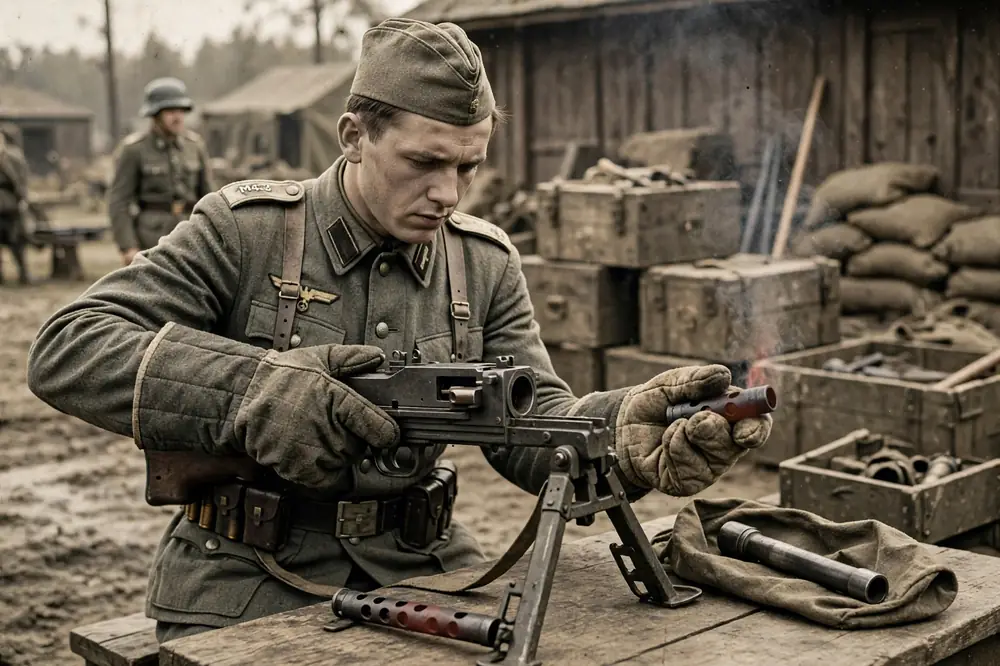
The MG34’s rate of fire of 800 to 900 rounds per minute was the highest of any infantry machine gun in service at the start of the war, and it gave the German squad a weight of fire that no Allied squad could match. The gun’s recoil operation was smooth, and its accuracy on the tripod was excellent: a trained gunner could put bursts into a target at 1,000 metres, and with the telescopic sight on the Lafette tripod he could engage targets at over 2,000 metres. The gun’s 7.92 mm bullet, fired at about 755 metres per second, had the range and the penetration to defeat light cover and to wound at long range, and its trajectory was flat enough for accurate fire at the ranges at which infantry fought. But the high rate of fire was also a weakness: it consumed ammunition at a prodigious rate, and a squad in a heavy action could fire through its ammunition supply in minutes, so German logistics had to work hard to keep the machine guns supplied, and the gunner had to be disciplined in his use of fire.
Comparison with the MG42 and Allied Guns
Compared with the MG42 that replaced it, the MG34 was more expensive, slower to make and more sensitive to dirt, but it was smoother in operation and it could fire single shots, which the MG42 could not. The MG42 fired faster, at 1,200 to 1,500 rounds per minute, and it was made from stamped sheet metal in a fraction of the time, but it was rougher and it wore out its barrels faster. Compared with the Allied machine guns, the MG34 was superior in rate of fire and in versatility: the British Bren gun fired at about 500 rounds per minute and could not serve as a medium machine gun, the American Browning M1919 fired at about 500 rounds per minute and was heavy and water-cooled in its early form, and the Soviet DP-28 fired at about 550 rounds per minute from an awkward pan magazine. The MG34’s combination of a high rate of fire, a quick-change barrel and a tripod mount that let it serve as a medium machine gun was unmatched in 1939, and it set the standard that every other army tried to meet for the rest of the war.
8. Operators
Germany and the Waffen-SS
The MG34 was used by the German Army, the Waffen-SS, the Luftwaffe’s ground units and the Kriegsmarine’s shore units, and it was the standard machine gun of the German armed forces from 1936 until it was gradually replaced by the MG42 from 1942 onwards. It was issued to every infantry squad, to the machine-gun companies of the infantry battalions, to the armoured forces as a tank gun, and to the engineers, the reconnaissance units and the paratroops, who valued it for its firepower and its versatility. The Waffen-SS used the MG34 in the same way as the army, and its divisions were equipped with it from their formation, though the SS, like the army, replaced it with the MG42 as the war went on. The MG34’s service in Germany ended with the war, but its design and its doctrine lived on in the German Army’s post-war machine guns, which kept the concept of the general-purpose machine gun that the MG34 had introduced.
Other Users and Post-War Service
The MG34 was supplied to Germany’s allies, including Romania, Hungary, Finland and Bulgaria, and it was used by the armies of those countries on the Eastern Front and in the Balkans. Captured MG34s were used by the Soviet Union, by the French resistance, by the British Home Guard and by the partisans of Yugoslavia, who prized the gun for its rate of fire. After the war, the MG34 remained in service in several countries: Yugoslavia built it as the M53 and used it for decades, Czechoslovakia used captured guns, and the French Army used MG34s in Indochina. The gun also served in the Middle East and in Africa, where it was used by the armies of several countries into the 1960s and 1970s. The MG34’s post-war career was a tribute to its design: a gun built for the German Army of 1936 was still in service thirty years later, in the hands of soldiers who had never seen Germany.
9. Legacy and Influence
The First General-Purpose Machine Gun
The MG34’s legacy is the concept of the general-purpose machine gun, and every army in the world now uses a gun that follows its pattern. Before the MG34, armies had separate light and heavy machine guns, and they had to train their soldiers on two weapons and supply two kinds of ammunition and spare parts; after the MG34, armies had a single gun that could do both jobs, and the light and heavy machine guns disappeared from service. The German infantry squad, built around the machine gun, became the model for the infantry squad of every army, and the idea that the machine gun, and not the rifle, is the squad’s main weapon is now accepted everywhere. The MG34’s high rate of fire also set a standard: the sound of the German machine gun, the tearing buzz that Allied soldiers called the “buzzsaw”, became the sound of the modern battlefield, and the guns that followed it — the MG42, the American M60, the Belgian FN MAG and the Russian PK — all fired at rates that would have been unimaginable before the MG34.
Influence on Post-War Design
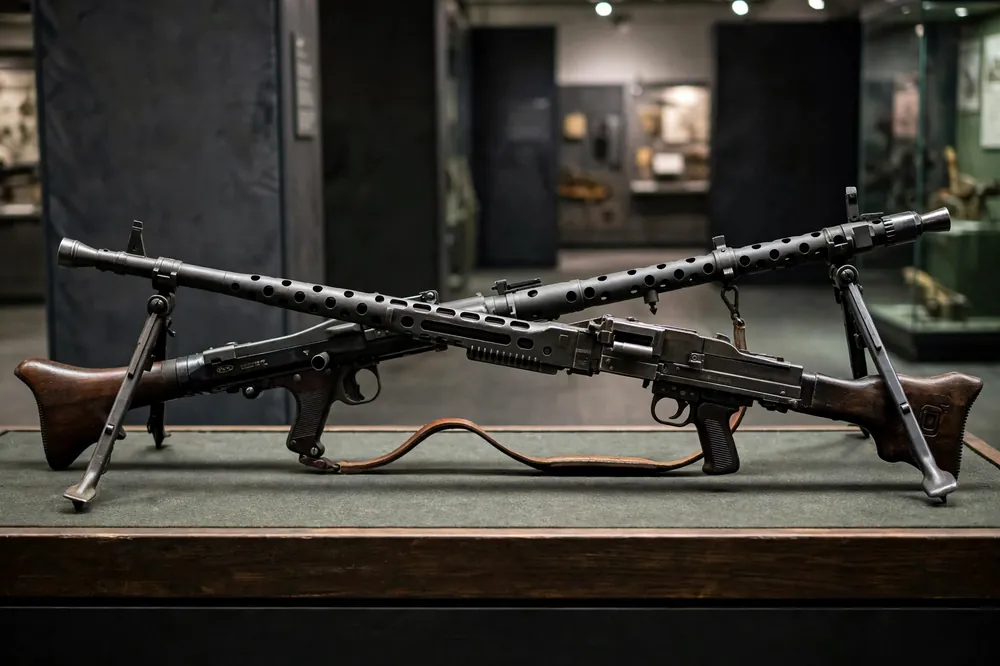
The MG34 influenced the design of every machine gun that followed it, and its features — the quick-change barrel, the belt feed, the tripod mount and the ability to serve as both a light and a medium machine gun — are now standard on every general-purpose machine gun in the world. The MG42, which replaced it, borrowed its feed system and its quick-change barrel and improved them, and the MG42’s own successor, the German MG3, is still in service today, a direct descendant of the MG34 through the MG42. The American M60, the Belgian FN MAG and the Soviet PK all owe something to the MG34’s concept, and the modern infantry squad, built around a single machine gun, is the MG34’s most lasting legacy. The gun itself is now a museum piece, but its idea — that one gun can do the work of many — is the foundation of modern infantry tactics, and it is the MG34’s greatest achievement.
10. Surviving Examples
Museums and Collections
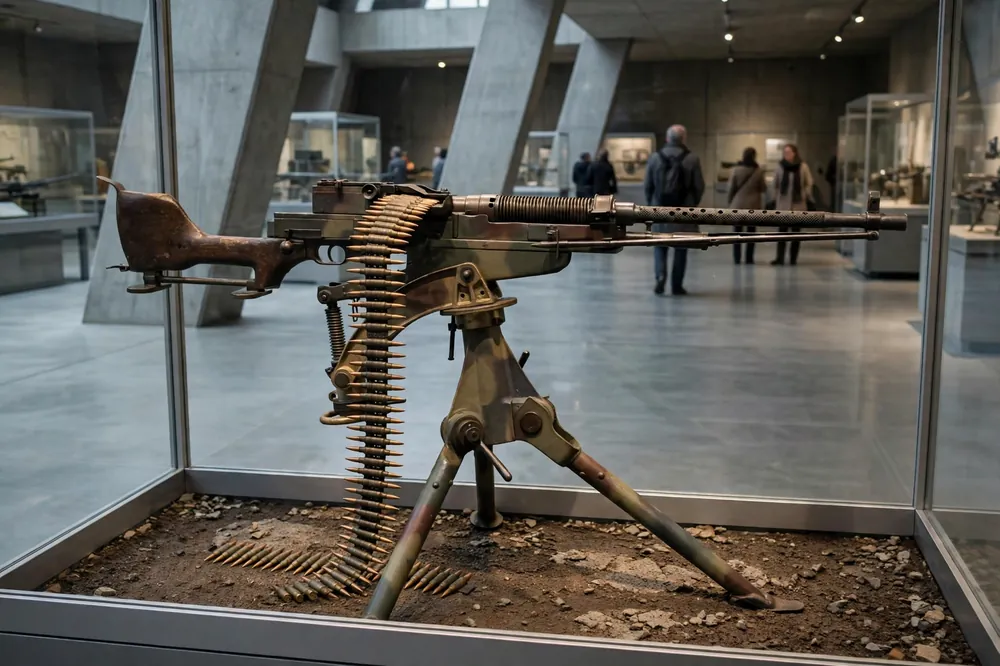
MG34s survive in large numbers in museums and in private collections around the world, because about 577,000 were built and many were captured and preserved. The Bundeswehr Military History Museum in Dresden holds MG34s in its collection, as do the Imperial War Museum in London, the National WWII Museum in New Orleans, the Musée de l’Armée in Paris and the Central Armed Forces Museum in Moscow, which holds captured German weapons from the Eastern Front, and the Royal Armouries in Leeds also displays examples of the gun. The Tank Museum in Bovington holds MG34s that were removed from German tanks, and the Waffenmuseum in Suhl, in the heart of the German arms industry, holds examples from the factories that built them. For the visitor, the MG34 is one of the most accessible weapons of the Second World War, and it is displayed in almost every military museum that covers the German Army.
Replicas, Films and the Collector Market
The MG34 is a popular weapon with collectors and with film-makers, and it appears in many films about the Second World War, though it is often played by the more common MG42 or by a replica, because original MG34s are expensive and, in many countries, restricted by law. Deactivated MG34s are legally owned by collectors in several European countries, and they are among the most sought-after German weapons on the collector market, with prices that reflect their rarity and their historical importance. Replicas of the MG34, built to fire blank cartridges, are used in films and in re-enactments, and the gun’s distinctive appearance — its perforated barrel jacket, its pistol grip and its long belt — makes it instantly recognisable. For the re-enactor and the collector, the MG34 is the weapon that defines the German infantryman of the Second World War, and its survival in museums and in private hands ensures that its story will continue to be told.
Frequently Asked Questions
What is the MG34?
The MG34 was Germany’s general-purpose machine gun of the Second World War, adopted in 1936. It fired the 7.92×57 mm cartridge at 800 to 900 rounds per minute and could serve as a light machine gun, a medium machine gun, a tank gun and an anti-aircraft gun.
How many MG34s were built?
About 577,000 MG34s were built between 1935 and 1945 by Rheinmetall, Mauser, Steyr and other German firms.
What is the difference between the MG34 and the MG42?
The MG42 was cheaper and faster to make, fired faster at 1,200 to 1,500 rounds per minute, and was made from stamped sheet metal, while the MG34 was machined from steel, fired at 800 to 900 rounds per minute, and could fire single shots, which the MG42 could not.
Why was the MG34 replaced?
The MG34 was expensive and slow to manufacture, taking about 150 hours of skilled labour per gun, and it was sensitive to dirt and cold. The MG42 could be made far more quickly and cheaply from stamped metal, and it replaced the MG34 in front-line infantry service from 1942.
What calibre was the MG34?
The MG34 fired the standard German 7.92×57 mm Mauser rifle cartridge, the same cartridge used by the Karabiner 98k rifle and the Gewehr 43.
Where can I see an MG34 today?
MG34s are displayed in the Bundeswehr Military History Museum in Dresden, the Imperial War Museum in London, the National WWII Museum in New Orleans and the Musée de l’Armée in Paris, among other museums.
Sources
- Wikipedia, “MG 34” — development, specifications, production of about 577,000, service history.
- Chris McNab, MG34 and MG42 Machine Guns (Osprey Publishing, 2012) — design, operation and combat use.
- Ian V. Hogg, German Small Arms of World War II (Greenhill Books, 1999) — the MG34’s development and its place in the German infantry.
- Gordon L. Rottman, The MG34 and MG42 Machine Guns (Osprey Publishing, 2011) — the squad organisation built around the machine gun.
- United States War Department, Handbook on German Military Forces (1945) — the MG34’s organisation, mounts and tactical employment.
- Robert Bruce, German Machine Guns of World War II (Windrow & Greene, 1997) — the Lafette tripod and the MG34’s variants.