 WAR ATLAS MILITARY HISTORY MAGAZINE · WWI — WWII
Panhard 178
1. Lead
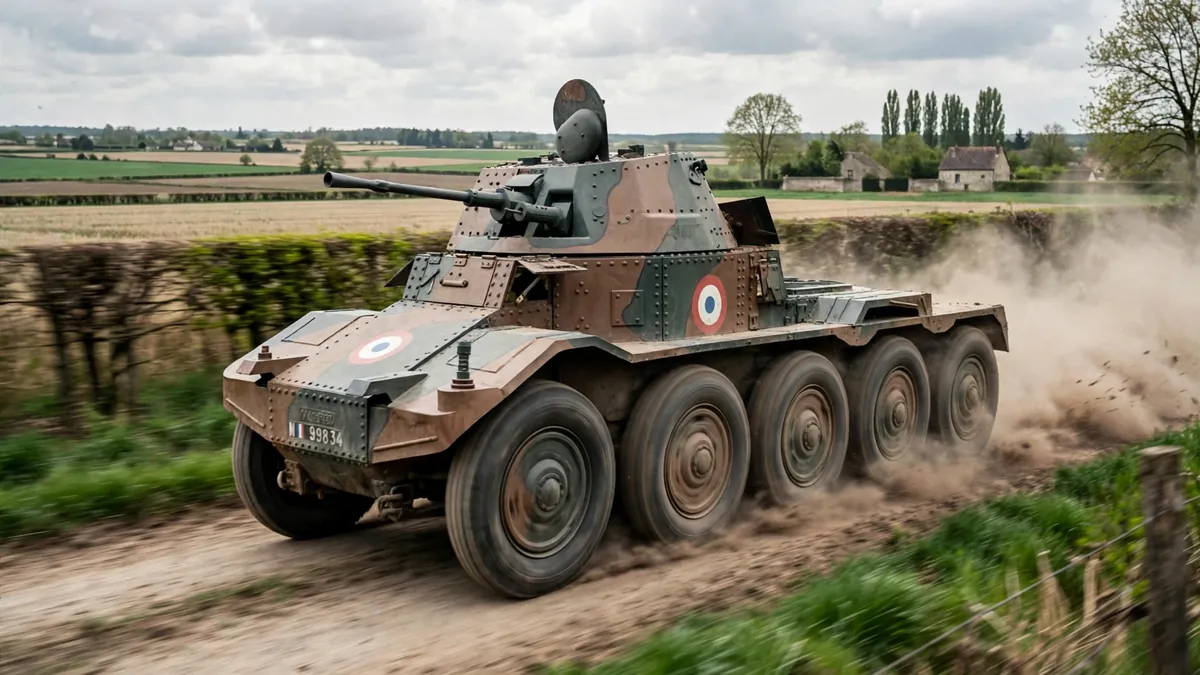
The Panhard 178 was France’s standard armoured car of the late 1930s, and one of the best reconnaissance vehicles of the Second World War. Built by the Panhard company, the Panhard 178 — officially the Automitrailleuse de Découverte AMD 35 — was an eight-wheeled armoured car with a 25 mm gun in a turret, a top speed of about 72 kilometres per hour on roads, and a range of about 300 kilometres.
More than 700 were built before and during the war, and they equipped the reconnaissance units of the French cavalry and mechanised divisions. In the Battle of France in May–June 1940, the Panhard 178 was one of the few French armoured vehicles that could outrun and outfight the German tanks it met: its 25 mm gun could penetrate the armour of the Panzer I and Panzer II, and its speed allowed it to escape from the Panzer III and Panzer IV.
After the fall of France, the Panhard 178 served with the Germans, with the Free French, and with the Vichy forces, and after the war it was rebuilt as the Panhard 178B and served in the French Army and in the armies of France’s former colonies into the 1960s.
The Panhard 178’s story is the story of French armoured reconnaissance in the 1930s: a story of a vehicle that was well-designed, well-built and well-armed for its role, and that was let down not by its own failings but by the collapse of the army it served. The Panhard 178 was a reconnaissance vehicle, and reconnaissance vehicles do not win wars on their own — but they can lose them, if they fail to find the enemy, and the Panhard 178 did not fail. In 1940, its crews found the Germans, reported them, and fought them, and the vehicle’s reputation was made in the few weeks of the Battle of France.
2. Key Facts
| Vehicle | Panhard 178 (AMD 35, Automitrailleuse de Découverte), French armoured car |
| Built | 1937–1940; more than 700 built (sources give 700–730) |
| Manufacturer | Panhard et Levassor, France |
| Weight | About 8.2 tons |
| Crew / Kíp lái | 4 (commander/gunner, loader, driver, rear driver) |
| Main armament | 25 mm SA 35 gun; 1 × 7.5 mm Reibel machine gun |
| Armour / Giáp | 7–20 mm / 7–20 mm |
| Engine | Panhard ISK 4-cylinder petrol, about 105 hp |
| Speed | About 72 km/h on roads |
| Range | About 300 km on roads |
| Service | Battle of France 1940; German, Free French and Vichy service; post-war as Panhard 178B |
3. Design and Development
The French cavalry’s requirement
In the early 1930s, the French cavalry needed a new armoured car for reconnaissance — a vehicle that could range far ahead of the main force, find the enemy, report back by radio, and fight its way out of trouble if it was discovered. The existing French armoured cars were old, slow and lightly armed, and they were no match for the fast, well-armed reconnaissance vehicles that Germany was developing.
In 1933, the French Army issued a requirement for an Automitrailleuse de Découverte — a discovery armoured car — with a 25 mm gun, a radio, a top speed of 70 km/h, and a range of 300 kilometres. Panhard, one of France’s oldest motor manufacturers, won the competition with a design that was radical for its day: an eight-wheeled vehicle, with four-wheel drive on the rear four wheels, a low, streamlined hull, and a turret mounting the 25 mm gun.
Eight wheels and a rear driver
The Panhard 178’s most distinctive feature was its eight wheels: four axles, with the rear two axles driven, and the front two axles steered. The eight-wheel layout gave the vehicle excellent cross-country mobility for a wheeled vehicle, and it allowed the Panhard to cross trenches and obstacles that would have stopped a four-wheeled armoured car.
The vehicle also had a second driver, seated at the rear, facing backwards, who could drive the vehicle in reverse at full speed — a feature that was invaluable for a reconnaissance vehicle, which often needed to break contact and withdraw quickly.
The driver and the rear driver sat in the hull, the commander and the loader sat in the turret, and the vehicle carried a radio — the ER 29 or ER 26 — which allowed it to report its findings to headquarters. The Panhard 178 was, by the standards of the 1930s, a sophisticated and well-thought-out reconnaissance vehicle.
Production
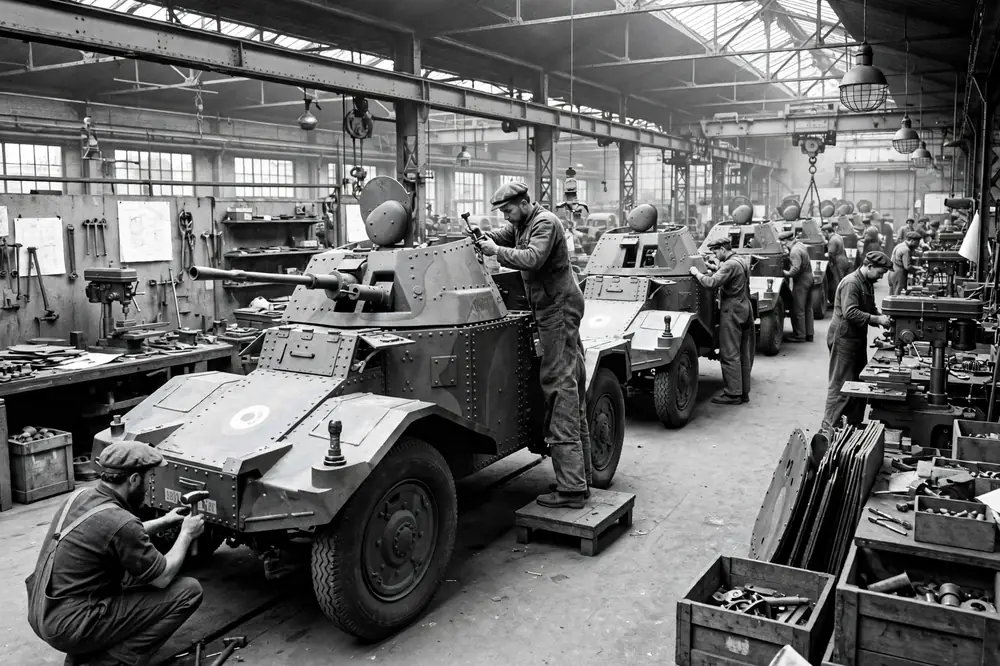
The Panhard 178 was ordered in 1935, and production began in 1937 at the Panhard factory in Paris. More than 700 were built before the fall of France in June 1940, and production continued under German occupation, with the Germans ordering additional vehicles for their own use.
The Panhard 178 was built in two main versions: the early version, with the APX 3 turret, and the later version, with the APX 3B turret, which had a slightly different shape and a better gun mounting. The production run was large by French standards, and the Panhard 178 was the most numerous French armoured car of the war — a measure of how important the French Army considered reconnaissance, and of how well the Panhard design met the requirement.
4. Armament and Protection
The 25 mm gun
The Panhard 178’s main weapon was the 25 mm SA 35 gun, a weapon derived from the French 25 mm anti-tank gun, the Hotchkiss 25 mm, which was one of the best light anti-tank guns of the 1930s. The SA 35 fired a 25 mm armour-piercing shell at a muzzle velocity of about 900 metres per second, which could penetrate about 40 mm of armour at 500 metres — enough to defeat the Panzer I and Panzer II, and to threaten the Panzer III and Panzer IV from the side.
The gun was mounted in the turret, together with a coaxial 7.5 mm Reibel machine gun, and it was aimed by the commander, who was also the gunner — a common arrangement in French armoured vehicles of the period, and one that slowed the vehicle’s rate of fire and its ability to acquire targets.
The 25 mm gun was the Panhard 178’s greatest strength, and it was the reason the vehicle could fight the German tanks it met in 1940.
Armour and the four-man crew
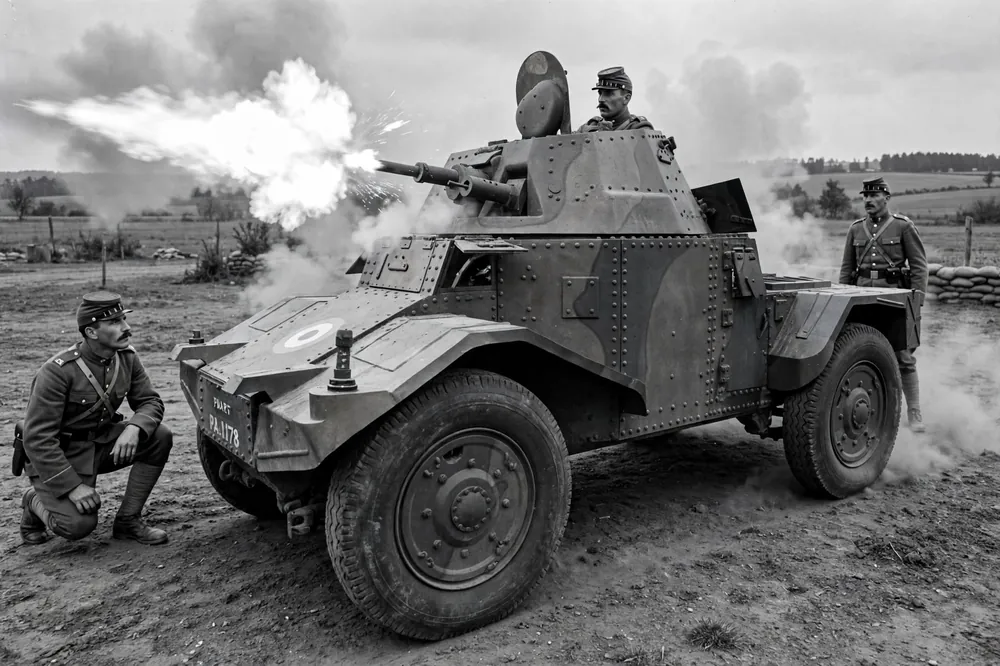
The Panhard 178’s armour was 7–20 mm thick, with the thickest armour on the turret front and the hull front. That was enough to stop rifle bullets, machine-gun fire and shell splinters, but not enough to stop an anti-tank gun or a tank gun at normal combat ranges.
The vehicle’s protection was its speed and its low silhouette, not its armour, and its crews understood that: the Panhard 178 was a reconnaissance vehicle, and its job was to find the enemy and report back, not to fight a pitched battle.
The crew of four — commander/gunner, loader, driver and rear driver — was a good crew for a reconnaissance vehicle: the rear driver was a luxury that no other armoured car of the period possessed, and it was a feature that the vehicle’s crews valued highly.
The radio, which was carried in the turret, was the vehicle’s most important piece of equipment, and the Panhard 178’s crews were trained to use it well.
Mobility
The Panhard 178’s mobility was its greatest asset. Its top speed of about 72 km/h on roads was faster than any German tank, and its eight-wheel layout gave it good cross-country performance for a wheeled vehicle. The vehicle’s range of about 300 kilometres allowed it to operate far ahead of the main force, and its low fuel consumption — the Panhard engine was economical for its power — meant that it could stay out for days.
The Panhard 178’s mobility was the reason it survived in 1940 when so many French tanks did not: it could outrun the Germans, it could escape from a trap, and it could report back. The vehicle’s mobility was also the reason the Germans valued it after the fall of France, and used it in their own reconnaissance units.
5. The Battle of France
Reconnaissance in the Ardennes
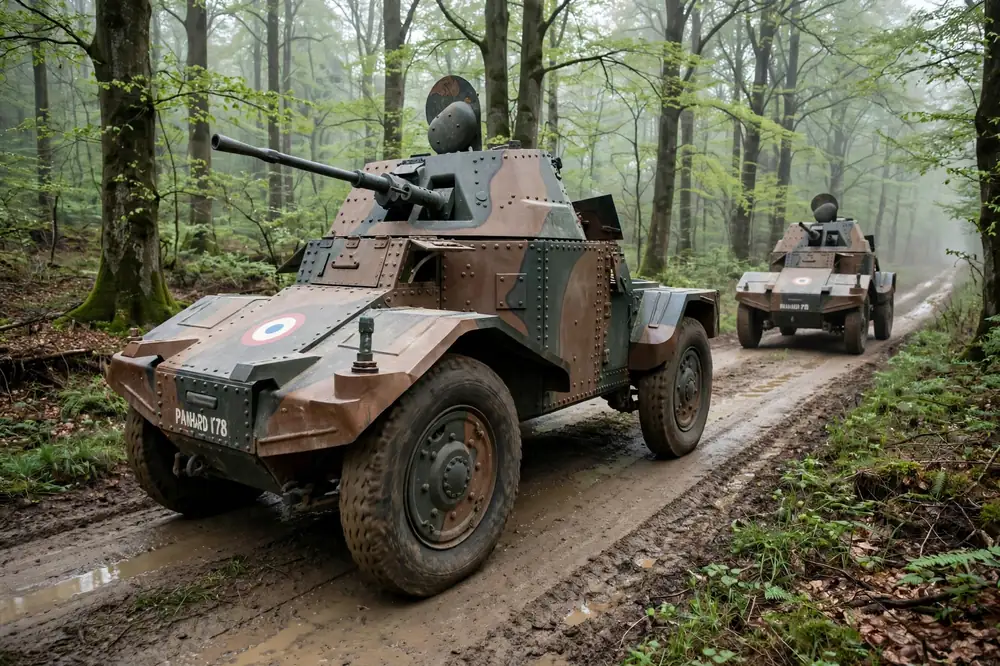
In May 1940, the Panhard 178s were in the reconnaissance units of the French cavalry divisions and the light mechanised divisions, and they were among the first French vehicles to meet the Germans. In the Ardennes, Panhard 178s of the 1st Light Mechanised Division encountered the German panzer divisions advancing through the forest, and they reported the German advance — reports that were not acted upon, because the French high command did not believe that the Germans could advance through the Ardennes in force.
The Panhard 178s fought delaying actions, using their speed to escape from the German tanks and their 25 mm guns to destroy the German reconnaissance vehicles and the Panzer I and Panzer II tanks that led the advance. The vehicles’ crews fought well, but they were fighting a battle that had already been lost at the level of strategy.
The fighting retreat
As the German advance continued, the Panhard 178s fought in the retreat to the Somme, to the Seine, and to the Loire. The vehicles’ speed and range made them ideal for the fighting retreat: they could screen the withdrawal, they could delay the Germans at river crossings, and they could escape when the position became untenable.
One of the most famous Panhard 178 actions of the campaign was the defence of the bridge at Hannut, where Panhard 178s of the 1st Light Mechanised Division fought German tanks and destroyed several of them before withdrawing. Another was the action at Abbeville, where Panhard 178s supported the British counterattack.
The Panhard 178s were among the last French armoured vehicles still fighting when the armistice was signed on 22 June 1940, and their crews had earned a reputation as the best reconnaissance troops in the French Army.
6. Service with Germany and the Free French
The Panzerspähwagen P204 (f) / Panzerspähwagen P204 (f)
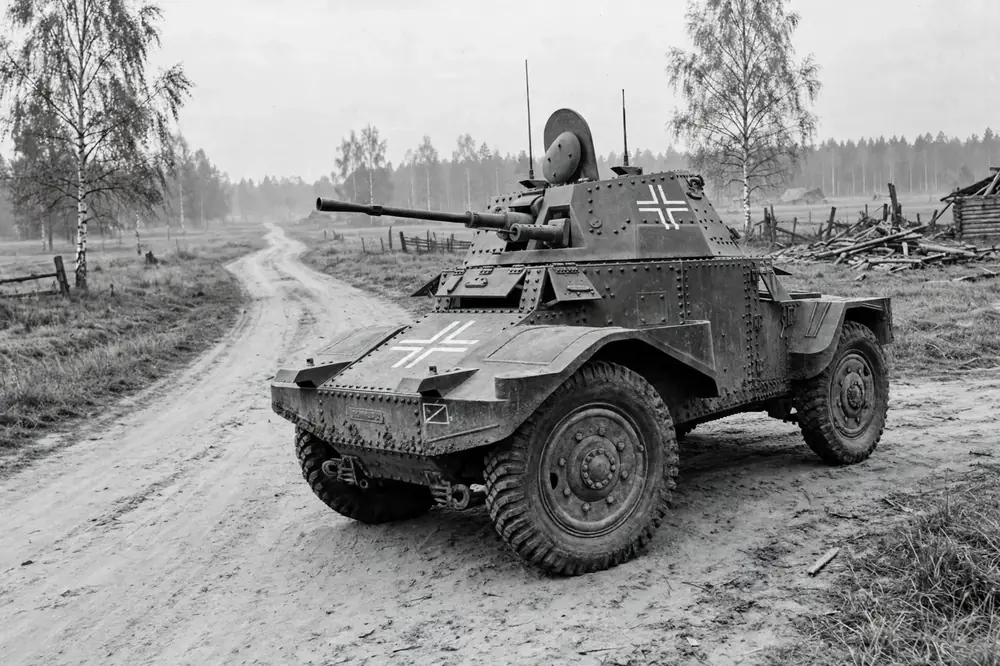
After the fall of France, the Germans captured large numbers of Panhard 178s — more than 200, by most estimates — and pressed them into service as the Panzerspähwagen P204 (f), the (f) denoting a French vehicle in German service. The Germans used the Panhard 178 in reconnaissance units on the Eastern Front, in France, and in the Balkans, where its speed and its 25 mm gun were valued.
The Germans also continued production of the Panhard 178 at the Panhard factory in Paris, ordering additional vehicles for their own use. The Panhard 178 in German service was a measure of the vehicle’s quality: the Germans, who had their own excellent reconnaissance vehicles in the Sd.Kfz. 232 and the Sd.Kfz. 234, still found the Panhard worth using, and they used it until the end of the war.
Free French and Vichy service
Panhard 178s also served with the Free French forces, who used them in North Africa and in the liberation of France, and with the Vichy forces, who used them in North Africa and in Syria. The most famous Free French Panhard 178 action was in the desert war, where the vehicles of the 1st Free French Division served as reconnaissance vehicles in the campaigns in Libya and in Tunisia.
After the war, the Panhard 178 was rebuilt as the Panhard 178B, with a new turret mounting a 47 mm gun, and it served in the French Army in Indochina and in Algeria, and in the armies of France’s former colonies in Africa.
The Panhard 178B was the last version of the design, and it served into the 1960s — a service life of nearly thirty years for a vehicle designed in 1933.
7. The Panhard 178B and Post-War Service
The 47 mm gun
After the war, the French Army needed an armoured car for its colonial wars, and the Panhard 178 was the vehicle it had. The Panhard 178B was a rebuild of the wartime vehicle, with a new turret — the FL-1 turret, designed by Fives-Lille — mounting a 47 mm SA 35 gun, a weapon that was more powerful than the 25 mm gun and that was better suited to the colonial wars, where the enemy was infantry and light vehicles rather than tanks.
The Panhard 178B also received a more powerful engine and improved radio equipment. About 400 Panhard 178Bs were built or rebuilt, and they served in Indochina, where they fought the Viet Minh, and in Algeria, where they fought the FLN.
The Panhard 178B was the last of the line, and it was replaced in the 1960s by the Panhard AML, a new armoured car that was designed for the same role.
Colonial service
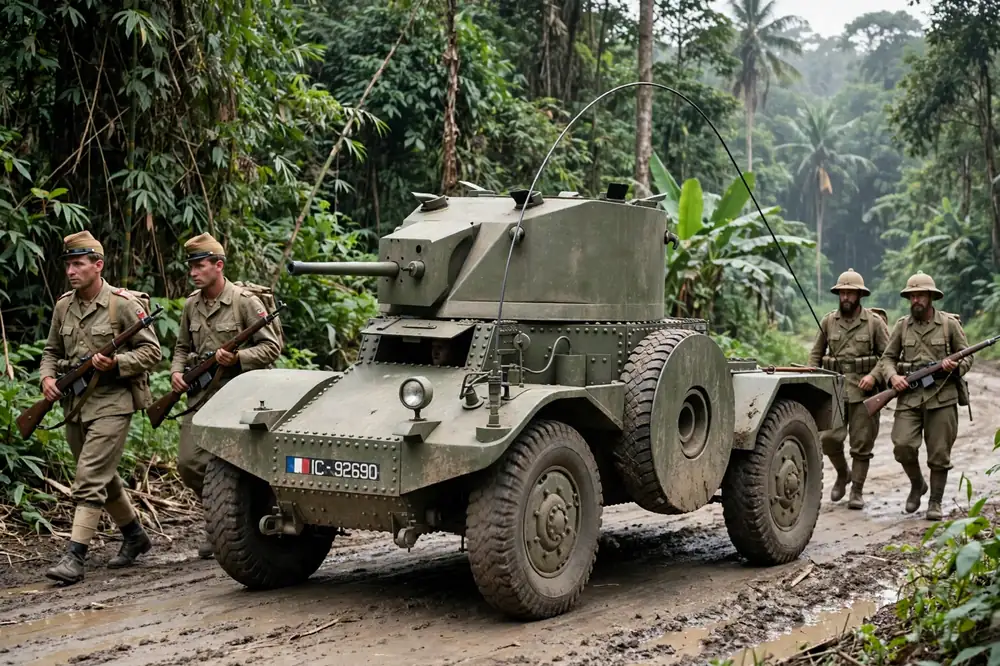
The Panhard 178B’s colonial service was long and hard. In Indochina, the vehicles operated on the roads of the Red River Delta, where their speed and their 47 mm gun were useful against Viet Minh ambushes, but where their wheeled layout limited their cross-country mobility in the paddy fields and the jungle.
In Algeria, the vehicles operated in the desert and in the mountains, where their range and their reliability were valued. The Panhard 178B was also exported to France’s former colonies in Africa, where it served in the armies of Senegal, Mali, Niger and other states into the 1970s and 1980s.
The vehicle’s long service life is a tribute to the soundness of the original 1933 design: a design that was still useful thirty years after it was drawn up.
8. Comparison with Other Armoured Cars
Against the German Sd.Kfz. 232
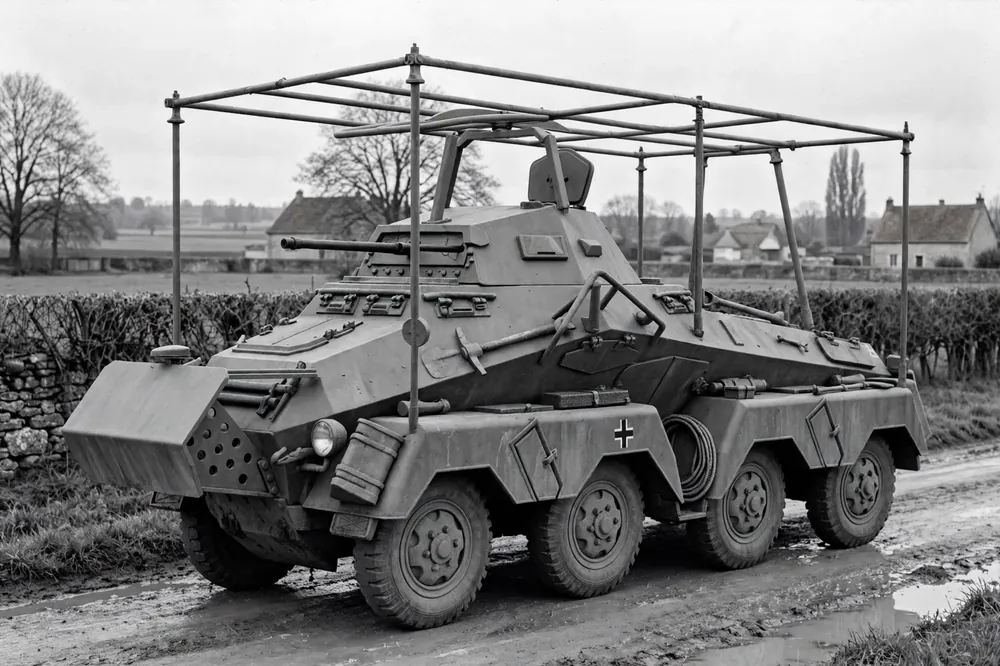
Compared with the German Sd.Kfz. 232, the Panhard 178’s main rival, the French vehicle was faster on roads (72 km/h against about 85 km/h for the Sd.Kfz. 232 — the German vehicle was in fact faster), but it was more heavily armed, with a 25 mm gun against the Sd.Kfz. 232’s 20 mm gun, and it had a longer range. The Sd.Kfz.
232 had eight wheels, like the Panhard, and it had a rear driver, like the Panhard — the two vehicles were remarkably similar, because they were designed for the same role and because the German designers had studied the French vehicle. The difference was in the details: the Sd.Kfz.
232 had a better radio, a better turret, and a more reliable engine, while the Panhard had a better gun and a lower silhouette. In 1940, the two vehicles met in France, and the Panhard’s gun gave it an edge in a fight — but the German vehicle’s radio and its integration into the German reconnaissance doctrine gave the Germans the advantage in the reconnaissance battle as a whole.
Against the British Daimler
Compared with the British Daimler armoured car, the Panhard 178 was larger, faster and more heavily armed, with a 25 mm gun against the Daimler’s 2-pounder (40 mm) gun — the Daimler’s gun was in fact more powerful, but the Panhard’s vehicle was faster and had a longer range. The Daimler was a four-wheeled vehicle, while the Panhard was an eight-wheeled vehicle, and the Panhard’s cross-country mobility was better.
The two vehicles were both excellent reconnaissance vehicles, and they were both used after the war — the Daimler in the British Army, the Panhard in the French Army — for many years. The comparison shows that the Panhard 178 was, by the standards of its day, a first-class reconnaissance vehicle, and that its only real failing was that it served an army that collapsed in six weeks.
9. The Panhard 178 in Detail
The vehicle’s layout
The Panhard 178’s layout was a model of compact design. The engine was at the rear, the driver sat at the front, the rear driver sat at the back, and the turret sat in the middle, over the fighting compartment. The hull was made of riveted armour plate, with a sloped front and a low, streamlined shape that gave the vehicle a distinctive, almost elegant appearance.
The vehicle’s eight wheels were arranged in four axles, with the rear two axles driven by the engine through a conventional gearbox, and the front two axles steered by the driver. The vehicle’s suspension was by leaf springs, and its tyres were bullet-proof — filled with a cellular material that prevented them from going flat when punctured.
The Panhard 178 was a vehicle that looked fast, and it was fast, and its appearance was a reflection of its purpose: a reconnaissance vehicle that was built to move, to see, and to report.
The radio / Radio
The Panhard 178’s radio was its most important piece of equipment, and it was the reason the vehicle existed. The radio — the ER 29, with a range of about 30 kilometres, or the ER 26, with a shorter range — allowed the vehicle to report its findings to headquarters, and it was the link between the reconnaissance vehicle and the army it served.
The French Army’s reconnaissance doctrine depended on the radio: the Panhard 178 was to find the enemy, report by radio, and withdraw, and the army would then act on the report. In 1940, the doctrine failed not because the Panhards failed to report, but because the reports were not acted upon — a failure of command, not of the vehicle.
The Panhard 178’s radio was a good radio for its day, but it was not as good as the German radio, and the German reconnaissance units’ radios were better integrated into their doctrine.
10. Assessment and Legacy
The Panhard 178 was one of the best armoured cars of the Second World War, and it is remembered as the vehicle that proved that a wheeled reconnaissance vehicle could fight and survive in a war dominated by tanks. Its speed, its gun and its radio made it a formidable reconnaissance vehicle, and its long service life — from 1937 to the 1960s, in French, German, Free French and colonial service — is a tribute to the soundness of its design.
The Panhard 178’s story is also a reminder that a good vehicle is not enough: the Panhard 178 served an army that collapsed, and its qualities could not save France in 1940. But the vehicle’s crews did their job, and the vehicle’s reputation was made in the few weeks of the Battle of France, when the Panhard 178 was one of the few French vehicles that could meet the Germans on equal terms.
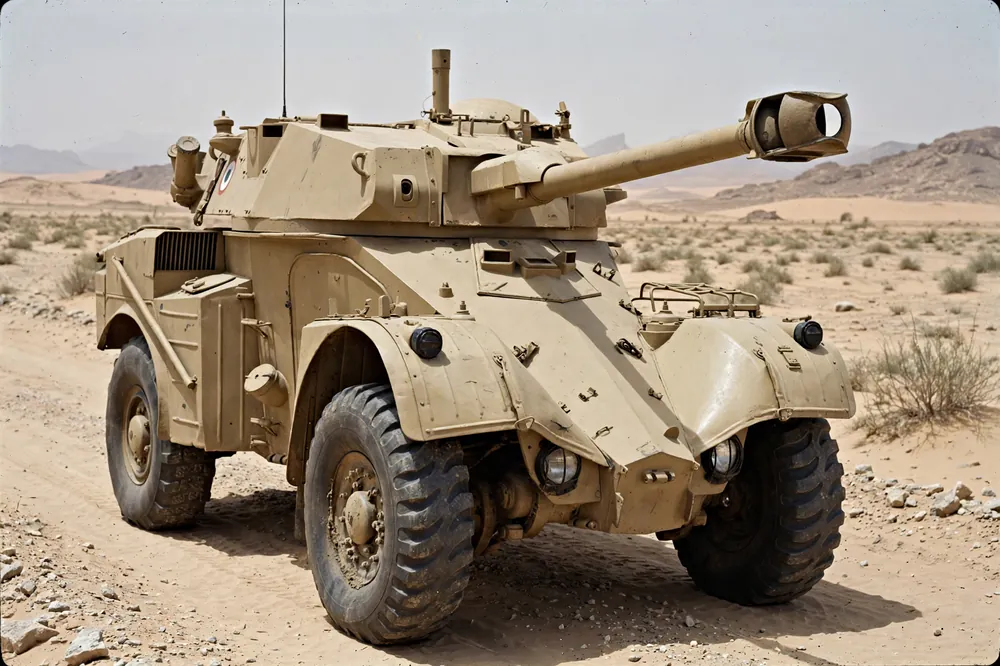
The Panhard 178’s legacy is the Panhard AML, the armoured car that replaced it in the 1960s and that served in the French Army and in dozens of other armies around the world. The AML inherited the Panhard 178’s role — the fast, well-armed reconnaissance vehicle — and it inherited the Panhard company’s reputation for building excellent armoured cars. The Panhard 178 itself survives in museums in France and in other countries, where it is displayed as the classic French armoured car of the Second World War, and as a reminder of a vehicle that was too good for the army it served.
11. Frequently Asked Questions
How many Panhard 178 armoured cars were built?
More than 700 Panhard 178s were built between 1937 and 1940, with sources giving a range of about 700–730, and production continued under German occupation for German use. The Panhard 178 was the most numerous French armoured car of the war, and it equipped the reconnaissance units of the French cavalry and mechanised divisions. The numbers matter because no other French armoured car was built in such quantity, and the type equipped the reconnaissance units of the French cavalry and mechanised divisions. Production continued under German occupation for German use.
How fast was the Panhard 178?
The Panhard 178 had a top speed of about 72 km/h on roads, which was faster than any German tank of 1940, and a range of about 300 kilometres. Its eight-wheel layout gave it good cross-country mobility for a wheeled vehicle, and its rear driver allowed it to reverse at full speed — a feature that was invaluable for a reconnaissance vehicle breaking contact. The speed was the car’s weapon: it could outrun the German tanks it met, and its rear driver allowed it to reverse at full speed when it had to break contact.
What gun did the Panhard 178 carry?
The Panhard 178 carried the 25 mm SA 35 gun in its turret, together with a coaxial 7.5 mm Reibel machine gun. The 25 mm gun could penetrate about 40 mm of armour at 500 metres, which was enough to defeat the Panzer I and Panzer II and to threaten the Panzer III and Panzer IV from the side. The post-war Panhard 178B carried a more powerful 47 mm gun. The gun was enough for the tanks the Panhard met in 1940: it could penetrate the Panzer I and Panzer II, and it could threaten the Panzer III and Panzer IV from the side.
What happened to the Panhard 178 after the fall of France?
After the fall of France, the Germans captured more than 200 Panhard 178s and used them as the Panzerspähwagen P204 (f) in reconnaissance units on the Eastern Front, in France and in the Balkans. Panhard 178s also served with the Free French in North Africa and in the liberation of France, and with the Vichy forces in North Africa and Syria. Production continued under German occupation at the Panhard factory in Paris. The car’s career after 1940 shows how widely it was used: the Germans took more than 200 of them, and the Free French used them in North Africa and in the liberation of France.
What was the Panhard 178B? / Panhard 178B là gì?
The Panhard 178B was the post-war rebuild of the Panhard 178, with a new FL-1 turret mounting a 47 mm SA 35 gun, a more powerful engine and improved radio equipment. About 400 were built or rebuilt, and they served in the French Army in Indochina and Algeria, and in the armies of France’s former colonies in Africa, into the 1960s and beyond. The rebuild mattered because it kept the design in service for another two decades: the new turret and the 47 mm gun made the old car useful again, and the improved radio and engine made it reliable enough for colonial service.
How did the Panhard 178 compare with the German Sd.Kfz. 232?
The two vehicles were remarkably similar: both had eight wheels, a rear driver, and a turret-mounted gun. The Panhard had a better gun (25 mm against 20 mm) and a lower silhouette, while the Sd.Kfz. 232 was faster on roads (about 85 km/h) and had a better radio and a more reliable engine. In 1940, the Panhard’s gun gave it an edge in a fight, but the German vehicle’s radio and its integration into German reconnaissance doctrine gave the Germans the advantage overall.
12. Sources
- Wikipedia, “Panhard 178” — production figures (more than 700), specifications, service history and the Panhard 178B.
- Steven J. Zaloga, French Tanks of World War II (1): Infantry and Battle Tanks and French Tanks of World War II (2): Cavalry Tanks and AFVs (Osprey New Vanguard) — Panhard 178 design and service.
- Pierre Touzin, Les véhicules blindés français 1900–1944 (EPA, 1979) — French armoured vehicles, including the Panhard 178.
- François Vauvillier, L’Automitrailleuse de Découverte Panhard 178 (in French) — detailed history of the Panhard 178.
- Thomas L. Jentz, Panzertruppen: The Complete Guide to the Creation and Combat Employment of Germany’s Tank Force 1933–1942 (Schiffer, 1996) — German use of the Panhard 178 as the P204 (f).
- Robert Forczyk, Case Red: The Collapse of France (Osprey, 2017) — the Battle of France and the French reconnaissance units.
- Steven J. Zaloga, The French Army 1939–45 (1): The Army of 1939–40 (Osprey Men-at-Arms, 2013).
- Martin Windrow, French Foreign Legionnaire 1945–65 (Osprey Warrior, 2013) — for the Panhard 178B in Indochina and Algeria.