 WAR ATLAS MILITARY HISTORY MAGAZINE · WWI — WWII
Philippe Leclerc de Hauteclocque
1. Lead
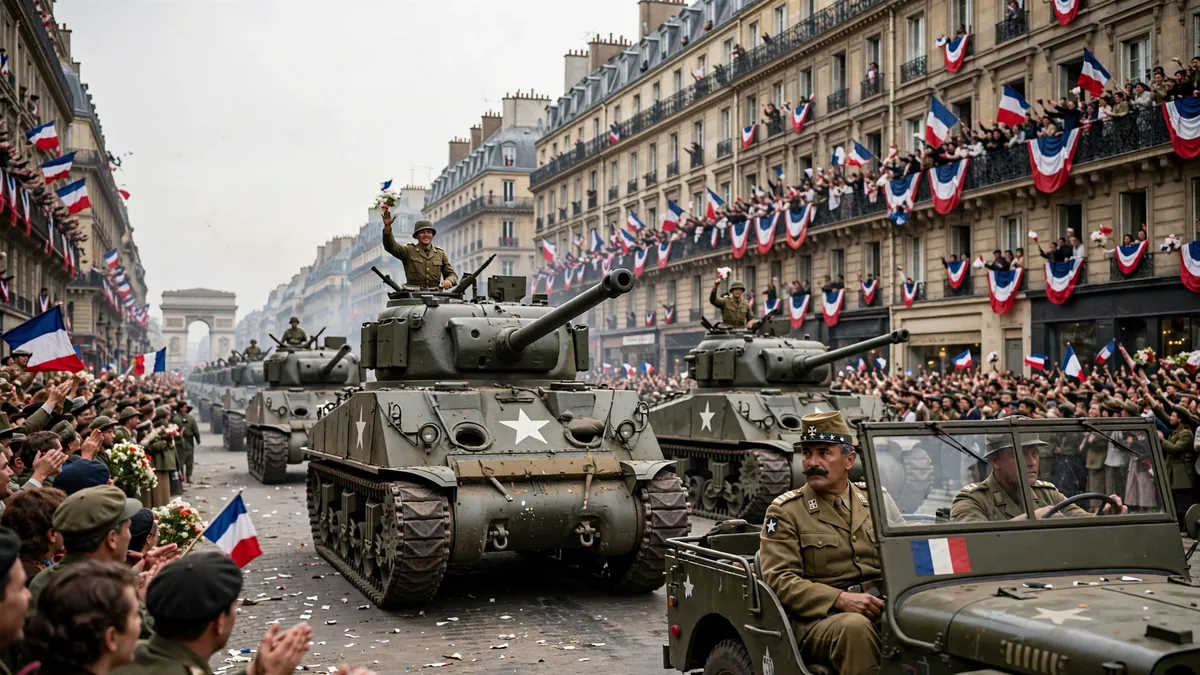
Philippe Leclerc de Hauteclocque (1902–1947) was the most celebrated French general of the Second World War and the man who led Free French forces into Paris. Born into an old Picardy family, a graduate of Saint-Cyr and a professional soldier, he refused to accept France’s defeat in 1940 and escaped to London to join Charles de Gaulle.
From a tiny force in the African desert — a few hundred men who swore at Koufra in 1941 never to lay down their arms until the French flag flew over Strasbourg — he built the 2nd Armoured Division, the famous 2e DB, which landed in Normandy in August 1944, liberated Paris, and fought across France and into Germany.
His men adored him, de Gaulle trusted him, and the French public made him a hero. He died in a plane crash in Algeria in 1947, at the age of forty-four, and was posthumously made a Marshal of France.
2. Key Facts
| Born | 22 November 1902, Belloy-Saint-Léonard, Picardy, France |
| Died | 28 November 1947, near Colomb-Béchar, Algeria (plane crash, aged 45) |
| Service | French Army, 1924–1947 |
| Commands | Free French forces in Chad; 2nd Armoured Division (2e DB) |
| Famous oath | Oath of Koufra, 2 March 1941: not to lay down arms until the flag flies over Strasbourg |
| Major victories | Koufra (1941); Paris (August 1944); Strasbourg (November 1944) |
| Highest honour | Marshal of France (posthumous, 1952) |
| Family | Married Thérèse de Gargan; six children |
3. Early Life and Military Career
A Picardy family
Philippe de Hauteclocque was born on 22 November 1902 at Belloy-Saint-Léonard, in Picardy, into an old family of the French nobility whose history reached back to the Crusades. His family was deeply Catholic, monarchist in sympathy, and steeped in the military tradition: his father had fought in the First World War, and the young Philippe grew up with the idea that service to France was a duty, not a choice.
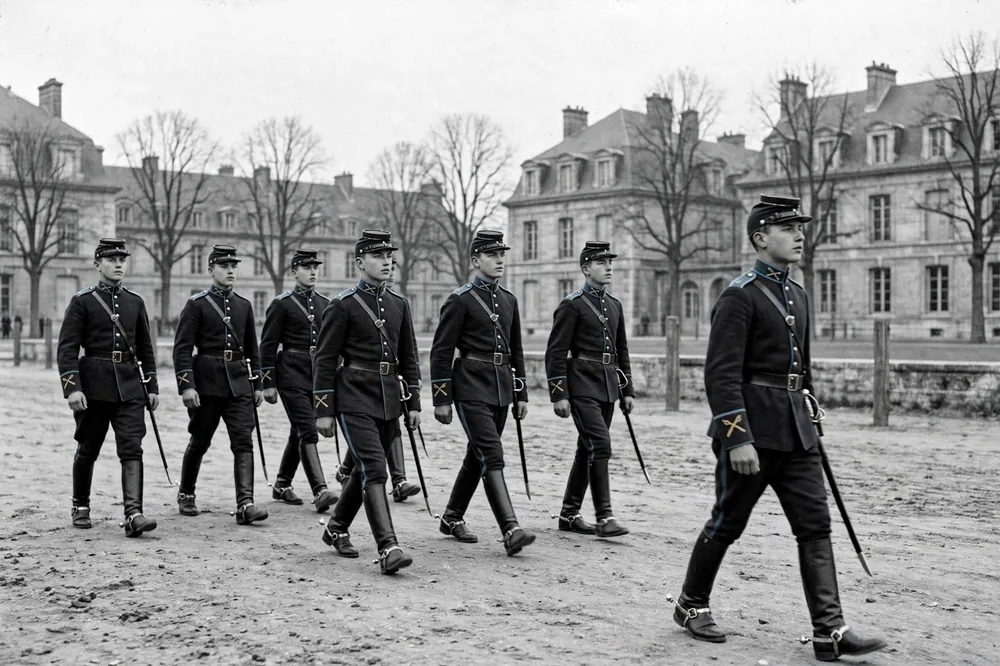
He was educated by the Jesuits, and he entered the military academy of Saint-Cyr in 1922, graduating in 1924 as a cavalry officer. The French army of the 1920s was a conservative institution, and Hauteclocque was in many ways a product of it: disciplined, devout, and convinced that France’s greatness lay in its army and its empire.
But he was also restless and independent-minded, and his early postings — in Morocco, where he served with the French colonial forces and learned desert warfare — gave him experience that would prove decisive in the war to come.
Leclerc married Thérèse de Gargan in 1925, and they had six children, a large family even by the standards of Catholic France in the 1920s. His family life was, by all accounts, a happy one, and his wife supported his military career, even when it took him to Morocco, to Chad, and to the battlefields of the Second World War.
The Hauteclocque family, like many French military families, regarded service as a duty, and Leclerc’s children grew up with the idea that their father was a soldier, and that his absence was a part of that life. When Leclerc went to London in 1940, his family remained in occupied France, and his use of the pseudonym ‘Leclerc’ was, in part, an attempt to protect them from German reprisals, a precaution that testified to the danger his choice had placed them in.
The fall of France
By 1940 Hauteclocque was a captain, serving with the 4th Infantry Division in the Battle of France. He fought in the desperate rearguard actions of May and June 1940, was wounded, and was taken prisoner by the Germans. He escaped, was recaptured, and escaped again, making his way through occupied France to Spain and then to Portugal, from where he reached London in July 1940.
There he offered his services to General de Gaulle, who had called on the French to continue the fight. De Gaulle gave him the mission that would define his war: to rally French Equatorial Africa to the Free French cause.
Hauteclocque adopted the pseudonym “Leclerc” — the name of a Napoleonic general — as his nom de guerre, partly to protect his family in occupied France from reprisals, and partly because it was a name that carried a history. The name stuck: for the rest of his life, and in history, he was Leclerc.
4. The African Campaign
Chad and Koufra
Leclerc’s first command was in Chad, the vast French colony in central Africa, which had rallied to de Gaulle in August 1940. From Fort-Lamy, his base, he set out to prove that Free France could fight. His force was tiny — a few hundred Frenchmen and African colonial troops, with a handful of old lorries and a few guns — but he used it with audacity.
In February and March 1941 he led a column across hundreds of kilometres of desert to attack the Italian oasis fortress of Koufra, in southern Libya, and captured it on 1 March 1941 after a siege. It was the first victory of Free French forces on land, and it mattered enormously for morale: de Gaulle’s movement, dismissed by many as a handful of exiles in London, had won a battle.
At Koufra, Leclerc and his men took the famous oath: they swore not to lay down their arms until the French flag flew over Strasbourg, the great Alsatian city annexed by Germany in 1940. The oath became the motto of his division, and Leclerc kept it.
Across the desert
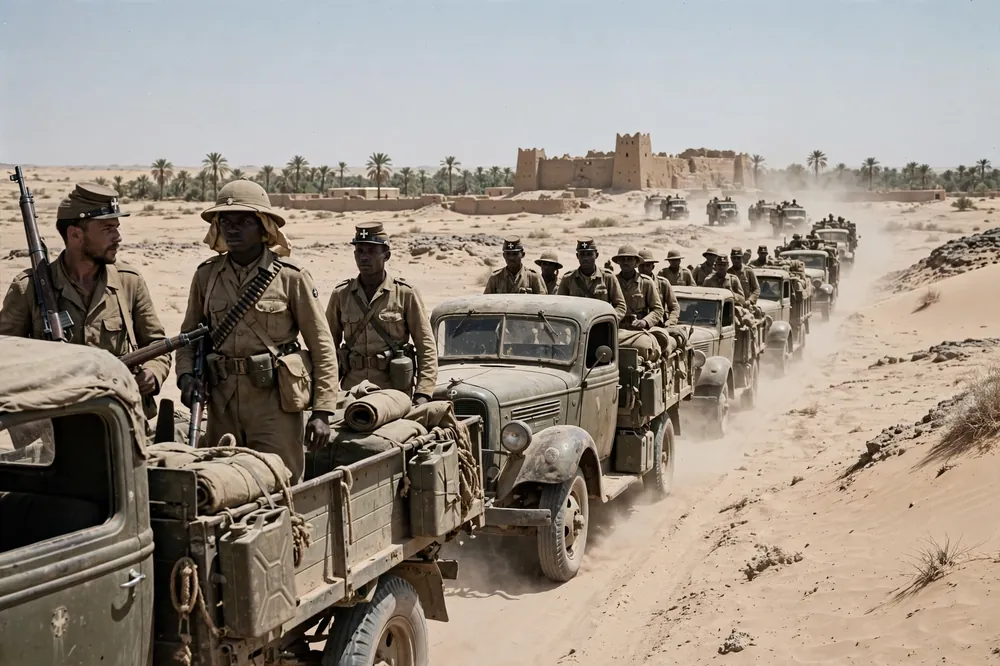
From Chad, Leclerc led his force — now called the “Force L” — across the Sahara to join the British Eighth Army in the fighting in Libya and Tunisia. The march was an extraordinary feat of desert warfare: more than 2,000 kilometres across some of the harshest terrain on earth, with little water, no roads, and constant danger from the heat and from Italian and German patrols.
Leclerc’s men, French officers and African soldiers from Chad and Cameroon, fought at Fezzan and at Ksar Rhilane, and took part in the Tunisian campaign of 1942–43, where they served under the British and distinguished themselves in the fighting around Gabès. By the time the North African campaign ended, Leclerc’s force had grown from a few hundred men into a brigade, and Leclerc himself had been promoted to general.
De Gaulle now gave him a greater task: to build a full armoured division, from Frenchmen gathered from every corner of the Free French world, that would return to France and liberate Paris.
5. The 2nd Armoured Division
Building the 2e DB
The 2nd Armoured Division — the 2e Division Blindée, or 2e DB — was formed in North Africa in 1943, equipped by the Americans with Sherman tanks, half-tracks and artillery, and manned by a remarkable mixture of men: veterans of Leclerc’s desert column, Frenchmen who had escaped from occupied France, sailors from the Free French navy, and volunteers from across the French empire.
Leclerc trained them hard in Morocco, instilling the discipline and the esprit de corps that had made his desert force so effective, and he gave the division a distinctive identity: its insignia was the Cross of Lorraine, de Gaulle’s symbol, and its motto was the oath of Koufra.
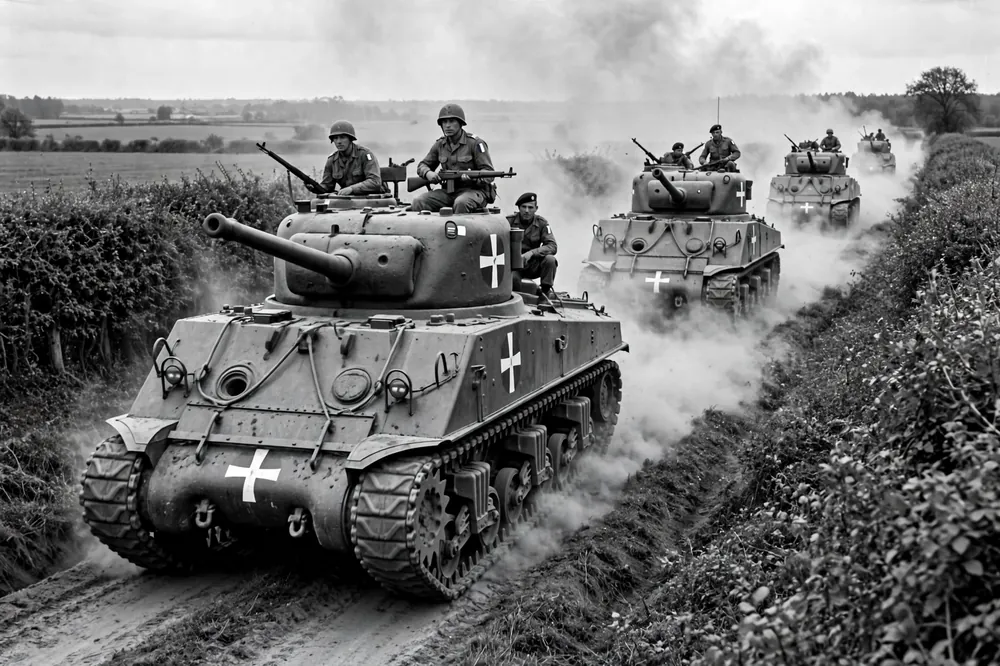
The division landed in Normandy on 1 August 1944, a month after D-Day, as part of the American Third Army under General George S. Patton. Leclerc’s orders were to advance towards Paris, and the political pressure was immense: de Gaulle insisted that French troops, not Americans, should liberate the French capital.
The march on Paris
The division’s advance through Normandy and towards Paris was rapid, and it was also a race. The Allies, after the breakout from Normandy, were advancing on a broad front, and the question of who would enter Paris first was politically charged: the Americans, under Eisenhower, were inclined to bypass Paris, which was of little military value and would need to be fed, while de Gaulle insisted that Paris must be liberated by French troops, and quickly, before the Resistance uprising in the city was crushed by the German garrison.
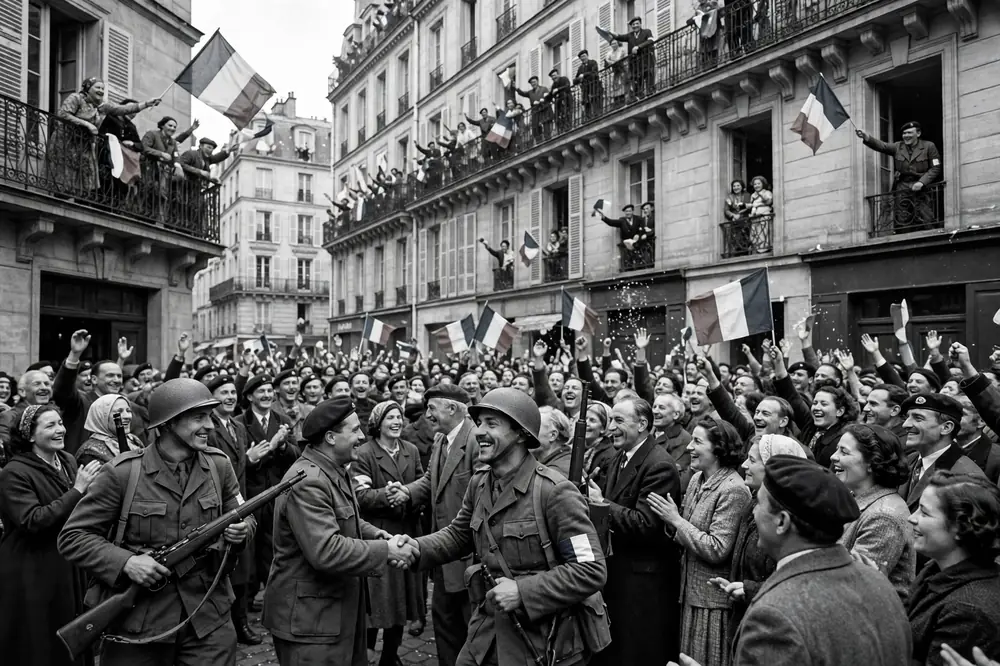
Leclerc, with de Gaulle’s backing, pressed his division forward, disobeying, or at least stretching, his American orders. On 24 August 1944 the first elements of the 2e DB — a detachment under Captain Raymond Dronne, with Spanish republican soldiers of “La Nueve” in the lead — entered Paris.
The next day, 25 August, Leclerc himself entered the city, accepted the surrender of the German garrison commander, General von Choltitz, and the liberation of Paris was complete. It was the moment Leclerc had fought for since 1940, and it made him a national hero.
6. Strasbourg and the End of the War
The oath fulfilled
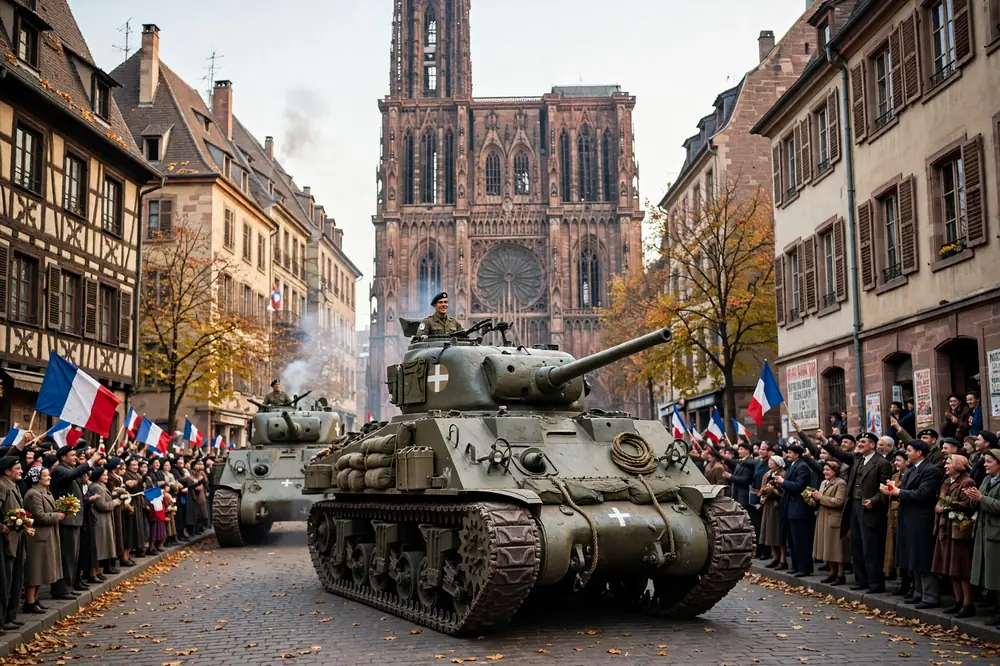
After Paris, the 2e DB fought on through eastern France, in the Vosges and in Alsace, in some of the hardest fighting of the campaign. Leclerc’s division, now battle-hardened and confident, advanced through Lorraine in the autumn of 1944, and on 23 November 1944 it liberated Strasbourg, the great Alsatian city whose name had been the object of the oath of Koufra.
Leclerc’s men raised the French flag over the cathedral, and the oath taken in the Libyan desert three years earlier was fulfilled. It was one of the great symbolic moments of the war: the city that had been annexed by Germany in 1940, and that had been the symbol of French humiliation, was French again, and it had been liberated by the men who had sworn to do it.
Leclerc, who had promised his men that they would see Strasbourg, was there to see it with them, and the photographs of the division’s tanks in the streets of Strasbourg became among the most famous images of the liberation.
Into Germany
The division fought on into Germany in the spring of 1945, crossing the Rhine and advancing into Bavaria, and it was present at the end of the war in Europe. Leclerc’s men were among the Allied troops who reached Hitler’s mountain retreat at Berchtesgaden, and the division ended the war as one of the most celebrated formations of the French army, with a record of continuous fighting from the deserts of Libya to the heart of Germany.
Leclerc himself had risen from a captain in 1940 to a general commanding a division, and he had done it by a combination of audacity, discipline, and an unshakeable sense of purpose. His division’s losses had been heavy — the 2e DB lost many men in the fighting in France and Germany — but its achievements were, by any measure, extraordinary for a formation that had begun as a few hundred men in the African desert.
The division’s advance into Germany in the spring of 1945 was the last act of its war, and it was fought in conditions very different from those of the desert and of France. The German army was collapsing, the roads were crowded with refugees, and the 2e DB, which had fought from Chad to Paris to Strasbourg, was now fighting in the heart of the enemy’s country.
The division’s men, who had sworn at Koufra to fight until the French flag flew over Strasbourg, had kept their oath, and they ended the war in Bavaria, at Berchtesgaden, in the mountains where Hitler had built his retreat. The division’s losses in the campaign had been heavy, as had the losses of all the Allied divisions that fought in France and Germany, but its achievements were, by any measure, extraordinary for a formation that had begun as a few hundred men in the African desert.
7. Leadership and Character
A demanding commander
Leclerc was a demanding commander, and his men knew it. He was strict about discipline, impatient with incompetence, and he expected his officers to lead from the front, as he did himself. He was also a commander who inspired intense loyalty: his men called him “the Patron”, and they followed him because they believed in him and in the cause he represented.
He was a devout Catholic, and his faith informed his conduct of the war: he believed that France’s cause was just, and that its liberation was a moral as well as a military task. His leadership style was direct and personal: he visited the front constantly, he knew his officers by name, and he made decisions quickly and stuck to them.
His relationship with his American superiors was sometimes difficult — he was willing to disobey orders when he believed the interests of France required it, as he did on the march to Paris — but the Americans respected his fighting qualities, and Patton, who commanded the army in which the 2e DB served, held him in high regard.
The man behind the legend
Behind the public image of the hero of Paris, Leclerc was a private and reserved man, devoted to his wife Thérèse and their six children, and uncomfortable with the fame that the liberation had brought him. He was, by the standards of French generals, young — forty-two when he entered Paris — and he had the energy and the impatience of a man who had spent four years fighting to return to a country he had left as a fugitive.
His men remembered him as a commander who shared their dangers: he was often in the leading tanks, and he was wounded more than once. He was also a man of strong opinions, and after the war he was not afraid to disagree with de Gaulle or with the French government, particularly on the future of the French empire.
His death, at forty-four, cut short a career that might have taken him to the highest levels of French public life.
8. After the War
Indochina
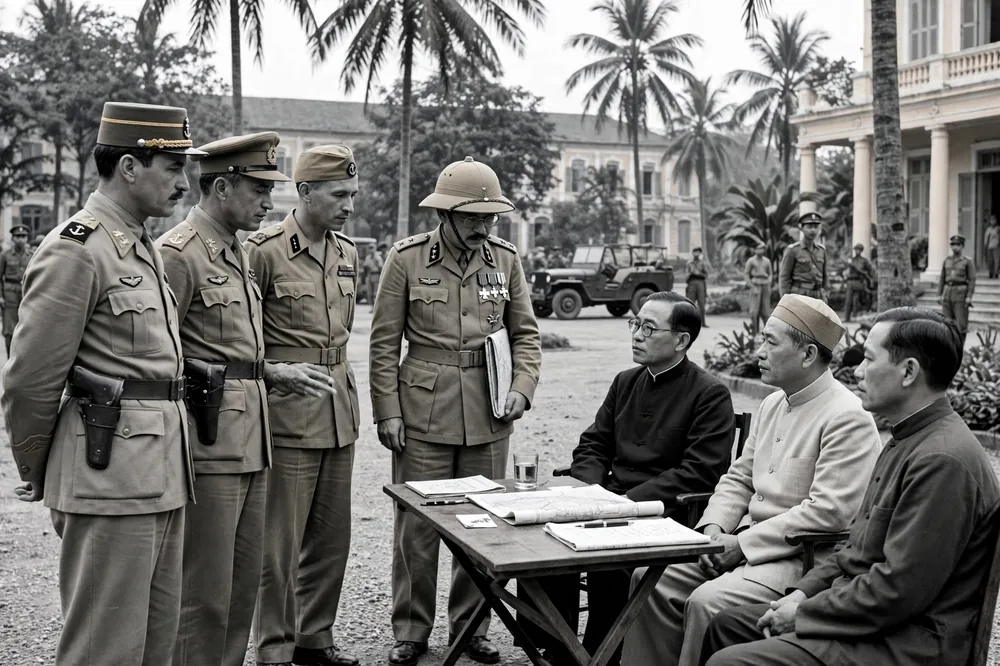
After the war in Europe, Leclerc was sent to the Far East, where he commanded French forces in Indochina and negotiated with the Vietnamese leader Ho Chi Minh. His time in Indochina was brief but significant: he was one of the few French generals who understood that the old colonial order could not simply be restored, and he argued, unsuccessfully, for a negotiated settlement with the Vietnamese nationalists.
His advice was not followed, and France drifted into the Indochina War, a conflict that would last eight years and end in defeat at Dien Bien Phu. Leclerc’s warnings, made in 1946, were prescient, and they are remembered today as evidence of his political judgement as well as his military skill.
He returned to France in 1946 and was appointed inspector general of French forces in North Africa, a post that took him to Algeria, where he died.
Death in Algeria
On 28 November 1947 Leclerc was killed in a plane crash near Colomb-Béchar, in Algeria, when the aircraft in which he was travelling crashed in bad weather. He was forty-five years old. His death shocked France: he was the country’s most popular general, the liberator of Paris, and his loss was felt as a national bereavement.
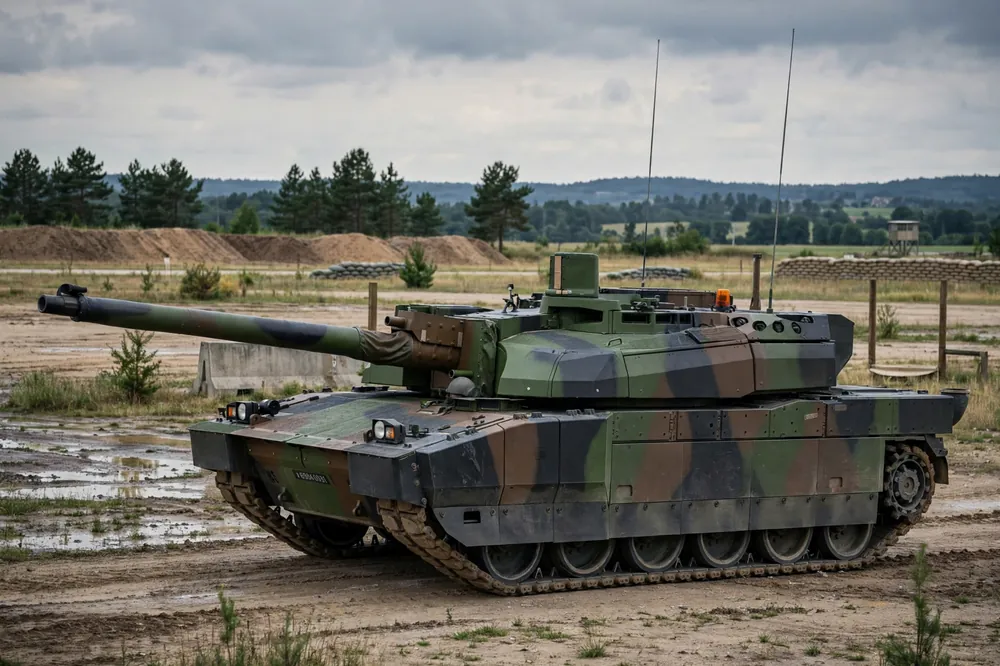
He was given a state funeral, and in 1952 he was posthumously promoted to Marshal of France, the highest military rank in the country. His name was given to streets, squares and schools across France, and to the French army’s main battle tank, the Leclerc, a tribute that links his name to the armoured warfare he had practised.
His division, the 2e DB, remains one of the most celebrated formations in French military history, and its veterans maintained the memory of their commander for the rest of their lives.
9. Legacy and Assessment
The liberator of Paris
Leclerc’s legacy is, above all, the liberation of Paris. The image of his tanks entering the capital on 25 August 1944 is one of the defining images of the Second World War, and it gave the French a moment of national redemption after four years of occupation and humiliation.
Leclerc understood the symbolic importance of Paris, and he fought for it not only as a soldier but as a Frenchman: the liberation had to be French, it had to be seen to be French, and it had to restore French honour.
His insistence on this point, and his willingness to defy his American superiors to achieve it, is sometimes criticised as political interference in military operations, but it is also recognised as an essential part of the liberation: a Paris liberated by Americans would not have had the same meaning for France, and Leclerc knew it.
A French hero
Historians today remember Leclerc as one of the great generals of the Second World War, and as a uniquely French hero: a man who combined the virtues of the old France — duty, faith, honour — with the audacity and the modernity of the Free French movement.
His career, from the deserts of Chad to the streets of Paris and Strasbourg, is a story of a soldier who never accepted defeat, and who built an army from nothing to liberate his country. His early death, and his warnings about Indochina, add a tragic dimension to his story, and they have made him a figure of enduring interest in France, where his name remains synonymous with the liberation and with the best traditions of the French army.
10. Leclerc in Popular Culture
Memory and commemoration
Leclerc’s memory is preserved in France in many forms: streets and squares named after him in every French town, a museum of the liberation in Paris, and the annual commemorations of the liberation of Paris on 25 August, in which the veterans of the 2e DB, and their descendants, march through the city.
His story has been told in books, films and documentaries, and the image of his division’s tanks in Paris is one of the most reproduced photographs of the war. The French army’s main battle tank, named the Leclerc, keeps his name in service, and the 2e DB’s traditions are maintained by the French army’s armoured units.
For the French, Leclerc remains what he was in 1944: the general who brought France home.
The oath of Koufra
The oath of Koufra, taken in the Libyan desert in 1941, remains one of the most famous moments in French military history, and it is taught in French schools as an example of patriotism and perseverance. The oath’s power lies in its simplicity: a handful of men, in the middle of nowhere, swearing to fight until their country’s flag flew over a city they had never seen, and then doing it.
Leclerc’s life is, in a sense, the story of that oath: from Koufra to Paris to Strasbourg, he kept his word, and his men kept theirs. It is a story that continues to resonate in France, and it is the reason why, more than seventy years after his death, Leclerc remains one of the most admired figures in French history.
11. Frequently Asked Questions
Who was Philippe Leclerc de Hauteclocque? / Philippe Leclerc de Hauteclocque là ai?
He was a French general who led the Free French 2nd Armoured Division, the 2e DB, in the liberation of Paris in August 1944 and of Strasbourg in November 1944. He is France’s most celebrated general of the Second World War. He led the Free French 2nd Armoured Division, the 2e DB, in the liberation of Paris in August 1944 and of Strasbourg in November 1944, fulfilling the oath he had taken at Koufra in 1941. He died in a plane crash in Algeria in 1947, and he was posthumously made a Marshal of France in 1952.
What was the oath of Koufra?
At Koufra, in Libya, on 2 March 1941, Leclerc and his men swore not to lay down their arms until the French flag flew over Strasbourg. They fulfilled the oath when the 2e DB liberated Strasbourg on 23 November 1944. Leclerc and his men took the oath on 2 March 1941, after capturing the Italian oasis fortress of Koufra, and they fulfilled it when the 2e DB liberated Strasbourg on 23 November 1944. The oath became the motto of his division, and it remains one of the most famous moments in French military history.
When was Paris liberated?
The first elements of the 2e DB entered Paris on 24 August 1944, and Leclerc himself entered the city on 25 August, accepting the surrender of the German garrison commander, General von Choltitz. Leclerc’s entry into the capital was greeted by cheering crowds, and de Gaulle himself arrived the next day to lead the victory parade down the Champs-Élysées. The first elements of the 2e DB entered Paris on 24 August 1944, under Captain Raymond Dronne, and Leclerc himself entered the city the next day, accepting the surrender of General von Choltitz.
How did Leclerc die?
He was killed in a plane crash near Colomb-Béchar, Algeria, on 28 November 1947, in bad weather. He was forty-five years old. He was posthumously made a Marshal of France in 1952. His funeral was held with full state honours in Paris, and he was buried in the crypt of the Invalides, among France’s great soldiers. He was forty-five years old, and his death shocked France, where he was the country’s most popular general, the liberator of Paris, and his loss was felt as a national bereavement.
What was the 2e DB? / 2e DB là gì?
The 2nd Armoured Division (2e Division Blindée) was a Free French armoured division formed in North Africa in 1943, equipped by the Americans with Sherman tanks, and commanded by Leclerc. It fought from Normandy to Paris, Strasbourg and Germany. The division was formed in North Africa in 1943, equipped by the Americans with Sherman tanks, and manned by veterans of Leclerc’s desert column, Frenchmen who had escaped from occupied France, and volunteers from across the French empire. It fought from Normandy to Paris, Strasbourg and Germany.
Why is Leclerc famous in France?
Because he led the French troops who liberated Paris, fulfilled the oath of Koufra by liberating Strasbourg, and embodied the Free French refusal to accept defeat in 1940. His name is given to streets, schools and the French army’s main battle tank. His name is given to streets, squares and schools across France, and to the French army’s main battle tank, the Leclerc, a tribute that links his name to the armoured warfare he had practised. He remains, more than seventy years after his death, one of the most admired figures in French history.
12. Sources
- Wikipedia, “Philippe Leclerc de Hauteclocque” — birth and death dates, Koufra, the 2e DB, Paris and Strasbourg, Marshal of France (1952).
- Wikipedia, “2nd Armored Division (France)” — formation of the 2e DB, its equipment and its campaign from Normandy to Germany.
- Encyclopædia Britannica, “Philippe Leclerc de Hauteclocque” — biography and the liberation of Paris.
- Jean-Christophe Notin, Leclerc (Perrin, 2005) — the standard modern biography in French.
- Hugh L. G. Williamson, The Liberation of Paris (various editions) — the liberation and Leclerc’s role.
- Ordre de la Libération, “Philippe Leclerc de Hauteclocque” — official record of his service and honours.
- Raymond Dronne, Leclerc et le serment de Koufra (Julliard, 1965).
- M. R. D. Foot, Resistance (Eyre Methuen, 1976).