 WAR ATLAS MILITARY HISTORY MAGAZINE · WWI — WWII
PPS-43
1. Lead
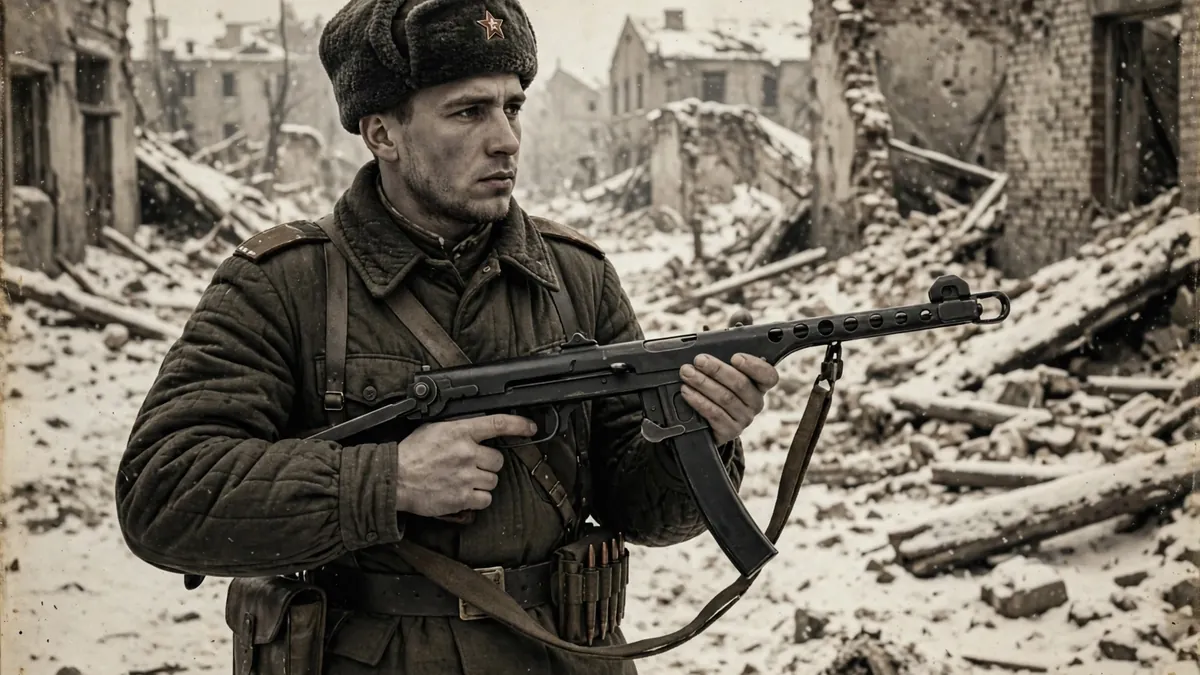
The PPS-43 (Pistolet-Pulemyot Sudayeva, Sudayev’s submachine gun) was the Soviet Union’s compact submachine gun of the Second World War, and one of the most practical weapons ever issued to the Red Army. Designed by Alexei Sudayev and adopted in 1943, it was built from stamped sheet steel in a fraction of the time and at a fraction of the cost of the PPSh-41 that it supplemented, and it was shorter, lighter and handier than its famous predecessor, with a folding stock that let it be carried by tank crews, paratroopers, reconnaissance troops and scouts who needed a weapon that would not get in the way in a cramped vehicle or on a long patrol. Chambered for the 7.62×25 mm Tokarev pistol cartridge, it fired at 500 to 600 rounds per minute from a 35-round box magazine, and about 2 million PPS-43 submachine guns were built between 1943 and 1946. It never replaced the PPSh-41 as the Red Army’s main submachine gun, but it became the weapon of the specialist, and it served in Korea, in Vietnam and in dozens of other wars long after the Second World War had ended.
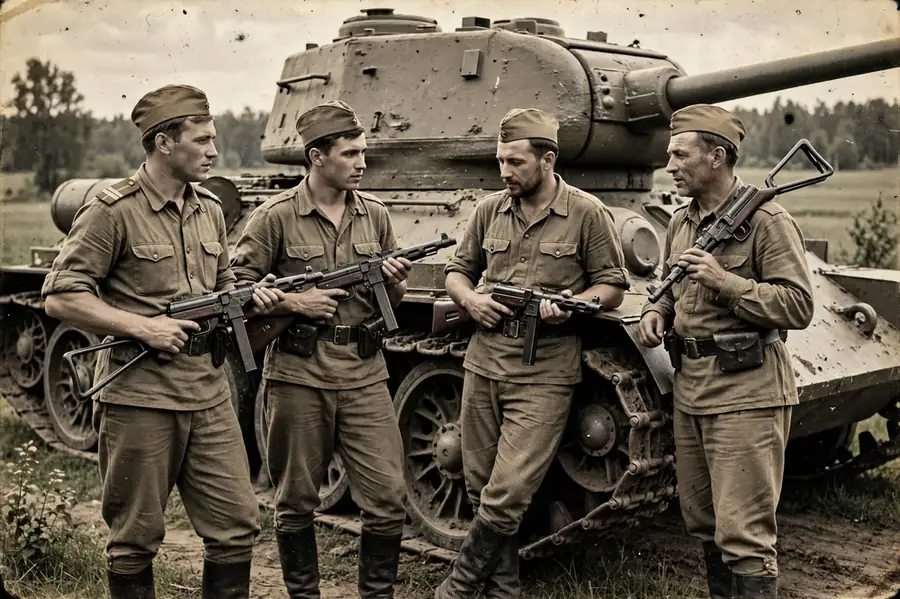
The PPS-43 was a weapon of its time and place: the Soviet Union in 1942 and 1943, fighting the greatest land war in history, needed a submachine gun that could be made quickly, cheaply and in enormous numbers, and that could be carried by the men who fought in tanks, in the ruins of cities and in the forests of the Eastern Front. The PPSh-41, which had served the Red Army since 1941, was a good weapon, but it was long and heavy, and its 71-round drum magazine was awkward and unreliable, and the Soviet arms industry wanted a gun that was better suited to the men who needed a compact weapon. The PPS-43 was the answer, and it was designed in the besieged city of Leningrad, under conditions that would have defeated a lesser designer, and it was built in factories that had been evacuated to the east and were working around the clock to supply the front. The gun’s story is therefore the story of Soviet wartime industry at its most inventive, and of a designer who understood what the soldier needed and built it from the simplest materials available.
2. Key Facts
| Type | Submachine gun |
| Origin | Soviet Union |
| Designer | Alexei Sudayev |
| Manufacturer | Sestroretsk Arsenal, Kovrov and other Soviet factories |
| In service | 1943–1950s (Soviet Union); later with other armies |
| Produced | 1943–1946 (USSR); about 2 million built |
| Calibre | 7.62×25 mm Tokarev |
| Weight | 3.04 kg unloaded; about 3.67 kg loaded |
| Length | 831 mm (stock extended); 615 mm (stock folded) |
| Barrel length | 269 mm |
| Rate of fire | 500–600 rounds per minute |
| Muzzle velocity | About 500 m/s |
| Effective range | About 200 m |
| Feed | 35-round detachable box magazine |
| Operation | Blowback, open bolt; selective fire |
3. Background and Development
The Red Army’s Need for a Compact Weapon
By 1942, the Red Army had learned that the submachine gun was the most important weapon of the Eastern Front, and it wanted more of them, and it wanted a gun that was better suited to the men who fought in tanks and in cities. The PPSh-41, which had been adopted in 1941, was a good weapon, but it was 842 millimetres long and weighed 3.6 kilograms unloaded, and it was too long for a tank crewman to handle in the cramped fighting compartment of a T-34, and too awkward for a scout to carry on a long patrol. The Soviet arms industry was also under enormous pressure: it had been evacuated to the east, it was short of skilled labour and of machine tools, and it needed a gun that could be made from stamped sheet metal, with a minimum of machining, and that could be produced in large numbers by factories that had never made weapons before. The competition for a new submachine gun was announced in 1942, and it was won by a young designer, Alexei Sudayev, whose gun was the simplest, the lightest and the cheapest of all the designs submitted.
Alexei Sudayev and the Leningrad Design
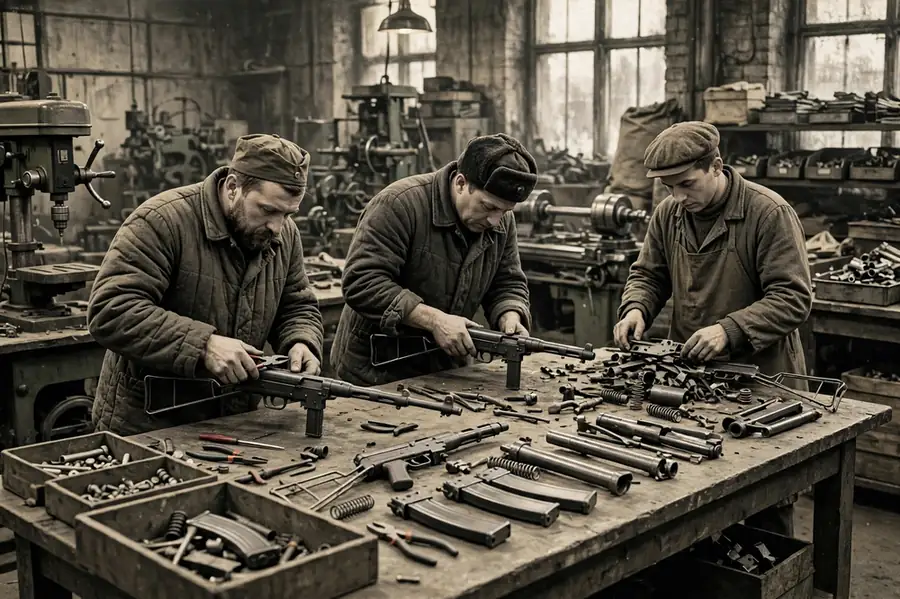
Alexei Sudayev designed the PPS-43 in Leningrad, in the middle of the siege of the city, and the conditions in which he worked were among the worst in the history of weapons design. The city was surrounded by the German Army, its people were starving, its factories were under bombardment, and Sudayev worked in a design bureau that had no heating and little light, with materials that were in short supply and with a team that was shrinking as its members died or were evacuated. But Sudayev understood what the soldier needed, and he designed a gun that was made from stamped steel, with a folding stock, a simple blowback action and a 35-round box magazine, and that could be made in about half the time of the PPSh-41. The first PPS-42 prototypes were tested in 1942, and the improved PPS-43 was adopted in May 1943, and production began at the Sestroretsk Arsenal in Leningrad and was soon taken up by factories in Kovrov and elsewhere. Sudayev died in 1946, at the age of thirty-three, of an illness contracted during the siege, and he did not live to see the worldwide success of his gun.
Adoption and Mass Production
The PPS-43 was adopted by the Red Army in May 1943, and production rose rapidly: about 2 million PPS-43 submachine guns were built in the Soviet Union between 1943 and 1946, and the gun was issued to tank crews, to paratroopers, to reconnaissance troops, to scouts and to the crews of artillery and of armoured vehicles, who needed a compact weapon that would not get in the way. The PPS-43 never replaced the PPSh-41 as the Red Army’s main submachine gun, because the PPSh-41 was already in production in enormous numbers and because the Soviet arms industry could not afford to retool its factories in the middle of the war, but the PPS-43 became the weapon of the specialist, and it was prized by the men who carried it for its lightness, its handiness and its reliability. The gun’s production was a triumph of Soviet wartime industry: it was made from stamped steel, it took about half the time to make as the PPSh-41, and it used far less material, and it showed that a good weapon could be made from the simplest materials by the simplest methods.
4. Design
Stamped Steel and the Folding Stock
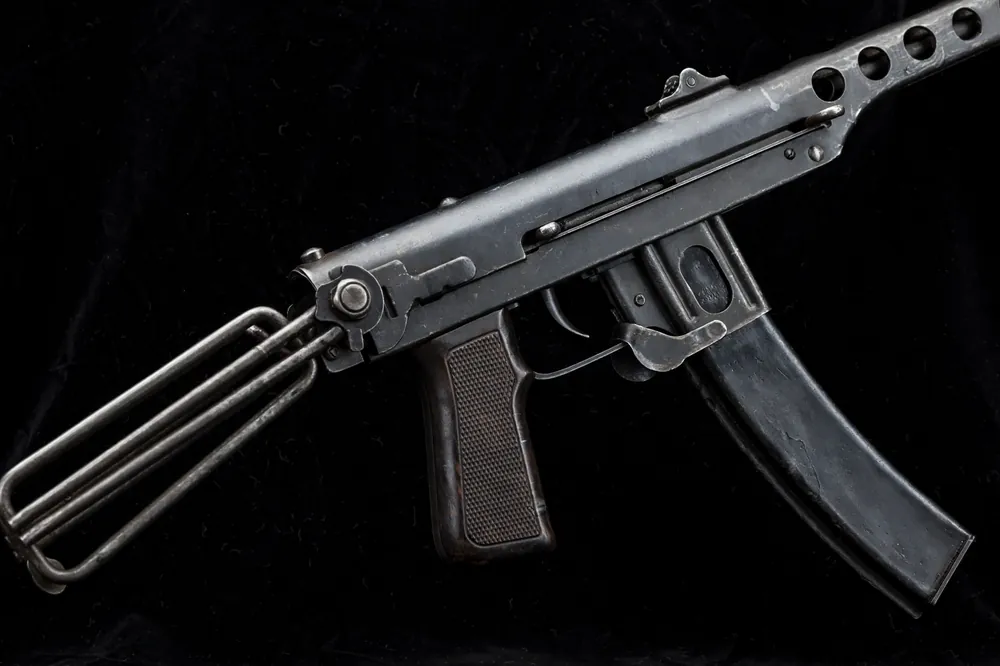
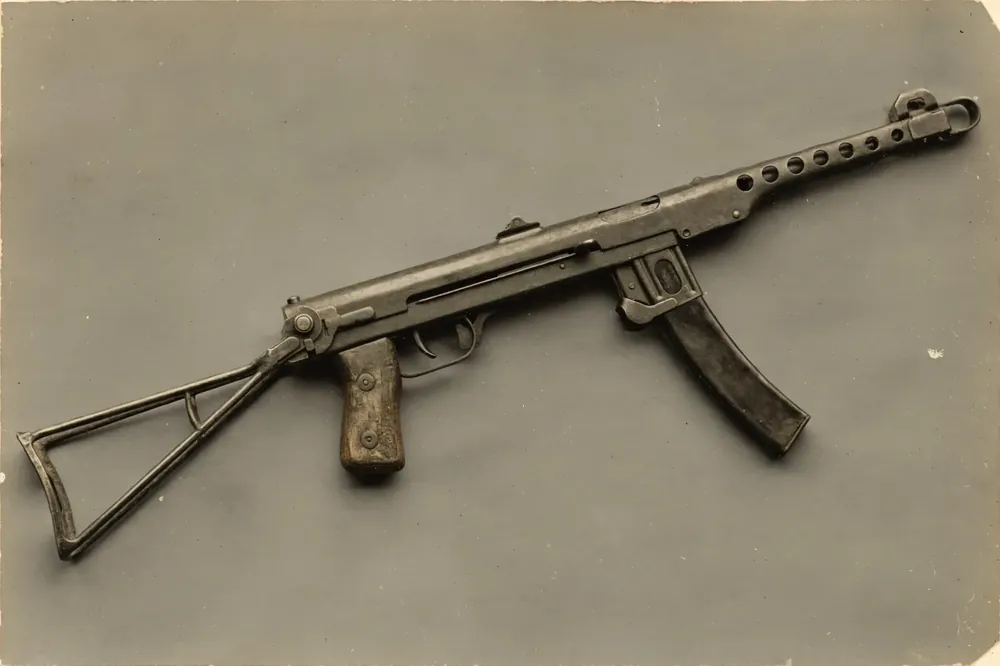
The PPS-43 was built from stamped sheet steel, and its receiver, its barrel jacket and its magazine were all made by pressing and folding steel, with a minimum of machining, which made the gun cheap and quick to produce and let it be built by factories that had never made weapons before. The gun’s most distinctive feature was its folding stock, a simple steel tube that folded over the top of the receiver, and that reduced the gun’s length from 831 millimetres to 615 millimetres, which made it easy to carry in a tank, in a vehicle or on a patrol, and to bring into action quickly when it was needed. The gun’s barrel jacket was perforated to let air cool the barrel, and its muzzle was fitted with a simple brake that reduced the climb of the muzzle in automatic fire. The PPS-43 was a gun of the simplest possible construction, and its simplicity was its strength: it had few parts, it was easy to strip and to clean, and it kept working in the mud and the cold of the Eastern Front when more complicated weapons failed.
Blowback Action and the Box Magazine
The PPS-43 operated on the simple blowback principle, in which the bolt was held closed by its own weight and by a spring, and the pressure of the fired cartridge drove it back to extract and eject the empty case and to chamber the next round. The system was simple and reliable, and it was well suited to the low-powered 7.62×25 mm pistol cartridge, which did not need a locked breech, and it gave the gun a rate of fire of 500 to 600 rounds per minute, which was slower than the PPSh-41’s 900 rounds per minute, and which made the gun easier to control in automatic fire. The gun was fed from a 35-round detachable box magazine, which was simpler and more reliable than the PPSh-41’s 71-round drum, and which was easier to carry and to load, and the gun could be set to fire single shots as well as fully automatically, which made it useful for accurate fire at longer ranges. The PPS-43’s sights were simple, with a flip-up rear sight graduated for 100 and 200 metres, and the gun’s trigger was a simple lever that the soldier pressed to fire.
Strengths and Weaknesses
The PPS-43’s strengths were its compactness, its lightness, its simplicity and its reliability, and its weaknesses were its limited range and its small magazine. The gun weighed only 3.04 kilograms unloaded, and it was 615 millimetres long with its stock folded, which made it one of the most compact submachine guns of the war, and it was easy to carry and to bring into action in a tank, in a vehicle or in a building. The gun’s blowback action was simple and reliable, and it kept working in the mud and the cold, and its stamped-steel construction made it cheap and quick to produce. But the gun’s 7.62×25 mm cartridge was a pistol cartridge, and its effective range was only about 200 metres, and its 35-round magazine held fewer rounds than the PPSh-41’s 71-round drum, so the soldier had to reload more often in a firefight. The PPS-43 was therefore a specialist’s weapon, and it was at its best in the hands of the men for whom it was designed — the tank crewman, the scout and the paratrooper — and less well suited to the ordinary infantryman, who needed the PPSh-41’s greater firepower.
5. Variants
| Variant | Years | Key features | Production |
|---|---|---|---|
| PPS-42 | 1942 | Prototype; folding stock; no muzzle brake | Small numbers for trials |
| PPS-43 | 1943–1946 | Improved version; muzzle brake; simplified production | About 2 million (USSR) |
| PPS wz. 1943/1952 | 1943–1955 | Polish licence production; later with fixed wooden stock | Large numbers in Poland |
| Type 54 | 1954– | Chinese licence production of the PPS-43 | Large numbers in China |
| Type 49 | 1949– | North Korean licence production | Used in the Korean War |
| K-50M | 1958– | Vietnamese conversion; extended barrel jacket; pistol grip | Used in the Vietnam War |
PPS-42 and PPS-43
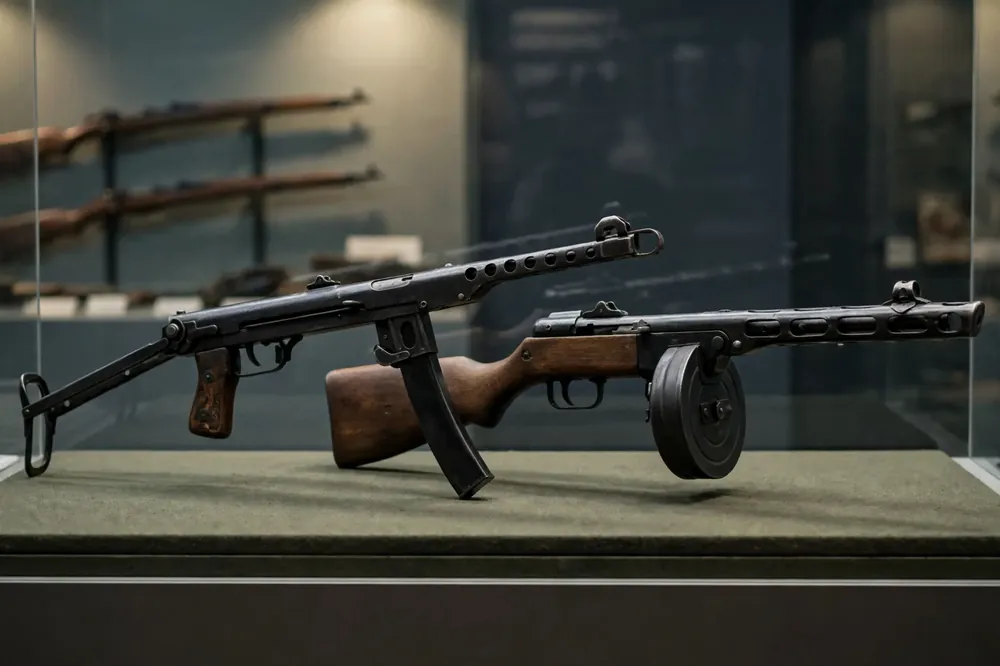
The PPS-42 was the prototype version, built in small numbers in 1942 for trials, and it differed from the PPS-43 in its details: it had no muzzle brake, its folding stock was of a different design, and its production was more complicated. The PPS-43, adopted in May 1943, was the improved version, with a muzzle brake that reduced the climb of the barrel in automatic fire, a simplified folding stock and a receiver that was easier to make, and it was the version that was built in large numbers and that served throughout the war. The two versions are often confused, but the PPS-43 is the weapon that the Red Army used, and it is the weapon that was copied abroad, and the PPS-42 survives only in museums and in the collections of a few specialists. The change from the PPS-42 to the PPS-43 was a small one, but it showed Sudayev’s understanding of the soldier’s needs, and it made the gun easier to make and easier to use.
Licensed Copies: Poland, China and North Korea
The PPS-43 was built under licence in several countries, and its copies served in the armies of the Warsaw Pact and of the communist world for decades. Poland built the PPS-43 as the PPS wz. 1943, and later as the PPS wz. 1952, with a fixed wooden stock in place of the folding stock, and the Polish guns were used by the Polish Army and by the police. China built the PPS-43 as the Type 54, and the Chinese guns were used by the People’s Liberation Army and were supplied to North Vietnam, where they were used in the Vietnam War. North Korea built the PPS-43 as the Type 49, and the North Korean guns were used in the Korean War, where they were captured by American and United Nations forces and brought back as souvenirs. The PPS-43’s copies are a measure of its success: a gun designed in besieged Leningrad was built in Poland, in China and in North Korea, and it served in the armies of half the world.
Post-War Derivatives
The PPS-43’s most interesting derivative was the Vietnamese K-50M, a conversion of the Chinese Type 54 that was built in North Vietnam in the late 1950s and early 1960s. The K-50M had an extended barrel jacket, a pistol grip and a longer wooden fore-end, and it was used by the Viet Cong and the North Vietnamese Army in the Vietnam War, where it was prized for its reliability and its compactness in the jungle. The K-50M was a tribute to the PPS-43’s design: a gun built in the Soviet Union in 1943 was still being adapted and used in Vietnam twenty years later, and it was still effective in the hands of soldiers who needed a compact and reliable weapon. The PPS-43’s derivatives are a reminder that a good design outlives the war for which it was built, and that the simplest weapons are often the ones that last the longest.
6. Operational History
The Eastern Front, 1943–1945
The PPS-43 was issued to the men who needed a compact weapon, and its service on the Eastern Front from 1943 to 1945 was defined by two very different kinds of fighting: the mobile war of the tank crews and scouts, and the close-quarters war of the ruined cities. Its first users were the tank crews, the scouts and the reconnaissance troops of the Red Army: the tank crewman, who fought in the cramped fighting compartment of a T-34, needed a weapon he could carry inside the tank and bring into action quickly if his tank was knocked out, and the PPS-43, with its folding stock, was short enough to be stowed in the tank, light enough to be carried on a long march, and powerful enough to defend the crewman at the ranges at which infantry fought. The scout, who worked behind the German lines and needed a weapon that would not give him away, prized it for its compactness and reliability, and the reconnaissance troops, who fought in small groups and needed a weapon that could lay down a heavy volume of fire, used it as their main weapon. The submachine gun was also the weapon of the city fighting of the Eastern Front, where its compactness and rate of fire made it formidable: in the ruins of Stalingrad, in the streets of Budapest and in the fighting for Berlin, it was the weapon of the assault group, the small team of soldiers who cleared buildings room by room, and who needed a weapon that could be brought to bear quickly in a confined space. The gun’s 35-round magazine was enough for a room, its folding stock let it be carried through a doorway and up a staircase, and its reliability in the dust and rubble of a ruined city was a great advantage — the role in which the submachine gun, as a class of weapon, proved its value in the Second World War.
Tank Crews and Scouts
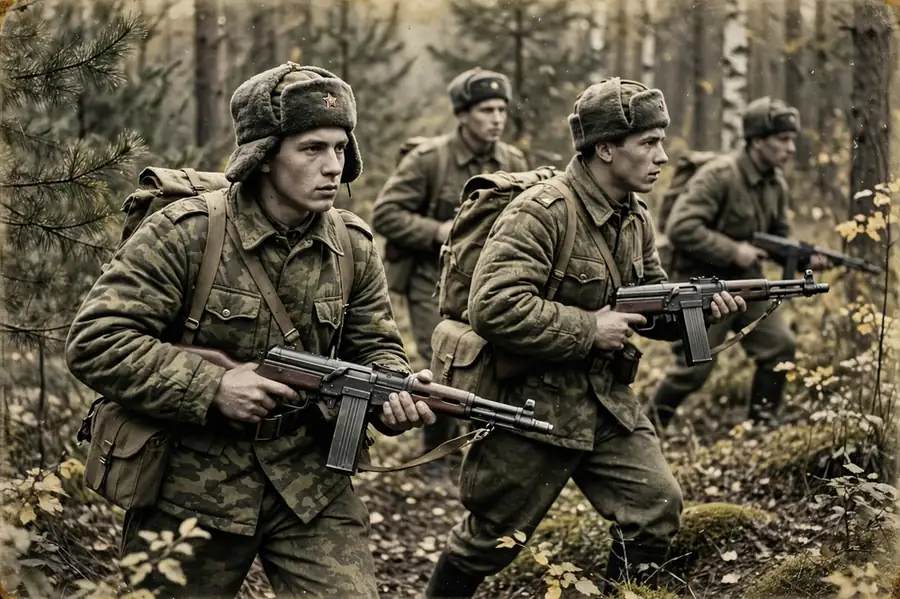
The PPS-43 was issued to the men who needed a compact weapon, and its first users were the tank crews, the scouts and the reconnaissance troops of the Red Army. The tank crewman, who fought in the cramped fighting compartment of a T-34, needed a weapon that he could carry inside the tank and bring into action quickly if his tank was knocked out, and the PPS-43, with its folding stock, was ideal for the role: it was short enough to be stowed in the tank, light enough to be carried on a long march, and powerful enough to defend the crewman at the ranges at which infantry fought. The scout, who worked behind the German lines and needed a weapon that would not give him away, prized the PPS-43 for its compactness and its reliability, and the reconnaissance troops, who fought in small groups and needed a weapon that could lay down a heavy volume of fire, used the PPS-43 as their main weapon. The gun’s service with these specialists was its most important role, and it was the role for which it had been designed.
City Fighting
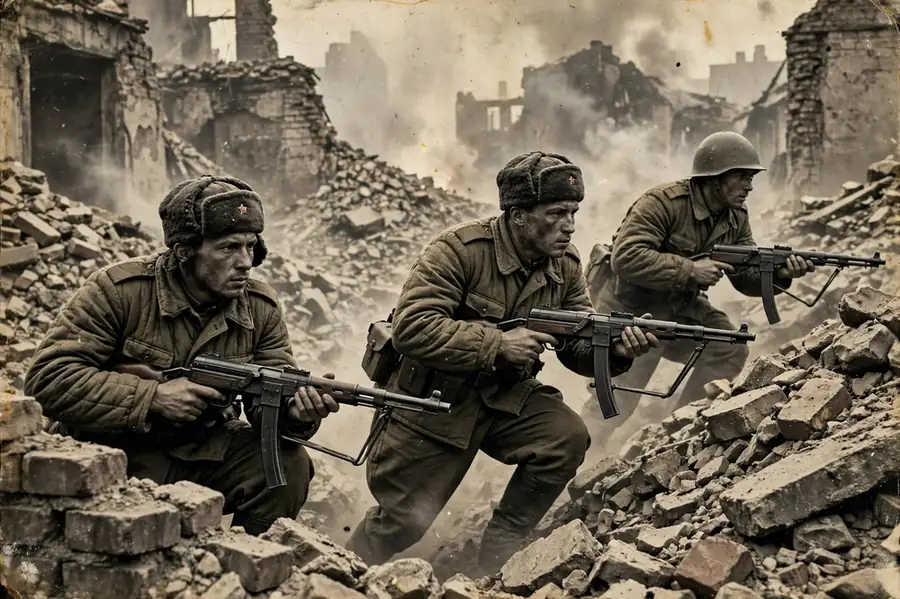
The PPS-43 was also used in the city fighting of the Eastern Front, where its compactness and its rate of fire made it a formidable weapon. In the streets of Budapest and in the fighting for Berlin, the PPS-43 was the weapon of the assault group, the small team of soldiers who cleared buildings room by room, and who needed a weapon that could be brought to bear quickly in a confined space and that could lay down a heavy volume of fire at close range. The gun’s 35-round magazine was enough for a room, and its folding stock let it be carried through a doorway and up a staircase, and its reliability in the dust and the rubble of a ruined city was a great advantage. The PPS-43’s service in the cities of the Eastern Front was one of its most important roles, and it was the role in which the submachine gun, as a class of weapon, proved its value in the Second World War.
The Last Battles: Berlin and Manchuria
In the last battles of the war in Europe, the PPS-43 served with the Soviet forces that fought for Berlin in April and May 1945, and it was used by the tank crews, the scouts and the assault groups who cleared the city street by street and building by building. The gun’s compactness was an advantage in the ruins of Berlin, where the fighting was close and the ranges were short, and its reliability in the dust and the rubble was a great asset. After the war in Europe ended, the PPS-43 served in the Soviet invasion of Manchuria in August 1945, where it was used by the Soviet forces that defeated the Japanese Kwantung Army in a campaign that lasted less than two weeks. The gun’s service in Manchuria was its last combat of the Second World War, and it was a fitting end to its wartime career: a weapon designed in besieged Leningrad had fought from Kursk to Berlin and to Manchuria, and it had served the Red Army in every theatre of the war.
Korea and Vietnam
After the Second World War, the PPS-43 served in the Korean War, where it was used by the North Korean and Chinese forces, and in the Vietnam War, where it was used by the North Vietnamese Army and the Viet Cong, in its original form and in its Chinese and Vietnamese derivatives. In Korea, the PPS-43 was the weapon of the North Korean infantryman, and it was captured by American and United Nations forces and brought back as a souvenir, and it was studied by American ordnance officers who were impressed by its simplicity and its reliability. In Vietnam, the PPS-43 and its derivatives, the Chinese Type 54 and the Vietnamese K-50M, were used by the Viet Cong in the jungle, where their compactness and their reliability were great advantages, and where their 7.62 mm cartridge, which was the same as that of the Soviet pistols and submachine guns, was easy to supply. The PPS-43’s service in Korea and Vietnam was a tribute to its design: a gun built for the Eastern Front in 1943 was still in service in Asia twenty years later, and it was still effective.
7. Performance and Specifications
| Specification | PPS-43 |
|---|---|
| Calibre | 7.62×25 mm Tokarev |
| Weight (unloaded) | 3.04 kg |
| Weight (loaded) | About 3.67 kg |
| Length (stock extended) | 831 mm |
| Length (stock folded) | 615 mm |
| Barrel length | 269 mm |
| Rate of fire | 500–600 rounds per minute |
| Muzzle velocity | About 500 m/s |
| Effective range | About 200 m |
| Feed | 35-round detachable box magazine |
| Operation | Blowback, open bolt; selective fire |
Firing Performance
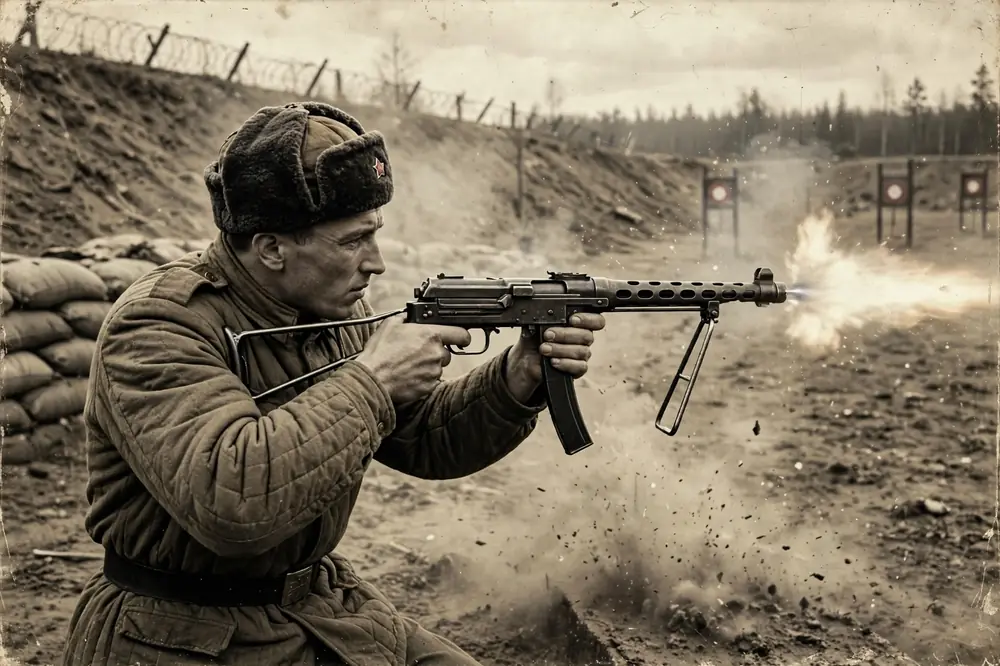
The PPS-43’s firing performance was good for a submachine gun of its generation, and it was well suited to the close fighting for which it was designed. Its rate of fire of 500 to 600 rounds per minute was slower than the PPSh-41’s 900 rounds per minute, and it was easier to control in automatic fire, and a trained soldier could put bursts into a target at 100 metres and hit a man-sized target at 200 metres with aimed fire. The gun’s 7.62×25 mm cartridge, fired at about 500 metres per second, had enough power to kill at 200 metres and to penetrate light cover, and its trajectory was flat enough for accurate fire at the ranges at which submachine guns were used. But the gun’s effective range was only about 200 metres, and beyond that range its bullet lost power and accuracy, and the soldier had to rely on his rifle or his machine gun. The PPS-43 was therefore a close-range weapon, and it was at its best in the hands of the men for whom it was designed, in the tank, in the city and in the forest.
Comparison with the PPSh-41 and the MP40
Compared with the PPSh-41, the PPS-43 was shorter, lighter, cheaper and easier to make, but it had a smaller magazine and a slower rate of fire, and it was less well suited to the ordinary infantryman who needed the PPSh-41’s greater firepower. The PPSh-41, with its 71-round drum magazine and its rate of fire of 900 rounds per minute, could lay down a heavier volume of fire, but it was longer and heavier, and its drum magazine was awkward and unreliable, and the PPS-43’s 35-round box magazine was simpler and more reliable. Compared with the German MP40, the PPS-43 was lighter and cheaper, and it fired a more powerful cartridge, but the MP40 was better made and more accurate, and it was the weapon of the German squad leader and the paratrooper. The PPS-43’s place in history is that of a specialist’s weapon, and it was the best submachine gun for the men who needed a compact and reliable weapon, and it was a tribute to the Soviet arms industry’s ability to make a good weapon from the simplest materials.
8. Operators
The Soviet Union and the Warsaw Pact
The PPS-43 was used by the Soviet Union from 1943 until the 1950s, and it was issued to the tank crews, the paratroopers, the reconnaissance troops and the scouts of the Red Army, and later to the Soviet Army and to the armies of the Warsaw Pact. Poland built the PPS-43 under licence and used it in the Polish Army and in the police, and East Germany, Czechoslovakia, Hungary and Bulgaria used Soviet-supplied PPS-43 submachine guns in their armies and in their police forces. The PPS-43’s service in the Warsaw Pact was a measure of its success: a gun designed in besieged Leningrad was the standard submachine gun of the communist world, and it served in the armies of half of Europe. The gun’s service in the Soviet Union ended in the 1950s, when it was replaced by the AK-47 assault rifle, but it remained in service in the armies of the Warsaw Pact for longer, and it was used by the police and by second-line units into the 1960s.
Other Users
The PPS-43 was used by many other countries, most notably China, North Korea and North Vietnam, which built it under licence or received it as military aid, and which used it in the Korean War and the Vietnam War. The gun was also used by the armies of several African and Middle Eastern countries, which received it as Soviet military aid in the 1950s and 1960s, and by the guerrilla movements of the post-war period, which prized it for its reliability and its compactness. The PPS-43’s worldwide service was a tribute to its design: a gun built for the Eastern Front in 1943 was used in the wars of Asia, Africa and the Middle East for decades, and it was still in service in some countries in the 1980s, forty years after it had been designed. The gun’s users were the soldiers of the communist world and of the guerrilla movements that it supported, and they valued it for the same reasons that the Red Army had valued it: it was simple, it was reliable, and it worked.
9. Legacy and Influence
The Specialist’s Weapon
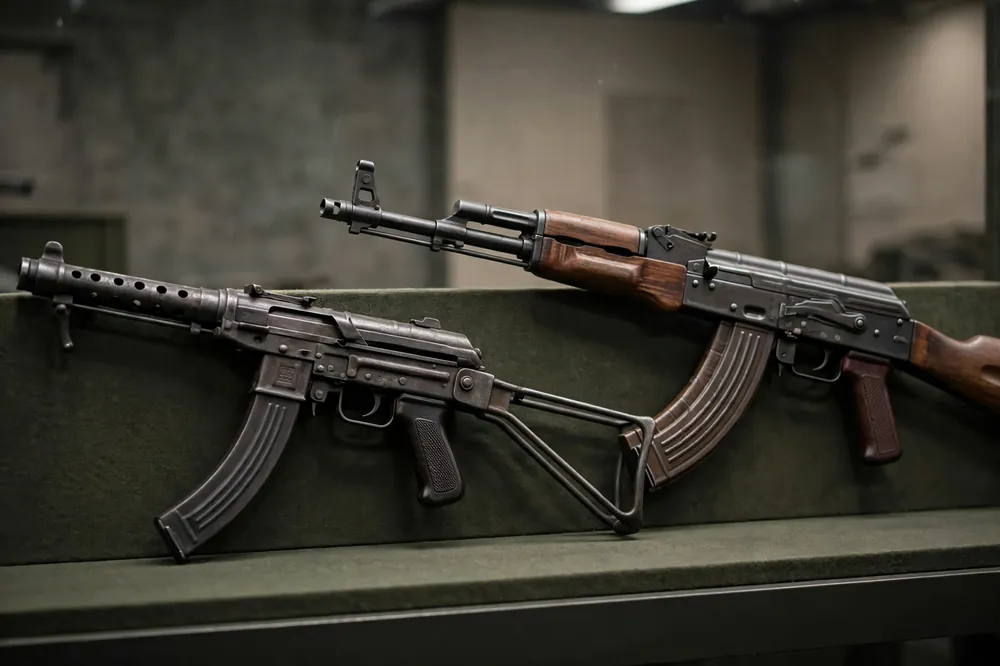
The PPS-43’s legacy is that of the specialist’s weapon, and it is remembered as the submachine gun that was designed for the men who needed a compact and reliable weapon, and that served them well in the worst conditions of the war. The gun’s folding stock, which reduced its length to 615 millimetres, became a standard feature of the submachine guns that followed it, and its stamped-steel construction, which let it be made quickly and cheaply, became the standard method of making submachine guns in the post-war period. The PPS-43’s design influenced the submachine guns of the Soviet Union and of the Warsaw Pact, and its concept — a compact, simple and reliable weapon for the specialist — is still the concept of the modern personal defence weapon. The gun’s legacy is therefore not only its service in the war, but its influence on the design of the weapons that followed it, and on the way that armies think about the weapons of the specialist.
Influence on Post-War Design
The PPS-43 influenced the design of every submachine gun that followed it, and its features — the folding stock, the stamped-steel receiver, the box magazine and the simple blowback action — are now standard on every submachine gun in the world. The gun’s designer, Alexei Sudayev, died young, but his design lived on in the submachine guns of the Soviet Union, of Poland, of China and of Vietnam, and in the personal defence weapons of the modern period, which owe their compactness and their simplicity to the PPS-43. The gun’s most important influence was on the Soviet arms industry, which learned from the PPS-43 that a good weapon could be made from stamped steel, and which applied the lesson to the AKM, the stamped-steel rifle that replaced the milled-receiver AK-47 in 1959. The PPS-43’s legacy is therefore a double one: it was a good weapon in its own right, and it taught the Soviet arms industry how to make weapons quickly, cheaply and in enormous numbers, and that lesson shaped the weapons of the Cold War.
10. Surviving Examples
Museums and Collections
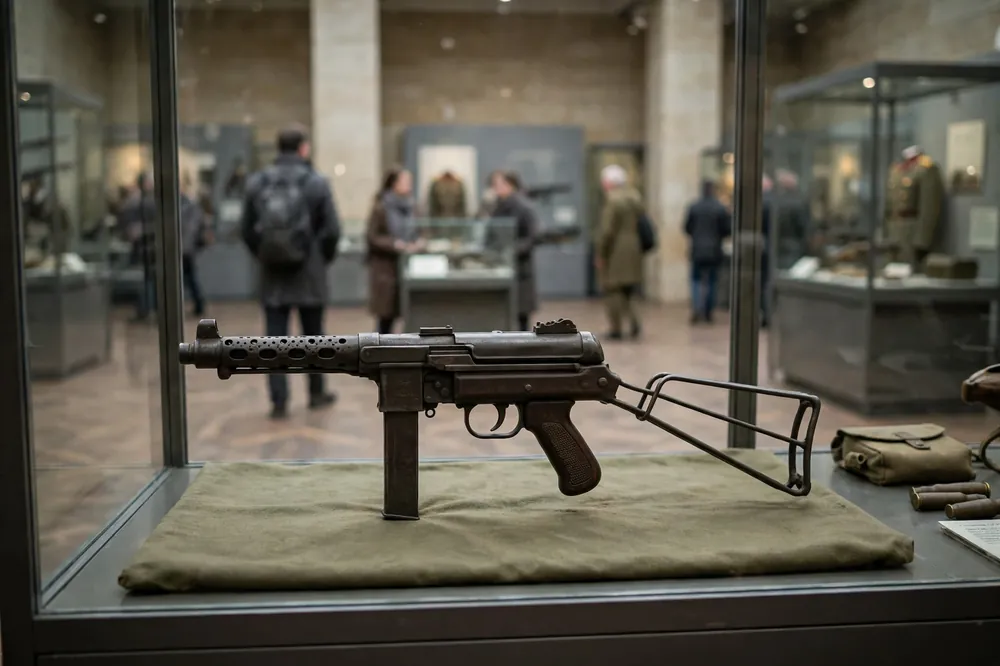
PPS-43 submachine guns survive in large numbers in museums and in private collections around the world, because about 2 million were built and many were captured and preserved. The Central Armed Forces Museum in Moscow holds PPS-43 submachine guns in its collection, as do the Museum of the Great Patriotic War in Moscow, the Bundeswehr Military History Museum in Dresden, the Imperial War Museum in London and the National WWII Museum in New Orleans, which holds examples captured in Korea and Vietnam. The Museum of the Defence of Leningrad holds PPS-43 submachine guns that were built in the city during the siege, and they are displayed as a tribute to the workers and the designers who made them under the worst conditions of the war. For the visitor, the PPS-43 is one of the most accessible Soviet small arms of the Second World War, and it is displayed in almost every military museum that covers the Eastern Front.
Replicas and the Collector Market
The PPS-43 is a popular weapon with collectors, and original submachine guns in good condition are sought after on the collector market, with prices that reflect their rarity and their historical importance, and with guns that were captured in Korea and Vietnam commanding the highest prices of all. Deactivated PPS-43 submachine guns are legally owned by collectors in several European countries, and they are displayed in private collections and in museums, and they are used in re-enactments and in films about the Second World War, the Korean War and the Vietnam War, where the gun’s distinctive appearance — its folding stock, its perforated barrel jacket and its long box magazine — makes it instantly recognisable. Replicas of the PPS-43, built to fire blank cartridges, are used in films and in re-enactments, and the gun’s survival in museums and in private hands ensures that its story will continue to be told, and that the weapon designed in besieged Leningrad will not be forgotten.
Frequently Asked Questions
What is the PPS-43?
The PPS-43 was the Soviet Union’s compact submachine gun of the Second World War, designed by Alexei Sudayev and adopted in 1943. It fired the 7.62×25 mm Tokarev cartridge from a 35-round box magazine and was issued to tank crews, paratroopers and scouts.
How many PPS-43s were built?
About 2 million PPS-43 submachine guns were built in the Soviet Union between 1943 and 1946, and large numbers were also built under licence in Poland, China and North Korea.
What is the difference between the PPS-43 and the PPSh-41?
The PPS-43 was shorter, lighter and cheaper than the PPSh-41, with a folding stock and a 35-round box magazine, while the PPSh-41 was longer and heavier, with a 71-round drum magazine and a rate of fire of 900 rounds per minute.
Who designed the PPS-43?
The PPS-43 was designed by Alexei Sudayev, a young Soviet engineer who designed it in Leningrad during the siege of the city. Sudayev died in 1946, at the age of thirty-three, of an illness contracted during the siege.
What calibre was the PPS-43?
The PPS-43 fired the 7.62×25 mm Tokarev pistol cartridge, the same cartridge used by the PPSh-41 submachine gun and the TT-33 pistol.
Where can I see a PPS-43 today?
PPS-43 submachine guns are displayed in the Central Armed Forces Museum in Moscow, the Museum of the Great Patriotic War in Moscow, the Imperial War Museum in London and the National WWII Museum in New Orleans, among other museums.
Sources
- Wikipedia, “PPS submachine gun” — Sudayev’s design in Leningrad, production of about 2 million, service history.
- Chris McNab, Soviet Submachine Guns of World War II (Osprey Publishing, 2014) — the PPS-43’s design and its service with tank crews and scouts.
- Gordon L. Rottman, The PPSh-41 and PPS-43 Submachine Guns (Osprey Publishing, 2011) — the competition of 1942 and the PPS-43’s adoption.
- Ian V. Hogg, Military Small Arms of the 20th Century (Krause Publications, 2000) — the PPS-43’s specifications and its licensed copies.
- David M. Glantz, Colossus Reborn (University Press of Kansas, 2005) — the Red Army’s use of submachine guns on the Eastern Front.
- John Walter, Guns of the Third Reich and Soviet Small Arms (Greenhill Books, 2004) — the PPS-43’s post-war service in Korea and Vietnam.