 WAR ATLAS MILITARY HISTORY MAGAZINE · WWI — WWII
Universal Carrier: Britain’s Versatile Tracked Workhorse of the Second World War
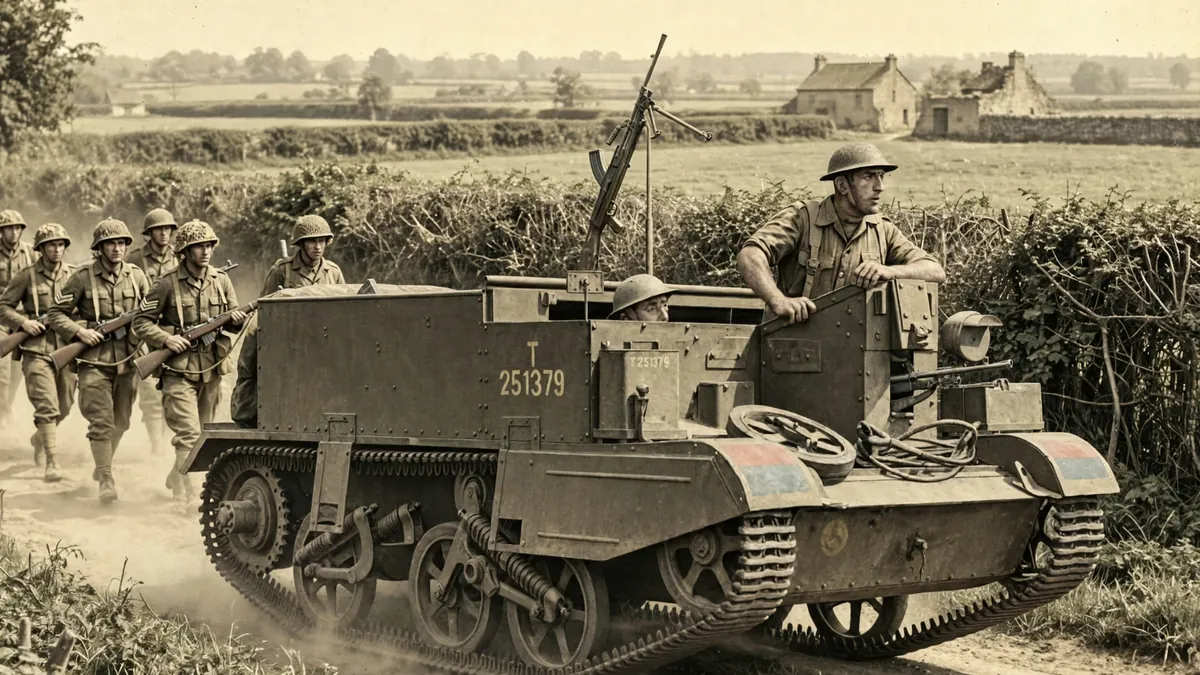
The Universal Carrier, often known simply as the Bren carrier, was one of the most numerous and versatile armoured vehicles of the Second World War. A small, open-topped, fully tracked vehicle, it was designed to transport infantry, weapons and supplies across the battlefield, and it was adapted for more roles than any other British vehicle of the war: as a machine-gun carrier, a mortar carrier, a flamethrower, an anti-tank gun tractor, a reconnaissance vehicle and an ambulance. Approximately 113,000 Universal Carriers were built between 1940 and 1945, in Britain, Canada, Australia, New Zealand and the United States, making it one of the most widely produced armoured fighting vehicles in history. It served in every theatre of the war, from the deserts of North Africa to the jungles of Burma and the streets of Berlin, and it remained in service with many armies into the 1960s.
The Universal Carrier was the final development of a family of small tracked carriers that the British Army had been developing since the 1920s, when the Carden-Loyd tankette showed that a small, cheap, tracked vehicle could be useful for reconnaissance and for transporting weapons. The Universal Carrier, introduced in 1940, combined the best features of its predecessors into a single, standardised design that could be adapted for many roles. It was powered by a Ford V8 petrol engine, it carried a crew of three to five men, and it could reach a top speed of about 30 miles per hour. Its armour was thin, only up to 10 mm, but it was enough to protect the crew against small-arms fire and shell splinters, and its small size and low silhouette made it difficult to spot.
The Universal Carrier is remembered as a symbol of British wartime improvisation and of the value of a simple, versatile vehicle. It was not a glamorous weapon, and it rarely appears in histories of tank battles, but it was indispensable to the British and Commonwealth armies, and its service in every theatre of the war earned it a place in the history of armoured warfare. Surviving examples stand in museums around the world, and the Universal Carrier’s distinctive shape, with its open top and its small, boxy hull, remains one of the most recognisable images of the British Army in the Second World War.
1. Key Facts
| Field | Value |
|---|---|
| Type | Tracked armoured personnel and weapons carrier |
| Origin | United Kingdom |
| Designed | 1939-1940 (Vickers-Armstrongs, based on Carden-Loyd) |
| In service | 1940-1960s (British Army; later with many other users) |
| Produced | Approximately 113,000 (all variants, all countries) |
| Manufacturers | Vickers-Armstrongs, Ford, and others in Britain; Ford Canada; Australian and New Zealand plants |
| Crew | 3-5 (depending on role) |
| Weight | Approximately 3.5-4 tons |
| Length | Approximately 3.65 m (12 ft) |
| Width | Approximately 2.06 m (6 ft 9 in) |
| Height | Approximately 1.57 m (5 ft 2 in) |
| Armour | Up to 10 mm (hull front); 7 mm on sides |
| Main armament | Bren light machine gun (typical); also Boys anti-tank rifle, 2-inch or 3-inch mortar, PIAT, flamethrower |
| Secondary armament | Varies by role |
| Engine | Ford V8 petrol engine, approximately 85 hp |
| Speed | Approximately 30 mph (48 km/h) maximum on roads |
| Range | Approximately 150 miles (241 km) on roads |
| Notable variants | Bren Carrier, Scout Carrier, Mortar Carrier, Wasp flamethrower, 3-inch Mortar Carrier, Loyd Carrier |
2. Background and Development
The Carden-Loyd Tankette
The origins of the Universal Carrier lay in the Carden-Loyd tankette, a small, two-man tracked vehicle developed in Britain in the 1920s by the engineers John Carden and Vivian Loyd. The Carden-Loyd was a cheap, simple vehicle that could be used for reconnaissance and for transporting a machine gun, and it was exported to many countries, including the Soviet Union, Japan and Poland, where it influenced the design of their own light tanks. The British Army adopted the Carden-Loyd as the basis for a family of carriers, and in the 1930s it developed the Bren Carrier, the Scout Carrier and the Cavalry Carrier, each designed for a specific role. The Universal Carrier, introduced in 1940, was the final development of this family, combining the best features of its predecessors into a single, standardised design.
Vickers-Armstrongs and the Universal Design
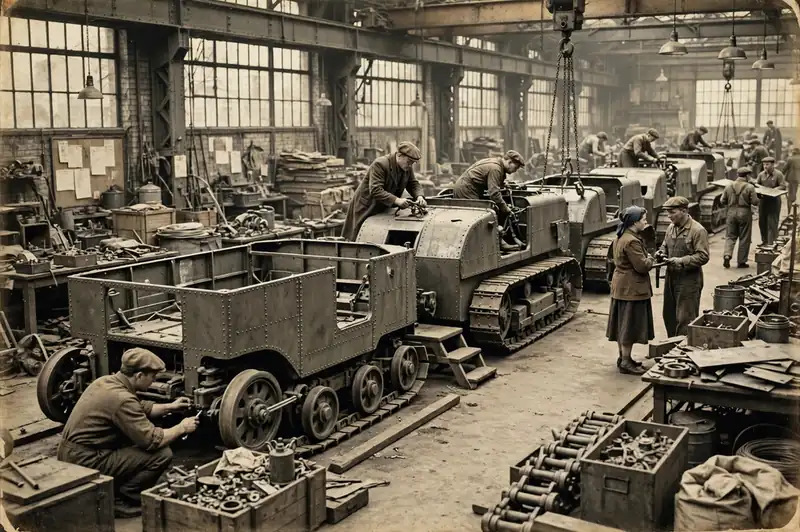
The Universal Carrier was developed by Vickers-Armstrongs, under the direction of the War Office, which wanted a single carrier that could be adapted for many roles. The design used a Ford V8 petrol engine, which was widely available and easy to maintain, and a simple, open-topped hull that could be fitted with different weapons and equipment. The first Universal Carriers were delivered in 1940, and production was soon expanded to Canada, Australia, New Zealand and the United States, where Ford and other firms built the vehicle under licence. The Universal Carrier’s production run of about 113,000 vehicles was one of the largest of any armoured vehicle of the war, and it reflected the importance that the British and Commonwealth armies attached to the carrier concept.
A Vehicle for Every Role
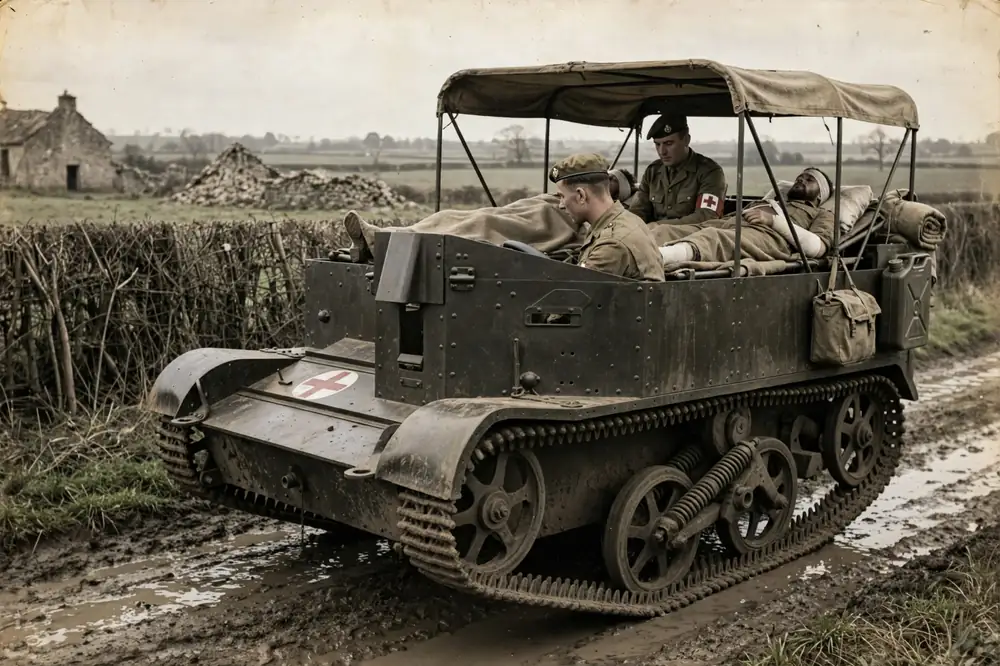
The Universal Carrier was designed to be adaptable, and its open-topped hull could be fitted with a Bren light machine gun, a Boys anti-tank rifle, a 2-inch or 3-inch mortar, a PIAT anti-tank weapon, a flamethrower, or a radio set. The carrier could also be used as a tractor for a 6-pounder anti-tank gun, as an ambulance, or as a supply vehicle. The Universal Carrier’s adaptability was its greatest strength, and it meant that a single vehicle could perform many different tasks on the battlefield. The British Army’s infantry battalions each had a carrier platoon, equipped with Universal Carriers, and the carriers were used for reconnaissance, for transporting weapons, and for supporting infantry in attack. The Universal Carrier was thus a vehicle for every role, and its versatility was a key factor in its success.
3. Design
Hull, Tracks and Mobility
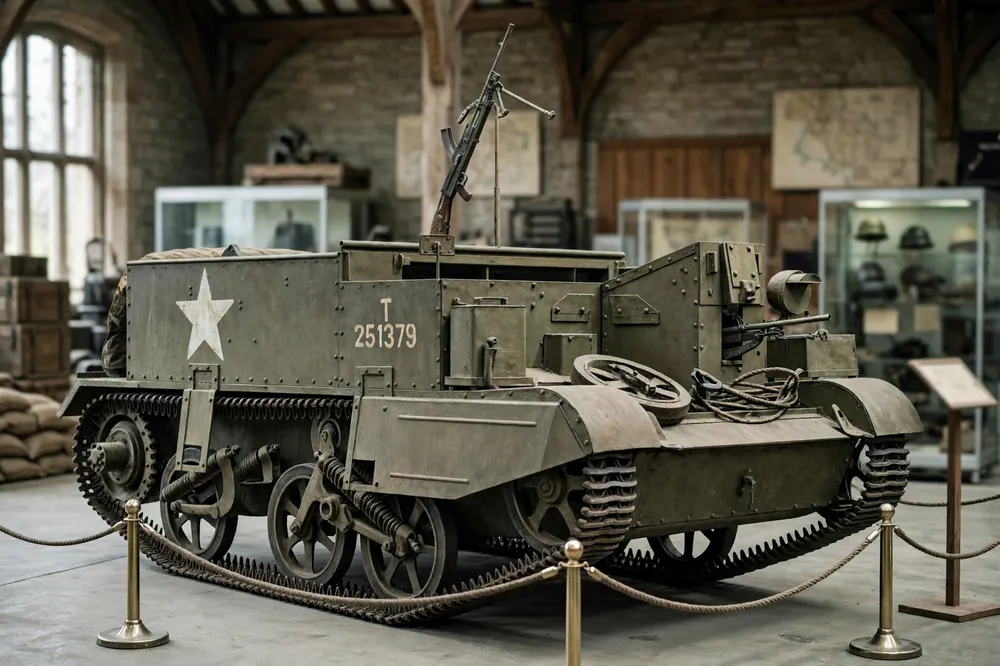
The Universal Carrier’s hull was a small, open-topped, boxy structure, about 3.65 metres long and 2.06 metres wide, with armour up to 10 mm thick on the front and 7 mm on the sides. The hull was mounted on a tracked chassis, with four road wheels on each side and a Ford V8 engine in the rear. The carrier weighed about 3.5 to 4 tons, depending on its role, and its Ford engine produced about 85 horsepower, giving a top speed of about 30 miles per hour on roads. The carrier’s suspension was simple and robust, and its ground pressure was low, which helped it in soft ground. The Universal Carrier’s mobility was good for a vehicle of its size, and it could cross trenches and climb obstacles that would have stopped a wheeled vehicle. The carrier’s small size and low silhouette made it difficult to spot, and its open top gave the crew good visibility.
Armour and Protection
The Universal Carrier’s armour was thin: the hull front was protected by up to 10 mm of armour, and the sides by 7 mm. The armour was enough to protect the crew against small-arms fire and shell splinters, but not against anti-tank guns or heavy machine guns. The carrier’s open top left the crew exposed to shell fragments and to air attack, and its small size meant that it could not carry heavy weapons. The Universal Carrier was not designed to fight other armoured vehicles, and its armour was intended only to protect the crew while they transported weapons and supplies. The carrier’s crews valued its mobility and its versatility, but they were aware of its vulnerability, and they used it carefully, avoiding direct combat with enemy tanks and anti-tank guns.
Engine, Crew and Ergonomics
The Universal Carrier was powered by a Ford V8 petrol engine, which was widely available and easy to maintain, and which gave the carrier a good range and a top speed of about 30 miles per hour. The carrier carried a crew of three to five men, depending on its role: a driver, a commander and one to three gunners or weapon crew. The driver’s position was in the front of the hull, and the other crew members worked in the open-topped fighting compartment. The carrier’s interior was cramped, and the crew’s working conditions were poor, but the carrier’s simplicity and reliability were valued. The Universal Carrier’s communications were by wireless in the command and reconnaissance versions, and by hand signals in the other versions. The carrier’s main weakness, apart from its thin armour, was its petrol engine, which was a fire risk, and its open top, which exposed the crew to the weather and to enemy fire.
4. Variants
Bren Carrier and Scout Carrier
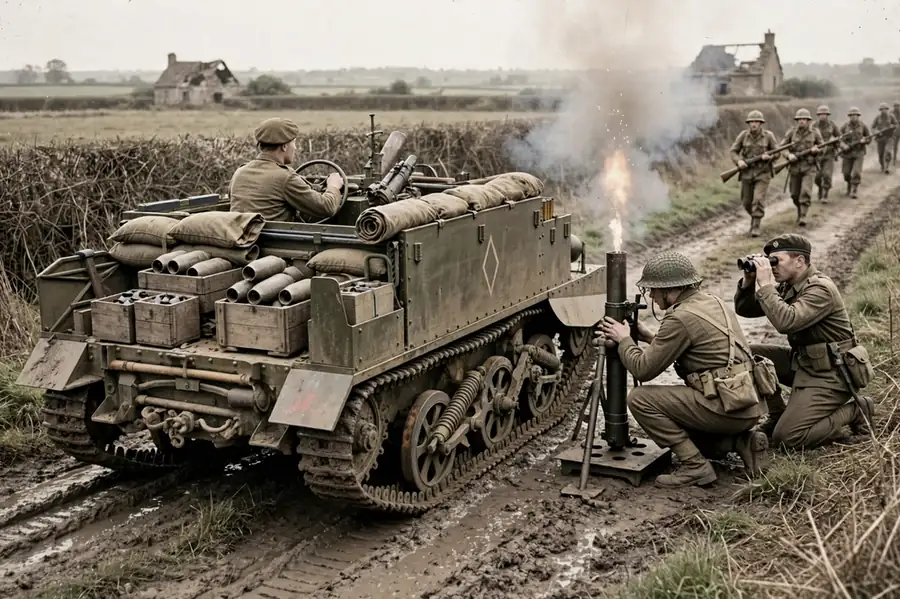
The most common variant of the Universal Carrier was the Bren Carrier, which carried a Bren light machine gun and was used to support infantry in attack. The Scout Carrier was a reconnaissance variant, with a crew of three and a radio set, which was used by the reconnaissance regiments of the armoured divisions. The Mortar Carrier was fitted with a 3-inch mortar, which could be fired from the carrier or dismounted and used on the ground. The Wasp was a flamethrower variant, with a flame projector replacing the Bren gun and a fuel tank in the rear. The 2-pounder Carrier was an anti-tank variant, fitted with a 2-pounder gun, although it was not widely used. Each variant reflected the Universal Carrier’s adaptability, and the large number of variants shows how the British Army used a single vehicle for many different roles.
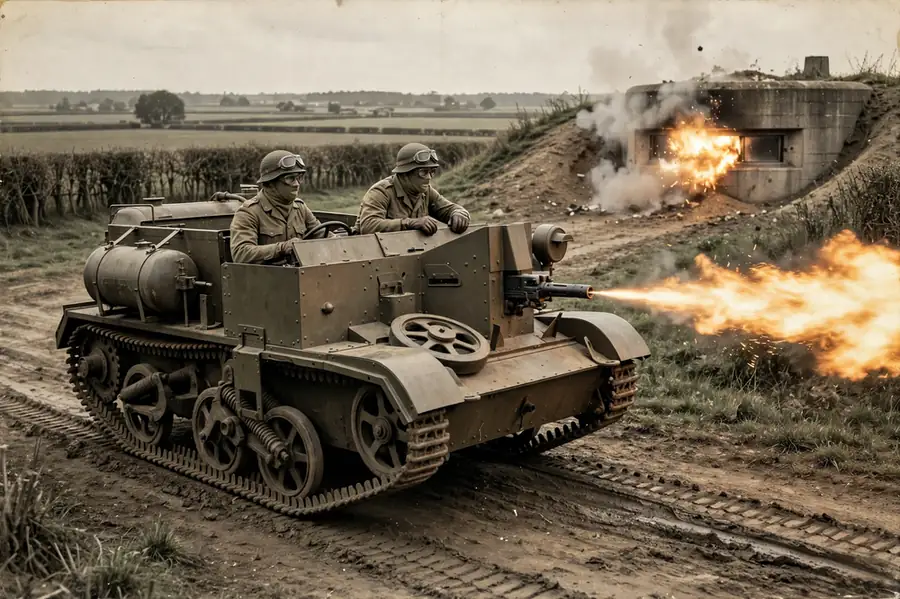
Wasp Flamethrower and Mortar Carrier
The Wasp flamethrower was one of the most effective variants of the Universal Carrier. It carried a flame projector with a range of about 70 metres, and it was used to clear bunkers and fortified positions in Normandy and in the Rhine crossing. The Wasp’s flame was feared by German defenders, who often surrendered rather than face it. The 3-inch Mortar Carrier was another important variant: it carried a 3-inch mortar and its crew, and it could provide immediate fire support for infantry in attack. The Mortar Carrier was used in every theatre of the war, and its 3-inch mortar was a valuable weapon for the infantry battalions. The Wasp and the Mortar Carrier show how the Universal Carrier’s hull could be adapted for specialised roles, and how the vehicle’s versatility made it valuable in many different situations.
The Loyd Carrier and Other Derivatives
The Universal Carrier was also the basis for the Loyd Carrier, a larger, unarmoured tracked vehicle that was used as a tractor for artillery and as a supply vehicle. The Loyd Carrier was built in large numbers, and it served in the British Army and in the armies of the Commonwealth. The Universal Carrier’s chassis was also used for the Windsor Carrier, a Canadian variant with a longer hull and a more powerful engine, and for the T-16, an American-built version. The Universal Carrier’s family thus included many different vehicles, all based on the same basic design, and all sharing the same virtues of simplicity, reliability and versatility.
5. Operational History
France and the Western Desert
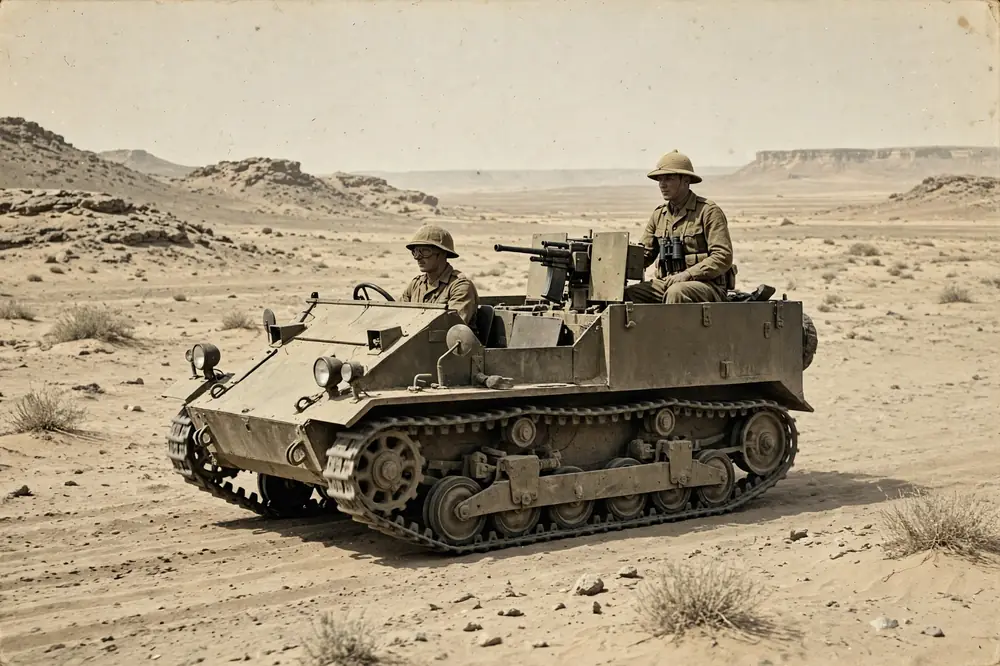
The Universal Carrier’s combat debut came in France in May 1940, when Bren Carriers of the British Expeditionary Force supported infantry in the fighting around Arras and Dunkirk. The carriers performed well, although many were lost in the retreat to Dunkirk. In North Africa, the Universal Carrier served in the Western Desert, where it was used by the 7th Armoured Division and other units for reconnaissance, for transporting weapons, and for supporting infantry in attack. The carrier’s mobility in the desert was good, and its Ford engine gave it a good range. The Universal Carrier’s service in the desert was its first major campaign, and it established the vehicle’s reputation as a reliable and versatile workhorse.
Normandy and North-West Europe
In Normandy, the Universal Carrier served in every British and Commonwealth infantry division, where its carrier platoons supported infantry in the fighting around Caen and in the breakout from Normandy. The Wasp flamethrower variant was used to clear bunkers and fortified positions, and the Mortar Carrier provided fire support for infantry in attack. The Universal Carrier also served in the advance into Germany and in the crossing of the Rhine in March 1945, where its mobility and its versatility were valued. The carrier’s service in North-West Europe was its longest and most important, and it fought in every major battle from D-Day to the end of the war.
Burma, the Pacific and the Far East
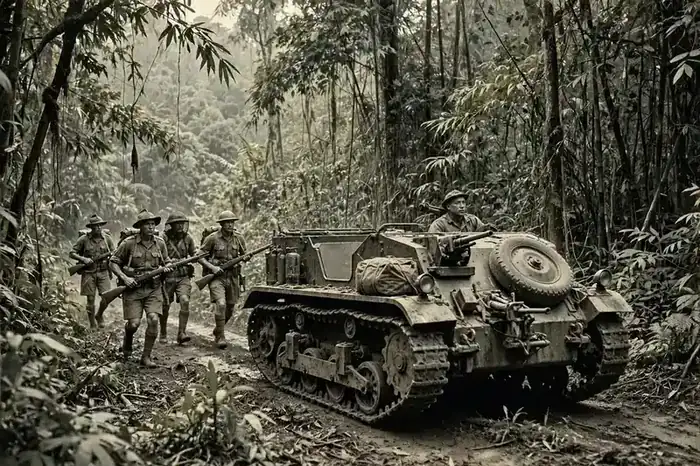
In the Far East, the Universal Carrier served in Burma, where it was used by the British and Indian Armies in the jungle fighting of 1943 to 1945. The carrier’s small size and its ability to operate in difficult terrain made it valuable in the jungle, and its Bren gun and its mortar were effective against Japanese infantry. The Universal Carrier also served in the Pacific, where Australian forces used it in New Guinea and Borneo. The carrier’s service in the Far East shows how a vehicle designed for Europe could be adapted for a very different theatre, and how its versatility made it valuable in many different situations.
The Carrier Platoon in Action
The Universal Carrier’s basic unit was the carrier platoon, which was part of every British infantry battalion. The platoon had 13 Universal Carriers, organised in three sections, and it was used for reconnaissance, for transporting weapons, and for supporting infantry in attack. The carrier platoon’s tactics were developed in the fighting of 1940 to 1945, and they became a standard part of British infantry doctrine. The carrier platoon’s service in every theatre of the war shows how important the Universal Carrier was to the British Army, and how the vehicle’s versatility made it an indispensable part of the infantry battalion.
6. Performance and Specifications
Strengths on the Battlefield
The Universal Carrier’s greatest strength was its versatility. It could be adapted for many different roles, from a machine-gun carrier to a flamethrower, and it could transport infantry, weapons and supplies across the battlefield. Its mobility was good, and its small size and low silhouette made it difficult to spot. Its Ford engine was reliable and easy to maintain, and its production was efficient, which meant that it was available in large numbers. The Universal Carrier’s simplicity was also a strength: it was easy to operate, easy to repair, and easy to adapt for new roles. In the infantry support role, the Universal Carrier was a highly effective vehicle, and its performance in every theatre of the war showed that a simple, versatile vehicle could be more valuable than a complex, specialised one.
Weaknesses and Trade-offs
The weaknesses were clear. The Universal Carrier’s armour was thin, and its open top left the crew exposed to shell fragments and to air attack. Its petrol engine was a fire risk, and its small size meant that it could not carry heavy weapons. The Universal Carrier was not designed to fight other armoured vehicles, and it was vulnerable to enemy tanks and anti-tank guns. The carrier’s crews were aware of its vulnerability, and they used it carefully, avoiding direct combat with enemy armour. The Universal Carrier’s performance must be judged against its intended role: transporting infantry and weapons, and supporting infantry in attack, where it was among the best vehicles of the war.
How the Universal Carrier Compared with Rivals
Compared with the German Sd.Kfz. 250 half-track, the Universal Carrier was smaller, lighter and more mobile, but it had thinner armour and a smaller crew. Compared with the American M3 half-track, the Universal Carrier was smaller and more manoeuvrable, but it carried fewer men and had less armour. Compared with the Soviet BA-64 armoured car, the Universal Carrier was more versatile and could carry more weapons, but it was slower on roads. The Universal Carrier’s combination of versatility, mobility and simplicity made it one of the most effective carriers of the war, and it was the only vehicle of its type to be built in such large numbers and to serve in so many different roles.
7. Operators
Britain and the Commonwealth
The principal operator of the Universal Carrier was the British Army, which used it in every infantry battalion and in the reconnaissance regiments of the armoured divisions. The carrier was also used by the Canadian, Australian, New Zealand, Indian and South African Armies, which built the vehicle under licence and used it in every theatre of the war. The Universal Carrier’s operators valued its versatility and its reliability, and the carrier’s service in the Commonwealth armies was a significant part of its history. The Universal Carrier was the standard carrier of the British and Commonwealth armies, and it remained in service with them into the 1960s.
Other Users and Post-War Service
The Universal Carrier was also used by the United States Army, which built a version under licence, and by the Soviet Union, which received carriers under lend-lease. After the war, the Universal Carrier remained in service with many armies, including the British, Canadian, Australian, Indian and Pakistani Armies, and it was used in the Korean War, the Malayan Emergency, and the Arab-Israeli wars. The Universal Carrier’s post-war service shows how long the design remained in use, and how widely it was distributed among the armies of the world. The Universal Carrier was finally withdrawn from service in the 1960s, when it was replaced by more modern armoured personnel carriers.
8. Legacy and Influence
The Ancestor of the Armoured Personnel Carrier
The Universal Carrier’s legacy is that of the ancestor of the modern armoured personnel carrier. It showed that a small, tracked, armoured vehicle could transport infantry and weapons across the battlefield, and that such a vehicle could be adapted for many different roles. The Universal Carrier’s concept, a versatile, tracked carrier, influenced the design of post-war armoured personnel carriers, including the British FV432 and the American M113, which became the standard carriers of the Cold War. The Universal Carrier’s legacy is thus not only its own combat record, but the family of armoured personnel carriers that it founded.
Cultural Memory and Historical Assessment
The Universal Carrier is one of the most famous British vehicles of the war, and its nickname “Bren carrier” has ensured its place in popular memory. Historians have assessed the Universal Carrier as a sound and effective design, well suited to its role, and as one of the most important vehicles of the war. The Universal Carrier’s reputation has been enhanced by its appearance in films, books and video games, where its small size and its open top make it instantly recognisable. In the end, the Carrier stands as an example of how a plain, adaptable design, produced in great numbers, could matter more than sophistication.
The Universal Carrier in Popular Culture
The Universal Carrier appears in many films, books and video games about the Second World War, and it is a popular subject for military historians and enthusiasts. Its distinctive shape, with its open top and its small, boxy hull, makes it instantly recognisable, and it is often used as a symbol of the British Army in the war. The Universal Carrier’s appearance in popular culture has ensured that it will be remembered long after the last surviving example has gone, and it is a reminder of the fascination that simple, practical vehicles hold for the public.
9. Surviving Examples
Museums in Britain and the Commonwealth
A large number of Universal Carriers survive in museums and private collections around the world, reflecting the type’s huge production run. The Tank Museum at Bovington in Dorset holds several examples, including a Bren Carrier and a Wasp flamethrower, which are among the most popular exhibits in the museum. The Imperial War Museum at Duxford also holds a Universal Carrier, and the Australian War Memorial in Canberra has examples. In Canada, the Canadian War Museum in Ottawa displays a Universal Carrier, and the Royal Canadian Armoured Corps School at CFB Borden holds examples. The large number of surviving Universal Carriers ensures that the vehicle remains visible to the public.
Survivors Abroad and Running Examples
Other surviving Universal Carriers include examples in the Kubinka Tank Museum in Russia, the Musee des Blindes at Saumur in France, and the National Armor and Cavalry Museum at Fort Benning in the United States. Many Universal Carriers are maintained in running condition by museums and private collectors, and they appear at military vehicle shows and commemorative events. The running examples are particularly valuable, because they demonstrate the Universal Carrier’s mobility and its distinctive engine note, which no photograph can convey, and which helps visitors understand why the carrier’s crews described it as a versatile and reliable workhorse.
Frequently Asked Questions
Was the Universal Carrier the same as the Bren carrier?
The Bren carrier was a variant of the Universal Carrier, fitted with a Bren light machine gun. The name “Bren carrier” was often used for all Universal Carriers, because the Bren gun version was the most common, but the Universal Carrier was the standard design, and the Bren Carrier was one of its many variants.
How many Universal Carriers were built?
Approximately 113,000 Universal Carriers were built between 1940 and 1945, in Britain, Canada, Australia, New Zealand and the United States. This was one of the largest production runs of any armoured vehicle of the war, and it reflected the importance of the carrier to the British and Commonwealth armies.
What was the Universal Carrier used for?
The Universal Carrier was used for many roles: as a machine-gun carrier, a mortar carrier, a flamethrower, an anti-tank gun tractor, a reconnaissance vehicle, an ambulance and a supply vehicle. Its adaptability was its greatest strength, and it meant that a single vehicle could perform many different tasks on the battlefield.
Did the Universal Carrier fight in Normandy?
Yes. The Universal Carrier served in every British and Commonwealth infantry division in Normandy, where its carrier platoons supported infantry in the fighting around Caen and in the breakout from Normandy. The Wasp flamethrower variant was used to clear bunkers, and the Mortar Carrier provided fire support.
How long did the Universal Carrier remain in service?
The Universal Carrier remained in British service into the 1960s, and in the service of other armies even longer. It was used in the Korean War, the Malayan Emergency and the Arab-Israeli wars, and it was finally withdrawn when it was replaced by more modern armoured personnel carriers.
Was the Universal Carrier a tank?
No. The Universal Carrier was a tracked armoured carrier, not a tank. It was designed to transport infantry and weapons, not to fight other tanks. Its armour was thin, its gun was a light machine gun, and its role was to support infantry, not to engage in tank combat.
Sources
- David Fletcher, Universal Carrier 1936-48 (Osprey Publishing, New Vanguard series).
- Peter Chamberlain and Chris Ellis, British and American Tanks of World War II (Arms and Armour Press).
- The Tank Museum, Bovington, Universal Carrier collection records and vehicle guides.
- Australian War Memorial, Universal Carrier collection records.
- Canadian War Museum, Universal Carrier exhibit records.
- Nigel Watson, Universal Carriers (model and history references).